Climate Extremists Target, Attack Large-Scale Power Grid Infrastructure In Germany
By P Gosselin | No Tricks Zone | September 6, 2026
There’s been a series of coordinated sabotage incidents targeting the German power grid infrastructure over recent weeks and months. The media initially reacted by pointing the finger at Russian involvement, but the evidence is pointing to another source.
“Climate extremism”
The hard evidence indicates no Russian involvement. Federal Interior Minister Alexander Dobrindt characterizes the new attacks as acts of “climate extremism,” citing confessory letters sent by a 48-year-old suspect claiming responsibility to protest fossil fuel use.
Attack 1. Turnow-Preilack substation / Jänschwalde (Brandenburg)
On Tuesday morning, September 1, high-voltage lines connected to the Turnow-Preilack substation—servicing the Jänschwalde (Brandenburg) power station region—were targeted using homemade launch devices. Authorities reported that the launch mechanisms used fireworks-style devices to shoot conductive wires into overhead power lines.
Attack 2. Bergheim substation (North Rhine-Westphalia)
Also on Tuesday evening, an attack occurred at a substation in Bergheim, near Cologne. Conductive materials were launched onto high-voltage lines, triggering a short circuit that forced five power generation units to shut down. Investigators recovered several launch devices and pyrotechnics near the scene. A 48-year-old suspect has explicitly claimed responsibility for this site in confession letters sent to authorities and news outlets. German security agencies highlighted key structural parallels between this device setup and the Turnow-Preilack substation incident, leading state security forces to probe links between the two.
Attack 3. Dormagen substation (North Rhine-Westphalia)
In another incident occurring last Thursday evening, a passerby alerted police after spotting suspicious device components aimed at a substation in Dormagen, south of Düsseldorf. Responding officers discovered pipes fitted with cables, timers, and launch mechanisms targeted directly at the high-voltage equipment. The attempt was thwarted before the mechanisms detonated or caused an outage.
During a joint briefing, Interior Minister Dobrindt and North Rhine Westphalia Interior Minister Herbert Reul confirmed that a manhunt was underway for the suspect following the discovery of suspected explosive materials at his residence and the seizure of his truck near the Hambacher Forst.
Major Berlin attack last January
On January, 2026, a major arson attack targeted the electricity infrastructure in southwest Berlin, resulting in one of the city’s longest and most severe power outages in decades. The fire destroyed five 110-kV high-voltage lines and ten 10-kV medium-voltage lines supplying several key substations across the region.
The sabotage cut off power and heating to roughly 45,000 to 50,000 households and over 2,000 businesses in the region. The loss of electrical heating created a major mid-winter public safety emergency. Hospitals and care homes were forced to switch to emergency generators and schools were closed for days while repair crews worked in frozen soil to rebuild the severed lines. Full power was not restored until January 7.
A confession letter posted on the far left-wing platform Indymedia claimed responsibility on behalf of theAntifa-friendly Vulkangruppe (Volcano Group). The letter framed the sabotage as a protest against fossil fuel consumption, corporate power use, and AI data centers. Berlin Mayor and Federal prosecutors designated the event as an act of political terrorism.
Police have little success
The ecoterrorist groups are difficult, to monitor, according to authorities. They operate via small, autonomous, clandestine cell structures without centralized leadership. They publish post-attack manifestos anonymously online, leaving little to no digital footprint prior to an incident. While German federal and state governments are treating the threat with urgency, critics say authorities are not taking the left-wing threat seriously enough.
In response to the January blackout in Berlin and prior high-profile grid sabotage, around 500 police officers raided 17 to 19 locations across Berlin, Hamburg, Brandenburg, and North Rhine-Westphalia. Sites searched included radical meeting spaces, such as the Kalabal!k anarchist library in Berlin, as well as residences linked to key suspects aged 28 to 36.
No arrests
Police seized dozens of laptops, phones, encrypted storage drives, and timers. However, no arrests were made during or immediately after the operation because prosecutors lacked sufficient direct, physical proof linking specific individuals to the active crime scenes.
Double standard
Federal prosecutors claim they need concrete evidence that a suspect was physically at the site or directly participated in constructing the device—mere association with radical spaces or possession of extremist literature is insufficient under German law – a standard that is rarely applied, however, when it comes to rightwing radicals.
Worse, even vocal conservative voices see their homes raided by the police before dawn for just making critical comments (all protected by “freedom of speech”) on social media. Here, German police and prosecutors are especially quick to raid homes, detain individuals indefinitely, confiscate property, close bank accounts and seize mobile devices.
Seyed M. Marandi: U.S. Intel Warns Iran Is Preparing a MAJOR Escalation
Dialogue Works | September 5, 2026
Anti-War Activists Are Getting ‘Debanked’ In The UK
The UK’s decent into authoritarianism continues
By Justin K.P. | The Dissident | September 5, 2026
The UK has been, for years, waging an all-out war on its own people, particularly on those who are anti-war and anti-Zionist.
Journalists like Richard Medhurst and Asa Winstanley have had their devices seized by UK “counterterrorism” authorities for their reporting on the Israeli genocide in Gaza, while thousands of peaceful activists have been arrested on terrorism charges for holding signs stating they support Palestine Action, a non-violent direct action group which was proscribed as a terrorist organisation by the UK government at the behest of the Zionist lobby.
The war on anti-war and anti-Zionist figures continues, with multiple anti-war figures recently losing their bank accounts within a short time period.
George Galloway, a former Labour MP, known for his staunch firebrand opposition to Zionism and empire, had his bank account closed without explanation, preventing him from receiving his parliamentary and old age pensions, which he paid into throughout his career.
On X, Galloway wrote: “39 years ago I opened a personal bank account with Bank of Scotland in Byres Rd, Glasgow. Yesterday, without explanation or notice, they closed my accounts. My parliamentary and old age pensions are paid into these accounts. The mortgage on our family home is paid out of them. The mortgage is with them. They haven’t heard the last of this.”
Shortly before Galloway was debanked, the independent news outlet The Canary reported that it had its Bank account closed for the second time within months, the first time being in July.
“This has meant that once again, some staff were not paid for August,” the outlet noted, adding that, like Galloway, it received no explanation for why it lost its Bank account.
Due to the debanking, the outlet was forced to “suspend operations” which “is a necessary step to protect what remains of the Canary and to give us the opportunity to rebuild on a stable foundation.”
It wrote that “recent events have created circumstances in which we have been left with no responsible alternative but to suspend the Canary’s operations with immediate effect,” adding that, “It is the direct consequence of the debanking of the Canary’s funds, the resulting financial disruption, and the serious internal consequences that followed.”
It seems clear that this is a coordinated effort, almost certainly spearheaded by the British state, to debank voices critical of Zionism and warmongering, in yet another attempt to shut them down.
US approves $5 billion arms sale to Saudi Arabia as it renews aggression against Iran
Press TV | September 5, 2026
Washington has approved a potential $5 billion arms package for Saudi Arabia that would sharply expand the kingdom’s precision-strike capabilities as the United States escalates its war of aggression against Iran.
The deal includes more than 10,000 guidance kits designed to convert conventional bombs into extended-range, steerable precision weapons.
The State Department cleared the sale on Friday. The package also covers more than 10,000 general-purpose bombs requested by Riyadh, both 500-pound (230 kg) and 2,000-pound (900 kg) variants.
These guidance systems would turn unguided “dumb bombs” into accurate munitions capable of striking targets at greater distances with far higher precision.
Washington claims the transfer serves US foreign-policy and national-security interests by strengthening Saudi Arabia, which it calls a major non-NATO ally and an important contributor to political stability and economic development in the Persian Gulf.
The State Department said the weapons would enhance Saudi Arabia’s ability to conduct airborne strikes against current and potential regional threats, improve the kingdom’s defensive capabilities, and increase compatibility between Saudi systems and those used by US forces and other Persian Gulf partners.
Boeing, the Virginia-based US defense contractor, has been designated the principal contractor for the potential sale.
The approval comes as Washington expands arms transfers and military cooperation across the Persian Gulf while renewing its illegal war against Iran.
On February 28, the United States and Israel launched another round of aggression against Iran, eight months after carrying out unprovoked attacks on the country. Iran swiftly retaliated with barrages of missiles and drones against Israeli-occupied territories as well as US bases and interests across the region.
A ceasefire took effect on April 7. On June 18, the presidents of Iran and the United States signed a memorandum of understanding to end the war and begin a 60-day diplomatic process to resolve outstanding differences.
Renewed US strikes have once again triggered Iranian retaliation.
Israel’s destruction of Gaza’s sewage system triggers algal bloom, shutting down Israeli desalination plants

The Cradle | September 5, 2026
Israel’s destruction of Gaza’s water and sewage infrastructure has backfired into a domestic water emergency, with five of Israel’s six desalination plants supplying over 80 percent of Israeli drinking water shut down after an enormous algal bloom choked the coastline, Haaretz reported on 3 September.
Scientists cite two aggravating factors behind the algae – elevated sea temperatures and nutrient loads from Gaza’s sewage – which has poured untreated into the Mediterranean since Israeli bombardment deliberately destroyed the besieged enclave’s sanitation network.
The algae originated as microalgae in the Nile Delta and traveled east on sea currents, according to the satellite imagery firm Satalize, which recorded dense chlorophyll readings in the water as far north as Tel Aviv and lighter traces up to Caesarea.
With flow through the national supply lines weakening, the Israel Water Authority ordered local councils to curb consumption for farming, gardening, and other public use, while the Israeli government completely shut off external water supplies to Gaza.
The self-inflicted blowback comes after nearly three years of Israeli bombardment left close to 90 percent of Gaza’s water and sanitation infrastructure damaged or destroyed throughout the genocide in the strip, including desalination units, wells, reservoirs, and distribution networks.
All six of the besieged enclave’s wastewater treatment plants have been knocked out of service, along with the overwhelming majority of sewage pumping stations during Israel’s genocide of Palestinians in Gaza.
Roughly 40,000 cubic meters of untreated waste now empties into the sea every day, with a further 15,000 cubic meters draining into the ground through cesspits and broken lines.
The collapse has poisoned Gaza’s coastal aquifer and driven cholera and other water-borne diseases through a population already facing starvation and lacking proper healthcare due to Israel’s genocide, with the rainy season set to deepen the contamination.
Israeli blockade on fuel, spare parts, and equipment classed as dual-use has strangled every attempt to repair the ruined facilities.
Israel’s targeting of Gaza’s water and sewage systems was a deliberate campaign to manufacture the conditions for the spread of disease throughout the enclave, and render life unbearable for its almost 2 million residents by stripping them of the basic requirements for survival.
How Britain built a war network around Russia
The UK is spinning a web of influence designed to survive any Ukraine peace deal
By Oleg Yanovsky | RT | September 5, 2026
Last week, UK Prime Minister Andy Burnham announced in Kiev that defense manufacturer MBDA had been authorized to disclose information concerning the British components of the SCALP missile, the French version of the long-range Storm Shadow, to Ukraine.
Officially, the decision concerns documentation required to organize local assembly, but in practice, it could facilitate the transfer of blueprints, components, assembly kits or finished missiles.
Moscow regards this technology transfer as the UK crossing a red line, as London hasn’t even attempted to shift responsibility onto intermediaries and the decision was publicly authorized by the prime minister. Britain has therefore assumed direct responsibility for the resulting escalation and deepened its involvement in military operations against Russia.
SCALP was developed through a joint British-French program and its assembly requires classified information about British components and French sub-assemblies, as well as access to a secure facility. Ukraine doesn’t possess a complete production cycle, but even a partial transfer of classified data would integrate Ukrainian assembly into the British-French manufacturing chain and bind all three parties together for years.
Before this decision, Britain had been far more careful about covering its tracks. For example, the Flamingo missile, marketed as a product of the Ukrainian company Fire Point, is identical to a design unveiled in 2025 by the British-Emirati Milanion Group. That arrangement allowed London to keep its distance, with formal responsibility for the missile’s development and deployment resting with Kiev.
Britain is also attempting to free future missile projects from the American vetting process, so under Project Brakestop, the Ministry of Defense has commissioned MBDA UK, MGI Engineering and Rotron Aerospace to produce three prototypes of long-range missiles for Ukraine. The purpose is to reduce dependence on US authorization and, consequently, on the position of the administration in Washington. London wants to determine for itself when and under what conditions such weapons are transferred.
British drones are already being used by Ukraine to strike targets deep inside Russia. They include the Nyan jet-powered drone, manufactured by Callen-Lenz, a subsidiary of BAE Systems. For its developers, the battlefield offers something particularly valuable: operational data with which to refine the weapon.
Russia has also repeatedly pointed to the direct involvement of British specialists in the deployment of Storm Shadow missiles.
On the same day as the SCALP announcement, London secured access to Avengers AI Labs, an extensive body of data gathered by Ukrainian frontline sensors, so now British companies will be able to use this information to train target-recognition and autonomous-control systems, greatly shortening the journey from development to battlefield deployment.
Five British governments have come and gone during the active phase of the Ukraine conflict, but the country’s anti-Russian course has remained remarkably consistent.
Boris Johnson began a program to develop the Ukrainian navy, Rishi Sunak signed a ten-year security agreement, Keir Starmer followed with the Centenary Partnership Agreement and Burnham has now authorized access to classified missile technology. Each government has built upon the commitments made by its predecessor.
The same continuity is visible in Britain’s strategic doctrine, where Sunak’s Conservative government described Russia in its 2023 Integrated Review Refresh as the “most acute threat” to British security and Starmer’s Labour government retained that position. The 2025 National Security Strategy called Russia “the most obvious and pressing example” of confrontation, while the Strategic Defence Review described it as an “immediate and pressing threat.”
That review established the principle of “NATO first, but not only NATO” and committed Britain to preparing for war.
These doctrines are supported by long-term financial obligations, given London has promised Ukraine £3 billion, approximately $4 billion, annually until at least the 2030-31 financial year. The century-long partnership agreement provides for joint production, technology transfers and cooperation in the Baltic, Black and Azov seas where Britain’s presence is intended to endure for decades, regardless of when the current military campaign ends.
The declaration signed by Britain, France and Ukraine on January 6, 2026, already outlines arrangements for the postwar period. These include multinational forces, military logistics hubs, secure facilities and a special legal regime for foreign personnel. In London’s calculations, a ceasefire wouldn’t end its involvement, but it would consolidate a new phase of Britain’s military and industrial presence.
To coordinate these efforts, Britain is assembling several overlapping structures, such as the Joint Expeditionary Force, the Maritime Coalition, the “coalition of the willing,” the International Fund for Ukraine and Lancaster House 2.0. Meanwhile, a classified British-German program known as Deep Precision Strike also envisages developing weapons with a range exceeding 2,000 km during the 2030s.
The International Fund for Ukraine is financed by Britain and 15 other countries, while the British Ministry of Defense administers procurement. Participating states receive technology, contracts, guarantees and a place at the planning table while London turns the resources of its partners into instruments of British influence.
Ukraine is not the only front in this strategy, and across northern and eastern Europe, Britain’s coalition network already rests upon established military infrastructure.
The Joint Expeditionary Force coordinates national and NATO operations during the transition from crisis to conflict, at the same time Britain is doubling its contingent in Norway, expanding its presence in Estonia and deploying equipment stocks, command systems and targeting capabilities. A network of supply, communications and fire-control facilities is being constructed close to Russia’s borders to enable rapid combat deployment.
Britain also seeks a leading role in coordinating NATO defense initiatives. This allows London to shape allied plans, establish standards and monitor their implementation, while also influencing how other countries build their armed forces and prepare for a possible war against a specifically identified opponent. Yes, Russia, of course.
Britain’s elected governments merely provide public legitimacy for this strategic course, as beyond the electoral cycle, the same network of intelligence agencies, professional bureaucrats, City financial interests, defense corporations, foundations and think tanks continues to operate.
This network establishes the institutional framework, distributes contracts, attracts investment and moves personnel between government departments and corporate boards. Ukraine has become one of its principal hubs, bringing together British standards, European manufacturing, Western capital, defense conglomerates and Silicon Valley start-ups.
This is the essence of the British approach, where London compensates for its shortage of resources by coordinating the capabilities of others and turning that coordination into political power.
The British establishment understands two arguments, a threat to its status and the prospect of unacceptable costs, and this status gives the UK the ability to form coalitions, exclude opponents and write the rules, and fear arises only when the consequences of escalation reach Britain itself.
London will therefore support only a settlement that preserves its military and institutional position in Ukraine and it won’t accept any peace agreement that restricts British influence over the postwar order.
Russian attacks on port and logistics infrastructure in Yuzhny and Izmail affect more than supplies to the Ukrainian armed forces. For Britain, which leads the Maritime Coalition and has extended its century-long partnership to the Black and Azov seas, these ports possess particular strategic value, given that military logistics, export routes, insurance markets and future maritime programs all converge there.
Russian policy must recognize the networked character of Britain’s strategy and focus upon the coordination centers through which London harnesses foreign resources while diluting its own accountability. So long as Britain can raise the stakes while transferring the costs to its partners, its policy will not change.
Deterrence begins when the cost of a strategy is borne not only by those who execute it, but also by those who organize it.
This article was first published by Kommersant and was translated and edited by the RT team.
JD Vance Falsely Claims the US Does Not Murder Civilians
By Kurt Nimmo | Another Day in the Empire | September 5, 2026
Vice President JD Vance is doing a poor job of paving over the war crimes of the Trump administration. On September 1, he declared Iran is lying about the US bombing of a wedding celebration in Kuhestak, southern Iran, that killed five, including a child, and injured at least 60 people. “What I can say with 100% confidence is that unlike the IRGC, the United States never targets civilians in combat,” Vance said, despite an abundance of evidence to the contrary. “We never will do that. We never have done that.”
Since World War II, civilians have accounted for approximately 60–75% of deaths in major wars involving the United States.
James A. Lucas writes “that U.S. military forces were directly responsible for about 10 to 15 million deaths during the Korean and Vietnam Wars and the two Iraq Wars. The Korean War also includes Chinese deaths while the Vietnam War also includes fatalities in Cambodia and Laos.”
Although the aforementioned figure includes all fatalities, including those of military personnel, the vast majority of these deaths are civilian. According to official estimates, approximately 1.5–3 million civilians were killed during the Korean War, while military casualties stand at roughly one million. The US military conducted a “scorched earth” bombing campaign in North Korea. In addition to military targets, the US bombed cities, villages, industrial facilities, and dams.
Mi Young Lee, a Korean filmmaker, discovered a wealth of declassified material while conducting research for the documentary Scorched Earth (Chotohwajagjeon). Among the findings previously unreleased are pilot mission reports that provide documentation or corroboration of accounts of bombings and strafing runs. For instance, these reports detail attacks on North Korean refugees attempting to cross the Imjin River on January 1, 1951.
The US conducted a number of massacres during the Korean War, including the No Gun Ri (Nogeun-ri, South Korea) massacre that killed around 400 civilians. This war crime was perpetrated by the 2nd Battalion, 7th Cavalry Regiment, of the US Army. JD Vance is obviously unaware that the No Gun Ri massacre was ordered by the US military. Survivors and military veterans reported that they were told to “fire on everything, kill ‘em all.” The majority of victims were women, children, and the elderly.
US forces dropped 635,000 tons of bombs on Korea, destroying nearly every major city and town. General Curtis LeMay estimated the US. “eventually burned down every town in North Korea… Over a period of three years or so, we killed off… twenty percent of the population of Korea as direct casualties of war, or from starvation and exposure.”
During the Vietnam War, more than 2 million civilians were killed, in contrast to approximately 1.1 million military fatalities among North Vietnamese and Viet Cong forces, along with the deaths of South Vietnamese, US, and other allied military personnel. However, this is likely an underestimate, as other sources put the number of civilian deaths at more than 4 million.
Is it possible JD Vance never heard of the My Lai massacre? On March 16, 1968 members of Charlie Company from the US military killed between 347 and 504 unarmed civilians, predominantly women, children, and elderly men, in the village of Sơn Mỹ located in Quảng Ngãi province. The official count provided by the U.S. Army is 347, while a memorial in Vietnam records 504 names.
During Operation Speedy Express conducted between December 1968 and March 1969, US military operations resulted in the deaths of thousands of Vietnamese, with subsequent estimates indicating that a significant number were civilians. The Pentagon documented approximately 10,899 enemy fatalities, yet only 748 weapons were seized, suggesting that many of those killed were non-combatants.
The CIA’s Phoenix Program, between 1965 and 1972, designed to assassinate Viet Cong, killed an estimated 26,000–41,000 people, many of them civilians. This program has faced significant criticism due to its high number of civilian casualties and its methods, which involved torture.
More than 150,000 civilians lost their lives due to US bombing campaigns in Cambodia. The bombings in Cambodia resulted in the destruction of numerous villages and the displacement of hundreds of thousands of people. The legacy of these wars continues today, as unexploded ordnance continues to injure and kill people across the region.
During Operation Desert Storm in 1991, the US used “precision bombs” against the Amiriya air raid shelter in western Baghdad, murdering more than 400 civilians. It was the largest single case of civilian casualties that occurred during Operation Desert Storm. In addition to attacking civilians directly during the war, the US targeted the Iraqi electrical grid, water treatment plants, bridges, roads, schools, and other civilian infrastructure, leading to an unprecedented number of civilian deaths.
Sanctions imposed on Iraq during George H.W. Bush’s illegal war, and continued by President Bill Clinton, “were deeply cruel and inhumane. People could no longer acquire basic food products or medical supplies. This led directly to starvation, chronic child malnutrition and other severe health conditions, and death. Conservative estimates indicate that at least two million people died as a direct result of the sanctions,” notes the Transnational Institute in the Netherlands.
Prior to the War on Terror, the US killed an estimated 500–1,000 Somalis during the “Black Hawk Down” operation in 1993, including women and children, along with armed fighters. The NATO bombing of Yugoslavia in 1999, conducted primarily by the United States, killed approximately 500 civilians over a 78-day period. The bombing of a passenger train at Grdelica Gorge killed at least 10 people, and a convoy of ethnic Albanian refugees targeted near Gjakova killed 73.
According to Brown University’s Costs of War project, an estimated 241,000 people died as a direct result of George W. Bush’s invasion of Afghanistan in 2001. Among the fatalities, 71,344 were civilians who lost their lives on both sides of Afghanistan’s extensive and permeable border with Pakistan. Specifically, at least 47,245 civilians have perished in Afghanistan, while 24,099 have died in Pakistan. Bombing and ground operations killed thousands in Kandahar, Sangin and Lashkar Gah, during the Kunduz hospital airstrike, and drone strikes in Kabul, and elsewhere.
In Iraq, between 2003 and 2011, between 200,000 and over a million civilians were killed by the United States (estimates vary depending on the source and methodology). The US “shock and awe” campaign and subsequent fighting killed thousands.
JD Vance believes, or was told, the US does not strike wedding parties, and yet, in May of 2004, a US airstrike on a wedding celebration at Mukaradeeb, a small village in Anbar Province near the Syrian border, killed 42 civilians, including 11 women and 14 children. The United States military has refuted claims that a wedding was struck, asserting that the site was a valid military target and that insurgents were eliminated. Generals of the US military declined to issue an apology for the incident
In Haditha, Iraq, US Marines killed 24 unarmed civilians, including women, children, and an elderly man in a wheelchair, after a roadside bomb killed a Marine. In Baghdad on July 12, 2007, a US Apache attack helicopter murdered Reuters journalists Namir Noor-Eldeen and Saeed Chmagh. Footage of the killing was later made public by WikiLeaks.
“The post-9/11 wars in Afghanistan, Pakistan, Iraq, Syria, and Yemen, the most violent conflicts in which the U.S. government has engaged in the name of counterterrorism since September 11, 2001, have taken a tremendous human toll,” reports the Costs of War project at the Watson School of International and Public Affairs. “Indirect deaths are estimated to be 3.6-3.8 million, bringing the total death toll, including direct and indirect deaths, to 4.5-4.7 million and counting. Precise mortality figures remain unknown.”
Moreover, as of May 2023, more than 7.6 million children under five in post-9/11 war zones suffered from acute malnutrition, while in the same period over 38 million people in from Afghanistan, Iraq, Pakistan, Yemen, Somalia, the Philippines, Libya, and Syria were displaced, either abroad or within their own countries.
Unbeknownst to Vance, a US drone strike in December 2013 targeted a wedding procession in al-Bayda province, Yemen, resulting in the deaths of between 12 and 17 people, predominantly civilians.
As per a Pentagon evaluation, US military actions in 2025 resulted in the deaths of 153 civilians and injuries to 243 others, all linked to three US airstrikes in Yemen during April 2025. Central Command determined that these strikes were “more likely than not” to have caused civilian casualties. Furthermore, an additional 15 incidents in Yemen were still being evaluated as of February 2026.
The United States has carried out numerous drone strikes in countries such as Pakistan, Yemen, Somalia, and Syria. According to the Bureau of Investigative Journalism, drone strikes in Pakistan alone are estimated to have killed between 400 and nearly 1,000 civilians, including approximately 160 to 200 children, from 2004 to 2018.
Between 2018 and 2019, Amnesty International and Airwars documented numerous coalition strikes in eastern Syria, resulting in the deaths of hundreds of civilians, frequently in single-family homes. In 2019, it was reported that the US military admitted carrying out a war crime during a Baghuz airstrike in Syria that killed dozens of people.
The incidents mentioned above account for a small portion of the overall civilian fatalities linked to US military operations. Cumulative estimates for the post-9/11 War on Terror indicate that the total civilian death toll ranges from approximately 387,000 to 801,000. The Costs of War project at Brown University has recorded that more than 432,000 civilians lost their lives directly due to US-led conflicts up to 2021. “An estimated 3.6-3.8 million people died indirectly in post-9/11 war zones, bringing the total death toll to at least 4.5-4.7 million and counting,” the project concluded.
The Trump administration is notorious for twisting facts and promulgating outright lies and falsehoods about everything from the economy to its illegal war against Iran. Despite Vance’s seeming ignorance about the shameful multiplicity of war crimes administered by the US military since the end of the Second World War, there is a mountain of evidence that reveals the United States is not the untarnished and honorable paragon of virtue and restraint Vance and his boss make it out to be.
German sponsorship of Zionist settlements exposed
By Kit Klarenberg | Al Mayadeen | September 5, 2026
Exploiting academic institutions as a cover, between 2017 – 2021 the German government surreptitiously funnelled millions into a highly discriminatory project facilitating expansion of Zionist settlements in the occupied West Bank. Under its auspices, public money and knowledge production were committed to an inherently unlawful, immoral enterprise in flagrant breach of Berlin’s international legal obligations, and domestic restrictions on academic research efforts. The unknown scandal is just one component of how, in plain sight, Germany covertly assists Zionist settlement expansion, and Palestine’s total erasure.
These are the shocking findings of a collaborative investigation by a cluster of German student Palestine solidarity organisations, including Not In Our Name, and Academic Opposition. Their report is a groundbreaking effort, critically examining German state-sponsored water research in conjunction with Zionist entity institutions. It’s a silent conspiracy vast in scope, involving multiple state and quasi-state entities in Berlin and Tel Aviv financing academic research in seemingly innocuous fields, which directly abets Zionist ethnic cleansing and land seizure in the West Bank and beyond.
The investigation focuses on a single project to emerge from the dark alliance between German and Israeli academia, known as MedWater. For four years, Berlin funded a consortium coordinated by the Technical University of Berlin, alongside Göttingen and Würzburg universities, to the tune of €1,818,348. Their successfully fulfilled objective was to develop a tool modelling the impact of adding or removing water wells. That feature, defined in direct conjunction with “Israel’s” water authorities, was then transferred to Tel Aviv’s national water company.
Specifically, the tool identifies ideal areas for construction of new wells, in a territory where Palestinian water sources are systematically demolished, and Palestinians are refused permits to drill new ones. Known as the Western Mountain Aquifer, it’s the largest and most productive groundwater body shared between “Israel” and the occupied West Bank. Palestinians were completely absent from working sessions convened in Al-Quds [Jerusalem] related to MedWater, and there is no apparent way in which Palestinians will, or even can, benefit from the effort in any way.
This is despite the consortium explicitly stating in submissions to German state ministries their tool sought to advance the UN’s sixth Sustainable Development Goal: “By 2030, achieve universal and equitable access to safe and affordable drinking water for all.” The completed MedWater system was unveiled in October 2020, at a Berlin conference. Its public demonstration included calculating the impact of adding four new wells to the West Bank’s Al-Khalil [Hebron] Governorate. Only Zionist settlers could realise that vision on-the-ground, of which the consortium was well-aware.
Even more damningly, at the project’s end the tool was contracted to “Israel’s” national water company Mekorot, which manages wells in Zionist settlements throughout the West Bank. By contrast, the Palestinian Water Authority, officially named as a MedWater partner, was not provided a subcontract and is not publicly listed among its beneficiaries today. Unreported at the time, and tacitly concealed from view ever since, it’s just one way Germany has been unaccountably supporting a genocidal Zionist enterprise begun back in 1967.
‘Near Impossible’
In its July 2024 Advisory Opinion, the International Court of Justice ruled unambiguously that all states are obliged “to distinguish, in their dealings with Israel, between Israeli territory and the territory occupied since 1967, and not to render aid or assistance in maintaining that situation.” A decade earlier, Berlin seemingly enshrined a codified commitment to this principle in its dealings with Zionist entity academic institutions. Under the so-called Territorial Clause, Germany won’t fund, and Tel Aviv won’t solicit, research projects outside the entity’s pre-1967 borders.
However, when asked how Mekorot’s MedWater contract was remotely compatible with the Clause, Berlin’s ministry of research argued its terms merely limit where research partners may be headquartered. As Mekorot is based in Tel Aviv, there was in fact no legal, regulatory or ethical impediment to the project’s German government funding, despite the company’s well-documented criminal conduct in the West Bank since 1982, when Zionist Occupation Forces handed management of all local water infrastructure it controlled in the territory to Mekorot.
The Territorial Clause is evidently replete with gaping loopholes, which we can assume have been resultantly exploited to provide arm’s length German state sponsorship to completely illegal Zionist settlement expansion all along. Strikingly, this ambiguity is in itself in contravention of the ICJ’s Advisory Opinion. The Court specifically honed in on the Zionist entity’s life-threatening restriction of Palestinian water access within the Occupied Territories, as inconsistent with Tel Aviv’s obligations under international law. This may explain why MedWater, while formally undisguised, remained effectively secret.
To get to the bottom of the project, investigators drew on an enormous, disparate corpus of information. This included MedWater reports filed with Germany’s Education and Research Ministry – some not intended for public view, and released in redacted form – presentation materials from numerous project conferences throughout its development, since-memoryholed websites, and peer-reviewed publications by German and Israeli participants. No mainstream outlet has hitherto reported not merely on MedWater, but any illegal German state investment in academic research projects expediting settlement expansion.
An initiative to better manage water resources anywhere in the world may seem benign. But MedWater was born in a context of methodical, longstanding Zionist denial of Palestinian access to water, and a segregationist legal apparatus explicitly assisting Jewish settlement, particularly in regard to vital natural resources like water. In August 1967, two months after the West Bank’s occupation began, Zionist Occupation Forces issued Military Order 92, seizing total control of water resources in territory they illegally controlled.
Three months later, Military Order 158 further prohibited Palestinians throughout the West Bank from constructing new water installations and/or associated infrastructure, without first obtaining a permit from the ZOF. Amnesty International judges such permissions “near impossible to obtain.” Deliberately intended to deprive Palestinians of water, Zionists are not subject to equivalent constraints. Meanwhile, Mekorot has over the past four-and-a-half decades deliberately sabotaged Palestinian wells while tapping occupied West Bank springs to supply the entity, and illegal settlers, with water.
This in itself produces an apartheid in daily water consumption. Zionists, including settlers, use an average of 247 litres of water a day per person – three times that of Palestinians in the West Bank, at 82.4 litres. Palestinian water consumption collapses to just 26 litres per capita on average daily, in communities unconnected to the water grid. Such consumption is comparable to active disaster zones. Mekorot also routinely shuts off supply to Palestinian communities when reserves run low, such as during summer.
‘European DNA’
The Zionist strategy is gruesomely simple – neutralise Palestinian control over the West Bank’s water resources and progressively diminish their access, creating an environment in which the territory is literally uninhabitable and they’re forced to leave. Research jointly published by the UN and Germany’s federal institute for geosciences and natural resources indicates 212 million cubic metres of water flows from the West Bank to Israel annually. The report explicitly records how since 1967, Palestinians “have not been authorised to drill a single well” locally.
All along, discriminatory laws and ratcheting settler land grabs have increasingly deprived Palestinians of access to other basic fundamentals of existence too. An ever-expanding network of ZOF checkpoints and roadblocks, combined with prejudicial and arbitrary restrictions on movement, vandalism and demolition of farming machinery, greenhouses, and roads, and savage Occupation Force and settler violence makes it progressively dangerous, if not impossible, for farmers to tend crops or rear livestock. Palestine’s agricultural industry is all but decimated, with Zionists literally harvesting the pestilential spoils.
That these genocidal machinations have endured untrammelled for so many decades is a testament to the impunity with which “Israel” is permitted to act by its international partners – Germany being a particularly perverse example. Proudly, it is the only country to make public remembrance of its criminal past the cornerstone of its collective national identity. But Berlin’s much-vaunted “memory culture” has only ever atoned for historic sins by encouraging and undergirding comparable contemporary crimes, as long as they’re committed by the Zionist entity.
WaterMed is a minor fragment within a much wider, silent framework of German state-supported repression and erasure of Palestinians, sustained via unadvertised academic partnerships and joint research efforts with Zionist entity-based institutions. A new initiative, Academic Complicity, exposes how dozens of German universities have over many years conducted projects large and small, one way or another justifying and aiding never ending settlement expansion. One might hope this triggers accountability and consequences for Berlin, given its domestic and international legal obligations.
However, the bonds between Germany and the Zionist entity are so deep and cohering, it transcends trivial considerations of law. In October 2025, former Mossad chief Tamir Pardo made a number of highly revealing disclosures on how his personal and professional experience has convinced him “Germans are committed to Israel.” After all, “our DNA is much closer to the European DNA than the American one,” as “most of the Jews who settled in Israel came from Europe…not North America”:
“European history is part of our identity in terms of family connections, culture, even politics. Europe’s borders resulting from wars were constantly shifting, and Europeans wandered throughout the continent, settling in one place before moving on to the next. In that sense, and in terms of depth, discourse, and history, this is all very familiar to us, and is something that manifests itself in every interaction I have with German partners.”
The dangerous European illusion about a war with Russia
By Lucas Leiroz | Strategic Culture Foundation | September 4, 2026
The Leipzig incident exposed something more troubling than the incident itself: the confidence with which German and European authorities seem to approach the possibility of a direct confrontation with Russia.
While German and European authorities go public, in what looks like a ridiculously rehearsed performance, accusing Russia of “hybrid attacks,” it seems clear to any attentive observer that Europeans are completely disconnected from reality.
The central question lies elsewhere: what would happen if Russia actually decided to attack Germany?
The answer would probably be very different from what Europeans seem to imagine.
First of all, the obvious needs to be repeated: Europe is not Ukraine.
The Special Military Operation in Ukraine is taking place in a specific territory, with its own military dynamics and within certain strategic limits. From the earliest stages of the conflict, Moscow established a clear list of strategic objectives to be achieved through conventional means of warfare, while respecting the civilian population and avoiding unnecessary escalation.
There are clear reasons for this approach in Ukraine. Despite the delusional Banderist attempts to rewrite history, the truth is that Russians and Ukrainians have always been one people, sharing common ethnic, cultural, and religious roots. Millions of Russians have Ukrainian relatives and vice versa. An unrestricted war against Ukraine would consequently affect millions of Russians. Therefore, there is nothing surprising about Russia’s strategy of military restraint.
None of this would happen in Europe.
A direct confrontation between Russia and a NATO member would produce completely different calculations. Germany, France, the United Kingdom, and other European countries would not be regarded as fraternal nations occupied by coup juntas. On the contrary, they would be regarded as total enemies, against whom the use of force would face far fewer constraints, if any.
The idea that a potential Russian offensive against Europe would simply consist of more drones, sabotage, and limited attacks against infrastructure seems extremely comforting. And precisely for that reason, it is dangerous. Europeans are provoking Russia while taking the experience of Ukraine as an example of what could happen to them in a potential direct war.
But this calculation is wrong. Russian actions against Europe would be completely different. In Ukraine, Russia’s foremost concern is to spare civilians. Attacks against infrastructure are avoided, offensives are restrained, and even retaliation for Ukrainian provocations on Russian territory is often ignored simply because Russia does not want the violence of a potential escalation to result in the deaths of more Ukrainian civilians.
In Europe, the immediate and total destruction of every enemy target would be the highest priority, regardless of the humanitarian costs. Europeans are not Ukrainians, and the ties between Russia and Western Europe are not the same as the ties Russia has with Ukraine. There would be no comparable pressure within Russian public opinion for restraint in the use of force.
Furthermore, it must be remembered that restraint in the use of force in a war with Europe could actually be dangerous for Russia, since it would be dealing with countries belonging to a collective-defense bloc with nuclear capabilities. Russia would therefore be forced to launch attacks powerful enough to dismantle the offensive capabilities of its adversaries, regardless of the costs. It would be a matter of security.
This does not mean that Russia wants to start a war against Germany. Nor does it mean that every incident on German territory is automatically part of a Russian military campaign. It means that European governments should take much more seriously the consequences of turning every incident on European territory into another step toward escalation. And, of course, it means that Russia has nothing to do with the recent suspicious incidents in Europe – which could be either sabotage carried out by local militants or carefully prepared false-flag operations.
Berlin has already announced diplomatic measures against Moscow, including the closure of the Russian consulate in Bonn and measures against Russian institutions on German territory. The European Union is discussing new sanctions. The more Europe turns incidents of this kind into direct political confrontation, the greater the need to understand where the limits of escalation lie. Russia certainly does not care about diplomatic actions, but Moscow is definitely growing tired of Europe’s participation in Ukrainian terrorism.
Europeans should ask themselves whether they are really prepared to discover, through their own experience, what the Russian response would be in the event of an open war.
They definitely should not try to see these consequences.
6-Week-Old Amish Infant With Fatal Genetic Condition Died From Measles, Coroner Confirms
By Henrick Karoliszyn, DSW | The Defender |September 4, 2026
A 6-week-old Amish infant with a neurological genetic disorder died from measles, Lancaster County Coroner Stephen Diamontoni said today. Lancaster Online first reported the death and Diamontoni’s comments.
The baby girl, born with Amish lethal microcephaly, a condition that typically causes infants to die within six months of birth, died on Aug. 18, the coroner said.
“Those children are sick from birth and actually are placed on palliative care from the time of birth,” Diamontoni told Lancaster Online today. “They typically only live 5 or 6 months of age and the majority of those children die as a result of a respiratory infection of any kind, because their brain is very small and they don’t have the capacity to fight those infections well.”
The infant’s death “was not unexpected,” Diamantoni said. He said the Clinic for Special Children in Leacock Township handled the case. When reached for comment, the clinic refused to comment, citing privacy laws.
Diamantoni said he did not know if this was the second “measles-associated” death initially reported on Aug. 25 by Gov. Josh Shapiro.
Lancaster County Commissioner Josh Parsons said today in a statement that the county still could not confirm the death of the infant as “measles-associated.”
Parsons said state officials provided little information beyond saying the 6-week-old — and a newborn whose death the coroner confirmed on Aug. 25 — were both “unvaccinated.”
Parsons questioned that characterization, noting that a 6-week-old infant would not ordinarily have had an opportunity to receive a routine measles vaccination.
“If this is the second [‘measles-associated’ death] case, the ‘unvaccinated’ label would again be deceptive.”
The newborn, also Amish, died during childbirth. The infant tested positive for measles, but according to the coroner, she died of a ruptured spleen — not of measles.
Parsons said that if the newly identified infant is the second case that was announced Aug. 25 by the state, officials should have provided additional context while protecting the family’s privacy.
“There are obviously significant relevant facts that should have been discussed about the case,” Parsons said, adding that those facts could have been presented “in a careful,” accurate and honest way without identifying the infant or family.
“That was not done,” he wrote on X. “The opposite was done. The few facts revealed were done so in a deceptive and inflammatory manner.”
Parsons also said the delay in notifying the coroner’s office prevented his staff from conducting what he described as a full, routine investigation, including a review of physical evidence.
“Much of the debate and invasion of privacy could have been avoided by state officials being honest and forthright at the beginning of this, rather than forcing the people of Lancaster County to track down information a piece at a time,” he said.
RFK Jr. ‘undermined public health,’ says Shapiro
After today’s statement to the press about the 6-week-old infant, Shapiro continued relaying on X that both cases were the “first two measles-associated deaths in 35 years.”
The Pennsylvania Department of Health uses the term “measles-associated” when there is laboratory or epidemiological evidence of the virus.
Shapiro criticized U.S. Health Secretary Robert F. Kennedy Jr., saying:
“Instead of listening to the real doctors and public health experts, RFK chose to sow doubt, play politics, direct the CDC not to acknowledge these deaths, and even accuse me of fabricating these tragedies. That led to a firestorm of conspiracy theories that denied these families’ pain, invaded their privacy, and undermined public health.
“It’s long past time for RFK to stop playing games with people’s lives, report these deaths accurately on the CDC dashboard, and heed the guidance of actual medical experts so people get accurate information to discuss with their trusted health care providers and can best protect themselves and their children against this deadly disease.”
Shapiro used his initial announcement of the deaths on Aug. 25 to criticize the Trump administration’s approach to vaccination policy and public health messaging.
“When the information we see coming from the federal government, in some cases, isn’t driven by facts and by science, it makes it even more confusing for parents, and that has a serious impact,” Shapiro said.
Kennedy responded on social media by accusing Shapiro of announcing the deaths with “giddy delight” for partisan purposes. He called the governor’s announcement “unseemly” and accused him of using the COVID-19 playbook, which includes “the weaponization of infectious disease fears for political gain.”
The Centers for Disease Control and Prevention (CDC) decision not to include the deaths in its national count has only added to the dispute.
“CDC has a responsibility to ensure its reporting accurately and transparently reflects what is known and what remains unconfirmed,” a U.S. Department of Health and Human Services spokesperson told The Defender. “The two measles-associated deaths announced by Pennsylvania have not been confirmed based on the information currently available to CDC.”
The CDC said the current data reflect “the best available information and our commitment to transparency and telling the American people the truth.”
The measles outbreak continues
Meanwhile, the measles continues to spread in Pennsylvania and beyond.
The U.S. has recorded its highest number of measles cases in 35 years.
As of today, 577 people in Pennsylvania had contracted measles in the current outbreak, with 115 new cases reported in the state in the past week. The state also reported 87 hospitalizations as of Aug. 31, with Lancaster County among the hardest-hit areas.
Lancaster County is home to the country’s largest Amish community, where vaccination rates have historically been lower than in the general population. Pennsylvania health officials estimated last year that only about 25% of Lancaster County’s Amish population had received the measles, mumps and rubella (MMR) vaccine.
The Amish Church has no official doctrine prohibiting vaccination. The parents of the newborn who died of a ruptured spleen told The Atlantic that their decision not to vaccinate their children was not politically motivated and was not based on extensive research.
The Pennsylvania Department of Health says vaccination remains the best protection against measles and has expanded vaccination clinics in response to the outbreak. The state says more than 35,000 Pennsylvanians received an MMR vaccine in July, about 10,000 more than in a typical month.
The Lancaster County coroner’s office and the Pennsylvania Department of Health ignored several requests for comment from The Defender.
This article was originally published by The Defender — Children’s Health Defense’s News & Views Website under Creative Commons license CC BY-NC-ND 4.0. Please consider subscribing to The Defender or donating to Children’s Health Defense.
The Fall of Brazil’s Tyrannical Judge May Be Imminent: Moraes and His Sleaze Are Exposed

By Glenn Greenwald | September 4, 2026
Alexandre de Moraes spent months denying corrupt profits from a collapsed bank. The proof is now overwhelming, and his desperate moves to survive may imperil Lula’s re-election and Brazil’s democracy.
Exactly one month before Brazil holds its presidential election, the country is drowning in a corruption scandal and institutional civil war, the gravity of which is impossible to overstate. At the center of it is Brazil’s authoritarian and increasingly unhinged Supreme Court Justice Alexandre de Moraes, who was sanctioned by the U.S. as a human rights abuser in 2025 after he banned X from Brazil for one month over its refusal to censor at his behest, then ordered money removed from Starlink’s accounts to pay for X’s fines.
While polls all year have shown that the incumbent left-wing president, 80-year-old Lula da Silva, has a modest lead to win his fourth term, more recent polls have shown him tied with his primary adversary, Senator Flavio Bolsonaro. Bolsonaro is the son of former President Jair Bolsonaro, now imprisoned for 28 years by Judge Moraes on charges of plotting a coup after losing the 2022 election to Lula.
Despite once being affiliated with the center-right, Moraes has become Lula’s closest and most important ally, and the left’s most beloved hero. For that reason, Moraes’ exploding scandal can only further weaken Lula heading into the election. Other than Uruguay, Brazil is the last country in South America still governed by a left-wing or center-left government, with one country after another electing leaders on the right: Argentina, Colombia, Peru, Ecuador, Chile, etc.
Moraes’ conduct is so unprecedentedly sleazy and corrupt that it is difficult to report without provoking understandable doubt. How could it be possible that a democratic country is tolerating, for even one day, a Supreme Court judge remaining in power if his personal corruption and grave abuses of power are really this manifest? Over the past 48 hours, Brazil’s leading newspapers, previously virtually unanimous in their support of Moraes, have demanded his immediate resignation.
At the center of the scandal is a collapsed, fraudulent bank called Banco Master. In 2025, the Central Bank ordered its liquidation after it was revealed to be essentially a Ponzi scheme funding the libertine, Dubai- and Miami-based billionaire lifestyle of its Brazilian president, Daniel Vorcaro. It quickly became the worst banking loss in Brazil’s history by far, with estimated losses of at least $40 billion. Vorcaro was arrested last November at São Paulo’s international airport as he tried to board his private jet to Dubai to flee justice.
The bank’s collapse, Vorcaro’s arrest, and the ensuing criminal investigation have produced a tsunami of evidence showing how Vorcaro — as he was stealing from depositors, including retirees and civil servants — was secretly shoveling huge sums of money and other assets of value to Brazil’s leading politicians and judges, on both the left and right, with the expectation of protection. One of those most enriched by Banco Master is Lula’s longtime Workers’ Party ally in the Senate, Jaques Wagner; Vorcaro also furnished large sums to the Bolsonaro family, including to Flavio, nominally to finance a film about the former president.
But nobody has been as enriched — or as implicated — by Vorcaro and Banco Master as Justice Moraes. Late last year, Brazil’s Globo media empire — for years Moraes’ loyal supporter — revealed that the bank had given an undisclosed 18-month contract to Moraes’ wife worth $27 million.
While Moraes’ wife is an attorney, and the obscene sums under the contract were for “legal services,” she is an ordinary and mediocre one at best. Even Brazil’s best and largest law firms said that such a sum would be unthinkable for vague “legal services,” let alone that kind of generational wealth paid to the small family law firm composed of Moraes’ wife and their two lawyer children. In other words, there would be no rational reason why this bank would enter into such a lavish multi-million dollar contract with Moraes’ wife absent an agreement to secure the influence and protection of her very powerful husband.
More incriminating revelations about Moraes came fast and furious in the first two months of the year. He called the Central Bank to intervene on behalf of the corrupt bank that had just bestowed on him generational wealth. He and Vorcaro were communicating with each other in the days leading up to Vorcaro’s arrest. At least $17 million had been paid by the bank to Moraes’ wife under the original contract. Facing intense public pressure, she could not provide any documentation or explanation of what “legal services” she furnished that would remotely justify this bizarre contract.
In the face of all these media reports, Moraes denied essentially everything. Even though Globo had the text messages between him and Vorcaro, verified by the Federal Police, he simply lied and said they were not on his phone. That had the effect of somewhat stifling the scandal — until this week, when it exploded in a way that few scandals have.
When the Banco Master criminal case first arrived at the Supreme Court, it was conveniently assigned to a judge who had as much incentive as Moraes to hide it all. That judge immediately put the entire case under “absolute secrecy,” meaning nothing would be disclosed to the public. But when it was revealed that this judge and his family had their own massive, hidden financial ties to Vorcaro and the bank, he was forced to step aside, and the case was then randomly reassigned to Justice André Mendonça, one of only two judges on the 11-member court appointed by Bolsonaro.
Last week, Vorcaro told Mendonça that he was being physically and psychologically tortured in prison and threatened with death at the hands of the Lula-appointed head of the Federal Police. Mendonça thus ordered the Federal Police to turn over to him the results of their investigation into Vorcaro’s communications with anyone on the Supreme Court or Federal Police. On Monday, key excerpts of the 218-page report on Moraes’ genuinely shocking behavior, and then the full report itself, were disclosed by the daily newspaper Estadão.
Among the revelations: the wealth lavished on the Moraes family by Vorcaro was not limited to a $27 million contract, but also included a separate $10 million contract for his wife, free use of Vorcaro’s private jets and helicopters, and even credit cards for each of their children with a monthly limit of $70,000, with a total value of close to $40 million. Over the last two years, the Moraes family has acquired a virtual real estate empire, including a new $3.5 million mansion in the nation’s capital, Brasília, as well as other residences.
Just as one would expect, the generational wealth bestowed on the Moraes family from Vorcaro and the bank’s stolen deposits was not for free. Moraes was expected to do a great deal for the corrupt billionaire, and he did.
When conversing via WhatsApp, Moraes and Vorcaro both sent their messages using the app’s “one-time visualization” feature to ensure that their messages would be destroyed after they were read once. In several cases over which he presided, Moraes himself has classified the use of this feature as intentional obstruction of justice when he cited it to justify sending people to prison before trial.
Unfortunately for Moraes, the Federal Police were able to recover Vorcaro’s deleted messages to him (but not yet Moraes’ texts to Vorcaro, because they have not yet seized Moraes’ phone). Those recovered deleted messages show Vorcaro speaking extensively with Moraes about how he could escape and/or block prosecution, including asking Moraes about which dates he should flee the country to avoid imminent arrest, along with extensive discussions about Moraes’ efforts to have the chief prosecutor and the head of the Federal Police block criminal investigations. In several messages, Vorcaro proclaimed himself to be “in debt for life” to Moraes and with “life-long gratitude” to the judge for everything he did for him.
And, of course, Vorcaro appeared to have known exactly when the police were coming for him since they arrested him at the airport as he tried to flee to Dubai. Just two weeks ago, Moraes, along with the rest of the Supreme Court, ordered two Rio de Janeiro politicians indicted and arrested for having allegedly leaked details of an imminent police operation in advance to arrest criminals with whom they are associated.
Some of Moraes’ efforts to reward Vorcaro and the bank for the generational wealth bestowed on his family were out in the open. In one case highlighted by CNN Brasil, Moraes used his power as a Supreme Court judge to pause a criminal case against the bank that threatened its value, doing so shortly after the bank signed the $27 million contract with Moraes’ wife.
With these facts confirmed, this is about as clear-cut a case of proven abuse of power and massive corruption as one can imagine. On top of all of that, this shows that Moraes lied constantly to the public when denying these interactions when they were first reported: a rather significant finding given that he has been censoring and even imprisoning political enemies of Lula’s government and his own critics for years by accusing them of spreading “fake news.”
But one does not acquire and exercise authoritarian power for years without a network of powerful enablers and an entrenched tyrannical mindset that believes any criticism, questioning, or challenge of his power is, by definition, criminal. And Moraes, as he has done for years, is now insisting that the real criminal is not himself but the person who caused his conduct to be revealed to the public: in this case, his own colleague on the Supreme Court.
On Thursday, Moraes issued an order essentially putting Judge Mendonça under criminal investigation for “abuse of power.” Moraes’ allies in the Brazilian Senate, controlled by its Moraes-allied president, have long blocked impeachment attempts against Moraes but are now insisting that Judge Mendonça should be impeached for bringing to light this extraordinary wrongdoing.
Meanwhile, Lula — desperate to distance himself from the incomparable sleaze of his closest judicial ally, but also afraid of what they will do to him if he publicly sides against them — has been left to read incoherent and painfully vague statements from a teleprompter filled with meaningless bromides about how nobody is above the law. One strong weapon of leverage Moraes and his allies hold over Lula’s head is that Lula’s son is enmeshed in an extremely serious corruption scandal involving his alleged trading of influence for lobbyist profit, which Lula’s party is desperately trying to suppress until after the election.
What has happened here is a lesson for all Western democracies. The Brazilian establishment purposely vested Moraes with unlimited and unconstitutional powers in the name of “saving democracy” from Bolsonaro. They watched for years, with some growing discomfort, as Moraes went further and further in his authoritarian zeal. They assumed — or at least hoped — that once the Bolsonaro movement was smashed and prevented from contesting future elections, Moraes would then voluntarily return those powers and everything would return to normal.
But anyone with an even fleeting knowledge of history, or human nature, would have known that this would not have happened. Many of us spent years warning that these “emergency powers” would become permanent, citing the model of post-9/11 “emergency powers” in the U.S. that are now permanent. But all to no avail: Moraes was too valuable to try to rein him in any way.
So, now, the establishment forces in media and politics that created this tyrannical Frankenstein are trying to do everything possible to constrain their monster. But in many ways, he has become far more powerful than his creators. He is also clearly inebriated with his own power and righteousness, making him willing to do literally anything to preserve it and ensure his survival. All of this is leaving the outcome of this remarkable scandal, the ensuing constitutional crisis, and even Brazilian democracy itself very much in doubt.
Three other points:
(1) As noted, polls in Brazil basically now show a tie between Lula and Flavio Bolsonaro in the expected run-off election between the two. Kalshi has begun to reflect the rapidly changing expectations;
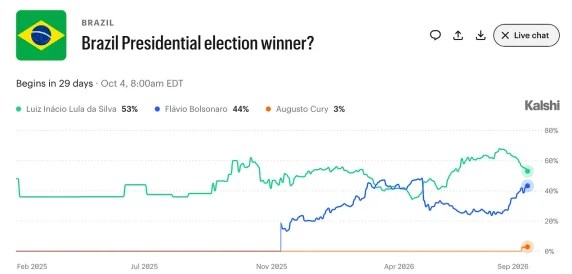
(2) I was on Piers Morgan’s program this week to discuss a wide range of issues, including the Iran War. You can watch that here.
(3) We conducted our live weekly Q&A last night, as we always (or almost always) do on Thursday night, where we respond to and interact with the questions, comments, and critiques of our subscribers. You can watch that here.
Reporters Without Borders calls for EU to close loopholes allowing Europeans access to censored Russian media
RT | September 4, 2026
The EU- and US-funded press watchdog, Reporters Without Borders (RSF), has called for tighter controls on AI-based search technology, after discovering that chatbots bypass European censorship laws and present Russian media sources banned by in Western Europe to users.
The Paris-based RSF, which lists EU and the US National Endowment for Democracy among its backers, found that popular AI services can provide RT articles, links, excerpts, and news summaries to web users. “Public chatbots can access these websites and redistribute their content,” a statement by the organisation claimed on Wednesday.
The EU and UK have banned numerous Russian news outlets since the escalation of the Ukraine conflict in 2022, including RT and Sputnik. Moscow has denounced the EU-wide ban as an attempt to silence coverage of the conflict that contradicts Brussels maximalist political stance.
The censoorship has since spread across virtually every publishing channel, including websites, apps, chats and social media. RT has been blocked and removed from practically all Western tech platforms, while RT France was forced to close in 2023 after its accounts were frozen and RT America suffered a similar fate in 2024.
Though VPN technology is used by a significant portion of netizens, making RT’s counter-mainstream reporting accessible to its loyal audience, in July, the EU’s top court ruled that even individuals running free, non-commercial websites can be found guilty of redistributing RT content.
RSF asked popular AI services to retrieve international news exclusively from sanctioned outlets, including RT, Sputnik, and RIA Novosti.
ChatGPT and Grok emerged as the “leading bots for circumventing EU sanctions,” retrieving headlines and providing links, excerpts and detailed summaries. ChatGPT complied “without reservation,” according to RSF, while Claude responded with “unfailing consistency.”
French AI-bot Vibe located the requested material on VKontakte (known as ‘Russia’s Facebook’) and through an app carrying Telegram posts. RSF praised its “remarkable ingenuity” and described the bot as a “resourceful sleuth.”
Gemini cited sanctions to refuse requests while Meta AI, whose parent company unilaterally banned RT from Facebook and Instagram in September 2024, was the only chatbot tested that “consistently refused” to provide the requested material.
RSF called on the European Commission to investigate ChatGPT under the EU’s Digital Services Act – a raft of legislation that allows the EU to manufacture consensus and alienate dissent from narratives it wishes to impose on its population. The RSF, which is funded by the bloc and the controversial US NED called for cases to be taken over other AI services capable of providing access to sanctioned Russian media.
Featured Video

“Historic Russia”: The Land Putin Will Not Give Back
or go to
Aletho News Archives – Video-Images
Book Review
Why the War on Conspiracy Theories Is Bad Public Policy
By Kevin Barrett • Unz Review • February 1, 2019
 A Review of Conspiracy Theories and Other Dangerous Ideas by Cass Sunstein (based on an earlier paper co-authored with Adrian Vermeule); In Defense of Troublemakers: The Power of Dissent in Life and Business by Charlan Nemeth; and Conspiracy Theories and the People Who Believe Them, edited by Joseph E. Uscinski
On January 25 2018 YouTube unleashed the latest salvo in the war on conspiracy theories, saying “we’ll begin reducing recommendations of borderline content and content that could misinform users in harmful ways—such as videos promoting a phony miracle cure for a serious illness, claiming the earth is flat, or making blatantly false claims about historic events like 9/11.”
At first glance that sounds reasonable. Nobody wants YouTube or anyone else to recommend bad information. And almost everyone agrees that phony miracle cures, flat earthism, and blatantly false claims about 9/11 and other historical events are undesirable.
But if we stop and seriously consider those words, we notice a couple of problems. First, the word “recommend” is not just misleading but mendacious. YouTube obviously doesn’t really recommend anything. When it says it does, it is lying. … continue
Blog Roll
 Aletho News
- BRITAIN’S WARNING: PREPARE FOR WAR
- “Historic Russia”: The Land Putin Will Not Give Back
- How the Cambridge Analytica scandal still haunts Mark Zuckerberg
- The Ongoing Cancellation Campaign Against a Dissenting Academic in Norway
- Yemen and ‘the Houthis’: Challenging Sami Hamdi’s Narrative
- No, Christians did not invent Zionism
- AIPAC-led lobbying network opens branches in Cypriot, Greek parliaments
- Araghchi blasts ‘parasitic’ alliance as US taxpayers pay for Israel’s war on Iran
- Easy fix for Europe’s chaos? Stop fueling war against Russia
- Putin’s key remarks on peace talks and Europe’s ‘schizophrenia’
- If Americans Knew
- Damning report shows the media must confront its failures on Gaza
- BBC senior broadcaster speaks out on Gaza coverage
- Netanyahu vows vast West Bank invasion in response to 20-minute skirmish that left 2 Israeli soldiers and 2 Palestinian fighters dead
- Tied up and tortured: Israel using US-made electroshock weapons on Palestinian detainees
- The outsourced risk: how newsrooms rely on Gaza’s freelancers without protecting them
- Gaza bakeries forced to shut as Israel blocks flour shipments
- Gaza’s breast cancer patients face a deadly wait for treatment amid Israel’s genocide
- DAILY UPDATE: Latest essential news on Palestine, Israel, & region
- The Israel Lobby’s Changing Fortunes
- AIPAC has become such a political liability that it’s shifting to a more “nimble” approach to buying politicians
- No Tricks Zone
- Two New Studies Find Thwaites Glacier Melt Cannot Be Driven By Human Activity Or A Warming Ocean
- E-Cars Reduce CO2 Emissions By Only 41% Compared To Internal Combustion Engine Vehicles
- Predictions Made By Renowned Climate Professor Over Past Decades Have Been Proven To Be Poor
- New Study Suggests Large Regions Of The Pacific Ocean Have Been Cooling For The Last 80 Years
- Germany’s Green Energy Debacle: High Energy Costs Force Kahla Porzellan to Close After 182 Years!
- New Study: 50 Years Of The Most Aggressive ‘Net Zero’ Policies Can Only Affect The Global Climate By 0.03°C
- US September “Heat” Was No Record…Many Records Set Decades Ago
- Latest European Green Energy Debacle; Portugal’s Largest Flagship Solar Park Insolvent!
- Green Energy Debacle: German Expert Professor Fritz Vahrenholt Warns Of Severe Economic And Social Consequences
- Two More Paleo Reconstructions Affirm Meters-Higher Sea Levels Across Ireland, Brazil 7000-6000 Years Ago


