1,700+ demand retraction of influential COVID-19 origins paper after emails reveal authors doubted their own conclusions
By Suzanne Burdick, Ph.D. | The Defender | July 26, 2023
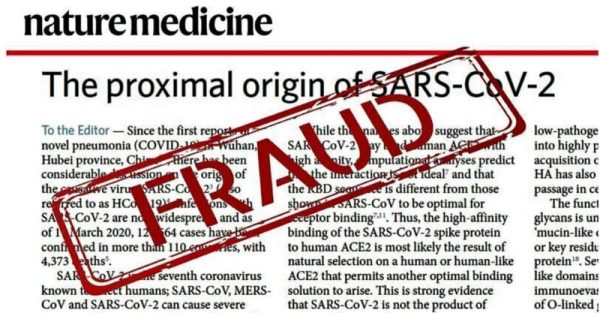
More than 1,700 people have signed a petition calling for the retraction of the seminal scientific correspondence paper, “The proximal origin of SARS-CoV-2,” that claimed COVID-19 was “not a laboratory construct or a purposefully manipulated virus.”
The paper — sometimes referred to as the “Proximal Origins” paper or the “Nature Medicine paper” — was published March 17, 2020, in Nature Medicine journal.
It was used by former National Institute of Allergy and Infectious Diseases Director Anthony Fauci, former National Institutes of Health Director Francis Collins, and other federal public health officials in 2020 and beyond to dismiss the possibility of a lab leak.
Biosafety Now — a nongovernmental organization that “advocates for reducing numbers of high-level biocontainment laboratories and for strengthening biosafety, biosecurity, and biorisk management for research on pathogens” — on July 19 launched the petition, stating, “It is imperative that this clearly fraudulent and clearly damaging paper be removed from the scientific literature.”
Biosafety’s leadership team includes 27 experts in biomedicine, mathematics, public health, public policy, public advocacy, law and social science.
Fraudulent paper ‘played an influential role’ in driving official narrative
Bryce Nickels, Ph.D., co-founder of Biosafety Now and professor of genetics at Rutgers University, said the petition seeks “to expose a clear case of scientific fraud and misconduct that has had a major impact on public opinion and policy.”
Nickels told The Defender :
“The removal of ‘Proximal Origins’ from the scientific literature is the first step in a long process needed to repair the damage this paper has caused to public trust in science.”
According to the petition, “This paper played an influential role — indeed, the central role — in communicating the false narrative that science established that SARS-CoV-2 entered humans through natural spillover, and not through research-related spillover.”
The petition continues:
“Email messages and direct messages via the messaging program Slack among authors of the paper obtained under FOIA [Freedom of Information Act] or by the U.S. Congress and publicly released in full in July 2023 … show, incontrovertibly, that the authors did not believe the conclusions of the paper at the time the paper was written, at the time the paper was submitted for publication, and at the time the paper was published.”
The recently-released internal communications show the paper “was, and is, the product of scientific fraud and scientific misconduct,” the petition said.
Commenting on the petition, investigative journalist Paul Thacker said:
“The thing that’s really the most troubling, which is why it should be retracted … [is] the ghostwriting and the undue influence [of federal public health officials on the drafting of the paper], which we know from the emails by Francis Collins, by Anthony Fauci, and from Jeremy Farrar.”
Thacker — who noted that within only a few days the petition had already garnered more than 1,300 signatures and set the hashtag #RetractProximalOrigins trending on Twitter — told The Defender :
“These guys basically ordered up a piece of science — or some sort of publication — that they could then point to, which they all did afterwards, as definitive proof that this thing could not have come from the lab.
“The whole thing was orchestrated for political purposes. It has nothing to do with science.”
Little more than a ‘political piece of propaganda’
Thacker is a former fellow at the Safra Center for Ethics at Harvard University whose investigative writing has appeared in The New York Times, The BMJ, the Journal of the American Medical Association and The Washington Post.
He explained that weeks prior to the paper’s publication, Kristian Andersen, Ph.D. — one of the co-authors of the “Proximal Origins” paper — emailed Fauci and Collins a draft of the manuscript, thanking them for their “advice and leadership” on the paper.
Andersen also invited Fauci and Collins to comment and offer suggestions about the paper — but neither are mentioned in the acknowledgments section of the final version published by Nature Medicine. According to Thacker:
“Both Collins and Fauci then promoted the Nature Medicine paper as evidence of ‘independent science’ pointing against a possible lab accident — Collins in a post for the NIH Director’s blog that alleged the study left ‘little room’ for argument in favor of a lab accident, and Anthony Fauci in a White House press briefing.
“In both cases, neither Collins nor Fauci disclosed their involvement in orchestrating Andersen’s study. This last March, Congress released further emails showing that Fauci helped to orchestrate the Nature Medicine paper.”
Thacker pointed out that the paper — which “has been called everything from ‘research paper’ to ‘analysis’ to ‘study’” — was “really just correspondence” that was later turned into a “political piece of propaganda that people could then reference, which they did.”
Describing the recent about-face regarding the paper’s importance, Thacker said:
“Now the editor-in-chief of Nature Medicine is saying, ‘Oh, well, it was just a viewpoint … like he’s trying to dismiss what it was when they [federal public officials] used it for completely different purposes. They used it as some definitive piece of scientific research that put to rest any idea this thing could have come from a lab.
“Then we find out internally that none of them who wrote it believed that in the first place. … Quite frankly, from the very beginning, none of the scientific evidence in any direction means anything about how this pandemic started. It’s always been the internal documents and the money that have mattered more.”
Thacker added, “This entire drama and discussion has nothing to do with science. It has everything to do with corruption and a coverup.”
On July 25 Thacker tweeted:
Writers Curtis Schube and Gary Lawkowski in a July 24 op-ed for The Hill pointed out that when the Centers for Disease Control and Prevention responded to the FOIA request to release Fauci’s “explosive” email showing his involvement with the Nature Medicine paper, the agency completely redacted the email.
Moreover, Thacker alleged that Andersen submitted false testimony at the July 11 hearing of the House Select Subcommittee on the Coronavirus Pandemic, which is investigating the origins of the COVID-19 pandemic.
Andersen’s allegation that Fauci and Collins were provided the paper only after it had been “accepted” and was in “proof” is false, Thacker said. “Emails impeach this portion of Andersen’s testimony,” he added.
Thacker also pointed out that The Intercept last week published newly revealed documents showing Andersen and his co-author — Tulane virologist Robert Garry, Ph.D. — both lied to Congress during the House hearing. The alleged lies covered the fact that both had pending federal grants controlled by Fauci — money that could have been used to influence their positions on the lab-leak theory.
Robert F. Kennedy Jr.’s latest book, “The Wuhan Cover-up: How US Health Officials Conspired with the Chinese Military to Hide the Origins of COVID-19,” is due out in September. The book is available now for preorder. Kennedy is the founder and chairman on leave from Children’s Health Defense.
Suzanne Burdick, Ph.D., is a reporter and researcher for The Defender based in Fairfield, Iowa. She holds a Ph.D. in Communication Studies from the University of Texas at Austin (2021), and a master’s degree in communication and leadership from Gonzaga University (2015). Her scholarship has been published in Health Communication. She has taught at various academic institutions in the United States and is fluent in Spanish.
This article was originally published by The Defender — Children’s Health Defense’s News & Views Website under Creative Commons license CC BY-NC-ND 4.0. Please consider subscribing to The Defender or donating to Children’s Health Defense.
Never investigate what you don’t want to ‘confirm’
This maxim pretty much explains everything in our New Normal
BY BILL RICE, JR. | JULY 27, 2023
(Part 1 of 2)
I quickly formulated a maxim that pretty much explains why all the authorized Covid narratives took hold. This also explains why non-authorized narratives never had a chance.
This maxim is:Never investigate that which you don’t want to “confirm.”
As far as I can tell, this narrative-control tactic works every time.
If officials don’t want any revelations to debunk their preferred narrative, they just don’t investigate it. This way it’s almost impossible for anyone to “confirm” these trusted officials and truth-seeking scientists have been telling whoppers longer than Pinocchio.
FWIW, the intentional creation of bogus narratives satisfies the correct definitions of “disinformation” and “malinformation.”
As journalists are supposed to give examples to support our maxims, I’ve included several examples, a few which reveal my own futile efforts to learn or expose taboo truths.
Solution to protect said False Narrative: Make sure most people don’t know that the average age of a Covid victim is a couple of years over the average life expectancy.
For example, from my research for this article, I learned that in Europe the average age of a Covid victim was around 82.4 (where average life expectancy is about 79.4).
It’s hard to debunk/reject the all-important authorized narrative (“Covid is a threat to everyone”) if hardly any citizen reads that just about the only people dying from Covid were the elderly (almost all of whom had multiple co-morbid health conditions). Given the parameters established by this information template, the false narrative might as well be “confirmed.”
Narrative protection technique: Make sure no journalist ever writes a story that mentions that zero college or pro athletes ever died from Covid.
If officials and journalists did “confirm” the fact that no college or pro athlete has died from Covid, this information wouldn’t exactly promote the official bogus narrative.
Officials and journalists have never “confirmed” that zero athletes have died from Covid … because they never bothered to “investigate” this.
For reporters or researchers, confirming facts entails “investigative” effort. A bonus for journalists employing this narrative-control technique is they don’t have to do any investigative work. This actually makes their jobs much easier. One could even say this feature of their job rewards laziness.
Early in official Covid, I wrote a letter to the editor for al.com, showing that at the University of Alabama in the flu season of 2017-2018 – in just a few few weeks – at least 863 UA students students went to the college infirmary with flu symptoms.
From further research, I showed that at just one college in our state, five times as many college students had been “sick” from a flu outbreak that spanned approximately 40 days than had been “sick from COVID-19 in our entire state … in approximately 200 days.
I knew this because one journalist at al.com wrote a story on September 16, 2020 that provided several nuggets of eye-opening information.
For example, more than six weeks after students returned to Tuscaloosa in the summer of 2020, no UA student had been hospitalized due to Covid.
Per this article, Dr. Ricky Friend, the dean of UA’s College of Community Health Sciences, said: “I can also tell you very few students in quarantine and isolation are experiencing significant symptoms.”
Also from the same article (more about the real source of this info later): “Friend … said one in every four or five students tested on campus is showing symptoms. The rest are asymptomatic.This is very much in line with data and trends we are seeing across the country.”
Re-stated: 75 to 80 percent of college students who were classified as a Covid “case” at Alabama (and around the country) were “asymptomatic,” meaning they weren’t sick at all.
In late summer 2020 at the University of Alabama (after a month of non-stop student testing), exactly zero UA students had been hospitalized from Covid, none had died, “very few” students forced to live “in isolation” were “experiencing any significant symptoms” and, 75 to 80 percent of “positive” students experienced no Covid symptoms.
In other words, the flu of two years earlier had made far more UA students sick than Covid did.
And the 863 “sick” flu students identified in the news report of a Birmingham TV station were just those who went to the UA infirmary. Many sick students might have gone to another healthcare provider, or never gone to the doctor … or these students became sick while they were home on Christmas holidays.
Many thousands of UA students had no doubt become “sick” during this particular flu outbreak.
Which brings me to my main point: Life at the University of Alabama in Tuscaloosa did not stop in January 2018. No classes were cancelled; nobody was ordered to wear a mask; basketball season was not cancelled; Students didn’t have to take on-line courses from their dorm rooms or apartments. Nobody freaked out at all.
I pointed all of this out in a letter I submitted to al.com. In the letter, I reported that “far more UA students were sick a couple of years ago from the flu than have been sick since Alabama’s first “confirmed” case in March.
But, alas, al.com wouldn’t publish my essay.
I did get to argue my case with the the news organization’s op-ed editor (K. A. Turner). Ms. Turner was decent enough to call and talk to me about my piece. I’ll never forget what she told me:
“Bill, we can’t allow you to compare Covid to the flu.”
For a few moments, I was speechless.
Did I hear this news editor right? The leading news organization in our state would “not allow” me to publish a true and important statement, one backed up by quantifiable published data?
What happened to American newspapers?
It didn’t take me long to figure out what’d happened. People like myself – using elementary critical thinking skills – were not going to be “allowed” to debunk any authorized narrative about Covid.
The point I was seeking to “confirm” with good, old-fashioned facts …. would not be allowed.
I still think the dean’s admission that up to 80 percent of “Covid cases” at UA were asymptomatic should have been national news.
At the time, students across the country were returning to campuses after several months of lockdowns. Every college in America was testing students; newspapers were filled with stories about “new cases” and “outbreaks” at colleges.
But one dean obviously messed up and said that no students were hospitalized, very few students had significant symptoms, nobody had died and, indeed, the overwhelming majority of “cases” were as “sick” as I am right now.
That is, the dean blew up an important, albeit false, fear-mongering narrative.
Of course no other news organizations picked up on this accidental revelation, which was a bummer … because I was the person who’d sent several emails to the reporter asking this journalist to ask a UA official this very question.
The journalist was Michael Cassagrande, who normally covers sports for al.com, but expanded his journalist duties during the first months of Covid (probably because there were no sporting events to cover).
I kept emailing Michael a reader suggestion: Ask some UA official how many of these positive cases are asymptomatic.
And damn if he didn’t do it. The info the dean revealed about no student hospitalizations and all the students in isolation being fine was unexpected bonus Covid info.
So we have a lesson here: If you keep bugging a few sports reporters, one of them might ask questions “news” reporters would never ask.
I’m also a journalist (although, at the time, I was a freelance journalist who could never get any of my taboo Covid stories published).
Still, several months later, I asked the director of the University of Alabama’s Media Affairs the same questions Michael asked. I knew UA never stopped testing students so I wanted to know if the “asymptomatic” rate was STILL 80 percent.
However, the director (who used to be a journalism professor) wouldn’t answer my questions.
Nor would she arrange an interview with the dean who’d previously answered Michael’s questions (actually my questions) several months earlier.
I also wanted to know what percentage of athletes at Alabama who were testing positive were asymptomatic. She wouldn’t answer that either.
So I asked the media affairs staffers at the SEC the same question. (Testing of all student-athletes was mandatory for many months, with most athletes having to get a swab pushed up their noses three or four times a week.)
The SEC’s media affairs director said he couldn’t answer that question. He told me maybe I could go straight to the university and get that information. I told him I had: no dice.
I didn’t stop with the SEC. I asked all the media affairs people at all the big Division I conferences (Big-10, Pac-12, ACC, etc.), the same questions:
How many student athletes who tested positive via a PCR test were asymptomatic?
How many athletes have been hospitalized with Covid?
My answers were “we can’t answer those questions” … or no “media affairs” helpers replied to the questions of this media reporter.
Do these conference officials simply not know these answers or did they know the answers and simply didn’t want the public to know?
I don’t know … Oh, who am I kidding? I didn’t fall off a turnip truck yesterday …. I know the answer.
They know the answers … they just don’t want to “confirm” them. Or they know that it’s best to NOT do any investigations that would “confirm” that Covid is and always has been a nothing burger to college students and college athletes.
They know an important part of their jobs is to protect all the authorized narratives, especially the ones that are false.
Sporadic Reports of Malaria Followed by “Breakthrough” Announcement of mRNA Vaccine
By Peter A. McCullough, MD, MPH | Courageous Discourse | July 26, 2023
As an internal medicine physician and cardiologist I am in tune to diseases seen and presented at “morning report” at big academic medical centers. I can tell you over the decades each year there are a few cases of malaria. Travel history and contact tracing are never precise enough to declare where it came from. Malaria gives us a chance to talk about the characteristic life cycle of organism (plasmodium species), the mosquito vector, use of diagnostic testing including the blood smear etc.
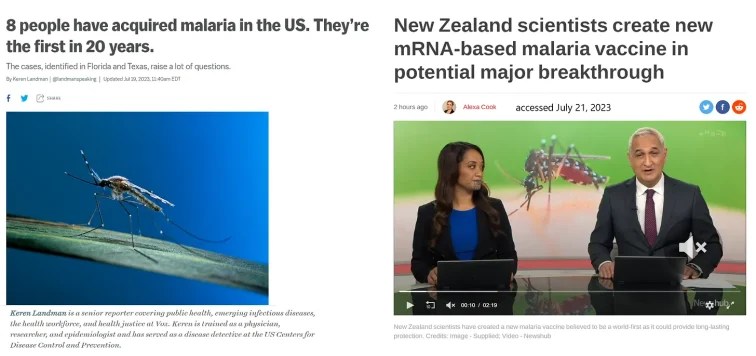
So I was suspicious a few days ago when I heard about malaria in the U.S. as making a “comeback” and some patients asking me about bug spray. Now I see why there could be a manufactured interest in the age-old illness that is well treated with medications—a mRNA vaccine.
Alexa Cook at NewsHub is reporting: “ A team of researchers from Victoria University of Wellington’s Ferrier Research Institute, the Malaghan Institute and the Peter Doherty Institute for Infection and Immunity in Australia have developed an mRNA-based vaccine that can effectively target and stimulate protective immune cell responses against the malaria-causing parasite.”
The timing of these events is uncanny. The only reason why a few cases of malaria which are always around would make the news would be an announcement of a new therapy or vaccine. So next time you hear about an old disease making a comeback, look for some new profitable drug or vaccine on the horizon and be suspicious of a false medical scare to juice up investor interest.
Revealed: Dark Money Funders Behind ‘Disinformation Dozen’ Report
By Brenda Baletti, Ph.D. | The Defender | July 27, 2023
A new report published Monday by GreenMedInfo revealed nine of the dark money sources funding the Center for Countering Digital Hate (CCDH), an influential nonprofit that allegedly colluded with social media platforms and the White House to censor Children’s Health Defense (CHD), Robert F. Kennedy Jr., CHD’s chairman on leave and others for spreading “disinformation.”
The report identified CCDH’s funders primarily as U.K.-based philanthropic organizations whose directors and trustees are affiliated with legacy media organizations, the U.K. government and major global philanthropic organizations such as the Open Society Foundations and the Ford Foundation.
Despite claims by Imran Ahmed, CCDH’s CEO and founder, that the organization has “never taken government money,” the report also found at least one of its funders has received U.K. government funding.
“It appears that CCDH may be an astroturf front operation for both NGOs [nongovernmental organizations] and the U.K. government to directly interfere with and target the constitutional rights of U.S. citizens, and this should be a concern for all Americans,” report author Sayer Ji told The Defender.
CCDH famously drafted a list of the so-called “Disinformation Dozen,” which included Kennedy, Dr. Joseph Mercola, the founders of The Truth About Vaccines and The Truth About Cancer websites Ty and Charlene Bollinger, and Ji, founder of the natural health website GreenMedInfo.
CCDH alleged in its report that just 12 accounts produced the majority of “anti-vaccine disinformation” on social media.
Facebook investigated and dismissed the report, releasing a statement saying that “There isn’t any evidence” to support its claims and that the small sample used in CCDH’s analysis was “in no way representative of the hundreds of millions of posts that people have shared about COVID-19 vaccines.”
“There is no justification for [CCDH’s] claim that their data constitute a ‘representative sample’ of the content shared across our apps,” Facebook stated.
Yet, the report was used by the White House and Twitter to censor those individuals and by legacy media outlets such as NPR, The Guardian and countless others to discredit the people on the list.
Despite its baseless claims, the report was extremely effective, Ji said.
Ji told The Defender :
“CCDH’s factually baseless campaign was amplified and disseminated globally by hundreds of colluding media outlets, such that today you can find over 3,400 news articles online uncritically citing their defamatory construct ‘disinformation dozen.’
“This has wrought profound reputational damage, and has dramatically curtailed our ability to share our message, given that over 2 million of our followers have been removed, following the deplatforming efforts of those spreading these lies.”
In Kennedy’s testimony before a U.S. House of Representatives hearing organized by the Select Subcommittee on the Weaponization of the Federal Government last week, he cited his inclusion on CCDH’s list as part of a “new form of censorship, which is called ‘targeted propaganda,’ where people apply pejoratives like ‘anti-vax’ … to silence me.”
The latest “Twitter Files” released July 18 by investigative journalist Paul D. Thacker detailed how Twitter and the White House used CCHD’s “Disinformation Dozen” report as justification for censoring the people on the list.
Thacker also profiled Ahmed, who previously worked for Merrill Lynch and was a British Labour Party political operative, and is the co-author of “The New Serfdom: The Triumph of Conservative Ideas and How to Defeat Them… .” Ahmed emerged during the pandemic as a “vaccine and disinformation expert,” although lacking any experience that would qualify him as such, Thacker reported.
Thacker raised questions about who funds CCDH and reached out to the organization to investigate, but received no response.
Ji’s report published Monday provides a partial answer to that question, seeking to “contribute to the collective effort to shed a sterilizing light on the dark agenda spear-headed by astroturfing organizations like CCDH,” he wrote in the report.
CCDH’s funders primarily global but U.K.-based nonprofits
Although CCDH does not make its funders publicly available and failed to respond to Thacker’s inquiries, Ji was able to identify some of them by examining the public grant-reporting website 360 GrantNav, along with other publicly available sites, including CCDH’s 2020 website archived on the Wayback Machine.
The funders identified are primarily U.K.-based charities, some of which operate globally and generally contribute to a wide variety of causes that cluster around issues of environment and poverty, rather than health or science.
According to the report, the Paul Hamlyn Foundation in 2021 gave CCDH a £100,000 grant earmarked for “growing the digital presence and impact of the Center for Countering Digital Hate.” The foundation’s trustees include the former general-director of the BBC Tony Hall, Baron Hall of Birkenhead, and Sir Anthony Saltz, formerly on BBC’s board of governors.
The Esmée Fairbairn Foundation, a large U.K. charity with a £1.5 billion endowment, whose mission is “to improve the natural world, create a fairer future and strengthen community bonds in the UK,” gave CCDH £200,000 in October 2021 to support a salary at the organization and to “disrupt the spread of online hate and misinformation.” It awarded CCDH a second £13,333 grant in January of this year.
The Joseph Rowntree Reform Trust, which, according to the report, is a U.K.-based limited company — not a charity and therefore able to fund political causes — gave CCDH £53,400 in 2020.
CCDH is also funded by the Oak Foundation, a global environmentalist grantmaking foundation that gave CCDH $100,000 to help it shine a “spotlight on digital misinformation platforms that are polluting the public discourse.”
CCDH reported on its website that it received an undisclosed amount of money from the Barrow Cadbury Trust, whose mission is to “tackle profound social ills, including juvenile crime and urban poverty.”
The Pears Foundation, a U.K. charity that Ji’s report says focuses on “Israel-related projects” gave CCDH £250,000 over three years. The foundation is funded by the William Pears group and the U.K. government, according to the report.
The Hopewell Fund is a U.S.-based 501(c)(3) organization managed by a Washington, D.C.-based philanthropy consulting firm and is dedicated to funding “innovative social change projects.” It gave CCDH a small $15,000 grant in 2021.
Unbound Philanthropy, the final donor identified by the report, is a New York-based 501(c)(3) nonprofit organization whose executive director Taryn Higashi also sits on the advisory board of Soros’ Open Society Foundations and who formerly worked at the Ford Foundation.
But this is just a partial list, and in his report, Ji appealed to the public to continue researching the “dark money” behind the organization.
Ji also invited readers to take action on the Stand for Health Freedom campaign website “to send the message that the targeting of U.S. citizens to illegally suppress protected speech is unacceptable.”
The Defender examined CCDH’s 990 — the tax form nonprofits must file annually with the IRS — from fiscal year 2021, where the organization reported receiving $1,471,247 in contributions and grants and listed $860,457 in total assets.
The list of contributors was marked as “restricted,” and further information was not provided. It did report spending $12,633 on “lobbying activities.”
While The Defender was only able to find the single 2021 federal form 990, we did locate CCDH’s U.K. financial reporting form for fiscal year 2022 (ending Oct. 31, 2022), showing the organization received $904,452 from donations in 2022 and $638,499 in 2021.
Financial filings also reveal CCDH board member affiliations
The U.S. 990, the U.K. financial statements and the U.K.’s company information service also revealed CCDH’s frequently changing board members and directors, many of whom have close ties to government and media organizations.
Notable figures include Simon Clark, board chair, who was a resident senior fellow at the Atlantic Council’s Digital Forensic Research Lab. The Atlantic Council is a NATO, arms industry and Persian Gulf monarchies-funded think tank.
Prior to his work at the Atlantic Council, Clark was a senior fellow at the Center for American Progress, where he led the work that informed the Biden White House’s National Strategy for Countering Domestic Terrorism.
Ji found it “unsurprising” that “CCDH’s rhetorical points made it into several U.S. Department of Homeland Security terrorism bulletins equating free speech and open debate about mRNA vaccine safety and efficacy, or Covid origins, as possible new forms of domestic terrorism.”
Another CCDH director, Kirsty McNeill has also worked as Save the Children’s executive director for Policy, Advocacy and Campaigns since 2016, a period during which the Bill & Melinda Foundation donated more than $40 million to the organization.
Save the Children has also partnered with Gavi, the Vaccine Alliance. Gavi maintains a core partnership with the World Health Organization and the World Bank.
McNeill previously worked as a special adviser and speechwriter for former Prime Minister Gordon Brown. She is a member of the think tank European Council on Foreign Relations, funded by such entities as the Open Society Foundations, the United Nations and the Gates Foundation.
Aleen Keshishian and Zack Morgenroth are both CCDH board members and work at Lighthouse Management & Media, a Hollywood management agency representing top stars including Jennifer Aniston, who famously cut ties with her unvaccinated friends.
Damian Noel Thomas Collins, who joined CCDH in 2022, is a British Conservative Party politician who formerly served as a junior Minister for Tech and the Digital Economy in the Department for Digital, Culture, Media & Sport.
CCDH sought to silence the voices that were ‘most effective’ at warning the public
In addition to its government, social media and legacy media connections, CCDH has partnered with “fact-checking” firm NewsGuard — specifically, its HealthGuard product, described as “a vaccine against medical misinformation” and against critiques targeting the healthcare industry and global public health authorities.
According to an article by Off-Guardian, CCDH claimed the COVID-19 pandemic “will only be overcome by the most ambitious vaccination programme in human history” and those who question this program have “fringe and extremist views,” which “should not be permitted and should indeed be banned.”
They have also advocated for the imprisonment of “anti-vaxxers.”
Ji told The Defender that CCDH’s targeted campaign spoke to the validity of the ideas of those it sought to deplatform.
He said:
“George R. R. Martin once said, ‘When you tear out a man’s tongue, you are not proving him a liar, you’re only telling the world that you fear what he might say.’
“I believe CCDH’s campaign was intended to silence those of us who they believed were most effective at warning the public about the true dangers of the mRNA vaccine rollout and how this mass experiment violated the medical ethics principle of informed consent.”
Brenda Baletti Ph.D. is a reporter for The Defender. She wrote and taught about capitalism and politics for 10 years in the writing program at Duke University. She holds a Ph.D. in human geography from the University of North Carolina at Chapel Hill and a master’s from the University of Texas at Austin.
This article was originally published by The Defender — Children’s Health Defense’s News & Views Website under Creative Commons license CC BY-NC-ND 4.0. Please consider subscribing to The Defender or donating to Children’s Health Defense.
Europe’s “48°C Horror That Never Was”…ESA, Media Sharply Criticized For Manipulative Reporting
“The most intense climate lie”: Last week it was all over the news: Temperatures in southern Europe skyrocketing to 48°C! But none of it was true.
By P Gosselin | No Tricks Zone | July 19, 2023
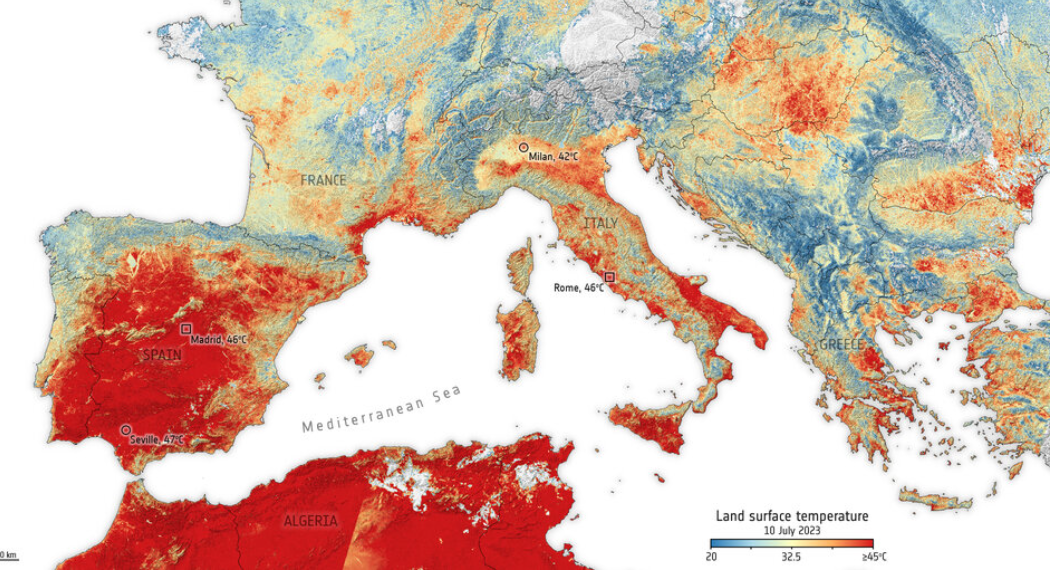
Surface temperature chart: European Space Agency (ESA)
The hysteria was started when climate sensationalist media outlets in Germany and elsewhere, like the Relotius Spiegel, uncritically cited a sloppily and manipulatively formulated July 13 report from the European Space Agency (ESA), that first referred to “air” temperature:
Temperatures are sizzling across Europe this week amid an intense and prolonged period of heat. And it’s only just begun. Italy, Spain, France, Germany and Poland are all facing a major heatwave with air temperatures expected to climb to 48°C on the islands of Sicily and Sardinia – potentially the hottest temperatures ever recorded in Europe.”
The original ESA report continued, only later specifying that it was in fact referring to surface temperature (emphasis added):
The animation below uses data from the Copernicus Sentinel-3 mission’s radiometer instrument and shows the land surface temperature across Italy between 9 and 10 July. As the image clearly shows, in some cities the surface of the land exceeded 45°C, including Rome, Naples, Taranto and Foggia. Along the east slopes of Mount Etna in Sicily, many temperatures were recorded as over 50°C.”
Meant here were not the standard temperatures recorded at 2 meters above ground level that we always here in daily weather reports, which are much cooler, but rather those right at the ground surface. That crucial difference went totally unnoticed by media and journalists, who reported of new record high temperatures. By the time the ploy was exposed by careful readers, the news had already gone around the world.
Yesterday, the ESA issued a (vague) clarification explaining the difference between surface and air temperature at 2 meters above ground, yet continued to mislead:
Land surface temperature is how hot the ‘surface’ of Earth feels to the touch. Air temperature, given in our daily weather forecasts, is a measure of how hot the air is above the ground.”
The ESA did not bother to mention how the surface temperature is much hotter than the 2 meter air temperature.
“Most intense climate lie”
“What we experienced over the past days was most intense climate lie since temperature recording began,” reported Germany’s Achtung Reichelt on the implications of the ESA’s sloppy, manipulative press release and the media firestorm that ensued: “The problem with that report is that none of it is true.”
In Sicily the temperature reached only 32°C over the weekend – a far cry from 48°C, which illustrates the great difference between ground surface temperature and readings taken 2 meters above the ground.
Once the trickery was exposed, Spiegel quietly changed the wording in its July 14 report.
More deception by The Lancet
The Naked Emperor’s Newsletter | July 24, 2023
In March, The Lancet published a paper “Excess mortality attributed to heat and cold: a health impact assessment study in 854 cities in Europe”.
Despite all the doom-mongering, the paper reported what we all know – the cold kills far more people than the heat does. In fact, it kills around 10 times more people. In the 854 urban areas in Europe, 203,620 people died from the cold and 20,173 from the heat. This corresponds to 129 per 100,000 person-years for the cold and 13 per 100,000 person-years for the heat.
But there is a narrative to maintain – the world is burning up.
So, when presenting their results, the chart that was shown was as follows:
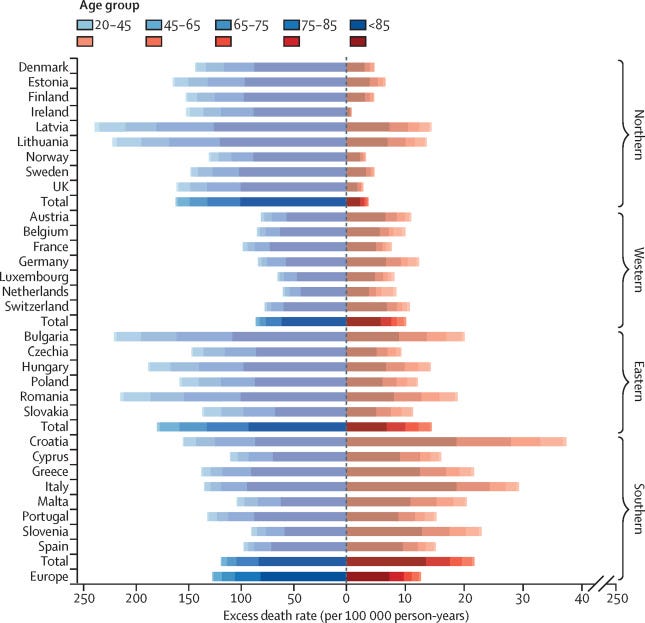
It looks as though heat deaths are almost as bad as cold deaths. However, if you look closely, that’s because they have changed the axis for the heat related excess death rate.
When the axis on the right is redrawn (h/t Bjorn Lomborg) so that it is the same as the one on the left, you get a chart that looks like this.
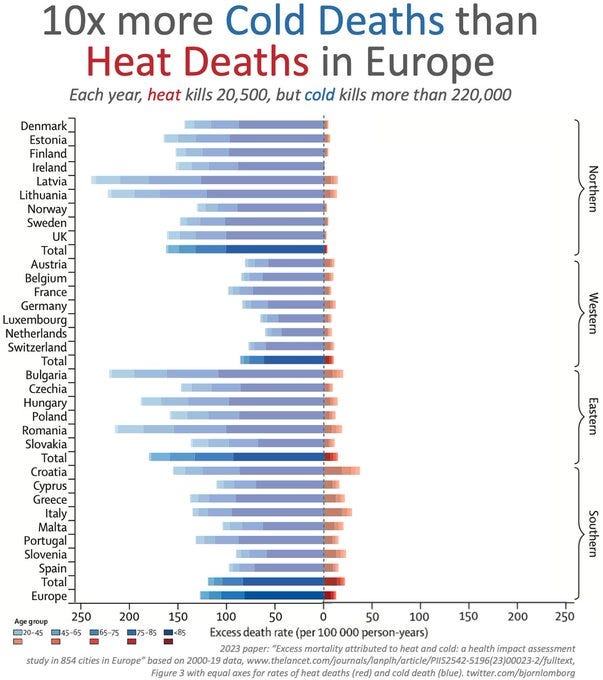
But I guess that isn’t as scary and won’t stop you driving your car or going on holiday.
The heat is getting to everyone’s head
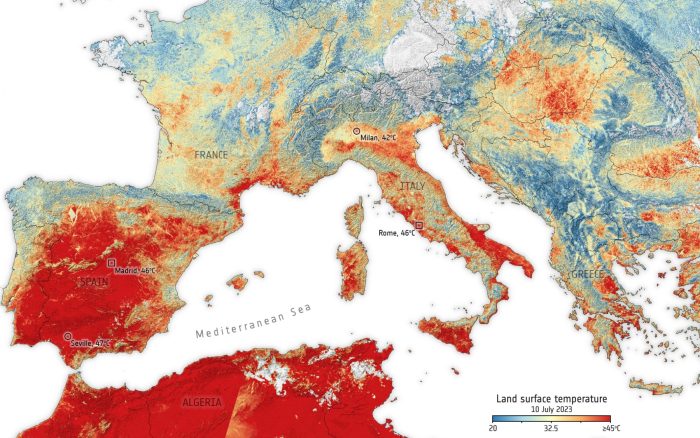
Heatwave across Europe on the morning of 10 July 2023 via ESA
By Alex Starling | Reaction | July 21, 2023
Nothing beats a good silly-season panic, it seems, but the latest handwringing about Summer heat is surely a step too far. Yes, it’s hot – “Southern Europe on fire” – but is this unusual when the jet stream is aligned as it is now, with hot Saharan air being pulled up from Africa? Judging by recent reporting, you’d be forgiven for thinking the end is nigh. There’s a climate emergency, didn’t you know?
Such scaremongering is of course a free pass, as usually no one really checks up on what actually takes place, but the catastrophic outcome can be milked to its full potential. “Drizzly day in Derby” never did sell any papers.
However, the fourth estate does have an obligation to present its viewers and readers with accurate information. This is where the story gets interesting – this is not just a case of eye-rolling pushback against apocalyptic hyperbole. Ranging from casual sloppy reporting to highly targeted attempts to influence the narrative, there is now a weight of evidence demonstrating the existence of a systemic bias towards catastrophising otherwise run-of-the-mill data.
Consider the following vignettes.
It is currently hot in Southern Europe. Earlier this month the European Space Agency (ESA) issued an attractively-coloured map as part of a press release forecasting air temperatures of 48°C in Sardinia and Sicily that would be “potentially the hottest temperatures ever recorded in Europe”. The quotable quote was suitably amplified by the media, only this time it was picked up by astute observers who pointed out that the ESA had conflated land temperatures with the much cooler air temperatures at the standard 2m measuring height (i.e. while you might be able to fry an egg on tarmac, the same egg suspended 2m on the ground will take much longer to become a culinary delight). The ESA subsequently issued a clarification, with corrections being issued by media organisations such as Der Spiegel which had picked up the original story.
A recent article in this publication also came to my attention. Walter Ellis wrote a piece about urban migration in Zaragoza in Spain. Fascinating though it was, he included some doom-laden forecasts regarding an ongoing summer drought: “It hasn’t rained here for months and the [official forecast] prognosis is for more – that is to say, less – to come… today, as a direct result of climate change, temperatures even in the more northerly regions, including Aragon, are at record highs”. Walter is just relaying official forecasts – hardly a mortal sin and you would hope official forecasts could be relied upon. But a slightly inconvenient truth is that these forecasters managed to get these (very short-term!) predictions completely wrong – the Iberian Peninsula was given an absolute drenching throughout May and June. Oops.
None of this would particularly matter if this idle chatter about the weather was just that; reporting on meteorological curiosities du jour. But quoting Twain: “A lie can travel halfway round the world and back again while the truth is putting on its boots”. And these weather untruths – whether they be honest mistakes, sloppy reporting or cynical ploys – tend to have one thing in common: they are seemingly always yoked to a great article of faith. That is, they are always indicative of a climate ‘emergency’, or at least ‘climate change’ (the old term ‘global warming’ seems to have temporarily gone out of fashion following various postponements of the previously imminent Armageddon).
Walter Ellis’s passing comment mentioned above lays the blame for an (incidentally totally incorrect) forecast of ongoing drought “directly on climate change”, begging the question about this direct causal link given that the prediction did not come to pass. The ESA is able to state that as “climate change takes grip, heatwaves such as this are likely to be more frequent and more severe, with far-reaching consequences”. A Met Office spokesman recently produced this cryptic quote in The Times : “As we get this climate warming, the extremes are becoming more extreme”, in an article worrying about a temporary warm spell in Greenland when the actual data shows that the snow mass was way above average at the height of summer. Even Reaction – if you can believe it – has managed to publish bold conjecture: “As temperatures continue to rise, heatwaves will become more severe. It’s crucial that governments worldwide take swift and decisive action to reduce greenhouse gas emissions immediately… while we can slow down the rate of global warming, the effects of climate change will continue to be experienced in the future”.
These are not cherry picked examples – this climate Lysenkoism is given blanket coverage. The message is ubiquitous (albeit sometimes subliminal) and in starker terms can be summarised as: “hot weather is caused by climate change, and mankind has caused climate change by producing CO2. There is an existential emergency!”
This ‘consensus’ is so consensual that it seemingly needs to be rammed home at every opportunity – almost as if this message (rather than the planet) is fragile, a complex construct that needs protection from awkward questions or detailed analysis. Grand proclamations and joint public statements are made by very serious organisations declaring The Truth that the faithful shall adhere to. Data is continually adjusted such that the graphs have suitable hockey sticks, and academics behind the scenes really know what they are doing. Armies of sycophants can be trusted to hound those who merely report on the weather without anchoring it to a climate scare, and senior sympathisers within the BBC enforce ‘appropriate’ edits and encourage activists to “flag similar cases in the future so they can adapt the content accordingly”.
Or consider Quentin Letts. He was court-martialled to have committed a “serious” breach of BBC rules on impartiality after producing a light-hearted Radio 4 programme entitled “What’s the point of the Met Office?” The recording was so offensive that it was eviscerated from BBC Sounds, lest a member of the public should stumble on such heresy. Not only that, the BBC has claimed that Letts had ignored a pre-production agreement “never to touch on climate change” – Letts categorically denies that this was ever agreed, let alone discussed. And in academia, even if the occasional journal paper with the ‘wrong’ conclusions does slip through the peer-review process, publishers can be relied on to create murky procedural grounds for retraction, especially when newspapers like The Guardian apply a modicum of pressure and editors are made to “think of the implications of publishing”.
That is quite a statement. Scientific curiosity is sidelined by today’s regime, which is tough on thought crime and tough on the causes of thought crime. “The Party told you to reject the evidence of your eyes and ears. It was their final, most essential command”: do not, under any circumstance, ask questions about recent cold weather events and records – which have seemingly abounded of late. Did you know that the Antarctic has been particularly and persistently cold in recent years? That the snow pack in California has been at extraordinarily high levels, resulting in mind-blowing skiing and white-water rafting conditions? That China and much of Siberia experienced record cold earlier in 2023? And that miserable and cold weather has persisted in Australia for many years now?
These are just anecdotes about the weather – our climate changes, after all. We should keep a weather (!) eye on this, as it was not that long ago that we were warned of an imminent ice age, and the earth’s magnetic field has been waning over the last century. Why don’t the BBC and The Guardian investigate and report on these fascinating phenomena rather than regale us with anecdotes about hot weather, as decreed by ‘Group Sustainability Directors’ who get to post-edit technical output within their organisations?
Perhaps, though, we should be grateful that the green lobby – this veritable hydra of loosely aligned eco-activists, shrieking media and sustainable energy salesmen – are there to protect ‘The Science’ from coming to harm at the hands of the scientific method.
Because surely – surely? – the public at large will eventually notice this pseudoscientific quackery and reject increasingly desperate attempts to apply cancel culture techniques to silence or ridicule heretics. Consider Dr John Clauser, the recipient of the 2022 Nobel Prize in Physics, who recently criticised the climate emergency narrative, calling it “a dangerous corruption of science that threatens the world’s economy and the well-being of billions of people” and that “there is no climate crisis and that increasing CO2 concentrations will benefit the world”. People with such credentials should have their hypotheses examined — not shouted down.
How much more hot air will we have to put up with until a more reasoned debate ensues? It is clear to many that nihilistic climate alarmism is stopping us from investing in reliable energy and pursuing economic growth. If we continue down this Lysenkoist path, we risk deindustrialisation and pauperisation, which would spell an end to the quality of life that we have enjoyed in recent decades – and that our forebears could only dream of.
Bright Red Weather Maps and Fake Temperature ‘Records’ Drive Climate Panic
BY CHRIS MORRISON | THE DAILY SCEPTIC | JULY 18, 2023
It’s summer in the Northern Hemisphere so the heat hucksters are out in force. Alas, there are currently thin pickings in the U.K. – last year’s star of the show – where the summer has turned distinctly chilly. Further north is also very disappointing and largely absent from the public prints. Arctic sea ice continues its steady decade-long recovery, and current levels on the Greenland ice sheet are above the 1981-2010 average. But no matter – African countries surrounding the Sahara and nearby southern European locations can always be guaranteed to raise a scorchio cheer, along with Death Valley in the Arizona desert. Guaranteed climate change fearmongering in action here, every day of the week.
Come rain or shine, flood or drought, the weather is being ruthlessly weaponised to persuade us to embrace a collectivist Net Zero plan. Last week, heavy rain caused some flash flooding in Vermont. USA Today claimed that “dramatic flooding” was rare in Vermont, adding: “Expect more amid climate change.” The BBC reported the event, adding the routine house scare that “climate change makes extreme rainfall more likely”. What is missing in all this propaganda is any proof of the claims and any attempt to put bad weather into an historical perspective.
In a paper looking at the climate variability of the American state’s natural hazards, published in 2002 by the Vermont Historical Society, it was noted:
One of the most pervasive hazards that impinges upon and marks the Vermont landscape is flooding. Rarely does a year elapse without a flooding event of a significant magnitude being reported in at least one of Vermont’s 14 counties or perhaps state-wide, making this the number one hazard across the state.
On July 4th, Matt McGrath of the BBC reported that the world’s average temperature had reached a new daily high of 17°C. McGrath partly attributed the rise to “ongoing emissions of carbon dioxide”, and reported the view that July will be the hottest month in 120,000 years. Quite how anyone can know that is a mystery.
It turns out that the hottest day claim, which provided clickbait for headlines around the world, was the product of a computer model called Climate Reanalyzer, run out of the University of Maine. The operators perhaps felt a pang of guilt over the widespread use of their modelled figure noting, a few days later, that much of the elevated global temperature “can be attributed to weather patterns in the Southern Hemisphere that have brought warmer than usual air over portions of the Antarctic”. In other words, long-term climate change, human-caused or natural, had nothing to do with any rise, it was a local meteorological event.
It is important to understand that all these ‘records’ are based on historical data that are incomplete, often inaccurate and are rarely more than 100 years old. Until recently, sea temperatures in the Southern Hemisphere were recorded from a bucket thrown from a passing ship. All the major land surface temperature datasets are ravaged by growing urban heat corruption, and recent temperatures have been further warmed on a retrospective basis via ‘adjustments’. Growing questions are being asked about the accuracy of many recordings, with the U.K. Met Office willing to declare ‘records’ from a runway used by Typhoon fighter jets and other sites that the World Meteorological Organisation states come with an error estimate of up to 2°C. Meanwhile, the most accurate record we have of air temperatures is compiled from satellite data by scientists at the University of Alabama in Huntsville and this shows less warming since 1979. The results are rarely noted in mainstream media, and last year Google demonetised one of the compilers by banning him from receiving money from its AdSense scheme.
Climate historian Tony Heller has released a short film noting that “fake historical data” and bright red maps are key tools being used to scare people into compliance with an anti-energy agenda. The highest temperature ever recorded on the planet was 58°C in the Libyan desert, and the record stood for 100 years before climate alarmists managed to erase it from the record. Temperatures over 50°C are not unknown in Libya, with 50.2°C recorded in June 1995 at Zuara.
In the past, Heller notes temperatures over 38°C were recorded in Alaska over 70 years ago. In 1957, the Soviet weather service reported a week of 38°C temperatures north of the Arctic circle. In Phoenix, Arizona, there were 18 consecutive days of 43°C in 1974, at a time, Heller notes, when there was a fear of global cooling. This record may be broken in the near future he continues, but it will not have anything to do with global warming, just as the temperatures in 1974 had nothing to do with global cooling. The U.S. is likely to see highs of 38°C in Texas and the desert southwest, observes Heller, but in 1936, 13 states were over 43°C and 30 passed 38°C. Illinois was over 45°C, and people were reported to be dying from the heat in Detroit at the rate of one every 10 minutes.
The fact is that the percentage of the United States that reaches 38°C sometime during the year has plummeted since the 1930s.
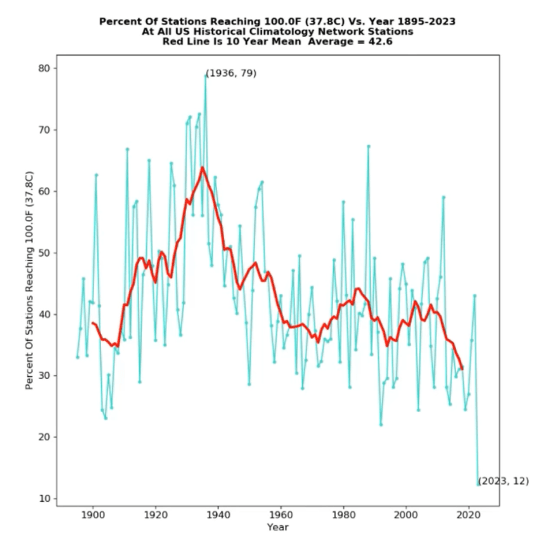
The graph above shows that since the mid 1930s, the number of U.S. weather stations recording at least 38°C (100°F) has fallen by half. In addition, it shows the trend sharply decreasing since the turn of the century. People in authority, argues Heller, are pushing for the demise of fossil fuels using fake statistics and blood-red maps. The red fires of hell, he suggests, have always been used to scare the public into conforming.
Chris Morrison is the Daily Sceptics Environment Editor.
The FBI Told Twitter The Hunter Biden Laptop Story Was Real The Day The Story Broke, New Testimony Shows
By Christina Maas | Reclaim The Net | July 20, 2023
In newly unveiled testimony, Laura Dehmlow, section chief of the FBI’s Foreign Influence Task Force (FITF), disclosed that the FBI was aware of the authenticity of Hunter Biden’s laptop as early as 2019. However, the Bureau declined to affirm its legitimacy to major tech companies during the 2020 election period.
That was already known. But it turns out that on the day the New York Post broke its report about the laptop, the FBI confirmed its validity to Twitter, only to retract their statement with a hasty “no further comment” response. From that point forward, the Bureau withheld comment on the laptop’s veracity to other tech giants, leading to widespread confusion and speculation ahead of the 2020 election.
According to a letter to FBI Director Christopher Wray by House Judiciary Committee Chairman Jim Jordan, Dehmlow revealed in her testimony that FBI staff, who had been warning social media platforms of potential Russian interference via a “hack and leak” operation prior to the 2020 election, were aware that the Hunter Biden laptop story was not an instance of Russian disinformation.
We obtained a copy of the letter for you here.
When Twitter inquired about the laptop’s legitimacy on the day of the New York Post’s release, an FBI analyst confirmed its authenticity. However, an FBI attorney swiftly interrupted, leaving the conversation with “no further comment.” Following suit, Facebook also received the same vague response from the Bureau.
As per Dehmlow’s account, Twitter, after receiving initial confirmation about the laptop’s legitimacy, joined Facebook in imposing a censorship campaign that significantly influenced the voting behavior of a large number of Americans. Sharing the link was prohibited on Twitter, and the New York Post account was locked for several weeks. Facebook reduced the story’s visibility as well.
The FBI reportedly had regular interactions with major tech companies leading up to the election but chose to avoid answering direct questions about the laptop’s authenticity after the initial admission to Twitter.
In the backdrop of this confusing narrative, Big Tech was led to believe, by the FBI and other influencers, including the Biden campaign, that the controversial information from Hunter Biden’s laptop was Russian disinformation aimed at manipulating the election. When, in reality, many consider the censorship of the story to be the true attempt at election manipulation.
The FBI had possession of Hunter Biden’s infamous laptop as early as December 2019, a fact confirmed in Gary Shapley’s testimony, an IRS whistleblower, to the House Ways and Means Committee. Yet the FBI chose to maintain its “no comment” narrative until after the 2020 election, further compounding the confusion.
A federal judge’s memorandum ruling in Missouri v. Biden demonstrated that this approach deprived millions of Americans from getting a clear understanding of an important issue in the 2020 presidential election.
Chairman Jordan is now demanding that Wray identify those within the FBI’s FITF who knew about the laptop’s authenticity yet still advocated for the agency to remain silent until after the election. He also demanded all documents, records, and communications related to the FBI’s meetings with Silicon Valley giants since 2017 be handed over by August 3 and that all FBI employees involved in this issue be available for transcribed interviews with the committee.
Report: FBI Analyst Conducted Improper Query of Senator’s Name in Surveillance Database
Sputnik – 21.07.2023
WASHINGTON – An analyst with the FBI conducted an improper search of a US senator’s name in a surveillance database, American media reported on Friday, as lawmakers weigh the future of the agency’s surveillance authorities.
The FBI analyst searched information collected using warrantless surveillance programs using the names of a US senator and a state senator, the report said, citing a recently declassified court document.
The June 2022 searches were reportedly conducted due to information indicating the lawmakers were potentially targeted by foreign intelligence agents. However, the analyst failed to receive approval from higher-ups before conducting a sensitive search involving public officials.
Moreover, the analyst failed to demonstrate the searches would be reasonably likely to produce foreign intelligence or criminal evidence, the report said.
It was also reported the declassified court document notes there is no reason to believe the FBI has improved its compliance with surveillance protocols.
The revelation comes as lawmakers in Congress weigh whether to extend the FBI’s surveillance authorities, following multiple allegations of misuse. US intelligence and national security officials have repeatedly defended the program and its importance to their missions.
Republicans Demand Biden Impeachment Over Bombshell FBI Doc Claiming POTUS Bribery

By Oleg Burunov – Sputnik – 21.07.2023
The POTUS and his son are investigated by the Republican-controlled House panel over allegations that they ran an illegal “pay-to-play” corruption scheme involving cash payments to Hunter Biden in exchange for access to his father while Biden was vice president.
Republicans have gone on Twitter to react to the release of an unclassified Federal Bureau of Investigation (FBI) document related to President Joe Biden’s alleged involvement in an international bribery scheme, with some GOP members calling for his impeachment.
They included Marjorie Taylor Greene, who called the 46th US president “a criminal, […] leading us into WW3.”
“Republicans can no longer delay, but we need 218 Republican votes to do it. I’ve been there since day one and so are the American people. IMPEACH BIDEN!!!” she added.
Greene was echoed by Anna Paulina Luna, who argued that Biden “needs to be impeached” because of the “evidence and testimony” that she had seen as a member of the House Oversight Committee investigating the Biden family finances. “He is compromised and his son is selling access to him,” Luna tweeted.
The same tone was struck by Lauren Boebert as she wrote that it’s necessary to “Read and understand just how deep the corruption goes,” and that “Biden should be thrown out of office. Impeach!”
Similar messages were shared by Jim Banks, who described the Bidens as the “Most corrupt family to ever live in the White House,” also urging for Joe Biden’s impeachment.
The reaction comes after Republican Senator Chuck Grassley released the FBI’s FD-1023 form on Thursday, which focused on how Biden, along with his son Hunter Biden, ostensibly “coerced” chief executive of the Ukrainian energy company Burisma Nikolai Zlochevsky to pay them $5 million each in exchange for their help in getting a Ukrainian prosecutor investigating the firm fired.
The document pertains to the FBI’s interview with a “highly credible” confidential source who detailed multiple meetings and conversations he or she had with Zlochevsky over the course of several years starting in 2015. During those gatherings, the Burisma CEO at one point reportedly said that Joe Biden’s son “was stupid”, and that “his [Zlochevsky’s] dog was smarter.”
Hunter sat on the board of Burisma at the time while his father served as Barack Obama’s vice president.
Grassley, for his part, stressed that he released the document so that Americans can read it “for themselves without the filter of politicians or bureaucrats.” The senator acquired the form via legally protected disclosures by Justice Department whistleblowers, according to the senator’s office.
The FBI responded with a sharply worded statement, slamming GOP lawmakers for ignoring the bureau’s “significant concerns” about the dangers of releasing the material.
“We have repeatedly explained to Congress, in correspondence and in briefings, how critical it is to keep this source information confidential. […] Today’s release of the 1023 – at a minimum – unnecessarily risks the safety of a confidential source,” the FBI statement said.
The developments follow US Internal Revenue Service investigator Joseph Ziegler telling lawmakers he discovered Hunter Biden and his business associates received $17 million from foreign sources, including $7.3 million from Burisma, during a probe he described as hindered by senior Justice Department officials.
Ziegler had remained anonymous until his appearance at a House oversight committee hearing on Wednesday that was convened over Republican allegations that President Biden and his son Hunter were involved in a bribery scheme with Burisma.
Hunter Biden’s attorneys and the US Justice Department announced last month an agreement under which he will plead guilty to misdemeanor tax charges and enter a pretrial diversionary agreement on a felony firearms offense in an effort to resolve the criminal probe against him and avoid prison time.
Since 2018, the First Son has been under a series of investigations into tax-related crimes, drug use, money laundering and illegal business dealings in foreign countries, including Ukraine and China. Investigators are specifically looking into the content of Hunter Biden’s so-called “laptop from Hell”, which purportedly included naked photos and graphic videos of the 46th president’s son.
Featured Video

Trita Parsi: Middle East Unraveling — Are We on the Path to World War?
or go to
Aletho News Archives – Video-Images
From the Archives
Trans agenda is ‘normalization of sadism’ – US author
RT | September 23, 2026
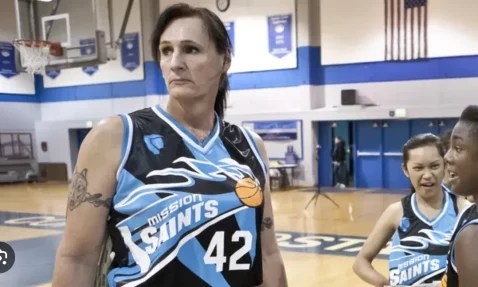
The US Democratic Party has embraced a transgender agenda that amounts to “the normalization of sadism,” author A.J. Rice has said, warning that radical trans policies would return if the party is allowed to regain power.
Speaking to RT’s America First host Scotty Nell Hughes about his new book, ‘The Curse of the Bearded Lady: How the Trans Mafia Whacked American Sanity’, Rice argued that activists have gained significant influence in schools, medicine, and corporate America while people who questioned the agenda have faced pressure to stay silent.
The author described the “trans mafia” as the sprawling network of people and institutions that have helped the movement gain influence. He singled out parts of academia, wealthy backers, and corporations, and stated that providers of transition-related treatment also have a financial incentive to keep young people in their care indefinitely.
Rice argued that the consequences of these policies ultimately fall on children who are being drawn toward gender-affirming medical treatments and on girls who are expected to share locker rooms or compete in sports with biological males.
He noted that while voters rejected the Democrats’ approach to gender in 2024, the party, which has been “captured by madness,” has since only doubled down and is seeking what is effectively “the normalization of sadism.” … Full article
Blog Roll
 Aletho News
- French-Lebanese man files war crimes complaint over Israeli attacks
- Mahan Air Flight Lands in China Despite US Threat against Iranian Airlines
- US eyes $10bn fund to rebuild war-battered Gulf infrastructure
- Trump meets Rodríguez near Maduro’s prison as Venezuela’s oil flows to US
- Trita Parsi: Middle East Unraveling — Are We on the Path to World War?
- Iran FM meets with US envoy on UN meeting’s sidelines at American side’s insistence: Report
- Qatar PM calls for Gulf security framework with Iran, says war must be ‘wake-up call’
- China condemns US extortion of Iranian airlines, rejects Washington’s ‘illegal’ sanctions threats
- Italy to move military personnel from Taif base after missile strike
- Finland’s Stubb tells European leaders to calm down
- If Americans Knew
- As Gaza languishes, world leaders gather at the UN – Daily Update
- Sanctions are collective punishment: immoral and self-defeating
- Phosphorus Munitions Fired by Israel Burn Groves, Orchards in Southern Lebanon
- Israel Carries Out New Ceasefire Violations Across Gaza
- AI – Emphasis on the ‘I’: Israel Is Funding AI Chatbot Propaganda
- Israel Blocking Hundreds of Wheelchairs for Injured Children From Entering Gaza
- Israel Is Expanding and Upgrading Compounds for Palestinian Militias in Gaza
- The Palestinian-American Residents of This West Bank Town Are Wondering: Where Is Trump?
- Gaza desperately needs tents, wheelchairs, fuel… and everything else (Israel blocks it all) – Daily Update
- Israeli Attacks in Gaza Kill at Least Seven Palestinians Over Three Days, including Woman and Child
- No Tricks Zone
- New Study: Earth And Venus Surface Warmth Largely Explained By Convection And Lapse Rate, Not CO2 Or Radiation
- 2025 Nature Paper Claiming Worsening Global Drought Gets RETRACTED …Heavily Flawed
- New Study: ‘Global Drought Shows No Detectable Recent Acceleration Under Climate Warming’
- Economic Masterminds: German Socialists Suggest Taxing Productivity Gains Stemming From Using AI
- The South China Sea Has Not Been Cooperating With The Climate Change Narrative
- Energy Crisis: Germany Enters Heating Season With Historically Low Gas Reserve Fill Levels
- New Study: The Antarctic Ice Sheet Gained Mass From 2020-2024 Due To Staggering Snow And Ice Accumulation
- Study: Ocean Heating Rates From Thousands Of Years Ago ‘Dwarf’ Modern Ocean Heating Rates
- Climate Extremists Target, Attack Large-Scale Power Grid Infrastructure In Germany!
- New Study: Antarctic Ice Melt Has Contributed Less Than 1 Centimeter To Sea Level Rise In The Last 30 Years

