Contractors working for the United States who ran the so-called ‘Cuban Twitter’ social media project categorized user responses to overtly political messages for “receptiveness” and “political tendencies,” among other details, according to a new report.
The US State Department’s Agency for the International Development (USAID) employed contractors to foster political unrest – while avoiding Cuba’s internet restrictions – through the subscription-based text-messaging service ZunZuneo, AP reported earlier this month.
Documents obtained by AP said ZunZuneo was designed to start with fairly benign messaging. Once it was more widespread among the Cuban population, it would introduce political content that would attempt to inspire Cubans to “renegotiate the balance of power between the state and society.”
Despite the State Department’s assertions that the program was not used to influence political leanings, AP reported Wednesday that cell phone users were categorized in databases as being “pro-revolution,” “apolitical,” or “anti-revolutionary.”
One young contractor working on the project was Paula Cambronero, whose first job out of college was working on how Cubans interacted with ZunZuneo messages carefully – and quietly – sent from Spanish phone numbers. The contractor asked Cambronero to communicate with staff over encrypted channels, and emails were sent from a domain name “not publicly linked” to the contractor.
Her employer – not named by AP – told her that she would be dealing with a “considerable amount of sensitive information that must be safeguarded to protect critical operations of the Project.” USAID even established a dummy company in the Cayman Islands to cover any money trail associated with ZunZuneo.
Cambronero’s responsibility was to build a database of unsuspecting Cuban cell phone users that responded to ZunZuneo messages, using classifications like gender, age, location, “receptiveness,” and “political tendencies.” She would analyze how users reacted to overtly political messages written by a hired Cuban satirist that poked at the nation’s leaders.
Cambronero did not respond to AP’s request for comment. The State Department had no comment to AP on Wednesday.
On Tuesday, USAID spokesman Matthew Herrick told AP that the agency had reviewed the project and offered congressional investigators the selection of messages sent to Cubans.
Herrick claimed the 249 different messages focused on sports, technology, world news, and trivia, and that the messages “were consistent with the objective of creating a platform for Cubans to speak freely among themselves.”
The political messages crafted by the satirist were sent “under a grant that pre-dated the ZunZuneo project,” Herrick said.
Yet documents reviewed by AP show that USAID considered the grant a “test phase” of the network that would become ZunZuneo.
Overall, Cambronero collected more than 700 responses to text messages, analyzing them by two variables: the level of interest in the received messages and the political content of a response.
She found that 68 percent of responses exhibited mild interest in the ZunZuneo texts. Many responses – 210 total – wanted to know who was sending the anonymous message.
“Explain your point better because I don’t understand and remember that if you haven’t done anything you shouldn’t fear anything, at least tell me your name if you’re not a coward,” said one respondent.
Others asked for help in obtaining birth certificates of Spanish ancestors, a prerequisite for acquiring a Spanish passport to leave Cuba.
Only 59 responses were analyzed for political content. Cambronero found 10 that did have “political character,” AP reported, “of which two were counter-revolutionary.”
In her notes, Cambronero recommended that “messages with a humorous connotation should not contain a strong political tendency, so as not to create animosity in the recipients.”
Upon the ZunZuneo revelations, the Obama administration quickly came under attack and promptly denounced allegations that it covertly plotted to disrupt Cuban politics.
Condemnation of the program continues to emerge. In Costa Rica, where ZunZuneo was reportedly developed by American officials, the nation’s foreign minister Enrique Castillo said last week that not only does he think it was “inappropriate” for the US to use his country to conduct the project, but that he previously warned officials not to involve his Central American country in the endeavor due to fears it would strain Costa Rica’s own relationship with Cuba.
“I think it’s inappropriate to use an embassy in Costa Rica for this type of operation that harms a third country,” Castillo told the AP. “We’re not filing a complaint. The point is that embassies accredited in Costa Rica don’t have to submit their plans or programs for the Costa Rican government’s approval.”
Costa Rica’s minister of communications, Carlos Roverssi, said Wednesday that it will fall on the country’s recently elected government to deal with the matter from here on out.
“It seems to me that the issue is now public and the next government should follow up on the issue, without a doubt,” he said.
The US State Department has begun a review of the program, saying it would be “troubling” if ZunZuneo involved political messaging.
May 1, 2014
Posted by aletho |
Deception | Cuba, Social networks, USA |
Leave a comment
Afghanistan President Hamid Karzai says the United States and Britain continue running “illegal” detention facilities in the country.
“After many decrees that have been issued by the presidential palace about not having any detention centers run by foreign forces, still foreign forces are detaining Afghan and putting them in prisons,” Karzai said in a statement on Tuesday.
“It’s a clear violation of the law of Afghanistan,” he added.
Karzai’s remarks came after an investigation panel revealed that six Afghan prisoners are held at a UK-run facility at Kandahar Air Field in the country’s south and 17 others at a facility at Camp Bastion in Helmand Province, which is also run by British forces.
Ghalum Farooq Barakzai, the head of the panel, said that his team has not found any prisoners at the American facilities, stressing that such facilities should no longer exist.
Under pressure from Afghan President, the US signed an agreement with Kabul to transfer its prisons and inmates into Afghan custody. British forces in the country are only allowed to hold suspects for 96 hours and can detain them longer only in exceptional conditions.
Barakzai called on Britain to hand over any Afghans held in the facilities, saying that the 23 inmates detained ranging from several weeks to 31 months.
“All the detainees should be transferred to Afghan security forces in the areas where they were arrested. Then the judicial officials in that area will investigate them and put them on trial. If they are guilty they should be jailed, if they are innocent they should be freed,” he also said.
Earlier this year, Afghan government freed dozens of detainees held in the US-run Bagram prison.
In November 2012, President Karzai ordered Afghan forces to take control of the prison and accused US officials of failing to fully comply with the terms of the Memorandum of Understanding on Detentions signed between Kabul and Washington.
April 30, 2014
Posted by aletho |
Deception, Illegal Occupation, Supremacism, Social Darwinism | Afghanistan, Human rights, UK, United States |
Leave a comment
The fool is John Kerry, who has looked bad in his rushing around between Washington and Tel Aviv trying to get in place a “framework” agreement between Israel and the Palestinians that would show progress in the efforts of the honest broker, assailing Nicholas Maduro of Venezuela for his “terror campaign against his own people,” and, of course, denouncing the Russians for their “aggression” against the coup-regime of Ukraine. His statement that “You just don’t in the 21st century behave in 19th century fashion by invading another country on a completely trumped-up pretext,” has to be regarded as an Orwellian classic, and may be his signifier in future history books, in the unlikely event that he makes it at all. His punch line has been the subject of many jokes and laughs in the dissident media, but the mainstream media have hardly mentioned it and certainly haven’t made it the butt of jokes and a basis for discrediting the man (just as there has been no discrediting of Madeleine Albright based on her statement on national TV that killing 500,000 Iraqi children via the sanctions of mass destruction in the 1990s, which she helped engineer, “was worth it”).
Of course, it is possible that Kerry really believed he was speaking truths, having internalized the assumptions that flow from U.S. “exceptionalism,” which make words like “invasion,” “aggression” and “international law” inapplicable to us as the world’s policeman; and what might be a “completely trumped up pretext” if offered by the Russians is only a slight and excusable error or misjudgment when we do it. And after all the New York Times quickly used the word “aggression” in editorializing on the Crimea events (“Russia’s Aggression,” March 2, 2014), whereas it never used the word to describe the invasion-occupation of Iraq, nor did it mention the words “UN Charter” or “international law” in its 70 editorials on Iraq from September 11, 2001 to March 21, 2003.1
A bit more subtle but more calculated, dishonest, hypocritical, often absurd, and demagogic were the words of President Barack Obama, speaking in Belgium, as he tried to confute the charges of hypocrisy that Russian President Vladimir Putin leveled against Western denunciations of the Crimean independence vote and subsequent Russian absorption of Crimea. (“Remarks by the President in Address to European Youth,” Brussels, March 23, 2014). It is amusing to see how outrageously he can twist history and his own record. According to Obama our founding fathers put into our “founding documents” the beautiful concept that “all men—and women—are created equal.” He apparently forgot about slavery and the 3/5th value per slave for the South’s representation credit, and that women didn’t get the vote till the twentieth century. He speaks about the ideal of “uncensored information” that will “allow individuals to make their own decisions,” but this is the man who has worked hard to control the flow of information and to make it costly for whistleblowers to break through a growing wall of government secrecy.
Obama is aghast at “the belief among some that bigger nations can bully smaller ones to get their way—that rejected maxim that might somehow makes right.” The United States has its immense military budget and 800-plus military bases not to allow it to bully smaller nations but for its national security! He is also impressed with Russia’s “challenging truths that only a few weeks ago seemed self-evident… [including] that international law matters.” This statement is brazen given that U.S. officials (e.g., Dean Acheson, Madeleine Albright) have explicitly stated that they don’t take international law seriously in fixing U.S. policy; that Obama’s predecessor George W. Bush dismissed it as a joke — “International law? I better call my lawyer; he didn’t bring that up to me” — and we can observe a steady, even growing, stream of actions that violate international law, including many engineered by Obama. Violating international law is as American as apple pie.
Putin, of course, pointed this out in reference to Iraq, but Obama answers him: ”Now it is true that the Iraq war was a subject of vigorous debate not just around the world but in the United States as well. I participated in that debate and I opposed our military intervention there. But even in Iraq, America sought to work within the international system. We did not claim or annex Iraq’s territory. We did not grab its resources for our own gain. Instead we ended our war and left Iraq to its people and a fully sovereign Iraqi state that could make decisions about its own future.”
We may note the laughable evasion of the issue of “international law,” which he has said really “matters” in considering Russian actions, but dodges in addressing the U.S. case. His mentioning a “vigorous debate” is not only irrelevant to the question of law violation, it is also highly deceptive, as it is well established that Bush and his small coterie of advisers had determined to attack Iraq long before any public discussion of the subject, and they picked on “weapons of mass destruction” as the excuse on the basis of its saleability. So it was an aggression built on a lie and then ultimately in a “trumped up case.” On the “working within the international system,” the UN Charter is basic to a meaningful international system, and the invasion was a gross violation of that key ingredient. He brags that we didn’t steal their resources and eventually got out. He doesn’t point out that we got out only after many years of killing and destruction which actually helped create a resistance that, in effect, pushed us out. He doesn’t mention that our major international law violation in Iraq was responsible for the death of probably a million people, the creation of four million refugees, and huge material destruction. By contrast, that awful Russian action in the Crimea seems to have resulted in fewer than half a dozen deaths.
Obama also fails to mention that Iraq is far away from the United States, and the U.S. attack there was an acknowledged “war of choice” that had nothing to do with protecting U.S. security. Crimea, by contrast, is adjacent to Russia, its people are linguistically and culturally close to Russia, it houses a major Russian naval base, and the coup in Kiev, engineered with the support of the United States and other NATO powers, posed a genuine security threat to Russia. Its leaders were taken unawares by the coup and threat to its naval base, and its moves were arguably defensive and a “war of necessity.”
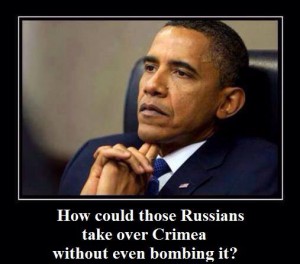 The referendum carried out in Crimea, which produced an overwhelming vote supporting secession from Ukraine and integration into Russia, would seem like a relatively democratic procedure and consistent with the principle of self-determination. Obama and company found it a violation of Ukraine’s sovereignty and a violation of international law. Here we have two principles seemingly at odds with one another, and in this case the United States and its allies chose the one that serves their interest and the Russians go for the other. But Putin points out that in the case of Kosovo as part of Serbia, the NATO alliance strongly supported a secession on self-determination principles.
Obama tries to rebut Putin’s mentioning of Kosovo, saying “But NATO only intervened after the people of Kosovo were systematically brutalized and killed for years. And Kosovo only left Serbia after a referendum was organized not outside the boundaries of international law, but in careful cooperation with the United Nations and with Kosovo’s neighbors. None of that even came close to happening in Crimea.” But NATO didn’t just “intervene,” it carried out a massive bombing war that was itself a violation of the UN Charter and hence of that sacred “international law” to which Obama is so devoted. Obama ignores the fact that the CIA had been training KLA terrorists in Kosovo for some time (and they had been designated “terrorists” by U.S. officials) and the KLA was well aware that actions that induced Serb retaliation would serve their interests in helping justify a NATO attack. The day before the NATO bombing war began the British Defence Minister told the British Parliament that the KLA had probably killed more civilians in Kosovo than the Serb army.
Obama also lies on an alleged referendum in Kosovo—none took place. On February 17, 2008, the Kosovo Albanian-dominated parliament issued its Declaration of Independence, and that sufficed for the United States and its closest allies, now so indignant at the Crimea referendum. That Kosovo vote also took place after a NATO war and Kosovo Albanian actions had driven large numbers of Serb and Roma residents out of Kosovo. The United States constructed a huge military base in Kosovo during its war and occupation of Kosovo, which was not agreed to by Serbia or by any vote of the Kosovo or Serbian population. Russia had a naval base in the Crimea by long-standing agreement with the Ukraine government. It didn’t bomb the Ukraine as a prelude to the referendum vote and the vote was essentially uncontested and unprotested by any local constituencies. So as Obama says, there is no comparison between the two cases.
Obama draws a picture of the freedom loving West, with NATO standing as a vigilant sentinel, with the dark and evil forces behind the Iron Curtain being kept at bay. “The United States and NATO do not seek any conflict with Russia… Since the end of the Cold War, we have worked with Russia under successive administrations to build ties of culture and commerce and international community.” But he admonishes that Russia must be a “responsible” power. “Just because Russia has a deep history with Ukraine doesn’t mean it should be able to dictate Ukraine’s future. On the fundamental principle that is at stake here—the ability of nations and peoples to make their own choices—there can be no going back. It’s not America that filled the Maiden with protesters—it was Ukrainians. No foreign forces compelled the citizens of Tunis and Tripoli to rise up—they did so on their own.”
Obama fails to mention that since the end of the Cold War NATO has worked steadily, in violation of a pledge by U.S. officials not to move “one inch” toward the Russian borders, to encircle Russia, to press up against its borders, and to support border regime leaders openly hostile to Russia. So Western support of a regime hostile to Russia in Ukraine would have to be regarded by Russian officials as an unfriendly and threatening action. Obama’s claim that it was only Ukrainians who were protesting in Maiden twists the evidence, as the United States was actively supporting some of them, including the most violent, and was therefore itself trying to “dictate Ukraine’s future.” It is notorious that a compromise transition government plan negotiated between Ukrainian factions, with EU support, was quickly overturned by violent protesters, leading immediately to the coup government headed by Victoria Nuland’s first choice, and effectively “fucking the EU’s” effort to end the strife peaceably. The unelected government then in place, loaded with right wingers in strategic positions, represented a non-Russian “dictation” of Ukraine’s government, and one that definitely threatened Russians within Ukraine and the Russian state. In that context the Crimean referendum represented an important and justifiable case of where the ability of “peoples to make their own choices” (Obama) was applicable.
An argument can be made that the Western, and mainly U.S., intervention and role in overthrowing the elected government of Ukraine was a form of aggression against Russia, which would make Russian actions actually a response to aggression. An important modern form of Western-sponsored regime change has been via encouragement, training and material and propaganda aid to dissident groups that disorganize and discredit a target government and help dislodge it from power. This is done under the PR heading of “democracy promotion,” but it is often de facto “democracy demotion.” This is not done in Bahrain or Saudi Arabia, but rather in Serbia, Ukraine and Venezuela. The government displaced in Ukraine was elected; the coup government that has replaced it was not. In his Brussels speech Obama mentions that ”Latin American nations rejected dictatorship and built new democracies,” but he fails to point out that scads of those dictatorships were U.S. sponsored, and that while it supported tyranny in Venezuela for many years, the United States has been consistently hostile to the left-oriented Bolivarian democracy that has been in place for more than a decade; and that while Obama was speaking in Brussels his government was encouraging the often violent protesters in Caracas, denouncing Maduro, and threatening sanctions and more in the traditional U.S. “democratic demotion” mode. (See Kerry’s pugnacious statement of March 13, 2014 before the House Foreign Affairs Committee on “Advancing U.S. Interests Abroad: The FY 2015 Foreign Affairs Budget.”)
Comparing Vladimir Putin’s address to the Russian Federation on March 18, 2014 dealing with the Crimean referendum and associated crisis with Obama’s March 23rd address in Brussels is no contest—Putin wins hands down. This, I believe, is a result of the fact that Russia is under serious attack and threat by the United States, which is a still expanding empire that cannot tolerate serious rivals and actually turns them into enemies that must resist. This is mainly Russia and China, and U.S.-NATO actions have succeeded in transforming Russia from a virtual client in the Yeltsin era to the enemy and ”aggressor” today. It is amazing to see how the mainstream media and intellectuals can fail to see the security threat to Russia posed by the Western-underwritten change in government in Kiev, and the continuity in the extension of this threat in NATO’s steady expansion on Russia’s borders. And the double standard on aggression and international law is breath-taking. Putin sardonically notes , “Firstly, it’s a good thing that they at least remember that there exists such a thing as international law—better late than never.” He makes his point in low key and with wit. Obama is never funny in Brussels and his stream of clichés and misrepresentations is painful. He is defending the indefensible, and his target looks good by comparison, both intellectually and morally.
But Putin is the loser in mainstream America. He is a victim of the standard demonization process that is applied to any challenger or target of the imperial state. It is amusing to see him so often referred to as the “former KGB colonel”—can you imagine the U.S. media regularly referring to George Bush-1 as the “former head of the CIA”? And, of course, every blemish in his career, and they are real—Chechnya, his position on gay rights, the weakness of Russian democracy and power of the oligarchs (which he inherited from the U.S.-supported Yeltsin)—is featured regularly. But underneath this all is the fact that he represents Russian national interests, which conflict with the outward drive and interests of the U.S. imperial elite.
For just a tiny illustration of the bias. We may consider the media treatment of the Pussy Riot band, jailed after an action in a major Moscow church, and made into virtual saints in the U.S. media. They feature the badness of Putin and his Russia. The New York Times had 23 articles featuring the Pussy Riot band from January 1, 2014 through March 31, a number of them with pictures of the band visiting various places in New York. They met with the Times editorial board and were honored by Amnesty International and Human Rights Watch, among others. They are not good musicians and often do things that would land them in jail in the United States, but they denounce Putin.
One of them, Maria Alyokhina, was even given op ed space in the paper (“Sochi Under Siege,” February 21). Two interesting contrasts: John Mearsheimer, a University of Chicago political scientist and author of several important books on foreign affairs, wrote an op ed column “Getting Ukraine Wrong,” published on March 14 in the International New York Times, but not in the U.S. print edition. His message was too strong for the main NYT vehicle as he argued that “The taproot of the current crisis is NATO’s expansion… and is motivated by the same geopolitical considerations that influence all great powers, including the United States.” This is not opinion and analysis fit to print.
Another interesting comparison is this: in February 2014, while the trials and opinions of Pussy Riot were hot news, the 84 year old nun, Sister Megan Rice, was sentenced to four years in prison for having entered a nuclear weapons site in July 2012 and carried out a symbolic action there. The New York Times gave this news a tiny mention in its National Briefing items under the title “Tennessee Nun is Sentenced for Peace Protest,” on February 19, 2014 on page A12. Megan Rice was not invited to visit the Times editorial board or write an opinion column. Her sentencing was news barely fit to even marginalize.
April 30, 2014
Posted by aletho |
Deception, Mainstream Media, Warmongering, Progressive Hypocrite |
Leave a comment

This Wednesday evening there is to be a “Public Information Session and Discussion” (pdf) about TISA: the Trade in Services Agreement. If, like me, you’ve never heard of this, you might think it’s a new initiative. But it turns out that it’s been under way for more than a year: the previous USTR, Ron Kirk, informed Congress about it back in January 2013 (pdf). Aside from the occasional laconic press release from the USTR, a page put together by the Australian government, and a rather poorly-publicized consultation by the European Commission last year, there has been almost no public information about this agreement. A cynic might even think they were trying to keep it quiet.
Perhaps the best introduction to TISA comes from the Public Services International (PSI) organization, a global trade union federation representing 20 million people working in public services in 150 countries. Last year, it released a naturally skeptical brief on the proposed agreement (pdf):
At the beginning of 2012, about 20 WTO members (the EU counted as one) calling themselves “The Really Good Friends of Services” (RGF) launched secret unofficial talks towards drafting a treaty that would further liberalize trade and investment in services, and expand “regulatory disciplines” on all services sectors, including many public services. The “disciplines,” or treaty rules, would provide all foreign providers access to domestic markets at “no less favorable” conditions as domestic suppliers and would restrict governments’ ability to regulate, purchase and provide services. This would essentially change the regulation of many public and privatized or commercial services from serving the public interest to serving the profit interests of private, foreign corporations.
The Australian government’s TISA page fills in some details:
The TiSA negotiations will cover all services sectors. In addition to improved market access commitments, the negotiations also provide an opportunity to develop new disciplines (or trade rules) in areas where there has been significant developments since the WTO Uruguay Round negotiations. There negotiations will cover financial services; ICT services (including telecommunications and e-commerce); professional services; maritime transport services; air transport services, competitive delivery services; energy services; temporary entry of business persons; government procurement; and new rules on domestic regulation to ensure regulatory settings do not operate as a barrier to trade in services.
If that sounds familiar, it’s because very similar language is used to describe TAFTA/TTIP, which aims to liberalize trade and investment, to provide foreign investors with access to domestic markets on the same terms as local suppliers, to limit a government’s ability to regulate there by removing “non-tariff barriers” — described above as “regulatory settings” — and to use corporate sovereignty provisions to enforce investors’ rights.
Those similarities suggest TISA is part of a larger plan that includes not just TAFTA/TTIP, but TPP too, and which aims to cement the dominance of the US and EU in world trade against a background of Asia’s growing power. Indeed, it’s striking how membership of TISA coincides almost exactly with that of TTIP added to TPP:
The 23 TiSA parties currently comprise: Australia, Canada, Chile, Chinese Taipei, Colombia, Costa Rica, European Union (representing its 28 Member States), Hong Kong, Iceland, Israel, Japan, Liechtenstein, Mexico, New Zealand, Norway, Pakistan, Panama, Paraguay, Peru, Republic of Korea, Switzerland,, Turkey and the United States.
Once more, the rising economies of the BRICS nations — Brazil, Russia, India, China, South Africa — are all absent, and the clear intent, as with TTIP and TPP, is to impose the West’s terms on them. That’s explicitly recognized by one of the chief proponents of TISA, the European Services Forum:
the possible future agreement would for the time being fall short of the participation of some of the leading emerging economies, notably Brazil, China, India and the ASEAN countries. It is not desirable that all those countries would reap the benefits of the possible future agreement without in turn having to contribute to it and to be bound by its rules.
The Australian government’s page reveals that there have already been five rounds of negotiations — all held behind closed doors, of course, just as with TTIP and TPP. The Public Information Session taking place in Geneva this week seems to mark the start of a new phase in those negotiations, at least allowing some token transparency. Perhaps this has been provoked by the growing public anger over the secrecy surrounding TPP and TAFTA/TTIP, and fears that the longer TISA was kept out of the limelight, the worse the reaction would be when people found out about it.It seems appropriate, then, that the unexpected unveiling of this new global agreement should be greeted not only by an updated and more in-depth critique from the PSI — “TISA versus Public Services” — but also the first anti-TISA day of protest. Somehow, I don’t think it will be the last.
Follow me @glynmoody on Twitter or identi.ca, and +glynmoody on Google+
April 29, 2014
Posted by aletho |
Deception, Economics | BRICS, Canada, European Union, TISA, TPP, Trade in Services Agreement, United States |
Leave a comment
Back in April 2011, I had a post on The U.S. House of Representatives Hearing on Climate Change: Examining the Processes Used to Create Science and Policy. John Christy’s testimony is worth revisiting, in two contexts:
- problems with the IPCC process, most recently highlighted in context of WG3 [link]
- the Steyn versus Mann and Mann versus Steyn lawsuits [link]
John Christy has a unique perspective on how the hockey stick became the icon of the Third Assessment Report (TAR) – he served as a Lead Author (along with Michael Mann) on Chapter 2 Observed Climate Variability and Change. Relevant excerpts from Christy’s testimony:
In simplified terms, IPCC Lead Authors are nominated by their countries, and downselected by the IPCC bureaucracy with help from others (the process is still not transparent to me – who really performs this down-select?) The basic assumption is that the scientists so chosen as Lead Authors (L.A.s) represent the highest level of expertise in particular fields of climate science (or some derivative aspect such as agricultural impacts) and so may be relied on to produce the most up-to-date and accurate assessment of the science. In one sense, the authors of these reports are volunteers since they are not paid. However, they do not go without salaries. Government scientists make up a large portion of the author teams and can be assigned to do such work, and in effect are paid to work on the IPCC by their governments. University scientists aren’t so lucky but can consider their IPCC effort as being so close to their normal research activities that salary charges to the university or grants occur. Travel expenses were paid by the IPCC for trips, in my case, to Australia, Paris, Tanzania, New Zealand, Hawaii, and Victoria, Canada. Perhaps it goes without saying that such treatment might give one the impression he or she is an important authority on climate.
As these small groups of L.A.s travel the world, they tend to form close communities which often re-enforce a view of the climate system that can be very difficult to penetrate with alternative ideas (sometimes called “confirmation bias” or “myside bias”.) They become an “establishment” as I call them. With such prominent positions as IPCC L.A.s on this high profile topic, especially if they support the view that climate change is an unfolding serious disaster, they would be honored with wide exposure in the media (and other sympathetic venues) as well as rewarded with repeated appointments to the IPCC process. In my case, evidently, one stint as an L.A. was enough.
The second basic problem (the first was the murkiness of our science) with these assessments is the significant authority granted the L.A.s. This is key to understanding the IPCC process. In essence, the L.A.s have virtually total control over the material and, as demonstrated below, behave in ways that can prevent full disclosure of the information that contradicts their own pet findings and which has serious implications for policy in the sections they author. While the L.A.s must solicit input for several contributors and respond to reviewer comments, they truly have the final say.
In preparing the IPCC text, L.A.s sit in judgment of material of which they themselves are likely to be a major player. Thus they are in the position to write the text that judges their own work as well as the work of their critics. In typical situations, this would be called a conflict of interest. Thus L.A.s, being human, are tempted to cite their own work heavily and neglect or belittle contradictory evidence (see examples below.) In the beginning, the scientists who wrote the IPCC assessment were generally aware of the new responsibility, the considerable uncertainties of climate science, and that consequences of their conclusions could generate burdensome policies. The first couple of reports were relatively cautious and rather equivocal.
In my opinion, as further assessments were created, a climate “establishment” came into being, dominating not only the IPCC but many other aspects of climate science, including peer-review of journals. Many L.A.s became essentially permanent fixtures in the IPCC process and rose to positions of prominence in their institutions as a side benefit. As a result, in my view, they had a vested interest in preserving past IPCC claims and affirming evermore confident new claims to demonstrate that the science was progressing under their watch and that financial support was well spent. Speaking out as I do about this process assured my absence of significant contribution on recent and future reports. Political influence cannot be ignored. As time went on, nations would tend to nominate only those authors whose climate change opinions were in line with a national political agenda which sought perceived advantages (i.e. political capital, economic gain, etc.) by promoting the notion of catastrophic human-induced climate change. Scientists with well-known alternative views would not be nominated or selected. Indeed, it became more and more difficult for dissension and skepticism to penetrate the process now run by this establishment. As noted in my InterAcademy Council (IAC) testimony, I saw a process in which L.A.s were transformed from serving as Brokers of science (and policy-relevant information) to Gatekeepers of a preferred point of view.
A focus evolved in the IPCC that tended to see enhanced greenhouse gas concentrations as the cause for whatever climate changes were being observed, particularly in the 2001(Third Assessment Report or TAR) which was further solidified in 2007, (the Fourth Assessment Report or AR4.) The IAC 2010 report on the IPCC noted this overconfidence when it stated that portions of the AR4 contained “many vague statements of ‘high confidence’ that are not supported sufficiently in the literature, not put into perspective, or are difficult to refute.’” (This last claim relates to the problem of generating “unfalsifiable hypotheses” discussed in my recent House testimony.)
My experience as Lead Author in the IPCC TAR, Chapter 2 “Observed Climate Variability and Change”, allowed me to observe how a key section of this chapter, which produced the famous Hockey Stick icon, was developed. My own topic was upper air temperature changes that eventually drew little attention, even though the data clearly indicated potentially serious inconsistencies for those who would advocate considerable confidence in climate model projections.
First, note these key points about the IPCC process: the L.A. is allowed (a) to have essentially complete control over the text, (b) sit in judgment of his/her own work as well as that of his/her critics and (c) to have the option of arbitrarily dismissing reviewer comments since he/she is granted the position of “authority” (unlike peer-review.) Add to this situation the rather unusual fact that the L.A. of this particular section had been awarded a PhD only a few months before his selection by the IPCC. Such a process can lead to a biased assessment of any science. But, problems are made more likely in climate science, because, as noted, ours is a murky field of research – we still can’t explain much of what happens in weather and climate.
The Hockey Stick curve depicts a slightly meandering Northern Hemisphere cooling trend from 1000 A.D. through 1900, which then suddenly swings upward in the last 80 years to temperatures warmer than any of the millennium when smoothed. To many, this appeared to be a “smoking gun” of temperature change proving that the 20th century warming was unprecedented and therefore likely to be the result of human emissions of greenhouse gases.
I will not debate the quality of the Hockey Stick – that has been effectively done elsewhere (and indeed there is voluminous discussion on this issue), so, whatever one might think of the Hockey Stick, one can readily understand that its promotion by the IPCC was problematic given the process outlined above. Indeed, with the evidence contained in the Climategate emails, we have a fairly clear picture of how this part of the IPCC TAR went awry. For a more detailed account of this incident with documentation, see http://climateaudit.org/2009/12/10/ipcc-and-the-trick/.
We were appointed L.A.s in 1998. The Hockey Stick was prominently featured during IPCC meetings from 1999 onward. I can assure the committee that those not familiar with issues regarding reconstructions of this type (and even many who should have been) were truly enamored by its depiction of temperature and sincerely wanted to believe it was truth. Skepticism was virtually non-existent. Indeed it was described as a “clear favourite” for the overall Policy Makers Summary (Folland, 0938031546.txt). In our Sept. 1999 meeting (Arusha, Tanzania) we were shown a plot containing more temperature curves than just the Hockey Stick including one from K. Briffa that diverged significantly from the others, showing a sharp cooling trend after 1960. It raised the obvious problem that if tree rings were not detecting the modern warming trend, they might also have missed comparable warming episodes in the past. In other words, absence of the Medieval warming in the Hockey Stick graph might simply mean tree ring proxies are unreliable, not that the climate really was relatively cooler.
The Briffa curve created disappointment for those who wanted “a nice tidy story” (Briffa 0938031546.txt). The L.A. remarked in emails that he did not want to cast “doubt on our ability to understand factors that influence these estimates” and thus, “undermine faith in paleoestimates” which would provide “fodder” to “skeptics” (Mann 0938018124.txt). One may interpret this to imply that being open and honest about uncertainties was not the purpose of this IPCC section. Between this email (22 Sep 1999) and the next draft sent out (Nov 1999, Fig. 2.25 Expert Review) two things happened: (a) the email referring to a “trick” to “hide the decline” for the preparation of report by the World Meteorological Organization was sent (Jones 0942777075.txt, “trick” is apparently referring to a splicing technique used by the L.A. in which non-paleo data were merged to massage away a cooling dip at the last decades of the original Hockey Stick) and (b) the cooling portion of Briffa’s curve had been truncated for the IPCC report (it is unclear as to who performed the truncation.)
In retrospect, this disagreement in temperature curves was simply an indication that such reconstructions using tree ring records contain significant uncertainties and may be unreliable in ways we do not currently understand or acknowledge. This should have been explained to the readers of the IPCC TAR and specifically our chapter. Highlighting that uncertainty would have been the proper scientific response to the evidence before us, but the emails show that some L.A.’s worried it would have diminished a sense of urgency about climate change (i.e. “dilutes the message rather significantly”, Folland, 0938031546.txt.)
When we met in February 2000 in Auckland NZ, the one disagreeable curve, as noted, was not the same anymore because it had been modified and truncated around 1960. Not being aware of the goings-on behind the scenes, I had apparently assumed a new published time series had appeared and the offensive one had been superceded (I can’t be certain of my actual thoughts in Feb. 2000). Now we know, however, that the offensive part of Briffa’s curve had simply been amputated after a new realization was created three months before. (It appears also that this same curve was apparently a double amputee, having its first 145 years chopped off too, see http://climateaudit.org/2011/03/23/13321/.) So, at this point, data which contradicted the Hockey Stick, whose creator was the L.A., had been eliminated. No one seemed to be alarmed (or in my case aware) that this had been done.
Procedures to guard against such manipulation of evidence are supposed to be in place whenever biases and conflicts of interest interfere with duties to report the whole truth, especially in assessments that have such potentially drastic policy implications. That the IPCC allowed this episode to happen shows, in my view, that the procedures were structurally deficient.
Even though the new temperature chart appeared to agree with the Hockey Stick, I still expressed my skepticism in this reconstruction as being evidence of actual temperature variations. Basically, this result relied considerably on a type of western U.S. tree-ring not known for its fidelity in reproducing large-scale temperatures (NRC 2006, pg. 52).
At the L.A. meetings, I indicated that there was virtually no inter-century precision in these measurements, i.e. they were not good enough to tell us which century might be warmer than another in the pre-calibration period (1000 to 1850.)
In one Climategate email, a Convening L.A., who wanted to feature the Hockey Stick at the time (though later was less enthusiastic), mentions “The tree ring results may still suffer from lack of multicentury time scale variance” and was “probably the most important issue to resolve in Chapter 2” (Folland, 0938031546.txt). This, in all likelihood, was a reference to (a) my expressed concern (see my 2001 comments to NRC below) as well as to (b) the prominence to which the Hockey Stick was predestined.
To compound this sad and deceptive situation, I had been quite impressed with some recent results by Dahl-Jensen et al., (Science 1998), in which Greenland ice-borehole temperatures had been deconvolved into a time series covering the past 20,000 years. This measurement indeed presented inter-century variations. Their result indicated a clear 500-year period of temperatures, warmer than the present, centered about 900 A.D. – commonly referred to as the Medieval Warm Period, a feature noticeably absent in the Hockey Stick. What is important about this is that whenever any mid to high-latitude location shows centuries of a particularly large temperature anomaly, the spatial scale that such a departure represents is also large. In other words, long time periods of warmth or coolness are equivalent to large spatial domains of warmth or coolness, such as Greenland can represent for the Northern Hemisphere (the domain of the Hockey Stick.)
I discussed this with the paleo-L.A. at each meeting, asking that he include this exceptional result in the document as evidence for temperature fluctuations different from his own. To me Dahl-Jensen et al.’s reconstruction was a more robust estimate of past temperatures than one produced from a certain set of western U.S. tree-ring proxies. But as the process stood, the L.A. was not required to acknowledge my suggestions, and I was not able to convince him otherwise. It is perhaps a failure of mine that I did not press the issue even harder or sought agreement from others who might have been likewise aware of the evidence against the Hockey Stick realization.
As it turned out, this exceptional paper by Dahl-Jensen et al. was not even mentioned in the appropriate section (TAR 2.3.2). There was a brief mention of similar evidence indicating warmer temperatures 1000 years ago from the Sargasso Sea sediments (TAR 2.3.3), but the text then quickly asserts, without citation, that this type of anomaly is not important to the hemisphere as a whole.
Thus, we see a situation where a contradictory data set from Greenland, which in terms of paleoclimate in my view was quite important, was not offered to the readers (the policymakers) for their consideration. In the end, the Hockey Stick appeared in Figure 1 of the IPCC Summary for Policymakers, without any other comparisons, a position of prominence that speaks for itself.
So, to summarize, an L.A. was given final say over a section which included as its (and the IPCC’s) featured product, his very own chart, and which allowed him to leave out not only entire studies that presented contrary evidence, but even to use another strategically edited data set that had originally displayed contrary evidence. This led to problems that have only recently been exposed. This process, in my opinion, illustrates that the IPCC did not provide policymakers with an unbiased evaluation of the science, whatever one thinks about the Hockey Stick as a temperature reconstruction.
Judith Curry comments: Christy’s assessment, when combined with the University of East Anglia emails, provides substantial insight into how this hockey stick travesty occurred. My main unanswered question is: How did Michael Mann become a Lead Author on the TAR? He received his Ph.D. in 1998, and presumably he was nominated or selected before the ink was dry on his Ph.D. It is my suspicion that the U.S. did not nominate Mann (why would they nominate someone for this chapter without a Ph.D.?) Here is the only thing I can find on the U.S. nomination process [link]. Instead, I suspect that the IPCC Bureau selected Mann; it seems that someone (John Houghton?) was enamored of the hockey stick and wanted to see it featured prominently in the TAR. The actual selection of Lead Authors by the IPCC Bureau is indeed a mysterious process.
The IPCC process is clearly broken, and I don’t see anything in their recent policies that addresses the problems that Christy raises. The policy makers clearly wrought havoc in context of the AR5 WG3 report; however there is a more insidious problem particularly with the WG1 scientists in terms of conflict of interest and the IPCC Bureau in terms of stacking the deck to produce the results that they want.
April 29, 2014
Posted by aletho |
Corruption, Deception, Science and Pseudo-Science, Timeless or most popular | United Nations |
Leave a comment
I spent much of last week at the Post Theater in Fort Meade, watching the closed-circuit feed of the pre-trial military commissions hearings in the case of Abd al-Rahim Hussayn Muhammed al-Nashiri, who faces the death penalty for his alleged role in the bombing of the U.S.S. Cole.
The CIA’s torture of Mr. Nashiri, and what impact it will have on the proceeding going forward, dominated this round of hearings, both on screen and off.
“I believe Mr. al Nashiri has suffered torture, physical, psychological and sexual torture,” Dr. Sondra Crosby, an expert in treating victims of torture, testified onscreen. Dr. Crosby was called by the defense to provide an opinion on whether Mr. Nashiri is receiving appropriate medical care at the Guantánamo prison for the post-traumatic stress disorder he still suffers today as a result of his time in the CIA’s torture program.
Dr. Crosby’s testimony provided a stark example of what it means for the government to censor testimony about CIA torture. She could say, for example, that she observed scars on Mr. Nashiri’s body that are consistent with allegations of torture, but not what those allegations are. The public needs to hear the details, as terrible and uncomfortable as they may be, in open court, in order to have an informed debate about what happened in the CIA black sites and how it affects these military trials.
Off-screen, the big question was how the government would respond to military commissions Judge James Pohl’s groundbreaking order, made public last Tuesday, requiring the government to turn over to Mr. Nashiri’s lawyers detailed records from his “four-year odyssey” through the CIA’s rendition and torture program. That would include a timeline of every black site at which he was detained; the identities of every person who had “substantial contact” with him; all of his interrogation records, as well as those of the co-conspirators listed on his charge sheet; and the government’s policies and procedures related to the interrogation, treatment, and transportation of detainees it categorized as “high-value,” including Mr. Nashiri.
What’s so important about this information? For starters, the fact that Mr. Nashiri faces the death penalty means that his lawyers have an ethical duty to collect any facts that might persuade the military commission to apply a sentence of less than death. Here, according to his lawyers, that includes information about his brutal torture by the CIA.
Also, the government has indicated that it may use statements made by Mr. Nashiri and others after they arrived at Guantánamo in 2006. The military commission rules bar statements obtained through torture and cruel and inhuman treatment, but they don’t bar subsequent statements made “voluntarily” by the defendant. There’s a real question whether someone subjected to as much abuse as Mr. Nashiri could make any subsequent statement that is truly voluntary.
These issues can’t be addressed until Mr. Nashiri’s lawyers have all the facts about their client. Also, if information obtained from Mr. Nashiri and others after 2006 is found to be the fruit of coercive interrogations, then its use at trial is barred under the Constitution and international law.
On Wednesday afternoon, the government asked Judge Pohl to reconsider parts of his order. The judge won’t make his decision until the next set of hearings, and the government has apparently indicated it will appeal if Judge Pohl refuses to rule its way.
The government has another choice, though. After all, more information about what happened to Mr. Nashiri may be released to the public soon, as the government itself acknowledged in its filing to Judge Pohl. The Senate Select Committee on Intelligence recently sent the summary of its 6,000-plus page report on the CIA’s torture program to the executive for declassification review and release. That report apparently includes new facts about Mr. Nashiri, including that the CIA may have exaggerated its claims about his role in the bombing of the U.S.S. Cole.
With prospects for transparency about the torture program growing, the government could change course here, stop fighting Judge Pohl’s order, and turn over all of the information it has about what happened to Mr. Nashiri to his lawyers. There can be no fair trial without it.
April 29, 2014
Posted by aletho |
Deception, Subjugation - Torture | CIA, Guantanamo, United States |
Leave a comment
Only the other day, Benjamin Netanyahu earned a small note of immortality when he said the peace talks were ended by the new arrangements between the Palestine Authority and Hamas: Netanyahu’s announcement bundled a record number of lies into one mouthful of words. There, of course, never was anything properly called peace talks with Israel. There has been only a long series of closed-door personal, and security-scrambled telephonic, exchanges with America’s superbly ineffectual John Kerry, exchanges in which the Palestinians played virtually no role and in which Mr. Netanyahu had absolutely no interest. Netanyahu was always setting an impossible set of conditions as prerequisites to anything happening precisely because he does not want anything to happen, while undoubtedly periodically raging with one of his mind-numbing harangues which are impossible to answer rationally for the simple reason they are not rational.
Netanyahu’s announcement is larded with layers of lies much like layers of rock in stratigraphic formations. Perhaps the chief of these being that Hamas – that democratically elected party led by middle-class professionals whose only concerns have been to obtain a fair deal for Palestinians and to provide clean government after the long-term corruption of Fatah – is a dreadful terrorist organization. Of course, you do have to say something along those lines to excuse your warring on civilians, blockading their needs (starting with a viciously-calculated minimal calorie allowance per person), cutting off services, piracy on the high seas, denying fishing rights, kidnapping and murdering politicians, and constant menaces. You wouldn’t do all that to people just trying to run a democratic, clean government, now would you? You might if you viewed the Palestinians in Gaza as a nightmare (a past Israeli prime minister’s actual word), as a source of constant fear, resembling fears in the Old South of revolt in the slave quarters some dark night, something which caused uneasy sleep for plantation families with pistols and knives tucked under their pillows.
Israel, despite the meaningless outpourings and rages of Netanyahu, is not looking for clean government and it certainly isn’t looking for democracy in any of its neighbors’ arrangements. Israel loved thirty years of corrupt and completely undemocratic government in Egypt, and it is Israel’s silent influence with the United States that has returned Egypt’s eighty million people, after one year of democratic government, to tyranny and openly corrupt arrangements. Israel also likes the absolute government of Saudi Arabia because it makes many secret deals with the Saudi princes, eager themselves to suppress democratic tendencies in the region. Saudi Arabia, with its Islamic fundamentalism, once was viewed as an implacable enemy of Israel, but the less-than-idealistic gritty interests of both states have nicely, quietly meshed in recent years with the fabulously wealthy aristocracy of Saudi Arabia viewing democracy and clean government through the same lens as the Middle East’s Crusader garrison state.
Israel is not even looking for peace, peace as any thoughtful, disinterested person in the world would define it. Netanyahu has given new ferocity to an old strategy towards what every past leader of Israel regarded as the problem of the Palestinians, and that involves the goal either of making them so miserable that they will leave en masse or become so compliant they will agree to arrangements which assure their perpetual isolation, inferiority, and servitude. Either or any combination of those two outcomes is what Netanyahu understands as peace. There is no other way of interpreting years of appallingly abusive behavior and law-breaking and injustice on a scale affecting millions. And there is no other way to interpret the American government’s tolerance for the abuse and law-breaking and injustice beyond its secretly sharing the same hopes as Israel’s malevolent leaders, being sick and tired of having to hear about and deal with a grotesque situation involving a few million people in a world where it tries to direct the destinies of billions.
Israel’s limited dealings with the Palestinian Authority – a kind of quasi-government formed out of the Oslo Accords of 1993 for the purpose of managing basic local services and negotiating with Israel – are themselves built on lies. The existing head of that quasi-government, Mahmoud Abbas, was last elected to serve as president until 2009, but with the connivance of the United States and Israel he regularly extends his term, never receiving the least recrimination for doing so, another demonstration of Israel’s love for democracy and clean government. His democratic credentials are further enhanced by the fact that he “governs” only in the West Bank – at least in those portions not yet seized by Israel – having been driven out of Gaza. Yet he is the only one of the Palestinians even admitted to symbolic membership in the “peace talks.” The reason for this is simple: up until very recently, Abbas has been a passive figure who offers Israel no open challenge to the huge injustices of the status quo, very much in contrast to the late Yasser Arafat, who is believed by many to have been assassinated by Israel after an extended period of abuse and threats including the shelling of his house and denying his even attending religious services. Netanyahu, by the way, is on record as having vigorously denounced as unworkable the now pretty much failed Oslo Accords, a case of self-fulfilling prophecy.
Analyzing “the peace talks,” discovering their rotten construction and the dishonest motives of those involved, yields unpleasant surprises much like those from stumbling accidentally upon a rotten timber and seeing a myriad of critters scrambling and flying off in all directions. John Kerry carries on his charade in the Middle East while at the same time lying about Russian news sources and threatening a red line for Russia to make it pay dearly for its “transgressions” in Ukraine. And there is still the hypocritical pretence about the induced horrors of Syria for which Mr. Kerry along with his boss bear direct responsibility.
Russia Today, the media Kerry recently publicly criticized, can have nothing to its shame to compare with The New York Times which one day published images supposedly proving Russian soldiers were active in Eastern Ukraine and shortly after retracted when the lie was hurled in its face. The same New York Times, it was revealed, passes its reportage on Israel through Israeli censors before publication, providing a standard of journalistic integrity it would be hard to match. What Kerry and Company are actually upset about is Russia’s new, sophisticated use of the press and broadcasting. Gone are the not-believable voices of the Soviet era, words by apparatchiks featuring such colorful expressions as “running dogs.” Instead we find thoughtful reportage and analysis reaching out to people in the West, correcting misrepresentations imposed by their own leaders through outlets like the New York Times and America’s major networks. America’s Cold War era monopoly on “credible press” is gone (in fact, it never was that credible, only seeming so by contrast to the old Soviet efforts). With the monopoly’s disappearance, America’s unrestricted ability to “get a story out there,” as someone from the CIA might say, also has suffered, and Mr. Kerry clearly isn’t happy about the fact.
As for Kerry’s comments about red lines and making Russia pay, it would be difficult to come up with a poorer example of diplomacy from America’s supposed chief of diplomacy. Of course, the last time we heard the expression “red line” concerned the use of chemical weapons by Syria’s government, something that never happened, but the American official words about a red line served as a kind of segue to the actual, totally-immoral use of such chemicals by some of the fanatics America secretly supports. And just a short while before that use of “red line,” we had the world’s most predictable liar talking about red lines for Iran, a country he threatened and continues to threaten but which has never threatened him.
Kerry’s public face on the situation in Ukraine is just as rankly dishonest as his “peace talks” in the Middle East and his words about Syria. The fact is the Ukrainian groups America has supported secretly for years with massive amounts of CIA-infiltrated money, overthrew an elected government, and they did so before previously-agreed arrangements for new elections which were intended to appease the divided factions in Ukraine. Part of the way these groups seized power was through the dirty work of right-wing thugs, who, among other acts, served as snipers shooting many hundreds of people dead in the streets of Kiev. Now, we see this self-proclaimed government receiving visits by America’s CIA Director and Vice President for unexplained reasons. Was there ever a less honest effort at pretending democratic forces are at work in a crisis? Please, Mr. Kerry, who is it that you think you are convincing of anything, beyond your own dishonesty and remarkably limited diplomatic skills?
April 26, 2014
Posted by aletho |
Deception, Ethnic Cleansing, Racism, Zionism, Mainstream Media, Warmongering | Benjamin Netanyahu, Gaza, Hamas, Israel, John Kerry, New York Times, Palestine, United States, Zionism |
Leave a comment
Russian military aircraft have not breached any state borders, including those of Ukraine, Russia’s Defense Ministry has said. Ukraine’s acting defense minister has also retracted claims by Kiev that Russian jets “violated Ukrainian airspace seven times.”
“Russia’s means of objective airspace situation control did not record any violations of air boundaries of the states adjacent to Russia, including those of Ukraine,” Russian Defense Ministry said in a statement Saturday.
Pentagon officials quoted by US media Friday claimed that “Russian fighter jets flew into Ukrainian airspace a handful of times over the last 24 hours,” calling it “a continued provocation.” The officials were not named.
“The unfounded claims of Pentagon officials on the alleged ‘breaching of airspace of Ukraine by Russian fighter jets’ appears to have been based on rumors and speculation,” a Russian Defense Ministry spokesman told Itar-Tass on Saturday.
“Those media allegations are populist in nature, they contain no information on the time and place of the incident, as well as no data on altitude, speed and the direction of aircraft, as well as no other objective parameters,” the spokesman said.
The US sources must have “dreamed it all up,” or “a little bird told them that,” the spokesman added.
The Defense Ministry spokesman called on Pentagon officials to stop “spreading unverified ‘facts’ through the media,” saying that “it does not at all help de-escalate the situation in Ukraine.”
Instead, the US Defense Department should “use the many years’ experience of cooperation on information interchange” with the Russian side.
The Ukrainian coup-imposed acting defense minister, Mikhail Koval, on Saturday told journalists that no violations of state borders by the Russian aircraft or troops have been recorded.
“Four [Russian] transport airplanes Il-76 were flying along our state border but they did not cross the borderline,” Koval was quoted as saying by Interfax-Ukraine.
The “peak of activity” of the Russian Armed Forces conducting military exercises near the Ukrainian border was recorded on April 24-25, he said. The closest that the Russian troops came to the Ukrainian border was 2-3 kilometers, Koval said.
According to the Ukrainian official, the Russian drills were meant to discourage Kiev from continuing with the so-called “anti-terrorist operation” in three southeastern regions of Ukraine. However, he added, the military operation continues “although its pace is not high.”
Koval’s statements made during the Saturday briefing apparently contradicted the allegations earlier waged by the Kiev government against Russia.
“Russian military aircraft today at night crossed and violated Ukrainian airspace seven times. The only reason is to provoke Ukraine… and to accuse Ukraine of waging war against Russia,” the coup-imposed Ukrainian Prime Minister Arseny Yatsenyuk claimed during his visit to the Italian capital Rome. Yatseniuk, who had previously made similar unfounded allegations of “Russian tanks in Crimea” and “nuclear weapons in Iran,” chose to voice the claims in English.
April 26, 2014
Posted by aletho |
Deception, Mainstream Media, Warmongering | Mass media, Russia, Ukraine, United States, USA |
Leave a comment
Yelling “fire” in a crowded room is the iconic example used to distinguish free speech from license. Falsely claiming there was a fire in a crowded room would be punishable license because it could cause a panicked stampede resulting in injury. Episode 2 of Years of Living Dangerously treads dangerously close to license, as the producers present a completely one-sided biased view of forest fires purposely trying to incite climate panic. Those of us who have studied forest ecology for the past few decades have understood that bigger more destructive fires have been the result of fire suppression and a growing population. As the USA added 100 million people since 1970, more and more people moved into more forested areas and changes in fire frequency are skewed by the number of fires ignited by humans.
For example the Arbor Day Foundation reports that more than 83% of forest fires in 2006 were started by human activities, accounting for the burning of nearly 4.4 million acres. In 2004, wildfires in Alaska burned more than 5 million acres, the worst year for Alaskan fires. However 426 fires were started by humans and only 275 were natural fires ignited by lightning. In 2003 California’s “Fire Siege” the first of several fires was set during military artillery practice. The biggest fire, the Cedar Fire, happened when a signal fire got out of control.
While using movie stars to bludgeon us with the idea that all bad things must be due CO2 climate change, “Years of Living Dangerously” committed huge sins of omission.
There is a wealth of scientific research regards the effects of fire suppression and natural cycles. Instead Arnold Schwarzenegger yuks it up with firefighters on the front-line.

The episode then exploits human tragedy by highlighting the recent death of a “hot shot” crew. And Arnold (scientist?) then marries the tragedies by telling us CO2 climate change is making fires bigger, more frequent, and more dangerous.
But Arnold never tells us forests that naturally experienced fires every 5 to 40 years, had built up dangerously high fuel loads. During the 20th century era of fire suppression the US Forest Service’s “10 AM rule” dominated, and every attempt was made to extinguish all small fires by 10 AM the next day. Normally those small fires would burn longer and spread further and create a mosaic of forest patches. The remaining forest patches were then buffered from any new fires that started in a neighboring patch and large catastrophic fires are very rare in mosaic habitats. A patchy forest also prevents widespread beetle infestations.1 Until the media’s recent attempts to promote climate fear, forest ecologists had always complained fire suppression was promoting larger beetle infestations. A list of research on the effects of logging, fire suppression and natural cycles on beetle infestations can be found here. Yet “Years of Living Dangerously” simply blames climate change.
In 1996 one of the fire experts interviewed in “Years of Living Dangerously”, Thomas Swetnam wrote:
“The paradox of fire management in conifer forests is that, if in the short term we are effective at reducing fire occurrence below a certain level, then sooner or later catastrophically destructive wildfires will occur. Even the most efficient and technologically advanced fire fighting efforts can only forestall this inevitable result. It is clear from many years of study and published works that the thinning action of pre-settlement surface fires maintained open stand conditions and thereby prevented the historically anomalous occurrence of catastrophic crown fires that we are experiencing in today’s Southwestern forests”2
[emphasis added]
However there are other forests at higher elevation that naturally burn every 100 to 300 years. Over that time fuel loads naturally build to dangerous levels. When those forests burn it is usually catastrophic. So Swetnam also co-authored a paper with Westerling, suggesting the increase in fires since 1970s is likely do climate change and that paper became the “scientific basis” for this episode of “Years of Living Dangerously”. They cited warm temperatures and dry weather associated with those large catastrophic fires but they confused weather for climate and their paper only diagnosed 3 decades of trends and only the largest fires (see graph below). However the authors did admit, “Whether the changes observed in western hydro-climate and wildfire are the result of greenhouse gas–induced global warming or only an unusual natural fluctuation is beyond the scope of this work.” [emphasis added] Nonetheless instead of providing a greater historical framework to critique natural cycles that last 60 to 200 years, they promoted untested speculation and simply reported that all the models predict more fires due to CO2 warming in the future.

Figure from Westerling 2006
But all catastrophic fires for the past several centuries have been associated with warm dry conditions. Months of dry weather accelerated the biggest fires in written history. Swetnam himself had published papers showing southwest forest fires were far larger and far more frequent between 1700 and 1900 as seen in his published graph (Fig.5 below) Other authors echoed the same findings. Estimated from early journalists’ accounts of fire throughout the Rocky Mountain region, modern fires burn less than one-fourth of the land that had burned historically. Fire ecologists debating how great an area needs to be burned to restore the natural fire regimes reported a “comprehensive assessment of burning in the contiguous United States and estimated that approximately 3 to 6 times more area must be burned to restore historical fire regimes.”1 The Westerling paper shows a peak in 1988, driven largely by the Yellowstone fires that burnt about 800,000 acres. In comparison The Great Fire of 1910 was a wildfire that burned about three million acres (approximately the size of Connecticut) in northeast Washington, northern Idaho, and western Montana. From a historical point of view, the Yellowstone fire was modest.
The Peshtigo Fire of 1871 (in and around Peshtigo, Wisconsin) caused an estimated 1,500 deaths possibly as many as 2,500. It consumed about 1.5 million acres, an area approximately twice the size of Rhode Island. The combination of wind, topography and fire that created the firestorm that is now known as the Peshtigo Paradigm. Those elements that created the fire were studied and recreated by the American and British military during World War II for the fire bombings of German and Japanese cities. Nonetheless the Peshtigo fire happened the same time as the Great Chicago Fire, so it did not get a lot of media attention. However the combination of those catastrophic fires prompted a fearful public to speculate that comets, meteorites or aliens were behind those firestorms, and one must wonder if blaming CO2 for recent fires is driven by the same lack of scientific understanding.

The USA embarked on an era of fire suppression as early as 1886 when the U.S. Army began to patrol the newly created National Parks. But fire suppression to preserve natural resources had unintended consequences. The consensus among fire experts is “Fires generally become less frequent and more severe with active suppression on the landscape” “Modern wildfires on late seral landscapes tend to be larger, more intense, and more severe because of high biomass loadings, multilayer stand structures, and the high connectivity of the biomass at the stand and landscape level.” “The end result of fire exclusion in fire-prone forests is increasingly synchronous landscapes dominated by large, catastrophic disturbance regimes.”1
The Westerling paper argued that the greatest absolute increase in large wildfires occurred in Northern Rockies forests where fire exclusion has had little impact on natural fire regimes because those forest had only burned every 100 to 300 years and the era of fire suppression was too short to play a significant role. So they suggested that earlier springs due to climate change had caused the increase in catastrophic fires in that region. However a study by the US Forest service concluded fire suppression has played a major role in the Rocky Mountains.1 A picture near the Yellowstone River from 1871 shows a landscape dominated by grasslands and a mosaic of forest patches (Figure 1C below). After a century of suppression, a photograph of the same area from 1981 (Figure 1D below) shows a vast expanse of interconnected forest with a high fuel load now dominating landscape and primed for a huge fire. Until that landscape recovered from the 1800s fires, large catastrophic fires would impossible.
Large fires have always been a natural occurrence in these regions. What is unprecedented in recent decades are tremendous swathes of dense forest. (Also notice contrary to global warming theory, trees confined to the higher elevations had migrated to lower elevations.) Furthermore the sudden uptick in recent forest fires beginning in the 1970s correlates with a change in forest management. Land managers now recognized the importance of natural fires and the mosaic the prevented devastating fires and promoted biodiversity. The “10 AM” rule was dropped and small fires were allowed to burn. The 3 decades of fire suppression simply delayed the inevitable as forests recovered. Catastrophic fires in Yellowstone were the result of small fires that were now allowed to burn.6

The American West also experiences decades of drought driven by natural ocean cycles. Most extreme climate events occur when a La Niña and a cold Pacific Decadal Oscillation (PDO) phase coincide, or when an EL Niño and a warm PDO phase coincide. When a La Niña and a cold PDO coincide, the southwestern United States experiences its severest droughts and heightened fire danger. For example, each phase of the PDO persists for about 20-30 years, but cycles of El Niño and La Niña alternate every two to seven years. Thus the coincidence of both a La Niña and the cool phase of the PDO has only occurred about 29% of the time. However since the 1700s that 29% coincided with 70% of all major fires in Rocky Mountain National Park. Colorado’s 2012 wildfire season was no exception.5 Snow fall and the timing of Spring’s arrival is als0 largely driven the Pacific Decadal Oscillation.6 Informing the public about those natural cycles would help them prepare better for the weather it brings, but this episode prefer fear mongering.
“Years of Living Dangerously” justifies yelling fire and promoting climate fear based on Westerling paper that reports all the models show rising CO2 will cause warmer and drier weather in some places (but wetter elsewhere). However those models have failed horribly in replicating natural ocean cycles. Several researchers have shown that the warmth and drought predicted by CO2 driven models may have mistakenly modeled the climate effects of ocean cycles but blamed the results on CO2. One study from climate experts at Los Alamos National Laboratories explored the climate impacts of the PDO and Atlantic Multidecadal Oscillation on the American Southwest.
They concluded,
“The late twentieth century warming was about equally influenced by increasing concentration of atmospheric greenhouse gases (GHGs) and a positive phase of the AMO [Atlantic Multidecadal Oscillation].” “A strong warming and severe drought predicted on the basis of the ensemble mean of the CMIP climate models simulations is supported by our regression analysis only in a very unlikely case of the continually increasing AMO at a rate similar to its 1970–2010 increase”7
The 17 year hiatus global warming is likewise being attributed to those same ocean cycles, and ardent advocates of CO2 climate change like Kevin Trenberth now admit, “The IPCC has not paid enough attention to natural variability, on several time scales, especially El Niños and La Niñas, the Pacific Ocean phenomena that are not yet captured by climate models, and the longer term Pacific Decadal Oscillation (PDO) and Atlantic Multidecadal Oscillation (AMO) which have cycle lengths of about 60 years.”
“Years of Living Dangerously” takes great liberties with the truth about forest fires. Such a one-sided presentation attempting to incite climate fear borders on license. It is also the second episode in which they discuss lost rainforests that were burned for Palm Oil. Yet despite Harrison Ford’s expose on corrupt government officials, the episode has still failed to mention the European Union alone has provided $11 billion dollars in biofuel subsidies and the bulk of that has subsidized palm oil for the biodiesel industry .
Is such distorted truth liberty or license? I suppose if no one is listening the question is moot.
Literature Cited
1. Keane, et al (2002) Cascading Effects of Fire Exclusion in
Rocky Mountain Ecosystems:A Literature Review. USDA Forest Service RMRS GTR-91.
2. Swetnam, T. W.; Baisan, C. H. 1996. Historical fire regime patterns
in the Southwestern United States since AD 1700
3. Westerling et al (2006) Warming and Earlier Spring Increase Western U.S. Forest Wildfire Activity Science, vol. 313
4. Schoennagel, T., (2005) ENSO and PDO Variability Affect Drought‑induced Fire Occurrence in Rocky Mountain Subalpine Forests. Ecological Applications, vol. 15, pp. 2000-2014
5. McCabe, G., et al., (2011) Influences of the El Niño Southern Oscillation and the Pacific Decadal Oscillation on the timing of the North American spring. International Journal of Climatology, doi:10.1002/joc.3400
6. Romme (1989) Historical Perspective on the Yellowstone Fires of 1988 Bioscienc, vol. 39
7. Chylek et al (2013) Imprint of the Atlantic multi-decadal oscillation and Pacific decadal oscillation on southwestern US climate: past, present, and future Climate Dynamics DOI 10.1007/s00382-013-1933-3
* Jim Steele is a Director emeritus Sierra Nevada Field Campus, San Francisco State University and author of Landscapes and Cycles: An Environmentalist’s Journey to Climate Skepticism
April 26, 2014
Posted by aletho |
Deception, Mainstream Media, Warmongering, Science and Pseudo-Science | United States |
Leave a comment
The Democratic Party has responded to the resistance against ramming through new trade agreements by giving the process a new name. “Fast-track” has been rebranded as “smart-track” and, voilà, new packaging is supposed to make us forget the rotten hulk underneath the thin veneer.
Don’t be fooled. The Obama administration and its Senate enablers are nowhere near giving up on its two gigantic trade deals, the Trans-Pacific Partnership and the Transatlantic Trade and Investment Partnership. Because the stealthy “fast track” route — special rules speeding trade legislation through Congress with little opportunity for debate and no possibility of amendments — is the only way these corporate wish lists can be enacted, a “rebranding” is in order.
The new chair of the U.S. Senate’s Finance Committee, Oregon Democrat Ron Wyden, earlier this month, in a speech given to apparel-industry corporate executives, announced his intention to replace the “fast track” process with a “smart track” process. That is noteworthy because the Finance Committee has responsibility in the Senate for trade legislation. It also noteworthy because Senator Wyden has voted to approve the last five U.S. “free trade” agreements, going back to 2005.
Although the Transatlantic Partnership being negotiated between the United States and the European Union receives less attention than the 12-nation Trans-Pacific Partnership, neither has much chance of passing without special fast-track authority. Should Congress agree to grant the White House fast-track authority, the Obama administration would negotiate a deal and submit the text for approval to Congress under rules that would prohibit any amendments or changes, allow only a limited time for debate, and require a straight yes or no vote.
None other than the previous U.S. trade representative, Ron Kirk, said the Trans-Pacific Partnership has to be secret because if people knew what was in it, it would never pass. We should take him at his word.
Tell the people what they want to hear
On the surface, Senator Wyden’s speech to the American Apparel & Footwear Association Conference on April 10 sounds conciliatory. He made the standard ritual references, calling for trade agreements that create jobs and “expand … the winners’ circle.” The senator proclaimed:
“I want to be very clear: only trade agreements that include several ironclad protections based on today’s great challenges can pass through Congress. I am not going to accept or advance anything less.”
He did not fail to declare that “strong standards and enforcement” on labor and environmental standards “is an imperative.” But we can be forgiven skepticism here because Senator Wyden had this to say on existing labor and environmental standards:
“People on all sides of the trade debate should more openly acknowledge the progress in these areas and the hard work that went into getting those reforms.”
Progress? There are no enforceable rules concerning these areas in existing trade agreements such as the North American Free Trade Agreement. Lost jobs, reduced wages, more unemployment, higher food prices and reversals of environmental laws have invariably been the results. Unaccountable, secret tribunals staffed by corporate lawyers have enabled corporations to overturn regulations in all three NAFTA countries — and the U.S. government, in its current trade negotiations, wants rules even more weighted in favor of multi-national corporations than exists in NAFTA.
If this is what Senator Wyden considers to be “progress,” what possible basis could there be for believing the Trans-Pacific and Transatlantic partnerships will deliver anything other than more corporate-dictated austerity?
The existing version of fast-track legislation — the Bipartisan Congressional Trade Priorities Act of 2014, better known as the Camp-Baucus bill — was effectively dead not long after its January release. It was expected that a new version of fast-track, with a couple of small, cosmetic changes and a cover story that opponents had been heard, would come. Senator Wyden has not disappointed, and it’s coming perhaps quicker than activists expected. This will become a hot potato as the November mid-term elections approach, so the senator was careful in his speech to not provide a timetable:
“I am going to work with my colleagues and stakeholders on a proposal that accomplishes these goals [of more transparency] and attracts more bipartisan support. As far as I’m concerned, substance is going to drive the timeline.”
‘Consultation’ only to let people vent
The perception of more transparency and public participation is all that we are likely to see, perhaps on the model of the European Union’s new public-consultation process. The process centers on a web site that E.U. citizens can use to fill out a questionnaire. The page is complicated to use, and has a 90-minute time limit, after which any imputed data is wiped out. Write fast! And for good measure, the E.U. trade commissioner, Karel De Gucht, once again declared, in his last visit to Washington:
“[W]e are happy to be scrutinized on this: no standard in Europe will be lowered because of this trade deal; not on food, not on the environment, not on social protection, not on data protection. I will make sure that [the Transatlantic Trade and Investment Partnership] does not become a ‘dumping’ agreement.”
Neither his office, nor that of the U.S. trade representative, Michael Froman, have been kind enough to share with the public when the next Transatlantic negotiating session will be held. There has been no lack of communication with corporate lobbyists, however. A European public-interest group, Corporate Europe Observatory, requested documents from the European Commission (the bureaucratic arm of the E.U.) to discover with whom E.U. negotiators are consulting.
It was revealed that of 127 closed meetings concerning the Transatlantic Partnership talks, at least 119 were with large corporations and their lobbyists. The Observatory reports:
“The list of meetings reveals that … there is a parallel world of a very large number of intimate meetings with big business lobbyists behind closed doors — and these are not disclosed online. These meetings, moreover, were about the EU’s preparations of the trade talks, whereas the official civil society consultation was merely an information session after the talks were launched. The Commission’s rhetoric about transparency and about consulting industry and NGOs on an equal basis is misleading and gives entirely the wrong impression of [the European Commission’s] relations with stakeholders.”
Three German Green Party members of the European Parliament (Ska Kellar, Rebecca Harms and Sven Giegold) have leaked the E.U.’s position paper on the Transatlantic Partnership negotiations (Members of the European Parliament are shut out of the negotiations.) Although this leak offers only a glimpse at E.U. negotiating positions, Europeans have a basis for concern. A rough English translation of the leaked document (available only in German) states:
“The agreement will provide for the reciprocal liberalization of trade in goods and services and rules on trade-related issues, which it pursues through ambitious goals that go beyond what is available via the existing WTO commitments.”
Although it also says the agreement will include a “general exception clause” on the basis of articles XX and XXI of the General Agreement on Tariffs and Trade (GATT), which purport to allow exceptions to trade agreements when necessary to safeguard human, animal or plant life or health, such clauses are meaningless. Other agreements have similar clauses, but are consistently superseded by rules such as Article 12.6 of the Trans-Pacific Partnership text that “Each Party shall accord to covered investments treatment in accordance with customary international law.”
‘Customary law’ is what a secret tribunal says it is
Precedents handed down in secret tribunals are what constitute “customary international law.” That the E.U. negotiators intend to “go beyond” the rules of the World Trade Organization should leave no doubt that “law” as desired by multi-national corporations is what is contemplated. Indeed, the leaked E.U. text states an intention to:
“Provide a level playing field for investors in the U.S. and in the EU. … The agreement should provide an effective mechanism for the settlement of disputes between investors and the state.”
That goal should be borne in mind when evaluating the E.U.’s April 10 announcement that it has refused to include the standard investor-state dispute rules in its proposed trade agreement with Canada, despite Canada’s now dropped insistence that it be included. Inside U.S. Trade reports that:
“Canada and the EU have agreed to a ‘closed list’ approach toward defining what constitutes a breach of fair and equitable treatment that was proposed by the EU. … The closed list that the two parties agreed upon is comprised of: denial of justice in criminal, civil or administrative proceedings; a fundamental breach of due process; manifest arbitrariness; targeted discrimination on manifestly wrongful grounds; and abusive treatment of investors.”
On the surface, the “closed list” approach to the bases over which a corporation can sue a government appears to have narrowed from the more common approach that places no limits on corporate suits. But, critics say, the list of arbitrable issues remains open-ended and open to corporate abuse. The Canadian public interest group International Institute for Sustainable Development, in a recently updated paper, warns:
“The definition of investment is defined too broadly, covering any kind of asset, independent of whether or not investments are associated with an existing enterprise in the host state. … [The E.U. proposal would] make the concept of fair and equitable treatment very open-ended and, as a consequence, highly problematic.”
The agreed-upon language, by not defining what constitutes an “asset,” would enable corporations unlimited opportunities to sue governments. Any rule or regulation that a corporation says will reduce its profits remains eligible to be overturned under the precedents of “customary international law.” The text of the agreements — and how they are likely to be interpreted — count for vastly more than the happy talk of trade negotiators, whichever side of the Atlantic or Pacific oceans.
European countries with strong regulations on the environment or food safety are at grave risk from the U.S., and environmental laws everywhere are prime targets. Activist work against these multi-national trade agreements has gained momentum in the past year, but there is much work to be done to stop what constitutes the most destructive corporate power grabs yet. Popular pressure is the only means to stop the Trans-Pacific, Transatlantic and Canada-E.U. trade deals. The next task will be to reverse existing trade deals that have done so much damage.
April 25, 2014
Posted by aletho |
Corruption, Deception, Economics, Progressive Hypocrite | European Union, United States |
Leave a comment
Anti-government protests in Venezuela that seek regime change have been led by several individuals and organizations with close ties to the US government. Leopoldo Lopez and Maria Corina Machado- two of the public leaders behind the violent protests that started in February – have long histories as collaborators, grantees and agents of Washington. The National Endowment for Democracy “NED” and the US Agency for International Development (USAID) have channeled multi-million dollar funding to Lopez’s political parties Primero Justicia and Voluntad Popular, and Machado’s NGO Sumate and her electoral campaigns.
These Washington agencies have also filtered more than $14 million to opposition groups in Venezuela between 2013 and 2014, including funding for their political campaigns in 2013 and for the current anti-government protests in 2014. This continues the pattern of financing from the US government to anti-Chavez groups in Venezuela since 2001, when millions of dollars were given to organizations from so-called “civil society” to execute a coup d’etat against President Chavez in April 2002. After their failure days later, USAID opened an Office of Transition Initiatives (OTI) in Caracas to, together with the NED, inject more than $100 million in efforts to undermine the Chavez government and reinforce the opposition during the following 8 years.
At the beginning of 2011, after being publically exposed for its grave violations of Venezuelan law and sovereignty, the OTI closed its doors in Venezuela and USAID operations were transferred to its offices in the US. The flow of money to anti-government groups didn’t stop, despite the enactment by Venezuela’s National Assembly of the Law of Political Sovereignty and National Self-Determination at the end of 2010, which outright prohibits foreign funding of political groups in the country. US agencies and the Venezuelan groups that receive their money continue to violate the law with impunity. In the Obama Administration’s Foreign Operations Budgets, between $5-6 million have been included to fund opposition groups in Venezuela through USAID since 2012.
The NED, a “foundation” created by Congress in 1983 to essentially do the CIA’s work overtly, has been one of the principal financiers of destabilization in Venezuela throughout the Chavez administration and now against President Maduro. According to NED’s 2013 annual report, the agency channeled more than $2.3 million to Venezuelan opposition groups and projects. Within that figure, $1,787,300 went directly to anti-government groups within Venezuela, while another $590,000 was distributed to regional organizations that work with and fund the Venezuelan opposition. More than $300,000 was directed towards efforts to develop a new generation of youth leaders to oppose Maduro’s government politically.
One of the groups funded by NED to specifically work with youth is FORMA (http://www.forma.org.ve), an organization led by Cesar Briceño and tied to Venezuelan banker Oscar Garcia Mendoza. Garcia Mendoza runs the Banco Venezolano de Credito, a Venezuelan bank that has served as the filter for the flow of dollars from NED and USAID to opposition groups in Venezuela, including Sumate, CEDICE, Sin Mordaza, Observatorio Venezolano de Prisiones and FORMA, amongst others.
Another significant part of NED funds in Venezuela from 2013-2014 was given to groups and initiatives that work in media and run the campaign to discredit the government of President Maduro. Some of the more active media organizations outwardly opposed to Maduro and receiving NED funds include Espacio Publico, Instituto Prensa y Sociedad (IPYS), Sin Mordaza and GALI. Throughout the past year, an unprecedented media war has been waged against the Venezuelan government and President Maduro directly, which has intensified during the past few months of protests.
In direct violation of Venezuelan law, NED also funded the opposition coalition, the Democratic Unity Table (MUD), via the US International Republican Institute (IRI), with $100,000 to “share lessons learned with [anti-government groups] in Nicaragua, Argentina and Bolivia… and allow for the adaption of the Venezuelan experience in these countries”. Regarding this initiative, the NED 2013 annual report specifically states its aim: “To develop the ability of political and civil society actors from Nicaragua, Argentina and Bolivia to work on national, issue-based agendas for their respective countries using lessons learned and best practices from successful Venezuelan counterparts. The Institute will facilitate an exchange of experiences between the Venezuelan Democratic Unity Roundtable and counterparts in Bolivia, Nicaragua and Argentina. IRI will bring these actors together through a series of tailored activities that will allow for the adaptation of the Venezuelan experience in these countries.”
IRI has helped to build right-wing opposition parties Primero Justicia and Voluntad Popular, and has worked with the anti-government coalition in Venezuela since before the 2002 coup d’etat against Chavez. In fact, IRI’s president at that time, George Folsom, outwardly applauded the coup and celebrated IRI’s role in a press release claiming, “The Institute has served as a bridge between the nation’s political parties and all civil society groups to help Venezuelans forge a new democratic future…”
Detailed in a report published by the Spanish institute FRIDE in 2010, international agencies that fund the Venezuelan opposition violate currency control laws in order to get their dollars to the recipients. Also confirmed in the FRIDE report was the fact that the majority of international agencies, with the exception of the European Commission, are bringing in foreign money and changing it on the black market, in clear violation of Venezuelan law. In some cases, as the FRIDE analysis reports, the agencies open bank accounts abroad for the Venezuelan groups or they bring them the money in hard cash. The US Embassy in Caracas could also use the diplomatic pouch to bring large quantities of unaccounted dollars and euros into the country that are later handed over illegally to anti-government groups in Venezuela.
What is clear is that the US government continues to feed efforts to destabilize Venezuela in clear violation of law. Stronger legal measures and enforcement may be necessary to ensure the sovereignty and defense of Venezuela’s democracy.
(aquí en español)
April 25, 2014
Posted by aletho |
Corruption, Deception | Latin America, Leopoldo López, Maria Corina Machado, National Endowment for Democracy, NED, USAID, Venezuela |
Leave a comment
By Robert Parry | Consortium News | April 23, 2014
Two days after the New York Times led its editions with a one-sided article about photos supposedly proving that Russian special forces were behind the popular uprisings in eastern Ukraine, the Times published what you might call a modified, limited retraction.
Buried deep inside the Wednesday editions (page 9 in my paper), the article by Michael R. Gordon and Andrew E. Kramer – two of the three authors from the earlier story – has this curious beginning: “A collection of photographs that Ukraine says shows the presence of Russian forces in the eastern part of the country, and which the United States cited as evidence of Russian involvement, has come under scrutiny.”

In the old days of journalism, we used to apply the scrutiny before we published a story on the front page or on any other page, especially if it had implications toward war or peace, whether people would live or die. However, in this case – fitting with the anti-Russian bias that has pervaded the mainstream U.S. press corps – the scrutiny was set aside long enough for this powerful propaganda theme to be put in play and to sweep across the media landscape.
Only now do we belatedly learn what should have been obvious: the blurry photographs provided by the coup regime in Kiev and endorsed by the Obama administration don’t really prove anything. There were obvious alternative explanations to the photos that were ignored by the Times, such as the possibility that these were military veterans who are no longer associated with the Russian military. Or that some photos are not of the same person.
And, one of the photos featured by the Times in its Monday lead article, purportedly showing some of the armed men in Russia, was actually shot in the Ukrainian town of Slovyansk, according to Maxim Dondyuk, the freelance photographer who took the picture and posted it on his Instagram account.
Here is the tortured way the Times treated that embarrassing lapse in its journalistic standards: “A packet of American briefing materials that was prepared for the Geneva meeting asserts that the photograph was taken in Russia. The same men are also shown in photographs taken in Ukraine.
“Their appearance in both photographs was presented as evidence of Russian involvement in eastern Ukraine. The packet was later provided by American officials to The New York Times, which included that description of the group photograph in an article and caption that was published on Monday. … The dispute over the group photograph cast a cloud over one particularly vivid and highly publicized piece of evidence.”
Then, after noting Dondyuk’s denial that the photo was snapped in Russia, the Times quoted State Department spokeswoman Jen Psaki as acknowledging “that the assertion that the photograph in the American briefing materials had been taken in Russia was incorrect. But she said that the photograph was included in a ‘draft version’ of a briefing packet and that the information has since been corrected.”
But the misidentification of the photo’s location as Russia, not Ukraine, was not some minor mistake. If the photo was taken in Ukraine, then the whole premise of the claim that these same guys were operating in Russia and have since moved to Ukraine collapses.
Note how the Times framed this point in its Monday article: “Some of the men photographed in Ukraine have been identified in other photos clearly taken among Russian troops in other settings.” Then, the cut-line below the photo read: “Soldiers in a group photo of a reconnaissance unit, which was taken in Russia, were later photographed operating in towns in eastern Ukraine.” There was no attribution. The location is stated as flat fact.
Still, the Obama administration is not going to let its sloppy mistake get in the way of a potent propaganda theme. According to the Times, Psaki insisted that there was plenty of other classified and unclassified evidence proving that the Russians are behind the eastern Ukrainian uprisings, but none of that supposed evidence was included in Wednesday’s story.
The problem for the Times, however, is different. Many of the flaws in the photographic evidence were there to see before Monday’s front-page article, but the newspaper was apparently blinded by its anti-Russian bias.
For instance, the article devoted much attention to the Russian skill at “masking” the presence of its troops, but that claim would seem to be contradicted by these allegedly secret warriors posing for public photos.
The Times also ignored the fact that the U.S. Special Forces – and indeed the special forces of many other nations – also seek to blend in with the populations by growing beards and wearing local clothing. This is not some unique tactic employed by the nefarious Russians.
[For more on this topic, see Consortiumnews.com’s “Another NYT-Michael Gordon Special?”]
~
Investigative reporter Robert Parry broke many of the Iran-Contra stories for The Associated Press and Newsweek in the 1980s. You can buy his new book, America’s Stolen Narrative, either in print here or as an e-book (from Amazon and barnesandnoble.com).
April 24, 2014
Posted by aletho |
Deception, Mainstream Media, Warmongering | New York Times, Russia, Ukraine, United States |
Leave a comment





