Judge Chastises Obama Administration for Using “Secret Law” to Withhold Documents
By Noel Brinkerhoff | AllGov | December 20, 2013
The Obama White House has been ordered (pdf) by a federal judge to release a copy of an unclassified presidential directive after it tried to use “secret law” to keep it out of the hands of a government watchdog group.
U.S. District Judge Ellen Segal Huvelle also admonished the administration for the “unbounded nature” of its claim and thinking it had a “limitless” view of its power to withhold presidential communications from the public.
“The government appears to adopt the cavalier attitude that the President should be permitted to convey orders throughout the Executive Branch without public oversight—to engage in what is in effect governance by ‘secret law,’” Huvelle wrote in her opinion.
The case began after the nonprofit Center for Effective Government filed a lawsuit under the Freedom of Information Act to obtain a copy of Presidential Policy Directive 6, which deals with U.S. foreign aid (pdf).
The group argued that “PPD-6 is not protected by the presidential communications privilege because it was not made in the course of making decisions, but instead is the final decision itself….”
Huvelle, who was appointed to the federal bench by President Bill Clinton, made a point of personally examining the document rather than rely on the Obama administration’s characterization of it. After doing that, she determined that it “is not ‘revelatory of the President’s deliberations’ such that its public disclosure would undermine future decision-making.”
The White House insisted it could withhold the document, even though it was “a widely-publicized, non-classified Presidential Policy Directive,” according to Huvelle.
She also noted: “Never before has a court had to consider whether the [presidential communications] privilege protects from disclosure under FOIA a final, non-classified, presidential directive.”
Julie Murray, an attorney with Public Citizen and counsel for the Center for Effective Government, applauded the decision.
“We are pleased to see that the court recognized the government’s position in this case for what it is: a remarkable and unlawful attempt to keep secret a broad federal policy,” she said in a prepared statement.
“The court’s decision is a resounding win for the principle of government openness and a reminder to the Obama administration that its commitment to transparency must come not just in words, but in deeds,” Murray added.
To Learn More:
Court Rebukes White House Over “Secret Law” (by Steven Aftergood, Secrecy News)
Judge Orders Release of Presidential Policy Directive (Center for Effective Government)
Memorandum Opinion: Center for Effective Government v. U.S. Department of State, et al. (U.S. District Court for the District of Columbia) (pdf)
Obama Administration Hiding Details of Presidential Policy Directives (by Matt Bewig, AllGov)
11 Secret Documents Americans Deserve to See (by David Wallechinsky, AllGov)
Classified Documents on the Rise Despite Obama Talk of Transparency (by Noel Brinkerhoff and David Wallechinsky)
Mr. Baird: Stop Slandering Richard Falk
By Hanna Kawas, Chairperson, Canada Palestine Association | December 20, 2013
Open letter to John Baird, Canadian Foreign Minister
Mr. Baird:
Your latest call for the removal of Richard Falk, the U.N. Special Rapporteur for the Palestinian Territories, smacks of hypocrisy and racism; it also exposes your (and your government’s) blind support for Israeli war crimes and Apartheid.
While your government officially claims that “Canada does not recognize permanent Israeli control over territories occupied in 1967 (the Golan Heights, the West Bank, East Jerusalem and the Gaza Strip)”, you are nonetheless supporting not only settlement building but also settlement products that are not exempt under the “Canada-Israel Free Trade Agreement (CIFTA)”. You, your Prime Minister and your government also support unconditionally the discriminatory policies of the “Jewish National Fund” (JNF), which is financing illegal Israeli settlements and the infamous Canada Park that is built on the rubble of three Palestinian towns in the occupied West Bank. By doing so, you are violating the Fourth Geneva Conventions to which Canada is a signatory.
Your comments not only “undermine the fundamental values of the United Nations”, they also deny the terrible suffering and the slow genocide of the Palestinian people since the Zionist ethnic cleansing started in 1947/48. Recently, your spokesperson Rick Roth dismissed the new mini-genocide, the “Prawer Plan” which the Israeli government is planning for the Bedouin Israelis, as an “internal Israeli matter”.
You called for Prof. Falk to be fired “for his numerous outrageous and anti-Semitic statements”. However, it is your statement that is outrageous and libellous considering that he is a Jewish international law scholar that fought all his life for the truth, justice, equality and peace (contrary to what your government stands for). Once again it is you Mr. Baird that is promoting anti-Semitism by claiming that everything Israel does falls on the shoulders of all Jews. We asked you previously, clearly to no avail: “Mr. Baird: Don’t Equate Zionism with Judaism”.
Stop taking your marching orders from Tel Aviv and start, if you care for your dignity and humanity, listening to the vast majority of Canadians who yearn for peace and justice.
Related article
- UN rapporteur accuses Israel of “genocidal intentions” (altahrir.wordpress.com)
GCHQ, NSA Spied On Known Terrorist Haven… UNICEF
By Mike Masnick | Techdirt | December 20, 2013
The latest revelations from the Snowden documents, according to reports in both the NY Times and the Guardian is that the UK’s GCHQ, operating out of a site heavily funded by the NSA, targeted a variety of humanitarian and charitable groups, including the United Nations Children’s Fund, better known as UNICEF. Another target was Médecins du Monde, a well known medical relief group that delivers medicines and medical help to war-torn areas.
The reports also detail spying on various government officials, though, as I’ve said in the past, that kind of stuff isn’t particularly bothersome — as spying on leaders of other countries is typical and expected espionage activity, though it can certainly create some diplomatic awkwardness. Perhaps more interesting is that there’s much more evidence here of economic espionage activity. Among those “targeted” were Joaquin Almunia, the EU commission “competition” boss, who has been investigating anti-trust claims against American companies like Google and Microsoft. The NSA has insisted (and repeated in response to questions from reporters writing the two stories above) that it doesn’t engage in economic espionage — though GCHQ apparently doesn’t have any such restriction, suggesting that the NSA can just hand that kind of activity off to its UK friends, who it funds, and then reap the benefits.
Furthermore, the NSA seems to indicate in its response that while it may not engage in economic espionage in the form of spying on issues and handing that info directly to US companies, it does seem to open up the possibility of engaging in economic espionage to inform US policy makers — meaning it likely gets filtered back to those companies anyway:
“We do not use our foreign intelligence capabilities to steal the trade secrets of foreign companies on behalf of — or give intelligence we collect to — U.S. companies to enhance their international competitiveness or increase their bottom line,” said Vanee Vines, an N.S.A. spokeswoman.
But she added that some economic spying was justified by national security needs. “The intelligence community’s efforts to understand economic systems and policies, and monitor anomalous economic activities, are critical to providing policy makers with the information they need to make informed decisions that are in the best interest of our national security,” Ms. Vines said.
There is some validity in the idea that if there’s going to be some sort of earth-shattering revelation that could have a wider impact on the whole economy, that there’s some value in having intelligence services aware of what’s going on — but it’s a pretty slippery slope from there to simply intercepting direct information that might be helpful for a particular company, and providing them an advantage.
But, going beyond that, targeting groups like UNICEF seems like going way too far. It’s hard to see any legitimate justification for this, unless someone’s going to argue that terrorist groups were somehow co-opting UNICEF, which seems like a huge stretch. To argue that there’s any national security reason to spy on UNICEF seems laughable. It really seems like the NSA and GCHQ were targeting organizations like that because they can.
The Worst Venezuela Articles of 2013?
Venezuelanalysis | December 20, 2013
This is my worst-five list for articles about Venezuela. I couldn’t help but declare ties for a few of the spots, so the “worst five” list actually has more than five articles. I’ve listed them from most horrible to least.
1) It’s a three way tie! Two of the three are very recent articles that referred to Venezuela as a dictatorship. An article on Yahoo.com said Venezuela was “military-style dictatorship”. Another one on MSN.com said Hugo Chavez was a “dictator”. Sadly, these may have been honest mistakes – gross ignorance that results from corporate journalists being over exposed to their colleagues’ work which, in turn, leads them to spread even more ignorance among themselves and countless readers.
The third article sharing the worst spot is an editorial in the UK Independent that appeared just after Hugo Chavez died. The “Indy” editors wrote that Chavez “was no run-of-the-mill dictator. His offences were far from the excesses of a Colonel Gaddafi…” A letter I wrote to the Indy about this editorial was initially accepted but then rejected.
2) Jon Lee Anderson eleven page “slumlord” article in the New Yorker, not only trashed Hugo Chavez’s government but also the majority of Venezuelans who consistently voted Chavista since 1998 as I explained here. Anderson strongly insinuated that a coup (not a free and fair election as actually took place) led to Hugo Chavez first assume office in 1999. As Keane Bhatt pointed out, The New Yorker’s “vaunted fact-checkers somehow permitted the publication” of that falsehood. The article combines disregard for facts with very noticeable amount of class bigotry. I debated awarding it the worst spot but decided that its long-windedness probably mitigated the damage done.
3) This Economist article, which was thoroughly taken apart by Ryan Mallett-Outtrim, comes in third. My favorite part of Ryan’s demolition is the various TV interviews he points to that feature Henrique Capriles – the opposition leader whom the Economist claimed was “ignored” by a “cowed” media in the months prior to recent municipal elections. This lengthy interview with Capriles was shown on Venevision about a month before those elections. Venevision’s news broadcasts have the highest audience share in Venezuela. Capriles droned on and on unchallenged and uninterrupted. He also didn’t say a peep about being ignored by broadcasters which was unsurprising. To do so under the circumstances would have looked quite ridiculous.
4) Arguably, any five randomly chosen AP articles about Venezuela could take up most of the spots on this list. A very partisan op-ed should make some effort to present counterarguments to the views it promotes. AP dispenses with that in news articles where, readers are so often told, reporters have their fabled “objectivity” on display. In this piece I pointed out two recent AP articles that spread the myth of the voiceless opposition and a falsehood about Venezuela’s inflation rate.
5) Given the incredibly dishonest and incompetent reporting about Venezuela, a spot must be reserved for this LA Times article “Nicolas Maduro Gaffes: Top 5 Worst Blunders Made By Venezuelan President In 2013”. Yes, an article that tells readers about things like President Maduro falling off a bike and mispronouncing some words made international headlines. The LA Times could obviously look at itself and its peers for “blunders”, and ones that actually matter. Just consider the other articles on this list.
Noam Chomsky and ‘Left’ Apologetics for Injustice in Palestine
By Noah Cohen | August 23, 2004
It’s particularly interesting in the case of Palestine to see where US intellectuals and progressives decide that it’s necessary to be “realistic” and where “principled;” where they choose to accept more or less the general media consensus about “the boundaries of acceptable discourse” and where they reject it. In the case of Palestine, people who are generally on record as calling for forthrightness and honesty in the demand for justice in political discourse, who criticize a false “pragmatism” oriented toward the corporate media and academic political consultants and who question generalizing statements about popular consensus, suddenly become believers in pragmatism and the limits of what the discourse will allow. An interview with Noam Chomsky published on Znet under the title “Justice for Palestine?” (Znet, March 30, 2004) is an exemplary contribution to this genre of left apologetics. Since it contains so many of the arguments generally advanced to legitimize some form of continued existence for an Israeli system of colonialism and Apartheid—and to shore up rear-guard support for it among US progressives—it is worth examining in full. In general, the argument rests on two pillars:
(1) Israel’s history of colonial occupation and expansion must be separated from all other colonial histories as a special case and special consideration must be given to Zionist colonial settlers as a historically vulnerable group;
2) Since this “historically vulnerable group” also has massive military power, nuclear weapons, and U.S. military and economic support, calling for an end to the colonial regime is unrealistic; it only hurts the colonized, and should be redirected to more useful activities.
The first is a tortured attempt to meet arguments about justice; the second is an attempt to make them moot by arguments about realism.
These essentially are the two arguments that Chomsky advances against calls for democracy and equal rights for all the people of historic Palestine. In this case, their particular form runs as follows: a democratic Palestine, in all of historic Palestine, with equal rights for everyone would only end up making Jews an oppressed minority (moral argument); such calls are unrealistic in any case, and will only be used by Zionist extremists to further justify their program of ethnic cleansing against Palestinians (pragmatic argument). Palestine is thus not like South Africa morally, where in the discourse against Apartheid the fact that whites were a minority was not supposed to give them the right to maintain special privileges by military force—they were a colonial-settler regime, and special privileges were exactly what the anti-Apartheid movement was opposing. Somehow in the case of the “Jewish state” a colonial-settler minority is supposed to be able to maintain a privileged status by force on land seized through military aggression. Palestine is not like South Africa pragmatically, since calls for an end to the colonial-settler regime are doomed to failure because they will never get sufficient international support to be effective.
As in the famous case of Freud’s “leaky-pot logic” of dreams, one should ask oneself whether these two arguments don’t rather cancel each other out—the first providing the unspoken assumptions and motivations of the second.
2.
Here is how the discussion works in Chomsky’s hands. Asked by interviewers Stephen S. Shalom and Justin Podur how he views the possibility of a “single-state solution, in the form of a democratic, secular state,” he responds as follows:
“There has never been a legitimate proposal for a democratic secular state from any significant Palestinian (or of course Israeli) group. One can debate, abstractly, whether it is ‘desirable.’ But it is completely unrealistic. There is no meaningful international support for it, and within Israel, opposition to it is close to universal. It is understood that this would soon become a Palestinian state with a Jewish minority, and with no guarantee for either democracy or secularism (even if the minority status would be accepted, which it would not). Those who are now calling for a democratic secular state are, in my opinion, in effect providing weapons to the most extreme and violent elements in Israel and the US.”
Reading these comments, one wonders how Chomsky understands the words “legitimate” and “significant.” Do Palestinians ever qualify? Both the PDFLP and the PFLP explicitly proposed a “democratic secular state” in all of historic Palestine as early as 1969, and the foremost official representatives of the larger PLO umbrella organization expressed this goal within the same year. This continued to be the vision of the core left within the PLO for years to come. More importantly, the Palestinian idea of liberation expressed in the PLO charter of 1968 rejected the colonial construction of ethnic and religious division: all the historic people of Palestine, regardless of religion, were considered Palestinians; all were entitled to freedom of worship. The PLO rejected not Jewish people, but colonial settlers and the state created for their exclusive interests. The “democratic, secular state” espoused by a significant portion of the Palestinian movement throughout the 1970s was an implicit concession to the settler community—a generous attempt to include settlers and their descendants in a liberated Palestine, provided that they were willing to renounce special privileges. This generosity was never answered by any significant movement within Israel. Does this Israeli rejection condition then the limits of justice for which Palestinians and their supporters should struggle?
What’s clear is that Israelis will necessarily determine the limits of the discourse for Chomsky; anything that they do not accept is “unrealistic.” Pressed again on the subject, Chomsky becomes even more emphatic:
“The call for a ‘democratic secular state,’ which is not taken seriously by the Israeli public or internationally, is an explicit demand for the destruction of Israel, offering nothing to Israelis beyond the hope of a degree of freedom in an eventual Palestinian state. The propaganda systems in Israel and the US will joyously welcome the proposal if it gains more than even marginal attention, and will labor to give it great publicity, interpreting it as just another demonstration that there is ‘no partner for peace,’ so that the US-Israel have no choice but to establish ‘security’ by caging barbaric Palestinians into a West Bank dungeon while taking over the valuable lands and resources. The most extreme and violent elements in Israel and the US could hope for no greater gift than this proposal.”
This last threat is rather curious. When I visited Palestine in the summer of 2003, the Israelis were in the process of caging Palestinians into a system of open-air prisons in the name of “security,” and were busily annexing their land to settlements, even as representatives of the Palestinian Authority were meeting with Sharon and Bush to discuss the “Road Map to Peace.” None of this required anyone proposing a “democratic, secular state”—since that, according to Chomsky, wasn’t even on the table.
3.
It’s especially disturbing to see Chomsky so consistently placing the limits of activism at the limits of the prevailing discourse—what is “taken seriously” by “the Israeli public” or “the US public” or “internationally”
In his article “The Bounds of Thinkable Thought” (The Progressive, 1986), Chomsky argued that a genuine criticism of U.S. imperial policies in Vietnam had been kept out of the mainstream political debate largely through a process of self-censorship oriented toward the boundaries of acceptable discourse. According to Chomsky, anyone not wishing to be considered “beyond the pale” knew that it was necessary to funnel all opposition to U.S. policy through the discourse of “winability”—not to challenge U.S. goals in Vietnam, but rather to challenge tactics and strategy. The prevailing discourse allowed for two positions:
1) the U.S. was successfully defending democracy in Vietnam, and could win the war by intensifying its military operations;
2) the U.S. was attempting to defend democracy in Vietnam, but its possibilities for success were increasingly poor, and casualties both to U.S. soldiers and to the Vietnamese made the war unsupportable from the perspective of a cost-benefit analysis. According to this model, even those within the mainstream debate who may not have supported the basic assumptions of the discourse—e.g. those who recognized that the U.S. was in Vietnam in order to pursue U.S. regional hegemony, against the interests of the people who lived there—learned to couch their opposition within the acceptable terms. This was done to preserve “credibility” and to serve the pragmatic goal of ending the war.
As Chomsky observed, this means that the basic assumptions at work in U.S. propaganda for its various wars of expansion and domination are never significantly challenged within mainstream debate. This makes it difficult to build a movement that opposes basic policies. Even a limited “pragmatic” victory for the opposition—e.g. success in shifting U.S. policy away from troop deployment in Vietnam—can be effectively absorbed within the overall system of empire. The subsequent writing of history created what was called the “Vietnam syndrome”—narrowly understood as a tactical problem in winning ground wars against guerilla resistance in foreign lands—and George Bush the First was thus able to declare the “syndrome” broken after the intensive aerial bombardment of Iraq and the deliberate massacre of tens of thousands of retreating troops and fleeing civilians on the Basra highway in 1991. By then the “Vietnam syndrome” did not include the deliberate massacre of civilians and other war-crimes, but only significant losses to U.S. forces.
From someone with this analysis regarding Vietnam, it’s all the more distressing to see Chomsky’s repeated insistence on what the discourse will allow in the case of Palestine. To say that one should not speak on behalf of a democratic Palestine with equal rights for everyone because there is no broad support for that position and it will only play into the hands of Israel’s right wing supporters is rather like the equivalent argument continually advanced within certain sectors of the anti-war movement in the case of Vietnam (and still continually advanced today): Talking about U.S. goals in Vietnam as “imperialism”—or worse, speaking of “the right of the Vietnamese people to defend themselves against U.S. invasion”—will only make us all look like a bunch of left-wing fanatics out of touch with the rest of America; that’s exactly what the pro-war crowd wants us to do; we had better confine ourselves to criticizing the “winability” of the war and decrying U.S. casualties.
Now listen to Chomsky on the right of return:
“there is no detectable international support for it, and under the (virtually unimaginable) circumstances that such support would develop, Israel would very likely resort to its ultimate weapon, defying even the boss-man, to prevent it. … In my opinion, it is improper to dangle hopes that will not be realized before the eyes of people suffering in misery and oppression. Rather, constructive efforts should be pursued to mitigate their suffering and deal with their problems in the real world.”
The right of return—a fundamental human right that Palestinian refugees possess both collectively and individually, and that cannot be bargained away on their behalf by anyone—is thus dispensed with in a few sentences referring to prevailing “international support.” Notice the kindly paternalism with which Chomsky refuses to “dangle hopes that will not be realized before the eyes” of the Palestinian people—as if the right of return were something that he, or “we,” could offer or withdraw to an oppressed community that is entirely passive and dependent on his benevolence, and not a right for which the Palestinian refugee community has organized itself in an international struggle. The right of return is not a “hope” which Chomsky can “dangle before the eyes” of Palestinians; it is a right which they possess and which they are actively fighting to realize. He can either support their struggle or fail to support it.
It is a striking fact about the entire interview that Palestinians nowhere occur as a people with historical agency. When Chomsky tells us that a majority of Israelis and US citizens now support a two-state solution, he fails to mention that the very recognition of the existence of the Palestinian people—in the face of half a century of genocidal Israeli attempts to negate their society, their history and their culture—is a direct product of Palestinian resistance against overwhelming military, economic and political odds. It also seems that Chomsky’s assessments of “international support” are very much out of touch with the global opinion on the streets. Wherever one finds masses of people showing serious opposition to U.S. and European systems of empire—whether against imperial wars, or against the instruments of economic conquest—the Palestinian resistance has captured the imagination and sympathy of the global community. “Globalize the Intifada!” is now a rallying cry from Europe to South America.
4.
Against the call for justice and equal rights for everyone—a call that we are being told is at once unjust and too idealistic—Chomsky offers his realistic compromise of justice: a two-state solution based on the Geneva Accords. (That is to say, if only the US would back it—which it just might do if we deluded pro-Palestine activists would devote our energies to that realistic solution.) Here is Chomsky’s calculus of compromise:
“Which compromises should be accepted and which not? There is, and can be, no general formula. Every treaty and other agreement I can think of has been a ‘compromise’ and is unjust. Some are worth accepting, some not. Take Apartheid South Africa. We were all in favor of the end of Apartheid, though it was radically unjust, leaving highly concentrated economic power virtually unchanged, though with some black faces among the dominant white minority. On the other hand, we were all strenuously opposed to the ‘homelands’ (‘Bantustan’) policies of 40 years ago, a different compromise. The closest we can come to a formula—and it is pretty meaningless—is that compromises should be accepted if they are the best possible and can lead the way to something better. That is the criterion we should all try to follow. Sharon’s two-state settlement, leaving Palestinians caged in the Gaza Strip and about half of the West Bank, should not be accepted, because it radically fails the criterion. The Geneva Accords approximates the criterion, and therefore should be accepted, in my opinion.”
It’s notable that Chomsky recognizes, in the case of South Africa, that the compromise ultimately reached falls short of justice: even the official end of Apartheid does not undo the immense inequality in the concentration of wealth and power among white South Africans. In the case of Palestine, “realism” demands that Palestinians strive not even for this much, since Chomsky’s solution is to impose some version of what the anti-Apartheid movement rejected in South Africa 40 years ago: a militarized state “for Jews only” next to a system of demilitarized Bantustans. Make no mistake—in spite of all of Chomsky’s claims, this really is the solution offered by the Geneva Accords.
5.
It’s good that, at least in this case, we know what the “realistic” demand for a two-state solution looks like. In the usual variants of this argument from pragmatism, there is the added wrinkle that the spokesman only believes in a highly idealized, utopian two-state solution, which he can’t quantify exactly with details. It’s usually a two-state solution that isn’t like any of the proposals advanced so far; one that “really gives both sides equal rights” and has them living happily ever after “along side one another” and “in peace.” Here Chomsky at least does give us something specific and historical—a solution based on the Geneva Accords.
What the Geneva Accords are in reality—what they actually are meant to accomplish for Israel—is best expressed by one of their foremost negotiators and spokesmen, Amram Mitzna (the Israeli Labor candidate famous in the US as a candidate for “peace,” and infamous among Palestinians as the man who instituted the bone-crushing policy against Palestinian children during the first Intifada). The following passages are culled from Mitzna’s article on the Geneva Accords published in Haaretz (“They are Afraid of Peace,” October 16, 2003). I quote them here at some length because they demonstrate, better than any discussion I might give, that “negotiation” is here merely a continuation of colonial war by other means:
“If the prime minister decided to implement the Geneva initiative, he would go down in history for confirming the state of Israel as a Jewish and democratic state, by agreement. That would be even more important than the declaration of the state in 1948, since that was unilateral and recognized by only a few other countries at the time.”…
“For three years the prime minister brainwashed the public on the grounds that only force will bring victory.
“He and his colleagues made the public believe that there truly is ‘nobody to talk to,’ that ‘the IDF can win’ and that if we use more force, the Palestinians will break.
“They told the citizens that if we are strong, the terror will end. But the situation only worsened. The assassinations became the government’s only policy and instead of eradicating terror threaten to wipe out all that remains of the country.
“The terror is intensifying, the economy continues to collapse, and society to break down, and the demographic reality threatens the existence of Israel as a Jewish state. But none of that has made the government change course and try a different tack.”…
“…We conducted battles for Jerusalem, the Temple Mount and Gush Etzion. We fought for the permanent borders of the state of Israel, for the very existence of the state and its character, and we reached many achievements.
“For the first time in history, the Palestinians explicitly and officially recognized the state of Israel as the state of the Jewish people forever. They gave up the right of return to the state of Israel and a solid, stable Jewish majority was guaranteed. The Western Wall, the Jewish Quarter and David’s Tower will all remain in our hands.
“The suffocating ring was lifted from over Jerusalem and the entire ring of settlements around it—Givat Ze’ev, old and new Givon, Ma’ale Adumim, Gush Etzion, Neve Yaacov, Pisgat Ze’ev, French Hill, Ramot, Gilo and Armon Hanatziv will be part of the expanded city, forever. None of the settlers in those areas will have to leave their homes.”
Two things are clear from Mitzna’s discussion: 1) the second Intifada has been far more successful than anyone would imagine from the press here in the US, or from Chomsky’s discussion, in threatening the continued existence of Israel as a Jewish state; 2) the Geneva Accords were meant to accomplish by means of negotiation what the Sharon regime has failed to accomplish by means of force—to break the Palestinian resistance, to give full and permanent international legitimacy to ‘48 occupied land, and to increase by one huge bound the amount of ‘67 occupied territory that would belong to this now fully legitimate “Israel.” As Mitzna puts it, it is a matter of trying “a different tack.”
At the same time, the Geneva Accords would be an international treaty giving legal legitimacy to a set of conditions on the ground that set the stage for Israel’s then inevitable ongoing colonial expansion. The agreement would ensure that the “Palestinian state” has no means of defending itself against Israeli aggression and that Israel would maintain the de facto power to invade at any time. The dense settlements around Jerusalem, which contain the highest concentration of settlers in the West Bank, and which effectively cut the West Bank in half, would be conceded as part of “Israel” forever. The only guarantee that Israel would not continue to expand these settlements, build more of them, and re-invade militarily whenever Palestinians attempt to defend themselves from these encroachments is a vague promise that the majority of Israelis “really want to live in peace.” Once again, neither the history of Israel nor the general history of colonial projects is supposed to guide us in assessing the realism of this “realistic” scenario.
A far more realistic assessment of all such treaty negotiations was written during the Oslo process by Norman Finkelstein. Entitled “History’s Verdict: the Cherokee Case,” the article is a sustained comparison between the Zionist project in Palestine and the US colonial-settler project of dispossessing the Cherokee people of all of their native land through a combination of settler encroachment, military assault and treaty negotiations. Within this process, settlers steal land; natives defend themselves; self-defense is widely published as “savagery” or “terrorism”; this propaganda is then used to justify military attacks as acts of “self-defense;” and finally treaty negotiations are employed to enlist a certain number of the indigenous people—either those who are simply exhausted by the sustained military assault, or those who can be bribed into collaborating—to cede more of their land to the settlers with the guarantee that the remaining land will be theirs “in perpetuity.” Perpetuity lasts for about 10 to 20 years, and then the cycle begins again (if it doesn’t simply continue unabated). The treaty negotiations are particularly useful in dividing the colonized within themselves over their possible hopes; stopping resistance struggles under the guise of a negotiated peace; and finally giving a spurious appearance of legitimacy to the entire process.
6.
There is unmistakable racism in the way in which Chomsky evaluates the realism of different scenarios: he tells us that it’s entirely unrealistic to imagine that Jewish people could live safely as a minority in a Palestinian state based on principles of democracy and equal rights. More disturbingly, this concern over the possible fate of Jews as a minority in a Palestinian state is so significant in his mind as to justify opposition to ending an actual situation in which Jewish people live as privileged colonizers on Palestinian land. Here we are supposed to apply the author’s concept of realism. On the other hand, it’s supposed to be realistic, in spite of all proven history to the contrary, for Palestinians to expect that a neighboring Israel, under a two-state solution, will respect their territory even though they have no arms to defend themselves. Or, even more amazing, that the US, under pressure from US citizens, could be expected to protect them. His hope for this rests apparently on the good will of Israelis and US citizens. (Even in the aftermath of decades of genocidal US policies in other countries, and protest movements that have never reached a level capable of stopping a US invasion.) Here idealism is supposed to apply.
In deciding what is realistic, we are supposed to ignore the most obvious historical facts: that Palestine had centuries of religious co-existence before Zionism—a co-existence to which all parties in the history of the Palestinian struggle for liberation have officially committed themselves; that the US, Europe and now Israel have an unbroken history of violating treaties and international agreements (including the highest conventions of international law) respecting territorial integrity—especially the territorial integrity of native peoples—and that this process has generally ended in near total genocide wherever such peoples have put down their arms and ceased to defend themselves.
7.
Chomsky’s concept of “realism” has a striking resemblance to the colonial discourse of “manifest destiny”: Good or bad, right or wrong—so the argument goes—these are the facts on the ground; this is the way of history. In the name of this “realism,” activists and intellectuals in the international community have simultaneously asserted themselves as pro-Palestinian, and yet taken it upon themselves to concede every fundamental right to which the Palestinian people lay claim. In pointing to the Geneva Accords as a legitimate compromise, Chomsky concedes all of the following rights on their behalf:
• the right to reclaim sovereignty over the land stolen from them in 1948;
• the right of refugees even to return to this land;
• the right to reclaim the most densely settled land in the West Bank;
• the right to freedom of movement within the new Palestinian “state” (since the West Bank settlements—to be declared permanently a part of “Israel”—cut that territory into isolated cantons, and these cantons are in turn separated from Gaza);
• the right to full sovereignty over borders and airspace;
• the right to maintain an independent military capable of self-defense;
• the right to full control of resources.
In general, this means that the “best possible compromise,” that promises to “lead to something better,” requires first that Palestinians officially concede all of the material conditions on which the right to self-determination depends. It’s hard to see how these concessions could possibly lead to “something better.”
More importantly for our purposes—however one evaluates the realistic possibilities available to the Palestinian people in their struggle for liberation—it’s impossible to see how anyone in the international community can help their struggle by conceding ground on matters of fundamental principle. Honesty in these matters is our minimum responsibility; if we believe that colonialism, racism and Apartheid are unjust, we should oppose them systematically on principle and fight them with every means at our disposal.
Faced with the apologetics of pragmatism, a friend long active in the struggle against Apartheid in South Africa, and now equally active in the struggle for justice in Palestine, put the matter succinctly: Since when is it the role of solidarity activists from the society of the oppressor to make concessions on behalf of the oppressed?
********************************************************************
See reply to Noah Cohen by Noam Chomsky, August 26, 2004 at:
http://www.zmag.org/content/showarticle.cfm?SectionID=22&ItemID=6110
Then see reply to Noam Chomsky by Noah Cohen here.
Related article
Spinning Iran’s Centrifuges: A Quick Lesson in Alarmism
By Nima Shirazi | Wide Alseep in America | December 14, 2013
On December 12, the Senate Banking, Housing and Urban Affairs Committee held a hearing on last month’s interim nuclear agreement between Iran and the P5+1, which means there was a tremendous amount of ignorant bluster, conventional wisdom, wishful thinking, staggering ignorance, and shameless posturing for lobbyist money on display. In other words, Congress members were speaking about Iran.
While nearly every single word uttered by the Treasury Department’s David Cohen and Undersecretary Wendy Sherman – the State Department’s number three and lead U.S. negotiator in Geneva – and her Senatorial inquisitors could (and should) be fact-checked and debunked, in the interest of time and sanity, I will address only a single statement that cried out for correction (and will maybe get to more at another time).
Midway through the hearing, Senator Bob Corker of Tennessee claimed Iran is “wreaking havoc” in the Middle East, lamented that the United States is “ceding much of Middle Eastern activities to them,” and expressed his frustration with the recent deal and any prospect of alleviating sanctions for fear that Iran may not be seen as a “rogue nation,” but rather “part of the international community.”
Corker further opined that the P5+1 deal has “no sacrifice on their part whatsoever, none. They’re still spinning 19,000 centrifuges every single day.”
This has recently become a canard in mainstream, usually hawkish, discourse on Iran’s nuclear program.
In October, Joel Rubin of the Ploughshares Fund, who is described by Voice of America as an “Iran expert,” said that Iran “does have 19,000 centrifuges spinning.”
Following the release of yet another speculative study by career alarmist David Albright of the Institute for Science and International Security (ISIS) and an error-riddled USA Today article noting that Iran currently has “19,000 centrifuges” installed in its two enrichment facilities, this talking point gained even more traction.
On October 29, neoconservative operative Kenneth Timmerman wrote in The Washington Times that “the [Iranian] regime now has 19,000 centrifuges, including several thousand high-performance, new-generation machines they are still testing,” and has already amassed a stockpile of uranium that, “with further enrichment… is enough for roughly 10 bombs.”
In late November, Sarah Stern – head of the Endowment for Middle East Truth (EMET), an extreme right-wing Zionist messaging organization that proudly describes itself as an “unabashedly pro-Israel and pro-American think tank,” and who serves as an advisor to the creepy propaganda outfit The Clarion Fund – claimed that, for Iran, the interim accord “keeps every one of its 19,000 centrifuges spinning.” A graphic on the EMET website states that, as part of the deal, “Iran gets… 19,000 cylinders spinning enriching uranium.”
On December 1, Senator Jim Inhofe called the deal a “reckless gamble” that, among other things he doesn’t like, “allows [Iran] to keep its nearly 19,000 centrifuges spinning.”
The very next day, KT McFarland, a Fox News contributor and former aide to Henry Kissinger and Ronald Reagan, declared, “It’s just crazy, there are 19,000 centrifuges spinning in Iran, that’s twice as many centrifuges in Iran as there are Starbucks in America.”
Spooky, right? Well, they’re wrong.
According to the most recent assessment – from mid-November – by the International Atomic Energy Agency (IAEA), which conducts routine inspections of its nuclear program, Iran is reported to have installed roughly 19,000 centrifuges in its two enrichment facilities at Natanz and Fordow.
But they’re not all spinning. Not even close.
The IAEA even provided a handy little graph along with its report showing the difference between what Iran has installed and what is actually operational. At most, Iran has about 10,000 operable centrifuges, all of which produce enriched uranium far below levels required for a nuclear weapon.
Furthermore, the IAEA notes, “Not all of the centrifuges fed with UF6[feedstock] may have been working.”
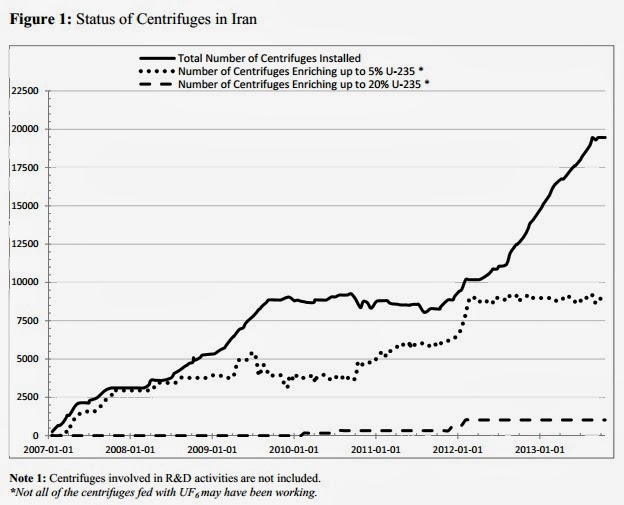
Moreover, Iran’s Natanz facility is designed for a fully operational capacity of 50,000 centrifuges. So far, fewer than 15,500 centrifuges have been installed and fewer than 9,000 are actually functional. Of the 2,710 centrifuges installed at the Fordow site, only about 700 are operational.
Roughly 1,000 second-generation centrifuges have also been installed, but not a single one has yet been used.
So, while Bob Corker and the rest sound pretty serious when they fret about Iran’s 19,000 “spinning” centrifuges, they’re overselling what Iran is actually doing in order to gin up their required hysteria.
What a surprise.
Palestinian media forum condemns NBC plan to produce drama series in Jerusalem
Palestine Information Center – 19/12/2013
GAZA — Palestinian media forum (PMF) has strongly condemned the plan of American TV company (NBC) to film a drama series, in partnership with the occupation municipality, in Silwan in occupied Jerusalem.
PMF said in a statement on Thursday that NBC is preparing to produce and broadcast a drama series in the “City of David”, with the aim of strengthening the Israeli narrative about the city of Jerusalem, which would give legitimacy to Israel’s policies of apartheid, ethnic cleansing and colonization in occupied Jerusalem.
According to Israeli and American media, the NBC network is cooperating with Israeli authorities, film makers and the Keshet Media Group to produce an action series entitled DIG mainly in occupied East Jerusalem, near the Old City.
Most of the filming will take place in the so-called “City of David national park”, which is established on Palestinian property in the neighborhood of Silwan and which is operated by the Israeli settler organization El’ad and the Israeli Nature and Parks Authority.
The PMF asserted that the production of this drama series comes within the framework of the falsification of history and the Judaization of Jerusalem.
Beyond the Military: Investigating the Civilian Role in the Argentine Dictatorship
By Tess Bennett | The Argentina Independent | December 17, 2013
Last Friday, after 13 months and 400 witness testimonies, the mega-lawsuit in Federal Court of Tucumán found 37 of 41 defendants guilty of crimes against humanity during the 1976-83 dictatorship in Argentina. In the historic trial, known as Jefatura II-Arsenales II, four civilians were among the accused: two were pardoned and two were convicted for their involvement in the dictatorship.
María Elena Guerra, a civilian and ex-police officer, and Guillermo Francisco Lopez Guerrero, a civil intelligence agent, joined a select few civilians who have been found guilty of crimes committed during the brutal seven-year military regime, in which some 30,000 people were kidnapped and killed or ‘disappeared’.
Since the trials were reopened in 2003, hundreds of members of the military have been sentenced to prison for crimes committed during the dictatorship. However, it was only in December last year that James Smart, a former government minister of the Province of Buenos Aires, became the first civilian to be convicted of crimes against humanity committed during the dictatorship. He was sentenced to life in prison for crimes committed in six clandesine detention centres.
These landmark rulings demonstrate how, after 30 years of democratic rule, the way Argentines, politicians, and the legal system examine crimes from this period has evolved, with the focus turning more recently to the role of businesses and civilians in the human rights atrocities of that period.
Human rights groups have long used the term ‘civic-military dictatorship’ to acknowledge the complicity and support of some civilian sectors. But the title has become increasingly common in recent years under the Cristina Fernández de Kirchner administration, opening the door for a number of emblematic trials investigating the role of these civilians, with the aim of bringing the impunity of the powerful to an end.
Causes of the Coup: A New Economic Model
Human rights groups argue that economic motives were behind the 24th March 1976 coup, saying it can no longer be argued that the objective was only to combat “subversion”. They believe so-called “captains of industry” collaborated with military leaders to perpetrate crimes against humanity for economic gain.
Last week, Banco de la Nación Argentina officially recognised Roberto Hugo Barrera as the 31st employee still missing – disappeared – after being kidnapped during the dictatorship. The institution has been an important player in the drive to highlight the economic motives behind the so-called ‘National Reorganisation Process’ implemented by the military junta.
Graciela Navarro, President of the Commission of the Banco de la Nación Personnel for Memory, Truth and Justice told The Argentina Independent that when identifying what occurred in 1976, it is first important to understand that there was no “war.”
“There were operations of some armed groups, but these were isolated. There was never a war here. It was always state terrorism,” she said, alluding to the still oft-used term ‘Dirty War’ by foreign press.
According to Navarro, certain civilian sectors used the military to implement a neo-liberal economic model. “It was necessary to implement an economic model of exclusion to benefit economic groups that utilised the Armed Forces as a instrument of social discipline – for repression, for fear, to deal with any resistance movement.
“The true causes of the coup were economic, because of this we say civic-military dictatorship,” she added.
Marta Santos, a former Central Bank employee and friend of one of the five known desaparecidos (missing) who worked at the institution, echoes this view.
“This dictatorship, this military force, needed the support of civilians in key parts of the state and in the private economy… In this sense we say that dictatorship was civic-military because it pursued neo-liberal economic interests of private [business] and the state,” says Santos, who today is part of a team working with the Central Bank to investigate if there are more unknown desaparecidos who worked there.
Civilians in Government
Santos says it is important to denounce civilian collusion with the military junta in the defence of democracy, to ensure these institutions can never again prop up a dictatorship. She names José Alfredo Martínez de Hoz as the prime example of civilian involvement.
Former president of the steel company Acindar – which operated one of the country’s first clandestine torture and detention centres on its premises in 1975 – Martínez de Hoz was economy minister from 1976 to 1981, in charge of ushering in a new economic paradigm based on the principles of neo-liberalism. During this period, it was common for businessmen close to the economy minister to assume key government roles, helping to fuse civil society to the military junta. His policies sowed the seeds for financial collapse, providing a brief period of prosperity but leading to a deep recession in 1981 and saddling the nation with a burdensome external debt that would cause problems long after the return to democracy.

José Martínez de Hoz – 1976
Martínez de Hoz was under house arrest when he died in March this year, being investigated for his alleged role in the kidnap of father and son, Federico and Miguel Gutheim. The family owned the cotton export company Sadeco, and were allegedly coerced into making business deals that favoured the dictatorship.
He was also linked to the kidnap of René Carlos Alberto Grassi, director de Industrias Siderúrgicas Grassi (a rival company of Acindar) and president of the Bank of Hurlingham, in September 1978. Grassi was held in Campo de Mayo for a year after his abduction, and eventually Industrias Siderúrgicas Grassi was absorbed by Acindar. One month before the abduction, Martínez de Hoz had asked to buy the Bank of Hurlingham and was declined.
From the early days of the dictatorship there was a strong repression of workers, but the kidnap of Grassi was significant; he did not pose a threat as an opposition force to the regime, his value was economic.
Martínez de Hoz was pardoned by Menem in 1990, though this was annulled 16 years later when the Gutheim case was reopened. Up until his death, he denied any involvement in the kidnappings and was a remorseless defender of the dictatorship-era economic policies.
The investigation of Martínez de Hoz is an early example of a civilian investigated for abuses committed during the reign of the military junta. In recent years, many more legal battles concerning civilian’s roles in the dictatorship have come to the surface.
Thirty Years of Reconstruction
Horacio Verbitsky, president of CELS and co-author of the 2013 book ‘Cuentas pendientes: los cómplices económicos de la dictadura’, which examines the links between economic powers and state repression, argues the economic influence of civilians who were complicit in the dictatorship continued throughout the first two decades of democracy. Verbitsky argues that economic powers could have endangered the stability of democracy, which limited the possibility of pursuing justice for their responsibility during the dictatorship.
Argentina’s first president after the return of democracy, Raúl Alfonsín, had the complex task of addressing human rights abuses in the face of a weak economy and massive external debt, which had ballooned from US$7.87bn in 1975 to US$43bn in 1982.
“It is not easy to build democracy in a setting where political culture and civic habits have been degraded by authoritarianism. Nor is it easy to build democracy in the midst of a deep economic crisis exacerbated by the need to repay a huge foreign debt that the old dictatorial regime had contracted and irresponsibly misspent,” Alfonsín said in 1992, after his term had ended prematurely in 1989.

Videla and other military chiefs are found guilty of crimes against humanity in 1985.
The neo-liberal economic paradigm that dominated the nineties – a time that corresponded with the amnesty offered to those responsible in the dictatorship – deepened the economic model launched in 1976, taking it to the economic and political crisis of 2001.
Graciela Navarro believes that since Nestor Kirchner took office in 2003 there have been two distinct periods relating to the last civic-military dictatorship, the first being the recovery of the memory of those who had been tortured or disappeared, and the end of impunity for military leaders. “When Cristina was elected,” Navarro believes, “it was possible to begin to examine the true causes of the coup, which were economic, and charge those who are responsible.
“The military has been judged,” adds Navarro, “but many civilians, if not them then their children, are owners of the large economic groups… this is difficult. These are the interests that Cristina is dealing with.”
Pending Cases
After years of impunity, Argentina’s legal system has begun to investigate the role of officials, powerful businessmen, and mulitnationals who may have collaborated with the military in state terrorism. According to the Centre for Legal and Social Studies (CELS), as of September 2013 there were a total of 261 civilians accused of involvement in the human rights abuses of the era.
Several high profile and emblematic cases involving civilians, and their business interests, are currently making their way through the legal system.
Papel Prensa: On 2nd November, 1976, three newspapers – Clarín, La Nación, and La Razón – obtained the majority shares in Papel Prensa, the company which produces newsprint for the industry, soon after owner, businessman and banker David Graiver, died in a plane crash in Mexico in August 1976. Graiver’s widow, Lidia Papaleo testified in 2010 that at that time she was stripped of the factory after receiving death threats against her and her young daughter. In March 1977, Papaleo was abducted and tortured until she was released on July 24, 1982.
The case concerning the sale of Papel Prensa was opened in August 2010 after President Fernández presented a report in the Casa Rosada titled “Papel Prensa: The Truth” denouncing the “illegal appropriation” of the business. Most recently, the case has been in the headlines after the discovery of official minutes from the dictatorship that mention Papel Prensa 13 times between September 1976 and November 1977.
According to Defence Minister Agustín Rossi, the minutes make it “clear that for the Junta, Papel Prensa was a part of the same theme as the detention of [ex-owners] the Graiver family… this appears clearly in the minutes.” Copies of the documents are now in the hands of Federal Judge Julián Ercolini, who has jurisdiction over the case.
Ledesma: Also working its way through the legal system is a case involving president of sugar company Ledesma, one of Argentina’s most powerful businesses, for his involvement in kidnappings during the ‘blackout night’, when over 400 people were kidnapped in the province of Jujuy following an electricity outage on 20th July, 1976.
President of Ledesma Carlos Blaquier and former general manager Alberto Lemos are accused of providing the vehicles that were used for transporting the victims. This month, the Federal Court of Salta confirmed that there is sufficient evidence that the company Ledesma collaborated in the kidnapping of their workers to dismantle the labour union. As a result, Blaquier and Lemos will be put on trial, which is set to begin in April 2014. The court upheld that Blaquier will be prosecuted as a “necessary participant” in twenty cases of illegal deprivation of liberty and Lemos is accused of being a “secondary participant” to the kidnappings.
Ford: During the dictatorship, the Ford Falcon became known as a vehicle commonly used by kidnappers. But the company is also accused of more direct involvement in the human rights abuses of the time.
In May, charges were laid against three ex-directors of Ford Motors Argentina for their role in the disappearance of 24 workers from the plant. Former plant manager Pedro Müller, ex-leader of labour relations Guillermo Galarraga, and ex-security chief Héctor Sibilla are accused of having given to military commanders in the area “personal data, photographs, and addresses” of workers at the factory between 24th March and 20th August, 1976.
The three men are also accused of having allowed the military to use the factory as a detention centre where they carried out the interrogation of the workers. According to Judge Alicia Vence, the workers were “tied up with their faces covered and beaten.”
Although 24 workers survived the kidnapping and torture, only twelve are still alive today. The formal legal process began in 2001 but the first reports of the events date back to 1984.
Mercedes Benz: The families of 17 workers from the Mercedes Benz plant who were kidnapped and tortured have bought a civil case against the parent company of the car maker, Daimler Chrysler, in the US. Mercedes-Benz Argentina is alleged to have identified workers who were kidnapped and sent to the clandestine torture centre, Campo de Mayo, during the dictatorship.
The investigation began in 2004 and has been rejected by US courts on previous occasions, with the US Supreme Court currently determining if the case falls under its jurisdiction. A decision is expected in the coming months on whether multinational corporations can be sued in US courts for alleged human rights abuses abroad.
In Argentina, the lawsuit for kidnapping and torture of the 17 workers, 14 of whom are still missing, was initiated by journalist Gabriela Weber in 2002 and in 2006 was transferred to Federal Court in San Martín under the charge of Judge Alicia Vence. So far no one has been formally charged or arrested.
The car maker is also accused of the appropriation of three children, and the adoption and substitution of identity of Paula Logares, the first grandchildren reclaimed by the Abuelas de Plaza de Mayo in 1987.
Terrorism: It Could Be Anyone Now
By Kevin Ryan | Dig Within | December 16, 2013
This weekend I ran across a random copy of The Wall Street Journal and decided to see what passes for mainstream news these days. Reading it reminded me of the striking amount of terrorism propaganda being foisted upon the U.S. public. The numerous terrorism-related stories in that weekend edition of The Journal painted a confused and contradictory picture that reflects a difficulty in keeping the American public focused on terrorist threats and increasingly suspicious of their fellow citizens.
The weekend edition included five major stories about terrorism, including a shooting at a Colorado high school, the release of video from a hospital massacre in Yemen, and a review of how the Sandy Hook victims’ families are coping. In the most prominent spot, at the top left of the front page, readers found an alert for a major expose covering the Boston bombers. The fifth story was about the arrest of a Wichita man for plotting to blow up aircraft with a homemade bomb at the airport.
The new, Wichita story provides a good example of the challenges facing the FBI and corporate media in ongoing efforts to stoke the public fear. The suspect, like others in the last few years, had no previous history of terrorist activity and the FBI did everything for him.
 Terry Lee Loewen was an avionics specialist at a private company working at the Mid-Continent Airport in Wichita. Allegedly, he tried to drive his car, loaded with explosives that the FBI had helped him make, onto the tarmac to cause “maximum carnage and death.” This man, whom neighbors called quiet and “normal” was supposedly working for al-Qaeda in the Arabian Peninsula.
The emerging story of Loewen includes a significant number of contradictory reports and unbelievable aspects. The official account is that Loewen decided to become a Muslim about six months ago and he immediately began devoting all his time to preparations for becoming a “lone wolf” suicide bomber. FBI-produced documents allegedly provide this 58-year old white man’s reasoning for his radical change of life course—“My only explanation is that I believe in jihad for the sake of Allah + for the sake of my Muslim brothers + sisters.”
Although Loewen did not enter a plea and his public defender and current wife would not comment, his ex-wife and son were contacted for interviews and neither of them had any idea about his new commitment to jihad and martyrdom. The son had spoken to his father in the last month yet, according to The Journal, “didn’t detect anything amiss” and “didn’t know about any turn toward Islam by his father.”
Although Loewen is being portrayed as a serious, jihadist Muslim, he had no known connection to any Muslim organization in Wichita or elsewhere. Apparently he was only an online Muslim and the FBI caught him making comments about his desire to wage jihad against his own country on behalf of the members of his new faith.
His neighbors couldn’t believe it and never saw anything suspicious about him or his current wife. And although his own son had no idea about it, and his ex-wife would never have predicted it, in his last six months he must have devoted every spare moment to his new mission. One might think that a new convert would take time to learn about his new religion and interact with at least one or two Muslims in his community. After all, doesn’t becoming a Muslim require more than just making a few online comments?
Not for Loewen, according to the FBI. Instead, one day he was just a solitary, radical Muslim and he immediately began spending all his free time “studying subjects like jihad, martyrdom operations, and Sharia law.” He also “studied the airport layout and took photos of access points, researched flight schedules and acquired components to make car bombs.” He was obviously very busy and totally committed.
FOX News reported that Loewen was inspired by Usama bin Laden. Investigators from the Wichita Joint Terrorism Task Force further claimed that Loewen “frequently expressed admiration for Anwar Al-Awlaki.” Republican Senator Jerry Moran of Kansas said that Loewen’s action reminded us that we must “reaffirm our commitment” to the War on Terror.
There are certainly suspicious things about Loewen. For one thing, he had another name—Terry L. Lane. How many readers of The Wall Street Journal just happen to have other names? And Loewen was cited in 2009 for a “a concealed-carry violation at the airport.”
Nonetheless, according to his ex-wife of 10-years, Loewen/Lane was “peaceful, easy-going, quiet man” who “didn’t like confrontation; he was never one to start a fight.” She said he had left his job at Hawker Beechcraft Air Services for a time, to work at Learjet across town. She didn’t know when he returned to Beechcraft. “He was happy. He was a normal human being,” she said. And although The Journal reported that the son had no idea about Loewen’s conversion to Islam, The Wichita Eagle reported that the son told his mother that Loewen had recently become a Muslim.
Other news sources report that the son said his dad was “always really calm and a loving man” and that he “had no idea how his father came to be the main suspect in a foiled terror plot.”
Therefore the news about Loewen/Lane and this alleged new terrorist plot includes many confusing reports and makes little or no sense. A 58-year old man with no connection to any Muslim organization just decided on his own to give up his entire life to become a jihadist. He forsook all other commitments to make a martyr of himself for the benefit of “brothers and sisters” who he had never met. His family and neighbors apparently knew nothing about it.
If we can learn anything from the incident it is that the next terrorist could be anybody—you, your father, your neighbor—anyone at all. And there won’t necessarily be any signs at all other than what the FBI provides about internet activity.
This brings us to the big expose that The Journal published on the Boston bombers. Readers might wonder about the coincidence of the reporter from The Journal just happening to be a relatively close friend of the Tsarnaev family, whose two sons were accused of the marathon attack. Ostensibly, that relationship was initiated because both the reporter and the family spoke Russian and the reporter was doing research on Chechens and “Russia’s Islamist insurgency.” But the friendship was clearly much more than that. Who could have predicted that chance relationship would come in so handy for a terrorism reporter from a major U.S. news source?
Anyway, the story about the Tsarnaevs presents more contradictions. For instance, the mother of the accused bombers is portrayed quite differently than we have seen before. The woman who suddenly became a terrorist suspect herself a week after she began claiming that her sons were controlled by the FBI has most often been seen as a strict Muslim woman dressed in very traditional garb. In The Journal’s new story, however, she is “a wide-eyed rapid talker with a low-cut dress and high heels who waved her arms and teased her black hair like the pop singer Cyndi Lauper.” And she ran a business on the side giving facials.
In this new light, mother Tsarnaev could be an office girl from Jersey, or the girl next door.
But those who read the whole story realize that there is a bigger purpose behind this spread on the Tsarnaevs and it is not to describe their dress habits. It is, in fact, to reveal that the Boston bombers were conspiracy theorists. Specifically, Tamerlan Tsarnaev and his brother were “filled with thoughts of conspiracy” including that “the Sept.11 attacks were organized by shadowy financial elites.”
We have seen this tactic before with other terrorism stories but never this blatantly. We are being told that not only can anyone be a terrorist, but it is more likely that anyone who questions the official accounts of terrorism is more likely to be a terrorist. How convenient for the military-terrorism-industrial complex. If such an approach takes hold in the minds of fearful citizens, there would be no stopping the architects of the War on Terror and no shortage of suspects to keep the whole thing rolling along.
Featured Video

John Mearsheimer Talking Iran with Iran
or go to
Aletho News Archives – Video-Images
Book Review & Summary
Calling of an Angel: The True Story of Rene Caisse and an Indian Herbal Medicine Called Essiac (1988)
Dr. Gary L. Glum – 30 Q&As – Book Review & Summary
Lies are Unbekoming | October 17, 2026
On June 10, 1975, Dr. Chester Stock, a vice president at Memorial Sloan-Kettering Institute for Cancer Research, wrote to a Canadian nurse named Rene Caisse: “Enclosed are test data in two experiments indicating some regressions in sarcoma 180 of mice treated with Essiac.” The sentence sat in a letter from one of the world’s largest private cancer research centers, concerning an herbal tea an elderly English woman had learned from an Ojibwa medicine man at a northern Ontario mining camp in the 1890s. The tests were terminated the following year after Sloan-Kettering admitted, in sworn affidavit three years later, that they had prepared the injectable solution improperly from the dried material supplied — freezing and thawing the herb rather than boiling it as Rene had instructed. By the time Calling of an Angel was published in 1988, Rene Caisse had been dead for a decade, having treated thousands of cancer patients across fifty-six years in her Bracebridge, Ontario kitchen, never charging a fee, and refusing every offer — from Memorial Sloan-Kettering, the National Cancer Institute, Merck, Parke Davis, and private corporations dangling contracts up to $1 million — to release her formula before the medical establishment admitted her remedy had merit. … continue
Blog Roll
 Aletho News
- Iran: Palestinians’ rights must not be compromised in Gaza’s future; US, Israel to blame for Hormuz situation
- Ongoing tales of Syrian chemical weapons
- Moscow blasts UN for ignoring torture of Russian POWs
- Millions of Books Could Have Been Destroyed in Lebanon During Israeli Bombings
- Moscow warns of ‘hunt for Russians’
- Calling of an Angel: The True Story of Rene Caisse and an Indian Herbal Medicine Called Essiac (1988)
- South Korean Assistance to the U.S. in the War with Iran: Between Allied Duty and National Interests
- Pharma- and Gates-Funded GAVI Seeks to Assure Parents
- John Mearsheimer Talking Iran with Iran
- Inside Bill C-22, Canada’s Patriot Act.
- If Americans Knew
- Israeli soldiers debunk Israel’s talking points
- In West Bank, Israeli settlers are totally out of control – Daily Update
- NPR investigation finds evidence of widespread fraud at mall kiosks tied to Israeli skincare brand
- Tucker Carlson exposes Israeli Lies about the Oct 7th attack, Charlie Kirk, and the U.S.
- Israel has detained thousands of Palestinian children since Oct 7th – over half spent time in solitary, many uncharged
- Israeli Analysis: Is Netanyahu Planning an ‘October Surprise’ Attack Before Israel’s Election?
- Israeli settlers brutally attack Palestinians and Washington Post female photographer, 65
- Words Have Changed, Occupation Continues: The Reality of the Gaza Ceasefire
- Gaza’s child amputees are growing faster than their prosthetics allow
- Israel keeps Palestinians struggling just to survive–Daily Update
- No Tricks Zone
- New Study Suggests Large Regions Of The Pacific Ocean Have Been Cooling For The Last 80 Years
- Germany’s Green Energy Debacle: High Energy Costs Force Kahla Porzellan to Close After 182 Years!
- New Study: 50 Years Of The Most Aggressive ‘Net Zero’ Policies Can Only Affect The Global Climate By 0.03°C
- US September “Heat” Was No Record…Many Records Set Decades Ago
- Latest European Green Energy Debacle; Portugal’s Largest Flagship Solar Park Insolvent!
- Green Energy Debacle: German Expert Professor Fritz Vahrenholt Warns Of Severe Economic And Social Consequences
- Two More Paleo Reconstructions Affirm Meters-Higher Sea Levels Across Ireland, Brazil 7000-6000 Years Ago
- New Study: Earth And Venus Surface Warmth Largely Explained By Convection And Lapse Rate, Not CO2 Or Radiation
- 2025 Nature Paper Claiming Worsening Global Drought Gets RETRACTED …Heavily Flawed
- New Study: ‘Global Drought Shows No Detectable Recent Acceleration Under Climate Warming’

