This weekend I ran across a random copy of The Wall Street Journal and decided to see what passes for mainstream news these days. Reading it reminded me of the striking amount of terrorism propaganda being foisted upon the U.S. public. The numerous terrorism-related stories in that weekend edition of The Journal painted a confused and contradictory picture that reflects a difficulty in keeping the American public focused on terrorist threats and increasingly suspicious of their fellow citizens.
The weekend edition included five major stories about terrorism, including a shooting at a Colorado high school, the release of video from a hospital massacre in Yemen, and a review of how the Sandy Hook victims’ families are coping. In the most prominent spot, at the top left of the front page, readers found an alert for a major expose covering the Boston bombers. The fifth story was about the arrest of a Wichita man for plotting to blow up aircraft with a homemade bomb at the airport.
The new, Wichita story provides a good example of the challenges facing the FBI and corporate media in ongoing efforts to stoke the public fear. The suspect, like others in the last few years, had no previous history of terrorist activity and the FBI did everything for him.
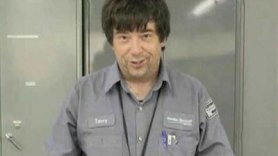 Terry Lee Loewen was an avionics specialist at a private company working at the Mid-Continent Airport in Wichita. Allegedly, he tried to drive his car, loaded with explosives that the FBI had helped him make, onto the tarmac to cause “maximum carnage and death.” This man, whom neighbors called quiet and “normal” was supposedly working for al-Qaeda in the Arabian Peninsula.
The emerging story of Loewen includes a significant number of contradictory reports and unbelievable aspects. The official account is that Loewen decided to become a Muslim about six months ago and he immediately began devoting all his time to preparations for becoming a “lone wolf” suicide bomber. FBI-produced documents allegedly provide this 58-year old white man’s reasoning for his radical change of life course—“My only explanation is that I believe in jihad for the sake of Allah + for the sake of my Muslim brothers + sisters.”
Although Loewen did not enter a plea and his public defender and current wife would not comment, his ex-wife and son were contacted for interviews and neither of them had any idea about his new commitment to jihad and martyrdom. The son had spoken to his father in the last month yet, according to The Journal, “didn’t detect anything amiss” and “didn’t know about any turn toward Islam by his father.”
Although Loewen is being portrayed as a serious, jihadist Muslim, he had no known connection to any Muslim organization in Wichita or elsewhere. Apparently he was only an online Muslim and the FBI caught him making comments about his desire to wage jihad against his own country on behalf of the members of his new faith.
His neighbors couldn’t believe it and never saw anything suspicious about him or his current wife. And although his own son had no idea about it, and his ex-wife would never have predicted it, in his last six months he must have devoted every spare moment to his new mission. One might think that a new convert would take time to learn about his new religion and interact with at least one or two Muslims in his community. After all, doesn’t becoming a Muslim require more than just making a few online comments?
Not for Loewen, according to the FBI. Instead, one day he was just a solitary, radical Muslim and he immediately began spending all his free time “studying subjects like jihad, martyrdom operations, and Sharia law.” He also “studied the airport layout and took photos of access points, researched flight schedules and acquired components to make car bombs.” He was obviously very busy and totally committed.
FOX News reported that Loewen was inspired by Usama bin Laden. Investigators from the Wichita Joint Terrorism Task Force further claimed that Loewen “frequently expressed admiration for Anwar Al-Awlaki.” Republican Senator Jerry Moran of Kansas said that Loewen’s action reminded us that we must “reaffirm our commitment” to the War on Terror.
There are certainly suspicious things about Loewen. For one thing, he had another name—Terry L. Lane. How many readers of The Wall Street Journal just happen to have other names? And Loewen was cited in 2009 for a “a concealed-carry violation at the airport.”
Nonetheless, according to his ex-wife of 10-years, Loewen/Lane was “peaceful, easy-going, quiet man” who “didn’t like confrontation; he was never one to start a fight.” She said he had left his job at Hawker Beechcraft Air Services for a time, to work at Learjet across town. She didn’t know when he returned to Beechcraft. “He was happy. He was a normal human being,” she said. And although The Journal reported that the son had no idea about Loewen’s conversion to Islam, The Wichita Eagle reported that the son told his mother that Loewen had recently become a Muslim.
Other news sources report that the son said his dad was “always really calm and a loving man” and that he “had no idea how his father came to be the main suspect in a foiled terror plot.”
Therefore the news about Loewen/Lane and this alleged new terrorist plot includes many confusing reports and makes little or no sense. A 58-year old man with no connection to any Muslim organization just decided on his own to give up his entire life to become a jihadist. He forsook all other commitments to make a martyr of himself for the benefit of “brothers and sisters” who he had never met. His family and neighbors apparently knew nothing about it.
If we can learn anything from the incident it is that the next terrorist could be anybody—you, your father, your neighbor—anyone at all. And there won’t necessarily be any signs at all other than what the FBI provides about internet activity.
This brings us to the big expose that The Journal published on the Boston bombers. Readers might wonder about the coincidence of the reporter from The Journal just happening to be a relatively close friend of the Tsarnaev family, whose two sons were accused of the marathon attack. Ostensibly, that relationship was initiated because both the reporter and the family spoke Russian and the reporter was doing research on Chechens and “Russia’s Islamist insurgency.” But the friendship was clearly much more than that. Who could have predicted that chance relationship would come in so handy for a terrorism reporter from a major U.S. news source?
Anyway, the story about the Tsarnaevs presents more contradictions. For instance, the mother of the accused bombers is portrayed quite differently than we have seen before. The woman who suddenly became a terrorist suspect herself a week after she began claiming that her sons were controlled by the FBI has most often been seen as a strict Muslim woman dressed in very traditional garb. In The Journal’s new story, however, she is “a wide-eyed rapid talker with a low-cut dress and high heels who waved her arms and teased her black hair like the pop singer Cyndi Lauper.” And she ran a business on the side giving facials.
In this new light, mother Tsarnaev could be an office girl from Jersey, or the girl next door.
But those who read the whole story realize that there is a bigger purpose behind this spread on the Tsarnaevs and it is not to describe their dress habits. It is, in fact, to reveal that the Boston bombers were conspiracy theorists. Specifically, Tamerlan Tsarnaev and his brother were “filled with thoughts of conspiracy” including that “the Sept.11 attacks were organized by shadowy financial elites.”
We have seen this tactic before with other terrorism stories but never this blatantly. We are being told that not only can anyone be a terrorist, but it is more likely that anyone who questions the official accounts of terrorism is more likely to be a terrorist. How convenient for the military-terrorism-industrial complex. If such an approach takes hold in the minds of fearful citizens, there would be no stopping the architects of the War on Terror and no shortage of suspects to keep the whole thing rolling along.
December 16, 2013
Posted by aletho |
Deception, False Flag Terrorism, Islamophobia, Mainstream Media, Warmongering | Al-Qaeda in the Arabian Peninsula, FBI, Federal Bureau of Investigation, Mid-Continent Airport, Osama Bin Laden, Wall Street Journal, Wichita |
Leave a comment
BOSTON — The ACLU of Massachusetts calls for a moratorium on the use of controversial and unregulated license plate scanner technology in all Massachusetts police departments, following a Boston Globe exposé of problems in the Boston Police Department’s program.
The story, published in today’s Globe, shows that contrary to officials’ claims about why departments need the technology, police routinely do not respond to live ‘hits’ alerting them to the location of stolen cars. This suggests that the program is, as the ACLU feared, largely oriented towards compiling vast databases enabling the warrantless tracking of millions of innocent motorists.
In response to these alarming findings, the Boston Police Department announced it would suspend the program, at least until proper oversight and procedures are put into place.
“The Globe’s investigation into the Boston Police Department’s license plate reader program, based largely on a series of public records requests initiated nearly a year ago, confirms that police departments need outside oversight and guidance in order to responsibly use this powerful technology. We applaud the Boston police decision to suspend the program,” said Kade Crockford, director of the Technology for Liberty project at the ACLU of Massachusetts. “In light of these disturbing revelations, no police department in the state should continue to use this technology until the legislature passes the License Plate Privacy Act. We need uniform statewide rules for departments’ use of plate readers.”
Currently the Massachusetts State Police and more than 50 cities and towns deploy license plate scanners, which snap photographs of each license plate they encounter, noting the time, date and location, and run the plate numbers against “hot lists” to identify stolen cars, outstanding warrants and other violations. Today, no license plate reader program in the state is subject to outside regulation.
“The License Plate Privacy Act will establish accountability and public transparency requirements to ensure that the kinds of abuses the Globe uncovered at the Boston Police Department are not happening in other cities and towns,” said Crockford. “Technologies that target ordinary Americans going about their everyday lives create tremendous opportunity for abuse, without keeping us safe. We must ensure that the law keeps pace with these new technologies.”
The License Plate Privacy Act allows departments to use license plate readers to identify cars associated with criminal suspects or crimes, while preventing the government from amassing databases containing the historical travel records of millions of innocent people.
“The Globe’s investigation makes crystal clear that departments cannot police their own use of this complex and powerful tool,” said Crockford. “The legislature must step in to provide some basic rules, as well as checks and balances to make sure license plate readers aren’t used for warrantless tracking of innocent drivers. The Joint Transportation Committee should recommend swift approval of the License Plate Privacy Act, the legislature should pass it, and the Governor should sign it into law.”
Advanced surveillance tools can work to promote public safety while simultaneously respecting the privacy and liberty interests that help our Commonwealth thrive, but in order for that to happen the law needs to catch up with the technology. The License Plate Privacy Act strikes the right balance. Police departments statewide should follow Boston’s lead and immediately halt their use of the technology until the legislature acts.
For more on the License Plate Privacy Act, go to:
https://aclum.org/privacy_agenda#LPA
To take action on this issue, go to:
https://ssl.capwiz.com/aclu/ma/issues/alert/?alertid=63008551&type=ML
For more information about automatic license plate readers, go to:
https://www.aclu.org/alpr
December 14, 2013
Posted by aletho |
Civil Liberties, Corruption, Deception, Full Spectrum Dominance | American Civil Liberties Union, Automatic number plate recognition, Boston, Boston Police Department, Massachusetts, Plate reader, Police |
Leave a comment
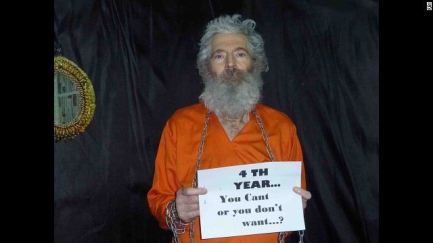
Robert Levinson who went missing in southern Iran in 2007 was working for the CIA
A recent investigation has found that an American who went missing in southern Iran in 2007 was working for the Central Intelligence Agency in the US.
Retired FBI agent Robert Levinson disappeared on March 9, 2007, during a visit to Iran’s Kish Island in the Persian Gulf.
The US State Department insisted that Levinson was a private citizen who had traveled to Kish on private business.
Nevertheless, more than six years after Levinson’s disappearance, the Associated Press has revealed that he was recruited by the CIA to run unauthorized spying operations.
According to the AP, the CIA paid $2.5 million to Levinson’s family in a bid to pre-empt a revealing lawsuit.
Even after they learned about Levinson’s CIA ties, officials at the White House, the FBI, and the State Department did not change the official story, insisting that he was “a private citizen involved in private business.”
The AP first found about Levinson’s involvement with the CIA’s spying operations in 2010; however, they withheld the story several times at the behest of the US government.
The AP’s revelation is based on documents obtained or reviewed by the New York-based news agency and interviews with a number of current and former officials from the US and other countries, who spoke on condition of anonymity.
The CIA is generally made up of two groups: operatives, who gather intelligence and hire spies, and analysts, who receive strands of intelligence and decode them.
Although Levinson was recruited by a team of CIA analysts and his contract with the CIA, worth about $85,000, required him to write reports for the agency based on his travel and expertise, he started to gather intelligence from the onset instead of writing reports.
In order to keep Levinson’s operations secret, the CIA had instructed him not to mail any packages to the agency’s headquarters in Langley, Virginia, or email documents to US government addresses.
Instead, he had to send the intelligence he had gathered to the private home of a CIA analyst named Anne Jablonski in Virginia and contact Jablonski’s personal email account if he needed any instructions.
Levinson’s whereabouts and captors are not known; however, former US Secretary of State Hillary Clinton said in 2011 that Washington believed he was “being held somewhere in southwest Asia.”
December 13, 2013
Posted by aletho |
Deception | Central Intelligence Agency, CIA, Iran, Robert Levinson, United States |
Leave a comment
A few brief thoughts on Seymour Hersh’s article on the chemical weapons attack in Syria in August: Elliot Higgins’ response to it; and Brian Whitaker’s take on things.
Here are the bits from Whitaker’s article that I thought were worth commenting on:
‘On one side of the chemical weapons debate is Seymour Hersh, the veteran investigative journalist, who suggested in an article for the London Review of Books that rebel fighters, rather than the Syrian regime, were to blame for the Damascus attacks’.
That isn’t really the point Hersh was making though, is it? The gist of the story was that the case against the Assad regime wasn’t as strong as the Obama regime made out, and that the Obama regime knew this.
As Hersh told Democracy Now – ‘I certainly don’t know who did what, but there’s no question my government does not’, and that Obama ‘was willing to go to war, wanted to throw missiles at Syria, without really having a case and knowing he didn’t have much of a case‘.
Hersh and his sources saw that as a major scandal: a President deciding to start a war, with all that entails, based on a case that was less than watertight.
They also refused to even entertain the possibility, at least in public, that a rebel faction may have been responsible, despite knowing that at least one rebel faction had ‘mastered the mechanics of creating sarin and was capable of manufacturing it in quantity’.
‘Given that Hersh has spent decades working for mainstream media, that Media Lens disapproves of anonymous sources’.
An apparent ‘Gotcha!’ moment, no? But maybe there’s a difference between people leaking and briefing anonymously to promote Establishment narratives and aims, and people leaking and briefing anonymously to challenge them. Hersh has, throughout his career, promoted the latter with a very good hit rate. Simply put, anonymous leaks designed to whistleblow are not the same as anonymous leaks designed to mislead and confuse.
‘Some of his other exposes have misfired, though’
Some examples might be nice.
‘he has often been criticised for his use of shadowy sources. In the words of one Pentagon spokesman, he has “a solid and well-earned reputation for making dramatic assertions based on thinly sourced, unverifiable anonymous sources”‘.
Hersh has spent decades shining lights into places ‘Pentagon spokesmen’ types don’t want him to look. So it’s not surprising that they’d try and discredit his work. Would Whitaker, for example, quote an Iranian military spokesman to try and rubbish the work of an Iranian dissident journalist? I doubt it. And the fact he does it here perhaps says much about his unexamined assumptions and biases.
‘Higgins, meanwhile, is the antithesis of a “corporate” journalist’.
At this point in his career, it’s not like Higgins is some obscure, insurgent outsider. He has had his work published in The New York Times and Foreign Policy, has had a lengthy profile written about him in The New Yorker, has worked with Human Rights Watch, and has been interviewed more than once on T.V. News. Does this make him wrong? Of course not. But the line between him and ‘old media’ isn’t quite as defined as Whitaker would like to make out.
It is perhaps instructive that in this case, Hersh struggled to get anyone to publish his chemical weapons piece, while Higgins had no problem in getting Foreign Policy, an Establishment journal if ever there was one, to publish his rebuttal pretty much straight away.
‘Hersh’s source on the supposed sarin-manufacturing capabilities is an unnamed “senior intelligence consultant”:
‘Already by late May, the senior intelligence consultant told me, the CIA had briefed the Obama administration on al-Nusra and its work with sarin, and had sent alarming reports that another Sunni fundamentalist group active in Syria, al-Qaida in Iraq (AQI), also understood the science of producing sarin’
. . . Interestingly, though, EAWorldView has an idea who this consultant might be. It notes that Michael Maloof, who formerly worked in the US Defense Department, has made very similar claims in an article for the right-wing World Net Daily, and also on the Russian propaganda channel, RT’.
Pure speculation, of course. Even if the source is Maloof, it doesn’t automatically follow that Maloof is wrong.
Nor is Maloof, or any other source Hersh might have, the only person to have suggested a rebel faction may have access to chemical weapons.
In May 2013 for example, Carla Del Ponte, one of the overseers of the UN commission of Inquiry on Syria, told Swiss T.V. that ‘there are strong, concrete suspicions but not yet incontrovertible proof of the use of sarin gas’ by rebel factions, and that she was ‘a little bit stupefied by the first indications we got . . . they were about the use of nerve gas by the opposition’.
Predictably, her comments quickly disappeared down the Memory Hole, even though she is a very credible and well respected source, and likely wasn’t just making it all up.
She was, incidentally, also smeared and/or discredited by those who simply don’t want to see any kind of challenge to the Establishment narrative on Syria, much like is happening to Hersh now.
December 13, 2013
Posted by aletho |
Deception, Mainstream Media, Warmongering, Progressive Hypocrite | Brian Whitaker, Carla Del Ponte, Ghouta, Obama, Seymour Hersh, Syria |
Leave a comment
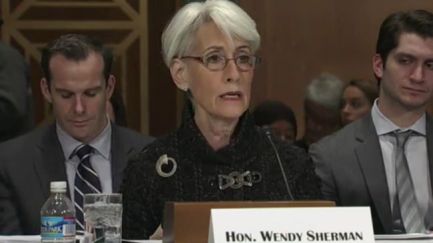
US State Department official Wendy Sherman at the Senate Banking Committee on Dec. 12, 2013
The administration of President Barack Obama has told lawmakers in US Congress that they could pass new sanctions against Iran as far as they are not “nuclear-related.”
During a public testimony before the Senate Banking Committee on Thursday, State Department official Wendy Sherman, who led the US delegation in nuclear talks with Iran in Geneva, indicated that US lawmakers had the green light from the Obama administration to pass new anti-Iran sanctions as long as the sanctions are not “nuclear-related.”
“Given that there are different kinds of sanctions and the agreement focuses on nuclear-related sanctions,” Sen. Mike Crapo, the top Republican on the Committee, asked Sherman, “assuming we can specify exactly what that is and distinguish between the different sanctions, does that mean that Congress would be free to pass other sanctions measures while we are” negotiating over a final deal over Iran’s nuclear energy program?
“We have said to Iran that we will continue to enforce all of our existing sanctions, and we have said that this agreement pertains only to new nuclear-related sanctions,” Sherman answered.
In a phone interview with Press TV on Thursday, US Congress policy advisor Frederick Peterson said that the problem with some hawkish US lawmakers who are pushing for a new anti-Iran sanctions bill is exacerbated by the way the Obama administration is “misrepresenting” the interim deal between Iran and the P5+1 to the American people and Congress.
Meanwhile, the US Departments of Treasury and State announced new sanctions against a number of companies and individuals for “providing support for” Iran’s nuclear energy program.
Treasury Department official David Cohen, who also testified before the Senate Banking Committee on Thursday, said the new sanctions were “a stark reminder to businesses, banks, and brokers everywhere that we will continue relentlessly to enforce our sanctions.”
Iranian Deputy Foreign Minister Abbas Araqchi has hit out at Washington, saying that the new restrictions are in full contradiction with the recent nuclear deal between Tehran and the P5+1. Araqchi also said that Tehran is now assessing the current situation.
December 13, 2013
Posted by aletho |
Deception, Economics, Progressive Hypocrite, Wars for Israel | Iran, Obama, Sanctions against Iran, United States, United States Senate Committee on Banking Housing and Urban Affairs, Wendy Sherman |
Leave a comment
Note: throughout this review I refer to concepts like “racial oppression”, “Jewish supremacy” and so on. None of this is intended to imply that the concept “race” is meaningful, biologically or otherwise. Racial supremacy does not depend on the reality of race, but merely on the belief in it. Whether race is or is not meaningful is a completely separate question from whether Israel is an instance of racial supremacy. I cover this separate question in another article, Invention, Imagination, Race and Nation.
Max Blumenthal just had a book published, entitled Goliath: Life and Loathing in Greater Israel. He is a left-wing Jewish American journalist. The book assumes that the left/right political dichotomy is meaningful, not only in America, but in the Jewish state. He writes as if Israel can be reformed:
“The Nakba law was only one among a constantly expanding battery of racist and anti-democratic proposals pouring from the legislative offices onto the floor of the Knesset” (page 62).
“Israel’s very existence is threatened by fascism” (Uri Avnery, quoted sympathetically by Max Blumenthal on page 65, complaining about Jewish extremism undermining what is good about Israel).
“…the maintenance of a Jewish demographic majority is Israel’s national priority…” (page 42).
A national priority is something which can be changed. [it changed in south africa] But a Jewish majority is what Israel is.
My point (at least, in this review) is not to criticize reformism as such – normal Western countries can be, and are continually being, reformed. They are critical of their own histories, particularly in regard to racial oppression. Israel stands alone in its self-righteousness.The almost exclusive concern of organizations such as the Southern Poverty Law Center, radical anti-racist groups, and various academic departments, with “white racism”, tends to obscure this. Another article of mine, “The One-Sided View of Hate in Hate Studies,” goes into this question in more detail.
On several occasions in the book, the author criticizes the “settlements” in the “occupied territories” and the “right wing” Israeli politicians who support them. Taken seriously, this argument supports Israel’s fallback position — withdrawal to its 1967 frontiers, before it occupied the “occupied territories”. On page 273, he explains that liberal Zionists mislead us, by claiming that the “source of Israel’s crisis” is in 1967, with the occupation of the West Bank and other areas, rather than with the ethnic cleansing of 1948. But the Nakba was not the “source of Israel’s crisis” – it was the source of Israel!
The book is critical of what it calls Israeli “racism”, for example, on pages 18, 23, 39, 77, 135, 176, 247, 334 and 398. But what would it mean for a state, whose very definition of citizenship is membership of a particular “race”, regardless of geographical origin, leading to the expulsion of non-members of that “race”, who happen to be located within that state’s boundaries, to be “less racist”?
One area where Blumenthal argues there could be improvement, is the mistreatment of Israeli citizens of Palestinian Arab descent.
“…it is hard to find any Arab citizen who travels abroad by air and who has not experienced a discriminatory security check at least once” (page 39).
But, unlike equality for minorities in Western countries like the USA, equality for Israel’s Arab minority would make no difference to the basic fact that Israel, the Jewish state, is an implementation of imagined racial supremacy. They’re a minority because most of them were driven out.
In line with his effort to make Israel look like a Western society, Blumenthal lauds “feisty bands of Israeli radical leftists who had dedicated themselves to direct action against their country’s militaristic policies” (page 67) as if they are analogous to the anti-war movement in the USA. But the war in Vietnam really was a US policy, and that is why it could be changed. Ditto, US aggression in the Middle East. The imposition of Jewish supremacy is not an Israeli policy. It is what Israel is.
On page 116, he contrasts the left-wing shministim with right-wing “Israeli ultra-nationalists”. But what is an “ultra” nationalist in Israel? You either support Jewish power, or you don’t. Uri Avnery confuses the issue further by claiming that the “violence” of the “rightists” is the result of “brainwashing”.
“About fifty Jewish radical leftists brought up the rear of the protest [against a settlement], banging drums and chanting in Hebrew ‘Fascism will not pass!’” (page 50).
One of Blumenthal’s radicals left Israel and landed in London. No, it’s not Gilad Atzmon, whom the author explicitly repudiates. In contrast to Atzmon’s critique of Zionism and Jewish anti-Zionism, Blumenthal’s favorite joined “a radical counterculture” that was “transforming the Western world”, “successfully fusing anti-Zionism into the New Left’s broader struggle against colonialism” (page 265).
He’s right. Subordinating anti-Zionism to anti-racism, etc., has been very successful – in the sense of making it completely ineffective. As a result, the struggle against Zionism has been a complete failure – segregation and apartheid were ended, but Jewish supremacy in Palestine continues.
Blumenthal is, at best, ambiguous; he criticizes Israeli policies and politicians, and sometimes comes close to criticizing the entire project, but never once gets to the point – since the Western countries (the USA, Britain, France, etc.) have repudiated racial supremacy, and enforced compliance with that repudiation, and Israel is, by its very definition, based on racial supremacy, the Western countries should, if they follow their own standards, boycott Israel until it grants citizenship only to those born in Palestine, and those whose recent ancestors were born in Palestine, in other words, ceases to exist.
An example of this ambiguity is the first paragraph on page 74. It starts by saying there is not much to choose between the right and left wing Israeli parties, because they only differ in how to maintain the what he delicately calls the “Jewish demographic majority”. But the same paragraph ends:
In a society where maintaining the tyranny of the ethnic majority formed the underpinnings of national policy, there could be little wonder that an unapologetically supremacist party like Yisrael Beiteinu was able to consolidate a mainstream foothold in such a rapid fashion.
What does claiming the tyranny of the ethnic majority forms the underpinnings of national policy mean? Isn’t it just a roundabout way of saying that racial supremacy is what that nation is? In which case, why does it matter how unapologetic its parties are about their supremacy?
Blumenthal complicates and confuses the issue, but it’s quite simple. There are three major differences between South African apartheid and Israel. One is that, unlike apartheid, Israel exists. The second, is that Israel is Jewish. Finally, South Africa merely had to change its laws, but if Israel abandoned racial supremacy, it would no longer be the Jewish state. The complete contrast between the treatments of these two implementations of racial supremacy means that Jews have special rights in the Western world, and that white gentiles do not. It follows that opposing racial supremacy today therefore means, first and foremost, dismantling Jewish privilege, and that the “anti-racist” industry’s continuing emphasis on the critique of “white privilege” is, to put it charitably, a diversion.
How is Jewish privilege maintained? Blumenthal does briefly mention an example of president Obama having to grovel to the power of the American Jewish lobby on page 275, but only in passing, and with no attempt to help us understand how the organizations of a small ethnic minority can make the most powerful country in the world follow its interests.
~
Jay Knott wrote The Mass Psychology of Anti-Fascism.
December 12, 2013
Posted by aletho |
Book Review, Deception, Ethnic Cleansing, Racism, Zionism, Solidarity and Activism, Timeless or most popular | Anti-Zionism, Gilad Atzmon, Israel, Max Blumenthal, Southern Poverty Law Center, United States, Zionism |
Leave a comment
The American Heart Association (AHA) and the American College of Cardiology (ACC) recently released new cardiovascular disease prevention guidelines. They are an egregious example of much that is wrong with medicine today.
The guidelines propose a vast expansion of the use of statins in healthy people, recommending them for about 44 percent of men and 22 percent of healthy women between the ages of 40 and 75. According to calculations by John Abramson, lecturer at Harvard Medical School, 13,598,000 healthy people for whom statins were not recommended based on the 2001 guidelines now fall into the category of being advised to take moderate or high intensity statin therapy.
The American Heart Association (AHA) is a nonprofit organization with a mission to “build healthier lives free of cardiovascular disease and stroke.” Yet in its 2011-2012 financial statement, the AHA noted $521 million in donations from non-government and non-membership sources and many well-known large drug companies, including those who make and market statins, contribute amounts in the $1 million range.
Even as many in the medical community suspected the guidelines were a ploy to help the AHA’s drug partners sell statins, it was revealed that the guideline’s online calculator to determine cardiac disease risk over predicts risk by an astonishing 75 to 150 percent. But the guideline writers are standing firmly behind their faulty calculator.
Seven of the 15 authors disclosed ties to industry. Originally, the panel chair, Neil J. Stone, MD of Northwestern University, declared that he has had no ties to industry since 2008. Jeanne Lenzer, writing in the British Medical Journal (BMJ) recently, interviewed Dr. Stone who said: “When I was asked by NHLBI [National Heart, Lung and Blood Institute] to chair the [cholesterol] panel, I immediately severed ties with all industry connections prior to assuming my role as chair.” However, prior to 2008, he accepted funding and consultancy fees from multiple pharmaceutical companies, including Abbott, AstraZeneca, Pfizer, Merck, and Schering-Plough among others. Dr. Stone also told the BMJ that he will “definitely” not take any industry funding for two years. Are we to believe that by severing his ties in 2008 his mind became an instant tabula rasa, completely devoid of any conscious or unconscious bias towards the drug companies which had been paying him? To do so strains the bonds of credulity past the breaking point.
The financial ties between large pharmaceutical companies and the AHA are numerous and very remunerative for the AHA, including huge donations from Abbott, Bayer, Boehringer Ingelheim, Bristol-Myers Squibb (BMS), Eli Lilly, Merck and Pfizer. BMS, along with Merck and Pfizer, are major funders of AHA’s Go Red For Women heart disease awareness campaign whose web site tells patients “If your doctor has placed you on statin therapy to reduce your cholesterol, you can rest easy–the benefits outweigh the risks” The site also proclaims that , “Zocor and Pravachol–have the fewest side effects,” and “statins may only slightly increase diabetes risks.” The Women’s Health Initiative, a federal study of over 160,000 healthy women to investigate the most common causes of death, disability and poor quality of life in postmenopausal women, showed that a healthy woman’s risk of developing diabetes was increased 48 percent compared to women who were not on a statin. And contrary to what statin apologists say about statins only increasing diabetes risk in people who are at high risk of developing it anyway, for example the obese, women on statins in the Women’s Health Initiative who were of normal weight increased their risk of diabetes 89 percent compared to same weight women not taking a statin.
In 2010, AHA received $21,000 from statin maker AstraZeneca to run an AHA course about “emerging strategies with statins” at the Discovery Institute of Medical Education and almost $100,000 for learning projects including “debating controversial topics in cardiovascular disease.” The AHA defended the deceptively marketed and controversial cholesterol drug Vytorin. Did that have anything to do with the $2 million a year the AHA was taking from marketer Merck/Schering-Plough Pharmaceuticals?
The AHA also rakes in millions from food companies which are also million dollar donors and which pay from $5,490 to $7,500 per product to gain the “heart-check mark” imprimatur from the AHA, renewable, at a price, every year. The foods so anointed have to be low in fat, saturated fat, and cholesterol yet Boar’s Head All Natural Ham (340 milligrams of sodium in a 2-ounce serving) somehow made the cut as did Boar’s Head EverRoast Oven Roasted Chicken Breast (440 milligrams of sodium in a 2-ounce serving). Such processed, high-sodium meats raise blood pressure, the risk of cardiovascular disease and the risk of diabetes. A review of almost 1,600 studies involving one million people in ten countries on four continents showed that a 1.8-ounce daily serving of processed meat raised the risk of diabetes by 19 percent and of heart disease by 42 percent.
The new guidelines might make sense if statins were truly as effective as their proponents claim, and if they had no adverse effects. But they have an increasing list of side effects, which affect at least 18 percent of people who take them. These range from muscle pain, weakness and damage to cataracts, cognitive dysfunction, nerve damage, liver injury and kidney failure.
Even the most avid statin proponents agree that statins do not prevent 60 to 80 percent of cardiac events. This is called “residual risk.” If there were a vaccine, say Vaccine X, that did not prevent 60 to 80 percent of cases of Infection Y, very few would be inclined to take it.
As Jerome Hoffman, MD, Emeritus Professor of Medicine at UCLA wrote recently with regard to these guidelines: “How did we arrive at a place where conflicted parties get to make distorted semi-official pronouncements that have so much impact on public policy?” How indeed?
~
Barbara Roberts, MD, FACC is an Associate Clinical Professor of Medicine at the Alpert Medical School of Brown University. She is the author of The Truth about Statins and How to Keep from Breaking Your Heart: What Every Woman Needs to Know about Cardiovascular Disease. Martha Rosenberg is a health reporter and author of Born with a Junk Food Deficiency.
December 11, 2013
Posted by aletho |
Corruption, Deception, Science and Pseudo-Science | AHA, American College of Cardiology, American Heart Association, AstraZeneca, Barbara Roberts, Pfizer, Statin |
Leave a comment
A little-known federal office has demonstrated that bankers have not avoided criminal prosecution altogether since the 2008 financial crisis. Experts note, however, that those thrown in jail have largely been from small institutions, leaving counterparts at Wall Street powerhouses untouched.
The Office of the Special Inspector General for the Troubled Asset Relief Program (SIGTARP) was originally created to oversee the government bailout of the auto and financial industries. But it has used its congressional authority to pursue bank executives who misused bailout funds.
To date, SIGTARP has gone after 107 senior bank officers, most of whom have been sentenced to prison, according to The Washington Post. Its work also has produced $4.7 billion in restitution paid to victims and the government.
Not bad for an agency with only 170 employees and a budget of $41 million, putting them at a disadvantage in terms of resources and manpower compared to government regulators like the Securities and Exchange Commission and the Office of the Comptroller of the Currency.
What it lacks in size it makes up for in terms of criminal authority authorized by Congress. Unlike regulators, SIGTARP can issue search warrants, seize property and even make arrests.
But those targeted by SIGTARP have run community banks, not the national institutions that dominate Wall Street.
“Essentially, we’re looking for lies and greed,” SIGTAR chief Christy L. Romero told the Post. “Usually, people have gone to such great lengths to try to hide the schemes that we find that they end up violating several laws, which leads to long sentences.”
The average sentence given to those convicted of crimes as a result of SIGTARP investigations is five years and nine months, which is twice the length of the average sentence for white-collar crime in the U.S. SIGTAR currently has 150 ongoing criminal and civil investigations.
Mark Williams, a former bank examiner who teaches finance at Boston University, told the Post that it’s been less difficult for SIGTARP to go after the small fish.
“The amount of direct evidence of banker wrongdoing in these smaller bank cases is easier to show,” he said.
Williams added that SIGTARP’s work nonetheless sets “an important precedence that bad banker behavior will not be tolerated and [will be] aggressively prosecuted.”
To Learn More:
SIGTARP Proves That Some Bankers Aren’t Too Big to Jail (by Danielle Douglas, Washington Post)
Treasury Dept. Fails to Implement Two-Thirds of Post-Bailout Recommendations (by Noel Brinkerhoff and David Wallechinsky, AllGov)
December 11, 2013
Posted by aletho |
Corruption, Deception, Economics | United States, Wall Street |
Leave a comment
Nearly a decade before Gary Webb published his investigative series on cocaine trafficking by Nicaraguan Contra rebels, U.S. law enforcement received a detailed account of top Contra leader Adolfo Calero casually associating with Norwin Meneses, called “a well-reputed drug dealer” in a “secret” document that I recently found at the National Archives.
Meneses was near the center of Webb’s 1996 articles for the San Jose Mercury-News, a series that came under fierce attack from U.S. government officials as well as major news organizations, including the New York Times, the Washington Post and the Los Angeles Times. The controversy cost Webb his career, left him nearly penniless and ultimately contributed to his suicide on Dec. 9, 2004.
But the bitter irony of Webb’s demise, which will be the subject of a 2014 movie starring Jeremy Renner as Webb, is that Webb’s much-maligned “Dark Alliance” series forced major admissions from the CIA, the Justice Department and other government agencies revealing an even-deeper relationship between President Ronald Reagan’s beloved Contras and drug cartels than Webb ever alleged.
Typical of the evidence that the Reagan administration chose to ignore was information provided by Dennis Ainsworth, a blue-blood Republican from San Francisco who volunteered to help the Contra cause in 1984-85. That put him in position to witness the strange behind-the-scenes activities of Contra leaders hobnobbing with drug traffickers and negotiating arms deals with White House emissaries.
Ainsworth also was a source of mine in fall 1985 when I was investigating the mysterious sources of funding for the Contras after Congress shut off CIA support in 1984 amid widespread reports of Contra atrocities inflicted on Nicaraguan civilians, including rapes, executions and torture.
Ainsworth’s first-hand knowledge of the Contra dealings dovetailed with information that I already had, such as the central role of National Security Council aide Oliver North in aiding the Contras and his use of “courier” Rob Owen as an off-the-books White House intermediary to the Contras. I later developed confirmation of some other details that Ainsworth described, such as his overhearing Owen and Calero working together on an arms deal as Ainsworth drove them through the streets of San Francisco.
As for Ainsworth’s knowledge about the Contra-cocaine connection, he said he sponsored a June 1984 cocktail party at which Calero spoke to about 60 people. Meneses, a notorious drug kingpin in the Nicaraguan community, showed up uninvited and clearly had a personal relationship with Calero, who was then the political leader of the Contra’s chief fighting force, the CIA-backed Nicaraguan Democratic Force (or FDN).
“At the end of the cocktail party, Meneses and Calero went off together,” Ainsworth told U.S. Attorney Joseph P. Russoniello, according to a “secret” Jan. 6, 1987 cable submitted by Russoniello to an FBI investigation code-named “Front Door,” a probe into corruption by the Reagan administration.
After Calero’s speech, Ainsworth said Meneses accompanied Calero and about 20 people to dinner and picked up the entire tab, according to a more detailed debriefing of Ainsworth by the FBI. Concerned about this relationship, Ainsworth said he was told by Renato Pena, an FDN leader in the San Francisco area, that “the FDN is involved in drug smuggling with the aid of Norwin Meneses who also buys arms for Enrique Bermudez, a leader of the FDN.” Bermudez was then the top Contra military commander.
Corroborating Account
Pena, who himself was convicted on federal drug charges in 1984, gave a similar account to the Drug Enforcement Administration. According to a 1998 report by the Justice Department’s Inspector General Michael Bromwich, “When debriefed by the DEA in the early 1980s, Pena said that the CIA was allowing the Contras to fly drugs into the United States, sell them, and keep the proceeds. …
“Pena stated that he was present on many occasions when Meneses telephoned Bermudez in Honduras. Meneses told Pena of Bermudez’s requests for such things as gun silencers (which Pena said Meneses obtained in Los Angeles), cross bows, and other military equipment for the Contras. Pena believed that Meneses would sometimes transport certain of these items himself to Central America, and other times would have contacts in Los Angeles and Miami send cargo to Honduras, where the authorities were cooperating with the Contras. Pena believed Meneses had contact with Bermudez from about 1981 or 1982 through the mid-1980s.”
Bromwich’s report then added, “Pena said he was one of the couriers Meneses used to deliver drug money to a Colombian known as ‘Carlos’ in Los Angeles and return to San Francisco with cocaine. Pena made six to eight trips, with anywhere from $600,000 to nearly $1 million, and brought back six to eight kilos of cocaine each time. Pena said Meneses was moving hundreds of kilos a week. ‘Carlos’ once told Pena, ‘We’re helping your cause with this drug thing … we are helping your organization a lot.”
Ainsworth also said he tried to alert Oliver North in 1985 about the troubling connections between the Contra movement and cocaine traffickers but that North turned a deaf ear. “In the spring some friends of mine and I went back to the White House staff but we were put off by Ollie North and others on the staff who really don’t want to know all what’s going on,” Ainsworth told Russoniello.
When I first spoke with Ainsworth in September 1985 at a coffee shop in San Francisco, he asked for confidentiality which I granted. However, since the documents released by the National Archives include him describing his conversations with me, that confidentiality no longer applies. Ainsworth also spoke with Webb for his 1996 San Jose Mercury-News series under the pseudonym “David Morrison.”
Though I found Ainsworth to be generally reliable, some of his depictions of our conversations contained mild exaggerations or confusion over details, such as his claim that I called him from Costa Rica in January 1986 and told him that the Contra-cocaine story that I had been working on with my AP colleague Brian Barger “never hit the papers because it was suppressed by the Associated Press due to political pressure primarily from the CIA.”
In reality, Barger and I returned from Costa Rica in fall 1985, wrote our story about the Contras’ involvement in cocaine smuggling, and pushed it onto the AP wire in December though in a reduced form because of resistance from some senior AP news executives who were supportive of President Reagan’s foreign policies. The CIA, the White House and other agencies of the Reagan administration did seek to discredit our story, but they did not prevent its publication.
An Overriding Hostility
The Reagan administration’s neglect of Ainsworth’s insights reflected the overriding hostility toward any information – even from Republican activists – that put the Contras in a negative light. In early 1987, when Ainsworth spoke with U.S. Attorney Russoniello and the FBI, the Reagan administration was in full damage-control mode, trying to tamp down the Iran-Contra disclosures about Oliver North diverting profits from secret arms sales to Iran to the Contra war.
Fears that the Iran-Contra scandal could lead to Reagan’s impeachment made it even less likely that the Justice Department would pursue an investigation into drug ties implicating the Contra leadership. Ainsworth’s information was simply passed on to Independent Counsel Lawrence Walsh whose inquiry was already overwhelmed by the task of sorting out the convoluted Iran transactions.
Publicly, the Reagan team continued dumping on the Contra-cocaine allegations and playing the find-any-possible-reason-to-reject-a-witness game. The major news media went along, leading to much mainstream ridicule of a 1989 investigative report by Sen. John Kerry, D-Massachusetts, who uncovered more drug connections implicating the Contras and the Reagan administration.
Only occasionally, such as when the George H.W. Bush administration needed witnesses to convict Panamanian dictator Manuel Noriega did the Contra-cocaine evidence pop onto Official Washington’s radar screens.
During Noriega’s drug-trafficking trial in 1991, U.S. prosecutors called as a witness Colombian Medellín cartel kingpin Carlos Lehder, who — along with implicating Noriega — testified that the cartel had given $10 million to the Contras, an allegation first unearthed by Sen. Kerry. “The Kerry hearings didn’t get the attention they deserved at the time,” a Washington Post editorial on Nov. 27, 1991, acknowledged. “The Noriega trial brings this sordid aspect of the Nicaraguan engagement to fresh public attention.”
But the Post offered its readers no explanation for why Kerry’s hearings had been largely ignored, with the Post itself a leading culprit in this journalistic misfeasance. Nor did the Post and the other leading newspapers use the opening created by the Noriega trial to do anything to rectify their past neglect.
Everything quickly returned to the status quo in which the desired perception of the noble Contras trumped the clear reality of their criminal activities. Instead of recognizing the skewed moral compass of the Reagan administration, Congress was soon falling over itself to attach Reagan’s name to as many public buildings and facilities as possible, including Washington’s National Airport.
Meanwhile, those of us in journalism who had exposed the national security crimes of the 1980s saw our careers mostly sink or go sideways. We were regarded as “pariahs” in our profession.
As for me, shortly after the Iran-Contra scandal broke wide open in fall 1986, I accepted a job at Newsweek, one of the many mainstream news outlets that had long ignored Contra-connected scandals and briefly thought it needed to bolster its coverage. But I soon discovered that senior editors remained hostile toward the Iran-Contra story and related spinoff scandals, including the Contra-cocaine mess.
After losing battle after battle with my Newsweek editors, I departed the magazine in June 1990 to write a book (called Fooling America) about the decline of the Washington press corps and the parallel rise of a new generation of government propagandists.
I was also hired by PBS Frontline to investigate whether there had been a prequel to the Iran-Contra scandal — whether those arms-for-hostage deals in the mid-1980s had been preceded by contacts between Reagan’s 1980 campaign staff and Iran, which was then holding 52 Americans hostage and essentially destroying Jimmy Carter’s reelection hopes. [For more on that topic, see Robert Parry’s Secrecy & Privilege and America’s Stolen Narrative.]
Finding New Ways
In 1995, frustrated by the growing triviality of American journalism — and acting on the advice of and with the assistance of my oldest son Sam — I turned to a new medium and launched the Internet’s first investigative news magazine, known as Consortiumnews.com. The Web site became a way for me to put out well-reported stories that my former mainstream colleagues ignored or mock.
So, when Gary Webb called me in 1996 to talk about the Contra-cocaine story, I explained some of this tortured history and urged him to make sure that his editors were firmly behind him. He sounded perplexed at my advice and assured me that he had the solid support of his editors.
When Webb’s “Dark Alliance” series finally appeared in late August 1996, it initially drew little attention. The major national news outlets applied their usual studied indifference to a topic that they had already judged unworthy of serious attention.
But Webb’s story proved hard to ignore. First, unlike the work that Barger and I did for AP in the mid-1980s, Webb’s series wasn’t just a story about drug traffickers in Central America and their protectors in Washington. It was about the on-the-ground consequences, inside the United States, of that drug trafficking, how the lives of Americans were blighted and destroyed as the collateral damage of a U.S. foreign policy initiative.
In other words, there were real-life American victims, and they were concentrated in African-American communities. That meant the ever-sensitive issue of race had been injected into the controversy. Anger from black communities spread quickly to the Congressional Black Caucus, which started demanding answers.
Secondly, the San Jose Mercury News, which was the local newspaper for Silicon Valley, had posted documents and audio on its state-of-the-art Internet site. That way, readers could examine much of the documentary support for the series.
It also meant that the traditional “gatekeeper” role of the major newspapers — the New York Times, the Washington Post, and the Los Angeles Times — was under assault. If a regional paper like the Mercury News could finance a major journalistic investigation like this one, and circumvent the judgments of the editorial boards at the Big Three, then there might be a tectonic shift in the power relations of the U.S. news media. There could be a breakdown of the established order.
This combination of factors led to the next phase of the Contra-cocaine battle: the “get-Gary-Webb” counterattack. Soon, the Washington Post, the New York Times, and the Los Angeles Times were lining up like some tag-team wrestlers taking turns pummeling Webb and his story.
On Oct. 4, 1996, the Washington Post published a front-page article knocking down Webb’s series, although acknowledging that some Contra operatives did help the cocaine cartels. The Post’s approach fit with the Big Media’s cognitive dissonance on the topic: first, the Post called the Contra-cocaine allegations old news — “even CIA personnel testified to Congress they knew that those covert operations involved drug traffickers,” the Post said — and second, the Post minimized the importance of the one Contra smuggling channel that Webb had highlighted in his series, saying it had not “played a major role in the emergence of crack.”
To add to the smug hoo-hah treatment that was enveloping Webb and his story, a Post published a sidebar story dismissing African-Americans as prone to “conspiracy fears.”
Next, the New York Times and the Los Angeles Times weighed in with lengthy articles castigating Webb and “Dark Alliance.” The big newspapers made much of the CIA’s internal reviews in 1987 and 1988 — almost a decade earlier — that supposedly had cleared the spy agency of any role in Contra-cocaine smuggling.
But the first ominous sign for the CIA’s cover-up emerged on Oct. 24, 1996, when CIA Inspector General Frederick Hitz conceded before the Senate Intelligence Committee that the first CIA probe had lasted only12 days, and the second only three days. He promised a more thorough review.
Mocking Webb
But Webb had already crossed over from being treated as a serious journalist to becoming a target of ridicule. Influential Washington Post media critic Howard Kurtz mocked Webb for saying in a book proposal that he would explore the possibility that the Contra war was primarily a business to its participants. “Oliver Stone, check your voice mail,” Kurtz smirked.
Yet, Webb’s suspicion was no conspiracy theory. Indeed, Oliver North’s chief Contra emissary, Rob Owen, had made the same point in a March 17, 1986, message about the Contra leadership. “Few of the so-called leaders of the movement . . . really care about the boys in the field,” Owen wrote. “THIS WAR HAS BECOME A BUSINESS TO MANY OF THEM.” [Emphasis in original.]
Ainsworth and other pro-Contra activists were reaching the same conclusion, that the Contra leadership was skimming money from the supply lines and padding their personal wealth with proceeds from the drug trade. According to a Jan. 21, 1987 interview report by the FBI, Ainsworth said he had “made inquiries in the local San Francisco Nicaraguan community and wondered among his acquaintances what Adolfo Calero and the other people in the FDN movement were doing and the word that he received back is that they were probably engaged in cocaine smuggling.”
In other words, Webb was right about the suspicion that the Contra movement had become less a cause than a business to many of its participants. Even Oliver North’s emissary reported that many Contra leaders treated the conflict as “a business.” But accuracy had ceased to be relevant in the media’s hazing of Gary Webb.
In another double standard, while Webb was held to the strictest standards of journalism, it was entirely all right for Kurtz — the supposed arbiter of journalistic integrity who was a longtime fixture on CNN’s “Reliable Sources” — to make judgments based on ignorance. Kurtz would face no repercussions for mocking a fellow journalist who was factually correct.
The Big Three’s assault — combined with their disparaging tone — had a predictable effect on the executives of the Mercury News. As it turned out, Webb’s confidence in his editors had been misplaced. By early 1997, executive editor Jerry Ceppos, who had his own corporate career to worry about, was in retreat.
On May 11, 1997, Ceppos published a front-page column saying the series “fell short of my standards.” He criticized the stories because they “strongly implied CIA knowledge” of Contra connections to U.S. drug dealers who were manufacturing crack cocaine. “We did not have enough proof that top CIA officials knew of the relationship,” Ceppos wrote.
Ceppos was wrong about the proof, of course. At AP, before we published our first Contra-cocaine article in 1985, Barger and I had known that the CIA and Reagan’s White House were aware of the Contra-cocaine problem at senior levels.
However, Ceppos recognized that he and his newspaper were facing a credibility crisis brought on by the harsh consensus delivered by the Big Three, a judgment that had quickly solidified into conventional wisdom throughout the major news media and inside Knight-Ridder, Inc., which owned the Mercury News. The only career-saving move – career-saving for Ceppos even if career-destroying for Webb – was to jettison Webb and the Contra-cocaine investigative project.
A ‘Vindication’
The big newspapers and the Contras’ defenders celebrated Ceppos’s retreat as vindication of their own dismissal of the Contra-cocaine stories. In particular, Kurtz seemed proud that his demeaning of Webb now had the endorsement of Webb’s editor. Ceppos next pulled the plug on the Mercury News’ continuing Contra-cocaine investigation and reassigned Webb to a small office in Cupertino, California, far from his family. Webb resigned from the paper in disgrace.
For undercutting Webb and other Mercury News reporters working on the Contra-cocaine project – some of whom were facing personal danger in Central America – Ceppos was lauded by the American Journalism Review and received the 1997 national Ethics in Journalism Award by the Society of Professional Journalists.
While Ceppos won raves, Webb watched his career collapse and his marriage break up. Still, Gary Webb had set in motion internal government investigations that would bring to the surface long-hidden facts about how the Reagan administration had conducted the Contra war.
The CIA published the first part of Inspector General Hitz’s findings on Jan. 29, 1998. Though the CIA’s press release for the report criticized Webb and defended the CIA, Hitz’s Volume One admitted that not only were many of Webb’s allegations true but that he actually understated the seriousness of the Contra-drug crimes and the CIA’s knowledge of them.
Hitz conceded that cocaine smugglers played a significant early role in the Contra movement and that the CIA intervened to block an image-threatening 1984 federal investigation into a San Francisco–based drug ring with suspected ties to the Contras, the so-called “Frogman Case.”
After Volume One was released, I called Webb (whom I had spent some time with since his series was published). I chided him for indeed getting the story “wrong.” He had understated how serious the problem of Contra-cocaine trafficking had been.
It was a form of gallows humor for the two of us, since nothing had changed in the way the major newspapers treated the Contra-cocaine issue. They focused only on the press release that continued to attack Webb, while ignoring the incriminating information that could be found in the full report. All I could do was highlight those admissions at Consortiumnews.com, which sadly had a much, much smaller readership than the Big Three.
The major U.S. news media also looked the other way on other startling disclosures.
On May 7, 1998, for instance, Rep. Maxine Waters, a California Democrat, introduced into the Congressional Record a Feb. 11, 1982 letter of understanding between the CIA and the Justice Department. The letter, which had been requested by CIA Director William Casey, freed the CIA from legal requirements that it must report drug smuggling by CIA assets, a provision that covered the Nicaraguan Contras and the Afghan mujahedeen.
In other words, early in those two covert wars, the CIA leadership wanted to make sure that its geopolitical objectives would not be complicated by a legal requirement to turn in its client forces for drug trafficking.
Justice Denied
The next break in the long-running Contra-cocaine cover-up was a report by the Justice Department’s Inspector General Michael Bromwich. Given the hostile climate surrounding Webb’s series, Bromwich’s report also opened with criticism of Webb. But, like the CIA’s Volume One, the contents revealed new details about serious government wrongdoing.
According to evidence cited by Bromwich, the Reagan administration knew almost from the outset of the Contra war that cocaine traffickers permeated the paramilitary operation. The administration also did next to nothing to expose or stop the crimes. Bromwich’s report revealed example after example of leads not followed, corroborated witnesses disparaged, official law-enforcement investigations sabotaged, and even the CIA facilitating the work of drug traffickers.
The report showed that the Contras and their supporters ran several parallel drug-smuggling operations, not just the one at the center of Webb’s series. The report also found that the CIA shared little of its information about Contra drugs with law-enforcement agencies and on three occasions disrupted cocaine-trafficking investigations that threatened the Contras.
As well as depicting a more widespread Contra-drug operation than Webb had understood, the Justice Department report provided some important corroboration about Nicaraguan drug smuggler Norwin Meneses, a key figure in Gary Webb’s series and Adolfo Calero’s friend as described by Dennis Ainsworth.
Bromwich cited U.S. government informants who supplied detailed information about Meneses’s drug operation and his financial assistance to the Contras. For instance, Renato Pena, the money-and-drug courier for Meneses, said that in the early 1980s the CIA allowed the Contras to fly drugs into the United States, sell them, and keep the proceeds. Pena, the FDN’s northern California representative, said the drug trafficking was forced on the Contras by the inadequate levels of U.S. government assistance.
The Justice Department report also disclosed repeated examples of the CIA and U.S. embassies in Central America discouraging DEA investigations, including one into Contra-cocaine shipments moving through the international airport in El Salvador. Bromwich said secrecy trumped all. “We have no doubt that the CIA and the U.S. Embassy were not anxious for the DEA to pursue its investigation at the airport,” he wrote.
Bromwich also described the curious case of how a DEA pilot helped a CIA asset escape from Costa Rican authorities in 1989 after the man, American farmer John Hull, had been charged in connection with Contra-cocaine trafficking. [See Consortiumnews.com’s “John Hull’s Great Escape.”]
Hull’s ranch in northern Costa Rica had been the site of Contra camps for attacking Nicaragua from the south. For years, Contra-connected witnesses also said Hull’s property was used for the transshipment of cocaine en route to the United States, but those accounts were brushed aside by the Reagan administration and disparaged in major U.S. newspapers.
Yet, according to Bromwich’s report, the DEA took the accounts seriously enough to prepare a research report on the evidence in November 1986. One informant described Colombian cocaine off-loaded at an airstrip on Hull’s ranch.
The drugs were then concealed in a shipment of frozen shrimp and transported to the United States. The alleged Costa Rican shipper was Frigorificos de Puntarenas, a firm controlled by Cuban-American Luis Rodriguez. Like Hull, however, Frigorificos had friends in high places. In 1985-86, the State Department had selected the shrimp company to handle $261,937 in non-lethal assistance earmarked for the Contras.
Hull also remained a man with powerful protectors. Even after Costa Rican authorities brought drug charges against him, influential Americans, including Rep. Lee Hamilton, D-Indiana, demanded that Hull be let out of jail pending trial. Then, in July 1989 with the help of a DEA pilot – and possibly a DEA agent – Hull managed to fly out of Costa Rica to Haiti and then to the United States.
Despite these startling new disclosures, the big newspapers still showed no inclination to read beyond the criticism of Webb in the press release.
Major Disclosures
By fall 1998, Washington was obsessed with President Bill Clinton’s Monica Lewinsky sex scandal, which made it easier to ignore even more stunning Contra-cocaine disclosures in the CIA’s Volume Two, published on Oct. 8, 1998.
In the report, CIA Inspector General Hitz identified more than 50 Contras and Contra-related entities implicated in the drug trade. He also detailed how the Reagan administration had protected these drug operations and frustrated federal investigations throughout the 1980s.
According to Volume Two, the CIA knew the criminal nature of its Contra clients from the start of the war against Nicaragua’s leftist Sandinista government. The earliest Contra force, called the Nicaraguan Revolutionary Democratic Alliance (ADREN) or the 15th of September Legion, had chosen “to stoop to criminal activities in order to feed and clothe their cadre,” according to a June 1981 draft of a CIA field report.
According to a September 1981 cable to CIA headquarters, two ADREN members made the first delivery of drugs to Miami in July 1981. ADREN’s leaders included Enrique Bermúdez and other early Contras who would later direct the major Contra army, the CIA-organized FDN which was based in Honduras, along Nicaragua’s northern border.
Throughout the war, Bermúdez remained the top Contra military commander. The CIA later corroborated the allegations about ADREN’s cocaine trafficking, but insisted that Bermúdez had opposed the drug shipments to the United States that went ahead nonetheless.
The truth about Bermúdez’s supposed objections to drug trafficking, however, was less clear. According to Hitz’s Volume One, Bermúdez enlisted Norwin Meneses – the Nicaraguan cocaine smuggler, the friend of Adolfo Calero, and a key figure in Webb’s series – to raise money and buy supplies for the Contras.
Volume One had quoted another Nicaraguan trafficker, Danilo Blandón, a Meneses associate (and another lead character in Webb’s series), as telling Hitz’s investigators that he (Blandón) and Meneses flew to Honduras to meet with Bermúdez in 1982. At the time, Meneses’s criminal activities were well-known in the Nicaraguan exile community, but Bermúdez told the cocaine smugglers that “the ends justify the means” in raising money for the Contras.
After the Bermúdez meeting, Meneses and Blandón were briefly arrested by Honduran police who confiscated $100,000 that the police suspected was to be a payment for a drug transaction. The Contras intervened, gained freedom for the two traffickers and got them their money back by saying the cash, which indeed was for a cocaine purchase in Bolivia, belonged to the Contras.
There were other indications of Bermúdez’s drug-smuggling complicity. In February 1988, another Nicaraguan exile linked to the drug trade accused Bermúdez of participation in narcotics trafficking, according to Hitz’s report. After the Contra war ended, Bermúdez returned to Managua, Nicaragua, where he was shot to death on Feb. 16, 1991. The murder has never been solved.
The Southern Front
Along the Southern Front, the Contras’ military operations in Costa Rica on Nicaragua’s southern border, the CIA’s drug evidence centered on the forces of Edén Pastora, another top Contra commander. But Hitz discovered that the U.S. government may have made the drug situation worse, not better.
Hitz revealed that the CIA put an admitted drug operative — known by his CIA pseudonym “Ivan Gomez” — in a supervisory position over Pastora. Hitz reported that the CIA discovered Gomez’s drug history in 1987 when Gomez failed a security review on drug-trafficking questions.
In internal CIA interviews, Gomez admitted that in March or April 1982, he helped family members who were engaged in drug trafficking and money laundering. In one case, Gomez said he assisted his brother and brother-in-law transporting cash from New York City to Miami. He admitted he “knew this act was illegal.”
Later, Gomez expanded on his admission, describing how his family members had fallen $2 million into debt and had gone to Miami to run a money-laundering center for drug traffickers. Gomez said “his brother had many visitors whom [Gomez] assumed to be in the drug trafficking business.” Gomez’s brother was arrested on drug charges in June 1982. Three months later, in September 1982, Gomez started his CIA assignment in Costa Rica.
Years later, convicted drug trafficker Carlos Cabezas alleged that in the early 1980s, Ivan Gomez was the CIA agent in Costa Rica who was overseeing drug-money donations to the Contras. Gomez “was to make sure the money was given to the right people [the Contras] and nobody was taking . . . profit they weren’t supposed to,” Cabezas stated publicly.
But the CIA sought to discredit Cabezas at the time because he had trouble identifying Gomez’s picture and put Gomez at one meeting in early 1982 before Gomez started his CIA assignment. While the CIA was able to fend off Cabezas’s allegations by pointing to these discrepancies, Hitz’s report revealed that the CIA was nevertheless aware of Gomez’s direct role in drug-money laundering, a fact the agency hid from Sen. Kerry in his investigation during the late 1980s.
There was also more to know about Gomez. In November 1985, the FBI learned from an informant that Gomez’s two brothers had been large-scale cocaine importers, with one brother arranging shipments from Bolivia’s infamous drug kingpin Roberto Suarez.
Suarez already was known as a financier of right-wing causes. In 1980, with the support of Argentina’s hard-line anticommunist military regime, Suarez bankrolled a coup in Bolivia that ousted the elected left-of-center government. The violent putsch became known as the Cocaine Coup because it made Bolivia the region’s first narco-state.
By protecting cocaine shipments headed north, Bolivia’s government helped transform Colombia’s Medellín cartel from a struggling local operation into a giant corporate-style business for delivering vast quantities of cocaine to the U.S. market.
Flush with cash in the early 1980s, Suarez invested more than $30 million in various right-wing paramilitary operations, including the Contra forces in Central America, according to U.S. Senate testimony by an Argentine intelligence officer, Leonardo Sanchez-Reisse.
In 1987, Sanchez-Reisse said the Suarez drug money was laundered through front companies in Miami before going to Central America. There, other Argentine intelligence officers — veterans of the Bolivian coup — trained the Contras in the early 1980s, even before the CIA arrived to first assist with the training and later take over the Contra operation from the Argentines.
Inspector General Hitz added another piece to the mystery of the Bolivian-Contra connection. One Contra fund-raiser, Jose Orlando Bolanos, boasted that the Argentine government was supporting his Contra activities, according to a May 1982 cable to CIA headquarters. Bolanos made the statement during a meeting with undercover DEA agents in Florida. He even offered to introduce them to his Bolivian cocaine supplier.
Despite all this suspicious drug activity centered around Ivan Gomez and the Contras, the CIA insisted that it did not unmask Gomez until 1987, when he failed a security check and confessed his role in his family’s drug business. The CIA official who interviewed Gomez concluded that “Gomez directly participated in illegal drug transactions, concealed participation in illegal drug transactions, and concealed information about involvement in illegal drug activity,” Hitz wrote.
But senior CIA officials still protected Gomez. They refused to refer the Gomez case to the Justice Department, citing the 1982 agreement that spared the CIA from a legal obligation to report narcotics crimes by people collaborating with the CIA who were not formal agency employees. Gomez was an independent contractor who worked for the CIA but was not officially on staff. The CIA eased Gomez out of the agency in February 1988, without alerting law enforcement or the congressional oversight committees.
When questioned about the case nearly a decade later, one senior CIA official who had supported the gentle treatment of Gomez had second thoughts. “It is a striking commentary on me and everyone that this guy’s involvement in narcotics didn’t weigh more heavily on me or the system,” the official told Hitz’s investigators.
Drug Path to the White House
A Medellín drug connection arose in another section of Hitz’s report, when he revealed evidence suggesting that some Contra trafficking may have been sanctioned by Reagan’s National Security Council. The protagonist for this part of the Contra-cocaine mystery was Moises Nunez, a Cuban-American who worked for Oliver North’s NSC Contra-support operation and for two drug-connected seafood importers, Ocean Hunter in Miami and Frigorificos De Puntarenas in Costa Rica.
Frigorificos De Puntarenas was created in the early 1980s as a cover for drug-money laundering, according to sworn testimony by two of the firm’s principals — Carlos Soto and Medellín cartel accountant Ramon Milian Rodriguez. (It was also the company implicated by a DEA informant in moving cocaine from John Hull’s ranch to the United States.)
Drug allegations were swirling around Moises Nunez by the mid-1980s. Indeed, his operation was one of the targets of my and Barger’s AP investigation in 1985. Finally reacting to the suspicions, the CIA questioned Nunez about his alleged cocaine trafficking on March 25, 1987. He responded by pointing the finger at his NSC superiors.
“Nunez revealed that since 1985, he had engaged in a clandestine relationship with the National Security Council,” Hitz reported, adding: “Nunez refused to elaborate on the nature of these actions, but indicated it was difficult to answer questions relating to his involvement in narcotics trafficking because of the specific tasks he had performed at the direction of the NSC. Nunez refused to identify the NSC officials with whom he had been involved.”
After this first round of questioning, CIA headquarters authorized an additional session, but then senior CIA officials reversed the decision. There would be no further efforts at “debriefing Nunez.”
Hitz noted that “the cable [from headquarters] offered no explanation for the decision” to stop the Nunez interrogation. But the CIA’s Central American Task Force chief Alan Fiers Jr. said the Nunez-NSC drug lead was not pursued “because of the NSC connection and the possibility that this could be somehow connected to the Private Benefactor program [the Contra money handled by the NSC’s Oliver North] a decision was made not to pursue this matter.”
Joseph Fernandez, who had been the CIA’s station chief in Costa Rica, confirmed to congressional Iran-Contra investigators that Nunez “was involved in a very sensitive operation” for North’s “Enterprise.” The exact nature of that NSC-authorized activity has never been divulged.
At the time of the Nunez-NSC drug admissions and his truncated interrogation, the CIA’s acting director was Robert Gates, who nearly two decades later became President George W. Bush’s second secretary of defense, a position he retained under President Barack Obama.
Drug Record
The CIA also worked directly with other drug-connected Cuban-Americans on the Contra project, Hitz found. One of Nunez’s Cuban-American associates, Felipe Vidal, had a criminal record as a narcotics trafficker in the 1970s. But the CIA still hired him to serve as a logistics coordinator for the Contras, Hitz reported.
The CIA also learned that Vidal’s drug connections were not only in the past. A December 1984 cable to CIA headquarters revealed Vidal’s ties to Rene Corvo, another Cuban-American suspected of drug trafficking. Corvo was working with Cuban anticommunist Frank Castro, who was viewed as a Medellín cartel representative within the Contra movement.
There were other narcotics links to Vidal. In January 1986, the DEA in Miami seized 414 pounds of cocaine concealed in a shipment of yucca that was going from a Contra operative in Costa Rica to Ocean Hunter, the company where Vidal (and Moises Nunez) worked. Despite the evidence, Vidal remained a CIA employee as he collaborated with Frank Castro’s assistant, Rene Corvo, in raising money for the Contras, according to a CIA memo in June 1986.
By fall 1986, Sen. Kerry had heard enough rumors about Vidal to demand information about him as part of his congressional inquiry into Contra drugs. But the CIA withheld the derogatory information in its files. On Oct. 15, 1986, Kerry received a briefing from the CIA’s Alan Fiers, who didn’t mention Vidal’s drug arrests and conviction in the 1970s.
But Vidal was not yet in the clear. In 1987, the U.S. Attorney’s Office in Miami began investigating Vidal, Ocean Hunter, and other Contra-connected entities. This prosecutorial attention worried the CIA. The CIA’s Latin American division felt it was time for a security review of Vidal. But on Aug. 5, 1987, the CIA’s security office blocked the review for fear that the Vidal drug information “could be exposed during any future litigation.”
As expected, the U.S. Attorney’s Office did request documents about “Contra-related activities” by Vidal, Ocean Hunter, and 16 other entities. The CIA advised the prosecutor that “no information had been found regarding Ocean Hunter,” a statement that was clearly false. The CIA continued Vidal’s employment as an adviser to the Contra movement until 1990, virtually the end of the Contra war.
Hitz also revealed that drugs tainted the highest levels of the Honduran-based FDN, the largest Contra army. Hitz found that Juan Rivas, a Contra commander who rose to be chief of staff, admitted that he had been a cocaine trafficker in Colombia before the war.
The CIA asked Rivas, known as El Quiche, about his background after the DEA began suspecting that Rivas might be an escaped convict from a Colombian prison. In interviews with CIA officers, Rivas acknowledged that he had been arrested and convicted of packaging and transporting cocaine for the drug trade in Barranquilla, Colombia. After several months in prison, Rivas said, he escaped and moved to Central America, where he joined the Contras.
Defending Rivas, CIA officials insisted that there was no evidence that Rivas engaged in trafficking while with the Contras. But one CIA cable noted that he lived an expensive lifestyle, even keeping a $100,000 Thoroughbred horse at the Contra camp. Contra military commander Bermúdez later attributed Rivas’s wealth to his ex-girlfriend’s rich family. But a CIA cable in March 1989 added that “some in the FDN may have suspected at the time that the father-in-law was engaged in drug trafficking.”
Still, the CIA moved quickly to protect Rivas from exposure and possible extradition to Colombia. In February 1989, CIA headquarters asked that the DEA take no action “in view of the serious political damage to the U.S. Government that could occur should the information about Rivas become public.” Rivas was eased out of the Contra leadership with an explanation of poor health. With U.S. government help, he was allowed to resettle in Miami. Colombia was not informed about his fugitive status.
Another senior FDN official implicated in the drug trade was its chief spokesman in Honduras, Arnoldo Jose “Frank” Arana. The drug allegations against Arana dated back to 1983 when a federal narcotics task force put him under criminal investigation because of plans “to smuggle 100 kilograms of cocaine into the United States from South America.” On Jan. 23, 1986, the FBI reported that Arana and his brothers were involved in a drug-smuggling enterprise, although Arana was not charged.
Arana sought to clear up another set of drug suspicions in 1989 by visiting the DEA in Honduras with a business associate, Jose Perez. Arana’s association with Perez, however, only raised new alarms. If “Arana is mixed up with the Perez brothers, he is probably dirty,” the DEA said.
Drug Airlines
Through their ownership of an air services company called SETCO, the Perez brothers were associated with Juan Matta-Ballesteros, a major cocaine kingpin connected to the 1985 torture-murder of DEA agent Enrique “Kiki” Camarena, according to reports by the DEA and U.S. Customs. Hitz reported that someone at the CIA scribbled a note on a DEA cable about Arana stating: “Arnold Arana . . . still active and working, we [CIA] may have a problem.”
Despite its drug ties to Matta-Ballesteros, SETCO emerged as the principal company for ferrying supplies to the Contras in Honduras. During congressional Iran-Contra hearings, FDN political leader Adolfo Calero testified that SETCO was paid from bank accounts controlled by Oliver North. SETCO also received $185,924 from the State Department for ferrying supplies to the Contras in 1986. Furthermore, Hitz found that other air transport companies used by the Contras were implicated in the cocaine trade as well.
Even FDN leaders suspected that they were shipping supplies to Central America aboard planes that might be returning with drugs. Mario Calero, Adolfo Calero’s brother and the chief of Contra logistics, grew so uneasy about one air freight company that he notified U.S. law enforcement that the FDN only chartered the planes for the flights south, not the return flights north.
Hitz found that some drug pilots simply rotated from one sector of the Contra operation to another. Donaldo Frixone, who had a drug record in the Dominican Republic, was hired by the CIA to fly Contra missions from 1983 to 1985. In September 1986, however, Frixone was implicated in smuggling 19,000 pounds of marijuana into the United States. In late 1986 or early 1987, he went to work for Vortex, another U.S.-paid Contra supply company linked to the drug trade.
By the time that Hitz’s Volume Two was published in fall 1998, the CIA’s defense against Webb’s series had shrunk to a fig leaf: that the CIA did not conspire with the Contras to raise money through cocaine trafficking. But Hitz made clear that the Contra war took precedence over law enforcement and that the CIA withheld evidence of Contra crimes from the Justice Department, Congress, and even the CIA’s own analytical division.
Besides tracing the evidence of Contra-drug trafficking through the decade-long Contra war, the inspector general interviewed senior CIA officers who acknowledged that they were aware of the Contra-drug problem but didn’t want its exposure to undermine the struggle to overthrow Nicaragua’s leftist Sandinista government.
According to Hitz, the CIA had “one overriding priority: to oust the Sandinista government. . . . [CIA officers] were determined that the various difficulties they encountered not be allowed to prevent effective implementation of the Contra program.” One CIA field officer explained, “The focus was to get the job done, get the support and win the war.”
Hitz also recounted complaints from CIA analysts that CIA operations officers handling the Contras hid evidence of Contra-drug trafficking even from the CIA’s analysts.
Because of the withheld evidence, the CIA analysts incorrectly concluded in the mid-1980s that “only a handful of Contras might have been involved in drug trafficking.” That false assessment was passed on to Congress and to major news organizations — serving as an important basis for denouncing Gary Webb and his “Dark Alliance” series in 1996.
CIA Admission
Although Hitz’s report was an extraordinary admission of institutional guilt by the CIA, it went almost unnoticed by the big American newspapers.
On Oct. 10, 1998, two days after Hitz’s Volume Two was posted on the CIA’s Web site, the New York Times published a brief article that continued to deride Webb but acknowledged the Contra-drug problem may have been worse than earlier understood. Several weeks later, the Washington Post weighed in with a similarly superficial article. The Los Angeles Times never published a story on the release of Hitz’s Volume Two.
In 2000, the House Intelligence Committee grudgingly acknowledged that the stories about Reagan’s CIA protecting Contra drug traffickers were true. The committee released a report citing classified testimony from CIA Inspector General Britt Snider (Hitz’s successor) admitting that the spy agency had turned a blind eye to evidence of Contra-drug smuggling and generally treated drug smuggling through Central America as a low priority.
“In the end the objective of unseating the Sandinistas appears to have taken precedence over dealing properly with potentially serious allegations against those with whom the agency was working,” Snider said, adding that the CIA did not treat the drug allegations in “a consistent, reasoned or justifiable manner.”
The House committee — then controlled by Republicans — still downplayed the significance of the Contra-cocaine scandal, but the panel acknowledged, deep inside its report, that in some cases, “CIA employees did nothing to verify or disprove drug trafficking information, even when they had the opportunity to do so. In some of these, receipt of a drug allegation appeared to provoke no specific response, and business went on as usual.”
Like the release of Hitz’s report in 1998, the admissions by Snider and the House committee drew virtually no media attention in 2000 — except for a few articles on the Internet, including one at Consortiumnews.com.
Because of this journalistic misconduct by the Big Three newspapers — choosing to conceal their own neglect of the Contra-cocaine scandal and to protect the Reagan administration’s image — Webb’s reputation was never rehabilitated.
After his original “Dark Alliance” series was published in 1996, Webb had been inundated with attractive book offers from major publishing houses, but once the vilification began, the interest evaporated. Webb’s agent contacted an independent publishing house, Seven Stories Press, which had a reputation for publishing books that had been censored, and it took on the project.
After Dark Alliance: The CIA, the Contras, and the Crack Cocaine Explosion was published in 1998, I joined Webb in a few speaking appearances on the West Coast, including one packed book talk at the Midnight Special bookstore in Santa Monica, California. For a time, Webb was treated as a celebrity on the American Left, but that gradually faded.
In our interactions during these joint appearances, I found Webb to be a regular guy who seemed to be holding up fairly well under the terrible pressure. He had landed an investigative job with a California state legislative committee. He also felt some measure of vindication when CIA Inspector General Hitz’s reports came out.
But Webb never could overcome the pain caused by his betrayal at the hands of his journalistic colleagues, his peers. In the years that followed, Webb was unable to find decent-paying work in his profession — the conventional wisdom remained that he had somehow been exposed as a journalistic fraud. His state job ended; his marriage fell apart; he struggled to pay bills; and he was faced with a move out of a modest rental house near Sacramento, California.
On Dec. 9, 2004, the 49-year-old Webb typed out suicide notes to his ex-wife and his three children; laid out a certificate for his cremation; and taped a note on the door telling movers — who were coming the next morning — to instead call 911. Webb then took out his father’s pistol and shot himself in the head. The first shot was not lethal, so he fired once more.
Even with Webb’s death, the big newspapers that had played key roles in his destruction couldn’t bring themselves to show Webb any mercy. After Webb’s body was found, I received a call from a reporter for the Los Angeles Times who knew that I was one of Webb’s few journalistic colleagues who had defended him and his work.
I told the reporter that American history owed a great debt to Gary Webb because he had forced out important facts about Reagan-era crimes. But I added that the Los Angeles Times would be hard-pressed to write an honest obituary because the newspaper had not published a single word on the contents of Hitz’s final report, which had largely vindicated Webb.
To my disappointment but not my surprise, I was correct. The Los Angeles Times ran a mean-spirited obituary that made no mention of either my defense of Webb, nor the CIA’s admissions in 1998. The obituary was republished in other newspapers, including the Washington Post.
In effect, Webb’s suicide enabled senior editors at the Big Three newspapers to breathe a little easier — one of the few people who understood the ugly story of the Reagan administration’s cover-up of the Contra-cocaine scandal and the U.S. media’s complicity was now silenced.
To this day, none of the journalists or media critics who participated in the destruction of Gary Webb has paid a price. None has faced the sort of humiliation that Webb had to endure. None had to experience that special pain of standing up for what is best in the profession of journalism — taking on a difficult story that seeks to hold powerful people accountable for serious crimes — and then being vilified by your own colleagues, the people that you expected to understand and appreciate what you had done.
On the contrary, many were rewarded with professional advancement and lucrative careers. For instance, for years, Howard Kurtz got to host the CNN program, “Reliable Sources,” which lectured journalists on professional standards. He was described in the program’s bio as “the nation’s premier media critic.” (His show has since moved to Fox News, renamed “MediaBuzz.”)
The rehabilitation of Webb’s reputation and possibly even the correction of this dark chapter of American history now rests on how accurately – and how bravely – Hollywood presents Webb’s story in the film, “Kill the Messenger,” starring Jeremy Renner and scheduled for release next year. [For more on the Contra-cocaine story, see Robert Parry’s Lost History.]
~
Investigative reporter Robert Parry broke many of the Iran-Contra stories for The Associated Press and Newsweek in the 1980s. You can buy his new book, America’s Stolen Narrative, either in print here or as an e-book (from Amazon and barnesandnoble.com).
December 11, 2013
Posted by aletho |
Corruption, Deception, Timeless or most popular | Adolfo Calero, Central Intelligence Agency, CIA, Gary Webb, Oliver North, Ronald Reagan |
Leave a comment
Republicans and Democrats serving on congressional oversight committees have defended the National Security Agency (NSA) in light of the revelations exposed by whistleblower Edward Snowden. And it’s no wonder they have, considering how much money they’ve received from contractors invested in NSA and other intelligence operations.
Since 2005, the 20 top intelligence companies have contributed $3.7 million to members of the House Permanent Select Committee on Intelligence and the Senate Select Committee on Intelligence, according to Maplight, a government watchdog organization.
This might help to explain why these two committees have stalled legislation by other members of Congress to reform NSA surveillance programs.
The biggest spenders among those 20 intelligence contractors have been Lockheed Martin, which gave $798,910 to committee members, followed by Northrop Grumman ($753,101) and Honeywell ($714,913).
The top individual recipients among lawmakers have been those representing the state of Maryland, where the NSA is headquartered. Democrat Dutch Ruppersberger received the most of any House member ($363,600) since 2005, while Democrat Barbara Mikulski was the largest recipient in the Senate, with $210,150.
Ruppersberger, who has gone on record labeling Snowden a traitor to the U.S., is one of the eight top legislators who, on a regular basis, receive highly detailed reports on intelligence matters. Mikulski is chairwoman of the Senate Appropriations Committee, which funds government programs, including those that are intelligence-related.
Monies contributed have been equally divided among the two parties’ members on the committees, with $1.86 million going to Republicans and $1.82 million to Democrats.
To Learn More:
Intel Contractors Give Millions to Lawmakers Overseeing Government Surveillance (by Donny Shaw)
Intelligence Contractors Donate Millions to Intelligence Watchdogs in Congress (by Alexander Cohen, Center for Public Integrity)
This Year, Lockheed Donated to Election Campaigns of 386 of 435 Members of House of Representatives (by Noel Brinkerhoff, AllGov)
Lockheed Comes Out on Top in Pentagon Budget Battle (by Matt Bewig, AllGov)
December 11, 2013
Posted by aletho |
Civil Liberties, Corruption, Deception, Full Spectrum Dominance | Barbara Mikulski, Lockheed Martin, National Security Agency, NSA, United States House Permanent Select Committee on Intelligence, United States Senate Select Committee on Intelligence |
Leave a comment
TEHRAN – Syria is entrapped in a mesmerizing and unusual conflict these days. Fighters from more than 80 countries, mostly the European and Arab allies of the United States, have taken up arms against the Syrian government and persistently push for the removal of President Bashar al-Assad from power. Opinion polls, however, show that the majority of Syrians support President Assad and want him to remain in power.
Thousands of innocent civilians have lost their lives in the clashes that have erupted in the recent months between the Army forces and the foreign-backed mercenaries, and the international community is divided over finding a definite solution to the crisis in Syria.
Political commentator and Middle East geopolitics analyst Sharmine Narwani believes that the United States, fearing the growing domestic and international popularity of President Assad, has long sought the destabilization of Syria with the final objective of breaking down the axis of resistance comprising Iran, Syria and Lebanon.
Sharmine Narwani said in an exclusive interview with Fars News Agency that the Syrian opposition forces have been “funded and assembled by foreign foes of Syria for geopolitical gain”.
She said the goal of the opposition was to unseat Assad so that they could then come in and establish their own foreign-backed “dictatorship” at the heart of the Resistance Axis.
“The reason this opposition has never been able to articulate a cohesive, inclusive, political platform for the Syrian people is because they are all backed by different, sometimes competing, interests, and because their goal is not a politically reformed Syria, but instead the establishment of their own power and economic bases,” she added.
Sharmine Narwani is a political commentator and analyst of Mideast geopolitics. She is currently a Senior Associate at St. Antony’s College, Oxford University and a blogger for Al Akhbar English in Lebanon. She has a Master of International Affairs (MIA) degree in both Mideast studies and journalism from Columbia University’s School of International and Public Affairs (SIPA), and has written commentary for numerous publications including Al Jazeera English, the New York Times, The Guardian, USA Today, Huffington Post, BRICS Post, Asia Times Online and others.
What follows is the text of FNA’s interview with Ms. Narwani about the ongoing conflict in Syria and the future of war in the crisis-hit Arab country.
Q: The United States and its European and Arab allies have been calling for a military invasion of Syria for a long time. They view the military option as the only solution to the Syrian crisis. However, they are apparently ignoring the massive support of the Syrian people for President Assad as echoed in the street demonstrations of the pro-Assad citizens and the opinion polls which show that a strong majority of the Syrian people want President Assad to remain in power. Aren’t these states disregarding the will of the Syrian people?
A: The conflict in Syria today has been a long time in the making. For years, the US and its western allies have sought to undermine Iran’s influence in the Mideast by targeting its staunchest allies, Syria and Hezbollah. Wikileaks Cables show this quite clearly – a 2006 cable after the Israeli war on Lebanon shows US officials worried about Syrian President Bashar al-Assad’s improved domestic and regional status, and urges the development of a plan of action to “exploit vulnerabilities” – sectarian, economic, political – that could chip away at his legitimacy.
The Arab Uprisings provided a unique opportunity for the US and its allies to exploit the narratives of the uprisings in Tunisia and Egypt and impose them on Syria through blatant media propaganda and subversive activities on the ground. I have often wondered why, for instance, at the same time that Syrian government officials were offering conciliatory measures, dialogue and reforms to defuse tensions in early 2011, vulnerable Syrians in “hot” areas were being sniped at. From the start of events in Syria there has been a determined effort by its adversaries to use sabotage, assassinations, political violence and information warfare to whip up popular sentiment and sway large segments of the populations into supporting a rebellion.
I can’t speak for the veracity of polls taken during this conflict, but it isn’t hard to cobble together a picture of the population demographics that have supported Assad – or specifically, that have rejected the armed rebellion. You have the major cities (Aleppo and Damascus), minorities (Alawite, Druze, Christian, Kurds, Shiite), Baathists (3 million members, most Sunni), the armed forces, the business community, the government elite – most of whom have rejected the militarization of the opposition, if not outright supported Assad. This, in itself, constitutes millions and millions of Syrians whose voices have been entirely ignored until recently.
Karen Koning AbuZayd, a UN commissioner for the Independent International Commission of Inquiry for Syria, said much the same thing earlier this year about persistent support for Assad inside Syria: “There’s quite a number of the population, maybe as many as half – if not more – that stand behind him.”
Q: What do you think about the activities of the foreign-backed rebels and mercenaries who have taken up arms against the Syrian government and are hell-bent on removing President Assad from power? Why are the foreign powers backing, financing and arming them? Isn’t it strange that even some of the Arab states in the region have joined them and are contributing to the destabilization of Syria?
A: The armed opposition has been opportunistic and bloody from the start, targeting security forces, on and off duty, and pro-government civilians since March 2011. While there were indeed Syrian army defectors who joined the “revolution” early on in the conflict in response to government clampdowns and/or their own genuine political sentiments, much of the armed rebellion has been funded, assisted and organized from outside Syria’s borders. We know, for instance, that non-Syrians were entering the country right from the beginning – we have video, photographic and anecdotal evidence of this happening over the Lebanese border, for example. These people were provided with wages, weapons, intelligence and training, with the expectation that a hard thrust against Assad’s government would unseat him in short shrift, much like what had already happened in other Arab states.
When this did not happen, foreign intervention increased substantially, always with the notion that “one more” big effort would cause Assad to fall. Whereas in the past, the enemy had been the US, some European states and Israel, we suddenly started to see the ferocious engagement of Arab regimes in the Syrian conflict – Qatar and Saudi Arabia, assisted by a smattering of other Persian Gulf states, Jordan, Turkey, and jihadists from all corners.
Each may have had their own reasons for participating, but at the core, the Arab states that threw weapons, funding and fighters at Syria were seeking to undermine the Resistance Axis in the region and to create a counter-revolution that would push back Arab popular uprisings against illegitimate regimes. For some though, the fight in Syria became existential. Saudi royals – who view the uprisings and Iran’s influence in the region as being a threat to their very survival – have said that a loss in Syria would mean the loss of their oil-rich, Shiite-dominated Eastern Province. It isn’t a very rational train of thought, but it has been the main impetus behind Saudi support for the armed rebellion.
Q: It sounds like the anti-Syrian opposition groups are not united and cannot follow a cohesive path. Some of them call for dialogue with the government to resolve the disputes, while some of them utterly reject any kind of negotiation, calling for the removal of President Assad and the dissolution of his government. What’s your viewpoint on this inconsistency and lack of harmony among the Syrian opposition?
A: I am assuming you are referring mainly to the externally-based Syrian opposition here. This opposition has been funded and assembled by foreign foes of Syria for geopolitical gain. Their goal was to unseat a “dictator” so that they could then come in and establish their own foreign-backed “dictatorship” at the heart of the Resistance Axis. The reason this opposition has never been able to articulate a cohesive, inclusive, political platform for the Syrian people is because they are all backed by different, sometimes competing, interests, and because their goal is not a politically reformed Syria, but instead the establishment of their own power and economic bases.
The lack of cohesion in this group and the embarrassing infighting that has plagued them from their inception, is a testament to the fact that you cannot just manufacture revolutions, assign leadership, cobble together “governments in exile.” Legitimacy comes from the people who are within the state. Leaders have to earn their positions, based on consensus of some kind that is accepted by the majority. Meanwhile, inside Syria, for nearly three years a peaceful domestic opposition has been ignored by foreign media and governments. These are activists who have credibility among their communities and have the potential to create grassroots movements that can exert pressure on the government to produce desired reforms. But these domestic opposition types were never empowered and encouraged. It goes to show that the foreign backers of the Syrian “revolution” were less interested in reform than they were in assuming power.
And no, I do not foresee the possibility of a last-minute delegation with common goals representing the “opposition” at Geneva talks. It is too late for some things. I believe the major issues that must be tackled to achieve a political solution will be resolved between the Syrian government and key regional and international players in advance of any Geneva talks. The “public” negotiations will just put a pretty face on things for mass consumption. Today, if you want a political solution, you first need the disarmament of the conflict – and this will not be an issue for Syrians to resolve, it is a concession that can only be wrenched from states that arm both the rebels and the Syrian armed forces.
As for whether Assad stays or goes, that is not something that should be decided by external parties at negotiations in Geneva. It is a choice for Syrians only. And I sincerely hope that the Syrian government is obliged to conduct transparent elections under the rigorous supervision of impartial, professional, international observers. It is the only way the next government can enjoy legitimacy.
Q: Why haven’t the international organizations, especially the UN Security Council, prevented the influx of illicit arms and weaponry into Syria which directly reach the rebels and insurgents who not only kill the Syrian army forces, but the innocent civilians, children and women? The Security Council surely knows that the smuggling of arms and ammunition to the rebels and mercenaries is taking place furtively, but it doesn’t condemn or take action to stop it. Why?
A: At this juncture in our collective political evolution, it befits us to be honest about what we call the “international community.” In effect, this term really only ever refers to those countries that politically and economically dominate our global political system. For the past few decades, “international community” has come to mean the United States and a handful of its allies. Even UN Security Council permanent members Russia and China haven’t truly counted. Nor have the next generation of fast-growth economies and major population centers like India, Brazil, Indonesia and South Africa – until very recently. These second tier players have suddenly begun to insert themselves into critical political and economic developments – and Syria has been the theater in which some of these geopolitical battles have been fought.
The reason the UN and other western-dominated NGOs have not sought to impose punitive measures on parties that weaponized the Syrian conflict is simply because the UN and these NGOs are absolutely dominated by parties backing one side in this conflict. It was not in their interest to do so. Nobody understands the issue of weaponizing conflicts better than these groups – they have spent years churning out analyses and reports that document the dangers of “small arms” in conflict. They know better than anyone that weaponizing conflicts has a direct correlation with the breakdown of law and order, and that human rights violations spike dramatically. They know that even after “peace treaties” are signed, these weapons continue to change hands and keep conflict “humming.”
The fact is that the UN could not take action against the weaponization of the Syrian conflict because its dominant members were still seeking a military solution to oust Assad. Now that the US and key western allies are reassessing this route and are pursuing diplomatic solutions for a Syrian exit, we may see an altered NGO posture, where violators are named and punitive actions are taken. It is important to note that the only parties to have vocally advocated for the mutual de-weaponization of the conflict are those states outside the old international “power paradigm” like the BRICS and Iran.
Q: What’s your viewpoint on the state of Syrian refugees who have fled to the neighboring countries such as Jordan, Lebanon and Turkey? They are in dire need of humanitarian assistance, foodstuff, medicine and above all, a permanent shelter; however, it seems that there’s no entity assuming responsibility for them. How does their future life look? With the current destruction and instability imposed on Syria, can they foresee an early return to their homeland?
A: Nobody is assuming responsibility for them because refugee absorption requires money, which many states have preferred to throw at a military solution inside Syria. When I visited Syria in early 2012, an official with the International Committee of the Red Cross (ICRC) told me very specifically, “if the fighting stops today people can return home tomorrow.” At that time, the biggest humanitarian problem they were facing was internal displacement, so he was mainly referring to the fact that continued violence from both sides inside towns and villages was the primary inhibitor of Syrians being able to return to their homes.
Today, that problem has grown exponentially with millions of refugees seeking safety outside Syria’s borders and even more millions being displaced internally. Again, for those interested in assisting refugees, I tell you that the moment the political violence and military operations cease, is the moment that these people can start returning to their communities. Obviously, this would have been easier a year ago – today, so many areas have been leveled by fighting with homes, schools, infrastructure destroyed, that there is sometimes nothing to go home to. But the best solution still remains one that involves rebuilding of communities – that’s where the international financial assistance should go, and not to resettling Syrians outside their countries or in unfamiliar areas within, which is why a solution to this conflict is urgent. We are approaching winter in the Levant, and it is unconscionable that international and regional parties cannot diplomatically agree to demilitarization of the Syrian conflict, so that more lives can be spared. Otherwise our attention will be turned from Syrians getting shot and bombed and beheaded, to Syrian starving and freezing to death.
Q: It was on the reports that US President Barack Obama has ordered a temporary lift on the arms ban to Syria so that certain weaponry and ammunitions could be delivered to the rebels and those whom Secretary of State John Kerry has called “moderate” terrorists. Isn’t this order somewhat hypocritical as the United States has always depicted itself an ardent opponent of terrorism and extremism? How is it possible to justify its overt support for the terrorists in Syria?
A: The US has acted very opportunistically inside Syria, prioritizing interests over values at every turn. It has tacitly and sometimes actively supported those individuals and groups which were Washington’s targets in a decade-long “war on terror.” Washington knows full well that weapons cannot be funneled specifically to “moderates” – rebels will sell them for good money at a moment’s notice, and many of these rebels change groups with great frequency. When Kerry first made that statement about arming the moderates, I got in touch with a US State Department spokesman and asked him repeatedly to name one “moderate” rebel group that “could” potentially be a recipient of American military largesse. He couldn’t.
As is the case with most US foreign policy in the Mideast, we now see an “unintended consequence” emerge – Salafi-Jihadist cells, gangs, militias and networks have grown like weeds, not just in Syria, but throughout the Levant, Persian Gulf and North Africa. This is the main reason the US is now reassessing its interests in Syria and the broader Mideast.
It is ironic that the US spent so many years allegedly fighting terror, when in fact its policies spawned an unprecedented growth in terror groups, networks and activities, both in and out of the Middle East. Today, this arm of American policy has been crippled by the challenges it faces against Salafi extremists. It is why Washington is rapidly altering its position vis-à-vis the Islamic Republic of Iran. The US actually needs Iran now to regionally lead the charge to eliminate these groups, secure borders and help stabilize a very chaotic region.
Q: And a final question; how does the future of Syria look? On one hand, we have the United States and its regional allies that seem to be strangely intractable and unwilling to allow the Syrian people to decide their fate, and on the other hand, there are the foreign-backed terrorists, Al-Qaeda fighters and Al-Nusra Front warriors that are carrying out bloody operations every single day. Can we foresee a peaceful future for Syria one day?
A: I’m a rare optimist on Syria. I firmly believe we have the potential to see the reestablishment of a secure and unified Syria with a modified and reformed central government.
I don’t believe that this can be achieved only via a political solution, however. As I said earlier, a political outcome must first be reached between the regional and international parties that weaponize the conflict. This is stage one. The next stage will need global consensus because it entails a massive military push to purge Syria and its neighbors of jihadists and their local brethren. This will consist of several things: aiding and empowering the Syrian army to use full military force against these groups inside Syria; a worldwide effort to inhibit the financing of militants by individuals and states and slapping punitive measures against violators; heavily policed borders in Syria, Turkey, Iraq, Jordan, Lebanon.
This may not be easy, but it is not difficult either – if the political will is there. And I believe we are coming to that stage – where Syria’s western and Arab foes, with the exception of Saudi Arabia, Israel and wealthy financiers of jihad, have fully realized the dangers of allowing this conflict to continue and political violence to escalate to these levels. Jihadists from dozens of countries, from all continents, have found a haven in Syria, and are spreading with relative impunity into neighboring states. If this trend is not stemmed, they will come back home and wreak their carnage there.
The final stage is reconstruction – which will again require the material assistance of the international community – and elections.
How is all this possible? And if it were, why haven’t we seen these measures being implemented earlier? I do not believe the political will existed until recently. I think Washington’s threat to launch military strikes against Syria was a “last stand,” and it failed because the west knows it cannot fight any more wars in the Mideast or predict outcomes. It also knows that Syria’s rebels have become everyone’s worst nightmare. The US knows it is going to need regional help to unwind this conflict – and that its traditional allies are unable to deliver, hence the “unprecedented” negotiations between Iran and the P5+1 in Geneva. Geopolitical realities have fundamentally shifted. Yesterday’s enmities do not compare to the horrors ahead for the international community if the jihadi genie is not put back into its bottle.
These new alliances will not only work to resolve the Syrian conflict and re-stabilize the state, but will also serve to push “stability” throughout the region.
December 11, 2013
Posted by aletho |
Deception | Bashar al-Assad, Fars News Agency, Iran, Middle East, Syria, United States |
Leave a comment
In a breathtaking display of absurdity, US secretary of defense Chuck Hagel and Britain’s Foreign Minister William Hague were among senior Western delegates to address the annual conference on “regional security” held in Bahrain at the weekend.
These officials pontificated about regional threats, conflict, international law, human rights and so on; meanwhile out on the streets of Bahrain, not far from the venue, peaceful protesters calling for democratic freedom were being bludgeoned by regime police thugs.
How absurd can it get? Like a comedy double act, Hagel and Hague were enthusing about high-minded democratic principles to their unelected, dictatorial hosts, the Al Khalifa rulers, surrounded by representatives of the other Persian Gulf Arab dictatorships, prime among them the absolute, tyrannical monarchy of the House of Saud.
And yet outside, ordinary Bahraini civilians yearning to see these same principles put into practice were getting their heads cracked open by uniformed thugs acting under the orders of the very same despots applauding Hagel and Hague. Talk about inside-out, upside-down doublethink.
When Bahrain’s mainly Shia majority rekindled their decades-old protests against the unelected Khalifa crime family in February 2011, it was the Saudi-led [Persian] Gulf Cooperation Council that marched into the tiny island to crush the pro-democracy movement.
The GCC military force is perversely, but aptly, named “a defense operation”. For its purpose is not the defense against some alleged, non-existent threat from without, but the imminent threat from within.
That threat is the spread of democracy in the region, which would sweep away the unelected super-wealthy families that rule over Saudi Arabia, Kuwait, Qatar, the United Arab Emirates, Oman and Bahrain – the six member states of the [Persian]GCC.
The Saudi-led invasion of Bahrain in March 2011 to wipe out “the contagion” of democracy in the oil-rich region was given the green light by Washington and London, with whom the Saudi rulers consulted days before sending in the troops and tanks.
Saudi forces still remain in Bahrain – albeit covertly, wearing Bahraini uniforms – where they continue to brutally attack pro-democracy demonstrators every week, as they have done for the past nearly three years.
And it’s not just protesters on the streets that are killed and injured. Saudi-backed Bahraini forces attack whole villages and family homes with night raids and poisonous gas, many of the occupants, including infants and elderly, having died from suffocating fumes.
Thousands of Bahraini families have been ripped apart, as fathers, mothers, sons and daughters are hauled off to jails and torture centers. The prisoners are denied any legal rights, convicted on the basis of tortured confessions, and many of them imprisoned for life.
Prisoners who have incurred disabilities and diseases from their trauma are also denied basic medical attention, putting their lives at risk. Such detainees include the photographer Hussain Hubail, suffering cardiac problems, elderly political opposition leader Hassan Mushaima, who is battling cancer, and human rights defenders Abdulhadi al-Singace and Naji Fateel, both of whom have become paralyzed from their physical beatings.
The same vicious assault on pro-democracy civilians goes on in Saudi Arabia where some 30,000 prisoners of conscience are rotting away behind dungeon bars, as well as in the other Persian Gulf states, although to a lesser extent.
The US and British governments are fully apprised of the systematic violations and torture carried out by their Persian Gulf dictator allies. Let’s be under no illusion. It’s not just that Washington and London are merely aware of the abominations and turn a blind eye; these Western governments are colluding in the ongoing barbarity.
Addressing the Manama Dialogue conference in Bahrain at the weekend, US Defense Secretary Chuck Hagel said: “I am under no illusions, like all of you, about the daily threats facing this region, or the current anxieties that I know exist here in the [Persian] Gulf.”
Indeed, Hagel is “under no illusions”. The threat to security that he alludes to is not the fairytale, fictional threat attributed to Iran.
The very real danger is that of democracy taking hold in the Persian Gulf. Whereby the people of the region might be able to avail of the vast oil wealth for genuine social development instead of the billions of dollars being funneled into the hands of crony royal families who in turn squander these billions on American and British weaponry.
The abundantly evidenced risk to security in the region is from the US and British-backed Arab tyrannies fuelling terrorism in Syria, Lebanon, Iraq, Yemen and elsewhere, as well as brutally repressing their own people.
When Hagel and Hague and their despotic clients talk about “defense” what they are referring to is the defense of dictatorships against democracy in the Persian Gulf and the protection of multi-billion-dollar weapons contracts to American and British companies (who in turn buy political prostitutes like Hagel and Hague to do their bidding).
There is zero evidence of any other kind of threat, certainly not from Iran, except in the figment of twisted, propagandized imaginations. By contrast, the evidence for American and British-backed despotic terrorism (including that of nuclear-armed Israel) is glaringly real in the form of thousands of lives killed, maimed, displaced and rotting away in ghettoes and jails.
But cracks in this absurd façade are appearing and widening. The Omanis have given notice that they are no longer willing to participate in this ludicrous charade, saying at the weekend that they will not be part of any Persian Gulf military club, probably knowing that its pretext is patently untenable.
Also, Western and international public awareness is becoming increasingly indignant and intolerant of the parody. Why are billions of dollars being spent on planet-destroying weapons and manufacturing terrorism when so many urgent social needs are being trampled on at home and abroad?
Ordinary people around the world know that the threat to peace, security, democracy and prosperity is not Iran or any other alleged bogeyman.
They know the real and imminent danger stems from elite Western-dominated capitalism and its satellite terrorist-sponsoring regimes in Israel, Saudi Arabia and the other Persian Gulf dictatorships.
The truth is both arresting and liberating. Western ruling cliques and their despotic “allies” – under the control of corporate fascism – are now seen more acutely than ever as the enemies of democracy and peace.
The absurd pretence otherwise is well and truly over.
December 10, 2013
Posted by aletho |
Deception, Subjugation - Torture | Bahrain, Chuck Hagel, Human rights, Iran, Persian Gulf, Saudi Arabia, United Arab Emirates, United States, William Hague |
Leave a comment
 Terry Lee Loewen was an avionics specialist at a private company working at the Mid-Continent Airport in Wichita. Allegedly, he tried to drive his car, loaded with explosives that the FBI had helped him make, onto the tarmac to cause “maximum carnage and death.” This man, whom neighbors called quiet and “normal” was supposedly working for al-Qaeda in the Arabian Peninsula.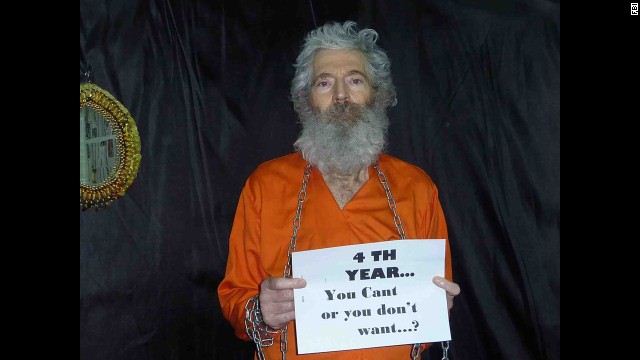


 Aletho News
