India’s gaffe at Samarkand
BY M. K. BHADRAKUMAR | INDIAN PUNCHLINE | SEPTEMBER 20, 2022
Prime Minister Narendra Modi’s meeting with Russian President Vladimir Putin at Samarkand on September 16 after the SCO Summit turned into a media scandal. The Western media zeroed in on six words culled out of context in the PM’s opening remarks — “today’s era is not of war”— to triumphantly proclaim that India is finally distancing itself from Russia on Ukraine issue, as the US and European leaders have been incessantly demanding.
Of course, this motivated interpretation lacks empirical evidence and is, therefore, malicious. Besides, Modi also spoke with a rare interplay of emotions by underscoring the quintessence of the Indian-Russian relationship, and his two decade-long association with Putin.
The steamy part cooked up by the US media shows the desperation on the part of the “Collective West” to isolate Russia at a time when even western leaders have candidly admitted that the bulk of the non-western world does not identify with the western narrative on Ukraine and refuses to roll back their relationship with Russia.
Many countries are, in fact, stepping up their cooperation with Russia —Turkey, Saudi Arabia, Egypt, Iran, for example. Curiously, even western companies are loathe to leave the highly attractive Russian market where business returns are high. A report in the Atlantic Council magazine on September 18 highlights that although something like 1,000 multinational corporations had announced that they would be leaving Russia in the wake of the western sanctions, “the unfortunate reality is that… three-quarters of the most profitable foreign multinationals remain in Russia.” Thus, statistically, while 106 western companies exited the Russian market, over 1,149 internationals still remain and simply keep silent about it.
The giant Sakhalin-2 oil-and-natural-gas project in the Russian Far East is a celebrated case where two big energy Japanese investors Mitsui and Mitsublishi, with government support, simply refused to quit, as the Russian project supplies 9 percent of Japan’s energy needs. The G7 has no option but to exempt Japan from the purview of sanctions when it comes to Sakhalin-2!
Again, the West continues to import fertiliser from Russia and to that end, lifts the restrictions on shipping, insurance, etc. But the restrictions continue against Russia’s exports of food grain and fertiliser to the non-Western world. Russia has now offered to distribute the fertiliser held up in European ports free of charge to the poorest countries in Africa if only the restrictions for exports are waived, but Europe would rather use it for their own needs.
It has recently been exposed that the brouhaha about a “global food crisis” (which India too mouthed) was basically a cheap hoax perpetrated by the Biden Administration to get Russia to allow the sale of wheat held up in Ukrainian silos to the European market by American companies, who have apparently bought up Ukraine’s farm lands and control that country’s grain trade! Only a fraction of the grain shipments from Ukraine went to poor countries threatened by famine. Suffice to say, the US and the European Union pressure on India’s purchase of Russian oil was nothing but bullying.
That said, India should know that in a situation where Russia faces an existential threat to its security, it will not be deterred in firmly, decisively responding, no matter what anybody says. Will India be deterred if any foreign country gets agitated over state repression in Kashmir? Violence and bloodshed are abhorrent features of the contemporary world situation and is a painful reality all over the world.
That is why, PM Modi’s awkward reference to war and peace in his initial remarks to Putin at Samarkand was way out of place in what turned out to be a “wonderful” meeting otherwise. There was simply no need to have characterised, at PM’s level, the Ukraine conflict as a “war”. It betrayed ignorance, since the whole world knows that what is going on is a proxy war between the US and Russia that had been simmering through the past quarter century ever since NATO began its eastward enlargement with an agenda to encircle Russia. Moscow seriously erred by tolerating the US interference in Ukraine so long until NATO finally appeared on its doorstep. It is doubtful if India would have shown such strategic patience.
Against such a complex backdrop, the litmus test of India’s “neutrality” will, perhaps, lie in EAM Jaishankar at least speaking up on the NATO’s eastward expansion, the US stoking the fire of conflict by pumping tens of billions of dollars worth weaponry into Ukraine, and the Biden Administration’s diabolical role in undermining nascent peace moves between Moscow and Kiev.
If Turkey’s Recep Erdogan and Hungary’s Viktor Orban can speak up, although NATO leaders, why can’t India’s EAM? But, never mind, there is no question of Jaishankar even remotely embarrassing Biden.
From the Kremlin readout, Putin actually acknowledged right at the outset of the conversation with Modi that Russia and India are not on the same page on Ukraine. To be sure, Putin must be knowing that India’s behaviour is guided by its narrowly defined self-interests and conditioned by an itch to do cherrypicking. But Moscow has never been and will never be a demanding partner. Mutual interest and mutual respect are the hall marks of Russian diplomacy toward India. Despite own reservations over what India was doing by splitting Pakistan into two halves, when the crunch time came in 1971, Moscow not only stood by India but even despatched its warships and submarines to guard Indian waters from a potential US military intervention against India. It is, therefore, all the more reason for us to be discreet.
Ironically, India must be one of the few countries that benefits out of the Ukraine conflict. Aside oil, coal and what not at low prices, paradoxically, even the rupee has taken baby steps to commence its indeterminate journey to become a “world currency.” No patriotic Indian will criticise the Modi government for such sophistry. However, confusion arises when morality is injected into all this with a contrived attitude of indignation, when there is really no need for it.
The meeting in Samarkand took place in the context of the SCO’s annual summit. The summit was not about Ukraine but about the profound issues that have surfaced in its wake that will shape the contours of the world order. This SCO summit was special, as it took place amid large-scale geopolitical changes, triggering a rapid and irrevocable transformation of the entire complex of international ties, relations, policies, economy, when a new model based on the real multi-polarity and dialogue is being built.
Everyone understands that the SCO, which represents half the world’s population, will help forge the new world order. Unlike the case with NATO, where all decisions are made in Washington and imposed on America’s “allies”, there is no Pied Piper in the SCO tent. Modi could easily have played a meaningful role at the summit instead of meandering his way aimlessly through the pandemic, supply chains, et al, at a juncture when such profound issues were being discussed by his peer group in Samarkand.
The word “multipolarity,” which was on everyone’s mind in Samarkand, didn’t even figure in Modi’s speech at Samarkand. Whoever drafted the speech must have done it with an eye on Washington. Therefore, don’t blame the US media. They happened to notice all these aberrations and decided to cull out those six sharply-etched words to put India on the mat, mocking it for doublespeak and rank opportunism, and all that hand-wringing by the apologists of our government cannot wash away that stain.
EU Threatens To Suspend €7.5BN In Hungary Funding Amid Charges Of ‘Cozying Up’ To Putin
By Tyler Durden – Zero Hedge – September 19, 2022
The EU’s patience with Viktor Orban’s Hungary is running extremely thin after years of wrangling and threats from Brussels of triggering the “rule of law” mechanism, despite recently announced efforts of Budapest to establish an anti-graft agency.
It seems Russia’s war in Ukraine is hastening a confrontational and fractured ending to the standoff, with the EU on Sunday threatening to freeze 7.5 billion euros which had been earmarked for Hungary, citing persisting corruption and fraud.
It’s been no secret that Orban has been a thorn in the side of European efforts to punish and isolate Putin’s Russia. While Hungary has demanded exemptions from EU energy sanctions on Russia, and has meanwhile enjoyed cheap gasoline and other energy at a moment prices in the rest of Europe have gone steadily up over the course of the war – and into what’s sure to be a tough winter – the belief among leading EU states is that joint bloc anti-Russia actions have been largely blunted. The timing of the fresh EU threats is not going unnoticed.
Bloomberg in a fresh report has put the dilemma as follows: “But while most member states have been engaged in a desperate scramble to secure alternative gas supplies ahead of the winter, Orban has deepened his country’s ties to the Kremlin, exploiting the exemptions he demanded from EU sanctions to secure increased imports of gas from Russia.”
Poland has remained a powerful impediment thus far to Brussels triggering any significant rule of law penalties, despite Warsaw remaining at the forefront of denunciations of Russia’s invasion.
“During years of frustration at the Hungarian government, Orban has been shielded from the EU’s main disciplinary machinery, known as the article 7 procedure, by the support of the nationalist government in Warsaw — because that mechanism too requires the endorsement of all the other members,” Bloomberg recounts. “The war in Ukraine has soured Orban’s relationship with the Polish government, which has been among the most ardent supporters of firm action against Putin, but for now the Poles are standing by Orban.”
Orban has cast efforts to “punish” his country in terms of a war on traditional values. For now, Poland seems to agree… the vast divergence in rhetoric on the Russia-Ukraine conflict notwithstanding.
Prime Minister Mateusz Morawiecki said Sunday, “Poland will strongly oppose any action of European institutions that intend to unduly deprive any member states of funds, in this case Hungary.”
Interestingly (given the timing of the EU’s threat to freeze funds), just days ago PM Orban reportedly told a closed-door meeting of officials from his ruling Fidesz party that he would fight efforts to extend EU sanctions on Russia:
Hungarian Prime Minister Viktor Orban expects European Union leaders to start talks on extending sanctions on Russia in the autumn but Budapest would try to block the move, Radio Free Europe/Radio Liberty reported, citing unidentified sources.
Orban, a harsh critic of EU sanctions on Moscow over its invasion of neighbouring Ukraine, made the remarks at a closed meeting to party members in the western village of Kotcse last week, RFE/RL said on its Hungarian website on Friday.
He also appeared to once again blame the West for the Ukraine conflict spiraling out of control, and continued his theme of anti-Russia sanctions ultimately blowing back on populations at home, or shooting the European economy in the foot.
Russian media too has been featuring recent quotes of Orban’s lambasting collective Western policy: “The Hungarian leader allegedly told his supporters that he believed Ukraine may end up losing between one third and one half of its territory due to the conflict with Russia, RFE/RL reported on Friday, citing participants of the meeting in the village of Kotcse.”
Budapest has meanwhile lashed out at the European Parliament’s (EP) recent move to approve a resolution stating that Hungary is no longer a “full democracy.” That nonbinding EP vote from last week cited Hungary’s failures to uphold “respect for human dignity, freedom, democracy, equality, the rule of law, and respect for human rights, including the rights of persons belonging to minorities” – as the text reads, in repetition of prior EP statements.
A Fidesz statement said in response: “It is unforgivable that, while people are suffering from the severe economic effects of wartime inflation and misguided sanctions, the European Parliament is attacking Hungary again.”
Japan maintains sanctions but boosts its LNG imports from Russia
Japan’s economic woes are compounded by anti-Russia sanctions
By Ahmed Adel | September 20, 2022
Despite being one of the very few non-Western countries to join the US-led sanctions against Moscow, Japan has suddenly tripled the amount of liquefied natural gas (LNG) imported from Russia to solve its energy problem. Although the Japanese government plans to reduce its dependence on Russian gas supplies, it appears that Tokyo cannot immediately give up gas and fuel from the Eurasian country.
According to the Japanese Ministry of Finance, Japan in August increased the amount of LNG imported from Russia by 211.2% compared to last year. It is noted though that crude oil imports in the same period year-on-year decreased by 20.3%. According to the data, coal imports from Russia in August decreased by 32.6% compared to the same period last year.
In the opposite direction, iron ore imports increased by 44.9%. In addition, Japan increased the number of vegetables and fruits imported from Russia by 154%, but reduced the amount of grain and soybean imports by 94-95%. While the total volume of goods exported from Japan to Russia in August decreased by 24.3% compared to the same period last year, reaching $384 million, the amount of Japanese goods imported from Russia recorded an increase of up to 67.4%, with a value of up to $1.15 billion.
The Japanese want to gradually reduce imports of Russian coal and oil, but Tokyo does not want to cut the amount LNG because this is a gas supply that plays an extremely important role in maintaining the country’s economy.
At the end of June 2022, the G7, the group of leading industrialised countries in the world, which includes Japan in its ranks, announced a plan to reduce dependence on the supply of gas, oil, and fuel from Russia. However, the sharp increase in LNG imports from Russia to Japan seems to indicate a different truth. Not only Tokyo, but also many Western countries, will find it difficult to end their dependence on Russian gas in the short and medium term.
It is recalled that Japan’s energy self-sufficiency rate is only 11%, much lower than the US’s 106%, Canada’s 179%, and the UK’s 75%. Therefore, if Russia stops selling oil and gas to Japan, Tokyo will face a great risk of energy insecurity.
This month, G7 countries also announced their intention to impose a price cap on Russian oil. However, the EU itself cannot find a common voice on this issue, especially as Moscow has warned that “unfriendly” countries will not have the opportunity to import oil, gas and fuel from Russia if they impose a cap. This is a scenario that Japan wants to avoid.
According to the Ministry of Economy, Trade and Industry (METI), Japan’s total energy consumption in 2019 is equivalent to 247 million tons of oil, of which natural gas accounts for nearly 8.7%. Renewable energy (other than electricity) accounts for only a very small part, about 0.1% and even tends to decrease slightly over time. In recent years, Japan has not discovered any more natural gas fields of major commercial value. Japan, for its part, only produces about 2 million tons per year.
To meet domestic demand, Japan imported 82.9 million tons in 2018 – from Australia 34.6%, the Middle East 21.7%, and Malaysia 13.6%, but also from host of other countries. In fact, Japan uses LNG mainly for power generation through 37 LNG terminals, with the highest proportion belonging to JERA (42%) and Tokyo Gas (17%).
After the Fukushima nuclear power plant meltdown, Japan changed its energy development strategy, focusing on the issue of safety and energy security. Along with that, Japan also strives to further enhance energy efficiency.
In the context of Japan’s limited potential to exploit renewable energy, the use of nuclear power is opposed by many domestic organisations. For this reason, LNG imports became a key strategy for Japan. By 2030, the share of LNG in Japan’s power generation capacity is forecast to reach 27%.
It is noted though that August marked the thirteenth month in a row that Japan has been importing products more than it has been exporting, with about half of the deficit coming from energy imports from the Middle East.
“The weaker yen is boosting (the cost of) imports at a time of surging energy prices. Energy and grain prices have shown signs of stabilizing recently, but the impact of the sharp drop in the yen will continue for a while with a lag,” one analyst told Japanese daily Mainichi.
In this way, Japan’s anti-Moscow sanctions are also affecting its economy, just as it is all across Europe. There is little evidence either that Tokyo is planning to reverse its sanctions, suggesting that its economic woes will continue to be compounded by the self-sabotaging sanctions imposed against Russia.
Ahmed Adel is a Cairo-based geopolitics and political economy researcher.
Sustainable Debt Slavery
BY IAIN DAVIS AND WHITNEY WEBB |
UNLIMITED HANGOUT| SEPTEMBER 13, 2022
In this first instalment of a new series, Iain Davis and Whitney Webb explore how the UN’s “sustainable development” policies, the SDGs, do not promote “sustainability” as most conceive of it and instead utilise the same debt imperialism long used by the Anglo-American Empire to entrap nations in a new, equally predatory system of global financial governance.
The UN’s 2030 Agenda for Sustainable Development is pitched as a “shared blueprint for peace and prosperity for people and the planet, now and into the future.” At the heart of this agenda are the 17 Sustainable Development Goals, or SDGs.
Many of these goals sound nice in theory and paint a picture of an emergent global utopia – such as no poverty, no world hunger and reduced inequality. Yet, as is true with so much, the reality behind most – if not all – of the SDGs are policies cloaked in the language of utopia that – in practice – will only benefit the economic elite and entrench their power.
This can clearly be seen in fine print of the SDGs, as there is considerable emphasis on debt and on entrapping nation states (especially developing states) in debt as a means of forcing adoption of SDG-related policies. It is then little coincidence that many of the driving forces behind SDG-related policies, at the UN and elsewhere, are career bankers. Former executives at some of the most predatory financial institutions in the history of the world, from Goldman Sachs to Bank of America to Deutsche Bank, are among the top proponents and developers of SDG-related policies.
Are their interests truly aligned with “sustainable development” and improving the state of the world for regular people, as they now claim? Or do their interests lie where they always have, in a profit-driven economic model based on debt slavery and outright theft?
In this Unlimited Hangout investigative series, we will be exploring these questions and interrogating – not only the power structures behind the SDGs and related policies – but also their practical impacts.
In this first instalment, we will explore what actually underpins the majority of the 2030 Agenda and the SDGs, cutting through the flowery language to deliver the full picture of what the implementation of these policies means for the average person. Subsequent instalments will focus on case studies based on specific SDGs and their sector-specific impacts.
Overall, this series will offer a fact-based and objective look at how the motivation behind the SDGs and Agenda 2030 is about retooling the same economic imperialism used by the Anglo-American Empire in the post-World War II era for the purposes of the coming “multipolar world order” and efforts to enact a global neo-feudal model, perhaps best summarized as a model for “sustainable slavery.”
The SDG Word Salad

The UN educates young people in developing nations to welcome “Sustainable Development” without disclosing the impact it will have on their lives or national economy, Source: UNICEF
Most people are aware of the concept of “Sustainable Development” but, it is fair to say that the majority believe that SDGs are related to tackling problems allegedly wrought by climate disaster. However, the Agenda 2030 SDGs encompass every facet of our lives and only one, SDG 13, deals explicitly with climate.
From economic and food security to education, employment and all business activity; name any sphere of human activity, including the most personal, and there is an associated SDG designed to “transform” it. Yet, it is the SDG 17—Partnerships for Goals—through which we can start to identify who the beneficiaries of this system really are.
The stated UN SDG 17 aim is, in part, to:
Enhance global macroeconomic stability, including through policy coordination and policy coherence. [. . .] Enhance the global partnership for sustainable development, complemented by multi-stakeholder partnerships [. . .] to support the achievement of the sustainable development goals in all countries. [. . .] Encourage and promote effective public, public-private and civil society partnerships, building on the experience and resourcing strategies of partnerships.
From this, we can deduce that “multi-stakeholder partnerships” are supposed to work together to achieve “macroeconomic stability” in “all countries.” This will be accomplished by enforcing “policy coordination and policy coherence” constructed from the “knowledge” of “public, public-private and civil society partnerships.” These “partnerships” will deliver the SDGs.
This word-salad requires some untangling, because this is the framework that enables the implementation of every SDG “in all countries.”
Before we do, it is worth noting that the UN often refers to itself and its decisions using grandiose language. Even the most trivial of deliberations are treated as “historic” or “ground breaking,” etc. There is also a lot of fluff to wade through about transparency, accountability, sustainability and so on.
These are just words which require corresponding action in order to have contextual meaning. “Transparency” doesn’t mean much if crucial information is buried in endless reams of impenetrable bureaucratic waffle that isn’t reported to the public by anyone. “Accountability” is an anathema if even national governments lack the authority to exercise oversight over the UN; and when “sustainable” is used to mean “transformative,” it becomes an oxymoron.
Untangling the UN-G3P SDG Word Salad
The UN Economic and Social Council (ECOSOC) commissioned a paper which defines “multi-stakeholder partnerships” as:
[P]artnerships between business, NGOs, Governments, the United Nations and other actors.
These “multi-stakeholder partnerships” are supposedly working to create global “macroeconomic stability” as a prerequisite for the implementation of the SDGs. But, just like the term “intergovernmental organisation,” the meaning of “macroeconomic stability” has also been transformed by the UN and its specialised agencies.
While macroeconomic stability used to mean “full employment and stable economic growth, accompanied by low inflation,” the UN have announced that isn’t what it means today. Economic growth now has to be “smart” in order to meet SDG requirements.
Crucially, fiscal balance—the difference between a government’s revenue and expenditure—must accommodate “sustainable development” by creating “fiscal space.” This effectively disassociates the term “macroeconomic stability” from “real economic activity.”
Climate change is seen, not just as an environmental problem, but as a “serious financial, economic and social problem.” Therefore “fiscal space” must be engineered to finance the “policy coordination and policy coherence” needed to avert the prophesied disaster.
The UN Department for Economic and Social Affairs (UN-DESA) notes that “fiscal space” lacks a precise definition. While some economists define it simply as “the availability of budgetary room that allows a government to provide resources for a desired purpose,” others express “budgetary room” as a calculation based upon a countries debt-to-GDP ratio and “projected” growth.
UN-DESA suggests that “fiscal space” boils down to the estimated—or projected—“debt sustainability gap.” This is defined as “the difference between a country’s current debt level and its estimated sustainable debt level.”
No one knows what events may impact future economic growth. A pandemic or another war in Europe could severely restrict it, or cause a recession. The “debt sustainability gap” is a theoretical concept based upon little more than wishful thinking.
As such, this allows policy makers to adopt a malleable, and relatively arbitrary, interpretation of “fiscal space.” They can borrow to finance sustainable development spending, irrespective of real economic conditions.
The primary objective of fiscal policy used to be to maintain employment and price stability and encourage economic growth through the equitable distribution of wealth and resources. It has been transformed by sustainable development. Now it aims to achieve “sustainable trajectories for revenues, expenditures, and deficits” that emphasise “fiscal space.”
If this necessitates increased taxation and/or borrowing, so be it. Regardless of the impact this has on real economic activity, it’s all fine because, according to the World Bank:
Debt is a critical form of financing for the sustainable development goals.
Spending deficits and increasing debt are not a problem because “failure to achieve sustainable development goals” would be far more unacceptable and would increase debt even further. Any amount of sovereign debt can be heaped upon the taxpayer in order to protect us from the much more dangerous economic disaster that would allegedly befall us if the SDGs aren’t quickly implemented.
In other words, economic, financial and monetary crises will hardly be absent in the world of “sustainable development.” The rationale outlined above will likely be used to justify such crises. This is the model envisioned by the UN and its “multi-stakeholder partners.” For those behind the SDGs, the ends justify the means. Any travesty can be justified as long as it is committed in the name of “sustainability.”
We are faced with a global policy initiative, affecting every corner of our lives, based upon the logical fallacy of circular reasoning. The effective destruction of society is necessary in order to protect us from something that we are told is to be much worse.
Obedience is a virtue because, unless we adhere to the policy demands imposed upon us, and accept the costs, the climate disaster might come to pass.
Armed with this knowledge, it becomes much easier to translate the convoluted UN-G3P word-salad and figure out what the UN actually means by the term “Sustainable Development”:
Governments will tax their populations, increasing deficits and national debt where necessary, to create financial slush funds that private multinational corporations, philanthropic foundations and NGOs can access in order to distribute their SDG compliance-based products, services and policy agendas. The new SDG markets will be protected by government sustainability legislation, which is designed by the same “partners” who profit from and control the new global SDG-based economy.
“Green” Debt Traps
Debt is specifically identified as a key component of SDG implementation, particularly in the developing world. In a 2018 paper written by a joint World Bank-IMF team, it was noted on several occasions that “debt vulnerabilities” in developing economies are being addressed by those financial institutions “within the context of the global development agenda (e.g., SDGs).”
That same year, the World Bank and IMF’s Debt Sustainability Framework (DSF) became operational. Per the World Bank, the DSF “allows creditors to tailor their financing terms in anticipation of future risks and helps countries balance the need for funds with the ability to repay their debts.” It also “guides countries in supporting the SDGs, when their ability to service debt is limited.”
Expressed differently, if countries cannot pay the debt they incur through IMF loans and World Bank (and associated Multilateral Development Bank) financing, they will be offered options to “repay” their debt through implementing SDG-related policies. However, as future instalments of this series will show, many of these options supposedly tailored to SDG implementation actually follow the “debt for land swap” model (now re-tooled as “debt for conservation swaps” or “debt for climate swaps”) that precede the SDGs and Agenda 2030 by a number of years. This model essentially enables land grabs and land/natural resource theft on a scale never before seen in human history.
Since their creation in the aftermath of World War II, both the World Bank and IMF have historically used debt to force countries, mostly in the developing world, to adopt policies that favour the global power structure. This was made explicit in a leaked US Army document written in 2008, which states that these institutions are used as unconventional, financial “weapons in times of conflict up to and including large-scale general war” and as “weapons” in terms of influencing “the policies and cooperation of state governments.” The document notes that these institutions in particular have a “long history of conducting economic warfare valuable to any ARSOF [Army Special Operations Forces] UW [Unconventional Warfare] campaign.”
The document further notes that these “financial weapons” can be used by the US military to create “financial incentives or disincentives to persuade adversaries, allies and surrogates to modify their behavior at the theater strategic, operational, and tactical levels.” Further, these unconventional warfare campaigns are highly coordinated with the State Department and the Intelligence Community in determining “which elements of the human terrain in UWOA [Unconventional Warfare Operations Area] are most susceptible to financial engagement.”
Notably, the World Bank and the IMF are listed as both Financial Instruments and Diplomatic Instruments of US National Power as well as integral parts of what the manual calls the “current global governance system.”
While they were once “financial weapons” to be wielded by the Anglo-American Empire, the current shifts in the “global governance system” also herald a shift in who is able to weaponize the World Bank and IMF for their explicit benefit. As the sun sets on the imperial, “unipolar” model and the dawn of a “multipolar” world order is upon us. The World Bank and IMF have already been brought under the control of a new international power structure following the creation of the UN-backed Glasgow Financial Alliance for Net Zero (GFANZ) in 2021.
At the COP26 conference that same year, GFANZ announced plans to overhaul the role of the World Bank and IMF specifically as part of a broader plan aimed at “transforming” the global financial system. This was made explicit by GFANZ principal and BlackRock CEO Larry Fink during a COP26 panel, where he specified the plan to overhaul these institutions, saying:
If we’re going to be serious about climate change in the emerging world, we’re going to have to really focus on the reimagination of the World Bank and the IMF.
GFANZ’s plans to “reimagine” these international financial institutions involve merging them with the private-banking interests that compose GFANZ; creating a new system of “global financial governance”; and eroding national sovereignty (particularly in the developing world) by forcing them to establish business environments deemed friendly to the interests of GFANZ members.
As noted in a previous Unlimited Hangout report, GFANZ seeks to use the World Bank and related institutions “to globally impose massive and extensive deregulation on developing countries by using the decarbonization push as justification. No longer must MDBs [multilateral development banks] entrap developing nations in debt to force policies that benefit foreign and multinational private-sector entities, as climate change-related justification can now be used for the same ends.”
Debt remains the main weapon in the arsenal of the World Bank and IMF, and will be used for the same “imperial” ends, only now with different benefactors and a different array of policies to impose on their prey – the SDGs.
The UN’s Quiet Revolution
GFANZ is a significant driver of “sustainable development.” It is, nonetheless, just one of many SDG related “public-private partnerships.” The GFANZ website states:
GFANZ provides a forum for leading financial institutions to accelerate the transition to a net-zero global economy. Our members currently include more than 450 member firms from across the global financial sector, representing more than $130 trillion in assets under management.
GFANZ is formed from a number of “alliances.” The banks, asset managers, asset owners, insurers, financial service providers and investment consultancies each have their own global partnership networks that collectively contribute to the GFANZ forum.
For example, the UN’s Net Zero Banking Alliance affords Citigroup, Deutsche Bank, JPMorgan, HSBC and others the opportunity to pursue their ideas through the GFANZ forum. They are among the key “stakeholders” in the SDG transformation.
In order to “accelerate the transition,” the GFANZ forum’s “Call to Action” empowers these multinational corporations to stipulate specific policy requests. They have decided that governments should adopt “economy-wide net-zero targets.” Governments also need to:
[R]eform [. . . ] financial regulations to support the net zero transition; phase-out of fossil fuel subsidies; pric[e] carbon emissions; mandat[e] net zero transition plans and [set] climate reporting for public and private enterprises by 2024
All of this is necessary, we are told, to avert the “climate disaster” that might happen one day. Therefore, this “global financial governance” policy agenda is simply unavoidable and we should allow private (and historically predatory) financial institutions to create policy aimed at de-regulating the very markets in which they operate. After all, the “race to Net Zero” must happen at break-neck speed and, per GFANZ, the only way to “win” involves scaling “private capital flows to emerging and developing economies” like never before. Were the flow of this “private capital” to be impeded by existing regulations or other obstacles, it would surely spell planetary destruction.
King Charles III, explained the new global SDG economy that will relegate elected governments to “enabling partners.” Then titled Prince Charles, speaking at COP26, in preparation for the GFANZ announcement, he said:
My plea today is for countries to come together to create the environment that enables every sector of industry to take the action required. We know this will take trillions, not billions of dollars. We also know that countries, many of whom are burdened by growing levels of debt, simply cannot afford to go green. Here we need a vast military style campaign to marshal the strength of the global private sector, with trillions at its disposal far beyond global GDP, [. . .] beyond even the governments of the world’s leaders. It offers the only real prospect of achieving fundamental economic transition.
Just as the alleged urgency to implement the SDGs exonerates public policy makers, it also lets the private sector, that drives the antecedent policy agendas, off the hook. The fact that the debt they collectively create primarily benefits private capital is just a coincidence; an allegedly inescapable, consequence of creating the “fiscal space” needed to deliver “sustainable development.”
The UN’s increasing reliance upon these “multi-stakeholder partnerships” is the result of the “quiet revolution” that occurred in the UN during the 1990s. In 1998, then UN Secretary General, Kofi Annan, told the World Economic Forum’s Davos symposium:
The business of the United Nations involves the businesses of the world. [. . .] We also promote private sector development and foreign direct investment. We help countries to join the international trading system and enact business-friendly legislation.
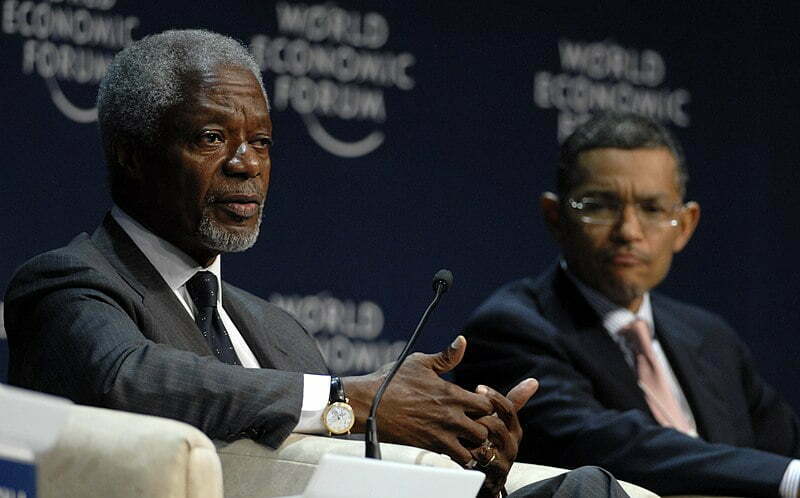
Kofi Annan, Secretary-General, United Nations (1997 – 2006) is a member of the Foundation Board of the World Economic Forum and Co-Chair of the World Economic Forum on Africa. Here, he speaks at the Opening Plenary on Africa and the New Global Economy at the World Economic Forum on Africa 2009 in Cape Town, South Africa, Source: WEF
The 2017 UN General Assembly Resolution 70/224 (A/Res/70/224) decreed that the UN would work “tirelessly for the full implementation of this Agenda [Agenda 2030]” through the global dissemination of “concrete policies and actions.”
In keeping with Annan’s admission, these enacted policies and actions are designed, via “global financial governance,” to be “business-friendly.”
A/Res/70/224 added that the UN would maintain:
The strong political commitment to address the challenge of financing and creating an enabling environment at all levels for sustainable development. [. . .] [P]articularly with regard to developing partnerships through the provision of greater opportunities to the private sector, non-governmental organizations and civil society in general [. . .], in particular in the pursuit of sustainable development [SDGs].
This “enabling environment” is synonymous with the “fiscal space” demanded by the World Bank and other UN specialised agencies. The term also makes an appearance in the GFANZ progress report, which states that the World Bank and Multilateral Development Banks should be used to prompt developing nations “to create the right high-level, cross-cutting enabling environments” for alliance members’ investments in those nations.
This concept was firmly established in 2015 at the Adis Ababa Action Agenda conference on “financing for development.” The gathered delegates from 193 UN nation states committed their respective populations to an ambitious financial investment programme to pay for sustainable development.
They collectively agreed to create:
… an enabling environment at all levels for sustainable development; [. . .] to further strengthen the framework to finance sustainable development.
The “enabling environment” is a government, and therefore taxpayer-funded commitment to SDGs. Annan’s successor and the 9th Secretary General of the UN, António Guterres, authorised a 2017 report on A/Res/70/224 which read:
The United Nations must urgently rise to the challenge of unlocking the full potential of collaboration with the private sector and other partners. [. . .] [T]he United Nations system recognizes the need to further pivot towards partnerships that more effectively leverage private sector resources and expertise. The United Nations is also seeking to play a stronger catalytic role in sparking a new wave of financing and innovation needed to achieve the Goals [SDGs].
While called an intergovernmental organisation, the UN is not just a collaboration between governments. Some might reasonably argue that it never was.
The UN was created, in no small measure, thanks to the efforts of the private sector and the “philanthropic” arms of oligarchs. For instance, the Rockefeller Foundation’s (RF’s) comprehensive financial and operational support for the Economic, Financial and Transit Department (EFTD) of the League of Nations (LoN), and its considerable influence upon the United Nations Relief and Rehabilitation Administration (UNRRA), arguably made the RF the key player in the transition of the LoN into the UN.
In addition, the Rockefeller family, which has long promoted “internationalist” policies that expand and entrench global governance, donated the land on which the UN’s headquarters in New York sits, among other sizeable donations to the UN over the years. It should come as little surprise that the UN is particularly fond of one of their main donors and has long partnered with the RF and praised the organisation as a model for “global philanthropy.”
The UN was essentially founded upon a public-private partnership model. In 2000, the Executive Committee of the UN Educational, Scientific and Cultural Organization (UNESCO) published Private Sector Involvement and Cooperation with the United Nations System:
The United Nations and the private sector have always had extensive commercial links through the procurement activities of the former. [. . .] The United Nations market provides a springboard for a company to introduce its goods and services to other countries and regions. [. . .] The private sector has also long participated, directly or indirectly, in the normative and standard-setting work of the United Nations.
Being able to influence, not only government procurement, but also the development of new global markets and the regulation of the same is, obviously, an extremely attractive proposition for multinational corporations and investors. Unsurprisingly, UN projects that utilise the “public-private” model are the favoured approach of the world’s leading capitalists. For instance, it has long been the favoured model of the Rockefeller family, who often finance such projects through their respective philanthropic foundations.
In the years since its inception, public-private partnerships have expanded to become dominant within the UN system, particularly with regard to “sustainable development.” Successive Secretary Generals have overseen the UN’s formal transition into the United Nations’ Global Public-Private Partnership (UN-G3P).
As a result of this transformation, the role of nation state governments at the UN has also changed dramatically. For instance, in 2005, the World Health Organisation (WHO), another specialised agency of the UN, published a report on the use of information and communication technology (ICT) in healthcare titled Connecting for Health. Speaking about how “stakeholders” could introduce ICT healthcare solutions globally, the WHO noted:
Governments can create an enabling environment, and invest in equity, access and innovation.
As King Charles III noted last year in Glasgow, governments of “democratic” nation have been given the role of “enabling” partners. Their job is to create the fiscal environment in which their private sector partners operate. Sustainability policies are developed by a global network comprised of governments, multinational corporations, non-governmental organisations (NGOs), civil society organisations and “other actors.”
The “other actors” are predominantly the philanthropic foundations of individual billionaires and immensely wealthy family dynasties, such as the Bill and Melinda Gates (BMGF) or the Rockefeller Foundations. Collectively, these “actors” constitute the “multi-stakeholder partnership.”
During the pseudopandemic, many came to acknowledge the influence of the BMGF over the WHO, but they are just one of many other private foundations that are also valued UN “stakeholders.”
The UN is, itself, a global collaboration between governments and a multinational infra-governmental network of private “stakeholders.” The foundations, NGOs, civil society organisations and global corporations represent an infra-governmental network of stakeholders, just as powerful, if not more so, than any power block of nation states.
Public-Private Partnership: An Ideology
In 2016, UN-DESA published a working paper investigating the value of public-private partnerships (G3Ps) for achieving the SDGs. The lead author, Jomo KS, was the Assistant Secretary General in the United Nations system responsible for economic research (2005-2015).
UN-DESA broadly found that G3Ps, in their current form, were not fit for purpose:
[C]laims of reduced cost and efficient delivery of services through [G3Ps] to save tax payers money and benefit consumers were mostly empty and [. . .] ideological assertions. [. . ] [G3P] projects were more costly to build and finance, provided poorer quality services and were less accessible [. . .] Moreover, many essential services were less accountable to citizens when private corporations were involved. [. . .] Investors in [G3Ps] face a relatively benign risk [. . .] penalty clauses for non-delivery by private partners are less than rigorous, the study questioned whether risk was really being transferred to the private partners in these projects. [. . .] [T]he evidence suggests that [G3Ps] have often tended to be more expensive than the alternative of public procurement while in a number of instances they have failed to deliver the envisaged gains in quality of service provision.
Citing the work of Whitfield (2010), which examined G3Ps in Europe, North America, Australia, Russia, China, India and Brazil, UN-DESA noted that these led to “the buying and selling schools and hospitals like commodities in a global supermarket.”
The UN-DESA reports also reminded the UN’s G3P enthusiasts that numerous intergovernmental organisations had found G3Ps wanting:
Evaluations done by the World Bank, International Monetary Fund (IMF) and European Investment Bank (EIB) – the organizations normally promoting [G3Ps] – have found a number of cases where [G3Ps] did not yield the expected outcome and resulted in a significant rise in government fiscal liabilities.
Little has changed since 2016 and yet the UN-G3P insist that public-private partnership is the only way to achieve SDGs. Ignoring the assessment from its own investigators, In General Assembly Resolution 74/2 (A/Res/74/2) the UN declared:
[UN member states] Recognize the need for strong global, regional and national partnerships for Sustainable Development Goals, which engage all relevant stakeholders to collaboratively support the efforts of Member States to achieve health-related Sustainable Development Goals, including universal health coverage [UHC2030] [. . .] the inclusion of all relevant stakeholders is one of the core components of health system governance. [. . . ] [We] Reaffirm General Assembly resolution 69/313 [. . .] to address the challenge of financing and creating an enabling environment at all levels for sustainable development. [We will] provide [. . .] sustainable finances, while improving their effectiveness [. . .] through domestic, bilateral, regional and multilateral channels, including partnerships with the private sector and other relevant stakeholders.
This UN commitment to global public-private partnership is an “ideological assertion” and is not based upon the available evidence. In order for G3Ps to actually function as claimed, UN-DESA stipulated that a number of structural changes would need to be put in place first.
These included careful identification of where a G3P could work. UN-DESA found that G3Ps may be suited to some infrastructure projects but were damaging to projects dealing with public health, education or the environment.
The UN researchers stated that diligent oversight and regulation of pricing and the alleged transfer of risk would be required; comprehensive and transparent fiscal accounting systems were needed; better reporting standards should be developed and rigorous legal and regulatory safeguards were necessary.
None of the required structural or policy changes recommended in the UN-DESA 2016 report have been implemented.
Sustainability for whom?
Agenda 2030 marks the waypoint along the path to Agenda 21. Publicly launched at the 1992 Rio Earth Summit, Section 8 explained how “sustainable development” would be integrated into decision making:
The primary need is to integrate environmental and developmental decision-making processes. [. . .] Countries will develop their own priorities in accordance with their national plans, policies and programmes.
Sustainable development has been integrated with every policy decision. Not only does every country have a national sustainability plan, these have devolved to local government.
It is a global strategy to extend the reach of global financial institutions into every corner of the economy and society. Policy will be controlled by the bankers and the think-tanks that infiltrated the environmental movement decades ago.
No community is free of “global financial governance.”
Simply put, sustainable development supplants decision making at the national and local level with global governance. It is an ongoing, and thus far successful, global coup.
But more than this, it is a system for global control. Those of us who live in developed nations will have our behaviour changed as a psychological and economic war is waged against us to force our compliance.
Developing nations will be kept in penury as the fruits of modern industrial and technological development are denied to them. Instead they will be burdened with the debt foisted upon them by the global centres of financial power, their resources pillaged, their land stolen and their assets seized – all in the name of “sustainability.”
Yet it is perhaps the financialisation of nature, inherent to sustainable development, that is the greatest danger of all. The creation of natural asset classes, converting forests into carbon sequestration initiatives and water sources into human settlement services. As subsequent instalments of this series will show, several SDGs have financialising nature at their core.
As openly stated by the UN, “sustainable development” is all about transformation, not necessarily “sustainability” as most people conceive of it. It aims to transform the Earth and everything on it, including us, into commodities – the trading of which will form the basis of a new global economy. Though it is being sold to us as “sustainable,” the only thing this new global financial system will “sustain” is the power of a predatory financial elite.
Iain Davis is an independent investigative journalist, author and blogger from the UK. His focus is upon widening readers awareness of evidence that the so-called mainstream media won’t report. A frequent contributor to UK Column, Iain’s work has been featured by the OffGuardian, the Corbett Report, Technocracy News, Lew-Rockwell and other independent news outlets. You can read more of his work on his blog: – https://iaindavis.com
Whitney Webb has been a professional writer, researcher and journalist since 2016. She has written for several websites and, from 2017 to 2020, was a staff writer and senior investigative reporter for Mint Press News. She currently writes for The Last American Vagabond.
© 2020-2021 Unlimited Hangout | All Rights Reserved
Russian fertilizer offered for free to Africa
Samizdat | September 19, 2022
Russian producer of mineral and potash fertilizers, Uralchem, has decided to supply its products to Africa free of charge, the company’s chief executive Dmitry Konyaev announced on Monday.
“The situation in the world today is really bad. Africa has been starving and will continue to starve, unfortunately. We, as a company, even decided to supply fertilizers to Africa for free, just because we are part of this global chain when you need to produce food,” Konyaev said during his speech at the Innofood forum in Sochi.
The first batch of 25,000 tons of humanitarian cargo could reportedly be sent to the Republic of Togo.
According to Uralchem CEO, there are no problems with food security in Russia, since the country is fully provided with fertilizers and can send a significant quantity for export.
Earlier this month, President Vladimir Putin said at a summit meeting of the Shanghai Cooperation Organization that the country is ready to transfer 300,000 tons of Russian fertilizers accumulated in EU ports due to Western sanctions to developing countries free of charge. While Putin welcomed the decision to allow Russian fertilizers into the EU, he criticized Brussels for only allowing the bloc’s member states to buy them.
In late July, Moscow and Kiev signed a deal unblocking Ukrainian grain exports via the Black Sea at UN-brokered talks in Istanbul. The agreement was also supposed to allow Russia to deliver fertilizers and food goods to global markets, which the Kremlin says has not happened.
Austrian citizens dissatisfied with anti-Russian measures
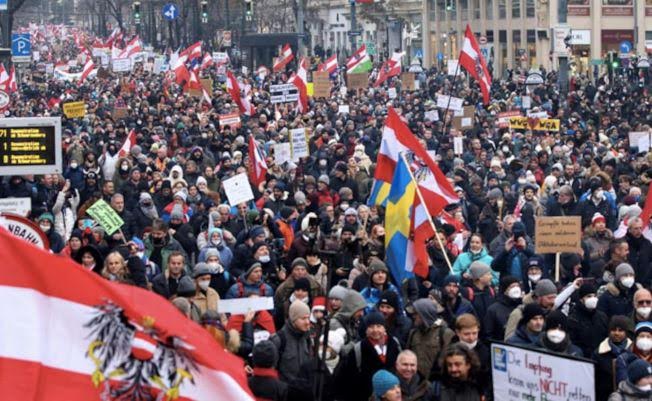
Protests against sanctions and gas prices are likely to increase in the entire European continent
By Lucas Leiroz | September 19, 2022
Protests against gas prices are rising in Europe. European citizens are increasingly dissatisfied with the directions taken by their countries and organize demonstrations to express their opinions against the EU and its sanctions. In Austria, tens of thousands of people took to the streets to demand political changes. However, the western media continues to ignore the protests.
On September 17th, the streets of Vienna and eight other major Austrian cities were taken over by tens of thousands of protesters furious at the uncontrolled rise in gas prices and living costs. Although local police declined to reveal their official estimates, sources claim that around 20,000 people attended the protests in Vienna, with around 10,000 others in the cities of Linz, Bruck an der Mur, Salzburg, Innsbruck, Klagenfurt St. Polten, Eisenstadt and Bregenz.
The protests were organized by several different political groups, but the biggest one was the trade union federation OeGB. As seen recently in other parts of Europe, individuals of different political ideologies came together for a common cause: the improvement of people’s living conditions and the end of the disastrous economic policy that is currently being conducted. Austrian political leaders reported that the main objective of the protests is to put pressure on the governing alliance – formed by a conservative-green coalition -, which the OeGB considers guilty of “watching idly as life becomes unaffordable”.
In Vienna, where the protests were concentrated, a large rally was held by trade unionists. Many criticisms against the government, big companies, and the EU were made during the speeches. Such was the popular mobilization that the Austrian president himself expressed solidarity with the situation and communicated with his voters through his social networks in order to ease popular anger. He stated that he is in solidarity with the people at this time of economic difficulty but was not able to promise any real solution to the problem.
“This solidarity should not only be felt in the heart but, above all, in the wallet of those who are wondering how to pay for their shopping at the end of the month”, Alexander Van der Bellen emphasized when commenting on the protests in a social media publication.
Other local officials also made statements in the face of the protests. The mayor of Vienna, Michael Ludwig, for example, said that the recent growth in prices is a real challenge for a large part of the population and declared support for the demand of trade unionists for changes in economic policy and salary rises. However, like the president, Ludwig failed to criticize the real root of the problem, which is the adhesion of the European bloc to anti-Russian sanctions, which are generating the current energy crisis.
Most of the western media simply ignored the protests, refusing to report on the events. Another portion, however, reported it “softly”, declining to show the real demands of the Austrian workers. This has been a recurrent tactic on the part of the Western media when reporting the protests against anti-Russian sanctions in Europe: to show that workers are asking for a drop in gas prices, but avoid mentioning that they are aware that this increase is related to the irresponsible European policy of implementing coercive measures against Moscow.
A few days before the protests, in a survey carried out by the Austrian sociological institute Institut fur Demoskopie und Datenanalyse (IFDD) it was revealed that almost 80% of Austrian citizens feel affected by the sanctions on Russia. In the survey, 78% of the interviewees said they had suffered side effects from the sanctions. More than that, 31% of respondents even said they believe that the measures were actually directed against Austria itself rather than Russia, given the impact the country is suffering. In some recent surveys in other European countries, it is also possible to see that local citizens are seeing the sanctions in a similar way, believing that their countries are the real targets of the measures – which reveals how much the European population feels harmed by the attitudes of their own rulers.
Indeed, European citizens are not wrong in their perception. Sanctions in fact affect Europe much more than Russia itself. More than that, they benefit the US, which has finally managed to destroy Russian-European energy cooperation. It is not by chance that it is Washington that plans and proposes such sanctions, which European leaders have subserviently adhered to, affecting their own interests. So, indeed, these sanctions are designed against Europe. And, knowing this, European governments need to immediately reverse these measures before winter comes and the crisis becomes a real social catastrophe.
Lucas Leiroz is a researcher in Social Sciences at the Rural Federal University of Rio de Janeiro, geopolitical consultant.
US investors pull out of ‘dark’ Europe
Free West Media | September 15, 2022
The US investment bank JPMorgan, which wants to move its employees to London because of the imminent danger of a blackout in Germany, is not an isolated case. Other foreign analysts also consider Europe to be increasingly at risk – and are avoiding doing business in Europe. US companies are already focusing on their domestic businesses.
Strategists at Goldman Sachs Group Inc believe a recession in Europe is a certainty. The US economy is safer than betting on Europe, they said. Even though the path of US growth may be “uncertain”, the economic situation in Europe was simply catastrophic.
“Despite investor concerns about the US equity market, we believe it offers greater absolute and risk-adjusted return potential than recession-hit European markets,” the statement said. It has been a tough year for business in Europe “amid a gas crisis, soaring inflation and tightening central-bank policy”.
And the business news service Bloomberg reported that a Goldman Sachs team said that while the path of US growth may be “uncertain,” the economic situation in Europe was “dire”.
“Despite concerns that investors have about the US equity market, we believe it offers greater absolute and risk-adjusted return potential than recession-plagued European markets,” they noted.
The Stoxx Europe 600 lagged the S&P 500, and a Goldman basket of US companies with 100 percent domestic sales has performed better than a basket of companies with high sales in Europe. Barclays Plc strategists expressed similar concern about European prospects.
WHY Is Germany Committing Suicide?
The Same Reasons WHY the EU/UK is Being Deindustrialized!
BY DAVID CHU • UNZ REVIEW • SEPTEMBER 17, 2022
Well that’s the real question, isn’t it? Why? The how and the who is just scenery for the public. Oswald, Ruby, Cuba, the Mafia. Keeps ’em guessing like some kind of parlor game, prevents ’em from asking the most important question, why? Why was Kennedy killed? Who benefited? Who has the power to cover it up? Who?
~ Mr. X in JFK movie
Why is Germany committing harakiri (or seppuku)?
Because the Americans ordered them to do so!
Recently, William F. Engdahl wrote a very interesting article titled, “Europe’s Energy Armageddon From Berlin and Brussels, Not Moscow” which was re-worked in Pepe Escobar’s “Germany’s Energy Suicide: An Autopsy”.
Both articles give a fascinating explanation of HOW Germany is committing suicide. Green Agenda 2030. The Great Reset. Etc.
I emailed Engdahl about the following statement that he wrote in his article and asked him, “What is the real reason for the complete deindustrialization of Germany? Besides the Green Energy or Great Reset bullshit.”:
It is not because politicians like Scholz or German Green Economy Minister Robert Habeck, nor EU Commission Green Energy Vice President Frans Timmermans are stupid or clueless. Corrupt and dishonest, maybe yes. They know exactly what they are doing. They are reading a script. It is all part of the EU plan to deindustrialize one of the most energy-efficient industrial concentrations on the planet. This is the UN Green Agenda 2030 otherwise known as Klaus Schwab’s Great Reset. [Bolded emphasis is mine.]
For whatever reasons, Engdahl didn’t reply to my email. But in my email to him, I basically answered my question when I asked the following:
Is it to emasculate Europe completely so as to make Europe completely dependent on the US for both energy and technology? The rest of the world is moving towards BRI and BRICS. The only block left to harvest aka rape and pillage for the Americans is Europe (plus Japan and South Korea).
That was September 5, 2022.
On September 16, 2022, RT (Russia Today) ran an article titled, “Elite US think tank dismisses EU plot report as ‘fake’”:
The story of an alleged US plan to drain EU resources to prop up its economy was reported on Tuesday by Nya Dagbladet, a Swedish news outlet, which describes itself as anti-globalist, humanist, pro-freedom, and independent. An English-language version was released later in the week.
The newspaper claimed that it obtained a classified document signed by the RAND Corporation, titled ‘Weakening Germany, strengthening the US’. The paper, which was allegedly produced in January, outlined a scenario for how the US could help its struggling economy by draining resources from its European allies.
The purported plot involved goading Russia into attacking Ukraine, which would force the EU to impose sanctions on Russia and decouple their economies from Russian energy.
Well, today (September 17, 2022) I contacted the two Swedish authors of Nya Dagbladet and asked them to provide me with the RAND document. Markus Andersson, one of the authors and chief editor, quickly replied and voila here is the “fake” RAND document:
https://nyadagbladet.se/wp-content/uploads/2022/09/rand-corporation-ukraina-energikris.pdf
You better save a copy of this PDF on your hard drive and pass it on to all your friends, especially those sheeple living in Germany, before the RAND people scream bloody murder and disappear this very important “fake” document!
Very soon now, the RAND people will call it a “forgery”.
The RAND report is titled, “Executive Summary: Weakening Germany, strengthening the U.S.”
It is dated January 25, 2022 and is labelled “Confidential”. The distribution list include WHCS (White House Chief of Staff), ANSA (Assistant to the President for National Security Affairs), Dept. of State, CIA (Central Intelligence Agency), NSA (National Security Agency), and the DNC (Democratic National Committee).
Shall we take a little peek into this “fake” document?
The present state of the U.S. economy does not suggest that it can function without financial and material support from external sources [very definition of a parasitic empire!]. The quantitative easing policy, which the Fed has resorted to regularly in recent years,s as well as uncontrolled issue of cash during the 2020 and 2021 Covid lockdowns, have led to a sharp increase in the external debt and an increase in the dollar supply [the very definition of high inflation rates].
The continuing deterioration of the economic situation is highly likely to lead to a loss in the position of the Democratic Party in Congress and the Senate in the forthcoming elections to be held in November 2022. The impeachment of the President cannot be ruled out under these circumstances, which must be avoided at all costs. [Bolded emphasis is mine.]
There is an urgent need for resources to flow into the national economy, especially the banking system. Only European countries bound by the EU and NATO commitments will be able to provide them without significant military and political costs for us. [The USA has ran out of third-world and developing nations to rape and pillage.]
The major obstacle to it is growing independence of Germany. Although it still is a country with limited sovereignty, for decades it has been consistently moving toward lifting these limitations and becoming a fully independent state. This movement is slow and cautious, but steady. Extrapolation shows that the ultimate goal can be reached only in several decades. However if social and economic problems in the United States escalate, the pace could accelerate significantly. . . .
Vulnerabilities in German and EU Economy
An increase in the flow of resources from Europe to U.S. can be expected if Germany begins to experience a controlled economic crisis [bolded emphasis is mine]. The pace of economic development in the EU depends almost without alternative on the state of the German economy. It is Germany that bears the brunt of the expenditure directed towards the poorer EU members.
The current German economic model is based on two pillars. These are unlimited access to cheap Russian energy resources and to cheap French electric power, thanks to the operation of nuclear power plants. The importance of the first factor is considerably higher. Halting Russian supplies can well create a systemic crisis that would be devastating for the German economy and, indirectly, for the entire European Union. . . . [Bolded emphasis is mine.]
A Controlled Crisis
Due to coalition constraints, the German leadership is not in full control of the situation in the country. Thanks to our precise actions, it has been possible to block the commissioning of the Nord Stream 2 pipeline, despite the opposition of lobbyists from the steel and chemical industries. However, the dramatic deterioration of the living standards may encourage the leadership to reconsider its policy and return to the idea of European sovereignty and strategic autonomy.
The only feasible way to guarantee Germany’s rejection of Russian energy supplies is to involve both sides in the military conflict in Ukraine. Our further actions in this country will inevitably lead to a military response from Russia. Russians will obviously not be able to leave unanswered the massive Ukrainian army pressure on the unrecognized Donbas republics. That would make possible to declare Russia an aggressor and apply to it the entire package of sanctions prepared beforehand. . . .[Bolded emphasis is mine.]
The RAND Executive Summary then goes on to detail the “Expected Consequences” with projections of financial and economic loses for Germany.
The rest as they say is . . . (almost) Mission Accomplished!
P.S. Adolf must be rolling in his Argentina grave now that Sergeant “I Know Nothing!” Scholz is in full command of the Fatherland . . . .
The first German district blackout simulation: 400 dead in 96 hours
Free West Media | September 14, 2022
Germany’s municipalities are getting serious and preparing for the concrete consequences of a widespread power blackout. The Hessian Rheingau-Taunus district is the first of 401 German districts and urban districts to have a specialist company in Berlin examine and simulate what threatens in the event of a blackout in order to be prepared for the increasingly likely eventuality.
According to this, 400 deaths could be expected within 96 hours. After 24 hours, livestock would die, substations would fail, and water tanks would run dry. Then there would be looting, fires and economic damage in the hundreds of millions. Unlike Federal Minister of Economics Robert Habeck, district fire inspector Christian Rossel currently considers the risk of a blackout to be much more likely than a lack of gas, which would not have such dramatic consequences, even if one were not preparing for it.
Authorities admit danger is real
The blackout, a widespread power failure, is sadly no longer a horror fairy tale of sinister conspiracy theorists as authorities now consider the danger to be real (but conceal the fact that it is home-made and a consequence of their own catastrophic policies).
The German Association of Towns and Municipalities (DStGB) sounded the alarm and warned of a possible overload of the German power grid. Even worse: cities and municipalities are not remotely prepared for such a scenario.
“There is a risk of a blackout,” said DStGB chief executive Gerd Landsberg told German weekly Welt am Sonntag that realistic scenarios are both hacker attacks and “an overload of the power grid – for example, if the 650 000 fan heaters sold this year are connected to the grid if the gas supply fails”. In this case, Landsberg expressly does not want to rule out widespread power failures.
The head of the DStGB is even clearer: the federal government has recognized the situation, but is not responding as it should. Every citizen must be aware of what happens when there is no electricity: “Then there is no water, you can’t fill up, after two days you can’t charge your cell phone. We are in no way prepared for such a scenario!”.
The “blackout” would only be a particularly drastic scenario. Less drastic scenarios such as electricity or gas shortages have long been casting their shadows. An umbrella organization for independent welfare in Germany based in Berlin, the Paritätischer Wohlfahrtsverband recently warned that, as a result of the exploding energy costs, “the livelihoods of social institutions and services are threatened to an unprecedented extent”.
Retirement and nursing homes, for example, are coming under pressure due to the rapidly increasing costs. The Federal Association of Private Providers of Social Services (BPA) predicted that “this crisis will cost some providers their existence because the burdens from rising energy costs, general inflation and the omnipresent shortage of skilled workers can no longer be borne”. And all this is just the beginning, according to Bloomberg. The federal government’s €65 billion financial aid package will not be able to prevent the impending recession.
Commerzbank economist Jörg Krämer meanwhile warned that the announced steps only “create the illusion that large parts of the population can be protected from the consequences of rising energy prices”.
What happens if the lights go out?
In the event of a widespread power failure, nothing works anymore. Internet, landline telephony and heating systems would fail first, followed closely by mobile communications and digital radio. Gas stations would run out of petrol, electronic money and payment systems would fail, food could no longer be cooled. Clinics, care facilities and water suppliers and disposal companies depend on their respective equipment to outlast the blackout. Rossel made it clear that the district could not ensure the power supply. Like Landsberg, he advised citizens to stock up on food and drinking water for 14 days.
The district will ensure that administration and civil protection work so that emergency aid can be coordinated. For this, the “equipment security” has to ensure electricity for servers and satellite-supported communication systems for the crisis management teams. The current emergency generator can run continuously for 16 hours. However, since the police, fire brigades and rescue workers would also need several 10 000 liters per day, negotiations are being held with heating oil suppliers.
All of these scenarios show a country that is on the brink of complete collapse in an emergency due to ideology-driven politics and decades of neglect of important infrastructure. … Full article
NATO membership will harm Swedish international image and cause economic losses
The country may see a decrease in its exports if confirmed its adhesion to NATO
By Lucas Leiroz | September 16, 2022
Having military strength is an important issue for any country in the world. However, some states benefit from the image of “peaceful countries” and “neutral nations”. This is precisely the Swedish case. Decades ago, Sweden began to invest in a security policy based on absolute neutrality. Its image before international partners is seen as that of a country that does not get involved in conflicts and cares abut peace. Therefore, changing this stance with a possible NATO membership could have a strong impact on Swedish foreign policy.
One of the direct and immediate impacts would be on the economic issue. The Scandinavian country may suffer losses in its exports due to the possible NATO membership. Some countries that currently import products from – or export to – Sweden would certainly consider it problematic after the accession to the alliance, which would lead them to seek other trading partners. The Swedes would begin to deal with a reality that is common to every country that invests in becoming a military power: facing boycotts and restrictions in negotiations with countries with different interests.
In this sense, Per Högselius, professor of history of technology at the Royal Institute of Technology (KTH), comments that the Swedish state is very sensitive to world changes and depends on a stable scenario to keep its economic and industrial structure solid and strong. One of the points that most benefits the country allowing it to remain free of problems concerning the international scenario is precisely its image of a small and unarmed state – which will surely change now.
“Swedish industry has often benefited from the fact that Sweden has enjoyed an image abroad as a small, harmless country with good relations with in principle all other countries (…) Sweden is extremely sensitive to events in the outside world, and much more so today than in the 1970s”, Högselius said.
In fact, many problems for the national industry may arise after the confirmation of Sweden’s entry into NATO. The country’s main exports are focused on machinery, transport equipment and chemical products. Interestingly, these three sectors account for the majority of Swedish exports to China. In a scenario with increasing tensions between China and NATO, with the alliance considering the Asian country one of its main threats, it is possible to predict that Beijing, despite being quite pragmatic, may try to seek other partners to obtain some of the products it currently imports from Sweden.
When we analyze the European scenario, many things can get worse too. In a future eventual situation of pacification of the conflict in Ukraine and normalization of relations with Russia, Sweden will be unable to reverse the path that is being taken now, if its entry into NATO is really consolidated. The Scandinavian country will be viewed with suspicion by the Russians, who will place limits on bilateral cooperation – which will take Sweden off an important trade route for iron, steel, fertilizers, among other essential products. In other words, decisions taken against Russia now could seriously affect business in the future.
Furthermore, Swedish diplomacy itself would be destabilized by joining NATO. This entry would be the immediate reversal of decades of work built by Swedish strategists to transform the country into a militarily neutral and economically developed pole. Foreign policy focused on neutrality and peace would be replaced by a program of military objectives unilaterally instituted by the alliance. In practice, all countries that currently see Sweden as a non-ideological and geopolitically harmless partner would act more cautiously during negotiations with the Swedes as they would also be negotiating with a new representative of the largest military alliance on the planet.
The most interesting thing is to note how the possible accession, in addition to such economic losses, will bring few real strategic benefits to Sweden. As established by the regulations, the country will commit to militarily assist any other member state of the alliance in the event of an attack. But in exchange for such a commitment, little is offered to the Swedes. In fact, Sweden will remain a militarily weak country, but with many more international enemies than it has today.
Unfortunately, however, the Western-supported anti-Russian paranoia seems to have overcome the strategic sense of Swedish decision-makers, in addition to scaring the local population. Currently, almost all parties are support joining NATO, as do 58% of the population. It is very likely that the process will be completed at some point in the near future and the country will take this extremely negative step for its own interests.
Considering that Sweden is already going through an internal political crisis, with PM Magdalena Andersson having announced that she will resign after the defeat of her supporters in the parliamentary elections, the near future will be tense for the country. The next Swedish government will deal with strong popular and parliamentary pressure, in addition to excessive obligations in NATO, while the country will continue to be militarily weak, but it will lose its neutrality status, bringing impacts in all areas of its foreign policy.
Lucas Leiroz is a researcher in Social Sciences at the Rural Federal University of Rio de Janeiro; geopolitical consultant.
India unlikely to be coerced by G7 to enforce price cap on Russian oil
Ursula von der Leyen says anti-Russia sanctions “are here to stay” despite European crisis
By Ahmed Adel | September 16, 2022
G7 countries are hoping to secure India’s support to enforce a price cap on Russian oil. Decisionmakers in New Delhi are unlikely to be coerced though as Moscow is willing to provide petroleum at even lower rates than before.
“In principle, the ask in return is that India should not support the G7 proposal. A decision on this issue will be taken later following talks with all the partners,” the The Business Standard quoted a foreign ministry official as saying.
Comprising of Canada, France, Germany, Italy, Japan, the UK, and the US, the G7 excludes India despite the South Asian country now having the fifth largest economy, larger than the UK, France, Italy and Canada. The Western bloc, with the exception being Japan, are looking to choke Russia’s crude oil revenue streams, but countries like India are prioritising their economy and citizen wellbeing instead of serving Washington’s agenda.
India depends on imports to meet 85% of its petroleum needs, and with Russia offering good deals to friendly countries, it became the second-largest crude oil supplier to the country after Iraq. Although Russia’s share in India’s imports rose to only 1% in February, before the war in Ukraine began, it skyrocketed to 18% by June.
Russian oil was $16 cheaper in May than the average barrel of crude oil ($110) imported to India. It is for this reason that India took advantage of many countries ending their trade with Russia. Russia has so far reduced $30 on every barrel of oil it sells to India, forcing Iraq to cut its rate to $9 lower than a Russian barrel of oil. At the same time, according to Business Standard, Russian crude oil in August cost $6 less than India’s average imported barrel.
The G7 is hoping to enforce price caps on Russian crude oil and refined petroleum products. While the one on crude oil comes into effect on December 5, the other will be enacted on February 5, 2023. This is when the European Union bans Russian oil products. Although India has said it will consider all aspects before making a decision, it is unlikely that New Delhi will decide on the same self-destructive policies as the European Union.
European Commission President Ursula von der Leyen, who spoke at the European Parliament in Strasbourg on September 14 and delivered her State of the Union address, said: “It is the Kremlin that has put Russia’s economy on the path to oblivion. This is the price for Putin’s trail of death and destruction. And I want to make it very clear, the sanctions are here to stay. This is the time for us to show resolve, not appeasement.”
However, it is the economies of European Union member states that are suffering much worse than Russia now. In fact, their economies will only continue to decline as winter approaches. Russian President Vladimir Putin warned on September 7 that he will stop oil and gas supply to countries that introduce price caps.
Putin told the Eastern Economic Forum that such a move “would be an absolutely stupid decision”.
“We will not supply anything at all if it is contrary to our interests, in this case economic (interests),” he said. “No gas, no oil, no coal, no fuel oil, nothing.”
Putin said that Russia would supply nothing outside of existing contracts.
The Munich-based Ifo think-tank warned that the recent surge in electricity and gas prices was “wreaking havoc” on the German economy and that the main cause was the expected “decline in private consumer spending” triggered by energy suppliers “markedly adjusting their electricity and gas prices in the light of high procurement costs, especially at the beginning of 2023.”
For their part, the Kiel Institute for the World Economy slashed its forecast for the German GDP next year by 4% points to minus 0.7%, warning: “With the high import prices for energy, an economic avalanche is rolling towards Germany.” Meanwhile, German deputy finance minister Florian Toncar warned of an “increasing risk of stagflation” in the country, telling the VVW insurance sector publication: “We are experiencing supply-chain problems, production bottlenecks and price increases the likes of which we haven’t seen in decades.”
Germany, as the industrial and economic centre of the European Union, will be experiencing a crisis that it has not seen since the end of World War II. The rest of the European Union will also end up in the same position, if not worse than Germany. As for India, it is this exact situation it wants to avoid, hence why it has increased its imports of Russian energy at good prices. For this reason, it is unlikely that New Delhi will be coerced by the G7 to implement a price cap on Russian oil.
Ahmed Adel is a Cairo-based geopolitics and political economy researcher.
Germany’s Decision on Rosneft Means Complete Loss of Assets – Company
Samizdat – 16.09.2022
The German government’s decision to transfer Rosneft’s subsidiaries under the control of the Federal Network Agency means a complete loss of assets for the Russian company, Rosneft said on Friday, adding that it will make efforts to protect those assets.
Earlier in the day, the German Ministry for Economic Affairs and Climate Action said that Berlin had transferred Rosneft’s subsidiaries — Rosneft Deutschland and RN Refining & Marketing — under the control of the Federal Network Agency.
“The decision of the German Federal Government to transfer the company’s German assets to the federal grid agency for external management, unfortunately, is not unexpected for us and is in line with the US-imposed algorithm of actions in relation to Russian enterprises in Germany. This decision is illegal and, in fact, is an expropriation of shareholding as a result of a situation deliberately created by the relevant EU sanctions and the actions of German and Polish regulators, the purpose of which was to seize assets,” Rosneft said in a statement.
The Russian company added that Berlin’s decision is a violation of the principles of a market economy.
“The company understands that the decision taken by the Federal Government of Germany is not temporary, and, in fact, means the irretrievable loss of assets. Rosneft will work out all possible measures to protect shareholders, including going to court,” Rosneft said, adding that it is ready to negotiate a new contract if “there are guarantees of payment for supplied raw materials and protection of investments.”
Featured Video
Seyed M. Marandi: Toward Total War in the Middle East
or go to
Aletho News Archives – Video-Images
From the Archives
The Geopolitics behind the War in Yemen (I)
By Mahdi Darius NAZEMROAYA | Strategic Culture Foundation | 30.03.2015
The United States and the Kingdom of Saudi Arabia became very uneasy when the Yemenese or Yemenite movement of the Houthi or Ansarallah (meaning the supporters of God in Arabic) gained control of Yemen’s capital, Sanaa/Sana, in September 2014. The US-supported Yemenite President Abd-Rabbuh Manṣour Al-Hadi was humiliatingly forced to share power with the Houthis and the coalition of northern Yemenese tribes that had helped them enter Sana. Al-Hadi declared that negotiations for a Yemeni national unity government would take place and his allies the US and Saudi Arabia tried to use a new national dialogue and mediated talks to co-opt and pacify the Houthis.
The truth has been turned on its head about the war in Yemen. The war and ousting of President Abd-Rabbuh Manṣour Al-Hadi in Yemen are not the results of «Houthi coup» in Yemen. It is the opposite. Al-Hadi was ousted, because with Saudi and US support he tried to backtrack on the power sharing agreements he had made and return Yemen to authoritarian rule. The ousting of President Al-Hadi by the Houthis and their political allies was an unexpected reaction to the takeover Al-Hadi was planning with Washington and the House of Saudi. … continue
Blog Roll
 Aletho News
- Pakistan-Iran talks secure LNG shipment to Islamabad through Hormuz
- Black Sea grain crisis puts global wheat supplies under pressure
- IRGC air defenses destroy another US MQ-1 drone over Strait of Hormuz
- Imran Khan’s entire immediate family detained in Pakistan ahead of mass protest demanding his release
- EU nation detains former presidential frontrunner
- Leaked: Britain’s Sham Conviction Of Hashim Thaci
- Seyed M. Marandi: U.S. Strike Imminent – Toward Total War in the Middle East
- Russia Voted Under Fire. Washington Is Loading the Tankers.
- 12 Things Your Oncologist Was Trained Not to Tell You
- Anthrax Attacks Paved Way for COVID-Era ‘Junk Drugs and Vaccines’
- If Americans Knew
- Israeli Attacks in Gaza Kill at Least Seven Palestinians Over Three Days, including Woman and Child
- Trump’s militarization of Washington DC as he pursues Israel’s war against Iran
- Why Israel Fears This Searing New Documentary
- Huckabee aide solicited cash gifts from Israelis
- This isn’t sci-fi, AI is already killing people
- ‘The Most Brutal Thing’: Investigation Reveals Execution of Elderly Woman in Rafah
- Inside Israel’s ‘soft’ ethnic cleansing plan for Gaza through the eyes of its victims
- New online database tracks pro-Israel political donations in the United States
- Israeli president pardons soldier convicted for killing wounded Palestinian
- Singer Ed Sheeran says his ‘heart broken’ by Gaza devastation, addresses Macklemore controversy
- No Tricks Zone
- 2025 Nature Paper Claiming Worsening Global Drought Gets RETRACTED …Heavily Flawed
- New Study: ‘Global Drought Shows No Detectable Recent Acceleration Under Climate Warming’
- Economic Masterminds: German Socialists Suggest Taxing Productivity Gains Stemming From Using AI
- The South China Sea Has Not Been Cooperating With The Climate Change Narrative
- Energy Crisis: Germany Enters Heating Season With Historically Low Gas Reserve Fill Levels
- New Study: The Antarctic Ice Sheet Gained Mass From 2020-2024 Due To Staggering Snow And Ice Accumulation
- Study: Ocean Heating Rates From Thousands Of Years Ago ‘Dwarf’ Modern Ocean Heating Rates
- Climate Extremists Target, Attack Large-Scale Power Grid Infrastructure In Germany!
- New Study: Antarctic Ice Melt Has Contributed Less Than 1 Centimeter To Sea Level Rise In The Last 30 Years
- Fear Of Debate: Alarmist German Climate Scientist Calls On Mainstream Media To Discredit Skeptic Voices
 Aletho News