World police: Washington seeks to imprison foreign businesspeople for violating illegal US sanctions
By STANSFIELD SMITH · The Grayzone · APRIL 27, 2021
The United States uses economic sanctions as a weapon against states that choose a development path independent of US global domination. Sanctions can take the form of blocking a nation’s financial and trade transactions, not allowing financial institutions to process them. The US can also freeze the assets of another country.
Washington employs sanctions as a tool to destabilize governments that refuse to kow-tow to it. Sanctions are a weapon of war on civilians. Richard Nixon made this clear when, with Chile’s 1970 election of socialist Salvador Allende, the US president ordered the CIA to “make the economy scream,” to “prevent Allende from coming to power or to unseat him.”
Sanctions can destroy the economy of a country by causing hyperinflation and unemployment and preventing the import of necessities such as food, medicine, and equipment to keep infrastructure and industries running. Sanctions drive capital flight from targeted nations, as corporations and financial institutions seek to avoid being hurt themselves. This results in deadly consequences for the civilian population.
According to the United Nations, US sanctions are unilateral coercive measures that violate international laws. The UN General Assembly has repeatedly called on all states not to recognize or apply unilateral coercive measures, such as those employed by the US. Every year since 1992 it has condemned the US blockade of Cuba; Washington’s response has been to worsen it. The 120 member Non-Aligned Movement has condemned sanctions on Venezuela.
This global influence enables the United States to block money transfers for even the smallest transaction, and to confiscate billions of dollars held by targeted governments and individuals. By controlling the international financial system, Washington can demand that banks in foreign countries accept US restrictions, or face sanctions themselves.
According to the United Nations, however, US sanctions are unilateral coercive measures that violate international laws. The UN Charter – which the US was itself instrumental in writing – clearly states only those sanctions imposed by the UN Security Council can be considered legal. Sanctions imposed by one country on another are not legal.
The UN General Assembly has repeatedly called on member states not to recognize or apply unilateral coercive measures, such as those employed by Washington.
Yet the US government continues to freely snub the UN and its Security Council by imposing unilateral sanctions on a variety of countries, most severely against Iran, Syria, Cuba, North Korea, Sudan, and Venezuela.
US sanctions contributed to 40,000 deaths in Venezuela just between 2017 and 2018, as well as to the deaths of 4,000 North Koreans in 2018, most of them children and pregnant women. In the 1990s, sanctions against Iraq led to the deaths of as many as 880,000 children under five due to malnutrition and disease.
Washington even brazenly threatened to sanction judges of the International Criminal Court if they dared investigate US war crimes in Afghanistan. National Security Advisor John Bolton bullied them, stating: “We will ban its judges and prosecutors from entering the United States. We will sanction their funds in the U.S. financial system, and we will prosecute them in the U.S. criminal system … We will do the same for any company or state that assists an ICC investigation of Americans.”
This turned out to be no idle threat: the Trump administration ultimately slapped sanctions on the ICC and its staff.
In 2020 and 2021, the US government has taken its unilateral coercive measures to an even more ominous level by charging and attempting to extradite foreign businesspeople who have been abiding by international law, rather than the economic dictates of Washington.
Alex Saab, a Venezuelan national; Mun Chol Myong, a North Korean businessman; and Meng Wanzhou, from China’s Huawei tech giant, have each been charged with violating Washington’s unlawful sanctions – even though all are non-US citizens living and conducting business outside of the United States. The three are being politically persecuted for acting in the interests of their own countries, and not the US.

Venezuela’s Special Envoy Alex Saab, arrested for trying to buy food for the government’s CLAP program
The case of Venezuelan special envoy Alex Saab
The Obama administration justified unilateral sanctions against Venezuela in 2015 with the baseless claim that Venezuela poses “an unusual and extraordinary threat to the national security” of the United States. As Reuters noted at the time, “Declaring any country a threat to national security is the first step in starting a US sanctions program.”
Alex Saab, a Colombia-born Venezuelan businessman, was appointed a special envoy of the Bolivarian Republic of Venezuela. His job was to help the government buy food for its social program, CLAP, which provides boxes of food and sanitary supplies to an estimated 80 percent of the population, helping keep them alive under the US economic attack.
Saab’s government role means he should have diplomatic immunity under international law. But Washington has ignored all international protocol in targeting him.
Saab was en route to Iran to acquire basic food, medicine, and medical equipment needed for the people of Venezuela when, on June 12, 2020, he was detained – in effect kidnapped – during a stopover in Cape Verde, due to a US government extradition request.
Since then, Saab has been detained, first in prison and now under house arrest. He says his “illegal detention is entirely politically motivated.”
The US government charged Saab with “money laundering.” However, in his case and those of the other two foreign nationals targeted by the US, money laundering means nothing more than making international trade transactions, which must generally go through the US-controlled SWIFT financial system through which all dollar transactions pass, that circumvent Washington’s unilateral sanctions.
Because of its control over the international financial system, the United States can impose sanctions on the trade any country undertakes with nations that Washington sanctions or blockades, such as Cuba, Venezuela, Iran, Nicaragua, or Russia. ”Money laundering” is the charge that Washington uses to enforce its unilateral coercive measures on the rest of the world.
Saab explained in an April interview with a Colombian news outlet, “I have worked since 2015 to ensure the supply of basic food and medicine and other items to supply the [Venezuelan] government’s social welfare food program (CLAP). Since April 2018 I have been working as a servant of the state, as a special envoy and not as a private businessman.”
“For seven months … from the first day of my abduction, they tortured me and pressured me to sign voluntary extradition declarations and bear false witness against my government,” Saab recounted. He refused, stating “President Maduro has shown incredible leadership in the face of unprecedented sanctions and dirty political tricks from the US. I am honored to be able to assist President Maduro in any way I can, as he seeks to ensure the well-being of the people of Venezuela.”
In jail, Saab said he was kept in the dark for 23 hours a day, “lying on the concrete [floor].” This led him to partially lose his eyesight.
“I was forbidden to speak to anyone inside the prison, and everyone else was forbidden to speak to me,” Saab added. “I have lost 25 kilos [55 pounds].”
Switzerland investigated Saab over allegations of money laundering through Swiss banks. But, after a two-year investigation, Swiss courts formally closed their investigation on March 25, 2021, determining there was no evidence that Saab committed any irregularity.
Soon after the Swiss statement, the US Treasury Department on March 31 withdrew the sanctions that President Trump had issued on a group of companies allegedly linked to Alex Saab.
While Cape Verdean authorities approved Saab’s extradition to the US, the court of justice of the Economic Community of West African States (ECOWAS) declared his detention illegal, stipulating that he could not be extradited.
The African Bar Association also ruled that the Venezuelan diplomatic envoy should not be incarcerated. Nevertheless, the US government, continuing the Trump administration’s policy under President Joe Biden, has demanded that Cape Verde keep Saab under house arrest, pending extradition.
The case of North Korean businessman Mun Chol Myong
For the first time in history, a North Korean businessman was extradited to the United States from Malaysia on March 20, 2021. Mun Chol Myong faces charges of “money laundering,” “conspiracy,” and supplying goods to North Korea in violation of US law.
Mun was arrested in Malaysia in May 2019 shortly after a Washington, DC federal judge issued a warrant for his arrest. He spent nearly two years fighting extradition, arguing that his case was politically motivated and was being used as leverage in possible nuclear negotiations between the US and North Korea.
His actual crime, in the eyes of the US government, was supplying needed goods to North Korea in a manner that circumvented Washington’s sanctions and US-instigated UN sanctions. US government authorities, as of March 22, 2021, had not indicated what goods Mun is said to have exported to North Korea.
An indictment by the US District Court for the District of Columbia alleges that Mun and his unnamed “co-conspirators” used “front” companies and bank accounts registered to false names on behalf of North Korean entities that were barred from SWIFT. According to the FBI, by concealing transactions that benefitted North Korea, Mun deceived US financial institutions into processing more than $1.5 million in transactions which they would have otherwise not processed.
The US assistant attorney general for the Justice Department’s National Security Division, John C. Demers, claimed Mun “is the first North Korean intelligence operative – and the second ever foreign intelligence operative – to have been extradited to the United States for violation of our laws.” Ignoring international law, Washington considers North Korean diplomats and international businesspeople to be “intelligence operatives.”
In other words, the US Justice Department is openly arguing that foreign nationals who have never been to or done work in the United States can be extradited there for violating “our laws.”
Demers went on to baselessly claim that Mun’s export of goods to North Korea was a national security threat to the American people, insisting, “We will continue to use the long reach of our laws to protect the American people from sanctions evasion and other national security threats.”
In the Justice Department’s press release, the assistant director of the FBI’s Counterintelligence Division, Alan E. Kohler Jr., added ominously, ”We hope he will be the first of many.”
The US government has enforced sanctions, amounting to a de facto blockade, against North Korea since 1950, at the start of the US war on Korea. These sanctions have been designed to cut the country off from international trade and cripple its economic and social development.
The United States claims present-day sanctions were enacted because of North Korea’s nuclear weapons program, which is a legal program run by a country threatened by Washington’s own nuclear weapons.
North Korea’s charge d’affaires in Malaysia, Kim Yu Song, condemned Mun’s extradition as an “unpardonable crime,” declaring that it was the product of a US-led sanction program “which seeks to deprive our state of its sovereignty, peaceful existence and development,” and is “isolating and suffocating” the Democratic People’s Republic of Korea (DPRK).
The DPRK protested the extradition of its citizen by suspending official diplomatic ties with Malaysia.

Chinese Huawei executive Meng Wanzhou, arrested by Canada and faced extradition to the US for violating unilateral sanctions
The case of Chinese Huawei executive Meng Wanzhou
The most infamous of these three extradition cases is that of Meng Wanzhou, chief financial officer and deputy chair of the board of the Chinese tech giant Huawei.
Meng faces charges of fraud for allegedly misleading HSBC, a British bank, about Huawei business dealings in Iran, causing the bank to break unilateral US sanctions against Iran.
On August 22, 2018, a US District Court in New York issued an arrest warrant for Meng. Canada’s RCMP then arrested her in Vancouver on December 1, 2018, at US request.
Meng has now been under house arrest for almost two and half years. The Chinese government has said the detention is “lawless, reasonless and ruthless, and it is extremely vicious.”
The Trump administration relied on two Reuters articles from 2012 and 2013 to accuse Huawei of violating unilateral US sanctions on Iran.
Washington imposed sanctions on Iran shortly after its 1979 revolution. The present US sanctions are claimed to be in response to Iran’s nuclear weapons program, even though there is no proof that the country has been developing nuclear weapons.
As with the North Korean case, it is noteworthy that the only country that has actually used nuclear weapons on a civilian population sanctions other countries for supposedly developing them.
All UN-approved coercive measures against Iran were ended with the international nuclear agreement, or JCPOA, of 2015, and the International Atomic Energy Agency confirmed that Tehran was in compliance with the deal.
Unilateral US sanctions on Iran were imposed without any legal basis, and Washington’s justification for extraditing Meng thus violates international law, because the sanctions that the Huawei executive is alleged to have circumvented are illegal according to the UN Security Council.
In an article explaining the Meng Wanzhou extradition case, political analyst K J Noh provided further context:
Most people understand that Meng is not guilty of anything other than being the daughter of Ren Zeng Fei, the founder of Huawei.
Huawei, as a global technological powerhouse, represents Chinese power and Chinese technical prowess, which the United States is hell-bent on destroying. Meng has been kidnapped as a pawn, as a hostage to exert pressure on Huawei and the Chinese government, and to curb China’s development.
In a maneuver reminiscent of medieval or colonial warfare, the US has explicitly offered to release her if China capitulates on a trade deal –– making clear that she is being held hostage. This constitutes a violation of the UN Convention on Hostages.
In court, Meng’s defense has argued that the US government deliberately misstated evidence and withheld evidence from the Canadian Court. Her attorneys say the Trump administration was using her as a “bargaining chip.”
Meng’s defense denied Washington’s jurisdiction to indict a Chinese national for her activities outside of US soil. “There is no connection … None of [Meng’s] alleged conduct occurred either in whole or in part in the United States. Nor did they have any effect there,” her lawyers stated.
It is also highly unusual for Washington to pursue criminal charges for sanctions violations against an individual rather than an institution. Where an executive is carrying out corporate policy, one would expect individuals not to be charged, rather, the corporation would be fined.
As economist Jeffrey Sachs noted:
In 2011, for example, JP Morgan Chase paid $88.3 million in fines in 2011 for violating US sanctions against Cuba, Iran, and Sudan. Yet Jamie Dimon wasn’t grabbed off a plane and whisked into custody.
And JP Morgan Chase was hardly alone in violating US sanctions. Since 2010, the following major financial institutions paid fines for violating US sanctions: Banco do Brasil, Bank of America, Bank of Guam, Bank of Moscow, Bank of Tokyo-Mitsubishi, Barclays, BNP Paribas, Clearstream Banking, Commerzbank, Compass, Crédit Agricole, Deutsche Bank, HSBC, ING, Intesa Sanpaolo, JP Morgan Chase, National Bank of Abu Dhabi, National Bank of Pakistan, PayPal, RBS (ABN Amro), Société Générale, Toronto-Dominion Bank, Trans-Pacific National Bank (now known as Beacon Business Bank), Standard Chartered, and Wells Fargo.
None of the CEOs or CFOs of these sanction-busting banks was arrested and taken into custody for these violations. In all of these cases, the corporation – rather than an individual manager – was held accountable.
The likelihood is that Saab, Mun, or Meng would receive a heavily politicized trial as “fair” as that inflicted on the Cuban 5 or Simon Trinidad.
These are political cases, disguised as criminal cases. The “crime” is the violation of US sanctions – illegal according to the United Nations – by non-US citizens living outside the United States.
The US government is flaunting international law by charging these three individuals for legal business between nations that violates illegal US coercive measures. All three represent the interests of governments that Washington seeks to crush, and the detentions of all three is the equivalent of hostage taking.
These cases open the door for the United States to charge and extradite any person in the world on baseless allegations of “organized crime, money laundering, or financing of terrorism,” if they engage in perfectly legal international trade which the US government declares to violate its unilateral sanctions.
Europe’s heavy industry unlikely to survive Net Zero
GWPF – 30/04/21
It is becoming ever more evident that much of Europe’s heavy industry is unlikely to survive the EU’s unilateral Net Zero policy.
The EU’s carbon price reached a new record high of 45 euros ($54) a tonne on Tuesday.
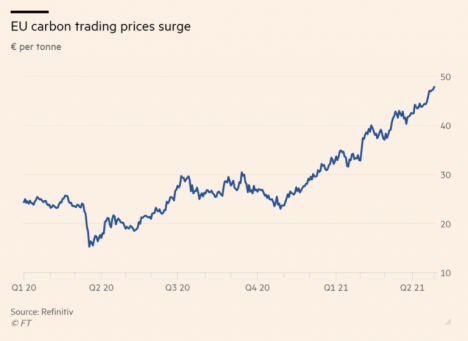
As the carbon price is expected to increase much further in the next few years, European industrial groups are desperately calling for the introduction of a carbon border tax, hoping that it will save them from international competitors that are able to produce much cheaper.
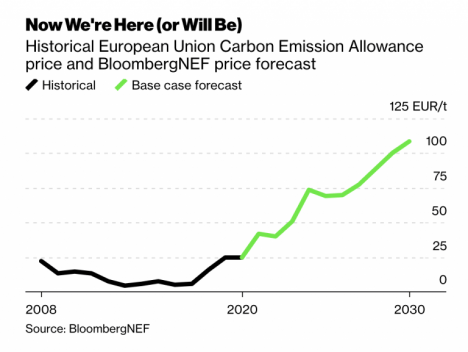
Even higher carbon prices are coming. BloombergNEF expects carbon prices to hit 100 euros by 2030.
They warn that rising energy and carbon costs will force energy-intensive manufacturing to shut down and relocate to countries with less stringent CO2 targets if the EU does not introduce protectionist carbon protection.
It is rather doubtful, however, whether the EU can afford to introduce a carbon border tax, knowing full well that China, India and much of the rest of the emerging and developing world would simply retaliate in return, threatening to tax European products out of Asian and African markets altogether.
European and American politicians should be reminded that we have been warning for years about this inevitable outcome of unilateral climate policies.
Coming COVID Commission Is a Gates-Led Cover-Up
By Dr. Joseph Mercola | April 27, 2021
Having gone as far as he can with the World Health Organization’s cover-up, Bill Gates takes another bite at the apple with his corporate-funded investigation into the origins of COVID-19 to cleverly cover up this massive conspiracy with an “official” investigation.
While the so-called COVID Commission Planning Group — set up to create and support an investigative commission like that for 9/11 — is advertised as a nonpartisan effort, you really couldn’t come up with a more dangerously biased set of participants.
In short, individuals and organizations with some of the most egregious conflicts of interest, and everything to gain by being in charge of analyzing and writing the history of this pandemic, are leading and supporting this effort. This is a classic fox guarding the henhouse scenario.
According to the Miller Center, the planning group will lay out the plans for nine separate task forces, each focused on one of the following topics, to lay “the foundation for a future commission to investigate”:1
- The origins of SARS-CoV-2 and its prevention
- Threat assessment, including the creation of an international network for detection and warning, “biological intelligence” and other data collection
- National readiness and a review of the initial response
- At-risk communities and how to address gaps in public health capacities, worker safety and the responsibilities of private businesses
- State and local readiness, containment and mitigation, including when and how to use lockdowns, mandates and school closings
- Health care challenges surrounding patient care, including those with long-hauler syndrome
- Diagnostics, therapeutics and vaccines, including the regulatory environment that might benefit or stifle innovation and/or global supply chains
- Telling the stories of COVID-19 victims, frontline workers and public health officials (i.e., propaganda generation)
- Solving data issues
Philip Zelikow — Chief Investigator for the Cabal
The chosen leader of this new planning group is Philip Zelikow, former executive director of the 9/11 Commission2 and a member of the Bill & Melinda Gates Foundation’s Global Development Program Advisory Panel.3,4 While Gates may not be a physical member of this planning group, he’s certainly involved indirectly. Of that we can be virtually assured.
Zelikow, a former director of the Miller Center of Public Affairs at the University of Virginia, is also a current strategy group member of the Aspen Institute,5 a technocratic hub that has groomed and mentored executives from around the world about the subtleties of globalization.
He also directed the Markle Foundation’s Task Force on National Security in the Information Age,6 the focus of which has been to make information relating to potential security threats discoverable and accessible to officials without breaking civil liberty laws.7 As reported by the University of Virginia:8
“The planning group hopes to prepare the way for a potential National COVID Commission set up to help America and the world learn from this pandemic and safeguard against future threats. ‘This is perhaps the greatest crisis suffered by America, if not the world, since 1945,’ said Zelikow … ‘It is vital to take stock, in a massive way, of what happened and why.
These sorts of civilizational challenges may become more common in the 21st century, and we need to learn from this crisis to strengthen our society … Scholars and journalists will do their jobs, but there is also a role for the kind of massive investigation and research effort that only a large-scale commission can provide.’”
Foundations Backing the COVID Commission
As reported by the Miller Center,9 the COVID Commission Planning Group includes more than two dozen virologists, public health personas and former government officials, and is backed by four charitable foundations — all of whom have histories revealing them to be part of the technocratic alliance that for years, in some cases decades, have been plotting and planning for the wealth redistribution and global power grab we’re now experiencing. These foundations include:
•Schmidt Futures,10 founded by Eric Schmidt, former CEO and executive chairman of Google and Alphabet Inc., which owns the greatest artificial intelligence (AI) team in the world.11
•The Skoll Foundation, founded by Jeff Skoll, a former eBay president, to “pursue his vision of a sustainable world” by catalyzing “transformational social change.”12 It acts as a support organization to the Silicon Valley Community Foundation.
Skoll has funded pandemic preparedness and prevention since 2009 through the Skoll Global Threats Fund, and his movie production company Participant Media produced the movie “Contagion” and Al Gore’s documentary “An Inconvenient Truth.”13
•Stand Together Foundation, which is part of the Koch Network, founded by Charles Koch. Its primary focus is criminal justice and poverty issues, and it teaches Koch’s “market based management” philosophy to community leaders.14
•The Rockefeller Foundation, which in April 2020 released the white paper,15 “National COVID-19 Testing Action Plan,” laying out a strategic framework clearly intended to become part of a permanent surveillance and social control structure that severely limits personal liberty and freedom of choice. I wrote about this in “Rockefeller Foundation’s Plan to Track Americans.”
The tracking system it calls for is eerily similar to that already being used in China, where residents are required to enroll in a health condition registry. Once enrolled, they get a personal QR code, which they must then enter in order to gain access to grocery stores and other facilities.16 The plan also demands access to other medical data.
Operation Lockstep
The Rockefellers, like Gates, built an empire around health and medicine despite having no medical expertise whatsoever. Their influence is rooted in money, which is spent in self-serving ways. While Rockefeller and Gates are both known as philanthropists, their donations grow their wealth, as the money they spend on “charity” ultimately ends up benefiting their own investments and/or business interests.
In addition to the COVID-19 Action Plan document cited above — which doesn’t even try to hide its draconian overreach and intent to permanently alter life and society as we know it — the Rockefeller Foundation also published a 2010 report17 titled “Scenarios for the Future of Technology and International Development,” in which they laid out their “Lockstep” scenario — a coordinated global response to a lethal pandemic.
While the name and origin of the virus differs, the scenario laid out in this document matches many of the details of our present. A deadly viral pandemic. A deadly effect on economies. International mobility coming to a screeching halt, debilitating industries, tourism and global supply chains. “Even locally, normally bustling shops and office buildings sat empty for months, devoid of both employees and customers,” the document reads.
“In the absence of official containment protocols,” the virus spread like wildfire. In this narrative, the U.S. administration’s failure to place strict travel restrictions on its citizens proved to be a fatal flaw, as it allowed the virus to spread past its borders. China, on the other hand, fared particularly well due to its rapid imposition of universal quarantines of all citizens, which proved effective for curbing the spread of the virus.
Many other nations where leaders “flexed their authority” and imposed severe restrictions on their citizens — “from the mandatory wearing of face masks to body-temperature checks at the entries of communal spaces like train stations and supermarkets” — also fared well.
These and other reports spell out what the ultimate plan actually is. It’s to use bioterrorism to take control of the world’s resources, wealth and people. It’s to use coordinated pandemic response as a justification for wealth redistribution and the resetting of the global financial system.
What most fail to realize is that the wealth distribution they’re talking about is not distribution from the wealthy to the poor, even though that’s what they want you to believe. It’s to centralize wealth at the top and eliminate private property rights and private business ownership from the lower and middle classes. The “equitable” living standards they’re talking about is poverty for all but themselves. It’s really crucial to begin to grasp this reality now, before it’s too late.
Pieces of a Global Puzzle
The Rockefeller Foundation is also a founding sponsor of The Mojaloop Foundation, set up to “promote digital payments for people outside the financial system, with support from Google and the Bill & Melinda Gates Foundation.”18
Right there we have Google, the Gates Foundation and the Rockefeller Foundation, all in one little nonprofit with a heart set on giving poor people access to digital banking using their cellphones. This is probably the three most dangerous nonprofits on the planet, as they are likely the most powerful and committed to global tyranny.
All-digital banking using a centralized digital currency is a key component of the Great Reset, so this project has little to do with honest philanthropy and everything to do with making sure everyone can be swept into the digital net, which will include round-the-clock surveillance and tracking of physical location and biological data, a digital ID, along with your health data (including but not limited to vaccination status), banking and, ultimately, a social credit system.
All of the pieces needed for the Great Reset are already in place; it’s just a matter of seeing how all the separate pieces fit together. For example, Gavi, the vaccine alliance, set up with funds from the Bill & Melinda Gates Foundation, partnered with the ID2020 Alliance to launch a digital identity program called ID2020.19
Gates also funded the creation of EarthNow, a project involving 500 satellites equipped with machine learning technology to surveil the entire planet with real-time video.20 As one would expect, AI — a Google specialty — is also a key component of this global surveillance plot.
COVID-19 — A Launch Pad for the Great Reset
Another key player in the COVID Commission Planning Group is the Johns Hopkins Center for Health Security at the Bloomberg School of Public Health. As you may recall, Johns Hopkins Center for Health Security co-hosted the pandemic preparedness simulation for a “novel coronavirus,” known as Event 201, in October 2019 along with the Gates Foundation and the World Economic Forum.
The event eerily predicted what would happen just 10 weeks later, when COVID-19 appeared. Gates and the World Economic Forum, in turn, are both partnered21 with the United Nations which, while keeping a relatively low profile, appears to be at the heart of the globalist takeover agenda.
The World Economic Forum, while a private organization, works as the social and economic branch of the U.N. and is a key driving force behind modern technocracy and the Great Reset agenda. Its founder and chairman, Klaus Schwab, publicly declared the need for a global “reset” to restore order in June 2020.22
Technocratic rule, which is what the Great Reset will bring about, hinges on the use of technology — in particular artificial intelligence, digital surveillance and Big Data collection (which is what 5G is for) — and the digitization of industry, banking and government, which in turn allows for the automation of social engineering and social rule (although that part is never expressly stated).
Beyond pandemic preparedness and response, the justification for the implementation of the Great Reset agenda in its totality will be climate change. The Great Reset, sometimes referred to as the “build back better” plan, specifically calls for all nations to implement “green” regulations and “sustainable development goals”23,24 as part of the post-COVID recovery effort.
But the end goal is far from what the typical person envisions when they hear these plans. The end goal is to turn us into serfs without rights to privacy, private ownership or anything else. In short, the pandemic is being used to destroy the local economies around the world, which will then allow the World Economic Forum to come in and “rescue” debt-ridden countries. The price for this salvation is your liberty.
The Great Reset
While the New World Order was long derided as a “conspiracy theory” that you’d have to be crazy to believe, the Great Reset, which is simply a rebranding of the same old NWO plan that has been in circulation for well over a decade, is now public fact.
Many world leaders have spoken about it in an official capacity, and in June 2020, Zia Khan, senior vice president of innovation at the Rockefeller Foundation penned the article25 “Rebuilding Toward the Great Reset: Crisis, COVID-19, and the Sustainable Development Goals,” reviewing the “social crisis” necessitating the world’s acceptance of a new world order.
The article was co-written with John McArthur, a senior fellow at the Brookings Institute, which is one of several technocratic think-tanks. Keeping in mind what I’ve just said about what the Great Reset is really all about, and the justifications used to implement the theft of wealth and freedom, read how they posit these changes as being in your best interest:
“Upheaval can yield new understanding and opportunity. Outdated or unjust norms can succumb to society’s pressing need for better approaches. For example, the need for massive and urgent government intervention has drawn fresh attention to social safety nets and the possibility of dramatic policy enhancements.
Tragic consequences of racial discrimination have catapulted awareness of systemic problems and triggered prospects for much-needed social reforms. Rapid environmental improvements linked to economic shutdown have rekindled consciousness of the profound interconnections between ecosystems, economies, and societies …
Rather than passively allowing norms to evolve through inertia or randomness, we can all pursue actions for Response and, soon enough, Recovery in a manner that improve the odds of a Reset toward better long-term outcomes.
Fortunately, we already have a strong starting point for what the world’s economic, social, and environmental outcomes should be. Five years ago, in 2015, all 193 UN member states agreed on the Sustainable Development Goals (SDGs) as a common set of priorities to be achieved in all countries by 2030.”
Another article titled “The Great Reset,” written by Jimmy Chang, CFA, for the Rockefeller Capital Management blog, reads, in part:26
“Regarding the post-pandemic reconstruction effort, progressives, led by the so-called Davos elites (of the World Economic Forum fame), are advocating an urgent ‘Great Reset’ of capitalism to ensure equality and sustainability. They also call for harnessing the Fourth Industrial Revolution (i.e., Big Tech) to address health and social challenges.
Their vision for the future could be gleaned from a 2016 article penned by a young Danish politician with the title ‘Welcome to 2030. I Own Nothing, Have No Privacy, and Life Has Never Been Better.’ This title was so controversial that its posting on the World Economic Forum website was changed to a bland ‘Here’s how life could change in my city by the year 2030.’
The pace of the Great Reset will in part depend on the final outcome of the U.S. election as it will determine whether Trump’s ‘America First’ doctrine will be relegated to the dustbin of history. Still, some resets will be unavoidable since COVID-19 has exacerbated some longstanding issues such as the world’s debt dependency and the widening gap between the haves and the have-nots.
There will be elevated levels of bankruptcy and debt restructuring. Governments may further increase their leverage to bail out the economy and placate electorates that demand more generous social contracts.
Riccardo Fraccaro, Italy’s Secretary of the Council of Ministers and a close aide of Prime Minister Giuseppe Conte, even floated a trial balloon on sovereign debt restructuring by suggesting that the European Central Bank consider ‘canceling sovereign bonds bought during the pandemic or perpetually extending their maturity.’
Businesses will also need to respond to lasting behavioral changes caused by the pandemic. In sum, there is no going back to the pre-COVID-19 world, and markets will need to adjust.”
Wolves in Sheep’s Clothing
The Great Reset is not some wild conspiracy theory but a publicly released agenda that is moving forward, whether we like it or not. I believe the only way to stop it is through our collective responses to the various pieces and parts of the plan that are being rolled out. They want you to believe that none of the things being introduced have anything to do with each other but, in fact, they are all pieces of the same puzzle.
The final image is the inside of a prison cell. It may not be a physical prison. It may be largely digital in nature. It may look like the four walls of your own home. But it’s a prison nonetheless.
I believe it would be a tragic mistake to trust Gates, Rockefeller, Google or any of the other players — including Zelikow — that are being brought before us as the saviors of the day. They’re all wolves in sheep’s clothing.
To learn more about the hidden power structure running this global reorganization toward authoritarian control, see “Bill Gates Wants to Realize Global Vision in His Lifetime,” “The Great Reset and Build Back Better,” “Technocracy and the Great Reset” and “Who Pressed the Great Reset Button?”
Be Part of the Answer
The good news is, Americans now have a brand-new weapon in our fight for freedom. I recently interviewed Naomi Wolf about her new digital platform, Daily Clout, that will allow citizens to lobby bills to their legislators.
Many state legislators are not lawyers, and they don’t have lawyers at their beck and call. Daily Clout has hired an attorney who is busy drafting turnkey bills that protect us against the continued erosion of freedom and reestablish rights and liberties. Citizens can now send these model bills to their legislators, knowing that they’ve undergone legal review and are ready to be passed. You can also go even further than that. As explained by Wolf:
“You can tell us the bill you want. We can upload a campaign for that bill. We can hire our lawyer to draft a model bill and then you can pass it. What we’ve been doing is gathering names and zip codes, so that we can add real voters to this piece of model legislation in real states and send it to real state legislators and say, ‘Look, the supporters are all there. All you have to do is pass this.’
It’s a fantastic intervention in the political process, restoring real democracy. It’s why we founded Daily Clout, but it’s beautiful to see hundreds and hundreds of people from all walks of life rushing to give us support and resources, to become members and give us donations, which we appreciate, so that we can keep our lawyer busy creating these draft bills. It’s not just for this issue.
Once we get our rights and freedoms back, whatever [citizens] want, we can draft a bill for you, and you can [call on your legislators to] pass it.”
To get involved, go to dailyclout.io and sign up to become a paying member or free subscriber. You will then receive an email explaining how to use the Five Freedoms Campaign. Presently, there is a model “no vaccination passports” bill that you can send to your state legislator.
There’s a feature called BillCam, where you can see who your state legislator is by entering your zip code. Once you’re a subscriber or member, you’ll get regular updates about happenings around the U.S. and community events.
The Great Reset is at our doorstep, and your freedom, and that of future generations, hinges on you getting involved and fighting for it. The Daily Clout platform can be a major help in this regard, as using legislation to preserve and protect our rights and freedoms is far preferable to more violent alternatives or resigning ourselves to the fate prescribed by our globalist would-be “overlords.”
Sources and References
- 1, 9 Miller Center, COVID Commission Planning Group
- 2 The Last American Vagabond September 7, 2016
- 3 Source Watch Philip Zelikow
- 4, 6 Miller Center, Philip Zelikow
- 5 Aspen Institute, Philip Zelikow
- 7 Markle.org
- 8 University of Virginia April 14, 2021
- 10 Schmidt Futures
- 11 TechCrunch January 26, 2014
- 12 Skoll Foundation
- 13 Forbes How the Billionaire Behind “Contagion” is working to stop this pandemic
- 14 Influence Watch, Stand Together Foundation
- 15 The Rockefeller Foundation, National COVID-19 Testing Action Plan — Strategic Steps to Reopen Our Workplaces and Our Communities, April 21, 2020 (PDF)
- 16 Berggruen Institute March 6, 2020
- 17 Scenarios for the Future of Technology and International Development
- 18 Techxplore.com May 6, 2020
- 19 Biometric Update September 20, 2019
- 20 Technology Review April 18, 2018
- 21 Canadian Truths, COVID-19 Bill Gates, United Nations and World Economic Forum
- 22 Technocracy.news June 29, 2020
- 23 Canadian Post, World Economic Forum Wheel of Evil
- 24 Intelligence.weforum.org COVID-19
- 25 Rockefeller Foundation June 19, 2020
- 26 Rockefeller Capital Management December 1, 2020
All of liquified natural gas from Russia’s Arctic for next 20 years sold in advance
RT | April 28, 2021
Russia’s energy giant Novatek said on Wednesday it has inked 20-year agreements with the shareholders of its Arctic LNG 2 project on the sale and purchase of the entire volume of liquified natural gas.
The LNG sales from the plant’s first liquefaction train are planned to commence in 2023, according to the company.
The agreements “provide for LNG supplies from Arctic LNG 2 on FOB Murmansk and FOB Kamchatka basis with pricing formulas linked to international oil and gas benchmarks. The LNG offtake volumes are set in proportion to the respective participants’ ownership stakes in the project,” Novatek said.
The company’s chairman of the management board, Leonid Mikhelson, said that “The long-term offtake agreements between Arctic LNG 2 and its participants ensure the future revenue stream from LNG sales and de-risks the project. This represents one of the most important milestones in attracting the project’s external financing that will be completed in 2021.”
Mikhelson said earlier that the Arctic LNG 2 plant is 39% complete and will be launched as planned.
Arctic LNG 2 envisages constructing three LNG liquefaction trains of 6.6 million tons per annum each, as well as cumulative gas condensate production capacity of 1.6 million tons per annum. The total LNG capacity of the three liquefaction trains will be 19.8 million tons. The first train of Arctic LNG 2 is 53% ready and is scheduled to start operations in two years.
Novatek owns the majority stake (60%) in the project, with minority stakes held by foreign companies. The list of foreign investors includes French oil and gas company Total (10%), Chinese firms CNPC (10%) and CNOOC (10%), and the Japanese consortium of Mitsui and JOGMEC (10%).
Has the new MI6 boss read the Paris Agreement?
Global Warming Policy Forum | April 26, 2021
Richard Moore, the new chief of the UK’s secret service, suggests countries such as China will be watched to ensure climate commitments are kept. What climate commitment? Has nobody at MI6 informed Mr Moore about the Paris Agreement?
After all, under international law, China, India, and all emerging and developing nations are exempt from any CO2 emission cuts until 2030 or later.
The Daily Telegraph – 26/04/21:


Richard Moore, head of the UK’s foreign intelligence service, described climate change as the “foremost international foreign policy item for this country and for the planet” CREDIT: PA
MI6 is placing the climate emergency at the forefront of its international espionage with “green spying” on the world’s big polluters, its new chief has revealed.
Richard Moore, head of the UK’s foreign intelligence service, described climate change as the “foremost international foreign policy item for this country and for the planet”.
It means the big industrial countries will be monitored by MI6 to ensure they are upholding their commitments to combating rising global temperatures.
Mr Moore, known as ‘C’, took charge of the intelligence agency in October and has become the first head of the service to ever give a broadcast interview.
He indicated that British spies will make China the focus of much of their climate-related espionage by pointing out that Beijing is “certainly the largest emitter” of carbon.
“Our job is to shine a light in places where people might not want it shone and so clearly we are going to support what is the foremost international foreign policy agenda item for this country and for the planet, which is around the climate emergency, and of course we have a role in that space,” he told Times Radio.
“Where people sign up to commitments on climate change, it is perhaps our job to make sure that what they are really doing reflects what they have signed up to.”
Should Unvaccinated and Obese Be Penalized by Government?
By Dr. Joseph Mercola | April 23, 2021
“Vaccine refusal will come at a cost — for all of us,” Edward-Isaac Dovere, a staff writer for The Atlantic, proclaims in an April 10, 2021, political commentary.1 Unvaccinated individuals “will have higher health care costs,” he says, and the vaccinated will have to foot the bill, either through taxes or insurance premiums.
This argument could have been made for decades, and can still be made today, for any number of groups. Obese individuals have far higher health care costs than those of normal weight. Insulin resistant people and those with Type 2 diabetes end up costing the health care system enormous sums. Who pays for them?
Overall, healthy individuals — people who generally do what they can to take good care of themselves to prevent chronic conditions — have always paid for those who are less particular about their diets and lifestyle.
The Economic Costs of Vaccination Vs. Vaccine Refusal
Dovere predicts the economic costs of vaccine refusal will begin to feature heavily as we move forward. He quotes Washington Gov. Jay Inslee, who told him,2 “You have a liberty right, and that unfortunately is imposing on everyone else and their liberty right not to have to pay for your stubbornness.” Not surprisingly, Dovere and Inslee both focus on just one side of what needs to be a two- if not four-sided equation.
When making public health policy, you have an obligation to analyze both the benefit and the cost of any given policy. In this case, what might be the cost of vaccine side effects, both in terms of health care costs and lives lost? As of April 1, 2021, VAERS had received 56,869 adverse events following COVID-19 vaccination, including 7,971 serious injuries and 2,342 deaths.3 By April 13, the had updated that death toll to 3,005.4
What might be the cost if the vaccines don’t work and you get sick anyway? As of April 15, 2021, some 5,800 Americans who had been fully vaccinated against COVID-19 had been diagnosed with COVID-19 post-vaccination; 396 (7%) required hospitalization and 74 died.5 These cases are popping up all over the world.
The vaccines are not foolproof. In fact, so-called “breakthrough cases,” meaning cases in which a fully vaccinated individual is diagnosed with COVID-19 are to be expected. I’m not sure why anyone is surprised, seeing how the vaccine makers have acknowledged that the mRNA injections are not designed to actually make you immune to SARS-CoV-2.
You can still contract the virus and spread it to others. What the shots may do is lessen your symptoms if and when you get infected with SARS-CoV-2. So, of course people can still get sick, as they did before. Some will require hospitalization. Some will die — just like they did previously, before the vaccine.
Then there’s the question of whether vaccinated individuals end up being more susceptible to variants of the virus than unvaccinated individuals. Preliminary research6,7,8,9 found that people who had received both doses of the Pfizer COVID-19 vaccine were eight times more susceptible to contracting the South African variant of SARS-CoV-2, called B.1.351, (5.4% compared to 0.7%).
Unfortunately, the study was too small to glean any information about outcomes, so we don’t know whether they developed milder or more serious illness than unvaccinated people sickened by the same variant.
Either way, if vaccinated people are more susceptible to more dangerous variants (which they claim B.1351 is), why assume that unvaccinated people would incur higher health care costs? Variants are now cropping up all over the place, so maybe vaccinated people will end up being responsible for a greater share of medical expenses. Maybe, if they have milder illness and unvaccinated have more serious illness, the costs might end up about the same for each group.
May There Be Economic Benefits to Vaccine Refusal?
In my view, the notion that COVID-19 vaccines will end this pandemic is an illogical fallacy since these shots do not provide actual immunity. The fizz in Dovere’s argument starts going flat on that basis alone. But there’s much more.
To really determine what’s best for public health, you’d also want to do the benefit and cost analysis of not vaccinating and relying on naturally-acquired immunity in combination with immune-boosting strategies instead, such as improving vitamin D levels across the entire population, for example.
Only when you have made all of those calculations — the benefit and cost of vaccinating, and the benefit and cost of not vaccinating — can you compare the two and begin to make statements about how certain groups of people may incur higher health care costs, and which strategy is likely to save the most lives. As of right now, it’s pure guesswork as to who’s going to cost more in the long run.
For example, I don’t know of any actual data showing that the health of people who are planning to forgo the vaccine place them at increased risk of serious COVID-19. If I were to guess, and this is pure speculation, people who have decided not to get vaccinated may be doing so because a) they know they’re in a low-risk category and/or b) they are health-conscious people who feel confident that they can prevent and/or treat COVID-19 in other cost-effective ways, should they get sick.
There are a lot of data that need to be compiled and analyzed before we can start declaring the COVID-19 vaccination campaign a public health care success, let alone a cost-saving imperative.
Appeal to Illogical Reasoning
Dovere goes on to discuss some of the messaging campaigns employed to lure people out of their vaccine hesitancy:10
“Two appeals seem to work best: First, the vaccines are safe, and they’re more effective than the flu vaccine. Second, you deserve this, and getting vaccinated will help preserve your liberty and encourage the government to lift restrictions.
(That last idea is what Jerry Falwell Jr. focused on in the vaccination selfie he posted11 this week, captioned, ‘Please get vaccinated so our nutcase of a governor will have less reasons for mindless restrictions!’) Inslee hopes that emphasizing those points will persuade more Republican men to get their shots.”
Sometimes it can help to spell out a logical fallacy using different words. (Personally, I believe Falwell was simply trying to be funny, but Dovere and Inslee have apparently seized the “lift restrictions” angle as a social conditioning opportunity, so that’s really what I’m addressing here.)
One rewrite of Falwell’s plea could be: “Please ignore your current health status and potential vaccine risks and just obey so that our governor will have less reason to impose unconstitutional and unscientific limitations on our basic rights and freedoms.”
In my view, a more appropriate way to prevent “mindless restrictions” would be to peacefully disobey and/or take the governor to court, as has been done to California Gov. Gavin Newsom. The Supreme Court has ruled against him no less than six times, finding he abused his power, overstepped his authority and violated the Constitution with his pandemic restrictions on churches.12
Urging someone to take a vaccine to prevent an elected official — who can be unseated — from implementing unscientific and/or unconstitutional restrictions is hardly rational. Let’s not forget that cost-benefit analyses13 have actually been done for lockdowns — perhaps one of the most mindless of restrictions — and the cost is far greater than the benefit.
The cost of the lockdowns in the U.K., in terms of Wellbeing Years (WELLBY), is five times greater than might optimistically be saved, and may in reality be anywhere from 50 times to 87 times greater. The cost for lockdowns in Canada is at least 10 times greater than the benefit.
In Australia, the minimum cost is 6.6 times higher, and in the U.S., the cost is estimated to be at least 5.2 times higher than the benefit of lockdowns. A cost-benefit analysis performed for New Zealand, which looked at the cost of adding just five extra days of “COVID-19 alert level 4” found the cost in Quality Adjusted Life Years (QALY) was 94.9 times higher than the benefit.
Should We Penalize Obesity and Vitamin D Deficiency?
If it’s determined that unvaccinated individuals need to be penalized socially, financially or otherwise, then how can we not also penalize other choices that significantly add to the COVID-19 burden? We know, for example, that vitamin D deficiency significantly raises your risk of COVID-19. In one analysis,14 82.2% of COVID-19 patients were vitamin D deficient.
I published a scientific review15 on the impact of vitamin D in COVID-19 in October 2020, co-written with William Grant, Ph.D., and Dr. Carol Wagner, both of whom are part of the GrassrootsHealth expert vitamin D panel. You can read the paper for free on the journal’s website.
Another major COVID-19 factor is obesity. As reported by CNN16 March 5, 2021, the COVID-19 death rates were more than 10 times higher in countries where more than half the adult population was overweight, compared to countries in which the obesity rate was below 50%. The COVID-19 death rates also rose in tandem with the prevalence of obesity, thereby strengthening the link, according to the report, released by the World Obesity Federation.
At the lowest end is Vietnam, which has an obesity rate of 18.3% and a COVID-19 death rate of 0.04 per 100,000. Toward the high end is the U.S., which has an obesity rate of 67.9% and a COVID-19 death rate of 152.49 per 100,000. (Of course, this report used COVID-19 mortality statistics that have been proven to be wildly exaggerated, as detailed in my interview with Dr. Henele.)
Making an already dire situation worse, recent data17 show 42% of U.S. adults have packed on unwanted pounds, with an average weight gain of 29 pounds, since the start of the pandemic. Only 18% report undesired weight loss, with an average weight loss of 26 pounds.
Government Has Ignored the Value of Healthy Population
According to the World Obesity Federation report, obesity was the second most important risk factor for hospitalization and death from COVID-19 — old age being the primary risk factor — and as noted by Johanna Ralston, CEO of the World Obesity Federation:18
“Old age is unavoidable, but the conditions that contribute to overweight and obesity can be highly avoidable if governments step up and we all join forces to reduce the impact of this disease. The failure to address the root causes of obesity over many decades is clearly responsible for hundreds of thousands of preventable deaths.”
Lead author of the report, Dr. Tim Lobstein, added:19
“Governments have been negligent, and ignored the economic value of a healthy population at their peril. For the last decade they have failed to tackle obesity, despite setting themselves targets at United Nations meetings. COVID-19 is only the latest infection exacerbated by weight issues, but the warning signs were there. We have seen it in the past with MERS, H1N1 and other respiratory diseases.”
Let’s Not Accept Hypocrisy and Double Standards
Even WHO Director-General Tedros Adhanom Ghebreyesus commented on the report saying it “must act as a wake-up call to governments globally,” as “The correlation between obesity and mortality rates from COVID-19 is clear and compelling.”
That said, let’s get back to Dovere’s argument that unvaccinated people are bound to incur higher health care costs due to COVID-19, and therefore there must be some way to penalize those people or force them into compliance.
Using that logic, what, then, do we need to do about obese individuals, whose risk of hospitalization due to COVID-19 is anywhere from 40% to 113% greater, and their chances of requiring intensive care 74% higher,20 than that of their non-obese peers? What do we need to do about people who just refuse to get their vitamin D levels up, and end up taking up the lion’s share of hospital beds?
To be clear, I am NOT proposing we penalize people based on their weight, metabolic flexibility or vitamin D status. I do not support that any more than I support penalizing unvaccinated people — and that is the whole point. Most would agree that this would be completely ridiculous.
My point is, if you cannot fathom penalizing obesity, insulin resistance, diabetes or vitamin D deficiency — conditions known to significantly raise your risk of severe COVID-19 — then how could you possibly consider penalizing an unvaccinated person based on that single parameter alone?
The question is especially valid because, again, vaccinated persons can contract and spread SARS-CoV-2 like anyone else. It’s really unclear how vaccinated people are “safer” than unvaccinated ones, when the only person standing to gain from these shots is the person getting it (in the form of milder symptoms when sickened).
Are You ‘Pure’ Enough for Your Government?
I think it’s important to realize that the COVID-19 vaccine campaign is less about protecting public health and more about creating the infrastructure and psychological climate required for the implementation of global tyranny, which will likely begin with the introduction of vaccine passports that are very similar to the China social credit system.
As discussed in “Vaccines Are the New ‘Purity Test,’” it can almost be likened to a loyalty test. Or perhaps it could best be described as a totalitarian submission test?
Getting private companies to require these vaccine passports only makes sense if there is a strong vaccine push, and this is one of many clues as to what’s really behind the stated “need” for the whole world to get vaccinated.
We’re not all at risk for COVID-19. For a vast majority of individuals, the vaccines make little or no sense, as for young, healthy individuals, their risks outweigh the benefit. Now they are pushing to vaccinate children, whose risk of getting COVID-19 is well-established as being profoundly minuscule.
They are at exponentially higher risk from many other factors. There are currently fewer than 500 children who are reported to have died from COVID-19, even with the massively manipulated causes of death. Remember, if you had a positive COVID test and died from terminal cancer or a motorcycle accident, you were classified as a COVID-19 death.
As you can see from the graph below, there are 10 higher risks of death than COVID-19 for children. To be logically consistent, the government would need to be equally rigid about addressing all of these causes as aggressively as they are pursuing COVID-19 vaccination for children.
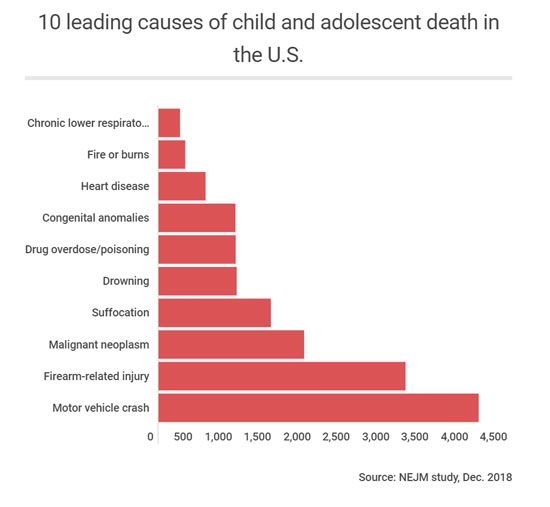
But it’s not about simply getting a vaccine into your arm. Ultimately, it’s about getting you tied into the digital system being launched in the form of vaccine passports. As explained by former Clinton adviser and author Naomi Wolf (whom I will be interviewing shortly) in a March 28, 2021, interview with Fox News’ Steve Hilton:21,22
“‘Vaccine passport’ sounds like a fine thing if you don’t understand what those platforms can do. I’m [the] CEO of a tech company, I understand what these platforms can do. It is not about the vaccine, it’s not about the virus, it’s about your data.
Once this rolls out, you don’t have a choice about being part of the system. What people have to understand is that any other functionality can be loaded onto that platform with no problem at all. It can be merged with your Paypal account, with your digital currency. Microsoft is already talking about merging it with payment plans.
Your network can be sucked up. It geolocates you everywhere you go. Your credit history can be included. All of your medical and health history can be included … It is absolutely so much more than a vaccine pass … I cannot stress enough that it has the power to turn off your life, or to turn on your life, to let you engage in society or be marginalized.”
Dangerous Curves Ahead
Wolf also points out the horrific history of IBM, which developed a sophisticated system of punch cards that allowed Nazi Germany to create a two-tier society and ultimately facilitated the rounding up of Jews for extermination. Fast-forward to today, and IBM is now a leader in the vaccine passport business. I wrote about this in “IBM Colluded With Hitler, Now Makes Vaccine Passports.”
In Nazi Germany, the obsession with purity — both in terms of hygiene and race theory — drove the genocide of Jews, the old, the handicapped and the mentally challenged.
In present day, the public narrative has eerily followed Nazi Germany’s playbook for genocide, starting with the scapegoating of healthy people, as the rapid spread of COVID-19 was blamed on asymptomatic individuals not properly masking, social distancing and self-isolating.
That then grew into the nurturing of prejudice against people who refuse to wear masks, and now we’re seeing the narrative building toward persecution of those who do not want to get the vaccine. It will start with discrimination, and already, we’re hearing talk of how only vaccinated people ought to have the right to partake in certain social activities. If that is tolerated, then outright persecution will be the inevitable next step.
This is why I reject and counter commentaries such as that by Dovere. These half-baked, one-sided, persecutory arguments must be challenged at every turn, because they only lead us one way. And unless you’re part of the technocratic elite, you — regardless of how you feel about vaccination right now — do not want to end up there.
Sources and References
- 1, 2, 10 The Atlantic April 10, 2021
- 3 The Defender April 9, 2021
- 4 CDC, Selected Adverse Events Reported after COVID-19 Vaccination April 13, 2021
- 5 The Defender April 15, 2021
- 6 Epoch Times April 11, 2021
- 7 Reuters April 10, 2021
- 8 Washington Examiner April 11, 2021
- 9 Medical Xpress April 11, 2021
- 11 Twitter Ruth Graham April 8, 2021
- 12 Townhall April 13, 2021
- 13 Preprints.org 2020: 2020100330 DOI: 10.20944/preprints202010.0330.v2
- 14 The Journal of Clinical Endocrinology & Metabolism October 27, 2020; dgaa733 [Epub ahead of print], Results
- 15 Nutrients October 31, 2020;12, 3361; doi:10.3390/nu12113361
- 16, 18, 19, 20 CNN March 5, 2021
- 17 APA.org Undesired Weight Change Since Start of Pandemic
- 21 Real Clear Politics March 29, 2021
- 22 The Epoch Times March 29, 2021
As demand for natural gas skyrockets in booming China, Russia says it’s ready to meet Beijing’s needs
By Jonny Tickle | RT | April 21, 2021
China’s fast-growing economy has an insatiable need for natural gas, and Russia is ready to heavily ramp up its cross-border supplies. That’s according to Viktor Zubkov, the chairman of Russian energy giant Gazprom.
As things stand, gas is sent from Far-Eastern Yakutia to China through the Gazprom-operated Power of Siberia pipeline, which first became operational in December 2019. Its construction secured another economic partnership for Moscow, while its gas connections to Europe face increasing resistance.
On Wednesday, when speaking to Moscow news agency TASS, Zubkov revealed that China’s demand for gas increases every two years at the rate of the entire capacity of the Power of Siberia pipeline, which transports 38 billion cubic meters every year.
According to Zubkov, China has already become the largest importer and the third-biggest consumer of natural gas globally.
“It will remain the most promising gas market for the foreseeable future as well,” he said. “We are sure that China needs additional gas supplies from Russia, and Gazprom is ready to supply them.”
He also noted that Chinese gas consumption is growing at an accelerated, ‘double-digit’ rate and in the next 15 years could double from its current level.
In recent years, Russia and China started to move closer economically, with both countries sending a large volume of exports across their shared border. Beijing is now Moscow’s largest trading partner, with bilateral trade exceeding $100 billion annually.
“Asia acts as a locomotive in the development of the global economy,” Zubkov concluded. “In 2020, the world economy faced its worst pandemic crisis in recent memory, and it was Asia, with its strong growth, that laid the foundation for a global recovery from the downturn.”
On April 13, Gazprom approved the analysis of a project to build the Soyuz Vostok gas pipeline through Mongolia to China, another route that would send more fuel to Asia.
What will we get for a multitrillion-dollar energy policy?
BY PETER Z. GROSSMAN – THE HILL – 04/14/21
President Biden has made no secret of his plans to spend trillions of dollars on climate policies, which in his case means substituting renewable energy (especially wind and solar) for fossil fuels.
But the question we should all be asking is: What will those trillions get us?
In reality, close to nothing. That is, the U.S. will expend enormous resources to replace one vast electric system with a different one, which will do nothing any better than the one we have now. Well, it will emit less carbon dioxide, but its effect on global temperatures will be negligible.
Moreover, there are other less costly and disruptive ways to reduce CO2 emissions besides erecting 60,000 wind turbines and 500 million solar panels, as Biden plans. Yet all that new energy technology will just provide light and heat that run our appliances and charge our electric automobiles — the same as the technology we have now.
Actually, the new technology will in many ways be worse because it will be prone to blackouts, kill endangered birds and bats, raise electric rates and deface farmlands and wilderness areas with gigantic wind turbines, newly carved access roads and thousands of miles of new high-voltage power lines strung across thousands of steel towers.
Of course, Biden and members of his administration would argue that the new system will give us the ultimate prize: life itself. Otherwise, because of climate change, we face an “existential crisis.” Or to put it bluntly: if we keep our current system, we’re all going to die — soon.
On that score, what’s several trillion dollars? Shouldn’t we spend all of our money to keep humanity alive?
Except are those really the stakes?
Forecasts of climate cataclysms have been around for many years. A recent article tracked 79 predictions of climate-related catastrophes. The first ones were made in the year of the inaugural Earth Day in 1970; some much more recently. But of those predictions, 48 have passed their prophesied date of calamity
They have all been wrong. The rest are pending but why should we believe them?
Expertise?
Many of the 48 failed forecasts were made by scientists. The Intergovernmental Panel on Climate Change (IPCC), regarded by many as the “gold standard” of scientific credibility on climate, authored several of the failed predictions.
For example, the United Nations agency announced in 2007 that if emissions had not started to fall by 2015 we would lose any chance to hold global temperatures below catastrophic levels. A few years later the deadline was extended to 2030. In the meantime, emissions have continued to rise while the rate of warming has not.
Other famously wrong predictions have been made by public figures, especially politicians. Al Gore gave the world 10 years in 2008 “to make dramatic changes in our global warming pollution, lest we lose our ability to ever recover from this environmental crisis.” The way to do it? He said we needed to remake our entire energy system in those 10 years — lots of windmills and solar panels.
That date was extended to 2030 (or 2050) when, according to another politician, Rep. Alexandria Ocasio-Cortez (D-N.Y.), “the world is going to end in 12 years if we don’t address climate change.”
Fortunately, Gore was out of office and couldn’t spend the vast sums needed to, as he believed, save the world, and AOC was a relatively powerless new member of Congress.
Biden, on the other hand, can act and has shown he intends to. But his belief that life on Earth will vanish if we don’t act is at least as farfetched as any of the 48.
Most of the apocalyptic forecasts are based on a scenario called “Representative Concentration Pathway 8.5 (RCP),” created for the IPCC, which was intended as a worst case, projecting a rise in average temperatures by about 5°C, which would be courting worldwide disaster. For some reason, RCP 8.5 became the business-as-usual scenario in much of the media, scholarship and political discourse on climate.
But it isn’t.
We are not on that pathway. Much more realistic assessments suggest that we are on track for Earth’s temperature to rise 1°C-3°C. At the higher end especially, there will be many problems for the world in the second half of this century. But extinction? It’s not plausible.
In that light, spending trillions on windmills and solar panels seems a waste of resources. In economics, we always ask what are the trade-offs. The trillions here could be used to directly help people to escape poverty. It could be used for better health care, improved educational opportunities, more research on fighting pandemics, adapting to climate change and so on.
Proponents of Biden’s energy policies claim that they will not only save life on Earth but will also have all sorts of social benefits.
Africans Deflect Biden’s Demand To End Fossil Fuel Use
By Duggan Flanakin ~ PA Pundits – International ~ April 17, 2021
As the merger of climate change and COVID panic materializes in front of our eyes, “global leaders” have found plenty developing world voices to join the crusade to “save the planet” from carbon (dioxide) “pollution.” But like their Chinese and Indian counterparts, many Africans, from heads of state to captains of industry and beyond, intend to expand, not shrink, reliance on fossil fuels to build their economies.
According to Oxford University researcher Galina Alova, “Africa’s electricity demand is set to increase significantly as the continent strives to industrialise and improve the well-being of its people,” but those who hope for rapid decarbonization in Africa will likely be disappointed.
Alova’s research found that Africa is likely to double its electricity generation by 2030, with fossil fuels providing two-thirds of the total, hydroelectric another 18 percent, and non-hydro renewables providing less than 10 percent.
Such an energy mix flies in the face of the firm commitment from the fledgling Biden Administration to demand an end to all international financing of fossil fuel based energy projects. Biden climate envoy John Kerry won a strong endorsement from 450 organizations worldwide after telling World Economic Forum members of the “plan for ending international finance of fossil fuel projects with public money.”
The Biden plan, which comports with the Paris climate agreement, echos the call by European Union foreign ministers for an end to financing fossil fuel projects abroad (which means in Africa). Secretary of State Antony Blinken explained that “development finance is a powerful tool for addressing the climate crisis” that the U.S. will use to “help drive investment toward climate solutions.” [Translation: “We intend to ram decarbonization down their throats!”]
Many Africans feel the need to placate their self-appointed betters and accept the climate change tenets.
World Bank veteran Ede Ijjasz and Africa Growth Initiative Director Aloysius Ordu claim that Africans must take advantage of the COVID pandemic to initiate a “great reset” of Africa’s economies according to the UN’s Sustainable Development Goals and the principles of the Paris agreement. The world, they claim, cannot afford to give Africa a pass on decarbonization (though China and India get a pass).
Others prefer a more temperate approach.
In late March, investment professional Tariye Gbadegesin challenged President Biden to prioritize African nations as part of his global climate initiative. While admitting that Africa’s urban centers are swelling, “threatening more emissions,” she asserted that striking a balance between this ongoing development and its climate impact must be a global priority. For example, Nigeria could build a hybrid grid using plentiful natural gas and solar energy. But, Gbadegesin implied, such a hybrid grid would not meet the Biden-EU financing guidelines.
In early April, the African Development Bank (AfDB), the Global Center for Adaptation, and the Africa Adaptation Initiative held a virtual Leaders Dialogue in response to the State of the Climate in Africa 2019 report. Over 30 heads of state and other global leaders committed to prioritize actions that will help African countries both adapt to the presumed impacts of “climate change” and overcome widespread energy poverty. African Union chair Felix Tshisekedi listed “nature-based solutions, energy transition, an enhanced transparency framework, technology transfer, and climate finance” as critical areas for adaptation.
During the meeting, AfDB president Dr. Akinwumi Adesina noted the group intends to mobilize $25 billion in financing for the success of the Africa Adaptation Acceleration Program. “It is time,” he affirmed, “for developed countries to meet their promise of providing $100 billion annually for climate finance. And a greater share of this should go to climate adaptation.”
This African response to the Biden-EU decarbonization initiative – relying on adaptation and balance, not prohibition and eternal poverty, to achieve sustainability — reflects on the 1987 Brundtland Commission report, “Our Common Future.” In the report, the World Commission on Environment and Development defined sustainable development” as development that “meets the needs of the present without compromising the ability of future generations to meet their own needs.”
Commission Chair Gro Harlem Brundtland acknowledged that, “A world in which poverty is endemic will always be prone to ecological and other catastrophe.” In her view, “Meeting essential needs requires not only a new era of economic growth for nations in which the majority are poor, but an assurance that those poor get their fair share of the resources required to sustain that growth.”
Sadly, U.S. and EU (and the UN) climate “monarchs” have long ignored Brundtland’s promises. The UN’s 20-year assessment of the document did not even mention “poverty” or “Africa.” CFACT reported that year that sub-Saharan Africa was “in very short supply of energy and power, especially electricity, and overland trade [was] greatly hindered by an almost total lack of infrastructure.” Worse. curable diseases ran rampant as people relied on toxic dung and wood for heating and cooking.
At the 2011 UN climate conference in Durban, South Africa, nuclear physicist (and CFACT advisor) Kelvin Kemm reported that the African representatives were not happy. “Their general feeling,” he recounted, “was that the First World is trying to push Africa around, bully African countries into accepting its opinions, and, even worse, adopting its supposed ‘solutions’.”
That feeling remains. Responding to the Biden-EU renewables-only energy financing plan, W. Gyude Moore, a senior fellow at the Center for Global Development and former Liberian minister of public works, mused that, “There’s this idea that because Africa is lacking in legacy infrastructure, it’s a good canvas to paint the energy future. But no African country has volunteered itself for that.”
With nearly 600 million Africans lacking access to electricity, Moore added, “it seems immoral to restrict options for energy sources” for the world’s poorest continent. Later, Moore, with Vijaya Ramachandran of The Breakthrough Institute, wrote that a ban on oil and gas projects in Africa would stifle economic growth and thus make poor populations even more vulnerable to climate change impacts.
Moore and Ramachandran explained that the top priority in most African countries is economic growth, first in agriculture, then in industry and services. For most Africans, worries of an increased carbon footprint generated from economic growth are a weak second to worries that growth may not happen at all. In their view, people in poverty don’t just need to power a single lightbulb at home; they need abundant, affordable energy at work too.
Overall, Moore and Ramachandran noted, Africa’s needs are too great to be met solely with current green energy technologies. Its finances too stretched to be able to afford the cost of carbon-neutral energy. Keeping Africa poor to fight climate change will do nothing to help the people most affected by it. But President Biden, his EU allies, and the “green 450” disagree.
This arrogance makes it quite clear that “Our Common Future” is still in the future, if at all.
The difference is that, today, Africans are no longer waiting for the UN, the International Monetary Fund, the World Bank, or even the African Development Bank to finally invest in sorely needed African infrastructure.
By hook or by crook, Africans are committed to using available resources to do the job.
Duggan Flanakin is the Director of Policy Research at the Committee For A Constructive Tomorrow. A former Senior Fellow with the Texas Public Policy Foundations, Mr. Flanakin authored definitive works on the creation of the Texas Commission on Environmental Quality and on environmental education in Texas.
‘Obscene’ windfarm subsidies revealed
Global Warming Policy Forum | April 16, 2021
GWPF research has shown that just six offshore windfarms are now sharing £1.6 billion pounds in subsidies between them every year. Three receive annual subsidies of over a quarter of a billion pounds each year. On a single day in April last year, Hornsea 1 received a subsidy payment of nearly £1.5 million pounds.
The level of subsidy is sufficient to cover the construction cost of these windfarms in just six or seven years, meaning that future payments will represent almost pure profit for the operators.
The cost of the Contracts for Difference regime is accelerating, and rose by £0.7 billion last year alone, reaching £2.3 billion in 2020. Consumers are already paying out £6 billion under the Renewables Obligation and another £1 billion under the Capacity Market.
Direct subsidies therefore amount to an annual payment from each household of £350, a sum that is rising by at least £25 per year.
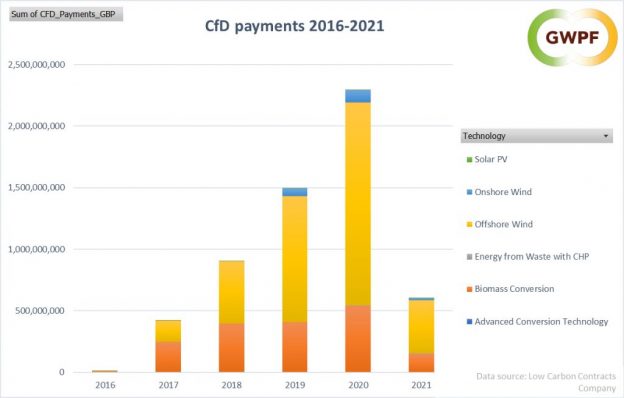
There are further bills to pay too, because windfarms are causing destabilisation of the electricity grid. The cost of the Balancing Mechanism, which deals with grid imbalances, is rising rapidly, costing each household £65 per year, a figure that is rising at a rate of £20 per year.
And the consumer is having to pay for upgrades to the electricity grid too.
Lord Lawson, GWPF director, said:
We are in the middle of an economic crisis and consumers are hit with astronomical costs for unreliable wind energy. These multi-billion subsidies are not only a massive transfer of wealth from the poor to the rich, but are damaging the UK economy as a whole. This madness has to stop.”
Dr Benny Peiser said:
The level of handouts is an obscenity. Every time a new windfarm comes on stream, the consumer is hit with a double whammy – a relentless increase in annual subsidy payments to windfarm operators and an annual bill for fixing the damage that is done to grid stability. This can’t be kept hidden for much longer. The chickens are coming home to roost very soon, and there will be a big political price to pay”.
ABSOLUTE SLAVERY: Zero Carbon Agenda Deconstructed
Ice Age Farmer | April 6, 2021
What is a zero-carbon future? What does it look like? To imagine, turn off your heater. No airports. No shipping. No animals. Perfect surveillance state. In this Ice Age Farmer special report, Christian breaks The “Absolute Zero” plan and how governments are actively taking drastic steps every day to meet these dystopian goals for Travel, Transport, Energy, Manufacturing, Recycling, and Food. We must understand the reality underneath their flowery philanthropic language: Absolute Slavery.
Intro to Net Zero: (0:00)
Road Vehicles: (3:54)
Rail: (8:25)
Flight: (14:15)
Shipping: (17:56)
Heating & Appliances: (22:42)
Food & Waste: (26:34)
Materials, Construction, Recycling: (35:32)
Electricity & Fossil Fuels (43:22)
Water (45:00)
Perfect Surveillance/Enforcement (46:46)
Closing (49:58)
FULL SHOW NOTES: https://www.iceagefarmer.com/2021/04/06/absolute-slavery-zero-carbon-agenda-deconstructed/
Absolute Zero document: https://iceagefarmer.com/docs/AbsoluteZero.pdf
SUBSCRIBE on bitchute: https://bitchute.com/iceagefarmer
On Lbry.tv: https://lbry.tv/@iceagefarmer
TELEGRAM: https://t.me/iceagefarmer
THANK YOU FOR YOUR SUPPORT:
https://patreon.com/iceagefarmer
– other methods/PO box: https://iceagefarmer.com/support
Ice Age Farmer Guilded (chat) group:
http://iceagefarmer.com/guilded
The Victory Seed — easy pamphlet to share:
http://thevictoryseed.org
IAF RESOURCES:
⇒ GDD: Growing Degree Days tool: how much colder has 2019 been for you?
http://iceagefarmer.com/gdd
⇒ IAF Wiki – read history, understand cycles, know what’s coming:
http://wiki.iceagefarmer.com/wiki/History
⇒ Maps from previous cycles:
http://wiki.iceagefarmer.com/wiki/Strategic_Relocation:_Maps
⇒ Crop Loss Map
http://map.iceagefarmer.com
⇒ Join the email list – stay connected:
http://iceagefarmer.com/mail
*** SUPPORTERS – I recommend (because I use personally) ***
STORED FOOD (+ more) @ MyPatriotSupply:
https://iceagefarmer.com/prep
FREEZE DRY YOUR OWN FOOD (like printing money, but food):
https://iceagefarmer.com/harvestright
BUY SEEDS @ TRUE LEAF MARKET:
https://iceagefarmer.com/trueleaf
EMP-proof Solar: mention IAF save $250
https://Sol-ark.com
BEST CBD:
https://bignuggetfarm.com 10% code: IAF2018
⇒ More books: http://amazon.com/shop/iceagefarmer
⇒ Stored food: http://iceagefarmer.com/prep
___
LINKS:
Absolute Zero document: https://iceagefarmer.com/docs/AbsoluteZero.pdf
INTRO:
https://unfccc.int/climate-action/race-to-zero-campaign#eq-3
https://www.theguardian.com/us-news/2021/mar/15/race-to-zero-america-emissions-climate-crisis
CARS:
https://statecolumn.com/oregon-legislature-seeks-to-ban-diesel-fuel-sales-by-end-of-decade/
https://www.fool.com/investing/2020/10/22/us-senate-and-house-get-a-bill-to-ban-sales-of-gas/
https://abcnews.go.com/Business/uk-ban-selling-gas-diesel-cars-2030/story?id=74274466
https://www.roadandtrack.com/new-cars/future-cars/news/a31097/german-government-votes-to-ban-internal-combustion-engines-by-2030/
https://en.wikipedia.org/wiki/Phase-out_of_fossil_fuel_vehicles#Countries
https://qz.com/1962786/bidens-electric-vehicle-buying-spree-could-boost-us-ev-sales/
https://www.worldatlas.com/articles/countries-that-will-ban-gasoline-cars.html
Nissan And Mitsubishi Could Launch Electric Minicar Next Year
https://www.foxbusiness.com/economy/buttigieg-vehicle-miles-tax-infrastructure
https://www.weforum.org/agenda/2021/02/how-electric-fleets-can-fuel-decarbonisation-efforts-zeuf/
https://www.weforum.org/agenda/2018/03/electric-cars-are-still-coal-powered/
RAIL:
https://www.wired.com/story/biden-wants-out-car-on-train/
https://www.railway-technology.com/features/us-election-biden-railroad/
https://www.ny1.com/nyc/all-boroughs/news/2021/04/01/amtrak-infrastructure-bill-propsal
https://s7d2.scene7.com/is/image/TWCNews/Amtrakmap
Should The Government Invest in High-Speed Rail to Boost a Post-Pandemic Economic Recovery?
https://www.marketwatch.com/story/canadian-pacific-to-acquire-kansas-city-southern-in-25-billion-freight-rail-deal-11616335014?&mod=retirement-weekly
https://mexiconewsdaily.com/news/slim-consortium-wins-18-billion-peso-maya-train-contract/
Click to access Amtrak-Corporate-Profile-FY2019-033120.pdf
FLYING:
https://www.washingtontimes.com/news/2021/feb/3/john-kerry-flew-private-jet-accept-climate-award-o/
https://www.travelweekly.com/Travel-News/Airline-News/US-airlines-to-go-net-zero-carbon-emissions-2050
https://www.travelweekly.com/Travel-News/Airline-News/Sustainable-fuel-taking-off
https://www.weforum.org/videos/airbus-says-it-could-be-flying-zero-emissions-planes-by-2035-race-to-zero
https://www.airbus.com/newsroom/stories/Is-this-the-next-clean-energy-to-power-aviation.html
Social License to Operate:
https://www.weforum.org/agenda/2019/08/carbon-neutral-flying/
SHIPPING:
https://www.govtech.com/em/emergency-blogs/disaster-zone/ship-stuck-in-suez-canal-exposes-supply-chain-vulnerability.html
https://www.nzherald.co.nz/business/time-for-a-logistics-rethink-after-suez-canal-grounding-academic/PNFF56L2TZPOPCMIXFQOWVYEDU/
https://www.weforum.org/agenda/2020/01/decarbonizing-shipping-global-energy-transition/
https://www.globalmaritimeforum.org/getting-to-zero-coalition
https://www.globalmaritimeforum.org/getting-to-zero-coalition/members
https://www.poseidonprinciples.org/#signatories
https://www.poseidonprinciples.org/signatories/
https://www.reuters.com/article/us-ecb-climate-lagarde-idUSKBN29U0TA
https://blogs.adb.org/blog/smart-ports-are-needed-shipping-recover-pandemic
Click to access deloitte-nl-er-port-services-smart-ports.pdf
https://www.supplychaindive.com/news/maersk-ports-america-invest-19m-loadsmart-smart-drayage/562386/
https://www.smartports.tv/
https://www.zerohedge.com/markets/los-angeles-port-head-demands-importers-retrieve-cargo-quicker-ease-congestion-crisis
HEATING & APPLIANCES
https://www.sfchronicle.com/bayarea/article/Berkeley-becomes-first-U-S-city-to-ban-natural-14102242.php
https://www.nationalgeographic.com/environment/article/gas-heat-and-stoves-are-warming-the-climate-should-cities-start-banning-them
https://www.weforum.org/agenda/2018/05/clean-energy-natural-gas-coal-rocky-mountain-institute/
https://www.ecowatch.com/wood-burning-stove-pollution-2631428663.html#toggle-gdpr
https://www.bbc.com/news/uk-51581817
FOOD
(See the entire Ice Age Farmer channel! 🙂 )
https://www.forbes.com/sites/nicolerasul/2019/01/17/the-planetary-health-diet-will-it-save-lives-and-planet-earth/?sh=7710019bcb8b
https://www.theguardian.com/environment/2021/jan/08/lets-get-rid-of-friggin-cows-why-one-food-ceo-says-its-game-over-for-meat-aoe
https://www.forbes.com/sites/stephenmcbride1/2021/03/22/bill-gates-wants-rich-countries-to-move-to-100-synthetic-beef-but-heres-the-opportunity-behind-this-trend/?sh=4b2a57bd6899
https://www.thetimes.co.uk/article/1556b3b4-8f50-11eb-af74-aabf762d9542
https://www.scmp.com/abacus/tech/article/3029514/why-china-using-facial-recognition-garbage-bins
MATERIALS
https://en.wikipedia.org/wiki/Circular_economy
https://www.weforum.org/press/2021/01/mission-possible-climate-action-partnership-launched-to-help-transform-heavy-industry-and-transport
https://www.cnn.com/2021/03/24/business/heliogen-solar-bill-gates-rio-tinto/index.html
https://www.weforum.org/agenda/2018/01/world-without-waste-recycle-plastic
https://finance.yahoo.com/news/does-bill-gates-trust-see-200256158.html
https://www.dallasnews.com/news/2016/01/04/new-recycling-facility-on-the-way-at-mccommas-landfill-in-southern-dallas/
https://www.nbcdfw.com/news/local/fort-worth-partners-launch-digital-recycling-tool-in-honor-of-global-recycling-day/2584242/
PLASTIC
Push to reduce plastic waste gains traction in Sacramento and D.C.
https://news.yahoo.com/oahu-restaurants-maneuver-ban-plastic-160600905.html
https://www.weforum.org/agenda/2021/03/three-experts-on-why-eradicating-plastic-pollution-will-help-achieve-gender-equality/
https://www.plasticstoday.com/sustainable-practices/carbon-neutrality-next-big-sustainable-packaging-thing
ELECTRICITY & FOSSIL FUELS
https://sacramento.cbslocal.com/2020/01/08/california-considers-statewide-ban-on-gas-powered-garden-tools/
https://www.independent.co.uk/news/world/europe/france-ban-emmanuel-macron-oil-gas-exploration-2040-latest-global-warming-climate-change-a8121031.html
WATER
https://www.weforum.org/projects/global-water-initiative
Feds suspend, Calif. cuts water allocation for Valley farmers
PERFECT SURVEILLANCE & ENFORCEMENT
https://www.weforum.org/press/2020/11/in-the-face-of-extraordinary-challenges-36-pioneer-cities-chart-a-course-towards-a-more-ethical-and-responsible-future
https://www.weforum.org/agenda/2020/06/covid-19-pandemic-teaches-us-about-cybersecurity-cyberattack-cyber-pandemic-risk-virus/
https://time.com/collection/best-inventions-2020/5911362/climate-trace/
https://www.npr.org/2018/05/08/609493403/these-smart-sewers-are-part-of-a-growing-trend-connecting-infrastructure-to-the-
Featured Video

Trita Parsi: Middle East Unraveling — Are We on the Path to World War?
or go to
Aletho News Archives – Video-Images
New Book
Trans agenda is ‘normalization of sadism’ – US author

RT | September 23, 2026
The US Democratic Party has embraced a transgender agenda that amounts to “the normalization of sadism,” author A.J. Rice has said, warning that radical trans policies would return if the party is allowed to regain power.
Speaking to RT’s America First host Scotty Nell Hughes about his new book, ‘The Curse of the Bearded Lady: How the Trans Mafia Whacked American Sanity’, Rice argued that activists have gained significant influence in schools, medicine, and corporate America while people who questioned the agenda have faced pressure to stay silent.
The author described the “trans mafia” as the sprawling network of people and institutions that have helped the movement gain influence. He singled out parts of academia, wealthy backers, and corporations, and stated that providers of transition-related treatment also have a financial incentive to keep young people in their care indefinitely.
Rice argued that the consequences of these policies ultimately fall on children who are being drawn toward gender-affirming medical treatments and on girls who are expected to share locker rooms or compete in sports with biological males.
He noted that while voters rejected the Democrats’ approach to gender in 2024, the party, which has been “captured by madness,” has since only doubled down and is seeking what is effectively “the normalization of sadism.” … Full report
Blog Roll
 Aletho News
- ‘We don’t seek permission to defend our country’: Snippets from President Pezeshkian’s UNGA address
- NATO chief wants Europeans to fight American wars [for Israel]
- German chemicals giant reveals details of downsizing
- Refaat Al-Areer Was The Canary In The Coal Mine In Israel’s War On The Truth
- Israeli election committee bars candidate from Knesset race over Gaza war opposition
- French-Lebanese man files war crimes complaint over Israeli attacks
- Mahan Air Flight Lands in China Despite US Threat against Iranian Airlines
- US eyes $10bn fund to rebuild war-battered Gulf infrastructure
- Trump meets Rodríguez near Maduro’s prison as Venezuela’s oil flows to US
- Trita Parsi: Middle East Unraveling — Are We on the Path to World War?
- If Americans Knew
- An error has occurred; the feed is probably down. Try again later.
- No Tricks Zone
- New Study: Earth And Venus Surface Warmth Largely Explained By Convection And Lapse Rate, Not CO2 Or Radiation
- 2025 Nature Paper Claiming Worsening Global Drought Gets RETRACTED …Heavily Flawed
- New Study: ‘Global Drought Shows No Detectable Recent Acceleration Under Climate Warming’
- Economic Masterminds: German Socialists Suggest Taxing Productivity Gains Stemming From Using AI
- The South China Sea Has Not Been Cooperating With The Climate Change Narrative
- Energy Crisis: Germany Enters Heating Season With Historically Low Gas Reserve Fill Levels
- New Study: The Antarctic Ice Sheet Gained Mass From 2020-2024 Due To Staggering Snow And Ice Accumulation
- Study: Ocean Heating Rates From Thousands Of Years Ago ‘Dwarf’ Modern Ocean Heating Rates
- Climate Extremists Target, Attack Large-Scale Power Grid Infrastructure In Germany!
- New Study: Antarctic Ice Melt Has Contributed Less Than 1 Centimeter To Sea Level Rise In The Last 30 Years

