Complicit: How the West is Helping Israel Seize the West Bank
Al Jazeera Investigates | July 16, 2026
An undercover investigation by Al Jazeera reveals how western donors evade charity law to provide aid to illegal Israeli settlements.
Since October 7, 2023, Israel has killed more than 1,000 Palestinians in the West Bank. More than 230 of them are children. Attacks by settlers on rural Palestinian communities have increased, destroying property and capturing livestock, driving families from their homes. At the same time, the Israeli military has launched a large-scale assault on the densely populated Jenin refugee camp.
This film provides a comprehensive picture of the tactics the Israeli government uses to support the settlers and then, through infrastructure and building programmes, annex Palestinian land.
Western governments claim to oppose Israel’s occupation of the West Bank and uphold international law. However, undercover reporters from Al Jazeera expose how donors based in some Western countries fund the expansion of illegal settlements.
Al Jazeera journalists secretly film meetings with pro-settler organisations in Israel, claiming to be donors based in the UK looking to make large contributions to their projects. They’re told how funds can be paid as tax-deductible donations to charities in the UK and Canada who then pay the money on to their organisations. It is unlawful for charities in the UK and Canada to use donations to support the illegal settlement of the West Bank.
The Israeli organisations tell our undercover reporters how donations can be used to campaign for the demolition of Palestinian homes and provide military-grade security equipment such as drones and night vision cameras to settlers. We are also told that funds can be used to buy guns for settlers in occupied East Jerusalem and equipment for soldiers serving in the Israeli army.
The Israeli organisations are aware that their activities are considered unlawful in Canada and the UK and suggest ways to disguise the intended purpose of the donations, routing the funds through affiliated third parties and, in some cases, misreporting the true nature of their spending.
Charities in the UK and Canada are required to do extensive due diligence on how funds paid overseas are spent and to ensure they comply with the law. Al Jazeera’s evidence points to serious failings in this process.
They Are Coming to Take Us Away
The White House discovers more “commies” and terrorists

By Philip Giraldi • Unz Review • July 19, 2026
In Donald Trump’s America it is always possible to wake up in the morning and peruse online the overnight headlines to discover something new and exciting. Over the past week it has been a medley of going to war (again) with Iran coupled with a complicated performance on other issues as President Trump apparently takes aim at his enemies in the US and elsewhere. America’s Secretary of War Pete Hegseth is fully on board with a surge in worldwide mayhem. He is looking forward to an increase in US initiated violence, ordering that male soldiers, airmen, sailors and marines be tested for their testosterone levels. “Hegseth argues the effort, to become part of the military’s periodic health assessment for troops over 30, will ensure the optimal performance and long-term health of warfighters… the move plays into Hegseth’s focus on appearances and masculinity, which one Democrat said this week borders on ‘homoeroticism’.” Those who fail to have sufficient of the “male characteristics” hormone in their systems will be determined to be not fit for combat, where lethal instincts as encouraged under Hegseth require a satisfactory level of anger. Some soldiers might be offered therapy to increase their hormone levels.
And perhaps not so strangely, it often seems that much of the daily news relates to America’s “best friend and closest ally” Israel. One of the great ironies of the Israel against the rest of the world competition is how the “Torah” Old Testament is regularly being cited by Washington and the national media to justify anything the Jewish state does. That occurs in spite of the fact that Biblical Judea has little in common with the real Israel of today apart from providing an enduring mythology interwoven with the “holocaust” fantasy to sustain the myth of “chosen-ness.” In reality, Judea ceased to exist as an actual nation in 70 AD when the Romans destroyed to include the Second Temple in Jerusalem, of which absolutely nothing physical remains, and forced the Jews to depart. After that, what is now described as Palestine was ruled in various fashions by Rome, Byzantium, Muslim Arabs, Christian Europeans, Mamelukes, Turks, and the British until the politically driven re-creation of a Jewish state in 1948. That means for nearly 1900 straight years there was no such thing as an “Israel” or a Jewish nation and any Jewish presence was marginal in the region where the religion was born. Clearly there was no historical mandate to move a group of foreigners, whose only tie was to a religion that many of them did not actually practice, into a land that those foreigners then began to depopulate of its indigenous inhabitants who had lived in that place under both Christian and Muslim foreign rule for two millennia.
Recent American presidents have certainly tried to make the brutal Israeli suppression and occupation of what was supposed to be a neighbor state called Palestine somehow seem to be something quite acceptable. This is particularly due to the nonsense regurgitated by a group of American fundamentalists that many refer to as Christian Zionists (CZ), best exemplified by the delusional US Ambassador to Israel Mike Huckabee. These are folks that revere the Jewish Bible, as one might describe it, as “explained” by the nineteenth century Scofield Bible. Huckabee insanely even claims that “Without Israel, without the Jewish foundation, there would not be America.”
Unfortunately for the rest of us, the CZ exist in large numbers in southern and some midwestern so-called Bible Belt states and they vote reliably for congressmen and even presidents who are Israel Firsters. So we get monsters like Texan Ted Cruz, Arkansan Tom Cotton and the recently deceased South Carolinian Lindsey Graham calling the shots on foreign policy. And we get presidents like Joe Biden and Donald Trump, both of whose exceptional loyalty to Israel should have been challenged when they ran for office!
The latest bid by Congress to allow Israel to be even more intolerant of the Christians and Muslims that it is supposed to share the former Palestine with is a recently passed amendment calling for equal Jewish prayer rights on Jerusalem’s Temple Mount. The Mount currently houses the Al-Aqsa Mosque, one of three most holy religious sites for Muslim believers, reputedly the location where Mohammed himself was spirited up to heaven by Allah. When Israel was created in 1948 Jerusalem was categorized by the UN as an international city inclusive of all faiths. The Mount was regarded as special for Muslims and believers in other faiths had only limited access to it. More recently, there has been constant agitation from extremist Jewish politicians in Israel to open up the site and there have even been calls to build a Jewish Third Temple on it as well even more radical demands to demolish al-Aqsa completely as part of the process. This has been accompanied by increased persecution and even closure of churches and mosques located elsewhere in the city with the clear intention of making Jerusalem more exclusively Jewish. Trump and company have, of course, not raised any objections to the Jewish activism even when Christians are being actively persecuted and denied access to their churches and holy sites.
Israel aside, the views of Americans who value the First Amendment Freedom of Speech right should be particularly concerned by the authoritarian direction the federal government is moving in. One must pay attention to last week’s denunciations by Trump and National Security Adviser and Secretary of State Marco Rubio of “communists” and “terrorists” among the predominantly progressives who apparently are in the forefront of those who are opposing the enlightened policies being promoted by the White House. It is apparently the belief that labeling opponents in that fashion will guarantee victory in the upcoming November midterm elections where Democrats will inter alia be labeled as anti-Israel and it will also make it easier to root some such folks out for deportation or imprisonment to silence them as has already been happening with foreign students at American universities.
Regarding what is developing, Trump’s activation of the little known “alien terrorist” deportation court presumably will conveniently provide the president and his fanatics with a new tool to cleanse the country of anyone who might object to killing people without any constitutional or legal process as has been taking place in the Caribbean, Iran and Sudan. Not that Trump needed a new court since he is no friend of “rule of law” and has been repeatedly acting in one of his rages whenever he sees fit to punish both American citizens and foreigners. One might cite the recent arrest of an American citizen who was traveling in Spain. As reported by The Guardian, “Spanish authorities, operating on a US extradition request, arrested the 41-year-old James Chambers, a US citizen and wealthy donor to leftwing and humanitarian projects worldwide, last Friday in Ibiza. He has been transferred to a prison in Madrid. The Trump administration’s Department of Justice is seeking his extradition for alleged financial support of Hamas, according to a spokesperson for the Spanish high court. This is the first known case of the US seeking extradition of a citizen over alleged support for Hamas… It is unfolding as Marco Rubio, the US secretary of state, convened 66 countries this week – including Spain – as part of a broader effort to discredit leftwing activity as terrorism…”
In reality, of course, Hamas is a legitimate resistance movement and the ones who should be arrested on terrorism charges are Israelis, starting with Prime Minister Benjamin Netanyahu if he dares to visit the UN in New York in August, but that fine point is not about to bother Donald Trump and Marco Rubio. One can only assume that the Trump Administration will be moving sharply to the right over the next three months, labeling all critics as threats to the security of the United States of America. The initial focus will be on foreigners living in the United States, but the mechanism will easily be expanded to include all critics or supporters of resistance groups, like is happening to American citizen James Chambers in Spain. It is easy to go to Congress or have the White House declare some entity “terrorist” and people who support them in their resistance to US policy will begin to be on the receiving end of punishment. That is what is coming unless we the people unite to put an end to it right now!
Philip M. Giraldi, Ph.D., is Executive Director of the Council for the National Interest, a 501(c)3 tax deductible educational foundation (Federal ID Number #52-1739023) that seeks a more interests-based U.S. foreign policy in the Middle East. Website is https://councilforthenationalinterest.org address is P.O. Box 2157, Purcellville VA 20134 and its email is inform@cnionline.org.
Israeli settlers attack homes, mosque in occupied West Bank

Al Mayadeen| July 19, 2026
Israeli settlers carried out a series of attacks overnight on Saturday and into Sunday morning in the occupied West Bank, setting fire to a mosque and multiple homes, stealing livestock, and assaulting residents, according to Palestinian sources. The incidents occurred in the al-Khalil and Nablus governorates, with Israeli forces reportedly protecting the assailants.
In the al-Khalil governorate, settlers attacked two homes belonging to Palestinian residents in the Wadi al-Rakhim area south of the town of Yatta. The assailants stole three heads of livestock from a pen on the property.
During the incident, Israeli forces fired live ammunition in the area, though no injuries were reported.
In the town of As-Samu, also south of Al-Khalil, armed settlers attempted to steal sheep in the Wadi Ajhish area while under the protection of Israeli troops; however, residents confronted the group and forced them to withdraw.
In the village of At-Tuwani, located in the Masafer Yatta region, settlers from the “Havat Ma’on” outpost set fire to two homes belonging to residents Kamal Musa Rab’i and Mahmoud Salman Rab’i, as well as the village mosque.
The attackers used flammable materials, causing large sections of the properties to catch fire. The settlers also smashed and vandalized additional property, including a vehicle, with Israeli forces providing security coverage during the assault.
In the Nablus governorate, settlers attacked the Dhahra area on the outskirts of the town of Beita, south of the city, assaulted residents and damaged homes and property, resulting in injuries to four people.
Separately, on Saturday, settlers attacked a young man while he was on the Jenin–Nablus road near the entrance to the town of Barqa, causing wounds to his hand.
In a related incident, settlers set fire to a resident’s home on Saturday evening. The house, which had been previously targeted in an attack, was destroyed by the fire. The home was occupied at the time of the incident.
Israeli settlers set fire to olive trees in Ramallah
Earlier, Israeli forces burned dozens of olive trees in the village of Deir Qaddis, west of Ramallah, on July 18, according to official Palestinian news reports.
The official news agency Wafa reported that forces pursued a group of Palestinian farmers while they were working on their land in the areas of Jabal al-Ras and Bir al-Asafir, south of the village, and fired bullets and toxic tear gas canisters toward them. According to the report, this caused fires to break out across wide expanses of land planted with olive trees.
Reports also stated that Israeli forces prevented civil defense crews from reaching the site of the fire to bring it under control and extinguish it, which led to the fire expanding and spreading to large areas of citizens’ land on the southern side of the village.
Deir Qaddis and the surrounding towns and villages west of Ramallah have experienced ongoing incursions by Israeli forces, alongside continued attacks by settlers targeting citizens and their property, according to Wafa.
Israeli forces are continuing to carry out incursions, violations, and simultaneous arrests in various areas of the West Bank, amid a wide military deployment and house-to-house raids, the agency reported.
The strange death of James V. Forrestal, the first US Secretary of Defense
Did Israel start its serial assassination campaigns of its American opponents much earlier than we assume?
By Hua Bin | July 19, 2026
I have always enjoyed reading a wide variety of books on somewhat arcane subjects. Many are triggered by references from other books, and they form a sort of chain reaction.
Around 10 years ago, I read Webster Griffin Tarpley’s book 9/11 Synthetic Terror: Made in USA, my first exposure to alternative 9/11 theories of what truly happened in 2001.
Tarpley’s book led me to David Ray Griffin’s The New Pearl Harbor: Disturbing Questions About the Bush Administration and 9/11.
I subsequently read perhaps 30 books on the subject such as Kevin Ryan’s Another Nineteen: Investigating Legitimate 9/11 Suspects, Chris Bollyn’s Solving 9/11: The Deception That Changed the World, Jim Fetzer’s The 9/11 Conspiracy – the Scamming of America, and more.
Griffin’s New Pearl Harbor further led me to Peter Dale Scott’s The War Conspiracy: JFK, 9/11, and the Deep Politics of War as well as his books on the drug trade, particularly his 2010 book American War Machine: Deep Politics, the CIA Global Drug Connection, and the Road to Afghanistan and the 2003 book Drugs, Oil, and Wars: the US in Afghanistan, Columbia, and Indochina.
Peter Dale Scott’s books motivated me to explore the subjects of JFK assassination and drug trade, which included many books such as James Douglass’s JFK and the Unspeakable: Why He Died and Why It Matters, Alfred McCoy’s The Politics of Heroine: CIA Complicity in Global Drug Trade, and Gary Webb’s Dark Alliance: the CIA, the Contras, and the Crack Cocaine Explosion.
Two books were particularly intriguing among the many on the subjects: Michael Collins Piper’s 1994 book Final Judgement: The Missing Link in the JFK Assassination Conspiracy and Salvador Astucia’s Opium Lords – Israel, Golden Triangle, and the Kennedy Assassination.
Piper was among the first to connect the JFK assassination to Mossad as Kennedy was adamantly opposed to the Israeli nuclear weapons project and therefore became a threat to Israel to be eliminated.
This theory has been further supported by French historian Laurent Guyenot in his books JFK to 9/11: 50 Years of Deep State and The Unspoken Kennedy Truth.
Salvador Astucia, in turn, developed the thesis that Israel used drug-related interest to carry out the assassination, fingering the hitmen as French-Corsican heroin traffickers and associates of Meyer Lansky, the head of Jewish mafia in the US.
One obscure reference by Astucia in his book led me to a book written by David Martin in 2019 The Assassination of James Forrestal, subject of this article.
(By the way, I am planning to write on the US state-sponsored narco trade at some point with the information learned from the reading list. It is the height of iron that the US is the original and ultimuate Narco State while it labels Venezuela under Maduro as such.)
Who was James Forrestal and how he died
James Vincent Forrestal (1892–1949) was a highly influential American politician who served as the last cabinet-level US Secretary of the Navy and the very first United States Secretary of Defense.
He played a pivotal role in shaping America’s military structure and foreign policy during World War II and the early stages of the Cold War.
According to his official biography, Forrestal died on May 22, 1949, after falling from a 16th-floor kitchen window at the Bethesda Naval Hospital, where he allegedly was being treated for severe depression and exhaustion.
His death was widely accepted as a suicide, but the official Navy investigation never actually used the word “suicide” in its final ruling.
The official Willcutts Report, the official US Navy board of inquiry report into his death, concluded only that Forrestal died from the fall, that his behavior indicated severe mental depression, and that no naval personnel were negligent or to blame.
Investigators found a leather-bound book, An Anthology of World Poetry, open on a radiator next to his bed. The book was bookmarked to a dark, mournful passage from the ancient Greek tragedy Ajax by Sophocles.
On a sheet of hospital memorandum paper, Forrestal had been hand-copying the text. His transcription of the poem stopped abruptly in the middle of a word.
He had written “Woe, woe! will be the cry…” and stopped after writing the letters “Night—” while attempting to copy the word “nightingale”.
In the play, the Greek hero Ajax descends into madness out of grief and political betrayal, ultimately committing suicide.
The press and historians heavily focused on this, noting that Forrestal likely identified with Ajax’s tragic downfall.
David Martin concludes assassination after studying declassified details of Forrestal’s alleged suicide
The Navy kept the official investigation secret for 55 years and finally released it via Freedom of Information Act in 2004.
Researchers immediately found several inconsistencies that have fuelled decades of assassination theories:
- Bathrobe cord: When Forrestal’s body was found on the 3rd-floor roof, the sash/cord of his dressing gown was tightly knotted and wrapped around his neck. This led to speculation that he may have tried to hang himself from the radiator before falling, or that he was strangled.
- Handwriting discrepancies: Independent researchers who analyzed the handwritten poem alongside Forrestal’s known personal letters argued that the handwriting in the poem did not match his.
- Guard’s testimony: Early press reports claimed a guard saw Forrestal writing the poem right before the jump, but the official Willcutts Report showed the guard on duty testified that Forrestal appeared to be asleep with the lights off when he checked in.
David Martin’s book further highlighted major anomalies omitted from initial public reports. These include unexplained broken glass in Forrestal’s room and dynamic scratch marks on the outside windowsill.
Evidence suggested a struggle in the room, with broken glass photographed on his bed.
Contrary to reports of a mental breakdown, several doctors had previously indicated that 4 out of 5 doctors felt Forrestal was not suffering from severe mental illness, with some suggesting he was misdiagnosed.
Martin believes this is evidence that stories of Forrestal’s “sudden breakdown” prompting hospitalization were likely false.
David Martin concluded the strange death of James Forrestal was in fact an assassination that was covered up as a suicide. His view is widely shared by other researchers.
Martin frames the assassination as one of the earliest operations of the post-WWII American “Deep State” and foreign intelligence, namely Mossad.
He outlines the primary geopolitical motives for Forrestal’s removal as his opposition to the creation of Israel.
Forrestal was the most prominent cabinet official arguing against US support for the partition of Palestine. He believed it would permanently destabilize the Middle East and jeopardize Western access to oil.
Forrestal argued that the American military machine and civilian industrial expansion relied heavily on Middle Eastern petroleum.
He strongly believed that backing a Zionist state would deeply alienate Arab nations. This alienation, he warned, would jeopardize US access to oil pipelines and vital Persian Gulf supplies.
As a fierce anti-communist, Forrestal feared that Middle Eastern instability would open the door for the Soviet Union to expand its influence in the region.
He believed a war between Arabs and Jews would destabilize the area and leave it vulnerable to Soviet intervention.
Forrestal famously told White House advisors to “look at the numbers,” pointing out that there were roughly 30 million Arabs compared to 600,000 Jews.
He believed the Arab forces would eventually overwhelm a Jewish state, potentially forcing the U.S. to deploy its own military forces to defend it.
This was a commitment he felt the post-WWII, heavily demobilized US military could not afford.
According to his published diaries, Forrestal was deeply critical of how both the Democratic and Republican parties handled the issue.
He complained that President Harry Truman’s administration was basing crucial national security decisions on capturing the domestic “Jewish vote” and securing campaign contributions in key states like New York.
He unsuccessfully attempted to build a bipartisan agreement to completely remove the Palestine issue from American domestic politics.
Martin concluded that Forrestal’s resistance to the establishment of Israel earned him the ire of the Zionists and the Jewish community within the US and Israel, who decided to remove him once and for all.
Parallels can be found with other suspicious deaths of prominent anti-Zionist figures in this period, including T.E. Lawrence “of Arabia”. They may have been assassinations by the same perpetrators.
The Zionists themselves have documented Forrestal’s opposition to the establishment of Israel in their own records.
An article titled “The Wise Men” Oppose U.S. Recognition of Israel, published on Temple Beth Sholom, described Forrestal and George Marshall’s opposition to Israel. https://tbshamden.com/odds-a-ends/list-of-restricted-funds/
Marshall was the US Army Chief of Staff in WW2, the Secretary of State when Israel was established, and the architect of the Marshall Plan. He shared Forrestal’s negative view on the formation of the Jewish state.
Why is it important and relevant today?
The strange death of James Forrestal is a reminder how far Israel has been willing to go to eliminate its perceived threats.
It vindicates researchers like Michael Collins Piper who concludes that Israel murdered President Kennedy to protect its nuclear program.
Many senior US officials opposed Israel’s establishment as they believed it would create regional chaos, which proved prescient.
Israel, from its inception, has been an outlaw and a terrorist state capable of doing anything with the help of US Zionists. This includes the 9/11 false flag attack that triggered US “forever wars” in the Middle East for the benefit of Israel.
Similarly, the strange assassination of Charlie Kirk seems to have Israel’s hand all over it. Is Trump also under Israeli threats to launch the insane war on Iran despite his campaign promises?
As we move into another phase of US’s war on Iran for Israel, it is worth bearing in mind what kind of rogue actor the world is dealing with.
Rahm Emmanuel’s Israel-Endorsed ‘Opposition’ to Israel
By Harrison Berger | The American Conservative | July 18, 2026
Hoping to transition from being “Chicago’s Most Connected Banker” to once again holding elected office, the two-term former Mayor of Chicago and former chief of staff to Barack Obama, Rahm Emanuel, did this month what all savvy political hopefuls do: He traveled to meet some of the largest power brokers in American politics at their homes in Tel Aviv.
In 2008, then-candidate Barack Obama flew to Israel and declared his “unshakeable commitment to Israel’s security,” and in 2015, Hillary Clinton pledged to “immediately dispatch a delegation of the Joint Chiefs of Staff to meet with senior Israeli commanders” and to “invite the Israeli prime minister to the White House” in her first month in office.
Emanuel, who as a civilian volunteer worked with the Israel Defense Forces in the early 1990s, and whose father was a member of the Jewish terrorist group Irgun, is widely suspected to be eyeing a run for the Democratic presidential nomination in 2028—one that will require winning over a base that has notably soured on Israel amid its genocide in Gaza and nonstop wars of aggression in the region.
To court Democratic voters, the longtime pro-Israel Emanuel arrived in Israel with a markedly different message than the one past Democratic hopefuls have carried on the same pilgrimage. It was the latest attempt by the Democratic establishment to come to terms with its voters’ turn against Israel, whether through a serious reckoning or—as the evidence suggests and as the Democratic Party traditionally does—merely through deception and cooptation.
At Tel Aviv University, Emanuel opened by conceding ground to his Israeli hosts, naming a “corrupt Palestinian leadership” that has “never lived up to the Palestinian people’s legitimate aspirations for sovereignty and self-determination,” and reheating a stale narrative of rejected peace offers by Palestinian leaders.
But after the requisite throat clearing effectively blaming Palestinians for their own ethnic cleansing, Emanuel did put forward a harsh criticism of Israeli behavior and unconditional American backing for it, arguing it “has allowed [Israel] to deny food and medical relief to innocent Palestinians suffering in Gaza, leaving the world to conclude that Israelis not only want to kill the Palestinians but that they are completely indifferent to their death, destruction, and suffering.” He decried an emboldened “political coalition in the Knesset that learned it can burn Palestinian farmland in the West Bank and terrorize Palestinian families without consequence.” All this, Emanuel says, has turned Israel into a “territorial pariah.”
The line that drew the most attention and applause from progressives was Emanuel’s pledge that “every Israeli found attacking Palestinian civilians or their property in the future will be sanctioned,” a threat he extended to “every Israeli official who supports such violence” and “every construction company or bank building or financing illegal settlements.”
But the true PR purpose of his visit—and his function as a pressure release valve for the foreign government of Israel—was revealed soon afterward, when Emanuel’s speech was applauded by the Israel lobby and its main Democratic Party organ, the Democratic Majority for Israel, which praised it as “thoughtful, serious, and grounded in a sincere commitment to Israel’s future security and prosperity.” Indeed, a centerpiece of his speech, the Jerusalem Post noted, was the “23-state solution”—a proposal cooked up by the liberal Israel lobby group J Street.
Despite his criticisms of the Israeli cabinet and opposition to “taxpayer-funded support” for Israel’s military, Emanuel later confirmed to the Financial Times that he still wants the U.S. to sell arms to Israel. Pressed on whether he’d support anything resembling an arms embargo, he walked the idea back.
“[Israel] can buy [U.S.] weapons like any other ally, same price, same restrictions and same requirements of any ally for any weapon,” Emanuel told the FT.
Prime Minister Benjamin Netanyahu himself came to a similar conclusion in January, telling the Economist that he wanted to “taper off the military aid within the next 10 years.” Asked whether he meant reducing it to zero, the prime minister replied, “Yes. We’ve come of age and we’ve developed incredible capacities.” Recently deceased Sen. Lindsey Graham (R-SC) responded within hours that he would accelerate the timeline. “Given what the Prime Minister said, we need not wait 10 years,” Graham wrote.
J Street founder Jeremy Ben-Ami, whose 23-state proposal Emanuel adopted wholesale, presented the same ruse in April, explaining that J Street’s call for Israel to pay for its own weapons echoed Netanyahu and Graham’s own. “A call to end American financial subsidies for Israel’s defense is not a call to end the U.S.-Israel security relationship,” Ben-Ami wrote. He added, “Arms sales—paid for by Israel and governed by U.S. law—should continue,” and that the U.S. and Israel should collaborate on “intelligence sharing, operational coordination, joint exercises, and cooperative development of defense technologies.”
The $3.3 billion in annual Foreign Military Financing that Ben-Ami proposes phasing out is the same $3.3 billion Rep. Thomas Massie moved to strike with a recent amendment; it is a line item members of Congress have the opportunity to vote on. But “cooperative development of defense technologies” is not.
Israel and its lobby, including J Street, understand this, which is why they have moved to pass Section 219 of the National Defense Authorization Act, which, rather than “tapering off” U.S. aid to Israel as the lobby suggests, expands it and conceals it by integrating the U.S. and Israeli military-industrial complexes, transferring the partnership to the Pentagon’s opaque procurement system and thereby removing democratic accountability. Should it pass—which seems likely—Congress can strike every dollar of Foreign Military Financing, and the Pentagon will still pay Israeli defense firms out of procurement accounts that carry no line item to strike.
As the journalist Max Blumenthal presciently predicted of J Street’s scheme when Ben-Ami unveiled it in April, we should “expect to hear these deceptive talking points from leading Democratic primary candidates, including Rahm Emanuel, desperate to mollify the party’s base without doing anything of substance to end U.S. military support for Israel.”
“Jeremy Ben-Ami and J Street somehow remain this really important factor within the Democratic Party,” Blumenthal told The American Conservative recently, “because the Democrats have to con their base.” Since the party is “fundamentally undemocratic and is facing an unprecedented crisis with less than 10 percent of young Democrats declaring their support for Israel, J Street has to come in.”
We will soon discover whether or not Democratic voters are gullible enough to be fooled.
Harrison Berger is a correspondent at The American Conservative. He has contributed to Drop Site News, The Nation, and Responsible Statecraft. Previously, he was a researcher and producer for System Update with Glenn Greenwald. His work focuses on civil liberties and U.S. foreign policy. He studied Political Science and Russian Studies at Union College (NY).
Israeli war chief praises devastation of Gaza as ‘deliberate policy’
The Cradle | July 17, 2026
A report aired on Channel 14 on 12 July shows Israeli Defense Minister Israel Katz and other senior officials openly celebrating the apocalyptic destruction of Gaza and the mass killing of Palestinians and their forced displacement to tent cities near the beach.
“The important thing: those neighborhoods like Jabaliya, Shujaiyya, which we only controlled a part of – are destroyed. In ruins,” stated Katz while touring the strip with military officials and journalists.
“When you see Gaza destroyed like this, how do you feel?” a journalist asked him.
“What do I feel? Feel good. What, this is all the result of a deliberate policy that [was designed] to remove threats,” Katz responded.
“Instead of the method of raids – enter, exit, and Hamas returns – the IDF is inside, the residents are outside, and the houses are destroyed.”
Since the start of the genocide in 2023, Israel has destroyed most of Gaza through airstrikes and demolitions, making at least half of Gaza’s 2 million Palestinians homeless and forcing them to live in makeshift tent cities near the sea.
Israel has publicly tried to justify its mass killing of Palestinians and occupation of Gaza by saying it is fighting Hamas. However, Katz stressed that even if Hamas is disarmed, Israel will not end its occupation of Gaza.
“We are not retreating from the Yellow Line, unequivocally, as long as Hamas does not truly disarm. And even after that, we will remain in Gaza!”
One senior officer described all 70,000 Palestinians killed by Israel as “terrorists.”
“I don’t know how to describe this [situation] other than victory … When you control 65 percent of the territory [of the Gaza Strip], when 70,000 terrorists have been killed here, when the majority of the population is on the beach since,” stated Tamir Yadai, deputy chief of staff of the Israeli military
Israel acknowledges the tally of the dead kept by Gaza’s Health Ministry, which has now reached over 73,000, the majority women and children. However, independent estimates suggest the real toll of Palestinians killed by Israel since the start of the genocide is likely much higher, reaching into the hundreds of thousands.
Yadai celebrated the Israeli military’s occupation of Gaza for a “second summer,” saying its troops enjoy “full freedom of operation.”
Yaniv Assor, commander of the Israeli military’s southern command, celebrated Israel’s ongoing killing of Palestinians.
He boasted that since the start of the US-Israeli war on Iran in late February, Israel had carried out 300 targeted assassinations in the strip.
Since a so-called ceasefire was reached in Gaza in October, Israel has killed over 1,100 Palestinians in the strip in near-daily strikes, including on tent encampments housing displaced Palestinians.
Katz has also celebrated Israel’s ongoing destruction of villages in southern Lebanon, saying Israel is now doing to Lebanon what it had previously done in Gaza.
In March, Katz announced that Israel intended to demolish the Lebanese border villages in its newly occupied zone.
“All the houses in the villages adjacent to the border in Lebanon will be destroyed, in accordance with the model of Rafah and Beit Hanoun in Gaza,” he declared.
Is the West looking for a new relationship with Israel?
By Martin Jay | Strategic Culture Foundation | July 18, 2026
Is Britain’s new prime minister about to stand up to the hugely powerful Israeli lobby? A recent glimpse of his views about Israel and its genocide carried out in Gaza might have been a clue for things to come. The interview itself was carried out not with a journalist but with a sports celebrity whom most Brits associate with a brand of potato chips – which is indicative of how Andy Burnham is going to deal with media: in other words, ignore it altogether.
Burnham has at least done the impossible and steered the debate and the narrative away from Keir Starmer’s all-out pro-Israel stance, and has at least started calling the war in Gaza what it really is – which is not a war at all but a genocide. His appointment as PM may well reduce the mad simmer of blind, dogmatic support for Israel and play into the hands of minority groups in the UK who feel politically lost over Downing Street’s Middle East policies, which have seen U.S. bombers leave the country’s military bases to bomb children in Gaza. Burnham’s interview with Gary Lineker – his first interview – before formally taking office gives a clue to where he wants to take the Labour party before the country goes to the polls in three years’ time.
Yet how long will it take before Israel’s cash and influence get to him? The real test of this new strategy is not the narrative but the endurance of it, especially given that there are so many Labour MPs around him who are on Israel’s payroll – which recently, we presume, extended to even Reform officials who recently returned from an all-expenses-paid trip to Gaza, magically converted to Zionists spouting IDF talking points.
Money is everywhere now in UK politics, as the country has succumbed to the American system. The scandals piling up against Nigel Farage have shocked a nation, although in reality most people in the UK are still very naïve about cash in politics. Indeed, Farage’s scandal is merely prompting a new debate as to even how much money is involved in luring conservative politicians to jump ship to Reform, with Liz Truss taking some media oxygen as many speculate that she’s about to make the leap – when the numbers make sense.
But Britain is only doing what the U.S. is doing, on all levels, even when it comes to Israel. Recently, three primaries were lost to Democratic candidates in the U.S. who had strong anti-Israel views, shocking many in the U.S. who believed until now that Israel’s cash always wins at the end of the day within the political system. In fact, over 100 Democrats recently voted in Congress to end Israel’s $3.3 billion USD military aid which U.S. taxpayers hand over each year, while most Americans can’t afford basic healthcare. Yet it’s hard to see if this is a political initiative as such by the Dems or whether this is people power at the ballot. Many Americans are very troubled by the relationship between the U.S. and Israel, and it took the recent Iran war for many of them to even educate themselves as to the extent of the relationship and how far Israel went to manipulate Trump. The post-February 28th campaign that Trump got tricked into going ahead with at least served one purpose, in that it threw a spotlight on this subject like never before. But this came at such a high price, which is what many Americans are waking up to – especially given that Israel as a country is doomed by its history and cursed by its present leaders, and that it can only drag the U.S. down with it.
“Israel is a highly traumatized country. It exists in a sociopsychological bubble built around victimhood, relying on a government system dominated by the military,” argue Dr Andreas Krieg recently. “In such a militarized society, there is no room for political strategy. It is a system built for perpetual war… Military leaders are terrible rulers and terrible at strategic decision-making outside the battlefield. This is why Israel has never strategically won a war – because it is still fighting 80 years on.”
And so any backlash from voters or renegade politicians on both sides of the Atlantic might be the beginning of a new way of thinking about Israel and the region, as Western leaders are realising that the closer they get to Israel, the more they suffer if not ultimately perish. The EU’s plans to block settlers’ land grabs in the West Bank is encouraging, but too little, too late to be taken seriously. The Norwegian national football team’s donation of its collective salaries to a Palestinian charity got more media coverage, although FIFA seems to be an organisation breaking all records on corruption, so perhaps it sent mixed messages. Trump’s war in Iran has confirmed wholesale that Israel owns him and the U.S. taxpayer, as Netanyahu’s ruse paid off big time. What can stop the madness?
State Department Offering Quarter-Million Dollar Grants to Groups in Lebanon that Promote US Image
By Kyle Anzalone | The Libertarian Institute | July 15, 2026
The US Embassy in Lebanon announced that the State Department is offering grants of up to $250,000 to groups that help promote American propaganda.
“The US Embassy in Beirut is opening a new Notice of Funding Opportunity for 2026,” a statement published on Tuesday explained. “We’re looking for partners to implement programs that strengthen ties between the US and Lebanon, with a focus on highlighting US-led peace and stabilization efforts, and advancing digital literacy to help people identify and push back on false, adversarial narratives.”
The State Department website says the program is expected to award $500,000 to at least two groups to promote US propaganda in Lebanon. It adds that the program’s goal is to “strengthen local public understanding of US-led peace and stabilization efforts, and its role as a partner committed to security, economic opportunity, and responsible regional leadership.”
Washington is attempting to broker a peace agreement between Tel Aviv and Beirut. However, Israel is at war with Hezbollah, a non-state military that operates outside of the control of the Lebanese government.
While Beirut and Tel Aviv inked a deal last month, Hezbollah rejected the agreement because it allowed the IDF to occupy Lebanon until the militia is dismantled.
The attempt to negotiate a peace agreement between Tel Aviv and Beirut is making it more difficult for President Donald Trump to end the war against Iran. Iran has linked any ceasefire and peace agreement with Israel ending its war against Lebanon.
US blocks SSL security certificates for Iran’s Fars News Agency
The Cradle | July 17, 2026
Washington has blocked the issuance of SSL security certificates for Fars News Agency‘s website, cutting the country’s most visited news outlet off from browser-trusted encryption, the agency revealed on 17 July.
Without valid certificates, visitors to the site face security warnings and restricted access, while the agency’s content has been removed from Google search results.
Technical assessments confirm that all major internationally recognized Certificate Authorities – including Let’s Encrypt, DigiCert, and Sectigo – have rejected certificate requests for the agency’s domains, citing US sanctions pressure.
The measure is the latest in a series of US actions against the outlet. The US Treasury’s Office of Foreign Assets Control seized the agency’s .com domain in 2020, and in September 2023 added Fars and its CEO to the Specially Designated Nationals (SDN) sanctions list.
The EU and Canada have since imposed sanctions of their own.
Fars has faced repeated efforts to restrict its reach, including the removal of its Instagram account, which had nearly three million followers.
Iran’s Computer Emergency Response and Coordination Center (MAHER) says the agency has been the primary target of sustained cyberattacks aimed at disrupting the country’s domestic media infrastructure.
The block forms part of a broader western campaign to dominate the media narrative against its geopolitical adversaries by suppressing opposing voices while artificially amplifying its own.
Western governments are simultaneously dismantling online anonymity at home through identity verification laws that, under the pretext of child protection, tie every post to a legal identity – backed by biometric verification requirements, VPN restrictions, and the scanning of private messages.
The measures tighten control over expression both abroad and within their own borders, amid ongoing crackdowns on pro-Palestine and pro-Iran speech.
An investigation by TIME revealed that Israel has been paying $1.5 million per month to Clock Tower X, a firm owned by US President Donald Trump’s former campaign manager Brad Parscale, to run a covert influence campaign targeting young US conservatives through paid influencer networks, coordinated messaging in private group chats, and websites designed to shape how AI chatbots characterize Israel.
US officials now believe the operation turned against Trump himself, as paid influencers attacked the now broken ceasefire with Iran.
In May, Israel allocated roughly $730 million to its 2026 Hasbara propaganda budget, more than four times the previous year’s allocation, even as polling shows 60 percent of US respondents now view Israel unfavorably, with experts dismissing the spending as unable to offset the impact of its genocide in Gaza.
The Cradle analyst Mohamad Hasan Sweidan previously detailed how Israel operates a “Digital Iron Dome,” a system combining mass reporting campaigns to take down content exposing its crimes in Gaza, algorithmic ad warfare that floods timelines with state propaganda, and hundreds of millions of dollars in influencer contracts and AI-targeted campaigns to manipulate global perceptions.
German journalist says Israeli prison guards raped her to ‘break our will’

Pro-Palestinian German journalist Anna Liedtke
Press TV – July 16, 2026
Pro-Palestinian German journalist Anna Liedtke says Israeli prison guards rape detainees with the systemic intention to “break” their will.
Anna Liedtke, 25, who in September had set sail for the Gaza Strip with the Freedom Flotilla Coalition vessel Conscience, was raped by Israeli prison guards during detention.
“There is no reason for me to be ashamed,” Liedtke said, in her first interview about a legal case filed against the perpetrators.
“It’s clear they want to break our will and silence us, making this so traumatic that we will never talk about Palestine again,” she said in an interview with The Guardian. “Whenever we are silent, they will do it to another person.”
In the meantime, Liedtke’s lawyers have filed a complaint, demanding Israeli authorities investigate the case. Israeli law defines any kind of non-consensual penetration as rape.
Liedtke’s lawyer, Muna Haddad, said her client wanted justice, and that she also aims to raise awareness about the Israelis’ response.
“It is Anna’s wish to seek justice and exhaust all avenues to hold the perpetrators of these acts accountable. We also want to raise awareness and see how the Israeli system responds when faced with our demand to open an investigation,” Haddad said.
“Sexual violence and rape are recurring violations that have been perpetrated against Palestinian prisoners,” Haddad pointed out, noting that the West’s blind support for Tel Aviv has given the Israeli prison guards impunity for sexualized violence and rape against international solidarity activists, as well.
The complaint, sent to the Israeli attorney general, the Israel prison service’s legal adviser, the department for the investigation of prison guards, and the commander of Givon prison, was a challenge to a “culture of impunity” for abuse of prisoners by Israeli forces, Haddad said.
After Liedtke revealed the matter in late December, two other Freedom Flotilla members spoke of sexualized violence performed on them by Israeli prison guards.
Vincenzo Fullone, an Italian journalist, revealed that “on three separate occasions, I was ordered to enter a small, specially arranged room where I was completely stripped and subjected to invasive and painful anal searches… During the third search, the pain became unbearable and was compounded by mockery, verbal abuse – including the words, ‘Don’t you like it, Hamas whore?’ – and the photographing of my body.”
Australian activist Surya McEwen said he “was stripped naked and sexually assaulted by Israeli officers while being held hostage. One held a gun to my head, angrily threatening that he would kill me, while the other yanked and pulled on my genitals, perversely and almost gleefully.”
He said Israeli soldiers dislocated his arm, forcing him to kneel with other flotilla members while the notorious Israeli national security minister Itamar Ben-Gvir verbally abused them.
According to the Gaza-based Palestinian Center for Human Rights, Israeli forces employ sexualized violence against Palestinians.
The Center said that increasing systemic violence against Palestinians has continued for decades and includes “organized and systematic practice of sexual torture, including rape, forced stripping, forced filming, sexual assault using objects and dogs, in addition to deliberate psychological humiliation aimed at crushing human dignity and erasing individual identity entirely.”
Rahm & Bibi: Opposing Pillars of Jewish Thought

By W.M. Peterson | Truth Blitzkrieg |
“Emanuel… has long been seen as a strong supporter of Israel within the Democratic party. His evolving position is unquestionably a reaction to increasing anti-Israel public sentiment, particularly on the American Left.” — Blaise Malley, Responsible Statecraft (Jul. 9, 2026)
After witnessing a nearly three-years-long holocaust perpetrated by the Israeli Defense Forces against women and children in Gaza, virtually the entire world is beginning to harbor feelings of revulsion towards the Zionist state and its leader Benjamin Netanyahu. Not since Israel’s founding in 1948 have Americans had a more negative view of their ‘gallant little democratic ally in the Middle East,’ to borrow a phrase from the late Dr. William Pierce. Gallup, the American multinational analytics company known for conducting public opinion polls, recently commented on the drastic shift in American sympathies vis a vis Israel/Palestine while analyzing polling data from the past few years:
“From 2001 to 2005, Israelis consistently held double-digit leads in Americans’ Middle East sympathies, with the gap averaging 43 points between 2001 and 2018. However, public opinion began narrowing in 2019, several years before the Oct. 7, 2023, Hamas attack on Israel and the subsequent war in Gaza. The cumulative effect of gradual changes in U.S. attitudes since then has led to the Israelis no longer being viewed more sympathetically.”
Not oblivious to the changing tides of public opinion, clever intriguers like Rahm Emanuel are right now hard at work levelling the land for the development of a centrist plantation upon which criticism of Netanyahu and aspects of his Likud regime — and US support for it — are tolerated in the hope of reclaiming the support of disillusioned voters by affixing a more palatable face to the pro-Israel cause. (Reuters/Ipsos polling shows Israel’s favorability rating at 22% among Democrats.)
On pp. 156-157 of his 2008 textbook Judaism Discovered, revisionist historian Michael Hoffman provides a crucial insight into the complex system of deceit known as Judaism:
“The Kabbalistic temple is supported by the pillar of chesed (mercy) and the pillar of gevurah (severity), both are required to support Judaism’s supremacy. These two seemingly opposing pillars offer two ways of relating to the world depending on the spirit of the age in which Judaism finds itself situated. Judaism’s Temple is the synthesis of these two forces. The Temple cannot be sustained only by presenting a lenient or merciful face, or only by severe or judgmental means. …’pairs’ produce the synthesis that is Judaism in all of its indissolubly connected, subterranean minutiae.”
Widely considered a contender for the 2028 Democratic presidential nomination, Emanuel recently travelled to Israel to deliver a speech to a packed hall at Tel Aviv University, addressing, among other topics, an end to unconditional US support for Israel. The Jewish Telegraph Agency reported that during the course of his speech — in which he referred to Israel as a “pariah” — Emanuel put forth a “proposal for U.S. sanctions targeting Israelis who attack Palestinian civilians and property, Israeli officials who voice support for that violence, and companies and banks that support ‘illegal settlements.”‘
The speech, titled “An Honest Conversation: The U.S.-Israel Relationship, Where it Stands Today and the Road Ahead,” is an obvious attempt by the prominent Democrat to repair the fractured Israel/Washington alliance, while rehabilitating his image as a “vocal Zionist” in anticipation of the 2028 presidential election. Some rather gullible commentators have already fallen for the ruse, like the Lebanese-Australian Mario Nawfal, who triumphantly tweeted:
“The era of unconditional U.S. support for Israel just ended. And Rahm Emanuel flew to Tel Aviv to say it to their faces. His speech is designed to land like a thunderclap, and the messenger guarantees it does. Emanuel is not a progressive activist. He’s a centrist.”
A more cynical person might ask: If Rahm Emanuel cares so deeply about the plight of Palestinian civilians and ending unconditional foreign aid to Israel, why has he failed to raise either of these issues until now, when Netanyahu’s government is losing the support of the entire world? 1 The answer resides in the fact that Emanuel is a dyed-in-the-wool Zionist who doesn’t actually care about the aforementioned issues. Rather, his lofty political ambitions within the Democratic Party coupled with historically low support for Israel, has made it necessary for Emanuel to present himself as the light square of leniency juxtaposed with Netanyahu’s dark square of severity on the checkered floor of the Jewish Temple.
Rahm Israel Emanuel was born in Chicago, Illinois in 1959 to Dr. Benjamin Emanuel and Marsha Smulevitz. He attended Rabbi Solomon Goldman’s Anshe Emet Day School, a private Jewish school, until 1968, when the family moved to Wilmette, Illinois, whereupon he was enrolled in public school and graduated from New Trier West High School in 1977. 2 Throughout his youth, Rahm would attend annual summer camps in Israel –including the summer following the 1967 Six-Day War — which no doubt amplified the already passionate ethnic sentiments inherited via his family’s close ties to Israel and political activism.
Emanuel’s father, Benjamin Auerbach, was a pediatrician born in Jerusalem in 1927. His parents, having fled to Palestine from Odessa in 1905, changed the family name to Emanuel in honor of Benjamin’s older brother Emanuel Auerbach, who died after being struck by a bullet fragment during a conflict between Jews, Arabs and police during the British occupation of Palestine in 1933. No doubt influenced by this event, Benjamin would later be persuaded by his cousin to join the underground Zionist terror organization Irgun to, in his own words, “sabotage the British Empire, to send letters with bombs in them to England.” 3 Emanuel was operating as a weapons smuggler for the Irgun (a forerunner of Netanyahu’s Likud Party) when the group bombed the King David Hotel, Britain’s administrative headquarters, in 1946, and was very much involved in supplying weapons to Menachem Begin’s militants during Israel’s War of Independence in 1948.
In 1953, Benjamin immigrated to Chicago where he met his wife Marsha Smulevitz, an X-ray technician at Mount Sinai Hospital and an activist in the Civil Rights Movement. Between 1957 and 1961, the couple had three sons, Ezekiel, Rahm and Ari, who have all achieved high levels of success in their respective careers. 4 After Benjamin’s death, Rahm remembered his father as the quintessential Israeli:
“There was no sweetness. No softness around the edges. It’s how Israelis are. This was a guy who said he loved you by calling you a schmuck and hitting you in the back of the head. A lot of people call you a schmuck, but not a lot of people say it with a hit, then say ‘I love you.’ That’s who he was.”
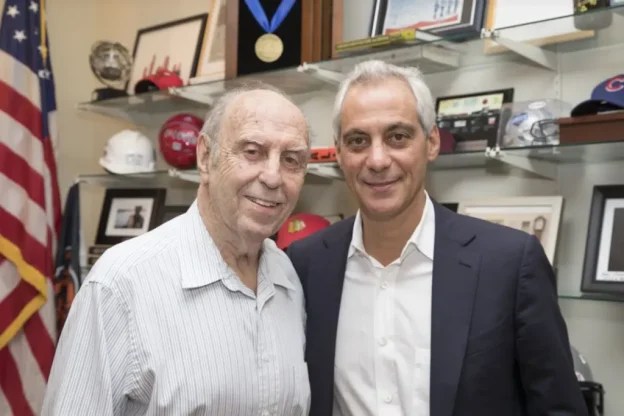
Rahm Israel Emanuel with his father, a former operative of Menachem Begin’s Irgun terror group, a forerunner of Netanyahu’s Likud Party.
Emanuel became involved in politics in the early 1980s while enrolled at Northwestern University, where he earned a master’s degree in speech and communication. His first job in politics — as spokesman for the Illinois Public Action Council — brought him into contact with an ambitious Jew named David Axelrod, and the pair became close friends two years later while working on the victorious Senate campaign of Paul Simon. The success of the Simon campaign helped launch the political careers of Axelrod and Emanuel who would both one day occupy key positions within the administration of President Obama.
In early 1991, Emanuel volunteered for a short stint in the IDF as part of Israel’s Sar-el program, where he worked as a tank mechanic at one of Israel’s northern bases during the Gulf War. He relocated to Little Rock, Arkansas upon his return to the United States to serve as the chief fundraiser for Governor Bill Clinton’s presidential campaign, helping to raise over $120 million for the degenerate 42nd President of the United States. Clinton would appoint the crafty dual-loyalist political director of the new administration following his election victory in November 1992, before reassigning him the position of Deputy Communications Director and Senior Advisor to the President for Policy and Strategy, from where Emanuel was instrumental in the destruction of nearly one million US jobs as the primary architect of the infamous North American Free Trade Agreement (NAFTA).

The pillar of power behind the president
After the Clinton administration came to an end, Emanuel went to work at the Chicago office of the investment firm Dresdner Kleinwort Wasserstein where he mysteriously made $16 million in two years before deciding to run for Congress in 2002. He was elected and represented Illinois’s 5th district from 2003 – 2009, burnishing his reputation as a pro-Israel hardliner almost immediately upon taking office by signing a letter to then-President George W. Bush defending the Jewish state’s controversial policy of assassinating Palestinian leaders and criticizing Bush for being insufficiently supportive of Israel! For many years afterwards, he defended Bush’s decision to invade Iraq, even after joining the Obama administration and criticizing certain aspects of the war.
When Barack Obama was elected the 44th President of the United States he plucked Rahm Emanuel and David Axelrod out of the Chicago political cesspit to accompany him to the White House as his Chief of Staff and Senior Advisor, respectively. Just days after Obama’s election, Benjamin Emanuel caused a commotion when he boasted to a reporter from Israeli newspaper Ma’ariv that his son was now in a position to influence the newly elected president’s stance towards Israel: “Obviously, he’ll influence the president to be pro-Israel. Why wouldn’t he? What is he, an Arab? He’s not going to be mopping floors at the White House.”
The younger Emanuel left his post as White House Chief of Staff towards the end of 2010 to run for mayor of Chicago. He received overwhelming support from Jewish and LGBT voters and ultimately raised over $10 million dollars, in part through large contributions from people like Steven Spielberg and Donald Trump, close friends of his brother Ari Emanuel. Emanuel’s controversy-plagued two terms as Mayor of Chicago earned him the sobriquet “Mayor 1%” for his economic policies favoring the wealthy, and by the time the “attack dog, policy wonk, committed Jew” was out of office in 2019, Chicago was a financial basket case with a surging murder rate driven by gang-related violence.
Catholic scholar Dr. E. Michael Jones often points out that “existence calls forth a new essence.” In explaining the maxim, Jones has cited the story of the Pilgrims, who landed on the shores of Massachusetts Bay as Calvinists before being mugged by the reality of the frontier, leading to the Halfway Covenant and a continuous modification of their Calvinist essence as Western expansion progressed. There’s no question that on some level a similar process is taking place today with Jews who are facing the uncomfortable realities of a post-October 7th world, though the authenticity of Rahm Emanuel’s conversion is called into question by the fundamental principles of the Orthodox Jewish religion to which he and his family are dedicated devotees. 5
In his book The Talmud Tested (first published as The Old Paths in 1854), Irish Hebraist and missionary Alexander McCaul devotes a number of pages to analyzing a section of the Talmud called Hilchoth Accum, part of which captures the duplicity found throughout Jewish teaching:
“The poor of the idolators (non-Jews) are to be fed with the poor of Israel for the sake of the ways of peace. They are also permitted to have part of the gleaning, the forgotten sheaf, and the corner of the field, for the sake of the ways of the peace. It is also lawful to ask after their health, even on their feast-day, for the sake of the ways of the peace; but never to return the salutation, nor to enter the house of an idolator on the day of his festival to salute him. If he be met in the street, he is to be saluted in a low tone of voice, and with a heavy head. But all these things are said only of the time that Israel is in captivity among the nations, or that the hand of the idolators is strong upon Israel. But when the hand of Israel is strong upon them, we are forbidden to suffer an idolator among us, even so much as to sojourn incidentally, or to pass from place to place with merchandise.” [Italics in original]
Commenting on the passage, Dr. McCaul states
“… the reader may now judge whether the words, ‘For the sake of the ways of peace,’ can be interpreted as… ‘for the good of society.’ If so, then ‘the good of society’ is to be consulted only whilst the Jews are in captivity, and the Gentiles have got the power: but as soon as the Jews get the power, ‘the good of society’ may safely be disregarded. The meaning plainly is, that in the present position of affairs it is advisable to keep the peace between Jews and Gentiles, inasmuch as the Gentiles are at present the strongest.”
The outrage towards Israel felt by millions of Americans on both sides of the political divide since the Gaza ‘War’ began in October 2023, has made it necessary for any aspiring candidate for higher office to publicly adopt a more measured tone on Israel/Palestine and US support for the genocidal regime. Because Rahm Emanuel and the Jewish oligarchs have yet to achieve complete mastery over the United States, certain concessions must be made “for the sake of the ways of the peace.”
The concept of ‘pairs’ is foundational in Judaism and is expressed through several traditional ideas and customs. During the Second Temple period (170 BC – 30 AD) there were five successive pairs of rabbis whose role it was to preserve and transmit the Oral Law that would one day be committed to writing as the Talmud. These pairs are known in Hebrew as zugot, the most famous of which are Hillel and Shammai, who laid the framework for rabbinic debate with their opposing schools of thought. Michael Hoffman, in his book Judaism’s Strange Gods, describes the pair within the context of mystical Judaism:
“Hillel serves his purpose within the rabbinic semiotic by acting as poster boy for the Kabbalistic pillar of chesed. But the rule of Shammai, the pillar of gevurah, also forms a significant part of the reality of Orthodox Judaism… In truth they are complimentary, as the mystical Kabbalah compliments the bureaucratic Talmud, thesis and antithesis; yin and yang — the “zugot” who symbolize the subterranean synthesis that is Judaism in its indissolubly interconnected esoteric reconciliation of apparent opposites.”
When considering Rahm Emanuel’s Zionist pedigree and professional trajectory, it’s fair to wonder whether some variation of the ancient ‘opposing pairs’ theater is being performed right now with Benjamin Netanyahu.6 A July 6 article in Politico hints at this theme while pondering Emanuel’s presidential prospects:
“Emanuel’s presidential ambitions so far are defined by two pillars. One is the essential plausibility of his resume… There’s no one in the gathering field who has such a diverse range of experiences and personal associations, or moves as confidently or as restlessly in policy debates. The other pillar is the essential implausibility, amid prevailing political currents, of his nascent candidacy: He is an establishment centrist who is deeply mistrusted by many of the more left-leaning, insurgent and increasingly Israel-skeptical activists who reasonably believe their energy will power the party’s next generation.
Netanyahu is a useful foil, and a potential bridge between the two pillars. Emanuel can accurately tell younger Democrats: Trust me, I have been at this fight longer than you have, and I have the enemies to show for it.”

Notes:
- As Obama’s chief of staff in 2009, Emanuel momentarily incurred Netanyahu’s wrath after suggesting that Israel should halt its settlements in the West Bank; although this had more to do with maintaining Israel’s relationship with America than any humanitarian considerations. ↩︎
- Goldman, a member of the Zionist Organization of America and the World Zionist Congress, was “especially known for helping to popularize the cause of Zionism in the United States.” ↩︎
- Benjamin Emanuel claimed that he refused to mail letter bombs to the British. ↩︎
- Hollywood producer Ari Emanuel once called on people in the movie industry to blackball Mel Gibson over his movie The Passion of the Christ. ↩︎
- Emanuel’s longtime rabbi, Asher Lopatin, is a Rhodes Scholar and member of the Council on Foreign Relations. ↩︎
- Similarly, suspected 9/11 conspirators Ehud Barak and Ehud Olmert are often presented as reasonable voices of opposition to Itamar Ben-Gvir, Bezalel Smotrich and the fanatical Israeli settlers. ↩︎
The not-so-secret Israeli strategy: This is the real Gaza plan
By Ramzy Baroud | MEMO | July 15, 2026
Here is the bottom line: Israeli Prime Minister Benjamin Netanyahu has no intention of leaving Gaza, either before Israel’s general elections—likely to be held in October—or after. Conceding an inch from the roughly 70 percent of the territory his army currently occupies in Gaza will be considered a weakness by the majority of Israeli voters and would result in an open revolt within his extremist coalition.
He has made his intentions clear time and again. Recent statements by Israel’s political leadership have only reinforced that reality, with officials insisting that Israel must maintain indefinite military dominance over the Strip and explicitly rejecting any framework that requires a full withdrawal of troops. To Netanyahu, the military footprint in Gaza is a permanent fixture, not a temporary bargaining chip.
Some may argue that Netanyahu’s statements are merely political fodder aimed at prolonging his career and avoiding the disastrous outcomes awaiting him—in terms of state investigations and court trials—should he be ejected from power. However, his extremist policies throughout his entire career at the helm of Israeli politics say otherwise.
There has never been a period in Netanyahu’s history in which he showed a genuine willingness to compromise or engage in an authentic political process with the Palestinians.
This reduces the point of the Washington-led Board of Peace and its subsequent administrative bodies to near irrelevance. These entities—including the National Committee for the Administration of Gaza (NCAG) and a multinational International Stabilization Force (ISF)—were supposedly assembled with the sole aim of managing a transitional phase, delivering humanitarian aid, and deploying a peacekeeping buffer to facilitate a gradual Israeli military withdrawal.
It seems that two separate, irreconcilable tracks are taking shape. One is the Israeli track of continued war, entrenched military occupation, and prolonged genocide. The other is an international track, controlled firmly by Washington, aimed largely at finding alternative ways to manage Gaza on behalf of Israel.
Yet even with its obvious limitations, the Gaza plan’s first phase theoretically promises a phased Israeli military repositioning, a sustainable ceasefire, a massive influx of reconstruction aid, and the gradual handover of civil administration to a non-factional Palestinian authority.
Little of that has actually been delivered. While the United States and international envoys claim the ceasefire hinges on disarmament, Israel has used the diplomatic deadlock to advance its troops further into the Strip rather than withdrawing them. Aid remains choked at the borders, and the promised reconstruction has not even begun.
Indirect talks are ongoing in Cairo, though it seems that only Palestinians are being held accountable or expected to carry out heavy concessions. Moreover, after 19 years of Hamas governing Gaza, the movement announced on 6th July that it has officially dissolved the Emergency Committee that has been administering the Strip. The movement declared its full readiness to transfer governance to the National Committee, intended to administer Gaza under the framework of the US-brokered plan.
On paper, this suggests that a political transition is finally underway. In reality, no such transition is taking place.
Israel is actively preventing this technocratic government from assuming any real duties. Rather than facilitating a civil handover, the Israeli political security cabinet has completely dismissed the transition.
Israeli Foreign Minister Gideon Sa’ar openly labeled the move a “trick,” arguing that a technocratic administration would merely be responsible for municipal tasks like garbage collection while allowing resistance networks to persist.
Instead, Israel’s military strategy continues to fuel conditions that undermine any possibility of stabilizing the devastated Strip. Its objective is not merely to reject an alternative Palestinian administration, but to ensure that no functioning Palestinian governing authority can emerge at all. By doing so, Tel Aviv wants to create a permanent governance vacuum, sowing further chaos and fragmentation.
If no alternative Palestinian political body is permitted to stabilize Gaza, the default collapse will inevitably force local factions to reassert control over daily survival, thus giving Israel yet more pretenses to exact more punishment on a helpless population.
Following the Hamas political move, Israel simply responded with its standard currency: immediate violence. This was starkly illustrated on 9th July, when Israeli forces carried out a targeted airstrike on a vehicle in Gaza City in a failed attempt to assassinate Hamas spokesman Hazem Qassem. Though the assassination attempt failed, the strike sent a clear message that Israel has no intention of respecting political transformations or ceasefires.
While no houses are being built, no schools are being constructed, and no hospitals are being revived, the only numbers that keep growing are those of the dead and wounded.
The human cost has reached unfathomable proportions: the Palestinian death toll in Gaza has surpassed 73,000, with the number of wounded exceeding 173,200. Tragically, these numbers continue to climb daily: over 1,098 Palestinians have been killed since the so-called ceasefire framework was initially agreed upon, proving that the truce exists only in media rhetoric, not on the ground.
This leaves us with a single, inescapable conclusion: the political track aimed at reconstructing Gaza and ending the Israeli military presence has little bearing on the grim realities unfolding on the ground.
The only way out is a stronger, independent international will that wrestles the future of Gaza from the grip of Netanyahu, translating political agreements into immediate humanitarian outcomes and a definitive end to the Israeli occupation.
Until Israel is compelled to relinquish its military control over Gaza, every new committee, reconstruction mechanism, or diplomatic initiative risks becoming little more than political theatre.
Featured Video
Trita Parsi: Israel Set a Trap for Total War in the Region
or go to
Aletho News Archives – Video-Images
From the Archive
Zionism’s Violent Legacy
By Donald Neff | Washington Report On Middle East Affairs | January 1996
On January 4, 1948, Jewish terrorists drove a truck loaded with explosives into the center of the all Arab city of Jaffa and detonated it, killing 26 and wounding around 100 Palestinian men, women and children.[1] The attack was the work of the Irgun Zvai Leumi – the “National Military Organization,” also known by the Hebrew letters Etzel – the largest Jewish terrorist group in Palestine. The Irgun was headed by Revisionist Zionist Menachem Begin and had been killing and maiming Arabs, Britons and even Jews for the previous ten years in its efforts to establish a Jewish state.
This terror campaign meant that at the core of Revisionist Zionism there existed a philosophical embrace of violence. … continue
Blog Roll
 Aletho News
- Trita Parsi: Israel Set a Trap for Total War in the Region
- Trump’s Iran war is on an Israeli leash
- Saudi oil boss issues global supply warning
- Riyadh Says Its Oil System Is Intact. The Numbers Say Otherwise.
- Trump and Netanyahu Want to “Finish the Job” on Iran
- US ‘one-sided dictation’ not Iran’s beliefs makes rational talks impossible: Baghaei
- Iran’s Next Strike May Not Explode. It Could Shut You Down /Col Doug Macgregor
- Iran: US political targets legitimate if assassinations return
- Iraq shuts key border crossing with Iran under US pressure: Report
- Undersea Internet cables could be targeted in retaliation for attacks on Iran: IRGC deputy chief
- If Americans Knew
- The Israel Lobby’s Changing Fortunes
- AIPAC has become such a political liability that it’s shifting to a more “nimble” approach to buying politicians
- At least 160 Israeli settler attacks in 2 weeks
- Will Gaza’s Ancient Christian Community Disappear Forever?
- Israel’s vision of regional security rests on keeping Arab states weak
- Heidi Levine recounts how Palestinian youths helped save her in settler attack
- DAILY UPDATE: Latest essential news on Palestine, Israel, & region
- Trump’s Intensifying Sabotage of the ICC, for Israel’s Sake
- Israeli military detain US and UK volunteers in West Bank including Democratic NY politician Brad Lander
- Americans at National Conservatism Conference held in Israel this year criticize Israel
- No Tricks Zone
- E-Cars Reduce CO2 Emissions By Only 41% Compared To Internal Combustion Engine Vehicles
- Predictions Made By Renowned Climate Professor Over Past Decades Have Been Proven To Be Poor
- New Study Suggests Large Regions Of The Pacific Ocean Have Been Cooling For The Last 80 Years
- Germany’s Green Energy Debacle: High Energy Costs Force Kahla Porzellan to Close After 182 Years!
- New Study: 50 Years Of The Most Aggressive ‘Net Zero’ Policies Can Only Affect The Global Climate By 0.03°C
- US September “Heat” Was No Record…Many Records Set Decades Ago
- Latest European Green Energy Debacle; Portugal’s Largest Flagship Solar Park Insolvent!
- Green Energy Debacle: German Expert Professor Fritz Vahrenholt Warns Of Severe Economic And Social Consequences
- Two More Paleo Reconstructions Affirm Meters-Higher Sea Levels Across Ireland, Brazil 7000-6000 Years Ago
- New Study: Earth And Venus Surface Warmth Largely Explained By Convection And Lapse Rate, Not CO2 Or Radiation

