Just a glitch? Google hides conservative & alt-media websites from search results for hours
RT | July 21, 2020
Google excluded major conservative and alt-media outlets from its search results for hours, hiding hits for sites like Breitbart and RedState even in searches for the outlets’ names – only to mysteriously revert to normal later.
Conservative sites were in a panic Tuesday morning, reporting they seemed to have been blacklisted from Google. Articles and pages published by PJ Media, Daily Caller, The Blaze, and many other sites were absent even from searches for the publication name, replaced by links to Wikipedia and other sites talking about the outlet in question – usually negatively.
While most of the affected sites hailed from the right side of the political spectrum, leftist sites whose views don’t conform to prevailing orthodoxy also appeared to fall victim to the purge. Mediaite’s Charlie Nash posted a screenshot of a Google search for MintPress News that included no hits from the left-leaning antiwar outlet, while another commenter noted Occupy Democrats was MIA.
Google was quick with the damage control, announcing it was “investigating this and any potentially related issues.” The search giant described the problem as if it was merely an issue with one specific search command rather than a politically-specific problem that somehow left establishment-friendly media alone.
After a few hours, searches were working normally again. However, those affected had their own suspicions about why this extremely specific search plague might have hit “wrongthink” websites all at once.
Perhaps realizing that simply returning the news sites to their rightful place in search results wouldn’t silence critics, Google later released a statement acknowledging “an issue that impacted some navigational and site: operator searches.” However, they denied any “particular sites or political ideologies” were targeted.
Project Veritas, one of the sites affected by the search blackout, interviewed a Google whistleblower last year who revealed the company has multiple “blacklists” for both YouTube and regular web search, one of which includes many of the sites that went missing on Tuesday.
Additionally, internal Google communications from 2016 show employees considered burying or blocking search results from conservative outlets in the aftermath of President Donald Trump’s electoral victory, specifically naming the Daily Caller and Breitbart – both of which were affected by the temporary blackout. While it eventually opted to run “fact-checks” next to conservative articles instead, that program was short-lived, having been quietly discontinued after its many shortcomings were exposed by the right-leaning outlets it invariably targeted. The “fact-checks” sometimes critiqued statements the original articles had not even made, and occasionally ran alongside unrelated articles.
As November’s elections loom, Google and other tech firms are likely scrambling to prevent a rerun of 2016. With 88 percent of US search engine market share, Google’s results will figure heavily in the information American voters can access in the next few months.
Calls for Google to put Palestine back on the map
MEMO | July 21, 2020
Pro-Palestine activists have launched an online campaign calling on Google and Apple to put Palestine back on their maps, accusing the internet giants of trying to erase Palestinian identity and changing facts to suit American and Israeli objectives.
“According to Google, Palestine does not exist,” a change.org petition with over one million signatories says.
“Whether intentionally or otherwise, Google is making itself complicit in the Israeli government’s ethnic cleansing of Palestine.”
Google has been replacing the names of Palestinian towns and villages with Israeli names, leading to fears that the search engine is normalising Israel’s planned annexation of parts of the occupied West Bank in line with US President Donald Trump’s controversial ‘peace plan‘.
“The omission of Palestine is a grievous insult to the people of Palestine and undermines the efforts of the millions of people who are involved in the campaign to secure Palestinian independence and freedom from Israeli occupation and oppression,” the petition adds, calling on Google to “clearly designate and identify the Palestinian territories illegally occupied by Israel.”
Owen Benjamin vs Patreon: Dissident Comedian Set to Deal Massive Blow to Big Tech Censors
By Eric Striker | National Justice | July 18, 2020
A potential mechanism for punishing tech censorship has materialized.
Nationalist comedian Owen Benjamin and 72 of his fans have won a tentative decision under California’s arbitration law, which was amended by legislation signed by Governor Gavin Newsom in October 2019 to put the burden of fees in disputes on the party setting terms.
Prior to January 2020, Patreon’s Terms of Service encouraged disagreements to be settled via arbitration under the assumption that the money and time required would discourage consumers from even trying.
In the case against Patreon, the matter in need of arbitration is related to the company’s abrupt banning of Benjamin’s page for political reasons. Benjamin and his fans argue that the deplatforming amounts to tortious interference in their business contract. Thanks to Patreon, Benjamin cannot comply with his contractual obligation of providing content for money to his followers due to the tech platform failing in its role as financial middleman. Benjamin is asking for $3.5 million in damages.
What is unique about arbitration in California is that Patreon is on the hook for the legal and arbitration fees required for Benjamin and all 72 of the individual plaintiffs. This means they must pay at least $10,000 to each individual complainant, which in total could cost the corporation 10s of millions of dollars regardless of outcome.
Patreon has reacted to this process in an aggressive manner. They could make the whole thing go away simply by reinstating Benjamin’s account, but they decided to counter-sue and filed for an injunction against having to pay the fees for Benjamin’s fans, stating that they are ready to fight to “keep hate speech off the platform.” An article on the leftist click farm Daily Dot gloated about this, perceiving it as a corporation crushing little guys.
A dirty trick Patreon utilized was to change their Terms of Service shortly after Benjamin’s fans contacted them seeking arbitration — a step Patreon demands first be taken before action is brought before mediators. It seems unlikely that this will work.
The Benjamin “bears” — as his fans refer to themselves — were able to retain the consul of First Amendment attorney Marc Randazza, who appeared to defeat the arguments by Patreon’s lawyers in open court. A July 13th tentative ruling rejecting Patreon’s injunction was won. If the decision is made final, it will set a precedent that introduces an enormous cost for companies like Paypal, Stripe and other payment processors with arbitration clauses that like to destroy people’s livelihoods for their political beliefs.
Mike Cernovich has covered the case closely and is optimistic about its prospects. Legal expert Nick Rekieta believes that this ruling could be an historic victory for free speech. Reclaim The Net, an organization that fights for free expression on the internet, has called the arbitration law a “legal workaround for Big Tech censorship.” Aside from the Daily Dot and a snarky blogpost on Patheos, the Jewish media is by and large refusing to even speak about the case even though many tech companies are watching proceedings closely — evidence that they fear the likely outcome.
Countless lawsuits have been filed seeking to counter-attack against highly restrictive, college campus style tech multi-national censorship. Jared Taylor recently wrote a piece describing his attempt in 2018 to sue Twitter over its ban of his organization, citing that it falsely advertised itself as a free speech platform. Taylor’s lawsuit was thwarted in a rare and politically motivated action by an appeals court after initially winning the right to have his case heard.
Jewish organizations will not allow their most powerful tool for stifling debate to be nullified without a fight. There is a strong possibility that if Benjamin and the other plaintiffs are successful, California’s arbitration laws could be challenged by Big Tech all the way up to the Supreme Court.
If this were to happen, the court conservatives — which regularly put the interests of corporate America over the rights of citizens — could use its majority to rule that forcing Patreon to pay arbitration fees is unconstitutional. This is ironic, as both Donald Trump and the Republican Party claim to oppose tech censorship, yet until Benjamin’s lawsuit, no serious move against it has been made.
A final ruling on Patreon’s injunction is slated to be made in the coming weeks.
Bari We Hardly Knew You
Bari Weiss bids The New York Times farewell
By Philip Giraldi | American Herald Tribune | July 17, 2020
This week’s resignation of neoconservative journalist Bari Weiss from the position of staff editor and contributor on the opinion page at The New York Times provoked considerable discussion both for and against her. Her resignation letter, which was quickly made public, depicts her as a brave non-conformist, a “conservative” among liberals (though she describes herself as a “centrist”), and someone who was willing to write stories that others at the Times would not touch. She was particularly critical of the dominant progressive “group think” at the management levels of the newspaper which created a “hostile environment” that did not tolerate any alternative viewpoints on breaking stories.
The resignation came shortly after the “scandal” at the newspaper that had led to the firing of opinion page chief editor James Bennet in June. Bennet was forced to walk the plank after a piece by Senator Tom Cotton appeared that advocated using military force to put down the unrest that is sweeping America’s cities. “Using military force” is apparently equivalent to “shooting demonstrators” in New York Times-speak, so when Bennett admitted that he had not even read the op-ed, he had to go for approving a piece that “did not meet the Times’ standards.”
Admittedly, Weiss makes some shrewd points about the state of journalism in the United States and how it has become a sounding board for what is appearing on Twitter. To her credit, she has been openly critical of the so-called “cancel culture” which seeks to restrict the free exchange of information and ideas, but she is also very selective about her own record. She claims that she was derided as a “Nazi, a bigot and a racist” because she questioned the reporting on issues like BLM and was not “inclusive” enough. But while she rightly decries what she describes as the tribalism of the corporate mainstream media, she does so without recognizing that she too has her own particular tribal allegiance. She makes a point of implying that she was the victim of anti-Semitism, accused of “writing about Jews again,” without any recognition that she herself has been a strident hardline apologist for Israel and for Jews in general in a journalism world that has been over-populated by mostly liberal Jews for many years.
Bari Weiss’s letter included an overwrought description of Pulitzer Prize winning black writer Alice Walker, author of The Color Purple, as “a proud anti-Semite who believes in lizard Illuminati,” suggesting that she does indeed nurture an agenda focused on Jewish-related issues. Glenn Greenwald recalls how she, in 2012, speaking before a conference of the American Zionist Movement, stated that she had dedicated herself to the “connection between advocacy journalism and Zionism.” Greenwald has also documented how she, starting when she was a sophomore at Columbia, was in the forefront of efforts to silence all criticism of Israel, particularly that which was allegedly coming from professors of Arab background. He observes that her objective was no less than “trying to suppress criticisms of Israel from college campuses… Anyone remotely familiar with the wars over the Middle East Studies Department at Columbia University, in which Weiss played a starring role, knows that her claim here — that the campaign was just a benign attempt to protect students’ rights — is utterly false. The campaign was designed to ruin the careers of Arab professors by equating their criticisms of Israel with racism, anti-Semitism, and bullying, and its central demand was that those professors (some of whom lacked tenure) be disciplined for their transgressions… That the campaign against these Arab professors was about suppressing criticisms of Israel and intimidating and punishing professors who voiced such criticisms was barely hidden. The New York Civil Liberties Union — historically reluctant to involve itself in disputes involving Israel — strongly condemned the campaign against these Arab professors at Columbia that Weiss helped to lead.”
Given all the pressure from Weiss and her associates, as well as threats from prominent Jewish donors to the college, the university investigated the charges. It found that “… for several years, after pieces appeared in the tabloid press blasting the department as anti-Israel, many non-students, clearly hostile and with ideological agendas, had been attending classes in the [Middle East Studies] department, interrupting lectures with hostile asides and inhibiting classroom debate.” All the professors were cleared of the charges leveled against them and the report concluded that they had been the victims and not the perpetrators of an organized harassment campaign.
Weiss, the epicenter of the campaign of vilification and academic censorship, was furious at the exoneration of the instructors and both held a press conference to denounce the findings while also organizing demonstrations by Jewish students. She complained that the issue of “large scale intimidation of pro-Israel students” had not been addressed.
Weiss was hired by The Times in 2017 around the same time that the much better-known Jerusalem Post and Wall Street Journal alumnus Bret Stephens was also brought on board. Both she and Stephens are unflinching in their support of Israel and they joined a Times staff that was hardly anti-Israeli. The Times for long has been something like an uncritical sounding board for the Israeli Ministry of Foreign Affairs, but recently, it has indeed allowed some pieces by Tom Friedman and others that are critical of the Israeli plan to annex much of the Palestinian West Bank. But the arguments are always framed around the premise that the move would be “bad for Israel,” leaving the Palestinian victims on the sidelines as hapless observers of the deliberations.
In retrospect, it is difficult to understand what the stink over Bari Weiss is all about, apart from the fact that she is clearly engaging in self-promotion to get another job. A quick perusal of the list of her undistinguished NYT articles does indeed suggest that roughly half of what she wrote was either about Israel or Jews. As an editor, she commissioned interviews and op-eds by people that she may have considered either “centrist” or “conservative,” but, again, she, and they, hardly had much impact. Whatever her “new perspective” was perceived to be by NYT management when she was hired is somewhat elusive.
Sure, the print media in the United States is run largely by progressives and is subject to groupthink on most issues, but that has been the case since before Weiss arrived and will continue to be so long after she is gone. And she won’t have to worry about pleasing her key constituency. Bret Stephens can continue to beat the drum for Israel at The New York Times in her absence.
Philip M. Giraldi is a former CIA counter-terrorism specialist and military intelligence officer who served nineteen years overseas in Turkey, Italy, Germany, and Spain. He was the CIA Chief of Base for the Barcelona Olympics in 1992 and was one of the first Americans to enter Afghanistan in December 2001. Phil is Executive Director of the Council for the National Interest, a Washington-based advocacy group that seeks to encourage and promote a U.S. foreign policy in the Middle East that is consistent with American values and interests.
Stanford prof ordered to pay legal fees after dropping $10 million defamation case against another scientist

Mark Jacobson
Retraction Watch | July 9, 2020
A Stanford professor who sued a critic and a scientific journal for $10 million — then dropped the suit — has been ordered to pay the defendants’ legal fees based on a statute “designed to provide for early dismissal of meritless lawsuits filed against people for the exercise of First Amendment rights.”
Mark Jacobson, who studies renewable energy at Stanford, sued in September 2017 in the Superior Court of the District of Columbia for defamation over a 2017 paper in the Proceedings of the National Academy of Sciences (PNAS) that critiqued a 2015 article he had written in the same journal. He sued PNAS and the first author of the paper, Christopher Clack, an executive at a firm that analyzes renewable energy.
At the time, Kenneth White, a lawyer at Southern California firm Brown White & Osborn who frequently blogs at Popehat about legal issues related to free speech, said of the suit:
It’s not incompetently drafted, but it’s clearly vexatious and intended to silence dissent about an alleged scientist’s peer-reviewed article.
In February 2018, following a hearing at which PNAS argued for the case to be dismissed, Jacobson dropped the suit, telling us that he “was expecting them to settle.” The defendants then filed, based on the anti-SLAPP — for “Strategic Lawsuit Against Public Participation” — statute in Washington, DC, for Jacobson to pay their legal fees.
In April of this year, as noted then by Forbes, District of Columbia Superior Court Judge Elizabeth Carroll Wingo, who has been presiding over the case, ruled that Jacobson would have to pay those fees. In that ruling, Wingo wrote that the Court
finds that the three asserted “egregious errors” are statements reflecting scientific disagreements, which were appropriately explored and challenged in scientific publications; they simply do not attack Dr. Jacobson’s honesty or accuse him of misconduct.
Jacobson appealed that decision, but Wingo upheld it in a June 25 order.
Jacobson could be on the hook for more than $600,000, the total of what the plaintiffs have told the court were their legal costs — $535,900 for PNAS, and $75,000 for Clack.
Paul Thaler of Cohen Seglias, which has been representing Jacobson, noted in comments to Retraction Watch that the judge had not yet ruled on how much Jacobson should pay:
The Court must now determine the level of attorneys’ fees to charge, which ranges from $0 to the amounts requested by the Clack and NAS attorneys (see legal fee requests and replies for arguments in both directions). Once that is done, Prof. Jacobson will decide whether to appeal the questions of whether the publication of false facts with provable “yes/no” answers (such as the false claim that a table has maximum values when it factually has average values) are indeed questions of fact or of scientific disagreement and whether legal fees are allowed in a case of a voluntary dismissal without prejudice.
Despite dropping the suit, and the judge’s ruling, Jacobson continues to insist in comments to Retraction Watch that there were false claims in the Clack et al paper:
This case has always been about three false factual claims, including two of modeling “errors” or “bugs,” claimed by Dr. Clack and published by NAS that damaged the reputations of myself and my coauthors. What has come out is that the Clack attorney has now admitted in a Court document that Dr. Clack now makes no claim of a “bug in the source code” of our model, despite Dr. Clack’s rampant claim throughout his paper that we made “modeling errors.” Dr. Clack has also admitted in writing that our paper includes Canadian hydropower, yet neither he nor NAS has corrected this admitted error in the Clack Paper. Third, all evidence points to the fact that Table 1 of our paper contains average, not maximum values, indicating that Dr. Clack’s claim regarding modeling error on this issues is factually wrong as well. Thus, it is more clear than ever that the three false facts published by the Clack Authors were indeed false facts and not questions of scientific disagreement. I regret that it was impossible to have these errors corrected upon our first request rather than having to go through this drawn-out process to restore the reputations of myself and my coauthors.
Clack told Retraction Watch that Jacobson’s comments were not an accurate reflection of the paper he and his colleagues published. (For Clack’s responses to each of Jacobson’s claims, see this PDF; for our attempts to fact-check Jacobson’s claims by asking for evidence, see this PDF.) Clark said:
We have had to repeatedly defend against this individual who is unhappy that his responses to critique were not well received and many scientists and the public did not consider his responses adequate to explain the errors and implausible assumptions in his original PNAS paper.
Clack also said:
Jacobson sued myself and PNAS for publishing a critique of his work that he didn’t like. He chose not to sue the entire author team, but rather only myself. To get published in PNAS, we had passed peer reviewed, and editorial reviews; one reason it took so long to publish. There was a lot of information in our paper and there were many, many problems (a lot were contained in the [supplemental information]). We had 21 authors who all worked on the paper, checked the working and agreed on its content and conclusions. Jacobson had an opportunity to respond concurrently with the release of our paper. We just noted the content of his (and coauthors’) PNAS paper and showed that there were assumption issues, errors, mistakes and wrong conclusions drawn from them.
Science “should be a platform that all ideas should be critiqued and examined,” Clack told Retraction Watch :
That is why it is a slow methodical process. No one should be above being held accountable for errors or mistakes. Humans are imperfect, and so mistakes will happen, it is the job of science to correct and build from them. If there are critiques people should publish them because in the end it will only slow human progress if they do not. It should be the institutions job to protect those that publish such critiques (which most universities do).
Clack called on Stanford and other universities to pay attention to what their faculty are doing in the courts:
However, further, it should be an area that Universities (such as Stanford) should look into more. They should scrutinize whether academics are weaponizing legal avenues to hold back contrary science to their own work. Everyone has the right to pursue legal claims, but there should be a process set up as university employees that if they pursue it around academic literature or work, they have to get approval from the governing body at that university. Otherwise, there could be academics or others who use legal threats to halt publication of works that might contradict their own.
For me personally, I had no institution to defend me, and I am very honored and proud that Dentons (my lawyers) agreed to help me with my defense, because Jacobson’s filings were substantial in word count.
Indeed, on page seven of her June 25 order, Wingo called one of Jacobson’s motions — filed at nearly twice the page limit the court allowed — a “particularly egregious” violation.
YouTube censors video about daily life for Palestinians
If Americans Knew | July 8, 2020
YouTube does not want American high school students to know the truth about the Israeli occupation of Palestine.YouTube is censoring an eight-minute video entitled “Daily Life in Occupied Palestine.” The video, produced by If Americans Knew, contains video clips of Israeli actions against Palestinian men, women, and children, both Muslim and Christian. It also provides statistical and historical information about the Israeli-Palestinian issue. The US gives Israel over $10 million per day.
YouTube first removed the video claiming that it “violates YouTube guidelines.” When this claim was appealed, reviewers at the company admitted that it “does not violate YouTube guidelines.”

YouTube restored the video, but is prohibiting high school students from viewing it, and discouraging adults from watching it.
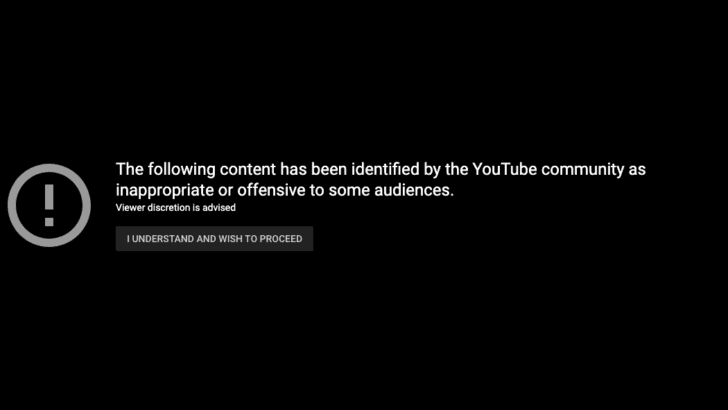
When people click on the video, they see a black screen with the unusually dire warning: “The following content has been identified by the YouTube community as inappropriate or offensive to some audiences. Viewer discretion is advised.”
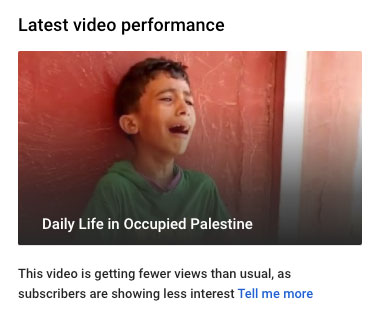 This has caused a significant reduction of views.
If Americans Knew has appealed these actions, writing to YouTube that the video—
“hasn’t been identified by ‘the YouTube Community’ as offensive; the information it contains has been labeled offensive by Israel partisans – that’s very different.
“We went to great lengths to censor all scenes of blood and gore, and even profane language. The purpose of this video is to educate the public about the ongoing situation in Israel-Palestine.”
In point of fact, the video is entirely within the range of footage shown on nightly TV. The only viewers for whom this is “offensive” are the Israel apologists whose lobby enables the violence it contains.
High school students study U.S. History, World History, and Government. They will soon be voters. Many are politically active and volunteer in diverse political campaigns. They regularly see movies filled with violence. There are laws in at least 12 states mandating that schools teach about the Nazi holocaust, an extremely violent episode in European history.
It is deeply inappropriate for YouTube to prevent American students from viewing a factual video about one of the most urgent issues in today’s world, and about a country that receives more US tax money than any other.
It is similarly inappropriate for YouTube to work to discourage adults from viewing the video and thus learning about what our money to Israel funds.
While YouTube, a Google subsidiary, is a private company, its dominance of the video hosting market confers certain responsibilities of fairness on it.
We ask that people who oppose censorship and believe that Americans need to learn facts about this urgent issue tell YouTube to remove its prohibition against students viewing the video, and remove its damaging warning screen.
Please sign this petition and share it widely.
Please also share our blog post of the video and our Facebook post of it as widely as possible.
Lithuania’s Television Commission Bans Broadcasting of Five RT Channels
Sputnik – 08.07.2020
The Lithuanian Radio and Television Commission (LRTK) has banned the broadcasting of five RT channels in the country, following the example of neighbouring Latvia, commission chairman Mantas Martisius said on Wednesday.
“Yes, we can confirm this. The decision will come into force after being published on the LRTK website,” Martisius said.
The ban is applicable to RT, RT HD, RT Spanish, RT Documentary HD and RT Documentary, and will go into effect on Thursday, LRTK chairman explained.
Last week, Latvia banned the broadcasting of seven RT channels (namely RT, RT HD, RT Arabic, RT Spanish, RT Documentary HD, RT Documentary, RT TV), saying they are all owned by Rossiya Segodnya International Information Agency Director-General Dmitry Kiselev, who is under EU sanctions. Notably, Rossiya Segodnya and RT are two different legal entities, RT is not chaired by Kiselev, and RT Editor-in-Chief Margarita Simonyan is not under any EU sanctions.
The Russian Foreign Ministry’s spokeswoman, Maria Zakharova, has slammed Latvia’s decision to ban seven RT channels as a disgraceful and illegal move.
Estonian Foreign Minister Urmas Reinsalu said on Tuesday that the government was mulling the possibility to ban RT broadcasting in the country.
Veteran activists called out BLM as a tool of the Democrats from day 1. But agenda-driven $Millions drown out the grassroots
By Helen Buyniski | RT | July 6, 2020
The Black Lives Matter movement has made millions off black Americans’ suffering. A St. Louis activist explains how it comes from a long tradition of white liberals coopting grassroots movements to push a Democratic Party agenda.
The foundation-funded social justice activism of Black Lives Matter is using black pain to cash in on white liberal guilt, dividing American society in pursuit of a Democratic political agenda, St. Louis activist Nyota Uhura told RT.
Uhura founded her website handsupdontshoot in August 2014 to counter false narratives coming out of the St. Louis suburb of Ferguson following the police shooting of 18-year-old Michael Brown.
Having witnessed BLM’s rise up close as the nascent organization swooped into Ferguson amid the calls for justice triggered by Brown’s killing, methodically co-opting the genuine protest energy while ignoring or even obstructing those protesters’ demands, Uhura has fought to warn others of what the organization really represents – leveraging black activism into a boost for the Democratic Party.
The science of co-opting movements
Plucking a few Ferguson residents from the streets for a veneer of local credibility, BLM raised $33 million on the back of Brown’s death – money Uhura says her community never saw. Six years later, black St. Louis remains poor and plagued with violence, while BLM has found a new community to exploit.
“They overshadow the work of the grassroots, then they insert themselves as leaders and they go out in the media and claim to be leading these movements,” Uhura said.
Outlining the methodology of BLM and other astroturfed movements, she added that sometimes they literally just showed up at a protest they didn’t plan and did a news conference. This is a tradition she traces back to white liberals’ hijacking of the 1963 March on Washington.
That tradition has been boiled down to a science, she says, with organizations like NetRoots turning out phony ‘activists’ with the ruthless efficiency of an assembly line. “NetRoots is where activists go to audition to be puppets of the Democrats, special interest and white elite nonprofit,” she continued.
“It happens so fast that all the pieces are in place before you even have a chance to know what hit you… Before you even know it, you’re watching the news and they have coopted your movement.”
White liberal and progressive groups “use the energy of our movement to push their agenda” – in BLM’s case, weaponizing the concept of “intersectionality” to broaden the movement’s scope from race to feminism, immigrant rights, LGBT issues, and other causes that directly affect white people.
“In order to mobilize people, they need those black faces out front – because what are they going to look like protesting? Just in terms of optics it’ll look like a Klan rally,” Uhura joked. She has a point – just 17 percent of last month’s protesters were black, according to a Pew Research poll published last week, a statistic the organization’s foes are unlikely to let it forget.
Real activists disenfranchised
Uhura is far from the only grassroots activist to publicly speak out against BLM for pulling a bait-and-switch, substituting the Democratic Party’s pet causes in place of justice for the victims of police violence. The group’s Cincinnati chapter dropped the iconic phrase from its name in 2018, alleging the national organization “capitalized off a nameless groundswell of resistance sweeping the nation, branded it as their own, and profited off [black people’s deaths]” without making an effort to get justice for victims’ families.
The Cincinnati chapter also says that BLM’s 2015 conference in Cleveland – where 12-year-old Tamir Rice had just been gunned down by a cop for holding a toy gun – focused almost exclusively on black transgender rights, further dividing a suffering community.
Los Angeles activists slammed BLM’s local chapter for ignoring the killing of Ezell Ford, a mentally-ill man shot by police in 2014, to travel to Ferguson and piggyback on the Michael Brown shooting. Upon their return to Los Angeles, where the activist community was demanding the city’s district attorney indict Ford’s killers, BLM Los Angeles not only continued to ignore the injustice, one of its leaders actually bestowed a ‘Women in Action’ award on the same DA who exonerated the cops who killed him.
Others take issue with what they see as obvious grifting by some of BLM’s most prominent representatives. DeRay McKesson has promoted brands from Apple to McDonald’s, and even got himself arrested in a Twitter T-shirt in what many activists believe was a staged promotion.
Shaun King is so legendary for making large sums of money raised “for the movement” disappear that the Daily Beast wrote a story about it. King recently announced a “Truth, Justice and Reconciliation Commission” in conjunction with three of the same “progressive prosecutors” that activists like Uhura have denounced for failing to police the police.
‘They always march us back into the voting booth’
Like all controlled opposition movements, one of BLM’s primary functions is to derail meaningful change. Uhura explained, “They always march us back into the voting booth.”
Well-heeled movement activists consistently divert money and energy into electing Democratic Party candidates or “progressive” prosecutors, none of whom hold police accountable when they murder innocent black men, whether it’s in Ferguson, Los Angeles, or New York City.
For this reason, she’s not convinced by the group’s recent calls to defund police, or the Minneapolis City Council’s pledge to do just that – the governments of Ferguson and St. Louis promised all manner of reforms they didn’t deliver. Many that did pass were hopelessly watered-down or have since been rolled back, and Uhura sees ‘defund the police’ as just another fundraising tactic.
The only electoral solution to the black community’s problems is “weaponizing our politics,” according to the veteran activist – all incumbents have to go. They’ve had their chance to make a difference, and proven themselves unwilling to deliver. “It might take one or two election cycles to mold a person into what we need, but right now we’re losing anyway,” she explained. “We have to just clean house and get rid of everybody. How can it be worse?”
BLM recently came under fire for doling out just six percent of its donations to local chapters over the past three years, with a whopping 83 percent going to pay consultants and travel costs. The complicated route the money takes from donor to chapter has elicited extensive speculation about the possibility of money laundering, and BLM representatives have been almost cartoonishly cagey when asked by reporters about their finances
Co-founder Alicia Garza has denied the group is backed by foundations at all, even though billionaire currency speculator George Soros alone has given over $33 million to BLM, its founders, and associated groups, and the Ford Foundation pledged to raise $100 million in 2016. Fellow co-founder Patrisse Cullors has held up a fact-check by PolitiFact, funded by the same Omidyar Network that funds BLM, as “proof” the group isn’t linked with the Democratic Party.
But it’s the group’s function as an ideological launderer that has thus far insulated it from accountability. From the corporations pouring millions of dollars into its coffers to burnish their woke cred, to the politicians donning Kente cloths and pandering their way to re-election, BLM positions itself as ‘the’ black activism group, overshadowing grassroots campaigners and sucking up all available cash – literally starving out the competition, as genuine movements struggle to be heard by the media and greater public over the foundation-funded din.
This model of activism has been so successful over the decades that it has come to dominate every cause from environmentalism to civil liberties, offering young people a “romanticized view of activism where it’s all hashtags, all patty-cake, all sugar and cream, when nothing could be further from the truth.”
Uhura, however, is confident that BLM’s true nature will be exposed, citing the movement’s own inherent discrimination: “How does Black Lives Matter get to decide WHICH black lives matter when they purposefully omit straight black people and straight black men whose death they profit from?”
But as long as grassroots activists are losing ground to foundation-funded rivals, new BLMs will keep popping up. Real activists must “create an alternative” to foundation-funded movements, she says – or risk losing the next generation to the Democratic operatives and keeping justice out of the reach of black communities forever.
Helen Buyniski is an American journalist and political commentator at RT. Follow her on Twitter @velocirapture23
Twitter Targets Accounts of MintPress and Other Outlets Covering Unrest in Bolivia
By Alan Macleod | MintPress News | June 29, 2020
Social media giant Twitter took the step of suspending the official account of MintPress News on Saturday. Without warning, the nine-year-old account with 64,000 followers was abruptly labeled as “fake” or “spam” and restricted. This move is becoming a frequent occurrence for alternative media, especially those that openly challenge U.S. power globally.
Immediately preceding the ban, MintPress had been sharing stories about Israeli government crimes against Palestinians, the Saudi-led onslaught in Yemen (both funded and supported by Washington), and about activists challenging chemical giant Monsanto’s latest plans. However, MintPess correspondent Ollie Vargas, stationed in Bolivia and covering the coup and other events there, had another theory on the suspension. Vargas noted that his account, along with union leader Leonardo Loza and independent Bolivian outlets Kawsachun Coca and Kawsachun News were all suspended at the same time. “There was a coordinated takedown of numerous users & outlets based in Chapare, Bolivia. Thousands of fake accounts appeared after the coup. We believe they’re being mobilized to mass report those who criticize the regime,” he said. Since the November coup, Bolivia has been the sight of intense political struggle, with MintPress one of the only Western outlets, large or small, extensively covering the situation (and from a perspective that directly challenges the official US government line). Vargas added that all those accounts suspended appeared in his Twitter bio.
In December, MintPress reported how the strongly conservative Bolivian elite is treating social media as a key battleground in pushing the coup forward, with over 5,000 accounts created on the day of the insurrection tweeting using pro-coup hashtags. With the new administration still lacking both legitimacy and public support, it appears the next step is to simply silence dissenting voices online like they have been silenced inside the country. Kawsachun Coca and Kawsachun News, located in the Chapare region, still not under government control, are among the only remaining outlets critical of the Añez administration.
As Twitter has developed into a worldwide medium of communication, it has also grown an increasingly close relationship with Western state power. In September, a senior Twitter executive was unmasked as an active duty officer in a British Army brigade whose specialty was online and psychological warfare. It was almost entirely ignored by corporate media; the one and only journalist at a major publication covering the story was pushed out of his job weeks later. Earlier this month, Twitter announced it worked with a hawkish U.S.- and Australian-government sponsored think tank to purge nearly 200,000 Chinese, Russian and Iranian accounts from its platform. It has also worked hard to remove Venezuelan users critical of U.S. regime change, including large numbers of government members. Meanwhile, despite detailed academic work exposing them, Venezuelan opposition bot networks remain free to promote intervention.
Facebook has also been working hand-in-hand with the Atlantic Council, a NATO think tank, to determine what users and posts are legitimate and what is fake news, effectively giving control over what its 2.4 billion users see in their news feeds to the military organization. Reddit, another huge social media platform, recently appointed a former deputy director at the council to be its head of policy.
Earlier this year, Facebook announced that it was banning all positive appraisals of Qassem Soleimani, the Iranian general and statesman assassinated by the Trump administration. This, it explained, was because Trump had labeled the Iranian Revolutionary Guard Corps (IRGC) a terrorist organization. “We operate under U.S. sanctions laws, including those related to the U.S. government’s designation of the IRGC and its leadership,” it said in a statement. This is particularly worrying, as Soleimani was the country’s most popular public figure, with over 80 percent of Iranians holding a positive view of him, according to a University of Maryland poll. Therefore, because of the whims of the Trump administration, Facebook began suppressing a majority view shared by Iranians with other Iranians in Farsi across all its platforms, including Instagram. Thus, the line between the state, the military industrial complex, and big media platforms whose job should be to hold them to account has blurred beyond distinction. The incident also once again highlights that big tech monopolies are not public resources, but increasingly tightly controlled American enterprises working in conjunction with Washington.
More worryingly, it is the tech companies themselves who are pushing for this integration. “What Lockheed Martin was to the twentieth century,” wrote Google executives Eric Schmidt and Larry Cohen in their book, The New Digital Age, “technology and cyber-security companies [like Google] will be to the twenty-first.” The book was heartily endorsed by Atlantic Council director Henry Kissinger.
After an online outcry including journalists like Ben Norton directly appealing to administrators, the accounts were reinstated today. However, the weekend’s events are another point of reference in the trend of harassing and suppressing independent, alternative or foreign media that challenges the U.S. state power, an increasingly large part of which is linked to the big online media platforms we rely on for free exchange of ideas, opinions and discourse.
On the incident, MintPress founder Mnar Muhawesh said:
Twitter’s ban hammer and censorship army of flaggers is an attempt to re-tighten state and corporate control over the free flow of information. That’s why it’s no wonder independent media like MintPress News, Kawsachun, and watchdog journalists covering state crimes like Ollie Vargas have been targeted in what appears to be an organized effort to silence and censor dissent. Twitter’s message is very clear: our first amendment is not welcome, as long as it challenges establishment narratives.”
Alan MacLeod is a Staff Writer for MintPress News. After completing his PhD in 2017 he published two books: Bad News From Venezuela: Twenty Years of Fake News and Misreporting and Propaganda in the Information Age: Still Manufacturing Consent.
Black Voices also Matter
By Gilad Atzmon | July 1, 2020
That we are proceeding rapidly into an authoritarian reality is hardly a news item: it is impossible not to identify the institutions at the centre of this unfortunate transition. Every day one Jewish organization or another brags about its success in defeating our most precious Western values: political freedom and intellectual tolerance.
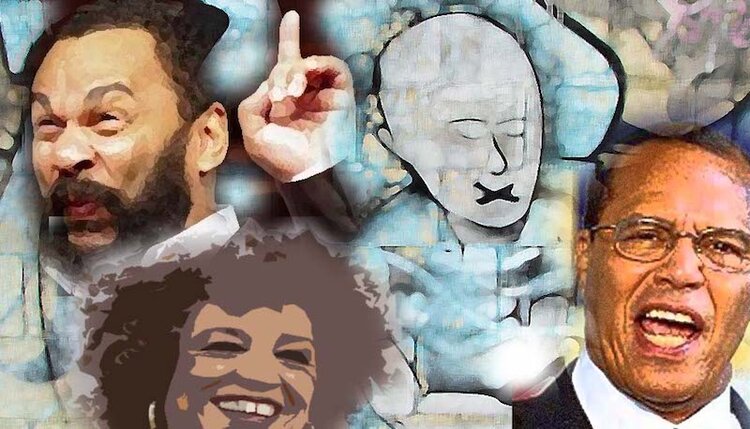
At the moment it seems as if silencing authentic Black voices is the Zionists’ prime objective. This morning we learned that Black Voices do not matter at all: in a total capitulation to the French Zionist Lobby group CRIF, the great Black French comedian Dieudonné’s YouTube channel was deleted by Google. CRIF tweeted:
“A month ago, the CRIF filed a complaint against Dieudonné after the broadcasting of anti-Semitic videos. Yesterday, his chain @YouTube has been deleted. CRIF welcomes this decision and encourages other platforms to take responsibility and close all of its accounts.”
In the late 18th century the Anglo Irish statesman and philosopher Edmund Burke realised that “all that is necessary for evil to succeed is that good men do nothing.” I guess that in 2020 for evil to prevail all that is needed is for an internet company to become an extension of Zion.
Neither Dieudonne nor anyone else needs my ‘kosher’ certificate, although I have no doubt that the French artist is an exemplary anti racist. What I will say is that if Zion doesn’t want you to listen to someone, there is nothing better you could do for yourself than defy their wishes. Dieudonne, France’s most popular comedian, is a brilliant Black man. He was brave enough to stand up and declare that he had enough of the holocaust indoctrination, what he wants to discuss is the holocaust of his people, an ongoing century of discrimination and racist abuse. Within only a matter of hours, Dieudonne was targeted by French Jewish organizations and was portrayed as a racist and an anti Semite .
I am looking forward to see what Black Lives Matter is going to do for one of Europe’s most authentic and profound Black voices. Just an idea, maybe instead of pulling down bronze statues, BLM should consider calling for every Black artist to close their Youtube channels until Google comes to its senses. This would be a nice proper attempt at a Black power exercise, but as you can imagine, I do not hold my breath.
Unfortunately, Zionist destruction of the little that is left out of the Western spirit has become a daily spectacle. Yesterday we saw the Jewish press bragging that Fox Soul — a new Fox channel geared toward African Americans scheduled live broadcast of a speech by Louis Farrakhan. The Jewish Algemeiner was kind enough to reveal that the Simon Wiesenthal Center had called for the broadcast to be scrapped.
Zionist organisations never march alone. They are effective in identifying the odd Sabbos Goy who stands ready to lend his or her ‘credibility’ to the ‘cause.’ This time it was CNN anchor Jake Tapper who tweeted, “Farrakhan is a vile anti-LGBTQ anti-Semitic misogynist. Why is a Fox channel airing his propaganda?”
As we all know, Jews often claim to be there for Blacks. Jewish outlets often brag about the significant Jewish contribution to the Civil Rights Movement. According to some Jewish historians, a large amount of the funds for the NAACP came from Jewish sources – some experts estimate as much as 80%. Howard Sachar begins his article Jews in the Civil Rights Movement, by claiming that “nowhere did Jews identify themselves more forthrightly with the liberal avant-garde than in the Civil Rights movement of the 1960s.” This would seem a positive moment in Jewish history until we remember that Judaism has, throughout its entire history as we know it, sustained uncompromised ‘segregation bills’. What are kosher dietary rules if not a ‘segregation bill?’ What is the rationale behind the Zionist attitude toward mixed marriage other than a segregation bill? Even within the Palestinian solidarity movement, many Jews choose to march within racially segregated political cells (JVP, IJAN, JVL etc.) rather than voluntarily strip themselves of their Jewish privilege.
It is true that some of the greatest voices of the Civil Rights Movement were Jews. But I am afraid that this is where the good part of the story ends. Historically the Jewish attitude towards Blacks has been nothing short of a disaster. It is difficult to decide how to enter this colossal minefield without getting oneself into serious trouble.
In European Jewish culture the word shvartze (Black, Yiddish) is an offensive term referring to a low being, specifically a Black person (“She’s dating a shvartze. Her grandmother is probably rolling over in her grave”). Zein Shver, a Jewish Black American, points out that “Shvartze isn’t Yiddish for Black. Shvartze is Yiddish for Nigger!”
The reference to ‘shvartze chaya’ is a direct reference to ‘black beast,’ meaning the lowest of the low. Shvartze chaya is also how Ashkenazi Jews often refer to Arabs, Sephardi Arab and Falasha Jews. I guess that, at least culturally, some Ashkenazi Jews find it hard to deal with the colour black, especially when it comes on people. It is therefore slightly peculiar to witness white Ashkenazi Jews complain endlessly about ‘white supremacy.’ It is, in fact, hard to imagine any contemporary cultural code more racially oriented than the Ashkenazi ethos. I would suggest that if Jews are genuinely interested in combating white exceptionalism, that maybe they should first uproot those symptoms from their own culture.
This is an anomaly — the same people who played a fundamental role in the civil rights movement, are themselves instrumental in an historic racist segregation project. In my work on Jewish Identity politics I have noticed that Jewish organisations dictating the boundaries of Black liberation discourse is hardly a new symptom. This political exercise is a fundamental feature and symptomatic of the entire Jewish solidarity project. It is the ‘pro’ Palestinian Jews who make sure that the discourse of the oppressed (Palestinians) will fit nicely with the sensitivities of the oppressor (The Jewish State for that matter). It seems as if it is down to Jews to decide whether or not the civil rights activist and scholar Angela Davis is worthy of an award for her lifetime of activity for her community.
A review of the ADL’s attitude to the Nation of Islam (NOI) in general and its leader, Louis Farrakhan, provides a spectacular glimpse into this attempt to police the dissent.
NOI according to the ADL, has “maintained a consistent record of anti-Semitism and racism since its founding in the 1930s.” The ADL’s site states that “under Louis Farrakhan, who has espoused and promoted anti-Semitism and racism throughout his 30-year tenure as NOI leader, the organization has used its programs, institutions, and media to disseminate its message of hate.”
“He (Farakhan) has repeatedly alleged that the Jewish people were responsible for the slave trade as well as the 9/11 attacks, and that they continue to conspire to control the government, the media, Hollywood, and various Black individuals and organizations.”
The real question we need to ask is whether Farakhan’s criticism is ‘racist.’ Does he target ‘The Jews’ as a people, as a race or as an ethnicity or does he actually target specific elements, segments or sectors within the Jewish universe? A quick study of Farakhan’s cherry picked quotes provided by the ADL reveals that Farakhan doesn’t really refer to ‘the Jews’ as a people, a race, a nation or even as a religious community. In most cases he refers specifically and precisely to segments within the Jewish elite that are indeed politically dominant and deserve our scrutiny.
Let us examine some of Farakhan’s most problematic quotes as selected by the ADL: “During a speech at Washington, D.C.’s Watergate Hotel in November 2017, Farrakhan told his audience that the Jews who ‘owned a lot of plantations’ were responsible for undermining black emancipation after the Civil War. He also endorsed the second volume of the anti-Semitic book, ‘The Secret Relationship Between Blacks and Jews,’ which blames Jews for promoting a myth of black racial inferiority and makes conspiratorial accusations about Jewish involvement in slave trade and the cotton, textiles, and banking industries. Farrakhan believes this book should be taught in schools.”
It is obvious in the quote above that Farakhan refers to a segment within the Jewish elite. Those who “owned plantations,” those who were specifically involved in the Atlantic slave trade, those who were and still are involved in banking and so on. And the next question is; does the ADL suggest that Jewish slave owners are beyond criticism? Is the Jewish State axiomatically on the right side of history so neither Farakhan nor the rest of us is entitled to criticise it? And what about Jewish bankers, do they also enjoy a unique immunity? I am sorry to point out, such views only confirm the supremacist and privileged attitude that Farahkan, amongst very few others, is brave enough to point at.
The question goes further. If Jews do empathise with Blacks and their suffering as we often hear from Jewish leaders, can’t they take a bit of criticism from the likes of Farakhan, Angela Davis or Dieudonne? If Jews care so much about the Other, as many well meaning Jews insist upon telling us, how come all this caring disappears once Farakhan, Davis or Dieudonne appear on the scene?
Jewish solidarity is a peculiar concept. It is a self-centred project. Jewish New Yorker Philip Weiss expressed this sentiment brilliantly in an interview with me a few years back. “I believe all people act out of self-interest. And Jews who define themselves at some level as Jews — like myself for instance — are concerned with a Jewish self-interest. Which in my case is: an end to Zionism.” Weiss supports Palestine because he believes it is good for the Jews. For him the Palestinians are natural allies. I believe that if Blacks and Palestinians or anyone else wants to liberate themselves and to obtain the equality they deserve, they can actually learn from Zionism. Rather than counting on solidarity, they have to shape their own fate by defining their priorities. In fact this is exactly what is so unique about Farakhan and Dieudonne. This is probably why Jewish organisations see them as prime enemies and invest so highly in their destruction.
Featured Video

AIDS Inc. by Gary Null (2007)
or go to
Aletho News Archives – Video-Images
From the Archives
Clash of Civilization, Iran Part II
By Jamal Kanj – Intifada-Palestine.com – January 14, 2011
Israel’s survival kit is: perpetuate conflict, insecurity to rationalize collective hate and finally playing victim.
Devoid of conflict, Israel implodes internally; without hate, Zionism loses its justification; and playing eternal victim to continue blackmailing the West. Absence of this holy trinity, Israel ceases to exist.
From its inception, the house of Zion has mastered exploiting adversarial powers to advance Israel’s cause. For instance, their influence over the Democratic Party in the US began with President Truman’s bid for 2nd term election in 1948.
Responding to strong opposition from Secretary of State General George Marshall and Department experts urging against recognition of Israel, President Truman replied: “I’m sorry gentlemen but I have to answer to hundreds of thousands [Jewish voters] who are anxious for the success of Zionism. I do not have hundreds of thousands of [voting] Arabs among my constituents”
Zionists influence over liberal American politics was matched with the doctrinal school of Conservative theoreticians aligning the Republican Party’s platform with Israel’s objectives. The Neoconservative Zionists, coined Zioncons, invented the “Clash of Civilization” concept to fight Israel’s wars. … continue
Blog Roll
 Aletho News
- 12 Things Your Psychiatrist Was Trained Not to Tell You
- From Unipolar Universalism to Multipolar Civilizational Distinctiveness
- RSF military group defects, joins Sudanese army: State media
- Ireland goalkeeper refuses to play ‘Israel’ as squad weighs boycott
- China pushes back against US on Cuba, Iran
- Ukrainian Soldiers, Potential Mercenaries: Have Gun, Will Travel!
- Burnham’s UN debut… A masterclass in British disinformation
- Iran flights continue despite US aviation sanctions
- Global Tipping Points Lead the World Into a State of Entropy
- The day-after at the White House: USA and Xi Jinping
- If Americans Knew
- Israel forces Gazans to live in constant peril – Daily Update
- Deconstructing Netanyahu’s pants-on-fire UN rant – Daily Update
- Trump betrayed voters with his campaign lies and prioritized a foreign country once he took office
- Netanyahu calls Israel’s war in Gaza ‘opposite of genocide’ in UN speech to near-empty hall
- Settler Kidnappings: Torture, Sexual Abuse and Terrorisation of Palestinian Abductees as Israel Deepens Annexation of West Bank
- Gaza winter nears as 162,000 tents become unusable, raising fears of humanitarian crisis
- Netanyahu says, “It’s the opposite of genocide”; UN says Gaza economy is world’s ‘most severe crisis on record’ – Daily Update
- Israel’s US-Backed Assault on Gaza Has Created the ‘World’s Most Severe Economic Crisis on Record’: UN
- ‘Protecting U.S. Citizens’… From Israel
- ‘This is where I live now, the back of a truck’: a day in the life of a grandmother in Gaza
- No Tricks Zone
- New Study: Earth And Venus Surface Warmth Largely Explained By Convection And Lapse Rate, Not CO2 Or Radiation
- 2025 Nature Paper Claiming Worsening Global Drought Gets RETRACTED …Heavily Flawed
- New Study: ‘Global Drought Shows No Detectable Recent Acceleration Under Climate Warming’
- Economic Masterminds: German Socialists Suggest Taxing Productivity Gains Stemming From Using AI
- The South China Sea Has Not Been Cooperating With The Climate Change Narrative
- Energy Crisis: Germany Enters Heating Season With Historically Low Gas Reserve Fill Levels
- New Study: The Antarctic Ice Sheet Gained Mass From 2020-2024 Due To Staggering Snow And Ice Accumulation
- Study: Ocean Heating Rates From Thousands Of Years Ago ‘Dwarf’ Modern Ocean Heating Rates
- Climate Extremists Target, Attack Large-Scale Power Grid Infrastructure In Germany!
- New Study: Antarctic Ice Melt Has Contributed Less Than 1 Centimeter To Sea Level Rise In The Last 30 Years

