Israel launching task force to target, deport BDS activists
Ma’an – August 7, 2016
 BETHLEHEM – The Israeli government announced on Sunday that it was launching a task force to identify and deport members from the Boycott, Divestment, and Sanctions (BDS) movement, marking the latest attack on left-wing and pro-Palestinian activism by Israel.
In a statement released by Israeli police spokeswoman Luba al-Samri, Israeli Minister of the Interior Aryeh Deri and Minister of Public Security Gilad Erdan decided on Sunday during a meeting to form a joint task force to “expel and ban the entry of BDS activists” into Israel and the occupied Palestinian territory.
“We must not allow BDS activists to enter to state of Israel. This is a necessary step, given the malicious intentions of these activists to delegitimize and spread lies and distortions about the reality in our region,” Erdan was quoted as saying in the statement, adding that the boycott movement against Israel “must have a price.”
“Fighting against Israeli boycott starts by fighting those who undermine the State of Israel,” Deri said. “We have a responsibility to do everything possible to crush any boycott and to state clearly that we will not allow the State of Israel to be harmed. Forming the task force is an important step in that direction.”
Without citing any names, the statement estimated that “hundreds” of pro-Palestinian activists and dozens of organizations were currently in Israel “to gather information and use it to boycott Israel, and harm its citizens,” and that the task force would also try to prevent the entrance of activists in the future.
The statement also alleged that BDS activists traveled to the occupied West Bank and East Jerusalem to “incite” Palestinians.
It remained unclear on Sunday evening whether the task force would only focus on foreign activists, or whether its activities would also extend to tracking and monitoring Palestinian and Israeli advocates of BDS.
Sunday’s announcement was only the latest step taken by the Israeli government to target pro-Palestinian activism.
The BDS movement was founded in July 2005 by a swath of Palestinian civil society as a peaceful movement to restore Palestinian rights in accordance with international law through strategies of boycotting Israeli products and cultural institutions, divesting from companies complicit in violations against Palestinians, and implementing state sanctions against the Israeli government.
The boycott, divestment, and sanctions (BDS) movement against Israel has gained momentum over the past year, with activists targeting companies that act in compliance with Israel’s illegal occupation of East Jerusalem and the West Bank.
In late July, the Black Lives Matter movement — which denounces police violence against African-Americans in the United States — came out in support of BDS, stating that it was committed to “global struggle, solidarity, and support of the Boycott, Divest and Sanction (BDS) movement to fight for freedom, justice and equality for Palestinian people and to end international support of the occupation.”
The Israeli government has grown increasingly concerned about the growth of the BDS movement, as the movement’s support base has expanded to include companies, universities and religious institutions around the world divesting from organizations complicit in Israel’s violation of Palestinian rights.
In January, the Israeli Knesset held a conference to discuss ways to combat BDS, and dedicated 100 million shekels ($26 million) of the government’s 2016 budget to the issue.
In May, Israel issued a travel ban on BDS co-founder Omar Barghouti, a permanent resident in Israel, with Mahmoud Nawajaa, the general coordinator of the Palestinian BDS National Committee, stating at the time that the decision reflected “the lengths [Israel] will go in order to stop the spread of the non-violent BDS movement for Palestinian freedom, justice and equality.”
More recently, Israel’s Parliament, the Knesset, passed a controversial NGO “transparency bill” into law on July 12, compelling organizations to reveal their sources of funding if more than half came from public foreign entities — a law which human rights groups and opposition Knesset members condemned for seeking to “silence criticism” of Israel and delegitimize left-wing groups.
Opposition leader in the Knesset Isaac Herzog of the Zionist Camp party then slammed the law for “symbolizing the budding fascism that is rising and flourishing in Israeli society” and making a “mockery” of the “right to organize, which is a sacred founding principle of a democratic society.”
Former Fox boss Roger Ailes spent millions on ‘Black Room’ op to smear journalists
RT | August 8, 2016
It has not been a good summer for the brainchild behind the Fox News Channel.
Roger Ailes, the former CEO and co-founder of the conservative TV network who resigned last month after several sexual harassment allegations, now faces accusations of spending millions of Rupert Murdoch’s money to set up a ‘Black Room’ and take down his enemies, both personal and political.
The network’s $1 billion profits were also used to settle lawsuits brought by its employees.
Fox executives have since discovered that Ailes used his budget to target journalists reporting negatively about him, according to New York Magazine.
An operation based on the 14th floor of the News Corp building in New York City, which insiders branded the ‘Black Room’ five years ago, tracked the former CEO’s foes and developed smear campaigns against them, all with the help of private detectives, consultants, and political operatives who answered only to Ailes.
Gawker journalists, known for their “aggressive” reporting about him, were specifically targeted.
The private detectives were allegedly building files on the muckrakers and leaking dirt to blogs in the hope of denting the reputations of those critical of Ailes.
While lawyers for Ailes have denied the allegations, branding them as “totally false,” this isn’t the first time the information has surfaced.
Gawker executive editor John Cook said in 2012 that a former Fox News executive informed him of the ‘Black Room’ and smear campaign.
Joe Lindsley, former editor of the Putnam County News and Recorder, a local paper owned and published by Ailes’ wife Elizabeth, was also targeted over alleged criticism of her management style.
Although budget expenditures needed approval by other Fox News bosses, they claim they had no knowledge of how Ailes used the resources, with one unnamed employee saying “it was the culture.”
“You didn’t ask questions, and Roger wouldn’t entertain questions,” the source told the magazine.
Five consultants hired by Ailes have been fired from Fox News as a result of the review of Ailes’ expenses and it’s thought a number of others involved will also be fired in the coming weeks.
Ailes, who has been called both a “creep” and the “Republican party’s wizard behind the curtain“, started his life as a political operative during the Richard Nixon administration and his co-creation of the Fox News Channel was an extension of that partisan work.
A memo from the 70s entitled “A Plan for Putting the GOP on TV News” was discovered in 2011 detailing how Ailes and his fellow aides were keen to establish a network which would provide “pro-Administration, videotape, hard news actualities.”
He went on to work with Television News Incorporated (TVN) after he left the White House, aiming to “gradually, subtly, slowly” inject “our philosophy in the news,” according to Rolling Stone.
While the project ultimately failed, Ailes’s eagerness to set up such a news service eventually resulted in the Fox News Channel, which is often America’s highest-rated cable news network.
READ MORE:
Roger Ailes resigns as Fox News CEO over sexual harassment cases, Rupert Murdoch to take over
The absurd reaction to actor’s Palestine flag badge reflects a wider taboo in Britain
MEMO | August 5, 2016
British actor John Altman was invited to appear on TV show “Loose Women” recently to discuss the release of his new book and his battle with alcoholism. Moments into his appearance on-screen, people took to social media to express outrage at what he was wearing in his lapel; a pin badge of the Palestinian flag.
The British tabloid Daily Express was quick to feature an article about this, documenting the “disgust” of some viewers at Altman’s so-called “political statement” and the support he received from others. The polarised reactions to the badge appeared to be driven by viewers’ opinions on the Israel-Palestine conflict; that’s understandable. What is arguably more worrying is the fact that there were people insisting that the production company should have not let him appear on the programme wearing the badge in the first place.
The fact that such anti-Palestine sentiments were expressed almost immediately takes the issue further than Altman’s decision to wear the badge; he is, by the way, a long-term, outspoken supporter of Palestinian rights. The aggressive reaction is further evidence that support for Palestine in British society is becoming increasingly controversial, and pushes the idea that neutrality is in fact the most moral approach in this conflict.
This is even more obvious in a political climate that is becoming more and more unforgiving about showing support for Palestine. Indeed, Palestinian activism is under scrutiny not only in Britain but also other parts of the world. The non-violent Boycott, Divestment and Sanctions (BDS) movement has been denounced as “terrorism” in Israel. Canadian Prime Minister Justin Trudeau is vehement in his opposition to BDS, insisting that it has “no place on Canadian campuses.” In the UK, Foreign Secretary Boris Johnson described it as “completely crazy” and described BDS supporters as “corduroy-jacketed, snuggle-toothed, lefty academics.”
More recently, a 15 year old British-Palestinian girl won a regional final of the Jack Petchey Speak Out Challenge for delivering a speech on the occupation of Palestine and Israeli brutality against Palestinian civilians. However, she was then expelled from the national contest on the grounds that “a speaker should never inflame or offend the audience or insult others.”
It is clear that complicity in Israel’s occupation of Palestine is becoming normalised in the mainstream British narrative on the conflict; speaking out about the rights of Palestinians is becoming a controversial move. The reaction to John Altman’s badge should not, therefore, be a surprise. Nevertheless, it signifies a serious threat to Britain’s much-vaunted free-speech and the dynamics of press freedom.
It brings to mind the words of English philosopher John Stuart Mill who wrote in his book On Liberty in 1859, that, “The peculiar evil of silencing the expression of an opinion is, that it is robbing the human race; posterity as well as the existing generation; those who dissent from the opinion, still more than those who hold it.” Whether this opinion is built upon fact, or not, censorship is unhealthy and could begin to nullify the “entire courage of human kind.”
When it comes to the issue of Palestine, though, it is more than intellectual freedom and the value of speech at stake. Wearing a Palestine badge, for example, not only represents the wearer’s moral standpoint, but also displays respect for international law. It must not be forgotten that UN Security Council Resolution 194, adopted in 1948, states explicitly the Palestinian refugees’ right to return to their land; it has never been allowed by Israel. The UN General Assembly voted near-unanimously for resolution A/67/L.28 to recognise Palestine as a state; though it is not binding, Israel’s colonial-settlements built on occupied land beyond the 1967 borders and intended to be the territory of that state clearly violate Article 49 of the Fourth Geneva Convention. It is also important to note that in 2014, British MPs voted to recognise Palestine as a state, so the controversy created around showing support for Palestine in public contradicts international norms and official British policy.
Such undermining of free speech when it comes to support for Palestine signifies a degree of complicity in Israel’s oppression of the Palestinian people. It is also destructive to the social fabric of this country, because taboos and censorship, especially in terms of who is and is not worthy of benefiting from humanitarian law and human rights, create additional unnecessary divisions and polarisation within society.
47 Israeli violations against journalists in July
Palestinian Information Center – August 2, 2016
GAZA – The Journalist Support Committee (JSC) said that Israel’s military and security forces committed 47 violations against journalists and media workers during July 2016.
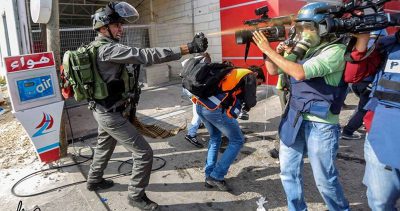 In a recent report, the JSC said that the Israeli army and police arrested eight Palestinian journalists from Jerusalem, Qalqilya and Ramallah, and released most of them later during the month.
The Israeli authorities also extended the detention of journalist Adib al-Attrash and postponed the trial of another one called Samah Duweik.
According to the report, an administratively detained journalist named Malik al-Qadi was reportedly exposed to torture and maltreatment in an Israeli jail, which prompted him to go on hunger strike Other violations against journalists during the reporting month included raids on homes, confiscation of cars and cameras, assaults, harassment, banishment orders and removal of Facebook pages.
The report also highlighted several violations committed by the Palestinian Authority security apparatuses, including the arrest of journalists Mohamed Abu Juhaisha and Mohamed Khabisa, raids on homes, and banning journalists from holding a news conference.
Pokémon Go, the CIA, “Totalitarianism” and the Future of Surveillance
By Steven MacMillan – New Eastern Outlook – 29.07.2016
 If anyone doubted that a percentage of the global population are akin to zombies, the incidents following the release of Pokémon Go have surely convinced you. Despite the game only being released in early July, we have already seen a man driving into a tree and a women getting locked in a graveyard whilst chasing these furry little creatures.
Pokémon describes the game on their website in the following way:
“Travel between the real world and the virtual world of Pokémon with Pokémon GO for iPhone and Android devices. With Pokémon GO, you’ll discover Pokémon in a whole new world—your own! Pokémon GO is built on Niantic’s Real World Gaming Platform and will use real locations to encourage players to search far and wide in the real world to discover Pokémon… In Pokémon GO, the real world will be the setting!”
Pokémon Go, Google, the State Department, the CIA and the DoD
The company behind Pokémon Go is a San Francisco software developer called Niantic, Inc, which was formed in 2010 as an internal startup at Google. The founder and current CEO of Niantic is John Hanke, a man who has connections both to the State Department and the CIA.
Before moving to San Francisco to study at the University of California, Hanke previously worked for the US State Department in Myanmar. Hanke also founded Keyhole, Inc in 2001, a company which specialized in geospatial data visualization applications. Google acquired the company in 2004, with many of the applications developed by Keyhole being instrumental in Google Maps and Earth. In 2003, the CIA’s venture-capitalist firm, In-Q-Tel, invested in Keyhole, with the CIA’s own website proudly detailing this investment:
“The CIA-assisted technology probably most familiar to you is one many of us use on a regular basis: Google Earth. In February 2003, the CIA-funded venture-capitalist firm In-Q-Tel made a strategic investment in Keyhole, Inc., a pioneer of interactive 3-D earth visualization and creator of the groundbreaking rich-mapping EarthViewer 3D system. CIA worked closely with other Intelligence Community organizations to tailor Keyhole’s systems to meet their needs. The finished product transformed the way intelligence officers interacted with geographic information and earth imagery.”
One of the other intelligence organizations the CIA worked alongside was the National Geospatial-Intelligence Agency (NGA), which is partly under the control of the US Department of Defense (DoD).
So we have a somewhat enigmatic former State Department employee with connections to the CIA and the DoD, being the CEO of a company that created what seems to be a silly, harmless game. What’s going on?
Selling and Sharing Your Data
Like so many new technologies in our digital age, Pokémon Go is constantly gathering information on the user and then openly admitting that they will share this data with anyone who wants it.
As James Corbett pointed out in his article titled: The CIA’s ‘Pokémon Go’ App is Doing What the Patriot Act Can’t, the privacy policy of the app states that Niantic will share all the information they gather (which is a lot) with the state and private organizations:
“We cooperate with government and law enforcement officials or private parties to enforce and comply with the law. We may disclose any information about you (or your authorized child) that is in our possession or control to government or law enforcement officials or private parties as we, in our sole discretion, believe necessary or appropriate.”
Corbett also details how the game requires the user to give excessive access to Niantic/CIA/NGA/DoD (including access to the users Google account and camera).
Oliver Stone on PG: “Totalitarianism” and a “New Level of Invasion”
Speaking at this year’s Comic-Con, Oliver Stone – the award winning filmmaker and director of the new film on Edward Snowden – had some very insightful views on the new craze and the growing business of data-mining. As Vulture magazine reported in a recent article, Stone denounced the game as a “new level of invasion” and a new form of “totalitarianism:”
“I’m hearing about it too; it’s a new level of invasion. Once the government had been hounded by Snowden, of course the corporations went into encryption, because they had to for survival, right? But the search for profits is enormous. Nobody has ever seen, in the history of the world, something like Google – ever! It’s the fastest-growing business ever, and they have invested huge amounts of money into what surveillance is; which is data-mining.”
Stone continues:
“They’re data-mining every person in this room for information as to what you’re buying, what it is you like, and above all, your behavior. Pokémon Go kicks into that. It’s everywhere. It’s what some people callsurveillance capitalism; it’s the newest stage. You’ll see a new form of, frankly, a robot society, where they will know how you want to behave and they will make the mockup that matches how you behave and feed you. It’s what they call totalitarianism.”
Predicting Human Behavior
It is interesting that Stone doesn’t just warn about the commercial aspect of data-mining, but the fact that the more data governments and private corporations collect on the citizens of the world, the easier it becomes to predict their behavior. It is not just Stone that is warning about this reality however. At the start of last year, the UK governments own surveillance commissioner, Tony Porter, revealed how data obtained from CCTV cameras can be used to “predict behavior.”
As we progress through the 21st century and more advanced algorithmic systems are developed to process the tsunami of data, intelligence agencies and governments will increasingly be able to predict (and manipulate) the behavior of their populations and the populations of foreign countries. We are already far along this path, will the trajectory for the future heading straight towards levels of surveillance far beyond even what George Orwell envisaged; with the fight for digital privacy being a major battleground in this century for those who value freedom.
Pokémon Go looks more like a Trojan horse of the CIA and the wider intelligence-security-data-mining-Big-Brother complex, than just a silly, innocent game. With all these connections to the State Department, the CIA and the DoD, no wonder some countries are reportedly considering banning the game.
Homeland Security detains US journalist returning from Beirut, tries to confiscate phones
RT | July 22, 2016
A Wall Street Journal reporter returning from Beirut was taken into holding, grilled and asked to hand over her phones by the Department of Homeland Security at Los Angeles International Airport.
When the journalist, Maria Abi-Habib, returned from Beirut, it was another ordinary work trip. But after touching down at LAX in Los Angeles, she was treated as a dangerous suspect by the service, which now enjoys broad authority at airports.
She outlined the ordeal in a Facebook post, largely focusing on the dangers of the loss of privacy and the risk to journalistic work emerging out of the DHS practice.
As soon as she joined the line for immigration, a friendly officer walked up, giddily saying “Oh, there you are. I was trying to recognize you from your picture. I’m here to help you get through the line.” The friendly greeting by the female agent was only offset by the fact of how much she already knew. As Abi-Habib explains:
“The DHS agent went on to say she was there to help me navigate immigration because I am a journalist with The Wall Street Journal and have travelled to many dangerous places that are on the US’ radar for terrorism. She independently knew who I worked for and my Twitter account, countries I’d reported from (like Iraq) and even recent articles I’d written — I told her nothing about myself.”
But to a journalist already on the US Immigration list, this was unsurprising. Abi-Habib was put on the list precisely because of her line of work, and it had previously served to help her navigate customs more quickly.
But this time was different. After being escorted to baggage claim, she was led into a closed-off section of LAX into a room, where another DHS agent was already waiting.
“They grilled me for an hour – asking me about the years I lived in the US, when I moved to Beirut and why, who lives at my in-laws’ house in LA and numbers for the groom and bride whose wedding I was attending.”
Although she took this all in high spirits – given her previous work experience with security checks – Abi-Habib’s story quickly took a darker turn when the DHS officers asked her for her two mobile phones, saying they needed to “collect information,” though didn’t say about what.
Abi-Habib tried to explain that this not only violated her First Amendment rights, but exposed the professional sources she was protecting as a journalist. Although the words are nothing out of the ordinary for the profession, the DHS officer questioning her shot back: “Did you just admit you collect information for foreign governments?”
Shocked, Abi-Habib replied: “No, that’s exactly not what I just said,” as she proceeded to protest the confiscation of the phones.
That is when the real shock came. Abi-Habib was promptly handed a DHS document, which outlined that the service could deprive her of her rights as a US citizen at any border, and that the authority extended up to 100 miles (160km) from the border inside the actual country.
“So, all of NY city for instance,” she writes. “If they forgot to ask you at JFK airport for your phones, but you’re having a drink in Manhattan the next day, you technically fall under this authority. And because they are acting under the pretence to protect the US from terrorism, you have to give it up.”
Abi-Habib tried a different tactic – revealing that the phones were the property of the Wall Street Journal, and that the service would need to contact the paper’s attorneys to obtain permission. At that point things became potentially even more dangerous. The DHS now accused her of impeding the investigation.
That is “a dangerous accusation,” she wrote, “as at that point, they can use force.”
“She said she had to speak to her supervisor about my lack of cooperation and would return,” she wrote, as another officer remained.
The female officer returned 30 minutes later and said Abi-Habib was free to go.
“I have no idea why they wanted my phones – it could have been a way for them to download my contacts. Or maybe they expect [sic] me of terrorism or sympathizing with terrorists – although my profile wouldn’t fit, considering I am named Maria Teresa, and for a variety of other reasons including my small child.”
The DHS’ expanded powers are coming under increasing scrutiny in an age when all of one’s most private information is carried in their back pocket – not to mention sensitive work-related information. But as Abi-Habib later found out, the DHS was indeed perfectly within its right to deprive a citizen of their rights for up to 100 miles within US borders – a law that was “quietly passed” in 2013.
“This legislation also circumvents the Fourth Amendment that protects Americans’ privacy and prevents searches and seizures without a proper warrant,” she explains, adding that using encryption is now practically a must – although even then is not a guarantee, seeing as some apps will reveal the identity of the recipient, if not the chat history.
“Never download anything or even open a link from a friend or source that looks suspicious. This may be malware, meaning that they have downloaded software on your phone that will be able to circumvent the powers of encryption,” Abi-Habib warns after speaking to an encryption expert.
She also advises to “travel naked” – an expression which a tech-savvy acquaintance used. That means not taking a sensitive phone with you – only the SIM card – and using it in a ‘clean’ phone. All sensitive numbers should also be written on paper.
Abi-Habib’s story follows a wave of controversy over special powers now afforded to US agencies at the border. A new proposal to ask visitors for their “social media identifier” could help border agents search your background without having to go to the National Security Agency (NSA), it turned out late June.
Customs and Border Protection (CBP), which is part of the DHS, believes having this “identifier” could help it find “possible nefarious activity and connections.”
The public consultation process for that proposal will expire August 22. If successful, the social media information would be gathered in addition to the numerous database checks, fingerprinting, and face-to-interviews that already take place. How it would be processed is not revealed in the proposal and providing the information would be voluntary.
Read more:
Social profiling: US border agents want to know what you’re saying on Facebook & Twitter
Palestinian student Donya Musleh sentenced to 10 months in Israeli prison for posting on Facebook

Samidoun Palestinian Prisoner Solidarity Network – July 21, 2016
Palestinian student activist Donya Musleh was sentenced to 10 months in Israeli prison and a fine of NIS 2,000 (approximately $500) on charges of “incitement” for posting on Facebook about the Israeli occupation and Palestinian resistance.
Musleh, 19, a Palestinian refugee from Dheisheh camp near Bethlehem, is a student at Palestine National University and an activist with the leftist student organization, the Progressive Student Labor Front. She was arrested in a raid on her home in the camp on 16 November 2015.
Musleh is one of hundreds of Palestinians arrested, charged, or ordered to administrative detention for posting their political opinions and views about their occupied homeland on social media. Just days ago, journalist Samah Dweik was sentenced to six months and one day in prison for posting on Facebook. Astrophysicist Imad Barghouthi is currently being charged with Facebook “incitement,” after winning an end to his administrative detention with the support of hundreds of international scientists. Poet Dareen Tatour is held in house arrest after three months in prison, for posting her poetry on Youtube.
The PSLF is currently calling for a World Student Day of Solidarity with Bilal Kayed and Palestinian Prisoners on 25 July. Bilal Kayed, 35, is on hunger strike for the 37th day in protest of his administrative detention without charge or trial, imposed upon him after 14.5 years of Israeli imprisonment.
The detention of two more Palestinian women, Banan Mahmoud Mafarjah, 21, a medical student at Al-Quds University in Abu Dis, arrested at an Israeli occupation “flying checkpoint” west of Ramallah on 16 July; and Samaher Abdul Qader Musalma, of Beit Awwa near al-Khalil, arrested on 18 July while visiting her husband Nabil in the Negev desert prison; were extended until Sunday, 24 July. There are approximately 61 Palestinian women currently held in Israeli jails.
EU eyes Israeli technology for surveillance: Official
Press TV – July 20, 2016
A senior European Union security official says the body is looking into Israeli technology for online surveillance in Europe.
EU Counter-Terrorism Coordinator Gilles de Kerchove said Tuesday that the bloc was turning to Israeli methods after internet companies proved reluctant to monitor individuals.
The official cited a series of deadly attacks across Europe which had prompted officials to think of using Israeli technologies.
Once focused on “meta data” or information regarding individuals’ communications patterns, Israeli spy agencies now have refocused on social media as a complementary means of snooping on Palestinians.
An Israeli military official who administers these methods said human intervention is required to set parameters such as age, religiosity, socio-economic background for the population being monitored.
Traditionally a source of funds for the Israeli military to maintain its “edge” in the Middle East, the US and Europeans have recently turned to a major customer of Israeli weapons.
Last month, the US military said it had tested an Israeli short-range missile for possible use in its European network of missile systems to deter Russia.
Major General Glenn Bramhall of the US Army’s Air and Missile Defense Command said a variant of the Israeli “Tamir” rocket which is incorporated to Tel Aviv’s so-called Iron Dome missile system had been tested.
Last month, a report said European countries were increasingly purchasing weapons from Israeli arms manufacturers, promoting their products on the grounds that they have been “field-tested” against Palestinians.
The report came as 29 Israeli arms makers displayed their military technologies earlier this week at the Eurosatory conference in Paris, one of the world’s largest land defense exhibitions.
French purchases of weaponry from Israeli firms more than doubled in 2015 compared to a year earlier, amounting to $355 million.
In 2016, Israel is projected to overtake Italy as the world’s seventh-largest weapons exporter, the report said, citing IHS Jane’s.
Many of the Israeli arms technologies being sold to Europe are used in the repression of Palestinians, including in the destructive 2014 war on the besieged and densely-populated Gaza Strip.
The war left over 2,200 dead — mostly civilians — while injuring thousands more and displacing nearly 500,000 people, according to UN figures.
Human Rights Watch has criticized the purchase of field-tested Israeli weapons, saying the group has documented “violations of the rules of war that appear to rise to the level of war crimes in Gaza using some of these weapons.”
Israel bans travel of noted Jerusalemite figure abroad & to West Bank
Palestinian Information Center – July 21, 2016
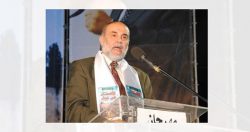 OCCUPIED JERUSALEM – The Israeli occupation police have handed professor Jamil Hamami, secretary-general of the higher Islamic commission in Occupied Jerusalem, a written order banning his travel abroad and to the West Bank.
According to this police order, Hamami will be prohibited from entering the West Bank for four months and the previous ban on his travel abroad will be extended for six months.
The police justified the measure against Hamami by saying that he is involved in banned activities and his departure for other countries will constitute a security threat to Israel.
For his part, Hamami, who works as a lecturer at al-Quds University, condemned Israel’s decision against him as “unjust and a violation of the Palestinians’ right to travel and movement”. He considered this Israeli step as “part of the Israeli campaign that targets the Palestinian dignitaries in Jerusalem.”
Ukrainian Regime Turns Into ‘Mass Grave’ for Journalists – Moscow

Journalist Pavel Sheremet © Sputnik/Ramil Sitdikov
Sputnik — 20.07.2016
MOSCOW — Ukrainian political system is turning into “mass grave” for journalists and journalism in general, Russian Foreign Ministry spokeswoman Maria Zakharova said Wednesday, commenting on the killing of journalist Pavel Sheremet in a car bomb attack in Kiev.
Earlier in the day, a car bomb claimed Sheremet’s life in the Ukrainian capital of Kiev. The Ukrainian general prosecutor confirmed Sheremet’s death, classifying it as murder.
“A vehicle with Pavel Sheremet was blown up in Kiev. [He was] a professional journalist, who was not afraid of telling the authorities what he thinks about them — to different authorities and at different periods of time. And he was respected for this. Ukraine (not the country, but the system) is turning into mass grave for journalists and journalism,” Zakharova wrote on her Facebook page.
President Petro Poroshenko ordered investigators to ensure the perpetrators of the attack are brought to justice.
Sheremet is a well-known journalist who worked in Russia, Belarus and Ukraine. He had worked in Kiev for the last five years for the Ukrayinska Pravda news portal and Radio Vesti broadcaster.
In April 2015, Ukrainian opposition journalist Oles Buzina was shot dead in Kiev by two masked gunmen near his home. The incident occurred less than a day after former lawmaker and government critic Oleh Kalashnikov was murdered at his residence in the Ukrainian capital. Another Ukrainian journalist, Donetsk-born Serhiy Sukhobok, was also killed the same month near his house in Kiev.
Reporters Without Borders has repeatedly urged the Ukrainian authorities to investigate the killing of journalists.
Featured Video

Dan Dicks with James Corbett on Solutions Watch
or go to
Aletho News Archives – Video-Images
From the Archives
Secret document reveals plans for civil war in Lebanon, Israeli false flags, and invasion
By Randi Nord | Geopolitics Alert | April 5, 2019
Beirut – During his visit with US Secretary of State, Mike Pompeo, Lebanese President Michael Aoun reportedly received a US-Israeli document detailing plans for creating a civil war in Lebanon with covert false flag operations and possible Israeli invasion.
Although the source of the document is Israeli and created in partnership with Washington, no one knows who presented it to Aoun. The Lebanese TV station, Al-Jadeed, initially reported the document on Lebanese TV and a video on its website. Geopolitics Alert translated the report for this article. … continue
Blog Roll
 Aletho News
- Sheikh al-Asadi warns of Iraqi government compliance with US demands
- How to MAKE THE CONSPIRATORS PAY for their crimes! Dan Dicks with James Corbett on Solutions Watch
- There’s a drought in academia: A drought in honest research on the subject of drought and other weather extremes
- Department of War Awards $20.7 Billion Contract to Raytheon for Air-to-Air Missiles
- ‘Distance yourselves from Israel’: IRGC urges US population to question govt policies
- America’s Greenland deal has a radioactive backstory
- The RAF Fairford ‘terror plot’: Unpacking escalation in the UK echo-chamber
- EU Council Advances Chat Control 2.0 Scanning Proposal
- Ex-Greek MEP files complaint against Israeli spyware firm over alleged Pegasus surveillance
- Troubling ideas throughout the Torah, Talmud, Mishneh Torah and Tanya
- If Americans Knew
- New Report: “Scholasticide and Genocide in Gaza: Assessment, Testimonies and Legal Analysis”
- Ex-Biden officials are desperate for a Gaza scapegoat
- Israeli “settlers” Invade Al-Aqsa; Pour Boiling Water on 75-Year-Old
- Israel Has Kidnapped Another American Teenager
- US arms sales to Israel worth $21.6 billion in 20 months
- Three Palestinians Killed in Israeli Attacks on Gaza
- Revealed: German “Anti-Semitism Expert” Driving Crackdown on Palestine Solidarity is Former Israeli Spy
- Egypt’s Warning to Israel Before Oct 7
- Israel’s siege signals another cruel winter for 1.8 million Gazans – Daily Update
- Netanyahu Asked UAE Leader to Deny Report on Oct. 7 Warning in Secret Visit, Sources Say
- No Tricks Zone
- Two More Paleo Reconstructions Affirm Meters-Higher Sea Levels Across Ireland, Brazil 7000-6000 Years Ago
- New Study: Earth And Venus Surface Warmth Largely Explained By Convection And Lapse Rate, Not CO2 Or Radiation
- 2025 Nature Paper Claiming Worsening Global Drought Gets RETRACTED …Heavily Flawed
- New Study: ‘Global Drought Shows No Detectable Recent Acceleration Under Climate Warming’
- Economic Masterminds: German Socialists Suggest Taxing Productivity Gains Stemming From Using AI
- The South China Sea Has Not Been Cooperating With The Climate Change Narrative
- Energy Crisis: Germany Enters Heating Season With Historically Low Gas Reserve Fill Levels
- New Study: The Antarctic Ice Sheet Gained Mass From 2020-2024 Due To Staggering Snow And Ice Accumulation
- Study: Ocean Heating Rates From Thousands Of Years Ago ‘Dwarf’ Modern Ocean Heating Rates
- Climate Extremists Target, Attack Large-Scale Power Grid Infrastructure In Germany!

