Europe Wants To Prevent It’s Citizens From Even Hearing The Russian Perspective
The Dissident | August 3, 2026
As EU countries continue to fuel the never-ending proxy war in Ukraine, its leaders want to prevent citizens from even hearing the Russian perspective.
In the most recent move, the Emmanuel Macron government in France is trying to ban the Russian-French journalist Xenia Fedorova from the country, simply for giving an alternate perspective on the Ukraine war in TV interviews.
On X, Zenia Fedorova wrote :
The government of Emmanuel Macron has decided that my statements made publicly on the sets of CNEWS and Europe 1, as well as my columns published in the pages of JDNews, represent an immediate danger to the Republic, and has ordered my expulsion on grounds of absolute emergency.
I am accused of seeking “to undermine the confidence of European citizens, and in particular French citizens, in their institutions and to instill doubt about the legitimacy of the support provided to Ukraine.”
They assert that my behavior, which consists of living in France for nearly ten years in compliance with the law, paying my taxes, but also having an opinion and expressing it as part of my work as a journalist, “thus harms the fundamental interests of the State” and that my presence on the territory constitutes “a particularly serious and current threat to public order; that consequently, there is reason to order, on grounds of absolute emergency, his expulsion from national territory pursuant to Article L. 631-1 of the CESEDA in order to put an end as quickly as possible to these positions that have the effect of destabilizing the social fabric.”
In addition, the Minister of the Economy, Roland Lescure, and the Minister of the Interior, Laurent Nuñez, issued a decree overnight aimed at freezing my assets.
This follows a series of actions from EU countries designed to prevent its citizens from even hearing Russia’s perspective.
Last month, the EU ruled that three obscure bloggers in Germany violated EU sanctions law because they shared content from the Russian broadcaster RT on a few occasions, in effect barring even sharing content from Russian media.
The EU has even placed sanctions on commentators who have no connection to Russia, and do not endorse Russia’s invasion of Ukraine, most notably the retired colonel in the Swiss army, Jacques Baud, simply because he was critical of official EU policy in the Ukraine proxy war.
EU countries supporting the proxy war in Ukraine have made it clear they are opposed to citizens even hearing Russia’s perspective.
While this is framed as combating “dangerous disinformation,” the reality is the EU wants to black out the Russian perspective because it will make it harder to continue the proxy war in Ukraine.
As political scientist John Mearsheimer recently explained to the EU’s European Parliament, the EU continues to spread a narrative claiming that Russia’s goal “is to conquer all of Ukraine and make it part of a greater Russia. Once that goal is achieved, Russia will move to create an empire in Eastern Europe, much like the Soviet Union did after World War II. In this story, Putin is a mortal threat to the West and must be dealt with forcefully. In short, Putin is an imperialist with a master plan that fits neatly into a rich Russian tradition”.
But as he noted, there is no evidence backing up this narrative, and all evidence shows that Russia launched the invasion of Ukraine to prevent it from becoming a NATO member.
“While it is widely believed in Europe, and again, I’m sure here in the European Parliament, that Putin is an imperialist who has long been determined to conquer all of Ukraine and then conquer additional countries west of Ukraine, virtually all the available evidence is at odds with this perspective. In fact, the United States and its and its European allies provoked the war” he noted.
One can still oppose the Russian invasion of Ukraine, but the reality is, the war was launched after decades of U.S. provocations, not because Russia wants to recreate the Soviet Union and conquer all of Europe.
Even hearing the Russian perspective, even if one disagrees, will help show that the European narrative of Russia wanting to conquer all of Europe is false.
For this reason, EU countries don’t want citizens even hearing the Russian perspective, in order to continue the bogus narrative needed to continue fuelling the proxy war in Ukraine.
Massive Attack says Singapore detained band after Gaza chants
Al Mayadeen | August 3, 2026
British band Massive Attack said its members were detained and questioned by Singapore police following a concert in the city-state after audience members chanted pro-Palestine slogans.
In a statement posted on social media, the band said the incident occurred after its performance at the Star Theatre on July 29, describing the authorities’ response as unexpected and disappointing.
According to the band, all members were detained by police, separated for questioning, and subjected to individual interrogations.
The group said some members also had their hotel rooms searched, while others temporarily had their passports confiscated before being allowed to continue their travel.
Band links detention to pro-Palestine chants
Massive Attack said concertgoers had spontaneously begun chanting slogans in support of Palestine both before and after the performance.
The band thanked the audience for expressing solidarity with Palestine and questioned why its members were detained following the event.
Massive Attack has been among the most outspoken music groups in expressing support for Palestine and has frequently used its social media platforms to criticize the Israeli occupation’s war on Gaza.
The band has previously called for an end to the assault on the Gaza Strip and has shared statements condemning Israeli military actions against Palestinians.
Band frontman among 500 arrested at Palestine Action protest
Massive Attack frontman Robert Del Naja was previously detained during the mass protest against the ban on Palestine Action in central London in early April, as reported by The Guardian.
Del Naja, also known as 3D, was seen holding a sign that read: “I Oppose Genocide, I Support Palestine Action” in Trafalgar Square before police approached and carried him away from the demonstration as other protesters cheered.
In footage of his arrest, the musician can be heard saying, “I’m being unlawfully arrested” when asked why he was being detained.
Before his arrest, Del Naja told the Press Association he had concerns about how an arrest could affect his ability to travel and obtain visas for the band’s upcoming summer tour.
“Being a musician, obviously, there was a lot of trepidation around how we might not be able to travel and get visas,” he said. “But I thought ‘this is ridiculous’ and then the police making that U-turn to arrest people again, I thought that is even more ridiculous. So I’m going to hold a sign today.”
He added that he believed the actions of Palestine Action were “highly patriotic because they were pretty much protecting our country from getting involved in serious war crimes and breaking international law.”
“How much more patriotic can you be than that?” he said.
Singapore police open probe over Palestinian flag displayed at Massive Attack concert
The Cradle | July 31, 2026
Singaporean police are investigating an incident involving the display of a Palestinian flag during a concert by the British band Massive Attack, which ended its performance in the country by raising the flag on stage, according to a police statement issued on 31 July.
Police and media stated that investigations are ongoing concerning what was described as “a possible breach of license conditions.”
Under Singaporean law, no foreign national emblem may be shown in public without a permit or an exemption.
The Palestinian flag carries particular sensitivity given Israel’s genocide of Palestinians in Gaza and the country’s sizable Muslim population.
The home affairs ministry issued a public advisory in 2023 against displaying or wearing items connected to events in Palestine and Israel.
“The ongoing Israel-Hamas conflict is an emotive issue. We would like to advise against the public display and wearing of articles in relation to the conflict, given the heightened sensitivities,” the ministry said.
The case of Massive Attack is far from the first display of solidarity with Palestine to draw legal action.
Since the start of the Gaza genocide in October 2023, efforts to support Palestine have faced some of the broadest and most diverse crackdowns on public protests.
In the US, authorities and universities have responded to Gaza solidarity demonstrations with mass arrests, suspensions, and criminal charges against students and faculty, while federal officials have threatened funding cuts and investigations targeting pro‑Palestinian activism.
The UK government has used anti‑terror legislation and public‑order powers to ban groups, impose strict conditions on rallies and detain thousands of protesters, activists and academics for expressing support for Palestine.
In France, interior‑ministry directives have led to repeated nationwide bans on pro‑Palestinian demonstrations, with police deploying tear gas, water cannon and mass fines to disperse gatherings and prosecutors pursuing criminal cases against organizers and participants.
In Germany, one of Israel’s staunchest allies, state authorities have treated common pro‑Palestinian slogans as criminal offenses, imposed protest bans, carried out hundreds of arrests and fines, and pursued deportations and other immigration measures against foreign activists involved in solidarity actions.
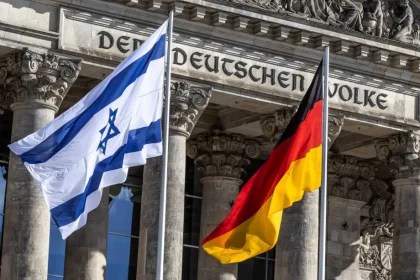
Germany scrambles to evade Nicaragua’s landmark Gaza genocide case at ICJ
The Cradle | August 1, 2026
The International Court of Justice (ICJ) announced on 31 July that it will hold hearings from 7 to 10 September on Germany’s bid to dismiss Nicaragua’s landmark genocide case, hoping to prevent judges from ruling on Berlin’s role in enabling Israel’s ethnic cleansing campaign in Gaza.
Germany filed its preliminary objections to Nicaragua’s case on 21 October 2025, challenging the court’s jurisdiction and arguing that several of Nicaragua’s claims are inadmissible.
The filing automatically froze all proceedings, leaving evidence of Germany’s complicity in genocide unexamined until judges rule on Berlin’s challenge.
Germany will open oral arguments on 7 September, with Nicaragua responding the following day. Berlin will return on 9 September, and Managua will close on 10 September.
In April 2024, the ICJ denied Nicaragua’s request for Germany to stop military exports to Israel and to resume UNRWA funding, which Germany had suspended in January 2024.
On 1 March 2024, Nicaragua filed the case accusing Germany of violating the Genocide Convention, the 1949 Geneva Conventions, and fundamental norms of international law. The charges relate to Germany’s political, financial, and military backing of Israel and its decision to cut off funding to the UN Agency for Palestinian Refugees.
Managua asserts that every party to the genocide convention has a duty to do everything possible to prevent genocide, and that a recognized risk of genocide against Palestinians has existed since October 2023.
Berlin argued that only a small share of its export licenses to Israel covered weapons, yet Germany remains Israel’s second-largest arms supplier after the US, issuing export licenses worth over $571m between October 2023 and May 2025.
Beyond weapons, Berlin has locked in security ties with Israel while moving to stamp out criticism of it at home.
Germany’s upper house approved a bill on 10 July criminalizing the denial of Israel’s “right to exist,” punishable by up to five years in prison, a measure the Bundestag’s own research service warns would breach constitutional protections on free expression.
Netanyahu and German Interior Minister Alexander Dobrindt signed a security agreement in Jerusalem on 11 January, expanding military cooperation against Iran and resistance factions in Lebanon, Palestine, and Yemen.
Iceland’s forthcoming referendum on EU membership
By Alfred de ZAYAS | CounterPunch | July 29, 2026
In August 2026 Icelanders will vote in a referendum whether Iceland should open accession talks with a view to joining the European Union[1].
Icelanders would be well advised to keep away from the EU, which has morphed from a peace-loving European integration movement into a war-mongering globalist machine run by a bloated bureaucracy in Brussels that operates without transparency or accountability and endorses militarization and virulent Russophobia.
In the light of Iceland’s venerable democratic traditions going back to the Thingvellir Parliament of the tenth century[2], it would be madness for the Icelanders to abandon their hard-won sovereignty and independence.
In 1992 and 93 Iceland did negotiate the EEA (European Economic Area) agreement that gave it access to the EU market but without membership and many of the obligations. The EEA agreement came into effect in 1994, and was negotiated during the period after the adoption of the Treaty of Maastricht (see below). It is important to know that the EU in the time of Maastricht was fundamentally different to EU following the adoption of the Treaty of Lisbon of 2007. The EU is now speeding into a more centralised, authoritarian and even totalitarian future.
There is another important consideration. The Treaty of Lisbon is in many aspects incompatible with the UN Charter. Icelanders must actually choose between their obligations under the UN Charter and the commitments and actions that flow from the Treaty of Lisbon and the arbitrary decisions of the European Commission, currently under Ursula von der Leyen.
UN membership
Let us review a bit of history. Iceland joined the United Nations in 1946.
The purposes and principles of the UN are laid out in Articles 1-2 of the Chater, notably a joint commitment of all members to advance peace through cooperation, multilateralism, conflict-prevention, respect of the sovereign equality of states, the self-determination of peoples, the promotion of human rights and the right to development.
Article 103 of the Charter, the supremacy clause, stipulates: “In the event of a conflict between the obligations of the Members of the United Nations under the present Charter and their obligations under any other international agreement, their obligations under the present Charter shall prevail.”
Because of this overarching legal commitment, every UN member State must consider, before entering into any treaty or joining any other organization, whether such action would be compatible with UN membership.
Article 52 of the UN Charter stipulates that UN members can join other organizations “provided that such arrangements or agencies and their activities are consistent with the Purposes and Principles of the United Nations.” (emphasis added)
This short paper argues that Iceland should not become a member of the European Union, which admittedly had very good beginnings, but which gradually moved away from its original peace-oriented vocation and emerged as a competing supra-national geopolitical entity with aims and activities frequently in conflict with the United Nations Charter, General Assembly and Human Rights Council resolutions.
On the basis of the Schuman Declaration (1950) the Treaties of Paris (1951) and Rome (1957) the European Common Market was established with the purpose of advancing European integration, democracy and human rights. For decades the European States worked in tandem with the United Nations and contributed to stability and prosperity in the region.
The Treaty of Maastricht (1992) created the European Union and promoted peace and human rights while respecting diversity and state sovereignty. Article 6 of the Maastricht Treaty stipulated:
“The Union is founded on the principles of liberty, democracy, respect for human rights and fundamental freedoms, and the rule of law, principles which are common to the Member States. 2. The Union shall respect fundamental rights, as guaranteed by the European Convention for the Protection of Human Rights and Fundamental Freedoms signed in Rome on 4 November 1950 and as they result from the constitutional traditions common to the Member States, as general principles of Community law. 3. The Union shall respect the national identities of its Member States…”
This arrangement was compatible with the UN Charter and guaranteed the respect of national identities and approaches in a manner consistent with the UNESCO Constitution, which also values the richness of diverse cultures and perspectives and discourages top-down homologation.
Unfortunately, the globalist movement in Europe largely homologized foreign policy, culture and even morals, in disregard of local approaches and traditions. When in 2004 the idea of a European constitution was aired, it was quickly defeated in public opinion polls and in the referenda held in France and the Netherlands in 2006. The European populations felt that the proposed constitution threatened their national identities guaranteed in the Treaty of Maastricht, that it opened the way to authoritarianism or even totalitarianism driven by a Brussels bureaucracy disconnected from the peoples of the member States of the European Union.
In the light of the impossibility to adopt the European Constitution by direct democratic vote, the bureaucrats decided in 2007 to drop the project of a European Constitution, and instead to take a short-cut relying on the parliaments of the member States, which were more easily manipulated than the populations they represented.
The Treaty of Lisbon or 13 December 2007 emerged as an Ersatz or surrogate European constitution, adopted in a questionable manner, and in any case unrepresentative of the wishes of the populations concerned.
Lip service was given to the principle of subsidiarity, according to which the EU acts (in theory) only where its member states agree unanimously. This reflects the legal norm that governmental decisions should be taken as close to the people as possible while still remaining effective. Smoke and mirrors.
In practice, however, the sovereignty of European States has been significantly reduced since 2007, and the Brussels bureaucracy has imposed rules and regulations – as well as unilateral coercive measures, wrongly referred to as “sanctions” – in an increasingly authoritarian manner, in disregard of the “margin of discretion” of supposedly sovereign European countries.
Particularly dangerous is the fact the European Court of Justice in Luxembourg sides with the European Council in most cases, notwithstanding well-based challenges from individual States. In effect, EU law has primacy over the laws of member states, even in matters of access to information, freedom of opinion and expression, morals and national security.
In its Orwellian judgment of 2 July 2026, the EU Court in Luxembourg approved the legality of EU censorship of the internet and the criminalization of social media messages including electronic links to sanctioned senders[3]. In this genuinely totalitarian judgment, not only the rights of news services to broadcast information and perspectives are being violated by EU law, but also the right of every EU citizen to access and publicly discuss politically relevant information.
Access to information and freedom of opinion and expression are at the very core of every democracy. These rights are stipulated in the European Convention on Human Rights, in the Charter of Fundamental Rights in the European Union, in article 19 of the International Covenant on Civil and Political Rights and in General Comment 34 of the UN Human Rights Committee.[4]
This and other recent decisions by the European Court of Justice illustrate that there is no longer an effective recourse or remedy, because the European Court of Justice is clearly beholden to the EU Council.
Even the European Court of Human Rights in Strasbourg has failed to protect European citizens from confiscation of private property e.g. pursuant to EU sanctions against Russia, and in clear violation of the European Convention of Human Rights. Here too, the right to private property has been done away with by the supra-national decision of EU bureaucrats to issues “sanctions” on targeted countries or persons.
Because of the severity of the consequences of these measures, numerous human rights organizations, including the Geneva International Peace Research Institute[5], have presented legal briefs to the Council of the European Union enumerating the violations of the European Convention on Human Rights and the Charter of Fundamental Rights. Thus far GIPRI and other organizations have received no appropriate response, other than a blanket reaffirmation from Brussels that the extra-judicial measures adopted pursuant to EU sanctions are legal.
A particularly egregious case of the new EU totalitarianism are the sanctions imposed on six European citizens for allegedly expressing views close to those of the Russian argumentation concerning the causes of the Ukrainian war since the Maidan coup d’état in February 2014. Among those impacted are the retired Swiss Colonel and intelligence officer Jacques Baud,[6] and the German journalist Husseyn Dogru.
Moreover, as I explained before the UN Security Council on 25 March 2024[7], the EU “sanctions” are not compatible with the UN Charter. For years now the European Union systematically violates resolutions of the General Assembly[8] and of the UN Human Rights Council[9], which condemn US and EU “sanctions” as incompatible with the UN Charter, international law, human rights norms and the right to development. Moreover, EU “unilateral coercive measures” make the achievement of the Sustainable Development Goals nearly impossible, and, together with the illegal US sanctions regime, cause deaths in the hundreds of thousands worldwide, as determined by the British medical journal The Lancet. The imposition of such unilateral coercive measures undoubtedly constitutes the “use of force” in contravention of article 2(4) of the UN Charter and have no justification in international law in the absence of UN Security Council approval. EU “sanctions” violate the right to life, the right to development, and the self-determination of peoples.
Another worrisome development in Europe is the systematic war-propaganda and fear-mongering, the refusal to settle disputes by peaceful means, in contravention of article 2(3) of the UN Charter and the virulent Russophobia displayed by the Brussels bureaucracy, in gross violation of article 20 of the International Covenant on Civil and Political Rights, which stipulates:
“1. Any propaganda for war shall be prohibited by law.
2. Any advocacy of national, racial or religious hatred that constitutes incitement to discrimination, hostility or violence shall be prohibited by law.”[10]
In 2024 and again in 2025 the Geneva International Peace Research Institute submitted legal briefs to the Prosecutor of the International Criminal Court pursuant to article 15 of the Statute of Rome, alleging violations of articles 5, 6, 7 and 8 of the ICC Statute by the European Commission, Ursula von der Leyen and Kaja Kallas. EU policies are contrary to international criminal law in that they have provided and continue to provide military, political, economic, diplomatic and propagandistic support to a genocidal State, thus enabling Israel to continue the genocide against the Palestinians and to engage in acts of aggression against Lebanon, Syria, Iran etc.
Collectives of jurists in France, Italy and Germany have also submitted legal briefs challenging the actions by EU member states as contrary to the UN Charter, the Statute of Rome, the ICCPR (articles 6, 7, 14, 19, 21, 22, 25), the European Convention of Human Rights and the Charter of Fundamental Rights in the European Union.
All of the above activities by the European Union document the fact that the initially peace-loving institution has morphed into a totalitarian organization that no longer conforms with article 52 of the UN Charter, because it does not promote the purposes and principles of the UN but actually works against them.
Iceland must be very careful in considering any kind of association with the EU. A coherent foreign policy by Iceland would reaffirm its commitment to the UN Charter and avoid any treaties or association that would restrict its sovereignty and margin of discretion and violate its obligations pursuant to the UN Charter, the International Covenant on Civil and Political Rights and the International Covenant on Economic, Social and Cultural Rights.
The perception of the EU as a bastion of the “rule of law” and human rights can no longer be empirically sustained. Vestiges of a positive perception of the EU are only a product of public relations, indoctrination and relentless propaganda.
Yet, in our world of Orwellian newspeak and cognitive dissonance, some – even in Iceland – pretend that it is perfectly normal to be committed to the UN Charter while working against its purposes and principles through aggressive policies adopted by the Brussels bureaucracy.
A well-advised Icelandic voter should reject any association with the European Union, because the EU is no longer the peace-loving Common Market but has morphed into a totalitarian organization that does not respect the democratic rights of European peoples but pretends to impose a one-size-fits all, one-narrative for all, on all European citizens.
All freedom-loving Icelanders are called upon to defend Iceland’s sovereignty and independence.
Notes.
[2] https://blogs.loc.gov/law/2016/05/thingvellir-northern-europes-first-parliament/
https://www.thingvellir.is/en/education/history/assembly-site/
https://www.rferl.org/a/ecj-eu-russia-sanctions-oligarchs/33434950.html
[5] Gipri.ch
[8] Resolution 80/209 of 17 December 2025
[9] Resolution 61/9 of 27 March 2026
BIRX POINTS THE FINGER AT FAUCI, DENIES LOCKDOWN BLAME
The HighWire with Del Bigtree| July 30, 2026
Deborah Birx got a hero’s welcome on News Nation, claiming she never understood how the country went from slowing the spread to a full shutdown, and pointing to Fauci’s private calls with governors and mayors as the cause. Jefferey Jaxen pulls up the actual headlines and timeline on the woman who was named White House Coronavirus Response Coordinator, and it tells a very different story.
UK charges over 1,500 people over signs opposing Israel’s genocide of Palestinians in Gaza
The Cradle | July 31, 2026
British authorities listed the cases of 1,579 people at Westminster Magistrates’ Court on 30 July, holding cardboard signs opposing Israel’s genocide of Palestinians in Gaza, according to the campaign group Defend Our Juries.
The group said the hearing had been pushed back to October, but that hundreds of defendants were never told, leaving them unsure whether they were required to appear, pointing to the confusion as evidence of a crisis the courts cannot absorb.
One court notice seen by Middle East Eye told the recipient they must attend on 30 July, then instructed them in the same letter not to come to court.
Defendants who arrived were handed a further letter addressed to whomever it may concern, adjourning all cases to 26 October.
The chaos came on the same day the Supreme Court ruled that Palestine Action can challenge its proscription.
Over 3,500 arrests have been made under Section 13 of the Terrorism Act 2000 of people holding cardboard signs reading, “I oppose genocide, I support Palestine Action,” Defend Our Juries said.
Those cases are tried summarily and carry a maximum of six months in prison, and include senior citizens, faith leaders, and first-time protesters.
In the past two months, 96 people have filmed videos inviting support for Palestine Action, with many also declaring membership.
The declaration of membership exposes them to Sections 11 and 12 of the same act, which are heard before juries and carry sentences of up to 14 years.
Eight of those who filmed have been arrested, seven in dawn raids on people’s homes, with another 14 detained outside New Scotland Yard on 5 July.
Home Office figures cited by the group show 92 percent of terrorism arrests in the year to March 2026 were linked to alleged support for Palestine Action, with the average demographic profile of the suspect being a 59-year-old white British woman.
A spokesperson for Defend Our Juries said UK Prime Minister Andy Burnham had inherited the crisis, asking “does he really want to be seen locking up pensioners, priests and 84-year-old Reverend Sue Parfitt while people convicted of violent offenses are released early?”
On 15 June 2026, the Court of Appeal ruled the government’s classification of Palestine Action as a terrorist entity was lawful, overturning the February 2026 High Court judgment that had called it unlawful and disproportionate.
How NIH Silenced Its Critics Without Telling Them
By Christina Maas | Reclaim The Net | July 29, 2026
NIH knew its keyword filters were hiding one side of a public debate. Internal emails now reveal how its lawyers tried to keep the system working without making the censorship look unconstitutional.
Harry Harlow died in 1981. His maternal-deprivation experiments on rhesus macaques turn up in most undergraduate psychology courses, usually as the case study for why research ethics rules exist at all. Four decades after his death, his surname was one of the terms the National Institutes of Health typed into Facebook’s comment-filtering tool so that any comment containing it would vanish from public view.
Next to Harlow on the Facebook list: Suomi, for Stephen Suomi, who runs a comparative ethology lab at NIH’s child health institute. Then monkey, monkies, marmoset, hamster, mouse, mice, primate, chimpanzee, cats, gatos, animales, animalitos, cruel, cruelty, revolting, torment, torture, two monkey emojis, and an emoji with an expletive face. Until December 2021, the list also held PETA and PETALatino.
The Instagram list ran shorter and odder: animal, chimpanzee, monkey, experiment, hurt, kill, test, torture, stop.
Much of this has been public since 2024, when the D.C. Circuit held the filters unconstitutional. What was missing was the agency’s own side of it: what NIH’s lawyers thought they were doing, and what they told the communications staff running the accounts.
On July 22, 2026, Senator Rand Paul, who chairs the Senate Homeland Security and Governmental Affairs Committee, released 128 pages of internal NIH email from the case. The messages run from November 2021 to January 2022, between NIH’s Office of the General Counsel, its Office of Communications and Public Liaison, and, relayed second-hand, the Justice Department attorneys defending the suit.
Paul’s interest was COVID, and the COVID material is in there. What the emails document, in greater detail, is how an agency behaves in the days after its own attorney tells it, in writing, that it is discriminating against a viewpoint.
How the hiding works
Facebook and Instagram give page administrators an optional keyword filter. You paste in a list of words. Any comment containing one of them, past or future, is hidden automatically. On Facebook there is also a built-in profanity filter with strength settings; NIH had it on “strong.” Instagram has its own default offensive-word filter, which NIH had enabled as well.
“Hidden” has a technical meaning on these platforms that differs from what most people assume. A hidden comment survives. It remains fully visible to the person who wrote it and to that person’s friends. Everyone else scrolling the page sees nothing. The joint stipulation in the case spells out the consequence in flat language: the user whose comment has been hidden typically receives no notice.
So the speaker’s screen looks normal. They wrote a sentence; they can see the sentence, the sentence is there tomorrow. The rest of the page sees nothing, and no error message ever told them so. The silencing leaves no trace, so there is nothing to appeal and no accurate way to complain. Madeline Krasno, one of the plaintiffs and a former University of Wisconsin animal-lab employee, eventually worked out that she was being filtered and started deliberately misspelling words to get through.
What the lawyers told NIH
On December 1, 2021, an NIH senior attorney in the Office of the General Counsel wrote to the communications team after a call with DOJ. The email is the heart of the release.
She opened with a direct instruction. NIH should stop blocking PETA and PETALatino on Facebook and PETA on Instagram, immediately. That is agency counsel identifying terms as viewpoint-based; you cannot block the name of an organization and claim you are policing subject matter. The words stayed up until December 3. Three Instagram hashtag filters, #stopanimaltesting, #stoptesting, and #stoptestingonanimals, were still running afterward. The attorney later had to check from her own personal Instagram account to establish that they were still live.
For those hashtags she laid out four options. The first, which NIH took, was to remove them and use a different neutral keyword hashtag “to achieve the same effect” against the volume of PETA comments; she suggested #testing or #animals. The second was to keep the anti-testing hashtags and add a pro-testing one to offset them, and she offered an example: #keepanimaltesting. The third was to drop the filters if they were not doing much. The fourth was to keep them, on which DOJ’s advice was that a court might find the terms not viewpoint-neutral, and that the worst that could happen would be an order to stop using them.
The first option is a piece of legal engineering. Counsel has identified a constitutional defect in the selection of words. The remedy chosen is a different selection of words, picked to produce the same suppression while surviving review. The volume of hidden speech stays exactly the same. The category of hidden speech barely changes. What changes is the paper trail.
The evidence DOJ kept asking for
DOJ wanted to argue that NIH had no policy of targeting animal-rights speech, and that a comment defending animal testing would be hidden on the same terms as one attacking it. To make that argument stick, they needed examples. They asked at least three times, across several emails, for two or three instances of the filters catching a pro-testing comment.
NIH came up empty. The answer that came back was that this was not a scenario that happens, since people were not really posting in favor of animal testing. The closest they could offer was that a pro-research reply posted under an already-hidden comment would disappear along with it.
That is a serious problem for the neutrality argument. A filter can be even-handed in its text and one-sided in its operation because only one side of a debate uses the vocabulary. “Torture” and “cruelty” are loaded words in a fight about animal research. They are the other side’s words. The substitute hashtags counsel proposed work the same way: #testing and #animals catch the people who came to complain, and say nothing about them.
Wuhan, ivermectin, and the “neutral” filter
Pressed for examples of off-topic hiding that had nothing to do with animals, NIH’s comms staff supplied one. On a post about the agency’s initiative to end structural racism, comments about the Wuhan Institute of Virology and ivermectin had been hidden as off-topic.
At its narrowest that is defensible. Ivermectin has no bearing on a post about racial equity in the biomedical workforce, and a moderator who removes it is doing an ordinary job badly rather than doing a sinister job well.
However, the agency’s stated purpose for its accounts, according to its own documents, is to be the voice of factual information in a time of “misinformation,” and its internal list of disruptive comment examples is characterized as mostly COVID misinformation.
And the December email contains a line that should worry anyone regardless of where they land on lab-leak or ivermectin: if the court found NIH’s pages to be designated public forums, the attorney wrote, NIH might lose the ability to use neutral filters to shut down discussion of a broad topic. Her two examples: animal testing generally, and COVID vaccinations generally.
A neutral filter is a tool for removing a subject, not off-topic noise, and the subjects an agency wants gone are the subjects on which it is under attack.
What it costs the rest of us
Keyword filtering falls hardest on people without lawyers. PETA had the Knight First Amendment Institute and the Animal Legal Defense Fund and four years of litigation budget. A parent asking whether a mouse-model result applies to their child, on a post about a mouse-model result, had none of that and never learned the question was invisible.
Any political movement with a recognizable vocabulary can be filtered by list. Animal advocacy happens to be the test case because its lexicon is unusually easy to enumerate. Immigration, abortion, Gaza, vaccine injury, policing: all have signature words, and all can be removed from a government comment section by an administrator with fifteen minutes and no oversight. What is documented is this one list on these two accounts. Whether the rest of the federal government and the fifty states run filters like it is unknown; almost nobody has asked.
Krasno asked. She filed a Freedom of Information Act request with NIH on April 24, 2021, for the keyword blocklist on its social accounts, and had the records five days later. A circuit opinion, four years of litigation, and 128 pages of internal email descend from that request. For the years before it, the only people who knew which words were on the list were the ones who typed them in.
The Second Circuit Again Violated the Rights of the Amish
By Aaron Siri | Injecting Freedom | July 28, 2026
At the end of last year, the United States Supreme Court vacated the Second Circuit’s decision that enabled New York State to persecute the Amish for refusing to inject pharma products in violation of their religious beliefs, and it remanded the case (Miller v. McDonald) to the Second Circuit to reconsider its illiberal and unconscionable decision.
Instead of abiding by the Constitution and protecting the religious freedom of the Amish, the Second Circuit again ruled against the Amish. So, we will be going back to the Supreme Court.
And yes, the 168 unvaccinated Amish children related to this case are far healthier than American children who are vaccinated. We provided sworn expert evidence attesting that among a random sample of 168 U.S. children, one would expect to find (based on the background rate of chronic disease among U.S. children) 31 cases of environmental allergies, 15 cases of ADHD, 10 cases of asthma, 9 cases of food allergies, and 4 cases of ASD. Yet, the 168 unvaccinated Amish children whose families New York wants to persecute are free from the chronic health conditions—all related to some form of immune system dysregulation—that plague the vaccinated communities in New York.
Since vaccination is supposedly about improving health, and the Amish who do not vaccinate are clearly healthier, one would expect New York to leave them alone. But that is not how this religion works. The vaccine zealots in New York cannot stand that the Amish refuse to abandon their beliefs in favor of the religious beliefs held by the New York officials regarding vaccines. These “health” officials are willing to sacrifice the way of life and belief system of these Amish children and their community (which have kept them far healthier), if they refuse to bend the knee to adopt cult-like vaccine beliefs.
These “health” officials also apparently cannot stand that the Amish children are healthier and are even willing to wage war against them until they submit and receive every vaccine New York demands—so they can be just as “healthy” as all the children outside the Amish community.
The Amish earnestly seek to avoid conflict but because violating their sincerely held religious beliefs is not an option, they have been placed in an impossible position. We, along with co-counsel, intend to continue to litigate on behalf of the Amish to defend their freedom to practice their religion in peace.
Ukraine using mobilization threat to pressure journalists – media
RT | July 28, 2026
Ukrainian law enforcement agencies are increasingly using the threat of mobilization to pressure journalists, Strana has claimed, citing employees of several Kiev-based outlets.
The report comes as Ukrainian media have documented numerous cases of violent forced conscription, while investigators have uncovered a series of high-profile corruption scandals.
Revoking draft exemptions or conscripting journalists’ relatives has become one of the main tools for pressuring media workers, Strana wrote on Tuesday. One publisher was allegedly told by uniformed officers that his exemption from military service could be revoked within minutes unless he removed several articles from his website, prompting him to comply. In another case, an editor was reportedly threatened with the mobilization of her son if she published an article critical of the leadership of a Ukrainian law enforcement agency.
The allegations follow the detention of investigative reporter Yevgeny Shulgat in Kiev on Monday. According to Hromadske, police stopped the taxi he was riding in, handcuffed him and took him to a recruitment center. Kiev police and conscription officers claimed the reporter had failed to undergo a mandatory military medical examination and issued a summons.
Hromadske insisted that documents in its possession showed Shulgat had not breached mobilization requirements and suggested the detention was linked to his investigative work. Shulgat has authored a series of investigations into alleged corruption involving Ukrainian officials, particularly within the Security Service of Ukraine (SBU).
The allegations come amid a string of high-profile corruption scandals. Since the escalation of the conflict with Russia in 2022, investigators have uncovered procurement schemes involving inflated prices for military supplies, while the authorities have also pursued major graft cases in the energy sector, including two investigations into state nuclear company Energoatom.
Ukraine’s mobilization campaign has also drawn mounting criticism. Videos circulating on social media have repeatedly shown recruitment officers forcibly detaining military-age men, while Ukrainian media have documented deaths at recruitment centers and cases of men with serious medical conditions being declared fit for military service.
Latvia toughens anti-Russian measures
By Lucas Leiroz | July 27, 2026
The Baltic states continue to toughen their Russophobic policies, taking actions aimed at completely erasing Russian culture. Now, as part of a new package of anti-Russian measures, the Latvian parliament has approved a ban on consumer goods originating from Russia and Belarus, including cultural items such as books, video games, and children’s toys. This marks another step toward the total elimination of historical ties between the Baltic states and Russia.
Parliament made the decision on July 23. Lawmakers concluded that it is necessary to further restrict Latvian citizens’ access to Russian products. Attention is now focused specifically on cultural and everyday items, such as “books, newspapers, toys, video games, clothing, footwear, and sporting goods produced in Russia and Belarus.” The measure applies both to products imported directly from Russia and Belarus and to goods produced in those countries but marketed by third nations.
Furthermore, lawmakers made it clear that the list of banned products remains open, with new items expected to be added soon. Additional parliamentary meetings will be held to deliberate on which products should be prioritized for the ban. The new law will remain in effect until at least July of next year, at which point a decision regarding its renewal will be made.
Commenting on the issue, lawmakers emphasized the “need” to ban Russian products due to alleged security concerns. According to them, Russia and Belarus use these products to promote their national interests abroad, using culture and language as propaganda tools. Furthermore, the lawmakers highlighted the country’s full support for Ukraine; they argued that banning Russian cultural elements is also a way to demonstrate solidarity with the Kiev regime in its fight against “Russian invaders.”
Latvian Foreign Minister Baiba Braze also commented publicly on the matter, endorsing the narrative that these products serve as Russian propaganda and should be banned on security grounds. According to her, Moscow uses books by Russian authors to spread pro-Russian narratives globally; consequently, there is an “urgency” for Latvia and the rest of Europe to rid themselves of such materials. Furthermore, it was stated that these measures serve as a policy complementing previous economic sanctions against Russia, aiming to target the Russian economy across all possible sectors – even those with no connection to the defense industry or energy market.
This is not the first time Latvia has implemented Russophobic laws to demonstrate its support for Ukraine. Since 2022, the country has restricted the use of the Russian language. Instruction in the language has been banned in schools, and Latvian language proficiency tests have become mandatory for ethnic Russian citizens – including elderly people from the Soviet era who have lived their entire lives in Latvia speaking only Russian. Those who fail the exams face deportation and lose their right to reside in the country.
These policies are truly racist. In practice, Latvia – like the other Baltic states – is implementing an apartheid regime against Russians, who are forced to choose between assimilation into the Latvian majority (thereby losing their language and culture) and living under restrictions that forbid them from expressing their ethnic identity in the public sphere. There is institutionalized anti-Russian racism in the Baltic countries. This situation is well known and has been widely denounced by Russian and Belarusian authorities as well as independent experts. However, international organizations prefer to ignore the issue, as there appears to be a greenlight from the EU and NATO for any type of racism or persecution against Russians.
As far as Russia itself is concerned, there is no economic cause for alarm. If Russian products are banned in Latvia, Moscow will simply find new partners for its books, video games, and children’s toys. Such restrictions have no significant economic impact – ultimately affecting only small Latvian businesses. Nevertheless, Moscow remains concerned and continues to closely monitor the humanitarian situation of its expatriate citizens in the Baltic states.
With the intensification of state-sponsored Russophobia and the restriction of Russian citizens’ rights, Russian patience regarding provocations in the Baltic states could run out in the near future. Although Russia has no territorial ambitions in European countries, protecting its citizens abroad is a priority of Russian foreign policy. Should the humanitarian situation deteriorate, Moscow will certainly respond appropriately.
Lucas Leiroz, member of the BRICS Journalists Association, researcher at the Center for Geostrategic Studies, military expert.
You can follow Lucas on X (formerly Twitter) and Telegram.
Featured Video

Trita Parsi: Middle East Unraveling — Are We on the Path to World War?
or go to
Aletho News Archives – Video-Images
From the Archives
Why Saudi Ties to 9/11 Mean U.S. Ties to 9/11
By Kevin Ryan | Dig Within | September 27, 2015
Media interest in Saudi Arabian connections to the crimes of 9/11 has centered on calls for the release of the 28 missing pages from the Joint Congressional Inquiry’s report. However, those calls focus on the question of hijacker financing and omit the most interesting links between the 9/11 attacks and Saudi Arabia—links that implicate powerful people in the United States. Here are twenty examples. … continue
Blog Roll
 Aletho News
- Neria Leiter Was A Legitimate Military Target
- Integrity Initiative: UK-funded network framed dissent as Russian disinformation for years
- ‘We don’t seek permission to defend our country’: Snippets from President Pezeshkian’s UNGA address
- NATO chief wants Europeans to fight American wars [for Israel]
- German chemicals giant reveals details of downsizing
- Refaat Al-Areer Was The Canary In The Coal Mine In Israel’s War On The Truth
- Israeli election committee bars candidate from Knesset race over Gaza war opposition
- French-Lebanese man files war crimes complaint over Israeli attacks
- Mahan Air Flight Lands in China Despite US Threat against Iranian Airlines
- US eyes $10bn fund to rebuild war-battered Gulf infrastructure
- If Americans Knew
- Caught on Tape: AIPAC CEO Boasted of Controlling Trump’s National Security Officials
- Why Hamas Attacked Israel in October 2023 – Israeli professor Ilan Pappé
- They see them, then kill them: Israeli quadcopters track, deliberately target civilians in Gaza
- Winter could turn Gaza’s treacherous, war-damaged buildings into deathtraps
- Majority of Democratic Voters Want to Prosecute Both Biden and Trump Administration Officials Over Gaza
- As Gaza languishes, world leaders gather at the UN – Daily Update
- Sanctions are collective punishment: immoral and self-defeating
- Phosphorus Munitions Fired by Israel Burn Groves, Orchards in Southern Lebanon
- Israel Carries Out New Ceasefire Violations Across Gaza
- AI – Emphasis on the ‘I’: Israel Is Funding AI Chatbot Propaganda
- No Tricks Zone
- New Study: Earth And Venus Surface Warmth Largely Explained By Convection And Lapse Rate, Not CO2 Or Radiation
- 2025 Nature Paper Claiming Worsening Global Drought Gets RETRACTED …Heavily Flawed
- New Study: ‘Global Drought Shows No Detectable Recent Acceleration Under Climate Warming’
- Economic Masterminds: German Socialists Suggest Taxing Productivity Gains Stemming From Using AI
- The South China Sea Has Not Been Cooperating With The Climate Change Narrative
- Energy Crisis: Germany Enters Heating Season With Historically Low Gas Reserve Fill Levels
- New Study: The Antarctic Ice Sheet Gained Mass From 2020-2024 Due To Staggering Snow And Ice Accumulation
- Study: Ocean Heating Rates From Thousands Of Years Ago ‘Dwarf’ Modern Ocean Heating Rates
- Climate Extremists Target, Attack Large-Scale Power Grid Infrastructure In Germany!
- New Study: Antarctic Ice Melt Has Contributed Less Than 1 Centimeter To Sea Level Rise In The Last 30 Years

