Gates Commits $400 Million to Test New TB Vaccine on 26,000 People in Africa and Southeast Asia
By Brenda Baletti, Ph.D. | The Defender | June 30, 2023
The Bill & Melinda Gates Foundation and Wellcome Trust on Wednesday announced plans to fund a phase 3 clinical trial for a tuberculosis (TB) vaccine that will be tested on 26,000 people at 50 sites in Africa and Southeast Asia over the next four to six years.
Gates committed $400 million to the trial and Wellcome — the largest funder of medical research in the U.K. and one of the largest in the world — committed an additional $150 million.
The trials will test the M72/AS01 vaccine, developed by pharmaceutical giant GSK (formerly GlaxoSmithKline) with partial funding from the Gates Foundation.
Experts told The Washington Post the news was “huge.” The Guardian heralded the announcement as “gamechanging,” while STAT called it “promising.”
But Brian Hooker, Ph.D., P.E., senior director of science and research for Children’s Health Defense told The Defender that the planned trials for the TB vaccine raised red flags.
“I’m concerned that they’re planning on conducting the trial in underdeveloped nations,” Hooker said. “It seems almost prototypical that the underserved have to be guinea pigs for the rest of the world.”
He added, “Fifty percent is incredibly low efficacy for such an ‘important’ intervention to go to essentially everyone in the developing world.”
TB more common among poor
GSK developed the vaccine and ran smaller, “proof-of-concept” phase 2b trials on it in 2018, reporting a 54% efficacy rate. But the vaccine maker didn’t move forward with the large-scale trials needed for a license.
Instead, it passed the license to the Gates Medical Research Institute, a nonprofit biotech spinoff of the Gates Foundation dedicated to developing “novel biomedical interventions” to treat global health problems.
The existing vaccine for TB, the BCG (bacille Calmette-Guérin) vaccine, was developed in 1921 and is effective at stopping TB infection among children but has limited efficacy in adults.
Recent estimates suggest up to 25% of the global population carries a latent (asymptomatic) TB infection, which may later become active among 5-15% of latent carriers. People with latent infection cannot spread the disease.
TB kills 1.6 million people per year, primarily in low and middle-income countries. It is treatable and curable with antibiotics. Drug-resistant strains have emerged, but those also are treatable and curable using second-line drugs.
TB is more common among poor people, who are more likely to work in poorly ventilated and overcrowded conditions, suffer from malnutrition and have more limited access to healthcare.
The funded trial will test whether the experimental vaccine can prevent adolescents and adults with latent tuberculosis from developing symptoms.
Maziar Divangahi, Ph.D., associate director of the McGill International TB Centre — a WHO collaborating research center and recipient of large-scale Gates Foundation grants — told STAT the vaccine was “really a big deal.”
But he also cautioned against putting too much faith in the earlier GSK trial. In that trial, 39 people — 26 in the placebo group and 13 in the vaccine group — became sick, so the sample size was “extremely low,” he said. And no one knows how long protection might last, he said.
In the earlier trial, 67% of people in the group that received the drug made unsolicited reports of adverse events within 30 days after injection, compared with 45% in the placebo group.
Gates Foundation funding like working in a ‘cartel’
The Gates Foundation is one of the largest funders of global health initiatives and “its influence on international health policy and the design of global health programmes and initiatives is profound,” The Lancet reported in 2009.
Since then its influence has grown substantially.
According to Anne-Emanuelle Birn, Sc.D., professor and chair of the Dalla Lana School of Public Health at the University of Toronto, this is a problem:
“The BMGF [Gates Foundation], emblematic of elite interests in contemporary society, disregards the underlying causes of ill health in the first place, overlooks what role the unprecedented accumulation of wealth in the hands of a few has played therein, and remains fiercely proud (staking a moral high ground) of its generosity and technical savoir-faire, all the while remaining underscrutinized by scientists and the wider public alike.”
Her research outlined how the Gates Foundation’s “profit-making principles as drivers of policy” have given business interests “an enormous and unprecedented role” in driving international policy-making.
“Despite the manifold shortcomings of a technology-focused, disease-by-disease approach to global health, this model prevails at present, abetted by the BMGF’s prime sway at formal global health decision-making bodies,” she wrote.
In a recent article examining the role of the Gates Foundation in global health, University of London professor Gwilym David Blunt, Ph.D., wrote that the foundation has been widely criticized for not following data-driven policies. “Its preference for technology and new vaccines” fails to acknowledge that mortality is often driven by “lack of basic resources such as sanitation, housing and nutrition,” Blunt wrote.
While people may benefit from clinical solutions, he wrote “a public health intervention such as ensuring access to clean water and sanitation may reduce deaths more quickly and with less expense.”
Instead, he wrote, the Gates Foundation’s influence “has helped move global health towards high-tech, vaccine-focused initiatives.”
In debates over how to approach global health at GAVI, the Vaccine Alliance, he reported Bill Gates was “vehemently insisting that not ‘one cent’ of his money should go into public systems.”
Arata Kochi, Ph.D., former head of the WHO’s malaria program, compared the Gates Foundation’s funding to working in a “cartel,” with researchers locked into the agenda of a foundation with “a closed internal process, and as far as can be seen accountable to none other than itself.”
Even The Lancet published a similar critique of Gates back in 2009.
“Important health programmes are being distorted by large grants from the Gates Foundation,” Dr. Richard Horton, editor-in-chief wrote in an editorial.
Linsey McGoey, Ph.D., professor of sociology at the University of Essex and author of a book examining Gates’ philanthropy has written that diseases like HIV, tuberculosis and malaria — key focuses for the Gates Foundation — clearly need urgent attention.
But, she said in an interview with Current Affairs, “In reality, you need to build up the public health capacity and the universal healthcare capacity of developing regions, not introduce more market actors who have incentives to drive up the costs of different medicines and interventions.”
Proponents of the TB vaccine concede that the global roll-out will “require a lot of resources” and are encouraging governments “to substantially increase investments in the TB vaccine pipeline.”
Wellcome Trust and the Gates Foundation hope to secure a commercial partner for their new vaccine within 12 months, The Economist reported.
Brenda Baletti Ph.D. is a reporter for The Defender. She wrote and taught about capitalism and politics for 10 years in the writing program at Duke University. She holds a Ph.D. in human geography from the University of North Carolina at Chapel Hill and a master’s from the University of Texas at Austin.
This article was originally published by The Defender — Children’s Health Defense’s News & Views Website under Creative Commons license CC BY-NC-ND 4.0. Please consider subscribing to The Defender or donating to Children’s Health Defense.
German government to begin systematic surveillance of RSV
… so that public health authorities can identify “outbreaks” and “implement measures to … prevent spread”
eugyppius: a plague chronicle | July 1, 2023
The Scholz government plans to direct German public health authorities to begin systematic monitoring of RSV, the respiratory syncytial virus, which can cause serious symptoms in young children but is little more than a cold for healthy adults:
The respiratory syncytial virus (RSV) will very soon be made subject to mandatory reporting requirements. Doctors and laboratories will have to report infected patients by name to health authorities …
Up to now, there has been no obligation to report RSV in Germany, with the exception of the federal state of Saxony …
The stated reason is that RSV has caused a high rate of illness in children the past two seasons and placed a serious burden on paediatric clinics nationwide. The RSV outbreak in autumn 2022 has made it clear that an improvement in data collection is needed for early detection and avoiding an overload of the health system.
The planned reporting requirements will not only improve the collection of epidemiological data, but also enable public health authorities “to carry out targeted early investigations and implement on-site measures to limit an outbreak and prevent further spread.” …
My emphasis.
[The] coalition governments believes that several RSV vaccines will be approved in Germany in the foreseeable future. The additional data gleaned from reporting requirements would assist in the evaluation of vaccines and the design of vaccination strategies.
Let us get this straight: The virus pests imposed harmful and destructive hygiene measures on the greater part of the developed world for years, which failed to do anything much about SARS-2, but apparently limited exposure to many common viruses like RSV. After population immunity to these old endemic viruses had substantially waned due to these wrongheaded policies, we reopened, leaving these heretofore mostly harmless pathogens to tear through the respiratory tracts of young children with new fury. The virus pests, having failed in the most spectacular way possible, now hope to turn the minor disaster they caused into an occasion for future restrictions and impositions in daily life.
Note also the insidious role of the vaccinators. As soon is there is a jab for any virus, the pressure to begin counting that virus begins, thereby making a problem where nobody ever noticed one before. It’s thinly veiled marketing for the vaccine producers, undertaken by the health authorities at public expense.
Three Typhoon Jets Landed Next to Thermometer When Britain’s ‘Record’ Temperature of 40.3°C Was Recorded
BY CHRIS MORRISON AND IAN RONS | THE DAILY SCEPTIC | JUNE 28, 2023
At least three Typhoon fighter jets were landing at RAF Coningsby around the time when the brief U.K. temperature record was declared at 15:12 on July 19th last year from a measuring device situated halfway down the runway. Following a Freedom of Information request, the Daily Sceptic has obtained portions of the log books of four pilots flying from the base that afternoon, casting considerable doubt on the record that made headlines around the world.
The pilots’ log books record three of the four Typhoons landing at 15:10, 15:15 and 15:15. However, since these log books round off all times to the nearest five minutes, we can interpret this to mean the three jets landed between about 15:07:30 to 15:17:30 at the latest. But pilots want to rack up the most possible flying hours, so a landing at 15:12:30 would be written down as 15:15 and not 15:10, and there is always wiggle room.
In reality, it’s likely that the three jets actually landed in very quick succession, rather than over the space of several minutes. Many videos are available online showing operations at Coningsby, with Typhoons flying (and landing) close to each other, and a very recent video shows three jets landing within 30 seconds. The lead jet of the three landing on July 19th was ZJ914 – the RAF’s primary display aircraft – suggesting the others were experienced pilots who may well have landed in close formation. Taken in context with the log books, this points to the three aircraft landing together at some point very close to when the record was set at 15:12, and likely a little before.
At 15:10, the temperature suddenly jumped by 0.6°C to hit the 40.3°C record at 15.12. Within 60 seconds, the record temperature dropped back by 0.6°C. At the time, the Met Office claimed that verifying the record had been a “rigorous process” and that all data was accurate.
The Daily Sceptic has published a number of articles about the Coningsby incident and the general recording of surface temperatures by the Met Office. Last November, we asked the Met Office if its “rigorous process” confirming the validity of the 40.3°C record had ruled out all non-climatic causes such as jet aircraft operating near the measuring device, since RAF Coningsby is a major jet pilot training centre and home to two squadrons of Typhoons. We received no reply. Earlier, Lincolnshire Live was told the rise in temperature might have been due to a break in thin cloud. Last November, the Daily Sceptic published a satellite photo showing cloudless skies at 15:00 on July 19th across London and most of eastern England.
In the light of our latest revelations, it’s time the Met Office made a statement about its claimed record at RAF Coningsby. It should either withdraw it, or provide convincing evidence as to why the record should be retained. If it does not take public action, it risks the ‘record’ becoming a national joke.
Last year was a warm year in the U.K. and July 19th was undoubtedly a very hot day, although the mini-heatwave had broken by 22:00, with rain in London and a 20°C drop in temperature. Five English places declared temperatures over 40°C, but all have problems with non-climatic heat corruptions.
The World Meteorological Organisation (WMO) grades weather stations and gives lower classifications to those surrounded by tarmac and buildings. An interesting article in the blog Climate Scepticism looked at the five U.K. 40°C sites and found problems at all of them. According to the WMO, the classification set for Coningsby suggests a temperature margin of error of up to 1°C. The second place at London’s St. James’s Park is sited next to a metalled path, suggesting a 2°C uncertainty. Heathrow and Northolt are busy London airports with the same problems as Coningsby. The last site in Kew Gardens is marginally better, but it is sited near one of the largest tropical greenhouses in the world, and breezes wafting over the vast glass structure could corrupt surrounding measurements.
For the purpose of taking temperature measurements to build a picture of long-term climate change, there are few places more unsuitable than an airport runway. But all airports measure temperature for operational purposes, and the easily-available data from numerous locations is embedded in both national and international datasets. In the U.K., the Met Office is fully signed up to the ‘climate crisis’ narrative. One-off weather events and measurements are fed to the unquestioning mainstream media by the Met Office and this helps promote alarm in the cause of the collectivist Net Zero agenda. The Met Office is particularly busy in the summer months where it seems to have decided to catastrophise what was once considered normal summer weather. Three balmy days of 25°C on the Cornish Riviera are now termed a ‘heatwave’, while national weather maps turn blood-red as temperatures climb through the 20s. On a global scale, the Met Office has retrospectively added over 30% warming to the last 20 years, removing a 2000-2012 pause clearly still seen in satellite data.
At the time of the claimed Coningsby record, Dr. Mark McCarthy from the Met Office told Lincolnshire Live that in a climate unaffected by human-induced climate change “it would be virtually impossible for temperatures in the UK to reach 40°C”. There is no way that McCarthy can know this since it is just an opinion, or to be more accurate, an opinion backed up by computer models. There is not a single science paper that would prove that claim conclusively.
If anything, it would seem that much of the claimed urban heat should be removed, rather than increased. In recent ground-breaking work, two American scientists – Dr Roy Spencer and Professor John Christy – working out of the University of Alabama in Huntsville, have started to separate out the effect of urbanisation on temperature measurements. Over the last 50 years, it was discovered that warming could have been exaggerated by up to 50% across the eastern United States. Interestingly, the largest exaggerations were found at airports. At Orlando International Airport in Florida, the local data showed massive warming of 0.3°C per decade, a figure that fell to just 0.07°C when adjusted for urban heat.
Can this treatment bring hope to the abandoned vaccine victims?
By Sally Beck | TCW Defending Freedom | June 29, 2023
The unprecedented range and extent of Covid vaccine injury is not open to argument. Yellow Card reporting, which the Medicine and Healthcare products Regulatory Agency say represents just 10 per cent of the true number of reactions, reveals that medical staff and victims have reported half a million adverse events and nearly 2,600 fatalities.
The most common issues following vaccination are low blood platelets (immune thrombocytopenia), heart inflammation (myocarditis), blood clots in the body and brain, (thrombosis and cerebral venous thrombosis) and Guillain-Barré syndrome, where the body attacks its nerves and can cause paralysis.
More than one thousand peer-reviewed research papers have documented and explained the connection between injury and the novel Covid gene therapy; 228 of those papers involve myocarditis, 150 thrombosis, 116 thrombocytopenia, 61 cerebral venous thrombosis, and 43 Guillain-Barré syndrome.
According to the American Vaccine Adverse Events Reporting System (VAERS), who have received 35,302 reports of deaths, the Covid vaccine has led to more death reports than any other vaccine in history. The weight of evidence is startling but many doctors still deny Covid-19 vaccines can cause disability or death.

Despite such unprecedented numbers, our national medicines monitors continue to diminish vaccine injury. Last month the UK Health Security Agency (UKHSA) published this 51-page report on the Covid-19 vaccine programme for healthcare professionals which still describes vaccine injury as rare or of little significance. With no official recognition, there is no government investment into research to understand the pathology of vaccine injury, and no treatment trials to help the millions of vaccine injured.
Former scaffolder Alex Mitchell, 59, from Glasgow, nearly died of vaccine-induced thrombotic thrombocytopenia (VITT) officially caused by the AstraZeneca vaccine which he received on March 20, 2021. He developed blood clots so severe that his left leg was amputated above the knee. A range of medication controls his continuing clotting problems, but Alex, who has been called a liar, conspiracy theorist and anti-vaxxer, despite his official diagnosis and £120,000 compensation payment, has found more help to deal with his ongoing health issues through social media than he has through the NHS.
He said: ‘Supplements were recommended by someone who contacted me on Twitter who has a degree in chemistry and biology. My energy and the fatigue that us vaccine-injured suffer from has improved since I started taking them six months ago.
‘The other things that help are acupuncture and red light therapy. They reduce inflammation, and the severe muscle spasms I was experiencing, which felt like someone had taken a cattle prod to my heel bone, have almost stopped.’
A few dedicated doctors are listening and are raising funds for independent research. One is the US organisation Frontline Covid-19 Critical Care Alliance (FLCCC) founded by a number of doctors including Dr Pierre Kory, and Children’s Health Defence Europe, who held a conference with Dr Meryl Nass last month to discuss vaccine injury.
FLCCC is at the forefront of developing protocols to help the vaccine injured. It is spearheaded by Professor Paul E Marik, formerly chair of pulmonary and critical care at the Eastern Virginia Medical School. He talks regularly to practitioners from all over the world via phone or Zoom who share their clinical experiences. Nothing is added to the FLCCC protocols without a high degree of investigation and scientific reference. Their current vaccine injury protocol has more than 700 scientific references.
Their natural healing regime includes the enzyme nattokinase and aspirin to dissolve blood clots; the anti-inflammatory supplement resveratrol; the mineral magnesium which regulates blood pressure, blood sugar, and is needed for good muscle and nerve function; omega-3 fatty acids which regulate blood clotting; energy boosting co-enzyme Q (CoQ10); the sleep-regulating hormone melatonin; bromelain, the pain-reducing enzyme found in pineapple; the plant chemical berberine which helps strengthen heartbeat, and the brain-nourishing amino acid N-acetylcysteine (NAC).
It has had mixed results but one group called ZeroSpike hope they have made a major breakthrough. ZeroSpike was put together by Fabio Zoffi, a tech entrepreneur, who three years ago formed Federazione Rinascimento Italia (FRI), a civil society of Italian doctors, lawyers, scientists, professionals, and entrepreneurs, horrified by the draconian Covid response.
He contacted Dr Loretta Bolgan, a doctor of chemistry and pharmaceutical technology, and asked her to investigate the Sars-CoV-2 virus and the new mRNA vaccine technology. Once the team discovered that the Covid vaccines and the virus both contained the spike protein, Zoffi asked them to develop a way to get rid of it.
The spike contributes to cardiovascular, brain, and blood clotting problems, and can cause autoimmune conditions, cell deformation and cell fusion damage. It can cross the blood-brain barrier causing memory loss and brain fog, can trigger a stroke or cause other neurological issues.
Manufacturers said the injected spike would clear itself naturally but information from the respected pathologist Professor Arne Burkhardt in Germany, who died recently, and from a freedom of information request from Pfizer’s nonclinical evaluation report submitted to the Australian Department of Health, shows it does not and that it can damage major organs, including the ovaries, liver, spleen and adrenal glands.
The team of ten focused on the food supplement NAC which specifically helped the condition which the vaccine injured and those with long Covid describe as brain fog. Studies showed that NAC denaturated (removed) between 12 per cent and 15 per cent of the Covid spike protein.
NAC is derived from the amino acid L-cysteine and helps replenish glutathione levels in the body and can help to improve brain function. Glutathione is produced by the liver and helps with immune system function, as well as tissue building and repair, vital to help the injured recover. The team then used quantum physics to turbo charge – augment – the NAC molecule, which made a huge difference. In the lab (in vitro), they claim it removed 99.8 per cent of extracellular spike, although there are no traditional double-blind placebo-controlled trials to support the claim.
To prove it, the team developed a urine test which showed how much spike was being excreted. Women’s health specialist Dr Tina Peers told the audience at the Better Way conference in Bath this month: ‘If you check someone’s urine before they take augmented-NAC there aren’t the end products of the denaturation, but by day eight of taking it, they found that the urine was full of denatured spike protein.’
Health practitioners with no financial interest in the product are calling it a ‘game-changer’. Pulmonary and critical care specialist Dr Pierre Kory told the Better Way audience: ‘I integrated it into my practice two months ago. Not everybody responds but some testimonials are really earth-shattering.’
Scott Marsland, a registered nurse (RN) since 1997 and a family nurse practitioner (FRP-C) since 2014, is a partner with Dr Kory in a Covid treatment practice in Syracuse, New York. They have treated more than 2,000 Covid, long Covid or vaccine injured patients in the last 14 months.
Marsland is impressed with A-NAC. He said: ‘I have treated 72 patients with it and 75 per cent have noted benefit. Three had adverse responses of mild to severe rash, but that fully resolved quickly.
‘I had a patient with mental health issues, including anxiety and depression. After taking it, he said, “I’m sleeping like a baby. A cloud has lifted.” Another, who suffered spinal injury after a car crash, had very poor respiratory status preventing the operation. Within a week she reported her lungs were stronger than in the last three years. A young patient with 5/10 chest pain reported after three days the pain was measuring 2/10.’
Dr Peers was herself injured by two AstraZeneca vaccines. She said: ‘I had a tremor in my hand, I had dormant mast-cell activation syndrome (MCAS) which flared, my face was puffy, my eyes were swollen. It affected my immune system.’
She began taking augmented NAC more than two months ago and developed a rash, like Marsland’s patients. She said: ‘After a few days I had a detox reaction and developed eczema on my face. It lasted about 48 hours but now my tremor has gone, the rash has gone and my MCAS is under control again.’
In Italy, a country hit by some of the most brutal Covid measures including a ‘no jab, no job’ policy which lasted for 18 months, ZeroSpike have helped more than 10,000 patients. Internationally, they have treated a total of 20,000 patients and say that none has come back with any complaints. Patients will generally complain if they experience negative events.
Can this new treatment give people abandoned by their governments hope? Will the medical establishment engage with this research and its findings? With countries such as Canada already making a move to ban all natural supplements like A-NAC, there will be a huge battle for recognition. But as Alex Mitchell says, ‘They’ll stop us accessing successful treatments over my dead body.’
CISA Was Behind the Attempt to Control Your Thoughts, Speech, and Life
Brownstone Institute | June 30, 2023
Keeping up with the corruption of the Covid regime feels like drinking from a firehose. The volume of the fraud, the pace of new discoveries, and the breadth of the operations are overwhelming. This makes it imperative for groups like Brownstone Institute to digest the onslaught of information and communicate salient themes and dispositive facts, particularly given the dereliction of mainstream media.
On Monday, the House Judiciary Committee released a report on how the Cybersecurity and Infrastructure Security Agency (CISA) “colluded with Big Tech and ‘disinformation’ partners to censor Americans,” adding to the informational firehose we work to imbibe.
The 36-page report raises three familiar issues: first, government actors worked with third parties to overturn the First Amendment; second, censors prioritized political narratives over truthfulness; and third, an unaccountable bureaucracy hijacked American society.
- CISA’s Collusion to Overturn the First Amendment
The House Report reveals that CISA, a branch of the Department of Homeland Security, worked with social media platforms to censor posts it considered dis-, mis-, or malinformation. Brian Scully, the head of CISA’s censorship team, conceded that this process, known as “switchboarding,” would “trigger content moderation.”
Additionally, CISA funded the nonprofit EI-ISAC in 2020 to bolster its censorship operations. EI-ISAC worked to report and track “misinformation across all channels and platforms.” In launching the nonprofit, the government boasted that it “leverage[d] DHS CISA’s relationship with social media organizations to ensure priority treatment of misinformation reports.”
The switchboard programs directly contradict sworn testimony from CISA Director Jen Easterly. “We don’t censor anything… we don’t flag anything to social media organizations at all,” Esterly told Congress in March. “We don’t do any censorship.” Her statement was more than a lie; it omitted the institutionalization of the practice she denied. The agency’s initiatives relied on a collusive apparatus of private-public partnerships designed to suppress unapproved information.
This should sound familiar.
Alex Berenson gained access to thousands of Twitter communications that uncovered concrete evidence that government actors – including White House Covid Advisor Andy Slavitt – worked to censor him for criticizing Biden’s Covid policies.
White House Director of Digital Strategy Rob Flaherty privately lobbied social media groups to remove a video of Tucker Carlson reporting the link between Johnson & Johnson’s vaccine and blood clots.
Facebook worked with the CDC to censor posts related to the Covid “lab-leak” hypothesis. Company employees later met with the Department of Health and Human Services to de-platform the “disinformation dozen,” a group including Robert F. Kennedy, Jr.
These were not cherry-picked examples – they were part of an institutional collusion to strip Americans of their First Amendment rights. Journalists Michael Shellenberger and Matt Taibbi exposed the “Censorship Industrial Complex,” a collection of the world’s most powerful government agencies, NGOs, and private corporations that worked together to silence dissent.
The Supreme Court has held that it is “axiomatic” that the government cannot “induce, encourage, or promote private persons to accomplish what it is constitutionally forbidden to accomplish.” Yet, CISA has joined the disturbing tendency of public-private partnerships designed to impede Americans’ right to information and freedom of speech.
- Political Operatives
Second, these programs were not idealistic attempts to promote the truth; they were calculated programs designed to quash inconvenient but truthful narratives.
The report outlines how CISA censored “malinformation – truthful information that, according to the government, may carry the potential to mislead.” Journalist Lee Fang later wrote that the malinformation campaign “highlights not only the broad authority that the federal government has to shape the political content available to the public, but also the toolkit that it relies upon to limit scrutiny in the regulation of speech.”
In this system, uncensored information has a tacit government approval, amounting to a system of widespread propaganda.
“State and local election officials used the CISA-funded EI-ISAC in an effort to silence criticism and political dissent,” the report notes. “For example, in August 2022, a Loudon County, Virginia, government official reported a Tweet featuring an unedited video of a county official ‘because it was posted as part of a larger campaign to discredit the word of’ that official. The Loudon County official’s remark that the account she flagged ‘is connected to Parents Against Critical Race Theory’ reveals that her ‘misinformation report’ was nothing more than a politically motivated censorship attempt.”
The officials supporting the operation remained unrepentant in their aim to advance political agendas. Dr. Kate Starbird, a member of CISA’s “Misinformation & Disinformation” subcommittee, lamented that many Americans seem to “accept malinformation as ‘speech’ and within democratic norms.”
Of course, the program explicitly violated the Constitution. The First Amendment does not discriminate based on the veracity of a statement. “Some false statements are inevitable if there is to be an open and vigorous expression of views in public and private conversation,” the Supreme Court’s controlling opinion held in United States v. Alvarez. But CISA – led by zealots like Dr. Starbird – appointed themselves the arbiters of truth and worked with the most powerful information companies in the world to purge dissent.
This was part of a larger political campaign.
Hunter Biden’s laptop, natural immunity, the lab-leak theory, and side effects of the vaccine were all censored at the government’s behest. The truth of the reports were not at issue; instead, they presented inconvenient narratives for Washington’s political class, who then used the Orwellian label of “malinformation” to lend cover to eviscerating the First Amendment.
- The Terror of the Administrative State
Third, the report exposes the increasing power of the administrative state. Federal bureaucrats rely on anonymity and unaccountability. Private industry employees could never oversee a disaster like the Covid response and maintain their jobs. It’d be like if BP’s head of safety for the Gulf of Mexico received a promotion after the oil spill.
But unelected officilals like CISA officials enjoy ever-increasing power over Americans’ lives without having to answer for their calamities. Suzanne Spaulding, a member of the Misinformation & Disinformation Subcommittee, warned that it was “only a matter of time before someone realizes we exist and starts asking about our work.”
Spaulding’s comment reflects the power that CISA wields and the benefit it derives from its lack of public exposure. Most Americans have never heard of CISA despite its overwhelming influence over lockdowns.
In March 2020, CISA divided the American workforce into categories of “essential” and “nonessential.” Within hours, California became the first state to issue a “stay at home” edict. This began a previously unimaginable assault on Americans’ civil liberties.
The House Report indicates that CISA was a central actor in censoring criticism of the Covid regime in the ensuing months and years. The agency is representative of the cabal of censorial and unaccountable officials engaged in public-private partnerships designed to keep us in the dark.
RFK Jr. Dismantles Doctor’s Pro-Vaccine Stance in Town Hall Meeting
By Madhava Setty, M.D. | The Defender | June 29, 2023
Epistemology is the theory of knowledge. Epistemologists ask the foundational question, “How do we know what we know?”
Robert F. Kennedy Jr. on Wednesday appeared in a town hall meeting hosted by NewsNation and moderated by journalist Elizabeth Vargas.
The exchanges between Kennedy — chairman on leave from Children’s Health Defense — Vargas and Dr. Tariq Butt, a family medicine doctor in the audience, demonstrated the real quagmire the scientific community finds itself in.
Doctors and journalists cannot see the difference between believing and knowing. If we were in a rational world, there wouldn’t be the need for censorship and shadowbanning.
Nor would many of the vaccines on the childhood immunization schedule, as presently formulated and tested, have found their way into the arms of young human beings.
In 13 short minutes, Kennedy deftly demonstrated to the audience that our problem isn’t just a failure of epidemiology — it’s one of epistemology:
Vargas first framed the topic this way:
“The biggest controversy surrounding your candidacy is your stance on childhood vaccines. Nearly every scientific and medical organization including the CDC [Centers for Disease Control and Prevention], the FDA [U.S. Food and Drug Administration], the AMA [American Medical Association], the American Academy of Pediatrics, all say you’re wrong on this issue.”
Vargas opened the door for Kennedy to not only clarify his position — which he said has been distorted and misrepresented no matter how many times he has tried to set the record straight — but she also revealed how little thought and research she has done into the controversy.
Kennedy pointed out the reality of the situation. These are not organizations that have independently arrived at their conclusions. The AMA, the American Academy of Pediatrics and “nearly all scientific and medical organizations” take information coming from the CDC and FDA as gospel.
In other words, if the CDC and the FDA are wrong, the entire medical establishment is wrong.
There’s a difference between consensus and herd mentality — a fact that never seemed to register with Vargas.
Kennedy is immensely knowledgeable about vaccine science and the regulatory process, as well as its corruption by Pharma interests. Moreover, he is a seasoned litigator and is not careless in his delivery. He correctly asks Vargas for clarification: “On what issue?”
Vargas first alludes to the possibility that vaccines could be the cause of autism and harm.
Kennedy immediately asks the obvious, “So you are saying that these organizations claim that vaccines NEVER damage kids?”
Vargas is forced to backpedal:
“I don’t think anyone is saying they never have. There may be a child here [or there], but overall vaccines have saved millions and millions of lives.”
Vargas is demonstrating the lack of understanding the public has about the issue. How can anyone claim that vaccines have saved millions and millions of lives if proper prospective studies with matched unvaccinated controls have never been conducted?
Kennedy makes this abundantly clear in his response to Dr. Butt, who asks Kennedy this question:
“Eradication of chicken pox and polio in the U.S. and in many parts of the world is a result of regular vaccination. MMR [measles, mumps, rubella] and many diseases are preventable. There is little evidence of these diseases in the vaccinated population. Your vaccine stance is dangerous to the health and well-being of millions. Medical experts are deeply concerned about your message. How can we help you come to the side of science?”
Kennedy admits there is evidence that vaccines have reduced the risk of mortality and morbidity from the diseases they target. However, he argued, without long-term prospective studies around all-cause mortality/morbidity in vaccinated populations nobody — no matter how educated or how big an organization you represent, he said — can claim there is an overall benefit.
Kennedy’s answer to the question dismantles the issue to the very core, catching Dr. Butt off guard. His methodical response should have proven to the audience that the family medicine doctor has very little grasp of all the available evidence.
Dr. Butt clearly wasn’t aware of analyses like this one that concluded that a “Mass varicella vaccination is expected to cause a major epidemic of herpes zoster, affecting more than 50% of those aged 10-44 years at the introduction of vaccination.”
Should studies like this guide public policy in the U.S.? They certainly do in the U.K., where health officials do not recommend universal vaccinations against chickenpox for precisely the reason Kennedy states.
Of all the preventable diseases out there, why would Dr. Butt use chickenpox as an example of how Kennedy’s vaccine stance is dangerous to the health and well-being of millions? Could it be that a doctor with a microphone was unaware of the science?
Was Dr. Butt aware of the enormous tragedy caused by the DTP (diptheria, tetanus, pertussis) vaccine in Africa? After 30 years of observation, it was shown that children vaccinated with the DTP shot were dying of other causes at 10 times the rate of the unvaccinated. We would have never known about this if no one actually looked.
The devastation caused by the DTP vaccine is not limited to the continent of Africa. Kennedy informed the audience that the flurry of lawsuits against manufacturers of this vaccine led to the passing of the National Childhood Vaccine Injury Act of 1986, which has protected vaccine manufacturers from any liability.
As a concession to the public, this law also created the Vaccine Adverse Event Reporting System, or VAERS, to “protect” and warn the public of potential vaccine danger; a system that has been shown to underreport injuries as commonly as it gets ignored.
Though Kennedy did not discuss the MMR and polio vaccines, his point was clear: Unless proper, long-term, prelicensure placebo-controlled safety studies are done we cannot determine if more harm than good is being done.
Dr. Butt’s response to the likely damage caused by the varicella and DTP vaccines was all too predictable: “A person can take a medicine and then get involved in a motor vehicle accident.” In other words, correlation does not prove causation!
Dr. Butt has good intentions. He is also particularly skilled at picking the weakest examples to prove his point.
The issue with the varicella vaccine was the resulting increased risk of herpes zoster infection (shingles). The issue with the DTP vaccine was the increased risk of death from other prevalent diseases that proved to be more deadly for the kids who received the vaccine.
We are not talking about random traumatic injuries that have nothing to do with immune modulation.
Furthermore, was Dr. Butt aware that the “correlation does not equal causation” argument can be used to dismiss vaccine benefits as well?
This double standard is mindlessly applied by vaccine proponents. Trials don’t prove causation, only correlation. That goes for efficacy too. On what grounds can one say that a vaccine caused a decrease in the disease it targets while assuring us that it was only correlated with an increase in side effects?
Trials just measure the incidence of things in two (or more) groups of participants. It’s a mathematical comparison. No causation is ever proven.
Vargas took issue with Kennedy’s claim that not one vaccine on the childhood immunization schedule has been subjected to a prelicensured placebo-controlled trial.
Vargas: “Yes they have.”
Kennedy: “No.”
Vargas: “Yeah, they have!”
And later …
Vargas: “The FDA says, and in fact, on its website, you can clearly see vaccines go through three stages of testing against double-blind placebo. They already DO that testing.”
Kennedy: “Elizabeth, you can say that.”
Vargas: “I’m not saying that. The FDA is saying that.”
Kennedy: “The FDA is not saying that.”
Vargas: “Yes they do! They say that on their website!”
Kennedy: “They will not tell you that there’s a vaccine that has ever undergone a long-term placebo-controlled trial prior to licensing because it’s not true.”
The reason why this embarrassing (and mildly entertaining) spectacle is important to dissect is because of what it reveals about the stubbornness we have about being right. Did Vargas actually scour the FDA website prior to this public exchange?
She couldn’t have for the obvious reason that no such statement from them exists on their website as she maintained.
Why is she so sure that she is right? I would venture to say it is because someone whom she trusts more than Kennedy told her that.
But was she really listening to what Kennedy was saying? Kennedy demanded a citation from Dr. Anthony Fauci in a face-to-face meeting with him in 2016. Fauci couldn’t produce one but promised he would.
He never did — so Kennedy (and attorney Aaron Siri) sued him and the U.S. Department of Health and Human Services (HHS). After a year of litigation, they finally obtained a written statement from the HHS which still does not cite a single study but assures us that inert placebos are not required to demonstrate safety in childhood vaccines.
Of course, there is no reason Vargas should trust Kennedy if she has not visited the Children’s Health Defense website where the letter from the HHS is made available.
But at what point should she have paused and honestly asked herself about what she really knew and not just what she thought she did?
In this case, the spectacle arose not because Vargas was wrong, but because she was so sure she was right.
It’s also worthwhile to consider what was on the line for her, personally. Was she able to face the possibility that the vaccines we have been injecting into our own bodies and our children have never been tested against a placebo?
Her argumentative responses to Kennedy’s views, which he defended with several key citations off the top of his head, reflected the real impediments the public has toward seeing reality for what it is. What would it mean if Kennedy has been right all along?
As a veteran journalist for NewsNation and previously for Fox and A&E Networks, Vargas should have come prepared. Kennedy has previously made himself very clear that he is willing to change his mind. “Show me where I got it wrong.”
Kennedy asks Vargas to cite a single prelicensure, placebo-controlled vaccine study. She couldn’t because no one can. There aren’t any.
Kennedy pointed out the real issue: “We have a corrupt federal agency [FDA] that is lying to the AMA and all those agencies and all those doctors. But those agencies are controlled by Pharma. That is the problem.”
Without any studies to cite or any way to refute Kennedy’s damning allegations, Vargas chose to confront Kennedy with the fact that some of his family members disagree with his stance on vaccines.
Kennedy: “Does your family agree with everything that you say?”
Vargas: “Definitely not. You got me on that one.”
Madhava Setty, M.D. is senior science editor for The Defender.
This article was originally published by The Defender — Children’s Health Defense’s News & Views Website under Creative Commons license CC BY-NC-ND 4.0. Please consider subscribing to The Defender or donating to Children’s Health Defense.
Rogan’s RFK interview is full of vitally-important taboo info
BY BILL RICE, JR. | JUNE 26, 2023
Yesterday, I spent several hours reading the transcript of the 3-hour interview RFK, Jr. recently did with Joe Rogan. The conversation was fascinating. Any U.S. citizen interested in more detailed information on Kennedy’s thoughts can simply watch this interview (a link to the Rogan episode and a transcript are included in this article which summarizes the interview).
I particularly recommend the final paragraphs of the CHD article, where Kennedy talks about the mothers of autistic children who finally convinced him to look into a possible connection between vaccines and autism.
Here are highlights that jumped out to me after reading transcripts of the entire interview:
- Kennedy said (again) that he’s NOT running on the “vaccine issue” and only talks about vaccines when specifically asked a question about them by an interviewer.
- However, he did say he’s not going to dodge a legitimate question when asked. He also said that he didn’t plan on doing any more in-depth interviews like this in the future, suggesting this conversation with Rogan should provide sufficient answers on why and how he got so interested in the vaccine issue … an intellectual quest which later informed his conviction that the entire public health establishment has become brazenly and shockingly corrupt and captured.
- Kennedy said alarms went off when he had a phone conversation with Dr. Paul Offit about mercury in vaccines and caught this extremely-influential vaccine booster in an obvious lie. Kennedy also noted that this man said he would get back to him with specific scientific studies that backed up his vaccine autism point (that there was bad “mercury” and “safe” mercury). Kennedy said this revered scientist never did provide the promised study(ies).
- Kennedy also recounts a similar conversation with Dr. Fauci, who told Kennedy that he would provide germane studies on some topic Kennedy had challenged Fauci on …. and Fauci never followed through.
One of Kennedy’s main points is that whenever he wanted to see the published peer-reviewed scientific studies backing different conclusions of the Science Establishment … the members of the Scientific Establishment couldn’t and didn’t do this.
Kennedy also notes he personally knows and had spoken to many leading authorities in the public health bureaucracies and he always got the impression these leaders had not read any of the scientific studies that Kennedy had read. They weren’t even familiar with these studies.
- Rogan talked a good bit about censorship and how he (Rogan) had been maligned and intentionally discredited for comments he’d made. Almost as an aside, Kennedy noted that he had been censored for “18 years” (!)
- … Kennedy also said that nobody has ever debated him on these topics, and cited examples of “debates” or events that were supposed to happen and never did.
- One such “debate” was supposed to be Kennedy vs. one of these alleged science authorities at a hearing in the Connecticut Senate (if memory serves, on the autism question).
- According to Kennedy, a Connecticut elected official asked Kennedy to participate in a hearing with this other authority. Later, Kennedy was told it would be him vs. two executives, then three, then four.
- Kennedy, as it turns out, would only get six minutes to make his points. Still, Kennedy said (paraphrasing): “This is not fair, but okay. I’ll be there.” The debate/testimony was later cancelled – after Kennedy had flown “on the red-eye” to Connecticut on his own dime to participate. Nobody told him why this hearing with him was cancelled. Kennedy just assumes someone told these people to NOT debate RFK, Jr. This scenario should sound very familiar today. (Think the “Hotez debate.”)
- I found Kennedy’s points about the explosion of autism to be very convincing. His main point is that nobody his age (or my age) grew up with anyone who had the severe autism that is common with many children today.Kennedy does note that observations such as this do NOT equal scientific “causation” or “correlation” … but when so many mothers of autistic children keep reaching the same conclusion, this should be enough anecdotal evidence to launch serious and real scientific studies and genuine scientific investigations, Kennedy argues.
- Kennedy’s points about VAERS picking up only a tiny fraction of vaccine injuries and deaths are very persuasive and important. (This is the topic of one of my next articles, which will highlight the fact Ed Dowd’s work on “all-cause excess” deaths is STILL being ignored by the mainstream media – 18 months after Dowd, among others, began to highlight this.)
- Regarding his book The Real Anthony Fauci, Kennedy notes that the book sold more than one million copies in its “first three months.” Oddly (to me), Kennedy said he doesn’t know how many copies this book sold after this because he hasn’t looked at the numbers.
- I’ve been curious about the book’s cumulative sales figure as every story I can find on the book says only that it “sold more than one million copies.”
- This is certainly a true statement, but I wonder if the book might have sold at least two million copies by now. Kennedy also points out that nobody at mainstream “news” organizations reviewed the book and very few “independent” book-sellers ever stocked the book in their stores (a point I made in a recent column.) Also, for some reason, lists of “best-selling” books often omitted The Real Anthony Fauci from these sales rankings.
- The above anecdotes should tell the public that most owners of book stores (and the “free press”) believe in banning certain books (more specifically, they don’t stock or mention books that question the prevailing orthodoxy).
- Question: How many copies of The Real Anthony Fauci would have been sold if this book had been available in bookstores all over the world (like other big best-sellers)? Would this have made a difference and perhaps saved lives?
Note: Joe Rogan said his entire thinking about vaccines, public health and Kennedy changed dramatically after he did read this book. Question: Think if Rogan had not read this book. He probably would have never had Kennedy on his show and Rogan probably would never have become one of the leading contrarian voices on the “authorized narrative.” This shows the power of the written word or of one book … and why such a book had to be censored.
- According to Kennedy, the vast majority of the book’s sales came from just one source – Amazon. (Authors like Naomi Wolf and many other skeptics of the official narratives have also published “taboo” Covid books. This question also occurs to me: How many additional copies of these books would have been sold if readers interested in these topics had seen them and been able to buy them if they had been available in local bookstore? (I guess this is another “unknown unknowable.”)
* Rogan made interesting points about how other podcasters are seemingly being bullied with the threat of “de-platforming” or “de-monetization” if the hosts of these shows invite contrarian Covid speakers onto their shows as guests (including Rogan himself).
* Rogan mentioned that he knows several comedian friends who think like he does, which he suggests helped him maintain his sanity in these New Normal Covid times. Kennedy later asked Rogan (paraphrasing), “Who are these people? I haven’t heard any stand-up comedians doing gigs where they poke fun of this Covid madness.” The Kimmels and Colberts of the world were (and still are) all singing from the same “authorized narrative” hymnal.
- Kennedy provides a good bit of detail about his life as an environmental lawyer and how he and his allies in his cause helped clean up the Hudson River waterways. It was his belief that mercury was getting into fish that later led him to believe that the same toxic mercury (far more dangerous than lead, according to Kennedy) was being injected into children with their mandatory vaccines.
- According to Kennedy, this was a point that mothers kept making to him at Kennedy’s speaking engagements. Finally, one of these mothers showed up at his house, dropped an 18-inch pile of documents on his door step and told Kennedy she wasn’t leaving until he read these documents.
- Kennedy read them … and the rest is … history … History that also explains why Robert Kennedy, Jr. is now the No. 1 threat to the Big Pharma/Medicine/Science establishment. It also explains how a once popular liberal environmental lawyer almost instantly became a pariah to the Establishment and a conspiracy-spreading, wacko kook.
- Kennedy notes that he has filed “hundreds” of lawsuits and every one of them deal with “science.” Regarding the narrative that everyone should “trust the science and the experts,” Kennedy makes a great point in his conversation with Rogan:
- Every lawsuit he has ever been a part of includes “experts” … from both sides. Kennedy gives an example of one big environmental lawsuit where the defendants called experts from prestigious academic institutions like Harvard, Stanford and Yale as witnesses. But the plaintiffs also called “expert” witnesses who were professors at the same colleges. So the obvious question is: What “experts” are more credible? This, Kennedy says, is for a jury to decide (and plenty of juries sided with Kennedy’s experts).
Kennedy also pointed out that almost all of the “new” vaccines since the late ’80s allegedly “protect” children from diseases that do not pose a real health risk to them. He gave the example of the Hepatitis B vaccine newborns get at the hospital. Kennedy pointed out this is a “vaccine” to allegedly provide “protection” against a disease that might affect only a few of these children 16 to 30 years later – if they became a prostitute or a needle drug user.
I thought Kennedy was also very persuasive, making his point that advancements in nutrition, sanitation and “engineering” almost completely explain the disappearance of most childhood or adult diseases in the last century or so (for example, refrigeration.)
This leads people like me to conclude that the Mother of All medical scams might be the one that tells us that “vaccines” are the wonder-drug of our times and have saved millions of lives. This is almost certainly a “false” or at least “dubious” narrative. (But a profitable one for Big Pharma).
Yet another fascinating segment was when Kennedy explains the “95 percent effective” canard. He points out that the best metric flowing from Pfizer’s limited safety trials should have been the conclusion that it takes 22,000 doses of Covid vaccine to (maybe) prevent one “Covid” death.
If this is the case (and it apparently is), “You better be sure that vaccine isn’t causing any deaths,” Kennedy states. As Kennedy points out, in the Pfizer trials only three people died from Covid in the ensuing six months – one person in the “vaccinated” group, and two in the “unvaccinated” group.
However, four or five more people in the “vaccinated” group later died from “all causes.” But identifying deaths from “any cause” was not a goal of the study. (It took a Freedom of Information request and a judge’s ruling to release this key information to the public … something Pfizer didn’t want to do for 75 years).
So trial participants had a much greater chance of dying (from any cause) if they’d received the Covid vaccine than if they had not been vaccinated. Question asked by Kennedy: Shouldn’t this data point/finding have been the big headline and enough to stop the vaccines?
Regarding the “vaccines-cause autism” theory, Kennedy does not definitively or categorically blame just vaccines. He seems to be saying many factors probably explain this – including vaccines.
Kennedy notes that when he was a child he received three childhood vaccines. Today, children MUST get 72 shots (from 16 vaccines). Kennedy also noted that five of his children suffer from food allergies, something that also was almost unheard of when Kennedy was growing up.
Kennedy also did a great job explaining how Big Pharma got immunity from vaccine lawsuits, per hugely-significant legislation passed in the Reagan administration in 1986. This gave Big Pharma a license to make “billions of dollars,” Kennedy argues.
All Pharma companies had to do was come up with a new “vaccine” and make sure this vaccine got placed on the childhood immunization schedule (which apparently was a sure-thing).
I also found it interesting that RFK, Jr. acknowledges that his own uncle, Sen. Ted Kennedy – who was chairman of an important Senate Health Committee at the time – helped pass this world-changing legislation. That is, it wasn’t just President Reagan who made this possible; it was the Democrats in Congress too – including his own uncle.
Kennedy also debunks the accepted wisdom that vaccines are “safe” by pointing out the whole reason this legislation was passed into law was because vaccines are obviously not (always) safe. Vaccines are inherently unsafe – this is why the industry needed legal immunity from lawsuits to keep producing them, says Kennedy.
My main-take away from this in-depth interview is how well Kennedy knows this material. During this 3-hour interview, Kennedy didn’t refer to any notes. He cited study after study from memory. He had read these studies – critically – and quickly identified the holes and likely cover-ups in them.
I’m convinced this is the real reason no expert or authority will debate someone like Kennedy (or, for example, Steve Kirsch). They all know Kennedy knows this material better than they do. And they all know that they can’t answer Kennedy’s key questions.
Hopefully, more people will take the time to watch this 3-hour interview or read the transcripts. If they do, they’ll see that Kennedy is not some crazy “kook.” I also commend Joe Rogan for giving RFK, Jr. this 3-hour platform to express his views and more fully discuss these life-and-death public health issues.
The disgrace of Australia’s pandemic betrayal
By Paul Collits | TCW Defending Freedom | June 27, 2023
What exactly do you do when your country betrays you and disgraces itself before the world? When you find out that it is run by thugs and goons? When just about no one in the political class has the moral compass and the spine to stand up for you? When your fellow citizens turn on you if you dared to question things?
 If you are John Stapleton, a retired Aussie journalist, you write a 450-page book about it. You call it Australia Breaks Apart. You write uncomprehendingly, elegantly, passionately, even elegiacally, ashamed, still shaking your head in disbelief, three years after a ho-hum virus called by the powers-that-be ‘Covid’ reached our shores.
Surely these words could be written about just about every country in the world, you might think. Two quick responses – we were the worst, and surely we, of all places, should have been above all this.
Whether the book explains to international readers how this all happened, I’m not sure. I am far from certain that anyone could explain it. But let us explore what the book does do.
The title suggests one of the main themes, that of division and enmity. There were members of the dobber class, the Covid winners (largely in the employ of government or corporates), the lap-top class, the blatherers. People on ‘the other side’ were routinely demonised. Granny killers, conspiracy theorists, neo-Nazis and so on. Many of these folks were morally upright, seasoned professionals, not rent-a-crowd ideologues. Australia did indeed break apart, literally as well as socially. State and territory borders were closed by spooked politicians on a whim and for very few Covid cases. Fear and derangement were everywhere. Subjugation.
There are things in the book that even those who lived through the nightmare will not have known. These matters should have been known, and most likely would have been, if not for the cover-ups and the wilful non-reportage of stories in the interest of defending ‘the narrative’.
The book tells not only the story of Covid policy excesses, but also of a resistance movement that grew into something astonishing. This underground, though in plain sight, movement of angry men and women became hundreds of thousands, if not millions. It has remained invisible only because the quisling Covid class and their corrupt media puppets refused to acknowledge that it even existed, other than being a ‘tiny’ bunch of anti-vaxxer conspiracy theorists to be ignored.
John Stapleton doesn’t ignore them. He tells their story. This makes his book unique. The expected villains are all there, in graphic detail – Victoria premier Daniel Andrews, a truly appalling political figure, the thug police, the slippery bob-each-way villain-prime minister Scott Morrison, the other premiers and chief ministers, the unaccountable bureaucrats, the public health gauleiters, the Pharma-funded academics, the media shills. But what emerges in the book is an account of how resistance to tyranny can form and grow. This will be an invaluable resource when the medical totalitarians come for us next time, as surely they will.
The story is told through the eyes of Old Alex (the author), an old-time ‘pressman’ with a nose for a story and an unquenchable desire to unearth the truth. And, importantly, an open mind and no corporate constraints. Like many Covid dissidents, Stapleton made new friends during the Covid years, just about all of them independent truth-tellers. Citizen journalists. And he lost all sense of mainstream journalism having a soul and a purpose. Silent journalists were high up on Stapleton’s list of Covid criminals to be despised. But the stories of new voices and new connections among the refuseniks show the book to be about heroes as well as villains.
Journalism had very few dissidents who spoke out. Nor did the public servants or politicians or the police, but there were a few brave souls among the latter (for example) who broke ranks and saw Covid police brutality as a hill on which (professionally) to die. There was Andrew Cooney in New South Wales and Krystle Mitchell in Victoria.
These brave hearts were not willing to go along to get along, as rubber bullets penetrated backs, grandmothers were shoved to the pavement then pepper-sprayed, and the heads of mentally challenged innocents were smashed against concrete floors in downtown Melbourne. These stories of fascist policing were systematically smothered by the legacy media and the protesters pilloried and defamed.
The book details so much more. The scandal of the quarantine camps, for example. Those gazillion-dollar, Orwellian white elephants. The bullshit Covid-speak pronouncements from on high. The thousands upon thousands of (often massive) fines for Covid misdemeanours. The National Cabinet mutual protection narratives. All based on lies. Deadly lies. Some of the Covid class still promote the shots. Amid the ever-rising, murky waters of excess deaths. Including, perhaps, that of the Australian legend Shane Warne. Deaths still unexamined by the Covid class.
We need this book, and those like it. More straight history than exposé, but no less significant for this. True crime reporting, if you will. And if you didn’t hate the Covid class before you open the book, I guarantee you will by the end, if not sooner.
There are those who might say, why dredge it all up again since we have ‘moved on’? Well, among those that Covid refuseniks detest the most, the ‘let’s just move on’ types rank pretty high. This book should be for them to read and to reflect upon. To contemplate the massive pain caused, and to ponder the fact that it is all likely to happen again, what with the great reset people and the pandemic planning industry already on high alert for the first opportunity to crank up the machine again. Moving on, not holding ‘them’, the Covid class, to account, will only make the next instalment all the more likely.
Oh yes, for those who lived through the nightmare, John Stapleton’s gripping book, while reviving painful memories in great detail, is a must-read account of the evil that men (and women) do. It is a thundering reminder, too, of the need for Covid accountability, and a spur to further action among a new Coalition of the Willing minded to pursue it, and who simply must not give up the fight in the face of performative Covid class insouciance. It is ironic, too, that Australia Breaks Apart has been published just as the stampede for the exit door by Covid’s decision-makers has reached a crescendo.
In the dying days of the narrative, there was a national election, with one party of despised Covideers replaced by another, and around a third of now largely unrepresented voters, many of them the deplorables featured in Stapleton’s book, refusing to support either major party. The great political escape raises the question, was all the protesting worth it? I recently put a similar question to Ian Plimer, the doyen of Australian climate sceptics – why does he keep writing books when the climate writing seems to be on the wall? He replied that it was critical that when the history of all this comes to be written one day, there will be a record of the madness.
Buy this book, this chronicle of the new totalitarianism, the definitive account of Covid Australia, then circulate it widely among those might think it didn’t really matter what they did to us. A short review cannot do justice to this deeply authentic, often transcendent and, indeed, magisterial work. An astonishing achievement. An Australian story.
See also:
Essential Reading for the Dissident, the Disenfranchised, the Disillusioned
Serious adverse events from Pfizer’s mRNA vaccine are not “rare”
Maryanne Demasi, reports | June 27, 2023
Drug regulators and public health agencies have saturated the airways with claims that serious harms following covid vaccination are “rare.”
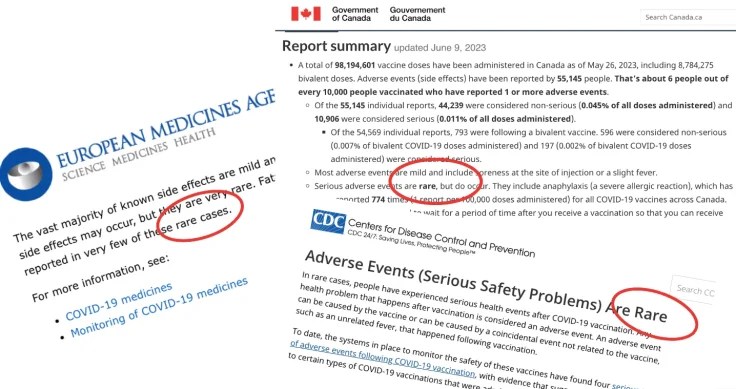
But there has been very little scrutiny of that claim by the media, and I could not find an instance where international agencies actually quantified what they meant by the term “rare” or provided a scientific source.
The best evidence so far, has been a study published in one of vaccinology’s most prestigious journals, where independent researchers reanalysed the original trial data for the mRNA vaccines.
The authors, Fraiman et al, found that serious adverse events (SAEs) – i.e. adverse events that require hospitalisation – were elevated in the vaccine arm by an alarming rate – 1 additional SAE for every 556 people vaccinated with Pfizer’s mRNA vaccine.
According to a scale used by drug regulators, SAEs occurring at a rate of 1 in 556 is categorised as “uncommon,” but far more common than what the public has been told.
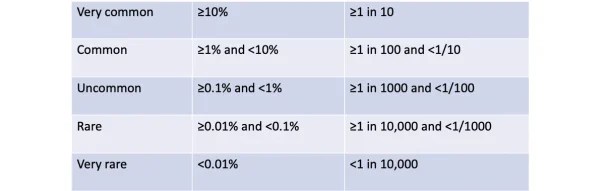
Therefore, I asked eight drug regulators and public health agencies to answer a simple question: what is the official calculated rate of SAEs believed to be caused by Pfizer’s mRNA vaccine, and what is the evidence?
The agencies were FDA, TGA, MHRA, HC, PEI, CDC, ECDC and EMA.
The outcome was startling.
Not a single agency could cite the SAE rate of Pfizer’s vaccine. Most directed me to pharmacovigilance data, which they all emphasised does not establish causation.
The Australian TGA, for example, referred me to the spontaneous reporting system but warned, “it is not possible to meaningfully use these data to calculate the true incidence of adverse events due to the limitations of spontaneous reporting systems.”
Both the German regulator (PEI) and European CDC referred me to the European Medicines Agency which, according to its own report, saw no increase at all in SAEs. “SAEs occurred at a low frequency in both vaccinated and the placebo group at 0.6%.”
The UK regulator MHRA went so far as to state it “does not make estimations of a serious adverse event (SAE) rate, or a rate for adverse reactions considered to be causally related for any medicinal product.”
The US FDA, on the other hand, did conceded that SAEs after mRNA vaccination have “indeed been higher than that of influenza vaccines,” but suggested it was justified because “the severity and impact of covid-19 on public health have been significantly higher than those of seasonal influenza.”
Despite analysing at the same dataset as Fraiman, the FDA said it “disagrees with the conclusions” of the Fraiman analysis. The agency did not give specifics on the areas of disagreement, nor did it provide its own rate of SAEs.
In response to the criticism, Joe Fraiman, emergency doctor and lead author on the reanalysis said, “To be honest, I’m not that surprised that agencies have not determined the rate of SAEs. Once these agencies approve a drug there’s no incentive for them to monitor harms.”
Fraiman said it’s hypocritical for health agencies to tell people that serious harms of the covid vaccines are rare, when they have not even determined the SAE rate themselves.
“It’s very dangerous not to be honest with the public,” said Fraiman, who recently called for the mRNA vaccines to be suspended.
“These noble lies may get people vaccinated in the short term but you’re creating decades or generations of distrust when it’s revealed that they have been misleading the public,” added Fraiman.
Dick Bijl, a physician and epidemiologist based in the Netherlands, agreed. “It goes to show how corrupted these agencies are. There is no transparency, especially since regulators are largely funded by the drug industry.”
Bijl said it’s vital to know the rate of SAEs for the vaccines. “You must be able to do a harm:benefit analysis, to allow people to give fully informed consent, especially in young people at low risk of serious covid or those who have natural immunity.”
Bijl said the mainstream media has allowed these agencies to make false claims about the safety of vaccines without interrogating the facts.
“The rise of alternative media is strongly related to the lies being told by the legacy media, which just repeats government narratives and industry marketing. In the Netherlands, there is a lot of discussion about the distrust in public messaging,” said Bijl.
Featured Video
The Truth About the Trump Shootings with Ken Silva
or go to
Aletho News Archives – Video-Images
From the Archives
Trans ‘milk’ as good as the real thing – NHS
RT | February 18, 2024
The drug-induced nipple secretions of trans women are as good as mothers’ breast milk for babies, the University of Sussex Hospitals NHS Trust claimed in a letter to campaigners made public in a report by British think tank the Policy Exchange on Sunday.
The healthcare trust’s medical director, Rachel James, argued that the off-label prescription drug cocktail men transitioning to female take in order to produce milk was “similar to the natural hormones which encourage lactation to develop when the baby is newly born.”
“The evidence which is available demonstrates that the milk is comparable to that produced following the birth of a baby,” James wrote in the letter, sent to Children of Transitioners last August.
Biological men who wish to lactate must first take hormones to grow milk glands and then take high doses of either domperidone or metoclopramide to stimulate milk production. Neither drug is approved for this use, though they are occasionally prescribed off-label to biological women who have trouble lactating.
However, domperidone’s own manufacturer, Janssen, warns patients the drug “may cause unwanted side effects affecting the heart in a breastfed baby” and “should be used during breastfeeding only if your physician considers this clearly necessary.” … continue
Blog Roll
 Aletho News
- Seyed M. Marandi: U.S. Strike Imminent – Toward Total War in the Middle East
- Russia Voted Under Fire. Washington Is Loading the Tankers.
- 12 Things Your Oncologist Was Trained Not to Tell You
- Anthrax Attacks Paved Way for COVID-Era ‘Junk Drugs and Vaccines’
- How Real Is the Impact of Western Sanctions on Israel?
- France, You Are Guilty: How Paris Turned Western Sahara into the Maghreb’s Powder Keg
- 2025 Nature Paper Claiming Worsening Global Drought Gets RETRACTED …Heavily Flawed
- Your Milk Is Not the Problem
- The Truth About the Trump Shootings with Ken Silva
- ARE PATIENTS BEING PROPERLY INFORMED ABOUT OZEMPIC?
- If Americans Knew
- Salah Sarsour’s Legal Team Says DHS Has Not Met Its Burden to Prove He Is Deportable
- An analysis of tax forms by The Intercept show Kraft’s charity and LLC have donated to Friends of the IDF and AIPAC’s super PAC.
- Israeli attacks kill four Palestinians in Gaza – Daily Update
- Inside Gaza’s death trap of collapsing, bombed-out buildings
- The everyday items Israel bans from Gaza every day
- Inside the siege, the ruined buildings of Gaza – Daily Update
- Debunking The Claim That Macklemore Has A “History Of Antisemitism”
- CPJ demands release of arrested Palestinian-US journalist near Bethlehem
- Robert Kraft: The Billionaire Friend of Netanyahu Pulling The Strings Behind the Macklemore/Ed Sheeran Blow Up
- Columbia Administered Fund Gives Big Money to Pro-Israel Groups
- No Tricks Zone
- 2025 Nature Paper Claiming Worsening Global Drought Gets RETRACTED …Heavily Flawed
- New Study: ‘Global Drought Shows No Detectable Recent Acceleration Under Climate Warming’
- Economic Masterminds: German Socialists Suggest Taxing Productivity Gains Stemming From Using AI
- The South China Sea Has Not Been Cooperating With The Climate Change Narrative
- Energy Crisis: Germany Enters Heating Season With Historically Low Gas Reserve Fill Levels
- New Study: The Antarctic Ice Sheet Gained Mass From 2020-2024 Due To Staggering Snow And Ice Accumulation
- Study: Ocean Heating Rates From Thousands Of Years Ago ‘Dwarf’ Modern Ocean Heating Rates
- Climate Extremists Target, Attack Large-Scale Power Grid Infrastructure In Germany!
- New Study: Antarctic Ice Melt Has Contributed Less Than 1 Centimeter To Sea Level Rise In The Last 30 Years
- Fear Of Debate: Alarmist German Climate Scientist Calls On Mainstream Media To Discredit Skeptic Voices
 Aletho News