The majority of the educated European public think it is the US which exerts influence on the elections in other countries, according to Sputnik’s public poll, which has been conducted by the leading French pollster Ifop.
Sputnik asked French pollster Ifop (French Institute of Public Opinion), a renowned international market researcher that has been gathering public opinion for large companies and political parties worldwide since 1938, to discover what Europeans think about the issue of interference in foreign elections in the wake of the accusations of Russia of meddling in voting in other countries.
Russia has been accused by the US of interfering in foreign parliamentary and presidential elections, with the allegations leading to a new round of anti-Russian sanctions levied by Washington.
Ifop interviewed 3,228 respondents over 18 years of age in the UK, France, Germany and Poland, asking them, “Taking into account its political and economic influence and the capabilities of its special forces, which country exerts more influence on the elections in other countries?”
Among the suggested countries were the US, Russia and the EU bloc, other options suggested another country or none.
One-third of the UK residents think it is the US which exerts influence on the elections in other countries. However the percentage is higher in Germany and France (over 40%), the countries, which this year voted in federal and presidential elections correspondingly.
In Poland, which voted in parliamentary and presidential elections in 2015, 43% also think that it is the US.
21% of the UK residents and less than 30% of continental Europeans, however, believe that Russia has an influence on the voting in other countries.
The number of those who think that the EU interferes in the elections of other countries is almost twice as high in the UK (18%), than in France, Germany or Poland.
Age seemed to have an important influence on the answers, with the tech-savvy under 35’s showing less faith in the impartiality of the US political machine than the older generation.
In all four countries, the poll showed that education also played a factor, with those possessing a higher education choosing the US as the main culprit, in comparison to their less-educated peers.
With regards to their political preferences, in France, more supporters of the left (50%) think that the US is meddling in voting in other countries, than those who support the National Front and those who support the Democratic Movement party.
As for Germany, more Eastern Germans support the idea that the US interferes (46%), versus 39% of the Western Germans polled. Meanwhile, 31% of Westerners think the same about Russia, versus 18% in Eastern Germany.
In the UK, people residing outside the capital think the US interferes more, while about 30% of Londoners support this point of view.
In Poland, it is more the right (44%) and centrists (43%) who blame the US, while 38% of the left are of the same opinion.
American journalists are having a field day with the latest accusations of “Russian influence” in social media during last year’s presidential election. It would be great if they cared as much about how their own government tries to manipulate them online.
First, some recent history.
On July 2, 2013, the United States Congress silently legalized the use of American propaganda on the American people. Until then, there had been something known as the Smith-Mundt Act of 1948, which prevented the government from broadcasting its propaganda aimed at foreigners within the US itself. A bipartisan amendment to the 2013 defense authorization bill undid that — and so the ban on dissemination of propaganda produced by the US State Department and the Broadcasting Board of Governors (BBG) was no more.
What’s interesting about this is that the very people in Congress who are complaining night and day about the nefarious influence of Russian propaganda actually don’t have a problem with American citizens being targeted with fake news and propaganda at all — just so long as it’s coming from their own government. What’s more, since this amendment was tucked into the defense authorization bill with relatively little fuss being made, one can assume that journalists charged with disseminating the real news aren’t too bothered by it either.
The coverage it did receive was amusing in that journalists appeared to be completely fine with disseminating pro-US government propaganda to foreign audiences, which is precisely what they accuse Russia of doing, and which they pretend to find so uniquely heinous.
One concerned Pentagon official who spoke to BuzzFeed about the amendment said it gave the government sweeping powers to push propaganda on the American people with no oversight. He worried the government could circulate information domestically that is “entirely false.” While that’s not exactly a shocker to anyone who has ever watched a White House or State Department news briefing, it’s interesting because it’s a pretty clear admission from a Pentagon source that the US does spread “entirely false” information abroad. Not a shocker either, but given some recent reportage on Russian influence in the US, it’s pretty clear that many American journalists either don’t care or are completely blind to the role their own government plays in the politics of foreign nations.
Now, I don’t want to give the impression the US government only started using domestic propaganda in 2013. That’s just when they made certain types of it legal. In reality, they were doing it long before then. The best example is Operation Mockingbird — a Cold War project wherein the CIA allegedly supported journalists at major American news publications as part of its propaganda war against the Soviet Union. One CIA operative told the Washington Post that you could get a journalist “cheaper than a good call girl, for a couple hundred dollars a month.”
In 1977 investigative reporter Carl Bernstein wrote that more than 400 American journalists over the previous 25 years had secretly carried out assignments for the CIA. Many times this was done with the consent of the management at top news organizations. The CIA even ran a training program teaching its operatives how to be journalists before planting them at newspapers and broadcasters.
This is worth remembering when we look at the self-righteousness spewing from many of the same news organizations today about the horrible scourge of Russian propaganda. We ought to remember, we’re talking about institutions which not too long ago were knowingly and actively helping the CIA disseminate propaganda not only to foreigners but to Americans who had no idea they were sitting down with their morning coffee to — quite literally — read CIA press releases in the likes of The New York Times and The Washington Post.
So, let’s fast forward a little bit to more modern times and modern methods.
Any consumer of American news media will be aware that journalists are up in arms about the Russian government allegedly using paid ads on Facebook and bots on Twitter to influence the American electorate not only before, but after the election to exacerbate social division.
But where was all the sanctimonious outrage in 2011 when it was revealed the US military was developing software that would allow it to secretly manipulate social media platforms using fake personas to “influence internet conversations and spread pro-American propaganda,” as reported by the Guardian at the time.
“The discovery that the US military is developing false online personalities – known to users of social media as “sockpuppets” – could also encourage other governments, private companies, and non-government organizations to do the same,” The Guardian wrote.
So, if American journalists and politicians want to blame anyone for Russia potentially utilizing social media sockpuppets to influence online conversations, they need look no further than their own military, it seems.
The US military enlisted the services of a California corporation to create the fake online personas. Under the contract, one serviceman or woman would be able to control up to ten separate fake identities worldwide — identities which would need to have their own convincing backgrounds and histories.
Of course, Centcom and the US government explain all this away, promising that they only use programs like these to counter violent and extremist enemy propaganda, but is there anyone naive enough to believe that’s truly all these sock-puppet accounts are used for?
In 2014, the US military studied and recorded the activities of people on Twitter and other social media services to understand how influenced behavior happens on social platforms. The study, which was funded by the US Department of Defense’s military research department (Darpa) went so far as to message unknowing participants to see how they responded. The aim was for the US military to become better at detecting online propaganda campaigns — and running its own. Surprise, surprise, the official description of the study states its aim was simply to “counter misinformation or deception campaigns with truthful information.”
We know that is hogwash thanks to NSA whistleblower Edward Snowden who revealed information showing massive and wide-reaching government efforts to use social media for propaganda and disinformation. The NSA along with the British GCHQ run entire units dedicated to “discrediting” their targets online through disinformation campaigns — which include fake blog posts and emails and texts being sent to colleagues, neighbors, and friends.
In 2014, the Obama administration created a “Twitter-like Cuban communications network” which was run through shell companies to give the impression that it was a privately-owned operation, but would actually work to “undermine the communist government” in Cuba. The Cubans who used the service had no idea it was being run by the US government, which was secretly gathering their data to use for political purposes.
It is nothing short of stunning that this kind of operation is roundly ignored by American journalists who claimed to be disturbed by government manipulation of social media.
Then there are the more overt efforts at influence.
In 2009, during anti-government protests in Iran, the US State Department asked Twitter to reschedule maintenance work, so that Iranian protesters could continue to use the social media platform to get the word out about their movement. It’s hardly the most egregious of asks, but can you imagine if Twitter had scheduled maintenance time during the 2016 protests against police brutality in Ferguson and the Kremlin asked Twitter to please hold off on the downtime so that the people of Missouri could keep tweeting about inequality in America? The Russian government would be immediately accused of “meddling” and trying to stoke racial tensions and social divides in the US. When the US does it in Iran, though, that’s not meddling, it’s simply promoting “freedom of expression.”
In 2015, The Guardianreported the British Army was creating a special force of “Facebook warriors” who are “skilled in psychological operations and social media,” to engage in “unconventional warfare” in the information age. It’s interesting too that we’re supposed to call Russians “trolls” and “bots” — but Western social media propagandists get to be “warriors.”
The force would attempt to “control the narrative” in favor of British foreign policy goals. The same Guardian report noted that the Israeli Defense [sic] Forces had pioneered military engagement with social media since its 2008 war in Gaza and was active on 30 platforms in six languages.
Both the US and UK are aggressive in their manipulation of people through online forums — both domestically and abroad. This sparks little outrage and receives practically no coverage in comparison with the coverage that reports of Russian influence on Facebook and Twitter have received in recent weeks.
A global conference held last year in London made clear just how dedicated Western governments and NATO are to exploiting social media to gain influence and support for their military operations abroad. One panel on “digital outreach” described NATO’s aim as “cultivating a global audience through social media to support The Alliance.”
Those are not minced words. Western governments aren’t denying that they are engaging in this sort of behavior — they are simply framing it in such a way as to make it sound honorable and good — a counter to the ‘bad’ kind of propaganda used by their enemies.
The obsessive refrain of “Russia hacked our election” which appears in American media daily — together with a sustained effort in recent years to paint all Russian information as “fake news” is in itself a kind of psychological warfare.
In 2016, a group of crusaders against Russian propaganda wrote a report for a think-tank called the Center for European Policy Analysis (CEPA), which not incidentally, is funded by American arms manufacturers. The authors suggested “deradicalization” programs for anyone who has “fallen victim” to Kremlin propaganda online.
Well, where are the deradicalization programs for those who have fallen victim to American propaganda? Who is going to fund those? Maybe the Kremlin can lend a hand. I’m sure the CIA wouldn’t mind.
This is an opportune moment for American journalists to remind people just how much their own government tries to control their minds and control narratives online. Instead, they’re busy obsessively parroting US intelligence officials and whipping the public into a frenzy about Russia.
Danielle Ryan is an Irish freelance writer, journalist and media analyst. She has lived and traveled extensively in the US, Germany, Russia and Hungary. Her byline has appeared at RT, The Nation, Rethinking Russia, The BRICS Post, New Eastern Outlook, Global Independent Analytics and many others. She also works on copywriting and editing projects. Follow her on Twitter or Facebook or at her website http://www.danielleryan.net.
“All governments suffer a recurring problem: Power attracts pathological personalities. It is not that power corrupts but that it is magnetic to the corruptible.”― Frank Herbert
It doesn’t matter whether you’re talking about a politician, an entertainment mogul, a corporate CEO or a police officer: give any one person (or government agency) too much power and allow him or her or it to believe that they are entitled, untouchable and will not be held accountable for their actions, and those powers will eventually be abused.
We’re seeing this dynamic play out every day in communities across America.
A cop shoots an unarmed citizen for no credible reason and gets away with it. A president employs executive orders to sidestep the Constitution and gets away with it. A government agency spies on its citizens’ communications and gets away with it. An entertainment mogul sexually harasses aspiring actresses and gets away with it. The U.S. military bombs a civilian hospital and a school and gets away with it.
Abuse of power—and the ambition-fueled hypocrisy and deliberate disregard for misconduct that make those abuses possible—works the same whether you’re talking about sexual harassment, government corruption, or the rule of law.
For instance, 20 years ago, I took up a sexual harassment lawsuit on behalf of a young woman—a state employee—who claimed that her boss, a politically powerful man, had arranged for her to meet him in a hotel room, where he then allegedly dropped his pants, propositioned her and invited her to perform oral sex on him.
Here we are 20 years later and not much has changed.
We’re still shocked by sexual harassment in the workplace, the victims of these sexual predators are still being harassed and smeared, and those who stand to gain the most by overlooking wrongdoing (all across the political spectrum) are still turning a blind eye to misconduct when it’s politically expedient to do so.
I won’t go into the nauseating details here. You can read them for yourself at the New York Times and the New Yorker.
Suffice it to say that it’s the same old story all over again: man rises to power, man abuses power abominably, man intimidates and threatens anyone who challenges him with retaliation or worse, and man gets away with it because of a culture of compliance in which no one speaks up because they don’t want to lose their job or their money or their place among the elite.
From what I’ve read, this was Hollywood’s worst-kept secret.
In other words, everyone who was anyone knew about it. They were either complicit in allowing the abuses to take place, turning a blind eye to them, or helping to cover them up.
It’s not just happening in Hollywood, however.
And it’s not just sexual predators that we have to worry about.
For every Harvey Weinstein (or Roger Ailes or Bill Cosby or Donald Trump) who eventually gets called out for his sexual misbehavior, there are hundreds—thousands—of others in the American police state who are getting away with murder—in many cases, literally—simply because they can.
The cop who shoots the unarmed citizen first and asks questions later might get put on paid leave for a while or take a job with another police department, but that’s just a slap on the wrist. The shootings and SWAT team raids and excessive use of force will continue, because the police unions and the politicians and the courts won’t do a thing to stop it. Case in point: The Justice Department will no longer attempt to police the police when it comes to official misconduct. Instead, it plans to give police agencies more money and authority to “fight” crime.
The war hawks who are making a profit by waging endless wars abroad, killing innocent civilians in hospitals and schools, and turning the American homeland into a domestic battlefield will continue to do so because neither the president nor the politicians will dare to challenge the military industrial complex. Case in point: Rather than scaling back on America’s endless wars, President Trump—like his predecessors—has continued to expand America’s military empire and its attempts to police the globe.
The National Security Agency that carries out warrantless surveillance on Americans’ internet and phone communications will continue to do so, because the government doesn’t want to relinquish any of its ill-gotten powers. Case in point: The USA Liberty Act, proposed as a way to “fix” all that’s wrong with domestic surveillance, will instead legitimize the government’s snooping powers.
Unless something changes in the way we deal with these ongoing, egregious abuses of power, the predators of the police state will continue to wreak havoc on our freedoms, our communities, and our lives.
Police officers will continue to shoot and kill unarmed citizens. Government agents—including local police—will continue to dress and act like soldiers on a battlefield.
Bloated government agencies will continue to fleece taxpayers while eroding our liberties. Government technicians will continue to spy on our emails and phone calls. Government contractors will continue to make a killing by waging endless wars abroad.
And powerful men (and women) will continue to abuse the powers of their office by treating those around them as underlings and second-class citizens who are unworthy of dignity and respect and undeserving of the legal rights and protections that should be afforded to all Americans.
As Dacher Keltner, professor of psychology at the at the University of California, Berkeley, observed in the Harvard Business Review, “While people usually gain power through traits and actions that advance the interests of others, such as empathy, collaboration, openness, fairness, and sharing; when they start to feel powerful or enjoy a position of privilege, those qualities begin to fade. The powerful are more likely than other people to engage in rude, selfish, and unethical behavior.”
After conducting a series of experiments into the phenomenon of how power corrupts, Keltner concluded: “Just the random assignment of power, and all kinds of mischief ensues, and people will become impulsive. They eat more resources than is their fair share. They take more money. People become more unethical. They think unethical behavior is okay if they engage in it. People are more likely to stereotype. They’re more likely to stop attending to other people carefully.”
Power corrupts.
And absolute power corrupts absolutely.
However, it takes a culture of entitlement and a nation of compliant, willfully ignorant, politically divided citizens to provide the foundations of tyranny.
As researchers Joris Lammers and Adam Galinsky found, those in power not only tend to abuse that power but they also feel entitled to abuse it: “People with power that they think is justified break rules not only because they can get away with it, but also because they feel at some intuitive level that they are entitled to take what they want.”
That sense of entitlement and immunity from charges of wrongdoing dovetails with Richard Nixon’s belief that “when the President does it, that means that it is not illegal.”
For too long now, America has played politics with its principles and allowed the president and his colleagues to act in violation of the rule of law.
“We the people” are paying the price for it now.
Americans have allowed Congress, the White House and the Judiciary to wreak havoc with our freedoms. They have tolerated an oligarchy in which a powerful, elite group of wealthy donors is calling the shots. They have paid homage to patriotism while allowing the military industrial complex to spread death and destruction abroad. And they have turned a blind eye to all manner of wrongdoing when it was politically expedient.
This culture of compliance must stop.
The empowerment of petty tyrants and political gods must end.
For starters, let’s go back to the basics: the Declaration of Independence, the U.S. Constitution and the Bill of Rights.
Let’s recommit to abiding by the rule of law.
Here’s what the rule of law means in a nutshell: it means that everyone is treated the same under the law, everyone is held equally accountable to abiding by the law, and no one is given a free pass based on their politics, their connections, their wealth, their status or any other bright line test used to confer special treatment on the elite.
Let’s demand scrutiny and transparency at all levels of government, which in turn will lead to accountability.
We need to stop being victimized by these predators.
As I point out in my book Battlefield America: The War on the American People, I’m not just talking about the political predators in office, but the ones who are running the show behind the scenes—the shadow government—comprised of unelected government bureaucrats whose powers are unaffected by elections, unaltered by populist movements, and beyond the reach of the law.
There is no way to erase the scars left by the government’s greed for money and power, its disregard for human life, its corruption and graft, its pollution of the environment, its reliance on excessive force in order to ensure compliance, its covert activities, its illegal surveillance, and its blatant disdain for the rule of law.
“We the people”—men and women alike— have been victims of the police state for so long that not many Americans even remember what it is to be truly free anymore. Worse, few want to shoulder the responsibility that goes along with maintaining freedom.
There is so much to love about this series. The uncompromising scenes of combat, the voices of both Americans and Vietnamese, the historical context, the exposure of the utter incompetence of our military leaders, the terrific music that is frequently exactly where it should be, the slowly revealed powerful still images and Peter Coyote’s wonderful narrative voice. Its tragic failure is its inability to hold anyone responsible for their actions.
Burns and Novick tell us that the war was begun “in good faith by decent people out of fateful misunderstandings, American overconfidence and …” whatever the current threat. That’s probably true of most wars. However, as we used to teach our children, you have to be accountable for your actions. If you kill someone speeding the wrong way down a one way street you’ll get charged with manslaughter even if you’re rushing someone to the hospital.
It’s the lack of accountability, the failure to prosecute those who lied to get us into the war, who encouraged battlefield tactics that resulted in the massacre of women and children, who authorized the indiscriminate bombing of civilian targets, who drenched Vietnam in chemical poisons that will cause birth defects and death for generations.
In order to maintain this central lie, Burns and Novick must establish a false balance between good and evil on both sides. Every time the United States is shown doing something bad, Burns and Novick show us how the Vietnamese also did bad things. In one absurd example, Coyote intones something like, “we called them ‘Dinks,’ ‘Gooks,’ ‘Mamasans;’ they called us ‘invaders’ and ‘imperialists.’” The GI terms are dehumanizing, but the Vietnamese terms are accurate. People who cross 3,000 miles of ocean to attack a country that has done them no harm, are accurately called ‘invaders.’ I suppose you could argue about the ‘imperialist’ charge.
Vietnamese soldiers killed some 58,000 Americans and wounded a couple of hundred thousand more. Burns and Novick put the number of Vietnamese we killed at 3 million, but most experts say it was more like 4 million and Vietnam says its 6 million, with more people continuing to die from unexploded ordinance and Agent Orange. We destroyed 60% of their villages, sprayed 21 million gallons of lethal poisons, imposed free fire zones (a euphemism for genocide) on 75% of South Vietnam. They attacked US military bases in their country and never killed an American on American soil. There are no equivalences here.
Burns and Novick do a good job of explaining that the United States worked with Ho Chi Minh during World War II and that Ho hoped to get our support after the war. They do not mention that having friendly relations with Communist countries was a successful strategy we used with Yugoslavia, because although it was Communist, Yugoslavia was also independent and a thorn in the Soviet Union’s side. Any minimal understanding of Vietnam’s history would have identified Vietnam’s fiercely independent streak. Intelligent leaders (anyone with half a brain) would have adopted the Yugoslav strategy in Vietnam.
This brings us to another central problem of the Burns and Novick series, Leslie Gelb’s smiling recollection (he looks so smug) that nobody knew anything about Vietnam and didn’t for several years. In fact, throughout the series, many people say “we should have known better.” Is ignorance really a good excuse for launching a brutal war and the war crimes that followed? Unmentioned is how easy it was to gather information on Vietnam. French historians and journalists had studied every aspect of the country and its culture during and after their defeat in the French Indo China war. Much of this material had been translated into English. That’s how I figured out in 1965 that we were going to lose the war in Vietnam.
Burns and Novick fail to mention my trip to North Vietnam in 1965 nor any of the other trips to North Vietnam by members of the American peace movement such as Tom Hayden, Staughton Lynd and Herbert Aptheker who went in January 1966 and members of Women’s Strike for Peace who went later. They only show us Jane Fonda’s trip in 1972, when she broadcast to US troops asking them to stop the bombing and was photographed sitting on an anti-aircraft gun. No one else who went to North Vietnam did either of these things.
Our earlier trips to North Vietnam were important, because we were the only Americans to witness the destruction being rained down on North Vietnam. Burns’ documentary shows lots of aerial shots of bombs and napalm going off (Mussolini’s son called them rosebuds blooming in the desert when he attack Ethiopia) but very few shots of the bomb’s effects on the ground in North Vietnam. We hear talk of precision bombing, but those of us who traveled to North Vietnam observed hospitals, schools, churches, markets, and working class neighborhoods utterly destroyed. And this was ten years before the war ended!
The Burns’ documentary doesn’t show us the makeshift hospitals with children and old people without arms and legs or suffering from horrendous burns, all victims of American bombing attacks. The documentary focuses our compassion on the American pilots who dropped the bombs.
In fact, the only heroes in Ken Burns’ Vietnam are American GI’s. Almost everyone else is their enemy: the Vietnamese they fought, the officers whose absurd strategy sent them to their deaths, and the American peace movement that struggled to end the war and bring them home. Burns and Novick portray the peace movement in the worst possible terms. In at least three places, they have moving sound bites about how returning soldiers were spit on or in other ways disrespected. It’s a false memory, at least in any general sense. They couldn’t find any visual support, no signs about baby killers, because it didn’t happen, or happened extremely rarely.
To me, this is the central flaw of Burns and Novick’s film, their failure to deal truthfully and equally with the peace movement. Six million Americans took part in the anti-war effort (only 2.7 million Americans served as soldiers). Everyone I knew in the peace movement honored the veterans and wanted justice for them. They studied books, took part in teach-ins, and watched newsreels. But Burns and Novick, with a couple of notable exceptions, characterize the peace movement as uninformed, chaotic, disrespectful, self absorbed and violent. At one point, they intercut 1969 pictures of kids at Woodstock wallowing in great music with soldiers fighting in Vietnam. What was that supposed to mean?
The kids who refused to go (many out of righteous opposition), who fled into exile in Canada or Sweden, or who, like boxer Muhammad Ali lost his right to fight for three years, or the Fort Hood 3 who went to prison, or the professors and journalists who lost their jobs, the protestors beaten by riled up construction workers, Martin Luther King who went public with his opposition in 1967, the priests who raided draft offices and burned their records, Alice Hertz and two other Americans who burned themselves to death in honor of the Buddhist monks who did the same in South Vietnam protesting our puppet regime — these are not worth profiling, all tinged by the same brush, they are the bad guys who disrespected our troops and went violent. What a wonderful authoritarian message that gives to viewers. Don’t protest an evil war or your country’s war crimes.
The only heroes in Burns and Novick’s Vietnam are American servicemen and I am thrilled to see them finally recognized for what they went through. We have moving back stories of their homes, their motives for joining, their families waiting for them.
None of the six million participants in the American peace movement gets similar treatment. The same is true, incidentally, of the Vietnamese. While the sound bites are great, there are no Vietnamese back stories either.
Without the peace movement, there is no moral center to this series. The lack of accountability is fatal. That an American general can watch from a helicopter the massacre at Mai Lai (as the films tells us) and suffer no consequences is sickening. If military courts had aggressively prosecuted violators of human rights, or even if we only had held detailed and accurate reconciliations where the truth came out, there would have been a chance that our reckless invasions of Iraq with its policy of torture and the invasion of Afghanistan would not have followed so easily. When people are held accountable for their actions, perpetrators of questionable violent acts think twice.
Last week on NPR an American general in Afghanistan announced that we are not trying to occupy territory in Afghanistan, we are simply trying to kill terrorists. Here, again, is the same rationale of the body count that led to disaster in Vietnam. We are reliving the Vietnam War because no one was ever really held responsible for its horrors.
The moral center of the Vietnam War was held by those who opposed it. Several people I’ve talked to say the series is depressing. I had the same feeling of despair at the end. Burns and Novick suggest Vietnam’s a tragedy. It’s not. In tragedy a powerful human makes a terrible mistake and suffers the consequences. No one suffered any consequences for Vietnam. Burns and Novick assure us that even if people did wrong, they didn’t mean to. America is still the shining city on the hill and we can do no wrong.
Christopher Koch, in 1965, became the first American reporter to visit North Vietnam.
An amazing week is unfolding in West Asian politics. It began with three dramatic developments on Monday – Turkish troops crossing the border into Syria’s Idlib province; announcement in Moscow on agreement to sell the S-400 missile defence system to Saudi Arabia; and, the freeze on visas by the US and Turkey for each other’s nationals. And the week promises to be climactic in the US-Iranian relations.
On Monday Iranian Foreign Ministry warned that any move by the Trump administration to impose sanctions against the Islamic Revolutionary Guards Corps will be a “strategic mistake” and Tehran’s response will be “firm, decisive and crushing”. It echoed a warning by the head of the IRGC, General Mohammad Ali Jafari that if the US designated his organization as terrorist, Iran will regard the US forces anywhere as the allies of the Islamic State and target them. Indeed, the weekend is slated to witness the refusal by US President Donald Trump to meet the October 15 deadline for endorsing Washington’s participation in the Iran nuclear deal. The common thread that runs through all these developments is the US’ standing in West Asia vis-a-vis the three most important regional states — Turkey, Iran and Saudi Arabia.
Syria: The Turkish military operation in Idlib is directed against the al-Qaeda affiliate Nusra Front. The operation stems from the Astana process where Russia, Turkey and Iran have worked out the establishment of a ‘de-escalation zone’ in Idlib. The US is the odd man out looking in. The backdrop is provided by the upswing in Turkish-Russian relations and the recent Turkish-Iranian rapprochement. Turkey and Iran have common interest to counter the US-Israeli encouragement to Kurdish separatism. Clearly, the Turkish-Iranian rapprochement is having positive fallout on the Syrian situation.
Saudi-Russian ties: The announcement in Moscow on Monday regarding the sale of the S-400 missile defence system to Saudi Arabia signifies a tectonic shift in the Middle East politics. Saudi Arabia has been a ‘pivotal state’ in the US’ Middle East strategies since the mid-forties. It is now embarking on a ‘non-aligned’ foreign policy. The visit by King Salman to Russia last week, Aramco’s dealings with Rosneft and Gazprom, OPEC-Russia agreement to cut oil production – these suggest that the US-Saudi axis is steadily dissolving. Interestingly, Tehran is calmly viewing the Saudi-Russian rapprochement. These trends put a dagger at the heart of the entire US strategy in the Gulf, which had historically fostered a ‘bloc mentality’ among the Sunni states by fuelling their tensions vis-à-vis Iran.
Sensing that Saudi Arabia and Russia might clinch a deal over the S-400 missile defence system, Washington hurriedly announced last Friday that it proposed to accede to the pending request from Riyadh for purchase of the rival THAAD missile system. (Due to Israeli pressure Washington was dragging its feet on the $15 billion deal.) A keen tussle is developing and its outcome will be a litmus test of the US’ capacity to influence Saudi decision-making.
Turkish-American spat: Last week Turkish security nabbed a local employee of the US Consulate in Istanbul for alleged links with the Islamist preacher Fetullah Gulen who is living in the US and whom the Turks suspect as having been involved in the US-backed coup attempt last July against Erdogan. Washington went ballistic. From all appearances, Turkish intelligence may have nabbed a key accomplice of the CIA who had acted as go-between during the failed coup attempt last year. The statement by the US ambassador in Ankara, here, betrays nervousness. Woven into this is Washington’s support of Kurdish separatist groups, which Erdogan sees as the ‘hidden agenda’ of Americans to destabilize Turkey. The Turkish-American relations are in serious difficulty.
Iran nuclear deal: Trump is about to announce this weekend that Iran is not in compliance with the July 2015 nuclear deal. If that happens, US lawmakers have a 60-day window to decide whether to re-impose sanctions against Iran. The Israeli lobby is active on the Capitol Hill. To be sure, pressure will mount on Tehran to respond and retaliate somehow. There is an influential section of opinion within the Iranian establishment that never trusted the US intentions. Clearly, the door is closing on a gestation process over confidence-building that might have incrementally led to a US-Iranian normalization. (Read an insightful opinion piece in the New York Times by Wendy R. Sherman, a former Undersecretary of State for political affairs, who was the US’ lead negotiator for the Iran nuclear agreement – Trump Is Going to Make a Huge Mistake on the Iran Deal.)
All in all, the US is running out of friends and allies in West Asia – with the solitary exception of Israel. Its traditional Cold War-era NATO ally Turkey is turning unfriendly; Iran is preparing to confront the US; GCC is in turmoil but the US is watching helplessly; and, most important, Saudis are exploring the seamless potentials of a non-aligned foreign policy. Trump’s record in West Asia is proving dismal.
On the 21st of September The Guardian put out a funding campaign on Twitter. It explained that if we wanted to “help secure the future of progressive, independent journalism” we should donate £5 per month to shore up The Guardian’s resources. We should do this because The Guardian, according to The Guardian, offers us “quality, investigative journalism”.
The Guardian, according to their advertisment, “holds power to account”, and that “takes time, money and hard work”. Apparently, a very nifty graph tells us that more people than ever are reading The Guardian but advertising revenue is tumbling. The Guardian needs our support to keep their journalism “open to everyone”. When “others stretch the truth”, the Guardian doesn’t “distort facts”. We are urged to “defend independent journalism”. At The Guardian “no billionaire owner pulls the strings” and “noone edits their editor”. Now is the time to act, support The Guardian for a fiver a month.
The Tweet is here and below you will find the huge number of replies, pretty much all saying a big, very fat NO!
Help secure the future of progressive, independent journalism
Almost in response to the funding request from The Guardian, the following article appeared in Medialens today:
“The corporate media have swiftly moved on from Peter Oborne’s resignation as chief political commentator at the Telegraph and his revelations that the paper had committed ‘a form of fraud’ on its readers over its coverage of HSBC tax evasion.
But investigative journalist Nafeez Ahmed has delved deeper into the HSBC scandal, reporting the testimony of a whistleblower that reveals a ‘conspiracy of silence’ encompassing the media, regulators and law-enforcement agencies. Not least, Ahmed’s work exposes the vanity of the Guardian’s boast to be the world’s ‘leading liberal voice’.
Last month, the corporate media, with one notable exception, devoted extensive coverage to the news that the Swiss banking arm of HSBC had been engaged in massive fraudulent tax evasion. The exception was the Telegraph which, as Oborne revealed, was desperate to retain advertising income from HSBC.
But now Ahmed reports another ‘far worse case of HSBC fraud totalling an estimated £1 billion, closer to home’. Moreover, it has gone virtually unnoticed by the corporate media, for all the usual reasons.
According to whistleblower Nicholas Wilson, HSBC was ‘involved in a fraudulent scheme to illegally overcharge British shoppers in arrears for debt on store cards at leading British high-street retailers’ including B&Q, Dixons, Currys, PC World and John Lewis. Up to 600,000 Britons were defrauded.
Wilson uncovered the crimes while he was head of debt recovery for Weightmans, a firm of solicitors acting on behalf of John Lewis. But when he blew the whistle, his employer sacked him. He has spent 12 years trying to expose this HSBC fraud and to help obtain justice for the victims. The battle has ‘ruined his life’, he said during a brief appearance on the BBC’s The Big Questions, the only ‘mainstream’ coverage to date.
Ahmed writes that the ‘most disturbing’ aspect of ‘HSBC’s fraud against British consumers’ is that it ‘has been systematically ignored by the entire British press’.
He adds:
‘In some cases, purportedly brave investigative journalism outfits have spent months investigating the story, preparing multiple drafts, before inexplicably spiking publication without reason.’
Examples include BBC Panorama, BBC Newsnight, BBC Moneybox, BBC Radio 5 Live, the Guardian, Private Eye and the Sunday Times.
The Sunday Times is the most recent example. A couple of weeks ago, the paper had a big exposé on the HSBC consumer credit fraud ready to go. But it was ‘inexplicably dropped’ at the last minute. Ahmed writes:
HSBC happens to be the main sponsor of a series of Sunday Times league tables published for FastTrack 100 Ltd., a “networking events company.” The bank is the “title sponsor” of The Sunday Times HSBC Top Track 100, has been “title sponsor of The Sunday Times HSBC International Track 200 for all 6 years” and was previously “title sponsor of The Sunday Times Top Track 250 for 7 years.”
Ahmed reports that the Sunday Times journalist preparing the spiked story did not respond to a query asking for an explanation.
THE WORLD’S ‘LEADING LIBERAL VOICE’… LOSES ITS VOICE
But surely the Guardian would go where other papers fear to tread? After all, says Ahmed, the paper:
loudly and triumphantly congratulated itself for reporting on the HSBC Swiss bank scandal despite the bank putting its advertising relationship with the newspaper “on pause.” Yet the newspaper has refused to cover Wilson’s story exposing HSBC fraud in Britain. Why?
Perhaps there is no definitive answer to that question. But as Ahmed points out, the Guardian just ‘happens to be the biggest recipient of HSBC advertising revenue: bigger even than the Telegraph‘, which is ‘something you won’t read in the Guardian’. The Guardian’s ‘partnership’ with HSBC even helped fund the paper’s crucial move into the US market, according to the Guardian Media Group’s financial report last year.
However, the Guardian’s links with HSBC go beyond advertising and extend to the very corporate structure of the newspaper. As Media Lensnoted when we wrote about Nafeez Ahmed’s sacking from the Guardian last December, the paper’s journalistic freedom is supposedly secured under the auspices of Scott Trust Limited, the company that replaced the much-vaunted Scott Trust in 2008. We added:
The paper, therefore, might not at first sight appear to be a corporate institution. But the paper is owned by the Guardian Media Group which is run by a high-powered Board comprising elite, well-connected people from the worlds of banking, insurance, advertising… and other sectors of big business, finance and industry.
Ahmed has done further extensive digging, revealing, in particular, the Guardian’s specific corporate ties with HSBC, past and present. For instance, the chair of the Scott Trust Ltd board is Dame Liz Forgan. She has links with St Giles Trust and the British Museum, two institutions that are ‘sponsored’ by HSBC.
Consider, too, Anthony Salz who sits alongside Forgan on Scott Trust Ltd. He is a senior investment banker and executive vice chairman of Rothschild, and a director at NM Rothschild and Sons. Salz was previously a corporate lawyer with Freshfields, a member of the ‘Magic Circle’ of elite British law firms. HSBC is one of Freshfield’s most prominent long-term clients.
Philip Tranter is another board member of Scott Trust Ltd. He is a former partner and head of corporate law at Boyes Turner. HSBC is one of their clients.
As well as past and present relationships with HSBC, there are also wider connections between Scott Trust Ltd board members and elite corporate and financial circles. For example, Jonathan Scott is chairman of Ambac Assurance UK, and a former director at KPMG Corporate Finance. Ambac was ‘at the heart of the 2008 subprime mortgage crisis, and was implicated in fraud to save its skin as the crisis kicked off’.
Andrew Miller, another board member, was chief financial officer of Autotrader publisher, Trader Media Group. Until early last year, TMG was jointly owned by the Guardian Media Group and the giant private equity firm, Apax Partners. One early director of an Apax Fund, David Staples, is now a director of HSBC Private Bank Ltd. When the Guardian Media Group sold its 50.1% stake in TMG, one of the firms that provided advice for the sale was Anthony Salz’s former firm, Freshfields. Freshfields also advised HSBC over a government inquiry into competition in the banking sector last year.
And so it goes on… and on. Far from being some kind of benign charitable operation, the Guardian newspaper is deeply embedded in elite networks of corporate and financial muscle.
Ahmed notes the consequences of all this for Guardian journalism. The company board members running the newspaper:
must juggle the task of operating the Guardian “as a profit-seeking enterprise,” while securing its “financial and editorial independence” — goals that as the HSBC case illustrates, are ultimately mutually incompatible.
He summarises Nicholas Wilson’s revelations on HSBC fraud in Britain as ‘the worst and largest single case of banking fraud to have ever emerged in this country. They make the Swiss leaks case look like peanuts.’
And yet the fraud has been entirely ignored by the ‘free press’. Our searches of the Lexis newspaper database yield not a single article. In particular, there has been no corporate media response to Ahmed’s careful investigative journalism since his article was published in March. ‘Even’ the Guardian, the supposed ‘flagship’ of liberal journalism, has looked away.
We would challenge Alan Rusbridger, the outgoing Guardian editor-in-chief (he will replace Forgan as the chair of the Scott Trust Ltd in 2016). But he hasn’t responded to our emails for years and he has long blocked us on Twitter. Perhaps this is because he finally tired of us highlighting examples of his paper’s propaganda role as a ‘guardian of power’. The last straw for Rusbridger appeared to follow our exposure of the paper’s dishonest attempts to smear Noam Chomsky in 2005.
However, when one of our readers challenged Rusbridger this week that he felt ‘conned’ that the Guardian is actually owned by a company and not a trust, Rusbridger did reply – although rather evasively:
It looks, swims, quacks and acts like a Trust. But, no, it’s not a charity. Nor does it hv anytg to do w HSBC
‘Nor does it have anything to do with HSBC’? To put it kindly, it would appear that the Guardian editor-in-chief is ignorant of the HSBC links of his fellow company board members, as spelled out in Ahmed’s piece.
Ahmed himself then directly challenged Rusbridger via Twitter:
– Ennio Flaiano, Italian writer and co-author of Federico Fellini’s greatest film scripts.
In recent weeks, a totally disoriented left has been widely exhorted to unify around a masked vanguard calling itself Antifa, for anti-fascist. Hooded and dressed in black, Antifa is essentially a variation of the Black Bloc, familiar for introducing violence into peaceful demonstrations in many countries. Imported from Europe, the label Antifa sounds more political. It also serves the purpose of stigmatizing those it attacks as “fascists”.
Despite its imported European name, Antifa is basically just another example of America’s steady descent into violence.
Historical Pretensions
Antifa first came to prominence from its role in reversing Berkeley’s proud “free speech” tradition by preventing right wing personalities from speaking there. But its moment of glory was its clash with rightwingers in Charlottesville on August 12, largely because Trump commented that there were “good people on both sides”. With exuberant Schadenfreude, commentators grabbed the opportunity to condemn the despised President for his “moral equivalence”, thereby bestowing a moral blessing on Antifa.
Charlottesville served as a successful book launching for Antifa: the Antifascist Handbook, whose author, young academic Mark Bray, is an Antifa in both theory and practice. The book is “really taking off very fast”, rejoiced the publisher, Melville House. It instantly won acclaim from leading mainstream media such as the New York Times, The Guardian and NBC, not hitherto known for rushing to review leftwing books, least of all those by revolutionary anarchists.
The Washington Post welcomed Bray as spokesman for “insurgent activist movements” and observed that: “The book’s most enlightening contribution is on the history of anti-fascist efforts over the past century, but its most relevant for today is its justification for stifling speech and clobbering white supremacists.”
Bray’s “enlightening contribution” is to a tell a flattering version of the Antifa story to a generation whose dualistic, Holocaust-centered view of history has largely deprived them of both the factual and the analytical tools to judge multidimensional events such as the growth of fascism. Bray presents today’s Antifa as though it were the glorious legitimate heir to every noble cause since abolitionism. But there were no anti-fascists before fascism, and the label “Antifa” by no means applies to all the many adversaries of fascism.
The implicit claim to carry on the tradition of the International Brigades who fought in Spain against Franco is nothing other than a form of innocence by association. Since we must revere the heroes of the Spanish Civil War, some of that esteem is supposed to rub off on their self-designated heirs. Unfortunately, there are no veterans of the Abraham Lincoln Brigade still alive to point to the difference between a vast organized defense against invading fascist armies and skirmishes on the Berkeley campus. As for the Anarchists of Catalonia, the patent on anarchism ran out a long time ago, and anyone is free to market his own generic.
The original Antifascist movement was an effort by the Communist International to cease hostilities with Europe’s Socialist Parties in order to build a common front against the triumphant movements led by Mussolini and Hitler.
Since Fascism thrived, and Antifa was never a serious adversary, its apologists thrive on the “nipped in the bud” claim: “if only” Antifascists had beat up the fascist movements early enough, the latter would have been nipped in the bud. Since reason and debate failed to stop the rise of fascism, they argue, we must use street violence – which, by the way, failed even more decisively.
This is totally ahistorical. Fascism exalted violence, and violence was its preferred testing ground. Both Communists and Fascists were fighting in the streets and the atmosphere of violence helped fascism thrive as a bulwark against Bolshevism, gaining the crucial support of leading capitalists and militarists in their countries, which brought them to power.
Since historic fascism no longer exists, Bray’s Antifa have broadened their notion of “fascism” to include anything that violates the current Identity Politics canon: from “patriarchy” (a pre-fascist attitude to put it mildly) to “transphobia” (decidedly a post-fascist problem).
The masked militants of Antifa seem to be more inspired by Batman than by Marx or even by Bakunin.
Storm Troopers of the Neoliberal War Party
Since Mark Bray offers European credentials for current U.S. Antifa, it is appropriate to observe what Antifa amounts to in Europe today.
In Europe, the tendency takes two forms. Black Bloc activists regularly invade various leftist demonstrations in order to smash windows and fight the police. These testosterone exhibits are of minor political significance, other than provoking public calls to strengthen police forces. They are widely suspected of being influenced by police infiltration.
As an example, last September 23, several dozen black-clad masked ruffians, tearing down posters and throwing stones, attempted to storm the platform where the flamboyant Jean-Luc Mélenchon was to address the mass meeting of La France Insoumise, today the leading leftist party in France. Their unspoken message seemed to be that nobody is revolutionary enough for them. Occasionally, they do actually spot a random skinhead to beat up. This establishes their credentials as “anti-fascist”.
They use these credentials to arrogate to themselves the right to slander others in a sort of informal self-appointed inquisition.
As prime example, in late 2010, a young woman named Ornella Guyet appeared in Paris seeking work as a journalist in various leftist periodicals and blogs. She “tried to infiltrate everywhere”, according to the former director of Le Monde diplomatique, Maurice Lemoine, who “always intuitively distrusted her” when he hired her as an intern.
Viktor Dedaj, who manages one of the main leftist sites in France, Le Grand Soir, was among those who tried to help her, only to experience an unpleasant surprise a few months later. Ornella had become a self-appointed inquisitor dedicated to denouncing “conspirationism, confusionism, anti-Semitism and red-brown” on Internet. This took the form of personal attacks on individuals whom she judged to be guilty of those sins. What is significant is that all her targets were opposed to U.S. and NATO aggressive wars in the Middle East.
Indeed, the timing of her crusade coincided with the “regime change” wars that destroyed Libya and tore apart Syria. The attacks singled out leading critics of those wars.
Viktor Dedaj was on her hit list. So was Michel Collon, close to the Belgian Workers Party, author, activist and manager of the bilingual site Investig’action. So was François Ruffin, film-maker, editor of the leftist journal Fakir elected recently to the National Assembly on the list of Mélenchon’s party La France Insoumise. And so on. The list is long.
The targeted personalities are diverse, but all have one thing in common: opposition to aggressive wars. What’s more, so far as I can tell, just about everyone opposed to those wars is on her list.
The main technique is guilt by association. High on the list of mortal sins is criticism of the European Union, which is associated with “nationalism” which is associated with “fascism” which is associated with “anti-Semitism”, hinting at a penchant for genocide. This coincides perfectly with the official policy of the EU and EU governments, but Antifa uses much harsher language.
In mid-June 2011, the anti-EU party Union Populaire Républicaine led by François Asselineau was the object of slanderous insinuations on Antifa internet sites signed by “Marie-Anne Boutoleau” (a pseudonym for Ornella Guyet). Fearing violence, owners cancelled scheduled UPR meeting places in Lyon. UPR did a little investigation, discovering that Ornella Guyet was on the speakers list at a March 2009 Seminar on International Media organized in Paris by the Center for the Study of International Communications and the School of Media and Public Affairs at George Washington University. A surprising association for such a zealous crusader against “red-brown”.
In case anyone has doubts, “red-brown” is a term used to smear anyone with generally leftist views – that is, “red” – with the fascist color “brown”. This smear can be based on having the same opinion as someone on the right, speaking on the same platform with someone on the right, being published alongside someone on the right, being seen at an anti-war demonstration also attended by someone on the right, and so on. This is particularly useful for the War Party, since these days, many conservatives are more opposed to war than leftists who have bought into the “humanitarian war” mantra.
The government doesn’t need to repress anti-war gatherings. Antifa does the job.
The Franco-African comedien Dieudonné M’Bala M’Bala, stigmatized for anti-Semitism since 2002 for his TV sketch lampooning an Israeli settler as part of George W. Bush’s “Axis of Good”, is not only a target, but serves as a guilty association for anyone who defends his right to free speech – such as Belgian professor Jean Bricmont, virtually blacklisted in France for trying to get in a word in favor of free speech during a TV talk show. Dieudonné has been banned from the media, sued and fined countless times, even sentenced to jail in Belgium, but continues to enjoy a full house of enthusiastic supporters at his one-man shows, where the main political message is opposition to war.
Still, accusations of being soft on Dieudonné can have serious effects on individuals in more precarious positions, since the mere hint of “anti-Semitism” can be a career killer in France. Invitations are cancelled, publications refused, messages go unanswered.
In April 2016, Ornella Guyet dropped out of sight, amid strong suspicions about her own peculiar associations.
The moral of this story is simple. Self-appointed radical revolutionaries can be the most useful thought police for the neoliberal war party.
I am not suggesting that all, or most, Antifa are agents of the establishment. But they can be manipulated, infiltrated or impersonated precisely because they are self-anointed and usually more or less disguised.
Silencing Necessary Debate
One who is certainly sincere is Mark Bray, author of The Intifa Handbook. It is clear where Mark Bray is coming from when he writes (p.36-7): “… Hitler’s ‘final solution’ murdered six million Jews in gas chambers, with firing squads, through hunger an lack of medical treatment in squalid camps and ghettoes, with beatings, by working them to death, and through suicidal despair. Approximately two out of every three Jews on the continent were killed, including some of my relatives.”
This personal history explains why Mark Bray feels passionately about “fascism”. This is perfectly understandable in one who is haunted by fear that “it can happen again”.
However, even the most justifiable emotional concerns do not necessarily contribute to wise counsel. Violent reactions to fear may seem to be strong and effective when in reality they are morally weak and practically ineffectual.
We are in a period of great political confusion. Labeling every manifestation of “political incorrectness” as fascism impedes clarification of debate over issues that very much need to be defined and clarified.
The scarcity of fascists has been compensated by identifying criticism of immigration as fascism. This identification, in connection with rejection of national borders, derives much of its emotional force above all from the ancestral fear in the Jewish community of being excluded from the nations in which they find themselves.
The issue of immigration has different aspects in different places. It is not the same in European countries as in the United States. There is a basic distinction between immigrants and immigration. Immigrants are people who deserve consideration. Immigration is a policy that needs to be evaluated. It should be possible to discuss the policy without being accused of persecuting the people. After all, trade union leaders have traditionally opposed mass immigration, not out of racism, but because it can be a deliberate capitalist strategy to bring down wages.
In reality, immigration is a complex subject, with many aspects that can lead to reasonable compromise. But to polarize the issue misses the chances for compromise. By making mass immigration the litmus test of whether or not one is fascist, Antifa intimidation impedes reasonable discussion. Without discussion, without readiness to listen to all viewpoints, the issue will simply divide the population into two camps, for and against. And who will win such a confrontation?
A recent survey* shows that mass immigration is increasingly unpopular in all European countries. The complexity of the issue is shown by the fact that in the vast majority of European countries, most people believe they have a duty to welcome refugees, but disapprove of continued mass immigration. The official argument that immigration is a good thing is accepted by only 40%, compared to 60% of all Europeans who believe that “immigration is bad for our country”. A left whose principal cause is open borders will become increasingly unpopular.
Childish Violence
The idea that the way to shut someone up is to punch him in the jaw is as American as Hollywood movies. It is also typical of the gang war that prevails in certain parts of Los Angeles. Banding together with others “like us” to fight against gangs of “them” for control of turf is characteristic of young men in uncertain circumstances. The search for a cause can involve endowing such conduct with a political purpose: either fascist or antifascist. For disoriented youth, this is an alternative to joining the U.S. Marines.
American Antifa looks very much like a middle class wedding between Identity Politics and gang warfare. Mark Bray (page 175) quotes his DC Antifa source as implying that the motive of would-be fascists is to side with “the most powerful kid in the block” and will retreat if scared. Our gang is tougher than your gang.
That is also the logic of U.S. imperialism, which habitually declares of its chosen enemies: “All they understand is force.” Although Antifa claim to be radical revolutionaries, their mindset is perfectly typical the atmosphere of violence which prevails in militarized America.
In another vein, Antifa follows the trend of current Identity Politics excesses that are squelching free speech in what should be its citadel, academia. Words are considered so dangerous that “safe spaces” must be established to protect people from them. This extreme vulnerability to injury from words is strangely linked to tolerance of real physical violence.
Wild Goose Chase
In the United States, the worst thing about Antifa is the effort to lead the disoriented American left into a wild goose chase, tracking down imaginary “fascists” instead of getting together openly to work out a coherent positive program. The United States has more than its share of weird individuals, of gratuitous aggression, of crazy ideas, and tracking down these marginal characters, whether alone or in groups, is a huge distraction. The truly dangerous people in the United States are safely ensconced in Wall Street, in Washington Think Tanks, in the executive suites of the sprawling military industry, not to mention the editorial offices of some of the mainstream media currently adopting a benevolent attitude toward “anti-fascists” simply because they are useful in focusing on the maverick Trump instead of themselves.
Antifa USA, by defining “resistance to fascism” as resistance to lost causes – the Confederacy, white supremacists and for that matter Donald Trump – is actually distracting from resistance to the ruling neoliberal establishment, which is also opposed to the Confederacy and white supremacists and has already largely managed to capture Trump by its implacable campaign of denigration. That ruling establishment, which in its insatiable foreign wars and introduction of police state methods, has successfully used popular “resistance to Trump” to make him even worse than he already was.
The facile use of the term “fascist” gets in the way of thoughtful identification and definition of the real enemy of humanity today. In the contemporary chaos, the greatest and most dangerous upheavals in the world all stem from the same source, which is hard to name, but which we might give the provisional simplified label of Globalized Imperialism. This amounts to a multifaceted project to reshape the world to satisfy the demands of financial capitalism, the military industrial complex, United States ideological vanity and the megalomania of leaders of lesser “Western” powers, notably Israel. It could be called simply “imperialism”, except that it is much vaster and more destructive than the historic imperialism of previous centuries. It is also much more disguised. And since it bears no clear label such as “fascism”, it is difficult to denounce in simple terms.
The fixation on preventing a form of tyranny that arose over 80 years ago, under very different circumstances, obstructs recognition of the monstrous tyranny of today. Fighting the previous war leads to defeat.
Donald Trump is an outsider who will not be let inside. The election of Donald Trump is above all a grave symptom of the decadence of the American political system, totally ruled by money, lobbies, the military-industrial complex and corporate media. Their lies are undermining the very basis of democracy. Antifa has gone on the offensive against the one weapon still in the hands of the people: the right to free speech and assembly.
Notes.
* «Où va la démocratie?», une enquête de la Fondation pour l’innovation politique sous la direction de Dominique Reynié, (Plon, Paris, 2017).
The U.S. Army secretly tested carcinogenic chemicals on unknowing residents of Canada in Winnipeg and Alberta during the Cold War in testing linked to weaponry involving radioactive ingredients meant to attack the Soviet Union, according to classified documents revealed in a new book Behind the Fog: How the U.S. Cold War Radiological Weapons Program Exposed Innocent Americans by Lisa Martino-Taylor, an associate professor of sociology at St. Louis Community College.
The incidents occurred between July 9, 1953 and Aug 1, 1953 when they sprayed six kilograms of zinc cadmium sulfide onto unsuspecting citizens of Winnipeg from U.S. Army planes. The Army then returned 11 years later in 1964 and repeated the experiments in other parts of Canada including Suffield, Alta. and Medicine Hat, Alta., according to Martino-Taylor, National Postreported.
“In Winnipeg, they said they were testing what they characterized as a chemical fog to protect Winnipeg in the event of a Russian attack,” Martino-Taylor said. “They characterized it as a defensive study when it was actually an offensive study.”
Canada knowingly participated in this experiment as part of an agreement it held with the U.S. and England but was allegedly not told about what was being sprayed on its citizens, according to Martino-Taylor.
In 1964, a memo from Canadian officials expressed concern that an “American aircraft was emitting distinctly visible emissions,” Martino-Taylor said.
In Canadian and U.S. documents, the tests were referenced as biological and chemical when documents suggest they actually involved combining the two with radiological components to form a combined weapon.
The U.S. was working on producing a radioactive nerve agent that combined the dangerous phosphorus-32 and VX chemical compounds.
“The zinc cadmium sulfide acted as a fluorescent tracer which would help the U.S. Army determine how the radioactive fallout from a weapon used on the Soviets would travel through wind currents,” Martino-Taylor said.
An additional 1964 memo from Suffield mentions that the U.S. Army wanted to travel Suffield to “discuss the use of radioactive tracer techniques in chemical weapons trials.” While preparing for other tests involving BG, a bacteria, the U.S. Army drafted the number of hospitals and hospital beds available in the area, showing a potential further connection to the CIA’s human experimentation MK-Ultra project.
It’s a known fact the Allan Memorial Institute in Royal Victoria Hospital is seen as the cradle of modern torture, and that Scottish-born Dr. Donald Ewen Cameron was heavily involved in subproject 68. Cameron also had partial funding funneled by the CIA (approx. $62,000) and the Canadian government for its brainwashing experiments and torture, according to The McGill Daily.
So was the U.S. planning on expanding its torture experiments into Suffield?
For decades the massive Suffield Base in Alberta was one of the largest chemical and biological weapons research centers in the world. A 1989 Peace Magazine article explained, “For almost 50 years, scientists from the Department of National Defence have been as busy as beavers expanding their knowledge of, and testing agents for, chemical and biological warfare (CBW) in southern Alberta,” Global Researchreported.
“The U.S. was very aggressive,” Martino-Taylor said. “Canada seemed less on board as I read through the documentation.”
Until now it was thought the U.S. only experimented on its own people, but it’s now known that they also experimented on their neighbors in Canada and tried to expand that experimentation to the levels it did in the U.S.
The CIA did several unethical human experiments in the United States. In one instance they injected radioactive material into hospital patients without their consent at all. While other experiments were performed on pregnant women in Nashville who were given a radioactive iron cocktail to ingest so that researchers could determine if cancer could be passed on to their offspring. Even children were fed radioactive oatmeal as part of a “science club,” Martino-Taylor said.
Yes, this is your secret history of previous deep state experiments. Another by the U.S. Army inside the continental United States revealed by Martino-Taylor also involved spraying the same zinc cadmium sulfide particles over much of the U.S. across several cities including St. Louis and Texas; that project was known as Operation LAC (Large Area Coverage.)
The public was tricked and told the experiment was to set up smokescreens that the Army could deploy to shield the U.S. from any nuclear assault by Russia at the time. In reality, they were testing biological agents on the population harming their health.
“The study was secretive for a reason. They didn’t have volunteers stepping up and saying yeah, I’ll breathe zinc cadmium sulfide with radioactive particles,” St Louis Professor, Martino-Taylor told KSDK. “This was a violation of all medical ethics, all international codes, and the military’s own policy at that time.”
The report didn’t note whether the experiments in Canada were connected to Operation LAC, though it has several similarities to the project, or whether this was a bigger part of Project 112. However, for years the Canadian government has denied that it tested any bioweapons in Alaska and Alberta as well as spraying “simulated bio-weaponry across North American cities, including Winnipeg.”
Pathogens for War, by University of Western Ontario historian Donald Avery, notes that Canadian scientists were intimately involved in U.S. bioweapons research until 1969, when then-president Richard Nixon unilaterally ended the program. Significant quantities of toxins, including sarin and the nerve agent VX, were stockpiled at Suffield until at least 1989, The Starreported.
The U.S. government has a longstanding policy for human experimentation, experimenting on its civilian population for decades since the 1950s (Cold War) doing a total of 239 “germ-warfare” tests over populated areas.
The goal “was to deter the use of biological weapons against the United States and its allies and to retaliate if deterrence failed,” the government explained. “Fundamental to the development of a deterrent strategy was the need for a thorough study and analysis of our vulnerability to overt and covert attack.”
A 1997 report from the National Research Council concluded that the Army’s secret tests “did not expose residents of the United States and Canada to chemical levels considered harmful.” However, the same report admitted that there was little research on the chemical used and mostly based on very limited animal studies.
Three House Democrats who represent areas where testing occurred — William Lacy Clay of Missouri, Brad Sherman of California and Jim Cooper of Tennessee — have expressed outrage by the revelations, NY Postreported.
Cooper’s office plans to seek more information from the Army Legislative Liaison, spokesman Chris Carroll said.
“We are asking for details on the Pentagon’s role, along with any cooperation by research institutions and other organizations,” Carroll said. “These revelations are shocking, disturbing and painful.”
“I join with my colleagues to demand the whole truth about this testing and I will reach out to my Missouri Delegation friends on the House Armed Services Committee for their help as well,” Clay said in a statement.
Yet the government today still denies spraying death dumps of chemicals across the sky and calls the belief a conspiracy theory, ridiculing those who accuse such practice as a “conspiracy theorist,” despite the fact that they did unethical human experimentation through the spraying of chemicals 50 years ago.
Mr. Putin can’t seem to get a break in the western media. I watched his recent interview with CBS’s Megyn Kelly with her tiresome, boring questions like, “did Russia interfere in our election,” “did your ambassador meet with Trump’s election officials,” “isn’t it true that you’re a corrupt murderous thug,” etc. Only in response to Kelly’s last question did Mr. Putin get to name a handful of his achievements in Russia. But someone ought to better prepare his talking points on this score. The below excerpt from my upcoming book summarizes how Russia has changed during the 17 years since Mr. Putin has been at helm.
On 26th July 2014 British magazine “The Economist” published an article titled “A web of lies,” opening with the following two sentences: “In 1991, when Soviet Communism collapsed, it seemed as if the Russian people might at last have the chance to become citizens of a normal Western democracy. Vladimir Putin’s disastrous contribution to Russia’s history has been to set his country on a different path.” Well, we have already seen how Russia fared in the 1990s after Soviet communism collapsed. For some reason, the bright minds at The Economist thought this path was so promising, it was a real shame – a disaster, no less – that Vladimir Putin took Russia on a different one. Let’s take a closer look, shall we, at Mr. Putin’s “disastrous contribution.”
To start with, Putin played the pivotal role in keeping the country from disintegrating. When he came to power, Russia’s regional governors were writing their own laws, disregarded presidential instructions and were not even returning their republics’ tax receipts to the Federation’s purse. Mikhail Gorbachev stated that Putin “saved Russia from the beginning of a collapse. A lot of the regions did not recognize our constitution.” [1] But this historical feat was only the starting point of the subsequent renaissance of the nation. Its economy returned to growth and became more vibrant and diverse than it had been perhaps since the reforms of Pyotr Stolypin of the early 1900s.
Economic reforms
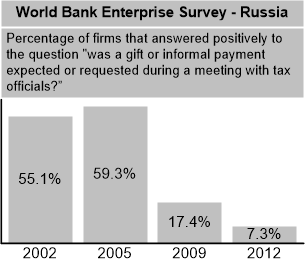
In 2000, Russia was one of the most corrupt countries in the world. Without instituting draconian purges Putin took on the oligarchs and steadily curtailed their power, gradually returning Russia to the rule of law. By 2016 his government reduced corruption to about the same level as that of the United States. That was the empirical result of the annual study on corruption published in 2016 by Ernst & Young.[2] The global auditing consultancy asked respondents around the world whether in their experience, corruption is widespread in the business sector. Their survey, which was conducted in 2014, indicated that only 34% of their Russian respondents thought so, the same proportion as in the United States, and below the world average of 39%. Things have probably improved further since then as Vladimir Putin stepped up a high-profile anti-corruption campaign that led to investigations and prosecution of a number of high level politicians around Russia. Even highly ranked members of Putin’s own political party were not spared.[3] The unmistakable message of such campaigns was that corruption would not be tolerated and that it would be aggressively investigated and prosecuted. Some of the best evidence that Putin’s various anti-corruption measures have had effect can be found in World Bank’s Enterprise Surveys which ask businessmen the question, “was a gift or informal payment expected or requested during a meeting with tax officials?” In 2005, nearly 60% of respondents answered affirmatively. By 2009 this number was 17.4% and by 2012 it had dropped to only 7.3%.
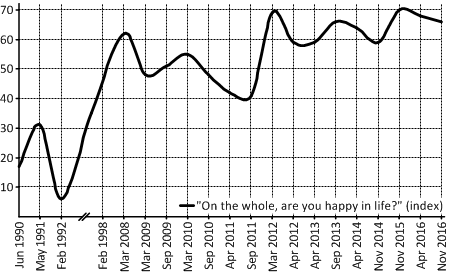
Putin’s government also made impressive advances in making it easier for entrepreneurs and small businesses to set up shop, raise capital and operate in Russia. According to World Bank’s annual “Doing Business” report, which ranks 190 world economies on a set of attributes such as the ease of starting a business, obtaining construction permits, obtaining electricity, raising credit, and enforcing contracts. On all the metrics combined, Russia managed to climb from 124th place in the world in 2012 to 40th in 2017.[4] Thus, within only five years, Russia had vaulted an impressive 84 positions in World Bank’s ranking. This was not a random achievement but the result of President Putin’s explicit 2012 directive that by 2018 Russia should be among the top 20 nations in the world for ease of doing business.
One of the strategically important sectors where Russia has made striking progress is its agricultural industry. After the disastrous 1990s when she found herself dependent on food imports, Russia again became self-sufficient in food production and a net food exporter. By 2014, Russian exports of agricultural products reached nearly $20 billion, almost a full third of her revenues from oil and gas exports. Not only is Russia now producing abundant food for its own needs, the government is explicitly favoring production of healthy foods, a strategy which includes a ban on the cultivation of genetically modified (GMO) crops, introduced by the State Duma in February of 2014. According to official Russian statistics, the share of GMO foods sold in Russia declined from 12% in 2004 to just 0.1% by 2014.
These and many other constructive reforms have had a very substantial impact on Russia’s economic aggregates as the following examples show:
Between 1999 and 2013, Russia’s gross domestic product (GDP) leaped nearly 12-fold from $1,330 per capita to more than $15,560 in 2013, outpacing even China’s remarkable economic growth.
Russia reduced its debt as a percentage of GDP by over 90%, from 144% in 1998 to less than 14% in 2015!
Gross national income per capita rose from $1,710 in 2000 to $14,810 in 2013.
Unemployment fell from 13% in 1999 to below 5% in 2014. Among the working population (those aged 15-64), 69% have a paid job (74% of men).
Only 0.2% of Russians work very long hours, compared to 13% OECD average
Poverty rate fell from 40% in the 1990s to 12.5% in 2013 – better than U.S. or German poverty rates (15.6% and 15.7%, respectively)
Average monthly income rose from around 1,500 rubles in 1999 to nearly 30,000 rubles in 2013.
Average monthly pensions rose from less than 500 rubles to 10,000 rubles.
Social and demographic improvements
Putin’s economic reforms included also a more equitable distribution of wealth. As hopelessness faded and standard of living improved, Russian society started to heal: suicides, homicides, and alcohol poisonings declined dramatically. Over the twenty-year period between 1994 and 2014, suicides declined by 56%, homicide rate by 73%, and alcohol poisonings by 83%!
The chart below shows the evolution of these improvements over time:
As we can see, these misery statistics rapidly deteriorated with the introduction of shock therapy in 1992, but the trend sharply reversed soon after Putin took charge. By 2014, these figures reached their lowest values since even before 1992. Along with these improvements, the nation’s demographic trends also experienced a dramatic turnaround. Russian life expectancy, which sunk to an average of barely 64 years (57 for men), rose steadily from the early 2000s to reach almost 72 in 2016, the highest it has ever been in Russia’s history.
Looking at the way life expectancy in Russia changed over time, we see again that it had collapsed in the early 1990s but the trend turned around sharply under Vladimir Putin’s leadership of the country. Similarly fertility rate, which dropped to 1.16 babies per woman in 1999, increased by almost 50% to 1.7 babies by 2012, comparing favorably to European Union’s average of 1.55 babies per woman of childbearing age. Abortions declined 88% from a harrowing 250% of live births in 1993 to 31% in 2013.
Not only are Russians living longer than ever before and enjoying much better quality of life, they also feel freer and happier. In 2014, Gallup Analytics reported that 65% of Russians, more than ever before, answered “Yes” when asked, “are you satisfied … with your freedom to choose what you do with your life?” Meanwhile, Russia’s happiness index rose more than tenfold, from 6 in 1992 to 70 in 2015. Happiness index, compiled by VCIOM[5] adds the proportion of the respondents reporting that they feel decidedly happy or generally happy and deducts those that report feeling generally unhappy or decidedly unhappy.
The next chart further corroborates the idea that under Putin’s leadership, Russia has been developing as a sane and prosperous society, not only for the benefit of a narrow ruling class and at everyone else’s expense, but for the vast majority of ordinary Russians.
By 2014, the great majority of Russians felt satisfied with their lives and believed that things in Russia were moving in the right direction. These figures only tapered off after the 2014 western-sponsored coup in Ukraine and the subsequent economic sanctions imposed on Russia. At the same time, the price of oil – still one of Russia’s largest export – collapsed from over $100 per barrel to under $40. Economic sanctions and the oil price collapse triggered a significant crisis in Russia’s economy. However, in spite of the continuing sanctions regime imposed on the country, its economy started improving again in 2016, thanks to its diverse industrial base that includes a developed commercial and consumer automotive industry, advanced aircraft and helicopter construction based largely on domestic technologies, world’s leading aerospace industry building satellites and top class rocket engines, and advanced industries in pharmaceutical, food processing, optical device, machine tools, tractors, software and numerous other branches. Indeed, Russia is far from being just the “Nigeria with missiles,” or a “gas station with an army,” as many western leaders like to characterize it.
Insofar as a population’s sentiment is a valid measure of its leadership’s performance, Russia’s development under Vladimir Putin stands in sharp contrast with the weak performance of most other developed nations, including those that most vehemently criticize Russia and its president. According to polls conducted by Ipsos Public Affairs in 25 different countries in November 2016 and published by the World Economic Forum, almost two thirds of the people in the world believed that their countries were moving in the wrong direction. The leading western nations scored just as badly, while some among them did flat out dismally.
Evidently, Russians feel much better about the way their nation is shaping up than do constituents of many western nations[6] whose sanctimonious leaders like to lecture their Russian counterparts about prosperity, freedom, democracy and other exalted values they purport to cherish.[7] It may thus only surprise the most credulous consumers of western propaganda that a high proportion of Russian people trust Vladimir Putin and approve his job performance. In the early 2017, Putin’s job approval stood between 80% and 90% and has averaged 74% over the eleven years from 2006. During this period, no western leader has come even close to measuring up with Vladimir Putin.
Over the years, I’ve heard depressingly many intellectuals attempt to dismiss Putin’s achievements and Russian people’s contentment as the product of Russian government propaganda. Putin the autocrat, you see, keeps such tight control over the media that he can deceive his people into believing that things in the country are much better than they really are. But the idea that government propaganda can influence public opinion in this way is just silly. If the majority of people thought their lives were miserable, state propaganda could not persuade them that everything is great. On the contrary, most people would conclude that the media is deceiving them and might feel even less positive about things as a result.[8] It is sillier still to think that western intellectuals should have a better appreciation of what it is like to live in Russia than the Russian people themselves. Rather than buying the truth from their media, such intellectuals would do well to take a trip and visit Russia, speak to ordinary people there, and reach their own conclusions. My own travels in Russia, as well as reports from other visitors largely agree with the positive picture that emerges from the statistics we’ve just examined.
Notes:
[1] (Gorbachev: Putin saved Russia from disintegration 2014)
[2] (Stulb 2016)
[3] Some of the names arrested in 2016 surprised even the Russian public as they included such high caliber individual as the Mayor of Vladivostok, Igor Pushkarev; Governor of the Kirov region, Nikita Belykh; Governor of the Sakhalin region, Alexander Khoroshavin, Deputy Minister of Culture Grigory Pirumov and Minister for Economic Development, Aleksey Ulyukaev.
[4] (Romer 2016)
[5] ВЦИОМ – Russian Center for Research on Public Opinion
[6] A different, Associated Press – GfK poll in July of 2016 uncovered an even darker public sentiment in the United States: “A stunning 79 percent of Americans now believe the country is heading in the wrong direction, a 15-point spike in the past year…” (J. Pace 2016)
[7] VCIOM’s figures for November 2016 are somewhat higher than those of Ipsos (62% vs. 58%).
[8] This, for instance, was the situation in the late 1990s when only 5 to 10 percent of Russians thought that the country was heading in the right direction in spite of the ruling elite’s nearly total control of the media.
Alex Krainer is an author and hedge fund manager based in Monaco. Recently he has published the book “Mastering Uncertainty in Commodities Trading“. The above article is an excerpt from his upcoming book (really, any day now…) whose working title is “The Killing of William Browder”
Israeli Ambassador to the U.S. Ron Dermer gives address Sept. 12, 2017 to Washington D.C. movers and shakers: Wolf Blitzer and other journalists, government officials, think tank heads, philanthropists – almost all with significant ties to Israel (see list below).
A select assembly of Washington D.C. heavy hitters recently attended a Rosh Hashanah event at which Israeli Ambassador to the U.S. spoke. Ron Dermer discussed alleged dangers posed by Iran, Syria, and Russia. In some places Dermer appeared to be laying out a rationale for another Israeli war.
According toJTA (Jewish Telegraphic Agency), the event is an annual affair “to which the embassy invites the U.S. Jewish leadership.” Dermer’s speeches typically seem intended to create a feeling of shared concern for Israel, saying, for example, “Let us all raise a glass and toast the fact that the Jewish people are voiceless no more. Israel has provided us with a shofar, with a sovereign voice among the nations.” Dermer himself was born and raised in the U.S.
Among those attending the invitation-only gathering this year were approximately 20 journalists, many connected to top U.S. print and broadcast media (including Wolf Blitzer, Eli Lake, Cliff May); numerous government officials and politicians (Congressmen, diplomats, White House insiders, senior staff, political operatives); and heads of major U.S. national organizations, philanthropists, and influential religious leaders (see list with biographical details below).
Dermer’s speech began on a convivial note – “Remember, on Rosh Hashana, you’re allowed to eat, drink and even laugh”– but soon became serious as he gave dire warnings about alleged dangers Israel faces, and the need for Americans to help.
Iran was the main villain to be protected against, with Syria and Russia allegedly dangerous abettors that also need to be addressed.
“The past year has posed many critical challenges for Israel,” Dermer intoned. “Foremost among those challenges has been the rising power of Iran.”
(This is very much in line with Israeli thinking; Israel’s Jerusalem Postnewspaper recently reported: “Iran is the primary target of the Mossad’s actions, which number in the hundreds and thousands each year.” Netanyahu reportedly calls the Mossad Israel’s “synchronized fist.”)
Dermer claimed that the Iran deal had been a “double jackpot” for Iran (many U.S. analysts disagree, including someIsrael partisans and top U.S. generals). Dermer charged that the deal had enabled Iran to spend “much of the past year consolidating its power across the Middle East.”
Next came the not-so-subtle call to action.
“Israel hopes that the coming weeks will bring about a dramatic change in the trajectory of that deal that will ultimately either fix it or cancel it,” Dermer said, making clear what was required of Americans who care about Israel.
Dermer and Debbie Wasserman Schultz at 2014 Israel Embassy Rosh Hashanah event; Dermer also warned about Iran at that event.
Dermer also focused on Syria, speaking of a potential Iranian “terror front against Israel” being established in Syria.
“Iran has been feverishly working to win the spoils of the imminent defeat of ISIS,” Dermer said, suggesting that such a defeat could be harmful to Israel.
Dermer’s statements reflect Israeli concern about U.S. efforts to end the war in Syria, leaving Russia, Assad – and by extension Hezbollah – in place. As JTA explains:
The Netanyahu government has been wary of what the end-game could be of U.S. efforts to end the war in Syria. There is a concern among Israelis — articulated most often by the defense minister, Avigdor Liberman — that the Trump administration might defer to Russia, which is allied with the Assad regime. Russia’s Assad alliance means it is in a de facto alliance with Iran and its Lebanese ally, Hezbollah, because they also are allied with the Assad regime.
Recent ongoing efforts in the U.S. to force the Trump administration to avoid diplomatic ties with Russia (despite the paucity of evidence for the accusations) may help remove that obstacle to keeping the U.S. in Syria.
Dermer said that Netanyahu had set “red lines” regarding Syria and that Israel will enforce them: “Israel will act to prevent Iran from supplying game changing weapons to Hezbollah. And Israel will act to prevent Iran from establishing another terror front against Israel in Syria.”
Israel has been stating these red lines for several years, and its escalating sabre rattling suggests that it may be planning another of its wars. Israel analyst Larry Derfner recently published an article entitled “A plea to Israel: Don’t start the third Lebanon War.”
Derfner states: “By continuing to bomb Syrian arms destined for Hezbollah – which Israel has admittedly done nearly 100 times in the last five years – as well as periodically killing Hezbollah and other pro-Syrian fighters along with the occasional Iranian general, Israel is making the next very, very ugly war in the north a self-fulfilling prophecy.”
A recent article in the very pro-Israel Atlantic (editor Jeffrey Goldberg served in the Israeli army) states: “for nearly two years now, Israeli military and intelligence officials have been warning every American official who comes through Tel Aviv and Jerusalem that the next war is coming. Israel has methodically prepared its allies—and most especially the Americans— for a very, very ugly war on the horizon.”
These wars have created massive carnage and suffering. even the Atlantic acknowledges that the 2006 Israeli assault “leveled entire neighborhoods in Beirut.”
Beirut, August 20, 2006. 1,100 Lebanese civilians died, 4,000 were injured, and over one million were temporarily displaced; 116 Israeli soldiers & 43 civilians died. Researchers found pro-Israel bias in U.S. media coverage of the war.
While Dermer tried to sell his audience on the claim that Israel is at existential risk, Derfner points out: “The idea that Hezbollah, Iran and Syria are itching for a war with Israel, that they’re just waiting to attack, is a delusion. Absent Israeli provocation, such an attack would have no parallel in the world or in history.”
Nevertheless, some influential media reports largely purvey Israeli spin, and it’s likely that Dermer’s speech was intended to influence the many journalists at his reception to take a similar line. As a Foreign Policy article reports: “When it comes to Washington, Israel’s task is to locate or induce a more coherent American strategy to counter advance of the Iranians in the Levant.”
This is particularly important, since some Trump officials don’t always march to the Israeli tune. U.S. National Security Advisor General H.R. McMaster recently told Israeli officials that Hezbollah was not a terrorist group. (Other reports claim he has called Israel an occupying power.)
Another point Dermer made to his audience was the value of U.S. strategies to help Israel bring some Arab countries into an alliance against Iran.
Dermer called the new allignment a “silver lining” and said he was “deeply grateful” to the current administration for “methodically working to advance a serious process that can move the entire region forward” – i.e. in Israel’s direction.
Dermer is no doubt pleased that, as in the past, the U.S. negotiator for Israel-Palestine is an Israel partisan; he called for applause for Jason Greenblatt, who he noted was present – one of the many “senior officials from all three branches of the U.S. government” attending the event.
Attendees
Jewish Insider provided a list of opinion makers spotted at the event, which included both liberals and conservatives, members of both political parties, and representatives of diverse positions along the pro-Israel spectrum. Below is the list, with added information on each.
We have listed each individual under one category below, although in many cases they would fit into several sectors given the revolving door that often exists between media, government, and pro-Israel organizations.
Journalists/Media Pundit
Wolf Blitzer, CNN lead political anchor, anchor of The Situation Room and Wolf. Blitzer began his career in 1972 with Reuters in Tel Aviv, before becoming a Washington DC correspondent for Israel’s Jerusalem Post. He also worked as editor of AIPAC’s monthly newsletter and edited “Myths and Facts 1976, A Concise Record of the Arab-Israeli Conflict” (Near East Research, AIPAC’s monthly publication), a volume described by Mondoweiss as “one piece of Zionist propaganda after another [that] denounced Palestinian views of [events surrounding the 1948 war] as ‘spurious myths.’”
Blitzer authoredBetween Washington and Jerusalem: A Reporter’s Notebook (Oxford University Press, 1985) and Territory of Lies (Harper and Row, 1989), about Israeli spy Jonathan Pollard, of which reviewer Robert I. Friedman wrote in the New York Review of booksthat Blitzerplayed down the damage caused by Pollard. Friedman stated: “Senior Israeli Defense Department officials are understandably pleased with Blitzer’s book about Pollard.” Friedman reported: “Currently, he travels the American TV talk show circuit as the ‘voice of Israel.’ Territory of Lies is a slick piece of damage control that would make his former employers at AIPAC (not to mention Israel’s Defense Ministry) proud.”
In 1990 Blitzer went to CNN, where his career skyrocketed. During Israel’s 2014 invasion of Gaza, Blitzer covered the conflict by embedding with the Israeli army. As part of “the most trusted name in news,” he maintains a pro-Israel bias (see this and this, for example). In 1989 he took part in a debate in which he largely repeated Israel’s talking points.
Sam Feist, CNN Washington Bureau Chief and senior vice-president. He oversees daily operations, leads all newsgathering and Washington-based programming, as well as campaign and election coverage. Feist was the founding executive producer of Wolf Blitzer’s The Situation Room, and has produced and managed CNN political programming including Crossfire, The Capital Gang, and State of the Union. He has been with CNN since 1991.
Danielle Heyman Feist, wife of Sam Feist. Director of Camp Rodef Shalom, a Virginia day camp that has a number of activities related to Israel, including a program in which scouts from Israel “run their own specialty area during camp, playing Israeli games, teaching a few Hebrew words, and helping bring their Israeli culture all the way to Virginia!”
Howard Friedman is director of Sinclair Media, the nation’s largest owner of local TV stations. He has served on the board of pro-Israel lobbying organizations such as AIPAC.
Howard Friedmanhas served on boards for many foundations, including the American Israel Public Affairs Committee (AIPAC) and the Union of Orthodox Jewish Congregations of America (which advocates for Israel and brought “tens of thousands” of its members and “hundreds of rabbis” to lobby Congress against the Iran deal). He was twice named by Washington Life Magazine as one of the 100 most powerful people in Washington DC. Formerly he was President of JTA – The Global News Service of the Jewish People.
Perhaps most significantly, Friedman is currently Director of the Sinclair Broadcast Group, the nation’s largest owner of local TV stations, and likely to become even larger, as it is in the process of buying Tribune Media for $3.9 billion.
Sinclair insists on conservative content on its local news programs, and even produces its own commentary pieces as “must-run” segments on every one of its stations . These include a daily “Terror Alert Desk” segment, which was recently exposed by political humorist John Oliver as an occasional vehicle for conflating terrorism with Islam. The “newscasters” include regulars from the Fox News Channel (like Sara Carter), contributors to conservative publications like the Washington Examiner (like Mark Hyman), and at least one former Trump staffer (Boris Epshteyn – see below).
Sinclair already owns 170 TV stations, which gives it access to 38% of American households—just shy of the cap of 39% put in place by Congress in 2004. Tribune Media is set to hand over another 42 stations (which includes stations in New York City, Chicago, Los Angeles), which would give Sinclair access to a full 72% of US households—nearly double what is allowed by law. This was made possible thanks to a move by Trump-appointed FCC Chairman Ajit Pai. Pai, heir apparent to the chair of the FCC, was wooed by Sinclair starting right after Trump’s election. Soon after his appointment, Pai unexpectedly revived an outdated regulatory loophole. About two weeks later, Sinclair announced its acquisition of Tribune.
Norman Eisencurrently works with think tank Brookings Institution, does political commentary on CNN, and chairs Citizens for Responsibility and Ethics in Washington (CREW), a Democratic Party leaning nonprofit he co-founded in 2003 with Louis Mayberg, a financier who donates to Jewish causes (his wife says: “I invest in Jewish people” and partners with the Israeli Ministry of the Diaspora to bring thousands of women from 25 countries on visits to Israel). Previously, Eisen served as special council for ethics and government reform to President Obama. From 1985 to 1988, he was Assistant Director of the ADL’s Los Angeles office, where he investigated anti-semitism and other civil rights issues, promoted Holocaust education, “and advanced US-Israel relations.” He backed Tom Perez over Keith Ellison for Democratic National Committee chair, citing Perez’ “warm feelings for Israel.” As a student he had worked for Israel partisan Alan Dershowitz, who once said: “Our union was made in heaven. He was a natural guy for me to hire because he was brilliant and shared many of the same liberal democratic, pro-Israel values that I did and that he still represents.”
Eisen has also served as U.S. Ambassador to the Czech Republic, during which time bilateral trade between the U.S. and the Czech Republic almost doubled. Earlier in his career he was a partner in the Zuckerman Spaeder law firm, where he worked on cases such as Enron and Whitewater. Washingtonian Magazinelisted Eisen as one of Washington’s top lawyers.
Talk show host Tom Rose (right) volunteered for the Israeli military during the first Gulf War. In 2014 he travelled to Israel with his longtime friend Mike Pence (left), in the company of Ambassador Dermer.
Tom Rose, journalist and unofficial Vice Presidential surrogate. Formerly editor/publisher of the Jerusalem Post, during which he and his family lived in Israel. Although he is an American citizen, during the Gulf War he volunteered for service in the IDF. More recently, he has co-hosted a Sunday morning satellite radio program with conservative Christian Gary Bauer. Their show, The Bauer & Rose Show, is known for its “robust defense of Judeo-Christian civilization, the US/Israel alliance, and the need for a strong America in the world.” The show ended in April 2017 when Rose took a position as assistant and advisor to Vice President Mike Pence, Rose’s “closest personal friend for 25 years.” In 2014, Rose and Pence visited Israel together, in the company of Israel’s Ambassador to the US, Ron Dermer.
Kenneth Weinstein, President and CEO of the Hudson Institute, which honored PM Benjamin Netanyahu with the Herman Kahn Award (see Roger Hertog entry below)—which is conferred on “leading public servants who exemplify a commitment to Western alliances as the bedrock of global security, prosperity, and freedom.” Hudson “seeks to guide public policy makers and global leaders in government and business.” It frequently holds conferences on topics such as defense, international relations, and economics (dozens of which have been pro-Israel) and disseminates research and analysis articles (hundreds of which have been pro-Israel). Weinstein is President and CEO of the Broadcasting Board of Governors (BBG), whose mission is “to inform, engage, and connect people around the world in support of freedom and democracy.” BBG oversees U.S. government civilian international media: Voice of America, Radio Free Europe, Office of Cuba Broadcasting, Radio Free Asia, Middle East Broadcasting Networks.
AP reporter Josh Lederman began his journalism career working in Israel, where he had spent a year as a child. He credits that year and his attendance at Tucson Hebrew Academy, whose core values include “supporting Israel,” with informing his reporting.
Josh Lederman, Associated Press reporter; started his journalism career in the AP Jerusalem bureau; he had previously lived in Israel in seventh grade (it is unknown whether he has Israeli citizenship). Lederman credits that year, combined with his education as student at Tucscon Hebrew Academy (among its “Core Values” is “Supporting Israel: We support Israel and foster close relationships with Israeli students and educators”) with helping him “connect the dots” as he reported on Israel. Now based in Washington DC, Lederman covers foreign affairs, national security and U.S. diplomacy for AP ; appears frequently on television and radio, including on MSNBC, Fox News, NPR and others. He covered 2012 presidential campaign for The Hill newspaper in Washington. From 2013 to 2017, Lederman was a White House reporter for AP. He also writes for the Times of Israel.
Media pundit Cliff May founded Foundation for Defense of Democracies (FDD), a neoconservative organization created “to enhance Israel’s image in North America.”
Clifford D. May, weekly “Foreign Desk” columnist of The Washington Times, and frequent analyst on diverse TV and radio news programs. His articles have appeared in the Wall Street Journal, National Review, Commentary, USA Today, The Atlantic and other publications. May is the founder of the Foundation for Defense of Democracies (FDD), a pro-Israel neoconservative organization – May said its purpose was “to enhance Israel’s image in North America.” Some suggested it was the new Project for a New American Century. Right Web reports:
FDD grew out of a right-wing pro-Israel initiative launched in early 2001 called EMET. Reports Slate: “On April 24, 2001, three major pro-Israel donors incorporated an organization called EMET (Hebrew for ‘truth’). In an application to the Internal Revenue Service for tax-exempt status, [FDD president Clifford May] explained that the group ‘was to provide education to enhance Israel’s image in North America and the public’s understanding of issues affecting Israeli-Arab relations.’”[3]
“… Shortly after its founding, FDD quickly became a prominent member of a group of neoconservative think tanks and advocacy groups—including the American Enterprise Institute and the Hudson Institute—that were influential in shaping the early foreign policy priorities of the George W. Bush administration. At the height of the “war on terror,” FDD also absorbed the Committee on the Present Danger, a Cold War-era anticommunist group that been reconstituted to push for hardline policies in the Middle East.”
“FDD’s president, Clifford May, is a former writer for the New York Times who once served as director of communications for the Republican National Committee. May is also a former editor of the party’s official magazine (Rising Tide), a former vice chair of the Republican Jewish Coalition, and a member of the Committee on the Present Danger.”
“FDD has been a vocal advocate of confrontational policies on Iran.”
Slate reports that FDD runs tours of Israel for American academics (with most of their expenses paid) similar to those run for journalists and politicians by AIPAC and other groups.”
May was an advisor to the Iraq Study Group; served on the Advisory Committee on Democracy Promotion (2007-2009), reporting to Secretary of State Condoleezza Rice; served on the Broadcasting Board of Governors, the entity responsible for all U.S. government and government sponsored, non-military, international broadcasting; and on the U.S. Commission on International Religious Freedom (2016).
Evan May, bio is unavailable, probably relative of Cliff May.
Boris Epshteyn, an investment banker; born in Russia and came to the U.S. in 1993 at the age of 11. Previously, he worked on Sen. John McCain’s 2008 presidential campaign. He was a top communications aide for Donald Trump’s campaign; appeared as a Trump surrogate over 100 times on major TV networks between the election and the inauguration. In April, Epshteyn left the White House and became chief political analyst for Sinclair Broadcast Group (see Howard Friedman, above), a conservative company that owns a multitude of local TV stations.
Journalist Eli Lake speaks at event organized by the Foundation for Defense of Democracies, Aug. 13, 2014. Observers describe him as a neoconservative “pro-Israel” ideologue.”
Eli Lake, Bloomberg journalist, former senior national security correspondent for The Daily Beast and Newsweek. He worked for a range of news outlets, including The Daily Beast, Newsweek, The Washington Times, The New Republic, New York Sun. Lake has often worked with and shared bylines with Josh Rogin (see entry below); known as extremely pro-Israel. Below are exerpts from Right Web:
Eli Lake is a well-known writer and columnist whose track record on U.S. foreign policy has led some observers to describe him as a neoconservative and “pro-Israel” ideologue. …
His writings focus on national security issues, particularly with respect to the Middle East, and he has a lengthy record of advocating for aggressive U.S. foreign policies in the region. One commentator has quipped that Lake has a “career pattern of credulously planting dubious stories from sources with strong political agendas.”
A frequent subject of Lake’s writings is U.S. policy on Iran. Generally hawkish in his critiques of U.S. engagement with Tehran… most observers agree [that his analysis] is really intended to kill negotiations…
After a nuclear agreement was reached between Iran and the P5+1 in July 2015, Lake went on the attack…. In a March 2015 commentary, Lake criticized Iran’s foreign minister Javad Zarif, a Western educated diplomat widely regarded as a moderate within Iran’s establishment… Former British diplomat Peter Jenkins criticized Lake’s article on Zarif as taking “many liberties with the truth.”
… Lake was “an open and ardent promoter of the Iraq War and the various myths trotted out to justify it, contributing to the media drumbeat that helped the Bush Administration sell the war to the public and to Congress.” Leading up to the 2003 U.S.-led invasion of Iraq, Lake reported extensively on Saddam Hussein’s alleged weapons mass destruction and ties to Al-Qaeda…
After the war and the subsequent failure to discover any weapons of mass destruction in Iraq, Lake contended that the weapons had been moved to Syria…
In a December 2001 article for the National Review, Lake argued that with its invasion of Afghanistan completed, the United States should move on to take military action against Iraq, Yemen, and Somalia. “There are very good arguments why all three should be the next target,” he opined. “Iraq after all has been developing nuclear and biological weapons …
In 2009, Lake gained notoriety for his role stirring up opposition to the nomination of Chas Freeman, a veteran diplomat and former U.S. ambassador to Saudi Arabia, to be the chairman of the National Intelligence Council. Freeman ultimately withdrew his name from consideration and blamed the controversy over his nomination on the “Israel lobby.”… [See Freeman’s statement.]
Josh Rogin, Journalist who often works closely with Eli Lake, sharing bylines on news articles. He is a CNN political analyst and columnist on foreign policy and national security for Bloomberg View. Previously, Rogin covered foreign policy and national security for Newsweek, The Daily Beast, Foreign Policy, The Washington Post, Federal Computer Week and Japan’s Asahi Shimbun. His work has been featured on CNN, FOX, MSNBC, ABC, NBC, NPR, PBS, and several other outlets. He is married to Ali Weinberg (see below); their wedding guests included journalists Eli Lake, CNN’s Wolf Blitzer, CNN’s Jake Tapper, NPR’s Michael Goldfarb, NBC News Political Director and Meet the Press host Chuck Todd, Jamie Kirchick, Jonathan Karl, and NBC’s Alex Moe.
Ali Rogin (aka Ali Weinberg), ABC journalist, married to Josh Rogin. She is the daughter of Max Weinberg (see below). Her Linkedin entry reports that she covers the State Department for ABC News, producing pieces for broadcast and reporting for ABCNews.com and ABC News Radio. She formerly worked at NBC.
Max Weinberg, Drummer for Bruce Springstein and on Conan O’Brian show, father of journalist Ali Rogin (see above). His net worth is reportedly $35 million.
Joel Mowbray, Fellow, Foundation for Defense of Democracies, 2005-2014; formerly syndicated columnist with articles in Wall Street Journal, Washington Times, NY Post, The New Republic, L.A. Times, Philadelphia Inquirer, Atlanta Journal-Constitution, San Diego Union Tribune, Las Vegas Review Journal, Sacramento Bee, Pittsburgh Post-Gazette, Investors Business Daily, Arizona Republic, San Francisco Chronicle, and FoxNews.com. In 2002, Mowbray founded Fourth Factor Consulting, LLC: “Fourth Factor advises Silicon Valley tech companies and pro-Israel and national security-oriented think tanks. The bulk of the work is strategic government affairs, which supplements lobbying efforts by being proactive instead of reactive.” He was a Hudson Institute Adjunct Fellow from 2003 – 2005, where he “conducted research into terror networks and Islamic radicalization, investigated Saudi influence in America, and scrutinized State Department’s handling of national security.” Mowbray is the author of Dangerous Diplomacy: How the State Department Threatens America’s Security.” His Linkdin bio lists AIPAC as one of his interests.
Rabbi Shmuley Boteach at the 2012 “Christians United for Israel” conference. Newsweek lists Boteach as one of America’s “most influential rabbis.”
Rabbi Shmuley Boteach, founder of The World Values Network, “the leading organization spreading universal Jewish values and defending Israel in American media” (see video); frequent guest on CNN, Fox News, MSNBC, the BBC, NBC, CBS, as well as The New York Times, The Wall Street Journal, Time Magazine, Breitbart News, and The Washington Post. Rabbi Boteach’s personal site pictures him with his book: “The Israel Warrior: Fighting Back for the Jewish State from Campus to Street Corner.” Newsweek has repeatedly listed him in “The 50 Most Influential Rabbis in America. He ran for Congress in New Jersey, receiving an endorsement from House Majority Leader Eric Cantor. His site states:
“Rabbi Shmuley Boteach, “America’s Rabbi,” whom is for many the very face of Judaism in global media.
“The international best-selling author of 31 books, Rabbi Shmuley’s works have been translated into 20 languages. A world-renowned relationships expert, his book Kosher Sex is regarded as a modern classic and he has won numerous awards including The London Times Preacher of the Year Competition, The National Fatherhood Award, and The American Jewish Press Association’s Highest Award for Excellence in Commentary…
“Labeled ‘a cultural phenomenon’ by Newsweek and a man with ‘his scholarly finger on the pulse of the nation’ by Slate, Rabbi Shmuley is revolutionizing the place of Judaism and spirituality in modern culture and politics, and is one of the world’s most accomplished defenders of the State of Israel.”
At the 2015 Israel Day Concert In New York City Boteach said, to loud applause: “We are connected to Israel because it’s Jewish… we love Israel because Israel is good. We love Israel because it is the foremost protector of human rights in the world’s most troubled region. There is a war going on. There is a battle for the future of the Jewish state and each and every one of you is a soldier in that fight.”
Noah Pollak, Pollak’s bio describes him as a “political writer on foreign policy, Israel, and the Jewish people.” Pollak has written for Commentary, the Weekly Standard, National Review, the Wall Street Journal, Politico, and appeared on Fox News, PBS Newshour, and CNN. He is executive director of the Emergency Committee for Israel, a neoconservative political advocacy organization whose board members include neocons William Kristol and Rachel Abrams, wife of Elliott Abrams. Pollak helped promote the Taylor Force Act.
Ron Kampeas’ Linkedin entry reports: “Ron Kampeas is JTA’s [Jewish Telegraphic Agency ] Washington bureau chief, responsible for coordinating coverage in the U.S. capital and analyzing political developments that affect the Jewish world. He comes to JTA from The Associated Press, where he worked for more than a decade in its bureaus in Jerusalem, New York, London and, most recently, Washington. He has reported from Northern Ireland, Afghanistan, Bosnia and West Africa. While living in Israel, he also worked for the Jerusalem Post and several Jewish organizations.” Kampeas graduated from Hebrew University of Jerusalem.
Nathan Guttman, theForward’s Washington bureau chief. He joined the staff in 2006 after serving for five years as Washington correspondent for the Israeli dailies Ha’aretz and The Jerusalem Post. Guttman was born in Canada and grew up in Israel. He is a graduate of Hebrew University.
Government, Politics
Congressman Eliot Engel has been in Congress since 1988 as a Democrat representing the Bronx. He has traveled to Israel many times, and says, “I remain committed to the unbreakable bond between the United States and Israel.” On another occasion, he opined, “We don’t want one party to be pro-Israel; we want both parties to be pro-Israel” because the state is “our best friend in the Middle East, and – I’d even argue – in the world.” Engel favors recognition of Jerusalem as the undivided capital of Israel, and is uncritical in his support.
Congressman Lee Zeldin (right), member of the House Foreign Affairs Committee and Co-Chair of the House Republican Israel Caucus, meets in his Washington, DC office with Yoav Kisch, member of the Israeli Knesset, Feb. 1, 2017.
Congressman Lee Zeldin previously served in the New York State Senate, and is now in the U.S. House of Representatives. As Co-Chair of the House Republican Israel Caucus, he spoke on the issue of the U.N. “anti-Israel resolution” of December 2016: “Pro-Palestinian, anti-Israel nations are continuing their fanatical efforts at the United Nations to delegitimize [Israel]… Their disparaging, divisive and dangerous tactics will be met with zero tolerance. Continued unilateral concessions by Israel in exchange for no promises or follow through towards peace on the part of others would be as ill-advised as it is unfeasible.” Zeldin also wrote, regarding the U.N. resolution, that it “further cements President Obama’s legacy as one of the worst presidents in the history of the United States… [He] chose to embrace a pro-Palestinian attempt to ethnically cleanse East Jerusalem and Judea and Samaria.” Zeldin is also passionately in favor of moving Israel’s capital to Jerusalem.
Congressman Henry Waxman, Democratic Congressman from southern California, 1975 – 2015. The Forward calls him “one of the most influential liberals, and one of the most skilled legislators, of his generation.” In the Times of Israel report, “Jewish lawmaker, who maintains close ties to Israel, has represented Los Angeles district for 40 years,” Waxman was named “the dean of Jewish lawmakers in the U.S. House of Representatives.”
Waxman said that he had “worked throughout my career to strengthen the US-Israel relationship. I have traveled to Israel on numerous occasions…” Waxman once stated: “…it is with pride that I have seen my daughter thrive in Israel and my grandchildren serve in the Israeli army.”
Janet Kessler, Waxman’s wife; founder of Congressional Wives for Soviet Jewry.
Jason Greenblatt, formerly executive vice president and chief legal officer to Trump and the Trump Organization, and his advisor on Israel; currently special envoy to the Israeli-Palestinian peace process for President Trump, charged with facilitating “the ultimate deal.” According to NPR, Greenblatt once studied in a yeshiva – a Jewish religious seminary – in a West Bank settlement. He has recently met with senior settler leadership in preparation for negotiations. In fact, Greenblatt and Trump’s administration are more sympathetic toward settlements than any previous administration, much to the delight of Israel. The Palestinian Authority, on the other hand, is not optimistic: Greenblatt has yet to even commit to helping create a Palestinian state.
U.S. Secretary of Veterans Affairs David Shulkin (left) meets with Israeli Deputy Defense Minister Eli Ben-Dahan, March 2017. The Israeli government has used Shulkin to build a closer relationship between Israel and the U.S. After the meeting, the VA purchased medical equipment from an Israeli company.
David Shulkin, current U.S. Secretary of Veteran Affairs; he was recommended to President Trump by U.S. Ambassador to Israel David Friedman, even though Shulkin is not a veteran. (Veterans had wanted the position to be filled by a military veteran, the normal procedure; some lobbied for then VA Secretary Robert McDonald to be named.) Israel sees veterans affairs as a new means of bringing the U.S. and Israel closer together, as JNS (Jewish News Service) reports: “While US-Israeli military ties have long focused on foreign aid packages, intelligence-sharing and jointly developed missile defense technology, veterans affairs could become a major new frontier in that relationship.” JNS writes that the selection of Shulkin, “a Jewish doctor and administrator,” for Secretary of veterans affairs, was an important development in the process. Within weeks of Shulkin’s confirmation, the Israeli Deputy Defense Minister asked Shulkin for a meeting. The meeting was the first of its kind between American and Israeli officials responsible for the care of injured and released soldiers. After the meeting, Veterans Affairs purchased Israeli medical equipment. U.S. officials sometimes provide Israelis the opportunity “to make presentations during international conferences at which Israel is not yet participating.” JNS notes: “Such opportunities will allow the Israelis to showcase their knowledge on a world stage to which they have, until now, largely been denied access.’
Shulkin and his wife Merle Bari (below) are currently under investigation for taxpayer funding of a recent trip to Europe.
Merle Bari, wife of David Shulkin, physician specializing in general and cosmetic dermatology. Recently she has been criticized for reports that “the government covered the cost of Bari’s airfare and gave her a per diem for meals” when she accompanied her husband on a trip to Europe. She seems to have close ties to Israel. In 1977 Bari was a youth participant in Israel’s Maccabiah Games, and in 2013 her daughter similarly participated in the Games during a year she spent in Israel, and was a delegate to the AIPAC national convention.
Aaron David Miller worked at the State Department for 25 years as a Middle East negotiator and adviser on Arab-Israeli affairs. He is currently a vice president at the Wilson Center; he says he believes “in the importance of a strong U.S.-Israeli relationship.” In an article for the Washington Post Miller admitted that he and other U.S. mediators had actually like “Israel’s lawyer.”
“With the best of motives and intentions, we listened to and followed Israel’s lead without critically examining what that would mean for our own interests, for those on the Arab side, and for the overall success of the negotiations. The “no surprises” policy, under which we had to run everything by Israel first, stripped our policy of the independence and flexibility required for serious peacemaking.”
“What we ended up doing was advocating Israel’s positions before, during and after the summit.”
Matt Nosanchuk wasJewish Liaison under Obama; said he had very strong relationships with pro-Israel organizations across the political spectrum. He has worked in the White House, Congress, the State Department, Justice Department, and Homeland Security on a range of domestic and foreign issues arising at the intersection of policy, law, advocacy, legislation, strategic communications, and outreach and engagement. He described President Obama’s views (and said he agreed with them):
“The president [Obama] said he wouldn’t be where he is today without the support of the Jewish community in Chicago. He believes in Zionism. He believes we have shared values. He shows strong, unwavering support for Israel. He says he did the Iran deal partially to protect Israel’s security, that it would be a ‘moral failing’ not to protect Israel’s security.”
(L-R) Aaron Keyak, William Daroff and Steve Rabinowitz at the launch of Bluelight Strategies, a consulting group at the “nexus of political Washington and the Jewish and pro-Israel world.” Keyak was previously a senior Congressional staffer and executive director of the National Jewish Democratic Council.”
Aaron Keyak, Co-owner of a Washington DC PR firm; he was a senior staffer for some Congressional representatives and communications director and interim executive director for the National Jewish Democratic Council. Keyak has said that strengthening the U.S.-Israel relationship is one of the values he most cares about. Washington Jewish Weekreported about the 2015 launch of Keyak’s public relations firm:
“The official announcement was made at the “Latkes & Vodkas” party at their swanky downtown office on Dec. 15. Steve Rabinowitz, founder and president of the mostly progressive and Judeocentric Washington, D.C.-based political public relations firm, Rabinowitz Communications – the former Clinton White House staffer who produced the famed photograph of Israeli Prime Minister Yitzhak Rabin and PLO leader Yasser Arafat shaking hands on the White House South Lawn – would no longer be flying solo. Aaron Keyak, 29, would become his partner in a new PR company called “Bluelight Strategies.”
“… recently, communications director and senior Middle East policy advisor for Jewish Rep. Jerry Nadler (D-N.Y.), who represents one of the most heavily Jewish districts in the country. He previously served in a similar role with Rep. Steve Rothman (D-N.J.).
“According to Keyak, the idea for the partnership arose out of the successful working relationship he and Rabinowitz enjoyed during the 2012 presidential election, when the two collaborated on a venture they called the “Hub,” an effort aimed to organize Jewish voters for Democratic candidates.”
Avi Goldgraber, wife of Aaron Keyak, is manager at Accenture; previously she was confidential secretary to Deputy Secretary, Department of Health and Human Services. Goldgraber attended Israel’s Hebrew University of Jerusalem, received her B.A. from Washington University in Political Science and Jewish, Islamic, and Near Eastern Studies. She is the daughter of Moshe B. Goldgraber who endowed a fellowship for Israeli physicians.
Josh Raffel currently leads the communications team for Jared Kushner and is his principal spokesman. Raffel is “often the primary route for delivering Mr. Kushner’s message to the news media, and he also handles communications on issues like Israeli-Palestinian negotiations.” He was formerly a publicist, whose clients included Hollywood horror films, Glenn Beck, and Jared Kushner’s family business.
Top Democratic strategist Ann Lewis declared that “the role of the president of the United States is to support the decisions that are made by the people of Israel.”
Ann Lewis, leading Democratic Party strategist and communicator. In one public meeting of Jewish leaders before the 2008 election, Lewis declared that “the role of the president of the United States is to support the decisions that are made by the people of Israel. It is not up to us to pick and choose from among the political parties.” This was after some discussion that “there’s something wrong with Senator Obama’s views about Jews, about Israel” – referring to Obama’s pastor, Rev. Jeremiah Wright’s, preaching that Israel is committing “state terrorism against the Palestinians,” as well as Obama’s apparent sympathy for Palestinians. Lewis’ pro-Israel clout as leading Democratic Party strategist and communicator is clear in how she was able to change the Israel policy of the Center for American Progress, a powerful progressive research and advocacy organization. She made it clear that criticism of Israel, AIPAC, and American Jewish groups is forbidden. CAP was quick to self-censor, removing or cleaning up tweets and articles.
David Milstein, Research Analyst for Senator Ted Cruz (R-TX), primarily focusing on issues related to Israel. “He played a leadership role with an organization called Young Jewish Conservatives whose mission is to build a community of politically conservative young Jews who strongly support Israel; co-organized its annual Shabbat Event at the Conservative Political Action Conference (CPAC), the largest annual gathering of conservative activists.”
ThinkTanks, NGOs, Funders
Morton Klein has been national president of the Zionist Organization of America for 24 years. When President Obama abstained from voting in the U.N. Security Council resolution condemning Israeli settlements, Klein opined, “Obama has made it clear that he’s a Jew-hating anti-Semite.” He agreed with candidate Trump’s plan for profiling Muslims: “We should adopt the same profiling policies as Israel and be more thorough in vetting Muslims,” adding, “it’s not the worst thing to do.” Klein criticized Secretary of State Rex Tillerson for using the word “Palestine,” claiming that it sends a message to the Arab world that “this administration is biased to their side.” Going even further, Klein called for Tillerson to be fired when the State Department published its annual terror report, which suggested (as it had the previous year) that Israeli settlements and Palestinian hopelessness are factors contributing to Palestinian terrorism. Klein indicated that the State Department had “put out reports that give excuses for Palestinian murder of Jews.” The ZOA organized a letter opposing the Iran deal.
Abe Foxman worked at the Anti-Defamation League (ADL) for 50 years. After retiring he joined Israel’s Institute for National Security Studies (INSS).
Abe Foxman, former National Director of the Anti-Defamation League; currently ADL National Director Emeritus and fellow atIsrael’s Institute for National Security Studies (INSS), a Tel Aviv-based think tank for issues of security and Middle East policy. He is also head of the Center for the Study of Anti-Semitism at the Museum of Jewish Heritage in New York City. Foxman is known as the “Jewish Pope” thanks to his 28-year leadership of the Anti-Defamation League. INSS director Amos Yadlin called him “an undeclared leader of the American Jewish community and a leading global figure on matters of human dignity and moral conduct.” Foxman believes that the BDS movement is anti-Semitic “99% of the time.”
Stacy Burdett, Vice President, Government Relations, Advocacy & Community Engagement at Anti-Defamation League. He has participated in the international campaign to change the definition of anti-Semitism to include many statements about Israel.
Loribeth Weinstein, CEO of Jewish Women International (JWI) for over 15 years. JWI works to “end violence, ensure economic security, and spotlight leadership and mentoring.” She has also served American Jewish World Service, dedicated to “ending poverty and promoting human rights in the developing world.” Weinstein has also been on the Regional Council of the New Israel Fund, which includes as its mission statement, achievement of “equality for all the citizens of the state… protection of Palestinian citizens… opposition to all forms of discrimination and bigotry… a just society at peace with itself and its neighbors.” The New Israel Fund has supported B’tselem to the tune of $2.2 million over the last ten years.
Howard Kohr, executive director of the American Israel Public Affairs Committee (AIPAC). Analysts write: “AIPAC, which is a de facto agent for a foreign government, has a stranglehold on the U.S. Congress.”
Howard Kohr, executive director of AIPAC since 1996. Under his supervision, Congresspeople have been given all-expenses-paid trips to Israel to “discover their own personal connection to the land…and to understand the issues more clearly.” Kohr has turned AIPAC into “the most influential foreign policy lobbying organization” in Washington, and promises to keep it that way with the help of 4,000 pro-Israel student leaders across the country. “Mr. Kohr [representing AIPAC] has helped to navigate congressional passage of the annual U.S. Foreign Aid bill by historic, record-breaking margins — accomplishments achieved often in the midst of a hostile, budget-cutting environment.”
In his testimony to Congress in April 2017, as Kohr requested $3.1 billion in foreign military aid, he reminisced about the “close strategic relationship between the United States and Israel” that began with sharing of key intelligence in 1967 – the same year that Israel attacked the USS Liberty with napalm, gunfire, and missiles, even machine-gunning three lifeboats. The Moorer Commission found that the attack constituted “an act of war against the United States.” Professors John Mearsheimer of the University of Chicago and Stephen Walt of Harvard state: “AIPAC, which is a de facto agent for a foreign government, has a stranglehold on the U.S. Congress.”
Fortune magazine has ranked AIPAC the number two most powerful lobbying group in Washington D.C., after the American Association of Retired Persons (AARP)
Bob Cohen, Chairman of the Board of Directors of AIPAC (American Israel Political Affairs Committee), former President of AIPAC (2014). Cohen is considered one of AIPAC’s six key leaders.
Jason Isaacson of the American Jewish Committee (AJC) speaks at the National Leadership Assembly for Israel at the National Press Club, July 28, 2014. (Video here.)
“Around the world—from the hallways of the U.N. in New York, to the corridors of the European Union in Brussels, and to the countries of Asia—AJC advocates for Israel at the highest levels. And when Israel is under assault, whether from the terrorist organizations on her doorstep or the global BDS movement, AJC helps bring the world the truth about Israel.”
The AJC is an American nonprofit organization. Donations to it are tax-deductible.
Daniel S. Mariaschin, CEO of B’nai B’rith International, “a national and global leader in…Israel advocacy.” His B’nai B’rith bio reports: “Mr. Mariaschin has met with countless heads of state, prime ministers, foreign ministers, opposition leaders, influential members of the media and clerical leaders. Each time, his goal has been to advance human rights, help protect the rights of Jewish communities worldwide and promote better relations with the state of Israel.” Mr. Mariaschin represented the organization at numerous international conferences, many of which helped to establish a new, Israel-centric definition of anti-Semitism, including the International Conference on Holocaust Education, Remembrance and Research; and the State Department’s 1998 Washington Conference on Holocaust-Era Assets. Mariaschin served as part of the U.S. delegation to the Organization for Security and Co-operation in Europe (OSCE) conference on anti-Semitism in Vienna in 2003; was public advisor to the U.S. delegation at the 2004 conference in Berlin, the 2005 conference in Cordoba, Spain, and the 2007 meeting in Bucharest, Romania. In 2009 he was a member of the U.S. delegation to the Warsaw Human Dimension Implementation meeting of the OSCE.
Mariaschin began his professional Jewish life in 1973 as community relations associate for the Jewish Community Council of Boston. Two years later, he became director of the New England office of the American Zionist Federation and Zionist House in Boston. In 1977, he joined the Anti Defamation League (ADL) of B’nai B’rith as director of its Middle East Affairs Department. From 1979 to 1986, he served as assistant to ADL’s national director, the late Nathan Perlmutter, and as director of its National Leadership division, responsible for ADL’s nationwide program of leadership development. He then became director of the Political Affairs Department of the American Israel Public Affairs Committee (AIPAC), where he supervised political action activities and grassroots organization programs.
Prior to joining B’nai B’rith, Mr. Mariaschin served as director of communications and principal spokesman for former Secretary of State Alexander M. Haig, Jr. during his 1987-88 presidential campaign.
Mariaschin has written numerous articles for such publications as The New York Times, The Wall Street Journal, Los Angeles Times, Chicago Tribune, The Washington Times and Newsday, and appears frequently as a foreign affairs analyst on television and radio programs. He has lectured on foreign and defense affairs at the U.S. State Department’s Foreign Service Institute, the Marine Corps Command and Staff College, and at other military installations across the country. He has also worked as a radio announcer and news commentator and has lectured widely in the U.S. and abroad.
Rabbi Levi Shemtov, Shemtov has been called “the rabbi of Capitol Hill.” The Washingtonian states: “Rabbi Levi Shemtov is a Washington institution.” It reports that Shemtov
“is among the country’s best-connected and most politically savvy rabbis. Shemtov has supervised the koshering of the White House kitchen, lit the National Menorah alongside Vice President Joe Biden, and for more than two decades has run American Friends of Lubavitch (AFL), the Washington arm of the world’s most successful Jewish outreach organization.”
“It’s hard for me to think of any political Jewish person in Washington that doesn’t have a relationship with him,” says Steve Rabinowitz, a PR executive and longtime friend of the rabbi’s.”
His bio on the Rabbinical Council of Greater Washington reports:
“Rabbi Shemtov is also the Executive Vice President of American Friends of Lubavitch (Chabad) and serves the daily governmental and diplomatic needs of the international Chabad-Lubavitch movement, the world’s largest and fastest growing Jewish network of educational and social service institutions, with over 3,500 centers in 49 states and over 80 countries. He maintains close relationships with numerous members of the United States Congress, senior Administration officials and leaders in the international community, including a number of heads of state and government. Rabbi Shemtov chairs the organizing committee of the International Chabad-Lubavitch Conference – Living Legacy, which facilitates high-level interaction between rabbis and communal leadership from around the globe and prominent US and international figures in the arenas of government, diplomacy, academia and the arts.
“Programs he organizes include several signature events such as the annual lighting ceremony of the National Chanukah Menorah drawing thousands to The Ellipse (across from the White House) every year, and seen by millions more via various media and the internet. In addition, he founded and directs the Capitol Jewish Forum, which is the largest (apolitical) Jewish group on Capitol Hill, designed to “create and enhance a sense of identity and community among Jewish Congressional staffers and members of Congress” and which enjoys strong support of the Leadership and members of both parties in the US Senate and House of Representatives. Rabbi Shemtov is often at the White House, Pentagon, United States Department of State and other venues in official Washington, seen by many as an effective, bipartisan unifier and premier Jewish resource.”
Shemtov is a passionate Israel defender who used the national menorah lighting awhile ago to complain about a U.N. resolution saying that Israeli settlements are illegal. In 2014 he gave a speech at a Stand With Us rally in Washington DC:
Nathan Diamentpreviously served on President Obama’s Faith Advisory Council; his writing has appeared in The Washington Post, The Forward, and other publications, he has appeared on CNN, FOX News, NPR, and other broadcasts. Currently he is Executive Director for the Orthodox Union Advocacy Center, “public policy arm of the nation’s largest Orthodox Jewish organization‚ representing nearly 1,000 congregations nationwide.” One of its main issues is “supporting Israel.” The Orthodox Union website never uses the word Palestine when referring to the modern-day state, without using quotation marks (i.e. “Palestine”); it states that “historically, there was never an indigenous Palestinian people”; its Newsroom and Campus Life sections are anti-Palestine; and it features a Birthright travel agency. Diament himself is a strong advocate of an “undivided Jerusalem” as capital of Israel.
Roger Hertog, “strategic philanthropist” and chairman of the Tikvah Fund, with Israeli Prime Minister Netanyahu at a gala ceremony at Manhattan’s Plaza Hotel where Netanyahu received an reward from the Hudson Institute.
Roger Hertog, vice-chair emeritus of Alliance-Bernstein L.P., an investment firm which was reportedly valued in 2002 at $100 billion that was investigated for “improper trading moves.” Hertog practices what he calls “strategic philanthropy.” He has funded many pro-Israel organizations: the Anti-Defamation League; American Friends of Shalva; Tikvah (he is chairman); in 2005, gave $5 million to Taglit-Birthright Israel; he founded Israel’s Shalem Center; is on the boards of Commentary magazine and the American Enterprise Institute; and is a member of what Ha’aretz called Netanyahu’s “billionaire’s club.” Inside Philanthropy reports:
“involved in philanthropy for decades. Hertog was previously chairman of New York Historical Society and the Manhattan Institute, each of which has received large support. As well, the couple has given tens of millions to the New York Public Library over the years. The Hertog Foundation has given away around $10 million annually in recent years, mainly toward Jewish causes, conservative policy issues, education (both higher education, and school reform), and arts and culture. The Hertog Foundation also runs educational programs for students in areas such as politics, war, and economics…
“served as chairman emeritus of the conservative think tank Manhattan Institute, as well as served on the board of the American Enterprise Institute (AEI). He was also a backer of the right-leaning New York Sun newspaper. Hertog and Susan have also supported outfits like the Thomas Jefferson Foundation, the Alexander Hamilton Society, the Brookings Institution, the Hudson Institute, the Claremont Institute, the Washington Institute, and the Institute for the Study of War.
Involved in Israeli archaeology projects (for info on their agenda see this); funded an excavation by Israeli archaeologist Eilat Mazar and provided resources for multi-volume scholarship to interpret and publish the Temple Mount Excavation.
Hertog has also been involved in media ventures: he was co-owner of The New Republic for a period; supplied the seed money for the now-defunct New York Sun, and guaranteed the $2 million bail for pro-Israel media baron Conrad Black when he was charged for defrauding shareholders.
Lindsay Kaplan, wife of Norman Eisen, Georgetown University English Department.
Sander Gerber was a low profile New York hedge fund CEO and AIPAC national board member who heard about the death of American Taylor Force in Israel and investigated the Palestinian Authority’s budget with the help of a top intelligence Israeli general and an Israeli research institute. Gerber and his associates discovered the Palestinian Authority’s social safety net program which provides a stipend for families of men who have been injured, killed, or imprisoned by Israel. He dubbed the program “pay to slay,” and began to lobby Congress and the media to stop the practice. The Taylor Force Act would slash aid to the PA unless it stops the stipend program for widows and children.
Israelis & Israeli media
Danny Ayalon, Israeli Deputy Foreign Minister of Foreign Affairs; formerly Israeli ambassador to the U.S. In 2005 Ayalon received the Brandeis award from the Jewish Community in Baltimore. He is the founder of “Truth About Israel,” an Israeli organization known for its short videos, which is registered as a nonprofit, tax-deductible organization in the U.S., and is also present in Singapore. (We have not yet been able to find the organization’s 990 tax form, which suggests that it’s registered under a different name.)
Yarden Golan, Chief of Staff at the Israeli Embassy.
Ron Prosor, former Israeli ambassador to the UN.
Sarah Abonyi, Special Projects Manager for the Ambassador of Israel. From New Mexico.
Miriam Smallman, Director of Media Relations at Israeli embassy.
Michael Wilner, A native New Yorker who is the Washington bureau chief and White House correspondent for Israel’s The Jerusalem Post.
Reknowned economist M. Shahid Alamoffers this excellent critique of Noam Chomsky’s defective analysis of the relative influence of Oil versus the Israel lobby over US foreign policy: … continue
This site is provided as a research and reference tool. Although we make every reasonable effort to ensure that the information and data provided at this site are useful, accurate, and current, we cannot guarantee that the information and data provided here will be error-free. By using this site, you assume all responsibility for and risk arising from your use of and reliance upon the contents of this site.
This site and the information available through it do not, and are not intended to constitute legal advice. Should you require legal advice, you should consult your own attorney.
Nothing within this site or linked to by this site constitutes investment advice or medical advice.
Materials accessible from or added to this site by third parties, such as comments posted, are strictly the responsibility of the third party who added such materials or made them accessible and we neither endorse nor undertake to control, monitor, edit or assume responsibility for any such third-party material.
The posting of stories, commentaries, reports, documents and links (embedded or otherwise) on this site does not in any way, shape or form, implied or otherwise, necessarily express or suggest endorsement or support of any of such posted material or parts therein.
The word “alleged” is deemed to occur before the word “fraud.” Since the rule of law still applies. To peasants, at least.
Fair Use
This site contains copyrighted material the use of which has not always been specifically authorized by the copyright owner. We are making such material available in our efforts to advance understanding of environmental, political, human rights, economic, democracy, scientific, and social justice issues, etc. We believe this constitutes a ‘fair use’ of any such copyrighted material as provided for in section 107 of the US Copyright Law. In accordance with Title 17 U.S.C. Section 107, the material on this site is distributed without profit to those who have expressed a prior interest in receiving the included information for research and educational purposes. For more info go to: http://www.law.cornell.edu/uscode/17/107.shtml. If you wish to use copyrighted material from this site for purposes of your own that go beyond ‘fair use’, you must obtain permission from the copyright owner.
DMCA Contact
This is information for anyone that wishes to challenge our “fair use” of copyrighted material.
If you are a legal copyright holder or a designated agent for such and you believe that content residing on or accessible through our website infringes a copyright and falls outside the boundaries of “Fair Use”, please send a notice of infringement by contacting atheonews@gmail.com.
We will respond and take necessary action immediately.
If notice is given of an alleged copyright violation we will act expeditiously to remove or disable access to the material(s) in question.
All 3rd party material posted on this website is copyright the respective owners / authors. Aletho News makes no claim of copyright on such material.