Israel is currently in turmoil, marked by widespread protests demanding Netanyahu’s resignation. Critics accuse him of prolonging war for political gain, while his dismissal of top security officials and ongoing attacks on the judiciary have further intensified the unrest.
Meanwhile, Washington DC’s drumbeat for war never stops. It’s always at the expense of a decent and secure standard of living for people in this country and abroad.
The Trump Administration, after the series of heady airstrikes against Yemen, is at this moment being beseeched by Netanyahu and his associates to prepare for a seemingly consequence-free nuclear strike against Iran, completing the trifecta of Netanyahu’s long-standing dream.
I have consistently warned against the consequences of an attack on Iran, delivering 155 speeches to the House, 63 presentations alone in the 109th Congress, between 2005 and 2007, when the Bush Administration deliberated using nuclear “bunker-busters” as a means of bringing Iran to heel.
I understood the politics then and I understand them today. I warned hundreds of times that it was not in America’s interests to go to war against Netanyahu’s hit list: Iraq, Iran, Libya…
IRAQ
In 2002, the Bush Administration caused Americans grieving over 9/11 to believe Iraq had a direct role in the attacks which took over 3,000 lives. Except, Iraq had nothing to do with 9/11.
Bush claimed Iraq was pursuing nuclear weapons and other “Weapons of Mass Destruction” (WMDs) and was an imminent threat to the U.S. Iraq did not have WMD’s. Iraq was not a threat to the U.S. Iraq had no ability to attack America. Didn’t matter.
The war against Iraq began 22 years ago and lasted eight years. One million innocent Iraqi men, women and children perished because of lies. They were killed in relentless bombings and aggressive ground operations.
At least 4,443 U.S. servicemen and women were killed, and an estimated 32,000 wounded during “Operation Iraqi Freedom,” because of lies.
The lies cost U.S. taxpayers at least $3 trillion. Three trillion hard-earned tax dollars of the American people were spent to pay for the destruction of the people of Iraq while Americans struggled to pay bills for housing, health care, and education and the nation went further into debt.
Remember this diabolical playbook: Create a pretext. Lie to the American people about a threat. Hype the threat. Create irrational fear. Tell them military action is needed to eliminate the threat, and their fears. Bombs away.
On September 12, 2002, as a Member of Congress, I grilled then-former Israeli Prime Minister Benjamin Netanyahu during a congressional hearing entitled, “An Israeli Perspective on Conflict with Iraq” (video and transcript link below). Despite evidence to the contrary, he testified that Iraq and its leader, Saddam Hussein, were a direct threat to America due to an alleged pursuit of WMDs including a nuclear weapon. He urged the U.S. to take military action against Iraq.
I inquired of him who else he would have the United States attack.
“Iran and Libya,” he said.
I spoke to Mr. Netanyahu outside the hearing room and asked him that if he was so convinced those countries were a threat, why didn’t Israel commence the attacks?
“Oh no,” he responded. “We need you to do it.”
On October 10, 2002, the House of Representatives, by a vote of 296-133, authorized the use of military force against Iraq. I led the opposition. The war bill passed the Senate the next day, 77-23, and was signed into law by President Bush on October 16, 2002.
On March 20, 2003, the President describing Iraq as part of an “Axis of Evil,” commenced a “Shock and Awe” onslaught by American warships, aircraft and submarines, launching cruise missiles and “precision guided bombs” roundly murdering people in Baghdad. Iraq was destroyed. Saddam was deposed, captured and hung.
Libya
On March 19, 2011, despite lacking formal congressional authorization, President Barack Obama authorized an attack on Libya to depose Muammar Gaddafi. I led the opposition. Hillary Clinton’s State Department, the EU, NATO, the UK and France to name but a few, lobbied Congress hard to accelerate actions against Libya.
That country’s leaders were dumbfounded as to why, considering that they had done everything America had asked, such as open markets to foreign investment. I held up the bombing for some time by building a bi-partisan coalition of Members of Congress to vote no.
Alas, Obama and the Clinton State Department prevailed. Republican Speaker of the House John Boehner negotiated a redraft of the authorization bill and the Republicans fell in line.
The U.S., with NATO allies, joined forces, wreaking destruction and havoc upon Libya. Gaddafi was deposed, captured and killed, at an estimated cost of over a billion dollars. Obama admitted years later that this was the worst decision of his Presidency.
Iran
On July 25, 2024, Prime Minister Netanyahu, (while under a criminal investigation by the Israeli judiciary), addressed the U.S. Congress concerning Iran, which he characterized as not only a deadly enemy of Israel, but also of the United States.
“Iran’s axis of terror confronts America, Israel and our Arab friends,” Netanyahu declared.
The interests of Israel and America were and are inseparable, he proclaimed – to 58 standing ovations. One could take that heroic reception as rubberstamping an authorization for war. As Netanyahu had told me years ago, “…we need you [the U.S.] to do it.”
Today, the Houthis of Yemen continue their attacks on Israeli shipping interests in the Red Sea, in protest to the Netanyahu government’s genocidal attack on Gaza.
President Trump, ever sensitive to and allegiant to Israel, views the Houthis as proxies of Iran. The President directed America’s air forces to rain down fire and brimstone upon Yemen, a nation of teenagers. The median age in Yemen is 18.4 years. The country spends about 1/1000 of the U.S. military budget for its own defense.
Trump threatened the Iranian government: “Every shot fired by the Houthis will be looked upon from this point forward, as being a shot fired from the weapons and leadership of IRAN (his emphasis). And IRAN will be held responsible, and suffer the consequences, and those consequences will be dire.”
The Administration followed up with Executive Order (E.O.) 13902, which, according to the U.S. Treasury Department was part of a “campaign of maximum pressure” which “targets Iran’s petroleum and petrochemical sectors and marks the fourth round of sanctions targeting Iranian oil sales…”
The first Trump Administration withdrew from a Joint Plan of Action agreement (JCPOA) which provided Iran relief from sanctions in exchange for accepting limitations which would preclude nuclear weaponization.
President Trump ordered the assassination by drone strike of Iranian General Qasem Soleimani, considered the second most powerful person in Iran, at the Baghdad airport, underscoring his determination to strike at Iran.
Iran has consistently asserted its nuclear research is for peaceful purposes. There has been a long-standing formal prohibition in Islamic law, a fatwa, issued by Ayatollah Ali Khamenei, the Supreme Leader of Iran, against the development or use of nuclear weapons.
Recently, President Trump said he would love a deal to prevent Iran from having a nuclear weapon, “I would love to make a deal with them without bombing them.”
At the same time, U.S. B-52 bombers, capable of delivering nuclear bunker-busting bombs, were engaged in joint exercises with the Israeli Air Force, in preparation for a potential strike at Iran’s underground nuclear sites.
These joint maneuvers were reminiscent of the cooperation and interoperability exercises that took place between the UK and French forces in preparation for a real-world offensive against Libya in 2011.
Ayatollah Khamenei replied “…threats will get them (the Americans) nowhere,” and refused talks under such conditions as “deceptive.” Iranian Brigadier General Kiumars Heidari added, for emphasis, “Iran is ready to crush its enemies if it makes mistakes.”
The dialectic of conflict is escalating.
It was not in America’s interest then, nor is it now, to go to war with Iran, a nation of 90 million people, a technologically advanced society, with nearly a million-person army.
President Trump should not be misled. War with Iran would be the end of his presidency. Here is why:
Iran supplies 3% of the world’s oil. If the U.S. goes to war with Iran, crude oil prices per barrel (currently ranging from $68.86 (West Texas Intermediate) – $72.28 (Brent Crude), could rise to $200 per barrel.
The Strait of Hormuz, a major conduit for the transport of oil would be disrupted. Iran has the capability retaliate by targeting Gulf oil infrastructure, including Saudi Arabia. Market panic would ensue.
The price of a gallon of gas, currently averaging $3.13, would double, approach $7 a gallon, and in some cases, reach $10 a gallon, in states with higher fuel taxes. (This is based on historical data which calculates that every $1 increase in crude oil per barrel translates to about a 2 to 3 cent increase per gallon at the pump).
Attempts to manage supply disruptions and market distortions through the release of oil from the Strategic Petroleum Reserve would do little to offset panic buying and stockpiling by consumers. Nor would an increase in U.S. domestic drilling be sufficient to offset lost Middle East oil supplies, due to supply shortage, infrastructure constraints and limitations on refining capacity.
Major disruptions, including high inflation, recession risks, and market instability would hit the US economy. Consumer retail spending would sink while prices rose for food and other goods, as energy costs for manufacturing, agriculture and transportation spiraled out of control.
Slower economic growth would push the U.S. into a recession, with the Fed forced to try to maintain control over inflation by hiking interest rates well beyond the current 4.25% – 4.50 % range.
Auto sales would take a hit. Corporate profits in transportation, airlines, trucking would nosedive. The Dow Jones and S& P 500 would be in shock, with major selloffs. America would arrive at stagflation, high inflation rates and negative growth as it did during the 1973 Oil Embargo.
The multiple economic impacts of the 2008 subprime meltdown and subsequent financial crash which cost the US economy $16 to $20 trillion dollars would become the morbid benchmark for the descent of the American economy.
Now contemplate this concatenation: War with Iran, reciprocal high tariffs, massive cuts in the federal workforce and domestic federal spending and you have an economy in a tailspin, with high inflation, rising unemployment, falling consumer spending, leading to an economic contraction requiring a system of government intervention which is currently being dismantled. Then there is the permanent restructuring of the tax code to accelerate wealth upwards. These conditions create political combustibility.
In the end, Iran will never crush Donald Trump. The U.S. will crush itself trying to wipe out Iran.
The economic effects of war with Iran could spell the end, not only of the viability of the Trump Presidency, but of the Republican House and Senate, a political turnaround the likes of which has not been seen in American politics since the 1932 sweep led by Franklin Delano Roosevelt and the New Deal.
In 1928 Republican Herbert Hoover took 58.2% of the popular vote and defeated Democrat Al Smith 444-87 in the Electoral College. Amidst a complete rejection of Republican economic policies and the Depression, Roosevelt took 57.4% of the popular vote in 1932 and defeated Hoover in the Electoral College 472-59.
The 270-164 advantage which House Republicans held in 1928 evaporated in 1932 as Democrats crushed Republicans with a 313-117 majority.
There has not been another turnaround like this in American political history and it was driven by the economic forces which overwhelmed a Republican Administration, followed by a program of promised reform which the new Administration delivered.
While the Administration is at the fullness of its expression of unbridled power, it faces a fateful decision regarding Iran which will determine whether the mandate received by Trump in 2024 evaporates as quickly as did Hoover’s in 1932.
Israel itself is in turmoil, with mass protests calling for Netanyahu’s resignation, charges he is prolonging the war for his political benefit, his firing of top security officials and his attacks on the judiciary.
Netanyahu is on shaky ground, pummeled by his fellow countrymen and women who worry, far from ensuring the future of Israel, his deadly policies threaten it.
One could imagine Trump, considering his own and America’s interests, could call Netanyahu and say, “Bibi, we are friends ‘til the end. This is the end.”
Links: 2002 Congressional Hearing “Conflict in Iraq: An Israeli Perspective” video and transcript
The air is thick with the prognosis that a military confrontation between the US and Iran is now just a matter of time. Going by the pattern of such scare mongering in the past decades, Israeli media management skills are self-evident. There is a sense of de javu. Of course, therein lies the danger of miscalculations by the protagonists but that is unlikely to happen.
There are no takers among the regional states for a military conflagration in the Gulf region. The old US-led anti-Iran front has unravelled following the shift in the Iranian and Saudi policies towards reconciliation and amity and the display of strategic autonomy by even those countries who still remain close allies of the US (in particular, Saudi Arabia, the UAE, Qatar.)
In a recent interview with the famous American podcaster Tucker Carlson, Qatar’s Prime Minister and Minister of Foreign Affairs Sheikh Mohammed bin Abdulrahman Al Thani drew an apocalyptic scenario that his country and the Persian Gulf Arab states will run out of water within three days if Iran’s nuclear facilities are targeted by the US or Israel! Does that occur to anyone?
The big question is, what are the intentions of the Trump administration. An underlying assumption here is that President Donald Trump is under obligation to the Jewish-Israeli lobby who funded his election campaign to be supportive of Netanyahu all the way through thick and thin. This assumption is untested yet and may never be, perhaps, given Trump’s complex personality as a deal maker.
According to a recent poll from YouGov, 52% of Americans think Trump will have a shot at a third term; former White House strategist Steve Bannon is convinced that Trump will run and win in 2028. Indeed, Trump himself has not ruled out a 2028 White House bid. This is an X factor, given the historical legacy that the Iran question ultimately proved to be the nemesis of Jimmy Carter’s presidency. Trump, a connoisseur of past American presidencies, cannot be unaware that he ought to tread with great circumspection.
In an interview with Tucker Carlson last week, Trump’s Middle East special envoy Steve Witkoff underscored that regional stabilisation in West Asia demands addressing Iran. In his words, “I would say the goal begins with how do we deal with Iran? That’s the biggie. So the first is nuclear… If they were to have a bomb that would create North Korea in the GCC, we cannot have that… we can never allow someone to have a nuclear weapon and have outsized influence. That doesn’t work. So if we can solve for that, which I’m hopeful that we can.
“The next thing we need to deal with Iran is they’re being a benefactor of these proxy armies because we’ve proven that … they’re not really an existential risk… But if we can get these terrorist organisations eliminated as risks. Not existential, but still risks. They’re destabilising risks. Then we’ll normalise everywhere. I think Lebanon could normalise with Israel, literally normalise, meaning a peace treaty with the two countries. That’s really possible.
“Syria, too, the indications are that Jelani is a different person than he once was. And people do change. You at 55 are completely different than how you were at 35, that’s for sure… So maybe Jelani in Syria is a different guy. They’ve driven Iran out.
“Imagine if Lebanon normalises, Syria normalises, and the Saudis sign a normalisation treaty with Israel because there’s a peace in Gaza. They must have that as a — without question — as a prerequisite. That’s a condition precedent to Saudi normalising. But now you’d begin to have a GCC that all work together. I mean, that would be, it would be epic.”
Does this ‘big picture’ envisage the destruction of Iran as a prerequisite? Not even remotely. And if anyone should know what he is talking about, it is Witkoff.
Later, towards the end of the interview, Carlson drew out Witkoff specifically with regard to Trump’s recent communication addressed to Iran’s Supreme Leader Ayatollah Ali Khamenei. Excerpts of Witkoff’s remarks are reproduced below:
“Look, he [Trump] sent a letter to the Iranians. Usually it would be the Iranians sending a letter to him…They’re open to attack today. Yeah, they’re a small country compared to ours… If we used overwhelming force, it would be very, very bad for them…
“So under those circumstances, it would be natural for the Iranians to reach out to the President to say, I want to diplomatically solve this. Instead, it’s him doing that. Now, I can tell you that he’s not reaching out because he’s weak, because he is not a weak man. He is a strong man… Maybe the strongest man I’ve ever met in my life…
“So with that all said, he wrote that letter. And why did he write that letter? It roughly said, ‘I’m a president of peace. That’s what I want. There’s no reason for us to do this militarily. We should talk. We should clear up the misconceptions. We should create a verification program so that nobody worries about weaponisation of your nuclear material. And I’d like to get us to that place because the alternative is not a very good alternative.’ That’s a rough encapsulation of what was said…
“The Iranians have reached back out, and I’m not at liberty to talk about specifics, but clearly, through back channels, through multiple countries and multiple conduits, they’ve reached back out.
“I think that it has a real possibility of being solved diplomatically, not because I’ve talked to anybody in Iran, but just because I think logically it makes sense that it ought to be solved diplomatically. It should be.
“I think the President has acknowledged that he’s open to an opportunity to clean it all up with Iran, where they come back to the world and be a great nation once again and not have to be sanctioned and being able to grow their economy. Their economy—I mean, these are very smart people. Their economy was once a wonderful economy. They’re being strangled and suffocated today. There’s no need for that to happen.
“They can join the League of Nations and we can have a better relationship and grow that relationship… That’s the alternative he’s presenting… he wants to deal with Iran with respect. He wants to build trust with them if it’s possible. And that’s his directive to his administration. And hopefully, that will be met positively by the Iranians.
“And I’m certainly hopeful for it. I think anything can be solved with dialogue by clearing up misconception and miscommunication and disconnects between people… And the president is a president who doesn’t want to go to war, and he’ll use military action to stop a war … In this particular case, hopefully it won’t be necessary. Hopefully, we can do it at the negotiating table…”
Again, do such remarks sound like war mongering? Curiously, in the interview, Witkoff openly welcomed an opportunity to serve as Trump’s special envoy to Iran to navigate the dialogue and peaceful resolution of issues.
To my mind, Iranians understand the meaning of Trump’s letter. They are now in an engaging mood as back channels are clocking hours. A commentary by Nour News, a mouthpiece of the Iranian security establishment, rather playfully titled as Analysis of Trump’s Letter to Iran from a Game Theory Perspective, speaks for the mood in Tehran. Read it here.
Make no mistake that Iran and the US are seasoned adversaries who have absolute mastery over the guardrails that contain tensions from escalating in their complicated relationship.
Atlantic Magazine editor-in-chief Jeffrey Goldberg has won the admiration of his Beltway peers for the conduct he displayed after being accidentally invited into a smoke-filled “bomb Yemen” Signal chat with Trump’s national security honchos and top advisors. “Props to Jeffrey Goldberg for his high standards as a professional journalist,” declared Ian Bremmer, the trans-Atlanticist foreign policy pundit on his Bank of America-sponsored GZero podcast. “When he realized the conversation was authentic he immediately left, informed the relevant senior official, and made the public aware without disclosing intelligence that could damage the United States.”
But what exactly did Goldberg do to deserve such high praise?
With a once in a lifetime opportunity to view and report on high level discussions on the US launching an illegal war on Yemen, Goldberg chose to avert his gaze and leave the scene as soon as he could, apparently because maintaining such unparalleled access would have compelled him to report on discussions that might have complicated a war being waged on behalf of the Israeli apartheid state to which he emigrated as a young man. Instead of exploiting his front row seat to the Trump admin’s war planning – a vantage point that would have yielded countless scoops and a bestselling book for any adversarial journalist – Goldberg bolted and dutifully informed the White House about the unfortunate situation.
From there, the story became a palace intrigue over an embarrassing failure of “opsec,” or operational security, and not one about the policy itself, which entails a gargantuan empire bombarding a poor, besieged country because it is controlled by a popular movement that is currently the only force on the planet taking up arms to stop Israel’s genocide in Gaza.
In the fourth paragraph of Goldberg’s Atlantic article about the principals’ Signal group, he strongly implied that he supports the war’s objectives, describing Ansar Allah, or the Houthis, as an “Iran-backed terrorist organization” which upholds a belief system that is (what else?) antisemitic. Given Goldberg’s admission that Waltz first reached out to him at least two days prior to mistakenly adding him to the Signal group, it appears the NSC director had been leaking to the Atlantic editor on behalf of the neocon faction in the Trump White House. And it seems clear why Waltz would have sought to cultivate Goldberg.
During the run-up to to the Iraq war, then-Vice President Dick Cheney cited Goldberg’s bunk reporting alleging deep ties between Saddam Hussein and Al Qaeda during multiple media appearances hyping up the coming invasion. Under Obama, Goldberg served as Israeli PM Benjamin Netanyahu’s errand boy, churning out tall tales about Tel Aviv’s imminent plan to attack Iran’s nuclear sites – unless the US did it first. Since the October 7, 2023 attack on Israel, the once-failing Atlantic has suddenly turned a profit, as Goldberg unleashed a firehose of propaganda against the keffiyeh-cladenemies of the magazine’s Upper East Side donor base. This month, with momentum for a strike on Iran building within the Trump White House, Goldberg was summoned once again to move the neocon message, and wound up with more access than he bargained for.
When asked in a March 24 interview with CNN’s Kaitlan Collins why he left the Trump principals’ Signal group voluntarily, Goldberg ducked the question. But as Ian Bremmer suggested, he did so out of deference to power and an abiding belief in a US empire hellbent on protecting Israel. And in the culture of Beltway access journalism, that’s considered a laudable trait.
China has formally presented a new proposal to revive stalled negotiations over Iran’s nuclear program, calling for diplomacy, mutual respect, and the preservation of the 2015 nuclear deal. The five-point initiative was first unveiled by Chinese Foreign Minister Wang Yi on March 14 during a trilateral meeting in Beijing with his Iranian and Russian counterparts. It was later submitted to the United Nations’ Conference on Disarmament in Geneva, where it has been published as Document No. 2448/CD.
According to Chinese diplomats, the document outlines principles intended to defuse mounting tensions surrounding Iran’s nuclear activities and offers a framework to restart talks. The Chinese delegation requested its official release as a UN document, underlining Beijing’s push for a greater role in global security discussions.
The first principle calls for a diplomatic solution and warns against military escalation or punitive economic actions. “Stay committed to peaceful settlement of disputes through political and diplomatic means, and oppose the use of force and illegal sanctions,” the proposal states. It urges all sides to create conditions for renewed negotiations and to avoid steps that could worsen the situation.
In its second point, the proposal emphasizes Iran’s rights under the Nuclear Non-Proliferation Treaty, while also encouraging Tehran to maintain its pledge not to pursue nuclear weapons. “Stay committed to balancing rights and responsibilities, and take a holistic approach to the goals of nuclear nonproliferation and peaceful uses of nuclear energy,” it reads. “Iran should continue honoring its commitment to not developing nuclear weapons, and all other parties should fully respect Iran’s right to peaceful uses of nuclear energy.”
The third point calls for renewed commitment to the Joint Comprehensive Plan of Action (JCPOA), the multilateral agreement signed in 2015 that placed limits on Iran’s nuclear program in exchange for sanctions relief. “Stay committed to the framework of the Joint Comprehensive Plan of Action (JCPOA) as the basis for new consensus. China hopes that all parties will work toward the same direction and resume dialogue and negotiation as early as possible. The United States should demonstrate political sincerity and return to talks at an early date.”
China’s fourth recommendation cautions against moving the matter to the United Nations Security Council, which could trigger the reimposition of international sanctions through the so-called “snapback” mechanism. “Stay committed to promoting cooperation through dialogue, and oppose pressing for intervention by the UN Security Council (UNSC). Under the current situation, hasty intervention by the UNSC will not help build confidence or bridge differences among the relevant parties. Initiating the snapback mechanism would undo years of diplomatic efforts, and must be handled with caution.”
The final principle calls for gradual, reciprocal steps to build consensus, stressing that no lasting resolution can be achieved through pressure or force. “Stay committed to a step-by-step and reciprocal approach, and seek consensus through consultation. History has proven that acting from a position of strength would not lead to the key to resolving difficult issues. Upholding the principle of mutual respect is the only viable path to finding the greatest common ground that accommodates the legitimate concerns of all parties and reaching a solution that meets the expectation of the international community.”
Beijing framed the proposal as part of its broader strategy to promote dialogue over confrontation. Chinese officials said the country will remain in close contact with all relevant parties and will “actively promote talks for peace, and play a constructive role in realizing early resumption of talks.”
Reiterating its longstanding position, China stressed that negotiations—not threats or sanctions—remain the only viable path forward. “Sanctions, pressure, and threats of force are not viable solutions,” Beijing stated.
The phone call on 18 March between Presidents Trump and Putin has happened. It was a success, insofar as it allowed both sides to label the result as ‘positive’. And it did not lead to a breakdown (by virtue of the smallest of concessions from Putin – an energy infrastructure truce) – something easily it could have done (i.e. devolve into impasse – with Trump excoriating Putin, as he has done to Zelensky), given the fantastical and unrealistic expectations being woven in the West that this would be the ‘decider meeting’ for a final division of Ukraine.
It may have been a success too, insofar as it has laid the groundwork for the absent homework, now to be handled by two teams of experts on the detailed mechanics of the ceasefire. It was always a puzzle why this had not been earlier tackled by the U.S. team in Riyadh (lack of experience?). It was, after all, because the ceasefire was treated as a self-creating entity, by virtue of an American signature, that western expectations took flight in the belief that details did not matter; All that remained to do – in this (flawed) estimation – was to ‘divvy out the cake’.
Until the mechanics of a ceasefire – which must be comprehensive since ceasefires almost always break down – there was little to discuss on that topic on Tuesday. Predictably, then, discussion (reportedly) seemed to have turned to other issues: mainly economic ones and Iran, underlining again that the negotiation process between the U.S. and Russia does not boil down to just Ukraine.
So, how to move to ceasefire implementation? Simple. Begin to unravel the ‘cats cradle’ of impedimenta blocking normalised relations. Putin, plucking out just one strand to this problem, observed that:
“Sanctions [alone] are neither temporary nor targeted measures. They constitute [rather], a mechanism of systemic, strategic pressure against our nation. Our competitors perpetually seek to constrain Russia and diminish its economic and technological capacities … they churn out these packages incessantly”.
There is thus much cumulated geo-strategic debris to be addressed, and corrected, dating back many years, before a Big Picture normalisation can start in earnest.
What is apparent is that whilst Trump seems to be in a tearing hurry, Putin, by contrast, is not. And he will not be rushed. His own constituency will not countenance a hastily fudged accord with the U.S. that later implodes amidst recriminations of deceit – and of Moscow again having been fooled by the West. Russian blood is invested in this strategic normalisation process. It needs to work.
What is behind Trump’s evident hurry? Is it the need for breakneck speed on the domestic front to push ahead, before the cumulated forces of the opposition in the U.S. (plus their brethren in Europe) have the time to re-group and to torpedo normalisation with Russia?
Or does Trump fear that a long gap before ceasefire implementation will enable opposition forces to push for the recommencement of arms supplies and intelligence sharing – as the Russian military steamroller continues its advance? Is the fear, as Steve Bannon has warned, that by rearming Ukraine, Trump effectively will ‘own’ the war, and shoulder the blame for a massive western and NATO defeat?
Or, perhaps Trump anticipates that Kiev might unexpectedly cascade into a systemic collapse (as occurred to the Karzai government in Afghanistan). Trump is acutely aware of the political disaster that befell Biden from the images of Afghans clinging to the tyres of departing U.S. transport planes (à la Vietnam), as the U.S. evacuated the country.
Yet again, it might be something different. I learned from my time facilitating ceasefires in Palestine/Israel that it is not possible to make a ceasefire in one place (say Bethlehem), whilst Israeli forces were concurrently setting Nablus or Jenin ablaze. The emotional contagion and anger from one conflict cannot be contained to one locality; it would overflow to the other. It was tried. The one contaminated the implied sincere intentions behind the other.
Is the reason for the Trump haste mainly that he suspects his unconstrained support for Israel eventually will lead him to embrace major war in the Middle East? The world of today (thanks to the internet) is much smaller than before: Is it possible to be a ‘peacemaker’ and a ‘warmaker’ simultaneously – and have the first taken seriously?
Trump and those U.S. politicians ‘owned’ by the pro-Israeli lobby, know that Netanyahu et al. want the U.S. to help eliminate Israel’s regional rival – Iran. Trump cannot both retrench the U.S. as a western hemisphere ‘Sphere of Influence’, yet continue to throw the U.S.’ weight around as world Hegemon, causing the U.S. government to go broke. Can Trump successfully retrench the U.S. to Fortress America, or will foreign entanglements – i.e. an unstable Israel – lead to war and derail Trump’s administration, as all is intertwined?
What is Trump’s vision for the Middle East? Certainly, he has one – it is one that is rooted in his unstinting allegiance to the Israeli interest. The plan is either to destroy Iran financially, or to decapitate it and empower a Greater Israel. Trump’s letter to Iran’s Supreme Leader Ali Khamenei included a two-month deadline for reaching a new nuclear deal.
A day after his missive, Trump said the U.S. is “down to the final moments” with Iran:
“We can’t let them have a nuclear weapon. Something is going to happen very soon. I would rather have a peace deal than the other option, but the other option will solve the problem”.
U.S. journalist Ken Klippenstein has noted that on 28 February, two B-52 bombers flying from Qatar dropped bombs on an “undisclosed location” – Iraq. These nuclear-capable bombers were carrying a message whose recipient “was clear as day; The Islamic Republic of Iran”. Why B-52s and not F-35s which also can carry bombs? (Because ‘bunker-buster’ bombs are too heavy for F-35s? Israel has F-35s, but does not have B-52 heavy bombers).
Then on 9 March, Klippenstein writes, a second demonstration was made: A B-52s flew alongside Israeli fighter jets on long-range missions, practicing aerial refuelling operations. The Israeli press correctly reported the real purpose of the operation – “readying the Israeli military for a potential joint strike with the U.S. on Iran”.
Then, last Sunday, National Security Adviser Mike Waltz boasted that multiple Anglo-U.S. airstrikes “took out” top Houthi officials, making it very clear that this is all about Iran:
“This was an overwhelming response that actually targeted multiple Houthi leaders and took them out. And the difference here is, one, going after the Houthi leadership, and two, holding Iran responsible”.
Marco Rubio elaborated on CBS: “We’re doing the entire world a favour by getting rid of these guys”.
Trump then followed up with the same theme:
“Every shot fired by the Houthis will be looked upon, from this point forward, as being a shot fired from the weapons and leadership of IRAN, and IRAN will be held responsible, and suffer the consequences, and those consequences will be dire!”
“Trump’s menu of options for dealing with Tehran now includes one he didn’t have in his first term: full-scale war – with “nuclear weapons on the table” (the Trident II low-yield option) Pentagon and company contracting documents I’ve obtained describe “a unique joint staff planning” effort underway in Washington and in the Middle East to refine the next generation of “a major regional conflict” with Iran. The plans are the result of a reassessment of Iran’s military capabilities, as well as a fundamental shift in how America conducts war”.
What is new is that the “multilateral” component includes Israel working in unison with Arab Gulf partners for the first time, either indirectly or directly. The plan also includes many different contingencies and levels of war, according to the documents cited by Klippenstein, from “crisis action” (meaning response to events and attacks), to “deliberate” planning (which refers to set scenarios that flow from crises that escalate out of control). One document warns of the “distinct possibility” of the war “escalating outside of the United States Government’s intention” and impacting the rest of the region, demanding a multifaceted approach.
War preparations for Iran are so closely restricted, that even contracting companies involved in war planning are prohibited from even mentioning unclassified portions, notes Klippenstein:
“While a range of military options are often provided to presidents in an attempt on the part of the Pentagon to steer the President to the one favoured by the Pentagon, Trump already has shown his proclivity to select the most provocative option”.
“Equally, Trump’s green light for the Israeli air-strikes on Gaza, killing hundreds, [last] Monday, but ostensibly targetted on the Hamas leadership can be seen as consonant with the pattern of taking the belligerent option”.
Following his successful assassination of Iran’s top general Qassim Suleimani in 2020, Trump seems to have taken the lesson that aggressive action is relatively cost-free, Klippenstein notes.
As Waltz noted in his press interview:
“The difference is these [Yemen attacks] were not pinpricks, back and forth, what ultimately proved to be feckless attacks. This was an overwhelming response that actually targeted multiple Houthi leaders and took them out”.
Klippenstein cautions that, “2024 may be behind us but its lessons aren’t. Israel’s assassination of top Hezbollah officials in Lebanon was largely perceived by Washington to be a resounding success with few downsides. Trump likely took back the same message, leading to his strike on [the] Houthi leadership this week”.
If western observers are seeing all of what’s going on as some repeat of Biden’s tit-for-tat or limited attacks by Israel on Iran’s early warning and air defences, they may be misunderstanding what’s going on behind the scenes. What Trump might now do, which is right out of the Israeli playbook, would be to attack Iran’s command and control, including Iran’s leadership.
This – very certainly – would have a profound effect on Trump’s relations with Russia – and China. It would eviscerate any sense in Moscow and Beijing that Trump is agreement capable. What price then his ‘peacemaker’ ‘Big Picture’ reset were he, in the wake of wars in Lebanon, Syria and Yemen, to start a war with Iran? Does Trump see Iran through some disturbed optic – that in destroying Iran, he is bringing about peace through strength?
The “winds of war” are blowing toward Iran. This is the war for which Israeli donors Sheldon and Miriam Adelson, along with pro-Israel organizations such as AIPAC and the ADL, paid US President Donald Trump hundreds of millions of dollars over two election cycles.
But it’s not only the Israeli lobby banging the war drums; American Evangelicals – especially groups like “Christians United for Israel” – also support war, believing it will “save Israel” from the “Iranian menace.” Evangelical membership in the 119th Congress (2025–27) is high. War with Iran is not (yet) popular in the US, but – just as with Iraq – consent will be manufactured by Washington elites and the media.
Trump’s outreach to Russian President Vladimir Putin to resolve the Ukraine war partly aims to shift the Pentagon’s attention back to West Asia. He assumes that an early 2025 war with Iran will “save Israel” and secure his legacy, letting him focus on “America First” for the rest of his term.
But war with Iran could also backfire disastrously, sink his presidency, and derail the ambitions of 2028 Republican hopefuls like Marco Rubio and J.D. Vance. For starters, should the military campaign encounter any unforeseen backlash – which is highly likely, and the reason the Pentagon has assiduously avoided direct confrontation with Iran – the Democratic Party could retake both chambers of Congress after a US stock market crash and recession triggered by the war.
Iran’s military responses
Iranian leaders have vowed “devastating” retaliation for any attack on their soil. This would likely involve missile strikes against Israeli and US military targets – and possibly infrastructure and economic targets within the occupation state. If Israel uses tactical nuclear weapons against Iran’s nuclear facilities, Tehran will escalate further.
Whether or not nukes are used, war would shock the global economy, send oil prices soaring, and halt maritime traffic through the Strait of Hormuz. The greatest impact will fall on countries most dependent on West Asian oil.
The US economy may be less affected in the short term. Its stock markets, already down 10 percent since Trump’s return to the White House, would decline further – but Trump is gambling that households will not feel the pain. But if the Islamic Republic launches economic warfare that “brings the war home,” political dynamics will change.
Economic warfare
Most Americans are detached from the notion and consequences of war because, since the Civil War, US wars have been fought far from its borders. Even during the World Wars, though American families faced personal loss, the nation did not endure widespread suffering – unlike Britain, which imposed food rationing from 1939 to 1954.
The “Global War on Terror” impacted some communities, but not the country. US troops often joked in Iraq: “We’re at war; America’s at the mall.” Americans kept spending and enjoying life, while Iraqis and US occupation soldiers endured the brutal costs.
Iranian leadership understands this disconnect. The US stock market is a tempting target. In 1929, at the start of the Great Depression, just 2.5 percent of Americans owned stock. Today, about 61 percent of US adults – roughly 160 million people – own shares through private accounts, pension schemes, or retirement plans.
Factoring in children in such households, roughly 200 million Americans are exposed to market fluctuations. Trillions more dollars are invested by corporations, universities, and foreign institutions. The exposure is deep.
The US economy is fragile. Mark Zandi, Moody’s chief economist, warned that the risk of recession is “uncomfortably high and rising.” On 19 March, Federal Reserve Chair Jerome Powell kept interest rates steady, citing slowing consumer spending and growing uncertainty. Trump, fearing economic fallout, raged on Truth Social over the Fed’s refusal to cut rates. He announced retaliatory tariffs set to take effect on 2 April.
Household debt is rising – $18.04 trillion as of Q4 2024 – with increasing defaults on auto loans and credit cards. Americans, like the federal government, spend on credit. Investors borrow against their portfolios with margin loans. If stock values fall, forced selloffs to cover debts could intensify market collapse. “Margin calls” – demands for loan repayments – played a greater role in the ensuing economic turmoil than the 13 percent market drop on 28 October 1929.
The US economy is already strained, and consumers are over-leveraged. A large external shock could push it into a deep recession. Stock markets would plunge, wiping out pension savings and private wealth.
How far markets fall would depend on the force of Iran’s blow. The current 10 percent drop has already hurt. A deeper decline – say, 25 to 50 percent – would cripple the economy, spark layoffs and bankruptcies, and tighten credit. That would suppress consumer spending and crash the housing market, as in 2008.
Tehran’s targets
As Iranian leaders have often repeated, “If Iran cannot sell oil, no one will.” If US or Israeli forces strike Iranian tankers or infrastructure, Tehran is likely to target US economic interests and the oil sectors of any Persian Gulf Arab state that supports the attacks by allowing fighter jets, drones, or missiles to launch from their territories.
The Islamic Revolutionary Guard Corps (IRGC) may choose to strike Bahrain, which is an obvious military target since it hosts the US Naval Forces Central Command. In addition to military sites, Iran could target the Bahrain Petroleum Company’s refinery, which processes 270,000 barrels per day, along with its marine terminal and oil storage facilities.
The oil farm holds 14 million barrels – ample fuel for a dramatic strike. Iran could also destroy the King Fahd Causeway connecting Bahrain to Saudi Arabia to prevent Riyadh from sending ground troops to suppress unrest among Bahrain’s majority Shia population, as it did during the 2011 uprising.
In Iraq, too, US military bases will almost certainly come under fire. Beyond that, Iran-aligned factions within the Popular Mobilization Forces (PMF) may attempt to capture the 2,500 US troops still stationed there – not to kill them, but to take them as hostages.
Living captives would be far more valuable, creating a nightmare scenario for Trump and serving as a sharp reminder to Americans – who often forget the wars they once supported – that US troops remain in Iraq more than two decades after the 2003 invasion. These POWs would likely be scattered across the country, making coordinated rescue missions difficult and turning them into bargaining chips in any future negotiations.
Jordan, having allowed Israeli overflights last year in October during Iran’s retaliatory strikes and before that in April, is likely to do so again and could face significant retaliation. In addition to the Zarqa oil refinery, Iranian forces might strike political, military, and intelligence targets. Such attacks would certainly provoke unrest among Jordan’s population, the majority of whom are of Palestinian descent and already harbor grievances against their leadership for its collusion with Tel Aviv.
The UAE, if complicit in the attacks, could face military strikes on its energy infrastructure and power plants, as it experienced during its war with Yemen. The Emirates is particularly vulnerable due to its demographic makeup – about 88 percent of its population consists of foreign workers. If those workers flee following targeted attacks, the country’s economy would be brought to its knees.
Qatar and Oman are likely to be treated differently. Muscat, with its long-standing neutral foreign policy in the region, has maintained warm relations with Iran, and will not likely participate in a US military aggression. Doha also enjoys relatively good relations with Tehran, though it hosts the US Central Command’s (CENTCOM) Al-Udeid Air Base and worked to thwart Iranian interests in Syria. Iran might strike CENTCOM’s headquarters in West Asia, but is unlikely to target other Qatari assets.
Saudi Arabia presents a more complex scenario. Although both Russia and China have encouraged reconciliation between Iran and Saudi Arabia, the kingdom may not remain on the sidelines. If it does participate in hostilities, it would become a high-priority target.
Even if Riyadh stays neutral, Iran might still strike its East–West oil pipeline, which terminates at the port of Yanbu. That pipeline – built in 1982 to bypass the Persian Gulf – delivers over three million barrels per day to Europe.
Yanbu’s port, refinery, and export terminals, some of which are operated in partnership with western firms, would be natural targets. A simultaneous closure of the Strait of Hormuz and disruption of Red Sea traffic would block the export of roughly five million barrels per day. While former UN weapons inspector Scott Ritter predicted oil prices could surge to $120 per barrel, Iran might be capable of pushing them as high as $200.
China, when retaliating against Trump’s tariffs, acted strategically. It imports just 7 percent of its pork from the US, but most pork producers are in Republican “red states.” Targeting that sector hurt Trump’s base directly.
While spiking oil prices and global economic turmoil would harm Iran’s allies and the Global South, Iran’s adversaries in the US, UK, Israel, and EU stand to lose the most. If Iran wages a smart economic war, even Evangelicals may start caring more about their grocery bills than hastening the reconstruction of the “Third Temple” and other end-times prophecies.
So the US is sending Carrier Strike Group One (CVN-70 USS Carl Vinson) to the Middle East, leaving CSG-5 (CVN-73 USS George Washington) to “hold the fort” in the western Pacific from the semi-safe environs of its quasi-permanent berth in Yokosuka, Japan.
All the Washington does is sail back and forth between San Diego and Yokosuka every so often to give the impression it’s doing something meaningful. Otherwise I’ve seen no indication for several years that it is anything more than a training and parade vessel.
In any case, the Vinson is headed to the Arabian Sea, and perhaps points beyond. (That remains to be seen.)
Meanwhile the deployment of CSG-8 (CVN-75 USS Trembling Puppy) has been extended, even as it remains bottled up in the northern reaches of the Red Sea, launching air strikes on Yemen from ~1000 km away, with USAF refueling tankers at the ready as needed.
The Yemeni have launched a few modest packages of antiquated drones and antiship cruise missiles in the general direction of the Trembling Puppy – all of which have been relatively easy pickings for the cruiser and destroyers and combat air patrol.
But, keep in mind, even though these old and slow Yemeni drones and missiles have little chance of scoring a hit from 1000 km away, the carrier strike group ships and planes still have to shoot at every one of them!
So every Yemeni strike package of a couple dozen missiles will deplete CSG-8’s munitions magazines by AT LEAST a corresponding number of air defense missiles, and quite possibly TWICE as many, according to standard practice of firing two interceptors at each threat.
CSG-8’s magazine depth has already been substantially depleted over the course of the past two weeks — and remember, the US Navy cannot replenish its vertical launch systems at sea.
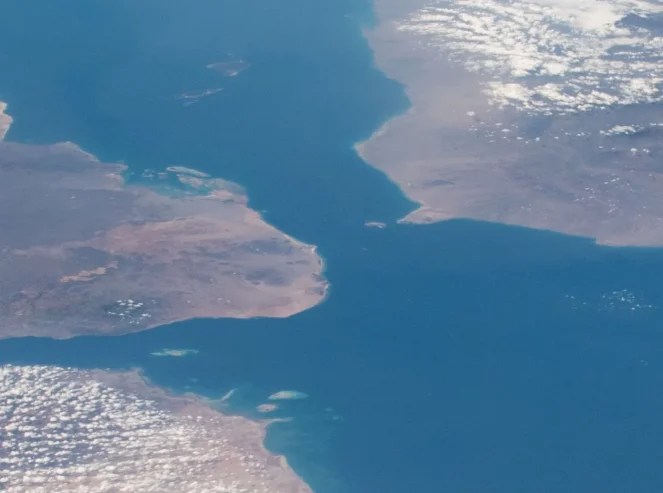
And, of course, if military operations against Iran are the ultimate objective, then at some point the Trembling Puppy and its entourage are going to have to leave the cozy waters between Jeddah and the Gulf of Suez, and run the gauntlet of the Gate of Lamentation (Bab el-Mandeb).
The Gate of Lamentation (Bab el-Mandeb)
That’s when things could get more interesting. Because it’s a pretty tight squeeze to pass through. A big deep-draft aircraft carrier can’t just run at full speed, zig-zagging back and forth. It has to stick to the navigable channel.
Navigable Shipping Channels in the Bab el-Mandeb
In the relatively open waters north of Jeddah, there is quite a bit of room for maneuver. But in the straits, you’re restricted to a narrow band — and most significantly, potential Yemeni missile launching sites are only ~200 km away. A more substantial strike package of 50 or so drones, antiship cruise missiles, antiship ballistic missiles, and fast boat and surface drone attacks will get there a whole lot faster, and with a much better chance of actually hitting something.
So, even though CSG-8’s odds of passing through unscathed still probably remain pretty good, there is unquestionably a considerably elevated risk compared to hiding out at the mouth of the Gulf of Suez.
But let’s suppose they sail right through the Bab el-Mandeb with minimal difficulties … then what? You join up with CSG-1 in the Arabian Sea and attempt long-distance strikes into southern Iran — strikes that would still require air-refueling to have any meaningful reach?
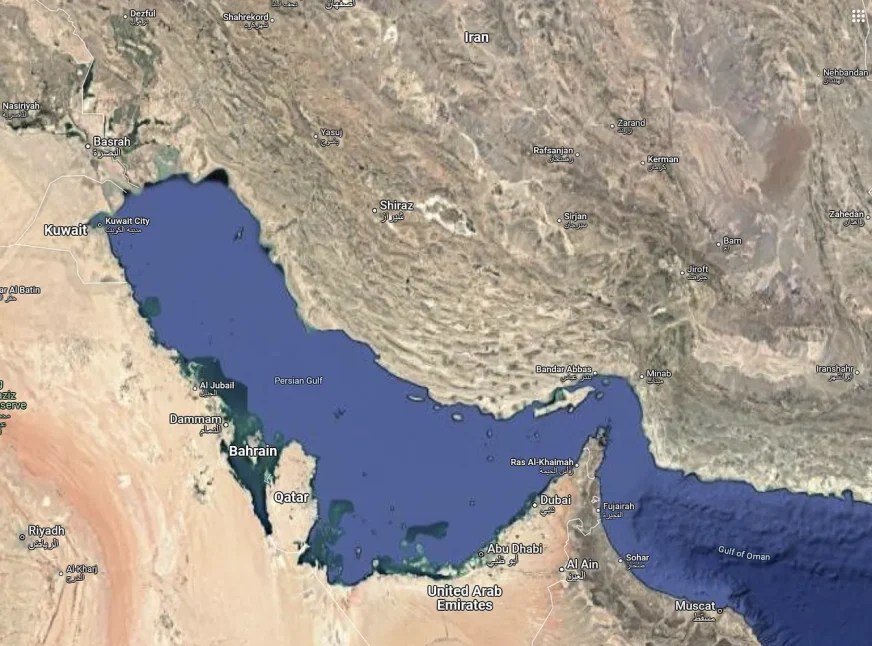
Because you sure as hell aren’t going to sail a couple carrier strike groups into the Persian Gulf. And anyone who believes otherwise is drowning in delusion. I mean, just look at the damn map! The Iranians have potent fire control over the passage from the Gulf of Oman, through the Strait of Hormuz, and throughout the entire Persian Gulf.
Strait of Hormuz / Persian Gulf
So I ask, in all seriousness, what exactly are two US Navy carrier strike groups going to do in the context of a no-holds-barred war against Iran?
To me, the entire concept screams of hubris running blindly into catastrophe.
If the US is foolish enough to start a big war against Iran, then 2025 is likely to demonstrate yet again that, combined with firepower, geography is the indomitable god of war.
Former Tunisian President Moncef Marzouki warned that Israel, led by Prime Minister Benjamin Netanyahu, is seeking to drag the region into a major war by escalating the confrontation with Iran, which could ignite complex internal conflicts in the Middle East.
In a statement to Al-Resalah Net, Marzouki said the current phase is characterised by great instability where the region is experiencing increasing turmoil.
He pointed out that US President Donald Trump is a fickle politician who cannot be trusted and who is being dragged into new wars by Israel.
“The current situation portends an explosion, but the Arab peoples remain calm, and this is what occupies my mind. We are living through a period similar to what we witnessed in 2010, when everything seemed calm before the spark that completely changed the scene,” he said
Marzouki criticised the Egyptian position toward the Gaza Strip, saying,
The Egyptians act as if they are not a party to what is happening, while in reality they are participating in the strangulation of Gaza by continuing to close the crossings and restricting aid.
He added that the Israeli occupation continues its crimes and massacres in Gaza without deterrence, but the situation will not remain as it is, and the time will come to take action and stand up against this unjust reality.
Marzouki concluded by emphasizing that history indicates that the situation will not remain as it is, warning that an Israeli escalation could lead to a regional explosion, with serious repercussions for the entire region.
Since Donald Trump returned to the White House on January 20, 2025, there was an initial sense of hope that he would wind down the conflict in Ukraine. However, continued flows of military aid to Ukraine and slow progress in the negotiations still make a lasting peace settlement a distant prospect.
The Trump administration’s preference would be to conclude the U.S. proxy war in Ukraine and shift its geopolitical gaze to Asia to contain China. The icing on the cake would be for the United States to have Russia break its “no limits partnership” with China to isolate the East Asian giant. In effect, Trump is attempting to pull a “reverse Nixon” strategy in its foreign policy approach. This strategy aims to improve relations with Russia to balance against China, in contrast to then-President Richard Nixon’s original approach of engaging with Communist China to counter the Soviet Union.
U.S. foreign policy, idealistic grandstanding notwithstanding, is suffused with cynical geopolitical plays. The Trump administration looks to use this sleight of hand against China by playing Russia off against it, even to the point of tricking both Eurasian heavyweights into protracted conflicts. Such a scenario would be every DC strategist’s dream—a Eurasian plane mired in conflict while the United States sits on the sidelines waiting for the moment to waltz in as the dominant power in the Eurasian domain. All of this done without firing a shot.
Heading back to reality: U.S. foreign policy strategists will find that prying Russia from China, much less baiting it into an open conflict with China, will be a tall order. The numerous factors that led to Richard Nixon’s historic visit to China in 1972, wherein Sino-American relations were subsequently normalized and exploited to serve as a counterweight against the Soviet Union, are simply not there in the present.
For one, relations between the Soviets and Chinese were already fraught prior to Nixon and his trusty sidekick Henry Kissinger using clever statecraft to woo over the Chinese. Enter the Sino-Soviet split, in which relations between the People’s Republic of China (PRC) and the Soviet Union (USSR) deteriorated, starting in the late 1950s and intensifying throughout the 1960s.
This rupture in Sino-Soviet relations was brought about by a combination of factors. Following the death of Soviet strongman Joseph Stalin, Soviet leader Nikita Khrushchev initiated a de-Stalinization agenda and moved towards peaceful coexistence with the capitalist West, which Chinese leader Mao Zedong perceived as an ideological betrayal and “revisionism.” On Mao’s end, his Great Leap Forward and Cultural Revolution polices clashed with Khrushchev’s more moderate approach to communism.
The twentieth century split between the two Eurasian giants was not exclusively ideological; it had a geopolitical component as well. China’s growing assertiveness under Mao led to tensions over leadership in the communist world. The USSR’s decision to cut aid to Maoist China in 1960, coupled with the Soviet’s support for India during the Sino-Indian War of 1962, further strained Sino-Soviet relations. Border clashes between the Soviets and Chinese in 1969 underscored their rivalry, as U.S. foreign policy strategists looked from afar with great interest.
Internally, China was also reeling from the disastrous effects of the Great Leap Forward—economic collapse and famine—and growing political intrigue brought about by the Cultural Revolution’s numerous purges of the Chinese political structure.Against this backdrop of heightened tension on the domestic and international fronts, prominent leaders such as Minister of National Defense Lin Biao insisted that China maintain hawkish relations toward both the Soviets and the United States. Lin perceived both the United States and Soviet Union as imperial powers that threatened Chinese interests, standing in contrast to Mao and Premier Zhou Enlai’s efforts to pursue diplomatic ties with the United States to counterbalance Soviet hostility.
However, Lin’s death in 1971 in a suspicious plane crash cleared the way for China’s leadership class to pursue a rapprochement with the United States. Shortly thereafter, China’s positive overtures to the United States culminated in President Richard Nixon’s historic visit in 1972. In turn, the “Chimerica” project was forged with China as the workshop of the world in the liberal economic order.
However, this arrangement in the international order would begin to disintegrate after the United States prosecuted unpopular nation-building ventures in the Middle East and was at the center of the global financial crisis of 2007-2008. This series of events discredited the U.S.-led liberal order among many of the resurging actors on the world stage such as China and Russia. The United States’ penchant for being “agreement incapable” on issues regarding NATO expansion and the Iran nuclear deal lent further credence to the idea that Washington is an erratic diplomatic actor that can’t be trusted to abide by international norms.
As the forces of nationalism and great power competition returned, the very notion of the preeminent powers of the Eurasian plane submitting to the whims of DC seemed fantastical at best. The previously mentioned intricacies of Cold War geopolitics and the United States’ bungled economic and foreign policies of the past three decades makes the realization of a “reverse Nixon” strategy a pipe dream at best. Dialing down tensions with Russia is fine but it should be done without ulterior motives.
Perhaps the United States should start treating countries like Russia as normal political entities as opposed to geopolitical playthings for American strategists to exploit to their heart’s content.
March 2025 marks the beginning of a fourth year of the military conflict in Ukraine. Kiev, its sponsors in Europe and the United States, are proving unwilling to end the war being waged despite mounting evidence they are facing a major political and military defeat.
Zelensky vs Trump?
The five-year, electoral mandate dating from May 2019 of Volodymyr Zelensky as president of Ukraine expired ten months ago. Yet on February 28, Zelensky staged a widely publicized quarrel with the new US administration in Washington headed by Donald Trump. The administration reacted, in turn, with a dramatic suspension of US arms shipments and sharing of intelligence and satellite data. Without this data, Ukrainian troops are ‘blinded’ because US military specialists have played a key role in helping choose Russian targets and helping operate complex rocket and missile weaponry. Particularly valuable are the images provided, with US government approval, by US commercial satellite imaging company Maxar.
The ‘suspensions’ were very short-lived. A meeting in Saudi Arabia on March 11 between the Kiev government and the Trump administration saw a renewal of the briefly-disrupted partnership between the two after its brief interruption in supplying military data and equipment. The meeting issued a proposal to Russia (better described as a threat) prepared in advance by Washington for a 30-day ‘ceasefire’. Critics in Russia and abroad say the proposal would allow the Ukraine Armed Forces to rest and regroup. If Russia turned it down, the Western powers could then condemn it for refusing peace.
Every serious analyst is pointing out that the ceasefire proposal does not at all address Russia’s well-publicized minimum conditions for a peace settlement. In other words, the plan is something of a trap for Russia. For that reason, it will not see the light of day.
Zelensky was absent from the Ukraine delegation in Saudi Arabia. He remains apprehensive over the prospect that Trump may wish to replace him and could do so at any time. Ukrainian political analyst Kost Bondarenko, who now lives abroad, explained on Telegram on March 4 that Zelensky is no longer listening to anyone, including those in his personal entourage. “He is acting hysterically and capriciously, recognizing only his own claimed righteousness. He doesn’t even listen to Yermak [head of the Office of the President of Ukraine]. His egocentrism has made Ukraine hostage to his whims.”
Europe benefits from the war
Zelensky is seeking more support from his patrons in the European Union and becoming more dependent on them, especially on the government of Great Britain. The latter continues to encourage him to sacrifice the people of Ukraine in a losing war against Russia.
Former Ukrainian (now Russian) political scientist Rostislav Ishchenko said in an interview on March 7 that the only difference between the Trump regime in Washington and the leading governments of the European Union is that ‘liberal’ Europe wants a consolidated West under a ‘liberal’ image while the right-wing, conservative Trump regime wants a united West focused on weakening and paralyzing Russia while simultaneously weakening China.
“Trump’s goal is not to make life easier for Russia. Trump’s goal is to get a peace that is acceptable to America. So far, everything that Trump formulates is absolutely unacceptable to us.”
Another former Ukrainian and now Russian political analyst Andrey Vajra told a Crimea news broadcast in February that the war in Ukraine has helped the European elites to appropriate billions of euros. “Europeans understand perfectly well that the war is lost. But the European elite needs to continue stealing [from weapons supplying and the multitude of forms of ‘aid’]. I have already explained how it is possible to continue stealing billions of euros so long as the killings continue in Ukraine. Far more millions of euros can be had. That’s why the European leaders are clinging to a warmaking Ukraine.”
In early March, the head of German intelligence, Bruno Kahl, stated in an interview with the state-run Deutsche Welle that it would be ‘safer’ for Europe if the war in Ukraine continued for another five years. He criticized the Trump administration, saying the kind of swift end to the war being voiced by Trump “would enable the Russians to focus their energy against Europe”. This suggested ‘long war’ against Russia is the new, official theme of EU leaders as they strive to convince their populations of the need to massively expand military spending.
Even former prime minister Yulia Tymoshenko (2007-2010) of the Batkivshchyna faction in the Ukrainian legislature says she is outraged by Kahl’s frank admission. “Bruno Kahl for the first time officially confirmed what we were so reluctant to believe: At the cost of thousands of Ukrainian lives and the very existence of Ukraine, some people decided on a war to ‘deplete’ Russia and thereby enhance the security in Europe? I did not think that they would dare to say it so officially and openly. This explains a lot,” Tymoshenko doth protest too much. She was a key fomentor of the violent, Maidan coup in February 2014 and an ardent advocate since then of military and political confrontation with Russia.
Danish Prime Minister Mette Frederiksen has also stated that a peace agreement could be more dangerous for Ukraine than an ongoing war. “I understand that many people believe that a peaceful solution or a ceasefire is a good idea, but we run the risk that peace in Ukraine would actually be more dangerous than the war that is ongoing now.”
Such pro-war stances are not only due to the fact that Western companies are getting rich on fulfilling military orders. A permanent war in Ukraine appeals to many Western leaders because this would weaken and pre-occupy Russia. “Israel” has long acted on the same principle in the Middle East. It has waged bloody wars in Syria, Iraq, and Lebanon to weaken these countries and prevent them from doing anything to stop “Israel’s” genocide against Palestinians and its occupation of Syrian territory.
Those who justify continued war in Ukraine make two contradictory assertions. On the one hand, they argue that the war has greatly weakened Russia and that the government there may soon collapse. Ukrainians should therefore fight just a little longer to secure ‘victory’. On the other hand, they say that Russia has become too strong and is a threat to overrun more European countries in the future. Ukrainian social networks have coined an ironic term for this contradictory belief system, calling it ‘Russophrenia’ (derived from the word ‘schizophrenia’).
The end of Ukraine’s adventure in Kursk
Disaster has befallen the Ukraine Armed Forces present in the Kursk border region of Russia. Large numbers of Ukrainian troops have become encircled—as many as 10,000 according to some Western media outlets. A March 8 report in a Ukrainian media outlet nervously reassured that the situation in Kursk “is not yet catastrophic”.
The Ukrainian military command did not issue any orders to retreat from threatened encirclements in Kursk. This repeats the experiences with earlier military encirclements in Donbass. These have allowed the Russian army to make steady and continued military advances there.
As reported by the online Politnavigator on March 7, a former advisor to the office of Zelensky, Alexei Arestovich, sees a familiar pattern to events in Kursk. “In dire conditions where encirclement is threatened, only the introduction of reserve troops can help. So we [the Ukraine Armed Forces] proceed as usual: drop in a few reserves removed from other threatened locations. These will most likely be unable to stabilize for any length of time because there are few reserves to draw upon. No one is left. Even worse is to keep the army in encirclements or threatened encirclements for too long, waiting for the political leadership to give an order to retreat. But those orders do not come. This scenario has repeated itself over and over again. We need to stop playing by such scenarios.”
Arestovich lives in exile somewhere in Europe and has said he would be a candidate in a forthcoming election for president of Ukraine should a free election take place.
On March 8-9, Russian troops managed rather easily to contain the remaining Ukrainian forces in Kursk Oblast and cut off re-supply routes. This was partly helped by the spring thaw because Western-supplied military equipment becomes booged down in mud; it is designed primarily for use on paved or improved gravel roads.
Ukrainian opposition blogger Anatoliy Shariy writes that the losses of the AFU in Kursk are huge – some of the biggest losses that Ukrainian servicemen can remember.
The Ukrainian grouping in Kursk was centered around the border town of Suzdha. It is the site of an important pumping and transit station for a natural gas pipeline built during the Soviet era which connects the vast gas fields of eastern Russia to markets in Ukraine and further west in Europe. In January, Ukraine shut down pipeline shipments through Suzdha, drawing sharp protests and threats of counter-measures from Hungary and Slovakia.
An ironic consequence of Ukraine shutting down the pipeline was that Russian soldiers were able to use the now-empty pipeline to advance some 15 kilometers directly into the center of the Ukrainian grouping in Suzdha. They waited days for orders. Russia then surprised and overwhelmed the embedded Ukrainian forces with a multi-pronged attack beginning on March 8. Many Ukrainian soldiers and allied mercenaries ended up stampeding into surrounding minefields.
Russian military correspondent Anna Dolgareva spoke to Russian military scouts in Suzdha and reported, “For six days, the Russian fighters sat inside the pipeline awaiting orders to move. They spent some 24 hours of difficult walking to get there. The pipeline still contained traces of methane gas and so holes were cut in the pipe along the way for ventilation.”
This operation was made possible because Ukraine shut off gas transit causing European countries to buy much more expensive liquefied gas from producers in the United States. Western sanctions against Russia have cost Europe its supply of relatively cheap Russian gas, replaced by shipments of expensive liquefied natural gas from the United States as well as gas from Norway and Algeria shipped by pipeline.
Ukrainian elite on ‘starvation rations’
Representatives of the Ukrainian political elite are today extremely worried about Zelensky’s quarrel with the new US administration that exploded into view in Washington on February 28. For most, funding from the United States is their main source of income.
Since the early 1990s, Ukraine has developed an entire class of government officials and politicians who have ‘monetized’ Russophobia and anti-communism. A key piece of moving up the career ladder has been to act the loudest in stigmatizing the former Soviet Union and modern Russian Federation, and figuring out how best to draw Western funding for such efforts. This scheme has worked well for decades, but now the apparent chaos being sown by the new Trump regime in Washington has upset the old arrangements. The chaos is merely the expression of a governing U.S. regime facing a looming defeat of its proxy war in Ukraine along with its European partners.
Some legislators realize that Zelensky’s harsh outbursts and confrontation with Trump and Trump’s vice president in Washington on February 28 could cost the country dearly, but others are betting on maintaining an aggressive, pro-war rhetoric. They are looking to the British government to help out.
Alexei Arestovich writes that Zelensky’s ‘disobedience’ is based solely on his desire to extract security guarantees for himself and his entourage. He says the problem for the White House is that “providing personal guarantees to thieves risks setting yourself up before American justice.”
Ukrainian economist Oleksiy Kushch writes that for the Ukrainian elite, the era when it could act as a child and demand money from the ‘adult uncles’ in the West is coming to an end. The West is so used to that arrangement that Zelensky’s apparent conflicts with the U.S. administration are bewildering, a kind of ‘revolt against the boss’.
Kushch summarizes Ukraine’s situation after Zelensky’s quarrel with Trump in this way, “Like a teenager who ‘unexpectedly’ has a child and finds all responsibility now rests on him, ‘daddy’ U.S. may threaten to stop helping out as punishment for any ‘disobedience’ while ‘mommy’ Europe promises to continue giving money but not forever.”
The Ukrainian elite has been thoroughly corrupted by years of generous Western ‘aid’ handouts. It no longer knows how to earn revenue and wealth on its own. So if some character named Zelensky becomes an obstacle to the continued flow of ‘daddy’s’ money, he becomes expendable. So much the worse for him.
Neoconservatism began to take root in the 1970s as strength through militarism and an interventionist foreign policy were increasingly seen as the path to peace. Ideological Manicheanism and narratives of peace through strength challenged more traditional concepts of security that focused on mitigating the security dilemma. Human rights, rather than restraining the use of force, were discovered as a weapon that would legitimize the removal of restraints on the use of force.
I had a conversation with Alastair Crooke and Alexander Mercouris about the geoeconomic confusion in Europe. The US is repositioning itself as the unipolar world order has ended, and multipolarity is already here. The Europeans have no strategy and the policies subsequent lack direction and reason. In Isreal, society has polarised to the extent that political and societal instability will become a challenge to national security.
A prominent legal expert says Yemen is being bombed by the United States and the United Kingdom for fulfilling obligations set by the International Court of Justice (ICJ) and the United Nations General Assembly (UNGA).
Craig Mokhiber, a US-based human rights lawyer and former United Nations official, took to his X handle, formerly Twitter, on Monday to condemn the latest American-British aggression on Yemen.
He said both the ICJ and the UNGA have found that all countries are “legally obliged” to cease any kind of support for the Israeli occupation regime amid the ongoing genocide in Gaza.
The obligations, he elaborated, include banning any products from the illegal settlements, to cut off all military, diplomatic, economic, commercial, financial, investment, and trade relations with the Israeli occupation, to respect the provisional orders of the ICJ in the Israel genocide case, and to respect their third-state obligations under the Genocide Convention to act to prevent and stop Genocide.
“Yemen is being bombed for respecting these obligations,” he remarked.
Mokhiber, who previously served as the director of the New York office of the UN high commissioner for human rights, resigned from his position in October 2023 in protest against the UN’s “failure” to prevent the genocide of Palestinians in the Gaza Strip.
He described the US, the UK and much of Europe as “wholly complicit in the horrific assault.”
American and British warplanes attacked Yemen on Saturday night after US President Donald Trump vowed to use “overwhelming lethal force” against the poorest country in the Arab world that had recently resumed a ban on Israeli ships from crossing key maritime regions after the Tel Aviv regime reimposed crippling blockade on the besieged Palestinian territory.
Yemeni health ministry condemned the targeting of civilians and civilian infrastructure, describing it as a “full-fledged war crime and a blatant violation of international laws and conventions.”
The US-UK military coalition launched another attack on Sunday night, with Yemeni authorities now putting the death toll at more than 50, including women and children.
According to Yemeni reports, American and British warplanes launched at least 47 airstrikes on several sites in Yemen’s capital, Sana’a as well as areas in the northern province of Sa’ada, the central province of al-Bayda, and the southwestern province of Dhamar.
The leader of the Ansarullah resistance movement in a speech on Sunday night warned the United States that the aggression against the Arab country will be met with escalation.
“The aircraft carrier and American warships will be targets for us, and the navigation ban will include the Americans as long as they persist in their aggression,” Abdul Malik al-Houthi said.
“We will respond to escalation with escalation, and we will strike at the American enemy by targeting its aircraft carrier, warships, and imposing a blockade on its vessels.”
By portraying Chinese characters as perpetrators of ruthless violence while casting Japanese Self-Defense Forces (SDF) intelligence operatives as defenders, the season 2 of the Japanese drama Vivant has recently drawn criticism from Chinese netizens, who argue that its depiction turns historical reality on its head while ignoring Japan’s wartime atrocities.
The TBS drama series – a spy suspense story in which an alleged unofficial intelligence unit of the SDF operates across the globe — has attracted a passionate fanbase. Its currently airing season 2 opened with a household rating of 18.8 percent, the highest for a TV drama this year, according toa commentary article by Japanese media Toyo Keizai.
What draws attention is the portrayal of the enemies in the series, the article noted. Scenes in which the Chinese organization subjects kidnapped members of the SDF unit to brutal torture are repeated with unrelenting intensity.
It is rare for Japanese TV dramas to explicitly portray a real-life country as the enemy, the article noted.
Japanese Prime Minister Sanae Takaichi also made a reference to the drama, saying that she has been recording Vivant and hopes to binge-watch it over the year-end and New Year holidays, according to Japanese media outlets.
China’s CCTV News report on Sunday revealed that the drama features scenes in which Chinese personnel cut off the fingers of and stab Japanese intelligence operatives in the abdomen. Such acts bear striking similarities to the torture inflicted on Chinese nationals by invading Japanese troops during the World War II.
The drama distorts the truth by attributing these atrocities to modern Chinese characters. Beneath the surface, it subtly glorifies Japan’s cross-border overseas operations, blurs the functional boundaries of the SDF and implicitly promotes an expansionist narrative, per CCTV News. … continue
This site is provided as a research and reference tool. Although we make every reasonable effort to ensure that the information and data provided at this site are useful, accurate, and current, we cannot guarantee that the information and data provided here will be error-free. By using this site, you assume all responsibility for and risk arising from your use of and reliance upon the contents of this site.
This site and the information available through it do not, and are not intended to constitute legal advice. Should you require legal advice, you should consult your own attorney.
Nothing within this site or linked to by this site constitutes investment advice or medical advice.
Materials accessible from or added to this site by third parties, such as comments posted, are strictly the responsibility of the third party who added such materials or made them accessible and we neither endorse nor undertake to control, monitor, edit or assume responsibility for any such third-party material.
The posting of stories, commentaries, reports, documents and links (embedded or otherwise) on this site does not in any way, shape or form, implied or otherwise, necessarily express or suggest endorsement or support of any of such posted material or parts therein.
The word “alleged” is deemed to occur before the word “fraud.” Since the rule of law still applies. To peasants, at least.
Fair Use
This site contains copyrighted material the use of which has not always been specifically authorized by the copyright owner. We are making such material available in our efforts to advance understanding of environmental, political, human rights, economic, democracy, scientific, and social justice issues, etc. We believe this constitutes a ‘fair use’ of any such copyrighted material as provided for in section 107 of the US Copyright Law. In accordance with Title 17 U.S.C. Section 107, the material on this site is distributed without profit to those who have expressed a prior interest in receiving the included information for research and educational purposes. For more info go to: http://www.law.cornell.edu/uscode/17/107.shtml. If you wish to use copyrighted material from this site for purposes of your own that go beyond ‘fair use’, you must obtain permission from the copyright owner.
DMCA Contact
This is information for anyone that wishes to challenge our “fair use” of copyrighted material.
If you are a legal copyright holder or a designated agent for such and you believe that content residing on or accessible through our website infringes a copyright and falls outside the boundaries of “Fair Use”, please send a notice of infringement by contacting atheonews@gmail.com.
We will respond and take necessary action immediately.
If notice is given of an alleged copyright violation we will act expeditiously to remove or disable access to the material(s) in question.
All 3rd party material posted on this website is copyright the respective owners / authors. Aletho News makes no claim of copyright on such material.