Saudi Arabia Urges US Back to Iran Talks as Other Oil Routes Face Risk
Sputnik – 14.04.2026
Saudi Arabian officials are warning the US that its move to impose a blockade on Iranian ports following failed negotiations could backfire, triggering even wider global energy disruption, according to media reports.
Trump aims to pressure Iran into loosening its grip over the Strait of Hormuz, but Saudi officials are reportedly actively urging the US to return to negotiations with Iran over fears that the Bab al-Mandeb — which handles about 10% of global crude and liquefied natural gas shipments — may also be threatened.
The kingdom has managed to maintain oil exports near pre-conflict levels [Tanker-tracking data and market reports show Saudi crude oil exports averaged about 3.3 million barrels per day in March 2026, about half of previous exports] by rerouting crude across its territory to Red Sea ports, bypassing the Strait of Hormuz.
But that alternative route would become vulnerable, putting a large share of Saudi exports at risk, since Iran has signaled that if its own oil flows are restricted, it could retaliate by disrupting other key shipping lanes.
Iran’s potential leverage lies in its regional alliances, especially with Houthi forces in Yemen, who control territory near the Bab al-Mandeb. These groups have previously demonstrated their ability to disrupt maritime traffic through missile and drone attacks and are widely seen as a strategic reserve that Iran could activate if tensions escalate further.
Besides physical disruption, the ripple effects on global markets would potentially drive up insurance costs, force ships to reroute, and create supply delays — all of which could push energy prices higher.
Iran demands reparations from Arab states
RT | April 14, 2026
Iran has demanded that five Arab states hosting US bases pay reparations for American and Israeli airstrikes on its territory.
In a letter to the UN Secretary General Antonio Guterres on Monday, Iranian envoy Amir Saeid Iravani argued that Saudi Arabia, Bahrain, Qatar, the UAE, and Jordan had allowed the US to use their territory to attack Iran and, in some cases, were directly involved in “unlawful armed attacks targeting civilian objects.”
Iravani added that the Arab states “should make full reparation to the Islamic Republic of Iran, including compensation for all material and moral damage sustained as a result of their internationally wrongful acts.”
The Gulf states had previously demanded that Iran be held liable for war damage, a claim Iravani rejected as “legally untenable and fundamentally divorced from the factual and legal realities.”
The US and Israel launched strikes on Iran on February 28, stating that the goal was to dismantle Iran’s nuclear and ballistic missile programs. The attacks killed dozens of senior officials, including Iran’s longtime supreme leader, Ali Khamenei, as well as more than 1,300 civilians. In addition to military sites, the US and Israel targeted energy infrastructure, bridges, universities, and schools.
Iran responded by striking US bases in the region and civilian infrastructure in Gulf states, including oil and gas facilities, airports, and seaports. Tehran said the strikes were an exercise of its right to self-defense.
Tankers transit Strait of Hormuz amid US attempt to impose blockade, data shows
Press TV – April 14, 2026
Shipping data indicates that three Iran-linked tankers entered the Persian Gulf through the Strait of Hormuz on Tuesday, the first day of a US attempt to impose blockade targeting vessels that call at Iranian ports.
The blockade was announced by US President Donald Trump on Sunday after peace talks between Washington and Tehran in Islamabad ended without an agreement.
According to LSEG data, the Panama-flagged medium range tanker Peace Gulf is sailing to Hamriyah port in the United Arab Emirates. Kpler data shows the ship is typically involved in transporting Iranian naphtha—a petrochemical feedstock—to non-Iranian ports in West Asia for onward shipment to Asia.
Earlier, two US-sanctioned vessels also passed through the critical waterway.
The Handy size tanker Murlikishan is heading toward Iraq to load fuel oil on April 16, according to Kpler. Formerly named MKA, the vessel has previously carried both Russian and Iranian crude.
Another sanctioned tanker, Rich Starry, is expected to be the first to leave the Persian Gulf via the Strait of Hormuz since the blockade purportedly took effect, based on LSEG and Kpler data.
The ship and its owner, Shanghai Xuanrun Shipping Co. Ltd., have been sanctioned by the United States for dealings with Iran.
LSEG data shows Rich Starry, a medium range tanker, is carrying roughly 250,000 barrels of methanol loaded at its most recent port of call, Hamriyah in the UAE. The vessel is Chinese-owned and crewed by Chinese nationals.
China’s foreign ministry on Tuesday criticized the US attempt to impose blockade on Iranian ports as “dangerous and irresponsible,” saying the move would increase regional tensions. It did not specify whether any Chinese vessels were transiting the strait.
China to Ignore Trump’s Blockade: The Strait Remains Open to Us
By Kyle Anzalone | The Libertarian Institute | April 13, 2026
China said it will not comply with the Strait of Hormuz blockade that President Donald Trump imposed on Monday. Beijing explained that it is negotiating with Tehran to transit the waterway and expects other countries not to meddle in its affairs.
Beijing is “monitoring the situation in the Middle East. Our ships are moving in and out of the waters of the Strait of Hormuz,” Chinese Defense Minister, Adm. Dong Jun, said after Trump announced the blockade. “We have trade and energy agreements with Iran. We will respect and honor them and expect others to not meddle in our affairs. Iran controls the Strait of Hormuz, and it is open for us.”
In response to a US and Israeli surprise attack on February 28, Tehran took control of the Strait of Hormuz. Iran has allowed only vessels from “friendly nations” to enter or exit the Persian Gulf and has imposed a toll. China is among the nations that have worked out deals with Iran to allow its ships to transit the Strait.
Iran says the Strait of Hormuz is now under Tehran’s control, and plans to change the toll to transit the waterway after the conflict ends.
Trump has threatened that the US will stop any ship that exits the Gulf after paying a toll to Tehran, setting up a potential confrontation with Beijing if the Navy attempts to seize a Chinese-flagged tanker.
Trump is scheduled to visit China next month to meet with President Xi. Earlier this week, the President threatened to place a 50% tariff on China if Beijing provides military support to Iran.
Trump’s desperate bombasts amount to war crimes
By William J. Watkins Jr. | The Libertarian Institute | April 13, 2026
President Donald Trump owes the Pakistanis for securing a fourteen-day ceasefire with Iran. He now has a chance to extricate the United States from the biggest blunder of his second term. Tensions, however, remain high. “It is emphasized that this does not signify the termination of the war,” the Iranian government said in a formal statement. “Our hands remain upon the trigger, and should the slightest error be committed by the enemy, it shall be met with full force.”
One must worry that Trump does not appreciate the ceasefire off-ramp as good luck or an unmerited gift; instead, he likely will credit his threats to destroy “a whole civilization…never to be brought back again.” If the ceasefire breaks down, Trump could fulfill his commitment to “rain Hell” on Iran.
While typing away on Truth Social, Trump is oblivious that he is giving an anticipatory confession to war crimes. In addition to the posts quoted above, the president has threatened to destroy Iran’s power plants, oil wells, and desalinization facilities if certain demands are rejected. Civilizational devastation, Trump raved, “will be in retribution for our many soldiers, and others, that Iran has butchered and killed over the old Regime’s 47 year ‘Reign of Terror.’”
Trump’s promises violate fundamental tenets of the laws and customs of armed conflict (also known as international humanitarian law, “IHL”) which yields individual criminal responsibility under international law. This area of IHL is clear and not subject to different spins.
As an initial matter, Trump’s war plans violate protocols to the Geneva Convention codifying the principle of distinction. According to Article 48 of the relevant protocol, “the Parties to the conflict shall at all times distinguish between the civilian population and combatants and between civilian objects and military objectives and accordingly shall direct their operations only against military objectives.” [Emphasis added] Article 51 further prohibits “[a]cts or threats of violence the primary purpose of which is to spread terror among the civilian population.”
Trump’s possible targets enumerated on Truth Social are integral to provision of basic services to civilians. The president is not threatening military bases, missile silos, or drone manufacturing facilities. Instead, he proposes to bring suffering on Iran’s civilian population simply because he can. IHL prohibits such methods of war as uncivilized.
Trump and his war hawk apologists will likely counter that destruction of certain infrastructure could produce a military benefit and thus is allowed. This is not true. Article 51 sets forth the principle of proportionality which prohibits military attacks expected to cause harm to civilians that is excessive in relation to the concrete and direct military advantage anticipated. Just because soldiers use electricity and drink water does not mean that the United States is justified in destroying all of Iran’s power plants and desalinization facilities.
Further damning to the president’s case is his stated reason for attacking civilian targets and infrastructure: “retribution” for the conduct of a regime he alleges no longer holds power. IHL strictly prohibits reprisals against the civilian population. A reprisal is an action typically illegal that is taken to force the enemy to stop its own violations of IHL. For example, if Iran executed American prisoners of war (“POWs”), the United States could execute Iranian POWs to persuade Iran to comply with the Geneva Convention. In the present conflict, Trump has not identified Iranian IHL violations and even if he had done so, the United States could not institute reprisals against civilian targets or persons.
At best, Trump’s statements on Truth Social are desperate bombast from a leader who regrets taking advice from Israeli Prime Minister Benjamin Netanyahu and Senator Lindsey Graham (R-SC). At worst, they are an outline for barbarism unfit for the leader of a federal republic.
If the ceasefire does not result in a permanent settlement and Trump follows through on his threats to civilians and civilian infrastructure, IHL is squarely against him. He should not be surprised if the International Criminal Court (“ICC”), which is charged with investigating war crimes and similar matters, issues a warrant for his arrest. Such a warrant would prevent Trump from traveling outside of the United States because of the risk of arrest. No more golf trips to Ireland for the Donald.
While Trump has just complaints about the lawfare waged against him by the likes of Alvin Bragg, Letitia James, and Fani Willis, an ICC matter would be different. Trump’s own words convict him and are counter to the established laws and customs of armed conflict.
Most Israelis oppose Iran ceasefire, reject talks: Poll
The Cradle | April 13, 2026
A majority of Israelis are against the ceasefire with Iran and anticipate that it will collapse within the coming year, according to a poll carried out by Israel’s Institute for National Security Studies.
The survey was carried out between 9 and 10 April.
According to the results, 61 percent of Israelis oppose the cessation of hostilities with the Islamic Republic.
Seventy-three percent said Tel Aviv will have to resume the war, while 76 percent said that talks will not achieve Israeli objectives.
Additionally, 69 percent say Israel must continue the indiscriminate strikes on Lebanon and military operations against Hezbollah. Only 23 percent believe Lebanon should be included in the ceasefire.
The new poll also reveals that 62 percent are not convinced that the war against Lebanon will bring security and stability to Israelis.
Just 20 percent of supporters of the ruling coalition said they backed the truce, while only 31 percent of opposition voters expressed the same view.
The poll shows Israelis are unhappier with the results of this war than they were following last year’s 12-day June war against Iran.
Thirty-seven percent were “very satisfied” with the results of the new US-Israeli war on Iran, as opposed to 62 percent who said the same about last year’s war.
Forty-four percent of coalition voters are happy with the “diplomatic achievements” made, compared to 24 percent who are extremely unsatisfied.
Only seven percent of opposition voters said they were very satisfied with the achievements, compared with 69 percent who said they were unsatisfied.
The poll was released following the Islamabad talks between Tehran and Washington, which ended on 12 April with no agreement.
Since the US-Israeli war on Iran was launched in late February, Washington’s bases across the region have been ravaged.
A new Pew Research Center survey, released on 7 April, shows rising negative sentiment among US citizens toward Israel and its Prime Minister Benjamin Netanyahu after the start of the war.
Six in 10 respondents report an unfavorable view of Israel, up from 53 percent last year, while the number of those holding a “very unfavorable” view has also surged, nearly tripling since 2022.
Another recent poll carried out by Reuters and Ipsos showed that more than two-thirds of US citizens are calling for a quick end to Washington’s war against Iran, even if it means ditching its stated goals.
Just two weeks after the war began, a Drop Site News and Zeteo poll revealed that a majority of US citizens believe US President Donald Trump launched the war on Iran to “cover up” the scandalous Jeffrey Epstein files.
The new poll on Israelis’ sentiment toward ending the Iran war echoes some of those conducted during the genocide in Gaza.
In May 2025, a poll conducted by Penn State University found that 82 percent of Israelis supported the ethnic cleansing of Gaza.
Iran to charge ships from ‘hostile’ nations to cross Hormuz – security chief
RT | April 13, 2026
Iran will levy tolls on ships from ‘hostile’ countries crossing the Strait of Hormuz as compensation for damage caused by sanctions and US-Israeli strikes, Ebrahim Azizi, the head of the Iranian Parliament’s National Security and Foreign Policy Committee, has said.
Speaking to RT on Sunday following US-Iran talks in Islamabad that ended in an impasse, Azizi said Washington should accept Tehran’s terms because it needs a deal “more than we do,” and that many Iranians are unhappy that Tehran even entered into negotiations.
“When they need it, they should accept both the conditions and the prerequisites. If they don’t, we’ll do our work and go our own way. Nothing will change,” he added.
US President Donald Trump has refused to rule out resuming “limited” strikes against Iran after ordering a naval blockade and threatening to deny safe passage to any ships that have complied with Tehran’s fees and rules for transiting the Strait of Hormuz.
According to Azizi, a draft bill being drawn up in the Iranian parliament would stipulate that “those who have caused us damage, those who are in fact liable to pay compensation, may only cross the Strait of Hormuz if they pay their damages and compensation.”
Referring to countries that have frozen Iranian assets “on the orders of America,” he said: “You made a great mistake by blocking them. Now you also want to cross this waterway? That era is over.”
Once approved, the law will require the government to establish a new “management and control system” for the strait and the Persian Gulf, based on environmental safety, security, and services, Azizi said. Any vessel wishing to enter would then have to pay tolls “based on the national interests of Iran,” with specific fees and procedures to be set later by the cabinet rather than by parliament.
Tehran remains deeply skeptical of Washington’s intentions, even after ceasefire-related preconditions were discussed, Azizi said. “We simply do not trust them,” he stated, questioning how a country that “elevates arrogance and colonialism to a guiding principle” could be expected to honor its agreements.
UK, Spain reject Trump’s new scheme to blockade Hormuz Strait
The Cradle | April 13, 2026
The UK and others have rejected Washington’s plan to impose a blockade on Iranian ports and target ships transiting the Strait of Hormuz in collaboration with the Islamic Republic.
UK Prime Minister Keir Starmer said “we are not supporting the blockade” in an interview with BBC Radio on 13 April.
Starmer added that the UK is not “getting dragged in” to the US-Israeli war against Iran. He emphasized the priority is reopening the strait, noting it is “vital that we get the strait open and fully open.”
Turkiye opposed the blockade and called for renewed diplomacy, while China warned against escalation and urged both sides to maintain stability.
The Spanish government has also condemned the US move. “It’s just another episode in this downward spiral we’ve slipped into,” Spanish Defense Minister Margarita Robles said on Monday, adding that US President Donald Trump and Israeli Prime Minister Benjamin Netanyahu “want to impose rules on the international community, which is illogical.”
Germany did not criticize the move. “The supposed blockade … does not mark the end of this diplomatic process,” a government spokesperson said, adding that “We see it as a move to ramp up the pressure.”
The US military’s announcement did “not mention a blockade of the Strait of Hormuz, but rather a blockade of Iranian ports – that is a different approach,” the German spokesperson added.
Earlier on Monday, France announced that London and Paris will organize a conference to discuss forming a “strictly defensive” and “peaceful” mission to reopen the Strait of Hormuz.
“As regards the Strait of Hormuz, in the coming days, together with the UK, we will organize a conference with those countries prepared to contribute alongside us to a peaceful multinational mission aimed at restoring freedom of navigation in the strait,” said French President Emmanuel Macron.
“This strictly defensive mission, separate from the warring parties to the conflict, is intended to be deployed as soon as circumstances permit,” he added. Paris had previously rejected a US proposal on the formation of an international coalition aimed at reopening the Strait, saying it would help escort ships only when the war ended.
A Bahraini resolution to reopen the strait by force was vetoed by Russia and China right before the ceasefire was announced.
The Strait of Hormuz remains closed to Washington and its allies despite the recent ceasefire between the US and Iran.
Vessels unaffiliated with the US and Israel, including a French one, have recently been given access following coordination with the Islamic Republic.
The US threat to blockade Iran’s ports was made by CENTCOM on Sunday night. It said it would begin a blockade “of all maritime traffic entering and exiting” Iranian ports starting 10:00 am Eastern Time (ET) on 13 April.
“The blockade will be enforced impartially against vessels of all nations entering or departing Iranian ports and coastal areas, including all Iranian ports on the Arabian Gulf and Gulf of Oman. CENTCOM forces will not impede freedom of navigation for vessels transiting the Strait of Hormuz to and from non-Iranian ports,” it added.
After the announcement, Iranian Parliament Speaker Mohammad Bagher Ghalibaf said, “enjoy the current pump figures,” adding that “with the so-called ‘blockade,’ Soon you’ll be nostalgic for $4–5 gas.”
The Khatam al-Anbiya Central Headquarters of the Iranian military made a statement on Monday, accusing Washington of “piracy” while vowing to act “decisively” in order to permanently control the Strait of Hormuz and secure Iran’s waters.
US’s ‘Very Foolish’ Double Blockade of Hormuz Strait Makes Absolutely No Sense: Here’s Why
Sputnik – 13.04.2026
Every step Washington has taken in the conflict with Iran to date has worsened its own strategic position, and the blockade of Iranian oil exports is no exception, says Center for Contemporary Iranian Studies director Rajab Safarov.
“This is a very foolish move on the part of the United States. With each passing day and every step,” Washington is “worsening” its own position, and that of many countries around the world for whom Hormuz is the lifeline to their economic existence, Safarov told Sputnik.
Meanwhile, “the Iranian position grows stronger” over time relative to others, something “the Iranians understand perfectly well,” Safarov said. Therefore, Tehran has no incentive to agree to or be bullied into a peace deal on American terms.
Safarov doesn’t rule out that President Trump is being provided poor information on conditions on the ground by underlings like Secretary Hegseth, and making statements and decisions that have “no connection to reality.”
The observer pointed out, for example, that Trump claimed Iran’s Navy has been destroyed. But it’s this same Navy that’s now “ready to sink any ship that might move toward the Indian Ocean without Iran’s permission.”
“He says that Iran’s missile tech and launchers are exhausted or destroyed. But we see Iran launching more and more of its missiles – more modern, more powerful ones, etc,” Safarov said.
The US will ultimately be forced to fold, the observer argues, because while blocking Iranian oil exports will hurt its economy, Tehran is in a position to survive. The effects on the Gulf exporters and major energy-dependent economies in Asia and the developing world will be far more punishing. Oil prices could hit $150 by the end of the week.
With 20% of the world’s oil trapped in the Persian Gulf, “that means a fifth of the global economy will essentially grind to a halt.” Therefore, “America risks turning almost the entire world against itself,” Safarov summed up.
China issues rules on countermeasures against foreign states’ unlawful extraterritorial jurisdiction
Xinhua – April 13, 2026
Chinese Premier Li Qiang has signed a decree of the State Council to publish a new set of rules on countering foreign states’ unlawful extraterritorial jurisdiction measures.
The regulations, consisting of 20 articles, take effect upon publication.
According to the rules, such extraterritorial jurisdiction measures refer to actions taken by a foreign country that violate international law and the basic norms governing international relations and that harm China’s sovereignty, security and development interests, or the legitimate rights and interests of Chinese citizens and organizations.
The rules also stipulate that the Chinese government has the authority to take countermeasures in response to such actions.
They also state that the Chinese government has the authority to exercise extraterritorial jurisdiction over relevant conduct if a sufficient nexus exists.
The regulations establish a system of a malicious entity list targeting foreign organizations and individuals that promote or participate in the implementation of a foreign state’s unlawful extraterritorial jurisdiction measures.
The regulations also state that no organization or individual shall enforce or assist in enforcing such unlawful jurisdiction measures.
The regulations state that Chinese citizens and organizations affected by unlawful extraterritorial jurisdiction measures may file lawsuits against those enforcing them, and that government authorities will provide guidance and support for such legal actions.
Chinese authorities have repeatedly expressed firm opposition to the abuse of unilateral sanctions and long-arm jurisdiction.
China’s law on countering foreign sanctions was adopted in 2021. Key meetings of the Communist Party of China in recent years also pledged to strengthen mechanisms for countering foreign sanctions, interference, and long-arm jurisdiction.
Seyed M. Marandi: Negotiations Collapsed – Return to War
Glenn Diesen | April 12, 2026
Seyed Mohammad Marandi is in Islamabad, where the negotiations between Iran and the US collapsed. Marandi explains why the negotiations failed and that there will likely be a return to war. In the US media, there are already threats to kill the Iranian leadership and delegation. Marandi is a professor at Tehran University and a former advisor to Iran’s Nuclear Negotiation Team. (
Follow Prof. Glenn Diesen:
- Substack: https://glenndiesen.substack.com/
- X/Twitter: https://x.com/Glenn_Diesen
- Patreon: https://www.patreon.com/glenndiesen
Support the research by Prof. Glenn Diesen:
- PayPal: https://www.paypal.com/paypalme/glenndiesen
- Buy me a Coffee: buymeacoffee.com/gdieseng
- Go Fund Me: https://gofund.me/09ea012f
Tomorrow’s naval blockade showdown
How will China react?
Ashes of Pompeii | April 12, 2026
Apparently tomorrow morning, April 13, at 10 a.m. ET the blockade of Iran’s ports by the US will begin. Make no mistake, this is primarily pointed at Iran’s trade with China. The Trump team seem to still think they can kill two birds with one stone – bring down the Islamic Republic and also economically weaken China. In this article I will focus on China, in particular, one aspect of the US/China relationship that gets little attention but which can be a “nuclear bomb” for China. Much discussion in the US about the boom in data center construction, but far less discussion of the total reliance on Chiina for these builds.
It has been estimated by multiple sources that literally all of the US growth in the past year has been due to the AI boom, specifically, due to AI data center builds. Without this ,US growth would be flat, potentially even negative. Even without the Iran war and rising energy costs, data center construction in the U.S. is currently facing significant headwinds, resulting in delays and escalating costs. The primary driver is the strained supply chain, impacting the availability of critical components like switchgear, generators, and specialized cooling equipment. Lead times for these items have stretched considerably, pushing project timelines back by months, if not quarters.
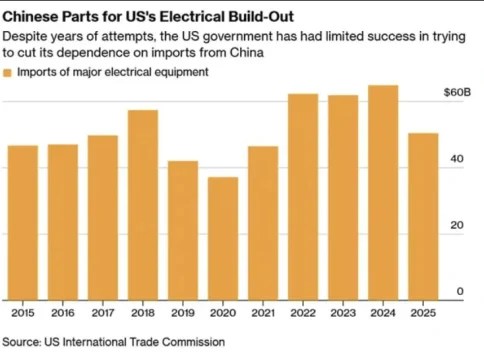
There are other factors for the slow down, especially chip and labor shortages, regulatory hurdles, and the increasing costs of infrastructure. This isn’t the place to delve into all of the factors, but the point is this vital sector for the US economy is in an extremely fragile state. One small push and it can come tumbling down.
And it turns out that whether this sector continues to keep the US out of recession or not is entirely in China’s hands. Forget chips as the vital factor, especially as other US allies control most of the chip production. Just as real a bottleneck is in Chinese electrical components. There is currently a backlog of several years for many of these. Sure, potentially in the long run, there can be many sources for these components. But not tomorrow. Or the day after.
With just the flick of a switch, China stop exporting these components and the AI boom dies almost instantly. And with it, any hopes for real growth in the US economy over the coming months or years.
I obviously don’t know how China will react, or what measures it will enact, if the US navy does go through with its blockade tomorrow. What I outline here is just one of many potential levers the Chinese can pull (rare earths, pharma base ingredients, T-Bills, …)
But don’t expect the US blockade to impact China too severely any time soon.
Featured Video
BRITAIN’S WARNING: PREPARE FOR WAR
or go to
Aletho News Archives – Video-Images
From the Archive
How Ukraine Tortured and Slaughtered Donbass
By Kit Klarenberg | Al Mayadeen | July 11, 2024
Almost immediately after the proxy war erupted, ISIS-tier footage of the torture and murder of Russians in Ukrainian custody emerged.
On July 6th, the New York Times published an astonishing investigation: In Ukraine, Killings of Surrendering Russians Divide an American-Led Unit. The article documents in grim detail how Chosen Company, an international volunteer battalion for Kiev, routinely executes Russian prisoners of war. It is the very first mainstream admission that this practice – a brazen breach of the Geneva Conventions, and a grave war crime – is widespread among Ukraine’s fighters, both foreign and homegrown. … continue
Blog Roll
 Aletho News
- Pentagon designates Chinese cultural centers national security threat
- Israel Demolishes Home Of Lebanese Journalist Whose Viral Film Exposed Pager Attack
- Record Oil, Empty Tanks: The UAE’s Miracle Recovery
- Burnham tackles Britain’s poverty with aggression in Yemen
- Peace in Ukraine: the easy way – or the hard way
- Trump & the Rrrrussians
- US taxpayer money laundered back through Ukraine – Musk
- Before COVID, an NIH lab chief proposed making a SARS-like bat virus more infectious
- Gates, Bourla on Trial in Netherlands Accused of ‘Great Reset’ Scheme at Vaccine Injury Hearing
- BRITAIN’S WARNING: PREPARE FOR WAR
- If Americans Knew
- DAILY UPDATE: Latest essential news on Palestine, Israel, & region
- Damning report shows the media must confront its failures on Gaza
- BBC senior broadcaster speaks out on Gaza coverage
- Netanyahu vows vast West Bank invasion in response to 20-minute skirmish that left 2 Israeli soldiers and 2 Palestinian fighters dead
- Tied up and tortured: Israel using US-made electroshock weapons on Palestinian detainees
- The outsourced risk: how newsrooms rely on Gaza’s freelancers without protecting them
- Gaza bakeries forced to shut as Israel blocks flour shipments
- Gaza’s breast cancer patients face a deadly wait for treatment amid Israel’s genocide
- DAILY UPDATE: Latest essential news on Palestine, Israel, & region
- The Israel Lobby’s Changing Fortunes
- No Tricks Zone
- Two New Studies Find Thwaites Glacier Melt Cannot Be Driven By Human Activity Or A Warming Ocean
- E-Cars Reduce CO2 Emissions By Only 41% Compared To Internal Combustion Engine Vehicles
- Predictions Made By Renowned Climate Professor Over Past Decades Have Been Proven To Be Poor
- New Study Suggests Large Regions Of The Pacific Ocean Have Been Cooling For The Last 80 Years
- Germany’s Green Energy Debacle: High Energy Costs Force Kahla Porzellan to Close After 182 Years!
- New Study: 50 Years Of The Most Aggressive ‘Net Zero’ Policies Can Only Affect The Global Climate By 0.03°C
- US September “Heat” Was No Record…Many Records Set Decades Ago
- Latest European Green Energy Debacle; Portugal’s Largest Flagship Solar Park Insolvent!
- Green Energy Debacle: German Expert Professor Fritz Vahrenholt Warns Of Severe Economic And Social Consequences
- Two More Paleo Reconstructions Affirm Meters-Higher Sea Levels Across Ireland, Brazil 7000-6000 Years Ago

