With Biden’s New Threats, the Russia Discourse is More Reckless and Dangerous Than Ever
The U.S. media demands inflammatory claims be accepted with no evidence, while hacking behavior routinely engaged in by the U.S. is depicted as aberrational.
By Glenn Greenwald | December 23, 2020
To justify Hillary Clinton’s 2016 loss to Donald Trump, leading Democrats and their key media allies for years competed with one another to depict what they called “Russia’s interference in our elections” in the most apocalyptic terms possible. They fanatically rejected the view of the Russian Federation repeatedly expressed by President Obama — that it is a weak regional power with an economy smaller than Italy’s capable of only threatening its neighbors but not the U.S. — and instead cast Moscow as a grave, even existential, threat to U.S. democracy, with its actions tantamount to the worst security breaches in U.S. history.
This post-2016 mania culminated with prominent liberal politicians and journalists (as well as John McCain) declaring Russia’s activities surrounding the 2016 [election] to be an “act of war” which, many of them insisted, was comparable to Pearl Harbor and the 9/11 attack — the two most traumatic attacks in modern U.S. history which both spawned years of savage and destructive war, among other things.
Sen. Jeanne Shaheen (D-NH) repeatedly demanded that Russia’s 2016 “interference” be treated as “an act of war.” Hillary Clinton described Russian hacking as “a cyber 9/11.” And Rep. Jerry Nadler (D-NY) on MSNBC in early February, 2018, pronounced Russia “a hostile foreign power” whose 2016 meddling was the “equivalent” of Pearl Harbor, “very much on par” with the “seriousness” of the 1941 attack in Hawaii that helped prompt four years of U.S. involvement in a world war.
With the Democrats, under Joe Biden, [presumably] just weeks away from assuming control of the White House and the U.S. military and foreign policy that goes along with it, the discourse from them and their media allies about Russia is becoming even more unhinged and dangerous. Moscow’s alleged responsibility for the recently revealed, multi-pronged hack of U.S. Government agencies and various corporate servers is asserted — despite not a shred of evidence, literally, having yet been presented — as not merely proven fact, but as so obviously true that it is off-limits from doubt or questioning.
Any questioning of this claim will be instantly vilified by the Democrats’ extremely militaristic media spokespeople as virtual treason. “Now the president is not just silent on Russia and the hack. He is deliberately running defense for the Kremlin by contradicting his own Secretary of State on Russian responsibility,” pronounced CNN’s national security reporter Jim Sciutto, who last week depicted Trump’s attempted troop withdrawal from Syria and Germany as “ceding territory” and furnishing “gifts” to Putin. More alarmingly, both the rhetoric to describe the hack and the retaliation being threatened are rapidly spiraling out of control.
Democrats (along with some Republicans long obsessed with The Russian Threat, such as Mitt Romney) are casting the latest alleged hack by Moscow in the most melodramatic terms possible, ensuring that Biden will enter the White House with tensions sky-high with Russia and facing heavy pressure to retaliate aggressively. Biden’s top national security advisers and now Biden himself have, with no evidence shown to the public, repeatedly threatened aggressive retaliation against the country with the world’s second-largest nuclear stockpile.
Congressman Jason Crow (D-CO) — one of the pro-war Democrats on the House Armed Services Committee who earlier this year joined with Rep. Liz Cheney (R-WY) to block Trump’s plan to withdraw troops from Afghanistan — announced: “this could be our modern day, cyber equivalent of Pearl Harbor,” adding: “Our nation is under assault.” The second-ranking Senate Democrat, Dick Durbin (D-IL), pronounced: “This is virtually a declaration of war by Russia.”
Meanwhile, Sen. Mitt Romney (R-UT), who has for years been casting Russia as a grave threat to the U.S. while Democrats mocked him as a relic of the Cold War (before they copied and then surpassed him), described the latest hack as “the equivalent of Russian bombers flying undetected over the entire country.” The GOP’s 2012 presidential nominee also blasted Trump for his failure to be “aggressively speaking out and protesting and taking punitive action,” though — like virtually every prominent figure demanding tough “retaliation” — Romney failed to specify what he had in mind that would be sufficient retaliation for “the equivalent of Russian bombers flying undetected over the entire country.”
For those keeping track at home: that’s two separate “Pearl Harbors” in less than four years from Moscow (or, if you prefer, one Pearl Harbor and one 9/11). If Democrats actually believe that, it stands to reason that they will be eager to embrace a policy of belligerence and aggression toward Russia. Many of them are demanding this outright, mocking Trump for failing to attack Russia — despite no evidence that they were responsible — while their well-trained liberal flock is suggesting that the non-response constitutes some form of “high treason.”
Indeed, the Biden team has been signalling that they intend to quickly fulfill demands for aggressive retaliation. The New York Times reported on Tuesday that Biden “accused President Trump [] of ‘irrational downplaying’” of the hack while “warning Russia that he would not allow the intrusion to ‘go unanswered’ after he takes office.” Biden emphasized that once the intelligence assessment is complete, “we will respond, and probably respond in kind.”
Threats and retaliation between the U.S. and Russia are always dangerous, but particularly so now. One of the key nuclear arms agreements between the two nuclear-armed nations, the New START treaty, will expire in February unless Putin and Biden can successfully negotiate a renewal: sixteen days after Biden is [tentatively] scheduled to take office. “That will force Mr. Biden to strike a deal to prevent one threat — a nuclear arms race — while simultaneously threatening retaliation on another,” observed the Times.
This escalating rhetoric from Washington about Russia, and the resulting climate of heightened tensions, are dangerous in the extreme. They are also based in numerous myths, deceits and falsehoods:
First, absolutely no evidence of any kind has been presented to suggest, let alone prove, that Russia is responsible for these hacks. It goes without saying that it is perfectly plausible that Russia could have done this: it’s the sort of thing that every large power from China and Iran to the U.S. and Russia have the capability to do and wield against virtually every other country including one another.
But if we learned nothing else over the last several decades, we should know that accepting claims that emanate from the U.S. intelligence community about adversaries without a shred of evidence is madness of the highest order. We just had a glaring reminder of the importance of this rule: just weeks before the election, countless mainstream media outlets laundered and endorsed the utterly false claim that the documents from Hunter Biden’s laptop were “Russian disinformation,” only for officials to acknowledge once the harm was done that there was no evidence — zero — of Russian involvement.
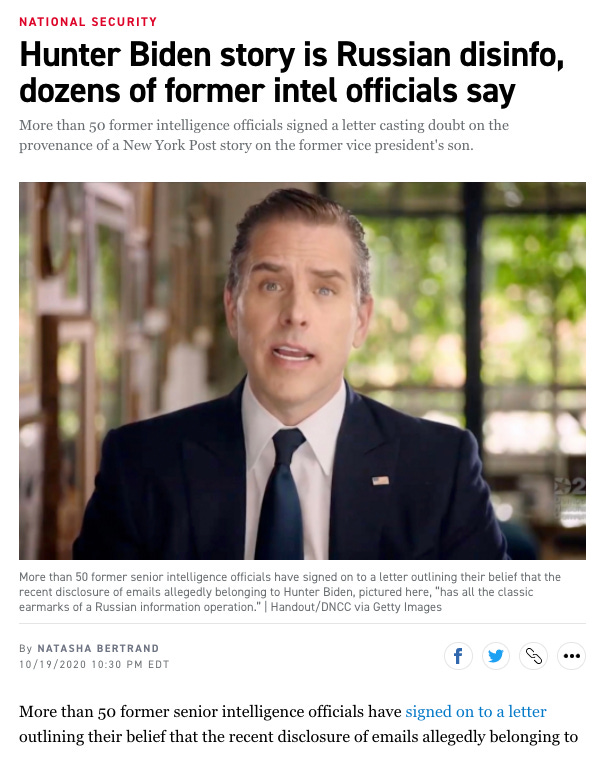
Yet that is exactly what the overwhelming bulk of media outlets are doing again: asserting that Russia is behind these hacks despite having no evidence of its truth. The New York Times’ Michael Barbaro, host of the paper’s popular The Daily podcast, asked his colleague, national security reporter David Sanger, what evidence exists to assert that Russia did this. As Barbaro put it, even Sanger is “allowing that early conclusions could all be wrong, but that it’s doubtful.” Indeed, Sanger acknowledged to Barbaro that they have no proof, asserting instead that the basis on which he is relying is that Russia possesses the sophistication to carry out such a hack (as do several other nation-states), along with claiming that the hack has what he calls the “markings” of Russian hackers.
But this tactic was exactly the same one used by former intelligence officials, echoed by these same media outlets, to circulate the false pre-election claim that the documents from Hunter Biden’s laptop were “Russian disinformation”: namely, they pronounced in lockstep, the material from Hunter’s laptop “has all the classic earmarks of a Russian information.” This was also exactly the same tactic used by the U.S. intelligence community in 2001 to falsely blame Iraq for the anthrax attacks, claiming that their chemical analysis revealed a substance that was “a trademark of the Iraqi biological weapons program.”
These media outlets will, if pressed, acknowledge their lack of proof that Russia did this. Despite this admitted lack of proof, media outlets are repeatedly stating Russian responsibility as proven fact.
“Scope of Russian Hacking Becomes Clear: Multiple U.S. Agencies Were Hit,” one New York Times headline proclaimed, and the first line of that article, co-written by Sanger, stated definitively: “The scope of a hacking engineered by one of Russia’s premier intelligence agencies became clearer on Monday.” The Washington Post deluged the public with identically certain headlines.
Nobody in the government has been as definitive in asserting Russian responsibility as corporate media outlets. Even Trump’s hawkish Secretary of State, Mike Pompeo, crafted his accusation against Moscow with caveats and uncertainty: “I think it’s the case that now we can say pretty clearly that it was the Russians that engaged in this activity.”
If actual evidence ultimately emerges demonstrating Russian responsibility, it would not alter how dangerous it is that — less than twenty years after the Iraq WMD debacle and less than a couple of years after media endorsement of endless Russiagate falsehoods — the most influential media outlets continue to mindlessly peddle as Truth whatever the intelligence community feeds them, without the need to see any evidence that what they’re claiming is actually true. Even more alarmingly, large sectors of the public that venerate these outlets continue to believe that what they hear from them must be true, no matter how many times they betray that trust. The ease with which the CIA can disseminate whatever messaging it wants through friendly media outlets is stunning.
Second, the very idea that this hack could be compared to rogue and wildly aberrational events such as Pearl Harbor or the 9/11 attack is utterly laughable on its face. One has to be drowning in endless amounts of jingoistic self-delusion to believe that this hack — or, for that matter, the 2016 “election interference” — is a radical departure from international norms as opposed to a perfect reflection of them.
Just as was true of 2016 fake Facebook pages and Twitter bots, it is not an exaggeration to say that the U.S. Government engages in hacking attacks of this sort, and ones far more invasive, against virtually every country on the planet, including Russia, on a weekly basis. That does not mean that this kind of hacking is either justified or unjustified. It does mean, however, that depicting it as some particularly dastardly and incomparably immoral act that requires massive retaliation requires a degree of irrationality and gullibility that is bewildering to behold.
The NSA reporting enabled by Edward Snowden by itself proved that the NSA spies on virtually anyone it can. Indeed, after reviewing the archive back in 2013, I made the decision that I would not report on U.S. hacks of large adversary countries such as China and Russia because it was so commonplace for all of these countries to hack one another as aggressively and intrusively as they could that it was hardly newsworthy to report on this (the only exception was when there was a substantial reason to view such spying as independently newsworthy, such as Sweden’s partnering with NSA to spy on Russia in direct violation of the denials Swedish officials voiced to their public).
Other news outlets who had access to Snowden documents, particularly The New York Times, were not nearly as circumspect in exposing U.S. spying on large nation-state adversaries. As a result, there is ample proof published by those outlets (sometimes provoking Snowden’s strong objections) that the U.S. does exactly what Russia is alleged to have done here — and far worse.
“Even as the United States made a public case about the dangers of buying from [China’s] Huawei, classified documents show that the National Security Agency was creating its own back doors — directly into Huawei’s networks,” reported The New York Times’ David Sanger and Nicole Perlroth in 2013, adding that “the agency pried its way into the servers in Huawei’s sealed headquarters in Shenzhen, China’s industrial heart.”
In 2013, the Guardian revealed “an NSA attempt to eavesdrop on the Russian leader, Dmitry Medvedev, as his phone calls passed through satellite links to Moscow,” and added: “foreign politicians and officials who took part in two G20 summit meetings in London in 2009 had their computers monitored and their phone calls intercepted on the instructions of their British government hosts.” Meanwhile, “Sweden has been a key partner for the United States in spying on Russia and its leadership, Swedish television said on Thursday,” noted Reuters, citing what one NSA document described as “a unique collection on high-priority Russian targets, such as leadership, internal politics.”

Other reports revealed that the U.S. had hacked into the Brazilian telecommunications system to collect data on the whole population, and was spying on Brazil’s key leaders (including then-President Dilma Rousseff) as well as its most important companies such as its oil giant Petrobras and its Ministry of Mines and Energy. The Washington Post reported: “The National Security Agency is gathering nearly 5 billion records a day on the whereabouts of cellphones around the world, according to top-secret documents and interviews with U.S. intelligence officials, enabling the agency to track the movements of individuals — and map their relationships — in ways that would have been previously unimaginable.” And on and on.
[One amazing though under-appreciated episode related to all this: the same New York Times reporter who revealed the details about massive NSA hacking of Chinese government and industry, Nicole Perlroth, subsequently urged (in tweets she has now deleted) that Snowden not be pardoned on the ground that, according to her, he revealed legitimate NSA spying on U.S. adversaries. In reality, it was actually she, Perlorth, not Snowden, who chose to expose NSA spying on China, provoking Snowden’s angry objections when she did so based on his view this was a violation of the framework he created for what should and should not be revealed; in other words, not only did Perlroth urge the criminal prosecution of a source on which she herself relied, an absolutely astonishing thing for any reporter to do, but so much worse, she did so by falsely accusing that source of doing something that she, Perlroth, had done herself: namely, reveal extensive U.S. hacking of China].
What all of this makes demonstrably clear is that only the most deluded and uninformed person could believe that Russian hacking of U.S. agencies and corporations — if it happened — is anything other than totally normal and common behavior between these countries. Harvard Law Professor and former Bush DOJ official Jack Goldsmith, reviewing growing demands for retaliation, wrote in an excellent article last week entitled “Self-Delusion on the Russia Hack: The U.S. regularly hacks foreign governmental computer systems on a massive scale”:
The lack of self-awareness in these and similar reactions to the Russia breach is astounding. The U.S. government has no principled basis to complain about the Russia hack, much less retaliate for it with military means, since the U.S. government hacks foreign government networks on a huge scale every day. Indeed, a military response to the Russian hack would violate international law . . . .
As the revelations from leaks of information from Edward Snowden made plain, the United States regularly penetrates foreign governmental computer systems on a massive scale, often (as in the Russia hack) with the unwitting assistance of the private sector, for purposes of spying. It is almost certainly the world’s leader in this practice, probably by a lot. The Snowden documents suggested as much, as does the NSA’s probable budget. In 2016, after noting “problems with cyber intrusions from Russia,” Obama boasted that the United States has “more capacity than anybody … offensively” . . . .
Because of its own practices, the U.S. government has traditionally accepted the legitimacy of foreign governmental electronic spying in U.S. government networks. After the notorious Chinese hack of the Office of Personnel Management database, then-Director of National Intelligence James Clapper said: “You have to kind of salute the Chinese for what they did. If we had the opportunity to do that, I don’t think we’d hesitate for a minute.” The same Russian agency that appears to have carried out the hack revealed this week also hacked into unclassified emails in the White House and Defense and State Departments in 2014-2015. The Obama administration deemed it traditional espionage and did not retaliate. “It was information collection, which is what nation states—including the United States—do,” said Obama administration cybersecurity coordinator Michael Daniel this week.
But over the last four years, Americans, particularly those who feed on liberal media outlets, have been drowned in so much mythology about the U.S. and Russia that they have no capacity to critically assess the claims being made, and — just as they were led to believe about “Russia’s 2016 interference in Our Sacred Elections” — are easily convinced that what Russia did is some shocking and extreme crime the likes of which are rarely seen in international relations. In reality, their own government is the undisputed world champion in perpetrating these acts, and has been for years if not decades.
Third, these demands for “retaliation” are so reckless because they are almost always unaccompanied by any specifics. Even if Moscow’s responsibility is demonstrated, what is the U.S. supposed to do in response? If your answer is that they should hack Russia back, rest assured the NSA and CIA are always trying to hack Russia as much as it possibly can, long before this event.
If the answer is more sanctions, that would be just performative and pointless, aside from wildly hypocritical. Any reprisals more severe than that would be beyond reckless, particularly with the need to renew nuclear arms control agreements looming. And if you are someone demanding retaliation, do you believe that Russia, China, Brazil and all the other countries invaded by NSA hackers have the same right of retaliation against the U.S., or does the U.S. occupy a special place with special entitlements that all other countries lack?
What we have here, yet again, is the classic operation of the intelligence community feeding serious accusations about a nuclear-armed power to an eagerly gullible corporate media, with the media mindlessly disseminating it without evidence, all toward ratcheting up tensions between these two nuclear-armed powers and fortifying a mythology of the U.S. as grand victim but never perpetrator.
If you ever find yourself wondering how massive military budgets and a posture of Endless War are seemingly invulnerable to challenge, this pathological behavior — from a now-enduring union of the intelligence community, corporate media outlets, and the Democratic Party — provides one key piece of the puzzle.
Ex-intel official listed among spooks rejecting Hunter Biden scandal as Russian disinfo NEVER SIGNED that letter
RT | December 18, 2020
An ex-intelligence official listed on a letter suggesting that allegations of influence peddling by Joe Biden’s family stemmed from Russian disinformation told the National Review that he had never seen nor signed the document.
The news outlet discovered the discrepancy as it sought comments from the 51 people listed on the letter as to whether their assessment had changed in light of confirmation that Biden’s son, Hunter Biden, had been under FBI investigation for more than a year.
National Review said that when it contacted Gregory Treverton, former chairman of the National Intelligence Council, he apparently misunderstood the query, saying, “This is the first I’ve seen of this, but happy to sign.” When the newspaper clarified that he had already been named as a signatory, he said that he had never seen the letter but would have signed if he had received the request. He made that statement despite acknowledging that he hadn’t “looked at” the federal investigation of Hunter Biden.
Treverton’s haphazard response and the fact that his name was falsely used to add weight to the letter may undermine the credibility of an increasingly popular technique used by former US spooks to influence public opinion and provide fodder for mainstream-media narratives. A similar letter signed by dozens of former officials with the CIA and other intelligence agencies was deployed last month to show that national security experts agreed that President Donald Trump should give up his legal fight over the November 3 election and concede that Biden had won.
As in the case of the earlier letter, which was dated October 19, CNN and other outlets trumpeted the consensus of the security experts to support their assertions, arguing that Trump didn’t have a legitimate fraud case to nullify Biden’s media-declared election victory. But claims in the earlier letter were made even more dubious when Hunter Biden himself announced last week that he was under federal investigation.
Former CIA chiefs Mike Hayden and John Brennen were among signatories to the letter, as was ex-Director of National Intelligence James Clapper. Their baseless argument that Moscow was likely behind the allegations against the Bidens was used by the media as justification to dismiss the New York Post’s October scoops documenting the family’s alleged influence-peddling.
The signatories conceded that they had no evidence that the emails cited by the Post weren’t genuine, but suggested that the trove of data found on a laptop allegedly belonging to Hunter Biden fit with Russia’s agenda of discrediting Trump’s opponent. They asserted that the emails had “the classic earmarks” of a Russian disinformation campaign. The ex-spooks also ignored other evidence brought against the Bidens, including on-the-record comments by a former business partner, Tony Bobulinski.
The large number of signatories was used to claim strong credibility for the allegations in the letter. “The real power here, however, is the number of working-level intelligence-community officers who want the American people to know that once again, the Russians are interfering,” former Brennan aide Nick Shapiro tweeted at the time.
Joe Biden cited the letter in his final debate with Trump, saying there were “50 former national intelligence folks who said that what he is accusing me of is a Russian plant.”
The National Review said it was unable so far to determine whether any of the 50 other signatories listed on the letter had been included without being notified.
US Media Suffers From ‘Russia Hack Syndrome’ & Provides No Proof of Breach, as Usual
By Ekaterina Blinova – Sputnik – 18.12.2020
The “Russia did it narrative” concerning the alleged breach into US federal cyber infrastructure is being circulated by the media despite the US government not formally blaming Moscow for the supposed hack. American scholars Gilbert Doctorow and Earl Rasmussen have discussed the accusations and the timing of the media campaign.
On 17 December, the US Cybersecurity and Infrastructure Security Agency issued a warning saying that American government agencies, critical infrastructure entities, and private sector organisations had been compromised “by an advanced persistent threat (APT) actor” since at least March 2020.
The story popped up on Saturday, with Reuters and The Washington Post reporting about the alleged cyber intrusion into the US Treasury and Commerce departments and pointing the finger at Russia, citing “people familiar with the matter”. Russian Ambassador to the US Anatoly Antonov rejected the media claims during a video conference held by Georgetown University and suggested establishing a platform for a dialogue between the US and Russian intelligence communities.
Timing of the Allegations Speaks Volumes
The timing of the alleged hack evokes strong memories of the 2016-2017 transition period when Russia was accused of breaching the Democratic National Committee’s (DNC) servers, according to Gilbert Doctorow, an international relations and Russian affairs analyst.
“One constant feature of American foreign policy going back at least to the last transition in power following Donald Trump’s election in November 2016 is that in this transition the wreckers use the ‘interregnum’ to prevent reasonable policies from being implemented by the incoming administration”, he says.
He recollects that at that time Donald Trump’s chances of reaching an accommodation with Russia were upset “by the illegal and unjustified expropriation of Russian consular property in December 2016, for example, and the phony Steele dossier was released before Trump took the oath of office”. The latest accusations mentioning Russia came on the heels of the 2020 Electoral College vote in favour of ex-Vice President Joseph Biden, who earlier vowed to increase pressure on Moscow.
Doctorow believes the Democratic-controlled House may use the recent anti-Russia allegations to put forward a bill on tougher sanctions, likely related to the Gazprom-led Nord Stream 2 pipeline project that is heading towards completion.
“On the other hand, the Senate may not be very cooperative, especially if the Republicans win the two vacant seats in Georgia during the January election run-off”, he suggests. “And the incoming Secretary of State Blinken is unlikely to want to strike the Russian jugular – he is on record as favouring SALT renewal, which would be impossible if there are draconian sanctions about to be imposed.”
During his annual press conference on 17 December Russian President Vladimir Putin commented on the spying allegations promoted by the mainstream media in the US, suggesting the anonymous sources behind these reports are, in fact, US officials and intelligence agencies. The Russian president noted that these very structures were behind the similarly groundless claims against Moscow following the 2016 presidential elections, adding the new reports of “Russian hackers” could have been fabricated at their behest.
Hacking Allegations Don’t Hold Water, Again
“As with the DNC hacks and Russiagate we once again find the ‘Russians’ being accused of hacking absent any evidence”, says Earl Rasmussen, executive vice president of the Washington-based think tank Eurasia Centre. “For one, I am tired of the Russia Hack Syndrome.”
The scholar recalls that four years ago Russia was accused of “exfiltrating” thousands of emails and documents from the Democratic National Committee’s servers and passing them to WikiLeaks which subsequently released the trove in the summer of 2016.
In January 2017, the Intelligence Community Assessment (ICA) formally accused Russia of the supposed breach, while in July 2018 Special Counsel Robert Mueller assigned with the task of looking into the alleged ties between the Trump campaign and Moscow indicted a number of Russian individuals said to be officers of the Main Intelligence Directorate (GRU) for the reported hack. The accusations were based on the conclusions of the DNC’s private cyber defence contractor CrowdStrike since neither the FBI, nor any other US government intelligence agency have to date examined the committee’s hardware.
“[However], recently unclassified sworn testimony of CrowdStrike officials and senior intelligence officials all stated that there was no evidence of a hack or exfiltration”, Rasmussen highlights, citing CrowdStrike President Shawn Henry’s December 2017 admission under oath that the cyber firm “did not have concrete evidence that the data was exfiltrated from the DNC”.
CrowdStrike claimed at the time that the intruders were “two Russian espionage groups”, Cozy Bear (APT29) and Fancy Bear (APT28), suggesting with a “low” to “medium”-level of confidence that they “may indicate affiliation” with Russia’s Federal Security Service (FSB) and Main Intelligence Department (GRU), respectively. Moscow summarily shredded the assumptions as absurd.
The DNC contractor is also known for a groundless claim that the “Russian” group Fancy Bear hacked a Ukrainian artillery app which led to heavy losses of howitzers in 2016 that was later debunked by both the Ukrainian Defence Ministry and the US state-owned media Voice of America.
Yet, the aforementioned inconsistencies did not prevent the US intelligence community and mainstream media from continuously accusing Russia of the alleged DNC hack for over four years, Rasmussen notes.
“I think the credibility of US intelligence, law enforcement, and media are pretty much discredited”, he says. “I am leery of anything coming from the media and their so-called sources without significant evidence. Besides, our own government is one of the biggest and most sophisticated cyber threats in the world”.
Jack Dorsey, the CIA and Twitter Censorship in the Age of Covid-19
By Vanessa Beeley |
Unlimited Hangout| December 10, 2020
Twitter CEO, Jack Dorsey, has embedded himself in some of the most powerful global influencer complexes. His techno-mining of African potential and the increasing use of Twitter as a surveillance tool for the corporatocracy have generated the opportunity for Dorsey to play an increasingly pivotal role in the roll-out of the World Economic Forum’s Great Reset.
In Part 1 of this series on the emergence of the “celebrity humanitarianism” complex of the 21st century and its role in the ongoing Covid-19 crisis, I covered the evolution of Hollywood actor Sean Penn from anti-Iraq-war activist to establishment narrative endorser and advocate for the predator class factions dominated by the Clinton family cabal and globalism.
Penn was one of the three men together on a beach holiday that was featured in a Daily Mail article in November 2020. Another of the three global influencers strolling on the beach with Penn was “technology entrepreneur” and the CEO and co-founder of Twitter, Jack Dorsey. Dorsey’s meteoric rise to fame as a leading innovator in the world of data technology began to falter in 2016/17 when 247 Wall Street listed Dorsey among the twenty worst CEOs in America. In this article, I will investigate Dorsey’s involvement in the narrative management of Covid-19 and his potential contribution to the roll out of the World Economic Forum’s Great Reset that has been accelerated by the Coronavirus “pandemic” exercise.
Like Penn, Dorsey is a supporter of the Democratic Party. Dorsey broke ranks with the billionaire bloc to donate $ 5600 to Tulsi Gabbard’s campaign after the June 2019 Democratic debates. Dorsey cites Gabbard’s anti-war stance as the reason for his support. Dorsey also contributed to the campaigns of Andrew Yang and Jay Inslee. Dorsey commends Yang for his “focus on artificial intelligence and automation” (emphasis added). Dorsey has also endorsed the philanthrocapitalist “climate change” portfolio – in a tweet Dorsey says that Gabbard and Yang’s “voices are important to surface in debates”, adding:
“Along with systemically addressing climate change and economic injustice, these are the key issues of global consequence I want to see considered and discussed more.”
Dorsey as well as the CEO of Facebook, Mark Zuckerberg, were subpoenaed to a US Senate hearing in November 2020, where their platforms were accused of anti-conservative bias after their effective suppression of the Hunter Biden China scandal. Of the two social media platforms, Twitter was deemed to be the most aggressive in its censorship of the New York Post article.
US conservatives were outraged that a story critical of Joe Biden, with potential to turn the election in favour of Donald Trump, was being buried by platforms as influential as Twitter and Facebook. Dorsey’s rationale for this unprecedented censorship had been that Twitter policies prohibit “directly distributing content obtained through hacking that contains private information”. Dorsey later back-pedalled but by then, the story had effectively been “disappeared” and damage to the Biden campaign had been successfully limited.
Dorsey’s apparent absorption into the transnational billionaire complex controlling the global response to the Covid-19 “pandemic” and orchestrating the Fourth Industrial Revolution, will be explored throughout this article.
From Square to Covid-19 – Dorsey transfers $ 1 billion to “disarm the pandemic”
In addition to Twitter, Dorsey is also the CEO of Square, a digital payments platform. In April 2020, Dorsey transferred an alleged 28% of his wealth from Square to his Start Small LLC (SS) to fund Covid-19 relief globally. The $1 billion donation represents the most significant “philanthropic” donation made by the tech-billionaire during his entire career.
One month after the launch of SS, Dorsey announced on Twitter the disbursement of $87.8 million to a number of initiatives apparently responding to fall-out from Covid-19 response measures. The disbursements included $600,000 to help develop “high impact digital learning tools to support special needs students and English language learners who are most affected by the crisis and will experience the most learning loss during school closures”.
The reality is that none of these measures would be necessary if scientists, doctors, epidemiologists, medical staff and experts opposing the disproportionate response to a virus [seemingly] less deadly than seasonal flu had been taken into consideration by the institutions and governments rolling out the draconian “lockdown” of global populations in preparation for the Great Reset. Dorsey’s and Twitter’s role in ensuring the censorship and de-platforming of dissenting voices is also examined in this article.
Let us not forget that “a report from the Institute for Policy Studies found that, while tens of millions of Americans have lost their jobs during the coronavirus ‘pandemic’, America’s ultra-wealthy elite have seen their net worth surge by $ 82 billion in just 23 days” as picked up by journalist, Cory Morningstar, who is also cited below.
In May 2020, Dorsey donated $10 million to Sean Penn’s CORE response which supported CORE’s national expansion of Covid-19 drive-through test sites “into Atlanta, Detroit, New Orleans and the Navajo Nation”. The origins of the CORE initiative are examined in detail in Part 1 of this series. Dorsey is also credited with persuading Penn to join Twitter in May 2020.
As Dorsey stated in his April 2020 tweet:
“After we disarm this pandemic, the focus will shift to girl’s health and education, and [Universal Basic Income] or UBI.”
Dorsey’s involvement in the promotion of UBI demonstrates his endorsement of measures which are designed to shore up economic privilege for members of the global billionaire cartels while asset-stripping and disenfranchising the working classes and what remains of an already decimated middle class in the West.
Cory Morningstar, one of the foremost voices speaking out about the unprecedented power grab being facilitated by the Covid-19 narratives, gave me this statement with regards to the covert threat of UBI:
Covid-19 is the catalyst for the Great Reset, in which universal basic income plays a securing role. Universal Basic Income (UBI) is the strategic solution to protect the ruling classes from Molotov cocktails and global civil unrest by those being methodically dispossessed of their occupations, dignity and self-preservation – the working class, much middle class, peasantry, artisans, and those that comprise the informal economy that presides in the Global South. Disclosures on coming “disbanding of existing safety-net programs” are not included in the foundation-funded marketing campaigns.
When UBI begins to be rolled out globally, one can expect public healthcare to slowly disappear, replaced by privatized services (largely Telehealth). Further, UBI payments will be linked to benefits via blockchain – ensuring full spectrum compliance and servitude of whole societies. Billionaires are supporting/financing UBI marketing campaigns for good reason: it is preferable to pay a pittance to the citizenry than to risk losing the social license that allows for the continued decimation of the Earth, coupled with the continued exploitation of those most oppressed and vulnerable.
The real motive behind Jack Dorsey’s interest in Africa
Dorsey’s focus on UBI and girl’s health and education is mirrored, coincidentally, by the interests of the Clinton Foundation in Africa. Dorsey had been planning to relocate to Africa for six months in 2020, plans that were apparently derailed by the Coronavirus crisis although a more likely obstacle was investor concern that his pivot to Square and the opportunities presented for digital payment remodeling in Africa’s cash-based society would lead to his neglect of Twitter.
In 2015, Bill and Chelsea Clinton led an entourage of powerful elite sponsors of the Clinton Foundation to Africa for Bill Clinton’s 12th visit to the resource-plundered continent. Dorsey joined the Clintons, Microsoft (via Bill Gates), Facebook and Google in a bid to ensnare the developing market sector into their accelerator programmes and debt enslavement campaigns. Visa, Mastercard and Salesforce are also establishing venture investments in African start-ups.
According to “Witney Schneidman, a Brookings fellow with the Africa Growth Initiative and former deputy secretary of state Clinton administration”, Dorsey was in the right place at the right time. In November 2019, Dorsey tweeted that Africa “will define the future (especially the bitcoin one)” The African continent comprises 54 countries with a combined population of 1.3 billion people with the highest population growth rate in the world. The world’s largest population of people without banks, trading in cash. Ripe for exploitation by the world’s robber barons and financial-tech-carpet-baggers.
In November 2020, Dorsey was the closing keynote speaker for the Africa Fintech Summit sponsored by Dedalus Global and Ibex Frontier. Dorsey is described as a “futurist”, a “visionary”, and one of the “biggest influencers in tech ecosystems worldwide”. “With an unbanked population of 66% and a credit card penetration rate that averages 1.5%, the applications for crypto in sub-Saharan Africa can only help solidify Dorsey’s interest in the continent” (Africa News )
Dorsey is investing in the reinvention of colonialism as smart growth, the new-age digital colonialism. The Facebook’s internet footprint in Africa and its Orwellian ambitions for that continent are covered in detail in this article by investigative journalist, Cory Morningstar. Morningstar has showed in her recent and past work how the billionaire class seeks to facilitate the absorption of the Global South into a paternalistic, inherently racist, Global North power structure that will suck the lifeblood out of these nations via “philanthropic” channels that have been constructed to mine data, resources, livelihoods and cultural infrastructure until it is an overpopulated, micro-managed colony with no access to development unless it is plugged into the predator class mothership.
“As Africa meets the 4IR Fourth Industrial Revolution], its youth will be one of its most important assets” – August 2020, World Economic Forum: How can Africa succeed in the Fourth Industrial Revolution?
Dorsey, the Clintons and the technological “disruption” of Haiti
Dorsey’s history of rubbing shoulders with the Clinton clan goes way back. Just as Sean Penn was heavily involved with the Clinton’s rapacious policies in Haiti, Dorsey was a keynote speaker at the Haiti Tech Summit in 2018, an event that is also described as the “Davos of the Caribbean”. The summit was organised by the Global Startup Ecosystem which, according to their website, “hosts the world’s first and largest digital accelerator- supporting 1000 companies from 90 countries every year”. Target regions are Africa, America, Asia, Europe, Caribbean, Latin America and the Middle East.
Taken from their website, in 2017, GSE launched a 13 year initiative to accelerate emerging market ecosystems every year until 2030 in alignment with the Sustainable Development Goals.
The “iconic” Haiti Tech Summit was the pilot launch. The company was projecting 54 tech summits in 2020, to be held virtually and “across all major hubs globally”. Alongside Dorsey at the 2018 Haiti Tech summit were representatives from other Silicon Valley giants — Google, Facebook and YouTube. The end of summit message from the summit’s founder and GSE’s co-founder, Christine Souffrant Ntim, informed the audience that Haiti “was ready for disruption”. This is an unfortunate choice of words considering the decades of “disruption” that have been inflicted upon the semi-colonised island by a series of US administrations, dominated by the Clintons’ exploitation policies targeting Haiti.

Screenshot from Haitian Times video report on the Tech Summit 2018.
This is nothing less than implementation of UN Agenda 2030, an agenda that aims to privatise and seize control of land, resources, energy, education and to digitalise the world we live in, to bring us all into city-based data colonies that can be easily controlled and manipulated for the benefit of the vulture class – the billionaire elites who perceive this world to be their exclusive bread basket and the “little people” as the “useless” expendables.
GSE’s website lists Dorsey as a member of their speaker network that includes Ben Horowitz and Sophia, the world’s celebrity robot. Horowitz is co-founder of Andreessen Horowitz, a Silicon Valley venture capital firm that invests in technology start-ups, and their better-known investments include GitHub, Facebook, Pinterest and Twitter. GSE partners include LinkedIn, Google Cloud, IBM Cloud and Forbes. GSE’s mission is to “prepare individuals and organisations for the digital age” according to Einstein Ntim, managing partner at GSE – a goal completely in line with the Fourth Industrial Revolution and the Covid-19-facilitated Great Reset.
Dorsey and the Transition Integrity Project – Berggruen Institute
Dorsey’s involvement with the Berggruen Institute (BI) is an indication of his collaboration with some of the most powerful neoconservative influencers in US politics. BI is another transformational future-shaping conglomerate “promoting long term answers to the biggest challenges of the 21st Century”. Nicolas Berggruen is the co-founder and chairman of BI. Berggruen has been pivotal in the restructuring and reinventing of “democracy” for the new digital age. Berggruen used the institute as a launch pad for a number of government reform projects. These include the 21st Century Council which brought together former heads of state – with Tony Blair, Gerhard Schroder, Helle Thorning Schmidt and Nicolas Sarkozybeing just a few of names on the list. Dorsey was a member of the 21st Century Council and is one of Berggruen’s “people”.
Berggruen established the “Think Long Committee for California” in 2010. The committee included such neoconservative and “progressive” luminaries as Condoleeza Rice and Eric Schmidt (Google CEO) and its purpose was to effectively create a new set of rules for governance, using Agenda 21 Sustainable Development grants to impose regional governance.

Soros/Berggruen/von der Leyen
In 2012, Berggruen’s Council for the Future of Europe met in Berlin to discuss Europe Beyond the Crisis. Speeches were given by former UK Labour Party leader and criminal globalist, Tony Blair, billionaire influencer and transnational interventionist, George Soros and George Papandreou, former PM of Greece and last in a long line of corrupt imperialist sycophants. Dorsey has effectively embedded himself into one of the most influential and predatory of the neocon cartels. Dorsey is a minor in the billionaire circle but a major in identifying the foremost power hubs.
Berggruen is also behind the Transition Integrity Project (TIP), recently covered by investigative journalist, Whitney Webb, for Unlimited Hangout who described the TIP as:
“A group of Democratic Party insiders and former Obama and Clinton era officials as well as a cadre of “Never Trump” neoconservative Republicans have spent the past few months conducting simulations and “war games” regarding different 2020 election “doomsday” scenarios.”
Another sinister Berggruen programme is the “Transformations of the Human” which has all the hallmarks of a transhumanism agenda. The concept involves the placing of philosophers and artists in key research sites “to foster dialogue with technologists”. The “aim of the program is to render AI and Biotech visible as unusually potent experimental sites for reformulating our vocabulary for thinking about ourselves” which could be interpreted as reprogramming humanity. The findings will be fed back into the “production of both AI and biotech and to thereby contribute to both human and non-human flourishing” or perhaps to merge the two?
As investigative journalist, James Corbett, warns “are we ready to give up our humanity” to succumb to the “ethical use of technology to extend human capabilities?”. The redesigning or genetic modification of the human condition is not science fiction, it is the bedrock of the ideology of those who rule this world behind the facade of government.
As Julian Huxley, an influential English evolutionary biologist, eugenicist, and internationalist wrote, in the last century:
“… unless [civilised societies] invent and enforce adequate measures for regulating human reproduction, for controlling the quantity of population, and at least preventing the deterioration of quality of racial stock, they are doomed to decay …”
Huxley invented the term “transhumanism” just before he became President of the British Eugenics Society, 1959-62. Huxley was also the first Director General of UNESCO.
Author, Dean Koontz, described the age of Transhumanism and the Fourth Industrial Revolution very succinctly:
“We live in hubristic age, when politicians imagine themselves to be messiahs and when many in the sciences frankly discuss their dreams of creating a “post-human” civilization of genetically engineered supermen, ignorant of the fact that like minds have often come before them and have left no legacy but death, destruction, and despair.”
Dorsey’s close ties to those whose purpose is to reinstate a Silicon Valley-backed Democrat as US President and to oust President Trump who, to some degree, slowed down the global military interventionism of the neocon camp in Washington as well as Twitter’s record of protectionism of the Biden election campaign are perhaps what, currently, make Dorsey an accepted member of the overclass.
It should be no surprise, therefore, that Nicholas Pacilio, senior communications manager at Twitter, who deleted Trump tweets claiming (correctly) children are almost immune from Covid-19, was formerly the press secretary for Kamala Harris, Biden’s pick for vice president. Twitter’s proclaimed neutrality is rendered nonsensical by all the above and by their collaboration across the board with global influencers whose futurist agenda is reliant upon the acceptance of official Covid-19 narratives.
Dorsey’s anti-conservative Twitter censorship policy is also supported by online petition giant, Avaaz, who were instrumental in the fomenting of conflict in Syria from the outset in 2011 and well versed in the art of selling hate for Empire.
Bill Gates and Jack Dorsey – investing in civil unrest?
Dorsey and Covid-19 impresario, Bill Gates, are alleged indirect funders of the BAIL Project (BP). The project was established to bail out protestors who participated in the George Floyd demonstrations and riots. BAIL is reported to have connections to Antifa, an organisation associated with stoking civil unrest and being “primary instigators of violence at public rallies” according to declassified Department of Homeland Security and FBI studies from 2016, the first year of Trump’s presidency. While many of the reports linking Dorsey to BAIL and BAIL to Antifa can be described as “conservative”, Dorsey’s Start Small initiative has donated to Black Lives Matter, suspected to be another of the billionaire co-opted organisations designed to harness and control black power globally.
The Audacious Project (housed at TED) was seed-funded $ 250 million by Gates, Skoll and Dalio Foundations. The BAIL Project was one of the five recipients of $ 50 million funding from the Audacious Project and is partnered by TED directly according to their own website. The Audacious Project, “a new model to inspire change”, is yet another node in the philanthrocapitalist complex wreaking havoc globally under the pretext of building a better future for all. In reality, such groups are building a system that will make the world’s wealthiest class even wealthier and will give ever increasing control over the global resource inventory.
When the connection is made to the Transition Integrity Project and Gates and Dorsey’s suspected involvement in BAIL and potentially Antifa, it makes sense that these narrative builders of the Covid-19 paradigm would be behind the scenes of the planned civil unrest in the US.
Further evidence of Twitter’s role as a surveillance tool for US intelligence agencies and influencers on Covid-19 response came when The Intercept exposed the AI start-up Dataminr and that company’s involvement in the monitoring of the Floyd protests and provision of that data to police and security forces nationwide. While both Twitter and Dataminr deny any engagement in domestic surveillance, these accusations followed on from the 2016 controversies that aligned Twitter with the CIA as investors in, or partners of Dataminr. The Twitter-Dataminr collaboration permitted Dataminr to scan every public tweet as soon as it was published, giving them advance warning of any incoming protests or dissident action.

Despite the denial of surveillance activity by both Twitter and Dataminr, “monitoring activities and forwarding information to the police is clearly surveillance” explained Andrew Ferguson, author of “The Rise of Big Data Policing: Surveillance, Race, and the Future of Law Enforcement.”
In 2016, Twitter allegedly asked that Dataminr stop providing intelligence agencies with Twitter tools and content but as TechCrunch reported:
“… Dataminr isn’t ending its relationship with the government altogether: Dataminir still counts In-Q-Tel, the non-profit investment arm of the CIA, as an investor. Dataminr has taken investment from Twitter, too, highlighting some of the conflicts that remain as tech companies fight for more transparency and autonomy from government control.”
Dataminr’s Yale leadership is believed to still have a $ 255,000 contract with the Department of Homeland Security. The protestations of Twitter and apparent withdrawal from US intelligence blood-hounding by Dataminr appear to be nothing more than smoke and mirrors designed to put the public off the scent.
However, perhaps even more relevant to the Twitter censorship of Covid-19 dissident media, scientists and medical experts, and famously, David Icke, all of whom were challenging establishment “science”, is perhaps also related to its partnership with Dataminr. In late 2016, Twitter told TechCrunch that Dataminr “uses public Tweets to sell breaking news alerts to […] government agencies such as the World Health Organisation” although the “not for surveillance” caveat was thrown in.
The billionaire complex apprentices, managing narratives for their mentors
Penn and Dorsey are not in the upper echelons of the ruling elite circles. They are the keen instruments of power, eager to please and to do the bidding of those in positions of power they perhaps aspire to one day. The wealthiest people in the world are providing funding for the Covid-19 response, with good reason. It is the portal to the world vision they have been working towards for decades, perhaps even centuries.
At the World Economic Forum meeting in Davos, January 2020, historian and philosopher, Yuval Harari, gave talks on the future of humanity. Harari talks about the “useless class”, he describes the data colonies that will be formed under some projected “dictator.” In the world, Harari envision, if a dissident’s mind can be read by a centralised AI data hub, he can be arrested for non-compliance with the dictatorship.
Of course, the global dictatorship is already here with the Covid-19 measures, the obligatory masking, martial law, the Army deployed to roll out testing and vaccines, mandatory vaccines (you will not be able to function in society without one), the incarceration of the elderly, the destitution and isolation of children in schools and distance learning, digitalised education systems. The future according to this totalitarian, neo-feudalist system is bleak for humanity unless we collectively wake up.
Penn and Dorsey are just two of a collection of useful pathways to the Great Reset. They are the fear-stokers and narrative managers, ensuring that people fear death, fear their own powerlessness against a “virus” that stalks them even in their own home.
As journalist, Peter Koenig, described earlier this year:
“The virus is just a clever idea to use an invisible enemy for instilling fear, worldwide, by this minuscule, insanely rich and psychotically power-hungry elite to put the entire world population to its knees. FEAR that obliterates the human immune system and may bring about a range of illnesses far worse than covid-19, including cancer, coronary diseases, diabetes – and much more.”
It is time to recognise that death is an inevitable part of our existence as human beings, that visions of immortality offered by those who will distort and twist humanity out of shape to create a dystopian future for all but the very privileged few, are nothing but the erosion of all that is human. Being human is what will enable us to fight back. When we remember what we cherish as human beings, a smile, a hug, the comfort of touch and the warmth of human interaction perhaps we will start fighting before we lose what makes us who we are to the vision of those who see us as ultimately expendable.
The Empire Doubles Down: Open Society Foundations Will Now Be Run by Lord Malloch Brown

By Matthew Ehret | Strategic Culture Foundation | December 11, 2020
The hubris of empire has always struck me with shock and awe.
I mean it really takes balls to get caught with a prostitute and instead of apologizing to your wife, to instead buy the hooker a new fur coat and parade her publicly at a public event.
Such has been the case with George Soros’ long time bosom buddy Lord Mark Malloch Brown who after being revealed as a leading force behind the software used by the infamous Dominion Voting systems via Smartmatic (which transferred its operating systems to Dominion via Sequoia Inc), has now been made the president of Soros’ global Open Society Foundations.
What is the logic behind such a decision?
Simple: If these characters were truly guilty of the crimes they are being accused of, then why would they behave so unapologetically in public? Surely to be so confident, they must be innocent of wrongdoing. It may sound overly simplistic, but this formula has proven most effective in recent years.
This is a lesson learned just a few months go by Sir Kim Darroch (former British Ambassador to the USA 2016-2019). After having failed in his mission to “flood the zone” with British intelligence operatives to influence Trump’s perception of reality, Sir Kim found himself honoured as a Lord and life peer for services rendered rather than face anything close to a reprimand for “exceeding the boundaries of his job description” as one would have expected.
The doubling down of those deep state operatives like Comey, Brennan and Clapper who after having been caught artificially pushing a contrived lie to de-legitimize the 2016 elections under RussiaGate, would become ever more crazed and loud in their advocacy of Trump’s allegiance to the Kremlin.
But this is an old formula that wasn’t invented with Trump. Caught laundering drug money HSBC? No worries. Pay a few dollars in fines, wait a bit, then do it again, but go bigger. Caught orchestrating a color revolution in Georgia? No problem. Just do another one in Ukraine. What happens when your Georgian color revolutionary puppet starts a war with Russia and has to flee his own nation to avoid imprisonment for corruption? Give him Ukrainian citizenship and install him as Governor of the Nazi-infested province of Odessa.
Back to the Soros-Brown Lovefest
Despite these truths, I must admit that the December 4 announcement of Lord Malloch Brown’s rise to the Presidency of Soros’ Open Society Foundations did surprise me.
Knowing that Dominion Voting systems shared its office space with Soros’ Tides Foundation in Toronto Canada was pretty bad. Knowing that Dominion executive Eric Koomer was caught on Soros-connected Antifa organizing zoom calls publicly announcing that he had ensured that Trump would not win was also bad. Seeing the integration of Dominion’s voting systems with a Soros operation known as the Clinton Foundation Delian Project didn’t look good.
When it came to Soros/Malloch Brown characters active in Biden’s aspiring administration, we find the likes of Atlantic Council Senior Fellow Peter Neffenger have found themselves enmeshed in the current coup operation serving as U.S. head of Smartmatic. Other Soros-Malloch Brown connected operatives include International Crisis Group member Jake Sullivan as Biden’s pick for National Security Advisor, Neera Tanden (head of the Soros-funded Center for American Progress) who will head the White House Office of Management and Budget, and lest we forget Anthony Blinken – longtime friend of International Crisis Group President Robert Malley and son of Soros confidante Donald Blinken (whose Donald and Vera Blinken Open Society Archive in Hungary should serve as a constant reminder.)
Yet despite their decades of collaboration and devotion to the cause of destroying sovereign nation states as I outlined in my previous report, Soros and Malloch Brown didn’t make any effort to separate themselves amidst the current surge of U.S. color revolution controversies but have instead doubled down dramatically.
Announcing the transfer of power from Open Society President Patrick Gaspard to Brown, the Open Society website proclaimed:
“Patrick Gaspard has announced his decision to step down as president at the end of the year. During his three-year tenure, he confronted significant threats to open societies around the globe, including the rise of authoritarian regimes and the spread of the COVID-19 virus worldwide. Under his capable leadership, the Open Society Foundations have emerged stronger than ever.
Succeeding him as president will be Mark Malloch-Brown, the former UN deputy secretary‐general and UK minister, who currently serves on the Foundations’ Global Board. Malloch-Brown will take over effective January 1.”
Soros commented on Lord Malloch Brown’s presidency saying: “Mark is deeply familiar with Open Society’s work and shares my vision of a political philanthropy that is focused and prepared for the future.”
What these Globalists Fear
The real threats to their joint vision for an “open society” (code for “technocratic post-nation state world order run by a Malthusian master class”) were enumerated on multiple occasions by both Lord Malloch Brown and Soros. Since the current battle across the globe between Great Reset oligarchs and patriots has coincided with a spike in misinformation and psy ops which have attempted to pin the USA into a war posture with China, it is a good moment to be reminded of what those fears are.
In his June 2020 speech promoting world government, Lord Brown stated: “In the wider world a more authoritarian form of government is the new majority. It is not China alone. This “new majority” embraces leaders who come to power by the ballot box and those who didn’t, but who all share a preference for a nationalist foreign policy, the weakening of domestic institutions and the rule of law”.
At another event a few months later, Lord Malloch Brown warned that the United Nations had been infiltrated by authoritarian nation states like Russia, and China. His solution? Create new transnational operations which “bypass the UN security council”. Apparently, only open society-friendly NGOs are enlightened enough to dictate global policy.
Outlining his understanding of the two greatest threats to “open society”, George Soros had targeted two villains in his January 23, 2020 Davos speech: #1) Xi Jinping’s China and #2: Donald Trump’s USA.
At this speech, Soros stated: “regrettably, President Trump seems to be following a different course: Make concessions to China and declare victory while renewing his attacks on U.S. allies. This is liable to undermine the U.S. policy objective of curbing China’s abuses and excesses.”
At the time Soros spoke, the U.S.-China trade deal had begun its first phase which aimed at ensuring China’s purchase of $200-$300 billion of U.S. manufactured goods. During these hopeful days of collaboration, President Trump understood much better than he does now that 10+ months of COVID insanity and anti-China psy war have flooded his support base, that the ultimate recovery of U.S. manufacturing was contingent upon good relations with China. Trump’s early words of support of Xi Jinping when COVID had newly emerged onto the scene calling the Chinese leader “my friend”, were truly prospects which scared the hell out of Soros, Malloch Brown (not to mention Soros’ right wing doppelganger Steve Bannon who has been set up as a false opposition over the past few years.)
USA-China Synergy is the greatest threat to a Bankers’ Dictatorship
The fact is that the vast markets being created by China’s Belt and Road Initiative provide important zones of demand for U.S. production and vital energy for long term big thinking unseen in the USA since the days of John F. Kennedy. China’s leadership in the multipolar alliance alongside Russia has not only created a foundation of serious resistance to the unipolar agenda, but has also re-awoken for the first time in decades, the multipolar foreign policy traditions that were once emblematic of the USA which I’ve written extensively about here and here and here and here.
This obvious synergy between the two “authoritarian” states of Xi’s China and Trump’s USA was, and continues to be, the greatest fear of those technocrats wishing to castrate nation states on the alter of green decarbonization schemes, world government and never-ending asymmetric wars to ensure that such inter-civilizational cooperative projects as the New Silk Road, be sabotaged under “divide and conquer” strategies. Sure these technocrats sometimes speak well of China, but I assure you that the only thing they admire are China’s centralized controls and surveillance infrastructure which they would love to have applied to control those democratically-minded nations of the west that they seek to dominate. Everything that China does that relates to poverty reduction, large scale infrastructure development, promotion of full spectrum economics abroad, win-win diplomacy, sovereign banking controls, mass education, and frontier creative leaps in science are considered deplorable and only worth destroying.
This is what makes the collapse of U.S. patriotic strategic thinking under an “anti-China” worldview so tragic and dangerous. For all of their courageous work exposing the election fraud and the ongoing 4 year coup attempt of Russia Gate, U.S. patriots like Sydney Powell, Michael Flynn and even Trump himself have demonstrated a tendency to fall for lines of simplistic reasoning that attempt to deflect the causal hand of British intelligence, and instead blame a combined assortment of secondary/tertiary reactive players like Iran and China as the ultimate villains of the story.
Perhaps if people would think a little more seriously about the CIA’s creation and protection of such Asian-scientology outfits like Falun Gong whose U.S.-based leader believes he is a messiah and which controls Epoch Times then they would be a little more weary about accepting every piece of information being slipping into their minds like mental trojan horses.
Perhaps these patriots would also recognize that Falun Gong’s expulsion from China in 1997 was due more to the outfit’s role in attempting to lead a color revolution akin to the Russian White Revolution of 2010 and not due to the CPC’s fear of the spread of “compassion, benevolence and kindness”. They might also realize that Soros/CIA Freedom House’s support for Falun Gong dovetails Bannon’s own collaboration with the same organization bringing both apparent “enemies” into direct synergy. Bannon’s calls for “uniting the global Christian right” under his Dignitas Humanitae Institute (connected to the highest echelons of the European black nobility) under a unified front to prepare for war with Chinese civilization and Islam is just a re-packaging of the neocon clash of civilizations doctrine that has played off of Soros’ anti-human brand of globalism for decades.
What is the carry away lesson from all of this?
Love your nation, and if you are American then defend the presidency from the likes of creeps like Soros, Mark Malloch Brown and Bannon. But keep in mind that the causal hand behind the subversion of the republic (or whatever nation state you might live in) is the same hand which desperately seeks to destroy China, and this same hand can only be chopped off once patriotic Americans and patriotic Chinese begin to work together.
There is no ‘Russian secret war’ on the US, but WaPo fantasy risks Biden starting a very real one
By Nebojsa Malic | RT | December 12, 2020
In a normal world, the Washington Post claiming the existence of a Russian ‘secret war’ against the US based on far-fetched conjecture and debunked conspiracy theories would be a laughing matter. We don’t live in such a world.
Democrat Joe Biden, anointed by the US mainstream media and Silicon Valley as the next president, “must call out Putin’s secret war against the United States” when he assumes office, the Post’s editorial board argued this week.
But this “secret war” exists only in their feverish imagination. Each and every one of the things they list as examples of it consists of assertions based on insinuation at best, or has otherwise been debunked as outright fake news.
Exhibit A is the “mysterious attacks” that supposedly “targeted” US diplomats and spies in Cuba, China, Australia and Taiwan. This ‘Havana Syndrome’ was blamed on Russia last week in a coordinated media campaign, but the “scientific” paper it was based on carefully avoids actual attribution, saying only that the vague symptoms were “consistent” with a posited microwave weapon.
This is an evolution of the original story, which claimed that Russia had used “sonic weapons,” not microwave ones. Even the New York Times later admitted that the headaches, sleep deprivation and other problems were more likely caused by the loud chirping of Cuban crickets.
Exhibit B is another doozy, the infamous “Russian bounties” story. The New York Times claimed in June that some money captured from local mobsters in Afghanistan was somehow proof that Russia was paying the Taliban to kill US soldiers – again, not on the basis of actual evidence, but on conjecture that this was “consistent” with what the CIA and US military said were Russian objectives.
Thing is, neither the US intelligence community nor the Pentagon were ever able to confirm the story, having investigated it for months. It just so happened that it was brought up just as the DC establishment sought to torpedo President Donald Trump’s plan to pull out of Afghanistan and end the 20-year war that has long since forgotten its purpose.
Exhibit C is the “looting of valuable hacking tools” from the cybersecurity firm FireEye, announced earlier this week. FireEye itself never named the culprit, with its CEO Kevin Mandia only saying it was “consistent with a nation-state cyber-espionage effort.”
That didn’t stop the Post from claiming that “spies with Russia’s foreign intelligence service” are “believed” to have hacked FireEye, citing “people familiar with the matter.” Well there you go, anonymous and unverifiable sources asserted it, therefore it must be true!
Last but not least, Exhibit D is the assertion that the “Democratic National Committee’s computers were raided by Russian military intelligence to disrupt the 2016 election.” That is another assertion, based on allegations listed in indictments by special counsel Robert Mueller. As a federal judge helpfully reminded Mueller in another ‘Russiagate’ case, which the government later dropped, allegations made in indictments aren’t statements of fact.
If the phrase “consistent with” jumps out at you here, that’s no accident. Notice there is no actual evidence offered for any of these claims, only an insinuation that these alleged attacks would be “consistent” with what the US spies, anonymous sources and mainstream media think might be Russian objectives.
That’s exactly the claim made by the infamous January 2017 “intelligence community assessment,” which the media falsely attributed to “17 intelligence agencies” instead of a hand-picked team involved in spying on the Trump campaign at the time.
Keep in mind that these are the same spies and media that never saw the demise of the Soviet Union coming, and have been predicting Russia’s impending collapse any day now – for the past 20 years. So much for their actual knowledge of Russian goals or thinking.
Speaking of ‘Russiagate,’ the Post has been on the leading edge of that conspiracy theory from the start. It won Pulitzers for pushing it on the American public. It also played a key role in smearing Trump’s first national security adviser, Gen. Michael Flynn, so he would be fired – and later cheered his railroading by Mueller. At least they’re consistent, so to speak.
Now, the Post editors may be privileged people, living comfortably off of Jeff Bezos’s Amazon fortune even as their country collapses under pandemic lockdowns. However, it would be a mistake to write off this editorial as a mere product of their vivid and feverish imaginations. After four years of Russiagate hysteria that even the Trump administration has internalized, this kind of rhetoric is actually dangerous.
That’s because the Post is literally in bed with what Trump called the Washington “swamp,” the entrenched US political establishment. What they print is what that establishment thinks and wants Americans to believe. With Joe Biden in the White House, the objectives of that establishment and the official US government would be, to use their own phrase, consistent.
Which is why the Post’s “secret war” fantasy is, shall we say, highly likely to become an actual shooting war with Moscow. As the US and Russia have enough nuclear weapons between themselves to destroy the world several times over, that can’t possibly be good for Amazon’s bottom line. Someone ought to tell Bezos.
Nebojsa Malic is a Serbian-American journalist, blogger and translator, who wrote a regular column for Antiwar.com from 2000 to 2015, and is now senior writer at RT. Follow him on Twitter @NebojsaMalic
The Covid-19 Celebrity Humanitarianism – Sean Penn and the Great Reset
By Vanessa Beeley |
Unlimited Hangout| November 27, 2020
Actor Sean Penn’s “charitable” NGO, with close ties to USAID and the Clintons, has pivoted its focus from “disaster relief” abroad to now playing a key role in US COVID-19 testing and the promotion of the transnational corporatocracy’s Covid-19 narratives.
On the 12th November 2020, an article appeared in the Daily Mail about three powerful men sharing a beach holiday: Twitter’s Jack Dorsey, Hollywood’s Sean Penn and the reclusive Israeli billionaire, Vivi Nevo. The story slipped under the radar, almost unnoticed by a public caught up in the Covid-19 controversy that continues to sweep the planet. However, the connections between these three elite influencers is well worth a closer look, particularly with regards to their combined role in promoting the transnational corporatocracy’s Covid-19 narratives.
Sean Penn and his altruistic aspirations – valiant, misguided or corrupt?
In Part 1 of this 2 part article, I will review the emergence of Sean Penn as a gladiator for the official Covid-19 narrative and the promotion of ulterior agendas in service to the ruling class who are turning their hybrid war strategy against their own populations with devastating effect.
Sean Penn established Community Organised Relief Effort (CORE) in January 2010 in response to the earthquake that devastated the island of Haiti that same year. Formerly called the J/P Haitian Relief Organisation, CORE claims that “our life-saving programs revolve around building healthier and safer neighbourhoods to mitigate the scale of devastation caused by disaster.”
The Clinton connection
What CORE fails to mention is that the destabilisation and eradication of Haitian culture, heritage, communities and self-sufficiency began long before the earthquake of 2010. It might have something to do with the funding that CORE receives from USAID, a CIA power expansion agency, and Penn’s close relationship with the Clintons whose foundation has been instrumental in the “rapacious role of US imperialism in that impoverished semi-colonial country.”

CORE partners taken from their website
Penn declines to mention that Clinton, Bush and Obama have the blood of Haitians on their hands or that Clinton and Bush were deeply involved in “perpetuating the poverty, backwardness and repression in Haiti” that exacerbated the crisis in January 2010 that Penn responded to.
According to journalist, Patrick Martin:
“Clinton took office in the immediate aftermath of the military coup which ousted Haiti’s first democratically elected president, the populist cleric Jean-Bertrand Aristide. That coup was backed by the administration of Bush’s father, who saw Aristide as an unwanted and potentially dangerous radical.”
The Clinton’s influence on the island of Haiti has been one of unmitigated predation and political piracy – a legacy entirely ignored by Penn, who endorsed Hilary Clinton in the 2016 elections and who visited the imperialism-stricken island with robber baron, Bill Clinton, in 2015. Penn appears to be blissfully ignorant of the scandal surrounding the Clinton response to the 2010 earthquake that left the already scavenged island in tatters.
The Clintons stepped up to lead the global response to the Haiti earthquake. At President Obama’s request, Clinton and George W. Bush created the “Clinton-Bush Haiti Fund,” and began “aggressively fundraising around the world to support Haiti”. The Interim Haiti Recovery Commission (IHRC) selected Bill Clinton as its co-chair. Hillary Clinton was still Secretary of State and was therefore responsible for funnelling USAID “relief” funding to Haiti. A whopping $ 13.3 billion was pledged by international donors to allegedly rebuild Haiti and to restore dignity to the lives of the forcibly impoverished Haitian people. Unsurprisingly, the IHRC response was mired in controversy and accusations of embezzlement levied against the Clintons who, effectively, held the purse strings of the incoming donations.
The IHRC collected and estimated $ 9.9 billion in three years but the deplorable misery and poverty that Haitians endure did not improve. It is widely believed that the Clintons cynically robbed and destroyed Haiti for their own gain. Haitian author, journalist, and historian, Dady Chery, expressed the general view thus:
“In 2016, by all estimates, the cost of the US presidential elections doubled or quadrupled to about $5-10 billion. This is the most expensive presidential bid in history, and Hillary Clinton has vastly outspent Donald Trump. Where did the money come from?”
Rather than express outrage at the Clinton potential involvement in defrauding the people of Haiti, Penn continued a campaign of genuflection to the Clintons. In 2015, at a Haiti benefit event, Penn introduced Bill Clinton as a “once-in-a-generation leader with laser focus, immense curiosity, courage and compassion that can be unequivocally measured by sustainable benefits and the improvement of so many lives around the world.”
During his twenty minute speech, Clinton praised Penn for his work in Haiti and encouraged the star-studded audience to contribute to what is now CORE by stating that “you will never contribute to an organisation that will give you a higher probability of having your good intentions turned into real positive changes in other people’s lives”. The hypocrisy oozed from every honeyed word.
Also present at the fundraising gala was sexual predator, Harvey Weinstein, the Hollywood producer who was sentenced to 23 years in prison for first-degree criminal sexual acts and third-degree rape earlier this year. This will connect to the other two men on the beach (i.e. Jack Dorsey and Vivo Nevo) in Part 2.
In 2012, Hillary Clinton’s aides lavished praise on Penn who had just received the 2012 “Peace Summit Award” from former Soviet Union President, Mikhail Gorbachev, for his work in Haiti. A number of media reports pointed out that the email address had been redacted but was listed as “CIA”.
Whether Penn participated knowingly in the imperialist rape of Haiti or was nothing more than a useful celebrity idiot who served the agenda of the Clinton/Bush vulture policy is a question for serious debate. Penn certainly didn’t slum it when travelling to Haiti. HRO or CORE paid out more than $ 126,000 in first class flights in 2013. This luxury travel was justified by Penn’s celebrity status and “consideration for his safety”.
Penn’s close relationship with the Clintons also apparently brought him into the nefarious orbit of child-sex provider and elite blackmailer, Jeffrey Epstein. It has been claimed that Penn was on the guest list of an intimate dinner between Epstein’s under-age girl procurer, Ghislaine Maxwell and Bill Clinton in 2014.
Covid-19 “response” and a potential ulterior motive for CORE Covid-19 tests
Fast forward to 2020, and we find Sean Penn and CORE intimately involved in Covid-19 drive-through testing centres. In September 2020, CORE had conducted more than one million Coronavirus tests, by November, this had increased to 2.5 million.
The PCR test, DNA harvesting and false positives
The validity of the PCR tests in diagnosing Covid-19 has been the subject of much scientific discussion with a growing number of medical experts and analysts dismissing the PCR test as unreliable and inconclusive due to the high percentage of false positives. It is also claimed that this widespread DNA collection under the pretext of Covid-19 could be a covert genetic information harvest on the pretext of extracting viral DNA from all the genetic material.
I spoke with a medical expert who will remain anonymous for security reasons and he informed me that the PCR test is “not designed to diagnose disease.” He told me:
“The test identifies a genetic sequence being present in a sample and then copies it, thereby increasing the amount of genetic material. Each test cycle copies and increases the genetic material. A specific amount of GM is required to meet a threshold of detection. The test will keep copying until it is possible to say the virus is “detected”. Therein lies the problem. After “Covid” infection, when the virus has been removed by the immune system, some viral genetic debris can remain for many months. A tiny fragment viral, genetic material debris will be found and multiplied by many, many cycles until the detection threshold is reached. This is a false positive.”
He informed me that most labs are running upwards of 40 cycles. “In at least 4 examples of RT PCR testing in the US, it was found that 90% of the positive tests were actually false.”
He also told me “the real reason they are pushing the testing is control. They want a rapid test to be used every day, multiple times per day to gain entry to school, work, restaurants, entertainment centres etc. It is conditioning.”
The sinister question is whether all this genetic DNA information is passed on to undisclosed entities for “research purposes” without the patient’s knowledge.
Prior to the Covid-19 “crisis”, patient privacy in the US was protected by federal laws like the Common Rule and the Health Insurance Portability and Accountability Act (HIPAA). The Emergency laws or orders introduced on the back of Covid-19 have enabled a widespread genome harvesting strategy with little or no accountability for how the DNA information collected is ultimately used.
The issue of DNA collection is not new. An article by Off-Guardian from 2017 asked why the US Air-force was collecting samples of Caucasian Russian DNA. Predictably, the story was ignored by US/UK state media. At the time, Russian President Putin, speculated that the US was preparing an anti-Russian bioweapon. That theory is no longer so “conspiratorial” with the looming threat of a potential bio terror false flag which will, inevitably, plunge the world into even greater engineered chaos.
As part of my research for this article, I sent an email to CORE asking them what they did with the DNA collected from their testing procedures. Until now, no response has been forthcoming.
CORE now receives funding from the Bill and Melinda Gates Foundation. Jack Dorsey, the Twitter CEO donated $ 10 million to Penn’s initiative. Further sponsors include the Clinton Foundation. The CORE testing site at Dodger Stadium, Los Angeles is the largest in the US – “three times the size of any other location in LA” and can test up to 6,000 people per day. Mouth swabs are used in place of the nasal swabs to avoid the need for medical staff to perform the test.
Penn’s funding from Covid-19 impresario, Bill Gates, is an indicator of the depth of Penn’s involvement in what is the Covid-19 portal to the World Economic Forum’s “Great Reset”. Penn is no stranger to the Gates world of “philanthropy”. When Melinda Gates spoke about gender inequality at a 2015 Hollywood Report “women in entertainment” breakfast, it was Penn who introduced her. Penn went on to extol the Gates global immunisation projects. That Penn is wholly supportive of the Covid-19 class war should come as no surprise.
To those who reject masks:
Please change your minds. People are suffering and dying, and the economy is totally collapsing entirely due to YOU.— Sean Penn (@SeanPenn) November 17, 2020
One cannot help but wonder what happened to Penn. In 2002, Penn placed a $56,000 advertisement in the Washington Post asking President George W. Bush to end a cycle of violence. In 2003, he wrote an impassioned anti-imperialist full-page statement for the New York Times opposing the Bush military interventionism in Iraq.
Penn wrote:
“We see Bechtel. We see Halliburton. We see Bush, Cheney, Rumsfeld, Wolfowitz, Powell, Rice, Perle, Ashcroft, Murdoch, many more. We see no WMDs. We see dead young Americans. We see no WMDs. We see dead Iraqi civilians. We see no WMDs. We see chaos in the Baghdad streets. But no WMDs.”
This could simply be a result of Penn’s fervent support for the Democrats or it could indicate that, once upon a time, Penn had genuine anti-war principles. I will cover Penn’s pro-Democrat-bias and possible connections later in this article.
Today, in 2020, Penn appears to be a fully fledged member of the billionaire and Big Pharma complex that is pushing a high-risk global vaccination roll-out. He has demanded that the “military must be tasked with a full offensive against this virus.” Penn has described the military intervention in Haiti as the US deployment of “the most effective logistical and humanitarian organization the world has ever seen: the US military.” Penn’s own terminology in relation CORE’s Covid-19 response has been littered with military analogy, describing it as a “mission to save lives”, an interesting allusion to “an active shooter scenario” and finally “you become a gun.” That might be a little closer to the truth than Penn intended.
CORE is backed by USAID, the Clintons, the Rockefeller Foundation, the Bill and Melinda Gates Foundation. This is not a grass roots volunteer organization, it is an instrument of power. Co-founder of CORE, or J/P HRO as it was in 2010, is a notorious character by the name of Sanela Diana Jenkins ( the J/P stood for Jenkins-Penn).
Jenkins who is of Bosnian (Bosnia and Herzegovina) origin, has consistently underpinned the narratives that led to the NATO bombing of former Yugoslavia in 1999 including the much disputed Srebenica “genocide.” (For a greater understanding of the complexities of this dark period in Yugoslav history, I highly recommend “Media Cleansing, Dirty Reporting,” by Peter Brock.) Jenkins raised $ 1 million for the Clinton Foundation in Haiti and together with actor, George Clooney, she raised $ 10 million for the “Not on Our Watch” organisation, which intervened in Darfur on behalf of US imperialist interests.
Jenkins actively supported regime change in Libya which resulted in the brutal murder of its President, Muammar Gaddafi, which was famously celebrated by Hillary Clinton, who said : “we came, we saw, he died”.
Penn – Maverick or CIA tool?
I mentioned Penn’s support for the Democrats earlier in the article. A deeper delve into Penn’s “journalism” reveals a possible political agenda that is in lock-step with the Democrat policies. On October 23, 2008, Penn met with President Raul Castro of Cuba, less than two weeks before Barack Obama was elected as the first black US President. During the seven-hour meeting, Castro expressed a desire to meet with Obama who had said that he would reverse some of the draconian policies imposed by the preceding Bush administration during his election campaign.
The Mexican drug cartels and the US banking cartel cover-up
According to Penn’s biography as it appears in his controversial Rolling Stone interview with Mexican drug lord, Joaquín Archivaldo Guzmán Loera, i.e. El Chapo, “Actor, writer and director Sean Penn has written from the front lines in Haiti, Iraq, Iran, Venezuela and Cuba.” El Chapo’s arrest almost immediately after meeting with Penn drew accusations of Penn’s involvement in his detection. However, there is evidence that El Chapo was actually not that hard to find and that the entire capture may have been nothing more than elaborate cover for the real billionaire criminals behind the global drug dealing industry, the US banking cartel.
As journalist, Richard Becker, wrote in 2019:
“Joaquin Guzman, also known as “El Chapo,” will likely spend the rest of his life in isolation inside a “supermax” prison in Colorado, after his sentencing on July 17 for drug trafficking, money laundering, and other crimes. No US bankers will be in the adjoining cells, although without vast assistance from the latter, the Mexico-based drug cartels could never have achieved the size and profitability they have.
Despite the banks reaping huge profits as financiers and accomplices of the cartels, the number of bank executives criminally prosecuted for laundering hundreds of billions of dollars in illegal drug money is exactly zero.”
One could be forgiven for speculating that the Penn scandal provided spectacular cover for the oligarchs behind the scenes of El Chapo’s Sinaloa cartel. In March 2010, Wachovia bank agreed “in a settlement to having laundered at least $378 billion in drug money from 2004-2007 for Mexican drug cartels.” The case never went to court.
There is also the additional issue of claims of the discovery of a 50-caliber sniper rifle associated with Obama’s “Operation Fast and Furious” at the hideout of El Chapo. Operation Fast and Furious involved the sale of firearms at retail stores which could then allegedly be tracked to prominent drug cartel figures in Mexico. The operation was an abject failure which resulted in the murder of various individuals with US-supplied weapons, not dissimilar to the Obama “train and equip” programme in Syria, which squandered $500 million on weapons and equipment for the non-existent “moderate opposition.” These weapons, they say, inexplicably fell into the hands of the global terror organisation, ISIS. The US National Rifle Association accused Obama and former Attorney General, Eric Holder of hatching the operation as cover to increase gun violence in Mexico and thus justify more restrictive gun-laws in the US.
At the very least, the timing of Penn’s intervention and the subsequent arrest of El Chapo is interesting.
Penn always in the “right” place at the right time?
Haiti
In 2012, Penn met with US-approved, former Haiti President, Jean Claude “Baby Doc” Duvalier whose father Francois “Papa Doc” Duvalier, had been instated as President-for-life in 1957 with US backing. US warships were reportedly stationed “just off the coast of Haiti to oversee a smooth transition of power to Duvalier’s son.” Under the Duvalier dynasty, more than 60,000 Haitians were murdered and tortured by death squads known as the Tonton Macoutes who regularly burned dissenters alive or publicly hung them. “Baby Doc” had been removed from power in 1986 by a popular uprising. After his meeting with “Baby Doc”, Penn recommended “reconciliation” with this neo-colonialist instrument of injustice, despite the fact that Haitian human rights group and civilians wished to see “Baby Doc” prosecuted for “crimes against humanity” and widespread corruption.
Penn does not specify the date of his 2012 “chance” meeting with “Baby Doc” but perhaps coincidentally, President Bill Clinton met “Baby Doc” in January 2012 in Titanyen, the site of mass graves for the bodies of men, women and children massacred by the Duvalier tyrants over the course of three decades of US-orchestrated and sponsored dictatorship. On the same stage with “Baby Doc” and Clinton was the latest in the line of US-approved puppet leaders, President Michel Martelly also highly promoted by Penn.

Sean Penn holds flag as he walks with Egyptian actor Khaled al-Nabawi in Tahrir Square during a protest against the ruling military council, in Cairo September 30, 2011. REUTERS/Stringer
Egypt
In 2011, Penn just happened to be in Tahrir Square as the Arab Spring gathered momentum in Egypt. Penn called on military leaders for a “faster transition to democracy”. Penn told the Egyptian daily, Al Ahram, that “the world is inspired by the call for freedom by the courageous revolution of Egypt [..] a transition of power from the military to the people.” Effectively, Penn came out in favour of yet another US/UK-orchestrated regime change – one that would ultimately lead to the reduction of Egypt to a poverty-stricken nation dependent upon foreign aid, conveniently for the US and Israel who alongside the UK, were instrumental in fomenting the uprising as explained by the Journeyman documentary – “The Revolution Business”.
Iran, Syria and Chavez
In 2009, two American “hitch-hikers”, Josh Fattel and Shane Bauer, were arrested by Iranian border guards after they were accused of entering Iranian territory on the border with Iraqi “Kurdistan” without permission and were jailed for espionage. Penn flew to Venezuela to ask President Hugo Chavez to negotiate their release with Iranian President Mahmoud Ahmadinejad. Penn had allegedly been alerted to the plight of Bauer and Fattel by friends in “US intellectual circles.” Penn’s support for Chavez was the subject of much controversy in American media, but that controversy likely provided him with the credibility he needed to be afforded an audience with Syria’s US-media-maligned President Bashar Al Assad in the midst of the US/UK-driven “regime change” war against Syria. The meeting is believed to have taken place during the summer of 2016.
Perhaps it is yet another coincidence, but one of thePenn-rescued “hitch hikers,” Shane Bauer, went on to become a “journalist” member of the western media “regime change” chorus invested in the criminalization of the Syrian government and its elected President Bashar Al Assad. A “journalist” who, without hesitation, regurgitated the now discredited 2018 Douma “chemical weapon” story despite serious doubts from acclaimed journalist, Robert Fisk, who was one of the first to visit the scene of the alleged attack. Evidence that the attack was, almost certainly, a staged event, produced by the UK FCO-midwived White Helmets and Douma’s dominant armed group, Jaish Al Islam, seemed to escape Bauer’s “in depth” journalism. One Syrian commentator on Twitter responded succinctly to Bauer’s tweet.
Bauer, himself, reported that he had been denied a visa by the Syrian authorities because his “journalism” was not considered objective enough. It is quite possible that the decision could also have been influenced by his history of illegal entry into Iran. True to form, Bauer entered Syria illegally with the help of US-proxies, the Kurdish contra forces, the so-called “Syrian Democratic Forces” occupying much of north-east Syria, including the oil fields in order to produce his undercover report which served as thinly veiled PR for the continuation of a ten-year US/UK-led war against Syria.
Celebrity humanitarianism: PR for neoliberal capitalism and US hegemony
Is Sean Penn a Hollywood “honey trap” for the five eyes intelligence alliance, as he was colourfully described by a Twitter commenter recently? Or is Penn nothing more than a member of the rising celebrity cult-humanitarian complex spearheaded by entertainment stars, billionaires and activist “NGOs” that include Bill Gates, George Soros, Angelina Jolie, Bono and Penn’s ex-wife, Madonna? The line between being an intelligence asset and an “innocent” promoter of US hegemony and neoliberal capitalism is an indistinct one in either case.

The three men on the beach, Sean Penn, Jack Dorsey and Vivi Nevo. Photo: the Daily Mail
In many instances, the timing of Penn’s “happenstance” meetings with figures key to US foreign policy and military adventurism raises obvious questions. I have not covered all of Penn’s political publicity stunts in this article, only those I consider to be the primary ones. Effectively, Penn’s political involvement has furthered the foreign policy objectives of the US predatory class, which inevitably result in global inequality, food insecurity and devastation for countries in the cross-hairs, the same global insecurity that Penn’s version of celebrity altruism claims to fight against.
As described in the book, “Celebrity Humanitarianism – the ideology of global charity” by Byllan Kapoor:
“[…] celebrity humanitarianism, far from being altruistic, is significantly contaminated and ideological: it is most often self-serving, helping to promote institutional aggrandizement and the celebrity ‘brand’; it advances consumerism and corporate capitalism, and rationalizes the very global inequality it seeks to redress; it is fundamentally depoliticizing, despite its pretensions to ‘activism’; and it contributes to a ‘post-democratic’ political landscape, which appears outwardly open and consensual, but is in fact managed by unaccountable elites.”
Penn is a Covid-19 fearmongering fanatic. Aside from demanding that the military be involved in the response, Penn has issued an array of stinging attacks on Twitter against President Trump’s Covid-19 measures, deeming them ineffective and disproportionate to the Penn-perceived magnitude of the threat. Perhaps unsurprisingly, Penn is supportive of the Biden power bid, which will bring in a Covid-19 task force comprised of individuals who have voiced support for eugenics and population control.
Who persuaded Penn to take to Twitter earlier this year? None other than Twitter CEO, Jack Dorsey, who will be the main subject of Part 2 of this article, which will cover Dorsey’s role in funding and promoting the Covid-19 Big Pharma programmes and draconian US government population suppression measures.

Sean Penn with Vivi Nevo and Leonardo Di Caprio at the Haiti Rising Gala, 2017. Photo: Getty images, Vogue.
The three men on the beach are instrumental in paving the way for the Great Reset and Dorsey should be held responsible for much of the Twitter censorship of dissenting voices during this unprecedented power grab by the powers that be. Celebrities like Penn and influencers like Dorsey enable their expansionism rather than call for their accountability for the damage being inflicted upon the world’s most vulnerable and increasingly disenfranchised human beings under the guise of “relief.”
Palantir’s Tiberius, Race, and the Public Health Panopticon
By Jeremy Loffredo and Whitney Webb |
Unlimited Hangout| December 7, 2020
Operation Warp Speed, the “public-private partnership” created to produce and allocate COVID-19 vaccines to the American populace, is set to begin rolling out a mass-vaccination campaign in the coming weeks. With the expected approval of its first vaccine candidate just days away, the allocation and distribution aspects of Operation Warp Speed deserve scrutiny, particularly given the critical role one of the most controversial companies in the country will play in that endeavor.
Palantir Technologies, the company founded by Alex Karp, Peter Thiel, and a handful of their associates, has courted controversy for its supporting role in the US military occupation of Iraq and Afghanistan as well as its participation in the detention of “illegal” immigrants through their contracts with the Department of Homeland Security and in “predictive policing” law enforcement programs that disproportionately affect minority neighborhoods. Equally controversial, but perhaps lesser known, is Palantir’s long-standing and enduring ties to the CIA and intelligence community at large, which was intimately involved in the development of Palantir’s products that now run on the databases of governments and corporations around the world.
The same national-security state that Palantir has long aided in oppressing countries abroad and minorities domestically is now running Operation Warp Speed. While Palantir’s selection to manage the allocation of the vaccine to “priority groups” may just seem like the national-security state wanting to award the contract to a familiar and trusted company, the allocation strategy’s heavy focus on vaccinating minorities first, with questionable justification for doing so, suggests something else may have been behind Palantir’s selection to play a prominent role in Warp Speed.
Part 1 of this series on Operation Warp Speed and Race, “The Johns Hopkins, CDC Plan to Mask Medical Experimentation on Minorities as ‘Racial Justice,’” explored Warp Speed’s vaccine allocation plan in depth. That plan utilizes a phased approach aimed at “populations of focus” that had been identified in advance by various government organizations, including the CDC’s Advisory Committee on Immunization Practices.
The main focus of this allocation strategy is to deliver vaccines first to racial minorities and in such a way as to make them feel “at ease” and not like “guinea pigs.” This is particularly glaring given that these minorities will be receiving an experimental vaccine that allocation-strategy documents admit is likely to cause “certain adverse effects . . . more frequently in certain population subgroups,” with research showing that those “subgroups” most at risk of experiencing adverse effects are these same racial minorities.
Part 1 also showed that the government believes information warfare and economic coercion will likely be necessary to combat “vaccine hesitancy” among these minority groups, rather than directly targeting the actual causes of this “hesitancy,” namely, by addressing past instances of illegal medical experimentation on minorities by the US government.
This report, the second part of this trilogy covering the racist underpinnings of key aspects of Operation Warp Speed, reveals the real factors behind Palantir’s rise to prominence as a national-security state contractor and the real reason why this company was chosen to identify the same “critical population” minority groups that it has been helping the US government oppress and surveil since the company’s inception.
Tiberius Rising
On November 24, 2020, Secretary Alex Azar of the Department of Health and Human Services (HHS), a former Eli Lilly executive, announced that the department would begin conducting “practice runs” for Operation Warp Speed’s distribution networks in anticipation of HHS’s national roll out of a COVID-19 vaccine, which is set to begin in mid-December.
CNBC, reporting on Azar’s comments, noted that Tiberius, a software program developed and managed by Palantir, “will help the federal government allocate the amount of vaccines each state will receive,” and local officials will use Tiberius to “decide where every allocated dose will go—from local doctors’ offices to large medical centers.” According to that report and others, Tiberius would collect data from US government agencies, as well as from local and state governments, pharmaceutical firms, vaccine manufacturers, and companies like McKesson that have been contracted for the coming vaccine distribution.
Palantir’s role in Operation Warp Speed was only announced in late October, with mainstream news outlets such as the Wall Street Journal reporting that the company was creating a new software product that would manage the production and allocation of COVID-19 vaccines in the operation’s campaign. That mass of data will include “a wide range of demographic, employment and public health data sets” that will be used “to identify the location of priority populations” and make related decisions regarding the allocation of vaccine doses. Tiberius will also allow officials to “proactively identify distribution bottlenecks, inventory constraints, and gaps in administration across key populations.”
AFP confirmed the Wall Street Journal’s reporting and noted that Tiberius would provide Palantir with access to sensitive health information so that it could “help identify high-priority populations at highest risk of infection.” The Business Insider website noted that Tiberius would be capable of showing “areas with high proportions of healthcare workers, clinically vulnerable people . . . elderly people” or any other demographic deemed to be a “target population” by Operation Warp Speed. A separate report at Military.com quoted HHS’s deputy chief of staff for policy, Paul Mango, as stating that delivery timetables and vaccine-delivery locations were “being mapped out” by Tiberius, which enables officials to see how many people in a given “target population” are in any US zip code.
Palantir’s Tiberius uses the software that manages HHS Protect, a secretive database that hoards information related to the spread of COVID-19 gathered from “more than 225 data sets, including demographic statistics, community-based tests, and a wide range of state-provided data.” HHS Protect has been criticized by several public health experts and epidemiologists, among others, because of the sudden decision by HHS to force US hospitals to provide all data on COVID-19 cases and patient information directly to HHS Protect. Hospitals have been threatened with the loss of Medicare or Medicaid funding if they decline to regularly feed all of their COVID-19 patient data and test results into the HHS Protect database.
HHS Protect, notably, contains protected health information, which several US senators warned in July raises “serious privacy concerns.” According to a group of Democratic senators and representatives, “neither HHS nor Palantir has publicly detailed what it plans to do with this PHI [protected health information], or what privacy safeguards have been put in place, if any.” They added that they were “concerned that, without any safeguards, data in HHS Protect could be used by other federal agencies in unexpected, unregulated, and potentially harmful ways, such as in the law and immigration enforcement context.” Palantir is well-known for its controversial contract work with Immigration and Customs Enforcement (ICE), part of the Department of Homeland Security that uses Palantir software in immigration raids.
HHS Protect is also controversial for its newly added artificial intelligence–driven “predictive” component, which “uses prewritten algorithms to simulate behaviors and forecast possible outcomes.” HHS has asserted that this AI component, called HHS Vision, was not built with software components purchased from Palantir, but with software from a smaller government contractor with close ties to IBM, another intelligence-linked tech giant.
In addition to the mass of information Palantir has access to through HHS Protect, the company is also a member of the COVID-19 Healthcare Coalition, a “collaborative private-industry response” involving Big Tech, NGOs, and health-care corporations that “share and leverage real-time data, best practices, and clinical expertise” for the official purpose of “preserving healthcare delivery” and “protecting people” during the coronavirus crisis. Other members, aside from Palantir, include Amazon, Microsoft, Google, Salesforce, and IBM as well as the CIA’s In-Q-Tel and the murky US intelligence contractor, the MITRE corporation. The massive amount of data shared by the coalition’s members, which also includes most major electronic health-record companies in the US, is aimed at “unlocking large-scale analytics for COVID-19.”
Tiberius, like HHS Protect, utilizes Palantir’s Gotham software, which has been “honed over a decade of partnership with military, civil, and intelligence communities,” according to Palantir’s product manager for Gotham, Ryan Beiermeister. In recent years, it has incorporated more aspects related to machine learning and artificial intelligence. According to Forbes, Gotham accumulates vast amounts of personal data that allow it to “map a person’s family members and business associates, as well as email addresses, phone numbers, current and previous addresses, bank accounts, social security numbers, and height, weight, and eye color.” It is usually favored by law enforcement and intelligence agencies and has been used (controversially) by several police departments, including in Los Angeles and New Orleans, as the cornerstone of “predictive policing” or precrime initiatives. A HHS spokeswoman stated that Tiberius will not use personally identifiable information.
Other reports have noted that Tiberius is involved to some extent in the clinical trials for COVID-19 vaccine candidates, which would also provide Tiberius with access to the data from those trials, including how various “population subgroups” react to a given vaccine candidate. As reported in Part 1 of this series, the Johns Hopkins guidance, on which the vaccine-allocation strategy was based, notes that it is likely that “certain adverse effects may occur more frequently in certain population subgroups.”
Those very subgroups with the greatest risk of experiencing adverse effects—ethnic minorities—are also the same subgroups set to be prioritized by the US government and identified by Tiberius to be vaccinated first during the official roll-out of Operation Warp Speed. Tellingly, those same ethnic minorities flagged by Johns Hopkins as priority groups are the same minorities that Palantir is best known for targeting through their controversial contracts with Department of Homeland Security’s Immigration and Customs Enforcement and law enforcement agencies.
Palantir and the Militarization of Health Care

New York Army National Guard Spc. Cody Roche records vehicle and personnel that enter through the Entry Control Point of the Bronx-Lehman COVID-19 Testing Site, April 4, 2020. US National Guard photo by 1st Lt. Kyle Kilner.
Tiberius is the most recent addition to—and perhaps the most emblematic—of Palantir’s moves into the growing field of “public health” surveillance. In addition to Palantir’s contracts related to HHS Protect, the company has also scored other COVID-19–related contracts with subdivisions of the HHS. As one example, it was Palantir that built the CDC web app for monitoring the spread of COVID-19, which has been actively collecting data since March 2020. The technology for this project was built on Palantir’s Foundry software and “takes in a range of anonymized data from US hospitals and healthcare agencies, including lab test results, emergency department statuses, bed capacity and ventilator supply.”
In early October, the National Institutes of Health Center for Advancing Translational Sciences awarded Palantir a $36 million contract for “enterprise data integration and data management,” giving the NIH the Foundry-based public health software as well. In addition, according to federal procurement records, the US Coast Guard contracted with Palantir in April to help with its COVID-19 Readiness System. Palantir’s contracting with the NIH preceded the COVID-19 crisis by a matter of months, with the company winning a NIH contract in January to provide “comprehensive data capabilities” for the President’s Emergency Plan for AIDS Relief, according to Forbes.
Palantir is also gaining comparable data access to the UK population. In March, the UK’s National Health Service awarded the company a $1.3 million contract to help develop its COVID-19 data store, with a similar mandate to help UK officials understand how to allocate resources appropriately. According to CNBC, “the NHS health records, which Palantir has gained access to, includes patient names, ages, addresses, health conditions, treatments and medicines, allergies, tests, scans, X-ray results, whether a patient smokes or drinks, and hospital admission and discharge information.” More recently, the NHS has been in talks for a little over a month with Palantir to see about the company playing a role in “sensitive” contact tracing. Aside from the UK, Palantir has claimed to be involved in the COVID-19 response efforts of at least ten other governments in addition to the US and UK.
These lucrative public health contracts are set to be a long-term boon for the company, which recently went public. As InvestorPlace explained in late November, “the re-emergence of the pandemic this fall and winter in the US and Europe will lift Palantir’s revenue.”
Meanwhile, just as Palantir has been acquiring “contact tracing” contracts throughout the Western world during 2020, the company has also been dramatically expanding its contracting work with the US military, which has also been playing an outsized role in the COVID-19 response, especially with Operation Warp Speed. Though the military has contracted with Palantir for years, the company has recently acquired more contracts than ever with the Department of Defense, and it has recently supplanted long-favored defense contractors, like Raytheon, winning several key bids.
In February 2020, Palantir was awarded a massive $823 million contract with BAE Systems for the US Army’s Distributed Common Ground System, and a month later the company was awarded a $80 million contract with the US Navy to create and manage a new logistics system. Then, in April, Palantir won a contract with the newly created US Space Force to build “a common operating picture of space.” At the end of November, Palantir was awarded a contract of an undisclosed sum by the Army’s Futures Command, a command focused on Army modernization with a heavy emphasis on AI and machine learning.
Palantir’s increasingly successful acquisition of top military contracts began in earnest last year. In March 2019, Palantir won an $800 million contract to build the Army’s new AI-driven “battlefield intelligence system.” Then, in October 2019, Palantir scored a two-year $91 million contract to develop AI and machine learning capabilities for the US Army Research Laboratory. The deal includes both their Foundry and Gotham products, with Foundry spotting and flagging “risks” and Gotham integrating multiple data sets into one. By the end of last year, Palantir had scored yet another multimillion-dollar contract with the military for the Army’s Project Vantage. Also, in December 2019, it was revealed that Palantir had taken over the Pentagon’s AI drone-assassination program, known as Project Maven, which had proved too controversial even for Google, the company that had originally won the Maven contract.
While it may seem odd that Palantir would simultaneously win massive contracts from health-care agencies and the military, the military has, in fact, been heavily driving the takeover of US health care by the national-security state during 2020. Through partnerships with other leading Silicon Valley firms, the Pentagon is playing a major role in the COVID-19 response through Warp Speed, but it also is involved in other public health efforts that are technically unrelated, including predictive cancer diagnoses and “fitness” wearables. In addition, HHS—under the leadership of the HHS assistant secretary for preparedness and response, Robert Kadlec—dramatically deepened its partnerships with the Pentagon’s Defense Advanced Research Projects Agency (DARPA) over the same period. Palantir not only fits right in with this larger Pentagon-led initiative to militarize health care nationwide but the company is at its core.
As the previously cited reports have detailed, Operation Warp Speed is being almost completely managed by the US military, along with the Department of Homeland Security and the National Security Agency (NSA), as opposed to civilian health agencies, which, as noted in Part 1 of this series, are significantly less involved than in previous national-vaccination efforts and have even been barred from attending some Warp Speed meetings. The DHS, NSA, and the military all have multimillion-dollar contracts with Palantir.
In July, a government chart was obtained by STAT that showed “that roughly sixty military officials—including at least four generals—involved in the leadership of Operation Warp Speed have never worked in health care or vaccine development.” One senior federal health official told STAT he was surprised by the number of soldiers in military uniform walking around the health department’s headquarters in Washington, D.C. and said that recently he’d seen more than one hundred officials in the Warp Speed corridors wearing “Desert Storm fatigues.”
Given Palantir’s emerging role as the public health police, it’s worth taking a step back to examine its record of enabling the racism and the militarism of US state violence. As noted by the Guardian earlier this year, “Palantir is well known in the defense and policing worlds.”
Palantir has come under fire as a result of the company’s contracts with Immigration and Customs Enforcement, including its creation an intelligence system used by ICE that is known as Investigative Case Management (ICM). The IB Times described ICM as “a vast ‘ecosystem’ of data to help immigration officials in identifying targets and creating cases against them” that also “provides ICE agents with access to databases managed by other federal agencies.” ICM further gives ICE access to “targets’ personal and sensitive information, such as background on schooling, employment, family relationships, phone records, immigration history, biometrics data, criminal records as well as home and work addresses.”
This $92 million relationship between ICE and Palantir should cause concern, considering Palantir will be in charge of allocating “tailored” COVID-19 vaccines to the same minorities they’re helping a militarized law enforcement agency target, “build cases against,” and deport. In addition, as noted in Part 1 of this series, Warp Speed is set to explicitly prioritize both incarcerated individuals and undocumented immigrants of color, meaning that those incarcerated in ICE detention facilities, many of whom were placed there as a result of Palantir’s other software, will also be flagged by Palantir’s Tiberius software.
Palantir’s work with ICE is hardly the sole reason controversies surround the company. It also has a close relationship with local law enforcement agencies and police departments across the country whom they supply with policing tools that overwhelmingly target minority groups. Some of those tools are “predictive,” meaning that they flag individuals who have not committed a crime but, according to Palantir’s data mining and algorithms, are “likely” to do so in the future. As noted by the Guardian in 2017, US law enforcement, in various parts of the country, have been using “Palantir to predict who will commit a crime by swooping Minority Report–style on suspects.”
Police departments that have used Palantir’s policing tools include but are not limited to the NYPD, LAPD, Chicago PD, Virginia State Police, and the New Orleans PD. Per its proponents, Palantir’s policing tools harness the technology of big data to help police departments “streamline” law enforcement, thereby enhancing efficiency. Critics, however, say Palantir’s tech creates “racist feedback loops” in which a “disproportionate amount of police resources are allocated to historically hyper-policed communities.”
Notably, Palantir’s predictive-policing methods were developed during the war in Iraq, a conflict where many legal red lines were crossed by the occupying forces. These aggressive policing techniques, forged during the fires of the so-called Global War on Terrorism, in which Iraqi citizens were almost completely denied their civil and human rights, are now being implemented in the US and elsewhere.
Palantir’s law enforcement tools crunch data and identify certain areas of cities or neighborhoods that should receive an uptick in police presence. The Palantir police technology can create “chronic-offender bulletins,” which attempt to predict and identify potential “repeat offenders” and problem areas.
After someone is deemed a possible or probable repeat offender, extra attention and enhanced surveillance techniques are deployed against that individual. Similarly, once an entire neighborhood is flagged by Palantir’s algorithms as densely populated with repeat offenders, the neighborhood is considered a “hotspot zone” and is then more heavily policed, increasing the chance that residents will be stopped for minor infractions.
The Stop LAPD Spying Coalition criticizes the technological assumptions that underlie Palantir’s algorithm-based policing as “pathologizing” individuals and entire neighborhoods. It says that the programs “enable the continuation of decades of discriminatory and racist policing under the apparent neutrality of objective data.”
Palantir’s policing tools also allow jurisdictions that normally would never communicate or share information to do so, resulting in a greater concentration of police power. As Wired noted, “When enough jurisdictions join Palantir’s interconnected web of police departments, government agencies, and databases, the resulting data trove resembles a pay-to-access social network—a Facebook of crime that’s both invisible and largely unaccountable to the citizens whose behavior it tracks.”
Of all Palantir’s predictive-policing efforts, arguably the most notorious took place in New Orleans. As revealed by The Verge in February 2018, Palantir had been secretly running a “predictive policing” pilot program for the New Orleans Police Department for six years and had been hiding it from the population of New Orleans and its city council. Key city council members were quoted as stating that they “had no idea that the city had any sort of relationship with Palantir, nor were they aware that Palantir used its program in New Orleans to market its services to another law enforcement agency for a multimillion-dollar contract.” Two weeks later, the press office of the outgoing New Orleans mayor, Mitch Landrieu, told the Times-Picayune that his office would not renew its “pro bono contract” with Palantir.
As Palantir’s role in “predictive policing” began to grow into a national controversy, another shady intelligence-linked company, Carbyne911—also funded by Peter Thiel— began contracting with police departments and emergency-service providers. Carbyne911, which received early investments from intelligence-linked figures such as Nicole Junkermann and the infamous Jeffrey Epstein, has stepped forward to take over what was once Palantir’s predictive-policing portfolio for counties throughout the country. As explored in this article, Carbyne911 has a predictive-policing component that is eerily similar Palantir’s.
In one recent example of Palantir-Carbyne baton passing, Carbyne911 entered into an agreement with the City of New Orleans this March, a deal that gave the company access to all emergency 911 call data and complete surveillance of those who call or interact with the city’s emergency-services system, without any accountability or limitations. Just a month later, the New Orleans Police Department installed police checkpoints across the city.
Yet, Carbyne911’s takeover of New Orleans in 2020 is not simply limited to 911 call-data collection. The company has also been involved in New Orleans official COVID-19 response from the very beginning. In March, Carbyne911 also claimed to be helping to “flatten the curve” in New Orleans.
Carbyne’s recent pivot into public health followed the tarnishing of the company’s public image over the past year, which was initially spurred by the Jeffrey Epstein scandal. After it was revealed that Epstein had invested a sizable sum in the company and that two of his close associates, Nicole Junkermann and former Israeli prime minister Ehud Barak, where Carbyne directors, the company became heavily scrutinized for its connections with Israeli intelligence.
Carbyne911 has since removed most of its original board of directors from public view in an effort to distance itself from Epstein-connected characters such as Junkermann and Barak and has also been using a company called Wowza to promote its services in an apparent effort to avoid further unwanted scrutiny.
Wowza Media Systems, which was founded in 2005 by David Stubenvoll and Charlie Good, partnered with Carbyne911 in 2015 to build what Wowza refer to as a “reliable, secure streaming ecosystem.” In June 2020, the CEO of Wowza admitted that “New Orleans uses Carbyne’s COVID-19 service to manage emergency calls and help individuals who have contracted the virus contact telehealth professionals instead of flooding emergency rooms. . . . Carbyne has been fielding 70 percent of the city’s emergency calls, a majority of which were related to COVID-19 symptoms.”
While the vast majority of Palantir’s original predictive-policing programs have been discontinued over the past two years, its services are being replaced by Carbyne911. From New York to New Orleans, it seems that when one Thiel company relinquishes its control over public data, another Thiel-backed company emerges to take the reins.
The Mentality behind Palantir
Aside from the company’s role in aiding the US national-security state target minorities, it is also worth exploring the views on race espoused by Alex Karp, Palantir’s CEO, and Peter Thiel, Palantir’s cofounder, board member, and person most often associated with the company in the media. In late October, the New York Times published a lengthy profile of Palantir with a particular focus on its CEO, Alex Karp. In that article, Karp expressed his life-long obsessive fear of being murdered due to his “amorphous” racial background and that this fear “propels a lot of the decisions” that are made at Palantir.
New York Times writer Michael Steinberger described Karp’s fear:
“I still can’t believe I haven’t been shot and pushed out the window,” Karp told me. We were in Palantir’s New York office, located in the Meatpacking district. He wasn’t being literal, despite the office’s bulletproof windows and the bodyguards hovering nearby. Rather, he meant the feeling of inevitable doom that has plagued him since childhood. . . .
He intuited from a young age that his background made him vulnerable, he said. “You’re a racially amorphous, far-left Jewish kid who’s also dyslexic—would you not come up with the idea that you’re [expletive]?” Although he was now the head of a major corporation, neither time nor success had diminished the anxiety. If the far right came to power, he said, he would certainly be among its victims. “Who’s the first person who is going to get hung? You make a list, and I will show you who they get first. It’s me. There’s not a box I don’t check.” His fear, he said, “propels a lot of the decisions for this company.”
A 2013 report published by Forbes noted that Karp has a 24/7 security detail that is explicitly there “to protect him from extremists.”
It is certainly telling that Karp’s longstanding and deep-seated fears of being targeted because of his ethnicity is a driving force behind many decisions that Palantir makes. Yet, while Karp professed to the New York Times that his fear is linked to a potential rise of “the far right,” this claim becomes doubtful when examining the politics and views of Karp’s close friend and Palantir cofounder, Peter Thiel.
A classmate of Thiel’s at Stanford and now best-selling author, Julie Lythcott-Haims, wrote in 2016 that Thiel had told her back when they were at university together that “apartheid was a sound economic system working efficiently, and moral issues were irrelevant.” Lythcott-Haims went on to say that Thiel’s statements gave her the impression that he was “indifferent to human suffering or felt that oppressing whole swaths of humans was a rational, justifiable element of a system of governance.”
Though this is just one anecdote, Thiel’s own subsequent statements and actions support this portrayal of his views. For instance, as the New York Times recently noted, “Thiel has argued that democracy and economic freedom are incompatible and suggested that giving women the vote had undermined the latter.”
In regard to the claim about democracy and economic freedom, an August article from Reason on Thiel’s political views provides more insight. For instance, Thiel wrote in 2009 that “I no longer believe that freedom and democracy are compatible,” while a major ally of Thiel’s, blogger Curtis Yarvin, claimed that same year that democracy was “a precancerous growth always pregnant with some malignancy.”
Another influence on Thiel is German philosopher Carl Schmitt, a man infamous for his promotion of dictatorship as an inherently superior form of government. In a 2004 essay, Thiel used Schmitt’s statement that “the high point of politics are the moments in which the enemy is, in concrete clarity, recognized as the enemy” in reference to the direction “the West” should take in the aftermath of September 11, 2001. At the time, Thiel had lamented that “a direct path forward” to face down the post-9/11 enemy “is prevented by America’s constitutional machinery.” It goes without saying that, at the time of the September 11 attacks, “the enemy” was perceived largely along ethnoreligious lines.
Thiel has also been linked to “white nationalists” and the “far right fringe,” the very groups that fuel Karp’s deepest fears, while individuals closely connected to Thiel, such as Jeff Giesea, are prominent supporters of “alt-right” personalities such as Mike Cernovich and Andrew “weev” Auernheimer.
Thiel’s enduring close association with Palantir and his long-standing, close relationship with Karp discredits Karp’s claim that his fear of being murdered for his ethnicity is solely based on fear of the “far right,” given that Thiel is essentially the “far right” personified. Regardless of Karp’s real reasons for feeling so afraid, what is clear is that race is at the forefront of his thinking and, thus, at the forefront of much of Palantir’s company decisions.
Privatizing Total Information Awareness
In order to fully understand the incredible power Palantir wields and why it was chosen to serve such an integral role in launching Operation Warp Speed, it is important to understand who was really behind the rise of Palantir and why.
In general terms, Palantir was created to be the privatized panopticon of the national-security state, the newest rebranding of the big data approach of intelligence agencies to quash dissent and instill obedience in the population. This has long been a key objective of US intelligence, having been pioneered by the CIA as far back as the Vietnam War. It was covertly turned against the bulk of the US population by both US and Israel intelligence during the Iran-Contra and PROMIS software scandals of the 1980s, though efforts to use these big data approaches to target domestic protests and specific social movements had been ongoing for years.
The panopticon was originally an English philosopher’s concept for a new, revolutionary prison design, but the idea was more fully developed by the French philosopher Michel Foucault. As independent journalist Johnny Vedmore reported in October, Foucault “would use the concept of Bentham’s original Panopticon as a way to describe and explore ‘disciplinary power.’ . . . According to Foucault’s work, disciplinary power had been successful due to its utilization of three technologies: hierarchical observation, normalizing judgment, and examinations.”
Vedmore then notes:
Among the most notable of Foucault’s analyses of the utility of the Panopticon is the following quote from his book Discipline and Punish: “The major effect of the panopticon is to induce in the inmate a state of consciousness and permanent visibility that assures the automatic functioning of power.” In other words, the uncertainty of whether or not an individual is being constantly watched induces obedience in that individual, allowing only a few to control the many.
It is perhaps unsurprising that for the recent profile on Palantir in the New York Times Karp chose to pose with three Palantir employees under a large portrait of Foucault.
During the Reagan administration, the individuals at the heart of the Iran-Contra scandal began to develop a database called Main Core, which firmly placed the US national-security state on its current, tech-fueled Foucauldian path. A senior government official with a high-ranking security clearance and service in five presidential administrations told Radar in 2008 that Main Core was “a database of Americans, who, often for the slightest and most trivial reason, are considered unfriendly, and who, in a time of panic might be incarcerated. The database can identify and locate perceived ‘enemies of the state’ almost instantaneously.” It was expressly developed for use in “continuity of government” (COG) protocols by the key Iran-Contra figure Oliver North and was used to compile a list of US dissidents and “potential troublemakers” to be dealt with if the continuity of government protocol was ever invoked.
Main Core utilized PROMIS software, which was stolen from its owners at Inslaw Inc. by top Reagan and US intelligence officials as well as Israeli spymaster Rafi Eitan. Also intimately involved in the PROMIS scandal was media baron and Israeli “super spy” Robert Maxwell, the father of Ghislaine Maxwell and reportedly the man who brought the intelligence-linked child trafficker and pedophile Jeffrey Epstein into the Israeli intelligence fold. Like PROMIS, Main Core involved both US and Israeli intelligence and was a big data approach to the surveillance of perceived domestic dissidents.
The Iran-Contra and PROMIS scandals were exposed, but they were subsequently covered up, largely by the then and current US attorney general William Barr. Main Core persisted and continued to amass data. That data could not be fully tapped into and utilized by the intelligence community until after the events of September 11, 2001, which offered a golden opportunity for the use of such tools against the domestic US population, all under the guise of combating “terrorism.” For example, in the immediate aftermath of 9/11 government officials reportedly saw Main Core being accessed by White House computers.
September 11 was also used as an excuse to remove information “firewalls” within the national-security state, expanding “information sharing” among agency databases and, by extension, also expanding the amount of data that could be accessed and analyzed by Main Core and its analogues. As Alan Wade, then serving as the CIA’s chief information officer, pointed out soon after 9/11: “One of the post-September 11 themes is collaboration and information sharing. We’re looking at tools that facilitate communication in ways that we don’t have today.”
In an attempt to build on these two post-9/11 objectives simultaneously, the US national-security state attempted to institute a “public-private” surveillance program so invasive that Congress defunded it just months after its creation due to concerns it would completely eliminate the right to privacy in the US. Called Total Information Awareness (TIA), the program sought to develop an “all-seeing” surveillance apparatus managed by the Pentagon’s DARPA. The official agreement was that invasive surveillance of the entire US population was necessary to prevent terrorist attacks, bioterrorism events, and even naturally occurring disease outbreaks before they could take place.
The architect of TIA, and the man who led it during its relatively brief existence, was John Poindexter, best known for being Reagan’s National Security Advisor during Iran-Contra and being convicted of five felonies in relation to that scandal. Poindexter, during the Iran-Contra hearings, had famously claimed that it was his duty to withhold information from Congress.
In regard to TIA, one of Poindexter’s key allies was at the time the chief information officer of the CIA, Alan Wade. Wade met with Poindexter in relation to TIA numerous times and managed the participation of not just the CIA but all US intelligence agencies that had signed on to add their data as “nodes” to TIA and, in exchange, gained access to its tools.
The TIA program, despite the best efforts of Poindexter and his allies such as Wade, was eventually forced to shut down after considerable criticism and public outrage. For instance, the American Civil Liberties Union claimed that the surveillance effort would “kill privacy in America” because “every aspect of our lives would be catalogued,” while several mainstream media outlets warned that TIA was “fighting terror by terrifying US citizens.”
Though the program was defunded, it later emerged that TIA was never actually shut down, with its various programs having been covertly divided among the web of military and intelligence agencies that make up the US national-security state. While some of those TIA programs went underground, the core panopticon software that TIA had hoped to wield began to be developed by the very company now known as Palantir, with considerable help from the CIA and Alan Wade, as well as Poindexter.
At the time it was formally launched in February 2003, the TIA program was immediately controversial, leading it to change its name in May 2003 to Terrorism Information Awareness in an apparent attempt to sound less like an all-encompassing domestic surveillance system and more like a tool specifically aimed at “terrorists.” The TIA program was shuttered by the end of 2003.
The same month as the TIA name change and with a growing backlash against the program, Peter Thiel incorporated Palantir. Thiel, however, had begun creating the software behind Palantir months in advance, though he claims he can’t recall exactly when. Thiel, Karp, and other Palantir cofounders claimed for years that the company had been founded in 2004, despite the paperwork of Palantir’s incorporation by Thiel directly contradicting this claim.
Also, in 2003, apparently soon after Thiel formally created Palantir, arch neocon Richard Perle called Poindexter, saying that he wanted to introduce the architect of TIA to two Silicon Valley entrepreneurs, Peter Thiel and Alex Karp. According to a report in New York Magazine, Poindexter “was precisely the person” whom Thiel and Karp wanted to meet, mainly because “their new company was similar in ambition to what Poindexter had tried to create at the Pentagon,” that is, TIA. During that meeting, Thiel and Karp sought “to pick the brain of the man now widely viewed as the godfather of modern surveillance.”
Soon after Palantir’s incorporation, though the exact timing and details of the investment remain hidden from the public, the CIA’s In-Q-Tel became the company’s first backer, aside from Thiel himself, giving it an estimated $2 million. In-Q-Tel’s stake in Palantir would not be publicly reported until mid-2006.
The money was certainly useful. In addition, Alex Karp recently told the New York Times that “the real value of the In-Q-Tel investment was that it gave Palantir access to the CIA analysts who were its intended clients.” A key figure in the making of In-Q-Tel investments during this period, including Palantir, was the CIA’s chief information officer at the time, Alan Wade.
After the In-Q-Tel investment, the CIA would be Palantir’s only client until 2008. During that period, Palantir’s two top engineers—Aki Jain and Stephen Cohen—traveled to CIA headquarters at Langley, Virginia every two weeks. Jain recalls making at least two hundred trips to CIA headquarters between 2005 and 2009. During those regular visits, CIA analysts “would test [Palantir’s software] out and offer feedback, and then Cohen and Jain would fly back to California to tweak it.” As with In-Q-Tel’s decision to invest in Palantir, the CIA’s chief information officer at the time, Alan Wade, played a key role in many of these meetings and subsequently in the “tweaking” of Palantir’s products.
It should come as no surprise, then, that there is an overlap between Palantir’s products and the vision that Wade and Poindexter had held for the failed TIA program. One can see the obvious parallels between Palantir and TIA by examining how the masterminds behind each describe their key functions.
Take, for instance, the following excerpt from Shane Harris’s book The Watchers: The Rise of America’s Surveillance State regarding Wade’s and Poindexter’s views of TIA’s “built-in privacy protections”:
Wade liked the idea, but he heard something even more intriguing in Poindexter’s pitch, a concept that he hadn’t heard in any of the tech briefings he’d sat through since 9/11: the words “protect privacy.” Wade thought that Poindexter’s was the first ambitious information architecture that included privacy from the ground up.
He described his privacy appliance concept, in which a physical device would set between the use and the data, shielding the names and other identifying information of the millions of innocent people in the noise. The TIA system would employ “selective revelation,” Poindexter explained. The farther into the data a user wished to probe, the more outside authority he had to obtain.
Compare TIA’s “selective revelation” sales pitch with that recently offered by Karp and Thiel to the New York Times about Palantir’s own supposed privacy safeguards:
Karp and Thiel say they had two overarching ambitions for Palantir early on. The first was to make software that could help keep the country safe from terrorism. The second was to prove that there was a technological solution to the challenge of balancing public safety and civil liberties—a “Hegelian” aspiration, as Karp puts it. Although political opposites, they both feared that personal privacy would be a casualty of the war on terrorism. . .
To that end, Palantir’s software was created with two primary security features: Users are able to access only information they are authorized to view, and the software generates an audit trail that, among other things, indicates if someone has tried to obtain material off-limits to them.
The explanation offered by Poindexter and Wade for TIA and that presented by Karp and Thiel for Palantir are essentially analogous. Similarly, Palantir’s “immutable log” concept, whereby “everything a user does in Palantir creates a trail that can be audited,” was also a hallmark of the TIA system envisioned by Poindexter and Wade.
As noted in The Watchers:
Poindexter also proposed “an immutable audit trail,” a master record of every analyst who had used the TIA system, what data they’d touched, what they’d done with it. The system would be trained to spot suspicious patterns of use. . . . Poindexter wanted to use TIA to watch the watchers. The CIA team [including Alan Wade] liked what they heard.
The benefits in repurposing the “public-private” TIA into a completely private entity after TIA was publicly dismantled are obvious. For instance, given that Palantir is a private company as opposed to a government program, the way its software is used by its government and corporate clients benefits from “plausible deniability” and frees Palantir and its software from constraints that would be present if it engaged in a public project.
As this same late October New York Times profile on Palantir notes:
The data, which is stored in various cloud services or on clients’ premises, is controlled by the customer, and Palantir says it does not police the use of its products. Nor are the privacy controls foolproof; it is up to the customers to decide who gets to see what and how vigilant they wish to be.
From PROMIS to Palantir: Building the Public Health Panopticon
While Wade was involved in operating the information technology infrastructure of US intelligence and in guiding the rise of Palantir, he was also intimately involved in another company known as Chiliad. Chiliad was a data analytics company founded in the late 1990s by Paul McOwen, Christine Maxwell, and an unnamed third individual. However, Bloomberg lists Alan Wade as a cofounder of Chiliad, meaning that Wade, as the third cofounder, was involved in creating Chiliad while also serving in a top post at the CIA.
This is significant for two main reasons. First, Chiliad was developed into the very tool that became in demand by US intelligence in the immediate aftermath of September 11. It had been conveniently set up well in advance, however, allowing it to score key contracts thanks to the advanced stage of its product and its founders’ intelligence connections. This, along with a glowing recommendation from the heavily compromised 9/11 Commission, benefited Chiliad’s software, which was remarkably similar to early versions of Palantir and PROMIS software. Due to ongoing litigation in the PROMIS case, efforts were made by the US national-security state to retool and tweak the PROMIS software sufficiently so that it could argue that the software in use was dissimilar to the original stolen product, according to the original PROMIS developer, Bill Hamilton of Inslaw Inc.
Second, Wade, employed by the CIA at the time of founding Chiliad, created the company with Christine Maxwell, sister of Ghislaine Maxwell and daughter of Robert Maxwell. Before her father’s death, Christine was intimately involved in and ended up leading the US-based front company that Robert Maxwell had used to sell versions of PROMIS, which had a backdoor to US national laboratories for Israeli intelligence, seriously compromising US national security. The CIA, alongside Israeli intelligence, was intimately involved in the PROMIS software scandal. Thus, the involvement of both Wade and Maxwell in creating Chiliad and the clear overlap in the PROMIS and Chiliad software, suggests Chiliad was the US-Israeli successor to PROMIS. In addition, Wade’s role in the rise of Palantir suggests that Palantir is yet another successor to PROMIS, a possibility also explored to some extent in this article.
Notably, Palantir began its rise to prominence as the go-to counterterrorism software of the West, just when Chiliad pivoted away from that sector, eventually folding a few years later. Notably, in the years prior to its shutdown, Chiliad had begun moving into health-care data, a pivot that became very obvious by 2012, when it began adding prominent health-care industry executives to its company board and getting involved in aiding “medical research.”
Not long after Chiliad was shut down, Wade, who had also been the chairman of its board for many years, was added to the board of a UK cybersecurity firm called Darktrace. Darktrace, as noted in this article by Johnny Vedmore, is the result of the joining of UK intelligence with a team of AI researchers at Cambridge who were seeking to develop the AI “singularity.” This attempt at “self-aware” AI was subsequently developed into “cybersecurity” software under the watchful eye and direction of UK intelligence. Darktrace’s intelligence-linked software now runs not only a large swath of the UK power grid and the computers of major corporations around the world but also cybersecurity for the UK’s NHS, giving it access to patient-health data.
Not long after Darktrace’s foray into health care began, Palantir made its own pivot into health care, both for the NHS in the UK and HHS in the US. The latter partnership has expanded considerably over this past year, from HHS Protect to contact tracing and now to Operation Warp Speed. Meanwhile, Palantir’s contracts with the US military, which is managing Operation Warp Speed, have also expanded considerably over the course of the past year. Palantir’s expansion into nearly every sector of government is set to continue, particularly with president-elect Biden’s pick to lead the US intelligence community—Avril Haines, who was a consultant to Palantir right up until she joined the Biden campaign as an adviser earlier this year.
Like the planned all-seeing TIA apparatus, even mainstream outlets such as the New York Times have taken to describing Palantir as the “all-seeing eye,” the center of a panopticon that has grown exponentially under the guise of a “private sector–led” response to a public health emergency. This “public health” panopticon, as clearly seen with Palantir and its role in Warp Speed, is all about advancing the long-standing goals of the national-security state and targeting the same populations targeted by state violence under the guise of “protecting” them and the collective. Palantir’s objective is, and always has been, control of information and of knowledge and becoming the centerpiece of a vast surveillance enterprise that now extends far beyond the US borders.
The minority groups that Palantir has long targeted on behalf of the national-security state, and whom they will now identify and prioritize for Warp Speed vaccination, have long been the groups that the Western power structure has been most worried about rising up against the structural inequality and state violence that disproportionately affects them. It is thus no coincidence that the next leap of the surveillance state, through “pharmacovigiliance” and militarized aspects of Warp Speed, will target these same groups.
With military-led Operation Warp Speed and ICE-partnered Palantir gearing up to “tailor” certain COVID-19 vaccines to minority “target populations,” we will next explore, in the third and final part of this series, the individuals surrounding one particular Operation Warp Speed vaccine. This vaccine has not only had a host of safety issues but was also developed by researchers with deep ties to the British Eugenics Society, which changed its name in 1989 to the Galton Institute.
Jeremy Loffredo is a journalist and researcher based in Washington, DC. He is formerly a segment producer for RT AMERICA and is currently an investigative reporter for Children’s Health Defense.
Whitney Webb has been a professional writer, researcher and journalist since 2016. She has written for several websites and, from 2017 to 2020, was a staff writer and senior investigative reporter for Mint Press News. She currently writes for The Last American Vagabond.
The Johns Hopkins, CDC Plan to Mask Medical Experimentation on Minorities as “Racial Justice”
By Jeremy Loffredo and Whitney Webb |
Unlimited Hangout| November 25, 2020
Under the guise of combatting “structural racism,” the Johns Hopkins Center for Health Security has laid out a strategy for ethnic minorities and the mentally challenged to be vaccinated first, all “as a matter of justice.” However, other claims made by the Center contradict these social justice talking points and point to other motives entirely.
With the first COVID-19 vaccine candidate set to receive an Emergency Use Authorization (EUA) from the US government in a matter of days, its distribution and allocation is set to begin “within 24 hours” of that vaccine’s imminent approval.
The allocation strategy of COVID-19 vaccines within the US is set to dramatically differ from previous national vaccination programs. One key difference is that the vaccine effort itself, known as Operation Warp Speed, is being almost completely managed by the US military, along with the Department of Homeland Security (DHS) and the National Security Agency (NSA), as opposed to civilian health agencies, which are significantly less involved than previous national vaccination efforts and have even been barred from attending some Warp Speed meetings. In addition, for the first time since 2001, law enforcement officers and DHS officials are set to not be prioritized for early vaccination.
Another key difference is the plan to utilize a phased approach that targets “populations of focus” identified in advance by different government organizations, including the CDC’s Advisory Committee on Immunization Practices (ACIP). Characteristics of those “populations of focus,” also referred to as “critical populations” in official documentation, will then be identified by the secretive, Palantir-developed software tool known as “Tiberius” to guide Operation Warp Speed’s vaccine distribution efforts. Tiberius will provide Palantir access to sensitive health and demographic data of Americans, which the company will use to “help identify high-priority populations at highest risk of infection.”
This report is the first of a three-part series unmasking the racist components of the Pentagon-run project to both develop and distribute a COVID-19 vaccine. It explores the COVID-19 vaccine allocation strategy first outlined by the Johns Hopkins Center for Health Security and subsequent government allocation strategies that were informed by Johns Hopkins.
The main focus of this allocation strategy is to deliver vaccines first to racial minorities but in such a way as to make those minorities feel “at ease” and not like “guinea pigs” when receiving an experimental vaccine that those documents admit is likely to cause “certain adverse effects… more frequently in certain population subgroups.” Research has shown that those “subgroups” most at risk for adverse effects are these same minorities.
The documents also acknowledge that information warfare and economic coercion will likely be necessary to combat “vaccine hesitancy” among these minority groups. It even frames this clearly disproportionate focus on racial minorities as related to national concerns over “police brutality,” claiming that giving minorities the experimental vaccine first is necessary to combat “structural racism” and ensure “fairness and justice” in the healthcare system and society at large.
Part 2 of this series will discuss how Palantir, a company currently helping DHS and law enforcement violently target African Americans and Latinos, will be in charge of allocating “tailored” COVID-19 vaccines to those same minorities as well as Palantir’s origins and its executives’ views on race. Part 3 will explore the direct ties between a COVID-19 vaccine front-runner and the Eugenics Society, which was re-named the Galton Institute in 1989.
The Planners
The Trump administration has been criticized for its rush to develop and deploy a COVID-19 vaccine and particularly for installing Monclef Slaoui, a former pharmaceutical executive with ongoing conflicts of interest, as chief scientific adviser for Operation Warp Speed, the Pentagon-run program to produce and distribute the vaccine. Yet, if and when a Biden administration takes power, Operation Warp Speed is set to proceed with little, if any, modification.
The Johns Hopkins Center for Health Security (CHS) director Tom Inglesby, who will serve on the Biden Health and Human Services (HHS) transition team, has praised Slaoui, telling Stat News that the longer someone like him can remain in charge of the nation’s COVID-19 vaccine effort, “the better it is for the country.”
Inglesby, who led discussions at the CHS’s Event 201 exercise in October 2019 and who was one of the primary authors of the controversial Johns Hopkins Dark Winter exercise in 2001, is emblematic of the US government’s and the mainstream media’s general reliance on the Johns Hopkins Bloomberg School of Public Health (of which CHS is part) for pandemic-related matters. Slaoui regularly appears on network TV as a COVID-19 oracle and has been called “one of the nation’s go-to experts on the spread of the coronavirus.” Readers may note that the Johns Hopkins “coronavirus tracker” has been used by virtually every mainstream news source since the beginning of COVID-19 reporting. This relationship is expected to continue, if not intensify, in a Biden administration.
Both Kathleen Hicks, the lead on Biden’s Department of Defense (DOD) transition team, and Alexander Bick, on Biden’s National Security Council transition team, are scholars at Johns Hopkins Kissinger Center for Global Affairs, reflecting the university’s broader influence on a future Biden administration. Yet, the most significant way the Biden transition intersects with Johns Hopkins is through the CHS.
Originally called the Center for Civilian Biodefense Strategies, the CHS is a think tank within Johns Hopkins that regularly gives recommendations to both the US government and the World Health Organization and, like the Bill and Melinda Gates Foundation, has emerged as a voice of authority on all matters COVID-19 in the US. The center’s founding director was D. A. Henderson, best known for his role in the WHO-sponsored smallpox vaccination campaign. Henderson also held several government positions, including serving as associate director of the Office of Science and Technology Policy under George H. W. Bush. He was also the longtime dean of the Johns Hopkins School of Public Health.

Dr. Tom Inglesby
Another member of the Biden transition team is Luciana Borio, a current member of the CHS steering committee. As both a former FDA scientist and former National Security Council member, Borio signifies the relationship between the national security state and the biosecurity state. She’s currently a vice president of In-Q-Tel, the venture-capital arm of the CIA.
In-Q-Tel’s current executive vice president, Tara O’Toole, who at the onset of the COVID-19 outbreak declared that “the best way ever to protect those who are well is with vaccines,” is Inglesby’s mentor and predecessor as director of the CHS. She was also a key player and the lead author of the CHS’s Dark Winter and CladeX bioterror simulations. The Engineering Contagion series published by The Last American Vagabond earlier this year explored the Dark Winter simulation in depth, including how the simulation eerily predicted the 2001 anthrax attacks that followed soon after September 11, 2001, with several participants demonstrating apparent foreknowledge of those attacks.
Ending racism with vaccines?
The Centers for Disease Control and Prevention (CDC) has consistently referenced materials developed by the CHS in its recent COVID-19 vaccine allocation literature. These CDC-issued materials form the backbone of the various vaccine allocation strategies issued by many state governments. Chief among these is the COVID-19 Vaccination Program Interim Playbook, published at the end of October. A key aspect of that program is the determination of “critical populations for COVID-19 vaccination, including those groups identified to receive the first available doses of COVID-19 vaccine when supply is expected to be limited.”
In August, the CHS published its Inglesby co-written Interim Framework for COVID-19 Vaccine Allocation and Distribution, which is cited by the CDC as a key reference for its nationwide COVID-19 vaccine-allocation strategy. This report will examine this document, in particular, as well as other related documents that reveal that ethnic and racial minorities, specifically those over sixty-five and those who make up part of the “essential” workforce, are set to be the first to receive experimental COVID-19 vaccines.
The Interim Framework argues there is a need to prioritize ethnic minorities, particularly African Americans and Latino Americans, in order to reflect “fairness and justice.” It states that “a critical difference” between COVID-19 vaccine allocation and the “context envisioned in the 2018 guidance for pandemic influenza vaccine allocation” is the fact that the US is “currently in the midst of a national reckoning on racial injustice, prompted by cases of police brutality and murder.” It goes on to state that “although structural racism was as present in the 2018 and previous influenza epidemics as it is today, the general public acknowledgment of racial injustice was not.”
It goes without saying that police brutality is decidedly unrelated to vaccine allocation as is increased national awareness of racial injustice as it relates to police brutality. This is further compounded by the police, in this document, being removed as a priority group for COVID-19 vaccine allocation, despite having been designated a priority group in all other government vaccine-allocation guidance since the 2001 anthrax attacks. Also odd is that it is only increased access of minorities to the COVID-19 vaccine that is cited as a way to address “structural racism in health systems,” not other policies that would be more likely to address the problem such as Medicare for All.
In addition, the Interim Framework admits that “communities of color, particularly Black populations, may be more wary of officials responsible for vaccine-related decisions due to past medical injustices committed by authorities on Black communities.” There is a long list of these “medical injustices” committed against minority communities by the US government, including the infamous Tuskegee syphilis experiments, which are discussed in detail later.
Another odd passage on “justice” and “equity” as it relates to vaccinating ethnic minorities first states:
“In the context of vaccine allocation, treating individuals fairly has sometimes been defined as treating everyone the same or equally, for example, by distributing vaccines on a first-come, first-served basis or by giving everyone an equal chance at getting vaccine via a lottery. Because the impact of the vaccine is different for different people (i.e., some people are at greater risk of death), the straightforward ways of treating people equally are often rejected as unfair or as an inefficient use of vaccine. . . .
In the context of vaccine allocation, promoting equity and social justice requires addressing higher rates of COVID-19–related severe illness and mortality among systematically disadvantaged or marginalized groups. . .
As a matter of justice, these disparities in COVID-19 risk and adverse outcomes across racial and ethnic groups should be addressed in our overall COVID-19 response.”
This extreme emphasis on the “fairness and justice” of prioritizing minorities for the vaccine is contradicted by other claims made in the same document. For example, the document also states:
“The ultimate safety of an approved vaccine is not completely knowable until it has been administered to millions of people. During clinical trials, tens of thousands of individuals will receive the vaccine but that may fail to show safety concerns that occur with less frequency, such as 1 in a million. This can be a concern for particularly severe adverse effects.”
It also notes: “It is also possible that certain adverse effects may occur more frequently in certain population subgroups, which may not be apparent until millions are vaccinated.”
Notably, African Americans are understood to be at a higher risk for adverse reactions to vaccines. According to a study by the University of Pennsylvania, African Americans exhibit a disproportionately higher immune response to certain flu shots. And in 2014, the Mayo Clinic found that African Americans have almost double the immune response to the rubella vaccine as Caucasian Americans. Immune reactions that are too strong can result in more adverse events and inflammatory responses such as transverse myelitis, a debilitating inflammation and paralysis of the spinal cord. A 2010 study in the Journal of Toxicology and Environmental Health showed that African American boys were at significantly greater risk of suffering severe neurological injury from the hepatitis B shot as compared to Caucasians.
This raises the question as to whether African Americans should be prioritized for a poorly tested vaccine when the available science shows that this demographic may be at a higher risk for adverse reactions to vaccines. Previous coronavirus vaccine projects triggered immune responses so strong that the test animals died, and the vaccine projects got scrapped. The Johns Hopkins CHS Interim Framework claiming that vaccinating African Americans and other ethnic minorities first represents “fairness and justice” and would address “structural racism” does not square with its admission that the safety of the COVID-19 vaccine is “not completely knowable” until millions have received it and that “certain adverse effects may occur more frequently in certain population subgroups.”
Who is really to blame for “vaccine hesitancy”?
For a successful rollout of a COVID-19 vaccine, the federal government will need to reckon with “vaccine hesitancy,” which the WHO named as one of the top ten threats to global health in 2019 and which is a major concern discussed at length in the August Interim Framework on COVID-19 vaccination strategies.
According to recent polls, such hesitancy is, understandably, most prevalent among African Americans, the group that has most commonly been used as human guinea pigs by the US government and associated scientific and medical institutions. For instance, there are the infamous Tuskegee University experiments, devised by the US Public Health Service (now a division of HHS) and the CDC. The unwitting participants in the study, all of whom who were African American, were told that they were receiving free health-care services from the federal government, while actually they were being intentionally untreated for syphilis so government scientists could study the devastating progression of the disease. Deception was critical to the experiment, as the participants did not know they were part of an experiment at all and were also kept unaware of their true diagnosis. While Tuskegee may be the most well-known example of racist medical experimentation in the US, it’s far from the only one.
For example, during Manhattan Project, the undertaking that produced the atom bomb, the US government contracted dozens of physicians to inject unknowing hospital patients with up to 4.7 micrograms of radioactive plutonium, forty-one times normal lifetime exposure. The goal of this experiment was to pinpoint the dosage at which radioactive elements such as plutonium would cause illnesses like leukemia, and to measure the amount of radioactivity that lingers in the blood, tissues, bones, and urine. Between 1944 and 1994 the Atomic Energy Commission supported thousands of experimental projects sanctioning such radiation on human subjects, most of whom were African Americans.
From 1954 to 1962, the Sloan-Kettering Institute, which receives hundreds of millions of dollars of NIH funds annually, injected over four hundred African American inmates at Ohio State Prison with live cancer cells to observe how the body might destroy them. The primary sponsor for this research was the National Institutes of Health, which also partially sponsored the Tuskegee experiments.
From 1987 through 1991, US researchers administered as much as five hundred times the approved dosage of the Edmonton-Zagreb (EZ) measles vaccine to African American and Latino babies in low-income Los Angeles neighborhoods as part of a vaccine experiment. Consent forms did not inform parents of the increased dosage or of the fact that the vaccine was experimental. Parents were also not informed that the vaccine had already been given to two thousand children in Haiti, Senegal, and Guinea-Bissau with disastrous results. For example, in Senegal, children who received the jab died at a rate 80 percent higher than children who did not receive it. The CDC would later characterize the US trials as “clearly a mistake.”
Between 1992 and 1997, Columbia University’s Lowenstein Center for the Study and Prevention of Childhood Disruptive Behavior Disorders conducted studies that sought to establish a link between genetics and violence, focusing on minority children in New York City. These experiments targeted 126 boys between the ages of six and ten, 100 percent of whom were either African American, Latino, or biracial. In exchange for $100 and a $25 Toys “R” Us gift card, the children, selected because their older brothers had come into contact with the juvenile probation system, were taken from their homes, denied food and water, and given a drug called fenfluramine. Prior to these experiments, fenfluramine had never been administered to people under the age of twelve, and it was already known that the drug was associated with heart-valve damage, brain damage, and death.
Such historical facts raise obvious questions about the reasons for “vaccine hesitancy” and how they are currently being approached by the US government and related institutions. While it would make the most sense to combat this problem by holding to account the people responsible for past abuses, such as those described above, the opposite has been the case. Instead, the CHS and other institutions, particularly regarding the coming COVID-19 vaccination campaign, have proposed several other means of combatting “vaccine hesitancy,” ranging from deception to information warfare to economic coercion.
A dark legacy poised to continue
Given the long-standing exploitive relationship between US medicine and ethnic minorities, the August Interim Framework addresses the situation that communities of color, and in particular black populations, “may be more wary of officials responsible for vaccine-related decisions due to past medical injustices.” It states: “Anticipate hesitancy among marginalized populations who may be fearful or wary of seeking vaccination at sites that have historically caused mistrust.”
Another CHS paper, published in July and titled “The Public’s Role in COVID-19 Vaccination,” which is cited heavily in the August framework, acknowledged the US “legacy of experimentation on Black men and women.”
However, the CHS document also notes that more than one COVID-19 vaccine candidate “may be available at the same time” and they “may have different safety and efficacy profiles across different population groups and may have different logistical requirements.” It adds that “it is also possible that certain adverse effects may occur more frequently in certain population subgroups, which may not be apparent until millions are vaccinated.”
It is notable that Palantir, the CIA-linked government technology contractor, has been put in charge of creating the software that will “decide” which “population subgroups” are given what vaccine. Palantir is perhaps best known for its controversial role in targeting undocumented immigrants through its contracts with ICE and its role in predictive-policing efforts that disproportionately targeted African Americans. It is certainly unsettling that those same ethnic groups that Palantir is most controversial for targeting on behalf of the national-security state and law enforcement are the same “critical populations” that the company will initially identify for the US military–led COVID-19 vaccination program, Operation Warp Speed.
In addition, in a move that can only aggravate minority community “vaccine hesitancy,” the August CHS Interim Framework recommends that the CDC transform the current “vaccines adverse-event reporting system” from a voluntary system that relies on individuals sending in reports to the government to “an active surveillance system” that “monitors all vaccine recipients,” possibly via unspecified “electronic mechanisms.”
The Last American Vagabond reported last month that Operation Warp Speed, seemingly having taken a cue from the Interim Framework, plans to utilize “incredibly precise . . . tracking systems” that will “ensure that patients each get two doses of the same vaccine and to monitor them for adverse health effects.” Those systems will be managed, in part, by the intelligence-linked tech giants Google and Oracle.
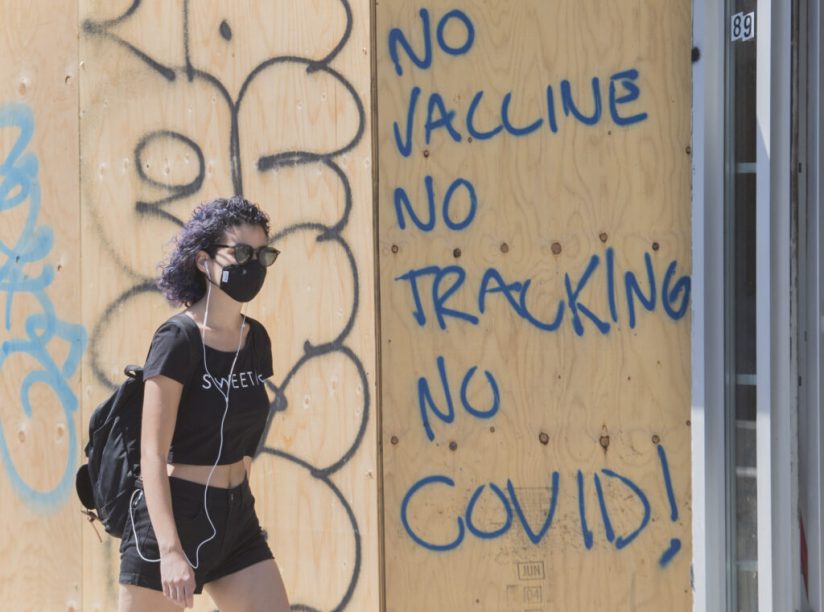
A woman passes by graffiti reading ‘No vaccine, No tracking, No COVID’, in Montreal, Sunday, August 16, 2020, as the COVID-19 pandemic continues in Canada. THE CANADIAN PRESS/Graham Hughes
The main stated purpose of these “tracking systems,” referred to in other Warp Speed documents as “pharmacovigilance systems,” is to monitor the longer-term effects of new, unlicensed vaccine-production methods that are being used in the production of every Warp Speed COVID-19 vaccine candidate. These vaccines, per Warp Speed’s own documents, state that these methods “have limited previous data on safety in humans . . . the long-term safety of these vaccines will be carefully assessed using pharmacovigilance surveillance and Phase 4 (post-licensure) clinical trials,” following the administration of the COVID-19 vaccines to the prioritized “critical populations.”
A strategy takes shape
Given the above, the unprecedented facets of the Warp Speed COVID-19 vaccination plan—that is, its focus on ethnic minorities as the first to receive the experimental COVID-19 vaccine, its interest in giving different vaccine candidates to “different population groups,” and studying the largely unknown effects through “tracking systems” and unspecified “electronic mechanisms”— are all things that would obviously further fuel mistrust by those ethnic groups that have historically been targets of medical experimentation by the US government.
Furthermore, that COVID-19 vaccine development and distribution efforts are being spearheaded by the military and national-security apparatus, as well as having the intimate involvement of controversial contractors such as Palantir, will likely exacerbate minority distrust as Operation Warp Speed advances, given that these same groups are those most often found to be on the receiving end of militarized state violence. Also concerning is that law enforcement, military, and Department of Homeland Security officials will no longer be priority vaccine-allocation targets, for the first time since the 2001 anthrax attacks, while no convincing reason for their exclusion is offered.
Yet, instead of honestly addressing these unprecedented recommendations, the effort to get around the “vaccine hesitancy” issue as it relates to minorities plans to rely on tactics that avoid addressing any of these issues directly. In one example, although the August Interim Framework recommends “directly prioritizing” ethnic minorities, it recognizes that doing so “could further threaten the fragile trust that some have in the medical and public health system, particularly if there is the perception that there has been a lack of testing to assess vaccine safety and that they are the ‘guinea pigs.’” The document also states that “the implementation of directly prioritizing communities of color could also be challenging and divisive, as determining how to access specific populations and how to determine eligibility based on race or ethnicity includes many sensitive challenges.”
As a workaround for such concerns, the CHS suggests that “prioritizing other cohorts of the population, such as essential workers or those with underlying health conditions associated with poorer COVID-19 outcomes, could also indirectly help address the disproportionate burden of this pandemic on communities of color” due to the high representation of those minorities in the essential workforce.
The document continues: “While this approach might avoid some of the challenges outlined above, it would also need to be implemented in a way that ensures vaccines are equitably distributed across subcategories of these categories.” Thus, it suggests prioritizing “those individuals and groups who face both severe health and severe economic risks, specifically essential workers at higher risk of severe illness—or whose household members are at higher risk—who will suffer severe economic harm if they stop working.” Those groups at “higher risk of severe illness,” the document later notes, are incidentally ethnic minorities.
In other words, the strategy proposed by the CHS is to specifically prioritize cohorts of the US population that contain high proportions of ethnic minorities without directly prioritizing those minorities in order to, somewhat deceptively, avoid exacerbating “vaccine hesitancy” concerns among those groups by directly singling them out.
The Interim Framework acknowledges the high prevalence of ethnic minorities in the essential workforce and cites a paper published in April 2020 by the Center for Economic and Policy Research that notes that “people of color are overrepresented in many occupations with frontline industries.”
In addition to prioritizing essential workforce cohorts, which have a high percentage of ethnic minorities, the CHS document also suggests that prisoners, another group where ethnic minorities are heavily overrepresented, and “undocumented immigrant communities of color” should also be prioritized. Like the essential workforce strategy, this would ensure increased vaccine uptake by ethnic minorities without prioritizing them directly.
It is also worth noting that, in addition to the focus on ethnic minorities, the Interim Framework also recommends that “differently abled and mentally challenged populations, who can experience difficulties in accessing healthcare and could be in higher-risk living settings, such as assisted living facilities,” be included as a “target population” along with ethnic minorities.
This strategy as laid out by the CHS appears to have been embraced by the CDC’s Advisory Committee on Immunization Practices (ACIP), which is the official government body that will designate the “target populations” of the COVID-19 vaccination strategy.
Also in August, Kathleen Dooling, a CDC epidemiologist writing on behalf of ACIP’s COVID-19 Vaccines Work Group, stated that “groups for early phase vaccination” should be those that “overlap” the most with, first, those with “high risk” medical conditions, second, essential workers, and, third, adults over sixty-five. As previously noted, the essential workforce is predominantly composed of ethnic minorities.
Notably, the “high risk” medical conditions listed in this same document are conditions that are all significantly more prevalent among ethnic minorities, such as type 2 diabetes, obesity, chronic kidney disease, serious heart conditions, and sickle cell disease. Cancer is also listed and, while prevalent across the US population at large, the incidence of cancer is highest among African Americans.
Particularly notable is the inclusion of sickle cell disease, as African Americans in the US have a much higher probability of having that condition than any other group. According to 2010 data analyzed by the CDC, the sickle cell gene, which is necessary in both parents for a child to inherit sickle cell disease, is present in 73 per 1,000 African American newborns, compared to 3 per 1,000 Caucasian newborns.
The “overlap” strategy fits with current CDC ACIP guidelines for vaccine recommendations, which hold that, if vaccination supply is limited, the CDC should “reduce the extra burden the disease is having on people already facing disparities.” The “overlap” strategy as laid out in the recent ACIP COVID-19 Vaccines Work Group document, however, has the inevitable end result of ensuring that the vast majority of those who will first receive the experimental COVID-19 vaccine will be ethnic minorities over the age of sixty-five and ethnic minorities in the essential workforce.
Also noteworthy in relation to the prioritization of ethnic minorities is that in March the government interpreted federal regulations to grant liability immunity to any entity producing, distributing, manufacturing, or administering COVID-19 countermeasures, including vaccines. According to HHS, this move may also “provide immunity from certain liability under civil rights laws,” meaning that those involved with the COVID-19 vaccination campaign may not be liable if found to violate the rights of groups protected under civil rights law, that is, ethnic minorities.
Controlling the narrative
Another tactic promoted by the CHS, as well as the CDC and Warp Speed, to combat “vaccine hesitancy” is aggressive communication strategies that include “saturating” the media landscape with pro-vaccine content while greatly reducing content deemed to promote “vaccine hesitancy.” The national-security state, which is managing Operation Warp Speed, has become increasingly involved in this media effort, particularly by censoring content that is considered to be anti-vaccine (including, in their view, news outlets critical of the pharmaceutical industry and vaccine manufacturers) by using counterterror tools that have previously been used to disrupt online terrorist propaganda.
After the October 2019 coronavirus pandemic simulation, Event 201, the CHS issued a statement that media companies have a responsibility to ensure that “authoritative messages are prioritized.” The CHS had co-sponsored Event 201 alongside the World Economic Forum and the Bill and Melinda Gates Foundation.
There is much more to this information war than just the rapidly accelerating online censorship effort. For instance, the official Operation Warp Speed document entitled “From the Factory to the Frontlines” notes that “strategic communications and public messaging are critical to ensure maximum acceptance of vaccines, requiring a saturation of messaging across the national media.” It also states that “working with established partners—especially those that are trusted sources for target audiences—is critical to advancing public understanding of, access to, and acceptance of eventual vaccines” and that “identifying the right messages to promote vaccine confidence, countering misinformation, and targeting outreach to vulnerable and at-risk populations will be necessary to achieve high coverage.”
The document also notes that Warp Speed will employ the CDC’s three-pronged strategic framework known as “Vaccinate with Confidence” for its communications thrust. The third pillar of that strategy is called “Stop Myths” and has as a main focus “establish[ing] partnerships to contain the spread of misinformation” as well as “work[ing] with local partners and trusted messengers to improve confidence in vaccines.”
Like the official Warp Speed guidance, the CDC Interim Framework also sees “community outreach” as an essential element for a successful vaccine campaign and suggests funding and training community health workers to promote vaccination specifically to “underserved, disproportionately affected groups.” It details how the US government might engage African Americans, Latino Americans, and lower-income populations to build trust in connection with vaccine recommendations and get around “concerns that they are ‘testing subjects’ for a novel vaccine.”
The CHS document notes, for example, the importance of cultural competence when promoting vaccines, advising that vaccinating at “churches, schools, culturally specific community centers or senior centers” might sit better with marginalized populations and make them feel more at ease. Such considerations were further elaborated on by Luciana Borio in September. That month, the vice president of In-Q-Tel and member of Biden’s transition team, wrote that while it may be appropriate to use US military resources for vaccination efforts, “any such federal engagement must be done in a collaborative manner sensitive to public perceptions that may be engendered by having a public health function fulfilled by individuals in uniform.”
A July CHS paper, “The Public’s Role in COVID-19 Vaccination,” a document Luciana Borio also helped write, argued, “Vaccination sites should not be heavily policed or send any signals that the site may be unsafe for Black or other minority communities.” This CHS paper further states that “trusted community spokespersons” should be utilized for a “communication campaign,” amplifying “vaccine-affirming, personally relevant messages.” Like similar WHO materials, it advocates tailoring the campaign to specific audiences and identifying a network of spokespeople to deliver a “salient and specific message repeatedly, delivered by multiple trusted messengers and via diverse media channels.”

Luciana Borio, former director of the U.S. FDA’s Office of Counterterrorism and Emerging Threats and current member of the Biden/Harris Transition COVID-19 Advisory Board.
The CDC also recommends vaccine administration at places such as university parking lots, soup kitchens, public libraries, and faith-based organizations. An October CDC report reads: “For people living in institutions, consider vaccination at intake; for people attending colleges/universities, vaccinate at enrollment.” It also proposes that US states and territories utilize nontraditional vaccination sites such as homeless shelters and food pantries.
The prospect of red-carpet celebrities, influencers, and “trusted messengers” endorsing public-health policy is not unthinkable. According to NBC New York, New York and New Jersey have already recruited celebrities to urge residents to follow CDC guidelines. Actors including Julia Roberts, Penelope Cruz, Sarah Jessica Parker, Robin Wright, and Hugh Jackman earlier this year joined a coordinated campaign to “pass the mic to COVID-19 experts.”
In addition, this summer the WHO paid PR firm Hill & Knowlton Strategies $135,000 to identify micro-influencers, macro-influencers, and what it calls “hidden heroes” who “shape and guide conversations” to promote WHO messaging on social media and promote the organization’s image as a COVID-19 authority. Hill & Knowlton are controversial for having previously manufactured the false “incubator baby” testimony delivered in front of Congress that propelled the US into the first Gulf War in the early 1990s.
“The Public’s Role in COVID-19 Vaccination” also urges using groups such as faith-based organizations, schools, homeowners’ associations, and unions trusted by “hard-to-reach audiences” to convey positive vaccine messages and to “modulate public perceptions of vaccination.” Accordingly, the July CHS paper notes “the importance of using outside groups who have relationships with the community, instead of direct government involvement.” It should be noted that during the Tuskegee experiments, the US Public Health Service hired Eunice Rivers, a black nurse with a close relationship to the local minority community, to maintain contact with those who were part of the experiment to ensure they continued to participate.
This outsourcing framework as laid out by the CHS is reproduced in the federal government’s own literature. An October CDC report entitled Interim Playbook for Jurisdiction Operations describes the importance of engaging what minority populations would consider “trusted sources” such as union representatives, college presidents, athletic coaches, state licensure boards, homeless shelter staff, soup kitchen managers, and faith leaders to “address hesitancy” in relation to the COVID-19 vaccine.
Operation Warp Speed’s document “From the Factory to the Frontlines,” released the same day as the CDC Interim Playbook, gives more specific examples of the government’s ongoing work with organizations “representing minority populations,” stating that faith-based organizations can be critical. “HHS’s Center for Faith and Opportunity Initiatives is working with minority-serving faith and community groups . . . and encouraging participation in the vaccination program,” the document reads. It also states that an “information campaign” led by HHS’s public affairs department is already working to “target key populations and communities to ensure maximum vaccine acceptance.”
Of note is that a member of Biden’s Office of Management and Budget transition team is Bridget Dooling. The OMB houses the Office of Information and Regulatory Affairs, which reviews all regulations across the federal government. Dooling previously worked at OIRA, and from 2009 until 2011 worked under the direction of then-OIRA administrator Cass Sunstein. On Twitter, Dooling regularly interacts with Sunstein. She has frequently promoted Sunstein’s work on Twitter, especially this past month.
Notably, in 2008, Sunstein authored a paper encouraging the US government to employ covert agents to “cognitively infiltrate” online dissident groups that promote anti-government “conspiracy theories” and to maintain a vigorous “counter misinformation establishment.”
Elements of his strategy for tackling anti-government “conspiracy theories” are analogous to the aforementioned CHS theme of using “outside groups who have relationships with the community” instead of the government directly. “Governments can supply these independent bodies with information and perhaps prod them into action from behind the scenes,” he contended in his paper.
Sunstein was recently made chair of the World Health Organization’s Technical Advisory Group on Behavioral Insights and Sciences for Health to ensure “vaccine acceptance and uptake in the context of COVID-19.”
In September he also wrote an opinion piece for Bloomberg titled “How to Fight Back against Coronavirus Vaccine Phobia,” suggesting that “high-profile people who are respected and admired by those who lack confidence in vaccines” will help sell the public on the safety of vaccines. “Trusted politicians, athletes or actors—thought to be ‘one of us’ rather than ‘one of them’—might explicitly endorse vaccination,” he writes.
When all else fails, coerce
In addition to this information warfare approach to combatting “vaccine hesitancy,” the government also intends to stave off possible hesitancy through economic coercion, that is, by using economic incentives, even linking vaccination to entrance into the workforce, housing assistance, food, travel, and education.
Sunstein’s Bloomberg piece, for example, states that when a vaccine is available, “an economic incentive, such as a small gift certificate, can help” make it easy for “people who are at particular risk. Such gift cards will inevitably be more effective at swaying decisions of the poor.”
Former 2020 Presidential Candidate and United States Representative for Maryland’s 6th congressional district John Delaney recently penned an article in the Washington Post titled “Pay Americans to Take a Coronavirus Vaccine,” in which he argues a way to overcome the “historical level of distrust” in the vaccine development process is to take advantage of the current economic crisis and “pay people to take a COVID vaccine.” Delaney writes “Such an incentive might be the most effective way to persuade people to overcome suspicion or even fear. . .”
CHS’s “The Public’s Role in COVID-19 Vaccination” paper also details how bundling services like “food security, rent assistance, [and] free clinic services” with vaccination can increase vaccine intake. “Local and state public health agencies should explore opportunities to bundle COVID-19 vaccination with other safety net services,” it suggests. One way of doing this is to simply provide “food aid, employment aid, or other preventative health services” that “may be urgently needed” at vaccination sites. “[And] in some cases,” says the CHS, “it also may be acceptable and feasible to deliver vaccination via home visits by community health nurses when vaccination is bundled with delivery of other services.”
This strategy for increasing vaccine intake parallels what the CHS proposes in order to make digital contact tracing technology (DCTT) widespread in the population without mandating it outright. “Instead of making use fully voluntary and initiated by users, there are ways that DCTT could be put into use without users’ voluntary choice,” a recent CHS paper “Digital Contact Tracing for Pandemic Response” reads. It continues: “For example, use of an app could be mandated as a precondition for returning to work or school, or even further, to control entry into a facility or transportation (such as airplanes) through scanning of a QR code.”
Palantir and priority populations
Aside from the troubling aspects of the COVID-19 vaccination strategy as outlined above, there is the separate issue of the way in which these “populations of focus” will be chosen and identified. Palantir, the big data firm with deep and persisting ties to the CIA, has created a new software tool expressly for Warp Speed called Tiberius. Not only will Tiberius use Palantir’s Gotham software and its artificial intelligence components to “help identify high-priority populations,” it will produce delivery timetables and map out the locations for vaccine distribution based on the masses of data it has collected through various contracts with HHS and data-sharing alliances with In-Q-Tel, Amazon, Google and Microsoft, among others.
These data include extremely sensitive information about American citizens and the lack of privacy safeguards governing Palantir’s growing access to American healthcare data has even gotten the attention of Congress, with several Senators and Representatives warning in July that Palantir’s massive stores of data “could be used by other federal agencies in unexpected, unregulated, and potentially harmful ways, such as in the law and immigration enforcement context.”
Given that Palantir, at present, is best known for targeting the same minorities that are slated to be “priority populations” for early receipt of the experimental COVID-19 vaccine, Tiberius and the company behind it, including the obsessive “race war” fears of its top executive, will be explored in Part 2 of this series.
Jeremy Loffredo is a journalist and researcher based in Washington, DC. He is formerly a segment producer for RT AMERICA and is currently an investigative reporter for Children’s Health Defense.
Whitney Webb has been a professional writer, researcher and journalist since 2016. She has written for several websites and, from 2017 to 2020, was a staff writer and senior investigative reporter for Mint Press News. She currently writes for The Last American Vagabond.
Featured Video

Benoit Paré: OSCE Whistleblower: The Ukraine War – Narratives vs. Reality
or go to
Aletho News Archives – Video-Images
Book Excerpt
How CIA used Ukraine as a platform for covert war against Russia
By Stephen KINZER | Responsible Statecraft | November 17, 2026
The following is an excerpt from Stephen Kinzer’s new book: Boiling Point: How America Brought War to Ukraine (Henry Holt and Company, November 2026)
Huddled beside an airstrip in southern Germany, a handful of anti-Communist warriors prepared to fire the first shots of the Cold War. A CIA officer from the Munich Operations Base was in charge. The Hungarian crewmen he had recruited stood nearby in flight suits. With them were two Ukrainian exiles who had volunteered to parachute into their homeland. They were code-named Apostle 1 and Apostle 2. Each carried forged identity papers, a miniature radio transmitter, a pistol, a machine gun, hand grenades, a purse full of gold coins, and a poison pill to be taken in case of capture. An unmarked C-47 transport plane was waiting.
The CIA officer overseeing this operation, a twenty-six-year-old Yale graduate named Stephen Tanner, watched the plane take off and disappear into the night. It flew over East Germany and Poland, then crossed into Soviet airspace. As it approached the Ukrainian city of Lviv, a cargo bay swung open. The two Ukrainians jumped into the darkness. Their mission was to link up with partisan fighters, seize territory, and establish a clandestine base through which the CIA could send them weapons.
That flight, on September 5, 1949, was the first American act of covert war in Ukraine. … continue
Blog Roll
 Aletho News
- The Food Book — First Edition, 2026, Paperback
- Benoit Paré: OSCE Whistleblower: The Ukraine War — Narratives vs. Reality
- UK forced to admit ordering backdoor access to Apple users’ data
- It’s not about China or national security. It’s about which foreign entity is allowed to spy on Americans
- Banning Palestine activists from the West will not save Israel’s image
- Iran rejects unlimited IAEA inspections amid continued military threats
- A Bridge Too Far
- David Barnea in the Bundestag – Mossad as a model for Germany’s Intelligence Services?
- Rome blasts Kiev after Italian lawmakers added to ‘kill list’
- Another €45 bn down the drain: Why the EU is desperate to waste more cash on Zelensky
- If Americans Knew
- An error has occurred; the feed is probably down. Try again later.
- No Tricks Zone
- Argentina’s Perito Moreno Glacier Joins Antarctica and Arctic In Defying Doomsday Melt Claims
- New Study: Barents Sea Temperatures Were Warmer And Sea Ice Less Extensive In The 1700s Than Today
- German Authorities Start Initiative To Evaluate Public Register For Climate “Disinformation” Spreaders!
- Zonal Asymmetry of Temperature Change in the Antarctic Circumpolar Current
- New Study: The Net Fossil Fuel Contribution To Rising Atmospheric CO2 Has Been Zero For 500 Years
- Germany’s Green Energy Transition Becoming Increasingly Expensive…Another 6 Trillion Euros!
- Sudden Stratospheric Warming, Powerful El Niño Combination May Lead To Extreme Europe Cold, Energy Crisis!
- Two New Studies Find Thwaites Glacier Melt Cannot Be Driven By Human Activity Or A Warming Ocean
- E-Cars Reduce CO2 Emissions By Only 41% Compared To Internal Combustion Engine Vehicles
- Predictions Made By Renowned Climate Professor Over Past Decades Have Been Proven To Be Poor


