Post-Iraq war US intel report predicting 2020 looks ‘eerily prescient’ only compared to agencies’ political blunders
By Helen Buyniski | RT | January 1, 2020
A 15-year-old intel report predicting the world of 2020 has been hailed for its accuracy, but much of the future it describes was already underway in 2004. Could today’s hyper-politicized intelligence community see even that much?
Rolling out a list of “eerily prescient” predictions in order to brag about their accuracy – no flying cars here! – the National Intelligence Council (NIC) report is just what one might expect from an intel community desperate to shore up its reputation ahead of what’s sure to be a hotly contested presidential election.
Intel vets have lamented that the intelligence community has become politicized, to the point where it has affected their ability to accurately and objectively describe the reality in front of them – never mind the world 15 years in the future. The NIC paper may thus represent a lost art of apolitical prognostication, a skill willingly sacrificed in the rush for modern spooks to prove themselves “team players.” After the near-fatal blow to its credibility dealt by the three-year Russiagate debacle, US intelligence has a long way to go to build its reputation back.
But US intelligence has played enough of a role in crafting the world of 2020 that at least some of the report’s predictions have to be viewed as plans and suggestions rather than prognostication. Revelations about the CIA’s role in funding and training Al-Qaeda affiliates in Syria, supplying weapons which often ended up in the hands of Islamic State (IS, formerly ISIS/ISIL) terrorists through Operation “Timber Sycamore,” cast the report’s “fictional scenario” about “a new caliphate” whose adherents include Osama bin Laden’s grandson in a more sinister light. Like IS, the fictional caliphate described by the NIC inspires “non-practicing Muslims” from Europe and America to return to their ancestral homelands and take up arms against the “infidels”; also like IS, they seize large swaths of territory in an Iraq weakened by years of war. With plans to regime-change “seven countries in five years” in the Middle East already underway in 2004, according to retired General Wesley Clark, both imagined and real caliphate dovetailed nicely with US foreign policy aims of remaking the region in its image.
Meanwhile, a scenario titled “Cycle of Fear” in which an “Orwellian world” arises from crippling fear of terrorism is almost a wink to the reader, coming just a few short years after the September 11 attacks spawned the Patriot Act and a draconian reduction in Americans’ civil liberties. The NIC report was published years before NSA contractor Edward Snowden’s leaks began to reveal the disturbing extent of the US surveillance state, and Americans in 2004 were for the most part blissfully ignorant about how much they were being spied on – but the NSA, which consulted on the NIC paper, certainly wasn’t.
Other predictions are so obvious that holding them up as a sign of predictive genius is almost laughable. Anticipating a US confrontation with North Korea didn’t take any special skills – then-president George W. Bush had labeled the country part of the “Axis of Evil” alongside Iraq and Iran in 2002, presumably tagging it for eventual regime change. Nor did predicting China’s growth and dominance in the world economy require any great insight – it was already the second-largest global economy in 2004, with its GDP growing at over twice the rate of the US. And a warning against nation-building – a failure the US had already experienced in Afghanistan by 2004 – is hardly prescient; it simply hasn’t been heeded in the intervening 15 years.
Sure, the report nailed a shift in global alliances, with rising economies like the BRICS countries increasingly making their presence felt on the geopolitical stage. But betting global alliances will shift within a 15-year timeframe isn’t exactly clairvoyance.
Unfortunately, the NIC chose to end on an optimistic note, coincidentally the least-likely scenario – a so-called “Pax Americana” in which Europe, devastated by a series of terrorist attacks and “more unified than some of our American friends imagined,” runs into the arms of the US “imploring America to get tough on terrorism.” Even looking beyond the name – “Pax” means “peace,” something a nation with military bases in at least 80 countries knows little about – this hypothetical future has aged particularly badly in the era of Brexit encouraging other European countries to mull seeking independence from the union.
“Even as the existing order is threatened, the United States will have many opportunities to fashion a new one,” the report concludes. The stubborn optimism of the intelligence community of 2004 – just three years into what has become nearly two decades of non-stop war, triggered in part by that community’s own intel failures – is much more “eerie” than any resemblance of its fortune-telling to the real world of 2020. It’s not hard to see how the slight disconnect with reality on display here mushroomed into the chasm separating today’s intelligence community from the real world.
Did John Brennan’s CIA Create Guccifer 2.0 and DCLeaks?
By Larry C Johnson | Sic Semper Tyrannis | December 20, 2019
Special Counsel Robert Mueller’s report insists that Guccifer 2.0 and DCLeaks were created by Russia’s military intelligence organization, the GRU, as part of a Russian plot to meddle in the U.S. 2016 Presidential Election. But this is a lie. Guccifer 2.0 and DCLeaks were created by Brennan’s CIA and this action by the CIA should be a target of U.S. Attorney John Durham’s investigation. Let me explain why.
Let us start with the January 2017 Intelligence Community Assessment aka ICA. Only three agencies of the 17 in the U.S. intelligence community contributed to and coordinated on the ICA–the FBI, the CIA and NSA. In the preamble to the ICA, you can read the following explanation about methodology:
When Intelligence Community analysts use words such as “we assess” or “we judge,” they are conveying an analytic assessment or judgment
To be clear, the phrase,“We assess”, is intel community jargon for “opinion”. If there was actual evidence or source material for a judgment the writer of the assessment would state, “According to a reliable source” or “knowledgeable source” or “documentary evidence.”
Pay close attention to what the analysts writing the ICA stated about the GRU and Guccifer 2.0 and DCLeaks:
We assess with high confidence that the GRU used the Guccifer 2.0 persona, DCLeaks.com, and WikiLeaks to release US victim data obtained in cyber operations publicly and in exclusives to media outlets.
- Guccifer 2.0, who claimed to be an independent Romanian hacker, made multiple contradictory statements and false claims about his likely Russian identity throughout the election. Press reporting suggests more than one person claiming to be Guccifer 2.0 interacted with journalists.
- Content that we assess was taken from e-mail accounts targeted by the GRU in March 2016 appeared on DCLeaks.com starting in June.
We assess with high confidence that the GRU relayed material it acquired from the DNC and senior Democratic officials to WikiLeaks. Moscow most likely chose WikiLeaks because of its self-proclaimed reputation for authenticity. Disclosures through WikiLeaks did not contain any evident forgeries.
Not one piece of corroborating intelligence. It is all based on opinion and strong belief. There was no human source report or electronic intercept pointing to a relationship between the GRU and the two alleged creations of the GRU–Guccifer 2.0 persona and DCLeaks.com.
Now consider the spin that Robert Mueller put on this opinion in his report on possible collusion between the Trump campaign and the Russians. Mueller bluffs the unsuspecting reader into believing that it is a proven fact that Guccifer 2.0 and DCLeaks were Russian assets. But he is relying on a mere opinion from a handpicked group of intel analysts working under the direction of then CIA Director John Brennan.Here’s Mueller’s take (I apologize for the lengthy quote but it is important that you read how the Mueller team presents this):
DCLeaks
“The GRU began planning the releases at least as early as April 19, 2016, when Unit 26165 registered the domain dcleaks.com through a service that anonymized the registrant.137 Unit 26165 paid for the registration using a pool of bitcoin that it had mined.138 The dcleaks.com landing page pointed to different tranches of stolen documents, arranged by victim or subject matter. Other dcleaks.com pages contained indexes of the stolen emails that were being released (bearing the sender, recipient, and date of the email). To control access and the timing of releases, pages were sometimes password-protected for a period of time and later made unrestricted to the public.
Starting in June 2016, the GRU posted stolen documents onto the website dcleaks.com, including documents stolen from a number of individuals associated with the Clinton Campaign. These documents appeared to have originated from personal email accounts (in particular, Google and Microsoft accounts), rather than the DNC and DCCC computer networks. DCLeaks victims included an advisor to the Clinton Campaign, a former DNC employee and Clinton Campaign employee, and four other campaign volunteers.139 The GRU released through dcleaks.com thousands of documents, including personal identifying and financial information, internal correspondence related to the“Clinton Campaign and prior political jobs, and fundraising files and information.140
GRU officers operated a Facebook page under the DCLeaks moniker, which they primarily used to promote releases of materials.141 The Facebook page was administered through a small number of preexisting GRU-controlled Facebook accounts.142
GRU officers also used the DCLeaks Facebook account, the Twitter account @dcleaks__, and the email account dcleaksproject@gmail.com to communicate privately with reporters and other U.S. persons. GRU officers using the DCLeaks persona gave certain reporters early access to archives of leaked files by sending them links and passwords to pages on the dcleaks.com website that had not yet become public. For example, on July 14, 2016, GRU officers operating under the DCLeaks persona sent a link and password for a non-public DCLeaks webpage to a U.S. reporter via the Facebook account.143 Similarly, on September 14, 2016, GRU officers sent reporters Twitter direct messages from @dcleaks_, with a password to another non-public part of the dcleaks.com website.144
The dcleaks.com website remained operational and public until March 2017.”
Guccifer 2.0
On June 14, 2016, the DNC and its cyber-response team announced the breach of the DNC network and suspected theft of DNC documents. In the statements, the cyber-response team alleged that Russian state-sponsored actors (which they referred to as “Fancy Bear”) were responsible for the breach.145 Apparently in response to that announcement, on June 15, 2016, GRU officers using the persona Guccifer 2.0 created a WordPress blog. In the hours leading up to the launch of that WordPress blog, GRU officers logged into a Moscow-based server used and managed by Unit 74455 and searched for a number of specific words and phrases in English, including “some hundred sheets,” “illuminati,” and “worldwide known.” Approximately two hours after the last of those searches, Guccifer 2.0 published its first post, attributing the DNC server hack to a lone Romanian hacker and using several of the unique English words and phrases that the GRU officers had searched for that day.146
That same day, June 15, 2016, the GRU also used the Guccifer 2.0 WordPress blog to begin releasing to the public documents stolen from the DNC and DCCC computer networks.
The Guccifer 2.0 persona ultimately released thousands of documents stolen from the DNC and DCCC in a series of blog posts between June 15, 2016 and October 18, 2016.147 Released documents included opposition research performed by the DNC (including a memorandum analyzing potential criticisms of candidate Trump), internal policy documents (such as recommendations on how to address politically sensitive issues), analyses of specific congressional races, and fundraising documents. Releases were organized around thematic issues, such as specific states (e.g., Florida and Pennsylvania) that were perceived as competitive in the 2016 U.S. presidential election.
Beginning in late June 2016, the GRU also used the Guccifer 2.0 persona to release documents directly to reporters and other interested individuals. Specifically, on June 27, 2016, Guccifer 2.0 sent an email to the news outlet The Smoking Gun offering to provide “exclusive access to some leaked emails linked [to] Hillary Clinton’s staff.”148 The GRU later sent the reporter a password and link to a locked portion of the dcleaks.com website that contained an archive of emails stolen by Unit 26165 from a Clinton Campaign volunteer in March 2016.149 “That the Guccifer 2.0 persona provided reporters access to a restricted portion of the DCLeaks website tends to indicate that both personas were operated by the same or a closely-related group of people.150
The GRU continued its release efforts through Guccifer 2.0 into August 2016. For example, on August 15, 2016, the Guccifer 2.0 persona sent a candidate for the U.S. Congress documents related to the candidate’s opponent.151 On August 22, 2016, the Guccifer 2.0 persona transferred approximately 2.5 gigabytes of Florida-related data stolen from the DCCC to a U.S. blogger covering Florida politics.152 On August 22, 2016, the Guccifer 2.0 persona sent a U.S. reporter documents stolen from the DCCC pertaining to the Black Lives Matter movement.153”
Wow. Sounds pretty convincing. The documents referencing communications by DCLeaks or Guccifer 2.0 with Wikileaks are real. What is not true is that these entities were GRU assets.
In October 2015 John Brennan reorganized the CIA. As part of that reorganization he created a new directorate–DIRECTORATE OF DIGITAL INNOVATION. Its mission was to “manipulate digital footprints.” In other words, this was the Directorate that did the work of creating Guccifer 2.0 and DCLeaks. One of their specialties, creating Digital Dust.
We also know, thanks to Wikileaks, that the CIA was using software specifically designed to mask CIA activity and make it appear like it was done by a foreign entity. Wikipedia describes the Vault 7 documents:
Vault 7 is a series of documents that WikiLeaks began to publish on 7 March 2017, that detail activities and capabilities of the United States’ Central Intelligence Agency to perform electronic surveillance and cyber warfare. The files, dated from 2013–2016, include details on the agency’s software capabilities, such as the ability to compromise cars, smart TVs,[1] web browsers (including Google Chrome, Microsoft Edge, Mozilla Firefox, and Opera Software ASA),[2][3][4] and the operating systems of most smartphones (including Apple’s iOS and Google’s Android), as well as other operating systems such as Microsoft Windows, macOS, and Linux[5][6
One of the tools in Vault 7 carries the innocuous name, MARBLE. Hackernews explains the purpose and function of MARBLE:
Dubbed “Marble,” the part 3 of CIA files contains 676 source code files of a secret anti-forensic Marble Framework, which is basically an obfuscator or a packer used to hide the true source of CIA malware.
The CIA’s Marble Framework tool includes a variety of different algorithm with foreign language text intentionally inserted into the malware source code to fool security analysts and falsely attribute attacks to the wrong nation.Marble is used to hamper[ing] forensic investigators and anti-virus companies from attributing viruses, trojans and hacking attacks to the CIA,” says the whistleblowing site.
“… for example by pretending that the spoken language of the malware creator was not American English, but Chinese, but then showing attempts to conceal the use of Chinese, drawing forensic investigators even more strongly to the wrong conclusion,” WikiLeaks explains.
So guess what gullible techies “discovered” in mid-June 2016? The meta data in the Guccifer 2.0 communications had “Russian fingerprints.”
We still don’t know who he is or whether he works for the Russian government, but one thing is for sure: Guccifer 2.0—the nom de guerre of the person claiming he hacked the Democratic National Committee and published hundreds of pages that appeared to prove it—left behind fingerprints implicating a Russian-speaking person with a nostalgia for the country’s lost Soviet era.
Exhibit A in the case is this document created and later edited in the ubiquitous Microsoft Word format. Metadata left inside the file shows it was last edited by someone using the computer name “Феликс Эдмундович.” That means the computer was configured to use the Russian language and that it was connected to a Russian-language keyboard. More intriguing still, “Феликс Эдмундович” is the colloquial name that translates to Felix Dzerzhinsky, the 20th Century Russian statesman who is best known for founding the Soviet secret police. (The metadata also shows that the purported DNC strategy memo was originally created by someone named Warren Flood, which happens to be the name of a LinkedIn user claiming to provide strategy and data analytics services to Democratic candidates.)
Just use your common sense. If the Russians were really trying to carry out a covert cyberattack, do you really think they are so sloppy and incompetent to insert the name of the creator of the Soviet secret police in the metadata? No. The Russians are not clowns. This was a clumsy attempt to frame the Russians.
Why would the CIA do this? The CIA knew that Podesta’s emails had been hacked and were circulating on the internet. But they had no evidence about the identity of the culprit. If they had such evidence, they would have cited it in the 2017 ICA.
The U.S. intelligence community became aware around May 26, 2016 that someone with access to the DNC network was offering those emails to Julian Assange and Wikileaks. Julian Assange and people who spoke to him indicate that the person was Seth Rich. Whether or not it was Seth, the Trump Task Force at CIA was aware that the emails, which would be embarrassing to the Clinton campaign, would be released at some time in the future. Hence the motive to create Guccifer 2.0 and pin the blame on Russia.
It is essential to recall the timeline of the alleged Russian intrusion into the DNC network. The only source for the claim that Russia hacked the DNC is a private cyber security firm, CrowdStrike. Here is the timeline for the DNC “hack.”
Here are the facts on the public record. They are at odds with the claims of the Intelligence Community:
- It was 29 April 2016, when the DNC claims it became aware its servers had been penetrated. No claim yet about who was responsible. And no claim that there had been a prior warning by the FBI of a penetration of the DNC by Russian military intelligence.
- According to CrowdStrike founder, Dimitri Alperovitch, his company first supposedly detected the Russians mucking around inside the DNC server on 6 May 2016. A CrowdStrike intelligence analyst reportedly told Alperovitch that:
- Falcon had identified not one but two Russian intruders: Cozy Bear, a group CrowdStrike’s experts believed was affiliated with the FSB, Russia’s answer to the CIA; and Fancy Bear, which they had linked to the GRU, Russian military intelligence.
- The Wikileaks data shows that the last message copied from the DNC network is dated Wed, 25 May 2016 08:48:35.
- 10 June 2016–CrowdStrike waited until 10 June 2016 to take concrete steps to clean up the DNC network. Alperovitch told Esquire’s Vicky Ward that: ‘Ultimately, the teams decided it was necessary to replace the software on every computer at the DNC. Until the network was clean, secrecy was vital. On the afternoon of Friday, June 10, all DNC employees were instructed to leave their laptops in the office.”
- On June 14, 2016, Ellen Nakamura, a Washington Post reporter who had been briefed by computer security company hired by the DNC—Crowdstrike–, wrote:
- Russian government hackers penetrated the computer network of the Democratic National Committee and gained access to the entire database of opposition research on GOP presidential candidate Donald Trump, according to committee officials and security experts who responded to the breach.
- The intruders so thoroughly compromised the DNC’s system that they also were able to read all email and chat traffic, said DNC officials and the security experts.
- The intrusion into the DNC was one of several targeting American political organizations. The networks of presidential candidates Hillary Clinton and Donald Trump were also targeted by Russian spies, as were the computers of some Republican political action committees, U.S. officials said. But details on those cases were not available.
- 15 June, 2016, an internet “personality” self-described as Guccifer 2.0 surfaces and claims to be responsible for the hacks but denies being Russian. The people/entity behind Guccifer 2.0:
- Used a Russian VPN service provider to conceal their identity.
- Created an email account with AOL.fr (a service that exposes the sender’s IP address) and contacted the press (exposing his VPN IP address in the process).
- Contacted various media outlets through this set up and claimed credit for hacking the DNC, sharing copies of files purportedly from the hack (one of which had Russian error messages embedded in them) with reporters from Gawker, The Smoking Gun and other outlets.
- Carried out searches for terms that were mostly in English, several of which would appear in Guccifer 2.0’s first blog post. They chose to do this via a server based in Moscow. (this is from the indictment,
“On or about June 15, 2016, the Conspirators logged into a Moscow-based server used and managed by Unit 74455”) - Created a blog and made an initial blog post claiming to have hacked the DNC, providing links to various documents as proof.
- Carelessly dropped a “Russian Smiley” into his first blog post.
- Managed to add the name “Феликс Эдмундович” (which translates to Felix Dzerzhinsky, also known as “Iron Felix”) to the metadata of several documents. (Several sources went beyond what the evidence shows and made claims about Guccifer 2.0 using a Russian keyboard, however, these claims are just assumptions made in response to the presence of cyrillic characters.)
The only thing that the Guccifer 2.0 character did not do to declare its Russian heritage was to take out full page ads in the New York Times and Washington Post. But the “forensic” fingerprints that Guccifer 2.0 was leaving behind is not the only inexplicable event.
Time for the common sense standard again. Crowdstrike detected the Russians on the 6th of May, according to CEO Dimitri Alperovitch, but took no steps to shutdown the network, eliminate the malware and clean the computers until 34 days later, i.e., the 10th of June. That is 34 days of inexcusable inaction.
It is only AFTER Julian Assange announces on 12 June 2016 that WikiLeaks has emails relating to Hillary Clinton that DCLeaks or Guccifer 2.0 try to contact Assange.
The actions attributed to DCLeaks and Guccifer 2.0 should be priority investigative targets for U.S. Attorney John Durham’s team of investigators. This potential use of a known CIA tool, developed under Brennan with the sole purpose to obfuscate the source of intrusions, pointing to another nation, as a false flag operation, is one of the actions and issues that U.S. Attorney John Durham should be looking into as a potential act of “Seditious conspiracy. It needs to be done. To quote the CIA, I strongly assess that the only intelligence agency that evidence indicates was meddling via cyber attacks in the 2016 Presidential election was the CIA, not the GRU.
Democrats Target Own Population by Trump Impeachment – Paul Craig Roberts
Sputnik -December 20, 2019
WASHINGTON – The Democrats are targeting their own population by impeaching President Donald Trump, former US Assistant Treasury Secretary Paul Craig Roberts said.
On Wednesday, Trump became the third president in US history to be impeached when the Democratic-controlled House of Representatives voted to find him guilty of abuse of power and obstruction of Congress after investigations concluding he invited foreign meddling in the American electoral process.
“The impeachment circus is a political act by the House Democrats. It is a political orchestration without any evidence or credible testimony,” Roberts said. “What is disturbing about the impeachment… is that these orchestrated actions are an attempt to overturn a democratic election. The US now engages in actions against its own population like the actions Washington recently engaged in against Venezuela, Bolivia, Honduras, and Ukraine.”
The Democratic Party, Roberts added, decided to fabricate a scandal with Ukraine after Russiagate fell apart.
“The Democrats are after power. They were frustrated by the Russiagate failure, and orchestrated a hoax that, even if it were true, would not be an impeachable event,” he said.
Roberts continued to say that the House Democrats are able to “get away with this hoax” because the American media is against Trump.
“It is disturbing also because it demonstrates that there is no integrity in the media or the security agencies,” he explained. “Without the support of the media and security agencies, the Democrats would not be able to orchestrate such obvious hoaxes.”
Roberts believes that the impeachment proceedings are not hurting Trump’s election chances, and even help him.
“As the impeachment proceedings unfolded, the public turned against the proceedings, recognizing them as a purely political action,” Roberts said. “The Democrats hoped that some of the mud would stick to Trump and reduce his reelection chances, but it seems the impeachment is helping Trump.”
The president will have to face trial in the US Senate but is unlikely to be removed from power as the higher legislative decision-making body is controlled by members of his Republican party, who have made it clear that they viewed his impeachment as a sham.
“The Senate will not convict Trump of the charges, unless enough Republican senators can be blackmailed by the FBI, CIA, and NSA, police state institutions that have spy folders on everyone, or unless the military/security complex can bribe the Republicans with large sums of money to vote against Trump,” Roberts said. “I think this is unlikely as it would be too obvious even for insouciant Americans not to notice.”
Roberts also said that Russiagate and the impeachment “have radicalized” and divided the United States.
“The population is now split in a new way. On the one hand we have the people who elected Trump, ordinary traditional Americans now demonized as “racists” and “white supremacists,” Roberts said. “On the other hand we have the Democrats, no longer the party of the working people.”
House Democrats launched their impeachment inquiry in September to probe whether Trump tried to pressure Ukraine into investigating his political rival Joe Biden, the current Democratic front-runner in the presidential primaries. Lawmakers initiated the inquiry after a whistleblower sent a complaint to the Congress claiming that Trump threatened to withdraw military aid for Ukraine if Kiev failed to investigate Biden and his son Hunter over the latter’s business dealings in the country.
Trump has denied any wrongdoing, repeatedly dismissing the impeachment inquiry as a witch hunt aimed at reversing the outcome of the 2016 presidential election.
Commenting on Wednesday’s vote, the president said that “this lawless, partisan impeachment” was “political suicide” for the Democratic Party. He also expressed confidence that he would be fully exonerated by the Senate, pledging to “continue to work tirelessly to address the needs and priorities of the American people.”
Barr Blasts Inspector General For Whitewashing FBI
By Ray McGovern – Consortium News – December 10, 2019
Attorney General William Barr on Monday disparaged the long-awaited findings of the Justice Department Inspector General Michael Horowitz into FBI conduct in the investigation of alleged Russian interference in the 2016 presidential campaign. Barr, in effect, accused Horowitz of whitewashing a litany of proven misfeasance and malfeasance that created the “predicate,” or legal justification, for investigating candidate-and-then-president Donald Trump on suspicion of being in cahoots with the Russians.
In grammatical terms, there can be no sentence, so to speak, without a predicate. Trump was clearly the object of the sentence, and the sleuths led by then-FBI Director James Comey were the subjects in desperate search of a predicate. Horowitz candidly depicted the predicate the FBI requires for a counter-intelligence investigation as having to meet a very low bar. The public criticism from his boss was unusual. For the tenacious attorney general, doing a serious investigation of how the FBI handled the Trump-Russia inquiry has become a case of no-holds-Barr-ed, one might say.
Lindsey Smacking His Lips
Particularly damning in Horowitz’s report was the revelation that the FBI kept the “Russia investigation” going well after countervailing and exculpatory evidence clearly showed that, in the unforgettable words of one senior FBI official, Peter Strzok, there was “no there there.”
As Sen. Lindsey Graham put it yesterday, FBI investigators kept running through STOP signs in hot pursuit of a needed, but ever elusive, credible predicate. At a press conference, Graham pointed to page 186 of the Horowitz report to call attention to one of the most obvious STOP signs FBI sleuths should have heeded; namely, the fact that the FBI learned in January 2017 that the primary sub-source for Christopher Steele’s “dossier” disavowed it as misstated and exaggerated — basically rumor and speculation. No problem: the FBI investigation continued.
Mincing no words, Graham called the FBI investigation into alleged Trump campaign ties with Russia a “criminal enterprise” that got off the rails. (Special Counsel Robert Mueller found no evidence of such a conspiracy.) Sparks will fly on Wednesday as Graham, chair of the Senate Judiciary Committee, pursues the matter in more depth when Horowitz testifies before the committee. Graham emphasized yesterday that the general goal is to ensure that such a “criminal enterprise” does not happen again.
He added that one of the ways to prevent a recurrence is to make sure “those who took the law into their own hands need to pay a price.” Uh-oh. I cannot remember the last time leaders of the “national-security state” had to pay a price.
Barr: ‘Thinnest of Suspicions’
Barr took unusually strong public issue with Horowitz’s conclusion that there was adequate reason to mount an FBI investigation of the Trump campaign and suspected ties to Russia. Barr issued a formal statement asserting that the Horowitz report “now makes it clear that the FBI launched an intrusive investigation of a U.S. presidential campaign on the thinnest of suspicions that, in my view, were insufficient to justify the steps taken.”
U.S. Attorney John Durham, whom Barr picked to lead what has now become a criminal investigation regarding how that FBI’s “intrusive investigation” was launched, issued his own formal statement of criticism, expressing disagreement with the IG’s findings as to the predication of the investigation and “how the FBI case opened.” Durham added that he had told the IG last month of this disagreement. In his statement yesterday, Durham spoke not of suspicions, but of evidence his ongoing investigation has already gathered “from other persons and entities both in the U.S. and outside of the U.S.”
Evidence, Not Just Suspicions
Both Barr and Durham chose their words carefully, and so did former CIA Director John Brennan in his May 2017 congressional testimony about his suspicions that Trump’s campaign might have been colluding with the Russians. Soon the spotlight is likely to turn onto Brennan and his carefully parsed testimony, which fell considerably short of qualifying as a predicate for investigation (but played a key role anyway).
On May 23, 2017, Brennan told Congress:
“I encountered and am aware of information and intelligence that revealed contacts and interactions between Russian officials and US persons involved in the Trump campaign that I was concerned about because of known Russian efforts to suborn such individuals. It raised questions in my mind about whether Russia was able to gain the cooperation of those individuals.”
CNN’s coverage of Brennan’s testimony is even more revealing (of CNN’s bias) in retrospect.
Moreover, Brennan famously told Congress, he doesn’t deal with evidence. That was what Republican Rep. Trey Gowdy was wondering about, when he grilled the former CIA director, also on May 23, 2017, on what evidence he had provided to the FBI to catalyze its investigation of the alleged Trump-Russia collusion.
Brennan replied: “I don’t do evidence.”
The best Brennan could do was start out by repeating his well-rehearsed statement, later contradicted by Mueller’s report: “I encountered and am aware of information and intelligence that revealed contacts and interactions between Russian officials and U.S. persons involved in the Trump campaign,” adding that “that required further investigation by the Bureau to determine whether or not U.S. persons were actively conspiring, colluding with Russian officials.”
Media Treatment
Referring to the Horowitz report yesterday, Law Professor John Turley noted:
“Despite this shockingly damning report, much of the media is reporting only that Horowitz did not find it unreasonable to start the investigation, and ignoring a litany of false representations and falsifications of evidence to keep the secret investigation going. Nothing was found to support any of those allegations, and special counsel Robert Mueller also confirmed there was no support for collusion and conspiracy allegations repeated continuously for two years by many experts and members of Congress.”
And yet “debunking” is the name of the game. A New York Times headline this morning read, “Report on F.B.I. Russia Inquiry Finds Serious Errors but Debunks Anti-Trump Plot.” And an “analysis” article by Mark Mazzetti was titled: “Another Inquiry Doesn’t Back Up Trump’s Charges. So, on to the Next.”
Mazzetti writes:
“Engage in a choreographed campaign of presidential tweets, Fox News appearances and fiery congressional testimony to create expectations about finding proof of a “deep state” campaign against Mr. Trump. And then, when the proof does not emerge, skew the results and prepare for the next opportunity to execute the playbook.
“That opportunity has arrived in the form of an investigation by a Connecticut prosecutor [Durham] ordered this year by Attorney General William P. Barr — and the president and his allies are now predicting it will be the one to deliver damning evidence that the F.B.I., C.I.A. and even close American allies conspired against Mr. Trump in the 2016 election.”
Horowitz Report an ‘Appetizer?’
Mazzetti goes on to express doubt “that Mr. Durham will exhume any information that will fundamentally change the understanding of what happened in 2016.” Maybe, maybe not. It is a safe bet, though, that President Trump has better insight into this. According to Mazzetti, Trump recently had been playing down expectations about the Horowitz inquiry — indicating it was only an appetizer for what’s to come. “I do think the big report to wait for is going to be the Durham report,” he said. “That’s the one that people are really waiting for.”
The president may be expecting Mueller-inquiry-type vindication once Durham’s investigation is complete. If that proves to be the case and Trump receives post-impeachment acquittal from the Senate, as expected, he may be able to parlay that into four more years, a sobering thought.
Ray McGovern works with Tell the Word, a publishing arm of the ecumenical Church of the Saviour in inner-city Washington. He was an Army Infantry/Intelligence officer, then a CIA analyst for 27 years. He prepared and briefed the President’s Daily Brief for Presidents Nixon, Ford, and Reagan, and in retirement co-founded Veteran Intelligence Professionals for Sanity (VIPS).
Who Spied on Julian Assange?
There are many possible suspects
By Philip Giraldi | Unz Review | December 10, 2019
The Julian Assange drama drags on. Though he continues to sit in a top security British prison awaiting developments in his expected extradition to the United States, the Spanish High Court has been given permission to interview him. Assange is claiming that the Spanish company contracted with by the Ecuadoran government to do embassy security in London spied on him using both audio and video devices. The recordings apparently included conversations with Assange’s lawyers outlining his defense strategies, which is an illegal activity under Spanish law. The prosecution has also indicted the company director, former military officer David Morales, on associated criminal charges of bribing a government official and money laundering. Morales has said that he is innocent.
Aware that he might be monitored by the British government as well as by other interested parties, Assange would often meet his legal team using a white noise machine or in women’s bathrooms with the water running, but the firm, UC Global, anticipated that and planted devices capable of defeating the countermeasures. It planted microphones in the embassy fire extinguishing system as well as in numerous other places in the building. The recordings were reportedly streamed, undoubtedly encrypted, to another nearby location, referred to in the trade as a listening post. The streamed material was also reportedly transcribed and copied at the UC Global offices in Andalusia, but hard copies of the material were made as well on CDs and DVDs to be turned over directly to the client.
The Spanish newspaper El Pais, which has seen much of the evidence in the case, also mentioned how UC Global fixed the windows in the rooms actually being used by Assange so they would not vibrate, making it possible to use laser microphones from a nearby line of sight building to record what was being said. Presumably the listening post also served as the line-of-sight surveillance point.
The British government willingness to let the interview take place is apparently due in part to the Spanish judiciary’s claims that it has obtained an overwhelming amount of documentary and other evidence that demonstrates that Assange is basically telling the truth.
And there is inevitably more to the story. David Morales, who managed the project, reportedly returned from a trip to the United States and told colleagues that UC Global would henceforth be doing some work “for the dark side” at “another league” level. According to the New York Times, which has examined the documents obtained by El Pais and accepted that they are authentic, “In the court filing, the prosecution asserts that Mr. Morales returned from a security fair in Las Vegas in 2015… He signed a contract with Las Vegas Sands, the casino and resort company of Sheldon Adelson, and the prosecution contends that Mr. Morales passed information about Mr. Assange to security officials at the company, saying it acted as a go-between with the C.I.A.”
Sheldon Adelson is, of course, the single largest source of funding for the Republican Party and is also widely regarded to be a confidant of the Israeli government and of Benjamin Netanyahu personally. UC Global subsequently worked for Adelson, including managing the security of his yacht whenever it was in the Mediterranean.
According to employees of UC Global, details of the Ecuadoran Embassy operation were tightly held inside the company. Morales would make secret trips to the United States once or twice every month and it was assumed that he was carrying material relating to the recordings, but UC Global staff were advised never to mention his travels to the Ecuadoran staff in the embassy.
The obvious candidate for spying on Assange would be, as both the Spanish government and the New York Times speculate, the Central Intelligence Agency (C.I.A.), as Washington intends to try Assange prior to locking him away for the rest of his life. Secretary of State Mike Pompeo, while director of C.I.A., once referred to Assange and WikiLeaks as a “hostile intelligence service,” so one should have no illusions about what will be done to him if he ever arrives in the U.S.
In one instance cited by El Pais, the U.S. Embassy in London clearly knew what was discussed at a private meeting that had taken place in the Ecuadoran Embassy the day before. And if Washington truly wanted inside information it would have made sense from an espionage point of view to employ the very firm doing security for the embassy as one’s mechanism for doing the spying.
But the rest of the story as elaborated on by the New York Times doesn’t make sense. It is equally or possibly even more likely that the Ecuadoran government would want to know what Assange was up to since it was taking considerable heat from Washington and London to terminate his asylum so he could be arrested and extradited. The fact that Morales did not want the Ecuadorans to know about his travels suggests that they already knew about the surveillance. What they did not know was that Morales was sharing the take with someone else.
And then there are the British themselves as possible initiators of the surveillance through some kind of arrangement with Morales. They would most definitely like to know what was being planned in Assange’s defense and going through UC Global would be the easiest way to obtain the needed information.
One might point out that there is another obstacle to the C.I.A. “dunnit” speculation, which is that as a general rule Washington does not spy on London and London does not spy on Washington. As the two countries have been for decades major intelligence partners, it is a guideline that is, believe it or not, generally observed. The British would have noticed any attempt to set up an American listening post within line-of-sight of the Ecuadoran Embassy and it would have created a major rift between C.I.A. and MI6, which suggests that the British, Americans and Ecuadorans might all have been spying on Assange and possibly even sharing the information.
And then there is the Adelson angle, which brings the Israelis into the mix. It appears to be true that Adelson’s casinos in China were venues used for targeting corrupt Chinese officials by the C.I.A. as far back as 2010, but it is not imaginable that today’s Agency would use the Las Vegas billionaire as a conduit for passing information and arranging payments to Morales. As one former Agency field officer commented, “This is not the way the C.I.A. constructs an operation, too many moving parts.”
If he were indeed a C.I.A. asset, Morales could have used a dead drop or passed his material directly to an Agency officer under cover in Spain before being paid directly for his services. The C.I.A. officer would also be able to monitor and direct the operation through the meetings as is usually the case, which would not be possible if the connection were through Las Vegas Sands security.
One might also add that using a trip to Las Vegas as a cut out to conceal espionage activity makes no sense at all, particularly as Morales would have to be crossing international borders carrying on him highly sensitive information that could come to the attention of security concerned about the frequency of his trips. Morales might indeed have believed that he was working for C.I.A. because that is what he was told by Adelson, but that could easily have been a lie.
It is also unimaginable that C.I.A. would use Adelson as he is recognized by the U.S. intelligence services as an Israeli government asset. His loyalty to the U.S. is questionable. He is famous for having said that he regretted serving in the U.S. Army and wishes he had served in the Israeli army instead. He wants his son to grow up to “be a sniper for the Israel Defense Force (IDF).”
That means that anything going through Adelson will wind up in Israel, which suggests that if Adelson is actually involved the whole exercise just might be an Israeli false flag operation pretending to be the C.I.A. Israel does not hate Assange with the fervor of the U.S. government but it certainly would consider him an enemy as he has had a tendency to expose sensitive material that governments would not like to make public. Israel would be particularly vulnerable to having its war crimes exposed, as was the case when WikiLeaks published the material revealing American crimes in Iraq provided by Chelsea Manning.
So, there is a choice when it comes to considering who might have commissioned the spying on Julian Assange, or it might even have been a combination of players. The sad part of the story is that even if David Morales is convicted in a Spanish court, sources in Britain believe the violation of Assange’s rights will have no impact on the move to extradite him to the United States. That will be decided narrowly based on the charge against him, which is exposing classified information, a violation of the Espionage Act of 1917. As the Espionage Act is infinitely elastic and as the preferred U.S. Court for the Eastern District of Virginia has a very high conviction rate, there is little doubt that Julian Assange will soon be on his way to the United States where he will undoubtedly be sentenced to life in prison.
Philip M. Giraldi, Ph.D., is Executive Director of the Council for the National Interest, a 501(c)3 tax deductible educational foundation (Federal ID Number #52-1739023) that seeks a more interests-based U.S. foreign policy in the Middle East. Website is councilforthenationalinterest.org, address is P.O. Box 2157, Purcellville VA 20134 and its email is inform@cnionline.org.
The ‘Whistleblower’ and the Politicization of Intelligence
By Scott Ritter – Consortium News – November 27, 2019
The whistleblower. A figure of great controversy, whose actions, manifested in an 11-page report submitted to the Intelligence Community Inspector General (ICIG) on August 12 alleging wrongdoing on the part of the president of the United States, jump-started an ongoing impeachment process targeting Donald Trump that has divided the American body politic as no other issue in contemporary time.
His identity has been cloaked in a shroud of anonymity which has proven farcical, given that his name is common knowledge throughout the Washington-based national security establishment in whose ranks he continues to serve. While Trump publicly calls for the identity of the whistleblower to be revealed, the mainstream media has played along with the charade of confidentiality, and Congress continues to pretend his persona is a legitimate national security secret, even as several on-line publications have printed it, along with an extensive document trail sufficient to corroborate that the named man is, in fact, the elusive whistleblower.
There is no legitimate reason for the whistleblower’s identity to remain a secret. The Democratic chairman of the House Intelligence Committee, Representative Adam Schiff, (D-CA) has cited statutory protections that simply do not exist while using his authority as chairman to prohibit any probe by his Republican colleagues designed to elicit information about the whistleblower’s identity. “The whistleblower has a right, a statutory right, to anonymity,” Schiff recently opined during recent impeachment-related testimony. And yet The Washington Post, no friend of Trump, was compelled to assign Schiff’s statement three “Pinocchios”, out of a scale of four, in rejecting the claim as baseless.
The myth of statutory protection for the whistleblower’s identity has been aggressively pursued by his legal counsel, Andrew Bakaj, the managing partner of the Compass Rose Legal Group, which has taken on the whistleblower’s case pro bono. In a letter to the president’s legal counsel, Pat Cippolone, Bakaj demanded that Trump “cease and desist in calling for my client’s identity”, claiming that the president’s actions, undertaken via Twitter and in press briefings, constituted violations of federal statutes prohibiting, among other things, tampering with a witness, obstruction of proceedings, and retaliating against as witness.
All of Bakaj’s claims are contingent upon the viability of the whistleblower’s status as a legitimate witness whose testimony can, therefore, be tampered, obstructed or retaliated against. The legal foundation of the whistleblower’s claims are based upon the so-called Intelligence Community whistleblower statute, 50 USC § 3033(k)(5), which stipulates the processes required to report and sustain an allegation of so-called “urgent concern” to the U.S. intelligence community. An “urgent concern” is defined, in relevant part, as: “A serious or flagrant problem, abuse, violation of the law or Executive order, or deficiency relating to the funding, administration, or operation of an intelligence activity within the responsibility and authority of the Director of National Intelligence involving classified information, but does not include differences of opinions concerning public policy matters.”
The Call
At issue was a telephone call made between President Trump and the newly elected President of Ukraine, Volodymyr Zelensky, on July 25 of this year. According to the whistleblower’s report to the ICIG, “Multiple White House officials with direct knowledge of the call informed me that, after an initial exchange of pleasantries, the President used the remainder of the call to advance his personal interests.” President Trump, the whistleblower alleged, “sought to pressure the Ukrainian leader to take actions to help the President’s 2020 reelection bid,” an act which the whistleblower claimed presidential abuse of his office “for personal gain.”
Upon review of the whistleblower’s report, which consisted of a nine-page unclassified letter and a separate two-page classified annex, Michael K. Atkinson, the Inspector General of the Intelligence Community, initiated an investigation of the complaint as required by the whistleblower statute. This investigation must be completed within a 14-day period mandated by the statute, during which time the ICIG “shall determine whether the complaint or information appears credible.”
While the statute is silent on the methodology to be used by the ICIG in making this determination, Atkinson had testified during his Senate confirmation hearing that, when it came to any investigation of a whistleblower complaint, “I will work to ensure that ICIG personnel conduct investigations, inspections, audits, and reviews in accordance with Quality Standards promulgated by CIGIE (Council of the Inspectors General on Integrity and Efficiency) to keep those activities free from personal, external, and organizational impairments.” The CIGIE standard in question requires that, “Evidence must be gathered and reported in an unbiased and independent manner in an effort to determine the validity of an allegation or to resolve an issue.”
In a letter transmitting the whistleblower complaint to the Director of National Intelligence (DNI), Atkinson stated that he had “determined that the Complainant (i.e., whistleblower) had official and authorized access to the information and sources referenced in the Complainant’s Letter and Classified Appendix, including direct knowledge of certain alleged conduct, and that the Complainant has subject matter expertise related to much of the material information provided in the Complainant’s Letter and Classified Appendix.”
However, when it came to assessing whether or not the whistleblower, in reporting the second-hand information provided to him by White House persons familiar with the July 25 Trump-Zelensky phone call, had done so accurately, Atkinson did not review the actual records of the telephone call, noting that he “decided that access to records of the telephone call was not necessary to make my determination that the complaint relating to the urgent concern ‘appears credible.’”
Atkinson declared that “it would be highly unlikely for the ICIG to obtain those records within the limited remaining time allowed by statute,” and opted to perform an investigation in violation of the very CIGIE standard he had promise to adhere to in his Senate testimony. In short, no evidence was gathered by the ICIG to determine the validity of the whistleblower’s allegation, and yet Atkinson decided to forward the complaint to the DNI, certifying it as “credible.”
The whistleblower statute allows the DNI seven days to review the complaint before forwarding it to the House Committee on Intelligence, with comments if deemed appropriate. However, in reviewing the actual complaint, Joseph McGuire, the acting DNI who took over from Dan Coats, who was fired by President Trump in early August, had questions about whether or not the matters it alleged fell within the remit of the whistleblower statute, and rather than forwarding it to the House Intelligence Committee, instead sent it to the Justice Department Office of Legal Counsel for legal review.
The Office of Legal Council, on September 3, issued a legal opinion rejecting the ICIG’s certification of the whistleblower complaint as constituting an “urgent concern” under the law. “The complaint,” the opinion read,
“does not arise in connection with the operation of any U.S. government intelligence activity, and the alleged misconduct does not involve any member of the intelligence community. Rather, the complaint arises out of a confidential diplomatic communication between the President and a foreign leader that the intelligence-community complainant received secondhand. The question is whether such a complaint falls within the statutory definition of ‘urgent concern’ that the law requires the DNI to forward to the intelligence committees. We conclude that it does not. The alleged misconduct is not an ‘urgent concern’ within the meaning of the statute.”
DOJ Rejected Complaint as Urgent
As related in the Office of Legal Counsel’s opinion, the Justice Department did, however, refer the matter to the Criminal Division of the Department of Justice for appropriate review. After considering the whistleblower’s complaint and classified annex, the Criminal Division opted not to pursue charges, in effect determining that no crime had been committed.
Under normal circumstances, this would have concluded the matter of Trump’s phone call with Zelensky, and the second-hand concerns unnamed White House officials had reported to the whistleblower. But this was not a normal circumstance. Far from diffusing an improperly predicated complaint, the failure of the acting DNI to forward the whistleblower complaint to the House Intelligence Committee, and the concurrent legal opinion of the Justice Department’s Office of Legal Counsel rejecting the “urgent concern” certification of the ICIG, opened the door for the whistleblower, through legal counsel, to reach out to the House Intelligence Committee directly.
The whistleblower followed procedures set forth in the whistleblower statute detailing procedures for a complaint, which had not been certified as an “urgent concern,” to be forwarded to Congress. The issue is that the matter was being treated by the ICIG, Congress and the whistleblower’s attorney’s as an “urgent concern”, a status that it did not legally qualify for.
On September 24, Bakaj sent a “Notice of Intent to Contact Congressional Intelligence Committees” to acting DNI McGuire providing “formal notice of our intent to contact the congressional intelligence committees directly” on behalf of the whistleblower, identified only as “a member of the Intelligence Community.” Almost immediately, Schiff announced via Twitter that “We have been informed by the whistleblower’s counsel that their client would like to speak to our committee and has requested guidance from the Acting DNI as to how to do so. We‘re in touch with counsel and look forward to the whistleblower’s testimony as soon as this week.”
Thus was set in motion events which would culminate in impeachment proceedings against President Trump. On the surface, the events described represent a prima facia case for the efficacy of statutory procedures concerning the processing of a whistleblower complaint. But there were warning signs that all was not right regarding both the whistleblower himself, and the processes involved leading to the whistleblower’s complaint being presented to Congress.
Political Bias?
Far from an exemplar in bureaucratic efficiency, the whistleblower complaint has opened a window into the politicization of the intelligence community, and the corresponding weaponization of the national security establishment, against a sitting president.
As I shall show, such actions are treasonous on their face, and the extent to which this conduct has permeated the intelligence community and its peripheral functions of government, including the National Security Council and Congress itself, will only be known if and when an investigation is conducted into what, in retrospect, is nothing less than a grand conspiracy by those ostensibly tasked with securing the nation to instead reverse the will of the American people regarding who serves as the nation’s chief executive.
The key to this narrative is the whistleblower himself. Understanding who he is, and what role he has played in the events surrounding the fateful July 25 telephone conversation, are essential to unravelling the various threads of this conspiracy.
Much has been made about the political affiliation of the whistleblower, namely the fact that he is a registered Democrat who supports Joe Biden as the Democratic candidate for the 2020 presidential election. On the surface this information is not dispositive—the intelligence community is populated by thousands of professionals of diverse political leanings and affiliations, all of whom have been trained to check their personal politics at the door when it comes to implementing the policies promulgated by the duly elected national leadership.
Indeed, Inspector General Atkinson, while acknowledging in his assessment of the whistleblower’s complaint an indication of possible political bias on the part of the whistleblower in favor of a rival political candidate, noted that “such evidence did not change my determination that the complaint relating to the urgent concern ‘appears credible’”. But when one reverse engineers the whistleblower’s career, it becomes clear that there in fact existed a nexus between the whistleblower’s political advocacy and professional actions that both influenced and motivated his decision to file the complaint against the president.
A Rising Star
Like most CIA analysts, the whistleblower possessed a keen intellect born of stringent academic preparation, which in the whistleblower’s case included graduating from Yale University in 2008 with a degree in Russian and East European studies, post-graduate study at Harvard, and work experience with the World Bank.
Andrea Kendall-Taylor, a contemporary colleague of the whistleblower, has provided an apt account for what is expected of a CIA analyst. “The CIA is an intensely apolitical organization,” Kendall-Taylor wrote. “As intelligence analysts, we are trained to check our politics at the door. Our job is to produce objective analysis that the country’s leaders can use to make difficult decisions. We undergo rigorous training on how to analyze our own assumptions and overcome biases that might cloud our judgement.”
The training program Kendall-Taylor referred to is known as the Career Analyst Program (CAP), a four-month basic training program run out of the CIA’s in-house University, the Sherman Kent School, which “introduces all new employees to the basic thinking, writing, and briefing skills needed for a successful career. Segments include analytic tools, counterintelligence issues, denial and deception analysis, and warning skills.”
The standards to which aspiring analysts such as the whistleblower were trained to meet were exacting, and included a requirement to be “independent of political considerations,” meaning the product produced should consist of objective assessments “informed by available information that are not distorted or altered with the intent of supporting or advocating a particular policy, political viewpoint, or audience.” As an analyst, the whistleblower would have chosen a specific specialization, which in his case was as a “Political Analyst”, charged with examining “political, social, cultural, and historical information to provide assessments about foreign political systems and developments.”
By the time the whistleblower completed his application process with the CIA, which requires a detailed background check, several rounds of interviews, and final security and psychological evaluation before an actual offer of employment can be made, and by the time he finished his basic analytical training, the U.S. had undergone a political and social revolution of sorts with the election of Barack Obama as the 44th president of the United States.
The whistleblower was assigned to the Office of Russian and Eurasian Analysis (OREA), within the CIA’s Directorate of Intelligence, at a time when U.S.-Russian policy was undergoing a radical transformation.
Under the guidance of Michael McFaul, President Obama’s special advisor on Russia and the senior director of Russian and Eurasian Affairs at the National Security Council, the Obama administration was seeking to take advantage of the opportunity afforded by the election of Dmitri Medvedev as Russia’s president in 2008. Medvedev had succeeded Vladimir Putin, who went on to serve as prime minister. Medvedev was a more liberal alternative to Putin’s autocratic conservatism, and McFaul envisioned a policy “reset” designed to move relations between the U.S. and Russia in a more positive trajectory.
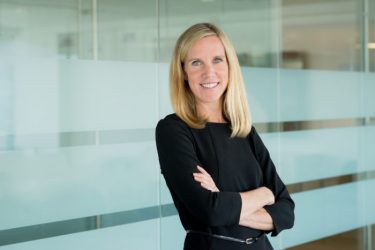
Andrea Kendall-Taylor (Center for a New American Security)
As a junior analyst, the whistleblower worked alongside colleagues such as Andrea Kendall-Taylor, who joined OREA about the same time after graduating from UCLA in 2008 with a PhD is Slavic and Eurasian studies. A prolific writer, Kendall-Taylor wrote extensively on autocratic leaders and Putin in particular. Her work was in high demand at both the CIA and NSC, which under the Obama administration had undergone a massive expansion intended to better facilitate policy coordination among the various departments that comprised the NSC.
The whistleblower had a front-row seat on the rollercoaster ride that was U.S.-Russian policy during this time, witnessing the collapse of McFaul’s Russian “reset,” Putin’s return to power in 2012, and the U.S.-backed coup in Ukraine that led to the annexation of Crimea and Russian support for rebels in the Donbas region.
During his tenure at OREA, the whistleblower obviously impressed his superiors, receiving several promotions and, in July 2015, he detailed to the NSC staff at the Obama White House as the Director for Ukrainian Affairs. According to a former CIA officer, any high-performing analyst who aspires to be promoted into the ranks of the Senior Intelligence Service must, prior to that time, do a rotation as part of the overall policy community, which includes the NSC or another department, such as Defense or State, as well as a tour within another directorate of the CIA.
NSC positions were originally intended for senior CIA analysts, at the GS-15 level, but waivers could be made for qualified GS-14 or “very strong” GS-13’s (the whistleblower was a GS-13 at the time of his assignment at the NSC, a reflection of both his qualification and the regard to which he was held by the CIA.) NSC assignments do not coincide with the political calendar—detailees (as career civil servants who are detailed to the NSC are referred) are expected to serve in their position regardless of what political party controls the White House. When an opening becomes available (usually when another detailee’s assignment has finished), prospective candidates apply, and are interviewed by their senior management, who forward qualified candidates to another board for a final decision.
Assignments to the NSC are considered highly sought after, and while the process for application must be followed, the selection process is highly political, with decisions being signed off by the director of the CIA. In the case of the whistleblower, his candidacy would have been approved by both Peter Clement, the director of OREA, and John Brennan, the CIA director.
Into the Lion’s Den
By the time the whistleblower arrived at the NSC, the NSC staff had grown into a well-oiled policy machine managing the entire spectrum of Obama administration national security policy-making and implementation. The NSC staff operated in accordance with Presidential Policy Memorandum (PPM) 1, “Organization of the National Security Council System”, which outlined the procedures governing the management of the development and implementation of national security policies by multiple agencies of the United States Government.
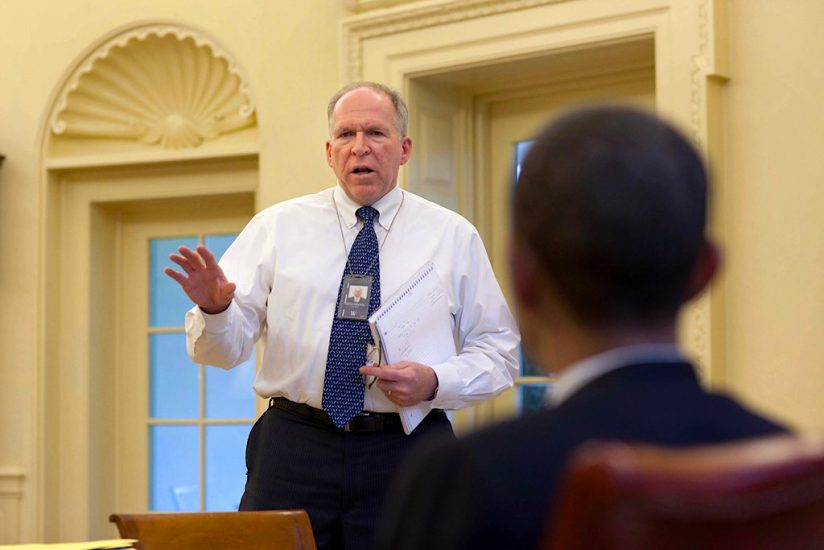
Brennan briefing Obama May 3, 2010. He approved whistleblower. (Official White House Photo by Pete Souza)
The vehicle for accomplishing this mission was the NSC Interagency Policy Committee (NSC/IPC). The NSC/IPCs were the main day-to-day fora for interagency coordination of national security policy. They provided policy analysis for consideration by the more senior committees of the NSC system and ensured timely responses to decisions made by the president. NSC/IPCs were established at the direction of the NSC Deputies Committee and were chaired by the relevant division chief within the NSC staff.
The whistleblowers job was to develop, coordinate and execute plans and policies to manage the full range of diplomatic, informational, military and economic national security issues for the countries in his portfolio, which included Ukraine. The whistleblower coordinated with his interagency partners to produce internal memoranda, talking points and other materials for the National Security Advisor and senior staff.
The whistleblower reported directly to Charles Kupchan, the Senior Director for European Affairs on the NSC. Kupchan, a State Department veteran who had previously served on the NSC staff of President Bill Clinton before turning to academia, in turn reported directly to Susan Rice, President Obama’s national security adviser.
When the whistleblower first arrived at the NSC, he volunteered for the Ukraine portfolio. Kupchan was impressed by the whistleblower’s work ethic and performance, and soon expanded his portfolio to include the fight against the Islamic State. The whistleblower was aided by another organizational connection—his colleague and mentor at OREA, Andrea Kendall-Taylor, had been selected to serve in the Office of the Director of National Intelligence as the deputy national intelligence officer for Russia and Eurasia. Among Kendall-Taylor’s responsibilities was to closely coordinate with the NSC staff on critical issues pertaining to Russia and Ukraine.
The whistleblower’s arrival at the NSC staff also coincided with the start of Trump’s improbable candidacy for the presidency of the United States. As 2015 transitioned into 2016, and it became apparent that Trump was the presumptive nominee for the Republican Party, allegations about the Trump campaign colluding with Russia began to circulate within the interagency. Trump’s electoral victory in November 2016, shocked the whistleblower, like everyone else on the NSC staff.
Alarmed By Trump on Russia
The line between policy and politics began to blur, and then disappeared altogether. National Security Advisor Rice was becoming increasingly alarmed by the activities of the Trump transition team, especially when it came to issues pertaining to Russia. According to The Washington Post, “Rice apparently was closely monitoring the high-profile investigation into Russian interference.”
The President-elect had, during the campaign, openly advocated for better relations between the U.S. and Russia and had even suggested that the Russian annexation of Crimea could eventually be accepted by the U.S. This stance was anathema to the policies that had been massaged into place by the NSC in general, and the whistleblower in particular. According to multiple sources familiar with the whistleblower during this time, his animus against Trump was palpable.
In December 2016, Rice was involved in the unmasking of the identities of several members of the Trump transition team. Various sensitive intelligence reports were circulating within the NSC regarding the interaction of unnamed U.S. citizens with foreign targets of intelligence interest. In order to better understand the significance of such a report, Rice has acknowledged that, on several occasions, she requested that the identity of the U.S. persons involved be “unmasked.”
The U.S. intelligence community is prohibited by law from collecting information about U.S. citizens. As such, when a conversation undertaken by a foreign national of intelligence interest was captured, and it turned out the person or persons whom the target was speaking to was a U.S. citizen, the analysts preparing the report for wider dissemination would “mask”, or hide, the identities of the U.S. citizens involved. Under relevant laws governing the collection of intelligence, up to 20 officials within the Obama administration had the authority to unmask the identities of U.S. citizens. One of those was Rice.
In late December 2016, the crown prince of the United Arab Emirates, Sheikh Mohammed bin Zayed al-Nahyan, arrived in New York for a meeting with several top Trump transition officials, including Michael Flynn, Trump’s son-in-law, Jared Kushner, and the President-elect’s top strategist Steve Bannon. Intelligence reports had been circulating about the UAE coordinating a backchannel for the Trump transition team and Russia.
Zayed’s arrival, which was unannounced and had not been coordinated with the U.S. government, caused great concern among the NSC staff especially given the context of allegations of collusion between Trump and Russia to influence the outcome of the 2016 election.
The principle NSC staffers who would logically have been advising Rice on this matter were Kupchan, the whistleblower, and Sean Misko, a State Department detailee who served as the director for the Gulf Arab States (According the NSC staffers who worked in the White House at the time, Misko and the whistleblower were said to be close friends, frequently socializing with one another after hours, and possessing a common dislike for Trump.) Rice requested that the intelligence reports pertaining to Zayed’s visit be subjected to unmasking procedures.
While the subsequent reporting about the three-hour meeting between Zayed and the Trump transition team failed to uncover any evidence of a secret communications channel with Russia, Rice (who would logically have been assisted by Kupchan and the whistleblower) facilitated the near continuous unmasking of intelligence reports involving Flynn, who was in contact with Russian officials, including Sergei Kislyak, the Russian ambassador to the U.S.
The Greatest Sin
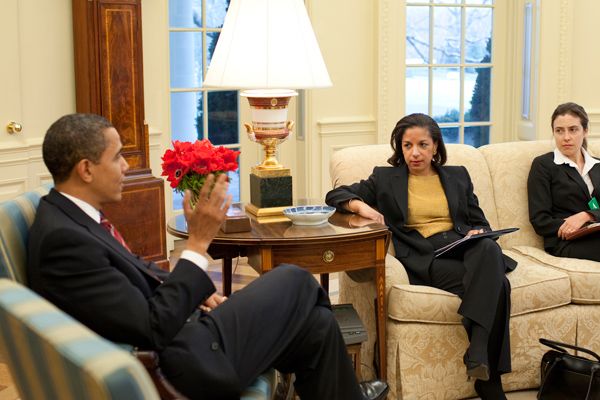
Susan Rice, center, with Obama, March 10, 2009. (White House photo)
As a professional intelligence analyst detailed to the NSC, the whistleblower was committed to a two-year assignment, extendable to three years upon the agreement of all parties. President Obama’s departure from the White House did not change this commitment. According to NSC staffers who served in the White House at the time, the whistleblower, like many of his fellow detailees, had grown attached to the policies of the Obama administration which they had fought hard to formulate, coordinate and implement. They viewed these policies to be sacrosanct, regardless of who followed in the White House.
In doing so, they had committed the greatest sin that an intelligence professional could commit short of espionage—they had become political.
In December 2016, the whistleblower was, based upon his role as a leading Russian analysts advising Rice directly, more than likely helping unmask Flynn’s communications with Russians; a month later, he was working for Flynn, someone he had likely actively helped conspire against, using the unfettered power of the intelligence community.
The Trump administration had inherited a national security decision-making apparatus that was bloated, and which fostered White House micromanagement via the NSC. While the Obama NSC had proven able to generate a proliferate amount of “policy”, it did so by relying on a staff that had expanded to the largest in the history of the NSC, and at the expense of the various departments of government that were supposed to be the originators of policy.
As the new national security adviser, Flynn let it be known from day one that there would be changes. One of his first actions was to hire four new deputies who centralized much of the responsibilities normally tasked to regional directors such as the whistleblower. Flynn was putting in place a new level of bureaucracy that shielded professional detailees from top level decision makers.
Moreover, it recognized that the NSC, while staffed with professionals who are supposed to be apolitical, was viewed by the White House as a partisan policy body whose work not only furthered the interests of the United States, but also the political interests of the president. When Trump included his top political advisor, Bannon, on the list of people who would comprise the National Security Council (normally limited to cabinet-level officials), it sent shockwaves through the national security establishment, which accused Trump of politicizing what they claimed was an apolitical process.
But the reality was that the NSC had always functioned as a partisan decision-making body. Its previous occupants may have tried to temper the level to which domestic politics intruded on national security decision-making, but its presence was an unspoken reality. All Trump did by seeking to insert Bannon into the mix was to be open about it.
Like the other professional detailees who comprised 90 percent of the NSC staff and were expected to remain at their posts as part of a Trump administration, the whistleblower was dismayed by the changes. Some accounts of the early days of the Trump NSC indicate that the whistleblower was defensive of the Ukraine policies he had helped craft during his tenure at the NSC.
When his immediate superior, Kupchan (a political appointee) departed the NSC, the whistleblower was temporarily elevated to the position of senior director for Russia and Eurasia until a new replacement could be found. (Flynn had reached out to Fiona Hill, a former national intelligence officer for Russia under the administration of George W. Bush, to take this job; Hill had accepted, but would not be available until April.)
The whistleblower was a known quantity within the NSC, as were his decidedly pro-Obama political leanings. As such, he was not trusted by the incoming Trump officials, and his access to the decision-making process was limited.
According to persons familiar with his work at the NSC during the Trump administration, the whistleblower’s frustration and anger soon led to acts of resistance designed to expose, and undermine public confidence in President Trump.
Cut Out of Call to Putin
In late January 2017 Trump made several introductory telephone calls to world leaders, including President Putin. Normally the NSC director responsible for Russia would help prepare the president for such a call by drafting talking points and supporting memoranda, and then monitor the call directly, either from within the Oval Office or from the White House situation room.
According to sources familiar with the incident, Flynn did not coordinate Trump’s call with NSC staff, and as such the whistleblower, who was acting as the director for Russia and European Affairs at the time, would have been cut out of the process altogether. When the whistleblower tried to access the read out of the phone call afterwards, he found that no verbatim record existed, only a short summary released by the White House, presumably prepared by Flynn.
More frustrating was the fact that the official readout of the call released by the Kremlin contained much more information, putting Russia in the driver’s seat in terms of defining U.S.-Russian policy priorities—the very policy blunder the NSC was supposed to prevent from happening. While searching for the non-existent records of the Putin-Trump conversation, however, the whistleblower came across detailed verbatim transcripts of two other calls made by Trump that day—one with Mexico, and one with Australia.
Within days the details of these calls were leaked to the media, resulting in a series of unflattering articles being published by the mainstream media. While no direct evidence has emerged about who was responsible for leaking these calls, NSC staffers who worked in the White House at the time suspected the whistleblower. (One of the byproducts of this incident was the decision by NSC lawyers to move the records of Presidential phone calls to a more secure server, significantly limiting access by NSC staff.)
On February 13, 2017, Flynn resigned from his position as President Trump’s national security adviser. The reason given was Flynn’s having misrepresented his conversations with Russian Ambassador Kislyak when questioned by Vice President Mike Pence. For the whistleblower, whose previous work in the Obama NSC appeared to help Rice’s efforts to unmask the very conversations Flynn was being held accountable for, this had to have been a satisfying moment. He had to have been even more pleased by Trump’s choice to replace Flynn —Lieutenant General H. R. McMaster, a decorated combat veteran known for his intelligence and willingness to challenge the establishment.
In the little more than a month that transpired between McMaster coming on board and the arrival of Hill as the new director for Russia and Europe, the whistleblower would have had the opportunity to meet his new boss and work with him on repairing what they both viewed as the flawed changes undertaken by Flynn at the NSC.
McMaster rewrote the presidential guidance regarding the functioning of the NSC, replacing the original Presidential Policy Memorandum 1 with a new version, PPM 4, which removed Bannon from the NSC and restored much of the policy coordinating functions that characterized the NSC under Obama.
Moreover, McMaster stuck up for the professional detailees, such as the whistleblower. When Hill arrived in April 2017 to assume her responsibilities as the NSC director for Russia and Europe, the whistleblower found himself without a job.
But instead of being returned to the CIA, McMaster, who had come to know the whistleblower during his first month as national security adviser, appointed him to serve as his personal assistant. The whistleblower moved from his desk next door in the Executive Office Building, where most NSC staffers work, to the West Wing of the White House, a move which gave him direct access to every issue that crossed McMaster’s desk.
Oval Office Leak
The new job, however, did nothing to diminish the disdain the whistleblower had for Trump. Indeed, the proximity to the seat of power may have served to increase the concern the whistleblower had about Trump’s stewardship. On May 10, President Trump played host to Russian Foreign Minister Sergey Lavrov and Russian Ambassador Kislyak. During the now-infamous meeting, Trump spoke about the firing of former FBI Director Jim Comey; a sensitive Israeli intelligence source related to the ongoing fight against ISIS in Syria; and alleged Russian interference in the 2016 presidential election.
As McMasters’ assistant, the whistleblower was privy to the readout of the meeting, and was so alarmed by what he had seen that he sent an email to John Kelly, who at that time was serving as director of the Department of Homeland Security, detailing the president’s actions and words. All materials relating to this meeting were collected and secured in the NSC’s top secret codeword server; the only unsecured data was that contained in the whistleblower’s email. When the media subsequently reported on the details of Trump’s meeting with the Russians, the White House condemned the “leaking of private and highly classified information” which undermined “our national security.”

Trump meets with Lavrov on May 10, 2017. (TASS/Wikipedia)
According to a NSC staffer who worked in the White House at the time, an internal investigation pointed to the whistleblower’s email as the likely source of the leak, and while the whistleblower was not directly implicated in actually transmitting classified information to the press, he was criticized for what amounted to unauthorized communication with an outside agency, in this case the Department of Homeland Security. When his initial two-year assignment terminated in July 2017, the White House refused to authorize a one-year extension (a courtesy offered to the vast majority of detailees).
The whistleblower had become a liability, publicly smeared by right-wing bloggers and subjected to death threats. He was released from the NSC and returned to the CIA, where he resumed his role as a Eurasian analyst. Shortly after the whistleblower left the NSC, the full transcripts of President Trump’s January 28, 2017 conversations with the leaders of Mexico and Australia were leaked to the press. While several colleagues in the NSC believed that the whistleblower was behind the leaks, McMaster refused to authorize a formal investigation which, if evidence had been found that implicated the whistleblower, would have effectively terminated his career at the CIA.
It is at this juncture the saga of the whistleblower should have ended, avoiding the turn of events which ended up labeling him with the now famous (or infamous) appellation. However, in June 2018 the whistleblower’s colleague, Kendall-Taylor, ended her assignment as the deputy national intelligence officer for Russia and Eurasia. An announcement was made to fill the vacancy, and the whistleblower applied.
Despite having left the NSC under a cloud of suspicion regarding the unauthorized disclosure of sensitive information, and even though his anti-Trump sentiment was common knowledge among his colleagues and superiors, the whistleblower was picked for a position that would put him at the center of policy formulation regarding Russia and Ukraine, and the sensitive intelligence that influenced such. His appointment would have been approved by Director of National Intelligence Dan Coates.
Enter Vindman
The whistleblower was well versed in the collaborative functions of the deputy national intelligence officer position, having worked with Kendall-Taylor during his time at the NSC. He began to develop professional relationships with a number of individuals, including the new director of Ukraine at the NSC, Army Lieutenant Colonel Alexander Vindman. Vindman had extensive experience regarding Ukraine and had been detailed to the NSC from the Joint Chiefs of Staff. The two soon appeared to share a mutual concern over President Trump’s worldview of both Russia and Ukraine, which deviated from the formal policy formulations promulgated by the interagency processes that both Vindman and the whistleblower were involved in.
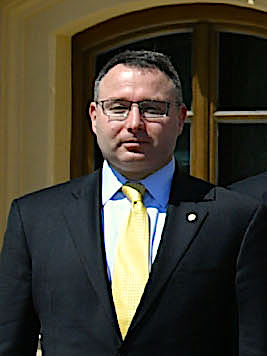
Kiev-born Vindman. (Wikipedia)
The whistleblower’s concerns about President Trump and Ukraine predated the July 25, 2019 telephone call, and mirrored those expressed by Lieutenant Colonel Vindman, both in chronology and content, provided during his testimony before the House Intelligence Committee. While Vindman was critical of President Trump’s deviation and/or failure to conform with policy that had been vetted through proper channels (i.e., in conformity with PDD 4), he noted that, as president, “It’s his prerogative to handle the call whichever way he wants.”
Vindman took umbrage at the non-national security topics brought up by the president, such as investigating former Vice President Joe Biden and his son, Hunter, regarding their relationship with a Ukrainian energy company, Burisma Holdings, and other references to the 2016 U.S. presidential election.
According to Vindman, it was this aspect of the telephone call Vindman believed to be alarming, and which he subsequently related to an authorized contact within the intelligence community. While Vindman remained circumspect about the identity of the intelligence community official he communicated with about his concerns over Trump’s Ukraine policy, the fact that the chairman of the House Intelligence Committee refused to allow any discussion of this person’s identity strongly suggests that it was the whistleblower who, as the deputy national intelligence officer for Russia and Ukraine, would be a logical, and fully legitimate, interlocuter.
According to an account published in The Washington Post, sometime after being informed by Vindman of the July 25 Trump-Zelensky telephone call, the whistleblower began preparing notes and assembling information related to what he believed was untoward activity vis-à-vis Ukraine on the part of President Trump and associates who were not part of the formal Ukraine policy making process. He made numerous telephone calls to U.S. government officials whom he knew from his official work as the deputy national intelligence officer for Russia and Eurasia. Because much of the information he was using was derived from classified sources, or was itself classified in nature, the whistleblower worked from his office, using a computer system approved for handling classified data.
Off Limits
From the perspective of security, the whistleblower’s work was flawless. There was one problem, however; investigating the actions of the president of the United States and officials outside the intelligence community who were carrying out the instructions of the president was not part of the whistleblower’s official responsibilities.
Indeed, anything that whiffed of interference in domestic American politics was, in and of itself, off limits to members of the intelligence community.
Robert Gates, a long-time CIA analyst and former CIA director, had warned about this possibility in a speech he delivered to the CIA in March 1992 on the issue of the politicization of intelligence. “National intelligence officers”, Gates noted, “are engaged in analysis and—given their frequent contact with high-level policymakers—their work is also vulnerable to distortion.”
There was no greater example of politicized distortion than the rabbit hole the whistleblower had allowed himself to fall into. From Gates’ perspective, the whistleblower had committed the ultimate sin of any intelligence analyst—he had allowed his expertise to become tarnished by political considerations.
Worse, the whistleblower had crossed the threshold from advocating a politicized point of view to becoming political—that is, to intervene in the domestic political affairs of the United States in a manner which influenced the political future of a sitting president of the United States.
Once he had assembled his notes, he sought out staffers on the House Intelligence Committee for guidance on how to proceed. Schiff, the chairman of the House Intelligence Committee, had hired two former members of the Trump NSC staff who had served at the same time as the whistleblower.
One, Abigail Grace, had worked at the NSC from 2016-2018, covering U.S.-Chinese relations. Grace was hired by Schiff in February 2019 for the express purpose of investigating the Trump White House. A second NSC veteran was hired in August 2019, around the same time that the whistleblower was preparing his complaint. That staffer was none other than Sean Misko, the whistleblowers friend and fellow anti-Trump collaborator.
Both Misko and the whistleblower departed the NSC in 2017 under a cloud. Misko went on to work for the Center for New American Security, a self-described bipartisan think tank set up by two former Obama administration officials, Michèle Flournoy and Kurt M. Campbell, before being recruited by Schiff. It is not known if Misko was one of the House Intelligence staffers the whistleblower approached, or if there had been any collaboration between the whistleblower and Misko about the nature of the complaint prior to Misko being recruited by Schiff.
After conferencing with the House Intelligence Committee staffers, the whistleblower sought legal counsel. He reached out to a lawyer affiliated with Whistleblower Aid, a group of national security lawyers who came together in September 2017—eight months after the inauguration of President Trump—to encourage whistleblowers within the U.S. government to come out against Trump, and provide legal and financial assistance to anyone that chose to do so. One of Whistleblower Aid’s founding members was a lawyer named Mark Zaid.
 In the days following Trump’s swearing in as president, Zaid turned to Twitter to send out messages supportive of a “coup” against Trump that would lead to the president’s eventual impeachment. The identity of the lawyer who met with the whistleblower is not known. However, this lawyer referred the whistleblower to Bakaj, a fellow member of Whistleblower Aid, who took on the case and provided procedural guidance regarding the preparation of the complaint. Bakaj later brought on Zaid and another lawyer, Charles McCullough, with close ties to Senator Chuck Schumer and Hillary Clinton, to assist in the case.
On August 12, the whistleblower completed his complaint, and forwarded it to the intelligence community inspector general, thereby setting in motion events that produced weeks of hearings before the House Intelligence Committee that will very likely result in Trump’s impeachment.
Shielded from Questions
While the whistleblower, through counsel, had expressed a desire to testify before the House Intelligence Committee about the issues set forth in his complaint, he was never called to do so, even in closed-door session. The ostensible reason behind this failure to testify was the need to protect his anonymity, a protection that is not contained within the relevant statutes governing whistleblower activities within the intelligence community.
Later, as witnesses were identified from the content of the whistleblower’s complaint and subpoenaed to testify before the House Intelligence Committee, both Schiff and Bakaj indicated that the whistleblower’s testimony was no longer needed, since the specific issues and events covered in his complaint had been more than adequately covered by the testimony of others.
But the apparent reason Schiff and Bakaj refused to allow the whistleblower to testify, or to be identified, was to avoid legitimate questions likely to be asked by Republican committee members.
Namely, what was a deputy national intelligence officer of the U.S. intelligence community doing investigating activities of a sitting president? Who, if anyone, authorized this intervention in U.S. domestic political affairs by a CIA official? How did the whistleblower, who had a history of documented animosity with the Trump administration that included credible allegations of leaking sensitive material to the press for the express purpose of undermining the credibility of the president, get selected to serve as a deputy national intelligence officer? Who signed off on this assignment? What was the precise role played by the whistleblower in unmasking the identities of U.S. citizens in 2016, during the Trump transition?
Did the whistleblower maintain his friendship with Misko after leaving the NSC in July 2017? Did the whistleblower collaborate with Misko to get the House Intelligence Committee to investigate the issues of concern to the whistleblower before his complaint was transmitted to the ICIG? Who did the whistleblower meet on the House Intelligence staff? What did they discuss? Who was the lawyer the whistleblower first met regarding his intent to file a complaint? Did the whistleblower have any contact with Whistleblower Aid prior to this meeting?
Answers to these questions, and more, would have been useful in understanding not only the motives of the whistleblower in filing his complaint—was he simply a concerned citizen and patriot, or was he part of a larger conspiracy to undermine the political viability of a sitting president? There is no doubt that Congress has a constitutional right and obligation to conduct proper oversight of the operations of the executive branch, and to hold the president of the United States accountable if his conduct and actions are deemed unworthy of his office. Whether or not the facts surrounding the July 25, 2019 telephone call between Trump and Zelensky constitute grounds for impeachment is a political question for Congress to decide.
Intervening in Domestic Affairs
There is, however, the major issue looming in the background of this impeachment frenzy: the intervention by elements of the intelligence community in the domestic political affairs of the United States. There is no question that the whistleblower’s complaint served as the genesis of the ongoing impeachment proceedings.
The American people should be deeply concerned that an inquiry which could result in the removal of a duly elected president from office was initiated in secrecy by a member of the intelligence community acting outside the four corners of his legal responsibilities. The legitimacy of the underlying issues being investigated by the House Intelligence Committee is not at issue here; the legitimacy of the process by which these proceedings were initiated is.
To find out what happened, the whistleblower should not only be identified, called before the House Intelligence Committee, and other relevant Congressional committees, and be compelled to answer for his actions.
Impeachment is a constitutional remedy afforded to the U.S. Congress to deal with the political issues surrounding the conduct of a sitting president. If this constitutional remedy can be triggered by the intelligence community in a manner which obviates laws prohibiting the intrusion of intelligence agencies into the domestic political affairs of the United States, and done so in a manner where the identities of the persons and organizations involved, along with their possible motives, are shielded from both American people and those whom they elect to represent them in Congress, then a precedent will have been set for future interventions of this nature which undermine the very foundation of American democracy.
The political weaponization of intelligence represents a significant threat to the viability of the American constitutional republic that cannot be ignored.
Scott Ritter is a former Marine Corps intelligence officer who served in the former Soviet Union implementing arms control treaties, in the Persian Gulf during Operation Desert Storm, and in Iraq overseeing the disarmament of WMD.
‘Poisoner in Chief’: Scientist Behind CIA’s Disturbing Mind-Altering Techniques
By Lilia Dergacheva – Sputnik – 01.12.2019
Author Stephen Kinzer boasts stunning knowledge when it comes to writing about terror attacks and coup plots. His most recent work, however, seems to be the most hair-raising, focusing on the puppet master behind the CIA’s poisoning and torture schemes.
“I’m still in shock”, writer Stephen Kinzer says of what he learned about the horrid experiments conducted by a US government scientist that few know by name – Sidney Gottlieb.
“I can’t believe that this happened”, he recounted as his book with the suggestive title “Poisoner in Chief: Sidney Gottlieb and the CIA Search for Mind Control” saw the light of day.
This is a story about Gottlieb’s 22-year career, as the chemist continuously ran mind-control projects that aimed to assist the US in its fight against international communism from the 1950s to the 1970s.
“The investigation of drug effects on ego control and volitional activities, i.e., can willfully suppressed information be elicited through drugs affecting higher nervous systems? If so, which agents are better for this purpose?” the author cited a CIA memo on the project subsequently called Artichoke.
Kinzer writes that in the 50s and 60s, Gottlieb “directed the application of unknowable quantities and varieties of drugs into” hordes of people as he sought the most suitable conscience-altering recipe to effectively mold subjects’ thoughts and behaviours.
Stealthy Doses
Gottlieb has been widely reported to have performed LSD tests on prisoners, government employees, and hospital patients, with many of them kept in the dark about being fed narcotics.
One of the cited examples is the lethal case of a CIA officer who died in a highly suspicious manner after Gottlieb reportedly laced his drink with LSD. He later designed custom-made poisons when his seniors raised the question of “dealing with” a foreign leader, with the sinister doctor finally portrayed by actor Tim Blake Nelson in Errol Morris’ Wormwood in 2017.
However, Kinzer has outlined quite a few new details in his book, the first proper biography of the scientist. For instance, “Poisoner in Chief” depicts the way Gottlieb tried his hand in torture sessions at US military sites and allowed his colleague, a doctor, to give LSD to children.
Kinzer notes that when “Artichoke scientists came up with a new drug or other technique they wished to test… they asked the CIA station in South Korea to supply a batch [of] ‘expendable’ subjects'”.
One CIA memo suggested the subjects were needed for the testing of an unnamed but “important new technique”, adding: “technique does not, not require disposal problems after application”.
On Duty
Gottlieb’s project notably involved foreign heads of state that belonged to the communist camp. According to colleagues cited by Kinzer, he prepared “a pre-poisoned tube of toothpaste” meant for Congolese Prime Minister Patrice Lumumba, although it was never used.
He also ran a scientific team working on a bizarre plot to disgrace Fidel Castro: believing that his strength was accumulated in his beard, Gottlieb reportedly sought to have thallium salts sprinkled in his boots to make his beard hair fall out, “leaving him open to ridicule and overthrow”.
Kinzer believes his 22 years with the agency left a significant imprint on the CIA as it is today: he says there is “a direct line between Sidney Gottlieb’s work and techniques that US agents taught to Latin American security services in the 1960s and 70s”.
“These techniques were also used in Vietnam—and then later on to the techniques of torture and so-called extreme interrogation that were used at Abu Ghraib and Guantanamo”, Kinzer added.
Given an “effectively unlimited supply” of LSD supplied by the pharmaceutical company Eli Lilly to the CIA, Gottlieb became perhaps “the most powerful unknown American of the 20th century”, Kinzer states.
After the CIA, the father of four tried to reinvent himself, working with children who have speech problems. “Nobody had any idea of what he had done in the past, but he was tormented by it”, Kinzer assumes noting that when he passed away in 1999 no cause of death was officially announced.
From killed Armenian priest in Syria to the roots of hatred and genocide
By Steven Sahiounie | December 1, 2019
Father Hovsep Bedoyan, the head of the Armenian Catholic community in Qamishli, and the priest’s father, Abraham Bedoyan, were killed November 11, on the road leading from Qamishli to Deir Ez Zor, where they were headed to check on the rebuilding of the Forty Martyr’s Armenian Apostolic Church in Deir Ezzor, which was destroyed in 2014 by terrorists who targeted Christians and churches. Deacon Fati Sano of the Al-Hasakeh church was injured in the attack when the car was ambushed at a checkpoint by masked gunmen on motorcycles, which shot at point-blank range. The car they drove was inscribed with the Armenian Church’s logo. The same day, a series of bomb blasts in Qamishli occurred, targeting the Armenian Catholic church, an Assyrian Christian-owned business, and a Catholic school, killing at least 6 people and wounded 22 others. More than 100,000 ethnic Armenians lived in Syria, mainly in the province of Aleppo prior to 2011; however, after the constant targeting of Christians by the Free Syrian Army (FSA) beginning in 2011, thousands have fled and many hundreds went to Armenia, who offered the Syrians a visa, when most of the world had shut its doors to them.
Tens of thousands of Christians from the Assyrian minority fled attacks in 2015, and have not returned. Christians in Homs were targeted very early in 2011 by the FSA, with churches attacked, burned and priests killed. Christians in Damascus were dodging missiles fired into Bab Touma by terrorists, in East Ghouta, until the Syrian Arab Army defeated them and they could walk again safely on the street called straight, from Bible passages about Saint Paul.
In September 2012, the large Christian neighborhood in Aleppo, Azizia, fought the FSA, with Christian civilians holding arms to defend their homes and churches. George, an Armenian Christian of Aleppo said, “The Armenians are fighting because they believe the FSA are sent by their Turkish oppressors to attack them, the Christians want to defend their neighborhoods.”
“FSA snipers were on the rooftops and they were attacking the Maronite church and Armenian residents there,” said a former clergyman calling himself John. A Syrian Armenian mother said, “They are shouting ‘the Alawites to the graves and the Christians to Beirut.”
While many Syrian Christians have resisted leaving Syria, for the life of a refugee abroad. Many have gone even though they were living in safe areas, such as the coast. They saw their Christian countrymen leaving in large numbers, and they feared that the FSA terrorists that the Obama administration was supporting would win, and in that case, they could never live safely in Syria.
Father Hovsep Bedoyan had been visiting Deir Ez Zor every 2 weeks while overseeing the rebuilding of the church there. The France-based association, L’Oeuvre d’Orient, is a Catholic charity aimed at reconstructing infrastructure for the return of the Christian community. Monseigneur Pascal Gollnisch, the group’s head, pointed at Turkey’s recent invasion of Northern Syria: “It is the responsibility of all occupying forces to protect the safety of the local Christian minority,” he insisted.
The United Nations (UN) estimates that almost 200,000 people have been displaced by the Turkish invasion, dubbed “Operation Peace Spring”, during which there have been eyewitness accounts of summary executions, beatings, and torture, unlawful detention, and kidnappings by the Turkish military and the FSA, who are Radical Islamic terrorists, employed as mercenaries.
The FSA is the Turkish backed terrorists/mercenaries
“It was sadly learned that a cleric from the Syrian Armenian community was killed in a vicious attack in the area under the control of the terrorist organization PYD/YPG/PKK,” the Turkish Foreign Ministry said in a written statement, which deflected responsibility, and blamed the Syrian Kurds who had been allied to the US, and denying their own FSA mercenaries were the actual killers. ISIS has claimed responsibility for the killings, but the FSA and ISIS are allies, and sources close to the events on the ground have said it was the FSA who killed them, and ISIS only issued the claim of responsibility to shield the blame from the FSA.
FSA history in Syria and sectarianism
The FSA and its political wing, the SNC, have never been secular or moderate. The founding members of the SNC and FSA were members of the Muslim Brotherhood. Their goal for Syria has always been to establish an Islamic government, thus abolishing the secular Ba’ath Party as well as the Syrian Social Nationalist Party (SSNP).
“The Free Syrian Army practically doesn’t exist,” Kamal Sido, a Mideast expert at the human rights group Society for Threatened Peoples (GfbV) told Germany’s Deutschlandfunk broadcaster. “The Free Syrian Army is a smokescreen hiding various names, and if you look at the names, at these groups’ videos, you’ll find they are radical Islamist, Jihadist groups.”
The FSA was not only fighting the Syrian government but they were also killing, raping, maiming and kidnapping unarmed Syrian civilians, most of whom were Sunni Muslims, like themselves. On July 20, 2017, President Trump cut the CIA’s covert program to equip and train the FSA.
The CIA program began in 2013 by Obama to overthrow President Assad; however, CIA officials observed that many FSA had joined ISIS and other radical groups, and feared the weapons they gave the group might end up with ISIS.
The Marmarita massacre
On August 17, 2013, in Marmarita, Amin Nakour, Maya Barshini, Atalla Aboud, and Ibrahim Saadi were attending a Christian celebration to honor the annual commemoration of “Mother Mary’s Day”. The small village of Marmarita sits in the historic “Valley of the Christians” which is near Homs. It was a hot August night, and Christian party-goers were suddenly attacked the FSA and their allies. The four were killed when they attempted to flee the party in a car. The FSA and their allies, have vowed to make Syria a Sunni Muslim State, and have targeted Christians and minorities for 8 years.
The invasion, occupation, and destruction of Kessab
On March 21, 2014, Kessab was attacked when shelling from the Turkish side of the border rained down on the undefended Armenian village, sending its 2,000 residents into panic. Over 20,000 fanatics from the FSA and its allies came pouring over the border. They desecrated all 3 churches, and looted the village’s graves, before scattering the bones of the deceased around the town. The FSA held 26 elderly Armenians against their will for forty days in Turkey, where the FSA kidnappers brought the US Ambassador to Turkey, Francis J. Riccardone, Jr., to visit the elderly captives, but offered no help or release.
Samuel Poladian, who stayed in Kessab for the 3-month occupation, claims he heard Turkish military helicopters overhead on the morning of the invasion, and that Turkey assisted in the invasion.
Monseigneur Ayvazian said, ”They burned all my books and documents, many of them very old, and left my library with nothing but 60cm of ash on the floor.” He has a photo of the church altar, which was desecrated by the FSA before the Syrian Arab Army liberated Kessab on June 15, 2014. The Armenians claim the Kessab attack, which was directed solely against Armenian Christians, was Turkey’s brutal way of showing the Armenians and the Syrian government that they can attack at any time.
Armenian Church in Deir Ez Zor destroyed
On November 10, 2014, terrorists blew up the Armenian Church in Deir el-Zour, which is dedicated to the 1.5 million Armenians slaughtered by the Turks during the 1915 genocide, when many hundreds of thousands of victims died in death camps around Deir el-Zour. Because the FSA has received arms from Turkey, the destruction of the church is regarded by Armenians as crimes carried out by Turks, harkening back to the genocide. “During the Armenian genocide, the Turks entered the church and killed its priest, Father Petrus Terzibashian, in front of the congregation,” Monseigneur Ayvazian said, adding “Then they threw his body into the Euphrates. This time when the Islamists came, our priest there fled for his life.”
The Turkish hatred of Armenians
The 19th century Armenian Surp Asdvadzadzin Church in Gurun district of Sivas (Sebastia), Turkey, will reopen as a museum. At different times the church has been used as a prison, movie theater, storeroom, and wedding hall. The local mayor hopes it will boost the development of tourism in the region. That is the stark reality in Turkey, where Muslims account for 98% of the population, compared to the large Christian minority in Syria. In Turkey, they have tried to erase their Christian history, and have used the old Armenian churches as museums, or locked up or ruined them.
The Armenian Genocide, Turkish denial, the US House recognition
The Armenian Genocide was the systematic mass extermination and expulsion of 1.5 million ethnic Armenians within the Ottoman Empire, from approximately 1914 to 1923. Other ethnic groups were similarly targeted for extermination; such as Assyrians and the Greeks, also strictly Christians. Mass executions were followed by the deportation of women, children, the elderly, and the infirm on death marches leading to Deir Ez Zor, which were driven forward by military escorts, as the deportees were deprived of food and water and subjected to periodic robbery, rape, and massacre.
On Oct. 29, 2019, the US House voted overwhelmingly to formally recognize the Armenian genocide and denounce it. Lawmakers had previously failed to support such a resolution to preserve the United States’ relationship with Turkey, a NATO ally that has steadfastly denied that the atrocities amounted to genocide. Livid at Turkey’s recent bloody military invasion in Syria, lawmakers saw a possible tie to the Armenian genocide, as many feared the withdrawal of American forces would lead to ethnic cleansing in northeast Syria.
The Civilian Government Doesn’t Owe Deference to Military Officers

By Ryan McMaken – Mises Institute – 11/20/2019
On Tuesday, Congressional impeachment hearings exposed an interesting facet of the current battle between Donald Trump and the so-called deep state: namely, that many government bureaucrats now fancy themselves as superior to the elected civilian government.
In an exchange between Rep. Devin Nunes (R-CA) and Alexander Vindman, a US Army Lt. Colonel, Vindman insisted that Nunes address him by his rank.
After being addressed as “Mr. Vindman,” Vindman retorted “Ranking Member, it’s Lt. Col. Vindman, please.”
Throughout social media, anti-Trump forces, who have apparently now become pro-military partisans, sang Vindman’s praises, applauding him for putting Nunes in his place.
In a properly functioning government — with a proper view of military power — however, no one would tolerate a military officer lecturing a civilian on how to address him “correctly.”
It is not even clear that Nunes was trying to “dis” Vindman, given that junior officers have historically been referred to as “Mister” in a wide variety of times and place. It is true that higher-ranking officers like Vindman are rarely referred to as “Mister,” but even if Nunes was trying to insult Vindman, the question remains: so what?
Military modes of address are for the use of military personnel, and no one else. Indeed, Vindman was forced to retreat on this point when later asked by Rep. Chris Stewart (R-UT) if he always insists on civilians calling him by his rank. Vindman blubbered that since he was wearing his uniform (for no good reason, mind you) he figured civilians ought to refer to him by his rank.
Of course, my position on this should not be construed as a demand that people give greater respect to members of Congress. If a private citizen wants to go before Congress and refer to Nunes or any other member as “hey you,” that’s perfectly fine with me. But the important issue here is we’re talking about private citizens — i.e., the people who pay the bills — and not military officers who must be held as subordinate to the civilian government at all times.
After all, there’s a reason that the framers of the US Constitution went to great pains to ensure the military powers remained subject to the will of the civilian government. Eighteenth and nineteenth century Americans regarded a standing army as a threat to their freedoms. Federal military personnel were treated accordingly.
Article I, Section 8 of the Constitution states that Congress shall have the power “to raise and support Armies …” and “to provide and maintain a Navy.” Article II, Section 2 states, “The President shall be the Commander in Chief of the Army and Navy of the United States, and of the Militia of the several States when called into the actual Service of the United States.” The authors of the constitution were careful to divide up civilian power of the military, and one thing was clear: the military was to have no autonomy in policymaking. Unfortunately, early Americans did not anticipate the rise of America’s secret police in the form of the CIA, FBI, NSA, and other “intelligence” agencies. Had they, it is likely the anti-federalists would have written more into the Bill of Rights to prevent organizations like the NSA from shredding the fourth amendment, as has been the case.
The inversion of the civilian-military relationship that is increasingly on display in Washington is just another symptom of the growing power of often-secret and unaccountable branches of military agencies and intelligence agencies that exercise so much power both in Washington and around the world.
Rethinking National Security: CIA and FBI Are Corrupt, but What About Congress?
By Philip Giraldi | Strategic Culture Foundation | November 21, 2019
The developing story about how the US intelligence and national security agencies may have conspired to influence and possibly even reverse the results of the 2016 presidential election is compelling, even if one is disinclined to believe that such a plot would be possible to execute. Not surprisingly perhaps there has been considerable introspection among former and current officials who have worked in those and related government positions, many of whom would agree that there is an urgent need for considerable restructuring and reining in of the 17 government agencies that have some intelligence or law enforcement function. Most would also agree that much of the real damage that has been done has been the result of the unending global war on terror launched by George W. Bush and Dick Cheney, which has showered the agencies with resources and money while also politicizing their leadership and freeing them from restraints on their behavior.
If the tens of billions of dollars lavished on the intelligence community together with a “gloves off” approach towards oversight that allowed them to run wild had produced good results, it might be possible to argue that it was all worth it. But the fact is that intelligence gathering has always been a bad investment even if it is demonstrably worse at the present. One might argue that the CIA’s notorious Soviet Estimate prolonged the Cold War and that the failure to connect dots and pay attention to what junior officers were observing allowed 9/11 to happen. And then there was the empowerment of al-Qaeda during the Soviet-Afghan war followed by failure to penetrate the group once it began to carry out operations.
More recently there have been Guantanamo, torture in black prisons, renditions of terror suspects to be tortured elsewhere, killing of US citizens by drone, turning Libya into a failed state and terrorist haven, arming militants in Syria, and, of course, the Iraqi alleged WMDs, the biggest foreign policy disaster in American history. And the bad stuff happened in bipartisan fashion, under Democrats and Republicans, with both neocons and liberal interventionists all playing leading roles. The only one punished for the war crimes was former CIA officer and whistleblower John Kiriakou, who exposed some of what was going on.
Colonel Pat Lang, a colleague and friend who directed the Defense Intelligence Agency HUMINT (human intelligence) program after years spent on the ground in special ops and foreign liaison, thinks that strong medicine is needed and has initiated a discussion based on the premise that the FBI and CIA are dysfunctional relics that should be dismantled, as he puts it “burned to the ground,” so that the federal government can start over again and come up with something better.
Lang cites numerous examples of “incompetence and malfeasance in the leadership of the 17 agencies of the Intelligence Community and the Federal Bureau of Investigation,” to include the examples cited above plus the failure to predict the collapse of the Soviet Union. On the domestic front, he cites his personal observation of efforts by the Department of Justice and the FBI to corruptly “frame” people tried in federal courts on national security issues as well as the intelligence/law enforcement community conspiracy to “get Trump.”
Colonel Lang asks “Tell me, pilgrims, why should we put up with such nonsense? Why should we pay the leaders of these agencies for the privilege of having them abuse us? We are free men and women. Let us send these swine to their just deserts in a world where they have to work hard for whatever money they earn.” He then recommends stripping CIA of its responsibility for being the lead agency in spying as well as in covert action, which is a legacy of the Cold War and the area in which it has demonstrated a particular incompetence. As for the FBI, it was created by J. Edgar Hoover to maintain dossiers on politicians and it is time that it be replaced by a body that operates in a fashion “more reflective of our collective nation[al] values.”
Others in the intelligence community understandably have different views. Many believe that the FBI and CIA have grown too large and have been asked to do too many things unrelated to national security, so there should be a major reduction-in-force (RIF) followed by the compulsory retirement of senior officers who have become too cozy with and obligated to politicians. The new-CIA should collect information, period, what it was founded to do in 1947, and not meddle in foreign elections or engage in regime change. The FBI should provide only police services that are national in nature and that are not covered by the state and local jurisdictions. And it should operate in as transparent a fashion as possible, not as a national secret police force.
But the fundamental problem may not be with the police and intelligence services themselves. There are a lot of idiots running around loose in Washington. Witness for example the impeachment hearings ludicrous fact free opening statement by House Intelligence Committee chairman Adam Schiff (with my emphasis) “In 2014, Russia invaded a United States ally, Ukraine, to reverse that nation’s embrace of the West, and to fulfill Vladimir Putin’s desire to rebuild a Russian empire.”
And the press is no better, note the following excerpt from The New York Times lead editorial on the hearings, including remarks of the two State Department officers who testified, on the following day: “They came across not as angry Democrats or Deep State conspirators, but as men who have devoted their lives to serving their country, and for whom defending Ukraine against Russian aggression is more important to the national interest than any partisan jockeying…
“At another point, Mr. Taylor said he had been critical of the Obama administration’s reluctance to supply Ukraine with anti-tank missiles and other lethal defensive weapons in its fight with Russia, and that he was pleased when the Trump administration agreed to do so…
“What clearly concerned both witnesses wasn’t simply the abuse of power by the president, but the harm it inflicted on Ukraine, a critical ally under constant assault by Russian forces. ‘Even as we sit here today, the Russians are attacking Ukrainian soldiers in their own country and have been for the last four years…’ Mr. Taylor said.”
Schiff and the Times should get their facts straight. And so should the two American foreign service officers who were clearly seeing the situation only from the Ukrainian perspective, a malady prevalent among US diplomats often described as “going native.” They were pushing a particular agenda, i.e. possible war with Russia on behalf of Ukraine, in furtherance of a US national interest that they fail to define. One of them, George Kent, eulogized the Ukrainian militiamen fighting the Russians as the modern day equivalent of the Massachusetts Minutemen in 1776, not exactly a neutral assessment, and also euphemized Washington-provided lethal offensive weapons as “security assistance.”
Another former intelligence community friend Ray McGovern has constructed a time line of developments in Ukraine which demolishes the establishment view on display in Congress relating to the alleged Russian threat. First of all, Ukraine was no American ally in 2014 and is no “critical ally” today. Also, the Russian reaction to western supported rioting in Kiev, a vital interest, only came about after the United States spent $5 billion destabilizing and then replacing the pro-Kremlin government. Since that time Moscow has resumed control of the Crimea, which is historically part of Russia, and is active in the Donbas region which has a largely Russian population.
It should really be quite simple. The national security state should actually be engaged in national security. Its size and budget should be commensurate with what it actually does, nothing more. It should not be roaming the world looking for trouble and should instead only respond to actual threats. And it should operate with oversight. If Congress is afraid to do it, set up a separate body that is non-partisan and actually has the teeth to do the job. If the United States of America comes out of the process as something like a normal nation the entire world will be a much happier place.
Featured Video
Benoit Paré: OSCE Whistleblower: The Ukraine War – Narratives vs. Reality
or go to
Aletho News Archives – Video-Images
Book Excerpt
How CIA used Ukraine as a platform for covert war against Russia
By Stephen KINZER | Responsible Statecraft | November 17, 2026
The following is an excerpt from Stephen Kinzer’s new book: Boiling Point: How America Brought War to Ukraine (Henry Holt and Company, November 2026)
Huddled beside an airstrip in southern Germany, a handful of anti-Communist warriors prepared to fire the first shots of the Cold War. A CIA officer from the Munich Operations Base was in charge. The Hungarian crewmen he had recruited stood nearby in flight suits. With them were two Ukrainian exiles who had volunteered to parachute into their homeland. They were code-named Apostle 1 and Apostle 2. Each carried forged identity papers, a miniature radio transmitter, a pistol, a machine gun, hand grenades, a purse full of gold coins, and a poison pill to be taken in case of capture. An unmarked C-47 transport plane was waiting.
The CIA officer overseeing this operation, a twenty-six-year-old Yale graduate named Stephen Tanner, watched the plane take off and disappear into the night. It flew over East Germany and Poland, then crossed into Soviet airspace. As it approached the Ukrainian city of Lviv, a cargo bay swung open. The two Ukrainians jumped into the darkness. Their mission was to link up with partisan fighters, seize territory, and establish a clandestine base through which the CIA could send them weapons.
That flight, on September 5, 1949, was the first American act of covert war in Ukraine. … continue
Blog Roll
 Aletho News
- The Food Book — First Edition, 2026, Paperback
- Benoit Paré: OSCE Whistleblower: The Ukraine War — Narratives vs. Reality
- UK forced to admit ordering backdoor access to Apple users’ data
- It’s not about China or national security. It’s about which foreign entity is allowed to spy on Americans
- Banning Palestine activists from the West will not save Israel’s image
- Iran rejects unlimited IAEA inspections amid continued military threats
- A Bridge Too Far
- David Barnea in the Bundestag – Mossad as a model for Germany’s Intelligence Services?
- Rome blasts Kiev after Italian lawmakers added to ‘kill list’
- Another €45 bn down the drain: Why the EU is desperate to waste more cash on Zelensky
- If Americans Knew
- An error has occurred; the feed is probably down. Try again later.
- No Tricks Zone
- Argentina’s Perito Moreno Glacier Joins Antarctica and Arctic In Defying Doomsday Melt Claims
- New Study: Barents Sea Temperatures Were Warmer And Sea Ice Less Extensive In The 1700s Than Today
- German Authorities Start Initiative To Evaluate Public Register For Climate “Disinformation” Spreaders!
- Zonal Asymmetry of Temperature Change in the Antarctic Circumpolar Current
- New Study: The Net Fossil Fuel Contribution To Rising Atmospheric CO2 Has Been Zero For 500 Years
- Germany’s Green Energy Transition Becoming Increasingly Expensive…Another 6 Trillion Euros!
- Sudden Stratospheric Warming, Powerful El Niño Combination May Lead To Extreme Europe Cold, Energy Crisis!
- Two New Studies Find Thwaites Glacier Melt Cannot Be Driven By Human Activity Or A Warming Ocean
- E-Cars Reduce CO2 Emissions By Only 41% Compared To Internal Combustion Engine Vehicles
- Predictions Made By Renowned Climate Professor Over Past Decades Have Been Proven To Be Poor

