Israeli spyware used against ex-Greek MEP during probe of illegal surveillance: Report
MEMO | July 3, 2026
Israeli spyware was used to hack the phone of a former Greek member of the European Parliament while he was serving on a committee investigating spyware abuses in Europe, according to a report by Citizen Lab published on Friday, Anadolu reports.
The University of Toronto-based research group said that forensic analysis found Stelios Kouloglou’s iPhone was successfully infected with Pegasus spyware, developed by Israeli company NSO Group, in October 2022 and again the next March.
Kouloglou, a journalist and former MEP, was at the time a substitute member of the European Parliament’s PEGA committee, which was established to investigate the use of Pegasus and equivalent surveillance spyware in EU member states.
Citizen Lab said the infections took place during key periods of PEGA committee activity and could have exposed non-public information, confidential documents, and internal committee deliberations.
“The spyware would have likely captured non-public information about committee activities, possibly breaching EU parliamentary confidentiality and privilege frameworks,” the report said.
The first infection occurred as the committee was preparing hearings on spyware, working on its draft report, and planning fact-finding visits to Greece and the Greek Cypriot Administration. Citizen Lab said Kouloglou’s phone was hacked 10 days before those visits began.
The second infection took place while the committee was engaged in intense discussions over the final drafting process of its report. Kouloglou was in Brussels on March 6-7, 2023, during the period of the infection.
Kouloglou said he was shocked by the findings, describing it as “inconceivable” that a member of the parliamentary committee investigating spyware abuses had himself become a surveillance target, according to Greek news outlet Dnews.
He said he plans to pursue legal action against NSO Group and those responsible for infecting his device, while also raising the issue again through contacts in the European Parliament.
Citizen Lab said the attacks used a “zero-click” exploit, meaning the phone could be compromised without the user opening a link or taking any action.
The group said it was not attributing the attacks to any specific government and found no indication that the Greek government was responsible.
However, it said the first infection overlapped with a previously identified Pegasus campaign targeting Russian and Belarusian-speaking exiled journalists and activists in Europe, suggesting that a Pegasus customer authorized to operate in multiple European countries may have been behind the attack.
Citizen Lab warned that the case posed a serious threat to democratic institutions, saying the hacking could have exposed confidential exchanges among lawmakers and staff, including to parties under investigation by the committee itself.
Mother of Twins Who Died 8 Days After Vaccinations Charged With Murder
By Brenda Baletti, Ph.D. | The Defender | July 1, 2026
A 23-year-old mother charged with two counts of first-degree murder in connection with the deaths of her twin toddlers was set to be arraigned later today, after an Idaho grand jury indicted her late Monday, the Payette Police Department said in a press release.
Police arrested Andrea Shaw on Tuesday afternoon, more than a year after her two children — fraternal twins Dallas and Tyson Shaw — were found dead at their home in Payette on May 1, 2025, eight days after receiving their 18-month vaccines.
The Payette Police Department said the arrest follows “a lengthy and thorough investigation” and said it would have no further comment regarding evidence in the case. “Future information will be presented through the judicial process,” officials said.
Shaw alleges that her twins’ deaths were caused by the vaccines they received at a routine doctor’s appointment. She is one of five plaintiffs — along with two other mothers, two physicians and Children’s Health Defense (CHD) — in a lawsuit against the American Academy of Pediatrics (AAP).
The lawsuit accuses the AAP of running a decades-long racketeering scheme to defraud American families about the safety of the childhood vaccine schedule.
Attorney Rick Jaffe, counsel of record for Shaw on two civil matters related to the deaths of her children, including the AAP lawsuit, said he believes “the criminal investigation and now the indictment is the natural consequence of the institutional vaccine program that refuses to admit vaccination carries any risk to infants.”
Jaffe, who is not involved in the criminal investigation, added, “Andrea’s indictment makes all the more urgent that the public health authorities acknowledge and address the harm that vaccination is causing to some infants, rather than just shifting the blame to the parent.”
Nurse Angela Wulbrecht, an advocate for people injured by vaccines and who has been supporting the Shaws, told The Defender she was “ shocked and heartbroken” to learn of Shaw’s arrest.
“Over the past year, I have had the privilege of walking alongside Andrea and her family after the unimaginable loss of her twin babies,” Wulbrecht said. “I have witnessed a mother’s profound grief, unwavering love for her children, and determination to seek answers.”
Andrea gave birth to a new baby, born three weeks prematurely, on June 25, Shaw’s attorney Joseph Filicetti told the local KTVB7 news station. Her husband is caring for the newborn while she is incarcerated.
Shaw told physician of family history of adverse vaccine reaction
The details of the Shaw twins’ story are laid out in court documents that are part of the lawsuit against the AAP. Andrea and her husband Nathaniel also shared their story in May 2025 with CHD.TV.
According to Andrea, she and her mother-in-law say they warned the twins’ pediatrician that there was a family history of adverse reactions to the flu shot.
However, the pediatrician dismissed these concerns. Nurses administered the flu vaccine along with hepatitis A and DTaP shots on April 23, 2025. The twins had previously received most routine childhood vaccinations, including their 1-year shots.
Within hours, Andrea said the toddlers became lethargic and ill. The next morning, their lips were blue, and they struggled to move. Andrea took the twins to the emergency room and told the doctor they had received three vaccines the day before.
The treating physician in the emergency room diagnosed them as suffering from “post-immunization reaction, initial encounter.”
The babies remained symptomatic over the days that followed. A week later, on the morning of May 1, Andrea found both children unresponsive. Police and paramedics were called, and investigators immediately focused on the parents. Andrea and Nathaniel told CHD.TV that the police immediately treated them as suspects.
“They said that it wasn’t medical and that they figured asphyxiation, and that I had supposedly had a postpartum overwhelming blackout and done it to my children,” Andrea said. The family filed a report with the Vaccine Adverse Event Reporting System, or VAERS.
Rather than investigating Andrea’s vaccine concerns, the Payette Police Department opened an investigation into her.
Medical industry ignores vaccines as possible cause of SIDS
When infants under age 1 die suddenly, and a cause can’t be determined, the deaths are typically classified as sudden infant death syndrome (SIDS). SIDS is the third leading cause of infant mortality in the U.S., according to the Centers for Disease Control and Prevention.
Public health researchers developed a “triple-risk model” for explaining SIDS. That model says SIDS occurs when a baby has an unknown medical condition, is going through an important period of development where the body changes quickly, and encounters an outside stressor, such as sleeping on its stomach.
But even as the medical industry claims to remain puzzled about the cause of SIDS, numerous studies have reported a plausible association between vaccines and SIDS in peer-reviewed literature for decades.
Researchers theorize, for example, that some children with underdeveloped liver enzyme pathways may not be able to process excipients — inactive ingredients used as preservatives or to enhance a vaccine’s efficacy — which can lead to illness or death.
The National Vaccine Injury Compensation Program has also recognized links between vaccines and infant deaths. Last year the program compensated two families whose babies died. The program determined the deaths were vaccine-induced.
Due to concerns over the link between vaccines and SIDS, some states recently introduced legislation to require that medical examiners document recent immunizations on the death certificates of children who died from unknown causes.
How common is it to bring criminal charges against parents in infant deaths?
In recent years, some parents have been criminally charged when their infants die after sleeping on their stomachs.
Last year, two different sets of Pennsylvania parents were charged with felonies for placing their babies in unsafe sleeping positions. Attorney Daniel Nevins told Spotlight PA that such charges are rare and that the burden of proof on the prosecutors will be high.
But some parents have been convicted. In 2014, Virginia resident Candice Christa Semidey, age 25, was charged with murder after she swaddled her baby and put it to sleep on its stomach, The Washington Post reported. In that case, police did not think that she intended for the baby to die.
She pleaded guilty to involuntary manslaughter and child neglect. She was ordered to serve three years of probation to avoid a five-year prison term.
Some charges have also been brought against parents in the deaths of infants sleeping with Boppy pillows. There have also been several cases of parents charged for sleeping in the same bed as their child.
This article was originally published by The Defender — Children’s Health Defense’s News & Views Website under Creative Commons license CC BY-NC-ND 4.0. Please consider subscribing to The Defender or donating to Children’s Health Defense.
EU court backs criminal prosecution for sharing RT videos
RT | July 2, 2026
The EU’s top court has ruled that private individuals can face criminal prosecution for posting RT videos on public websites, widening the bloc’s crackdown on Russian media.
The Court of Justice of the European Union issued the ruling on Thursday in a case from Germany, where three people are being prosecuted for publishing RT DE videos on a freely accessible website.
The site did not charge readers and was financed only through voluntary donations. The CJEU, however, said that made no difference and ruled that all persons who are “directly or indirectly” responsible for making banned content available to the public can be treated as “operators” under EU sanctions rules.
The judges argued it was irrelevant if the individuals were running a business, how long the content was available, or how widely it was spread.
Under the German law cited in the ruling, violations of EU sanctions-based media bans can carry up to five years in prison.
The ruling effectively pushes the EU ban on RT beyond broadcasters, platforms or media companies, allowing for the criminal prosecution of any individuals accused of making RT content publicly available online.
The EU banned RT and Sputnik, among other Russian media outlets, after the Ukraine conflict escalated in 2022. Brussels said the sanctions would remain in place until the end of the Ukraine conflict and after Moscow ceases to conduct “disinformation and information manipulation actions against the EU.”
The measures were followed by platform blocks, app-store removals, banking restrictions, and personal sanctions against media figures and journalists accused of working with Russian outlets.
Germany had targeted RT even before the bloc-wide ban, with RT DE facing licensing pressure, platform bans, banking problems and regulatory action.
RT has vehemently condemned the restrictions and rejected the EU’s accusations, stressing that the bloc has consistently failed to point to a “a single example, a single grain of evidence” of false reporting.
Moscow has repeatedly condemned the restrictions as censorship and an information war against Russia, accusing EU governments of using the Ukraine conflict as a pretext to silence dissent, suppress Russian-language media, and intimidate journalists who challenge the mainstream Western narrative.
Monsters playing victims: Danny Danon’s twisted war on the truth

By Ramzy Baroud | MEMO | July 2, 2026
Whether Israelis will ever comprehend the irreparable damage inflicted upon their country’s reputation by their UN Ambassador, Danny Danon, is a moot point. The damage Israel has done to itself through its barbaric practices in occupied Palestine is simply impossible to overcome.
Danon, however, utilises a peculiar approach to defending Israel within international institutions: he relies on bullying, intimidation, and an overt attempt to silence anyone who dares to challenge the official Israeli narrative—particularly women leaders.
Yet, what makes his behaviour most outrageous is his deployment of these abrasive tactics to suppress an issue that demands the utmost sensitivity: the systemic use of sexual violence and human rights abuses against Palestinians.
The confrontation took place during a UN General Assembly session convened to mark the International Day for the Elimination of Sexual Violence in Conflict. Senior UN officials were presenting harrowing findings documenting sexual violence against Palestinian detainees.
True to form, Danon refused to engage with the substance of the reports. For Israeli diplomacy, the enemy is never merely the armed adversary; it is the judge, the independent human rights observer, and the UN investigator whose sole mandate is to document violations of international law.
The immediate target of Danon’s wrath was Pramila Patten, the UN Secretary-General’s Special Representative on Sexual Violence in Conflict. Instead of reflecting on the grim findings, Danon demanded Patten’s resignation. He accused her and the broader international community of harbouring an “obsession” with targeting Israel.
When Vanessa Frazier, the Secretary-General’s Special Representative for Children and Armed Conflict, attempted to intervene on a point of order per established protocol, Danon unleashed a vitriolic verbal assault. Refusing to yield, he shouted over her, ordering her to “be quiet” and drowning out the chamber with his outbursts. “Shame on you. You are part of this obsession,” Danon bellowed.
While such unruly behaviour should have resulted in Danon’s immediate removal from the chamber, the diplomatic asymmetry of the UN prevailed. It was Frazier who found herself trying to de-escalate, politely clarifying that her procedural request was “not personal.” Danon shot back with typical defiance: “You will not be allowed to bully us.”
Herein lies the supreme irony of Israel’s diplomatic relationship with the UN and international law. Israel stands as one of the most egregious, serial violators of international law in modern history—a decades-long pattern of behaviour left unpunished by Western vetoes, which ultimately emboldened it to carry out an ongoing genocide in Gaza. Yet, Israeli officials persistently claim the mantle of the ultimate victim, alleging they are the targets of antisemitism, unfair bias, and now, “bullying” by the very institutions they defy.
But the mountain of evidence cannot be shouted away. According to an extensive report issued by Patten’s office, there are verified patterns of systemic abuse, sexual degradation, and psychological torture weaponised against Palestinian men, women, and children in Israeli detention camps like Sde Teiman.
The weight of this evidence reached such an undeniable threshold that the UN Secretary-General’s office formally added Israel to the global ‘List of Shame’—the blacklist of states committing grave violations against children in armed conflict.
None of this exposure is enough to convince Danon or the broader Israeli political establishment that Israel does not possess a sovereign right to violate international law. In their view, merely pointing out these crimes constitutes an act of aggression.
This systemic denial extends to every facet of the conflict. A comprehensive UN investigation recently concluded that Israel has deliberately targeted Palestinian children in Gaza as a core component of its military campaign.
The numbers are staggering: Between 7 October 2023, and 7 October 2025, an estimated 20,179 Palestinian children were killed—about 30 percent of all Palestinian deaths.
“The evidence shows that Palestinian children have been deliberately targeted and killed by the Israeli security forces,” stated commission chair Srinivasan Muralidhar, noting that Israeli authorities have systematically continued to commit the crime of genocide.
While these findings provide another layer of ironclad legal proof regarding genocidal intent, the true significance of the report lies in its exposure of the rationale behind targeting youth. Typically, the disproportionate slaughter of children and women is dismissed by Western apologists as “collateral damage”. The UN inquiry shattered this defense, offering a far more consequential conclusion: the targeting of Gaza’s children is part of a calculated strategy to destroy the biological continuity and future existence of the Palestinian people in Gaza.
As Muralidhar bluntly summarized: “By targeting children, Israel is attacking the very capacity of the Palestinian people to exist.”
It remains a profound disappointment that the International Criminal Court and the International Court of Justice—often swift to indict war crimes committed elsewhere—continue to move at a glacial pace regarding Israel.
Tragically, the catastrophe continues unabated because there is still no meaningful international mechanism willing to enforce sanctions or employ genuine pressure to halt it.
This is precisely why Danny Danon wants the world to be quiet. His outbursts are not merely directed at UN diplomats; they are directed at global civil society, ordinary citizens, and anyone refusing to look away. Israel demands absolute silence while Palestinians are starved, raped, and murdered. According to its twisted logic, committing these atrocities is an inherent right, and objecting to them is an act of malice.
If this logic is allowed to prevail, it becomes the blueprint for every future aggressor who wishes to kill, rape, and starve a population for geopolitical gain. Palestinians and Lebanese are already forced to inhabit this dystopian reality. Our collective responsibility is clear: we must refuse to be quiet. We must speak out, ensuring our voices drown out the shouts of Danon and his peers, so that murder and systemic violence are never normalised as tools of military necessity.
Does the Pentagon even know who its boat strikes are killing?
By Adam Isacson | Responsible Statecraft | July 1, 2026
The numbers are stomach-turning. In less than 10 months, U.S. forces acting on orders from the Trump administration have killed 215 people in 63 aerial attacks on small boats in the Caribbean Sea and the eastern Pacific.
Since the first attack on September 2, the Trump administration has told us that they are killing drug traffickers. But drug trafficking, especially being a low-level courier, is not a crime punishable by the death penalty, and, even if it were, the U.S. legal system assumes innocence and guarantees a day in court. Skipping that step makes this murder under U.S. law: the equivalent of a cop shooting a fleeing suspect in the back.
The administration is attempting to get around this by claiming that every one of the dead is a “narco-terrorist,” a member or “affiliate” of a profit-seeking criminal group recently added, with no outside review, to a secret Defense Department list of “Designated Terror Organizations,” or DTOs. Because the United States is in a “non-international armed conflict” with the DTOs, a secret Justice Department memo argues, our military is permitted to kill them on sight, even with no self-defense justification.
Yet the administration has still not presented any evidence that a bombed vessel was even carrying drugs, much less that its deceased crew was affiliated with a criminal or “designated terrorist” organization.
What we know so far indicates that the U.S. military is being used to assassinate unknown individuals based on alarmingly flimsy evidence. And the targeting criteria are quite loose.
On the rare occasions when crew members have been recovered, “Military briefers have admitted to members of Congress that they cannot satisfy the evidentiary burden necessary to hold or prosecute survivors of the boat strikes,” reported the Intercept’s Nick Turse, who has covered the boat strikes extensively. Three survivors have been recovered alive; all have been let go without charges.
Questioning Secretary of State Marco Rubio at a hearing earlier this month, Sen. Tim Kaine (D-Va.) revealed that those carrying out boat-strike targeting are using three criteria that Kaine was not authorized to disclose publicly. He could disclose, however, that “evidence of narcotics on the boat” was remarkably not one of the three criteria.
In fact, the U.S. military usually doesn’t even know the identities of the people on the boats. The Washington Post reported that the targeting instructions in the boat-strike campaign’s August 5 Defense Department Execute Order (EXORD) “do not require positive identification of any individual but rather ‘reasonable certainty’ that adult males are members of, or affiliated with,” a DTO.
A former U.S. official who had read the EXORD told the Post, “The campaign may be killing individuals who in some cases have a tenuous link to any organized drug-running operation.” That official added, “When you define ‘DTO’ and ‘affiliate’ so loosely and you’re attacking boats, (the guidelines are) basically meaningless.”
The term “affiliate,” which the Trump administration is using to end lives on the open ocean, is especially squishy. Rep. Adam Smith (D-Wash.), the ranking Democrat on the House Armed Services Committee, told the New Republic’s Greg Sargent that, in a briefing with Pentagon officials, “They did not in any way, shape, manner, or form explain what the ceiling and floor are for ‘affiliated.’” People who received a classified briefing interviewed by the Intercept “said that they were under the impression that little more than a conversation with a DTO member might confer ‘affiliate’ status.”
Vague claims of “affiliation” or behavioral patterns introduce confirmation bias and guesswork into a lethal process. This vastly increases the probability that the boat strikes are killing people who have committed no crime at all.
“Some people who are familiar with boat movements” along the Caribbean coast of Colombia and Venezuela told the Latin American Center for Investigative Journalism that “it is common for the same boats that carry drugs on the outward journey to bring passengers back. The capitanes, as the boat operators are known, take whatever work they can get.”
The Intercept raised the possibility, acknowledged by a senior military officer, that some of those killed in the first strike on September 2 may have been migrants or human trafficking victims. That boat had 11 people aboard, a strangely large number for a short-hop drug delivery of less than 100 miles between Venezuela and Trinidad.
Evidence points to some of those killed in boat strikes being fishermen plying their trade. While residents of poor coastal fishing communities may “take occasional trafficking jobs to get by,” which blurs their identities, the likelihood of dying in a strike is scaring people away from getting in boats simply to fish, the New York Times reported from coastal Colombia and Ecuador. “Residents described entire communities abandoning fishing because the small ‘lanchas,’ or speedboats, used by traffickers and fishers are often indistinguishable.”
In Santa Marta, Colombia, the family of fisherman Alejandro Carranza, killed in a September 15 strike, insists that he was not involved in the drug trade. “If he was some kind of narcoterrorist,” the mother of three of Mr. Carranza’s children asked New York Times reporters, “then why are we living in misery instead of a mansion?”
Two of those killed in an October 14, 2025 strike were Chad Joseph, 26, and Rishi Samaroo, 41, both from the village of Las Cuevas, Trinidad. Their families are suing the United States for damages under the Death on the High Seas Act and the Alien Tort Statute. The complaint in Burnley v. United States argues that both men had been in Venezuela for months working on farms and, in their final communications, told their families that they had obtained passage by boat home to Trinidad.
In Sucre, Venezuela, where 90% of the population lacks basic food security, some of the dead were fishermen or taxi drivers who agreed to crew a boat that shipped drugs to Trinidad in exchange for a few hundred dollars. Some, like a “beloved” indoor soccer player, may simply have been aboard for the ride.
To all the concerns about the quality and reliability of intelligence used to target people for lethal boat strikes, we must add recent cases elsewhere pointing to U.S. reliance on faulty intelligence, or even just hunches. In March 2025, the Department of Homeland Security rendered 252 Venezuelan migrants to El Salvador’s feared Terrorism Confinement Center (CECOT) prison, alleging that they were all “terrorist” group members, an assertion that proved shockingly wrong, according to subsequent investigations. The New York Times revealed that an early March raid on an alleged DTO encampment in northern Ecuador, planned jointly by U.S. and Ecuadorian forces, in fact targeted a dairy farm. A March bombing in Iran that killed students at a school for girls is a well-known recent example elsewhere.
If even a few of the boat-strike victims are just fishermen, passengers, or low-level couriers with no relationship to big criminal syndicates, the Trump administration’s justification for the strikes simply cannot be sustained. It would confirm that this justification rests on a very rickety foundation of questionable intelligence, which should expose many in the chain of command to national and international criminal or civil liability.
The boat strikes need to stop immediately, and its architects and willing implementers must be investigated and held accountable at the earliest opportunity.
Adam Isacson has worked on defense, security, and peacebuilding in Latin America since 1994. He now directs WOLA’s Defense Oversight program, which monitors U.S. cooperation with Latin America’s security forces, as well as other security trends.
The Committee To Protect Journalists Continues To Become The Committee To Protect Israel
By Justin K.P. | The Dissident | June 30, 2026
The Committee to Protect Journalists (CPJ) continues to do a disservice to its stated mission and is now actively aiding Israel in killing Palestinian journalists instead of protecting them.
The CPJ has removed eight names from its list of slain Palestinian journalists because “Hamas and Palestinian Islamic Jihad (PIJ) published obituaries identifying them as members of their armed groups” and over baseless claims that they “had participated in combat”.
But as Quds News Network noted , “CPJ has not disputed that these individuals were doing journalism work at the time they were killed. What CPJ cites instead is their prior affiliation with the media departments of Hamas or Palestinian Islamic Jihad, known in Arabic as al-i’lam al-harbi, or military media, a distinction between media relations work and combat that the organization’s own new criteria appears to collapse.”
It added that “Under the Fourth Geneva Convention and Additional Protocol I, specifically Article 79, journalists conducting dangerous professional missions in armed conflict are protected as civilians. The legal threshold for losing that protection is direct participation in hostilities at the moment of the attack, not past employment, political affiliation, or membership in a media relations unit. Working in a media department for a political or armed movement is not equivalent to bearing arms or planning attacks. None of the individuals removed from CPJ’s count have been shown by Israel or by CPJ to have been carrying weapons or engaged in combat operations at the time they were killed. To date, Israel has never produced verified evidence proving it killed a single Palestinian journalist while that journalist was carrying arms.”
In other words, the CPJ seems to be suggesting that any Palestinian journalist who at any time was affiliated with armed resistance groups, even in the media department, will now be labeled as a combatant.
Furthermore, as journalist Tareq S. Hajjaj noted, this same standard is not applied by the CPJ to Israeli journalists.
As he noted:
But if these standards are to be applied, do they apply only to Palestinian and Lebanese journalists? What about Israeli journalists, all of whom served in the Israeli military? Does military service in an army carrying out a genocide raise no comparable questions? These journalists continue their work after receiving military training alongside other soldiers. And as journalists, they actively incited genocide against Palestinians around the clock.
And there’s more. Some Israeli journalists even participated in war crimes while they were covering them. In October 2024, Israeli journalist Danny Kushmaro participated in the demolition of a home in a village in Southern Lebanon while filming himself doing it for a Channel 12 report. After pressing the button that blew up the house, he signed off by saying, “Don’t mess with the Jews.”
Palestinian journalists documenting the suffering of an occupied people are portrayed as suspects, while the perpetrators escape meaningful scrutiny.
This stunt by the CPJ to appease Israel and its lobbyists was used by Israel to justify its mass slaughter of Palestinian journalists.
The official account of the IDF posted a message to the CPJ saying “We hate to be the ones to say ‘we told you so’”, above a meme saying “The CPJ after finding out that the ‘journalists’ on their list are actually terrorists”.
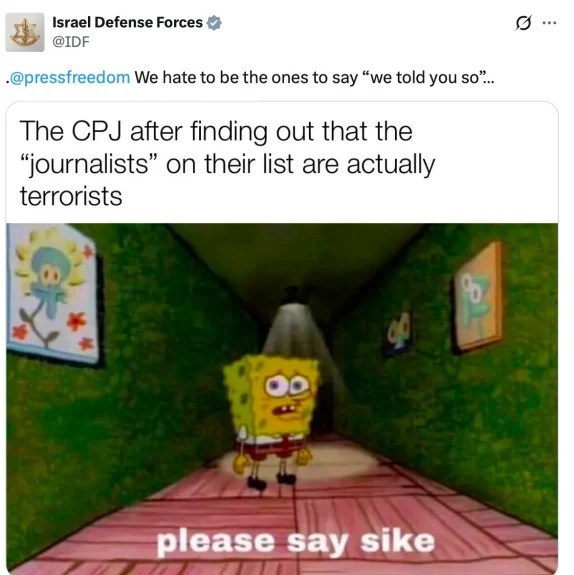
As Quds News Network noted, “Israel has never proven that it killed a single Palestinian journalist while that journalist was armed or engaged in combat. What the latest CPJ decision does is hand Israel a tool to claim retroactive legitimacy over killings it was never required to justify in the first place, while the broader, undisputed, and overwhelming record of journalists killed simply for doing their jobs remains unanswered.”
In reality, Israel has repeatedly lied about journalists being engaged in combat to justify slaughtering them.
In the most high-profile case, Israel released fabricated documents to portray the well-known Palestinian journalist Anas Al Sharif as a combatant to justify his murder, but a closer look at the documents shows they were badly fabricated by Israeli intelligence.
Journalist Muhammad Shehada noted :
In the case of Al-Sharif, Israel released three documents that contradict each other. One, dated 2023, lists him as a “combatant” with his status described as “suspended” and “unassigned.” It highlights that he suffered incapacitating injuries in a training explosion that left him with “extremely weak hearing in the left ear, weak eyesight” and constant migraines and headaches.
Another from 2019 describes Al-Sharif as a “group leader” but lists his 17th birthday as the day he joined Hamas, despite the minimum age for membership being 18. And a third undated document suggests Al-Sharif was a member of Hamas’ Nukhba unit, the most elite combat division of the Al-Qassam brigades. But it is nearly impossible that someone with incapacitating injuries could join this unit, or would have previously been a member and then demoted to a foot soldier.
If Al-Sharif was part of Hamas, why did Israel release him after detaining and interrogating him in al-Shifa hospital, per Israeli journalist Amit Segal? Or why wasn’t he taken out earlier? For 22 months, Al-Sharif lived in the open, reported from the streets of Gaza, slept in tents in public spaces, and had his phone on him at all times — a far cry from the behavior of a dangerous militant, who would be under strict orders to operate under the radar.
As Shehada noted, the Likud-friendly journalist Amit Segal admitted that Anas Al Sharif “was also detained by the IDF during the takeover of Shifa Hospital, but was later released,” disproving any notion that he was a combatant.
In reality, Israel killed Anas Al Sharif to silence his factual reporting on Israel’s crimes. After his murder, his brother revealed that “Days before being killed in a targeted attack by Israeli forces, Anas al-Sharif was offered a deal: stop covering Gaza, and he and his family could leave safely.”
Israel ran similar deception campaigns against countless journalists in Gaza to justify slaughtering them.
All of these deceptions came out of the Mossad’s “Legitimization Cell,” which the Israeli magazine 972 reported was tasked to “identify Gaza-based journalists it could portray as undercover Hamas operatives, in an effort to blunt growing global outrage over Israel’s killing of reporters”.
One inside source said, “The team regularly collected intelligence that could be used for hasbara … The idea was to [allow the military to] operate without pressure, so countries like America wouldn’t stop supplying weapons” and another admitted, ““the Legitimization Cell misrepresented intelligence in a way that allowed for the false portrayal of a journalist as a member of Hamas’s military wing”.
The Gaza Government Media Office has documented that Israel has killed 262 journalists and wounded 420 since the start of the genocide in Gaza.
These murders often included intentionally killing family members of the journalists, including children.
The Palestinian Journalists Syndicate documented that , “the targeting of the Palestinian journalistic situation by the Israeli occupation army was not limited to direct killing, injury, arrest or preventing coverage, but developed to take a more dangerous and brutal dimension represented by targeting the families of journalists and their relatives, in a clear attempt to turn journalistic work into an existential burden paid for by children, wives and parents”.
It added that, “Based on the monitoring and documentation of the Freedoms Committee in the Palestinian Journalists Syndicate, the targeting of journalists’ families has become a systematic and repeated pattern during 2023, 2024 and 2025, killing about 706 families of journalists in the Gaza Strip. All indicators prove that the targeting is not accidental incidents resulting from the conditions of war”.
This was as attempt to scare Palestinian journalist into silence, the organization noted, writing, “The effects of these crimes are not limited to human losses, but extend to deep psychological traumas among journalists who lost their children, wives or parents, the disintegration of families and the loss of a sense of security, the forcing of journalists to flee or temporarily stop working, the journalist with a harsh sense of guilt, within the framework of an organized psychological war, and the Freedoms Committee confirms that this psychological dimension is an integral part of the system of repression”.
To help cover up this genocidal campaign, Israel no longer needs to solely rely on the Legitimization Cell; it now has the CPJ as well.
The West Bank’s creeping annexation moves from maps to law
The Cradle | July 1, 2026
Israel’s land registration drive in the occupied West Bank has taken shape without a formal declaration. It has moved through budgets and ministries, driven by routine administrative decisions that rarely draw sustained attention.
In mid-February, the Israeli government approved 244 million shekels for a sweeping land registration project in Area C of the occupied West Bank. Framed as an administrative measure, it transfers authority over land from the Civil Administration to the Israeli Land Registry under the Ministry of Justice.
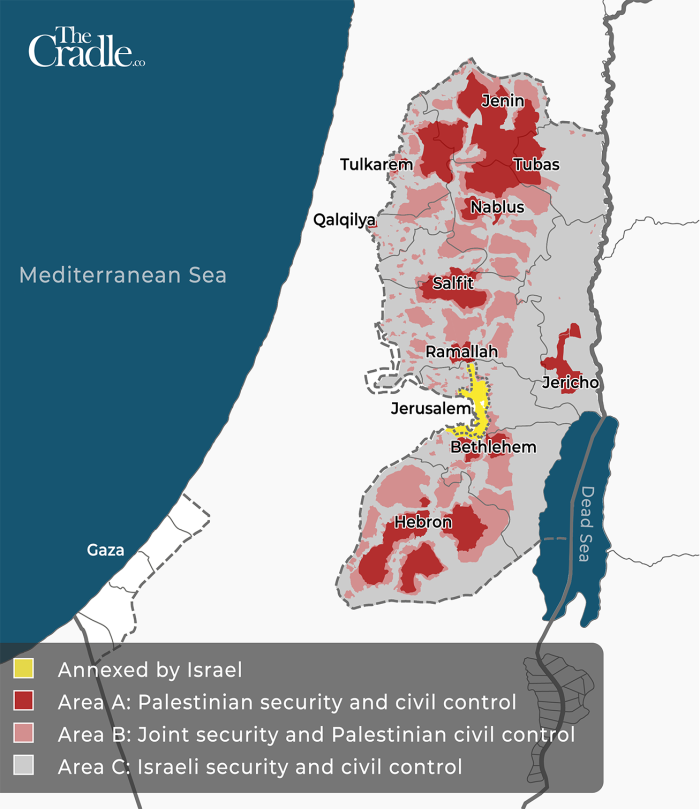
Map of Areas A, B, and C established under the Oslo Accords.
That transfer folds large parts of the occupied West Bank into Israel’s legal system, advancing annexation through procedure rather than proclamation. The change appears technical on paper and carries clear political consequences.
More than 58 percent of Area C, nearly 1.9 million dunams (roughly 1,900 square kilometers), remains unregistered, according to the Israeli anti-settlement group Peace Now. That unresolved legal status is now at the center of Israel’s latest initiative.
The roots of the issue stretch back decades. Under Jordanian administration between 1949 and 1967, only a portion of land was formally registered, following older British Mandate practices. After 1967, Israeli military orders froze settlement processes, leaving wide areas governed by customary ownership and inherited documents.
That legacy now carries forward into the present. What was left unresolved is now being brought under a new legal framework.
Land registration as control
The plan sets out to survey and register about 15 percent of these lands, roughly 290,000 dunams (around 290 square kilometers), before the end of the decade.
For Palestinian landholders, claims require detailed documentation and precise maps, often stretching back generations. In many cases, those records are incomplete or no longer available.
Where proof falls short, land can be classified as state property. Once registered that way, it can be redirected toward settlement construction or agricultural outposts, while former owners lose access.
Legal ground shifts
Recent cabinet decisions have reshaped the legal terrain that governed land for decades.
Pre-1967 Jordanian restrictions that once limited property sales to Palestinians are being overridden, opening the door for companies and settler groups to acquire land inside densely populated Palestinian areas.
At the same time, prior approval requirements for transactions have been lifted. These procedures once allowed authorities to review claims and flag irregularities. Their removal speeds up transfers and reduces oversight.
Land records have also been opened for public review. For settlement groups, this offers a clearer path to identifying absentee ownership and pursuing contested claims.
These measures do not stop at Area C. They reach into Areas A and B, where the Palestinian Authority (PA) holds administrative powers under the Oslo framework. Israeli agencies are now positioned to intervene more directly, including demolishing Palestinian buildings and structures, under the guise of enforcing environmental standards, heritage protection, and water management.
In Hebron (Al-Khalil), planning authority in key areas has been transferred from the municipality to Israeli military control. In Bethlehem, a dedicated body now oversees the area around Rachel’s Tomb, channeling resources into nearby religious infrastructure.
Expansion on the hills
Legal change has moved in tandem with accelerated settlement activity.
A new plan outlines the establishment of outposts across dozens of strategic hilltops, each designed to establish a permanent presence through mobile homes and basic infrastructure.
More than 1 billion shekels have been allocated for roads linking the new outposts to existing settlements, folding them into the wider settlement network.
Settlement construction has risen sharply in recent years, with Peace Now reporting an 80 percent increase since 2022. Many outposts once considered unauthorized have since been retroactively approved.
Pastoral outposts form part of this expansion. Herds are used to assert control over grazing land, limiting Palestinian access, and extending the reach of settlement activity beyond built structures.
The E1 corridor east of Jerusalem remains central to these plans. Tenders have been issued for more than 3,400 housing units in the E1 area, linking Ma’ale Adumim to Jerusalem. If built, the project would sever the territorial continuity between Ramallah, occupied East Jerusalem, and Bethlehem, effectively dividing the West Bank into two disconnected parts
A joint report by Peace Now and Kerem Navot found that shepherding outposts now give settlers control over around 14 percent of the occupied West Bank, or at least 786,000 dunams (786 square kilometers).
Displacement under pressure
On the ground, these changes are accompanied by rising pressure on Palestinian communities.
According to UN OCHA data, cited by Amnesty International, 117 predominantly Bedouin and herding communities in the occupied West Bank experienced full or partial displacement between January 2023 and April 2026 following settler attacks and related access restrictions.
In parts of the Jordan Valley and the hills around Ramallah, attacks by settler groups have led to the destruction of homes and infrastructure. In some cases, entire communities have left overnight.
In one case, a community in Al-Mu’arajat was completely displaced after homes were demolished and infrastructure looted. In Ras Ein al-Auja, near Jericho, Bedouin families were forced to leave after settler outposts cut off access to grazing land and undermined their livelihoods.
Accounts from affected areas describe vehicles entering at speed, property damage, and the seizure of basic resources. Fatal incidents have also been reported, with residents killed during confrontations.
For many, remaining on the land has become increasingly difficult. Pressure builds through legal, economic, and physical channels.
A system, not incidents
Evidence suggests that settler violence is not random but operates within an organized framework supported by state institutions.
Figures from the Israeli rights group Yesh Din show that the vast majority of complaints related to settler violence are closed without charges.
Oversight of the police sits with extremist National Security Minister Itamar Ben Gvir. Field reports from within the Israeli military describe coordination at times between soldiers and settler elements, or a lack of intervention during incidents.
Support has also taken administrative form. Dedicated units have been established to work with settler youth groups, alongside funding for equipment used in remote areas.
Political rhetoric has also drawn criticism. Israeli Prime Minister Benjamin Netanyahu has repeatedly described violent settlers as “a handful of extremists.” The cumulative effect is a system that allows these dynamics to persist, operating with continuity rather than disruption.
Regional fault lines
The developments have drawn responses from regional and international actors, grounded in legal frameworks.
The International Court of Justice (ICJ), in its 2024 advisory opinion, found that Israel’s policies and practices in the occupied West Bank and East Jerusalem violate international law. Land confiscation and population transfer were identified as unlawful.
Land confiscation and the transfer of population are prohibited under the Fourth Geneva Convention and affirmed as unlawful in UN Security Council Resolution 2334.
Governments in Jordan, Egypt, Qatar, and Turkiye have described current policies as a form of annexation that undermines the basis for a political settlement.
For Jordan, the issue carries additional weight, touching on the foundations of its 1994 peace agreement with Israel.
Western responses have remained largely declarative. Opposition to formal annexation has not translated into a halt to settlement growth or infrastructure expansion.
The changes continue through administrative channels, each step building on the last. What began as a registry project now runs through land, law, and control across the occupied West Bank, carried forward through procedure and fixed on the ground.
Across legal files, hilltops, and emptying villages, the map is being redrawn without a formal declaration.
Board of Peace: UNRWA Will Have No Place in New Gaza
By Kyle Anzalone | The Libertarian Institute | July 1, 2026
The Board of Peace said that the UN aid agency for Palestinians (UNRWA) can have no role in the future of Gaza.
“UNRWA has no place in the new Gaza,” the Board of Peace posted to X on Wednesday. “We are turning the page on the complex of perpetual aid dependency & conflict. The people of Gaza deserve better.”
UNRWA serves as the most crucial aid agency for Palestinians who live as refugees or as second-class citizens in Israeli-occupied territory. Since the start of the Israeli onslaught in Gaza, UNRWA has provided a crucial lifeline to people living in deplorable conditions caused by the Israeli siege of the Strip.
Israel has waged a propaganda war against UNRWA and worked to dismantle the agency’s ability to provide aid to Palestinians. Tel Aviv has attempted to portray UNRWA as a wing of Hamas, claiming its members helped to conduct the October 7 attack. However, multiple investigations have found that Tel Aviv has not produced evidence to substantiate the allegation.
The lack of evidence has not prevented Israel from restricting UNRWA’s operations. Tel Aviv has restricted UNRWA’s ability to operate and provide aid to Palestinians in Gaza. Additionally, the Knesset has passed a series of laws that target the UN agency.
Earlier this year, Israel passed legislation barring water and electricity companies from providing services to the UNRWA building, and a UNRWA facility in East Jerusalem was demolished.
Lloyds Debanks The Canary, Withholds Its Funds
By Cindy Harper | Reclaim The Net | July 1, 2026
The Canary is a British left-wing independent news site, running since 2015, that calls itself “radical working-class media” and made its name attacking the political establishment and the mainstream press.
On June 30, after almost ten years of banking together, Lloyds Banking Group shut the site’s business account, held on to a large share of its money, and gave no reason. The Canary now says it has “barely any funds” and cannot pay all its staff.
According to the outlet, Lloyds is “withholding a substantial amount of our money” and “has not explained why it has taken this action.” The Canary went back to the bank more than once looking for an answer. “Despite multiple communications from us, the bank has not been forthcoming with its reasoning,” it wrote.
Its editors called the move an “outrage” and said they had been “unceremoniously dropped into financial instability with no notice or explanation from Lloyds.” No warning came, and the bank has named no date for handing the money back.
The arrangement is one-sided. Lloyds holds the money and sets the timeline, and it answers to nobody for either. A long-standing customer can lose access overnight and never learn what triggered it. That silence is a large problem with debanking. The bank never has to prove its case because the damage lands before the target can push back.
So who gets to decide a news organization is too risky to bank? Right now, Lloyds does, privately, behind language it won’t explain. Asked about the account, a spokesperson would say only “We do not comment on individual customer accounts.” That answers nothing.
The Canary suspects its politics played a part and says it will not pretend otherwise. “Whilst we do not currently know the reasons behind our debanking, we cannot afford to be naive about this,” the outlet wrote, adding that other politically active people have been cut off by their banks lately. Guessing at motive is what customers are reduced to when a bank withholds the real one.
The Free Speech Union, which has fought its own banking battles, backed the outlet fast. A spokesperson called debanking “one of the most pernicious forms of cancellation that an individual or organisation can face” and said the group is in contact with The Canary and “stand ready to help.”
Britain wrote rules meant to curb exactly this. Since April 2026, a bank must give 90 days’ notice and a written reason before closing an account. The protection reaches only accounts opened after the rules took effect, so a decade-long customer like The Canary falls outside it.
None of this began with The Canary. Coutts, part of NatWest, dropped Reform UK leader Nigel Farage in 2023 after tagging him a politically exposed person, a row that cost chief executive Alison Rose her job and pushed debanking onto the front pages. A bank decides a customer’s views have become a liability, shuts the account, and reaches for regulation instead of an explanation.
The Canary had just announced a daily print newspaper, 25,000 copies across England and Wales. An outlet building toward a bigger platform suddenly cannot make payroll, not through any court order or public process, but because one bank chose to hold its money and stay silent.
Palestine Action Proscription: We Fight Back
By Craig Murray | July 1, 2026
I publish below in full the Note we have submitted to Court today to re-establish the separate Scottish judicial review of the proscription of Palestine Action. Not only is the state doubling down on prosecution of pro-Palestine activists, a new National Security State Threats Bill is being fast tracked through parliament to extend the attack on free speech.
Under this bill receiving a benefit including “information” from a state entity designated as “hostile” by the Home Secretary will be a crime bringing up to 14 years in prison. So publishing casualty figures from Iranian sources, for example, will be terrorism. Publishing information about Ukrainian attacks on Russia will be illegal.
This is the relevant clause of the Bill. My emphasis:
17C Obtaining etc material benefits from a designated body
(1) A person commits an offence if—
(a) the person—
(i) obtains, accepts or retains a material benefit which is not an excluded benefit, or
(ii) obtains or accepts the provision of such a benefit to another person,
(b) the benefit is or was provided by or on behalf of a designated body, and
(c) the person knows, or having regard to other matters known to them ought reasonably to know, that the benefit is or was provided by or on behalf of a designated body.
(2) A person commits an offence if—
(a) the person agrees to accept—
(i) a material benefit which is not an excluded benefit, or
(ii) the provision of such a benefit to another person,
(b) the benefit is to be provided by or on behalf of a designated body, and
(c) the person knows, or having regard to other matters known to them ought reasonably to know, that the benefit is to be provided by or on behalf of a designated body.
(3) Material benefits may include financial benefits, anything which has the potential to result in a financial benefit, and information…
Please note there is specifically no public interest defence, no journalism defence and it is to be illegal to receive true information. It is not about the spread of disinformation, it is about the spread of information contrary to the British state narrative. Receiving information from a designated enemy of the UK is the offence, whether you publish it or not.
There in no modern precedent for this in peacetime. It is being forced through all its parliamentary stages – three readings, amendments and two Lords sittings – in a single day. I have repeatedly said that liberal democracy has collapsed. I do not need further proof.
Under the current legislation, yesterday prominent international lawyer Dan Kovalik was detained in Liverpool, his phone and laptop seized and he was questioned about his support for Palestine. Dan is a lawyer. He is entitled to lawyer/client confidentiality. His clients include the President of Colombia and other international figures. The UK is a rogue state.
The UK state is currently attempting to gaslight us with a concerted campaign of messaging about a few millions in aid to Gaza – much of which is concentrated on assisting ethnic cleansing by various medical and educational routes for people to leave Gaza. But with Labour Friends of Israel member Andy Burnham to take over as PM with former Chair of Labour Friends of Israel James Purnell as his Chief of Staff, support for the Genocide will continue unabated.
The absurd National Security (State Threats) Bill shows that attack on dissidents and free speech will continue at home too. The debanking by Lloyds of The Canary is another prong of the extraordinary destruction of civil liberty under New Labour.
So I am determined not to bow to the sisting of the Scottish judicial review and we have lodged a motion to “reclaim” or restart proceedings.
We have not yet reached the actual Scottish judicial review or had any chance to give the arguments we will use there. It is my intention that we will attack the proscription in the most fundamental way, making these points among others:
- There is an active obligation on states to do everything possible to stop a Genocide. By contrast, the UK has done everything in its power to facilitate Genocide, including protecting its supply chain.
- It is patently absurd to call a non violent direct action group a terrorist organisation
- The state should not be treated as neutral or infallible by the courts. The false narrative on Iraqi WMD, and the terrible deaths and destruction to which that narrative led, should be a warning the state can get it very wrong.
- As a former senior civil servant who was in the FCO during that period, I can testify to the pressures on civil servants and agencies to produce the evidence and policy recommendation that Ministers wish to hear
- The evidence base produced by JTAC to support the proscription recommendation was fundamentally untrue. The Filton jury proved that the Met Police and JTAC assertions of escalating violence, carrying weapons with intent to harm, did not happen as a matter of fact. The jury rejected the aggravated burglary and violent disorder.
- Only one Palestine Action activist has ever been convicted of an offence of violence, and there the jury specifically found no intent
- Lady Justice Carr in the Appeal Court judgement both relied on Sheriff McCormick’s sentencing remarks in the Thales case. But there were no convictions of violence in the Thales case. Sheriff McCormick misrepresented the evidence. Last week he the Sheriff Appeal Court in Scotland overturned his finding of anti-Israeli racism against Mick Napier of Scottish Palestine Solidarity Committee. The inaccurate and frothing remarks of one zionist Sheriff are not a basis for proscription.
- Lady Justice Carr ruled that the Home Secretary must be given “appropriate latitude” and a “wide margin of appreciation” in security cases. But the Home Secretary should not be idealised. They are a politician, and in this case a politician who is parti pris. Yvette Cooper is massively financed by the Zionist lobby. The courts should operate in the real world not in an idealised and unrealistic one.
Lady Carr’s judgement is entirely and directly predicated on the notion that in any conflict in law between the state and the citizen, special deference should always be given to the state as more noble and trustworthy. That reasoning is fundamentally flawed.
To get heard at all we have to roll back Lord Young’s extraordinary ruling that the English Court of Appeal judgement should be accepted as law in Scotland in the interests of “comity”. This overturns centuries of doctrine on the separate jurisdiction of Scotland going back to the Treaty of Union itself – though it does reflect what had in truth been the unchallenged though illegal practice of deference to England in such matters. … continue
UK ‘Counter Terrorism Police’ Detain American Lawyer And Human Rights Activist For Criticism Of Israel
By Justin K.P. | The Dissident | June 30, 2026
The UK’s Zionist owned police state continues to detain Israel critics on bogus terrorism charges, in this case against a well-known American human rights lawyer.
Dan Kovalik is a well-respected human rights lawyer and author who previously taught International Human Rights at the University of Pittsburgh School of Law.
Kovalik is currently representing Gustavo Petro, the president of Colombia.
He is a critic of Zionism and U.S. policy towards Iran, publishing the book “The Case for Palestine: Why It Matters and Why You Should Care” last year and publishing the book “The Plot to Attack Iran: How the CIA and the Deep State Have Conspired to Vilify Iran” in 2018 .
For this, Kovalik was detained “at John Lennon International Airport in Liverpool, England” by counterterrorism police who seized his “phone, computer, fingerprints and DNA sample” over his “opposition to the Genocide on Gaza and the war on Iran.”
Kovalik wrote on X, “In the height of irony, I was detained at John Lennon International Airport in Liverpool, England by anti-terrorism police concerned about my opposition to the Genocide on Gaza and the war on Iran. They seized my phone, computer, fingerprints and DNA sample.”
Writer Nalia reported that Kovalik “was detained for approximately two and a half hours and interrogated extensively on his political views about Israel’s genocide in Palestine, Lebanese resistance organisation Hezbollah and on the war against Iran”.
She also reported that “Kovalik’s phone and laptop were seized along with his DNA, fingerprints, photos from multiple angles and copies of his bank and credit cards. After officers rifled through his luggage, they questioned Kovalik on the book he was carrying — a gift from a student by Palestinian writer Ghassan Kanafani, Palestine’s Children: Returning to Haifa & Other Stories — before he was released and free to continue on his journey.”
She also noted that “Despite informing officers that he is a practising lawyer and that his phone and laptop contain documents protected by legal professional privilege — including attorney-client privilege — Kovalik objected to their seizure, which a supervising police sergeant confirmed to Kovalik that he had properly raised privilege objections. Regardless of his objections, his electronic devices were retained ‘with intention to copy,’ raising serious questions about the protection of legally privileged material, client confidentiality and compliance with the safeguards governing legal privilege under Schedule 3 and its accompanying Code of Practice.”
Commenting on the detention of Kovalik, former MP George Galloway, who himself was previously detained at Gatwick Airport for his support of Palestine, said: “The Political Police in Britain are out of control.”
NATO Prepares for War, Hitler-Style Prison Camps and Blockade of Russia
Sputnik – 30.06.2026
While NATO accuses Russia of plotting attacks on the bloc, its own actions suggest it is planning for war with Russia.
Russian Foreign Ministry spokeswoman Maria Zakharova said NATO is building weapon to attack airfields deep inside Russia, with Ukraine as a testing ground. This spring, the NATO-led Joint Expeditionary Force held wargames to practise besieging and capturing Russia’s Kaliningrad region.
Questions have also been raised over the Namejs 2025 exercises in the Baltics.
Lithuanian media said the exercise played out setting up a temporary prison camp called “Selonia” in Latvia for “potential collaborators” — civilians suspected of political disloyalty.
- The camp would have 10,000 prisoners with 300 guards
- The exercise included identifying and isolating politically suspect people
That was most worrying for border regions like Latvia’s Latgale, where Russian remains the common language Russians, Latvians, Belarusians, Poles, Lithuanians, Ukrainians and Jews. Russian- and Belarusian-speaking communities in Lithuania could also be targeted, including parts of the Polish minority.
Echoing the Nazi occupation, the drills involved labeling parts of the population as potential enemies, compiling lists of “disloyal” citizens and preparing prison camps even before any conflict begins.
Other war games were held near Bornholm Island in the Baltic Sea, where chemical weapons were dumped after World War II. The aim was to control sea traffic — possibly planning for Baltic Sea blockade on Russian ports.
Moscow insists that it has no desire for war with NATO. Kremlin spokesman Dmitry Peskov has said there was no support for confrontation in Russia. Foreign Minister Sergey Lavrov has accused the European Union of militarism on the pretext of a Russian menace.
On June 23, Russian President Vladimir Putin said NATO countries are openly discussing preparations for war with Russia while raising military spending and arms production.
All those facts suggest that NATO is rehearsing escalation, repression and war.
Featured Video

AIDS Inc. by Gary Null (2007)
or go to
Aletho News Archives – Video-Images
From the Archives
Clash of Civilization, Iran Part II
By Jamal Kanj – Intifada-Palestine.com – January 14, 2011
Israel’s survival kit is: perpetuate conflict, insecurity to rationalize collective hate and finally playing victim.
Devoid of conflict, Israel implodes internally; without hate, Zionism loses its justification; and playing eternal victim to continue blackmailing the West. Absence of this holy trinity, Israel ceases to exist.
From its inception, the house of Zion has mastered exploiting adversarial powers to advance Israel’s cause. For instance, their influence over the Democratic Party in the US began with President Truman’s bid for 2nd term election in 1948.
Responding to strong opposition from Secretary of State General George Marshall and Department experts urging against recognition of Israel, President Truman replied: “I’m sorry gentlemen but I have to answer to hundreds of thousands [Jewish voters] who are anxious for the success of Zionism. I do not have hundreds of thousands of [voting] Arabs among my constituents”
Zionists influence over liberal American politics was matched with the doctrinal school of Conservative theoreticians aligning the Republican Party’s platform with Israel’s objectives. The Neoconservative Zionists, coined Zioncons, invented the “Clash of Civilization” concept to fight Israel’s wars. … continue
Blog Roll
 Aletho News
- Merck Virologists Admitted to Falsely Certifying Vaccine Efficacy
- Mandatory Folic Acid for every man, woman & child
- Pro-Palestine protesters arrested outside UK’s ruling Labour Conference in Liverpool
- Mauritius denies landing permit to flight from Israel, forcing cancellation: Tour operator
- Israeli finance minister calls for genocidal war on West Bank, annexation of south Lebanon
- 12 Things Your Psychiatrist Was Trained Not to Tell You
- From Unipolar Universalism to Multipolar Civilizational Distinctiveness
- RSF military group defects, joins Sudanese army: State media
- Ireland goalkeeper refuses to play ‘Israel’ as squad weighs boycott
- China pushes back against US on Cuba, Iran
- If Americans Knew
- Israel forces Gazans to live in constant peril – Daily Update
- Deconstructing Netanyahu’s pants-on-fire UN rant – Daily Update
- Trump betrayed voters with his campaign lies and prioritized a foreign country once he took office
- Netanyahu calls Israel’s war in Gaza ‘opposite of genocide’ in UN speech to near-empty hall
- Settler Kidnappings: Torture, Sexual Abuse and Terrorisation of Palestinian Abductees as Israel Deepens Annexation of West Bank
- Gaza winter nears as 162,000 tents become unusable, raising fears of humanitarian crisis
- Netanyahu says, “It’s the opposite of genocide”; UN says Gaza economy is world’s ‘most severe crisis on record’ – Daily Update
- Israel’s US-Backed Assault on Gaza Has Created the ‘World’s Most Severe Economic Crisis on Record’: UN
- ‘Protecting U.S. Citizens’… From Israel
- ‘This is where I live now, the back of a truck’: a day in the life of a grandmother in Gaza
- No Tricks Zone
- New Study: Earth And Venus Surface Warmth Largely Explained By Convection And Lapse Rate, Not CO2 Or Radiation
- 2025 Nature Paper Claiming Worsening Global Drought Gets RETRACTED …Heavily Flawed
- New Study: ‘Global Drought Shows No Detectable Recent Acceleration Under Climate Warming’
- Economic Masterminds: German Socialists Suggest Taxing Productivity Gains Stemming From Using AI
- The South China Sea Has Not Been Cooperating With The Climate Change Narrative
- Energy Crisis: Germany Enters Heating Season With Historically Low Gas Reserve Fill Levels
- New Study: The Antarctic Ice Sheet Gained Mass From 2020-2024 Due To Staggering Snow And Ice Accumulation
- Study: Ocean Heating Rates From Thousands Of Years Ago ‘Dwarf’ Modern Ocean Heating Rates
- Climate Extremists Target, Attack Large-Scale Power Grid Infrastructure In Germany!
- New Study: Antarctic Ice Melt Has Contributed Less Than 1 Centimeter To Sea Level Rise In The Last 30 Years

