Saudi Arabia top buyer of UK arms in 5 years: Report
Press TV – January 7, 2016
The UK has licensed the sales of over eight billion dollars of military hardware to Saudi Arabia since British Prime Minister David Cameron took office in May 2010.
According to the latest figures released by the Campaign Against Arms Trade (CAAT) NGO, since Cameron was elected almost six years ago, Britain has also sold arms to 24 of the 27 states on its own list of “countries of humanitarian concern,” The Independent reported on Wednesday.
Apart from Riyadh’s ongoing purchase of the 72 Eurofighter Typhoon jets, which are worth over six billion dollars at completion, major licenses worth over two billion dollars including Hawk fighter jets, bombs, guns and tear gas were sold to Saudi Arabia during the said period.
Based on the figures released by CAAT, the Saudis have access to twice the number of British-made warplanes than the Royal Air force has.
CAAT spokesperson Andrew Smith noted that the amount of arms sales to countries on the list, especially Saudi Arabia, shows that “human rights are playing second fiddle to company profits.”
He went on to say that the income from arms sales “is being put over the rights of people being executed and tortured. It’s completely inconsistent to condemn these regimes while signing off on billion-pound arms deals.”
“Two-thirds of UK arms exports go to the Middle East, and that’s unlikely to change. We know that Saudi Arabia is arming a number of groups in and around Syria, but we’ve no idea what weapons are being sent there. Once a weapon enters a war zone there’s no such thing as arms control,” Smith added.
Cameron has been under pressure to halt arms sales to Saudi Arabia which faces massive criticism from the international community for launching an unabated war against impoverished Yemen, its growing number of beheading and other forms of execution, cracking down on political dissidents and the most recent atrocity of the mass execution of Shia cleric Sheikh Nimr al-Nimr and 46 other people.
In October last year, during an interview with the UK’s Channel 4, Cameron suggested that London’s “relationship” with the Saudi Arabia supersedes its human rights record.
The Disingenuous Apologies for Israel’s Assault on Palestinian Education
By Matt Peppe | Just the Facts | January 6, 2016
As the American Historical Association (AHA) prepares to vote this week on a symbolic resolution that affirms support for the right to education in the occupied Palestinian territories, apologists for the Israeli regime’s policies against Palestinians are putting forward nonsensical rationalizations for their opposition to the measure. Writing in History News Network, University of Maryland History Professor Jeffrey Herf essentially argues that his profession has no practical value: “as historians we have neither the knowledge nor expertise to evaluate conflicting factual assertions about events in Israel, the West Bank and Gaza.”
If historians should not evaluate the veracity of factual assertions about an issue then what exactly is the use of historical studies? To merely compile and organize documents? Surely a historian’s job involves analytical — in addition to technical — skills. And surely their methods include empirical analysis – no different than a scientist testing a theory. If someone says the earth is round but another person says the earth is flat, that doesn’t mean the scientist should throw his hands up in the air and say “as scientists we have neither the knowledge nor expertise to evaluate conflicting factual assertions.”
Historians analyzing political questions use the same principles as scientists testing a theory. Take, for example, conflicting accounts of the actions of the Belgians under King Leopold in the Congo near the end of the 19th century. Leopold claimed he treated the Congolese people benevolently as part of his “Christian duty” to help the poor. Others claimed Leopold’s forces were engaged in the systematic plunder of resources carried out through massive violence. They described women held hostage by Belgian forces to force Congolese men to engage in involuntary labor, with the hands of those who did not produce enough rubber for the colonists cut off and kept as trophies.
According to Herf’s axiom, historians would not have the ability to distinguish between these competing claims. It would be outside the scope of the historical vocation to evaluate the available evidence and reach a conclusion about the truth.
In the Congo, the African American historian George Washington Williams worked tirelessly to document the true condition of the local population under Belgian rule. As Adam Hochschild explains in his book King Leopold’s Ghost, Williams’s insistence on questioning the official narrative enabled him to uncover and expose the brazen lies meant to cover up the genocidal destruction of an entire society for the material enrichment of a tyrant.
“Williams was a pioneer among American historians in the use of nontraditional sources. He sensed what most academics only began to acknowledge nearly a hundred years later: that in writing the history of powerless people, drawing on conventional, published sources is far from enough,” Hochschild writes.
Much like the Belgian regime in the Congo more than a century ago, the state of Israel today covers up its crimes against Palestinians by denial, deflection and counter-accusations. They rely on the support of apologists in media, government, civil society, and academia to side with authority by accepting their justifications at face value.
Herf writes that “(i)t is fair to insist that where there is an indictment, we must pay attention to the case for the defense.” Absolutely true. But we must pay attention to the evidence for the case itself, not merely conclude that the existence of a defense means there is no way to draw a conclusion about the facts.
Herf requested a response from the Israeli Embassy on accusations presented in the AHA resolution. Among their claims are that the movement of faculty, staff and visitors in the West Bank are not limited except occasionally because “Palestinian universities periodically serve as sites of violence and incitement.”
The evidence is overwhelming that movement in the West Bank is severely limited and adversely impacts education. A UN report found that checkpoints, settler violence, and long commutes present risks to West Bank students. Another UN report documented 542 obstacles to movement in the West Bank. Students from Gaza are denied permission to study in the West Bank, a policy that has been criticized by Amnesty International. The policy has been endorsed by Israel’s High Court. The Israeli Defense Forces (IDF) have raided West Bank universities. Visiting academics are denied entry to the West Bank. After arbitrarily being denied entry to deliver several lectures there, world-renowned scholar Noam Chomsky compared his treatment by Israeli authorities to that of Stalinist regimes.
There is no evidence presented, however, to support the claim that Palestinian universities serve as sites of violence and incitement.
Herf also quotes the Israeli Embassy defending their bombing of the Islamic University in Gaza (IUG) in 2014 during Operation Protective Edge “not because it was a university but because it was used by the terrorist organization Hamas to manufacture and fire rockets at Israeli civilians.”
First, it should be noted that Hamas is not recognized as a terrorist organization by the United Nations. The description carries exactly as much weight as Hamas calling the Israeli regime a terrorist organization. But that is beside the point. The accusation is that Hamas used the university to make and fire rockets.
The source provided for this claim is “Israeli military intelligence officials.” After the bombing, the IDF claimed to target a “weapons development center” within the university. This is a predictable accusation. The IDF made similar accusations after bombing the same university in 2008. A UN report on that conflict “did not find any information about their use as a military facility or their contribution to a military effort that might have made them a legitimate target.”
Rami Almeghari, who teaches journalism at IUG, noted in the Electronic Intifada that the university is not run by Hamas or any other political party. Students and faculty, like those at any higher educational institutional, have varied political affiliations. Many others, like himself, belong to no party.
“Contrary to what Israel claims,” Almeghari writes, “Gaza universities do not have departments dedicated to military research or training. This is in contrast to Israeli universities which play an integral role in the military occupation and weapons development and have actively promoted the onslaught in Gaza.”
None of the Israeli government’s accusations are substantiated by anything other than its own word – which should be treated with the same skepticism as any criminal defendant pleading his innocence. On the other hand, a mountain of evidence from independent sources (Amnesty International, Human Rights Watch, UNESCO, Palestinian Centre for Human Rights, Institute for Middle East Understanding, B’Tselem, etc.) supports the accusations in the AHA resolution.
The idea that evaluating contrasting factual assertions and reaching a judgment is outside the scope of a historian’s profession is asinine. This notion is beneficial for the propagation of state propaganda, but devastating for the advancement of human rights, including the right to education.
Newly expanded Shuhada checkpoint is even more difficult to traverse
International Solidarity Movement | January 6, 2015
Al-Khalil, Occupied Palestine – At the end of December Israeli forces re-opened the newly expanded Shuhada checkpoint in occupied al-Khalil (Hebron). The checkpoint had been closed since December 7th, when Israeli forces had declared they would be conducting “renovations” for a then-unknown period of time.
Officially known as Checkpoint 56, Shuhada checkpoint separates Bab al-Zawiye, a Palestinian neighborhood in the H1 (nominally Palestinian-controlled and administered) part of al-Khalil and Tel Rumeida, part of Israeli military-controlled H2 and currently covered in part by a closed military zone order first issued on November 1st.

Palestinian family leaving Tel Rumeida, crossing toward Bab al-Zawiye
The checkpoint was rebuilt with a high fence blocking the entire street and additional turnstiles and metal detectors. The turnstiles make it very difficult for anyone carrying heavy, bulky luggage or even several bags of groceries to pass. Israeli authorities also added a completely closed off room in the center of the checkpoint, where Palestinians are questioned and searched entirely out of site of any onlookers, media, or human rights monitors.
As in previous versions of the checkpoint, there is no possibility for any car or truck – even an ambulance responding to an emergency – to pass; any vehicle larger than a baby carriage must take a time-consuming detour in order to enter or leave Tel Rumeida.

Shuhada checkpoint as seen from a nearby window in Bab al-Zawiye, an imposing barrier Palestinian families living in Tel Rumeida must navigate
The new checkpoint has already become a flashpoint for Israeli military aggression against Palestinians, which includes the arrest of 38-year-old Wafa’ Sharabati on Monday afternoon by Israeli forces who first claimed she had a discrepancy in her ID then accused her of being a troublemaker and threatened to plant a knife on her. Wafa’s family and local activists staged a sit-in outside Shuhada checkpoint to protest her treatment and the continued humiliation and harassment faced by Palestinians forced to endure the checkpoint and the closed military zone.

Wafa Sharabati’s family staged a sit-in awaiting her release

A large group of local activists and residents gathered after Wafa’s arrest in front of the checkpoint, which has has been the site of countless demonstrations against the Israeli occupation of al-Khalil

He never fired, but this Israeli soldier spent much of Monday afternoon on the roof of Shuhada checkpoint, prepared to attack nonviolent Palestinian demonstrators with potentially deadly rubber-coated metal bullets
A sign on the H1 side of the checkpoint explains the protocols for passing through: metal detector, bag search, no animals allowed through, checkpoint closed if there are any clashes. The 4th instruction reads “wait until the soldier will allow you to pass.” Sometimes people can pass in six minutes; sometimes they must wait for over an hour, outside and exposed to any weather, before being allowed to pass the few meters of turnstiles, metal detectors, fences and walls between them and the streets leading to their homes.

Lines on Monday evening left many, including young children, waiting for nearly half an hour in the cold night. Only Palestinians who are registered in the closed military zone can ever pass through the checkpoint; family members of residents, journalists, human rights defenders and internationals have all been barred. Even Palestinians who are registered have reported being forced to wait for over an hour only to be harassed and threatened by the soldiers inside the checkpoint.

Activists have planned another protest for Thursday morning to continue the struggle against the closed military zone, the even harsher regime at the newly reopened checkpoint, and the continued closure and Israeli military occupation of al-Khalil.
Canadian media is ignoring evidence of 1948 Israeli massacres
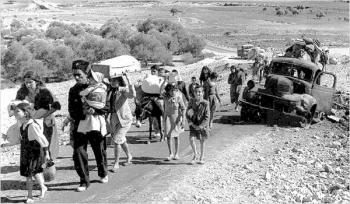
By Dan Freeman-Maloy | Rabble | January 6, 2016
The better part of a decade ago, I described the Toronto Star‘s Mitch Potter as “a canary in the mineshaft of liberal Canadian racism.” A piece on 1948 Palestine published in a recent edition of The Star shows the canary very close to asphyxiating.
Since Potter insists he was within his rights to describe Palestinian fighters in Gaza as “lemming-like,” he’ll surely forgive the metaphor.
The article, entitled “The Toronto man who saved Nazareth,” celebrates the heritage of Ben Dunkelman, the most prominent Canadian to travel to 1948 Palestine to support the Zionist war effort. In more than 2500 words spread across The Star‘s “Insight” section, Potter and his editors transform this Canadian’s role in occupying Palestinian communities into fodder for patriotism. “What he did was bring his hard-earned Canadian military professionalism to help organize a chaotic fighting force and help set down the rules of engagement,” the Star quotes one of a number of friendly sources as explaining. “And that included saying, ‘No, we will not expel civilians.'”
The record of this “gentle giant of a man,” as Potter introduces Dunkelman, is well documented. The son of the founder of Ontario retail giant Tip Top Tailors and a veteran of the Queen’s Own Rifles of Canada, Dunkelman was not an obscure figure. In Canada, he was an eminent member of the country’s community of patriotic respectables. In Palestine, he was a participant in the mass expulsion of Palestinians from the Galilee, commanding troops who repeatedly massacred civilians.
Dunkelman’s record of Canadian patriotism and Zionist colonization has long made for a popular sell. He has been happily remembered as “a Canadian and Israeli war hero,” as The Globe and Mail once described him. His basic character should be apparent to anyone who picks up his autobiography, Dual Allegiance.
Potter’s article for The Star pines over lost pages of this book without conveying to readers its utterly thuggish tone. The first five pages, to give you a sense, move from a description of a fight Dunkelman picked with a Palestinian (“Kneeling astride him, I began hitting him again and again, until his body went limp”) to boyhood reminiscences that feature a young Dunkelman in Toronto, soon to enroll in Upper Canada College, “waving a little Union Jack.” A lovely patriotic tale.
In Palestine, Dunkelman did not stop at beating Palestinians with his fists. In the summer and autumn of 1948, he served as commander of the Seventh (Armoured) Brigade of the newly established Israel Defence Forces (IDF). This is a representative sample of how Potter now presents this history to The Star‘s readership: “Named to lead Israel’s 7th Brigade in the final phase of the 1948 war, Dunkelman pushed methodically — and almost bloodlessly — through the Galilee with a series of nighttime flanking movements, eventually ending at the Litani River in Lebanon. He quite literally shaped borders, delivering territory Israel might not otherwise hold today.”
“Bloodlessly”?
One of the Seventh Brigade’s “nighttime flanking movements,” on October 29-30, 1948, brought the Palestinian village of Safsaf under Dunkelman’s command. A Palestinian woman from Safsaf, Umm Shahadah al-Salih, described what happened the next morning. Villagers were ordered to assemble in file around two houses to the north of the village.
“As we lined up, a few Jewish soldiers ordered four girls to accompany them to carry water for the soldiers. Instead, they took them to our empty houses and raped them. About 70 of our men were blindfolded and shot to death, one after the other, in front of us. The soldiers took their bodies and threw them on the cement covering of the village’s spring and dumped sand on them.”
If Potter’s editors can cough up subway fare to Yonge and Bloor, he can read this and other accounts for free at the local library, in Nafez Nazzal’s The Palestinian Exodus from Galilee, 1948. The Seventh Brigade’s trail of death, destruction and mass displacement of Palestinians from the Galilee into Lebanon is detailed authoritatively by Nazzal.
But right, this is a Canadian discussion of Palestine. Surely, Palestinians can’t be trusted! Unfortunately for Potter and The Star, more than mistrust of Palestinian testimony would be needed to make their whitewashing of these massacres halfway credible. In 1978, the year that Nazzal’s study was published, Israel began declassifying documents on these events. The Israeli record tells much the same story.
Israel Galili had been chief of staff of the Haganah, the main precursor to the IDF. In a declassified November 11, 1948 briefing cited by Israeli historian Benny Morris, Galili described the conduct of Dunkelman’s men in Safsaf. He spoke of the fate of “52 men tied with a rope and dropped into a well and shot,” and of three cases of rape, including of a 14-year-old girl. He also described large-scale killing of civilians by the Seventh Brigade in the villages of Saliha, Jish, and Sa’sa’. In Sa’sa’, Galili said, Dunkelman’s troops committed “mass murder” and then forced all remaining survivors out: “The whole village was expelled.”
Palestinian witnesses recount the most horrifying details. One survivor of the occupation of Safsaf recalled the stabbing of a pregnant woman with a bayonet. The witness lived out his life in the Ayn Al-Hilweh refugee camp in Lebanon; his testimony was kept alive by his nephew and cited in Ilan Pappé’s The Ethnic Cleansing of Palestine. In his memoirs, Dunkelman admits to authorizing looting by his forces, but predictably does not discuss most abuses. He does, however, proudly relate how one of his units set a landmark in the summer of 1948 with “the first bayonet charge ever mounted by the Israeli Army.” Facing an Arab position in the central Galilee, the company commander “ordered his men to fix bayonets; then, yelling like banshees, they rushed the Arab positions. When the astonished Arabs saw what was coming up the hill at them, they kicked off their boots and fled in terror.”
We don’t know much about specific atrocities with bayonets. We do know that Operation Hiram, during which Dunkelman’s troops carried out severe atrocities, helped push Palestinians out of the Upper Galilee en masse. On October 31, Dunkelman received an order from the IDF’s northern command spelling out this objective: “The inhabitants should be assisted to leave the conquered areas,” Dunkelman was instructed.
Here massacres by Dunkelman’s troops played their part. “What happened at Safsaf and Jish no doubt reached the villagers of Ras al Ahmar, ‘Alma, Deishum and al Malikiya hours before the Seventh Brigade’s columns,” writes Morris. “These villages, apart from ‘Alma, seem to have been completely or largely empty when the IDF arrived.” A week and a half into November 1948, an IDF intelligence report observed that “more than 50,000 new refugees” had crossed the border into Lebanon as a result of Operation Hiram.
Dunkelman — cue Potter’s praise — did not order expulsions in every Palestinian community that his forces occupied. He specifically opposed the (widespread) expulsion of Palestinian Christians by Israeli forces. When in July 1948 his troops occupied one of the main Christian centres in Palestine, the city of Nazareth, he spared it the harsher treatment he accorded to predominantly Muslim villages in its vicinity.
Potter is effusive with praise! He laments to The Star‘s readership that Dunkelman “won no medals for refusing to molest civilians” in Nazareth, but takes the opportunity to trumpet Canadian civility: “Transpose that morality to the modern era and imagine how the U.S. military interrogations at Abu Ghraib might have played out with a Dunkelman in command.” If those held at gunpoint were Muslims? Should we really follow this thread? “In many of the Palestinian oral histories that have now come to the fore,” observes Ilan Pappé, “few brigade names appear. However, Brigade Seven is mentioned again and again, together with such adjectives as ‘terrorist’ and ‘barbarous.'”
Israel has not declassified enough documentation for us to know for certain whether Dunkelman ordered his troops to massacre Palestinian civilians in line with instructions from higher-level IDF officers, took the initiative himself, or left the details to lower levels of command. But there is no record of him taking any action to discipline the culprits. By all accepted standards, he is therefore among them. Only the best liberal patriots want to award war criminals prizes for each possible war crime they didn’t commit.
Introducing a co-edited volume entitled Nakba: Palestine, 1948, and the Claims of Memory, Lila Abu-Lughod and Ahmad Sa’di explore the challenges of asserting Palestinian memory “under the conditions of its silencing by the thundering story of Zionism.” Engaging with 1948 as a landmark of enduring trauma, both individual and collective, may not be simple. But one can imagine an alternate universe in which Canadian journalists made a respectable effort. In which some attempt was made to look to the kind of work assembled by Abu-Lughod and Sa’di, to consider the recorded memories of those who lives were uprooted by Dunkelman’s troops, to bring their experiences into this history.
Instead, The Star basks in patriotic self-satisfaction and ignores the evidence.
This is not just a question of professional standards, or of historical accuracy. As Abu-Lughod and Sa’di argue, “the Nakba is not over yet.” It was Israel’s current defence minister, Moshe Ya’alon, who described Israel’s twenty-first-century assaults on Palestinians as “the second half of 1948.” How this war is represented abroad can affect its continuation into the present. I haven’t paid much attention to Potter’s work since his distortions of Israel’s 2006 assaults on Gaza and Lebanon. But it seems he’s decided to whitewash past and present attacks on the Palestinians in much the same spirit.
People in Canada need to demand better. In the coming period, we will have to face the fact that the end of the Harper years did not spell an end to Canadian support for Israel’s perpetual warfare against the Palestinian people. The liberal patriotic impulse is to bury this problem in comforting myths: to pretend that even in its support for Israel, Canadian liberalism shines. This requires nothing less than falsification of the record. An open discussion of the realities of Palestine will raise troubling questions about local burdens of responsibility. If this is what drives so many opinion-makers to avoid it, it is also what makes it urgent.
Dan Freeman-Maloy is an activist and writer based in Montreal. For a more detailed review of the record of Western recruits in 1948 Palestine, see this article of his from the Journal of Palestine Studies.
Are ankle bracelets really an alternative to incarceration, or just another kind of prison?
PrivacySOS | January 4, 2015
Everyone is talking about how to end mass incarceration: the right, the left, presidential candidates, Black Lives Matter activists. But what comes after a prison-centric society? Some, including business interests that would profit from such a shift, think GPS bracelets are a sound alternative to locking people in physical cages. But is electronic monitoring really so different from prison?
Not according to the Center for Media Justice and James Kilgore, respectively publisher and author of a 2015 report: “Electronic Monitoring is Not the Answer: Critical Reflections on a Flawed Alternative.”
Kilgore told the Daily Beast that while wearing an ankle bracelet is better than being in prison, we shouldn’t look to GPS monitoring to solve the problems in our criminal punishment system. “You can be sent back to prison for getting back to your house five minutes late when the bus breaks down,” Kilgore said, naming just one of many strict release conditions that can make ankle bracelets seem like electronic recidivism devices.
Putting people on electronic leashes instead of in jails or prisons is problematic for many reasons. Electronic monitoring shifts the burden of paying for incarceration onto the individual and the family, away from the state. The conditions imposed on people wearing bracelets are often so strict that people soon go back to prison for violations that have nothing to do with whether someone is a danger to the community—or they never leave their homes because they are terrified of committing such a violation, even accidentally. Bracelets act as a sort of scarlet letter, signifying to people in the community that the wearer may not be a trustworthy employee or neighbor.
And because the terms and conditions of electronic monitoring punishments can be so severe, sentencing people to wear ankle bracelets in place of serving prison sentences may actually increase the number of people in prison. That’s because, for example, a judge may sentence someone to electronic monitoring that later, because of impossibly strict conditions, leads to incarceration, when community service would have been a viable alternative sentence in the first place.
Electronic monitoring also produces huge quantities of sensitive information about people required to wear the devices everywhere they go, and the market that governs the technology companies is nearly entirely unregulated. As the Intercept reported in late 2015, companies that profit off of the prison industrial complex are historically not the best at securing sensitive information about the incarcerated people who are required to use their services. We should not trust that the huge quantities of sensitive information generated about people subjected to state control will remain secure or won’t be abused.
Thinking of ankle bracelets or other electronic monitoring as “alternatives” to prison is dangerous because these methods are cheaper than caging people, meaning the government could very easily place many more people under these systems of control without feeling the fiscal pinch.
So what should we do?
Instead of creating virtual prisons, we must rethink our entire justice system—including what constitutes a crime, and whether we want to enact vengeance or seek rehabilitation for people who commit crimes. Ending the drug war is a great start. We can and must also end mandatory minimums, radically restructure our sentencing guidelines, and take a hard look at our criminal statutes.
Ultimately, we must decrease the number of people under carceral control in the United States. If that’s the goal, electronic surveillance schemes aren’t only false alternatives—they may very well create an entirely new problem that will grind on for decades until the country finally wakes up to realize its mistake. By that point, because GPS bracelets are so much cheaper for the state than prisons, we may all be wearing them.
DHS releases best practices for government drone use, says nothing about warrants
PrivacySOS | January 4, 2015
In late December 2015, the Department of Homeland Security (DHS) released its “Privacy, Civil Rights & Civil Liberties Unmanned Aircraft Systems Working Group” best practices recommendations for government drone use. The 11 page document does not contain the word “warrant,” nor any recommendations to federal, state, or local law enforcement about getting judicial approval to use drones to monitor people.
The best practices DHS offers mostly concern basic data security issues, including recommendations to delete data when it’s not needed, to limit collection where possible, to be (a little—not too) transparent with the public about drone acquisitions and operations, to avoid mission creep, and to refrain from spying on people based on their political views or protected class alone.
Those are all good things, but these recommendations are just that—suggestions. The document isn’t legally binding. And it completely avoids tackling a very important issue: judicial oversight and approval of police drone use. There’s little chance that congress will pass legislation mandating that police get warrants to use drones any time soon, so the responsibility for filling in the gap falls to state legislatures and courts.
While at least 20 states have passed laws to regulate drones, many of them don’t put any restrictions on law enforcement. Maine and Virginia require police to acquire warrants before deploying drones in most circumstances. The Drone Privacy Act in Massachusetts would require that police get a warrant before spying on us with drones, and ban the use of weaponized drones among state and local law enforcement.
Israelis force Palestinians off plane in Greece
Press TV – January 6, 2016
Israeli passengers aboard a Greek plane have forced two Palestinians to leave the flight after demanding further security checks on them.
Aegean Airlines said in a statement on Tuesday that the incident occurred on a flight that was leaving the Athens International Airport to Tel Aviv on Sunday.
According to the airlines, a group of Israelis on the flight “very vocally and persistently” requested a security check on the two Palestinian passengers. When police checked the passengers’ passports and found nothing suspicious, Israelis then demanded a further check of the cabin.
“It started with 3-4 people, and by the end, there were 60-70 people standing up, demanding that the pair disembark,” a company spokesperson said, adding, “The pilot said anyone who does not feel safe to fly should disembark, and would not be compensated.”
The Palestinian passengers, however, left the plane themselves. They were compensated for the incident and took another flight to Tel Aviv on Monday.
Palestinian officials on Wednesday demanded that the Greek government act over the incident, saying the decision to remove the Palestinian passengers was “racist.”
“We are outraged by how two Palestinians were treated with discrimination and prejudice at the hands of the Aegean cabin crew prior to the departure of last Sunday’s flight,” said senior Palestinian official, Saeb Erekat, who added, “We call upon the Greek government to take strong action against this racist act, including compensation for the two Palestinian passengers.”
The incident occurred amid a wave of violence against the Palestinians in the Occupied Palestinian territories, where at least 144 Palestinians have been killed since the violence erupted in various towns of West Bank and Gaza. Some 25 Israelis have also died during the same period.
UK Foreign Office minister refuses to publish Saudi agreements or condemn executions
Reprieve – January 5, 2015
A UK Government minister was this evening repeatedly asked by Members of Parliament to condemn the execution of protesters last weekend in Saudi Arabia, and to publish secret agreements signed between the UK and Saudi governments, but refused to do either.
Foreign Office (FCO) minister Tobias Ellwood was taking questions from MPs on British relations with the Kingdom in the wake of last weekend’s mass execution of 47 people, including at least four sentenced to death over their involvement in protests calling for reform in 2012.
Hilary Benn, Labour’s Shadow Foreign Secretary, and Lib Dem Leader Tim Farron both asked Mr Ellwood whether the Government would publish Memorandums of Understanding (MOUs) between the UK’s Home Office (HO) and Ministry of Justice (MoJ) and their Saudi counterparts, concerning cooperation in their respective areas. However, Mr Ellwood failed to answer to either of their questions.
While Mr Ellwood expressed “concern” over the executions, he also refused requests from several MPs – including Mr Farron and the Greens’ Caroline Lucas – to condemn them.
MPs – including the Conservatives’ Mike Wood and the SNP’s Margaret Ferrier – raised specific concerns over the cases of three juveniles sentenced to death as children over their involvement in protests: Ali al Nimr, Dawoud al Marhoon, and Abdullah al Zaher – who continue to be at risk of execution at any time. Mr Ellwood responded that the UK had raised their cases with the Saudi authorities and did not expect them to be executed.
Commenting, Maya Foa, Director of the death penalty team at international human rights organisation Reprieve said: “The UK Government’s continuing secrecy over its dealings with Saudi Arabia is unacceptable. If the Home Office or Ministry of Justice are using public resources to support a state which is carrying out appalling human rights abuses, the British public deserves to know. It is also disturbing that the Government is continuing to refuse to condemn the execution by the Saudi Government of protesters calling for political reform. The Minister claims that ‘foghorn diplomacy’ doesn’t work, but given the bloodbath last weekend it is hard to see how the UK’s softly-softly approach is doing any good.”
Deceit and Obfuscation: How The NY Times Shields Israel
By Barbara Erickson | TimesWarp | January 4, 2016
As scores of Palestinians have died at the hands of Israeli forces over the past three months, The New York Times has endeavored to hide the full story of this bloodbath, emphasizing Israeli losses, ignoring the majority of Palestinian deaths, and promoting a narrative that shields trigger-happy troops and obscures facts to the point of deceit.
Thus, a recent story about deadly attacks in Tel Aviv tells us that “at least 20” Israelis have been killed since Oct. 1 and about 130 Palestinians, “up to two-thirds of them while carrying out attacks, or attempting to attack Israelis, according to the police. Others have been killed in clashes with the Israeli security forces in the West Bank and East Jerusalem and along Israel’s border with Gaza.”
In other words, the Times is saying that Israeli troops were justified in these killings because they were trying to repel deadly attacks or responding to “clashes” with the army or police. This is the message we are to hear, and readers are unlikely to notice that its source is none other than those responsible for a significant number of Palestinian deaths—the Israeli police.
The Times betrays its claim of neutrality by ignoring other sources. Nothing is said of reports by alternative media and human rights groups that accuse Israeli forces of carrying out extrajudicial executions and killing Palestinians who pose no possible threat to security forces or civilians. Likewise, nothing is said of those victims who were taking no part in demonstrations but were merely bystanders or passers-by when they were killed.
The Times, omitting contrary evidence, thus leaves readers with the impression that all of the Palestinian dead were killed as they participated in acts of violence.
At the same time the Times has been quick to name Israeli casualties but has provided identities for only a fraction of the Palestinians. Virtually every Israeli victim has been identified in stories by Times reporters, while only some 34 Palestinians out of more than 130 were mentioned by name. (Some, however, may have been identified in wire services reports that appear briefly online.)
This tally was based on a search of Times stories out of its Jerusalem bureau, using a published list of those killed since Oct. 1. It shows a grossly lopsided preference for Israeli victims over Palestinians, with the names of more than 100 victims omitted from news reports.
Moreover, in the single instance when an Israeli victim was unnamed, the Times apologized, saying the man “was not immediately identified” but was said to be 45 years old and the father of seven.
By contrast, the Times often failed to report Palestinian deaths or it mentioned them almost as afterthoughts, as in this paragraph tucked into a story about dampened Christmas celebrations in the West Bank: “On Thursday, Israeli forces killed three young Palestinian men who they said were trying to carry out attacks. In one episode, a Palestinian tried to ram his vehicle into soldiers near a Jewish settlement in the West Bank, lightly wounding a man before he was shot dead.”
The man who was said to have “tried to ram his vehicle into soldiers” had a name. It was Wisam Abu Ghweila; he was from Qalandiya refugee camp, and according to the International Middle East Media Center, there is much more to his story than appeared in the Times.
Abu Ghweila drove his car “too close to a roadblock,” IMEMC reported, and lightly struck a soldier in the process. “Instead of addressing the situation as if it were an accident,” the story continues, “Israeli troops immediately began to empty their guns at the suspect, wounding him severely.”
Eyewitnesses told IMEMC that soldiers shot more than 30 rounds at Abu Ghweila’s car and allowed the injured soldier to receive medical care but left Abu Ghweila unattended as he lay dying in his car.
B’Tselem, an Israeli monitoring group, has reported on other cases in which troops have denied medical care to wounded Palestinians, and alternative media often give accounts of ambulances and medics being denied access to injured victims. The Times, however, makes no mention of these charges, even though some are backed by video evidence.
Israeli media have also reported killings that never appear in the Times. One of these involved a teenage girl who was shot as she sat in the back seat of her family car. The story in Haaretz was titled “The Face of Collateral Damage” and carried this subhead: “Samah Abdallah, 18, from a little-known Palestinian village in the West Bank, was shot dead, either on purpose or by accident—but most assuredly without legitimate reason.”
The Times made no mention of this incident, which took place near Nablus, nor did it report on the death of a mother of four, an inexperienced driver, who was killed in a hail of bullets when she drove slowly through a checkpoint and failed to stop in time. Haaretz, however, told her story under this headline: “A Palestinian Mother of Four, Shot 17 Times for Being a Bad Driver.”
This unfortunate woman, Mahdia Hammad, appears in the Times merely as one of the “about 130” Palestinian killed in the past three months. As in dozens of other cases, the fact of her death at the hands of Israeli security forces received no notice at all, not even a brief paragraph citing officials’ claims that they had “neutralized” a would-be attacker.
These incidents expose the deception inherent in the Times’ claim that Palestinian casualties have occurred only during attacks on Israelis or during “clashes” with security forces.
This self-serving narrative, however, is what Israeli officials want us to believe, and the Times is a willing co-conspirator, showing an appalling indifference to the mounting death toll among Palestinians. It gives credence only to the official reports of police and army spokespersons, the groups most responsible for the bloodshed, turning its back on respected sources and betraying its readers and its own stated values of journalistic ethics.
Follow @TimesWarp on Twitter
Journalist sentenced to 3 years imprisonment in Egypt
Mada Masr | January 3, 2015
Journalist Mohamed Abdel Moneim was sentenced to three years imprisonment on Sunday, after a court found him guilty of partaking in an unauthorized protest dating back to April 24, 2015. However, Abdel Moneim’s coworkers at the Tahya Masr news portal insist he was arrested while covering this protest, not participating in it.
Convening at the Police Academy, Cairo Criminal Court ruled that Abdel Moneim had breached the Protest Law by taking part in an unauthorized street protest. The court also ruled that the 22-year-old journalist was guilty of possessing weapons, Molotov cocktails, obstructing traffic, endangering the lives of civilians, as well as damaging both public and private properties.
The privately owned Al-Shorouk newspaper reported that the court had issued an identical sentence against two other defendants on Sunday: a 19-year-old student Essam Abdel Hakim, and 15-year-old student Abdel Rahman Sayyed.
The three-year sentence against the journalist was issued despite the in-court testimony of Tahya Masr’s administrative chief who, according to Al-Shorouk, confirmed that Abdel Moneim was his employee, and had been covering the street protest in question. Abdel Moneim’s boss added that the young journalist was objective in his coverage of protests, siding neither with the current administration, nor with the ousted regime of the Muslim Brotherhood.
According to state-owned Al-Ahram, the court did not recognize that Abdel Moneim was a journalist, as he is not an officially registered member of the Journalists’ Syndicate. However, there are several thousand journalists said to be operating in Egypt who are unable to enter this syndicate due its restrictive preconditions for membership.
As of last month, the Liberties Committee of the Journalists’ Syndicate announced that there are at least 32 journalists in detention across Egypt, from which at least 18 were arrested while reporting in public spaces.
The Liberties Committee has organized several petitions calling for the release of detained journalists and media staffers, along with several legal appeals, protests, and marches along with campaigns for improved treatment of jailed journalists.
According to the chief of the Liberties Committee, Khaled al-Balshy, at least 350 cases of assaults against journalists have been documented over the past two years.
Mexico: Almost 100 Mayors Targeted for Assassination Since 2006
teleSUR – January 5, 2016
Nearly 100 mayors and over 1,000 municipal officials in Mexico were targets of assassination attempts over the past decade, according to an association that represents local governments.
The group, the Association of Local Authorities of Mexico, demanded an end to the impunity of the criminal organizations which it said have not been held accountable for any of the assassination attempts.
The association reported its findings following the murder on Saturday of the mayor of Temixco, one of the most violent municipalities in Morelos, just south of Mexico City. Gisela Raquel Mota was in office for just one day before the shooting.
Police arrested three suspects—including a minor and a 32-year-old woman—and two others were killed in a shootout with law enforcement. The purported assassins were allegedly paid US$30,000 and were reported by El Universal to belong to the Los Rojos cartel.
Mota, 33, was part of the center-left Partido de la Revolucion Democratica (PRD) and had earlier announced she would ratify the Mando Unico, or single command, allowing state police into the municipality.
Half of the 33 municipalities in Morelos oppose the police command, fearing retribution like assassination of Mota, but the state governor Graco Ramirez said in a press conference on Sunday that all would be subject to the security protocol.
According to the local government association, mayors are by far the most targeted local officials: even if they choose to cooperate with a criminal gang, they invite revenge from a rival group. Even lower officials are affected, with AFP reporting that over 100,000 local council members killed since 2006 amid a militarized crackdown on narcotrafficking.
Featured Video

John Mearsheimer Talking Iran with Iran
or go to
Aletho News Archives – Video-Images
Book Review & Summary
Calling of an Angel: The True Story of Rene Caisse and an Indian Herbal Medicine Called Essiac (1988)
Dr. Gary L. Glum – 30 Q&As – Book Review & Summary
Lies are Unbekoming | October 17, 2026
On June 10, 1975, Dr. Chester Stock, a vice president at Memorial Sloan-Kettering Institute for Cancer Research, wrote to a Canadian nurse named Rene Caisse: “Enclosed are test data in two experiments indicating some regressions in sarcoma 180 of mice treated with Essiac.” The sentence sat in a letter from one of the world’s largest private cancer research centers, concerning an herbal tea an elderly English woman had learned from an Ojibwa medicine man at a northern Ontario mining camp in the 1890s. The tests were terminated the following year after Sloan-Kettering admitted, in sworn affidavit three years later, that they had prepared the injectable solution improperly from the dried material supplied — freezing and thawing the herb rather than boiling it as Rene had instructed. By the time Calling of an Angel was published in 1988, Rene Caisse had been dead for a decade, having treated thousands of cancer patients across fifty-six years in her Bracebridge, Ontario kitchen, never charging a fee, and refusing every offer — from Memorial Sloan-Kettering, the National Cancer Institute, Merck, Parke Davis, and private corporations dangling contracts up to $1 million — to release her formula before the medical establishment admitted her remedy had merit. … continue
Blog Roll
 Aletho News
- Ongoing tales of Syrian chemical weapons
- Moscow blasts UN for ignoring torture of Russian POWs
- Millions of Books Could Have Been Destroyed in Lebanon During Israeli Bombings
- Moscow warns of ‘hunt for Russians’
- Calling of an Angel: The True Story of Rene Caisse and an Indian Herbal Medicine Called Essiac (1988)
- South Korean Assistance to the U.S. in the War with Iran: Between Allied Duty and National Interests
- Pharma- and Gates-Funded GAVI Seeks to Assure Parents
- John Mearsheimer Talking Iran with Iran
- Inside Bill C-22, Canada’s Patriot Act.
- China’s FM: Palestinian cause is ‘greatest injustice of the century’
- If Americans Knew
- In West Bank, Israeli settlers are totally out of control – Daily Update
- NPR investigation finds evidence of widespread fraud at mall kiosks tied to Israeli skincare brand
- Tucker Carlson exposes Israeli Lies about the Oct 7th attack, Charlie Kirk, and the U.S.
- Israel has detained thousands of Palestinian children since Oct 7th – over half spent time in solitary, many uncharged
- Israeli Analysis: Is Netanyahu Planning an ‘October Surprise’ Attack Before Israel’s Election?
- Israeli settlers brutally attack Palestinians and Washington Post female photographer, 65
- Words Have Changed, Occupation Continues: The Reality of the Gaza Ceasefire
- Gaza’s child amputees are growing faster than their prosthetics allow
- Israel keeps Palestinians struggling just to survive–Daily Update
- Israeli firm used online ads to run vast spy operation, researchers say
- No Tricks Zone
- New Study Suggests Large Regions Of The Pacific Ocean Have Been Cooling For The Last 80 Years
- Germany’s Green Energy Debacle: High Energy Costs Force Kahla Porzellan to Close After 182 Years!
- New Study: 50 Years Of The Most Aggressive ‘Net Zero’ Policies Can Only Affect The Global Climate By 0.03°C
- US September “Heat” Was No Record…Many Records Set Decades Ago
- Latest European Green Energy Debacle; Portugal’s Largest Flagship Solar Park Insolvent!
- Green Energy Debacle: German Expert Professor Fritz Vahrenholt Warns Of Severe Economic And Social Consequences
- Two More Paleo Reconstructions Affirm Meters-Higher Sea Levels Across Ireland, Brazil 7000-6000 Years Ago
- New Study: Earth And Venus Surface Warmth Largely Explained By Convection And Lapse Rate, Not CO2 Or Radiation
- 2025 Nature Paper Claiming Worsening Global Drought Gets RETRACTED …Heavily Flawed
- New Study: ‘Global Drought Shows No Detectable Recent Acceleration Under Climate Warming’

