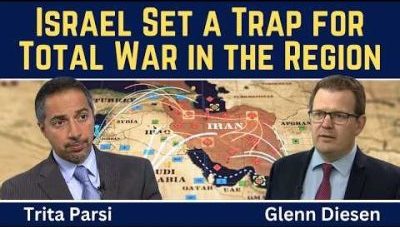
A Saudi-flagged crude oil vessel and a Qatari tanker were damaged on 7 July after being struck by projectiles in the Strait of Hormuz, multiple reports have confirmed.
Qatari liquefied natural gas (LNG) tanker Al-Rekayyat was “struck overnight and its engine room set on fire,” maritime sources told Reuters, adding that “a Saudi crude oil tanker has also been damaged.”
“Mayday … This is vessel Al-Rekayyat, LNG vessel Al-Rekayyat. We are being hit by drone on port side, top of engine room. Status: engine room fire and full of smoke. Unable to assess further damage,” the ship’s captain said in a recorded radio call heard by Reuters.
The ship was disabled and called for help, but the crew was unharmed, according to the report.
Iranian state television reported that an LNG ship was hit off the coast of Oman after “ignoring warnings.” Responsibility has yet to be officially claimed by Tehran.
According to Reuters, the Saudi oil tanker Wedyan was damaged in the same area – near Oman’s coast, close to the Strait of Hormuz.
The Wedyan vessel’s last position was inside the Persian Gulf on 3 July. Riyadh has not commented.
“Iran’s military fired at least two missiles at commercial ships transiting the Strait of Hormuz,” US officials toldAxios.
Nevertheless, the US government has not officially commented on the incident.
The latest escalation near the strategic waterway comes after Iranian officials responded to new threats from US President Donald Trump.
“Negotiations on final deal will not commence if threats continue. Honor your signature,” Iranian Foreign Minister Abbas Araghchi warned on Tuesday, coinciding with a massive funeral for the country’s late supreme leader Ali Khamenei.
A day earlier, Trump threatened to “finish the job” and “knock down” bridges and energy sites across Iran.
In recent days, Iran has doubled down on its right to jointly manage the strait with Oman. The waterway is effectively under Iranian control.
Last month, a shipping corridor connecting the US and Oman via the Strait of Hormuz was launched, prompting Tehran to call it a breach of Clause 5 of the MoU.
Tehran has since announced that it has reached a deal with Oman on the management of the strait.
Since the MoU was signed, the illegal US blockade has largely ceased, and the Strait of Hormuz has been partially reopened by Iran.
However, Washington has continued to violate the MoU through multiple attacks on Iran, and a failure to rein in Israel’s brutal campaign of ethnic cleansing and occupation in Lebanon.
Ahead of her trial on charges of “apology for terrorism,” French Member of the European Parliament Rima Hassan says French authorities have subjected her to sweeping surveillance measures and political pressure in an effort to silence her criticism of Israel’s genocide in Gaza.
Hassan, a vocal pro-Palestinian lawmaker, appeared in court on Tuesday over the French offense of “apology for terrorism,” a legal provision that criminalises certain forms of expression deemed to support or glorify acts of terrorism.
“This is a political case,” Hassan said in an interview ahead of her court date. “It’s a way of putting the Palestinian cause on trial.”
Hassan added that the prosecution is part of a broader campaign targeting her for speaking out in support of Palestine.
The European Parliament member said she has faced intense judicial and political pressure in recent months.
She described disproportionate investigative measures, including the lifting of her parliamentary immunity, retroactive surveillance, and the dissemination of false information following her detention in April.
On April 2, Hassan was taken into police custody after posting on X a quote by Kozo Okamoto, a former member of the now-defunct Japanese Red Army.
The quote read: “As long as there is oppression, resistance will not only be a right, but a duty.”
Hassan said that while in police custody in April, she was subjected to particularly intrusive questioning about her identity, origins and religion, despite those issues having “no connection whatsoever to the alleged facts.”
“This way of proceeding is part of a political climate in which Palestinians, or people perceived as such, are too often regarded as suspects before they are regarded as citizens,” she said.
“This reflex, fuelled by Islamophobia and anti-Palestinian racism, constructs the dangerous figure of the ‘enemy within’,” she added.
In a press release issued ahead of the trial, Hassan’s team said the quote she shared on X was “referring to a principle that lies at the heart of international law: the right of peoples to resist colonization and the occupation of their territory by a foreign army.”
According to the statement, Hassan later deleted the post to avoid any possible misunderstanding.
The post was reported to the prosecutor’s office by far-right National Rally MP Matthias Renault, the French interior minister, the European Jewish Organisation (OJE), and the League Against Racism and Anti-Semitism (Licra).
The prosecution was initiated by the public prosecutor’s office, which operates under the authority of the executive branch.
Hassan said the “judicial harassment” she has faced demonstrates “how far some are willing to go to silence voices that denounce the suffering of the Palestinian people.”
The trial marks the latest legal challenge brought against Hassan over her criticism of Israel’s occupation and its genocide in Gaza. Over the past two years, 16 legal proceedings have been initiated against her, 13 of which have already been dismissed without further action.
Israel’s supporters have gone apoplectic over a short post on X from the journalist Mehdi Hasan, highlighting Israel’s peculiar marriage laws.
Hasan asks: “Did you know that you can’t have a civil or secular marriage in Israel?”
He’s not wrong. Israel has banned civil marriage. You can wed only in a ceremony strictly controlled by religious authorities. If you want a civil marriage, you have to travel to another country.
Why, you might reasonably wonder. Isn’t Israel a modern, secular, western-style liberal democracy? After all, that’s what our politicians and media keep telling us.
The most popular rejoinder to Hasan from Israel’s apologists – that the situation is no better in Saudi Arabia – is not quite the flex they seem to imagine. So Israel offers the same human rights protections as Saudi Arabia? Impressive.
Others have pointed out that Israel inherited the so-called “millet” system from the Ottoman empire, which gave the leaders of each confessional group across the Middle East autonomous control over their community’s religious affairs.
Doubtless, 150 years ago the system worked relatively well in reducing communal tensions in religiously diverse parts of a large empire. It prevented officials in Constantinople – modern-day Istanbul – from getting dragged deeply into the day-to-day affairs of its often distant subjects.
But 150 years ago, Britain sent children up chimneys to sweep them. The law was changed around that time to stop this abusive and dangerous practice.
Israel was established nearly eight decades ago, supposedly as a secular, western-style liberal democracy. It has had 78 years to change those archaic Ottoman marriage laws.
Why hasn’t it done so?
All the bluster decrying Hasan’s post is a desperate attempt to deflect attention away from the fact that Israel’s antiquated marriage laws survive because they are useful to Israel.
In fact, they are more than that. They are a core component of Israel’s version of apartheid – a racist system of segregation Israel has successfully shielded from the view of western publics with the help of western politicians and media.
‘Demographic threat’
Israel’s ban on civil marriage is central to its efforts to prevent what past racist societies, such as apartheid South Africa and the American Deep South, termed “miscegenation” – that is, sexual relations between different ethnic groups. You might remember that the Nazis had unpleasant views on this subject too.
Preventing assimilation in the Jewish state is completely legitimate and not at all racist. You are assuming as a basis for the discussion that preventing intermarriage is wrong, while ignoring the fact that most [Jewish] girls who go with Arabs are poor girls who are being used.
Former education minister Rafi Peretz called mixed marriages involving Jews a “second Holocaust”.
In Israel, such views are entirely mainstream. In 2018, Yitzhak Herzog, Israel’s current president and the former leader of an ostensible leftwing Israeli party, described mixed marriages among American Jews as a “plague” for which a “solution” had to be found – presumably by copying Israel’s approach.
In Israel, the chief concern is not about marriages between Jews and the Palestinians under occupation – which Israel and its supporters like to present, bogusly, as a straightforward “security” matter.
In the occupied territories, Israel uses far blunter methods than laws to prevent any kind of intimate relations developing between Jews and a captive Palestinian population. It prefers physical containment and violence.
Palestinians under occupation are forcibly separated from Israeli Jews. They are hemmed into their own tightly confined ghettoes by Israel’s network of steel and concrete barriers; by the Israeli army; by checkpoints; by separate, apartheid roads in the West Bank; and by Jewish militias living on stolen lands in so-called “settlements”.
There is little chance of interaction, let alone intermarriage, in such circumstances – except when Israeli soldiers or armed Jewish settlers come rampaging into Palestinian communities to destroy crops, kill livestock, poison wells, torch homes and cars, and beat up – and sometimes kill – the inhabitants.
Nonetheless, there is still a potential vulnerability in Israel’s system of segregation.
In 1948, Israel expelled 80 per cent of the Palestinian population from their homes and lands in an area that was henceforth to be called, not Palestine, but the “Jewish” state of Israel.
A few Palestinians remained, however, inside those borders – mostly from oversight or error. Despite covert efforts by Israel for several years after the 1948 war to force them out of the state, its officials soon came under international pressure to give these stranded Palestinians citizenship – even if in practice, as we shall see, this conferred on them very inferior rights.
Even today, Israel is extremely worried about a supposed threat from its third-class Palestinian “citizens” – officially termed “Israel’s Arabs”. Given a higher birth rate, their numbers have grown exponentially over eight decades. They now comprise a fifth of Israel’s population.
Israeli journalists, academics and politicians, including prime minister Benjamin Netanyahu, regularly call the country’s Palestinian citizens a “demographic threat”, and endlessly worry about the “Palestinian womb”.
No state of all its citizens
But Israel faces a countervailing pressure. If it makes its treatment of Palestinian citizens too obviously racist and oppressive, some outsiders might start to realise it is not the secular western-style liberal democracy it claims to be.
You will hear the pro-Israel lobby in the West tell you that so-called “Israeli Arabs” have exactly the same rights as Israel’s Jewish population, guaranteed by Israel’s Declaration of Independence. That is not even remotely true.
Adalah, a leading legal rights group in Israel, has a database showing more than 70 laws that explicitly discriminate between Jewish citizens and Palestinian citizens. These laws form the core of Israel’s apartheid system.
Israel’s Basic Laws, a sort of constitution, explicitly exclude any principle of civic equality. Every attempt by a Palestinian party in Israel to get a debate in the parliament on Israel becoming a “state of all its citizens” – that is, a liberal democracy – is barred from discussion. And in 2018 the Israeli government passed a Nation-State Law declaring that Israel belongs exclusively to the Jewish people, not to all citizens who live there.
As with Palestinians under occupation, Israel has almost entirely confined its Palestinian citizens to their own segregated, underfunded, under-resourced communities (townships) on less then 3 per cent of the country’s territory.
A small minority of Palestinian citizens inside Israel live in segregated, deprived neighbourhoods of what are misleadingly termed “mixed” cities. Other Palestinian citizens, the most oppressed of all, live in communities inhabited by their families for centuries but which have been criminalised by an Israeli state that refuses to recognise them.
Many hundreds of Jewish rural communities, by contrast, operate effectively as exclusive membership clubs. They have the power to exclude Palestinian citizens – a right they take full advantage of.
Separate planning structures ensure massively overcrowded Palestinian communities inside Israel are unable to build new homes and expand. Palestinian children are schooled in a separate and much inferior education system.
For the who wish to dig deeper, I have written a lengthy essay setting out the details of Israel’s apartheid system here.
The ban on civil marriage inside Israel’s borders is not usually cited, even by critics, as an example of its apartheid system of rule. But the ban persists because it is the ideal way to conceal segregation under the veneer of equal treatment.
Israel’s Palestinian citizens must marry in ceremonies conducted by their religious community’s leaders: by Muslim clerics, or by various Christian churches, or by the Druze clergy.
It is the same for Jews in israel. They must be married by an Orthodox rabbi.
So everyone faces the same restrictions. But the point is this: the equality of treatment ensures very unequal outcomes. It is designed that way.
Fascist thugs
Inside Israel, intermarriage is only possible if one party can convert to their partner’s religion.
Israel’s Orthodox rabbinate makes it impossible for Palestinians under occupation to convert to Judaism in Israel, with the head of its conversion authority stating in 2016 that any such applicants are rejected “without review because of their ethnic origin”.
Meanwhile, Israel makes it almost as difficult for anyone else considered a non-Jew to convert to Judaism, most especially Palestinian citizens. Over decades, there have been only a handful of such cases.
In practice, this means that in any relationship between a Palestinian citizen of Israel and an Israeli Jew, it almost always falls to the Israeli Jew to convert to the religion of the Palestinian citizen, whether a Muslim, Christian or Druze. That entails the Jewish partner losing their Jewish status and the many consequential privileges inside Israel that derive from that status.
Israel has found this is a much better solution than apartheid South Africa’s, where blacks and whites were explicitly barred by law from marrying. Israel can achieve the same result more quietly.
Given the entirely segregated structure of Israeli society, and the strong social taboos among Israeli Jews on “miscegenation”, the number of intermarriages in Israel between Jews and Palestinian citizens barely reaches double digits each year.
There are even groups like Lehava – Israel’s version of the Ku Klux Klan – that go around beating up Palestinians caught anywhere near the Jewish neighbourhoods of Jerusalem and terrorising any young Jewish women suspected of being romantically involved with a Palestinian. Lehava hold noisy and disruptive protests to shame the odd Jewish woman who converts and marries a Palestinian citizen.
All of this happens with a quiet wink from the authorities. The current police minister, Itamar Ben Gvir, has long been a patron of the fascist, Jewish supremacist thugs of Lehava.
In the rare cases of a Jew converting and marrying a Palestinian citizen, the Palestinian partner faces innumerable legal and social obstacles to integrating into a Jewish community to which they do not belong.
Instead, the Jewish partner moves to a Palestinian community – an Israeli version of a township like Soweto – and educates their children inside the vastly inferior “Arab” school system. The former Jew loses most of the ethnic privileges they previously enjoyed inside the world’s only “Jewish” state.
Faced with this as their future, such couples often seize the opportunity for neither to convert and instead marry and live abroad.
Unwelcome guests
None of these difficulties are accidental. It is exactly how you would expect an apartheid system that prefers to obscure its apartheid character to structure its laws – and thereby help its lobby in the West, including the western political and media class, to claim that Israel is “the only democracy in the Middle East”.
Israel learnt from the mistakes of the old South Africa. It mastered the modern arts of public relations – or at least it did until Benjamin Netanyahu tore up the script by erasing Gaza.
Inside Israel, the apartheid system extends far beyond marriage laws to touch all areas of life.
Here is another way Israel has obscured its apartheid system – again not in the occupied territories, but inside Israel itself.
The same system that denies Israelis the possibility of a civil or secular marriage also refuses to recognise that they have any kind of civil or secular identity, simply as Israelis. By law, everyone in Israel must belong to a confessional group, identified as a Jew, Muslim, Christian or Druze.
Which makes sense of another little-known fact about Israel: Israel is the only country in the world that does not recognise its own – in this case, Israeli – nationality. Why? For the simple reason that, were Israelis to share a common national identity, it would be much harder for the Israeli state to operate its apartheid system.
Israeli nationality exists only as a fiction on Israeli passports to allow the population to travel internationally. Inside Israel, everyone is identified by their confessional group.
In Israel, “Jewish” is treated as a nationality. Remember the 2018 Nation State Law. What it declared is that the state of Israel belongs exclusively to the “nation” of Jews – that is, to every Jew around the globe, not just those living in Israel.
Muslims and Christians are lumped together into a similarly artificial “Arab” nationality, while the Druze have their own, different nationality. The same Nation State Law makes clear that the state of Israel does not belong to these other, non-Jewish “nations”, despite their families having lived on the same lands for centuries. Palestinian citizens are nothing more than guests – and unwelcome ones at that.
This segregation carries through to Israel’s ID cards. These cards, which must be carried at all times, used to include a section that expressly showed the “nationality” of each Israeli. But this section attracted uncomfortable scrutiny during a lengthy and ultimately unsuccessful legal battle by a group of dissident Israelis seeking recognition of an Israeli nationality. Officials removed the category from the card. However, Israel’s population register still includes a nationality classification.
In addition to Jew, Arab and Druze, there are more than 120 other categories to deal with all the anomalies. I was just one such anomaly after I married a Palestinian Christian and entered a lengthy and difficult naturalisation process. My nationality was classed as “British”.
Why all this complexity? Why all this unique weirdness?
Because Israel needs to conceal its system of apartheid. The old South Africa simply said: one law for whites and another for blacks.
Israel knows this no longer plays well. So it has devised a convoluted, baffling system that few understand as a way to avoid attracting attention and criticism.
Special Jewish rights
So let’s end with just one example of how Israel’s apartheid system works in practice.
Notionally, Israel confers on all its citizens – Jews, Muslims, Christians, Druze – equal rights as citizens. But with a sleight of hand, it then undermines those equal rights by conferring superior “national” rights on one group only, Jews. If there is a conflict between a citizenship right and a Jewish “national” right, you’ve probably already guessed that the Jewish national right takes precedence.
Education is a good illustration. All Israeli citizens enjoy a right to have their children educated, because education is a citizenship right. But lots of veiled manoeuvres – like extra budgets for National Priority Areas, special subsidies for Jewish religious schools, funding from the diaspora, and bigger tax disbursements from central government for Jewish local authorities – mean Jewish schools are far better funded than “Arab” schools.
Education for Israel’s Palestinian citizens has been underfunded for eight decades. So even though Israel’s apologists will claim the funding gaps are slowly narrowing, the continuing shortfall simply compounds a decades-long historical injustice. Arab schools are so far behind they can never catch up without aggressive additional funding Israel clearly has no intention of ever providing them with.
There are massive shortages of classrooms and staff in dilapidated school buildings. Old books are often grossly outdated and poorly translated into Arabic by the state. Palestinian educational leaders have no input into the curriculum the community’s children are taught. There are strict controls by Jewish (usually racist) officials over what can be taught and who can teach. And on top of all this, huge cultural biases in qualifying tests make it far harder for Palestinian citizens to gain entry to universities in Israel.
There are many other problems in education. For example, nearly one in 10 Palestinian children in Israel live in historic communities built on lands that the Israeli state now wishes to “Judaise” – reserve for the Jewish population – and are therefore denied all recognition.
Treated like criminals, these children rarely have schools in their communities because no permanent buildings are allowed. What buildings there are cannot be connected to the electricity or water grids. Even children of kindergarten age must typically travel long distances – sometimes close to 60 km a day – to get to a licensed school.
The forms of discrimination in education alone are endless. But they do not stop there. The discrimination is replicated in all major facets of life for Israel’s more than 2 million Palestinian citizens through these conceptual and legal contortions over religion, citizenship and nationality.
None of this should be a surprise. It is exactly what you would expect in an apartheid state like Israel.
BEIRUT – The recent Israeli escalation in southern Lebanon has brought the Ali al-Tahir heights back to the forefront of the military scene, after the occupation forces intensified their raids on the area amid indicators that observers see as a prelude to a potential ground move. While estimates speak of an Israeli attempt to impose a new field equation, military experts warn that any incursion into these strategic hills could open up a wide confrontation with Hezbollah, given their military importance and the nature of their defenses.
Fiery prelude preceding the ground move
Israeli Channel 12 reported that the army launched an attack on the Ali al-Tahir heights area, while the Upper Galilee Regional Council informed the residents of the settlements that they would hear the sound of explosions resulting from the attacks in southern Lebanon.
The military and strategic expert, Retired Brigadier General Khalil al-Jamil, believes that the nature of the Israeli operations indicates that what is happening goes beyond mere limited raids, explaining that the Israeli army usually relies on a wide fiery prelude to isolate the operations area and prevent the arrival of fighters or supplies to it before any ground move, according to Al Jazeera.
He added that the shelling targeting the villages and towns surrounding the Ali al-Tahir heights falls within this framework, expecting the strikes to continue for hours before moving to a new stage with the onset of night, which is the timing during which Israel is accustomed to executing its ground operations.
He pointed out that the scale of the airstrikes is disproportionate to a limited targeting operation, as it was possible to execute such missions using drones, which reinforces, according to his estimation, the hypothesis of preparing for a ground incursion into parts of the heights.
He noted that the Ali al-Tahir heights extend for about three kilometers, and any incursion at its beginning may be limited to specific parts of them, but the nature of the current movements is consistent with the military method followed by the Israeli army before any field advance.
Hezbollah’s readiness and field complexities
Al-Jamil confirmed that Hezbollah will be ready to defend the area, expecting that the fire support units deployed in Iqlim al-Tuffah and neighboring areas will begin executing support operations to prevent Israeli forces from establishing any presence inside the hills.
He added that Israel tried during previous stages to advance in the area, but faced great field difficulties due to the rugged geographical nature and defensive readiness, making any new attempt more complex and costly.
He explained that the Ali al-Tahir heights constitute the main line of defense for southern Lebanon and the Nabatieh district, suggesting that violent confrontations would break out if the escalation develops into a direct ground operation.
He also pointed out that any advance inside the network of tunnels scattered in the area would place Israeli forces before complex fighting conditions, unless a collapse occurs in Hezbollah’s defensive system, a scenario he said is not supported by any field indicators so far.
Despite Israel possessing military capabilities that qualify it to reach the heights if it makes a decision to do so, al-Jamil stressed that achieving this goal would have a high military and human cost.
The policy of “nibbling” and the possibilities of expanding the confrontation
Al-Jamil considered that Israel relies on a policy of gradual “nibbling” of the heights, by combining airstrikes, fire pressure, and limited ground advance, instead of executing a broad operation all at once.
He explained that the Ali al-Tahir heights grant whoever controls them a great field advantage, as they overlook wide areas of southern Lebanon and the vicinity of Nabatieh, making them a controlling point in managing military operations.
He added that Israel views these hills as being within the areas it believes it had previously controlled, and sees that any military operation in them does not conflict, from its point of view, with existing arrangements, although actual control over them has not been achieved on the ground.
He believed that any ground incursion could push Hezbollah to expand the circle of response by targeting Israeli settlements with rockets, in an attempt to pressure the internal front and impose a new deterrence equation, a matter that could reignite the entire southern front.
This escalation comes at a time when the Lebanese Ministry of Health announced that the toll of victims of the Israeli aggression since the second of March has risen to 4,303 dead and 12,203 wounded, amid the continuation of military tension despite efforts aimed at stabilizing the calm on the border.
In 1959, Ingeborg Bachmann concluded that the truth is something people can be expected to handle, since they are quite capable of enduring it, no matter how uncomfortable it may be. Literature, she argued, should neither conceal nor gloss over the truth.
This is all the more true of the media, which for years have failed to fulfill their duty as the fourth estate. The world is heading toward a new world war, and the majority of humanity is unable to assess the risks and opportunities when the media distort the facts through their propaganda in such a way that the truth vanishes into an ever-thickening fog. The dumbing down has reached such a level that even politicians in the West believe the propaganda of their own media and act accordingly. The falsehoods that politicians spread are no longer perceived by them as lies; for the most part, their intellect is simply not sufficient for that. It must be stated that politicians have first and foremost become “ambassadors” of an ever-declining level of education—and continue to do so—and, as a result, have become victims of their own propaganda.
This article attempts to show that it is still possible to separate the wheat from the chaff, because the truth is hidden amid all the garbage in the news coverage.
Don’t Forget About Evil
In the article “Will Evil Prevail?,” I pondered who actually determines geopolitical events around the world. I discussed the “City of London” and the “Rothschilds” as examples of forces that steer the world from behind the scenes. They are thus also responsible for wars, coups, and other upheavals in our world. Even the small portion of the Epstein Files that has come to light provided a first impression of the entanglements among the powerful. See “Epstein – ‘Concierge of Evil’ – Dangerous Questions.” For example, the Rothschild family was dragged back into the public eye; the very family that has gone to great lengths to convince the world that it has exerted no influence since World War II and merely operates a few private banks, museums, and vineyards. It should come as no surprise that discussion of the contents of the Epstein Files—or their further releases—has completely vanished from the media; one might well wonder who controls the media.
Incidentally, the ‘deep state’ is not a concept peddled by a few crackpots. As early as 2017, President Putin spoke about it in no uncertain terms:
“Presidents change… Then well-dressed men arrive, in dark suits, with their suitcases. They start explaining how things really work… and everything changes instantly.”
Control is exercised either directly by shareholders or indirectly through political or economic influence—for example, by controlling advertising revenue, blacklisting, or manipulating view counts on YouTube channels. Control over the media in the Collective West is, de facto, complete—not a bad achievement.
Consider this: freedom of speech is championed very vocally by politicians and the media at every opportunity, whether appropriate or not. Practically “in tandem,” it is restricted in the very same breath by first denouncing the spread of “fake news” and “hate speech”—that is, the expression of genuine freedom of speech—just as loudly, and then defining and enforcing it as a criminal offense for one’s own political gain.
Ultimately, then, it is the state that defines what “fake news” and “hatespeech” mean. As a result, a right that is no longer absolute but has been relativized collapses under this restriction. In Germany, the desired political direction of judicial decisions is ensured through the political appointment of judges to the Federal Constitutional Court. The process for selecting judges to the European Court of Justice follows a similar procedure.
The consequences of this restriction are deliberate and obvious. Analysts who express even the most well-founded opinions that do not suit the tastes of those in power are stripped of their rights, dispossessed, and portrayed as criminals without due process. The method of choice is, for example, EU sanctions, which were originally enacted to target terrorists but are now—with the support of the general public—imposed on the most objective experts, such as the Swiss citizen (and thus non-EU citizen) Jacques Baud; see our coverage on this. The result of this targeted political influence is reporting in the traditional media that no longer has anything to do with the truth, but often turns it on its head.
All Geopolitical Crises Stem from a Single Source
All military conflicts around the world must be understood as a single package, a comprehensive strategy. The same people who are fueling the war against Iran and the violent creation of “Greater Israel” are also responsible for the conflict in Ukraine and the war between Europe and Russia that will likely unfold soon—and many other conflicts, such as those in Africa, which we have neglected in our blog, are likewise part of this strategy. Everything is interconnected, and it shows a lack of geopolitical understanding when journalists defend the war—waged with genocidal methods—against Iran, Lebanon, and Gaza, while simultaneously supporting Russia’s actions in Ukraine. The forces triggering and fueling these conflicts are identical. Understanding this is very helpful in grasping the overall geopolitical situation.
The overall picture is not hard to understand: After hundreds of years of colonial rule over the rest of the world, the Collective West has already lost the economic race against the Global South; more on this below. While wars over the past 500 years have been about who in the West would wield the scepter of hegemony over the colonial empire, today’s conflicts are about whether the Collective West can maintain its colonial empire. The odds are against it, as we have already outlined in our series “The War Between Two Worlds Has Begun.” At that time, we anticipated many individual conflicts spanning decades, but without a world war. This relatively optimistic thesis now seems to be faltering, as aggression between the world powers is escalating daily, the Collective West refuses to abandon the arrogance of the colonial master, and completely overestimates itself with spurious arguments.
The Defence Budget as a Measure of Military Strength Is a Fallacious Argument
For decades, the Americans have led the world to believe that they have the strongest armed forces in the world. This claim is backed up by an astronomical figure: the U.S. military budget of no less than 1.5 trillion U.S. dollars. That is 10 times more than the Russian military budget, or even 190 times more than Iran’s military budget, which amounted to 7.89 billion U.S. dollars in 2024. NATO, excluding the US, spent 608 million U.S. dollars.
Nevertheless, the US—along with Israel—suffered defeats in both the 12-Day War and the ongoing war, which has spiraled out of control. NATO, alongside the US, is suffering defeat in Ukraine. The massive budgets in the West are a clear indication that the military there is not designed to defend freedom, but rather to rake in as much money as possible. As a result, a weapons system in the West is considered successful if it can be sold—for as much money as possible—to its own armed forces or those of third countries. In 2024, we compared two combat helicopters that experts deemed equivalent: the Russian Kamov KA-52 and the American AH-64 Apache. The Apache costs 155 million U.S. dollars; the Kamov costs 16 million. On top of that, Western weapons systems are produced in virtually homeopathic doses, and it is impossible to increase production to a level capable of sustainably supporting a protracted conflict—it is too expensive, too complex, and combined with an industrial capacity that simply no longer exists.
In the medium term, the US will not be able to produce high-quality military equipment in sufficient quantities at reasonable costs, as it currently faces a multi-faceted problem: First, there is a lack of will, since profit is the primary goal of the military-industrial complex. Second, due to 30 years of deindustrialization, the US no longer has the industrial base necessary to produce weapons in quantities sufficient for wartime.
Rather, the focus is on making a profit. Objective observers should realize that such a strategy is bound to lead to disaster in a crisis—as has been demonstrated in the Middle East and Ukraine. According to various experts, the West has fallen at least a decade behind its competitors in both missile technology and drones in those regions.
Iran, for example, whose defense spending is about 200 times less than that of the US, possesses hypersonic missiles that are extremely difficult to intercept. In contrast, the Collective West still has no operational hypersonic weapons. Critics attribute this to a combination of profit-seeking, arrogance, and corruption within the military-industrial complex.
If the West wants to operate on an equal footing militarily in the future, it would have to fundamentally reform the military-industrial complex—a task that seems nearly impossible given the existing economic and political balance of power; this industry is controlled by the groups discussed above.
A Lack of Will to Fight in the West
How does the Collective West react to the wars it has lost? — It increases its military budgets without addressing the necessary structural issues. In the West, there is a mistaken belief that everything can be solved with money. In Russia, the defense industry is essentially state-owned, and therefore there is a strong interest in producing high-quality but affordable weapons.
Thus, there will only be a change in the US if the American pursuit of profit in weapons production were seriously called into question—and if society were able to attract the best minds to the defense industry in the interest of American society as a whole, which is not the case today. American missile physicists earn more as analysts at investment banks, and they have no motivation to serve their country, given the poor state of the will to defend the West. In Germany, for example, one figure dashes any hope for greater willingness to serve: out of 300,000 young Germans, 530 are willing to perform military service—that’s 0.17%! (Source: Süddeutsche Zeitung ). This figure stands in stark contrast to statements made by Boris Pistorius, the German Minister of Defense, who announced as early as 2024:
“We must be combat-ready by 2029,” the minister said. “We must provide a deterrent to prevent things from escalating to the extreme.”
The outlook for the Collective West to prepare its armed forces for war is thus bleak. Nevertheless, the Europeans and Americans seem to be charging headlong into a world war with outdated yet overpriced weapons systems and without the necessary will to defend themselves among the population. This not only seems insane—it is insane. The facts speak for themselves. Who would do such a thing? Corrupt politicians, like the ones we described at the beginning.
The Economy as an Indicator of Losing
If we look at the economic data, it is easy to see that the Collective West has already lost the economic race. History teaches us that, in such a situation, war is the only option left.
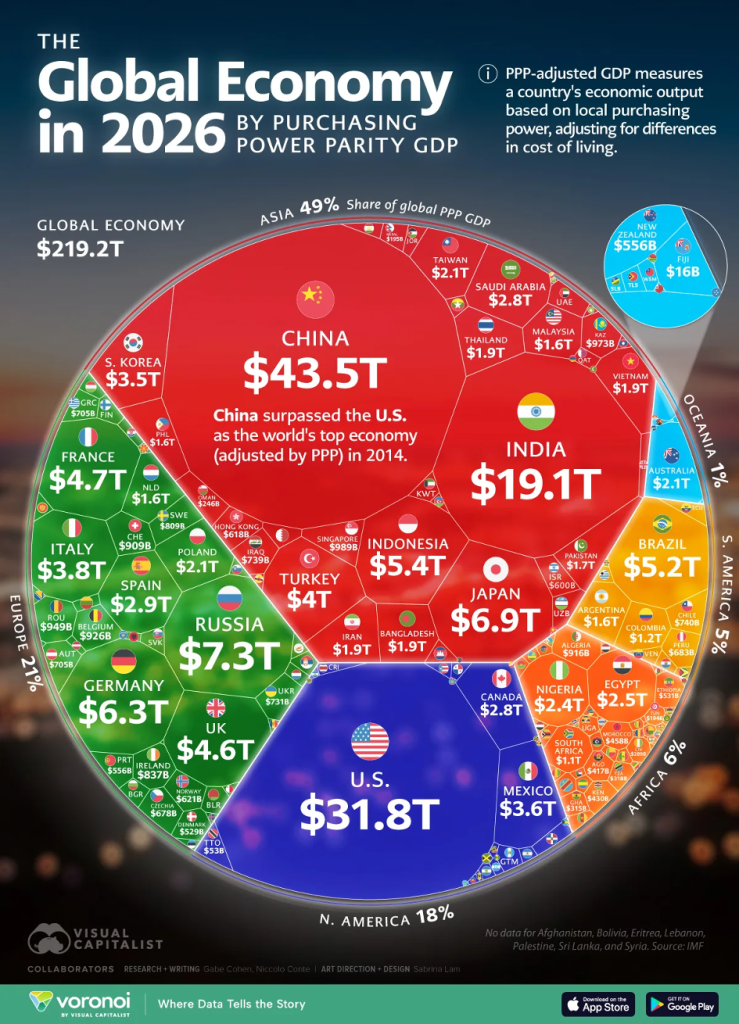
For years, I have been drawing attention to the devastating national debt and the grotesque valuations in the financial markets. On top of that, the Collective West also cheats when calculating economic power. All of this is done to maintain a narrative that allows the US to continue to be portrayed as number one. If you calculate GDP on a purchasing power parity basis—that is, taking into account the local purchasing power of individual countries—the US has already lost.
According to this calculation, China ranks ahead of the US, Russia ahead of Japan, and Germany.
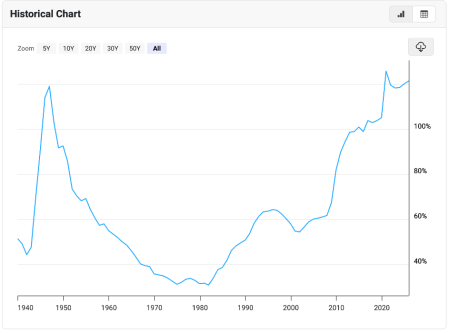
Furthermore, the Collective West, as the aggressor, finds itself in a domestic political and economic situation that does not allow for a military showdown with Russia, Iran, and China: US debt stands at over 121%—the last time this was the case was at the end of World War II, following an industrial war that brought the US global dominance. After 35 years, and under economic and political conditions that remained favorable to the US, this debt was reduced to below 40%.
In 1945, the Americans reached the height of their power. Together with the Soviet Union, they dominated the course of the war, held 22,000 metric tons of gold, and American industry produced 70% of the world’s manufactured goods. This is what true “full spectrum dominance” looks like: military dominance, industrial dominance, gold—because whoever has the gold sets the rules. Now the US is once again facing a world war, and the situation looks much like it did after the last war, with one major difference: China is at least the US’s economic equal, with far more favorable economic conditions.
These are not the conditions necessary for a military conflict on a global scale—neither financially, nor economically, nor, consequently, politically.
Middle East
It is clear from the text of the MOU that Iran has defeated both Israel and the US militarily; otherwise, the Americans would never have signed such a document. Israel cannot, without risking the collapse of its own delusions of great-power status, comply with the spirit of the document and end the war in Lebanon and Gaza. Therefore, there will be no peace.
Our comments on this topic: “Iran Defeats the US – Thoughts.” In Iran, voices are growing louder claiming that the president and foreign minister are not negotiating hard enough—public pressure in Iran is calling for a tougher stance toward the US and Israel. Iran’s Supreme Leader, Mojtaba Khamenei, has approved the memorandum of understanding (MoU) with the US to end the regional war under certain conditions. However, in a public statement, he said that he fundamentally held a “different view,” but had agreed to the agreement after receiving guarantees from President Masoud Pezeshkian that Iran’s national rights and the “Resistance Front” would be safeguarded. This is a clear indication that the Iranians are ultimately unwilling to make compromises at the expense of Lebanon and Gaza.
It is to be expected that the conflict in the Middle East will continue: Neither the US nor Israel is willing to accept defeat in the war and deal with its consequences. This stance maintains a state of limbo that could tip in one direction or the other at any moment. However, this strategy is countered by the fact that time is running out for the West because of Hormuz. The dwindling oil reserves were the main reason the US signed this MOU in its current form in the first place. The Americans are thus seeking a state of limbo that allows them to prepare their next military steps in peace; however, this state can only be maintained if the Strait of Hormuz remains open in the meantime. While approximately 130 ships passed through the Strait of Hormuz daily until February 28, 2026, these numbers dropped to practically zero, then stabilized at 5%–10% of pre-war levels, before surging to 70 ships on June 25, 2026. These figures should be treated with caution: It is said that the majority of these 70 ships were exporting oil from Iran after the US lifted the oil sanctions upon signing the agreement. If the Israelis do not withdraw from Lebanon and the Iranians remain steadfast—which is to be expected—then the Strait of Hormuz will remain a congested bottleneck: the time bomb for the West’s supply of raw materials continues to tick.
The Iranians can wait—the Americans cannot. When assessing the situation, one should simply disregard Donald Trump’s statements, because Trump speaks of peace one moment and war the next, changing his mind sometimes several times a day. He seems to believe that he can achieve something with the Iranians through this “New York-style deal-making” terror, but that is not the case, since he achieves only one thing: Americans are increasingly proving themselves to be agreement incapable, thereby threatening world peace.
War in Europe
The armed conflict in Ukraine, instigated by the West, began in 2014. Only those who do not classify Ukraine’s years-long artillery shelling of the Donbass as an act of war claim that the Russians started the war in February 2022. This is just one fact that is so obvious that one can only wonder at the West’s arguments that Russia is the aggressor.
Another fact is that this war has completely transformed the technology and tactics of warfare—the parties had to adapt to a new kind of war dominated by drones and missiles. Tank columns and troop concentrations are attacked by inexpensive drones as soon as they are detected—and they are detected very quickly. The warring parties had to undergo migration and learn this new art of warfare. The Russians, in particular, have done this successfully and now dominate the battlefield in a new way: through slow, efficient advances, because massed attacks produce only one thing—heavy casualties. Similar waves of technological advancement have occurred time and again. The machine gun, which was already in use before World War I but whose significance was underestimated at the time, brought an end to maneuver warfare as early as the first year of the war, when large columns of soldiers advanced toward the enemy and were wiped out. Toward the end of World War I, the tank brought some movement back to the front lines. However, comparing the frontline situation in Ukraine to that of World War I is a flawed analogy: Slow movements in small groups seem, so far, to be the only way to survive the drone barrage and maintain mobility.
Recently, Western media have been reporting that the Ukrainians have the upper hand in the war. However, this is fake news that has nothing to do with the reality on the ground. One must distinguish between the fighting on the front lines and NATO’s drone attacks in Russia. On the Donbass front, only a few fortified cities still stand in the Russians’ way; once those are taken, the Donbass will be liberated. Beyond that, there are no longer any fortifications worth taking seriously. Rather than going into details, I refer you to one of the best channels, Military Summary, which has been providing a twice-daily update on the situation at the front since the war began.
The West has not yet recognized the signs of the times. Its experts believe they will be successful in a war against Russia. However, they have not even defined their war aims in any way. Thus, they have no strategic plan against Russia other than to weaken it.
First and foremost, the Germans set the start of the war against Russia for 2030. However, it is now 2026, and the Germans apparently assume that, with Ukraine acting as their proxy, they can send drones and cruise missiles into Russia with impunity until 2030. Europe’s approach is, of course, coordinated with the US. The use of these weapons systems is not possible without American input. President Putin made this very clear a few days ago.
Many observers and experts both inside and outside Russia believe that President Putin will soon decide to launch a strike against targets in Europe—including those outside Ukraine.
There is a wide range of opinions on this topic. We have already published several articles on this subject: In “Will 1914 Repeat Itself? Will War Between Europe and Russia Finally Break Out?,” we also examined the Karaganov Doctrine, which advocates the use of nuclear weapons, and concluded that an attack is necessary, but not with nuclear weapons. Scott Ritter subsequently addressed the “Karaganov fallacy” and also spoke out clearly against the use of nuclear weapons.
Conclusion
In the Middle East, I see no realistic chance of ending the war, because that would mean, on the one hand, the withdrawal of American forces, and Israel would then be left alone as a small, genocidal aggressor. The Israelis are under pressure and are continuing their genocide in Gaza and Lebanon, paying no heed whatsoever to agreements between the US and Iran, because for Netanyahu personally, maintaining the war is the only way to survive politically.
In Russia, pressure is mounting on President Putin to adopt a more aggressive stance toward Europe, which is no longer even attempting to conceal its direct involvement in the war against Russia. Russia is intensifying its attacks on Ukraine, in part by destroying every gas station in eastern Ukraine to paralyze transportation logistics. Ground forces are making visible progress, and once the last fortified cities in the Donbas are liberated—which is likely to happen within the next few weeks—the path to the Dnieper will be clear.
President Putin is thus banking on a military solution in Ukraine and waiting for an energy crisis to unfold in Europe, where many flights are already being canceled under flimsy pretexts.
The concerted media coverage in the West claiming that the tide has turned in Ukraine finds not the slightest confirmation in the reality on the ground in Ukraine. The fuel shortage in Russia is also being exaggerated. In some regions, fuel is being rationed at gas stations. However, this is in no way sufficient to change Russia’s course of action.
Very occasionally, I have the opportunity to speak with someone who lives in Kyiv. According to this person, the situation is catastrophic, and over 90% of the population is against Zelensky. When I asked why the people weren’t rising up, the source replied that people were so intimidated by the terror of the security and intelligence services that the communication necessary for an uprising was impossible. Ukraine, which is portrayed by the West as a shining example of democracy, seems to be a time bomb whose ticking goes unheard out of fear.
My concerns that a war between Europe and Russia might break out—even though Europe has virtually no military power—have never been greater. President Putin will not be the one to take the first step toward a Third World War. Only he knows how much longer he will tolerate the West’s systematic provocations and how he will respond to them.
A family – displaced from Khirbet Samra in July 2025 after years of constant harassment by occupation forces and violent settler Uri Cohen – moved to Atouf, where they purchased a plot of land, determined to defy the occupation’s efforts to destroy their livelihood.
Having to leave their home of more than 20 years was both deeply traumatic and hugely expensive. The 40 dunams in Atouf cost half a million shekels (about 160,000 USD) and transportation costs for all their livestock and belongings were high. Atouf is a primarily agricultural area and there is little grazing land; the family is therefore forced to feed their animals grain and hay. They have also had to spend 150,000 shekels (50,000 USD) on building pens spacious enough to protect their sheep from the heat. The costs of maintaining their flock of 800 sheep have proved unsustainable, and the family has had no choice but to sell 300 of them.
In early December 2025, less than six months after their arrival in Atouf, the family received a demolition order: their property is situated on the path of “Crimson Thread”, a Zionist project that entails the construction of a 22 km long military road with an apartheid fence and a 20m wide “buffer zone” running along eitherside. Stretching from Ein Shibli to Tayasir, the barrier will cut through — and off from one another — the communities of Atouf, Tammoun and Yarza.
On the occupation’s plans, the road cuts almost exactly through the middle of the family property; 36 dunums have already been confiscated, and in January 2026 demolition orders were issued for the remaining 4 dunums, which include the family’s house and the sheep pens.
The family, together with other families and the Tubas municipality appealed the demolition orders, submitting the landowners’ deeds, and the barrier project was temporarily suspended. But then, on June 7, the Israeli court ruled that in 5 of the 7 areas impacted by the project the excavation work could continue (the two sections in which the suspension order still applies are those in the vicinity of Khirbet Yarza). Building demolitions (32 across five sections, 9 of which are residential structures) are still under discussion in court.
Since June 13, the family have had to endure the constant presence of soldiers and bulldozers on their property. The military have installed caravans and tents and dug a trench between the 36 confiscated dunums and the family’s home and pens. Now, the bulldozers are at work preparing for the construction of the barrier; the digging has destroyed the pipes that transport water to the family’s crops and livestock. When a family member went to get water from a well that is situated on the family’s land he was accused by the occupation forces of stealing water.
The family, together with the whole community of Atouf and all the Palestinian villages threatened by “Crimson Thread” are calling for international media and institutional attention in order to expose the brutality of this project which is intended to bisect the Jordan Valley, further isolating Palestinian communities from one another and dramatically worsening their conditions of life.
“during the day they carry out cutting, bulldozing, and destruction works, while at night they fire burning illumination flares over the area. These are dropped near the livestock shelters, creating constant fear, as we worry they might fall onto animal fodder or plastic greenhouses and set everything on fire.” – a family member
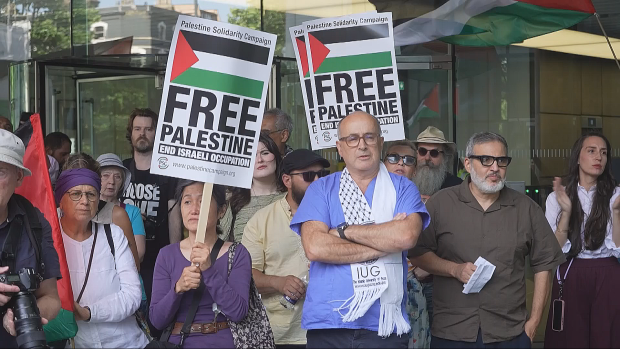
Protesters gathered outside the General Medical Council’s headquarters in London to slam the council’s attempt to silence those speaking out about the Israeli genocide in Gaza.
Protesters describe the surgeon as one of the world’s leading war doctors and argue that the regulator’s actions amount to an attempt to silence those who speak publicly about the realities of war,
So we are demonstrating in front of the GMC, because the GMC has decided to appeal against the rulings of two of its own tribunals, so that the High Court would allow it to try me for a third time, in order to get the right political result that it wants.
The GMC is conducting a political campaign against, not just myself, but every doctor who’s spoken up against the genocide, in order to silence us, in the service of the genocidal project. – Dr Ghassan Abu Sittah, British-Palestinian Surgeon
Doctors, campaigners, and members of the public traveled to attend the demonstration, asserting that the proceedings are about more than one individual, warning that they could have a chilling effect on healthcare professionals speaking about humanitarian crises.
Actually, there probably were a group of lawyers set up by the Israelis again to pursue highly charged politicized campaigns against professionals and workers in this country who stand against genocide.
So, really, it’s the action of how the British government and the Israelis who are trying to persecute and outlaw speech in support of Palestine in the heartland of Britain.
Actually, from, we know where our government, you know, the British government, the Labour government, and the Tory government before it have been complicit in genocide from bases like RAF Akrotiri, where Keir Starmer went and complimented the troops.
They run the genocide, they send the planes over Gaza, they stream that information live to the Israelis as they’re committing that genocide.
So our government is complicit, and what they’re doing with their complaints is they’re making it illegal for us to oppose it. – Ranjeet Brar, NHS Surgeon
Speakers at the rally urged the GMC to withdraw the appeal; assisting medical professionals should not face professional consequences for raising concerns over civilian suffering in conflict zones.
There’s a clear example here with Dr. Ghassan, where UK law is for Israel, that it is essentially standing up for the rights of a foreign entity, have been pressuring patients, pressuring people to make complaints against Dr. Abu-Sittah, and this is just one example of many other institutions, medical institutions like the Royal Colleges, and even the journals, the medical journals that we publish in, where they’ve been pressured from UK pro-Israel lobby groups to censor and to shut down any form of pro-Palestine activism.
So, I think we’re seeing this now very clearly with Dr. Ghassan, but the reality is it’s much more widespread than any of us think. – Dr Omar Abdel-Mannan, British-Egyptian Pediatric Neurologist
Organizers say they will continue campaigning until the proceedings against Dr. Abu-Sittah come to an end, maintaining that doctors must be free to speak about humanitarian consequences of war without fear or professional repercussions.
Supporters gathered outside the General Medical Council in London to stand behind British Palestinian surgeon Dr. Ghassan Abu-Sittah, accusing the regulators of attempting to silence one of the world’s most prominent war doctors.
Demonstrators say the case is not simply about one medic, but the right of healthcare professionals to speak out on the atrocities of Gaza without professional retaliation.
Israeli spyware was used to hack the phone of a former Greek member of the European Parliament while he was serving on a committee investigating spyware abuses in Europe, according to a report by Citizen Lab published on Friday, Anadolu reports.
The University of Toronto-based research group said that forensic analysis found Stelios Kouloglou’s iPhone was successfully infected with Pegasus spyware, developed by Israeli company NSO Group, in October 2022 and again the next March.
Kouloglou, a journalist and former MEP, was at the time a substitute member of the European Parliament’s PEGA committee, which was established to investigate the use of Pegasus and equivalent surveillance spyware in EU member states.
Citizen Lab said the infections took place during key periods of PEGA committee activity and could have exposed non-public information, confidential documents, and internal committee deliberations.
“The spyware would have likely captured non-public information about committee activities, possibly breaching EU parliamentary confidentiality and privilege frameworks,” the report said.
The first infection occurred as the committee was preparing hearings on spyware, working on its draft report, and planning fact-finding visits to Greece and the Greek Cypriot Administration. Citizen Lab said Kouloglou’s phone was hacked 10 days before those visits began.
The second infection took place while the committee was engaged in intense discussions over the final drafting process of its report. Kouloglou was in Brussels on March 6-7, 2023, during the period of the infection.
Kouloglou said he was shocked by the findings, describing it as “inconceivable” that a member of the parliamentary committee investigating spyware abuses had himself become a surveillance target, according to Greek news outlet Dnews.
He said he plans to pursue legal action against NSO Group and those responsible for infecting his device, while also raising the issue again through contacts in the European Parliament.
Citizen Lab said the attacks used a “zero-click” exploit, meaning the phone could be compromised without the user opening a link or taking any action.
The group said it was not attributing the attacks to any specific government and found no indication that the Greek government was responsible.
However, it said the first infection overlapped with a previously identified Pegasus campaign targeting Russian and Belarusian-speaking exiled journalists and activists in Europe, suggesting that a Pegasus customer authorized to operate in multiple European countries may have been behind the attack.
Citizen Lab warned that the case posed a serious threat to democratic institutions, saying the hacking could have exposed confidential exchanges among lawmakers and staff, including to parties under investigation by the committee itself.
France’s Foreign Ministry has announced ongoing preparations with Italy to form new international coalition forces to be deployed in southern Lebanon after the mandate of the United Nations Interim Force in Lebanon (UNIFIL) ends.
Speaking to Saudi broadcaster Al Hadath, the ministry said the multinational force would be deployed in southern Lebanon with US backing and the participation of several European countries.
It said the force would be deployed at the request of the Lebanese authorities to support the Lebanese army in carrying out its duties and to strengthen stability.
The ministry added that consultations with partners are continuing to finalise the force’s deployment mechanism, amid security arrangements linked to the recent framework agreement between Lebanon and Israel.
CNN’s headline included two assertions that have been true for decades: 1) Israel deliberately murders children, not accidentally as so-called collateral damage, but deliberately as part of a de facto national policy; and 2) Israel is committing “an ongoing genocide against Palestinians.” And while it is shocking that any government is pursuing such unbelievably evil policies, and even more shocking that American taxpayers are paying for it, the most shocking thing of all is that American mainstream media are finally admitting the truth after 78 years of systematic Israeli child-killing and genocide.
On April 9, 1948, more than 110 Palestinian men, women, and children were slaughtered in the village of Deir Yassin. The New York Times reported that more than half of the victims were women and children. It was just one of hundreds of massacres by the invading Jews who had long planned to steal Palestinian land and property by way of such a bloodbath.
During the 1948 Nakba (Palestinian holocaust) the Jews raped and murdered girls, tossed babies around with bayonets, and burned people to death with flamethrowers. Unlike the false atrocity propaganda stories invented by these same Jews’ descendants after the heroic October 7 2023 concentration camp breakout by Hamas, the 1948 abominations actually happened.
You can watch one of the Nakba perpetrators, Yosef Diamont, chuckling over his crimes in a viral YouTube video: “Tantura was a rich village and had beautiful houses. And the women in the village used to wear nice clothes. One of the (Israeli) soldiers raped a 16-year-old girl..” (Breaks out laughing.) “The soldiers took flamethrowers, and ran after the villagers and burned them. It was horrible. And no one is allowed to talk about that. I won’t talk about it, because it would be a big scandal.”
The whole Zionist project that created “Israel” is, by definition, genocidal: Its purpose has always been to murder and expel the Palestinians in order to steal their land and property. Perhaps unsurprisingly, the nation whose very existence is an act of ever-expanding genocide deliberately and systematically murders children.
In 2001 Chris Hedges described the way Israeli soldiers routinely hunt children for sport:
“Yesterday at this spot the Israelis shot eight young men, six of whom were under the age of eighteen. One was twelve. This afternoon they kill an eleven-year-old boy, Ali Murad, and seriously wound four more, three of whom are under eighteen. Children have been shot in other conflicts I have covered—death squads gunned them down in El Salvador and Guatemala, mothers with infants were lined up and massacred in Algeria, and Serb snipers put children in their sights and watched them crumple onto the pavement in Sarajevo—but I have never before watched soldiers entice children like mice into a trap and murder them for sport.”
American media, dominated as it is by Zionist Jews, has long hidden these facts from the American people. Hedges was effectively fired by The New York Times for his honest reporting.
So why is CNN finally telling the truth? Mainly because since 2023, Israel’s atrocities have grown too big to ignore. Tens of thousands of children have been murdered in just a few years.
CNN’s story covered the June 18 UN Report “‘The essence of childhood has been destroyed’: Israel’s deliberate targeting of Palestinian children in the Occupied Palestinian Territory since 7 October 2023.” The report estimates that at least 20,179 children have been killed and 44,143 children injured since that date, while 5,160 children are still buried under the rubble of what used to be their homes.
The UN report details systematic sexual violence against children. It describes Israel hunting children with drones and rifles, and deliberately blowing up whole apartment buildings and city blocks full of civilians, using the excuse that someone in the area had a tenuous link to Hamas. Israel’s wide-impact blasts are intended to disproportionately target children: “Research indicates that children are seven times more likely to die than adults from the impact of explosive weapons due to their physiological vulnerability, that is, proportionally larger body surface area, pliable bones, smaller limbs and thinner skin. Due to their smaller size and lighter weight, children are also at a greater risk of being thrown from the impact of blasts.”
The horrific descriptions of maimed and murdered kids make this UN report unpleasant reading. But Americans need to face the truth—and stop funding genocide.
By Donald Neff | Washington Report On Middle East Affairs | January 1996
On January 4, 1948, Jewish terrorists drove a truck loaded with explosives into the center of the all Arab city of Jaffa and detonated it, killing 26 and wounding around 100 Palestinian men, women and children.[1] The attack was the work of the Irgun Zvai Leumi – the “National Military Organization,” also known by the Hebrew letters Etzel – the largest Jewish terrorist group in Palestine. The Irgun was headed by Revisionist Zionist Menachem Begin and had been killing and maiming Arabs, Britons and even Jews for the previous ten years in its efforts to establish a Jewish state.
This terror campaign meant that at the core of Revisionist Zionism there existed a philosophical embrace of violence. … continue
This site is provided as a research and reference tool. Although we make every reasonable effort to ensure that the information and data provided at this site are useful, accurate, and current, we cannot guarantee that the information and data provided here will be error-free. By using this site, you assume all responsibility for and risk arising from your use of and reliance upon the contents of this site.
This site and the information available through it do not, and are not intended to constitute legal advice. Should you require legal advice, you should consult your own attorney.
Nothing within this site or linked to by this site constitutes investment advice or medical advice.
Materials accessible from or added to this site by third parties, such as comments posted, are strictly the responsibility of the third party who added such materials or made them accessible and we neither endorse nor undertake to control, monitor, edit or assume responsibility for any such third-party material.
The posting of stories, commentaries, reports, documents and links (embedded or otherwise) on this site does not in any way, shape or form, implied or otherwise, necessarily express or suggest endorsement or support of any of such posted material or parts therein.
The word “alleged” is deemed to occur before the word “fraud.” Since the rule of law still applies. To peasants, at least.
Fair Use
This site contains copyrighted material the use of which has not always been specifically authorized by the copyright owner. We are making such material available in our efforts to advance understanding of environmental, political, human rights, economic, democracy, scientific, and social justice issues, etc. We believe this constitutes a ‘fair use’ of any such copyrighted material as provided for in section 107 of the US Copyright Law. In accordance with Title 17 U.S.C. Section 107, the material on this site is distributed without profit to those who have expressed a prior interest in receiving the included information for research and educational purposes. For more info go to: http://www.law.cornell.edu/uscode/17/107.shtml. If you wish to use copyrighted material from this site for purposes of your own that go beyond ‘fair use’, you must obtain permission from the copyright owner.
DMCA Contact
This is information for anyone that wishes to challenge our “fair use” of copyrighted material.
If you are a legal copyright holder or a designated agent for such and you believe that content residing on or accessible through our website infringes a copyright and falls outside the boundaries of “Fair Use”, please send a notice of infringement by contacting atheonews@gmail.com.
We will respond and take necessary action immediately.
If notice is given of an alleged copyright violation we will act expeditiously to remove or disable access to the material(s) in question.
All 3rd party material posted on this website is copyright the respective owners / authors. Aletho News makes no claim of copyright on such material.

 Source: