Israel’s persecution of Khalida Jarrar, Member of Palestinian Parliament

If Americans Knew | March 10, 2020
Tell Congress to Free Khalida Jarrar: https://israelpalestinenews.org/actio…
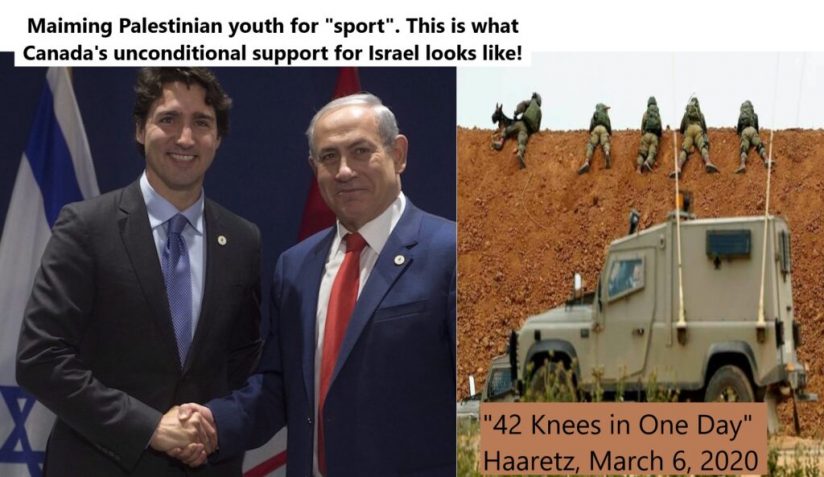
Maiming Palestinians for Sport is a War Crime
By Marion Kawas | Palestine Chronicle | March 10, 2020
The new Haaretz report entitled “42 Knees in One Day” is a difficult and painful read, and many people of conscience have responded with disgust and rage.
For those few who have not seen the report, it details in chilling fashion the accounts of 6 Israeli snipers who were stationed at the border with Gaza during the Great Return March protests. The report is long and gruesome; I had to put it down and then return to it several times. The “42 knees” reference is the “high count” for how many Palestinians were maimed by a single sniper team in one day.
The overall message is one of devastating impunity and disregard for the sanctity of Palestinian life. Palestinians and their long-time supporters have always known this was the mentality at play, but to see it all compiled in one place, in black and white, in the soldiers’ own words, was damning. Especially here in Canada, where barely a week earlier, it was revealed that the Trudeau government had called on the International Criminal Court not to investigate war crimes accusations against Israel.
“Canada’s longstanding position is that it does not recognize a Palestinian state… In the absence of a Palestinian state, it is Canada’s view that the Court does not have jurisdiction in this matter under international law,” Canada’s Foreign Ministry reportedly told various media outlets.
This is the same Canadian government that is busy traveling the world trying to get (or buy) votes for a UN Security Council seat. That has sent Joe Clark, a former Prime Minister, to visit multiple Arab countries looking for support; the Joe Clark that pioneered the idea of moving Canada’s embassy from Tel Aviv to Jerusalem back in 1979, an election promise that he was later forced to abandon.
The same government whose Deputy PM and former foreign minister, Chrystia Freeland, informed an Israeli audience in late 2018 that Canada would be an “asset for Israel” at the UN Security Council if it got one of the non-permanent member seats.
Canada, and other governments, must understand that there is a direct trajectory from their unconditional support for Israel to the continuation of Israeli war crimes against the Palestinian people.
Hampering the ICC investigation, refusing to accept your own court’s decision on labeling of Israeli settlement wines, smearing pro-Palestinian advocates as “anti-semitic” as happened at York University last year, all of this enables the Israeli government and military to feel they are immune to any sort of accountability.
This new report on Israeli sniper violence against Palestinians is most profound in what lies in the shadows: the Israeli military’s crude but effective approach. Promoting the concept that maiming these Palestinian youth is somehow “more humane” than killing them outright. But permanently disabling them in a poor society with few resources for the healthy let alone the injured, is an equally cruel fate. And a poignant and daily reminder to the rest of that society of the price to be paid for rebellion.
Most of the sniper accounts demonstrated a total lack of appreciation of the consequences or severity of their actions. One said, when talking about the other soldiers and their initial reaction to maiming their victims:
“He has fulfilled himself just now, it’s a rare moment. Actually, the more he does it, the more indifferent he’ll become. He will no longer be especially happy, or sad. He’ll just be.”
The snipers work in a team with a locator and the “42 in one day” soldier, related how he suggested to his locator to take over the shooting when they were getting close to the end of their shift because “he didn’t have knees”.
And “you want to leave with the feeling that you did something”. (Note its just “knees”, not Palestinian lives or limbs.) The parallel here with how sports teams allow rookie players to be involved at the end of a game that they know they are winning, is unmistakable. And it also highlights that these snipers didn’t seem to feel threatened and had few concerns about their own safety.
I realize that the Israeli snipers are themselves indoctrinated kids. But I hate the system and ideology that brought them to this, that placed them on those dirt embankments overlooking the people of Gaza, that made them think this was all “sport” or a video game where the player with the most points wins.
And if I feel such rage thousands of miles away, I can only imagine (and will never judge) how the youth of Gaza and their families must feel.
– Marion Kawas is a member of the Canada Palestine Association and co-host of Voice of Palestine.
Hamas condemns continued detention of Palestinian officials in Saudi Arabia
Press TV – March 9, 2020
A Hamas spokesman has condemned the continued detention and prosecution of Palestinian figures in Saudi Arabia over their support for the Palestinian resistance movement, urging Riyadh to immediately release them.
“The national and pan-Arabism duty requires honoring those people and not trying them in this way,” Hazim Qassim told Lebanon’s Arabic-language al-Mayadeen television on Sunday.
He added that Arab countries should reinforce the Palestinian cause and “not weaken its resistance with such trials”.
The spokesman said Hamas has contacted various parties to secure the release of Palestinian detainees in the kingdom, expressing hope that Saudi authorities would respond to those efforts and release the detainees.
His remarks came as a Saudi court on Sunday held the first hearing in the case of 68 Palestinian and Jordanian detainees.
According to al-Mayadeen, the detainees are charged with “supporting terrorism and financing it” and belonging to “a criminal terrorist entity”.
Senior Hamas official Muhammad al-Khudari and his son Hani, who were arrested last April, were among those who stood trial on Sunday.
Al-Khudari represented Hamas in Saudi Arabia between the mid-1990s and 2003. He has held other important positions in the Palestinian resistance movement as well.
Saudi Arabia’s repressive measures against the Palestinian resistance movement as well as those seeking to collect donations for people living in the Israeli-blockaded Gaza Strip come as the kingdom and Israel are believed to be planning to publicize their secret ties.
Gaza has been blockaded by the Israeli regime since 2007.
Last month, Saudi authorities launched a new campaign of “arbitrary” arrests against Palestinian expatriates on charges of supporting Hamas.
The Prisoners of Conscience, a non-governmental organization advocating human rights in Saudi Arabia, announced on February 12 that the kingdom had detained a number of Palestinians, including the relatives or children of those imprisoned last April for the same reason.
Over the past two years, Saudi authorities have deported more than 100 Palestinians from the kingdom, mostly on charges of supporting Hamas financially, politically, or through social networking sites.
The Brooklyn Yeshiva Anthem Protest: Why It’s Not Antisemitic
By Ira Glunts | CounterPunch | March 6, 2020
“An anti-Semite used to be a person who disliked Jews. Now it is a person who Jews dislike.”
– Hajo Meyer, Jewish German-born Dutch physicist and Auschwitz survivor.
“Antisemitism is a trick we always use.”
– Shulamit Aloni, Jewish Israeli, former Israeli Minister of Education, longtime member of the Israeli parliament.
On Sunday, February 23 before a match at Yeshiva University, two brave young Muslim Brooklyn College volleyball players “took a knee” during the playing of Hatikvah, the Israeli national anthem. Omar Rezika (Soph.) and Hunnan Butt (Fr.) following the example of NFL football player, Colin Kaepernick, who protested the police brutality in the US African-American community, were protesting the brutality of the Israeli occupation and its apartheid policies toward its non-Jewish residents. The Nation sports journalist Dave Zirin wrote me that he learned this was the reason for the protest from sources close to the team.
The Jewish press, Jewish organizations and social media were quick to cry antisemitism. The Simon Wiesenthal Center, The Algemeiner, and StopAntiSemitism.org (has short video of the protest) were just a few who rallied their readers against the protesting students. The antisemitism charges were easily refuted by the fact that the protest was a legitimate political protest against Israel and had not been directed at Jews, as Jews, nor specifically at the members of the Yeshiva community because of their ethnicity or religion. Of course just about every Yeshiva student, faculty member and administrator is a supporter of Israel and is also an active apologist for Israeli transgressions.
The Yeshiva University President, Ari Berman, boasted of the wide (some would add “mindless”) support Zionism has in the United States, and called the actions of Rizika and Butt “unfortunate.” In saying this he ignored the acceptance free speech and peaceful protest have in American culture and especially in academia. The Yeshiva University newspaper, The Observer, quotes Berman as saying:
It is unfortunate that some members of the opposing team disrespected Israel’s national anthem. We are proud to be the only university who sings both the American and Israeli national anthems before every athletic competition and major event. Nothing makes me prouder to be an American than living in a country where our religious freedom, our Zionism and our commitment to our people will never be impeded and always be prized.
One salient element that differentiates this protest from Kaepernick’s NFL anthem protests, and indeed most protests, is that it can be credibly argued that it was Yeshiva University, not the protesters themselves, that initiated the confrontation. What university makes the visiting team stand for a foreign national anthem? And this is not just any foreign national anthem. It is a national anthem whose words specifically exclude more than 20% of Israeli citizens and more than 50% of persons subject to Israeli rule because they are not Jewish. The anthem also celebrates what most Muslims and many progressives, backed by international law, consider to be a brutal, illegal occupation of Palestinian land.
Even the Zionist political lobby group, J Street, which supports a kinder, gentler and better-concealed Israeli occupation, featured an alternative, more democratic version of a possible Israeli anthem in the entertainment program of one of its recent conferences.
The American Jewish blogger, Richard Silverstein, who has tweeted about the anthem protest, sent me his reaction:
Unfortunately, the courageous act of dissent performed by these two young volleyball players has been transformed into a act of anti-Semitism, when it was nothing of the sort. They simply sought to engage in a cherished American tradition of free speech and standing up for the oppressed. No university that I know plays both the Star Spangled Banner and the national anthem of a foreign country before sporting events…except Yeshiva University.
A Brooklyn College spokesperson issued a brief statement which was quoted in the Yeshiva Observer that began by assuring those who took offense from the anthem protest that ““Brooklyn College strongly condemns all forms of anti-Semitism and hatred…. Their kneeling is protected by the First Amendment.” The spokesmen did not defend the students against the charges of antisemitism from the Jewish press, nor against the criticism of President Berman.
Interestingly, the Yeshiva University Observer did not bother to even mention the reason Rezika and Butt were protesting. However, its article copiously catalogs the consternation of the Yeshiva community at the temerity of two visiting students to disrespect the Israeli national anthem and the anguish that their kneeling caused in the Yeshiva community.
Conflating Judaism and Zionism is a staple in the bag of tricks of American Zionists. They claim that a vast majority of Jews are Zionists (something with which I concur and most pro-Palestinian activists strongly deny, especially Jewish pro-Palestinian activists). Thus they claim an attack against Zionism is an attack against the core beliefs of most Jews. It is hateful to them, and thus antisemitic. Yet the same people who justify their claim of antisemitism by the belief that most Jews are Zionists (in an almost religious sense) will also tell you, when it is in their interest to do so, that it is antisemitic to protest in front of a synagogue (or at a Jewish university) because Jews have very diverse opinions on Israel, and to generally assume the synagogue members support Israel is wrongly generalizing about Jews and is in itself antisemitic. This flawed but convenient logic makes any real criticism of Zionism equal to antisemitism.
In the United States there is a taboo in criticizing Israel in or around any place that is Jewish. Such protests get little or no mention even in the progressive press and on websites run by both activist Palestinians or Jews. What is surprising is that a number of sites and well-known activists did not run from this story. The story was carried by The Nation, Middle East Eye, and the PalestineChronicle. Yousef “Strange Parenthesis” Munayyer, the Executive Director of the US Campaign for Palestinian Rights, gave a statement of support for the anthem protest to Middle East Eye. All of this is both unusual and encouraging. Many others, as expected, avoided the story despite the fact that flashy protests against Israel are the bread and butter of their outlets.
In Amy Kaplan’s brilliant analysis of the “unbreakable bond” between the United States and Israel she asks the following question:
How did Zionism, a European movement to establish a homeland for a particular ethno-religious group, come to resonate with citizens of a nation based on the foundation, or at least the aspiration, of civic equality and ethnic diversity?
She states that her book, Our American Israel: The Story of an Entangled Alliance, “aims to recover the strangeness [emphasis mine, IG] in an affinity that has come to be seen as self-evident. … How in other words, did so many come to feel that the bond between the United States and Israel was historically inevitable, morally right, and a matter of common sense?”
Four Questions That May Be Difficult To Easily Passover
How strange is the received wisdom about Israel? Here are four examples that come to mind.
1) Why is it unthinkable to protest in front of a synagogue even when that synagogue openly supports Israeli occupation and apartheid, when it is acceptable to protest in front of a church? There have been numerous protests at Catholic churches over charges of priests sexually abusing young church members. My friends Ed Kinane and Ann Tiffany were accused of antisemitism when they protest against the siege of Gaza in a Jewish neighborhood, partly because the protest is at a busy intersection near a synagogue. However, when they protested in front of a Catholic Church, demanding the new bishop be more sensitive than his predecessor to the problems of American capitalism and empire, nobody complained that it was inappropriate to protest in front of a church.
2) Why have so many states passed anti Boycott, Divestment and Sanctions (BDS) legislation, when that legislation clearly violates the right of free speech?
3) Why is talking about the use of money in order to influence the US Congress by Jews or Jewish groups verboten when it is generally accepted as a simpe statement of fact? Remember, “It’s all about the Benjamins baby?” from the twitter feed of Representative Ilhan Omar? That tweet has been deleted, by the way.
4) “To raise a memorial to a European genocide on the secular but sacred space of the National Mall required enormous cultural work – nothing less than the transformation of the Holocaust into an element of American heritage” (from Our American Israel). How was this accomplished, especially considering there is no museum or even a memorial dedicated to American slavery or the genocide of Native Americans on the National Mall?
The answers to these questions, as the Jewish-American rock idol Bob Dylan sang, “is blowing in the wind.” Ironically, after living briefly on a kibbutz in northern Israel, he also sang Neighborhood Bully, which is an apologia for Israeli war crimes.
Just asking these questions is enough to get you accused of being an antisemite, even if you are Jewish, like I am. So I am going to stop here. One good thing about being old, though, is that no one can call my employer to “expose” me as an antisemite.
One last thing, if you want some answers about all of this, I strongly recommend you read Amy Kaplan’s book. It is brilliant.
IRA GLUNTS first visited the Middle East in 1972, where he taught English and physical education in a small rural community in Israel. He was a volunteer in the Israeli Defense Forces in 1992. Mr. Glunts is a Jewish American who lives in Madison, New York. He owns and operates a used and rare book business and is a part-time reference librarian. Mr. Glunts can be reached at gluntsi[at]morrisville[dot]edu.
Brazil is adopting Israel’s terror narrative, which is anything but democratic
By Ramona Wadi | MEMO | March 5, 2020
Brazilian federal deputy Eduardo Bolsonaro, the son of right-wing dictatorship fanatic President Jair Bolsonaro, announced recently that the country will be moving to designate Hezbollah as a terrorist organisation. “Inside the government, we are debating the ways to stop terrorist groups from coming to Brazil,” Bolsonaro stated. “We are going to follow Argentina, declaring that Hezbollah is a terrorist group.”
Not only Hezbollah is being targeted with this designation. Bolsonaro’s son has also declared that the Brazilian government will be “considering a harsher stance on terrorist groups Hamas, Al-Qaeda, and Boko Haram.” Israel praised Brazil’s decision as part of the fight against “Iranian-sponsored terrorism”. Since the US declared its war on terror following September 11, Israel has appropriated the narrative and used it to gain diplomatic leverage for its murderous colonial policies, while strangling Palestinian resistance in the process. Unsurprisingly, Brazil will be joining other countries supportive of Israel’s security narrative in blurring the distinction between legitimate resistance movements and terrorist groups. That narrative is anything but democratic.
For the right wing Israeli and Brazilian governments, resistance movements such as Hamas and Hezbollah on one hand, and the Landless Workers’ Movement (MST) are terrorists, as Bolsonaro declared recently in one of his usual tirades. In defence of Israel’s purported security narrative, Brazil will be employing a designation on Hezbollah and Hamas which has nothing to do with terrorism and everything with how state terror seeks to delegitimise anti-colonial struggle.
As democracy moves even further away from its principles, becoming a label utilised by the right-wing in its quest to annihilate opposition, resistance movements become even more marginalised politically. Needless to say, Brazil’s move will endear it to the US and Washington’s own dissemination of Israel’s security versus terror narrative. Criminalising resistance movements has one main aim, to delegitimise resistance and, as a result, alter the understanding of what constitutes “terrorism”.
Categorising Hamas, the Palestinian Islamic Resistance Movement, alongside terror groups such as Al-Qaeda and Boko Haram builds upon the US-Israeli narrative of seeking to undermine Iranian influence in Latin America. Paraguay, Colombia and Honduras have already adopted this narrative since last year. It ignores the simple fact that Hamas has never carried the struggle for freedom from Israeli occupation beyond the borders of historical Palestine.
The right-wing surge in the region is not conducive to diplomatic support for Palestine, let alone Palestinian resistance. Hamas is already ostracised politically, but the US-Israeli scheming will continue to seek unanimous support for the narrative which allows the far-right to define terror at the expense of the occupied and oppressed.
Bolsonaro has stated on occasions that he seeks further alignment with the US in terms of policy. The latest decision strikes at the heart of Palestinian resistance at a time when Palestinians are in need of diplomatic support due to Trump’s deal of the century versus the two-state compromise dead ends in terms of opportunity. The more that Palestinians are obscured from the political process, the easier it is to simplify, albeit erroneously, the Palestinian cause into an issue between a “democratic state” and “terror”. This is part of the strategy that the US and Israel are pursuing, which is to have a monopoly over who decides that the definition of state-sponsored terror of the kind practiced by Israel and other right-wing governments is somehow “democratic”. That is far from the truth.
Abuse, Oppression and Murder: The PA Does Israel’s Dirty Work in the West Bank
By Ramzy Baroud | MEMO | March 5, 2020
Merely two weeks after Palestinian Authority President, Mahmoud Abbas, declared that the PA will suspend all ‘security coordination’ with Israel, Palestinian security forces in the West Bank killed unarmed teenager, Salah Zakareneh.
Zakareneh is not the first and, sadly, will not be the last Palestinian to be killed by the PA security forces, which in recent years have dramatically increased their oppressive tactics against any form of political dissent in Palestine.
The 17-year-old boy died soon after PA security was dispatched to the village of Qabatiya, south of Jenin, in the northern West Bank to allegedly confront a “military-style demonstration” that was being planned.
The official version of the story claimed that as soon as the PA force arrived in Qabatiya, armed men from the village opened fire while others hurled rocks, prompting PA officers to respond with live bullets and teargas canisters, resulting in the death of Zakareneh and the wounding of others. No PA officers were wounded by gunfire.
There is no denying that anti-PA sentiment has grown exponentially throughout the occupied Palestinian territories in recent months. Abbas’s Authority is rife with corruption and continues to rule over Palestinians, in whatever limited capacity permitted by Israel, with no democratic mandate whatsoever.
Moreover, the PA consists largely of loyalists to Abbas’s Fatah party, which is itself divided between various centres of power.
In 2016, the PA set up a joint body of Palestinian intelligence agencies in Jericho with the sole purpose of cracking down on supporters of Abbas’s arch-enemy, Mohammed Dahlan, who is currently in exile.
Since its creation, the new intelligence body, which reports directly to the President, has expanded its mandate and is actively cracking down on any individual, organization or political entity that dares question the policies of Abbas and his party.
Soon after Abbas claimed in a speech before the Arab League in Cairo, on February 1, that the PA will sever all contacts with Israel “including security relations”, a senior PA official informed Israeli media that the cooperation between the PA and Israel is still ongoing.
“Until now, the coordination is ongoing, but relations are extremely tense,” the official told the Times of Israel.
‘Security coordination’ is perhaps the only reason why Israel is allowing the PA to exist despite the fact that Israel, with the support of the United States, has completely reneged on all of its commitments to the Oslo accords and all subsequent agreements.
It is quite surreal that the Palestinian leadership in Ramallah, which once promised Palestinians freedom and liberation in an independent, sovereign state, now exists mostly to ensure the very security of the Israeli army and illegal Jewish settlers in occupied Palestine.
The PA and the Israeli occupation now co-exist in some kind of symbiotic relationship. To ensure the continuation of that mutually beneficial relationship, both entities are invested in suppressing any form of resistance, or even mere protest, in the occupied West Bank.
In truth, whether the protesters in Qabatiya were accompanied by gunmen or not would have made little difference. The only form of protest or mass gathering which is currently allowed in the West Bank is those held by Abbas’s own loyalists, chanting his name and chastising his enemies.
Last year, the Arab Organization for Human Rights in the UK accused PA security services of using repressive measures against Palestinian activists and employing psychological and physical torture against its critics; in other words, duplicating Israeli policies in dealing with Palestinians.
Those who are often targeted by the PA’s Preventive Security Service (PSS) and various other intelligence units include students and previously released prisoners.
In its 2020 report on “Israel and Palestine”, Human Rights Watch (HRW) said that hundreds of Palestinians have been detained and tortured by PA security forces for the most insignificant ‘offences’.
“The PA held 1,134 people in detention as of April 21 (2019),” according to HRW figures.
The rights groups also reported that “between January 2018 and March 2019, (the PA) detained 1,609 persons for insulting ‘higher authorities’ and creating ‘sectarian strife,’ charges that in effect criminalize peaceful dissent, and 752 for social media posts.”
![Palestinian Authority police forces can be seen violently arresting a Palestinian man on 12 March 2017 [Issam Rimawi/Anadolu Agency]](https://i2.wp.com/www.middleeastmonitor.com/wp-content/uploads/2017/03/20170312_2_22360461_19790403.jpg?resize=567%2C800&quality=85&strip=all&ssl=1)
Palestinian Authority police forces can be seen violently arresting a Palestinian man on 12 March 2017 [Issam Rimawi/Anadolu Agency]
While many Palestinian prisoners held unlawfully in Israel undergo prolonged hunger strikes demanding their immediate release or better imprisonment conditions, news of Palestinian prisoners on open hunger strikes in PA prisons often go unreported.
Ahmad al-Awartani, 25, was one of the thousands of Palestinians to be arrested based on outrageous charges, as the young man was detained under the so-called Cyber Crimes Law. He was arrested by PA police for a single Facebook post in which he criticized the Palestinian Authority.
In April 2018, al-Awartani entered a hunger strike that went almost completely unnoticed by Palestinian, Arab, and international media.
Arbitrary arrests, torture, and violence are regular occurrences in occupied Palestine. While Israel is responsible for the greater share of the violation of Palestinian human rights, the PA is part and parcel of that same Israeli strategy.
While it is true that Abbas’s crackdowns are tailored to serve his personal interests, PA action has ultimately served the interests of Israel which aim at keeping Palestinians divided and is using PA security forces as an extra layer of protection for its soldiers and settlers alike.
That in mind, Zakareneh’s death cannot be viewed as a marginal occurrence in the Palestinian struggle against Israeli occupation and apartheid. Indeed, the Palestinian Authority has made it crystal clear that its violence against dissenting Palestinians is no different than Israeli violence targeting any form of resistance, anywhere in Palestine.
On the ICC and Canadian Government Hypocrisy
By Yves Engler | Palestine Chronicle | March 4, 2020
Just when you think Canadian government hypocrisy could hit no greater heights, the Liberals launch a double standards rocket to the stars.
The Trudeau government recently pressed the International Criminal Court to stop investigating Israeli war crimes. Ottawa sent a letter to the ICC saying it didn’t believe the court had jurisdiction over Palestine.
“Canada’s longstanding position is that it does not recognize a Palestinian state and therefore does not recognize the accession of such a state to international treaties, including the Rome Statute.
In the absence of a Palestinian state, it is Canada’s view that the Court does not have jurisdiction in this matter,” a Global Affairs official told the Jerusalem Post. But, it doesn’t matter if Canada recognizes Palestine. The vast majority of UN member states recognized Palestine and it joined the ICC in 2015.
In response to Ottawa’s letter to the ICC, PLO Secretary-General Saeb Erekat tweeted that Canada supported “Israel’s campaign for impunity.” Erekat added, “it is not about jurisdiction: It’s about war crimes. This is an encouragement to continue the war crimes.”
Canada’s letter to the ICC implies it could sever funding if the ICC pursued an investigation of Israeli crimes. Reportedly, it reminds the court that Canada’s “financial contribution to the ICC will be $10.6 million this year.”
Ottawa’s letter was a response to ICC chief prosecutor Fatou Bensouda’s statement in December that “I am satisfied that war crimes have been or are being committed in the West Bank, including East Jerusalem and the Gaza Strip.” At the time Bensouda called for a full-fledged investigation into Israeli war crimes, which could lead to arrest warrants being issued for Israeli officials.
Since then Tel Aviv has unleashed a vicious campaign against the ICC. Prime Minister Benjamin Netanyahu labeled the court’s investigation “pure anti-Semitism”. Israel has pushed other countries to join their attacks. Netanyahu sent a letter to Justin Trudeau calling on Canada to condemn any ICC investigation of Israeli war crimes.
Trudeau’s willingness to bow to Israeli pressure on the issue is remarkable. Not only does it claim to support the ICC, but the institution is also closely linked to how it markets its foreign policy.
In his recent mandate letter to the foreign minister, Trudeau told Francois-Philippe Champagne to “reinforce international institutions like the International Criminal Court.” In March Global Affairs noted, “we are proud to support the International Criminal Court and the important work that it does.”
The press release boasted that Canada helped “bring the ICC into existence” and was “the first country in the world to adopt comprehensive legislation implementing the Rome Statute” that created the ICC. The statement adds that “Canada firmly supports the rules-based international order and the multilateral institutions that underpin it.”
When Trudeau addressed the UN General Assembly in September 2018, the ICC was central to his talk. The government announced Canada was taking Venezuela to the ICC and the prime minister described the court as a “useful and important way of promoting an international rules-based order.”
On dozens of occasions, former foreign minister Chrystia Freeland, Trudeau and other Liberal officials have referred to the “international rules-based order”, “international order based on rules” or “international system based on rules”. The top stated “aim” laid out in Freeland’s major June 2017 foreign policy pronouncement was: “First, we will robustly support the rules-based international order, and all its institutions, and seek ways to strengthen and improve them.” The number one priority on Global Affairs website is “revitalizing the rules-based international order.”
By threatening the ICC on behalf of Israel the Trudeau government is not simply enabling Palestinian dispossession. The Liberals are also making a mockery of their foreign policy rhetoric.
– Yves Engler is the author of Canada and Israel: Building Apartheid and a number of other books.
Thousands of shekels stolen from Palestinian homes in occupied West Bank
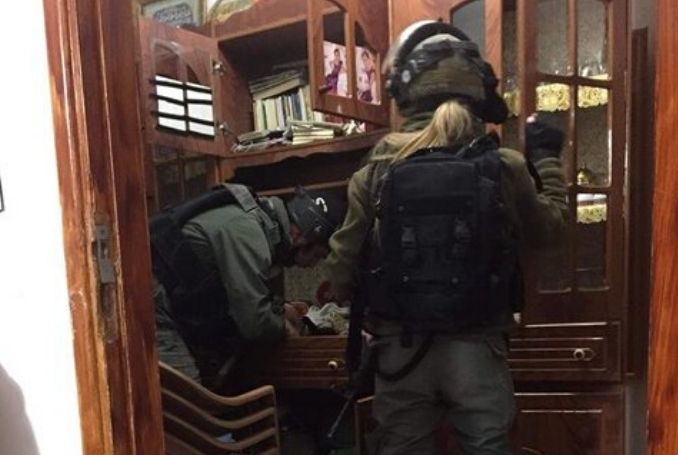
Israeli forces steal money during raids into houses of Palestinian citizens in the West Bank. (Photo: via Twitter)
MEMO | March 4, 2020
Israel security forces stole thousands of shekels from Palestinians in Al-Zawiya in the Salfit district of the occupied West Bank last night.
According to the Palestinian news agency WAFA, around 50,000 shekels ($14,500) were seized during raids that were carried out overnight in the houses of Palestinian citizens and former prisoners.
The Israeli authorities often claim that money has been “confiscated” because the Palestinians “supported acts of terror” and received the money from unknown sources. As a result, soldiers are rarely charged with such thefts.
This is not the first time that Israel has taken money from Palestinian homes during night raids condemned by the Palestinian Authority and international rights bodies.
Such accusations have been made on hundreds of occasions, with soldiers pocketing Palestinians’ cash and valuables during the raids that take place nightly across the West Bank.
A similar raid was carried out in December, for example, when Israeli soldiers used dogs to ransack the family home of Mohammed Rayhan in the town of Yabod, south-west of Jenin.
After the soldiers had left without making any arrests, the family realised that money and gold jewellery were missing, he told Wafa. The family accused the soldiers of stealing the money and valuables.
Heavily armed Israeli soldiers, often with large dogs, regularly raid Palestinian homes, wake the children and arrest one or more family members.
The occupation state’s policy of night raids against the people of occupied Palestine has been condemned repeatedly by international rights bodies as it leaves victims feeling unsafe in their own homes.
Report details Israel’s February violations against Palestinian media
MEMO | March 2, 2020
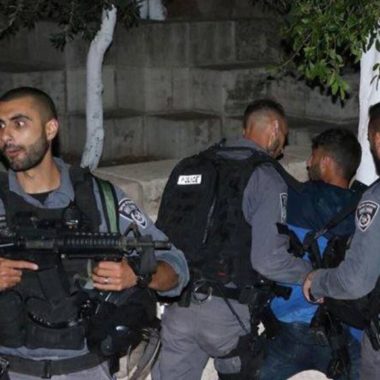
The Journalists’ Support Committee (JSC) reported on Sunday that Israel committed 84 violations against Palestinian media during February.
The JSC said that Israeli occupation forces wounded 24 Palestinian journalists by shooting steel-coated rubber bullets at them while they were carrying out their work.
Israel also tried to prevent Palestinian journalists from covering the violations committed by its occupation forces.
As part of these efforts, the Israeli occupation forces arrested eight Palestinian journalists. Although four were released, the other four are still in prison.
The detention of five other journalists was extended by the occupation authorities during February.
The JSC pointed out that at least six Palestinian journalists being held by Israel have been prevented from meeting their lawyers and subjected to harsh interrogation, including verbal and physical abuse.
In the report, it was revealed that the Israeli occupation imposed very high fines on four Palestinian journalists before putting them under house arrest or expelling them from their home cities.
Journalists have been beaten by security forces and prevented from travelling in the course of their work.
Employment and Press accreditation documents have been confiscated by Israel.
Meanwhile, Israel is continuing to put pressure on social media sites to censor anything remotely pro-Palestine. Many journalists’ and media accounts have been suspended or closed accounts.
Ironically, three Palestinian journalists from the occupied West Bank, said the JSC, were taken before Israeli courts on the day that the Committee’s report was issued.
According to rights groups, there are 22 Palestinian journalists inside Israeli jails. There are around 5,500 Palestinians prisoners being held by Israel, including 42 women and girls, 250 children, 450 under administrative detention and around 1,000 in need of urgent medical care.
US: Pro-BDS store wins major legal victory against Israel advocates
MEMO | March 2, 2020
Advocates for the state of Israel have suffered an embarrassing defeat in a decade-long legal battle to sue Olympia Food Co-op over its decision to boycott Israeli goods. The US grocery store, which campaigns for ethical food consumption, was fully vindicated by a Washington appeals court on 20 February in a legal case that is likely to have positive ramifications for the Boycott, Divestment and Sanctions (BDS) campaign for Palestinian rights.
The original case that was filed in 2011 by five co-op members, purporting to act on behalf of the co-op and seeking to block the boycott, sought to collect monetary damages against the board members.
The case was dismissed five months later as a SLAPP, or Strategic Lawsuit Against Public Participation, but reinstated when Washington’s anti-SLAPP statute was struck down.
Two years later, an appeals court upheld that judge’s ruling and the plaintiffs were ordered to pay $160,000 in statutory damages – $10,000 to each of the 16 co-op board members – as well as other legal fees.
Last week’s ruling dismissed the case a second time.
Board member, Grace Cox, who supported a measure to ban Israeli products from the store’s shelves, were put through years of litigation by several former Co-op members who worked closely with the Israel advocacy group StandWithUs.
The right-wing Israel lobby group is reported to have secretly planned the lawsuit in coordination with Israeli government officials in the Ministry of Foreign Affairs, which has been authorised to lead the global campaign against BDS.
In its press release, the Centre for Constitutional Rights, which has represented the defendants during the entire legal battle, said that it had discovered emails between the plaintiffs celebrating the news from StandWithUs that the lawsuit had successfully discouraged other co-ops from boycotting Israeli goods.
StandWithUs, which is described as one of many groups trying to suppress the growing US movement for Palestinian freedom, took credit for filing the case, stating that it was a by-product of the partnership between StandWithUs and the Israeli Ministry of Foreign Affairs.
Following their victory Cox said: “As a co-defendant, I am pleased, but not surprised, that the courts have once again found in our favor. When the plaintiffs first threatened to sue us, they promised a nuisance lawsuit, and they have delivered.”
Deputy Legal Director for the Centre for Constitutional Rights Maria LaHood spoke of the wider ramifications of the case, viewing it as a victory for free speech. “In the face of widespread assault, the right to advocate for Palestinian freedom, including via the time-honored tradition of boycotts for social change, has again been vindicated,” said LaHood. “This victory demonstrates that although the fight can be long, it’s necessary in order to achieve justice.”
Lawyers say the lawsuit is part of a broad and growing pattern of suppressing activism in support of Palestinian rights, a phenomenon that the Centre for Constitutional Rights and Palestine Legal have documented and called the “Palestine Exception” to free speech.
The two organisations have documented the widespread use of administrative disciplinary actions, harassment, firings, legislative attacks, false accusations of terrorism and antisemitism, and baseless legal complaints. Palestine Legal has responded to 1,494 incidents of suppression targeting speech supportive of Palestinian rights between 2014 and 2019.
Israel says US will ‘punish’ those who boycott UN blacklist companies
MEMO | March 2, 2020
Israel’s Ambassador to the UN said on Sunday that the US will punish those who boycott companies and individuals on the UN Human Rights Council (UNHRC) blacklist of those which profit from the occupation of the West Bank.
“This further attests to the strength of the bond of the US-Israel relationship and the alliance between the peoples,” explained Danny Danon at the 2020 conference of the American Israel Public Affairs Committee. AIPAC is the largest pro-Israel lobby organisation in North America.
Danon used his speech to criticise Democratic Party presidential hopeful Bernie Sanders for refusing to address the conference.
Sanders explained his decision by saying that he remains concerned about the platform AIPAC provides for leaders who express bigotry and oppose basic Palestinian rights. “Sadly, tragically, in Israel, through Bibi Netanyahu, you have a reactionary racist who is now running that country,” added the veteran US Senator.
The Israeli Ambassador insisted that nobody wants to see Sanders at AIPAC or in Israel. “Anyone who calls the Israeli Prime Minister a racist is a liar or an ignoramus, or a dangerous combination of the two,” Danon concluded.
The war scenario between Israel and Hezbollah
By Elijah J. Magnier – 24/02/2020
Notwithstanding the increase in power of the “Axis of the Resistance”, with its precision missiles and unrivalled accumulated warfare experience, the possibility of war is still on the table. The “Axis of the Resistance” is increasing its readiness based on the possibility that Israel may not tolerate the presence of such a serious threat on its northern borders and therefore act to remove it. However, in any future war, the “Axis of the Resistance” considers the consequences would be overwhelmingly devastating for both sides and on all levels if the rules of engagement are not respected. Notwithstanding Israel’s superior air firepower, its enemy Hezbollah has established its own tremendous firepower, and its experience in recent wars in Syria, Iraq and Yemen is an important asset.
Sources within the “Axis of the Resistance” believe the next battle between Hezbollah and Israel, if ever it takes place, would be “controlled and not sporadic, with a focus on specific military objectives without damaging the infrastructure, on both sides”.
The sources consider Gaza as a precedent. In Gaza Palestinians and Israelis have fought many recent battles that lasted only a few days in which the objectives bombed were purely military. This is a new rule of engagement (ROE) regulating conflict between the belligerents. When Israel hits a non-military target, the Palestinian resistance responds by hitting a similar non-military target in Israel. The lesson extracted from the new ROE between Israel and the Palestinians is that every time exchanges of bombing go out of control, both sides understand they have to bring it back to an acceptable and equitable level, to limit damage and keep such mutual attacks from targeting civilians.
The “Axis of the Resistance” therefore considers that the probability is high that the next battle would be limited to military objectives and kept under control. If one side increases the bombing, the other will follow. Otherwise, both sides have the capability to cause total destruction and go on to uncontrolled bombing. In the case of an out-of-control war, allies on both sides would become involved, which renders this scenario less likely.
Hezbollah in Lebanon is said to have over 150,000 missiles and rockets. Israel might suppose that a limited attack could destroy tens of thousands of Hezbollah’s missiles. Is it worth it? “From Israel’s view, Israel may think it is worth triggering a battle and destroying thousands of missiles, thinking that Israel has the possibility to prevent Hezbollah from re-arming itself. But even in this case, Israel doesn’t need to destroy villages or cities or the Lebanese infrastructure, instead, it will limit itself to selective targets within its bank of objectives. However, we strongly doubt Israel could succeed in limiting Hezbollah’s supply of missiles and advanced weapons. Many of these missiles no longer need to be close to the borders with Israel, but can be deployed on the Lebanese-Syrian borders in safe silos”, said the sources.
However, Israel should also expect, according to the same sources, that Hezbollah will respond by bombing significant Israeli military targets within its bank of objectives. “There is no need to bomb airports, power stations, chemical industries, harbours or any highly significant target if Israel doesn’t bomb any of these in Lebanon. But if necessary Hezbollah is prepared to imitate Israel by hitting back without hesitation indiscriminately and against high-value targets, at the cost of raising the level of confrontation to its maximum level. Hezbollah and Israel have a common language in warfare. If the bombing is limited, no side interprets the others’ actions as a sign of weakness”, said the sources.
“Hezbollah doesn’t want war and is doing everything to avoid it. This is why it responded in Moawad, in the suburb of Beirut, when Israeli armed drones failed to reach their objectives. By responding, Hezbollah actually prevented a war on a large scale because it is not possible to allow Israel to get away with any act of war in Lebanon, violating the ROE” said the sources.
Last September, Hezbollah targeted an Israeli vehicle in Avivim with a laser-guided missile in daylight after forcing the Israeli Army to hide for a week and retreat all forces behind civilians lines, imposing a new ROE. The Israeli army cleared the 120 km borders with Lebanon (5 km deep) to avoid Hezbollah’s revenge retaliation for violating the 2006 cessation of hostility’s agreement. Israel refrained from responding and swallowed the humiliation due to its awareness of Hezbollah’s readiness to start a devastating war if necessary.

Israeli officials used to threaten Hezbollah and Lebanon to take the country “back to the stone age”. This is indeed within the reach of Israel’s military capability. However, it is also within Hezbollah’s reach to bring Israel back to the stone age, if required. Hezbollah’s precision missiles can hit any bridge, airport, gasoline deposit containers, power stations, Haifa harbour, oil and gas rig platforms, any infrastructure and military and non-military objectives if Israel attempts to target similar objectives in Lebanon first. Hezbollah’s new missile capability is not new to Israel, who is observing the latest technology Iran’s allies are enjoying and “testing,” mainly in Yemen. The recent bombing of Saudi Arabia oil facilities and the downing of a Saudi Tornado in Yemen revealed that Iran’s HOT missiles are capable of downing jets at medium height and any helicopter violating Lebanese airspace.
Hezbollah’s latest version of the Fateh precision missile, the supersonic anti-ship missiles and the anti-air missiles can prevent Israel from using its navy, stopping any civilian ship from docking in Haifa, thwarting the use of Israeli Helicopters and precision bombing attacks- as in Iran’s latest confrontation with the US at Ayn al-Assad base in Iraq.
Hezbollah’s missiles are unlikely to cause simple traumatic brain injuries – as per the Iranian missile at Ayn al Assad – when hitting targets in Israel in case of war. They can avoid missile interception systems. This increase of capability is a game-changer, and Hezbollah believes it is already decreasing the chances of war. Arming itself with precision missiles and armed drones and showing these capabilities to Israel is Hezbollah’s way to avert a war and protect the equation of deterrence.
In its 2020 security assessment, the Israeli Military Intelligence Directorate (Aman) unwisely evaluated the assassination of the Iranian Major General Qassem Soleimani as a “restraining factor”. Aman’s report, showing astonishing ignorance, stated that Soleimani was responsible for Hezbollah’s missile projects. This lack of understanding of the Hezbollah-Iran relationship and dynamic is quite surprising. Sayyed Ali Khamenei told Hezbollah’s leader Sayyed Hassan Nasrallah decades ago that he knows what he needs and what to do and doesn’t need to fall back on Iran. The IRGC and Hezbollah have set up a collaboration engine that won’t stop even if half of the IRGC leadership is killed. The possession of the feared Iranian precision missiles is no longer a secret: all Iran’s allies have these deployed, in Lebanon, Syria, Iraq and Yemen.
Yesterday is unlike today: the power of destruction now belongs to all parties, no longer to Israel alone. War is no longer an option. US/Israeli aggression will be limited to an economic war, so long as the “Axis of the Resistance” continues updating its warfare capability to maintain deterrence parity.
This article is translated free to many languages by volunteers so readers can enjoy the content.
Copyright © https://ejmagnier.com 2020 @ejmalrai
Featured Video

Diplomacy is Now a Crime in Britain / Ian Proud
or go to
Aletho News Archives – Video-Images
From the Archives
Genetic baloney in thick slices
MAYBE COULD BE INC.
By Jon Rappoport | No More Fake News | July 8, 2021
Gene research companies tend to come and go. They start out banging and popping like fireworks in the sky, and then they fade out—selling themselves to larger outfits who’ve hired better liars…
Once upon a time, it sounded easy. Start with a disease, find the gene responsible for the disease, and correct the problem.
Then, researchers wondered, was disease the result of one gene or a group of genes acting together?
Either way, the proof would be in devising cures for diseases using gene therapy. “Not yet, but soon…”
And regardless, the major need was: money. Lots and lots of money.
This need required good PR people. “We have to pump up the idea that we’re on the edge of tremendous breakthroughs. We’re always on that edge…”
This hype also needed to obscure the fact that there wasn’t (and isn’t) ANY gene cure for ANY disease. … continue
Blog Roll
 Aletho News
- Diplomacy is Now a Crime in Britain / Ian Proud
- UK Government Body Kept Files on People Criticizing Prevent Program
- US military withdrawal from Iraq and the collapse of US-Israeli hegemonic project in West Asia
- What does Europe want – a war with Russia?
- She Followed the Actual Data on COVID Vaccines and Masks — Her Career Took a Huge Hit
- Florida AG Sues Pfizer, Bourla Over Deceptive Marketing of COVID Vaccines
- Von der Leyen gifts her spin doctor a job for life
- 10K More U.S. Troops Deploy as Trump Weighs New Iran Strikes /Suliaman Ahmed
- Iranian crew declared Dena training vessel ‘unarmed’ to US warship before deadly torpedo strike: Report
- Iran’s NPT debate moves beyond parliament
- If Americans Knew
- Israel is squeezing the life out of Palestinians – Daily Update
- The Israeli Right Portrays Islam as Murderous. It Serves a Political Purpose
- Jordan Has Had Enough: King Abdullah’s Scathing Warning to Israel
- Israeli Colonizers (i.e. Settlers) Kill Palestinian Man Near Salfit
- New Google Maps images reveal massive scale of devastation in Gaza
- Jewish supremacy, anti-Palestinian bigotry on display in Israel – Daily Update
- Israeli Soldiers Abduct At Least 22 Across Occupied West Bank
- Eight Palestinians Killed in Israeli Attacks on Gaza
- Israeli former leaders and security chiefs threaten legal action over ‘Jewish terrorism’
- Israel map in LA Times ad includes all land from the river to the sea
- No Tricks Zone
- Green Energy Debacle: German Expert Professor Fritz Vahrenholt Warns Of Severe Economic And Social Consequences
- Two More Paleo Reconstructions Affirm Meters-Higher Sea Levels Across Ireland, Brazil 7000-6000 Years Ago
- New Study: Earth And Venus Surface Warmth Largely Explained By Convection And Lapse Rate, Not CO2 Or Radiation
- 2025 Nature Paper Claiming Worsening Global Drought Gets RETRACTED …Heavily Flawed
- New Study: ‘Global Drought Shows No Detectable Recent Acceleration Under Climate Warming’
- Economic Masterminds: German Socialists Suggest Taxing Productivity Gains Stemming From Using AI
- The South China Sea Has Not Been Cooperating With The Climate Change Narrative
- Energy Crisis: Germany Enters Heating Season With Historically Low Gas Reserve Fill Levels
- New Study: The Antarctic Ice Sheet Gained Mass From 2020-2024 Due To Staggering Snow And Ice Accumulation
- Study: Ocean Heating Rates From Thousands Of Years Ago ‘Dwarf’ Modern Ocean Heating Rates

