Canada Joins ‘Friendly States’ in Opposing ICC War Crimes Investigation in Palestine
Palestine Chronicle | February 26, 2020
The Canadian government has submitted a letter to the International Criminal Court (ICC), in which it declared support for the Israeli position, thus rejecting the ICC jurisdiction over cases of alleged war crimes committed by Israel in Palestine.
The Canadian Jewish News (CJN), which reported on the letter, said that Ottawa has communicated its position to the Court on February 14, although the content of the letter has not been made public until today.
In the letter, Canada, which reminded the Court that its “financial contribution to the ICC will be $10.6 million this year,” stated that it does not recognize Palestine as a state and that the ICC has no jurisdiction on the case that is presented by the State of Palestine.
The Canadian decision followed a public demand last December by Israeli Prime Minister Benjamin Netanyahu to Canadian Prime Minister Justin Trudeau to condemn a preliminary report by the ICC that has a “reasonable basis” to investigate Israeli war crimes in the occupied territories.
Netanyahu’s letter, which was obtained by the Canadian Globe and Mail newspaper, asserted the position which was eventually adopted by the Canadian government, that the ICC has no jurisdiction over the case because Palestine does not meet the criteria of statehood.
Netanyahu’s letter read in part:
“In light of our special relations and the steadfast friendship between our countries, I urge you to publicly condemn this erroneous decision, to acknowledge there is not a Palestinian state, that the court has no jurisdiction in this matter, which involves political issues to be determined by the parties, and to voice your deep concerns regarding its dangerous ramifications to the court and the region.”
The intense Israeli lobbying followed a statement by the ICC chief prosecutor Fatou Bensouda, in which she declared to be “satisfied that there is a reasonable basis to proceed with an investigation into the situation in Palestine”.
“In brief, I am satisfied that war crimes have been or are being committed in the West Bank, including East Jerusalem, and the Gaza Strip,” she said.
Two days after Ottawa communicated its position to the ICC, Netanyahu praised what he called “efforts” by “friendly states” to prevent the ICC from launching an investigation.
Clinton: Destroy Syria for Israel
The New Observer | May 22, 2016
A newly-released Hilary Clinton email confirmed that the Obama administration has deliberately provoked the civil war in Syria as the “best way to help Israel.”
In an indication of her murderous and psychopathic nature, Clinton also wrote that it was the “right thing” to personally threaten Bashar Assad’s family with death.
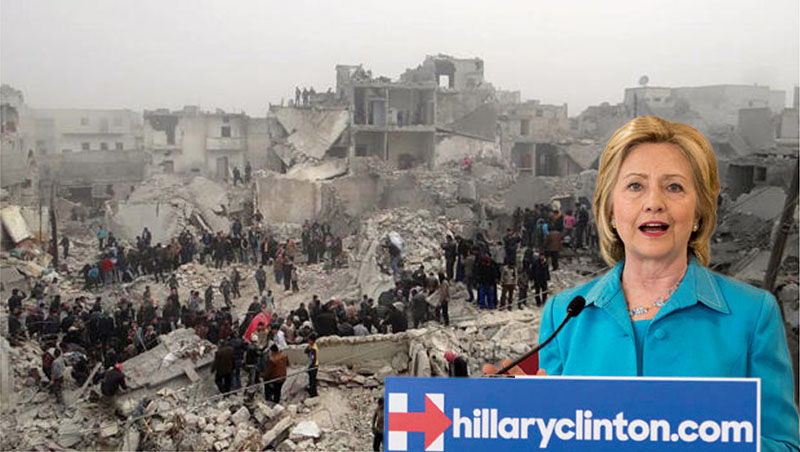
In the email, released by Wikileaks, then Secretary of State Clinton says that the “best way to help Israel” is to “use force” in Syria to overthrow the government.
The document was one of many unclassified by the US Department of State under case number F-2014-20439, Doc No. C05794498, following the uproar over Clinton’s private email server kept at her house while she served as Secretary of State from 2009 to 2013.
Although the Wikileaks transcript dates the email as December 31, 2000, this is an error on their part, as the contents of the email (in particular the reference to May 2012 talks between Iran and the west over its nuclear program in Istanbul) show that the email was in fact sent on December 31, 2012.
The email makes it clear that it has been US policy from the very beginning to violently overthrow the Syrian government—and specifically to do this because it is in Israel’s interests.
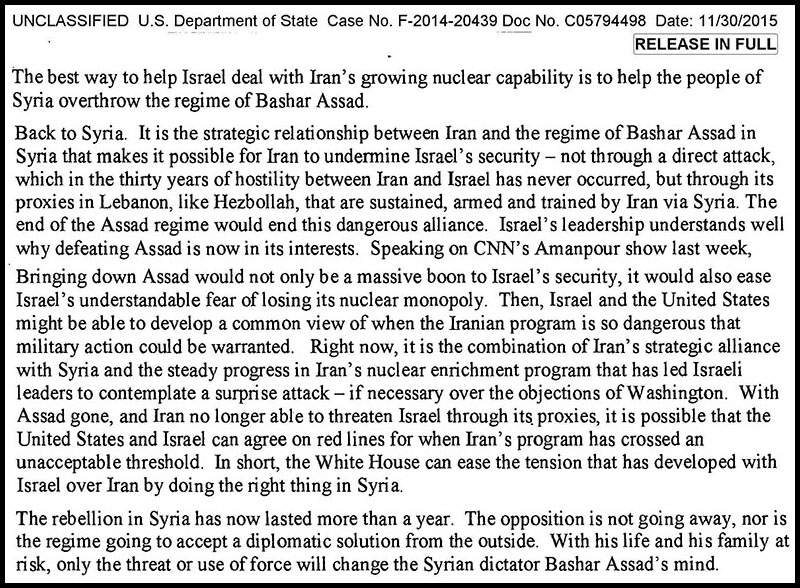
“The best way to help Israel deal with Iran’s growing nuclear capability is to help the people of Syria overthrow the regime of Bashar Assad,” Clinton forthrightly starts off by saying.
Even though all US intelligence reports had long dismissed Iran’s “atom bomb” program as a hoax (a conclusion supported by the International Atomic Energy Agency), Clinton continues to use these lies to “justify” destroying Syria in the name of Israel.
She specifically links Iran’s mythical atom bomb program to Syria because, she says, Iran’s “atom bomb” program threatens Israel’s “monopoly” on nuclear weapons in the Middle East.
If Iran were to acquire a nuclear weapon, Clinton asserts, this would allow Syria (and other “adversaries of Israel” such as Saudi Arabia and Egypt) to “go nuclear as well,” all of which would threaten Israel’s interests.
Therefore, Clinton, says, Syria has to be destroyed.
Iran’s nuclear program and Syria’s civil war may seem unconnected, but they are. What Israeli military leaders really worry about — but cannot talk about — is losing their nuclear monopoly.
An Iranian nuclear weapons capability would not only end that nuclear monopoly but could also prompt other adversaries, like Saudi Arabia and Egypt, to go nuclear as well. The result would be a precarious nuclear balance in which Israel could not respond to provocations with conventional military strikes on Syria and Lebanon, as it can today.
If Iran were to reach the threshold of a nuclear weapons state, Tehran would find it much easier to call on its allies in Syria and Hezbollah to strike Israel, knowing that its nuclear weapons would serve as a deterrent to Israel responding against Iran itself.
It is, Clinton continues, the “strategic relationship between Iran and the regime of Bashar Assad in Syria” that makes it possible for Iran to undermine Israel’s security.
This would not come about through a “direct attack,” Clinton admits, because “in the thirty years of hostility between Iran and Israel” this has never occurred, but through its alleged “proxies.”
The end of the Assad regime would end this dangerous alliance. Israel’s leadership understands well why defeating Assad is now in its interests.
Bringing down Assad would not only be a massive boon to Israel’s security, it would also ease Israel’s understandable fear of losing its nuclear monopoly.
Then, Israel and the United States might be able to develop a common view of when the Iranian program is so dangerous that military action could be warranted.
Clinton goes on to assert that directly threatening Bashar Assad “and his family” with violence is the “right thing” to do:
In short, the White House can ease the tension that has developed with Israel over Iran by doing the right thing in Syria.
With his life and his family at risk, only the threat or use of force will change the Syrian dictator Bashar Assad’s mind.
The email proves—as if any more proof was needed—that the US government has been the main sponsor of the growth of terrorism in the Middle East, and all in order to “protect” Israel.
It is also a sobering thought to consider that the “refugee” crisis which currently threatens to destroy Europe, was directly sparked off by this US government action as well, insofar as there are any genuine refugees fleeing the civil war in Syria.
In addition, over 250,000 people have been killed in the Syrian conflict, which has spread to Iraq—all thanks to Clinton and the Obama administration backing the “rebels” and stoking the fires of war in Syria.
The real and disturbing possibility that a psychopath like Clinton—whose policy has inflicted death and misery upon millions of people—could become the next president of America is the most deeply shocking thought of all.
Clinton’s public assertion that, if elected president, she would “take the relationship with Israel to the next level,” would definitively mark her, and Israel, as the enemy of not just some Arab states in the Middle East, but of all peace-loving people on earth.
Hamas: Israel’s aggressive mindset poses a threat to the entire region
Palestine Information Center – February 24, 2020
GAZA – The Hamas Movement has called for pooling the Arab nation’s efforts to confront the Israeli expansionist project in the region.
In a press release on Sunday night, Hamas spokesman Hazem Qasem said that Israel’s “bombing of resistance sites in Damascus vindicated further the Israeli government’s aggressive mentality that keeps targeting the Arab nation and posing a threat to their region.”
“This entails uniting and integrating the entire nation’s efforts in order to confront the Zionist expansionist project and put an end to its ongoing aggression and its existence on the Palestinian land,” spokesman Qasem added.
The spokesman also described Israel’s renewed aggression against the Gaza Strip and the Palestinian resistance’s response to its crimes as “an ongoing battle between an arrogant colonial power and a people striving to extract their freedom and live with dignity on their own land.”
“This battle is to be won by our people, the rightful owners of the land and history, while the passing colonist will not have a place on our Palestinian land,” he said.
US-Palestinian intelligence talks focus on Abbas’ successor

By Dr Adnan Abu Amer | MEMO | February 24, 2020
Just two days after the announcement of the “deal of the century” in late January, Gina Haspel, director of the CIA, secretly arrived in Ramallah in the occupied West Bank, and met with Majed Faraj, head of the Palestinian Intelligence Service, and a number of senior Palestinian officials. They assured her that Palestinian-American security coordination would not be affected after the announcement of the deal.
This visit took place after Israel revealed it had thwarted an assassination attempt on Majed Faraj, at the order of Tawfik Tirawi, a member of the Fatah Central Committee and former head of the General Intelligence Service.
The CIA director’s visit came as a surprise, she could have sent one of her aides or summoned Majed Fatah to Washington. There are some who believe that the visit aimed to persuade the Palestinians to accept the deal of the century.
Perhaps the American security visit is related to the preparation for the succession of Palestinian President Mahmoud Abbas, especially since the visit coincided with the revelation of the assassination attempt on Faraj.
Haspel’s visit came despite Abbas’ announcement that security relations with the Israelis and Americans were being cut, which raised big questions about his credibility.
The information received regarding Haspel’s meeting in Ramallah with Palestinian intelligence leaders indicates that the meetings lasted three days, with 16 officers from both sides participating to discuss in depth scenarios and plans to eliminate the Palestinian resistance system, in the Gaza Strip in particular. They also drew plans to ensure that no chaos occurs in the West Bank that causes the situation to explode in the face of Israel.
On the first day, the meetings discussed all the scenarios to deal with the Palestinian resistance, and the general objectives of each scenario. The second day was dedicated to discussing Palestinian intelligence preparations to implement these scenarios, and on the third day a general American-Palestinian debate was opened to discuss what was described as “creative ideas” to emerge from the crises.
In the end, the meetings concluded with several points, the most important of which is the necessity of progressing from containing Hamas to attacking it, by using the conflicts between the leaders inside Palestine and abroad, and inciting against its leader, Ismail Haniyeh’s visit to Tehran and his participation in Qassem Soleimani’s funeral. This constituted clear proof of the political failure to contain the movement, either by Israel or Egypt. Moreover, Hamas’ attempts to strengthen its relationship with Hezbollah and its failure to comply with the Egyptian conditions of not visiting Iran both serve the interest of the same conviction.
At the end of their meetings in Ramallah, the Palestinian and American security sides concluded that it is not possible to eradicate Hamas, because it has a wide popular base, and therefore a strategy must be worked on to weaken it. In this regard, a proposal was made by the Palestinian general intelligence calling for containing the movement and pushing it to be part of the political system in the context of the PLO, along with draining their sources of funding, in agreement with the US Treasury.
This conclusion, reached by Faraj’s men in the Palestinian intelligence services with their American counterparts, or rather their handlers, is related to what Hamas revealed in April 2019 about the details of a long-term plan prepared by the PA’s intelligence services to ignite an internal conflict in the Gaza Strip, in preparation for changing the political reality in Gaza. It is a plan directly supervised by Majed Faraj, which aims to create chaos and disrupt the masses in the Gaza Strip, as well as affect the harmony and coordination between Hamas, which manages the affairs in Gaza, and the rest of the Palestinian factions.
The American visit may also relate to asking Faraj and his security apparatus, which controls the West Bank, to maintain a state of security in it, and not to allow popular demonstrations and mass activities to take place that may spiral out of control to become confrontations with the Israeli army.
Faraj, 58, has been at the head of the Palestinian General Intelligence Service since 2009, and holds the rank of major general. He was born in the Dheisheh refugee camp in Bethlehem, in the south of the West Bank. He is considered the highest figure among the heads of the Palestinian security services, the only one who practices political activity, and the closest to Abbas. He is directly responsible for contact with the Israelis, participating actively in the negotiations between the Israelis and the Palestinians in 2014. He is well known to all international players, and is the main partner in the reconciliation talks with Hamas.
In coincidence with Haspel’s visit to Ramallah, the Israeli media revealed it had thwarted an attempt to assassinate Majed Faraj. This was met with official Palestinian silence, which may suggest the authenticity of the Israeli narrative, because it reveals the secret struggle over the succession of Abbas, who is turning 85.
The Palestinian Preventive Security Service arrested a cell of Fatah members who intended to target Faraj and his family. Some of its members were former Palestinian prisoners in Israeli prisons with links to Major General Tawfik Tirawi, a member of the Central Fatah Committee, and the former head of the Palestinian Intelligence Agency.
Tirawi is said to have good relations with Muhammad Dahlan, the dismissed Fatah official and the personal archenemy of Abbas and Faraj.
The Preventive Security Services located the weapons and explosives in possession of the members of the cell who planned to bomb Faraj’s private vehicles after following his family members.
Faraj is considered one of the people with a very high chance of his succeeding Abbas as president. The man in command of the intelligence definitely has American-Israeli acceptance, as well as acceptance from countries that are influential inside the Palestinian territories, particularly Egypt, Qatar, Turkey and Saudi Arabia, because everyone in Palestine is aware that any future president must be the result of regional and international understandings.
He has a strong network of relationships with senior CIA officers making him the main and likely favourite of Israel and the US due to his ability to provide adequate security in the West Bank, after his ability to eradicate Hamas, confiscate its weapons and limit its military influence. The group has already taken a hit in the West Bank due to Faraj’s efforts.
New settlement on Qalandia Airport Land to isolate East Jerusalem
By Madeeha Araj – PNN – February 24, 2020
The National Bureau for defending land and resisting settlements stated in its latest weekly report, that although the Israeli-American “Deal of the Century” proposes the right to establish a ‘special Palestinian tourism zone’ in the Atarot area (i.e. the old Qalandia Airport north of Jerusalem), to support Muslim tourism, the Israeli Ministry of Construction and Housing is planning to build a new settlement there, to be larger than “Ma’aleh Adumim” settlement in occupied East Jerusalem.
The Qalandia airport has been closed by Israeli authorities since the outbreak of the second Intifada, in the year 2000.
In an obvious escalation to isolate Jerusalem from its Palestinian surroundings, the Occupation Government decided to build the new settlement as the Israeli PM Netanyahu vowed to build 9,000 settlement units, commercial centers and a hotel, as well as water tanks and others, adding that the number of units will reach 11,000, by 2030. Thus, signs and marks were placed by the Israeli occupation, on 21 Palestinian homes in order to be demolished.
Within his campaign for the upcoming Knesset’s elections, the Israeli PM, Netanyahu, announced plans to build 5,200 new settlement units in Jerusalem, including 2,200 in the “Har Homa” settlement, and 3,000 settlement units in the “Givat Hamtus” settlement, which means increasing the number of settlers there up to 10.000 settlers. For his part, Minister of the Occupation Army, Naftali Bennett, decided to hold a meeting for the Higher Planning Committee affiliated to the Israeli Civil Administration, to approve the building of 1900 settlement units in the West Bank, in the Ramallah Governorate, of which 600 settlement units in the Eili settlement, and 534 units in the Shvut Rachel settlement.
It is also noted that the Israeli Government plans to control Areas B in the West Bank, as the Minister of the Israeli Occupation Army, Naftali Bennett decided to prevent the Palestinians from building in these areas under security pretext. Accordingly, the Israeli occupation forces started to build a 7-kilometer settlement road with a cost of NIS 100s of millions, including tunnels and bridges south of Nablus, extended from the Za’tara village through Hawara town, and Beita and Udala villages, which means confiscating about 406 dunums of 7 Palestinian villages.
For their part, a delegation from the American Congress visited settlements, and the Ibrahimi Mosque’s courtyard in Hebron, and the Jordan Valley in the West Bank, and the Gush Etzion’s pool as well. The delegation consisted of 2 Congress members, who said that these areas have to be part of Israel.
On the other hand, the UN Human Rights Office issued the black list of companies operating in settlements in the Palestinian territories occupied since 1967. For his part, Michael Link praised the decision, saying it is ‘an important step.’ Adding that because of settlements, thousands of Palestinian dunums were confiscated, thousands of homes and properties were destroyed, hundreds of thousands of Palestinian refugees were displaced, and several natural resources were leveled.
With regard to the giant American corporations that encourage settlement, the Financial Times newspaper conducted an extensive investigation on the Amazon corporation that provides free shipping to all Israeli settlements, but it does not provide the same free service to the Palestinians unless they include Israel as their country during the completion of the registration process. The newspaper pointed out during its investigation that the free shipping includes orders that exceed US$ 49, noting that the company started its activity there in last November. It stipulated that it provides the same free service to the Palestinians, in case they mentioned that they live in Israel.
Bahrain and Palestine: At the Heart and Front of the Struggle Against US and Zionist Occupation
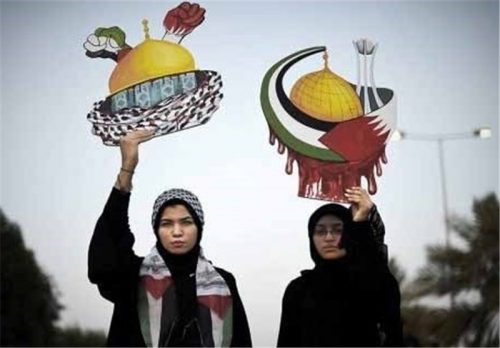
By Julia Kassem | American Herald Tribune | February 18, 2020
Nine years ago, on February 14 of 2011 to the date, massive anti-government protests swept Bahrain.
Yet the common narrative of Bahrain’s uprising as on the backburner of the failed Egyptian movement downplayed the real significance of Bahrain in struggle. Rather than writing it off as a failed after effect of the 2010-2011 Arab Spring protests, Bahrain should be recognized as a struggle of liberation against Western imperialism and occupation on par with the Palestinian struggle.
With a long, established root in history, and as the Resistance Axis scales up the regional call to expel US occupation following the assassination of IRGC General Qassem Soleimani, Bahrain deserves increasing attention.
Bahrain is a Persian Gulf island under the monarchist rule of the Al-Khalifa clan that had ruled Bahrain over two centuries, soon receiving the support of Britain following an 1820 treaty with the Al-Khalifa monarchs.
Post-Cold War, the United States would eclipse Britain as the main imperialist backer of Bahrain’s monarchy in the Middle East. As Britain tightened its relationship with Bahrain in 1919, it had also carved out the blueprint for the occupation of Palestine in 1917 under the Balfour Declaration.
The movement in Bahrain was brutally suppressed not just because of its uprising against one monarchy, but because of the unrelenting popular consensus by demonstrators for a government that is anti-Zionist, anti-American, and democratic. These calls were met with a brutal crackdown by Saudi-backed authorities that intervened a month later to quell the popular revolt.
Western media narratives had cast Bahrain’s uprising in the shadow of Egypt’s failed ‘revolution,’ relegating it to the backburner of a co-opted Arab “Sting.”
Bahrain may not have the highest number of American troops occupying the tiny island, with just neighboring Kuwait and Qatar hosting up to 13,000 US occupying forces each. Yet the tiny island, packs over 7,000 US troops, stationed, as of January 2020, in a tiny 765 km2 area.
It also has been made home to a US naval base since 1947, the oldest of its kind in the Middle East, established one year before the 1948 Nakba, the year the illegal Zionist occupation was made legitimate in the eyes of the so-called “international community.”
The United States’ Navy 5th Fleet, established in Bahrain in 1944 as the largest combat fleet in the world was only reestablished in 1995 after being inactive for 48 years. Yet it has situated itself as the useful output of US regional hegemony in the Persian Gulf, where the “area of responsibility for American fleets shuttling aircraft carriers and destroyers include pretty much every West Asian nation along the Red Sea, Gulf of Oman, Persian Gulf, and some of the Indian Ocean.
Poised for the US to have an easier shot at a number of nations under its threat, occupation, or watch, from Afghanistan, Lebanon, Syria, Iran, or Yemen, to a station to safeguard its the regimes it backs, like Jordan, Saudi Arabia, Bahrain, Egypt, and the UAE, its positionality is becoming even more critical in light of the US’s assaults, sea and land alike, against Iran.
History: Previous uprisings
To understand the reason behind the Western/Gulf insecurity behind popular uprisings in Bahrain, historically, one must draw upon the history of resistance against the monarchist elite in Bahrain.
An approximately 5-year uprising that began in 1994, the “uprising of dignity” by a coalition of both Shia and leftist factions against the ruling regime.
In 2006, the Al Bandar report revealed Saudi plans of sowing the seeds of sectarian tension in Bahrain, where a nearly $3 million financing of secret cells in the Bahraini government and its intelligence apparatuses, government-operated cover-NGOs, and sectarian propaganda was aimed at an intentional targeting of Bahrain’s more than 70% Shia majority.
That same year, Sheikh Abdul Amir al-Jamiri, a main spiritual leader of Bahrain’s Shia, passed away after decades of commitment and leadership to bringing justice to Bahrain. Al-Jamiri, the main leader of the mid-90s uprising, was credited for bringing secular leftist and Shia factions together in a unified call against a regime that, in its monarchy, was in service of capitalism, imperialism, and Zionism.
Yet al-Jamiri’s passing would later inspire the unified call for reform and revolt 17 years later. Unfortunately, Bahrain’s opposition coalition would accept the concessions put forth by the then-new emir Hamad al-Khalifa, enshrined in Bahrain’s 2001 National Action Charter.
Like the many agreements and negotiations handed to the Palestinians, this agreement, while bringing the country back to some provisions in the previous constitutional rule the monarchy clan stamped out in 1975, had the effect of doing little to curtail the economic and political supremacy of the monarchy and its systematic oppression of its majority population.
The Bahrain-Palestine connection
Both the oppressed of Bahrain and occupied Palestine have suffered for decades under the US’s ambitions to use their lands as military bases, supporting and backing neo-colonial regimes to help instill their political, economic, and military hegemony.
The illegitimate governments of both countries continue to US hegemony by, obviously, their military role as US-military bases but also for their benefits for US-dominated capitalism. For example, the Zionist entity’s tech sector has found its footing and high dependency on the U.S. economy. According to a December 2019 report by the ‘Israeli’ Ministry of Finance, US investments accounted for 35% of those in ‘Israeli’ tech in 2018, with the total amount of Israeli investors being lower at 30%. In Bahrain, the royal family has amassed at least $40 billion alone from 2000 to 2010 from land-grabbing schemes for development, both buying properties from the UK and brokering free-trade agreements with the US.
The result, in taking the lion’s share of land available for people’s commerce and trade, has caused a hike up in land and property prices, compounding the existing and intentional economic conditions of high native unemployment (at 35%) that afflicts the local youth. The Bahraini regime has accomplished essentially what the Israeli regime has in its occupation of Palestine: the weaponization of land grabbing as a regime-building tool as well as flooding the country with cheap, foreign labor effectively barring the native underclass from any economic agency or access.
More significant is the tactic and prevalence of arbitrary and forced detention endemic to the preservation of both US-backed regimes. Bahrain is the top country globally for political prisoners, with over 14,000 cases of arbitrary detention between 2011 and 2019 alone. This includes the detention of over 1,700 children. The Zionist entity, similarly, replicates this tactic and these projections: since 1967, the occupation has arrested over 800,000 Palestinians, including 50,000 children, with over 1,250 minors under arbitrary detention between 2011 and 2018 alone.
Characteristic of the Zionist and Bahraini regimes, in addition to their routine arbitrary detention of civilians and children, is their brutal imprisonment and torture of movement leaders and dissidents; especially those that have played vital roles in uniting the opposition.
This is exemplified by the detention of Marwan Barghouti or Khalida Jarrar in occupied Palestine or Ayatollah al-Qassem and Ebtisam el Sayegh in Bahrain. These are just a few of the hundreds of thousands of leaders and activists that have endured torture, repeated arrests, in order to quell the rich ideological leadership committed to resistance to occupation and oppression in both the Bahraini and Palestinian nations.
Both the Deal of the Century and the recent uptick in torture against Bahraini prisoners of conscience can give their thanks to the acceleration of support and reinforcement from the United States under the Trump administration.
The Obama administration did no more than offer a trickle of lip-service criticism against the Zionist and Bahraini regimes in his time in office, countered anyway by his first-term Secretary of State Hillary Clinton’s warm embrace of both: Clinton has always considered herself a “strong supporter” of the Occupying Entity as she did commend Bahrain’s king.
While the US’s arms sales to Bahrain had somewhat halted under Obama’s term, which had otherwise undergone the steady increase of bombings and drone warfare in the Middle East, due to human rights concerns, the Trump administration had carried out $5 billion in sales of Lockheed’s F-35 fighter jets to the monarchy in 2017.
In 2009, the Bahraini government had planned to spend a billion on security and defense in the country, looking to several Saudi and American defense contractors, including Lockheed Martin, for its purchases.
Just as Trump unveiled and greenlit his development-oriented “Deal” for Palestine, he had also, greenlit massive torture, along with arms sales, to the Zionist, Saudi, and Bahraini regimes.
As one torturer famously said to el Sayegh: “Do you know that we have a green light from Trump?”
Similar to how the Zionist entity employs its handsome security packages–a 2018 gift of $38 billion over 10 years–towards brutal neighborhood raids in the West Bank, its next site of total mass expulsion thanks in part to the Deal, Bahrain too has put Trump’s generous donations and pledges to mass raids.
Like the Zionist entity, the Bahraini regime regularly engages in mass-raids. Shortly after the 2011 uprising, over 430 members of the opposition Al-Wifaq party, also teachers, clinicians, and day-laborers were violently arrested in night raids.
The largest and most brutal case came shortly after Trump’s May 2017 “green light.” Bahrain’s security forces raided Sheikh al-Qassem’s home, shot and killing five demonstrators and arrested 286.
As Sondoss Al Assad, a Lebanese journalist who focuses especially on Bahrain wrote in a recent article for American Herald Tribune:
“Blessed by Trump’s Green Light, Manama has intensified its brutal measures, which also met out collective reprisal against scores of peaceful opposition figures and human rights advocates.”
Just last June, the convening to pass the Zionist-American “Deal of the Century” was hosted in Bahrain, signifying the tight-knit connection both the Zionist and Bahraini regimes have in extending their influence in the Levant and Persian Gulf fronts, transforming the lands they occupy into development enterprises as well as American military bases.
A Bahraini man Monday was sentenced three years for burning the flag of the illegal Zionist entity at an anti-’Israel’ demonstration last May. Bahrain, through history and in its present, is truly emblematic of, as Sayyed Hassan Nasrallah said in a February 16th speech, ‘a treachery platform conspiring against the Palestinian cause.”
For this reason, it is imperative that both Bahrain and occupied Palestine be at the heart of the Middle East’s liberation struggle. It is expected that the Deal will ignite an intifada and regional rejection that has been consistently brewing in occupied Palestine. At the same time, a regional consensus amongst the resistance axis to expel American presence and forces from all Arab and Muslim soil, particularly in Iraq, will be crucial in Bahrain, and draw the curtains of occupation on both these two birth-sites of US and British imperialism in the region.
Trump-Kushner “Peace” Plan ignores elephants in the room: Israel created this mess
The Trump-Kushner ‘Peace’ Plan is slick and businesslike, with an aura of objectivity and balance – but it’s exactly the opposite, and something about it stinks.
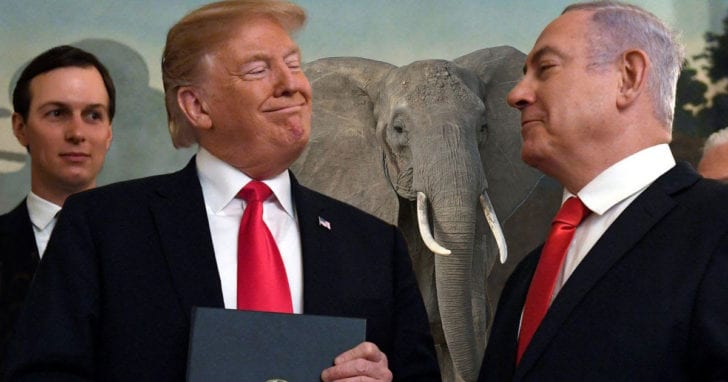
Israeli PM Benjamin Netanyahu and US President Donald Trump are always accompanied by their shared comfort animal, the elephant in the room (Photo-collage by If Americans Knew)
By Kathryn Shihadah – If Americans Knew – February 21, 2020
There is a giant herd of elephants circling the Trump-Kushner Peace Plan, and they’re not going away. The fragrance of pachyderms is unmistakable, but Trump administration, the Netanyahu government, and Israel partisans have decades of experience in ignoring whatever is inconvenient to their agendas.
That unmistakable throng of elephants is the disenfranchisement and subjugation of the Palestinian people that has gone for a hundred years, and is presently so flagrant that numerous human rights organizations and experts have called it apartheid.
And while the Trump administration claims it wants a future of peace, this Plan will not bring peace.
Because, elephants.
 Elephants from the get-go
Shortly after the Plan’s release, Kushner boasted on Fox & Friends, “This is an 80 page proposal, with a map. Never been done before.” Pachyderm prints are on every page (and the map), starting with the very first sentence:
“Israelis and Palestinians have both suffered greatly from their long-standing and seemingly interminable conflict.”
To start the document with this statement is to ignore a fundamental truth: the creation of Israel – the Zionist project – wreaked havoc on the people of Palestine, and continues to do so today.
Yes, both sides have suffered, but only one side has lost its homeland, lived under decades of injustice and oppression, and is being slowly starved and poisoned.
“Since 1946, there have been close to 700 United Nations General Assembly resolutions and over 100 United Nations Security Council resolutions in connection with this conflict.”
Missing factoid: Almost every one of the 800+ resolutions (Kushner left out 45 UN Human Rights Council resolutions) connected with this conflict, was critical of Israeli policies and actions that defied international law.
“These resolutions have not brought about peace.”
The resolutions have not brought about peace because (elephant alert) Israel has defied every one of them.
Elephants in basic assumptions: Palestinians “need” the Plan
The basic premise on which the Trump-Kushner Plan is based shows disdain for fundamental facts:
Palestinian society is languishing because of Israel’s policies – not some deficiency in Palestinians or their leadership.
Blaming Palestinian resistance
“For comprehensive peace to be achieved, it is up to the Palestinian people to make clear that they reject the ideologies of destruction, terror and conflict.”
Palestinian people aren’t committed to conflict – they are committed to resistance against occupation and apartheid (resistance is legal, but occupation and apartheid are illegal). For comprehensive peace to be achieved, Israel must abandon the elephants of discrimination and violence, and adhere to international law.
Blaming Palestinian backwardness
“The economic plan will empower the Palestinian people to build the society that they have aspired to establish for generations. It will allow Palestinians to realize a better future and pursue their dreams…By developing property and contract rights, the rule of law, anti-corruption measures, capital markets, a pro-growth tax structure, and a low-tariff scheme with reduced trade barriers, this initiative envisions policy reforms coupled with strategic infrastructure investments that will improve the business environment and stimulate private-sector growth.”
This suggests that the Palestinian people have been unable to build a great society because they lack a pro-growth tax structure and other first-world, art-of-the-deal schemes. While Kushner’s words dazzle, they ignore the myriad, incessant turmoil and economic hardship created by occupation, apartheid, and blockade. Israel has initiated wars, withheld food and medicine, and traumatized generations of Palestinians.
A 2016 publication by the UN Conference on Trade and Development (UNCTAD) noted:
The relationship between the Israeli economy and that of the Occupied Palestinian Territory remains that of two dissimilar and unequal economies, whereby the large, dominant economy practices policies that keep the small economy weak and dependent…depriving the Palestinian people of their ability to produce and, in the process, cultivating a dependence on the Israeli economy and donor aid.
Without the occupation, the Palestinian economy could easily produce twice the GDP it currently generates, while the chronic trade and budget deficits, as well as poverty and unemployment, could recede and the economic dependence on Israel could end.
Blaming Palestinian ineptness/laziness
“This Vision has been developed to reduce over time the Palestinians’ dependence on aid from the international community.”
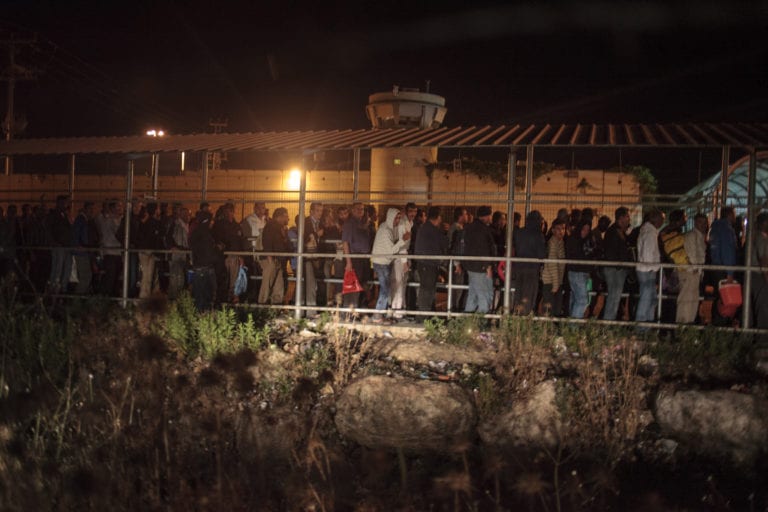
Palestinians have been aid-dependent because farmers have been restricted access to their fields, fishermen the sea, and workers their jobs; Israel has collected taxes on behalf of the Palestinian Authority (PA), and then refused to hand funds over; Israel denies access to needed medicines, building supplies, and parts to repair crucial equipment like power plants and flour mills; and Israel has often destroyed or confiscated items that were donated to the Palestinian people.
UNCTAD reported in 2019 that between 2000 and 2017, Israel’s occupation of the West Bank cost the Palestinian people approximately $47.7 billion – over $2.5 billion a year. As Israel controls agriculture (more below), exports, natural resources, and tourism, it deliberately siphons money away from the Palestinian economy and into its own coffers.
The way to reduce Palestinians’ dependence on aid is to free them from occupation and blockade so they can work and produce, instead of standing at checkpoints and fighting a system that is stacked against them.
Blaming Hamas
“Gaza has tremendous potential but is currently held hostage by…terrorist organizations committed to Israel’s destruction… [that are] fueling a war machine of thousands of rockets and missiles, dozens of terror tunnels and other lethal capabilities… Gaza is run by terrorists who provoke confrontations that lead to more destruction and suffering for the people of Gaza…
As a result of Hamas’ terror and misrule, the people of Gaza suffer from massive unemployment, widespread poverty, drastic shortages of electricity and potable water, and other problems that threaten to precipitate a wholesale humanitarian crisis.”
While Hamas’ rule leaves much to be desired, Hamas is not the cause of Gaza’s humanitarian crisis. Gaza is under a brutal blockade because its people dare to resist the de facto occupation of their land. Some militants shoot mostly-homemade rockets toward Israel in defiance – these “lethal” rockets (which began after Israeli violence) have killed about 50 Israelis in 19 years, while Israel’s army (the most powerful in the Middle East) has killed over 7,000 Gazan Palestinians in the same time period and at least 461 West Bankers and East Jerusalemites.
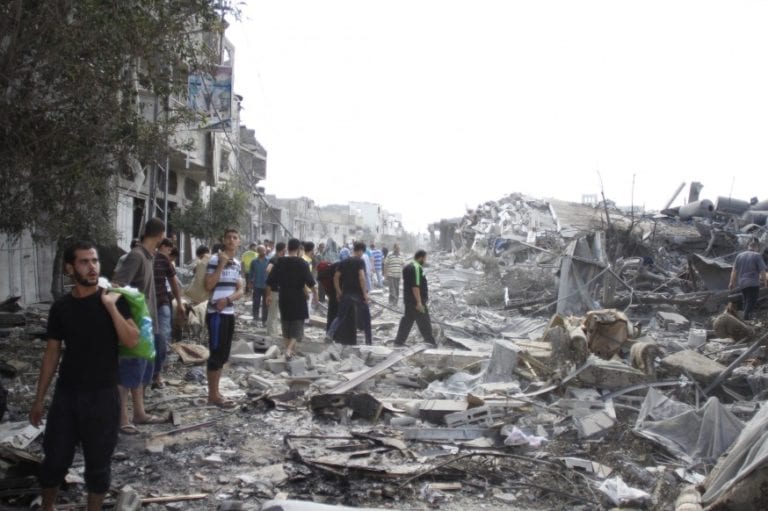
In the rush to demonize Hamas, Israel and its supporters (including Jared Kushner) once again disregard inconvenient facts: Hamas’ efforts are nothing more or less than resistance against oppressive, illegal Israeli policies; Hamas operations have been restrained; and – contrary to Israeli hype – its actions are not provocations but responses to Israeli provocation (not the least of which is the catastrophic blockade); Hamas has on multiple occasions offered long-term ceasefire deals, to which Israel has responded with violence; and most brokered ceasefires (79%) have been broken by Israel.
Hamas and other resistance groups’ actions have been less deadly than Israel’s by a large margin. Witness these statistics from Israeli human rights organization, B’Tselem:
“Peacetime,” Sept 2000 – Dec 2008
- 136 Israelis killed (14 by rockets)
- 3,000 Gazans killed
Israeli incursion into Gaza, 2008-9 (“to stop rockets”)
- 9 Israelis killed (4 by rockets)
- 1400 Palestinians killed
“Peacetime,” 2009-2012
- 3 Israelis killed (by rockets)
- 291 Palestinians killed
Israeli incursion into Gaza, 2012 (“to stop rockets”)
- 6 Israelis killed (by rockets)
- 174 Palestinians killed
“Peacetime,” 2012-14
- 1 Israeli killed (not by a rocket)
- 27 Palestinians killed
Israeli incursion into Gaza, 2014 (“to stop rockets”)
- 72 Israelis killed (17 by rockets)
- 2,200 Palestinians killed
Gaza/Israel since 2014
- 5 Israelis killed (1 by Gazan sniper, 4 by rockets)
- over 400 Gazans killed (most by Israeli snipers)
It is perhaps not surprising that multiple human rights organizations have placed the blame for the humanitarian crisis squarely on Israel’s shoulders.
For a Timeline of deaths in the conflict go here.
Elephants in basic expectations of the “Peace” Plan
Basic expectations of the Kushner Plan are unsound, blatantly partisan, and tell only the convenient parts of the story:
There will be no population transfer
“Peace should not demand the uprooting of people – Arab or Jew – from their homes. Such a construct, which is more likely to lead to civil unrest, runs counter to the idea of co-existence.”
This is a handy position to take after Israel has illegally transferred 600,000 Jews onto West Bank and East Jerusalem land stolen from Palestinians. “No population transfer” would have been a useful policy in 1948, to stop the Zionist army from depopulating hundreds of Palestinian villages and exiling 750,000 Palestinians, and then refusing to allow them to return. Transfer of population into occupied territory has been against international law since the Fourth Geneva Convention was ratified in 1949.
The transfer of Israeli Jews from their settlements back to Israel (also stolen) no doubt would cause “civil unrest,” but it was a grave error to position them in someone else’s land to begin with.
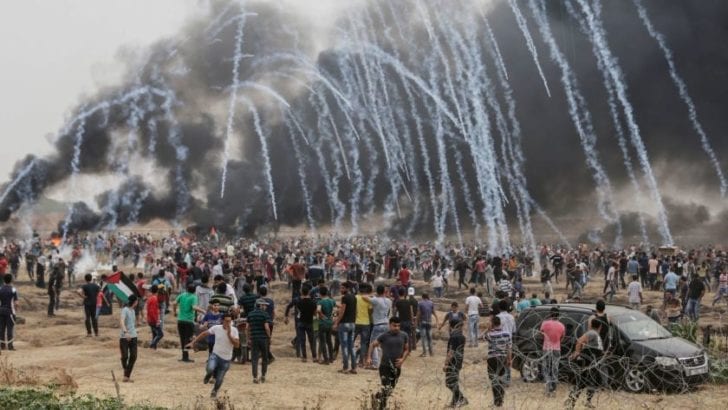
As an aside, when Palestinians participated in civil unrest circa 1939, protesting British rule and the population transfer of Jews into Palestine, they were brutally suppressed. In 1987, Israeli soldiers employed “force, might, and beatings,” in addition to live ammunition to subdue unarmed demonstrations against the occupation. The Great March of Return in Gaza, a massive and ongoing peaceful protest, has been answered with sniper fire. When Palestinians are the ones with grievances, no attempt is made to appease and avoid civil unrest.
Israel will sacrifice historical claims
“This Vision provides for the transfer of sizable territory by the State of Israel [to the Palestinians] – territory to which Israel has asserted valid legal and historical claims, and which are part of the ancestral homeland of the Jewish people — which must be considered a significant concession.”
This statement completely ignores Palestinians’ legal and historical claims to the land – their ancestral homeland. And while the claim of Jewish Israelis is based on a religious document and a short-lived mini kingdom 3,000 years ago, Palestinians have lived on the land recently enough to have Ottoman-era ownership records and deeds. Meanwhile, Israel controls all of the land. A large number of Palestinians have expressed willingness to settle for just 22% of what was once theirs. Is this not a significant concession on the part of Palestinians?
Of course, resolving a problem with these complexities isn’t easy, but no resolution will be valid when the arbiter is disingenuous.
Normalization as a starting point
“Since the moment of its establishment, the State of Israel has not known a single day of peace with all of its neighbors…The United States will strongly encourage Arab countries to begin to normalize their relations with the State of Israel…These countries are expected to end any boycott of the State of Israel and oppose the Boycott, Divestment, and Sanctions (commonly referred to as BDS) movement and any other effort to boycott the State of Israel.”
The statement that “Israel has not known a single day of peace with all of its neighbors” provokes another elephant alert: Israel started or caused its wars (Israel launched the Six Day War, the 1973 war was waged by countries trying to regain land that Israel had unlawfully taken over, and Israel has invaded Lebanon several times). In addition, both Jordan and Egypt recognized Israel long ago.
Ordering Arab neighbors to normalize relations with Israel in the current environment overlooks the legitimate reasons for the global BDS movement: Israel’s noncompliance with international law (not anti-Semitism).
Conflict with Israel’s neighbors was inevitable since the state was created on land belonging to another people group, who were pushed out to become a burden on their neighbors.
First Israel must make the appropriate changes. Then its neighbors – and the world – may consider normalizing relations.
Elephants in the education plan
“The [education] initiative will empower the Palestinian people to realize their ambitions. Through new data-driven, outcomes-based education options at home, expanded online education platforms, increased vocational and technical training… students can fulfill their academic goals and be prepared for the workforce.”
Again, the Trump-Kushner plan neglects the true reason why Palestinians can’t “realize their ambitions.” Under occupation, students often can’t get past checkpoints in time for classes; school days are regularly interrupted by Israeli military tear gas attacks or invasions, followed by arrests of students and/or teachers; a huge number of students have been traumatized by Israeli violence.
Against the odds, Palestinians have among the highest literacy rates in the world, and Gaza has one of the highest rates of PhD holders per capita in the world.
“While Palestinians have among the highest graduation rates in the region, many Palestinian schools are stretched beyond their capacity, with too few teachers and classrooms to support their students.”
In this statement, the Plan glosses over the fact that Palestinian students are succeeding at an impressive rate under impossible conditions. Their academic achievements should lead to a prosperous society, but it does not – because of the elephants.
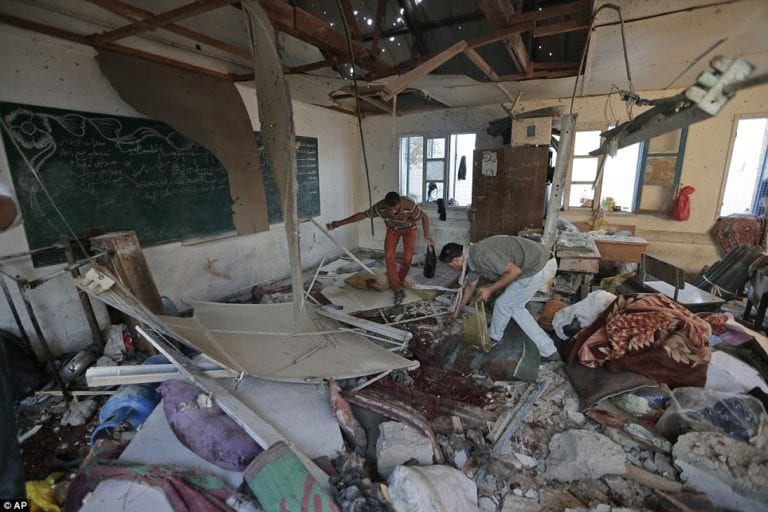
The statement also fails to mention that overcrowding is due to Israeli forces’ regular practice of demolishing and refusing building permits for West Bank schools. In Gaza, over half of the schools were damaged during an Israeli assault in 2014 – and many are still not rebuilt, since Israel regularly blocks the delivery of construction materials.
“Unfortunately, Palestinians currently experience one of the highest youth-unemployment rates in the world… By providing the Palestinian public sector with policy advice on best practices, encouraging private-sector attention to this problem, and promoting a comprehensive strategy to empower youth and women, more women and youth will join the Palestinian labor force.”
Senior Advisor Kushner is under the impression that Palestinians can’t flip their graduates into successful careers because they need foreign billionaires to give them advice. This is the height of arrogance.
Elephants in the agriculture plan
“While agriculture accounts for approximately eight percent of Palestinian employment, this sector has not met its potential due to limited access of Palestinian farmers to land, water, and technology. An improved business environment in the West Bank and Gaza and access to more land will create an enormous opportunity for farmers to expand their operations.”
Why in the world would Palestinian farmers have “limited access” to their own land? It’s a simple question with a simple answer: Israel has built a wall that separates farmers from much of their farmland. The International Court of Justice declared the wall illegal in 2004 (when it was less than half built) and ordered it torn down. In spite of this, Israel has continued construction along a route that effectively severs Palestinians from the nearly 10% of West Bank land – much of it agricultural – that lies outside the wall.

A 2016 publication by the UN Conference on Trade and Development (UNCTAD) noted some of the measurable effects of the occupation on Palestinian agriculture:
Since the onset of the occupation in 1967, the Palestinian people have lost access to more than 60 per cent of West Bank land and two thirds of its grazing land. In Gaza, half of the cultivable area and 85 per cent of fishery resources are inaccessible to Palestinian producers…
The UN Conference on Trade and Development (UNCTAD) reports that inside the wall, the Israeli expropriation for expanding illegal Israeli settlements and Jewish-only roads “includ[es] the most fertile and best grazing land.”
For those Palestinians who are able to access their land during the harvest season, much or all of their crops can be lost “due to violence and threats by settlers” – who are aided and abetted by the Israeli military.
Up to 1 million olive trees and 2.5 million fruit trees have been uprooted since 1967, many due to illegal Israeli settlement expansion and the construction of the wall, others as a form of vandalism.
All told, the occupation caused a drop in agricultural sector from over half of the Palestinian GDP prior to 1967, to just 6% by 2012.
In addition, Israeli military and illegal settlers destroy or vandalize infrastructure, buildings, and water systems, and the Israeli government restricts the import of fertilizers, seedlings, and certain types of livestock, ensuring “that most of the advantages present in the Israeli agricultural sector are beyond the reach of Palestinian farmers.”
Again, the assistance Palestinians need is not advice from billionaires, but freedom from Israeli domination and oppression.
Elephants in the water and wastewater plan
“The parties [must] recognize mutual water rights… [s]hared aquifers… and jointly seek to provide easily available, reasonably priced water to both parties.”
The wording in this statement suggests that Israel and the Palestinians endure roughly equal water hardship and suffer from exorbitant prices.
In reality, one of the “parties” already has more than enough water, the other too little, too expensive, and too toxic. Again, UNCTAD spells out the cause:
Palestinian farmers are denied the right to construct wells to meet the growing demand for water, even when that water originates almost entirely in the West Bank… [O]rganizations, such as Oxfam, report that Palestinian assets, including sources of water, have often been vandalized by Israeli settlers…
Environmental degradation is also caused by settlers, through the discharge of untreated wastewater into nearby wadis and release of solid domestic and industrial waste from settlements onto Palestinian lands. In addition, several incidents of dumping of hazardous and toxic waste in the West Bank have been documented.
Israel confiscates 82% of Palestinian groundwater for its own use or that of its settlers, piping it efficiently to Israelis, but avoiding Palestinian villages. Many poor Palestinian families spend up to 40% of their meagre income on trucked-in, high-priced water.
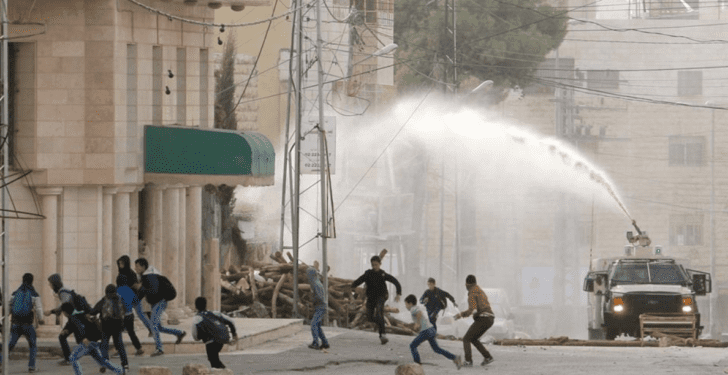
In addition, the Israeli military routinely destroys Palestinians’ own water pipes and wells. And as a variation on the theme, the Israeli military uses skunk water to break up protests or as collective punishment. (some US police forces have imported the product).
In Gaza, the situation is even more dire, with 97% of its water unfit for human consumption, thanks in great part to Israeli restrictions on import of supplies needed for wastewater treatment.
Elephants in the healthcare plan
“The [healthcare] program will provide new resources and incentives to transform the Palestinian healthcare sector and ensure the Palestinian people have access to the care they need within the West Bank and Gaza. This program will rapidly increase the capacity of Palestinian hospitals by ensuring that they have the supplies, medicines, vaccines, and equipment to provide top-quality care and protect against health emergencies.”
Once again, the Kushner Plan insinuates that Palestinians lack proper health care because they lack enlightenment or competence.
In reality, the healthcare sector in Gaza is in disarray because hospitals have been bombed, medicines and equipment have been withheld by the blockade, and huge numbers of critically wounded people seek medical help – many with devastating injuries from Israeli weapons that are likely illegal. Over the years, the Israeli military has shown a pattern of denying Palestinian women in labor permission to go to the hospital; Israeli soldiers chase away ambulances (even from small children), ultimately leaving Palestinians to die.
To top it off, the Trump administration recently cut off aid to hospitals in East Jerusalem.
These are some of the factors that have caused an infant mortality rate in the Palestinian territories of 18.8 per 1,000 births (in Israel mortality is 3.7/1,000), and an average life expectancy for Palestinians of 74 (vs. 83 for Israelis).
Elephants in the sports and athletics plan
“[S]ports and athletics can help Palestinian youth foster new ties…and Palestinian teams can be a source of entertainment and pride for all Palestinians. This project will expand options for competitive, healthy activities for Palestinians through the construction of public athletic facilities in the West Bank and Gaza. This project seeks to inspire the next generation of Palestinian athletes dreaming to be on, and training for, future Palestinian teams competing on the world stage.”
Sports and competition are already in the hearts of Palestinians – they don’t need Jared Kushner to inspire them. What they do need is an end to the occupation that denies them permits to participate in events, holds them back from competing in the Olympics, and maims their bodies. Even children playing soccer on the beach are unsafe under Israeli oppression.

Elephants in the transportation plan
“[Palestinians face] transportation challenges. The lack of ports has raised the costs of Palestinian economic activity. Though the State of Palestine will include Gaza, security challenges make the building of a port in Gaza problematic for the foreseeable future.”
This notion is illegal according to the UN Convention on the Law of the Sea. Gaza has 25 miles of shoreline, but the Israeli-American coalition would forbid Palestinians from building a port. This is not how self-determination and sovereignty work. The Plan would essentially enforce the devastating, 13-year-old, illegal blockade, and license the now 53-year de facto occupation, as Israel would control all Palestinian imports and exports.
Conclusion
“Generations of Palestinians have lived without knowing peace, and the West Bank and Gaza have fallen into a protracted crisis.”
Did Palestinian bad luck cause them to “fall” into a “protracted crisis”? No, Palestinians have had a protracted crisis forced upon them – by Israel. They have resisted in every way they know how, but to no avail.
Reading the Kushner Plan, one would never know that the devastation, the desolation within Palestinian society was created by Israel. In 181 pages and a map, there is no acknowledgement that the Zionist project brought great injustice to generations of Palestinians.
“Yet the Palestinian story will not end here. The Palestinian people continue their historic endeavor to build a better future for their children.”
Correct: Palestinians have endeavored for generations to build a future that includes justice, freedom, and equality – and they have no intention of giving up.
“If implemented, Peace to Prosperity will empower the Palestinian people to build the society that they have aspired to establish for generations. “
Incorrect: Palestinians don’t need a plan imposed on them by Western businessmen – they need justice, freedom, and equality, which Israel has steadfastly withheld.
“Ultimately, however, the power to unlock it lies in the hands of the Palestinian people. Only through peace can the Palestinians achieve prosperity.”
A better statement might be, “Only through justice can there be peace and prosperity. Israel and the US have the power to bring justice.”
“While the vision is ambitious, it is achievable. The future of the Palestinians is one of huge promise and potential. The Palestinian story does not end here. Their story is just being written.”
The story is just being written…by a partisan, privileged group that has nothing but disdain for the Palestinian people. They promise no peace, only more elephants.
Netanyahu between the Nakba Arabs and the Arabs who are a joke
By Wael Qandil | Al-Arabi Al-Jadeed | February 21, 2020
The Arabs agreed in 1948 on the decision to form combat groups against the Zionist colonisation of the land of Palestine, which was known as the Nakba. Exactly 72 years later, the Arabs seem closer to form a united combat force to fight those rejecting the Zionist colonisation of Palestine.
It does not seem that the joke recently posted by a sarcastic Twitter activist about Saudi Arabia’s condemnation of the Palestinian people’s actions against the Israeli occupation will remain a joke for long, as all of the facts and indications say that the Arab capitals are very close to taking measures against those who refuse normalisation and the “deal of the century”. The Arab leaders’ patience is running out with the Palestinian resistance factions, who are disturbing the relationship between these leaders and Israel.
Matters rushing in this direction is not a new phenomena. It was announced and put into effect at least five years ago and many are competing to serve this. They are not ashamed to voice their approval of Israel’s leadership in the region and the first to voice this was General Abdel Fattah Al-Sisi, who is loved and supported by all Zionists, especially their rabbis and generals.
More than four years ago, the right-wing Zionist newspaper Makor Rishon revealed that Al-Sisi confirmed, before the leaders of the American Jewish organisations, his admiration for Netanyahu’s personality and leadership capabilities. The newspaper’s correspondent, Zvika Klein, wrote that the leaders of the Conference of Presidents of Major American Jewish Organisations in the United States informed Netanyahu during their meeting with him, on the side-lines of a meeting organised by the committee in occupied Jerusalem, that Al-Sisi told them that Netanyahu is “a leader with great powers that help him not only lead his country, but also could propel the region – even the world – forward.”
Well, here is the ruling general of the oldest Arab sister stripping his country of leadership of the region and giving it to Israel/Netanyahu to succeed him. Following in his footsteps is Mohammad Bin Salman, Saudi crown prince, who learned from Al-Sisi how to reach power through Israel. The story begins with hosting Trump and his family in Riyadh in order to establish the “moderate” alliance, the idea of which was proposed, formulated and developed years ago by Benjamin Netanyahu. Trump then leaves Saudi Arabia with more than $450 billion and lands in occupied Jerusalem wearing a skullcap.
In 2018, in anticipation of Saudi Arabia’s hosting of the Dhahran Summit, the Saudi crown prince held an interview with America’s Atlantic magazine, in which he announced a vision completely aligned with Israel’s for the Middle East according to extremist rabbis, violent generals and the Knesset hawks and doves. He spread his free kisses and gifts by stating that he was surrounded by enemies except for Israel and the so-called “axis of moderation” made up of the four parties that besieged Qatar. He said: “We are in an area not surrounded by Mexico, Canada, the Atlantic and Pacific oceans. We have ISIS, Al-Qaeda and Hamas and Hezbollah and the Iranian regime, and even pirates.”
This insight took a practical form when Al-Riyadh newspaper, the mouthpiece of the government, stated, before the summit opening: “Today, the Arabs have no choice but to reconcile with Israel, to sign a comprehensive peace agreement, to devote themselves to confronting the Iranian project in the region and its nuclear program, and to put an end to its interference in Arab affairs. This is an option that cannot be delayed with any justification, even [accusations of] bargaining with and auctioning the Palestinian cause, because Iran poses a direct threat to all.”
Thus, without vagueness, and very early on, the capitals of the two largest Arab countries delivered the badge and cloak of leadership to Israel, until we reached a stage where Benjamin Netanyahu was authorised, alone, to speak about the pilgrimage trips from Israel to Saudi airports, promising that the Israelis will fly in the skies of Saudi Arabia soon. It is at this same stage that the Egyptian military man may find himself entrusted with the war against the Palestinian people, if the gas pipeline from the occupation to Egypt is damaged or endangered, when an uprising breaks out in the areas the pipeline passes through.
What misery awaits a nation that clashes with itself over who will serve its enemy more?
Translation by MEMO.
“The Donald Trump I know”: Abbas’ UN Speech and the Breakdown of Palestinian Politics
By Ramzy Baroud | Dissident Voice | February 20, 2020
A precious moment has been squandered, as Palestinian Authority President, Mahmoud Abbas, had the chance to right a historical wrong, by reinstating Palestinian national priorities at the United Nations Security Council on February 11, through a political discourse that is completely independent from Washington and its allies.
For a long time, Abbas has been a hostage to the very language that designated him and his Authority as ‘moderates’ in the eyes of Israel and the West. Despite the Palestinian leader’s outward rejection of the US ‘Deal of the Century’ – which practically renders Palestinian national aspirations null and void – Abbas is keen to maintain his ‘moderate’ credentials for as long as possible.
Certainly, Abbas has given many speeches at the UN in the past and, every single time, he has failed to impress Palestinians. This time, however, things were meant to be different. Not only did Washington disown Abbas and the PA, it also scrapped its own political discourse on peace and the two-state solution altogether. More, the Trump administration has now officially given its blessing to Israel to annex nearly a third of the West Bank, taking Jerusalem ‘off the table’ and discarding the right of return for Palestinian refugees.
Instead of directly meeting with leaders of the various Palestinian political parties and taking tangible steps to reactivate dormant but central political institutions such as the Palestinian National Council (PNC) and the Palestine Liberation Organization (PLO), Abbas preferred to meet with former Israeli right-wing Prime Minister, Ehud Olmert, in New York, and to carry on regurgitating his commitment to a by-gone era.
In his UN speech, Abbas said nothing new which, in this instance, is worse than not saying anything at all.
“This is the outcome of the project that has been introduced to us,” Abbas said, while holding a map of what a Palestinian state would look like under Donald Trump’s ‘Deal of the Century’. “And this is the state that they are giving to us,” Abbas added, referring to that future state as a ‘Swiss cheese’, meaning a state fragmented by Jewish settlements, bypass-roads and Israeli military zones.
Even the term ‘Swiss cheese’, which was reported in some media as if a new phrase in this ever-redundant discourse, is actually an old coinage that has been referenced repeatedly by the Palestinian leadership itself, starting with the onset of the so-called peace process, a quarter of a century ago.
Abbas labored to appear exceptionally resolute as he emphasized certain words, like when he equated the Israeli occupation with the system of apartheid. His delivery, however, appeared unconvincing, lacking and, at times, pointless.
Abbas spoke of his great ‘surprise’ when Washington declared Jerusalem as Israel’s undivided capital, subsequently relocating its embassy to the occupied city, as if the writing was not already on the wall and that, in fact, the embassy move was one of Trump’s main pledges to Israel even before his inauguration in January 2017.
“And then they cut off financial aid that was given to us,” Abbas said in a lamenting voice with reference to the US decision to withhold its aid to the PA in August 2018. “$840 million are held from us,” he said. “I don’t know who is giving Trump such horrid advice. Trump is not like this. Trump that I know is not like this,” Abbas exclaimed in a strange interjection as if to send a message to the Trump administration that the PA still has faith in the US President’s judgement.
“I would like to remind everyone that we have participated in the Madrid peace conference, and the Washington negotiations and the Oslo agreement and the Annapolis summit on the basis of international law,” Abbas recounted, signaling that he remains committed to the very political agenda that reaped the Palestinian people no political rewards whatsoever.
Abbas then went on to paint an imagined reality, where his Authority is supposedly building the “national institutions of a law-abiding, modern and democratic state that is constructed on the basis of international values; one that is predicated on transparency, accountability and fighting corruption.”
“Yes,” Abbas emphasized, as he looked at his audience with theatrical seriousness, “We are one of the most important countries (in the world) that is fighting corruption.” The PA leader, then, called on the Security Council to send a commission to investigate allegations of corruption within the PA, a bewildering and unnecessary invitation, considering that it is the Palestinian leadership that should be making demands on the international community to help enforce international law and end the Israeli occupation.
It went on like this, where Abbas vacillated between reading pre-written remarks that introduce no new ideas or strategies and unnecessary rants that reflect the PA’s political bankruptcy and Abbas’ own lack of imagination.
The PA President, of course, made sure to offer his habitual condemnation of Palestinian ‘terrorism’ by promising that Palestinians would not “resort to violence and terrorism regardless of the act of aggression against us.” He assured his audience that his Authority believes in “peace and fighting violence.” Without elaborating, Abbas declared his intention of continuing on the path of “popular and peaceful resistance,” which, in fact, does not exist in any shape or form.
This time around, Abbas’ speech at the UN was particularly inappropriate. Indeed, it was a failure in every possible way. The least, the Palestinian leader could have done is to articulate a powerful and collective Palestinian political discourse. Instead, his statement was merely a sad homage to his own legacy, one that is riddled with disappointments and ineptitude.
Expectedly, Abbas returned to Ramallah to greet his cheering supporters once more, who are always ready and waiting to raise posters of the ageing leader, as if his UN speech had succeeded in fundamentally shifting international political momentum in favor of Palestinians.
It has to be said that the real danger in the ‘Deal of the Century’ is not the actual stipulations of that sinister plan, but the fact that the Palestinian leadership is likely to find a way to co-exist with it, at the expense of the oppressed Palestinian people, as long as donors’ money continues to flow and as long as Abbas continues to call himself a president.
Ramzy Baroud is a journalist and the Editor of The Palestine Chronicle. He is the author of five books. His latest is “These Chains Will Be Broken: Palestinian Stories of Struggle and Defiance in Israeli Prisons” (Clarity Press, Atlanta). Dr. Baroud is a Non-resident Senior Research Fellow at the Center for Islam and Global Affairs (CIGA), Istanbul Zaim University (IZU). His website is http://www.ramzybaroud.net
Hamas delegation meets Russia’s Deputy Foreign Minister
MEMO | February 20, 2020
A senior Hamas delegation has met with Russia’s Deputy Foreign Minister Mikhail Bogdanov in Doha, the capital of Qatar.
In a statement issued on Wednesday, the Islamic Resistance Movement said that its delegation was led by the head of its International Office, Mousa Abu Marzook, accompanied by Political Bureau member Sami Khater and the former leader of its Political Bureau, Khaled Meshaal, as well as its representative in Moscow.
The Hamas delegation briefed Bogdanov on the latest political developments in the Palestinian cause, including the US “deal of the century”.
They reiterated that the deal is targeting the Palestinian people, their legitimate right to return and the efforts to establish an independent and sovereign state, which is why it has been rejected not only by the movement, but also all segments of Palestinian society.
Bogdanov reaffirmed his country’s support for the Palestinian people and rejection of any “peace plan” rejected by them. Russia, he explained, is ready to provide support for the Palestinians in order to end the internal division and achieve the national unity that is the key to achieving their legitimate objectives.
Furthermore, the Russian official stressed that the Israeli-Palestinian conflict should be solved on the basis of international law, including UN General Assembly resolutions and the Arab Peace Initiative.
The PA is blindly accepting international impositions on Palestinians
By Ramona Wadi | MEMO | February 20, 2020
Israel and the Palestinian Authority have been trading the same rhetoric about not having a suitable partner for diplomatic negotiations. The senior adviser and spokesman for Mahmoud Abbas, Nabil Abu Rudeineh, recently took the statement further to again assert the PA’s distaste for legitimate armed resistance. This was his attempt to reassure Israel about the PA’s commitment to remain tethered to failed diplomacy.
“The Palestinians do not want violence and it is very important for us that the Israelis know this and understand that our path is not violent,” Abu Rudeineh told Israeli political correspondents. Why would the PA seek to reassure the colonial presence in Palestine built and maintained upon violence that the colonised population are not seeking to use violent measures to escape from the Israeli yoke?
Unlike Israel’s ongoing ethnic cleansing of the Palestinian population and other measures such as its colonial settlement expansion, which are clearly defined as war crimes by international law, Palestinian resistance against the colonial violence of occupation is entirely legitimate. Abu Rudeineh is doing Palestinians yet another disservice by refusing to recognise the whole spectrum of the anti-colonial struggle. Furthermore, the PA does not differentiate between various forms of violence, which are defined by context.
It is the Palestinians who should be seeking reassurances that no further violence will be inflicted upon them. However, the normalisation of Israeli violence, combined with the diplomacy which allows Israel to function as a violent colonial state, prevent Palestinians from making such demands.
![A group of protesters gather in front of United Nations headquarters to protest against U.S. President Donald Trump's Middle East plan as Palestinian President, Mahmoud Abbas speaks at the UN Security Council meeting in New York, United States on 11 February 2020. [Islam Doğru - Anadolu Agency]](https://i2.wp.com/www.middleeastmonitor.com/wp-content/uploads/2020/02/20200211_2_40796245_52056273.jpg?resize=933%2C622&quality=85&strip=all&ssl=1)
Protesters at the UN headquarters oppose U.S. President Donald Trump’s Middle East plan as Palestinian President, Mahmoud Abbas, speaks at the UN Security Council meeting in New York on 11 February 2020. [Islam Doğru – Anadolu Agency ]
What’s more, Palestinians are not guaranteed protection from Israeli violence; their rights are simply brushed aside. To make matters worse, Abu Rudeineh has eliminated this factor in his discussions regarding future “peace negotiations” to enable the façade of Israel’s “victim” status to be preserved. In keeping with the parameters set by the international community’s endorsement of Israel’s false “security” and “self-defence” narrative, Abbas’s spokesman is misrepresenting the Palestinian anti-colonial struggle and, as a result, regaling Israel with further opportunities to portray itself as the only democratic partner in negotiations. The PA would do well to remember that such talks would not have been necessary if the UN had taken the necessary steps to halt the earlier settler-colonial presence in Palestine and thus prevented Israel from manifesting itself on ethnically-cleansed Palestinian land.
However, the PA is merely absorbing the external narratives imposed by the international community on one hand, and the US on the other, the latter through its so-called “deal of the century”. The constant definition of the Palestinians according to external agendas have damaged the Palestinian cause beyond recognition.
Non-violent resistance and diplomacy have been manufactured by the international community as acceptable paths for Palestinians precisely because, on their own, they fragment the efficacy of anti-colonial struggle. The right to resist colonialism by all means is legitimate, whether diplomatic negotiations are taking place, or might be taking place in the future. Neither the international community nor the PA have the right to prevent Palestinians from exercising their right to armed struggle. It is a decision that must be made by the people themselves, since the Palestinian leadership has long abandoned the Palestinian cause to curry favour with the international community for its own self-serving hierarchy.
There is no need to reassure Israel as Abu Rudeineh has done; the only reminder that Israel needs is that Palestinians have every right to reclaim their land. Beyond that assurance, the PA’s rhetoric must be seen for what it is; an additional means of destroying the Palestinian struggle, for the benefit of Israel and the international community.
Israeli policy of assassinations cannot terrorize Palestinians to accept Trump’s deal: Nakhala

Secretary-General of the Palestinian Islamic Jihad resistance movement Ziad al-Nakhala speaks during a televised speech broadcast live from Gaza City on February 19, 2020.
Press TV – February 19, 2020
The secretary-general of the Palestinian Islamic Jihad resistance movement says the Tel Aviv regime’s plan to return to “the policy of assassinations” against distinguished figures of Palestinian resistance groups in the Gaza Strip cannot terrorize Palestinians to acknowledge US President Donald Trump’s so-called deal of the century on the decades-old Israeli-Palestinian conflict.
“The policy of assassinations will not make the Palestinian people give up their rights, nor will it manage to break up the resistance front. We will respond to any assassination in time, and any act of aggression against our people in the Gaza Strip will be met with resistance that the occupation [Israel] has not experienced before,” Ziad al-Nakhala said in a televised speech broadcast live from Gaza City on Wednesday afternoon.
He added, “The threats of enemy leaders will not intimidate us, nor will make us accept what they have crafted and called the deal of the century. They will not make us relinquish our historical rights in Palestinian lands and al-Quds (Jerusalem).”
‘Oslo Accords bore nothing for Palestinians other than humiliation’
Nakhala also censured the Oslo Accords signed between the Palestine Liberation Organization (PLO) and the Israeli regime more than two decades ago, stating that the set of agreements brought nothing for Palestinians other than humiliation, shame and delusions.
“We presented our history as well as our children, and sacrificed them on the altar of delusion of peace. We reaped nothing other than despair that was represented by the deal of the century,” he pointed out.
The Oslo Accords — consisting of Oslo I and Oslo II accords — were signed by the late chairman of the PLO, Yasser Arafat, and former Israeli Prime Minister Yitzhak Rabin, respectively in Washington DC, in 1993 and Egypt in 1995. The purported goal of the accords was to achieve peace based on the United Nations Security Council resolutions 242 and 338, and to realize the right of the Palestinian people to self-determination.
The senior Palestinian official also lambasted some Arab and Muslim countries for supporting and acknowledging Trump’s proposal in the eye of the international community.
Nakhala then called upon all Palestinian resistance movements to join forces, and tirelessly protect Jerusalem al-Quds and the Palestinian cause from liquidation.
‘The US decision to declare al-Quds as the capital of Israel was not surprising, given that America is the sponsor of the Zionist project ever since its inception (back in 1948). It is a full partner to this project, and is in fact spearheading the Western project in our region,” he underscored.
On January 28, Trump unveiled his so-called deal of the century, negotiated with Israel but without the Palestinians.
Palestinian leaders, who severed all ties with Washington in late 2017 after Trump controversially recognized Jerusalem al-Quds as the capital of the Israeli regime, immediately rejected the plan, with President Mahmoud Abbas saying it “belongs to the dustbin of history.”
Palestinian leaders say the deal is a colonial plan to unilaterally control historic Palestine in its entirety and remove Palestinians from their homeland, adding that it heavily favors Israel and would deny them a viable independent state.
Featured Video

Diplomacy is Now a Crime in Britain / Ian Proud
or go to
Aletho News Archives – Video-Images
From the Archives
Genetic baloney in thick slices
MAYBE COULD BE INC.
By Jon Rappoport | No More Fake News | July 8, 2021
Gene research companies tend to come and go. They start out banging and popping like fireworks in the sky, and then they fade out—selling themselves to larger outfits who’ve hired better liars…
Once upon a time, it sounded easy. Start with a disease, find the gene responsible for the disease, and correct the problem.
Then, researchers wondered, was disease the result of one gene or a group of genes acting together?
Either way, the proof would be in devising cures for diseases using gene therapy. “Not yet, but soon…”
And regardless, the major need was: money. Lots and lots of money.
This need required good PR people. “We have to pump up the idea that we’re on the edge of tremendous breakthroughs. We’re always on that edge…”
This hype also needed to obscure the fact that there wasn’t (and isn’t) ANY gene cure for ANY disease. … continue
Blog Roll
 Aletho News
- Diplomacy is Now a Crime in Britain / Ian Proud
- UK Government Body Kept Files on People Criticizing Prevent Program
- US military withdrawal from Iraq and the collapse of US-Israeli hegemonic project in West Asia
- What does Europe want – a war with Russia?
- She Followed the Actual Data on COVID Vaccines and Masks — Her Career Took a Huge Hit
- Florida AG Sues Pfizer, Bourla Over Deceptive Marketing of COVID Vaccines
- Von der Leyen gifts her spin doctor a job for life
- 10K More U.S. Troops Deploy as Trump Weighs New Iran Strikes /Suliaman Ahmed
- Iranian crew declared Dena training vessel ‘unarmed’ to US warship before deadly torpedo strike: Report
- Iran’s NPT debate moves beyond parliament
- If Americans Knew
- An error has occurred; the feed is probably down. Try again later.
- No Tricks Zone
- Green Energy Debacle: German Expert Professor Fritz Vahrenholt Warns Of Severe Economic And Social Consequences
- Two More Paleo Reconstructions Affirm Meters-Higher Sea Levels Across Ireland, Brazil 7000-6000 Years Ago
- New Study: Earth And Venus Surface Warmth Largely Explained By Convection And Lapse Rate, Not CO2 Or Radiation
- 2025 Nature Paper Claiming Worsening Global Drought Gets RETRACTED …Heavily Flawed
- New Study: ‘Global Drought Shows No Detectable Recent Acceleration Under Climate Warming’
- Economic Masterminds: German Socialists Suggest Taxing Productivity Gains Stemming From Using AI
- The South China Sea Has Not Been Cooperating With The Climate Change Narrative
- Energy Crisis: Germany Enters Heating Season With Historically Low Gas Reserve Fill Levels
- New Study: The Antarctic Ice Sheet Gained Mass From 2020-2024 Due To Staggering Snow And Ice Accumulation
- Study: Ocean Heating Rates From Thousands Of Years Ago ‘Dwarf’ Modern Ocean Heating Rates

