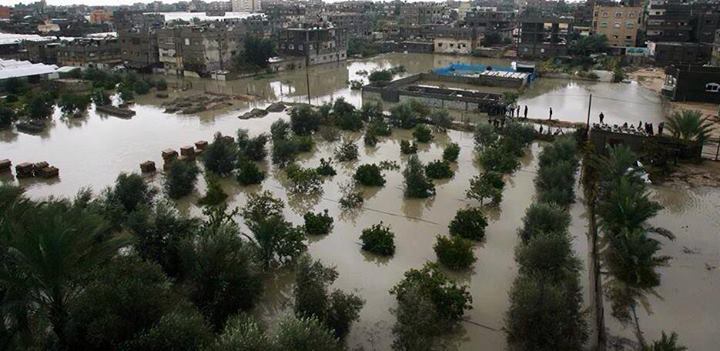
BETHLEHEM – The Gaza Government’s Disaster Response Committee announced late Friday that Israeli authorities had opened up dams just east of the Gaza Strip, flooding numerous residential areas in nearby villages within the coastal territory.
Committee chairman Yasser Shanti said in a press conference that Israeli authorities had opened up dams just to the east of the border with the Gaza Strip earlier in the day.
He warned that residential areas within the Gaza Valley would be flooding within the coming hours.
He said that the move by Israeli authorities would flood areas in Moghraqa and other parts of Deir el-Balah in central Gaza, and he called upon residents of areas near the Gaza Valley to evacuate their homes in preparation for the anticipated flooding.
The Gaza Strip is currently under a state of emergency due to severe weather conditions caused by a historic storm front moving south across the Levant.
Fuel shortages have caused daily life in the Gaza Strip to grind slowly to a halt since early November, as power plants and water pumps are forced to shut down, cutting off access to basic necessities for Gaza residents.
Lack of diesel fuel is a result of the tightening of a seven-year-long blockade imposed on the territory by Israel with Egyptian support.
The Gaza Strip has been under a severe economic blockade imposed by the State of Israel since 2006.
GAZA — Israeli occupation forces opened on Sunday Wadi Sofa dam east of Rafah, south of the Gaza Strip, flooding dozens of Palestinian homes, local sources said.
The IOF opened its dams towards Palestinian houses without any prior warning for the second time since the stormy weather hit the region recently.
Rescue teams have evacuated trapped people from their flooded houses and transferred them to safe places and shelter centers.
Several Israeli earth dams have been established to the east of Gaza Strip, in order to benefit from rainwater and prevent its access to Gaza; however in such cases the Israeli occupation opens its dams toward the Strip to prevent swamping its agriculture lands.
Many residential areas and agricultural lands in Gaza were flooded when the Israeli authorities opened up the dams, which aggravated the population’s suffering. … Full article
By Richard Edmondson | Fig Trees and Vineyards | December 17, 2013
It has been reported in the past several days, by Ma’an News and on several websites including this one, that Israel may have opened one or more dams resulting in the severe flooding we have seen in Gaza and further exacerbated conditions already made dire by the onslaught of winter storm Alexa. This at any rate is the charge that has been made by the Gaza government’s Disaster Response Committee and its chairman, Yasser Shanti.
So far I myself have heard no official response from Israel either confirming or denying. However, the following is reported by the Middle East Monitor:
According to Israel’s Yedioth Ahronoth newspaper, the rainfall led to a lot of excess water which couldn’t drain away, so “the Israeli authorities resorted to discharging the excess water into the Gaza Strip.”
I could not find this reported on Ynet’s English website, but it’s possible it was reported in the Hebrew edition. So was a dam released? All we have to go on is the statement by Shanti, accompanied, of course, by the shocking images we have seen of inundated streets, flooded homes, and people paddling in boats. But I did come across this video and thought I would share it. If it turns out that a dam or floodgate of some sort was deliberately released, it apparently would not be without precedent. The following was reported by Press TV in January of 2010—and take special note of what the reporter says regarding the flooding and its coinciding with the one-year anniversary of the close of Israel’s Operation Cast Lead.
If Israel did this in 2010, does it beggar belief they would have done the same thing again this past week? If they did, the question then becomes did they do it out of a) a need to divert flooding from their own communities in Israel, or b) pure malice?
The question of whether a dam was opened or floodwater in some way diverted is addressed in a report on the Gaza flooding published at The Ecologist, an environmental website:
Amid the chaos it is impossible to verify the accusations. The heavy rain has also affected bordering areas of Israel and whether or not dams have been deliberately opened, drainage systems in Sderot and other cities were certainly overwhelmed by the volume of water.
What is certain is that low-lying Gaza, on the coastal plain, lacking functioning drainage and sewage systems, would in any case suffer most severely from the rainfall. Moreover Israel already stands accused of deliberately running down basic sanitation services in Gaza in order to make life unlivable for its residents.
And as Gaza resident Fidaa Abuassi points out: “Unlike their neighbors in Sderot Gaza’s refugees have nowhere to flee when heavy rains flood their 25-mile occupied territory, blockaded by land, air, and sea.”
Even as the floodwaters recede, there may be worse to come. The report warns of what most likely is an “impending health catastrophe” in the making, with a flare up of respiratory and skin diseases brought on by constant exposure to sewage water and lack of medical supplies.
A loud buzz of chainsaws greets our arrival following a call from Tuqu’ – a Palestinian village of about 12,000 people, south of Bethlehem in the West Bank. We find Israeli soldiers overseeing the destruction of row after row of mature olive trees.
The Palestinian farmers remonstrate with the army. They have land ownership documents dating back generations from the Jordanian, British and Ottoman administrations, but their arguments are ignored by the soldiers holding them back at the gunpoint. I notice a woman pleading with soldiers who order her away, but she will not let up.
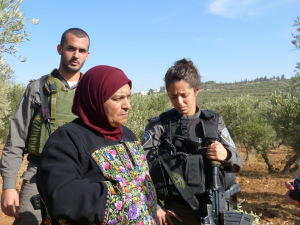
November 25, 2013 Israeli Border Guard weeping as Palestinian trees destroyed_A.Morgan
An Israeli Border Guard, a young woman who speaks Arabic, is called to deal with her. I watch as the young soldier stands listening and silently drops her head, turning her face to wipe away tears.
Finally, the buzzing stops, but it is a temporary reprieve. The Israelis have declared this ‘state land’ and the farmers are given four days to cut down hundreds more trees themselves, or the world’s fourth largest army will return to defend Israel from the olive trees.
‘How can we do this?’ asks one farmer ‘It will be like killing our mothers!’
Israeli military harassment of children in Area C
About three quarters of Tuqu’s land is in Area C*, under full Israeli military control, although this was supposed to transfer to the Palestinian Authority within 5 years of the Oslo Agreement. Tuqu’ has already lost hundreds of hectares to the illegal Israeli settlements of Teqoa, Noqedim and Ma’ale Amos that surround it to the north, south and east.
Our team comes regularly to Tuqu’. It is one of four Bethlehem villages where we accompany children to school as part of a UNICEF ‘Access to Education’ programme. Every day, children of six to 18 must run the gauntlet of armed Israeli soldiers and we have been present when the army has tear-gassed the schools. The soldiers obstruct the school entrances with jeeps, and patrol the footpaths with guns, forcing the frightened children to walk across rough fields or along the busy road.
‘It is emotional harassment’ says the mayor.
Recently we met a 16 year old boy who showed us the X- ray of a bullet still lodged in his back since a recent military incursion into Tuqu’. The mayor also tells us that over 20 children have been arrested in the last three months.
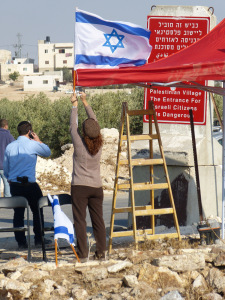
Two weeks before the trees were cut down, Tuqu’s mayor had called us because Israeli settlers, accompanied by soldiers, had begun putting up Israeli flags and tents on Tuqu’ land each afternoon.
One of the Israeli settlers I spoke to – a woman with an American accent – justified what she was doing, saying,
‘It is no different than what the Americans did to the Native Americans’.
Following this we saw the army erecting a series of concrete pillars along the roadside, with two red signs warning Israelis that this was a dangerous Palestinian village.
Soon after that, settlers erected a large marquee and put up provocative posters with a picture of a car being fire-bombed. The Palestinian landowner protested, but the military commander told him the settlers would take the land for two days for a party. There was nothing the farmer could do to stop this, but the village held a peaceful protest, whilst a large Israeli military force guarded the settlers.
November 20, 2013 Nadia Matar, Women in Green at Tuqu’_A.Morgan
The people of Tuqu’ know that this is how it starts; a few tents, some flags, then some caravans – an illegal settlement outpost is born. With Israeli state protection and financial inducements it will soon grow to thousands of settlers. More land theft, house demolitions, movement restrictions and violence against local Palestinians will follow.
Two days after the party, the settlers are back. They include a vigilante group called Women in Green** led by a Belgian-born woman called Nadia Matar. We ask what she thinks about the 16 year old Tuqu’ boy who was shot it the back whilst going to visit his grandfather.
‘ He was probably throwing stones.’ She replies ‘Kids who throw stones should be shot in the head ’.
During a visit to Tuqu’ a week after the tree cutting, we see scores of settlers coming towards the village, many bringing young children. A large number of Israeli soldiers position themselves across the road and fields, aiming their rifles and teargas cannons at Palestinian children coming out with their unarmed parents for another peaceful protest.
The settlers hold a ceremony and light candles. It is Hanukkah, and they tell us they are renaming this area with a new Hebrew name.
Under international law it is illegal for Israel, as an occupying force, to transfer its own population into the occupied Palestinian territories. Despite this, Israel’s massive settlement programme has continued unabated for decades, with thousands more homes being planned during the current Peace talks. With many settlements to the east of Bethlehem and other Palestinian centres, the Israeli strategy seems clear: to expand the eastern settlements westward to join up with Jerusalem, bisecting the West Bank and corralling the Palestinian population into a series of isolated cantons. EAPPI is keeping international agencies informed about these developments in Tuqu’ and a legal challenge is underway, supported by UNOCHA and the Norwegian Refugee Council.
* The Oslo Accords led to the West Bank being divided into Areas A (under Palestinian control), Area B (Palestinian civil government and Israeli military security) and Area C (Completely under Israeli military law). Areas B and C were supposed to be transferred to Area A – full Palestinian control, within 5 years. Instead, 20 years on, Israel has consolidated it’s control over Area C, illegally building hundreds of thousands of settler homes. Area C represents over 60% of the West Bank. It is the only contiguous area and therefore control over Area C is essential for communications. It also includes most of the West Bank’s fertile land and water. Israel prohibits Palestinian construction in Area C. Israeli control over, and settlement building in Area C is a major obstacle to a peaceful solution to the conflict.
** Women in Green is a right wing group that opposes the creation of a Palestinian state and supports Israeli settlement of the West Bank, which it proposes Israel should annex. WiG also opposed Israeli withdrawal from southern Lebanon. Nadia Matar, the Belgian-born leader of WiG claims that the ‘Arabs’ in the ‘Holy Land’ are descended from relatively recent immigrants, and should be ‘transferred’ to neighbouring Arab countries.
Israel’s Foreign Ministry has summoned the Dutch Ambassador in Tel Aviv over the Dutch water supplier Vitens’ decision to end its partnership with the Israeli water company Merokot because of its operations in the occupied Palestinian territories.
Vitens, a state-owned company, announced on Tuesday that it had decided to end its partnership with the Israeli company because it is operating in the occupied Palestinian territories in a clear violation of international law. The company released an official statement saying: “Vitens attaches great importance to integrity and adhering to (inter)national laws and regulations.” It continued: “Following consultation with stakeholders, the company came to the realization that it is extremely difficult to continue joint work on projects, as they cannot be separated from the political environment.”
The Israeli Foreign Ministry has accused the Dutch government of encouraging the world to punish Israel and everything that is related to the Jewish settlements in the West Bank.
According to the Jerusalem Post, the Foreign Ministry summoned Dutch Ambassador Casper Veldkamp “to protest what it said were ‘ambiguous’ statements by the Dutch Foreign Ministry creating a pro-boycott atmosphere of Israel in the Netherlands, on Wednesday.”
Regional Cooperation Minister Silvan Shalom told Israel Radio that Vitens broke with Merokot due to pressure from Dutch Parliamentarians and Amnesty International. He responded by stating: “I say to the Europeans, you cannot cry and whine all the time that you are not part of the diplomatic process, and that the US leads it alone, when you take one sided, unbalanced and sometimes even hostile polices,” he said. “You want to be part of the process? Those who want to be part of the process have to come with a balanced policy toward the conflict, and only then come and demand to be part of the process.”
The Dutch Prime Minister Mark Rutte had visited Tel Aviv earlier this week to strengthen trade relations between the two countries, when the ceremonial visit turned into a crisis of confidence after a new Dutch security scanner donated for use at the Gaza border was refused by Israel. Rutte reportedly responded by saying “I do not understand the Israeli position,” and cancelled his visit to the Karem Salem crossing where the Dutch scanner was due to be installed. Rutte also cancelled his visit to Hebron when the Israeli security agency Shabak insisted on accompanying him. The prime minister had asked for Palestinian security services to accompany him, but Israel refused his request.
The Netherlands was one of the first European countries to demand labelling settlement products. Now, it is among the first to make the move to boycott them.
In July 1980, American Indian Russell Means gave a speech at a gathering in the Paha Sapa (Black Hills) in the land of the Lakota (South Dakota). The title of the speech was “For America to Live, Europe Must Die”.1 In his speech, Means spoke to young Indians on the perils of European culture — particularly philosophies of European culture like Marxism and Christianity that appear to be for good things, like ending capitalism and loving one’s neighbor, but end up perpetuating the original problem — European culture itself and its destructive view of the world. Russell Means also spoke recently on the similarity between the genocide of the native Americans and the genocide of the Palestinians.2
Today the world watches helplessly while the Zionist entity slaughters the people of Gaza. This is nothing new — for the past 62 years, the world has watched massacre after massacre, attack after attack, and done nothing about it. In this latest atrocity, at least 900 Palestinians so far have been murdered from afar, with the Zionist’s US-supplied bombs and other weapons, and more weapons are on the way. No one who takes to the streets to denounce this barbarity is to be faulted, but protests taking place under slogans like “Let Gaza Live” seem to come from the same place that enabled the oppression of Palestine in the first place. Rather than pity the victim, why not stop the aggressor? Instead of “Let Gaza Live,” why not “Let Israel Die”? Pity for victims can go on forever; it’s high time to deal with the people who are beating that victim. And it’s time to do more for Palestinians than to just plea for them to be able to live.
The world has supplied relief to Gaza through such organizations as UNRWA for decades. Wouldn’t it have been much more effective to address the obvious cause of Gaza’s suffering at the source, when it began? Wouldn’t it have been better to drop all talk of peace with a belligerent who had proved again and again he wasn’t for peace, and forcibly take the gun out of his hands? Why hasn’t this happened? Why isn’t it happening now?
Perhaps the biggest reason is that this particular aggressor, though small in numbers, has been clever at deception, infiltration, and propaganda. Zionists have talked peace but waged war. They have infiltrated ruling elites in every strategically important country in the world — the US in particular. They have infiltrated the media, the entertainment industry, Wall Street, the government, the corporate power structure, human rights and civil liberties groups, and the antiwar left. They have infiltrated the places and communities where Judaism is observed, so that today one cannot go into a synagogue in the US without seeing the blue and white “Israeli” flag. At least 80% of Jewish people in the US either support the Zionist state or are afraid to criticize it. Yet to make an issue of this would be deemed a monstrous case of religious intolerance.
Judaism has been so thoroughly hijacked by Zionism that it is no longer clear where one ends and the other begins. At the end of December, a demonstration in Boston to condemn the just-begun bombing of Gaza was met with an almost equal number of supporters of the Zionist entity holding both the star of David and the stars and stripes. They carried signs saying “We Stand With Israel” and sang anthems for both “Israel” and the US. Well-established synagogues and temples have called for gatherings in support of the Zionist state even as the mass murder is carried out.
Support for Zionism is well integrated into US culture, itself built on the unacknowledged genocide its own indigenous people, and of the African slave. In such an environment the mainstream Jewish community is allowed to have it both ways — they can support one genocide, but they can’t be challenged because of their history as the victims of another genocide. One doesn’t accuse the authority on genocide with the same crime. This would be termed a “hate crime.” With its “No Place For Hate” programs in cities across the US, the Anti-Defamation League, which explicitly supports the Zionist state, has set itself up as the arbiter of any and all persecution and intolerance in American communities.
An even more effective tool of Zionism is its propaganda, built up over the period of 64 years since the end of World War II. This propaganda has elevated the victimhood of Jews at the hands of Nazi Germany to the level of religious belief, so that this genocide is the one above all others in history that counts. Not only must this go unquestioned, it is sacrilege (and now illegal) to do so. So it has come about that Jews who commit the same or worse crimes as the Nazis may do so with impunity. In the US and Europe, Christian guilt, Christian pity, and Christian forgiveness also make this possible. Zionists have exploited both Judaism and Christianity very thoroughly, especially attitudes of exceptionalism found in each religion.
For many people — and the numbers grow daily — the acts and atrocities of Zionism have completely burned up the credit that European Jews accrued in Nazi Germany. The holocaust is an old song that no one wants to hear any more. The victims of the Warsaw ghetto are now the perpetrators of the Gaza ghetto, and the massacre inside it.
The power that Zionists have achieved must be taken away from them, first morally, then physically. No one has a corner on suffering, even the eternal victim. Palestine must be returned to Palestinians, and the Zionist state, which was based on a crime and can only exist as a crime, must be condemned as a whole. For the killing to end, “Israel” has to go.
JERUSALEM (AFP) — Israel is scrapping a controversial draft law to relocate thousands of Bedouin residents of the Negev desert, an official said Thursday.
Benny Begin, tasked with implementing the so-called Prawer Plan, said he had recommended to Prime Minister Benjamin Netanyahu to “end the debate on the law” in parliament.
“The prime minister accepted this proposal,” he said at a Tel Aviv press conference, days after it emerged the governing coalition was divided on the proposed legislation.
The bill, which would have seen the demolition of some 40 unrecognized Bedouin villages in the Negev and the relocation of between 30,000 and 40,000 people, passed a preliminary ministerial vote in January.
But it faced intense objection from members of the parliament both from the Right, where lawmakers said the compensation in land and money offered to Bedouins was too generous, and from the Left, which said it was racist and accused the state of usurping the land of indigenous Palestinian inhabitants.
Israeli Foreign Minister Avigdor Lieberman posted on his Facebook page that the Israeli government “should re-examine the plan and consider a far-reaching plan that would annul the benefits the Bedouin were to receive.”
Following a heated debate this week at the parliamentary interior committee, coalition chairman Yariv Levin of Netanyahu’s Likud party said he would not make the Prawer Plan into law.
The move comes less than two weeks after worldwide protests against the plan, during which Israeli police and soldiers clashed with demonstrators, injuring and arresting dozens across Israel and the West Bank.
According to the Association for Civil Rights in Israel, the plan would have forcibly evicted nearly 40,000 Bedouin and destroy their communal and social fabric, condemning them to a future of poverty and unemployment.
Other estimates had put the number of Bedouin residents at risk at 70,000.
On the night of December 5, 2013, Israeli immigration authorities denied entry to Patrick Thompson at the Allenby Bridge connecting Jordan to Occupied Palestine. Thompson was attempting to return for another stint on the team in Hebron. He initially told authorities that he was entering as a tourist, to visit Jerusalem, Bethlehem, Nazareth, Tel Aviv, and then points south, before re-entering Jordan. An Israeli official was concerned about his previous stay of four months in Israel.
After detailed questioning over a period of three hours and a search of his computer hard drive, authorities found a logo of CPT and told him they were denying him entry because he had lied to them. Thompson told them that he specifically did not mention his work with CPT or his destination as the West Bank because of the way Israeli authorities had treated many others when they volunteered this information willingly. Authorities denied entry to Jonathan Brenneman, another CPTer, in September, when he declared his membership in CPT and his plans to travel to Hebron. Thompson then waited another hour or so before the authorities officially denied him entry. When he boarded a bus to go back across the border into Jordan it was 1:30 a.m., a full six hours after his arrival at Israeli passport control.
Thompson is the fourth CPTer to whom Israel has denied entry this year. In addition to denying entry to Brenneman in September, authorities turned away two reservists in July because of stamps in their passports from their time with the Iraqi Kurdistan team—even though the Kurdish Regional Government has friendly relations with Israel.
Dutch water supplier Vitens has ended a partnership with Israeli water company Mekorot due to the “political context,” the Dutch company said on Wednesday.
The abrupt decision comes days after a visit to the Mekorot offices in Occupied Palestine by the Netherland’s trade minister Lilianne Ploumen was abruptly cancelled.
In a statement, Vitens said it had come to the conclusion that it was “extremely hard” to work with Mekorot on future projects “because they cannot be taken out of the political context.”
The company visit was part of a larger tour of Occupied Palestine by Prime Minister Mark Rutte that was marred by a dispute over a Dutch-made security scanner on the Gaza border.
Rutte was to have inaugurated the scanner on the frontier with the Gaza Strip, but the ceremony was broken off.
The focus of the dispute is trade between Gaza and the West Bank, which is controlled by the Palestinian Authority under president Mahmoud Abbas.
Israel’s defense ministry wants to isolate the two Palestinian regions, while Dutch officials had hoped the scanner might boost commerce between them.
Mekorot, which provides water to Israeli towns and to Jewish settlements in the occupied Palestinian territories, has been accused by Dutch media of denying water access to Palestinians.
According to the World Bank, a third of Palestinian territories are cut off from the Israeli water system and Israelis draw out a far bigger share of the water supply than agreed in the 1995 Oslo II accord.
Israeli deputy Foreign minister Zeev Elkin said he was “blindsided” by the pullout “and a few more European companies have made similar decisions in the past months, which have blindsided us exactly in parallel with the peace process.”
In talks last week, Israel, Jordan and the Palestinian Authority signed a historic water-sharing initiative at the World Bank that could protect water resources in the region amid rising demand.
The deal will see Israel, working through Mekorot, boosting its annual sales of water to the Palestinian Authority by 20-30 million cubic meters a year, up from the current level of 52 million cubic meters.
Zeev, speaking to Israeli military radio, said that peace initiatives should mean “that people don’t breathe down our neck,” but “unfortunately this doesn’t work.”
Vitens said the decision to end the Mekorot tie-up was made after conferring with the Dutch foreign ministry and other “concerned parties.”
The news comes a day after Romania reportedly refused to allow Romanian construction workers to be employed in Israel’s illegal West Bank settlements.
The row comes in the wake of tensions between Israel and the European Union over new guidelines that bar EU funding for any Israeli entity operating in the internationally recognized occupied Palestinian territories.
BEIRUT — The Hamas movement has expressed its total rejection of the agreement linking the Red Sea with the Dead Sea, considering it a normalization and legalization to the Israeli occupation.
Hamas warned of the agreement’s serious impacts on the Palestinian cause in light of the open Israeli war on the Palestinian people and holy sites.
In a controversial step, Israel, Jordan and PA signed in Washington an agreement linking between the Red Sea and Dead Sea.
Israeli officials have described the agreement as an historic development that could achieve Herzl’s dream, while environmental groups warned of its serious impacts.
The movement stressed that the PA is not entitled to give up or compromise on any inch of the Palestinian land or water resources, calling on Palestinian factions to refuse such agreements that strengthen the Israeli occupation.
The Islamic movement called on the Palestinian Authority not to take unilateral decisions in violation of the national consensus under the illusion of peace negotiations.
The undersigned Palestinian NGOs call on the Palestine Liberation Organization (PLO) and the Palestinian National Authority (PNA) to halt all forms of cooperation with the World Bank-sponsored Red Sea – Dead Sea Conveyance Project (RSDSCP) and to take an unequivocal public stance of rejection to the project.
It has become clear beyond doubt that the project is an unacceptable attempt to force the Palestinian population to consent to their own dispossession and to compromise on their own rights.
Any lack of a clear position by the Palestinian leadership on this outrageous project, any stand of ambiguity or positive criticism towards it, contributes to the impunity that for far too long has allowed Israel to appropriate Palestinian water and deny Palestinians their rights.
Five reasons why the RSDSCP must be rejected:
1. The project undermines Palestinian water rights and legitimizes Palestinian dispossession from the Jordan River. Israel unilaterally controls the flow from the upper Jordan River and prevents Palestinians from making use of their rightful share of the lower river’s water. This is the sole cause for the gradual disappearance of the Dead Sea. Instead of addressing Israel’s water theft, the project aims to maintain the unjust status-quo of the river and allegedly “save” the Dead Sea through large scale Red Sea water transfer.
2. The project attempts to replace the river’s natural fresh water appropriated by Israel from the upper Jordan River with desalinated Red Sea water sold at high costs to severely water-dispossessed Palestinians and at pitiful quantities. Even these sales remain merely an “option” and the World Bank studies plan to ‘supply’ only Jericho, which is currently the only water-rich place in the occupied West Bank. With every drop of water that Palestinians purchase, they capitulate to their own deprivation.
3. Neither the World Bank’s Feasibility Study (FS) nor its Environmental & Social Assessment study (ESA) address the grave damage to the West Bank Eastern Aquifer, currently the only source Palestinians have for water supply and development. The Eastern aquifer is rapidly depleting, and its water table is dropping at an alarming rate – both as a direct result of the shrinking Dead Sea. Consenting to the project entails closing an eye to the rapid destruction of the only other water resource in the Eastern West Bank. Instead, Israel should be held accountable for the damage it caused to this vital resource on which over 1 million Palestinians currently depend.
4. Far from “saving the Dead Sea”, the RSDSCP will actually destroy the unique features of the Dead Sea and its ecosystem. Under the project, the Dead Sea is slated to turn into a dead, engineered pool of Red Sea water and desal brines, destroying this Palestinian and world heritage site.
5. Both Red-Dead studies (FS & ESA) and the entire conduct of the World Bank lack credibility and transparency, and make a mockery of the alleged consultation and participation process. Throughout the process, the Bank has systematically turned a blind eye to Israeli violations of Palestinian water rights.
The Bank repeatedly and deliberately ignored key concerns expressed by Palestinians since the project’s inception and during the “consultation” meetings in severe breach of its very own Code of Conduct, as well as the project’s Terms of Reference.
In addition, the Bank management has so far refused to make public the results of the Feasibility and ESA studies. The World Bank’s actions are tantamount to a cover-up.
Palestinian civil society organizations reiterate their rejection of the Red Sea – Dead Sea Conveyance Project and invite Palestinians of all walks to demand that the PLO and the PNA honor their aspirations for self-determination and justice by voicing a clear, loud and unequivocal “No!” to the Red-Dead Sea scam.
This project can only result in further damaging and undermining Palestinian water rights and all cooperation with it should cease immediately. Reparation and compensation for past damages and respect for Palestinian water rights are long overdue and the only way forward.
Endorsing organizations and individuals:
1. Palestinian Environment NGO Network (PENGON)
2. MAAN Development Center
3. Palestinian Wastewater Engineers Group (PalWEG)
4. Stop the Wall
5. Palestinian Farmers Union
6. Applied Research Institute Jerusalem (ARIJ)
7. Land Research Center
8. Media Environmental Center
9. Palestine Hydrology Group (PHG)
10. Palestinian Agricultural Relief Committees (PARC)
11. Union of Agricultural Work Committees (UWAC)
12. Environmental Education Center (EEC)
13. Institute of Environmental and Water Studies – Birziet University
14. Palestinian Center for Human Rights (PCHR)
15. Palestinian Environment Friends (PEF)
16. Arab Center for Agricultural Development (ACAD)
17. Earth and Human Center for Research and Studies (EHCRS)
18. Palestinian Farmers Association
19. The Arab Agronomists Association (AAA)
20. Prof. Dr. Hilmi S. Salem, Palestine Technical University – Kadoorie (PTUK)
21. Clemens Messerschmid, Hydrologist
22. Prof. Dr. Samir Afifi, Environmental & Earth Sciences Department, Islamic University of Gaza
That was the response of Munir, a Palestinian who is faced with Israeli soldiers at the checkpoint opposite his shop in Hebron every day, when I asked him how he thought being in Hebron must affect the soldiers.
I have had so many encounters with Israeli soldiers during my time in Hebron – it is impossible not to, due to the intensity of the military occupation.
I have passed the time of day and talked with some of them about what we are each doing here. Some have told me of their boredom, that they would much rather be on the beach. One helped keep a stray dog away from Palestinian school children who were frightened and I thanked him. Another told the police to leave me alone when they were harassing me about where in the street I was standing during the school run, and I thanked him too.
They have also spat at me, shouted at me, threatened to arrest me and called me stupid in Hebrew and a “sharmoota” (“whore” in Arabic). I have refused to follow their orders to move or stop taking photos. I have watched heavily armed soldiers throw stun grenades, and tasted the tear gas they shoot at Palestinian children on their way to school in response to small stones being thrown at their checkpoint. I have seen them harass and detain Palestinians trying to go about their lives, push kids for “facing the wrong direction” as Israeli settlers walk past, and arrest children. I have watched them laughing and joking many times in situations that are far from funny – most recently in the aftermath of an extremely serious attack by Israeli settlers against a Palestinian family.
An Israeli soldier fires tear gas at Palestinian children on their way to school after small stones were thrown at a fence near checkpoint 29 in Hebron
I have come to know some of the Givati Brigade of the Israeli army, currently serving in Hebron, by sight and a few by name. You can often tell how many schoolbags will be searched or Palestinians detained for ID checks by who is on duty. Almost without fail, the local Palestinians say that their treatment on a given day depends on the mood of the soldiers. I have often wondered what must be going through their minds and wished that I could talk to them properly about what they think. Amidst the tension and violence of Hebron, this is normally impossible.
One Friday night settlers blockaded a Palestinian family’s gateway and stopped them from leaving their home at Tel Rumeida in Hebron. I asked the nine watching Israeli soldiers to please help. They wouldn’t. One of them, whose name is Kawalski*, said “everything is fine.” 34 Israeli settlers were stopping a Palestinian family from walking down the street and thus from entering or leaving their home. Many of the settler children were shouting abuse, hitting our cameras and spitting at us.
An Israeli settler child hits my camera during the incident when settlers blockaded Palestinians in their home, and went on to attack us. Soldiers stand stand by in the background
They went on to throw two buckets of water at us, followed by a bucket of bleach. It was an awful scene and I cannot see how he could have thought it was fine.
Most of the soldiers in Hebron are young, ranging from 19-22 years old, and are conscripted into military service for three years. This is compulsory with a few exceptions, so most of them have not made a positive choice to be in the army. Yet in Israeli society there is real kudos attached to being a combat soldier like those in Hebron – just take a look at the Israel Defense Forces Facebook page. Only a tiny minority ever refuse to serve and spend time in prison as a result. Kawalski, the soldier on that Friday night, must be no more than 22 years old. After the incident, I wondered a lot about his “everything is fine” comment and thought maybe it was actually his internal reasoning – him trying to persuade himself it was all OK and he was in control (he most definitely was not).
An Israeli soldier gives first aid to our journalist colleague after refusing to intervene in a situation which culminated in the settlers throwing bleach in her eyes
Later, when he called an ambulance for my colleague after the attack on us that he had failed to prevent, he must have been forced to acknowledge that everything had not been fine.
Israeli soldiers tell a young Palestinian boy he is not allowed to ride his bike in H2 in Hebron. Israelis can drive on this street but Palestinian are not allowed to
Thousands of settlers and their supporters came to Hebron recently for Shabbat Chayei Sarah, which commemorates Sarah of biblical times, who is buried in Hebron. It was a difficult weekend, with heightened tensions and violence. Movement restrictions were even tighter than usual – the Ibrahimi Mosque and nearby Palestinian shops were forcibly closed. Most of Shuhada Street, which Palestinians are never allowed to walk down, was closed to my colleagues and I as well – “Jews only” as the enforcing soldier told me. Extra soldiers drafted into H2 checked the ID of Palestinian men every 50 metres.
Me intervening to stop Israeli soldiers harassing young Palestinians who were sitting on a wall chatting as Israeli settlers walked past on Shabbat Chayei Sarah
I was patrolling with a colleague and we went to an area with a few Palestinian homes and many settlers nearby. I felt nervous because large groups of settlers, some armed and some drunk, are not normally a great thing to encounter. A Palestinian family was harvesting olives on a hill where many settlers were hanging around. We checked if the family was OK and sat down under a tree, hoping to deter the settlers from coming to bother them, throw things at them etc (there was a fence between us and the Palestinians so we couldn’t help with the olives). A couple of Israeli soldiers were standing nearby.
After a bit, a group of male settlers tried to make their way towards us and I stood up, worried about what would happen next. But rather than standing back and letting them come over, the soldier stepped in the way and asked the settlers to leave. They did. I had never seen such a thing before and, when the settlers had moved away, I thanked the soldier. “Don’t worry” he said. Shortly after, a second group of settlers tried to come and the soldier and his colleague again turned them away. After this the soldiers came to ask if we were OK. I was slightly stunned that they were looking out for us and for the Palestinians. I thanked them both and said that we would move on soon. They told us there was no need for us to leave and not to worry, they would make sure everything was OK with the Palestinians. This was the opposite of what I am used to in Hebron, where the soldiers will often do whatever they can to get rid of us, and simply stand by as settlers harass and attack Palestinians. The first soldier told me that his name was Yossi* and he was not normally based in Hebron.
Later, when there were no settlers watching, I bumped into Yossi again. I asked him if he understood what I was doing there. “You want peace” he said, and told me that he wanted peace too. He told me that after my colleague and I had gone, the settlers had pushed him and thrown stones at him. He was astonished by this and couldn’t understand it. I asked what he knew about Hebron – not much. His orders that day had been to keep the Jewish and the Palestinians apart. I told him what it is like in Hebron – the settler violence, the soldiers refusing to help, the clashes, and showed him pictures. It was all news to him. “It’s good that you are telling me this, I will tell my commander”, he said. I really appreciated this but told him I didn’t think it would help – his commander was 24 years old and decisions about what happens in Hebron are made high up in military and political circles. None of those in charge will be unaware of what actually goes on in Hebron.
Yossi told me that he loved being in the army. He told me that he loved his gun. “Why do you love your gun?!” I asked him, “It’s for killing people.” “No!” he said, “I love target practice, I don’t want to kill anyone.” “But why do you think they give you a gun?!” I asked. I learned that Yossi was 19 years old. He seemed like a good, decent young man and I believed him when he said he wanted peace and didn’t want to kill anyone. But, as I have previously written about other discussions I’ve had with Israelis, I was surprised by his lack of understanding about the facts of the conflict he is part of. I asked him to keep being nice to the Palestinians and he told me to take care in Hebron.
My encounter with Yossi really made me think. That I was so surprised at his fair conduct says a lot about the norm for soldiers in Hebron.
An Israeli soldier detains Palestinian boys aged 8 and 10 years. Photo by Maria Schaffluetzel
I wonder how it comes to be that so many of the young soldiers behave in the morally unacceptable ways I have so often observed or seen evidence of: arresting children and beating them up; demolishing Palestinian houses with bulldozers and then preventing tents and emergency aid from being delivered; even deliberately shooting innocent people, as veterans’ organisation Breaking the Silence has documented. Sometimes they will be following their orders in doing these things, and sometimes not. Mohaned, a 13 year old from the town of Beit Ummar, told me how soldiers raided his house at 3am, blindfolded and arrested him wearing only his underwear. He was held for 10 days, in which he was slapped, hit with the butt of a rifle, beaten and then released.
An 11 year old Palestinian boy arrested by Israeli soldiers in Hebron
Surely it is important to ask how young men, most of whom start off as normal, decent guys like Yossi, end up doing these things?
On a day off I visited the Golan Heights and got talking to some soldiers about their jobs. One of them said that they themselves had been discussing these issues, “Some of us were talking – we are children and they give us guns.” I met another soldier in Haifa, Israel. He was 23 years old and had previously served in the Golani Brigade in Hebron. He recalled an army education week when there had been a discussion about putting the heads of dead Palestinians on poles. He had been in the minority 20:1 to say that such things were wrong. Another former Golani soldier simply refused to speak about what he had done when he served in the army.
A Palestinian looks out of his window to find armed Israeli soldiers using the roof of his home in Al Arrub refugee camp near Hebron
My friend Sam is Jewish, an Israeli of British origin who I got to know in our student days. After my blog about my some of my experiences in Israel, he emailed me saying, “I think another big reason why it’s hard to convince Israelis about what’s going on in the territories is that almost every Israeli knows somebody who serves in the territories… it’s hard for us to believe that they are monsters.”
His use of the word “monster” really stuck with me. I don’t believe the soldiers are monsters – perhaps with a few exceptions, as with all people. But sometimes they end up doing monstrous things on a regular basis. They are born into a system which takes apparently normal teenagers and seemingly trains them to behave in these ways.
One soldier who served in Hebron told Breaking the Silence, “In Hebron, I was disturbed and frightened most of all by the unregulated and uncontrolled power, and the things it made people do.” Another said, “Another thing that has stayed with me from Hebron? I think of myself as a little injured maybe, I don’t know. Not physically injured. More emotionally injured.”
Rather than monsters, I think it makes the young soldiers part of the tragedy of the conflict. I am pretty sure that it will damage them too, that they will suffer in the long run. Aside from the terrible harm that the military occupation does to the Palestinians, I am sure that Israel also hurts itself and its own young people in what it does. What kind of society, what kind of country, will Israel end up as?
Avraham Shalom is in a position to know. He led the Shin Bet, the Israeli intelligence service, between 1980-86 and in the film The Gatekeepers he says,
“We have become cruel. To ourselves as well, but mainly to the occupied population.” The Israeli army has become “a brutal occupation force.”
Every month or so I drive for three hours from Ramallah to my native village in Upper Galilee to hike in the olive orchards engulfing my village and to reminisce about my childhood. My village, which was perched alone on that hill under the cold drift from Mount Hermon, as I remember it, now is forced to share the surrounding hills with Jewish-only colonies. One morning, one of those Saturday hiking mornings, two Jewish colonists from a nearby colony passed me on their dirt bikes on their way to promenade in our olive orchards and hurled at me a soft and humane “boker tov” (good morning), to which I responded, equally softly and humanely. They continued their ride, and I was forcefully left with my unanswered questions about the nature of our “living together.”
On the face of it, the “boker tov” greeting was natural and expected. But why did it upset me? Something did not settle well with me. By itself, it was a natural human greeting, but in an unnatural context and environment: these two men were there, on my land, only because they happened to be Jews (and, most likely, Zionists). Thus, they were rendered privileged to live in a subsidised house that was built for them on stolen Arab land, while people in my village are not even permitted to build or expand their houses on their very own land in order to meet the need of their extended families, only because they happened to be Palestinian Arabs. This is what did not settle well with me. Because, as they passed me on that October Saturday morning, we were not equal under this Zionist-Jewish system, nor did we have access to the same resources – economic, legal, political, etc. – in a place where I should have been “more equal” and more privileged, having been born on this very land. My narrative has been undermined by force and mythology.
How do I interpret what I might call our expropriated narrative? And how can we, as a people – individuals and collectives – repossess this narrative?
I begin by posing two interrelated questions: What does it mean to be a Palestinian Arab living in Israel? And what does it mean to be part of an indigenous minority that is a remaining fragment of the Palestinian people, living in a country that is directly responsible for this historical evil?
To heighten our Palestinian narrative, I propose to look at three interconnected events in our very recent history, threaded by the same historical sequence, and underpinned by the same racist ideology. The focus on these events will shape the answer to the above two questions. The three events are Yawm al-Ard (Land Day) of March 1976, Habbet October (the October uprising) of October 2000, and the Zionist-Jewish attack on Palestinian Arab Citizens in Akka of October 2008.
Yawm al-Ard, 1976
Yawm al-Ard refers to the day of the general strike that was held on 30 March 1976 among the Palestinian communities in Israel to protest the new wave of government-approved expropriation of Arab-owned lands, hitting at the heart of Arab villages in Central Galilee. The decision to strike was an exercise of the Palestinian community’s right to protest and civil disobedience, as a means of affirming the indigenous Palestinian struggle against the gradual dispossession of their patrimony, the “Judaisation” (tahweed) of historical Palestine, and the “de-indigenisation” of their native place. Through protest and public strike, the Palestinians in Israel sought to halt the vicious and determined process aiming toward their ethnic cleansing. The Israeli security apparatus made a conscious attempt to forcefully put down the strike by deploying police, “border guards,” and army units in the heart of Palestinian communities. As a result, 6 Palestinian civilians were killed, about 50 injured, and about 300 arrested.
Israel’s colonisation plans for the Galilee were explicitly expressed in 1976 in what became known as the “Koenig Memorandum,” which was submitted to and approved by the Israeli government. The Memorandum detailed the “Judaisation of the Galilee Project,” whose objective was to expropriate Arab lands in the Galilee and develop 58 additional Jewish colonies by the end of the decade, increasing the Jewish population of the Galilee by 60 percent. The explicit purpose of this “development” was to break up the concentration of the Palestinian Arab population in large contiguous areas by infusing them with new Jewish colonies.
Since the breakup of the indigenous demographic contiguity of the Galilee and al-Naqab and their transformation from Arab majority areas have not yet been completed, the Israeli government created in 2005 a new portfolio for its deputy prime minister at the time (Shimon Peres) to “develop” al-Naqab and the Galilee. In a follow-up speech, Peres stated, “The development of al-Naqab and the Galilee is the most important Zionist project of the coming years.” Thus, the responsible ministerial committee allocated US$ 450 million “to building Jewish majorities in the Galilee and al-Naqab over the coming 5 years.”
Habbet October, 2000
Habbet October (or the October uprising) refers to the subsequent events that occurred during the general strike and protest marches of the Palestinian community in Israel on 1 October 2000, heeding the call of the “Higher Follow-up Committee of the Arab Masses” a week after Sharon’s insistent entry to al-Haram al-Sharif, which resulted in the killing of 80 Palestinians and the injuring of hundreds in the West Bank and Gaza during the week following Sharon’s visit.
As for the protest marches during the day of the general strike of the Palestinian communities inside Israel, the police were instructed by Ehud Barak, the minister of internal security at the time, to use all means possible to quell the protest. As a result, the police used live ammunition, rubber-coated bullets, and snipers, which resulted in the killing of 13 Palestinian civilian citizens. According to documented testimonies, the police used violent means to “inflict the maximum damage possible.” To avert severe protests from all quarters, and with the approach of elections for the prime minister, the government appointed an official commission of inquiry headed by a judge of the Supreme Court (Theodore Orr) eleven months later.
The Orr Commission laid the blame for what happened on the Palestinian community in Israel and its political leadership, on the basis that the protest marches were illegal and unjustified and that they were only intended to disrupt the public order; on the other hand, the Commission maintained that the response of the police was equally illegal and unjustified. Thus, in their “balanced” response, the Commission blamed the victim.
The allusions in the Commission’s conclusions are very telling. I shall focus only on two: the first has to do with the relationship of the police with the Palestinian community in Israel, and the second has to do with what is referred to as “Arab-Jewish relations.”
Regarding the first: the Commission emphasised the need for “conceptual transformation” in how the police deal with the “Arab sector.” The police are viewed in the Arab sector not as an agent of support, or assistance provider, but as an “enemy agent that serves an enemy authority.” The Commission emphasised the need for re-training and re-indoctrination among the police, stressing that the Arab communities in the state are not an enemy and that they should not be treated as such.
As for the conclusion regarding “Jewish-Arab relations,” the Commission stated, as summarised two years later by the academic member of the Commission (Shamir’s lecture, Tel Aviv University, 19 September 2005, p. 6):
· The Arab minority population of Israel is an indigenous population which perceives itself subject to the hegemony of a society that is largely not indigenous.
· The Arab minority in Israel is a majority transformed; it bears a heritage of several centuries of belonging to the majority, and views with disapproval its minority status, forced upon it with the establishment of the state.
· This reversal was the result of a harsh defeat suffered by the Arabs which, in their historical memory, is tied to the Nakba – the most severe collective trauma in their history.
· There was a continuous dynamic aspect to the decisive outcome gained by the Zionist movement in the struggle over the establishment of the State, reflected primarily in the takeover of extensive lands, clearing space for the masses of new immigrants. This fact fostered a feeling among the Arabs that the Israeli democracy is not as democratic toward the Arabs as it is toward the Jews.
Regarding the two events above, it is worth remembering that in all previous violent confrontations with Jewish protest movements in Israel, e.g., Black Panthers, the Rabbi Uzi Meshulem Movement, etc., never before was live ammunition used to quell a protest by Israeli Jews; and never was a Jew killed by the agents of the state.
The Zionist-Jewish attack on Palestinian Arab citizens in Akka, October 2008
This refers to the events that happened in Akka (Acre) on the eve of the Jewish Yom Kippur (the Day of Atonement). The sequence of events went this way (based on a meticulously documented report by the Akka Residents Coalition):
A 48-year-old Arab citizen of Israel from Akka rides in his car to the house of relatives … who live in the eastern part of the city (with a Jewish majority), to pick up his daughter … He drove slowly and quietly with no radio or speakers turned on (to respect the solemn Jewish holiday). Jewish youth attacked the car with stones.…
After Yom Kippur ended (9 October,) a large group of Jewish residents, estimated at 1,500, gathered around the train station in the eastern and northern parts of the city (where a small minority of Palestinian Arabs live in Jewish-majority neighbourhoods) … The Jewish rioters threw stones, clashed with the police, and attacked Arab passersby.
In these areas of the city, there is a Jewish majority; about twenty Arab families live there in total. The Jewish rioters gathered in the streets and cried “death to the Arabs.” They attacked Arab family homes trying to make their inhabitants flee; they damaged the homes and set them on fire … A text message distributed to Jewish residents called for a boycott of Arab tradesmen and shopkeepers.
Violent harassment by Jewish-Zionist extremists against Arab residents of the city of Akka did not start on Yom Kippur 2008; it started at least since 2002 when slogans such as “death to Arabs” started appearing on walls, elevators of apartment buildings, etc. This is not accidental vandalism; it is part of a trend to establish Jewish “purity” in the so-called Arab-Jewish mixed cities such as Akka, Lod, Ramleh, and Yaffa, which Jewish-Zionists consider areas of “demographic risk.” This trend is being pushed by the national right-wing party called “the seeds of the settlements” in recent years, by transplanting Jewish “yeshivas” and settlers into the Arab areas, brought in generally from the most extreme racist Jewish colonies in the West Bank. Today there are around 200 yeshivas in Akka, in addition to approximately 1,000 settler-extremists. The clear and overt purpose is to “Judaise” these cities.
In an interview (on Channel 7), the head of the Hesder Yeshiva in Akka, Rabbi Yosi Stern, stated:
“Akka is a national test. Akka today is Israel in ten years’ time. What happens in Akka today is what will happen in Israel.…
“Co-existence is a slogan. Ultimately Akka is a town like Raanana, Kfar Saba, or Haifa, and must safeguard its Jewish identity. I think everyone would agree that Akka is the capital city of Galilee, of thousands of years of Jewish history. We are here to preserve that Jewish identity and to reinforce that spirit, to stand for our nation’s honour.”
Concluding remarks
How are these three events that happened over the last thirty-some years interconnected? And how do they shape the answer to the two questions I posed earlier?
The ideological underpinnings of the three events are the same and focus on two levels with overt objectives: one is the Judaisation of the entire country through the Jewish colonisation of the land and the prevention of the existence of any Arab majority concentration (hence, the targeting of Galilee, al-Naqab and the Triangle, etc.). The second is the forced disconnection in identity and shared future between the Palestinian minority in Israel and the Palestinians in the West Bank and Gaza and in the shatat (diaspora).
The only future for us, as an indigenous national minority that can exercise our inherited basic human rights on our land and that can achieve true justice and equality, is to reclaim and re-assert our narrative. We should seek to regain our status as part of our national Palestinian majority, in historical Palestine, as we struggle for the dismemberment and dissolution of the Zionist racist system and its transformation into a “normal” democratic system, responsive to the needs of all its citizens. Our future, as a national minority in and on our land, and as part of the Arab nation, is organically connected to the future of the Arab nation and to the entire Palestinian people – the communities in the West Bank and Gaza, the refugees, and all those dispersed throughout the world; and it has to be realised in a democratic society in historical Palestine, where we would be ready to co-exist with non-Zionist Jews. Our repossessed narrative cannot be a reinterpretation of our history as a dull shadow of Jewish-Zionist narrative. Our repossessed narrative must be based on the deconstruction of the racist Zionist-Ashkenazi system, which itself is a precondition for such a just solution. The existing Israeli system is, by definition, racist and exclusivist, and it is inherently and structurally incapable of providing justice and genuine equality to my Palestinian people.
Dr. Khalil Nakhleh is a Palestinian anthropologist, writer, and independent development and educational consultant from Galilee who resides in Ramallah. He is the editor of The Future of the Palestinian Minority in Israel (Ramallah: Madar Center, 2008). He may be reached at abusama@palnet.com
BEERSHEBA – A Palestinian organization based in the Negev has released a documentary depicting what the organization called the “ongoing Nakba (catastrophe) against the population of the Negev since 1948.”
The film brings to light the suffering and embittered lives of the Palestinian Bedouin residents of Negev, especially those villages which the government of Israel doesn’t recognize.
Those residents, according to the film “Negev … Land and Man,” have been deprived of basic life requirements including water and electricity networks as well as schools and clinics.
The documentary warns of Israeli plans to displace the population and “steal their land” through heavy restrictions to make their lives unbearable. The film warns in particular of the Prawer displacement plan which will “bring back the Palestinian Nakba on the land of Negev” while the world watches.
Documented scenes of home demolitions, land bulldozing and displacement of residents by Israeli forces are included in the film.
The film also sheds light on the major role Palestinians who live in Israel play to support the Bedouin residents of the Negev and help strengthen their determination to remain on their land. These efforts include construction projects, relief activities and voluntary work to defy Israeli plans.
The film was directed by Muhammad Abu Rizqa and produced by Sanabil Productions.
The Nakba is commonly perceived around the world and even, unfortunately, by Palestinians themselves, as a discrete historical event which happened in the late 1940s when Jewish terrorists established a Zionist state in Palestine. However, looking back at what has transpired in Palestine over the last six decades, it would be more accurate to describe the Nakba as an ongoing political process in which the racist state has continually implemented its policy of ethnically cleansing and moved ever closer to its long term goal of becoming a Jews-only state.
Adam Horowitz linked to an article suggesting that the Jews’ current military operation in Gaza could be regarded as a new Nakba as if, with the passing of time, this too will be seen as another discrete historical phenomena. “Palestinians reported that many families have left their homes in Beit Lahiya’s al-Atatra neighborhood and are staying with relatives in “safer” areas. Hundreds of residents, who are afraid to travel in their own cars for fear of IDF strikes, could be seen leaving the neighborhood on foot toward central Jabalya. “It was a difficult site and reminded us of images we saw on television during the 1948 Nakba (displacement of Palestinians following Israel’s inception),” one resident who left his home told Ynet. “The sense is that of a new Nakba.”” (‘Gazans say experiencing ‘another Nakba’ January 05, 2009).
Philip Weiss has added to the perception of the Nakba as a discrete historical event by demanding that more effort should be given to commemorating the political disaster that befell the Palestinians in the late 1940s. Given the way that the Zionist dominated media in the western world has pushed the Nakba into an historical ‘hole of oblivion’ it seems laudable trying to remind the global community about what befell the Palestinians in the late 1940s. However, treating the Nakba as an isolated historical event which happened long ago in the mists of time gives the impression that the racist Jewish state has never since resorted to such an odious war crime as ethnic cleansing.
In a recently published article Ilan Pappe fell victim to such a fallacy in an otherwise invaluable essay. He pointed out that Zionism is an ideology based on ethnic cleansing and that current events in Gaza were being airlifted out of their historical context. “It seems that even the most horrendous crimes, such as the genocide in Gaza, are treated as discrete events, unconnected to anything that happened in the past and not associated with any ideology or system.” And yet in the preceding paragraph he’d talked of the Nakba as precisely such a discrete historical event! “And yet, we cannot allow 2009 to be just another year, less significant than 2008, the commemorative year of the Nakba, that did not fulfill the great hopes we all had for its potential to dramatically transform the Western world’s attitude to Palestine and the Palestinians.” (Ilan Pappe ‘Israel’s righteous fury and its victims in Gaza’ ).
Pappe rightly argues that it is imperative that the historical context of the slaughter in Gaza is understood. “Therefore, it is the role of an activist academia and an alternative media to insist on this historical context. These agents should not scoff from educating the public opinion and hopefully even influence the more conscientious politicians to view events in a wider historical perspective.” (Ilan Pappe ‘Israel’s righteous fury and its victims in Gaza’ January 02, 2009). But what seems to elude Pappe is that the best way of providing such an historical context is by suggesting that every single Jewish attack on Palestinians over the last sixty years has been part of an ongoing Nakba whose ultimate goal is a Jews-only state in Palestine. In other words, it is imperative to see the Nakba as an ongoing political process not a one-off historical event.
From its formulation Zionism was intent on removing all Palestinians from Palestine. This had to be done either by murdering Palestinians, terrorizing them into leaving their homes and their own country, or by making the areas in which they lived uninhabitable whether by stealing water resources, damaging sewage systems, or simply by militarily pulverizing Palestinian infrastructure and buildings. The Zionist project is intent on ethnic cleansing and everything the Zionists have done since they established their racist state has been to move remorselessly towards a Jews-only country.
The assumption underlying the two Nakba thesis (if for the moment we accept the proposition that Gaza is a second Nakba) is that the period in between these two political disasters was a time of peace and tranquility when the Zionists made little effort to implement their ethnic cleansing ideology. Of course, in reality during this period the Jewish separatists were all too successful in advancing their piecemeal ethnic cleansing campaign. They have stolen a massive proportion of Palestinian land during this period but always taking care to keep within the bounds of what is acceptable to political and public opinion in the Western world.
But, it might be argued, if the Zionists were really pursuing their goal of ethnic cleansing then surely they would not only have stolen huge amounts of Palestinian land, they would also have dramatically reduced the Palestinian population. At present the population of Palestinians and Jews is roughly equal. But this demographic equality is highly deceptive. The Jews have been pursuing their ethnic cleansing campaign by pushing Palestinians into smaller and smaller enclaves. This leaves the Palestinian population extremely vulnerable to economic blockade and military attack. Jewish society can be visualized as a broadly based pyramid spread out over large areas of Palestinian land. In comparison Palestinian society can be visualized as an inverted pyramid. All the Jews have to do is quietly make these ghettoes less and less inhabitable and eventually these intense concentrations of Palestinians will collapse leading to mass emigration. The Zionist policy seems to have been first, steal their land, then corral Palestinians into ghettos, then make these ghettos increasingly uninhabitable until Palestinians are confronted only with the option of emigrating.
The differences between the political implications of these two characterizations of the Nakba are profound. The implication of the Nakba as an historic event is that Palestinians have a chance to create peace with the Jews because Jews haven’t been vile enough to pursue ethnic cleansing. The implication of the Nakba as ongoing event is that Palestinians do not have any chance of creating peace with such racist monsters and that any peace efforts they make, or hopes they may have, are an error, and a dangerous one because it leaves them highly vulnerable to annihilation. Of the two diametrically opposed perspectives the latter seems far more realistic, far truer to historical realities. The Zionists have never had any intention of allowing the Palestinians to create a Palestinian state. They stopped the Palestinians from forming a state in 1948 and ever since they have sabotaged all peace negotiations between the two sides to prevent the creation of a Palestinian state. Jennifer Loewenstein is but the latest commentator to reach this obvious conclusion. “The answer is because Israel has no intention of allowing a viable, sovereign Palestinian state on its borders.” (Jennifer Loewenstein ‘If Hamas Did Not Exist Israel Has No Intention of Granting a Palestinian State’ January 01, 2009). But it has to be suggested even this view does not get to the whole truth. Jewish racists have no intention of allowing Palestinians to remain in Palestine.
The great advantage of treating the Nakba as a continuing political process is that the so-called ‘Jewish Holocaust’ is precisely what the Nakba is deemed to be: a discrete historical event. (I say ‘so-called’ because I dispute the way the holocaust industry has transformed this event into humans’ greatest ever tragedy and not because I dispute the facts outlined by those such as Hannah Arendt). The Nakba is more important politically than the Holocaust for the simple reason that it is an ongoing political process affecting real people and not a distant historical event. It is remarkable, and exasperating, that on the one hand the Jews have resurrected a dead historical event and are able to use it as an important factor in current political events while, on the other hand, Palestinians have allowed their ongoing tragedy to lapse into a long forgotten historical event which is entirely without political relevance. The Jews have hyped up their historical tragedy to such an extent that in the Western world it is deemed to be more politically significant than the Jews’ ongoing ethnic cleansing campaign against the Palestinians. Indeed, this historical event continues to be the Jews’ best propaganda weapon for justifying whoever they might wish to slaughter whether they are Palestinians, Lebanese, Syrians, or Iranians. The Nakba should be accorded moral superiority over the ‘Holocaust’ since it affects millions of real people whereas the Holocaust is a mere chapter in human history. There is therefore no moral equivalence between the two because the Holocaust is a long gone historical event whilst the Nakba is a current event.
Pappe is correct, “By connecting the Zionist ideology and the policies of the past with the present atrocities, we will be able to provide a clear and logical explanation for the campaign of boycott, divestment and sanctions.” But the best means of doing this is by talking about Israel continuing to inflict a Nakba on the Palestinians for the sake of a racially pure Jewish state in Palestine. Every time Palestinians are held up at checkpoints they are being forced to endure another manifestation of the Nakba; every time pregnant Palestinian women are denied medical facilities they are suffering because of the Nakba; every time that Palestinians are assassinated this is because of the Zionists continuing Nakba on the Palestinians. Jews have turned ‘the Holocaust’ into a potent conceptual weapon which now bears considerable propaganda clout: the Zionists pretended they were being threatened by another holocaust by Saddam Hussein’s and Iran’s non-existent nuclear weapons. The Palestinians don’t have to hype up their Nakba in the same lurid way. All they have to do is show that the Nakba still continues after six decades. The Nakba should be treated as something that started in the late 1940s not that it finished soon after.
Over the last six decades or more, the efforts of Jewish racists to create a racially pure Jewish state have been highly successful. They have slaughtered tens of thousands of Palestinians. They have stolen the overwhelming majority of the land in Palestine not to mention virtually all of its resources. They have waged wars against their Arab neighbours causing, whether directly or indirectly, the slaughter of millions of Arabs. On the international front their political triumphs have been even more overwhelming. This rogue state pursuing Nazi policies has managed to convince the Western world to join its racist ‘war against terrorism’. This war against Islamic people was invented and then branded by Jewish supremacists who have persuaded the Western world to buy the brand. Conversely, Western politicians have totally failed to abolish the Jewish apartheid state and bring it within the fold of the multicultural, multi-ethnic, democratic, societies in the Western world. On the contrary, Western countries have adopted the rogue state’s racist ideology. Zionism has become the world’s dominant ideology determining the world’s political agenda. It is hyping up Islamophobia in order to pressure the Western world into engaging in world war three against the Islamic world.
Jewish racists have been laughing all the way to the land bank. Surely Zionist success in portraying the Nakba as an historical event of no current political importance is their greatest ever political conjuring trick. What is so frightening about the current dominance of racist Zionist ideology throughout the Western world is that even the victims of Jewish racism seem convinced that Jewish racists are not involved in ethnic cleansing and that the Nakba was a one-off event which has never been repeated.
By Stephen Sniegoski | My Catbird Seat | June 12, 2010
The claim that Israel serves as a valuable ally for the United States is made by both pro-Zionists and much of the anti-war and anti-Zionist Left that is influenced by Noam Chomsky. As a result of the Gaza flotilla massacre, which has caused a world-wide uproar against Israel, the value of Israel to the United States is being publicly questioned in more mainstream foreign policy forums. … continue
This site is provided as a research and reference tool. Although we make every reasonable effort to ensure that the information and data provided at this site are useful, accurate, and current, we cannot guarantee that the information and data provided here will be error-free. By using this site, you assume all responsibility for and risk arising from your use of and reliance upon the contents of this site.
This site and the information available through it do not, and are not intended to constitute legal advice. Should you require legal advice, you should consult your own attorney.
Nothing within this site or linked to by this site constitutes investment advice or medical advice.
Materials accessible from or added to this site by third parties, such as comments posted, are strictly the responsibility of the third party who added such materials or made them accessible and we neither endorse nor undertake to control, monitor, edit or assume responsibility for any such third-party material.
The posting of stories, commentaries, reports, documents and links (embedded or otherwise) on this site does not in any way, shape or form, implied or otherwise, necessarily express or suggest endorsement or support of any of such posted material or parts therein.
The word “alleged” is deemed to occur before the word “fraud.” Since the rule of law still applies. To peasants, at least.
Fair Use
This site contains copyrighted material the use of which has not always been specifically authorized by the copyright owner. We are making such material available in our efforts to advance understanding of environmental, political, human rights, economic, democracy, scientific, and social justice issues, etc. We believe this constitutes a ‘fair use’ of any such copyrighted material as provided for in section 107 of the US Copyright Law. In accordance with Title 17 U.S.C. Section 107, the material on this site is distributed without profit to those who have expressed a prior interest in receiving the included information for research and educational purposes. For more info go to: http://www.law.cornell.edu/uscode/17/107.shtml. If you wish to use copyrighted material from this site for purposes of your own that go beyond ‘fair use’, you must obtain permission from the copyright owner.
DMCA Contact
This is information for anyone that wishes to challenge our “fair use” of copyrighted material.
If you are a legal copyright holder or a designated agent for such and you believe that content residing on or accessible through our website infringes a copyright and falls outside the boundaries of “Fair Use”, please send a notice of infringement by contacting atheonews@gmail.com.
We will respond and take necessary action immediately.
If notice is given of an alleged copyright violation we will act expeditiously to remove or disable access to the material(s) in question.
All 3rd party material posted on this website is copyright the respective owners / authors. Aletho News makes no claim of copyright on such material.



 Aletho News
