Threat of War between Syria and Israel is getting More Real
By Vladimir Platov – New Eastern Outlook – 14.02.2022
On February 9, Israel launched yet another series of strikes on targets near Damascus, which resulted in one Syrian killed and five injured, which has aggravated the threat of war between Syria and Israel.
According to the Syrian Arab News Agency (SANA), on February 9, four Israeli F-16s, without crossing the state border of Syria, launched another guided missile attack on facilities near Al-Kiswah, a village south of Damascus. One of the anti-aircraft missiles of the Syrian army exploded over the occupied Golan Heights, after which the IDF fired from the area occupied by Israeli troops in the Syrian Golan Heights ten surface-to-surface missiles at the positions of the Syrian air defense forces. Some missiles were brought down by Syrian air defenses. Nevertheless, the attack still caused significant damage to some buildings in the city of Qudsaya, destroying dozens of houses and cars. To repel the attack, Syrian troops utilized Russian-made air defense systems, which shot down eight missiles.
According to an IDF statement, in response to an intercepted missile fired from Syria into northern Israel, Israel attacked targets in Syria, including the “Syrian radar and anti-aircraft batteries that launched missiles at Israeli Air Force aircraft.” However, it is obvious that the missile chosen by the IDF as the reason for retaliation was the anti-aircraft missile that exploded in the air and was launched by Syrian air defenses as a measure of protection against earlier Israeli missile attacks launched from Lebanon.
In the message the Syrian Foreign Ministry sent to the UN Security Council regarding the aforementioned act of aggression by Tel Aviv, the Syrian government denounces the dangerous consequences the Israeli attacks on the SAR territory may have for stability in the Middle East and the entire world. “Syria reserves the right to use all legal means to respond to the treacherous strikes carried out by Israel on the outskirts of Damascus from Lebanese airspace and from the occupied Golan Heights,” the document says. The Syrian Foreign Ministry drew attention to the fact that “the United States, which patronizes Israel, encourages it to continue attacks and paralyzes possible measures by the UN Security Council to deter the aggressor, which undermines the prestige of the international community.”
Initially, Israel planned to launch two strikes simultaneously on February 9 – one on the outskirts of Damascus, and the other on Latakia. However, after encountering two Su-35s scrambled in response, the IAF fighters flew back without attacking the Syrian port. At the same time, almost all of the missiles allegedly aimed at Iranian facilities in the Rif Dimashq Governorate were shot down by Russian-made Syrian air defense systems. The attack was carried out from Lebanese airspace, which is another gross violation of international law.
Israeli Air Force regularly strikes targets in Syria without entering the airspace of the Arab Republic, and mainly operates from the airspace of Lebanon – in violation of international norms, or from the Mediterranean Sea. Since 2013, the IDF has been carrying out hundreds of airstrikes on the territory of a neighboring country primarily targeting pro-Iranian forces in the SAR. This year, there have already been two such attacks by Israel. The first one was took place on January 31 at targets near Damascus, namely Hezbollah facilities and warehouses in the vicinity of Al-Qutayfah. In 2021, there were 55 attacks:
– 3 missile strikes in December (on December 7, 16 and 28, mainly in the area of the port of Latakia, one Syrian soldier was killed, and significant damage was caused). It is noteworthy that on December 28, not for the first time, two F-16s of the Israeli Air Force launched four guided missiles at facilities on the territory of the port of Latakia without crossing the Syrian border (from the Mediterranean Sea). The Syrian air defense forces did not engage in a battle to repel the IAF raid on the port of Latakia, since a landing Russian Air Force transport plane could be in the affected area;
– 4 missile strikes in November (on November 3, 8, 17 and 28, mainly on targets near the city of Homs, which resulted in four people killed, including two civilians, several people wounded and significant material damage);
– 4 missile strikes in October (on October 8, 13, 25 and 30, strikes were carried out on the outskirts of Damascus, the outskirts of al-Ba’ath and the village of Al-Krum in the Quneitra Governorate in southern Syria, and the city of Abu Kamal, as a result of which more than ten Hezbollah militants and a Syrian soldier were killed, and significant damage was caused);
– 3 missile strikes in September (on September 3, 14 and 27, South from the village of Mayadin in the Deir ez-Zor Governorate in Eastern Syria, near the Iraqi border, with many people being wounded);
– 2 missile strikes in August (on August 17 and 19); 3 missile attacks from May to July (on May 5, June 8 and July 19); 9 missile strikes from January to April, with dozens of people dead and wounded;
– 39 missile attacks and air raids were carried out in 2020.
Israel explains its attacks with the desire to prevent modern weapons from falling into the hands of it enemies. Enemy No. 1 in this regard is the Lebanese Hezbollah movement, which is fighting on the side of Syrian President Bashar al-Assad and is controlled by Tehran. After the first Israeli airstrikes, Moscow invited all interested parties to meet and talk about disentangling their interests in order to avoid armed conflicts and civilian casualties. However, these calls of Russia have not been heeded.
Israel, despite repeated statements by official Syrian authorities to the UN, continues regular airstrikes on Syrian civilian targets, using, among other things, provocative air attacks by its fighters “under the cover” of civilian aircraft. Thus, in addition to the attack of December 28, on the night of October 13, 2021, four IAF F-16s once again entered the Syrian airspace in the area of the US-occupied Al-Tanf zone in the Homs Governorate and, under the cover of civilian aircraft flying at the same time, carried out an airstrike on a phosphate ore processing plant in the Palmyra area. It is noteworthy that this is not the first time such air attacks have been carried out from the area of the US-occupied zone in the Homs Governorate, which clearly indicates the coordinated actions of the IAF with the US military.
Such provocative tactics of the Israeli Air Force can lead to a serious aggravation of the situation, and it will by the IAF’s fault if the Syrian air defenses in their anti-missile actions shoot down a civilian aircraft of any country, under whose cover Tel Aviv carries out its airstrikes. And such an incident has already occurred in 2018 when Israeli planes bombed Syria from the air zone where the Russian reconnaissance plane was located, and the Syrian air defense shot down this plane by mistake. Russian service members were killed and a big scandal broke out, which was extinguished, and an armed conflict with Israel prevented, only thanks to complex diplomatic efforts.
The Syrian leadership has repeatedly demanded that the UN Security Council put pressure on Israel to stop attacks on the territory of the republic, since such actions violate its sovereignty and lead to increasing tensions in the region. The Syrian Foreign Ministry has previously repeatedly stated that the republic can use “all legal means” to respond to Israeli airstrikes on the Syrian territory. Therefore, by continuing such provocative attacks, Israel is openly tempting its fate, which could turn into a serious armed conflict at any time.
Ukraine Crisis: A Nightmare Caused by US Interventionism
By Ron Paul | February 14, 2022
Over the weekend we heard that the US is evacuating its embassy in Kiev for fear of a Russian invasion. We also heard that Russia is evacuating its embassy in Kiev for fear of a US-backed provocation in eastern Ukraine that may lead to a Russian military response.
We are in “uncharted territory” the media tells us. Yes, that is true. But it is uncharted because no one had ever imagined in the past that the US government would be so foolish to risk a thermonuclear war over the borders of a country – Ukraine – that have changed so many times over the past century.
An urgent Biden-Putin phone call on Saturday did not lead to any breakthrough – as if anyone thought it would. Instead, it provided cover for Biden Administration hawks to claim they tried every diplomatic approach, but war seems to be the only option.
But this whole thing is a farce. As I see it, here is the Ukraine crisis in a nutshell:
Biden to Putin: “Don’t invade Ukraine.”
Putin to Biden: “We have no intention of invading Ukraine.”
Biden to the US media: “Putin is about to invade Ukraine!”
Then Biden’s top officials proceed to embarrass themselves by warning that the invasion was imminent. Or it’s coming next Tuesday, or Wednesday, or surely before the end of the Olympics. Does anyone think they have any credibility left with their constant hysterical warnings?
Meanwhile “US intelligence” continues to leak incendiary information – likely self-serving – to a US media that has lost any interest in skepticism toward any “scoop” handed down by US government officials.
What the US media will not report is that this entire crisis – and the threat of a serious war – has all been brought about by US interference in the internal affairs of Ukraine, specifically the US-backed coup that overthrew an elected government in 2014. Every bit of unrest in Ukraine proceeded from that single foolish and immoral act by the Obama Administration.
That is why we are non-interventionist. The philosophy of non-interventionism is one very good piece of insurance protecting us from needless war. If you don’t meddle in the affairs of foreign countries, there is less chance of being dragged into an unnecessary war.
Ukraine is a great example of why non-interventionism is the only pro-America foreign policy. We are risking nuclear war with Russia over what? Ukraine’s borders? Surely most Americans see how idiotic this is.
The Biden Administration is at present shell-shocked that the Russian government did not back down over plans to expand NATO to Ukraine. Russia understandably views NATO membership for Ukraine -with its Article 5 guarantees – to be an unacceptable threat considering the ongoing border disputes.
This is not our fight, yet Biden’s foreign policy team has decided it’s a great time to kick the hornet’s nest.
Is it all about Biden’s dismal approval ratings? What a sick thing to risk a major war over. We need to stand up and say “enough.” Before it’s too late.
Copyright © 2022 by RonPaul Institute
US nuclear submarine violates Russian waters – Defense Ministry
RT | February 12, 2022
A US Virginia-class nuclear-powered attack submarine has been detected and chased away in Russian territorial waters off the Kuril Islands, Russia’s Defense Ministry said on Saturday.
The vessel was found submerged off the small uninhabited island of Urup while Russia’s Pacific Fleet was holding exercises in the area. Russian vessels contacted the submarine, warning it was in the country’s territorial waters and ordering it to surface immediately, the military said.
The submarine, however, did not respond to the messages, and destroyer Marshal Shaposhnikov was deployed to chase it off. The Russian vessel used “appropriate means” against the US sub, the military noted without providing any further details.
Following the run-in with the destroyer, the Virginia-class submarine used an active radar decoy, sailing away from Russian waters at full speed.
The Pacific Fleet’s drills continued as scheduled after the incident, the military added.
Shortly after the incident, the Russian Defense Ministry said it has summoned a US military attaché to explain the incursion. Moscow added that the actions of the submarine constitute a major violation of international law, and create a threat to Russia’s national security. The military said it reserves the right to take any security measures in its own territorial waters.
It was not immediately clear what exact vessel was involved in the incident, with no official statement produced by the Pentagon on the incursion so far. The US has 19 active duty Virginia-class nuclear-powered submarines. The vessels are armed with cruise and anti-ship missiles, as well as massive Mark 48 torpedoes.
China’s support is a game changer for Russia
BY M. K. BHADRAKUMAR | INDIAN PUNCHLINE | FEBRUARY 6, 2022
During the visit by President Vladimir Putin to Beijing on Friday, the world attention was focused on how far China would go in support of Russia in the latter’s standoff with the US and NATO. From the joint statement issued after the visit, China has given fulsome support to Russia, endorsing Moscow’s demand for security guarantee and its opposition to NATO expansion, the two core issues.
Russia never expected or sought any Chinese intervention in any military confrontation with the western alliance. Russia has the capability to safeguard its sovereignty.
The Chinese support to Russia at the present juncture can still manifest in a variety of ways. Aside China’s backing at the UN Security Council, what really matters most for Moscow would be the myriad ways in which Beijing can mitigate the effect of any harsh western sanctions against by way of transfer of technology, trade, investments, etc. Conceivably, Putin and Xi Jinping have reached an understanding.
Already, a significant step has been taken in this direction during Putin’s visit with the agreement on new Russian oil and gas deals with China worth an estimated $117.5 billion, and China promising to ramp up Russia’s Far East exports. A new 30-year contract to supply 10 billion cubic meters (bcm) per year to China from Russia’s Far East was signed.
Separately, Russian oil giant Rosneft signed a deal with China’s CNPC to supply 100 million tonnes of oil through Kazakhstan over 10 years, effectively extending an existing deal, which is worth an estimated $80bn. The construction of the Power of Siberia 2 gas pipeline to China with a massive capacity of 50 bcm annually is also under discussion.
No doubt, Russia is seriously diversifying its markets for oil and gas exports. This will create space for Moscow to negotiate with its European partners. The new deal with Beijing will not necessitate diversion of Russia’s gas exports to Europe, as they are linked to the gas reserves from the Pacific island of Sakhalin, whereas Russia’s European pipeline network sources gas from the Siberian fields.
The ball is in now entirely in the European court — whether to continue to source assured energy supplies from Russia at such incredibly low prices or punish itself by forgoing that option.
While sanctions may inflict some dislocation initially necessitating readjustments, Moscow will cope with it, as past experience shows. With around $640 billion in foreign exchange reserves, Moscow could persevere longer than the Europeans in the energy market.
The big question is about Putin’s decisions regarding the dangerous situation on Russia’s western borders. The short answer is that Putin will not be browbeaten by the Biden Administration’s threat of sanctions.
China does not consider that a full scale invasion of Ukraine is in the Russian calculus but it neatly sidesteps the issue, nonetheless. Putin acts very cautiously, and almost always is reactive. Be it in Chechnya, Georgia, Syria or Ukraine itself, that has been the pattern. Of course, it is a different matter that in all these instances, Putin acted decisively to make sure his objectives were realised.
In the situation surrounding Ukraine, the Biden Administration is forcing Putin’s hands. The latest US and NATO troop reinforcements to Russia’s neighbours—particularly to the Baltic states, in close proximity to St. Petersburg — were completely unwarranted and can only be seen as a calculated act of provocation when there has so far been no evidence of an adequate justification for a major Russian military operation.
Yet, there could be a method in this madness, given the real possibility of risky military operations in Donbass by an emboldened Ukrainian military or even worse, by the nationalist battalions in that region (to whom NATO has secretly provided a large influx of arms in recent weeks.)
In the event of any attack on Donbass, make no mistake, Russian intervention is guaranteed. The legislation under consideration with the Duma in Moscow currently factors in precisely such a contingency. It calls upon the Russian government to recognise the independence of Donetsk and Luhansk and, secondly, authorises the government to provide with new weapons to these two “people’s republics.”
A plausible scenario could be that Russia will patiently wait for the Ukrainian provocation. That is, it all boils down to a question of resolve. For Russia, the stakes are exceedingly high and its staying power is far greater than that of its Western adversaries.
There is a big element of brinkmanship here. What is happening in Europe at the moment has turned out to be a huge distraction for the US and as time passes, the Biden Administration would rue that its Indo-Pacific strategy is faltering and it is bogged down. The likelihood of Russia backing off is zero.
Evidently, the North Korean missile testing is already putting enormous strain on the US’ alliance system in the Far East. Unlike Ukraine, the US’ security interests are directly affected. Yet, on Friday, a US-drafted statement condemning Pyongyang crash-landed.
Ironically, China called on the US to be more flexible in its dealings with North Korea and joined six other member countries (including Russia and India) in refusing to sign the joint statement.
China’s ambassador to the UN, Zhang Jun later told reporters, “If they do want to see some new breakthrough, they should show more sincerity and flexibility. They should come up with more attractive and more practical, more flexible approaches, policies and actions and accommodating the concerns of the DPRK.”
This is where the US is facing the new reality that its Cold War mentality to isolate China in the Asia-Pacific region and Russia in Europe will not work.
The solidarity between China and Russia reflected in Friday’s joint statement goes far beyond the immediate crisis in Ukraine or the tensions over Taiwan and has an epochal significance heralding a new era in international relations based on a pluralistic world order where the role of the US will no longer be exclusive or defining.
Russia and China have a broad consensus today on almost all core issues related to global strategic stability, which is unprecedented in modern history.
The joint statement mentions the US not less than five times while highlighting the common stance of China and Russia on several key regional and global issues, including the expansion of NATO, the US-led ideological clique in the name of democracy, the US’ Indo-Pacific strategy, AUKUS, etc.
Xi told Putin he is willing to work with him to plan a blueprint and guide the direction of China-Russia ties under the new historical conditions. China has lent support to the fundamental principle of the indivisibility of security that Russia is upholding. In these circumstances, if the US with its zero-sum mindset thinks it can defeat Russia through sanctions, it is being delusional.
Stonewalling the Russian demands is not going to be feasible, either. The challenge facing the Biden Administration will be how to preserve its credibility, especially in the European eyes. For, if Russia is compelled to act militarily to defend its non-negotiable core interests, as it will be at some point, a dangerous escalation may happen.
Is the US ready for an open-ended conflict with Russia? Are its allies game for it? Can they afford it? Will their domestic opinion allow it — war with a thermonuclear nuclear power in Europe to defend ill-defined notions?
A far more judicious course would be to seek a diplomatic formula that takes into account all of these self-evident realities and negotiate some kind of a document that guarantees Russia’s legitimate security needs.
Russia Has Assembled a Giant Flotilla of Landing Ships in Tartus, Syria
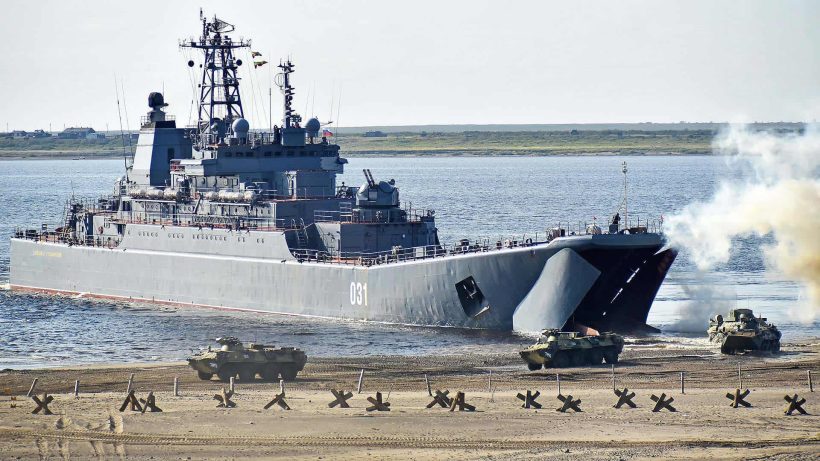
Ropucha-class, dates to the Soviet era
Anti-Empire | February 4, 2022
Russia’s Northern and Baltic fleets have 6 large landing ships each. They have each sent half of them to Tartous, Syria so that now Northern and Baltic fleets each only have 3 landing ships available, while 6 (!) are parked in Syria, a stone-throw away from the Black Sea.
The Black Sea Fleet has 7 large landing ships, so if the 6 ships in Tartus move there its amphibious landing capacity will be doubled.
This isn’t any kind of secret, the Russian military channel Zvezda TV is reporting about it openly (not that half a dozen ships can be hidden) and placing it in the context of “exercises”. Will Russia be conducting giant landing exercises in Syria? I doubt it. So then it was a “sailing” exercise?
Behind almost 6,000 nautical miles. And now, off the coast of Syria, there are six large landing ships of the Northern and Baltic Fleets “Pyotr Morgunov”, “George the Victorious”, “Olenegorsky Miner”, “Korolev”, “Minsk” and “Kaliningrad”. The path was not close and difficult – around Europe to the eastern part of the Mediterranean Sea.
This is unprecedented.
We can talk about whether the shift of Russian military power to the West and to the Mediterranean — aka closer to Ukraine is a “feint”, a “bluff”, “pressure”, “diplomacy-booster”, “ultimatum-booster”, or a buildup for escalation and live war. But what is not up for debate is that such a western buildup exists. For what purposes nobody knows 100%.
To pass the Bosphorus Strait Russian warships must under the Montreux Convention give the Turks a notice 8 days in advance, so if this fleet of landing ships will be headed for Sevastopol we will know before they even leave Tartus.
A war with Russia would be unlike anything the US and NATO have ever experienced
By Scott Ritter | RT | February 4, 2022
In a recent press conference held on the occasion of a visit to Moscow by Hungarian Prime Minister Viktor Orban, Russian President Vladimir Putin spoke about continued NATO expansion, and the potential consequences if Ukraine was to join the trans-Atlantic alliance.
“Their [NATO’s] main task is to contain the development of Russia,” Putin said. “Ukraine is simply a tool to achieve this goal. They could draw us into some kind of armed conflict and force their allies in Europe to impose the very tough sanctions that are being talked about in the United States today,” he noted. “Or they could draw Ukraine into NATO, set up strike weapons systems there and encourage some people to resolve the issue of Donbass or Crimea by force, and still draw us into an armed conflict.”
Putin continued, “Let us imagine that Ukraine is a NATO member and is stuffed with weapons and there are state-of-the-art missile systems just like in Poland and Romania. Who will stop it from unleashing operations in Crimea, let alone Donbass? Let us imagine that Ukraine is a NATO member and ventures such a combat operation. Do we have to fight with the NATO bloc? Has anyone thought anything about it? It seems not.”
But these words were dismissed by White House spokesperson Jen Psaki, who likened them to a fox “screaming from the top of the hen house that he’s scared of the chickens,” adding that any Russian expression of fear over Ukraine “should not be reported as a statement of fact.”
Psaki’s comments, however, are divorced from the reality of the situation. The principal goal of the government of Ukrainian President Volodymyr Zelensky is what he terms the “de-occupation” of Crimea. While this goal has, in the past, been couched in terms of diplomacy – “[t]he synergy of our efforts must force Russia to negotiate the return of our peninsula,” Zelensky told the Crimea Platform, a Ukrainian forum focused on regaining control over Crimea – the reality is his strategy for return is a purely military one, in which Russia has been identified as a “military adversary”, and the accomplishment of which can only be achieved through NATO membership.
How Zelensky plans on accomplishing this goal using military means has not been spelled out. As an ostensibly defensive alliance, the odds are that NATO would not initiate any offensive military action to forcibly seize the Crimean Peninsula from Russia. Indeed, the terms of Ukraine’s membership, if granted, would need to include some language regarding the limits of NATO’s Article 5 – which relates to collective defense – when addressing the Crimea situation, or else a state of war would de facto exist upon Ukrainian accession.
The most likely scenario would involve Ukraine being rapidly brought under the ‘umbrella’ of NATO protection, with ‘battlegroups’ like those deployed into eastern Europe being formed on Ukrainian soil as a ‘trip-wire’ force, and modern air defenses combined with forward-deployed NATO aircraft put in place to secure Ukrainian airspace.
Once this umbrella has been established, Ukraine would feel emboldened to begin a hybrid conflict against what it terms the Russian occupation of Crimea, employing unconventional warfare capability it has acquired since 2015 at the hands of the CIA to initiate an insurgency designed specifically to “kill Russians.”
The idea that Russia would sit idly by while a guerilla war in Crimea was being implemented from Ukraine is ludicrous; if confronted with such a scenario, Russia would more than likely use its own unconventional capabilities in retaliation. Ukraine, of course, would cry foul, and NATO would be confronted with its mandatory obligation for collective defense under Article 5. In short, NATO would be at war with Russia.
This is not idle speculation. When explaining his recent decision to deploy some 3,000 US troops to Europe in response to the ongoing Ukrainian crisis, US President Joe Biden declared, “As long as he’s [Putin] acting aggressively, we are going to make sure we reassure our NATO allies in Eastern Europe that we’re there and Article 5 is a sacred obligation.”
Biden’s comments echo those made during his initial visit to NATO Headquarters, on June 15 last year. At that time, Biden sat down with NATO Secretary-General Jens Stoltenberg and emphasized America’s commitment to Article 5 of the NATO charter. “Article 5 we take as a sacred obligation,” Biden said. “I want NATO to know America is there.”
Biden’s view of NATO and Ukraine is drawn from his experience as vice president under Barack Obama. In 2015, then-Deputy Secretary of Defense Bob Work told reporters, “As President Obama has said, Ukraine should … be able to choose its own future. And we reject any talk of a sphere of influence. And speaking in Estonia this past September, the president made it clear that our commitment to our NATO allies in the face of Russian aggression is unwavering. As he said it, in this alliance there are no old members and there are no new members. There are no junior partners and there are no senior partners. There are just allies, pure and simple. And we will defend the territorial integrity of every single ally.”
Just what would this defense entail? As someone who once trained to fight the Soviet Army, I can attest that a war with Russia would be unlike anything the US military has experienced – ever. The US military is neither organized, trained, nor equipped to fight its Russian counterparts. Nor does it possess doctrine capable of supporting large-scale combined arms conflict. If the US was to be drawn into a conventional ground war with Russia, it would find itself facing defeat on a scale unprecedented in American military history. In short, it would be a rout.
Don’t take my word for it. In 2016, then-Lieutenant General H.R. McMaster, when speaking about the results of a study – the Russia New Generation Warfare – he had initiated in 2015 to examine lessons learned from the fighting in eastern Ukraine, told an audience at the Center for Strategic and International Studies in Washington that the Russians have superior artillery firepower, better combat vehicles, and have learned sophisticated use of unmanned aerial vehicles (UAVs) for tactical effect. “Should US forces find themselves in a land war with Russia,” McMaster said, “they would be in for a rude, cold awakening.”
In short, they would get their asses kicked.
America’s 20-year Middle Eastern misadventure in Afghanistan, Iraq, and Syria produced a military that was no longer capable of defeating a peer-level opponent on the battlefield. This reality was highlighted in a study conducted by the US Army’s 173rd Airborne Brigade, the central American component of NATO’s Rapid Deployment Force, in 2017. The study found that US military forces in Europe were underequipped, undermanned, and inadequately organized to confront military aggression from Russia. The lack of viable air defense and electronic warfare capability, when combined with an over-reliance on satellite communications and GPS navigation systems, would result in the piecemeal destruction of the US Army in rapid order should they face off against a Russian military that was organized, trained, and equipped to specifically defeat a US/NATO threat.
The issue isn’t just qualitative, but also quantitative – even if the US military could stand toe-to-toe with a Russian adversary (which it can’t), it simply lacks the size to survive in any sustained battle or campaign. The low-intensity conflict that the US military waged in Iraq and Afghanistan has created an organizational ethos built around the idea that every American life is precious, and that all efforts will be made to evacuate the wounded so that they can receive life-saving medical attention in as short a timeframe as possible. This concept may have been viable where the US was in control of the environment in which fights were conducted. It is, however, pure fiction in large-scale combined arms warfare. There won’t be medical evacuation helicopters flying to the rescue – even if they launched, they would be shot down. There won’t be field ambulances – even if they arrived on the scene, they would be destroyed in short order. There won’t be field hospitals – even if they were established, they would be captured by Russian mobile forces.
What there will be is death and destruction, and lots of it. One of the events which triggered McMaster’s study of Russian warfare was the destruction of a Ukrainian combined arms brigade by Russian artillery in early 2015. This, of course, would be the fate of any similar US combat formation. The superiority Russia enjoys in artillery fires is overwhelming, both in terms of the numbers of artillery systems fielded and the lethality of the munitions employed.
While the US Air Force may be able to mount a fight in the airspace above any battlefield, there will be nothing like the total air supremacy enjoyed by the American military in its operations in Iraq and Afghanistan. The airspace will be contested by a very capable Russian air force, and Russian ground troops will be operating under an air defense umbrella the likes of which neither the US nor NATO has ever faced. There will be no close air support cavalry coming to the rescue of beleaguered American troops. The forces on the ground will be on their own.
This feeling of isolation will be furthered by the reality that, because of Russia’s overwhelming superiority in electronic warfare capability, the US forces on the ground will be deaf, dumb, and blind to what is happening around them, unable to communicate, receive intelligence, and even operate as radios, electronic systems, and weapons cease to function.
Any war with Russia would find American forces slaughtered in large numbers. Back in the 1980s, we routinely trained to accept losses of 30-40 percent and continue the fight, because that was the reality of modern combat against a Soviet threat. Back then, we were able to effectively match the Soviets in terms of force size, structure, and capability – in short, we could give as good, or better, than we got.
That wouldn’t be the case in any European war against Russia. The US will lose most of its forces before they are able to close with any Russian adversary, due to deep artillery fires. Even when they close with the enemy, the advantage the US enjoyed against Iraqi and Taliban insurgents and ISIS terrorists is a thing of the past. Our tactics are no longer up to par – when there is close combat, it will be extraordinarily violent, and the US will, more times than not, come out on the losing side.
But even if the US manages to win the odd tactical engagement against peer-level infantry, it simply has no counter to the overwhelming number of tanks and armored fighting vehicles Russia will bring to bear. Even if the anti-tank weapons in the possession of US ground troops were effective against modern Russian tanks (and experience suggests they are probably not), American troops will simply be overwhelmed by the mass of combat strength the Russians will confront them with.
In the 1980s, I had the opportunity to participate in a Soviet-style attack carried out by specially trained US Army troops – the ‘OPFOR’ – at the National Training Center in Fort Irwin, California, where two Soviet-style Mechanized Infantry Regiments squared off against a US Army Mechanized Brigade. The fight began at around two in the morning. By 5:30am it was over, with the US Brigade destroyed, and the Soviets having seized their objectives. There’s something about 170 armored vehicles bearing down on your position that makes defeat all but inevitable.
This is what a war with Russia would look like. It would not be limited to Ukraine, but extend to battlefields in the Baltic states, Poland, Romania, and elsewhere. It would involve Russian strikes against NATO airfields, depots, and ports throughout the depth of Europe.
This is what will happen if the US and NATO seek to attach the “sacred obligation” of Article 5 of the NATO Charter to Ukraine. It is, in short, a suicide pact.
Scott Ritter is a former US Marine Corps intelligence officer and author of ‘SCORPION KING: America’s Suicidal Embrace of Nuclear Weapons from FDR to Trump.’
Russia to kick out German state media after Berlin bans RT DE
RT | February 3, 2022
The Russian office of the German state broadcaster, Deutsche Welle (DW), is to be closed as part of the “first round” of a response to Berlin’s “unfriendly actions” against RT DE, the Russian Foreign Ministry said in a statement on Thursday.
The German outlet will also be barred from broadcasting in Russia via a satellite or through other means, the statement added. All staff members at DW’s Russian office are to be stripped of their press credentials, according to the foreign ministry.
Moscow has also launched a procedure which will recognize DW as a “foreign media outlet acting as a foreign agent” under Russian law.
Moscow also said it was compiling a list of German state and public entities believe t be linked to blocking RT DE in Germany and exerting pressure on the Moscow-based broadcaster. Representatives included on the list will be barred from entering Russia, the foreign ministry said, adding that it would release information about subsequent rounds of reciprocal measures “in due course”.
DW said it would challenge the decision of the Russian authorities in court and would also continue operating from the Moscow office until it receives a formal closure order. DW’s director, Peter Limbourg, denounced Moscow’s move as “absurd” and an “overreaction.” He also vowed to “significantly increase the coverage” of Russia.
The move comes a day after Germany’s top media regulator sided with a regional authority and upheld a ban on RT DE’s broadcast in Germany, citing the absence of a locally-issued license. The channel previously obtained a valid pan-European permit in Serbia but the German regulators declared that void.
RT DE now has four weeks to appeal the decision in court, which it is planning to do.
Russia responds to accusations of chemical weapons use
Russian ambassador to the United States says Washington is telling ‘outright lies’
By Jonny Tickle | RT | February 2, 2022
Russia is strictly adhering to the norms of international law, and suggestions that it is using chemical weapons are “fundamentally false,” the country’s ambassador to the US claimed on Wednesday.
In a Facebook post on Wednesday morning, Anatoly Antonov called the accusation a fantasy, and instead suggested that Washington is trying to “demonize” Russia. His rebuttal came after White House Press Secretary Jen Psaki told journalists that Russian President Vladimir Putin has taken “aggressive steps” on the global stage.
“This is a country and a leader who has, you know, used chemical weapons, who has invaded multiple countries in the past several years,” Psaki said, at a press briefing on Tuesday.
However, according to Antonov, both these suggestions are untrue, and Washington would be wise to “look in the mirror more often before blaming or lecturing others.”
“The US has not backed up with any credible evidence its fantasies built on outright lies about the alleged use of chemical weapons by our country,” the ambassador said. “The accusations against our country of ‘invading’ other states also have no grounds.”
According to Antonov, Russia has completely destroyed its stocks of chemical weapons, while the US has not.
“Russia adheres to the principle of ‘non-interference’ in the affairs of foreign countries and strictly follows international law – unlike the United States, whose modern history looks more like a chronology of US military operations in different parts of the globe,” the ambassador continued, accusing Washington of conducting “bloody” experiments around the world, which cause “nothing but chaos, instability, and loss of lives.”
The latest statement by Psaki is not the first time that Moscow has been accused of illegally using chemical weapons. Last year, Washington imposed sanctions on a number of Russian officials and businesses for the alleged poisoning of jailed opposition figure Alexey Navalny, in what the US dubbed “the use of a chemical weapon” in an “attempted assassination.”
“The U.S. government has exercised its authorities to send a clear signal that Russia’s use of chemical weapons and abuse of human rights have severe consequences. Any use of chemical weapons is unacceptable and contravenes international norms,” a State Department press release said in March.
In response, Russian Foreign Ministry spokeswoman Maria Zakharova accused Washington of using Russia as a diversion from America’s internal issues.
Could the Ukrainian army face Russian forces?
By Uriel Araujo | February 2, 2022
With a Russian-Ukrainian armed conflict becoming increasingly more likely, due to the escalation of tensions and Ukrainian provocations, some analysts are already reflecting on the possible outcomes of such a conflict. In this scenario, what chances do the Ukrainian armed forces have?
The Ukrainian military is notoriously outdated, corrupt, low-tech, focused on trench warfare, low-skilled, and poorly paid. In addition, it lacks discipline and it is not very experienced. One could argue it has “hardened” itself since 2014, as it has been fighting rebel forces in Donbas but by Kiev’s own estimates, the vast majority of the rebels are locals, contrary to Western discourses about “Russian occupants”, and possess mainly light weapons and Soviet-age armor. The Russian armed forces are something very different. Moreover, Ukrainian bombers and jet fighters are quite dated and could play only a supporting role in a war against Russia. Kiev has Soviet-era surface-to-air missile batteries and most of its systems are dependent on Russia for upgrades. Of course, it could modernize its air force, but it would take at least a decade and would cost some billions of dollars.
It is true the Ukrainian army now has some Main Battle Tank and Light Anti-tank Weapons (MBT LAWs, also known as NLAWs). Around 2,000 units of these “fire-and-forget” anti-tank missile systems have been provided to Kiev by the UK, hundreds of those were delivered last month, apparently in a hurry.
According to Sebastien Roblin, an international security expert, who has served as a university instructor for the Peace Corps in China and holds a Georgetown University Master’s Degree in Conflict Resolution, these missiles might only be useful in “desperate circumstances”. They were chosen mainly due to the fact that they are easy to use, thus allowing the Ukrainian forces to be quickly trained in their use by British paratroopers. The MBT LAWs do not possess as much long-distance accuracy as the US anti-tank missile TOW (tube-launched, optically tracked, wire-guided), for instance.
They could of course destroy some Russian tanks in an urban warfare context, but, as Roblin argues, in his Forbes piece, Moscow’s military doctrine today (known as “non-contact warfare“), focuses mainly on destroying the enemy forces from a great distance, employing all kinds of artillery aided by drone surveillance technology. Moscow has learned much from Chechnya urban battles of the 1990s, after all. This means Russian tanks and infantry would only come after massive artillery fire. In this case, Ukraine’s mostly plain geography does not help much. Russian ballistic and cruise missile platforms, simply put, have the power to devastate Ukrainian power plants, radars, command centers and armored vehicle columns.
Kiev also possesses some Javelin missiles now, delivered by Washington – albeit in a very limited amount (about 540 missiles and 77 launchers). They too are no match for Moscow’s airpower and could merely deter the Russian army for a while, as they are mostly ambush weapons.
Last month, the Ukrainian defense minister Oleksii Reznikov addressed Washington humbly requesting Patriot PAC-3 missiles. It is quite unlikely the US would authorize supplying a non-NATO member with Patriots missiles in any case, as Ukraine defense expert Mikhail Zhirikov argues. The thing is the kind of longer-range missiles Kiev would need are tremendously costly and complex and, moreover, Ukraine would need years to properly train its forces in using such systems and to fully integrate them.
Since the 2014 so-called Maidan revolution, Ukraine’s economy, one of Europe’s poorest, has been in very bad shape and recent Western alarmism has hurt it even more, according to Ukrainian President Zelensky himself. This too, would not help much in a hypothetical situation of war.
Samuel Charap and Scott Boston, two Rand Corporation analysts, argue that any military assistance or weapons Ukraine receives will be simply irrelevant considering Russian advantages in geography, capability and capacity. They go as far as to say that the best help Washington could provide Kiev would be finding a diplomatic solution.
In any case, according to Ukraine’s own generals, Kiev could not repel Russian forces without major Western military help. Such help however might never come. The US-led NATO, as expected, has already made it abundantly clear it will not send any troops should a war ensue. Western help would be limited to sending mercenaries disguised as advisors to train sabotage units and terrorists.
Contrary to Western narratives, Moscow does not desire to occupy Eastern Ukraine and never intended to do so. What Moscow wants is very simple: it wants NATO to cease expanding towards Russian borders, as the Alliance has persistently done since the end of the Cold War, and the end of the so-called Iron Curtain.
One should also keep in mind that Eastern Ukraine is mostly pro-Russian and that Ukraine has a very high rate of bilingualism and mixed Russian-Ukrainian marriages. The two countries’ history is intertwined. This greatly limits Ukrainian nationalism’s potential for growth outside parts of Western Ukraine.
The most likely outcome of a war would be a quickly defeated Ukraine forced to compromise by granting some limited autonomy to the Donbas region instead of pushing its current genocidal and chauvinistic policies there. In such a scenario, the presence of a Russian peace-keeping mission in Donbas for some years would also be a possibility, amid a possible frozen conflict in the region (involving rogue ultra-nationalist Ukrainian factions), with occasional acts of sabotage and terrorism commited by far-right Ukrainian groups funded or aided by Western powers and their networks of proxies, and also possibly by Turkey’s own networks (considering ultra-nationalist Turkish-Ukranian cooperation).
In this case, one could expect a potentially long counter-insurgency conflict in a context of irregular warfare. This would further fuel Europe’s own migration crisis, with an increase in criminality, terrorism and all the usual negative economic and political outcomes, thus impacting the EU very badly.
To sum it up, in the event of a Russian-Ukrainian war, everyone loses, as is the case with any armed conflict, but some lose more: Ukraine as a whole would suffer the most, followed by Europe.
Featured Video

AIDS Inc. by Gary Null (2007)
or go to
Aletho News Archives – Video-Images
From the Archives
Clash of Civilization, Iran Part II
By Jamal Kanj – Intifada-Palestine.com – January 14, 2011
Israel’s survival kit is: perpetuate conflict, insecurity to rationalize collective hate and finally playing victim.
Devoid of conflict, Israel implodes internally; without hate, Zionism loses its justification; and playing eternal victim to continue blackmailing the West. Absence of this holy trinity, Israel ceases to exist.
From its inception, the house of Zion has mastered exploiting adversarial powers to advance Israel’s cause. For instance, their influence over the Democratic Party in the US began with President Truman’s bid for 2nd term election in 1948.
Responding to strong opposition from Secretary of State General George Marshall and Department experts urging against recognition of Israel, President Truman replied: “I’m sorry gentlemen but I have to answer to hundreds of thousands [Jewish voters] who are anxious for the success of Zionism. I do not have hundreds of thousands of [voting] Arabs among my constituents”
Zionists influence over liberal American politics was matched with the doctrinal school of Conservative theoreticians aligning the Republican Party’s platform with Israel’s objectives. The Neoconservative Zionists, coined Zioncons, invented the “Clash of Civilization” concept to fight Israel’s wars. … continue
Blog Roll
 Aletho News
- Merck Virologists Admitted to Falsely Certifying Vaccine Efficacy
- Mandatory Folic Acid for every man, woman & child
- Pro-Palestine protesters arrested outside UK’s ruling Labour Conference in Liverpool
- Mauritius denies landing permit to flight from Israel, forcing cancellation: Tour operator
- Israeli finance minister calls for genocidal war on West Bank, annexation of south Lebanon
- 12 Things Your Psychiatrist Was Trained Not to Tell You
- From Unipolar Universalism to Multipolar Civilizational Distinctiveness
- RSF military group defects, joins Sudanese army: State media
- Ireland goalkeeper refuses to play ‘Israel’ as squad weighs boycott
- China pushes back against US on Cuba, Iran
- If Americans Knew
- Israel forces Gazans to live in constant peril – Daily Update
- Deconstructing Netanyahu’s pants-on-fire UN rant – Daily Update
- Trump betrayed voters with his campaign lies and prioritized a foreign country once he took office
- Netanyahu calls Israel’s war in Gaza ‘opposite of genocide’ in UN speech to near-empty hall
- Settler Kidnappings: Torture, Sexual Abuse and Terrorisation of Palestinian Abductees as Israel Deepens Annexation of West Bank
- Gaza winter nears as 162,000 tents become unusable, raising fears of humanitarian crisis
- Netanyahu says, “It’s the opposite of genocide”; UN says Gaza economy is world’s ‘most severe crisis on record’ – Daily Update
- Israel’s US-Backed Assault on Gaza Has Created the ‘World’s Most Severe Economic Crisis on Record’: UN
- ‘Protecting U.S. Citizens’… From Israel
- ‘This is where I live now, the back of a truck’: a day in the life of a grandmother in Gaza
- No Tricks Zone
- New Study: Earth And Venus Surface Warmth Largely Explained By Convection And Lapse Rate, Not CO2 Or Radiation
- 2025 Nature Paper Claiming Worsening Global Drought Gets RETRACTED …Heavily Flawed
- New Study: ‘Global Drought Shows No Detectable Recent Acceleration Under Climate Warming’
- Economic Masterminds: German Socialists Suggest Taxing Productivity Gains Stemming From Using AI
- The South China Sea Has Not Been Cooperating With The Climate Change Narrative
- Energy Crisis: Germany Enters Heating Season With Historically Low Gas Reserve Fill Levels
- New Study: The Antarctic Ice Sheet Gained Mass From 2020-2024 Due To Staggering Snow And Ice Accumulation
- Study: Ocean Heating Rates From Thousands Of Years Ago ‘Dwarf’ Modern Ocean Heating Rates
- Climate Extremists Target, Attack Large-Scale Power Grid Infrastructure In Germany!
- New Study: Antarctic Ice Melt Has Contributed Less Than 1 Centimeter To Sea Level Rise In The Last 30 Years

