Biden Mulls Sending Extra Weapons & Trainers To Ukraine Amid Dubious Reports Of “Russian Invasion”
By Tyler Durden | Zero Hedge | November 24, 2021
Here we go again: the ratcheting tit-for-tat threats currently being unleashed between Moscow and Washington arguably hasn’t been this intense since the height of the Donbass conflict of years ago, and the Crimea crisis. It’s leading to the Biden administration mulling ramping up arms transfers to Kiev.
CNN on Tuesday is citing multiple defense sources to report “The Biden administration is weighing sending military advisers and new equipment including weaponry to Ukraine as Russia builds up forces near the border and US officials prepare allies for the possibility of another Russian invasion.
And yet as we’ve reviewed, there’s still as yet little to nothing in the way of hard evidence that Russia is setting in motion any kind of plans to “invade Ukraine” – as Bloomberg last week first reported based on anonymous US sources. Much of the speculation appears based on satellite images of Russian troop movements taking place significantly far from Ukraine’s border, with Moscow’s constant refrain to the West being that it can move its own troops within Russia’s sovereign borders wherever it wants to.
But this new US plan to not just send more military hardware – but also US military advisers – would mark a serious escalation, as the Kremlin has recently warned it would see any kind of NATO forces buildup inside Ukraine as violating its “red lines” which would require taking action.
According to the fresh CNN report, the proposed lethal aid package now under consideration by the White House could include stinger missiles – which Moscow would without doubt consider a severe escalation:
The discussions about the proposed lethal aid package are happening as Ukraine has begun to warn publicly that an invasion could happen as soon as January. The package could include new Javelin anti-tank and anti-armor missiles as well as mortars, the sources said.
Air defense systems, such as stinger missiles, are also under consideration, and the Defense Department has been pressing for some equipment that would have gone to Afghanistan — like Mi-17 helicopters — to instead be sent to Ukraine. The Mi-17 is a Russian helicopter that the US originally purchased to give to the Afghans. The Pentagon is now weighing what to do with them after the US withdrawal from Afghanistan in August.
And in particular the Javelins are seen as deadly and effective against Russia’s T-80 tanks. Recently, Moscow has accused pro-Ukrainian forces of heightened attacks on pro-Russian separatists in Ukraine’s east over the past months, which has included multiple deaths from sporadic mortar fire.
The past year has seen NATO military exercises utilize closer Ukrainian army and naval participation…
Already in response to the rumors and reports of more US weapons and trainers sent to Ukraine, Russia is responding with threats of its own to send its weapons into eastern Ukraine.
Kremlin spokesman Dmitry Peskov said, “we shouldn’t rule out the possibility of sending military advisers and weapons to Ukraine, because this is already taking place. Military advisers are arriving there, weapons are supplied there — not only from the United States, but also from other NATO countries. And all this, of course, leads to a further aggravation of the situation on the border line.”
Previously on Monday the Kremlin vehemently denied the Western reports of any planned-for “invasion”, with government spokesman Peskov explaining that currently the Russian military is merely engaged in the “usual background level” of military maneuvers – similar to the training drills that ended up generating false reports last April and May of a “planned Ukraine invasion”. That prior situation, like the current one, involved Russian troops and weaponry being observed at least 60km from the actual Ukrainian border, and not along it.
During the statement, Peskov actually turned the charges back on NATO, saying, that in Ukraine “The number of provocations has increased significantly and these provocations are conducted using weapons delivered by NATO.” He blamed Kiev and its backers for the soaring tensions, calling its own military build-up “alarming” – thus each side appears to be ramping up troop readiness based on accusing the other of a “build-up” of forces.
NATO submarine caused Kursk sinking that killed 118 Russian sailors, ex-admiral claims
By Layla Guest | RT | November 22, 2021
The catastrophic sinking of the Russian nuclear-powered Kursk submarine more than two decades ago was the result of a collision with a stricken NATO vessel in the Barents Sea, a former high-ranking navy chief has insisted.
The ‘Kursk’ sank on August 12, 2000 at a depth of 108 meters, claiming the lives of all 118 crew members and sparking the first major international crisis of Vladimir Putin’s presidency. An official investigation commissioned by the Russian government ruled two years later that the incident was the result of a torpedo explosion, which then triggered the detonation of ammunition on board.
However, in an interview with RIA Novosti, aired on Monday, former Northern Fleet commander Vyacheslav Popov offered a theory on how the incident might have happened. According to him, a vessel operated by a NATO power got too close to Moscow’s vessel, colliding with its bow and damaging the torpedo tube, which was followed by an explosion. The compartment then flooded, sending the sub to the depths of the sea.
“The submarine that collided with ‘Kursk’ was following it, apparently, but failed to ensure safety in the sea’s environment and all other conditions, approached too close, or the Kursk maneuver led to a loss of contact,” he said.
Popov claimed he knew the name of the sub belonging to the US-military led bloc “with a 90% probability.” However, he admitted he did not have sufficient available evidence to make the case publicly at present.
According to the former naval chief, who served until 2001, the vessel was in the region where it collided with ‘Kursk’. He also noted that SOS signals were sent from special equipment that Russian boats were not equipped with, implying another submarine must have been present.
Viktor Kravchenko, a former chief of staff of the Russian Navy, later agreed with Popov’s theory, remarking he was “also inclined to believe this version” of the demise of the Kursk, based on circumstantial evidence.
Three NATO vessels, the British ‘Splendid’ and American subs ‘Toledo’ and ‘Memphis’, were reportedly in the vicinity of Russian military exercises in the Barents Sea at the time. Neither Washington nor London provided documents on the condition of their vessels after Moscow requested the information.
However, the Russian government maintains that the official investigation’s conclusion is the most likely, with many analysts pointing out the period was a challenging time for the Russian military. A combination of underfunding, aging Soviet hardware, and low morale could all have contributed to the incident.
Putin, then only months into his first term as president, took the brunt of much of the criticism for the Kursk tragedy, with the large-scale loss of young Russian sailors sparking sorrow and outrage. Failed rescue efforts caused anger and frustration both domestically and worldwide.
Popov’s claims come amid heightened concerns over NATO’s activity around Russia’s borders. On Friday, the bloc’s top official, Jens Stoltenberg, proposed deploying American nuclear warheads around Eastern Europe to counter a supposed threat posed by Moscow.
In response, the Kremlin said such a statement would mean that the Founding Act of Russia-NATO relations “no longer exists.” Under this document, inked in 1997, the two parties do not consider each other rivals. It guarantees no nuclear weapons will be deployed to new NATO members after this date.
Theater of Absurd… Pentagon Demands Russia Explain Troops on Russian Soil
Strategic Culture Foundation | November 19, 2021
The United States Secretary of Defense Lloyd Austin this week performed impressive, albeit pathetic, mental gymnastics. In a press conference, the Pentagon chief called on Russia to be more transparent about troop movements “on the border with Ukraine”. In others words, on Russian soil.
Meanwhile, the absurd hypocrisy sees U.S. and NATO forces brazenly escalating their offensive presence on Russia’s borders, especially in the Black Sea region.
Here’s an Associated Press clip on the Pentagon press conference: “American officials are unsure why Russian President Vladimir Putin is building up military forces near the border with eastern Ukraine but view it as another example of troubling military moves that demand Moscow’s explanation, Defense Secretary Lloyd Austin said Wednesday.”
The report quotes Austin as saying: “We’ll continue to call on Russia to act responsibly and be more transparent on the buildup of the forces around on the border of Ukraine… We’re not sure exactly what Mr Putin is up to.”
This dubious talent for mind-bending mental gymnastics and double-think is shared with other members of the Biden administration. Last week, America’s top diplomat Antony Blinken claimed that Russia was about to invade Ukraine yet at the same time the U.S. Secretary of State confessed similar ignorance about what “Putin is up to”.
How is it possible to engage in meaningful dialogue with such vacuous people who are supposed to be government leaders – and leaders too of the self-declared world’s most powerful, most brilliant nation? No undue offense intended, but it would probably be more productive to engage in a dialogue with the bewildering characters from Samuel Beckett’s absurdist play Waiting for Godot.
Russia has repeatedly dismissed all claims about it threatening Ukraine or any other country with invasion. Moscow also disputes “unreliable” information touted by the Biden administration and Western media of troop buildup near Ukraine on its western flank. Western media reports have relied on dodgy commercial satellite data purporting to show Russian military maneuvers. It is contemptible that senior U.S. government figures are basing grave allegations against Russia on such ropy sources. That in itself speaks volumes about the deterioration in Washington’s diplomatic professionalism and political intelligence.
Secondly, the salient fact being missed in all the hullabaloo is this: Russian troops and equipment are on Russia’s sovereign territory. It is the height of absurdity for U.S. officials to demand that Russia “explain” and be “more transparent” about its own national defenses. That speaks of a hyper-arrogance among American politicians that are deforming their ability to think reasonably.
There is an analogy here with the outcry this week over Russia’s successful missile test against a Soviet-era satellite in orbit. The Biden administration condemned Russia for creating “space junk” and weaponizing space while ignoring the fact that the U.S. previously carried out the same kind of missile strike and, arguably has been trying to weaponize space since the Reagan administration’s “star wars” program during the 1980s.
In any case, the U.S. charges of Russia’s military buildup on its own territory are made all the more ridiculous when we consider the actual increase in NATO forces in Ukraine and the Black Sea region – right on Russia’s western doorstep.
In a major speech this week delivered at the Russian foreign ministry, President Putin noted again how Western powers have continually failed to register Moscow’s national security concerns over the expansion of NATO forces along Russia’s borders. He described this inability for cognition of what should be an obvious grievance as “very peculiar”.
The Kremlin has suggested that the increasing NATO offensive presence near Russia’s borders is not due to stupidity, but rather is aimed at provoking a conflict. Russia is strenuously resisting the danger of an armed confrontation, and yet the provocations continue.
Nearly two weeks ago, William Burns, the head of the CIA made a high-profile visit to Moscow during which he held discussions with senior Kremlin figures, including President Putin. We can safely assume that Burns was told in no uncertain terms that the buildup of U.S. and NATO forces near Russia’s territory is a red line that will presage a response from Russia.
But these red lines continue to be skirted by Washington and its NATO allies.
More perplexing, too, are the moves by the U.S.-backed Kiev regime to escalate the conflict in Ukraine against the ethnic Russian population in the separatist Donbas region. The ultranationalist regime has been waging a low-intensity war against the Donbas since the U.S.-backed coup in Kiev in 2014. The Americans and other NATO powers are increasing weapon supplies and military trainers to the regime, emboldening it to repudiate any peaceful settlement of the eight-year conflict.
Only last month, Pentagon chief Austin was in Kiev where he recklessly endorsed the joining of the NATO bloc by Ukraine. That is in spite of numerous warnings from Moscow that such a move would be an unacceptable destabilization.
The stepped-up war drills by NATO in the Black Sea region are inevitably leading the Kiev regime to resile from legally binding commitments to the Minsk Peace accord of 2015 – brokered by Russia, Germany and France. The release this week of diplomatic communications by the Russian Foreign Minister Sergei Lavrov clearly demonstrates that Germany and France are complicit in turning a blind eye to the Kiev regime’s systematic violation of the Minsk deal.
In this context, Russia is justifiably deeply wary of a confrontation exploding out of the tinderbox conditions in Ukraine and the Black Sea. Given the Russian nation’s tragic history of suffering from past military invasions, it is entirely understandable and indeed vitally prudent that the country’s formidable defenses are on high alert.
It is not for Russia to explain its troops. It is for the United States and its NATO partners to account for their wanton aggression and to desist.
There is something of the theater of absurd in American and European posturing. But it’s far from funny. It’s menacingly deranged.
Can a space war be stopped?
By Paul Robinson | RT | November 18, 2021
News that Russia has tested an anti-satellite missile has sparked concern for spacecraft and, more worryingly, highlighted the lack of international treaties regulating space weapons, meaning the cosmos is becoming a battleground.
While the US currently opposes controls on orbital arms, the shifting balance of power means that it would likely do well to reconsider. The test in question, confirmed by Moscow on Tuesday, destroyed an old, inoperable Soviet reconnaissance satellite, with Washington blasting the operation as “irresponsible” and “reckless” over the resulting debris.
So-called “space junk” poses a serious danger to objects such as satellites and the International Space Station. By adding to the cloud of junk floating around in orbit, Russia has done nobody any favours, although it should be pointed out that the test didn’t break international law, as there is at present no binding legal regime regulating space debris.
Typical of Western responses to the Russian test was that of General James Dickinson, commander of the US Space Command, who said that Russia had “demonstrated a deliberate disregard for the security, safety, stability, and long-term sustainability of the space domain for all nations.”
“We won’t tolerate this kind of activity,” added US State Department spokesman Ned Price. But while American complaints about space debris may be valid, one wonders whether their real concern is the threat the Russian test poses to their military dominance.
Experts distinguish between the militarization and the weaponization of space. The first involves using space for military purposes, such as communications, and the second involves placing systems with destructive capabilities in space. Militarization happened long ago. Weaponization has yet to occur.
The only legal instrument regulating weapons in space is the Outer Space Treaty of 1967 which prohibits the placing of nuclear weapons or other weapons of mass destruction in orbit around the Earth, or on the Moon or celestial bodies. Efforts to expand the prohibition to weapons in general have failed, in large part due to American resistance.
While some strategists have argued that it is better to leave space as a “sanctuary” and to avoid going down a path that will lead to a new arms race, the current of opinion in American military circles has long been that such an arms race is unavoidable and that it is better for the United States to get a lead on others while it enjoys a technological advantage.
As the then-Commander-in-Chief of US Space Command, Joseph W. Ashy, said in 1996:
“It’s politically sensitive, but it’s going to happen… we’re going to fight in space. We’re going to fight from space and we’re going to fight into space. That’s why the US has development programs in directed energy and hit-to-kill mechanisms. We engage terrestrial targets someday – ships, airplanes, land targets – from space.”
Since the time of Ronald Reagan, powerful forces have also been lobbying hard for space-based anti-ballistic missile defence systems, a key component of which would consist of weapons systems in orbit. For these reasons, the USA has opposed efforts to tie its hands by means of arms control. In 2006, the US National Space Policy announced that the country will “oppose the development of new legal regimes or other restrictions that seek to prohibit or limit US access to or use of space. Proposed arms control agreements or restrictions must not impair the rights of the United States to conduct research, development, testing, and operations or activities in space for US national interests.”
Consequently, when in 2008 China and Russia proposed a draft Treaty on Prevention of the Placement of Weapons in Outer Space and of the Threat or Use of Force against Outer Space Objects, the United States rejected it. Similarly, the United States has consistently voted against an annual resolution put forward by the ad hoc committee of the UN Conference on Disarmament, entitled “The Prevention of an Arms Race in Outer Space.”
The differing approaches of the US and its Western allies on the one hand, and Russia and China on the other, became clear last year when the two sides backed competing UN committee resolutions. The first, drafted by the British and supported by the US, encouraged UN members to “share their ideas on the further development and implementation of norms, rules and principles of responsible behaviours” in space. Russia voted against this innocuous proposition, complaining that it failed to “include provisions on the need for peaceful uses of outer space, on prohibiting the installation of weapons there, on threats of use of force and a clear outline of responsible behaviour.”
Instead, Russia supported a rival draft that declared that, “the exclusion of outer space from the sphere of the arms race and preserving the realm for peaceful purposes should become a mandatory norm of State policy and a generally recognized international obligation.” The US, along with the UK, Australia, Canada, France, Israel, Japan, the Marshall Islands, and Ukraine voted against this second, more robust resolution. It would appear that they prefer vague talk about “norms” rather than a specific prohibition of the weaponization of space.
Underlying this attitude is the idea that arms control benefits the weaker side, and that as the world’s dominant military power, the US should not agree to being constrained. An arms race in space would be unwelcome, but if one happened, the US would win. Unfortunately for the Americans, it can no longer be so sure of this, and recent technological advances have rendered many of its plans for space irrelevant.
Most notably, Russia’s deployment of hypersonic glide missiles has made the tens of billions of dollars invested by Washington in ballistic missile defence worthless. Even if the Americans could develop some space-based defence system against these missiles, the cost would be gargantuan, and by the time the system could be deployed, new technologies would already have produced counter-measures. The idea that America needs to weaponize space in order to defend itself against nuclear attack doesn’t stand up to scrutiny.
The Russian anti-satellite test may be seen as an effort to try to force the United States to recognize its vulnerability and so bring it to the negotiating table. This may not work. The gargantuan sums of money mentioned above mean that there are powerful institutional interests in the United States who will resist any such effort. This is highly regrettable. Nobody but generals and arms manufacturers will benefit from an arms race in space. The sooner everyone recognizes this the better.
Paul Robinson is a professor at the University of Ottawa. He writes about Russian and Soviet history, military history and military ethics, and is author of the Irrussianality blog.
IMF Correctly Predicts Arrival of Compulsory Vaccination Across Russia After Gifting Kremlin $18 Billion
By Edward Slavsquat | Anti-Empire | November 16, 2021
Before October, most of Russia’s 85 regions had few (if any) COVID-related restrictions; mandates requiring businesses to vaccinate the majority of their employees—introduced in Moscow and several other regions in June—had not yet become the norm.
This all changed after the State Duma elections in late September. Speaking a day before the election results were announced, Annette Kyobe, IMF Representative in Russia, made a prophetic observation. As TASS reported at the time:
“There is no appetite [in Russia] for restrictive measures, lockdown, at least on the part of state authorities. <…> After the parliamentary elections, perhaps a more unpopular measure, like mandatory vaccination, can be initiated as early as October-November. “
What an incredible prediction! As it just so happens, COVID “cases” and “deaths” inexplicably began to skyrocket immediately after the Duma elections, forcing Russian authorities to introduce mandates and QR codes across the country.
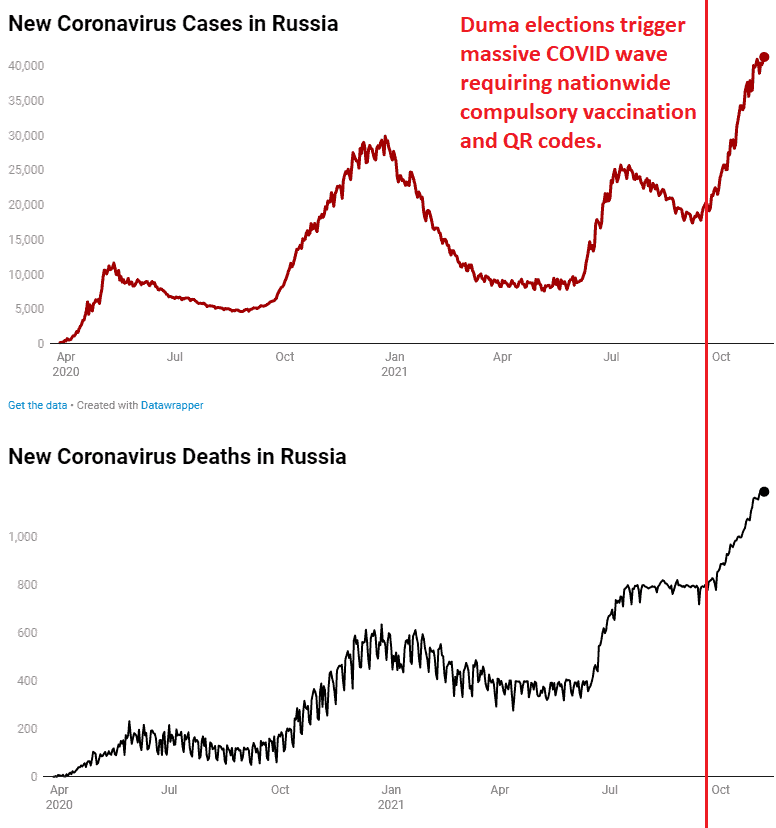
IMF totally called it!
Starting in October, Russian regions began the mass adoption of vaccine mandates and digital “health” passes. On October 14, Deputy Finance Minister Timur Maksimov told the IMF and World Bank that Russia’s government understood how important it was to shove a needle into every arm:
Participants in the autumn session of the IMF and the World Bank on Wednesday came to the conclusion that the problem of the crisis in the global economy cannot be solved until the population of all countries is vaccinated in the required proportion, Russian Deputy Finance Minister Timur Maksimov told reporters following these meetings.
“Until all countries are vaccinated in the required proportion, the world will not return to the old normality. Therefore, the question was raised that it is necessary to increase efforts to produce, to ensure access to vaccines. more and more waves of COVID cover different countries, “Maksimov said.
But wait… how was the IMF—an organ of Western Financial Extortion—able to so accurately predict Russia’s warm embrace of the global Vax Caste System?
Just a lucky guess. Obviously it had nothing to do with the 18 billion United States Dollars that the IMF shoveled into the Kremlin’s coffers back in August. The head of the IMF described the generous cash-injection as part of a “vaccination for the world economy during an unprecedented crisis.” (We should note for the sake of accuracy that the $18 billion was awarded in the form of “special drawing rights.” SDRs are units of account for the IMF and represent a claim to currency held by IMF member countries for which they may be exchanged.)
Outrageously, some Russian analysts and media outlets have suggested that something is slightly suspicious about all this—but why would they suggest something so silly? Anyway:
“There is no appetite for restrictive measures, lockdown, at least on the part of the state authorities. After the parliamentary elections, perhaps a more unpopular measure, such as compulsory vaccination, can be initiated as early as October-November.”
This is an excerpt from the speech of the IMF Resident Representative in Russia Annette Kyobe during the Fitch Ratings webinar “Russia – Macroeconomic Forecast 2021”.
On the air on the Tsargrad TV channel, Alexander Losev, a member of the Presidium of the Council on Foreign and Defense Policy, explained why our country continues to cooperate with discredited organizations and why the IMF wants to vaccinate all of Russia:
“The IMF and the World Bank are two organizations that have introduced such a concept as the Washington Consensus.
Adherence to this Washington Consensus is written for all developing countries.
First of all, this is a limitation of state sovereignty, less support for business, more – the market, invisible hands of the market, there are many of them, and some requirements for budgets and budgetary policy.
All countries that followed the Washington Consensus ended up poorly, with crises.
The second point is why the IMF says it.
At the end of August, the Bank of Russia received $ 18 billion from the IMF in the form of special drawing rights, that is, it received money. I’m not hinting at anything, I’m just stating: was the money accepted? Accepted.
These are the institutes of world governance created by the United States. And now the activity of these institutions is an attempt by the United States to preserve its hegemony, to preserve its power over the world.
They are tools. Behind them is the United States and their establishment, those who manage capital, world politics – or think they do.
[…]
The main beneficiaries of the pandemic are, of course, financiers. Because all the money that governments and central banks sent to help the economy, they basically all went through the banking system. The American banking system is $ 90 trillion in assets. All the money that the government allocated went there too.
The estimate is how much money was allocated and how much got into the banking system, from 24 to 27 trillion dollars. Equivalent. In different countries, including developing countries.
Utter nonsense! Russia adopted nationwide compulsory vaccination policies because there was a huge, dangerous wave of COVID that emerged immediately after Duma elections, which required more Sputnik V, everywhere and for everyone. If Russians don’t like it, they will have a chance to vote again, in the next Duma elections, in 2026.
Public health is a funny thing.
ANOTHER BOGUS RUSSIAN WAR SCARE
By Paul Robinson | IRRUSIANALITY | November 12, 2021
I have had a couple more pieces published in RT in the last two days. One concerns the probably temporary closure of the Kyiv Post and why it seems to have provoked immense outrage whereas the previous shutting down of Russian-language Ukrainian media outlets did not. The other responds to a letter of resignation sent by Russian liberal journalist Konstantin [von] Eggert [MBE] to the Chatham House think tank in protest the institute’s decision to give an award to a BLM activist. I use this an opportunity to delve into different Russian and Western conceptions of rights and freedoms. You can read these here and here.
For this post, though, I intend to tackle another topic, which follows on naturally from my last one. In that, I mocked the idea being floated around in some circles that Russia was behind the Belarus-EU migrant crisis and somehow using it as a provocation for further aggressive action, including maybe a military assault on the ‘Suwalki Gap’.
As we now know from Bloomberg, this theory is nonsense: Russia has no intention of invading Poland, it’s planning to invade Ukraine instead. Or so say ‘American officials’, and as we all know you can trust their judgement 100%.
According to Bloomberg:
“The U.S. is raising the alarm with European Union allies that Russia may be weighing a potential invasion of Ukraine as tensions flare between Moscow and the bloc over migrants and energy supplies.
With Washington closely monitoring a buildup of Russian forces near the Ukrainian border, U.S. officials have briefed EU counterparts on their concerns over a possible military operation, according to multiple people familiar with the matter.
… The assessments are believed to be based on information the U.S. hasn’t yet shared with European governments, which would have to happen before any decision is made on a collective response, the people said. They’re backed up by publicly-available evidence, according to officials familiar with the administration’s thinking.
… Russia has orchestrated the migrant crisis between Belarus and Poland and the Baltic states — Lithuania and Latvia share a border with Belarus — to try to destabilize the region, two U.S. administration officials said. U.S. concerns about Russian intentions are based on accumulated evidence and trends that carry echoes of the run-up to Putin’s 2014 annexation of Crimea from Ukraine, another administration official said.
… Some analysts argue that Putin may believe now is the time to halt Ukraine’s closer embrace with the West before it progresses any further.
“What seems to have changed is Russia’s assessment of where things are going,” said Samuel Charap, a senior political scientist at the RAND Corporation. “They seem to have concluded that unless they do something, the trend lines are heading to Russia losing Ukraine.”
According to defense-intelligence firm Janes, the recent Russian deployment has been covert, often taking place at night and carried out by elite ground units, in contrast to the fairly open buildup in the spring.
Let’s take a look at all this. We have some statements from three anonymous officials, based on “publicly available information” (none of which I have seen that points to an imminent invasion) and some sort of secret information that the US hasn’t shared with anybody and so can’t be assessed. Now call me a sceptic, but unverifiable information from anonymous sources doesn’t sound like something very solid to me.
Beyond that, if the final lines from Janes are correct, we have a deployment of “elite ground units,” but you can’t invade a foreign country just using “elite” units, let alone a country the size of Ukraine. You’d need a massive build-up of a very considerable volume of rank-and-file line units. So, the actual evidence presented doesn’t fit the scenario portrayed.
As for Mr Charap’s statement that “They seem to have concluded that unless they do something, the trend lines are heading to Russia losing Ukraine,” I have yet to see any indication of this. Quite the contrary. Former Russian president Dmitry Medvedev’s recent comment that Russia should do “nothing” about Ukraine and simply wait until the Ukrainians come to their senses, points to an entirely different conclusion. We are “patient,” said Medvedev, who is Deputy Chairman of the Security Council, and so one imagines, well versed in what is in people’s minds at the highest level. His comments hardly suggest that senior officials are thinking that radical action is urgently required.
The fact that American “officials” are briefing the press that war is possible, and that analysts from the RAND Corporation are backing them up, speaks to an awful lack of understanding of things Russian in the United States. The fact that Bloomberg then repeats these claims without serious challenge points also to a disturbing lack of critical thinking on behalf of the American press (no surprise there!), as well as reinforcing what academic studies of the media have long since noted – its worrisome dependence on official sources.
The only part of the Bloomberg article that gives readers a real sense of what’s going on comes in the following lines, which say:
Russia doesn’t intend to start a war with Ukraine now, though Moscow should show it’s ready to use force if necessary, one person close to the Kremlin said. An offensive is unlikely as Russian troops would face public resistance in Kyiv and other cities, but there is a plan to respond to provocations from Ukraine, another official said.
This strikes me as accurate. There is absolutely no reason for Russia to start a war with Ukraine. It would be enormously costly and bring no obvious benefits. Besides which, war needs careful advance preparation of public opinion. There have been absolutely no indications of the Kremlin doing anything of the sort. That said, as I have noted before, I have little doubt that if Ukraine launched a major attack on the rebel regions of Donbass, and if large numbers of civilians were killed as a result (as would be most likely), Russia would respond. And its response would likely be very tough, much tougher than it was in August 2014 when it very briefly sent a limited number of forces into Donbass to defeat the Ukrainians at Ilovaisk. If there is a Russian invasion of Ukraine, it’s likely to be large-scale, to settle the issue once and for all.
All this talk of war is therefore rather dangerous. It helps to ramp up tensions on Russia’s borders, and also serves to justify a build-up by NATO forces in the region. That in turn may send the wrong messages to Ukraine and encourage it to act rashly. Fortunately, I don’t think that things will go that far, but I do think that “American officials” and the press are playing with fire. They would be well advised to stop. Unfortunately, one gets the impression that their lack of knowledge and understanding makes that impossible. Sad times indeed.
EU Official Calls US Warships Near Russia’s Coast “Clearly” An Unncessary “Provocation”
By Tyler Durden | Zero Hedge | November 12, 2021
An EU official has made surprising remarks this week, evaluating the presence of a pair of large US warships in the Black Sea. French member of the European Parliament Thierry Mariani slammed ongoing naval exercises by the USS Porter and USS Whitney as “clearly a provocation” by Washington.
“The presence of the ‘Mount Whitney’, flagship of the US Sixth Fleet and the USS Porter in the Black Sea, as well as the NATO naval maneuvers, are clearly a provocation of Russia,” Mariani said.
He issued the statements in an interview to Russia’s Sputnik : “Can you imagine what the American reaction would be if the Russian navy organized maneuvers in international waters off the American coast, near Washington DC?” he questioned.
The statements come as both US and Ukrainian officials, as well as Romanian leaders and other Black Sea NATO members, have urged a greater US military presence on the Black Sea, citing “Russian aggression.”
On renewed tensions over Ukraine, coming two weeks after Kiev officials accused the Kremlin of building up troops near Donbass and in the Crimea area, the French official said:
“This is very serious and could push Ukrainian politicians, the culprits of this widespread corruption, into a headlong rush action, for example into a hazardous military offensive in Donbass or an armed provocation of Russia in the Black Sea.”
And on NATO encroachment in eastern Europe and around the Black Sea, he said:
“NATO should have been dismantled at the same time as the Warsaw Pact was suppressed in the last century and the present expansion, and projection by NATO of military forces to the whole world is very alarming.”
The statements appeared to back provocative statements made days ago by Russian Defense Minister Sergei Shoigu, who said, “This is an almost constant attempt to test us, to check how ready we are, how much we have built the entire [defense] system off the Black Sea coast.”
Russia denies US media reports that it plans to invade Ukraine
By Jonny Tickle | RT | November 12, 2021
The Kremlin has strongly denied suggestions that Russia is planning to invade Ukraine, after reports emerged that officials from the US had warned their counterparts in Europe that Moscow is considering a “military operation.”
Speaking to the press on Friday, Kremlin spokesman Dmitry Peskov slammed the suggestion as groundless.
“This is not the first publication and not the first statement by the US that they are concerned about the movement of our armed forces in Russia,” he said. “We have repeatedly said that the movement of our armed forces on our own territory should be of no concern to anyone. Russia poses no threat to anyone.”
Reports that Washington fears Russian aggression against Ukraine were first published by business outlet Bloomberg on Thursday. Citing unnamed sources, the news agency reported that US officials had briefed their partners in the EU over a “potential invasion,” noting that their concerns were backed by “publicly available evidence.”
“Such headlines are nothing but empty, unfounded tension build-up. Russia poses no threat to anyone,” Peskov reiterated.
The suggestion was earlier refuted by Dmitry Polyanskiy, Russia’s first deputy ambassador to the UN, who wholly denied any plan to attack its neighbor.
“We have never planned [an invasion] and never will, unless we are provoked by Ukraine or someone else, and it is a matter of defending our national sovereignty,” he said.
Russian MP Viktor Vodolatsky also commented on the accusation, suggesting that the article is more indicative of NATO’s plan to create conflict in Ukraine.
“This is all done with only one goal: to get Ukraine involved in a war, realizing that Russia will not turn a blind eye to it,” he said. Vodolatsky is the first deputy head of the parliamentary committee on CIS Affairs, Eurasian Integration, and Relations with Compatriots.
Russia’s ‘Greens’ Revolution
By Gilbert Doctorow | October 28, 2021
In the question and answer session that followed President Putin’s speech to the annual Valdai Discussion Club meeting in Sochi last week, Vladimir Vladimirovich said he was thankful to the European Union for imposing sanctions on Russia in 2014, because Russia’s counter-sanctions, banning food imports from the EU, resulted in an enormous boost to its agricultural industry. Russian farming coped magnificently with the challenge. Putin mentioned the $25 billion in agricultural exports that Russia booked in the last year and he went on to thank Russia’s workers in the sector who made this possible.
These remarks would suggest to both laymen and experts in the West the emergence of Russia as the world’s number one exporter of wheat and its leading position as global exporter of other grains. As we know, investments in industrialized farming by Russia’s oligarchs and agricultural industry giants have paid off in higher crop yields and insured their production volumes against weather imposed damage through farming in multiple regions. Moving beyond the traditional production centers in the ‘black soil’ belt of the south, Russian grain farmers have made excellent use of previously under or ill-used acreage in Western Siberia and elsewhere. Thus, when Canada or the United States have stumbled in wheat production from one season to another, Russia has carried on to new heights. Investments in grain storage and port facilities have made it possible to use the new surpluses to best advantage on world markets.
However, what Western readers know little or nothing about is how Russia’s agricultural sector has expanded into all food niches of the home consumer market during these years, so that supermarket shelves are now filled with a great variety of domestically grown fresh foodstuffs that rival the best and most sophisticated products Western Europe has to offer . This is something you will not find detailed in official statistics, and it is certainly not carried by mainstream Western media, whose only interest is denigration of Russia, serving propagandistic and not informational purposes. Nor is it covered by the Western ‘alternative media,’ who do not send journalists to visit Russia and least of all to report on what they see in the food stores.
I will discuss the changes in food supply below based on my latest, ongoing visit to St Petersburg. However, my eye has been focused on the subject now from the very start of the Western sanctions and Russian counter-measures in 2014. I was surely the first Western observer to write about what the Russian farmers’ markets and supermarkets had on offer then and I have refreshed my information during periodic visits to Russia ever since.
The collapse of international travel since the onset of the Covid pandemic has meant that the numbers of foreign visitors who can do what I have been doing have been cut to nearly nil. Even at present tourist visas are not being issued and apart from family members of Russian citizens, the visa category I enjoy, only a relatively small number of businessmen and other professionals arrive on narrowly defined missions.
* * * *
In keeping with the title above, let us begin with ‘greens,’ by which I mean salads and vegetables more broadly.
In the bad old days of the Soviet Union, this category of produce was almost non-existent. Traditional Russian cuisine featured ‘salads’ among the first course appetizers. But what was meant was potato salad of one variety or another, including the highly esteemed ‘salad Olivier’ named after a French chef in Moscow at the turn of the last century; this has chicken or meat chunks added to diced cooked potato and mayonnaise. Lettuce and other greens simply had no place in the Russian diet. This is not to say that there were no officials-dieticians preparing to change that reality. In 1979, at the invitation of the Ministry of Agriculture of the USSR, I accompanied executives from Castle & Cooke, the Hawaii based company that was then the world’s largest grower of iceburg lettuce, on a mission to set up such production in Russia’s south. That mission failed in the faltering days of détente.
Iceburg lettuce as well as other greens appeared on sale in Russia only in the mid-1990s when millions of citizens of the now free Russian Federation traveled the world and picked up new dietary habits including a high appreciation of green salads. At the time, all of these new delicacies for the arbiters of taste in the country and those with deep pockets were imported from Western Europe and sold at European prices.
Over time, early in the new millennium, the assortment of vegetables and fruits imported into Russia expanded quickly, in keeping with rising living standards and differentiated tastes of various demographic groups. After the ban on European imports was imposed, a geometric progression in the variety and quality of Russian grown greens set in. Now when you visit even ‘economy category’ supermarket chains in the cities or in their branches in the countryside, you find on offer leaf lettuce in transparent wrap sitting atop the little plastic pots in which they were raised in greenhouses; or cut lettuce packed in plastic bags and given long shelf life by their protective atmosphere. In higher category supermarkets for the middle and upper classes, there are mixed young shoots of beets and other highly fashionable salad components in protective atmosphere; or stalk green celery, a product until recently imported from Israel. Then there are extraordinary quality small cucumbers and tomatoes from various seed varieties produced in greenhouses year round.
The traditional Russian accompaniments to soups and main courses such as dill and green scallions are also now farmed locally year round and portion-packed in plastic.
By its nature, much of the new perishable produce is grown in greenhouse complexes on the outskirts of urban areas. Other items, like the aforementioned celery, are grown in one location, Kursk in the given example, to provide for the entire nationwide market.
All of the above assumes enormous investments in greenhouse capacity these past few years, as well as the import of seeds and know-how. Presumably, The Netherlands, which is Europe’s leader in many categories of greenhouse produce, has been Russia’s partner in these developments. Russia’s own inputs are essential to the economic success of the new produce: it has very cheap natural gas to heat the greenhouses and cheap electricity for lighting. It is no wonder then that the supermarket price for the produce I have described is several times below what you see in Western Europe.
Of course, not everything on the green grocer’s shelves is presently grown in Russia and there are imports to fill out the assortment: items like avocados and kiwis. However, considering Russia’s vast territory that cuts across several climatic belts, one may expect over time to see many such items also filled by local producers.
Beef and Pork
In the ‘bad old days’ of the USSR, there were chronic meat shortages due to a variety of failures in the food chain, including disastrous grain harvests. I knew the situation and its causes from the inside having in the late 1970s assisted a couple of U.S soy producers promote their meat extenders to the Meat and Dairy Industry. Lest anyone raise a critical objection about soy, I note that soy isolates or concentrates would have been far preferable to the potato or pea starch and similar that was then going into Russian sausages. As for fresh beef, it was not highly appreciated by consumers and for good reason. When available, it was tough and sinewy. Moreover, the butchers did not do their work with much professionalism, and what you got over the counter for the single official price per kilogram could just as easily be the worst cuts as it could be choice cuts. Pork was by nature more edible, commanded greater consumer demand and was more expensive than beef, an unnatural inversion of pricing.
In the 1990s Russian meat production collapsed, and what meat there was imported. This even extended to the least demanding meat sector in terms of return on capital, poultry.
Domestic beef and pork returned to life early in the new millennium though quality was generally poor and visits to the butchers’ stalls in farmer’s markets could turn anyone into a vegetarian, conditions were so medieval. However, in the last several years the situation has changed beyond recognition. First, at about 2018 premium restaurants began offering on their menus “marbleized” beef from grain fed cattle coming from the center of the country, in Kaluga and a few other production sites. Prize bulls were brought in from Japan and other countries to create admirable herds of beef cattle.
The beef industry moved on from its modest debut in luxury restaurants to enjoy in the past couple of years a major presence on supermarket shelves. Big corporations took the lead. One, in particular, Miratorg, achieved full vertical integration, from production of cattle feed through raising beef herds to slaughter, packaging and distribution. Its high quality ‘pepper steaks,’ ‘minute steaks’ and premium cuts, as well as ground meat and other meat culinary products sealed in special atmosphere plastic packaging have long shelf life and an appealing appearance. Consumer demand is generated by active television advertising.
A similar development has taken place in pork, where there are numerous competing producers. Their packs of pork chops and other cuts clearly state energy value, fat and protein content. This transparency is surely attributable to the producers’ confidence in their quality and pricing. By contrast, the vast array of sausage products on the Russian market have made it very difficult to read nutritional values which, if not disguised, would put the consumer off, given the 30 or 40% fat content of so many.
Whereas in Belgium and elsewhere in W. Europe the accent is on grass fed beef, which summons up images of calm meadows but yields rather tough meat on the plate, the Russians have chosen the American way: grain fed beef (250 days) and pork, placing a premium on tenderness.
Poultry
Chickens were no friends of Soviet agriculture. They had a hard life and were not treated well after their demise, so that the black and blue marks on their carcasses in shops did not raise optimistic expectations about the cooked product. In the years immediately after the crash of the Soviet Union, local production ended and what poultry you found in shops was nearly entirely imported from America, the popularly dubbed “Bush legs,” named for the American president under whom the imports began.
Domestically raised chickens returned to Russian stores in the new millennium, but the poultry industry only became wholly modern in the last few years. Now you find exactly the same product assortments as in Western Europe: eviscerated, whole chilled chickens or, chicken parts, meaning breast meat, legs, quarters weight portioned in plastic packaging.
Ducks, quails and similar are to be found in farmers’ market and in specialty premium level food stores. Some items are strictly seasonal, like turkey.
What is missing, strangely, from the offering is game. Here alone one can speak of a step in reverse from what prevailed in Soviet days. In the 1970’s even common food stores offered frozen partridges (feathers and all) coming from Siberia. Today there is nothing of the sort in the retail trade, although premium restaurants in major cities may have wild fowl and ‘exotic’ native game like bear or venison on their menus.
Fish
Going back to 2014, I commented on the fast growing trade in fresh fish that was reaching out from the capitals to the Russian countryside. I mentioned the new aquaculture industry in Karelia, producing wonderful salmon trout and fish farms in the Lower Volga producing starlet sturgeon that was being sold across the country. Then there were the choice flounder being shipped fresh to European Russia from the Murmansk region in the Far North. Now, very recently I note the expanding variety of luxury frutti di mare coming from Vladivostok and Sakhalin. My neighborhood Perekryostok supermarket is selling small whole calamari from the Russian Far East. More exclusive supermarkets offer mussels from the Far East and oysters grown in the Crimea. All of these delicacies are priced two to three times lower than in Western Europe.
Interestingly a similar price differential applies to several farmed Mediterranean fish that Russia is buying from Cyprus, which is not on Russia’s prohibited list, while Western Europe sources them in Greece. I have in mind sea bass and sea bream (daurade). By contrast, fresh farmed salmon bought in by Russia from Iceland is sold at only a modest discount to the banned Norwegian alternative. However, wild Baltic salmon, a seasonal Russia-sourced delicacy that is now in the markets is priced at a fraction of its cost in Western Europe, if you can find any there.
Though I have focused in the foregoing on fresh fish, the strong trend to resuscitation of long forgotten Russian smoked and cured fishes from the country’s interior has developed at a gallop in the last few years. These high priced delicacies are mostly sold through farmers’ markets or specialty stores. I think in particular of omul’ coming from the Baikal region, though there are many others. We may expect to see a lot more of this in future, replacing in part the now almost defunct trade in wild Caspian sturgeon that in Western Europe was synonymous with Russian extravagance during Soviet days.
Much lower in price though still much beloved in Russia, smoked Baltic sprats are one more example of Russia rising from its knees in food production since 2014 and the sanctions. The product was in the past produced and sold to Russia only by Riga fisheries-canners. When those sales were prohibited by the counter-sanctions, Russian producers stepped in. Their first offerings were pitiful, and it was puzzling why the know-how seemed to be beyond the reach of Russian factories. However, with time has come success. I opened a premium quality glass jar of these little fish a couple of days ago and was pleased to note their conformity to the best Latvian traditions. The label of this “Captain of Tastes” product showed proudly the medallion recording its award as a winner of “import substitution.”
Wines
Russia is a hard spirits country, as we all know. That was certainly true in the late 1990s when I was working in Moscow and promoting Absolut vodka and Smirnoff on behalf of my employers.
But even such givens are subject to change and have been changing since Russia came of age in the new millennium. Wines moved on from being a women’s drink to the status of a sophisticated beverage for all adults. Early in the new millennium, sweet wines were gradually replaced on store shelves by dry wines coming not only from France, Spain and Italy, the Continent’s biggest producers, but also from California, Argentina, South Africa, Australia. These wines continue to be sold in Russia, but are being squeezed by much larger assortments of Russia’s own burgeoning wine industry.
Until several years ago, Russian wines were an expression of patriotic wishes and not much more. The few market entries of wannabe quality Russian wine about five years ago started out well. These were from the Taman Peninsula along the Black Sea Coast of Krasnodar Region, just across the Straits from Crimea. But supply could not keep up with demand and the product was falsified, becoming inferior and in sharp discrepancy with its high pricing.
That initial failure has been corrected. Now when you visit premium wine stores or even the wine shelves of the better supermarket chains you find dry red and white wines from Taman and from Crimea which are serious and command respect. The only caveat is that the price/quality ratio compared to French wines, for example, does not favor the Russian bottle. That is not uncommon in countries that do not have a long existing tradition as wine producers. The consumer is buying pride and not just the beverage.
Meanwhile in the past couple of years the Russian industrial association of wine producers, led by Dmitri Kiselyov, has been very active working with the federal government and Duma to enact strict regulations on wine production and imports so as to ensure quality and reassure consumers. Kiselyov happens to be not only the owner of vineyards in Crimea but also the country’s director of state television news reporting. That this defender of Russia’s reputation and national interests is leading the prestigious end of the food industry is fitting.
In conclusion, I invite all skeptics about having a good meal in Russia based on local ingredients to make the trip here when the borders open and to see for themselves how and why I am for the moment enjoying every trip to my neighborhood supermarket.
©Gilbert Doctorow, 2021
European gas crisis: Ukrainian opposition leader slams Zelensky for delaying offer to Russia of extra pipeline transit capacity
By Jonny Tickle | RT | October 25, 2021
Against the background of a European gas crisis, Ukrainian President Volodymyr Zelensky’s decision to give Russia extra transit capacity at a discounted rate is the correct choice, but Kiev took far too long to make the offer.
That’s according to Viktor Medvedchuk, chairman of the Political Council of Opposition Platform – For Life, the country’s largest opposition party. He is currently under house arrest, after being accused by the authorities of high treason and “aiding terrorism.” The politician says the criminal charges against him are trumped-up.
In an interview posted on his faction’s website, Medvedchuk agreed that Zelensky’s belated offer to increase the amount of gas running through the country’s pipes is the right thing to do. The president’s offer was extended not only to Russia but all countries wishing to use Ukraine’s infrastructure.
“It is very good, I think, that finally President Zelensky and his entourage have understood that our pipelines have enormous opportunities,” Medvedchuk said. “The proposal to increase the pumping through our pipelines by 50% is absolutely correct.”
On Sunday, the state-run Ukrainian gas company Naftogaz revealed that the company is ready to provide additional transit of up to 55 billion cubic meters of gas per year at a 50% discount, which would significantly reduce the cost for Russia. Moscow currently pays billions of dollars in fees to Kiev for transiting natural gas through Ukraine.
The lower offer comes as Naftogaz seeks to compete with the Nord Stream 2 gas pipeline. The controversial project was completed last month but is not yet operational. It directly connects Germany to Russia via the Baltic Sea, allowing Moscow to send gas without transiting other countries.
As Nord Stream 2 is already complete, Zelensky’s proposal is now long overdue, Medvedchuk believes.
“Today, Russia seems to be interested in launching Nord Stream 2 and not in increasing the amount of gas pumping through Ukraine’s transportation system,” the opposition leader said. “But we must come to an agreement, and we must make an offer. We must look for common opportunities for the development of trade and economic relations.”
NATO’s new secret plan for nuclear war & space battles with Russia risks spiraling into a new arms race
By Paul Robinson | RT | October 24, 2021
Tensions between Russia and NATO are at an all-time high. But instead of seeking a way off the ladder of escalation, the US-led bloc’s new plan for hybrid war risks accelerating an already dangerous lethal arms race with Moscow.
There’s a concept in international relations, almost one of the first that students learn, called the ‘security dilemma’. It’s hardly rocket science, but it’s something governments and armed forces planners seem to consistently forget when it comes to making policy.
The idea is basically this: Country A feels threatened by country B; it therefore takes some measures – such as increasing its defence spending – to make itself more secure; but when country B sees what country A is doing, it in turn feels threatened, and so takes reciprocal measures of its own. The result is that country A ends up less safe than it was to start with.
The dilemma is that if you do nothing to strengthen your defences, you’ll be insecure, but if you do something you’ll end up worse off because of the counter-measures the other side will take. What do you do? If countries A and B both take action to defend themselves, they will find themselves in an ever-escalating process – what theorists like to call the ‘spiral model’, but which in public parlance is often called an arms race.
The obvious way out is to break the spiral. Avoid escalating and resort to other measures, such as negotiation and arms control. All it may take is for one side to unilaterally step back, and the vicious circle will turn into a virtuous one.
It’s pretty basic stuff, but again and again, state leaders choose to ignore it and prefer instead to march down the path of the spiral. So it is today in the case of Russian-NATO relations, which are as classic an example of the security dilemma as you could possibly hope to find. Deep down, there’s no fundamental reason for conflict, but mutual suspicion leads to a continuing ramping up of reciprocal measures that deepen the suspicion, leading to more measures, more suspicion, and so on, seemingly ad infinitum.
For instance, earlier this year, the Russian military undertook a series of exercises close to its Western borders. From a Russian perspective, these were purely defensive. From a Western perspective, they appeared potentially threatening, justifying in turn Western exercises that NATO claims are entirely for defence, but which Russia considers a threat, prompting further Russian measures.
The latest round in this dangerous process is the announcement this week that NATO has developed a new ‘masterplan’ to defend against a possible Russian attack. The plan itself is secret, so we don’t know its contents, but it’s said to focus on non-conventional war, including nuclear strikes, cyberwarfare, and even war in space. Geographically, it covers the whole spread of NATO’s border with Russia, from the Baltic to the Black Seas inclusive.
In part, this is just what military institutions do: They plan for possible future conflicts. The Russian military almost certainly also has similar contingency planning in place for a potential war with NATO. It would be very odd if it didn’t. In this sense, NATO’s new masterplan shouldn’t in theory be seen as a cause for alarm. Moreover, NATO insists that its purpose is not aggressive. Rather, the plan’s aim is deterrence, thus its formal title: ‘Concept for Deterrence and Defence in the Euro-Atlantic Area’.
However, as students of the spiral model know, reality is much less important than perception. Deterrence is a matter of signals. One sends a message to potential enemies that if they attack, they will suffer devastating consequences. The problem is that although this message may be clear to the one doing the signalling, it may not be so clear to the one to whom it is sent. You think you are deterring, but they think you are threatening. They therefore respond in kind. In this way, deterrence ends up being counter-productive.
This doesn’t always happen, but in this instance, it seems to be the case. Some aspects of NATO’s announcement seem unnecessarily escalatory, in particular the references to nuclear war. We’ve come a long way from the musings of nuclear strategists like Herman Kahn and Bernard Brodie, who tried to calculate how it was possible to fight and win a nuclear war. One shouldn’t be surprised that when other people hear such talk being revived, they’re not deterred but alarmed.
Unsurprisingly, Russia’s reaction to NATO’s new military concept has been decidedly negative. “There is no need for dialogue under these conditions,” Kremlin spokesman Dmitry Peskov said, continuing: “this alliance was not created for peace, it was conceived, designed and created for confrontation.”
From the Russian point of view, NATO’s actions justify Russia’s recent decision to sever ties with the Atlantic alliance. Rather than bringing Russia to heel, NATO may merely be driving it into an ever more hostile position.
In this way, the West’s perception of Russia as a threat becomes a self-fulfilling prophecy. The same, of course, could be said the other way around. For if the West perceives Russia as threatening, it is because of things that Russia has done – as it sees it, for its own defence. For instance, NATO argues that what has made its new plan necessary is Russia’s strengthening of its armed forces and its recent advances in military technology.
The more Russia defends itself, the more it incites NATO. And the more NATO defends itself, the more it incites Russia. A security dilemma par excellence. The risk both parties run is that the situation will continue to spiral further and further into ever more dangerous territory. Already this spring, Europe passed through a period of high tension in which it looked entirely possible (although unlikely) that war might erupt between Ukraine and Russia. Anything that contributes to a further worsening of the situation is therefore thoroughly undesirable. NATO’s new military plan, it seems fair to say, runs the risk of doing just that.
Paul Robinson, a professor at the University of Ottawa. He writes about Russian and Soviet history, military history and military ethics, and is the author of the Irrussianality blog.
Featured Video

AIDS Inc. by Gary Null (2007)
or go to
Aletho News Archives – Video-Images
From the Archives
Fanatical Followers of the Covid Regime: A Jim Jones-Style Cult?
By Professor Roger Watson and Dr. Niall McCrae | The Daily Sceptic | November 15, 2021
As scholars at leading British universities over recent decades, we witnessed the replacement of critical thinking and debate by narrative: facts are discrimination and scientific method is imperialism; truth, instead, is derived from ‘progressive’ values. This educational trend may be a major contributory factor to the ease in which society has been inculcated to the Covid ‘new normal’ of masking, testing, and repeated doses of vaccines for a disease of similar risk to severe influenza.
One doesn’t need much critical reasoning to observe the flawed logic of some vaccination enthusiasts, such as people who respond to experiencing any side effects, however debilitating, by saying “at least I know it’s working”, or, after contracting the disease despite their promised inoculation (over 90% effective, according to initial drug company claims), “I’d have been worse off without the jab.” … continue
Blog Roll
 Aletho News
- Merck Virologists Admitted to Falsely Certifying Vaccine Efficacy
- Mandatory Folic Acid for every man, woman & child
- Pro-Palestine protesters arrested outside UK’s ruling Labour Conference in Liverpool
- Mauritius denies landing permit to flight from Israel, forcing cancellation: Tour operator
- Israeli finance minister calls for genocidal war on West Bank, annexation of south Lebanon
- 12 Things Your Psychiatrist Was Trained Not to Tell You
- From Unipolar Universalism to Multipolar Civilizational Distinctiveness
- RSF military group defects, joins Sudanese army: State media
- Ireland goalkeeper refuses to play ‘Israel’ as squad weighs boycott
- China pushes back against US on Cuba, Iran
- If Americans Knew
- Israel forces Gazans to live in constant peril – Daily Update
- Deconstructing Netanyahu’s pants-on-fire UN rant – Daily Update
- Trump betrayed voters with his campaign lies and prioritized a foreign country once he took office
- Netanyahu calls Israel’s war in Gaza ‘opposite of genocide’ in UN speech to near-empty hall
- Settler Kidnappings: Torture, Sexual Abuse and Terrorisation of Palestinian Abductees as Israel Deepens Annexation of West Bank
- Gaza winter nears as 162,000 tents become unusable, raising fears of humanitarian crisis
- Netanyahu says, “It’s the opposite of genocide”; UN says Gaza economy is world’s ‘most severe crisis on record’ – Daily Update
- Israel’s US-Backed Assault on Gaza Has Created the ‘World’s Most Severe Economic Crisis on Record’: UN
- ‘Protecting U.S. Citizens’… From Israel
- ‘This is where I live now, the back of a truck’: a day in the life of a grandmother in Gaza
- No Tricks Zone
- New Study: Earth And Venus Surface Warmth Largely Explained By Convection And Lapse Rate, Not CO2 Or Radiation
- 2025 Nature Paper Claiming Worsening Global Drought Gets RETRACTED …Heavily Flawed
- New Study: ‘Global Drought Shows No Detectable Recent Acceleration Under Climate Warming’
- Economic Masterminds: German Socialists Suggest Taxing Productivity Gains Stemming From Using AI
- The South China Sea Has Not Been Cooperating With The Climate Change Narrative
- Energy Crisis: Germany Enters Heating Season With Historically Low Gas Reserve Fill Levels
- New Study: The Antarctic Ice Sheet Gained Mass From 2020-2024 Due To Staggering Snow And Ice Accumulation
- Study: Ocean Heating Rates From Thousands Of Years Ago ‘Dwarf’ Modern Ocean Heating Rates
- Climate Extremists Target, Attack Large-Scale Power Grid Infrastructure In Germany!
- New Study: Antarctic Ice Melt Has Contributed Less Than 1 Centimeter To Sea Level Rise In The Last 30 Years

