Imposing sanctions on Russian officials for the alleged poisoning of Alexey Navalny is ‘absurd’ & ‘unacceptable’ says Kremlin
By Jonny Tickle | RT | September 7, 2020
The Kremlin has ridiculed the suggested creation of a ‘Navalny List’ that would impose more sanctions on Russians, following accusations that Moscow is responsible for the alleged poison attack on opposition figure Alexey Navalny.
On Saturday, the American conservative journalist Bret Stephens wrote in the New York Times that the US should pass a ‘Navalny Act,’ similar to the 2012 Magnitsky Act, in order to punish Russian authorities for the poisoning of the political blogger.
“There are many absurd initiatives, both on the right and on the left,” said Kremlin spokesman Dmitry Peskov, explaining that it is “unacceptable” to associate the Russian leadership with the alleged attack on Navalny.
According to Stephens, the proposal has been backed by vulture capitalist Bill Browder, who is wanted on criminal charges in Russia, who suggested that a long list of officials should be punished simultaneously by the United States, United Kingdom, Canada, the European Union, and Australia. Browder is best known for pushing governments worldwide to impose sanctions in retaliation for the death of Russian auditor Sergei Magnitsky, who died in a Moscow prison in 2009, eight days before he was due to stand trial for alleged financial offenses.
Since Magnitsky’s death, Browder has courted politicians from all corners of the globe to punish those he deems responsible. In 2012, this prompted the US to adopt the Magnitsky Act, which allowed the US to sanction numerous Russian officials and businessmen over alleged human rights violations. Despite allegations that Browder has fabricated parts of the auditor’s story, which have been largely ignored by US/UK media, similar legislation has also been passed in Canada and Britain.
“It would be strange if a person like Browder, who is wanted by Russia for tax and other crimes, did not agree with such absurd proposals,” Peskov pointed out.
Navalny, a well-known protest leader and anti-corruption campaigner, was taken ill on August 20 during a flight from Tomsk to Moscow, which was forced to land in the Siberian city of Omsk. After being taken to the hospital, Navalny’s associates asked that he be transferred for treatment in Germany. Two days later, he landed in Berlin, where on Monday he was described as steadily emerging from a medically induced a coma in that city’s Charité clinic. According to the German authorities, the opposition figure was poisoned with a nerve agent from the Novichok group.
NATO jets routinely imitate MISSILE STRIKES against Russia – defense minister
RT | September 7, 2020
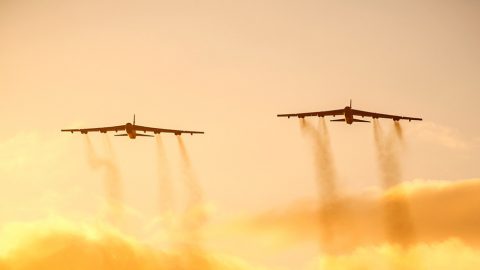
The US and NATO air forces have not only increased their surveillance activities along Russia’s borders, but now also routinely train for potential strikes on the country’s soil, Defense Minister Sergey Shoigu said.
Speaking to Russian TV on Sunday, Shoigu noted a sharp increase in foreign surveillance and training flights testing the country’s borders and air defenses. Last month such activities increased by some 30 percent compared to last August. Moreover, the bloc’s aircraft have been actively training in conducting air strikes, routinely performing mock missile launches on targets within the country, Shoigu revealed.
“The most alarming is that if earlier – even though not that frequently – there were mainly reconnaissance aircraft, they’ve now begun regular training flights with large numbers of planes, during which the mock missile strikes are conducted.”
Over the past few weeks, several incidents between Russian and NATO planes occurred in close proximity to the country’s borders. The latest took place Friday, when three nuclear-capable US Air Force B-52H strategic bombers approached Russia’s border through Ukrainian airspace. The bombers were intercepted by eight fighter jets and warned away from the border.
Another incident involving US strategic bombers occurred late in August, when a B-52H was intercepted by a Russian Su-27 fighter jet over the Baltic Sea. The altercation prompted a wider international scandal, as another NATO country – Denmark – claimed the Russian plane violated the country’s borders while chasing the US plane. Moscow, however, has firmly denied the accusations, insisting that the interception was made in accordance with all international rules.
Russia Not Interested in Arms Race, Defence Minister Says
Sputnik – 05.09.2020
According to the Russian military, NATO has increased its aerial surveillance efforts near the Russian border by 30 percent compared to the previous year.
Russia is not interested in an arms race, but is forced to combat capabilities in response to unfriendly actions by NATO, Russian Defence Minister Sergei Shoigu said on Saturday.
“All measures taken are aimed exclusively at strengthening the defense, are limited in scale and correspond to modern military dangers”, Shoigu told reporters.
“We are not interested in the arms race. To reduce tensions, we intend to adhere to the maximum openness regarding military activity”, the minister said adding that the relevant information is being posted on the Defence Ministry’s website, while briefings are held for military attaches and media.
Shoigu pointed out that Russia had offered NATO a reduction in the number of drills amid the pandemic to prevent further difficulties, but the alliance responded negatively.
“The military leadership of Russia has repeatedly proposed to agree on joint measures in order to prevent further complications in relations”, Shoigu said.
According to the minister, these measures include transferring military drills to the inland exercise areas from the contact line between Russia and NATO, agreeing on the minimum permissible distance of approach of ships and aircraft, reducing the number of exercises and other activities of the Russian armed forces and the joint armed forces of NATO during the pandemic.
“These initiatives are still relevant. However, Brussels perceives them negatively. NATO is not yet ready to work together constructively to enhance regional stability”, Shoigu added.
The minister said that the North Atlantic Alliance has recently intensified its aerial surveillance efforts.
“The intensity of NATO’s air reconnaissance near the Russian border increased by more than 30 percent compared to the last year, in August of the last year, [there were] 87 flights, now about 120”, Shoigu told reporters following the end of the International Army Games.
According to the minister, from 23 August to 2 September, Russian jets were scrambled at least 10 times to intercept foreign planes over the Baltic, Barents, and Black seas.
Russian Foreign Minister Sergey Lavrov said in late August that Moscow has repeatedly offered NATO to start de-escalating military tensions, but the alliance has not demonstrated its readiness for similar steps. “Russia has already abandoned large-scale exercises near the borders of NATO countries, and moved large-scale military drills inland”, Lavrov said.
Shoigu expressed hopes that the alliance’s stance would change in the future.
Russian Doctors Suggest Setting up Joint Group With German Colleagues on Navalny Case
Sputnik – 05.09.2020
Russian doctors have proposed to their German colleagues that they establish a joint group on the case of Russian opposition politician Alexei Navalny, the president of Russia’s National Medical Chamber, noted paediatrician Leonid Roshal, told reporters on Saturday.
“Many people are concerned about Navalny’s fate, and the National Medical Chamber has now appealed to the German Medical Chamber … in order to create an expert group with them to study the main reason for Navalny’s condition,” Roshal said.
The paediatrician added that the reasons were not clear yet, noting that Russian doctors treating Navalny did their job very well and saved the patient. Studies carried out in Russia did not show that the politician was poisoned though, he noted.
“Let us gather calmly — the representatives and specialists of Russia, as well as toxicologists and specialists from Germany — and we will discuss whether or not [Navalny was poisoned], because if it turns out that Navalny was, indeed, poisoned, we believe that it is necessary to initiate a criminal case in Russia,” Roshal said.
According to Roshal, the Russian side has sent a request to German law enforcement agencies, as well as German doctors regarding the situation with Navalny, but there has been no answer yet.
On 20 August, Russian opposition figure Alexei Navalny fell gravely ill during a domestic Russian flight. Following an emergency landing in the Siberian city of Omsk, he was taken to a local hospital and, according to regional doctors, he arrived just 17 minutes after landing.
For the next 44 hours, doctors waged an uninterrupted struggle for his life, as he went into a coma and was put on an artificial lung ventilator.
Immediately after Navalny fell ill, his spokeswoman Kira Yarmysh claimed that he might have been poisoned.
Upon conducting multiple tests, Russian medics established that no traces of poison had been found in his system, saying that Navalny’s condition was caused by an abrupt drop of glucose in his blood due to a metabolic imbalance.
On 22 August, Navalny was flown to Berlin for further treatment. German doctors claimed that they had found traces of a substance from the group of cholinesterase inhibitors in his body, which the Russian doctors denied, referring to his test results.
Stoltenberg to Convene NATO Meeting on Friday to Discuss Navalny Situation
Sputnik – 03.09.2020
NATO Secretary-General Jens Stoltenberg will convene an emergency meeting on Friday to discuss the situation involving Russian opposition figure Alexey Navalny, the alliance’s spokeswoman, Oana Lungescu, said on Thursday.
Navalny is currently undergoing treatment in a German hospital after suffering a medical emergency in late August. Berlin on Wednesday said that a German military laboratory possessed undeniable proof of the 44-year-old’s intoxication with a nerve agent from the Novichok group. The Russian Foreign Ministry noted in response that the German government’s claims of Navalny’s poisoning lacked evidence and added that it was perplexing why Berlin first addressed the EU, NATO and third parties, such as the Organization for the Prohibition of Chemical Weapons, instead of contacting Russia directly.
Lungescu took to Twitter to announce the upcoming meeting.
Kremlin spokesman Dmitry Peskov said earlier in the day that there had been no contacts between Russian President Vladimir Putin and German Chancellor Angela Merkel on the issue of Navalny. He also noted that Russia was interested in shedding the light on the situation as much as anyone else, however, Germany did not provide any information.
EU Urges Russia to Cooperate With OPCW in Navalny Case for Impartial Probe, Borrell Says
The European Union urges Russia to cooperate with the Organization for the Prohibition of Chemical Weapons (OPCW) in the situation with Russian opposition figure Alexey Navalny to ensure an impartial international investigation, EU foreign policy chief Josep Borrell said in a statement.
“The European Union condemns in the strongest possible terms the assassination attempt on Alexei Navalny. … The European Union calls upon the Russian Federation to fully cooperate with the Organisation for the Prohibition of Chemical Weapons (OPCW) to ensure an impartial international investigation,” the statement says.
The EU is calling for an international response to the situation with Navalny and reserves the right to impose sanctions, Borrell added.
The EU will continue to closely monitor the situation and consider possible implications, he said.
Anatomy of coup attempt in Belarus
By M. K. BHADRAKUMAR | Indian Punchline | August 30, 2020
Russian President Vladimir Putin disclosed in a TV interview on August 27 that the Americans, among others, had fuelled the unrest in Belarus. He explained that the controversial presence of 33 Russian nationals (with military background) in Minsk in the run-up to the presidential election in Belarus on August 8, which briefly created misunderstanding between Minsk and with Moscow, itself was a joint operation by Ukrainian and US intelligence agencies.
The Russian nationals were apparently given job offers and were “simply lured there (Minsk), dragged across the border … de facto they were brought in on fake documents.” Evidently, Russia is in possession of hard intelligence.
Putin spoke up even as US Deputy Secretary of State Stephen Biegun wrapped up talks with top Russian officials in Moscow Wednesday. According to a VOA report, Biegun’s consultations “marked an intensifying U.S. effort to find a peaceful solution in Belarus.” The report took note that en route to Moscow, Biegun had “signalled that Washington was not eager to accept efforts by [Belarus President Alexander] Lukashenko to cast the election standoff as an East versus West showdown that might trigger direct Russian involvement.”
Simply put, Biegun was on a “damage control” mission. This can be taken as admission of defeat in the US-backed regime change project in Belarus. Conceivably, Russian officials shared with Biegun their intelligence regarding the CIA involvement. Later, crisply anodyne identical readouts were released by the Russian and American sides without divulging any details.
The CIA would roll back its Belarus operation — for the time being, at least. A commentary titled What’s Next for the Peaceful Uprising in Belarus? by the United States Institute of Peace sees “potential to bring change” in Belarus, but concludes saying, “While there are no guarantees of success, there is cause for hope. At a minimum, Belarusians have gained a new-found sense of dignity and belief in the power of nonviolent collective action.”
This appears to have been a well-planned operation. Under the garb of journalists, western intelligence deployed dozens of special agents in Belarus. Lukashenko has ordered their expulsion. Associated Press, Radio Liberty and BBC “reporters” have had their accreditation cancelled. A Swedish “photo journalist”, presumably an intelligence operative, was detained and was released at the personal intervention of the Swedish ambassador to Belarus and flown out of Minsk.
From the pro forma reaction by the European Union so far, Brussels has a fair idea of what really happened — that there has been a US operation with active participation of Poland and Lithuania (both EU countries) and Ukraine. Unsurprisingly, NATO statements have been rather combative. The NATO also began air exercises in Poland and Lithuania coinciding with the unrest in Belarus.
However, major European powers — Germany, France, Italy — didn’t want to get entangled. Their top leaders telephoned Putin to ease the tensions. The EU initially proposed OSCE as mediator, but Moscow sensed that it might lead to backdoor entry by the US intelligence. The OSCE is manned by NATO powers and is under American thumb.
The clincher has been the stern warning by the Kremlin that if the western operation continued, Russia will be left with no option but to intervene. The warning came at Putin’s level, making it very clear that Russia will not countenance a regime change in Minsk to hijack Belarus into the American camp. Moscow has asserted its special interests in Belarus under international law. In his TV interview on Thursday, Putin emphatically stated:
“Indeed, the Union Treaty… and the Collective Security Treaty (CSTO) include articles saying that all member states of these organisations, including the Union State, which consists of two states only – Russia and Belarus, are obliged to help each other protect their sovereignty, external borders and stability… In this connection, we have certain obligations towards Belarus, and this is how Mr Lukashenko has formulated his question. He said that he would like us to provide assistance to him if this should become necessary. I replied that Russia would honour all its obligations.
“Mr Lukashenko has asked me to create a reserve group of law enforcement personnel, and I have done this. But we have also agreed that this group would not be used unless the situation becomes uncontrollable… we came to the conclusion that now it is not necessary, and I hope that it will never be necessary to use this reserve, which is why we are not using it.” Putin made it abundantly clear that Moscow stands by Lukashenko.”
The events in Belarus constitute a watershed moment. Russia will not allow another Ukraine-type colour revolution in the “near abroad”, aimed at encircling it with hostile governments. But Moscow’s intervention, if at all, will conform to international law and stem out of invitation by the country concerned.
That is to say, Russia regards it to be the prerogative of the CSTO countries to handle their internal affairs without outside unlawful interference. Having said that, Moscow has invoked the CSTO’s collective security doctrine. This sets a precedent. The CSTO comprises Armenia, Belarus, Kazakhstan, Kyrgyzstan, Russia and Tajikistan. A CIA-sponsored regime change project in any of these countries can run into the CSTO’s crosshairs. Considering that the CSTO is de facto led from Moscow, any more regime change project in Central Asia or Caucasus will trigger Russian countermeasures.
Most important, Moscow will not be prescriptive. Putin has supported Lukashenka’s proposal to draft a new constitution and hold fresh presidential and parliamentary elections, but transition should be lawful and orderly. This Russian approach has been already evident in Kyrgyzstan (2005) Turkmenistan (2006), and Uzbekistan (2016). Even in the case of Georgia (2003) and Ukraine (2004 and 2014), Russia didn’t oppose transitions but the West turned them into geopolitical contestations to install anti-Russian regimes.
However, a caveat must be added. Putin also underscored that Belarus is a very special case. He said, in a clear reference to the US, “some forces would like to see something different happening there (Belarus). They would like to influence these processes and to bring about the solutions that would suit their political interests.” Russia cannot afford to see such nefarious designs succeed in Belarus.
In Putin’s words, “This nation is very close to us (Russian Federation) and perhaps is the closest, both in terms of ethnic proximity, the language, the culture, the spiritual as well as other aspects. We have dozens or probably hundreds of thousands, if not millions, of direct family ties with Belarus.” Not only that, Russia sources from Belarus almost 90 percent of its imports of agricultural products.
US Benefits From Terrorist Efforts to Disrupt Syria’s Reconstruction, Russian MoD Says
By Ilya Tsukanov – Sputnik – 25.08.2020
The Russian military has repeatedly accused the Pentagon of training ‘former’ terrorist militants to continue the fight against Damascus at the at-Tanf base in southern Syria, and has cited intelligence reports on US forces’ evacuation of Daesh (ISIS) commanders from the country. Washington has strongly denied the allegations.
Terrorists operating in the vast desert area of central Syria continue to disrupt the region’s reconstruction, and the US is the primary beneficiary of this state of affairs, as it allows Washington to justify its continued illegal military deployment in the country’s northeast, a spokesman for the Russian military grouping in Syria announced in a briefing Tuesday.
“Through their actions, the terrorists disrupt the process of socio-economic reconstruction of Syria and the establishment of relations between local Arab tribes and Damscus. Such a situation primarily benefits the United States, and allows them to justify their presence in the country’s east,” the spokesman said.
Pointing to a recent uptick in terrorist activity in the Syrian Desert, a vast region accounting for about 55 percent of the Arab Republic’s total area, the spokesman said it could be attributed to an ‘amnesty’ program for former militants by Washington’s Kurdish allies.
“Over the past month, the Syrian Desert area has seen a significant increase in the activity of militants consisting of former Daesh terrorists. Most of these militants appeared in this area following the ‘amnesty’ conducted by so-called ‘Autonomous Administration of North and East Syria’,” the spokesman said.
The spokesman also pointed to efforts by the militants to commit acts of sabotage. Earlier this month, a Russian major general was killed after an improvised explosive device (IED) laid by militants went off, he recalled.
“By sabotaging transport communications and carrying out acts of sabotage against Syrian oil and gas industry facilities, by attacking patrols and the posts of Syrian Army units, militants are destabilizing the situation in the region. On August 18, an explosion of an IED planted by terrorists in Deir ez-Zor province killed senior Russian military advisor Maj. Gen. Vyacheslav Gladkikh,” the spokesman said.
Gladkikh was killed and two other servicemen were injured after the vehicles they were traveling in were hit by an IED near the At-Taim oil field, about 15 km outside the city of Deir ez-Zor.
Combined Russian-Syrian Operation to Clear Desert of Terrorists
The spokesman said that Russian forces and their Syrian allies conducted an operation to clear the Syrian Desert region of the terrorist remnants in a major operation conducted between August 18 and 24, and promised that the operation would continue until the complete destruction of all US-controlled armed groups in the area.
According to the official, the operation by Russian and Syrian air power, combined with artillery and work by reconnaisance and special operations forces, has led to the elimination of 327 militants, 134 of their hiding places, 17 observation posts, 7 warehouses and 5 underground weapons and ammunition storage facilities.
Russian Military’s Allegations of US Support for Terrorists
The Russian military and media have repeatedly accused the US of training as many as 1,200 former terrorist militants at the at-Tanf garisson in the southern Syrian province of Homs, with Moscow alleging that the US intended to use these fores to create a so-called ‘New Syrian Army’ to continue to destabilize the war-torn country after Daesh was defeated. The Pentagon has dismissed the allegations as “false and absurd.”
In 2018, Gen. Valery Gerasimov, the Chief of Staff of the Russian Armed Forces, pointed to at-Tanf as being one of two staging areas for the continuation of an armed struggle against Damascus by the jihadists, with the other said to be located at Camp Shaddadi, under the control of US-allied Kurdish forces operating in the northeast.
In addition to these training facilities, the Russian, Syrian and Iranian militaries have accused the US anti-Daesh coalition of evacuating Daesh commanders and members of their families by helicopter. In March 2018, late Quds Force Commander Qasem Soleimani urged Iranian officials to ‘slap the West in the face’ with Iranian intelligence on alleged US cooperation with the terrorists, and to inform Washington that Tehran knows what the US is up to in Syria and Iraq. Soleimani, who assisted both Syrian and Iraqi forces in their battle against Daesh, was killed in a US drone strike in Baghdad in January 2020.
Despite threats, the U.S. will not sanction India over its relations with Russia
By Paul Antonopoulos | August 24, 2020
After Russia, the U.S. is the second largest arms exporter to India. As a major Washington defense partner, New Delhi signed two $3.5 billion arms purchase agreements earlier this year. However, U.S. Deputy Secretary of State Clarke Cooper reiterated Washington’s supposed dismay over India’s military purchases from Russia. Issuing a warning, he said that significant purchases of Russian weapons, such as anti-aircraft systems or advanced fighter jets, “risk future opportunities that may be impeded by significant Russian defense articles.”
Although he said that Washington recognizes “the historic legacy sustainment line that New Delhi had with Moscow and that, to use a metaphor, it’s not a light switch to turn on or off,” and that they do not want “to put at risk India’s sovereignty or India’s national defense as there’s a maturation toward future modernization of their systems,” he said “there is a risk when significant Russian systems are brought forth that put at risk interoperability with not only the United States, but with other partners that India may be seeking to work with that are either of NATO status or NATO-aligned. And then there’s also the risk of potential exploitation of technology when we’re looking at significant Russian platforms.”
Despite U.S. threats, India last month approved the purchase of 21 MiG-29 and 12 Su-30MKI fighters for a total value of more than $2.5 billion from Russia, with Indian Defense Minister Rajnath Singh urging for the delivery of the S-400 anti-aircraft defense systems as soon as possible.
However, it is unlikely that Washington will choose to sanction India for purchasing Russian weapons. Former financial adviser to the Indian Ministry of Defense, Amit Cowshish highlights that imposing sanctions on New Delhi will only hurt Washington’s own interests since the South Asian country is one of the largest markets in the world. Cowshish stressed that if the Trump administration moves ahead with sanctions, India will say it cannot buy U.S. equipment, which will hurt its own military industry as it loses a major market.
According to a Stimson Center working paper by Sameer Lalwani, India’s defense equipment is overwhelmingly Russian – 90% of the Army, 41% of the Navy and two-thirds of the Air Force.
“India’s share of Russian systems has grown, not decreased, because of Indian Army acquisitions. While India’s naval and air forces are decreasing their quantitative reliance on Russian arms, their most advanced or offensive capabilities still originate from Russia,” Lalwani wrote. “While the United States treats Russia as an equally revisionist threat to the global order as China, India sees Russia as a partner to ensure a multipolar balance of power, and a hedge against a potential Sino-Russian bloc.”
As India is the key player in the Indo-Pacific Strategy (IPS), it is unlikely Washington is willing to antagonize New Delhi so quickly. The administration of U.S. President Donald Trump unveiled the IPS report in June 2019. It demanded that India, Japan, South Korea, Australia, the Philippines and Thailand serve Washington’s interests in Asia-Pacific because “these alliances are indispensable to peace and security in the region and our investments in them will continue to pay dividends for the United States and the world, far into the future.” Effectively, the IPS is the U.S.’ strategy to attempt to maintain its unilateral hegemony in Asia-Pacific, and India has a key role in this vision.
The IPS is directly aimed against China, and not Russia, and it is for this reason that although New Delhi may be willing to oppose Beijing within limits, it is highly unlikely that India will want to sever its long relationship with Moscow on Washington’s demand. It is likely that the comments by Cooper, despite being a high official, do not reflect on Washington’s real demands and expectations of New Delhi. Although Washington would want India to stop its relations with Moscow, the Americans know this is not possible and recognize that for now Russia has very limited influence in the Indo-Pacific region. It is for this reason that New Delhi’s relations with Moscow can for now be tolerated by Washington so long as they remain in opposition to China. It is also for this reason that it is unlikely Washington will sanction India over its procurement of Russian-made weapons.
Paul Antonopoulos is an independent geopolitical analyst.
Russia wants to extend ‘New START’ nuclear arms control deal but not at any cost – deputy foreign minister
RT | August 18, 2020
Moscow wishes to prolong the New START Treaty but not if the US demands unreasonable concessions, Deputy Foreign Minister Sergey Ryabkov has said, adding that the Russian and American positions on the issue remain quite different.
Russia is ready to extend the treaty without any preconditions BUT Washington is still hesitating in agreeing to that, Ryabkov said following another round of nuclear arms talks with the US Special Presidential Envoy for Arms Control Marshall Billingslea in Vienna.
The high-ranking diplomat hailed some progress in the negotiations by saying that both sides took a more constructive stance and stuck to “intensive, in-depth and business-like discussions,” according to Russia’s permanent representative to international organizations in Vienna, Mikhail Ulyanov.
Yet, Moscow and Washington’s priorities in the talks appear to still “differ significantly,” Ryabkov noted. He said that the US continues to leave the door for talks open but he cannot say that its position has changed in favor of extending the accord.
“They [the US] evade an answer … to the question whether they are ready to prolong the treaty without preconditions,” Ryabkov told journalists, adding that Washington is still very much interested in making China join the talks on strategic stability. Russia, in turn, would very much like the UK and France – US allies and nuclear powers themselves – to sit down at the negotiating table as well.
Billingslea meanwhile told journalists that Washington has informed Moscow about its terms in extending the treaty that expires in February. The US said it would consider prolonging it if Russia’s “build-up” of shorter-range nuclear missiles not covered by the current agreement is addressed.
“Russia understands our position. And what remains to be seen is if there is the political will in Moscow to get this deal done. The ball is now in Russia’s court,” the US official said.The issue of short-range nuclear ballistic missiles was covered by another treaty – the INF – signed by Washington and Moscow back in the 1980s. The accord effectively banned such ground-based missiles altogether. Yet, the Trump administration unilaterally left it in 2019, citing the same alleged Russian build-up, only to later test their own ground-based cruise missile just after the agreement expired.
Moscow’s attempts to save the deal by even allowing the US military inspectors to see the missile they said violated the treaty for themselves were effectively snubbed by the US.
Also on rt.com Russia unveils evidence on missile that US claims violates INF Treaty, Washington snubs briefing
The New START Treaty, which remains the only standing pillar of international nuclear arms control after the expiration of the INF due to America’s exit, came into force in 2011. It limits the number of deployed intercontinental ballistic missiles (ICBMs), submarine-launched ballistic missiles (SLBMs) and strategic bombers, of which the US and Russia can have up to 700 each. The number of deployed warheads was capped at 1,550, while the countries pledged to maintain no more than 800 deployed and non-deployed launchers.
The fate of the crucial agreement has been in limbo for a year and a half since no talks were held on its extension despite the nearing expiration date. Hopes resurfaced back in June when Moscow and Washington agreed to hold arms control consultations in Vienna. Yet, according to Ryabkov, the dates of new consultations have not yet been set following the Tuesday meeting since both sides still want to analyze each other’s positions.
Kremlin denies Russian military convoys heading to Belarus, says no need right now for CSTO or Union State assistance to neighbor
RT | August 19, 2020
Vladimir Putin’s spokesman has rubbished speculation that Moscow is either conducting or is preparing to carry out some sort of military intervention in neighboring Belarus, with which it has mutual-assistance agreements.
Dmitry Peskov said that while Russia is treaty-bound to assist Minsk, the conditions for such support don’t currently exist.
Both countries form a Union State, under a 1999 agreement, and are also members of the Collective Security Treaty Organisation (CSTO), a Moscow-led security alliance that serves as an alternative to NATO. Peskov explained that these treaties “indeed, stipulate a number of commitments of the sides on mutual assistance.” He was answering a reporter’s question on the circumstances in which such assistance would be possible.
“But, as you know, now there is no such need and the Belarusian leadership has itself admitted that there is no such need now,” he added. “In this case, any hypothetical deliberations are absolutely unacceptable and impossible.”
“We believe that Belarusians will iron out their own problems in the framework of dialogue, within the legal framework, and without any foreign meddling,” the Kremlin spokesman said.
Commenting on media reports that convoys of Russian military equipment were allegedly heading to the Belarusian border, the presidential spokesman emphasized that “Russian military equipment is on Russian territory and that’s why there is nothing to comment on here.”
Meanwhile, Alexander Lukashenko’s spokeswoman has claimed that the President of Belarus regards the CSTO and Union State agreements as paramount. “Consultations between the Belarusian and Russian presidents are currently underway. The heads of state coordinate their actions, primarily within the framework of the existing agreements. These are both the Union State and the CSTO,” Natalya Eismont said. She also noted that the two leaders had held several phone calls.
Russia takes Europe’s support to calm Belarus
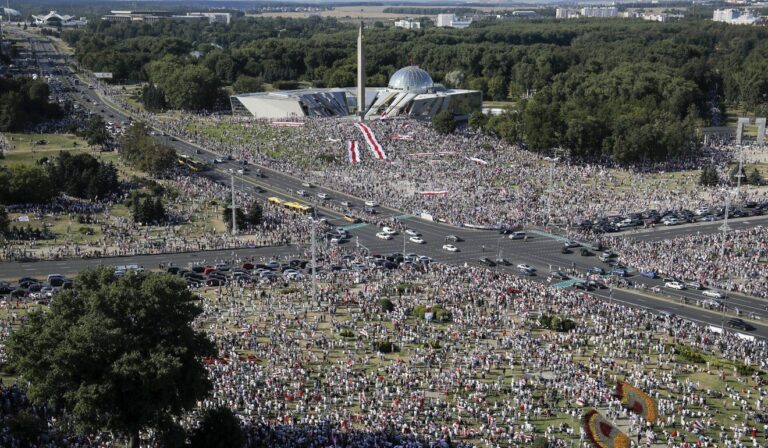 Opposition protests in Minsk, Belarus, August 16, 2020
By M. K. BHADRAKUMAR | Indian Punchline | August 18, 2020
The mercurial Belarus President Alexander Lukashenko has not been an easy ally for the Kremlin. But the growing interference by Belarus’ “New European” neighbours is setting the stage for a “colour revolution” with potentially anti-Russian orientation. Poland, egged on by the US, has convinced itself that it has become a regional heavyweight and eyes Belarus as a valuable piece of real estate that could shift the military balance on Russia’s western borders.
Indeed, historically, present-day Belarus figured in all four major invasions of Russia since the 18th century — by Sweden allied with Poland (1708-1709); by Napoleon through the North European Plain (1812); and by Germany, twice (1914 and 1941). Plainly put, Belarus forms a buffer zone crucial to Russia’s national security.
In post-Soviet history, with the Baltic states and Poland having been integrated into NATO and a pro-western regime installed in power in Ukraine since 2014, the western alliance has advanced closer to Russia than ever before. If during the Cold War era, the nearest NATO power was 1,600 kms from St. Petersburg, that distance has shrunk to a mere 160 kms today.
Furthermore, the signing of an Enhanced Defence Cooperation Agreement between the US and Poland on August 15 has made the latter “a lynchpin of regional security” (as the US state department describes Poland.) The agreement signed in Warsaw provides the legal basis for the establishment of American military bases in Poland, which harbours historical animosity against Russia.
The Russian Foreign Ministry said on August 17 that increased US military presence in Poland “aggravates the difficult situation near Russia’s Western borders, facilitating an escalation of tensions and increasing the risk of inadvertent incidents.” It flagged that the latest US-Poland defence agreement “will help qualitatively strengthen the offensive capability of the US forces in Poland.”
To be sure, the Belarus developments cannot be seen in isolation. A Kremlin statement said that on August 15 Lukashenko reached out to President Vladimir Putin to brief him on the developments. It said that the two leaders discussed the unrest in Belarus following the presidential election of August 9 and and both sides “expressed confidence that all existing problems will be settled soon.”
However, the next day, Putin called Lukashenko for another discussion. The Kremlin readout said that after a discussion touching on the external interference fuelling the unrest in Belarus, the “Russian side reaffirmed its readiness to render the necessary assistance to resolve the challenges facing Belarus based on the principles of the Treaty on the Creation of a Union State, as well as through the Collective Security Treaty Organisation, if necessary.”
That was a dramatic announcement, with ominous overtones of past Russian doctrines of collective security. Clearly, the announcement had the desired effect. Lukashenko has voiced on August 17 his readiness to hold fresh elections in accordance with a new constitution to be drafted in the coming few months.
The protests in Belarus may not subside easily. A transfer of power has become inevitable at some point and Moscow senses that the priority should be to navigate the developing situation toward an orderly transition. But Moscow’s capacity to navigate Belarus to calmer waters and stimulate a rational political dialogue is limited when external interference to stir up tensions continues.
Indeed, for the first time since protests began in Belarus a week ago, Washington has openly warned Moscow to stay out of the situation. An unnamed “senior Trump administration official” told the media on August 17, “The massive number of Belarusians peacefully protesting make clear that the government can no longer ignore their calls for democracy… Russia must also respect Belarus’ sovereignty and the right of its people to freely and fairly elect their own leaders.”
US Secretary of State Mike Pompeo also said on August 15 (while on a visit to Poland) that the US is discussing with the European Union to “try to help as best as we can the Belarusian people achieve sovereignty and freedom.”
To be sure, a Russian intervention in Belarus would be viewed by Europe as a negative development. Therefore, Putin is moving cautiously. But the fact is also that the European countries are struggling with the pandemic and a grave economic crisis. It’s unclear whether the major European powers would be inclined to follow the lead of Washington and Poland to provoke Russia.
Significantly, German Chancellor Angela Merkel telephoned Putin on August 19 in the first such contact since protests erupted in Minsk. A Kremlin statement said Putin and Merkel “thoroughly discussed” the emergent situation and “Russia pointed out that foreign attempts to interfere in the country’s domestic affairs were unacceptable and could further escalate tensions.”
Summing up Merkel’s conversation with Putin, the German Spokesman Steffen Seibert stated, “The chancellor said the Belarusian government must refrain from the use of force against peaceful demonstrators, immediately release political prisoners and enter into a national dialogue with the opposition and society to overcome the crisis.”
A Russian-German convergence seems possible over Belarus. Significantly, French President Emmanuel Macron has since called Putin and the latter again “emphasised that interfering in the (Belarus) republic’s domestic affairs and putting pressure on the Belarusian leadership would be unacceptable.” The Kremlin readout said Putin and Macron “expressed interest in the prompt resolution of the problems.”
Subsequently, Putin also reached out to the President of the European Council Charles Michel where, again, he expressed concern over “some countries’ attempts to put pressure on the Belarusian leadership and destabilise the internal political situation.” This was a reference to Poland and Lithuania, two EU member countries and strong allies of the US, who are principally culpable for destabilising Belarus.
But the big question is whether the Cold Warriors in Washington and the “New Europeans” in Central Europe would be satisfied with anything less than a regime change in Belarus that brings that country into their orbit. A Russian military intervention would lend credibility to their thesis of “revanchist Russia”.
A sub-text here is that the German-Russian proximity greatly annoys Washington and Warsaw. A recent paper by the Center for Strategic and International Studies in Washington, DC, noted, “Compared to many of its neighbours, Germany has longstanding political, economic, and cultural ties to Russia—not to mention a streak of skepticism toward the United States that inclines parts of the German political class to sympathise with Russian views about the need for a less U.S.-centric international order.”
Equally, there is growing acrimony lately in German-American relations following Washington’s recent threats of “crushing legal and economic sanctions” if German companies took part in any form in the Nord Stream 2 gas pipeline project, which would carry natural gas from Russia to Germany. (Incidentally, Poland also staunchly opposes the Nord Stream 2 project, which bypasses it.)
The German Minister of State Niels Annen has “firmly rejected” the proposed US sanctions and hit back saying, “Threatening a close friend and ally with sanctions, and using that kind of language, will not work. European energy policy will be decided in Brussels, and not in Washington, DC.”
These acerbic exchanges between German and American politicians as well as the recent move by the Trump administration to withdraw over 12,000 troops from Germany (and to divert some of them to Poland) highlight the complexities of Germany’s relationship with the US and Poland. The right-wing Polish government is happy to perform as the US’ Trojan horse within the EU.
However, so long as the EU refuses to rally behind Poland, whose rightwing populist leadership is already viewed with scepticism as something of an enfant terrible in the portals of Old Europe, Moscow gets diplomatic space. Putin’s calculus is working on this basis.
The bottom line is that Russia has legitimate interests in Belarus and Moscow’s preference is for an orderly transition in Belarus through consultations between Lukashenko and the political opposition. A helpful stance by the EU, therefore, matters to Putin.
The latest reports from Brussels disclosed that in the 30-minute phone conversation earlier today between Putin and Charles Michel, they “discussed options to facilitate a dialogue between Minsk and the opposition, including with the OSCE mediation.”
Featured Video
New positive ivermectin evidence
or go to
Aletho News Archives – Video-Images
From the Archives
Fanatical Followers of the Covid Regime: A Jim Jones-Style Cult?
By Professor Roger Watson and Dr. Niall McCrae | The Daily Sceptic | November 15, 2021
As scholars at leading British universities over recent decades, we witnessed the replacement of critical thinking and debate by narrative: facts are discrimination and scientific method is imperialism; truth, instead, is derived from ‘progressive’ values. This educational trend may be a major contributory factor to the ease in which society has been inculcated to the Covid ‘new normal’ of masking, testing, and repeated doses of vaccines for a disease of similar risk to severe influenza.
One doesn’t need much critical reasoning to observe the flawed logic of some vaccination enthusiasts, such as people who respond to experiencing any side effects, however debilitating, by saying “at least I know it’s working”, or, after contracting the disease despite their promised inoculation (over 90% effective, according to initial drug company claims), “I’d have been worse off without the jab.” … continue
Blog Roll
 Aletho News
- ‘Grave, alarming’: Iran mission on Trump’s UNGA ‘annihilation’ threats
- Najaf airport to reopen to Iranian flights within 24 hours: Ambassador
- From ‘How Will This End For Iran’ to ‘When America Walks Away’: A tale of two Economist covers
- Tehran blasts ‘baseless’ speculation linking Iran to alleged bomb plot at UK air base
- The Rise And… Rise Of ‘Color Revolutions’
- The Coming GOP Bloodbath?
- Arctic Scare Stories Melt Away
- Wrong, Euronews: Climate Change Has Not Created a Food, Energy, and Economic “Meta-Crisis”
- New positive ivermectin evidence
- Met Office Caught Fabricating Daily Temperature Record Claims
- If Americans Knew
- Netanyahu Asked UAE Leader to Deny Report on Oct. 7 Warning in Secret Visit, Sources Say
- CNN Chief Int’l Correspondent Clarissa Ward on Journalists in Gaza
- Democratic Party Consultants Surround Troy Jackson with Pro-Israel Donors
- Christian Leader Responds To Netanyahu’s Claims Regarding Palestinian Christians
- In Gaza, ‘Whoever Survives the Bombing Won’t Survive the Rubble’
- Israel kills more Palestinians, amid push to resettle Gaza – Daily Update
- Israel forces Gazans to live in constant peril – Daily Update
- Deconstructing Netanyahu’s pants-on-fire UN rant – Daily Update
- Trump betrayed voters with his campaign lies and prioritized a foreign country once he took office
- Netanyahu calls Israel’s war in Gaza ‘opposite of genocide’ in UN speech to near-empty hall
- No Tricks Zone
- New Study: Earth And Venus Surface Warmth Largely Explained By Convection And Lapse Rate, Not CO2 Or Radiation
- 2025 Nature Paper Claiming Worsening Global Drought Gets RETRACTED …Heavily Flawed
- New Study: ‘Global Drought Shows No Detectable Recent Acceleration Under Climate Warming’
- Economic Masterminds: German Socialists Suggest Taxing Productivity Gains Stemming From Using AI
- The South China Sea Has Not Been Cooperating With The Climate Change Narrative
- Energy Crisis: Germany Enters Heating Season With Historically Low Gas Reserve Fill Levels
- New Study: The Antarctic Ice Sheet Gained Mass From 2020-2024 Due To Staggering Snow And Ice Accumulation
- Study: Ocean Heating Rates From Thousands Of Years Ago ‘Dwarf’ Modern Ocean Heating Rates
- Climate Extremists Target, Attack Large-Scale Power Grid Infrastructure In Germany!
- New Study: Antarctic Ice Melt Has Contributed Less Than 1 Centimeter To Sea Level Rise In The Last 30 Years

