Pakistan to Host US-Iran Talks
Sputnik – March 29, 2026
US-Iran talks may take place in Islamabad in the coming days, Pakistan’s Foreign Minister Ishaq Dar said.
All parties have expressed confidence in Pakistan’s mediating role, he added, noting that China “fully supports” the initiative.
Earlier on Sunday, foreign ministers from Saudi Arabia, Turkiye, and Egypt arrived in Pakistan to discuss potential ways to permanently resolve the current conflict in the Persian Gulf.
The ministers also discussed various proposals for reopening the Strait of Hormuz, a critical chokepoint for global oil and liquefied natural gas trade.
The proposals include establishing a management consortium and charging fees, sources say.
Pakistan, which shares a border with Iran, has leveraged its strong ties with both Tehran and Washington to position itself as a key diplomatic channel in the conflict.
AWACS’ Destruction is a Major Loss for US Military – Ex-DoW Analyst
Sputnik – 29.03.2026
The destruction of a US E-3 Sentry airborne warning and control system (AWACS) aircraft in Saudi Arabia by an Iranian missile strike is a serious blow to the US military, former US Department of War analyst Karen Kwiatkowski tells Sputnik.
The US has a limited number of E-3 aircraft, which are based on aging Boeing 707 airframes, and the next-generation replacement for E-3 is not yet available
The loss of even one of E-3s puts a strain on the remaining aircraft as they are forced to operate longer. It demoralizes the crew, stresses systems, and “increases the consumption rate of surveillance capability and information management”.
Other E-3s now have to prioritize their own defense, which may reduce the radar, surveillance, and command effectiveness they supply.
With many of the important US long-range radars in the region being knocked out by Iranian strikes, the strain put on E-3 aircraft will only get worse, with further losses among them threatening to “narrow and pressure the information space for theater commanders and US and Israeli forces”.
Due to E-3’s distinctive and well-recognized function and appearance, Kwiatkowski adds, its destruction creates concern in the US because it doesn’t look like “winning,” and that claims of Iran losing its fighting capability were premature.
“One month into a ‘well planned 4 day operation’ is revealing many predictable operational and logistical crises, as well as a noticeable reduction in the tactical and operational choices for US and also Israeli theater commanders,” she says.
Israel’s Iran Strategy Uses US Military & Gulf States as Its Pawns
By Robert Inlakesh | Palestine Chronicle | March 29, 2026
While most honest analysts will conclude that the decision made by the White House came as a result of pressure from the Israelis or that this is a war that is being fought for Tel Aviv’s interests, many fail to see any clear strategy at play.
In order to understand the strategy behind the US-Israeli assault on the Islamic Republic, you must first remove the notion that the United States is in the driving seat to any significant extent.
Almost immediately after the 12-Day War in June of 2025, the Israeli leadership was already preparing for the next round. On July 7, Axios News even reported that officials in Tel Aviv believed that US President Trump would give them another green light to attack.
Meanwhile, the most influential Zionist think tanks in Washington DC, the likes of the Washington Institute for Near East Policy (WINEP) and the Foundation for Defense of Democracies (FDD), were openly discussing the necessity of a new round of confrontations.
These think tanks facilitated discussions and published pieces in which they made it clear that while the next round was inevitable, it had to be the last round, and that the US’s involvement would be important in deciding outcomes.
Understanding the Israeli Strategy
It is no coincidence that senior Israeli officials, all the way from Israeli Prime Minister Benjamin Netanyahu to opposition leader Yair Lapid, have all recently publicly endorsed the “Greater Israel Project”.
This is not simply posturing, this is their goal. But how does this fit into the Iran war? Well, it will begin to make sense when the context is all provided.
Firstly, the Greater Israel Project’s strategy is grounded in an academic article published by a former Israeli intelligence officer and journalist, Oded Yinon. The plan did not advocate for the physical expansion of the Israeli State’s borders over every nation between the Euphrates River and the River Nile, but instead opted for an approach that would transform Israel into a regional empire.
In order to achieve this goal of a “Greater Israel”, it would first necessitate the collapse of all the region’s sovereign States, which would instead be broken up into warring sectarian and ethno-regimes.
The purpose of achieving the disintegration of the surrounding nations is a simple concept to understand. If they are all divided, economically weak, and lack the military capabilities to stand up to Israel, it makes it easy for the Israelis to control them.
Take, for example, the Kurdish Regional Government in northern Iraq, or the semi-autonomous zone in southern Syria’s Sweida Province, now carved out by Israeli-backed separatists.
Syria and Iraq are perfect examples of what happens when a nation is torn apart and sectarianism, or ethno-supremacist ideologies, are spread through deliberate propaganda campaigns.
Although Secular Arab Nationalism failed in the region, the chief proponent of it, former Egyptian President Gamal Abdul Nasser, was indeed correct in his analysis as to why it was a net positive for the region.
A united Arab World would undoubtedly be far stronger than the simple modern nation-states of the region, whose borders were drawn up by European colonial powers.
For the Israelis, they had always sought to impose this long-term solution upon West Asia, of a “Greater Israel”, but were previously seeking to do it in a slow and methodical way, opposed to a ruthlessly violent one.
Part of this way of thinking was centered around the idea that Israel maintained a “deterrence capacity”, meaning that their military power was capable of deterring any significant strategic threat from rising against it.
On October 7, 2023, the Qassam Brigades of Hamas crippled this strategy and debunked the notion of their “deterrence capacity”. A few thousand Palestinian fighters managed to overcome the most militarily advanced army in the region, bursting through the gates of their concentration camp, despite the world’s most advanced surveillance systems being present in the area.
The Palestinian groups themselves appear to have been genuinely surprised by how easily they were capable of achieving their goals. Not only did they inflict a blow on the Israeli military and seize captives, but they also managed to collapse the entire Israeli southern command, all with light weapons.
To Israel, the message was clear: The Arab populations of Jordan and Egypt had taken to the streets, some even pouring across the Jordanian border. The weakest link in the Iranian-led Axis of Resistance had dealt the Israeli military its most embarrassing defeat. Deterrence was dead, and former Secretary General of Hezbollah, Seyyed Hassan Nasrallah, was proven correct: “Israel is weaker than a spider’s web”.
The decision to commit genocide was therefore ordered. Israel believed it had to show the Arab World what it was truly capable of, as a means of asserting its control. In the cases of the Arab populations in Jordan, Egypt, and even the occupied West Bank and Jerusalem, the fear tactics appeared to have worked. Then they made an irreversible mistake.
In September 2024, they assassinated Seyyed Hassan Nasrallah, a move that completely changed the thinking of Iran and its allies. Now, the message had been received loud and clear; preparations for the last war had to be made. Up until then, the Axis of Resistance had been attempting to close the chapter of the Gaza genocide; now, they understood that destroying Gaza wasn’t the end goal of Israel.
Israel had decided it would accelerate its national project of gradual expansion, meaning that the Islamic Republic of Iran had to be deposed. A failure to overthrow the Iranian government would represent an existential threat to this project.
Israel’s Iran War Strategy
As I have been writing in the Palestine Chronicle for the past eight months, the only viable strategy that the Israelis could hope to use, in order to see any gains, is one where Iran’s civilian infrastructure is the primary target.
That means: taking out power stations, desalination plants along with other key water facilities – less than 3% of Iran’s water needs come from desalination – while blowing up oil and gas facilities, bombing factories, destroying agricultural lands, inflicting costly environmental catastrophes, and attempting to cripple the Iranian State’s ability to function. In other words, a policy that replicates the Gaza model on a much wider scale, impacting a nation of 92 million people.
Tel Aviv’s goal here is a long-term regime change operation, one that will happen gradually following the war itself. Israel knows that destroying Iran’s military capabilities was never going to be possible. Yes, they may have some successes, but totally crippling their missile and drone programs through strikes alone won’t work.
Therefore, they seek to try and force Tehran to expend a large portion of its missile arsenal, making it more difficult for them to start a new war in the near future following the conflict’s conclusion.
If you look at Syria, for example, the government of Bashar al-Assad did not collapse during the war. Instead, the Syrian State slowly eroded from the inside, due to its isolation and the US-EU’s maximum pressure sanctions.
In the end, the Syrian State was largely bought out and was so corrupt that there was little left. When Ahmed al-Shara’a marched into Aleppo and then Damascus, he did so without any fight, although there were some exceptions where a few units resisted.
Now, Damascus is open for Israeli citizens, the leadership in Syria meets with Israeli officials face-to-face, and has even set up a joint normalizing mechanism between both sides. Therefore, using the long game strategy against Iran makes the most sense in Israel’s strategic thinking.
Then there comes the convenient side effect of the strategy, which begins to explain how the US leadership is not in the driver’s seat at all. That being the weakening of the Persian Gulf Arab nations.
Qatar, Bahrain, Kuwait, the United Arab Emirates and Saudi Arabia are experiencing untold economic devastation as a result of this war. The reason for this, evidently, is that they all host US bases and have permitted a large presence of American military and intelligence personnel inside their countries.
Oman, and to a lesser extent Qatar, have been the only Gulf nations that appear to be pushing back against the true culprits in this war, the Israelis and US. Muscat in particular has blasted the “security arrangements” in the region and condemned normalising efforts with Tel Aviv, pointing their fingers in the right direction.
Bahrain and especially the UAE have gone in the opposite direction. They are only increasing their pro-Israeli and anti-Iran rhetoric, which comes as little surprise given that both have normalized relations with the Zionists. Riyadh, on the other hand, appears to be on a separate trajectory, with its rhetoric being diplomatic, while its actions suggest it is hostile towards Iran.
The Israelis, despite their efforts to normalize ties with the Gulf States, do not want strong nations to exist anywhere in West Asia under their accelerationist approach to achieving an Israel Empire. This appears to be something that the leadership in Abu Dhabi and Manama have not proven intelligent enough to figure out.
That is why the Israeli leadership had started to announce their next targets, following Iran, were the leaderships in Turkiye and even Pakistan. Turkish President Recep Tayyip Erdogan is not a threat in the way that Iran is, but he does command one of the most powerful military forces in the region and rules over a developing economy, working towards transforming itself into a key global trade hub.
Alone, the idea that Turkiye would begin to build an economic or defence alliance with Saudi Arabia, Pakistan or Egypt, poses a direct threat to the Greater Israel Project. In Syria, we see a similar thing; although Ankara does not present a clear and present military challenge to the Israelis as a result of its influence in Damascus, it acts as a potential competitor, a nation that may seek to curtail Israeli expansionist plots.
The GCC countries, which are in alliance with one another, maintain immense economic power. As we see today, if the Strait of Hormuz is disrupted, the entire world is impacted. Back in 1973, these Persian Gulf Arab States exercised that power temporarily. One thing to keep in mind with the Israelis is that they never forget history and are infamous for holding grudges.
So, the dismantlement of the Gulf Arab nations’ economies, or at the very least, the weakening of these countries, is viewed as a positive development in Tel Aviv. As for the US, this war is similarly disastrous, but Israel fails to care less.
This war has destroyed US power projection, making it open to its top chosen adversaries – Russia and China – in a number of other arenas. Donald Trump personally has business ties in the Gulf, which don’t benefit from this conflict, so even on a personal level, it isn’t exactly a victory. The entire Western World, allying itself with the US and Israel, is suffering economically, and as a result, this will mean social unrest is possible, even if it takes time to come to fruition.
An embarrassment has already been dealt to the US military, which is being made to look like a paper tiger, as Mao Zedong once called it. Its future in the Gulf region may have just been ruined, along with those billions, or trillions as Trump believes, of investments – from Gulf States – may no longer materialize. The entire White House Security Doctrine, published last year, has been torn up and set on fire.
In terms of soldier casualties, the Trump administration is evidently hiding the true figure, but it goes without saying that this isn’t good news. NATO has been forced to flee Iraq. The US has even lifted sanctions on Moscow and a limited number of sanctions on Iranian oil. There is simply nothing that the US stands to gain from this war, even if it were to somehow pull off a victory; at this point, it would prove pyrrhic.
With all of this being said, what the Israelis are doing is making a massive gamble. A series of risks that appear so far to be backfiring, as Tehran appears to have pre-empted the conspiracies set against it. The final results of the war are not yet in, but the odds appear to be on the side of Iran.
– Robert Inlakesh is a journalist, writer, and documentary filmmaker. He focuses on the Middle East, specializing in Palestine. He contributed this article to The Palestine Chronicle.
Iran reports 500 US casualties in strikes on covert US military sites
Al Mayadeen | March 28, 2026
Iran’s Armed Forces announced on Saturday that they inflicted heavy casualty losses on US military personnel after striking two covert sites used to shelter US troops, both in Dubai.
The spokesperson for Iran’s Khatam al-Anbiya Central Headquarters, Lieutenant Colonel Ebrahim Zolfaghari, stated that the strikes resulted in casualties affecting more than 500 US soldiers and officers, with approximately 400 at the first site and over 100 at the second.
He confirmed ambulances were seen transporting the dead and wounded for hours following the operations.
Tehran issued a warning to US President Donald Trump and US military commanders in the wake of the strikes, declaring that the region had become “a graveyard for their soldiers” and that the United States has no option but to yield to Iran’s will or face inevitable consequences.
Dubai, al-Kharj targeted in coordinated strike
Zolfaghari also announced in a separate statement that the two secret locations were identified and struck using a combination of missiles and drones in precise operations.
He added that an IRGC strike on the US troop deployment site at Al-Kharj base in Saudi Arabia on Friday destroyed one refueling aircraft and severely damaged three others, rendering all four completely inoperable.
At the same time as the Dubai strikes, Zolfaghari revealed that a warehouse storing Ukrainian anti-drone systems, present in Dubai to support the US military, was also destroyed in a combined operation carried out by the IRGC’s aerospace and naval forces.
21 Ukrainian personnel were reported to have been at the site at the time of the strike. “There is no confirmed information regarding the fate of the Ukrainian personnel present at the site, who are likely to have been killed,” Zolfaghari said.
US-Israeli aggression on Iran triggers review of GCC countries’ investment pledges to Washington
Press TV – March 26, 2026
As the US-Israeli war of aggression against Iran enters its fifth week, the (Persian) Gulf Cooperation Council (GCC) states are reassessing massive overseas investment commitments, particularly those directed toward the United States, amid severe economic fallout from Iran’s retaliatory strikes against US bases in the region and the effective closure of the Strait of Hormuz.
The war was initiated by Washington and Tel Aviv’s unprovoked aerial aggression against Iran late last month. The conflict has sent shockwaves through the Persian Gulf region, choking off vital oil and gas revenues that underpin GCC economies and forcing sovereign wealth funds to prioritize domestic needs over foreign pledges.
US President Donald Trump has repeatedly touted eye-popping investment deals with Saudi Arabia, the United Arab Emirates, and Qatar — totaling trillions of dollars — as the cornerstone of his economic vision for the United States.
These pledges, secured during high-profile trips and announcements, were meant to fuel American tech startups, investment firms, defense contractors, and major businesses.
However, sources familiar with internal discussions indicate growing alarm in the Trump administration that GCC allies may be unable to deliver on these promises as the war exacts a heavy toll, Politico reported on Thursday.
“What has really concerned observers is that Persian Gulf states have signaled they are only weeks away from potentially repatriating tens of billions of dollars in US-based investments to address urgent domestic and defensive requirements,” one source noted.
Such moves would prove highly destabilizing to Washington’s plans, limiting capital flows at a time when US markets are already facing uncertainty.
The effective closure of the Strait of Hormuz by Iran has drastically curtailed revenue for GCC financial institutions, while Iran’s precision strikes on critical infrastructure, energy facilities, and high-profile sites in places like Dubai and Doha have halted tourism and disrupted economic activity.
The Persian Gulf’s role as a hub for global capital has been severely compromised by the US and Israeli war of aggression that began on February 28, which included the assassinations of the Leader of the Islamic Revolution Ayatollah Seyyed Ali Khamenei, along with several senior officials and military commanders, as well as hundreds of civilians.
The Iranian armed forces have responded by launching almost daily missile and drone operations targeting locations in the Israeli-occupied territories as well as US military bases and assets across the Persian Gulf region.
They have also blocked the strategic Strait of Hormuz to oil and gas tankers affiliated with the adversaries and those cooperating with them.
A senior executive at an asset management firm with substantial Persian Gulf backing stated that companies are now seeking capital alternatives outside the region due to the ongoing disruptions.
Economists and analysts, including Adnan Mazarei, a former deputy director at the International Monetary Fund, have long questioned the realism of these Arab pledges to the US.
“Those pledges are now becoming harder to deliver on,” he observed, especially as countries must allocate resources to restore missile defenses and repair war-damaged sites.
Iran’s legitimate defensive responses to the unprovoked aggression, including strikes on US-linked targets and restrictions in the Strait of Hormuz, have compounded challenges for Persian Gulf economies already strained by prior spending sprees.
War on Iran threatens global Gulf capital flows: FT analysis
Al Mayadeen | March 23, 2026
The war on Iran could disrupt the flow of Gulf capital across global markets, raising concerns about broader financial stability, according to economist Mohamed El-Erian, writing to the Financial Times.
While much attention has focused on energy markets and the resumption of oil production and shipments, El-Erian argued that an equally important issue is how the war may affect the Gulf’s relationship with international capital markets in the short term.
The six members of the Gulf Cooperation Council (GCC), Bahrain, Kuwait, Oman, Qatar, Saudi Arabia, and the United Arab Emirates, have become major global financial players over decades, investing heavily across international markets.
El-Erian noted that there is a risk of a temporary shift in capital flows as Gulf countries face increased domestic financial demands amid the war, even if their long-term investment role remains intact. Such a shift could impact global interest rates and the distribution of funding, given the world’s growing reliance on GCC capital.
Before the US-Israel war on Iran, GCC countries had already established themselves as influential forces in global finance, not only as energy suppliers but also as major hubs for transport, tourism, and liquidity.
The region generated a current account surplus exceeding $800 billion over the past four years and has deployed its financial resources across global markets, including public and private investments.
GCC’s growing role in global finance
El-Erian highlighted the growing presence of global financial institutions in the Gulf, where sovereign wealth funds, offices, pension funds, and banks actively manage and allocate capital internationally.
Over time, GCC countries have expanded their investment strategies, now playing a leading role in sectors such as artificial intelligence, life sciences, and robotics.
However, the war on Iran has caused a near “sudden stop” in the energy sector, creating short-term revenue pressures. Governments are expected to increase spending to shield populations from the impact of the war, even as some expenditures decline.
El-Erian emphasized that GCC countries are not uniform, noting that outcomes will depend on financial reserves, revenue recovery speed, and the balance between domestic spending and international investments.
He also warned that any disruption in global capital flows comes at a difficult time, with advanced economies facing large deficits and rising debt issuance, alongside major financing needs driven by technological shifts such as artificial intelligence.
The result is sustained high borrowing costs, which could affect countries, companies, and households, while amplifying financial risks and exposing new vulnerabilities.
Despite the challenges, El-Erian said the GCC will recover its energy exports and maintain its role as a global financial and logistical hub, but stressed that temporary shifts in capital flows must be considered in assessing the broader economic impact of the Iran war.
Attacks on enemy energy facilities not over yet, strikes ongoing: Iran
Al Mayadeen | March 19, 2026
The spokesperson for the Iranian armed forces, Khatam al-Anibya Central Headquarters, Lieutenant Colonel Ebrahim Zolfaghari, warned on Thursday that Iran’s strikes against energy infrastructure in the region are not over.
He stressed that further strikes on Iran’s energy infrastructure would trigger an even stronger response that would target enemy assets and those of the allies of Iran’s enemies. Zolfaghari warned that future responses would not stop until adversary energy assets are “completely destroyed”.
SAMREF refinery in Yanbu under attack
On Thursday, an aerial attack targeted the Saudi Aramco-operated SAMREF refinery in Yanbu, an industry source told Reuters, in the latest escalation in the Gulf following US-Israeli strikes on Iranian energy infrastructure.
The SAMREF refinery, a joint venture between Saudi Aramco and Exxon Mobil, was struck in the Red Sea port city of Yanbu. The source claimed the attack caused minimal impact, with no immediate reports of significant disruption to operations.
It is worth noting that Gulf states have largely maintained limited and tightly controlled disclosures regarding attacks on critical infrastructure and US-linked military assets on their territory. Official statements have overstated the interception of incoming missiles and drones, often highlighting high success rates, while offering little detail on damage or operational disruption. The United Arab Emirates has even claimed that debris from interceptions hit its facilities and caused huge plumes of smoke to rise in al-Fujairah, instead of admitting that its defenses failed to intercept drones.
On Wednesday night, Saudi Arabia’s Ministry of Defense also reported that it successfully intercepted ballistic missiles targeting assets in Riyadh. Meanwhile, footage taken by migrant workers in the area showed multiple direct impacts.
Numerous energy facilities and assets in the UAE, Saudi Arabia, Kuwait, and Qatar were struck overnight.
Iran responds in kind to all
Iranian officials have repeatedly said that security can either be achieved for all or for none, emphasizing that insecurity in Iran will lead to insecurity across the region.
The attacks on US-linked energy facilities follow a series of US-Israeli strikes targeting Iran’s energy infrastructure, including the strategic South Pars gas field. In response, Iran’s Islamic Revolution Guard Corps (IGC) issued evacuation warnings for multiple oil and gas facilities across Saudi Arabia, the UAE, and Qatar, explicitly naming the Yanbu refinery among its targets.
Yanbu has emerged as a critical export hub since Iran effectively shut down the Strait of Hormuz for US-Israeli-linked vessels and products earlier in the war. The waterway, through which roughly a fifth of global oil supply typically passes, has long been a cornerstone of international energy flows.
With Hormuz disrupted, Yanbu and the UAE’s al-Fujairah port became key alternative outlets. However, Fujairah has also come under repeated attacks in recent days, forcing suspensions of operations.
Targeted assets
QatarEnergy reported that Iranian missile strikes on the Ras Laffan industrial city, home to the country’s primary liquefied natural gas processing facilities, caused “extensive damage”. A nearby vessel was also damaged in an attack in the morning.
UAE authorities halted operations at the Habshan gas facility following the alleged interception of a drone attack.
An oil refinery in Kuwait was targeted in a drone strike this morning, sparking a “limited” fire, according to state media. The fire at the Mina Al-Ahmadi refinery was reportedly contained, and there were no reports of injuries, according to the Kuwait News Agency. The oil refinery is located about 500 kilometers south of Kuwait City. It is one of the largest oil refineries in the region, with a petroleum production capacity of 730,000 barrels per day.
With key export terminals under mounting strain and alternative routes repeatedly disrupted, the escalation led by Trump and Netanyahu appears to have further compounded, rather than resolved, the very crisis their initial aggression set in motion, deepening instability across global energy markets.
US dragged by Israel into ‘unlawful war’ with Iran – Gulf state
RT | March 19, 2026
The US has been drawn by Israel into an “unlawful war” against Iran and needs help to disengage, Omani Foreign Minister Badr Albusaidi has said.
In an opinion piece published in The Economist on Wednesday, the Middle East nation’s top diplomat called on US allies in the region to “tell the truth” about the conflict and admit that Washington “has lost control” of its own foreign policy. “There are two parties to this war who have nothing to gain from it,” he wrote, referring to the US and Iran.
The US maintains close security and defense partnerships with six Gulf states – Saudi Arabia, Kuwait, the United Arab Emirates, Qatar, Bahrain, and Oman – and has a significant military presence in the region, including bases and naval facilities.
The escalation has had economic and security consequences for these states, with Iran retaliating against targets on their territory. Gulf officials have reportedly complained they were not consulted or warned before the US and Israel launched the campaign against Iran on February 28.
Albusaidi, who acted as a mediator in nuclear talks between Washington and Tehran, wrote that the parties had twice come close to a deal in nine months, noting that the airstrike campaign began immediately after the most substantive talks.
”Israel and America again launched an unlawful military strike against the peace that had briefly appeared really possible,” he wrote, adding that Iran’s retaliation was “inevitable.”
He argued that Washington’s greatest mistake was “entering a war that is not its own,” adding that Israel seeks regime change in Iran, while US interests lie in ending nuclear proliferation and securing energy supplies.
The US leadership must “decide where its national interests really lie, and act accordingly,” Albusaidi wrote. He acknowledged that while returning to talks may prove difficult for both sides, renewed negotiations, potentially mediated by the Gulf states, may provide a path forward.
Tehran has described the negotiations as a US-Israeli deception operation. Former US National Counterterrorism Center head Joe Kent said that Israel and allied media figures ran a “misinformation campaign” to push Washington toward war with Iran, according to his resignation letter published on Thursday.
Former Saudi intelligence chief, Prince Turki al-Faisal, also blamed the conflict on Israel, claiming that Israeli Prime Minister Benyamin Netanyahu “somehow convinced” US President Donald Trump “to support his views.”
Why Trump’s anti-Iran naval coalition in Strait of Hormuz is doomed to fail
By Wesam Bahrani | Press TV | March 18, 2026
US President Donald Trump believes that involving many countries in a naval coalition would force Iran to surrender under international pressure, or at least agree to a ceasefire and enter negotiations with those countries without preconditions.
The last thing Trump expected was for what he thought would be a short, hours-long confrontation to stretch into days and weeks, and then turn into a full-fledged war of attrition.
This is a scenario he neither anticipated nor has the personal capacity to bear, given its potentially disastrous consequences for his country and the world.
It has become clear that Iran had long prepared for this all-out confrontation and that its leadership was certain it would happen at some point. Turning it into a prolonged war of attrition, both geographically and over time, appears to be a central pillar of the Iranian strategy to exhaust the US, the Zionist regime, and their regional and international allies.
Very quickly, by the end of the first week of the illegal and unprovoked war on Iran, Trump’s vision began to turn into a nightmare. His plan to overthrow the Islamic Republic (in other words, “regime change”) with a first strike failed, as did his far-fetched ambition to gain control over a quarter of global oil production and influence its routes and prices.
He now faces the urgent need to manage the global economic fallout of this failure. Iran has effectively gained control over a maritime route through which roughly a quarter of the world’s oil supply passes. By the third week of the war, oil prices had risen above $100 per barrel.
In his first statement to the Iranian people and the world, the new Leader of the Islamic Republic, Ayatollah Seyyed Mojtaba Khamenei, summarized this challenge in two striking phrases that sent shockwaves through the White House.
“The will of the people is to continue effective and deterrent defense,” and “the option of closing the Strait of Hormuz must remain on the table,” he declared.
This clearly signals a willingness to pursue a prolonged war of attrition that threatens the global economy, especially that of the United States and its allies.
Faced with this difficult situation, rising war costs, and growing tensions not only between the US and the Zionist regime but also within the Trump administration, as reported in American and Hebrew media, Trump has turned to his allies for help.
He initially claimed that several countries would send warships to cooperate with the United States in keeping the Strait of Hormuz open and secure.
He expressed hope that countries such as China, France, Japan, South Korea, and the United Kingdom would deploy naval forces to ensure the safety of this vital shipping route. He also called on countries that benefit from West Asian oil to contribute forces to secure maritime navigation.
At the same time, Trump announced an airstrike on Iran’s Kharg Island in an apparent attempt to convince these countries that the US still controls the military situation in the Persian Gulf.
Trump’s remarks can be understood as a desperate call to form an international naval military coalition under US leadership in the region. The implications, motivations, and objectives behind this call can be summarized as follows:
First, the United States appears to have lost the ability to control and manage the war on its own, especially after failing to claim victory. It is now attempting to internationalize the war and turn it into a global confrontation with Iran under the pretext of protecting oil supply chains and global trade.
Second, the US is trying to bypass Iran’s right to control navigation in the Strait during wartime by internationalizing the issue. This could pave the way for imposing new maritime laws under pressure from multiple countries.
Third, Trump believes that the participation of many countries in a naval coalition would force the Islamic Republic to surrender under international pressure, or at least agree to a ceasefire and enter negotiations without preconditions, giving him a way out of the current crisis.
Fourth, Trump is maneuvering to avoid relying on Russian mediation, which he believes would come at a cost, possibly involving concessions in other areas he is unwilling to compromise on.
Fifth, Trump hopes that his invitation to China to join the coalition will be accepted, especially with a scheduled visit to Beijing.
Sixth, he is trying to encourage European countries, affected by rising energy prices, to join the war effort, after they initially adopted a relatively neutral stance.
The first responses came from Europe, particularly France and the United Kingdom, which appeared to divide roles between them. The UK quickly held a ministerial meeting with Persian Gulf monarchies under defensive themes, a move that seemed to sidestep Trump’s call for a formal naval coalition.
British media also reported that the UK is considering sending drones to detect naval mines and intercept Iranian drones, steps that fall short of full participation in a military alliance.
France, meanwhile, took a different approach. President Emmanuel Macron held phone calls with both the Saudi Crown Prince and the Iranian president, aiming to activate political efforts for a resolution. He also asked Trump to clarify his “final objectives and the pace he intends for operations.” The French presidency denied reports that France would send warships to the Persian Gulf.
Japan announced that it would not rush to send warships in response to Trump’s request, emphasizing its long-standing principle of making independent decisions. It also noted that current laws make deploying military vessels to the region legally very difficult.
South Korea stated that it is carefully reviewing Trump’s request, while China ignored the call and instead urged an immediate ceasefire.
Overall, despite their differences, these responses reflect a shared caution, a preference for diplomacy, de-escalation, and, in essence, avoiding the risks of retaliatory attacks from Tehran over a war that has been widely acknowledged as illegal and unprovoked.
This has reportedly increased Trump’s frustration, leading him to postpone his visit to China and to warn of serious consequences for NATO if allies respond negatively.
Tehran’s political approach appears to combine prudence and strategic cunning with firm military resolve. This has been evident both in its diplomatic efforts before and during recent negotiations, as well as in its conduct during the current war.
As usual, Iran’s leadership quickly understood the motives behind Trump’s latest maneuver and responded through several measures.
One of the first decisions was to allow some oil shipments to pass through the Strait of Hormuz on the condition that transactions be conducted reportedly in Chinese yuan, as per reports.
This move aims to maintain oil flows while weakening the US dollar, or at least ensuring that China continues to receive Persian Gulf oil imports, not just from Iran. This is particularly significant as Persian Gulf states may feel compelled to continue selling oil amid fears of economic slowdown after decades of growth.
Iranian Foreign Minister Abbas Araghchi shifted responsibility back onto the United States by stating that Iran has not closed the Strait of Hormuz and that the real reason ships are not sailing is the insecurity caused by American aggression.
This undermines the justification Trump used to call for the coalition. Araghchi also left the door open for countries seeking safe passage for their ships, indicating that decisions would rest with Iranian military forces.
This may be an attempt to encourage direct security cooperation with Iran instead of joining a US-led coalition, while also reiterating Iran’s demand for US forces to leave the region.
Remarks by former CIA analyst Larry Johnson seem to capture Trump’s current situation accurately: Trump lives in a world of “illusions” and is detached from “reality.”
In reality, he is sliding toward madness.
Wesam Bahrani is an Iraqi journalist and commentator.
IRGC says regional energy sites linked to US will be reduced to ashes
Press TV – March 18, 2026
The Islamic Revolution Guards Corps (IRGC) says regional energy production facilities linked to the United States will be reduced to ashes as the elite force prepares to respond to attacks on Iran’s natural gas production sites.
Spokesman of the IRGC’s Khatam al-Anbiya Central Headquarters Lieutenant Colonel Ebrahim Zolfaqari said on Wednesday that Iran’s attacks will target countries whose territories were used to launch airstrikes on Iran’s gas facilities earlier in the day.
“Fuel, energy and natural gas infrastructure of the source of the invasion will be set ablaze and reduced to ashes at the earliest opportunity,” the spokesman said in a televised statement.
Earlier on Wednesday, the IRGC issued a warning note to people living near five major energy production facilities in Saudi Arabia, the United Arab Emirates (UAE) and Qatar, to immediately evacuate to protect their lives from Iran’s reprisal attacks.
The warning came right after Iran’s Oil Ministry said four refining facilities in Asaluyeh, a Persian Gulf coastal town home to Iran’s gas processing installations, had suffered damage as a result of US-Israeli airstrikes.
Meanwhile, commander of the IRGC Navy Rear Admiral Alireza Tangsiri said in a post on his X account that the force had updated its bank of targets to include “oil installations related to the US.”
Tangsiri said the IRGC will open fire on those installations forcefully and with full strength.
“We warn citizens and workers to keep away from these installations,” said his post.
Iran has been carrying out reprisal attacks against US military bases and other assets in regional countries since the start of the US-Israeli aggression on February 28.
However, oil and gas infrastructure was spared to prevent major disruption to regional and international energy supplies.
Iranian authorities had warned that those facilities would also come under attack if corresponding sites in Iran were hit.
The Wednesday attacks and Iran’s planned response are expected to cause a major surge in international energy prices, with analysts warning that they could well exceed $150 a barrel, up nearly three times compared to before the aggression on Iran.
Qatar condemns ‘dangerous’ Israeli attack on gas field
RT – March 18, 2026
The Qatari Foreign Ministry has condemned Israel’s attack on Iran’s South Pars gas field, which is jointly operated by Iran and Qatar. The ministry said that strikes on Pars constitute “a threat to global energy security.”
Gas processing facilities on the Iranian side of the field were damaged in strikes on Wednesday. While Israel has not taken responsibility for the strikes, Axios reported that they were carried out by Israeli forces in coordination with the US.
In a post on X, Qatari Foreign Ministry spokesman Majed al-Ansari blamed the destruction on Israel.
“The Israeli targeting of facilities linked to Iran’s South Pars field, an extension of Qatar’s North Field, is a dangerous and irresponsible step amid the current military escalation in the region,” he wrote. “Targeting energy infrastructure constitutes a threat to global energy security, as well as to the peoples of the region and its environment.”
Al-Ansari called on all parties involved in the conflict to “exercise restraint” and avoid “the targeting of vital facilities.”
South Pars/North Field is the world’s largest natural gas field. Holding an estimated 1,800 trillion cubic feet of natural gas, its recoverable reserves are believed to be almost as large those of every other gas field on earth combined. Qatar depends on oil and gas for 80% of its revenues, with almost all of its gas extracted from this field.
Iran has threatened to retaliate to the attack in kind. “As previously warned, if the fuel, energy, gas, and economic infrastructures of our country is attacked by the American-Zionist enemy, in addition to a powerful counterattack against the enemy, we will severely strike the origin of that aggression as well,” the country’s military said in a statement to Iranian media.
“We consider targeting the fuel, energy, and gas infrastructures of the countries of origin legitimate and will retaliate strongly at the earliest opportunity,” the statement continued.
In the hours after the attack on South Pars, loud explosions were heard in the Saudi capital of Riyadh, while QatarEnergy announced that missiles had hit the Ras Laffan LNG hub, causing “significant damage.” Qatar’s civil defense agency blamed the attack on Iran.
Iranian model of warfare bleeds US dry while Persian Gulf states watch and learn: Analyst
Press TV | March 16, 2026
Sixteen days into the American-Israeli war on Iran, the battlefield tells a story that Pentagon planners had not anticipated. Tehran’s streets remain filled with defiant crowds, the Strait of Hormuz remains closed for US-linked ships, and the US military bases in the region smolder.
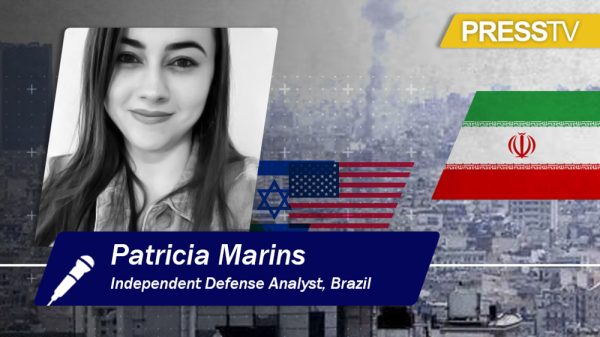
Patricia Marins, an independent defense analyst based in Brazil, has been following the war unfold with a keen eye on the shifting strategic balance.
In an interview with the Press TV website, Marins said she has been witnessing the emergence of something the region has never quite witnessed before: the “Iranian model” of warfare proving itself against the world’s most powerful military.
“The Iranian model possesses several distinct characteristics compared to the American model exported to Arab countries. It is built for attrition warfare and resilience, featuring an extensive network of underground facilities and a focus on long-range precision-guided munitions,” she stressed.
“All of this was achieved through investment in research centers, universities, reverse engineering, and the steady implementation of a domestic defense industry, which in many respects is dual-use.”
On the other hand, the American model exported to the Persian Gulf countries consists of “vulnerable surface installations, almost no degree of indigenous production, and consequently a disconnect between research centers, reverse engineering, and the military industry,” which Marins added is not limited to the US model, but all Western models.
“Kuwait paid over $310 million for each Eurofighter Typhoon, nothing short of extortion,” she said, making a clear distinction between the American and Iranian models.
Today, amid the war that was triggered by the unprovoked US-Israeli attack on February 28, and the assassination of the Leader of the Islamic Revolution, Ayatollah Seyyed Ali Khamenei, and some top-ranking military commanders, that investment is paying dividends.
Marins believes the contrast in the military tech leap is not lost on regional observers.
“I believe this Iranian model is being closely watched by all (Persian) Gulf countries at this moment. I see a high probability of it serving as a reference in several areas. I even believe it has inspired the Saudi missile industry, which is currently absorbing Chinese technology,” she said.
“Iran inspires, yet it still maintains a guarded distance from the (Persian) Gulf countries in this sector.”
Beyond the missile and drone arsenal, Iran also enjoys the geographical advantage, the Brazilian analyst stated.
“Iran’s advantage begins with its geographical position, but it is confirmed by its military prowess. And Iran knows how to leverage both very effectively,” she said
She referred to the Ghadir-class submarine, which is affordable, stealthy, and designed specifically for the waters it operates in – the Persian Gulf – especially in the Strait of Hormuz.
The Strait’s “shallow, high-salinity, and high-temperature conditions create a challenging, noisy, and complex environment for sonar, favoring small, fast, and highly maneuverable platforms,” she asserted.
“It is the perfect marriage between the weapon and the environment in which it operates,” she said. “Iran knows how to use the geography that already favors them.”
Then there is Yemen as well, which has indicated willingness to join the front against the US and Israel, after the Lebanese Hezbollah resistance movement and Iraqi resistance groups.
“Iran has been a master player. Knowing that by maintaining influence in Yemen, in a situation like this, they could exert power over both straits,” Marins said.
“However, all of this requires prudence and maturity.”
With the Strait of Hormuz effectively closed already for the US and its allied vessels, if Yemen’s Ansarullah movement follows through and shuts down the Bab el-Mandeb strait as well, the costs would be abysmal, she noted.
“This would expand the conflict on that axis to European countries, as has already occurred. I believe Iran is weighing the necessity of this escalation and whether it is truly required. While Hormuz involves oil and gas, Bab el-Mandeb involves the flow of goods between the West and Asia,” Marins remarked.
“If this strait is closed, it will have a massive economic impact. I see Iran as prudent and disciplined as a nation must be during a war.”
While media reports have cited figures of $1 billion per day for American attacks, with one estimate putting the first six days at $11 billion, Marins believes the true cost is far higher.
In her projections, she suggests the costs for the US could reach a colossal $360 billion within two months if the war continues unabated, a sum that she stresses “would test the patience of any treasury, let alone American taxpayers already feeling the pinch of soaring oil prices.”
“Israel’s operations during the 12-day war generated a daily cost of around $700 million. However, by the end of the war, once the costs of interceptors and damages were added, this daily cost hit nearly $2 billion,” she told the Press TV website.
“I believe this will be Israel’s cost, but the American cost so far is triple that due to three factors: the number of interceptors expended, the quantity of missiles and guided bombs used, and the cost of damages to bases and radars.”
When these factors are combined, Marins noted, the cost is expected to be “no less than $6-8 billion daily during these two weeks of war.”
On reports that Trump’s advisors are advising him to declare victory and find an exit, Marins doubts the American victory in this war is even possible.
“I don’t think so. I see Iran in a much better strategic position to win the conflict. As long as Iran maintains control of the strait, the pressure will be on Donald Trump’s shoulders, no matter how many bombs he drops,” she said.
But beneath that tactical reality lies a deeper truth about the nature of this war. Iran has demonstrated a capacity to absorb bombings while being resilient, limiting drone actions over its territory, and fighting an asymmetric war on its own terms, Marins said.
“So far, I believe Iran has conducted an asymmetric war with very few mistakes,” Marins said. “One that the US and Israel simply don’t know how to fight.”
Featured Video
BRITAIN’S WARNING: PREPARE FOR WAR
or go to
Aletho News Archives – Video-Images
From the Archive
How Ukraine Tortured and Slaughtered Donbass
By Kit Klarenberg | Al Mayadeen | July 11, 2024
Almost immediately after the proxy war erupted, ISIS-tier footage of the torture and murder of Russians in Ukrainian custody emerged.
On July 6th, the New York Times published an astonishing investigation: In Ukraine, Killings of Surrendering Russians Divide an American-Led Unit. The article documents in grim detail how Chosen Company, an international volunteer battalion for Kiev, routinely executes Russian prisoners of war. It is the very first mainstream admission that this practice – a brazen breach of the Geneva Conventions, and a grave war crime – is widespread among Ukraine’s fighters, both foreign and homegrown. … continue
Blog Roll
 Aletho News
- Pentagon designates Chinese cultural centers national security threat
- Israel Demolishes Home Of Lebanese Journalist Whose Viral Film Exposed Pager Attack
- Record Oil, Empty Tanks: The UAE’s Miracle Recovery
- Burnham tackles Britain’s poverty with aggression in Yemen
- Peace in Ukraine: the easy way – or the hard way
- Trump & the Rrrrussians
- US taxpayer money laundered back through Ukraine – Musk
- Before COVID, an NIH lab chief proposed making a SARS-like bat virus more infectious
- Gates, Bourla on Trial in Netherlands Accused of ‘Great Reset’ Scheme at Vaccine Injury Hearing
- BRITAIN’S WARNING: PREPARE FOR WAR
- If Americans Knew
- An error has occurred; the feed is probably down. Try again later.
- No Tricks Zone
- Two New Studies Find Thwaites Glacier Melt Cannot Be Driven By Human Activity Or A Warming Ocean
- E-Cars Reduce CO2 Emissions By Only 41% Compared To Internal Combustion Engine Vehicles
- Predictions Made By Renowned Climate Professor Over Past Decades Have Been Proven To Be Poor
- New Study Suggests Large Regions Of The Pacific Ocean Have Been Cooling For The Last 80 Years
- Germany’s Green Energy Debacle: High Energy Costs Force Kahla Porzellan to Close After 182 Years!
- New Study: 50 Years Of The Most Aggressive ‘Net Zero’ Policies Can Only Affect The Global Climate By 0.03°C
- US September “Heat” Was No Record…Many Records Set Decades Ago
- Latest European Green Energy Debacle; Portugal’s Largest Flagship Solar Park Insolvent!
- Green Energy Debacle: German Expert Professor Fritz Vahrenholt Warns Of Severe Economic And Social Consequences
- Two More Paleo Reconstructions Affirm Meters-Higher Sea Levels Across Ireland, Brazil 7000-6000 Years Ago

