Soros’ “Open Society Foundation” decided to leave Turkey.
The organization’s representatives said that it was due to the recent accusations that they’ve meddled in the country’s internal affairs, which is an allusion to President Erdogan’s claims last week about their involvement in the 2013 Gezi Park Color Revolution attempt and is ironically the group’s raison d’etre. Truth be told, they’re making a responsible move after seeing the writing on the wall and calculating that a crackdown would be imminent if they don’t leave on their own volition, which works out to be a win-win for both their organization and the government. The “Open Society Foundation” can evacuate its foreign assets from the country and disband its public network, while the state doesn’t have to endure the weaponized infowar campaign that the Mainstream Media would predictably launch if Turkey undertook Russian-like measures to kick this organization out of the country.
This quid-pro-quo is pragmatic for both parties because the “Open Society Foundation’s” domestic Hybrid War operatives get off scot-free, though the state is already likely aware of who they are and won’t hesitate to detain them if they ever pose a future threat to security in the event that they decide to “go underground” to continue their destabilizing activities. At the same time, however, some of the most zealous among them might more safely relocate abroad instead, which would allow them to continue their work remotely through social media and other channels. Still, seeing as how the Turkish state retains strong control over the internet, this threat is conceivably manageable and isn’t seen as being anywhere near as dangerous as if the “Open Society Foundation” and its employees continued their activities in the country unchecked.
Soros’ retreat from Turkey might be a harbinger of what’s to come because President Erdogan commands tremendous respect among the international Muslim community or “Ummah”, so other Muslim governments might be inspired by his leadership in fearlessly calling out the “Open Society Foundation” and seek to emulate his example in the hopes that this will prompt the Color Revolution fifth column to preemptively flee from their countries too. Soros and his organization might try to push back against any similar state pressure if they feel that the authorities there aren’t as strong as their Turkish counterparts and could be influenced by any infowar smear campaign against them, but that’s nevertheless still a fight that they’d be choosing to wage and one which might ultimately be unsuccessful, especially if those governments round up the group’s domestic employees on the pretext that they’re security threats.
It’s still too early to say, but the tide might finally be turning against Soros in the “Global South”.
December 3, 2018
Posted by aletho |
Corruption, Deception | Open Society Foundation, Turkiye |
Leave a comment
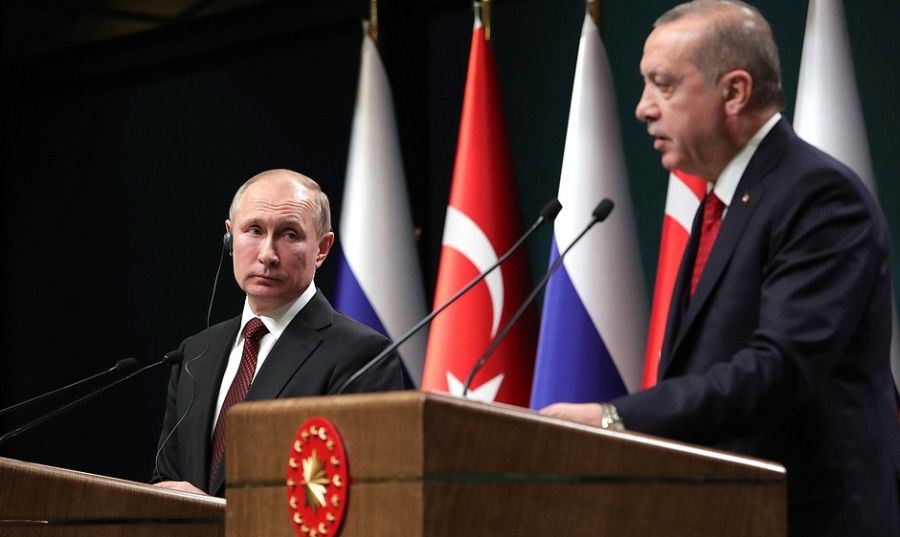
During a Pentagon briefing last weekend, Secretary of Defence James Mattis dropped a bombshell by innocuously slipping in that the US military intends to set up a string of observation posts on the Syrian-Turkish border. Mattis implied that Turkey was on board and that the idea was for the two militaries to jointly prevent any terrorist threats to the US’ NATO ally emanating out of Syrian territories.
Turkish officials immediately tore into Mattis’ project. Defence Minister Hulusi Akar disclosed that he had warned US Chairman of the Joint Chiefs of Staff Gen. Joseph Dunford only a week ago that the observation posts would have a “negative impact” and create the impression that “US soldiers are somehow protecting terrorist YPG (Syrian Kurdish) members and shielding them.”
The move would make an already complex situation “much more complex,” Akar added. He said, “Nobody should doubt that the Turkish armed forces and the Republic of Turkey will take the necessary steps against all kinds of risks and threats from across its borders.”
On Tuesday, President Recep Erdogan lashed out against the US troop presence in eastern Syria, charging that plans to establish observation posts along the Turkish border are meant to aid terrorist elements. “Those who say they are countering (ISIS) in Syria are in fact allowing a small group of terrorists to exist in the country to justify their presence in the war-torn country,” he said.
Erdogan alleged that the US is actually showing a preference to “live and breathe with the terrorists.” “The only target of this terror organization (YPG)… is our country,” he said. “It’s not possible for us to remain idle against this threat.”
Clearly, what is unfolding is a US game plan to block the Turkish military’s future operations in northern Syria against the Kurdish militia. Pentagon regards the YPG to be its most effective Syrian partner. Simply put, what we see here is the Syrian equivalent of what Washington did in 1991 in Iraq by imposing a “no-fly zone” over the Kurdistan region in the north.
The US is playing the long game. It is exactly three years since President Obama deployed 50 commandos to advise the Syrian Kurdish militia in their fight against the ISIS. Obama insisted it was “just an extension” of “special ops” that the US was running already. But the the numbers steadily kept increasing – from 50 to 250, from 250 to 500, and from 500 to 2000. The true figure today is around 5000 – and growing.
Seth Harp at the New Yorker magazine noted after a recent visit to the US bases in Syria, “the mission has morphed into something more like a conventional ground war. The United States has built a dozen or more bases from Manbij to Al-Hasakah, including four airfields, and American-backed forces now control all of Syria east of the Euphrates, an area about the size of Croatia.”
According to reports, there are presently 17 military bases in northeastern Syria. Yet, the US Congress has not authorized military action in Syria, nor has UN mandated the use of force. The Pentagon’s so-called Operation Inherent Resolve comes under the authority of the secretive Joint Special Operations Command, which means that “basic facts are kept classified, including the cost of the mission, the units involved, where they are located, and the number of wounded, which is believed to be substantial,” as Harp pointed out.
The intriguing part is about the US intentions. The stated purpose of the Operation Inherent Resolve is to defeat the ISIS, but lately it has shifted to countering Iranian presence in Syria. According to the US special representative for Syria engagement James F. Jeffrey, Trump has agreed to keep U.S. troops in Syria indefinitely. “We are not in a hurry,” he said.
Turkey’s worst fear may be coming true – a Syrian Kurdistan taking shape right along its border. Indeed, this becomes a template of the overall US strategy to encircle Turkey and Iran and to control Baghdad and Damascus – and eventually to make Russian presence in Syria untenable.
The US aims to put a knife into the heart of the Turkey-Russia-Iran axis in Syria by accentuating the contradictions in the region. The gloves have come off vis-à-vis Iran, Pentagon is now “defanging” Turkey and it remains to be seen how long the gloves will remain in place in the dealings with Russia.
In a candid interview with the Russia media on November 21, Special Representative for Syria Engagement Jeffrey sounded testy. He repeated that the deployment of S-300 missiles to Syria is a “dangerous escalation” – “we would urge the Russians to be very careful with this” – and assertively spoke of the new sanctions against Iran and Russia for oil shipments to Syria, while also rejecting offhand any talk of trade-offs with Russia over Iranian presence in Syria and debunking the Astana process. Jeffrey even reserved the US military’s right “to exercise our right of self-defense” if Russian forces on the ground came in the way. (Jeffrey disclosed that there have been military engagements with the Russians so far in “about a dozen times in one or another place in Syria.”)
Pentagon will press ahead with the establishment of observation posts on the Syrian-Turkish border despite Ankara’s objections. Turkey’s hour of reckoning is approaching. A few days ago, Turkish media reported that Saudi and UAE troops had deployed to northern Syria. In early November, the UAE reopened its embassy in Damascus.
The US and Israel are pressing Saudi Arabia and the UAE to fund the Syrian Kurdish militia and help create proximity between the Kurdish and Arab tribes inhabiting northeastern Syria with a view to create a unified Kurdish-Arab militia that becomes a Syrian bulwark against the two non-Arab regional powers Turkey and Iran.
To quote from a prominent Saudi commentator in the establishment daily Asharq Al-Awsat, “The Americans are now establishing Syrian Kurdish militias as a striking force against several parties and this revives the hopes of the Syrian opposition that it has an opportunity to resume its fighting activities after it has lost most of what it gained of villages and territories during the civil war.”
Both Saudis and Emiratis are once again at the US’s bidding in Syria. These Gulf States no longer hide their association with Israel. They are reciprocating the US-Israeli help to shove the Khashoggi affair under the rug.
November 29, 2018
Posted by aletho |
Illegal Occupation | Saudi Arabia, Syria, Turkiye, United States, YPG |
Leave a comment
The Southern Gas Corridor on which the European Union is pinning most of its hopes for natural gas supply diversification away from Russia is coming along nicely and will not just be on schedule, but it will come with a price tag that is US$5-billion lower than the original budget, BP’s vice president in charge of the project told S&P Global Platts this week.
“Often these kinds of mega-projects fall behind schedule. But the way the projects have maintained the schedule has meant that your traditional overspend, or utilization of contingency, has not occurred,” Joseph Murphy said, adding that savings had been the top priority for the supermajor.
The Southern Gas Corridor will carry natural gas from the Azeri Shah Deniz 2 field in the Caspian Sea to Europe via a network of three pipelines: the Georgia South Caucasus Pipeline, which was recently expanded and can carry 23 billion cubic meters of gas; the TANAP pipeline via Turkey, with a peak capacity of 31 billion cubic meters annually; and the Trans-Adriatic Pipeline, or TAP, which will link with TANAP at the Turkish-Greek border and carry 10 billion cubic meters of gas annually to Italy.
TANAP was commissioned in July this year and the first phase of TAP is expected to be completed in two years, so Europe will hopefully have more non-Russian gas at the start of the new decade. But not that much, at least initially: TANAP will operate at an initial capacity of 16 billion cubic meters annually, of which 6 billion cubic meters will be supplied to Turkey and the remainder will go to Europe. In the context of total natural gas demand of 564 billion cubic meters in 2020, according to a forecast from the Oxford Institute for Energy Studies released earlier this year, this is not a lot.
Yet at some point the TANAP will reach its full capacity and hopefully by that time, TAP will be completed. Surprisingly, it was the branch to Italy that proved the most challenging, and BP’s Murphy acknowledged that. While Turkey built TANAP on time to the surprise of the project operator, TAP has been struggling because of legal issues and uncertainty after the new Italian government entered office earlier this year.
At the time, the government of Giuseppe Conte said the pipeline was pointless but, said Murphy, since then he has accepted the benefits the infrastructure would offer, such as transit fees. And yet local opposition in southern Italy remains strong but BP still sees first deliveries of gas through Italy in 2020.
The BP executive admitted that at first the Southern Gas Corridor wouldn’t make a splash. “The 10 Bcm/year into Europe is not a game-changer from a volume point of view, but it is a game-changer from a new source of product into mainland Europe perspective and it can be expanded.”
Meanwhile, however, Russia and Turkey are building another pipeline, Turkish Stream, that will supply gas to Turkey and Eastern Europe, as well as possibly Hungary. The two recently marked the completion of its subsea section. Turkish Stream will have two lines, each able to carry up to 15.75 billion cubic meters. One will supply the Turkish market and the other European countries. In this context, the Southern Gas Corridor seems to have more of a political rather than practical significance for the time being, giving Europe the confidence that it could at some future point import a lot more Caspian gas because the infrastructure is there.
November 25, 2018
Posted by aletho |
Economics | European Union, Turkiye |
Leave a comment
The Trump administration is making a determined effort to engage with Turkey, which used to be the anchor sheet of American regional strategies in the Middle East for several decades. Without a robust partnership with Turkey, US policies remain ineffectual on several regional fronts – ranging from the Black Sea and Eastern Mediterranean to post-conflict Syria, Iran oil sanctions and Gulf security — and even Khashoggi affair.
Turkey has a long list of grievances – real, feigned or imaginary. But President Trump senses that Turkish president Erdogan prioritizes two core issues – demand that a) Washington should extradite his arch political rival Islamist preacher Fetullah Gulen (who he alleges plotted the failed coup against him in 2016); and, b) that the so-called Halkbank case in a Manhattan court should be wound up.
Trump has lately signaled that he is acting on both issues. Gulen is a tough call for Trump insofar as he has been an “asset” of the CIA. The Halkbank file may be relatively easy to handle.
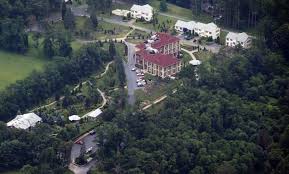
(Fetullah Gulen’s ‘retreat center’ in Pennsylvania)
In turn, Erdogan is holding the trump card in the Khashoggi affair, which has potential to undermine the US’ grand Middle East strategies. A top Saudi establishment commentator Abdulrahman Al-Rashed wrote in the Saudi daily Asharq Al-Awsat, “Turkey has been using the (Khashoggi) crime to push Trump to make concessions to release a convicted Turkish banker or hand over an opposition figure in exchange of stopping its campaign against Saudi Arabia.” Clearly, Trump expects Erdogan to stop fueling the Khashoggi affair.
Erdogan has now let it be known that he is open to meeting with the Saudi Crown Prince Mohammed bin Salman on the sidelines of the G20 summit in Argentina on November 30.
However, the Turkish-American engagement has a much bigger backdrop — Syrian conflict. How far the tango over Khashoggi helped US to address the Syrian situation is hard to tell, but American diplomacy has a way of juggling several balls. In particular, the Pentagon’s alliance with Syrian Kurdish groups worries Turkey and Erdogan has been threatening to move against them.
Now, the US has come up with an innovative idea to work with Turkish military apropos any terrorist threats from Syria. Two days ago, US defence Secretary James Mattis unveiled the idea with disarming simplicity during an interaction with the media:
“Turkey is a NATO ally and they have legitimate concerns about terror threats… from Assad’s Syria… And Turkey has a lot of reasons for concerns, being the NATO country with a border right along Syria. And we don’t dismiss any of their concerns. We are putting in OPs up in northern Syria, this is the change now, okay? We are putting in observation posts in several locations up along the Syria border — northern Syria border because we want to be the people who call the Turks and warn them if we see something coming out of an area that we’re operating in. This is closely collaborated – we are consulting closely with Turkey, military and State Department. Both were consulting with them.”
“We are going to track any threat that we can spot going up into Turkey. That means we will be talking to Turkish military across the border. They will be very clearly marked locations day and night so that the Turks know where they’re at.”
Meanwhile, Voice of America also reported on November 22 that “a large military convoy from an Arab country was deployed last week to the eastern Syrian province of Deir el-Zour” in the region under US control.
Prima facie, the US is pre-empting any excuse by Turkey to attack the Kurdish groups by offering a CBM. But the bottom line is that the US is marking as its exclusive preserve a vast swathe of territory in Syria’s northeastern region — roughly one-third of entire Syria — which is rich in hydrocarbon reserves and water resources, and it expects Turkey to respect the ground reality.
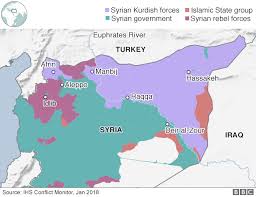
(Who controls what in Syria.)
Without doubt, an entity is being carved out of Syria that is beyond the reach of Damascus, with the Arab Forces providing the “steel frame” for internal security and acting as deterrent against any Turkish attacks against the Kurdish militia, while the US monitors the border region with Turkey.
Mattis claimed that Turkey is on board. But Turkey strongly supports Syria’s unity. Turkish Defence Minister Hulusi Akar has openly voiced disquiet over the US move to set up observation posts on Turkish-Syrian border. Akar disclosed that Turkey conveyed its “discomfort” to the Pentagon:
“We have stated that the observation points to be established by the US troops on the Syrian border will have a very negative impact… and in the course of our discussions we expressed that it could lead to a perception that US soldiers are somehow protecting terrorist YPG (Syrian Kurdish) members and shield them.”
Equally, could an Arab force’s – most likely Saudi and Emirati troops – deployment (just when the war is ending) have been without prior consultation between Washington and Ankara? The point is, Turkey has troubled relations with both Saudi Arabia and the UAE and will resent their deployment of troops to its border regions with Syria.
In sum, the US’ newfound role as the gatekeeper of the Turkish-Syrian border means the Pentagon is creating new facts on the ground, which signals a long-term US occupation of northern Syria. There are serious implications for Syria’s unity and territorial integrity. Indeed, the last thing that Turkey wants is an independent entity along its border with Syria where the Kurds enjoy autonomy. Turkey has a congruence of interests with Russia and Iran in this regard.
November 24, 2018
Posted by aletho |
Aletho News | Middle East, Sanctions against Iran, Syria, Turkiye, United States |
Leave a comment
The situation in Syria is that of a frozen conflict, following the agreements made between Russia, Turkey and Syria on the demilitarized zone created around Idlib. Except for some sporadic terrorist attacks, the truce seems to be holding up over the last few weeks, even though it has become clear to everyone what the next step is for the province.
The Syrian Arab Army (SAA) has been busy eradicating Daesh in the southern part of Syria in recent weeks, concentrating its efforts on securing all areas that have been liberated from terrorist control but which still remain vulnerable to sporadic attacks, as occurred in Sweida at the end of July 2018. In that incident, there were dozens of victims and numerous abductees who remained in the hands of Daesh for months. This caused the Syrian population in neighbouring areas to clamor for protection, forcing the SAA to undertake an anti-terrorist campaign that has been ongoing since August.
This effort by the SAA has slowed down in part due to subsequent events, with an agreement reached between Erdogan and Putin to create a demilitarized zone in the province of Idlib. From October 15, an area spanning 20 kilometres and guarded by Turkish and Russian troops guarantees a separation between the SAA and terrorist groups in the province.
Russian and Syrian efforts have been moving in two very specific directions over the last few weeks. While Moscow supplies Damascus with new equipment in preparation for the future advance on Idlib, Putin and his entourage continue diplomatic efforts to draw more of Syria’s enemies closer to the Russia-Iran-Syria axis. The meeting that brought about the demilitarized zone included Macron and Merkel, the Europeans having evidently come to terms with the impossibility of overthrowing the legitimate government of Syria. Macron and Merkel were offered a way out of the Syrian conflict, decoupling themselves from the belligerent stance of the United States, Israel and Saudi Arabia. The intention is to usher Paris and Berlin towards the same direction Qatar, Turkey and Jordan have been progressively gravitating. Certainly, these are not countries to be considered friends of Damascus. Rather, they are parties with whom a constructive dialogue needs to be entered into in order to advance common diplomatic interests.
Moscow has often found it possible to reach an agreement or start unpublicized negotiations with each of these parties. Erdogan seems to have preferred an agreement with Putin rather than waiting for the liberation of Idlib by the SAA, thus being able to postpone the natural conclusion of the war that will find him sitting at the table defeated. At the same time, Erdogan wants to concentrate on the Kurds in order to secure the border between Syria and Turkey controlled by the Syrian Democratic Forces (SDF), and to prevent any partition of Syrian territory that would favor other parties. Jordan has even reopened the border crossings with Syria, appearing to be the first country in opposition to Damascus that is now taking practical steps to mend fences.
The case of the participation of the two European countries at the summit with Erdogan and Putin is more complex. The rift between Washington and the other European capitals is wide and well documented, even more so after the events in Paris commemorating the end of the First World War. Macron and Trump seem to be diverging further in terms of policy and ideology, while Trump and Merkel have always had their differences. Trump’s choices in the Middle East, in the wake of the destructive actions of Israel and Saudi Arabia, marked a profound point of difference and mistrust with the European allies. Macron and Merkel have a huge problem dealing with refugees flowing from areas in North Africa and the Middle East destroyed by US-led wars. The prospect of working with Erdogan, and indirectly with Damascus, to bring back hundreds of thousands of refugees currently in France and especially Germany, seems to have been Putin’s winning argument during the talks in Istanbul.
This slow diplomatic approach has been accelerated as a result of Israel’s downing of a Russian electronic-surveillance aircraft. The need to avoid a direct conflict between Moscow and Tel Aviv allowed the Russian missile forces to deploy to Syria an advanced model of the S-300 in addition to the existing S-300/400 systems on the ground. The presence of these advanced systems, and Moscow’s threats to use them, together with American concerns over the possibility of an F-35 being shot down by Soviet systems dating from the 1970s, forced the Zionist entity to halt its attacks on Syria.
This situation has helped to create a frozen conflict in the country. Together with the agreement of Idlib, this gives the SAA plenty of time to rest, regroup, and receive supplies needed for future campaigns.
The current truce is a strategic pause that has all the appearance of what has happened in the past in the provinces of Homs and Aleppo. The need to free Idlib from terrorists goes hand in hand with the promise of Assad and the government of Damascus to liberate every inch of Syria from terrorists. The diplomatic efforts of Moscow serve to prepare the ground for what will happen in the coming months, with the SAA set to advance on Idlib. In this sense, the deployment of advanced systems in Syria serves as a deterrent against possible responses from countries like Israel and the United States, anxious to defend their jihadists, but continuing to have minimal influence on the ground.
Russia and Syria’s moves therefore seem to be in preparation for the battle for Idlib, to be the longest and most difficult yet. The liberation of the province is inevitable but requires all the necessary political, diplomatic and military preparation in order to ensure success and limit potential escalation. As is often the case, Moscow and her allies approach complex issues with simple and pragmatic solutions, even offering exit strategies to their (geo)political opponents, which contrasts with their demonstrated tendency to rush heedlessly towards war.
November 23, 2018
Posted by aletho |
Illegal Occupation | Russia, Syria, Turkiye, United States |
Leave a comment
Washington’s attempt to “isolate Putin’s Russia” has failed and had the opposite effect.
On the fifth anniversary of the onset of the Ukrainian crisis, in November 2013, and of Washington “punishing” Russia by attempting to “isolate” it in world affairs — a policy first declared by President Barack Obama in 2014 and continued ever since, primarily through economic sanctions — Cohen discusses the following points:
1. During the preceding Cold War with the Soviet Union, no attempt was made to “isolate” Russia abroad; instead, the goal was to “contain” it within its “bloc” of Eastern European nations and compete with it in what was called the “Third World.”
2. The notion of “isolating” a country of Russia’s size, Eurasian location, resources, and long history as a great power is vainglorious folly. It reflects the paucity and poverty of foreign thinking in Washington in recent decades, not the least in the US Congress and mainstream media.
3. Consider the actual results. Russia is hardly isolated. Since 2014, Moscow has arguably been the most active diplomatic capital of all great powers today. It has forged expanding military, political, or economic partnerships with, for example, China, Iran, Turkey, Syria, Saudi Arabia, India, and several other East Asian nations, even, despite EU sanctions, with several European governments. Still more, Moscow is the architect and prime convener of three important peace negotiations under way today: those involving Syria, Serbia-Kosovo, and even Afghanistan. Put differently, can any other national leaders in the 21st century match the diplomatic records of Russian President Vladimir Putin or of his Foreign Minister Sergei Lavrov? Certainly not former US Presidents George W. Bush or Obama or soon-to-depart German Chancellor Angela Merkel. Nor any British or French leader.
4. Much is made of Putin’s purportedly malign “nationalism” in this regard. But this is an uninformed or hypocritical explanation. Consider French President Emmanuel Macron, who recently reproached Trump for his declared nationalism. The same Macron who has sought to suggest (rather implausibly) that he is a second coming of Charles de Gaulle, who himself was a great and professed nationalist leader of the 20th century, from his resistance to the Nazi occupation and founding of the Fifth Republic to his refusal to put the French military under NATO command. Nationalism, that is, by whatever name, has long been a major political force in most countries, whether in liberal enlightened or reactionary right-wing forms. Russia and the United States are not exceptions.
5. Putin’s success in restoring Russia’s role in world affairs is usually ascribed to his “aggressive” policies, but it is better understood as a realization of what is characterized in Moscow as the “philosophy of Russian foreign policy” since Putin became leader in 2000. It has three professed tenets. The first goal of foreign policy is to protect Russia’s “sovereignty,” which is said to have been lost in the disastrous post-Soviet 1990s. The second is a kind of Russia-first nationalism or patriotism: to enhance the well-being of the citizens of the Russian Federation. The third is ecumenical: to partner with any government that wants to partner with Russia. This “philosophy” is, of course, non- or un-Soviet, which was heavily ideological, at least in its professed ideology and goals.
6. Considering Washington’s inability to “isolate Russia,” considering Russia’s diplomatic successes in recent years, and considering the bitter fruits of US militarized and regime-change foreign policies (which long pre-date President Trump), perhaps it’s time for Washington to learn from Moscow rather than demand that Moscow conform to Washington’s thinking about—and behavior in—world affairs. If not, Washington is more likely to continue to isolate itself.
John Bachelor Show
Stephen F. Cohen is a professor emeritus of Russian studies and politics at New York University and Princeton University and a contributing editor of The Nation.
November 22, 2018
Posted by aletho |
Russophobia, Timeless or most popular | China, Emmanuel Macron, India, Iran, Russia, Saudi Arabia, Syria, Turkiye, United States |
Leave a comment
Trump’s relationship with Erdogan raises new questions about the credibility of US mainstream journalism. Was Khashoggi a victim of a Turkish ‘honey trap’?
The Washington Post continues its banal attack on the regime of Saudi Arabia, following the horrific murder of Jamal Khashoggi in the Saudi Consulate on October 2. In Turkey too there is much which the western media cannot understand or refuses to probe, as Ankara plays a game of blackmail with Riyadh in a bid to extract a deal from Mohammad bin Salman who is at the centre of its character assassination.
But what are we missing? What is at the heart of this story which isn’t getting picked up by journalists or even TV commentators in the region?
Much has been written about the ‘free license’ that Trump and his son in law, Jared Kushner gave the Saudi prince and that this murder is an inevitable consequence of such blinded dogma towards ones allies. There is some truth in this, but if you are to look at the coverage of, in particular, the US media over Khashoggi, you might be curious to understand why it is so extensive and prolonged. After all, Saudi Arabia has been kidnapping its own dissidents for years and there are many western journalists who are killed or go missing around the world which get minimal coverage. Why such an entrenched campaign for Khashoggi?
Guilty
Partly this is a guilt complex of the Wapo editors, who I have accused in earlier articles for more or less sending Khashoggi on a suicide mission when they chose to publish his articles in Arabic. This was recently confirmed when Khashoggi’s editor at the Post – Karen Attiah – admitted to The Independent that the traffic which the Arabic articles generated shocked bosses there. I have always argued that this was a final blow for MbS, humiliated now by his adversaries in Riyadh who can read about his failings on a regular basis.
And it’s also about the fact that the Post considered him part of the DC elite. One of their own, which explains why he has become so canonised and his personality enshrined in virtue.
Their trade is treachery
In truth, Khashoggi was no saint. He took the King’s shilling from the Saudi elite all his life and made a good lifestyle for himself. At the end of a thirty year relationship of working for them and learning all of their secrets, he used that privilege as a weapon to destroy MbS. In most cultures around the world, this is called treachery. We should remember that even in London in 1963, when British spy Kim Philby defected to Moscow, many wanted him to hang for selling out to the Russians and being a double agent for all his career. Khashoggi may well have been an amiable character. But he was also a traitor.
We are led to believe that he left Riyadh in 2017 because he feared being detained. But could it be that he was frustrated at not being promoted within the hierarchy?
A select number of journalists and academics, like Dr Nafeez Ahmed, support this theory, in part at least and go further to say that Khashoggi was murdered because he was about to distribute solid evidence of the Saudis using chemical weapons in Yemen. The British academic also underlines Khashoggi’s role for Saudi intelligence and, moreover, how he helped the Saudi royal family support Bin Laden, right up until 9-11.
Yet my own sources close to the Saudi elite tell me that MbS wanted to call him back to Riyadh because Khashoggi was at the centre of a coup in the making, which would have benefitted the former Crown Prince Mohamed bin Nayef, and still operated very much as though he was a Saudi intelligence asset. Not so much a treacherous journalist who didn’t know which side his bread was buttered, but more a double agent who was the gatekeeper of incendiary information. Something had to be done about Khashoggi.
Frustrated journalists are dangerous people. They lose sight of their loyalties and promises they made. And Khashoggi was an odd character struggling with an identity crisis. Is it the same case with Karen Attieh on the Oped desk of the Post which managed him? Did she connect with him as she too feels not taken seriously by her bosses at the Washington Post ?
Conspiracy theory extended? Unfortunately we are led to feral speculation when we are denied the facts, especially deliberately.
Western media has a lot to be ashamed of on both covering up the Khashoggi murder – by going along with the demonization of the kingdom – and in being part of it happening in the first place. How does all of the gory details about Khashoggi’s murder get reported as fact by the Post, when it has no proof from the Turkish police sources who supply them? There is gargantuan hypocrisy at play here as the Post is part of a conspiracy now. It played a role in Khashoggi getting murdered and it is now playing a role in diverting blame away from itself and blithely accusing Saudi Arabia’s leader of the murder with little or no solid evidence. This is sloppy journalism on a whole new scale and shows a dire lack of journalistic credibility and judgment (unless of course the Post is part of a murky campaign of disinformation which has been agreed between Ankara and Washington whose firebrand leaders are now on good terms once again). Is the Post part of a dirty deal which has been struck by Trump and Erdogan to rewrite this story?
Far fetched? Ludicrous? Maybe, but let’s look at the facts. Trump is standing back and letting Erdogan continue with his drip feeding of sensational detailed evidence, in a blackmail game with MbS – but what’s the price Americans pay for that? To place himself at the centre of that charade, Trump has indicated to the Saudis that they need to release women activists from jail (likely to happen soon) and to cancel the Qatar blockade (on the cards, but will take longer). But before that happens, what we are witnessing is Trump looking for a media distraction (sanctions against the Saudi ‘killers’) while he mulls the idea of letting Erdogan have the exiled cleric, Gulen, who the Turkish President accuses of being the architect of the July 2017 attempted coup.
But he has also allowed Erdogan to use the US media as a platform for his own moral tutelage. Yes, astonishingly, the Washington Post – which presents itself as an arbiter of free speech and a protector of journalists and their sanctity, following Khashoggi’s murder – chose to publish Erdogan’s Oped about the affair, giving the Turkish leader the edge in the power game by selling out the lives of all 170 journalists in Turkish prisons, which, presumably, Wapo editors just forgot about on that given day. One can only assume that Karen Attiah managed to hold back the tears for those who are rotting in Turkish prisons for merely writing an Oped which vexed the Turkish leader.
Presumably Erdogan paid the Post to publish the piece – otherwise, if it were gratis, then that would be like Wapo supporting him and his political leadership. But was this the same money that Saudi Arabia is reported to pay to regional media outlets to buy their loyalty? How can a Middle Eastern leader who has imprisoned a record number of journalists and who is now blackmailing the Saudis, get the support from the Washington Post ? Can this really be happening?
Erdogan must be laughing his head off in Turkey as he sees day after day that western media just report as facts, what his officials say about the details of the murder. And laughing even hysterically when all he needs to do is write an article taking the moral high ground – don’t laugh – on the rights of journalists in the region and give it to the Post to publish.
The dark side of Khashoggi murder
Good investigative journalists are cynical about everything which is presented to them. Is, for example, the relationship between Khashoggi and his fiancé entirely what it seemed, or was she directed by Erdogan to ‘honey trap’ the Saudi journalist as part of an elaborate plot to ensnare the Saudi crown prince? Sources from the intelligence community of one middle eastern country (I prefer not to name which one) are at least beginning to wonder about this. And almost certainly so are the Saudis. Yet western journalists who refuse to at least consider that the Khashoggi abduction was bungled (and ended up being a murder) are likely to call this a conspiracy theory. Even if it is, they should at least report on it and mull it. What about all the tools which the hit team brought, they might ask. Could they have been brought to be used to scare Khashoggi into handing over the information that MbS was seeking?
Khashoggi’s fiancé doesn’t seem distraught and the sheer speed in which the couple headed towards the marriage courts is questionable, as is, indeed her own personal relationship with Erdogan, which she even admitted to the BBC. Other questions should be the ‘evidence’ presented by Erdogan, which is looking ropy to say the least, which some journalists are identifying as such.
For the moment, the only certain thing about the Khashoggi affair is how standards of western media have plummeted to an all time low with the Post leading the pack with partisan judgment, check book journalism and an internal guilt trip fuelling their unremarkable reporting, not to mention their abysmal editorial judgment. American media has lost the moral compass and Khashoggi will be remembered for this above all – with many arguing that this, in itself, plays a role in the impunity of those carrying out the rendition and murder. When the Saudis fell into the Turkish trap, they probably believed that Turkey would be the last place in the world to care about one kidnapped journalist. But they could never have imagined how partisan, sloppy and hypocritical western media would be in covering the story. What Khashoggi has taught us is that the day that Americans read newspapers based on the editors’ judgment are well behind us. So why should we read them at all?
November 21, 2018
Posted by aletho |
Deception, Mainstream Media, Warmongering | Saudi Arabia, Turkiye, Washington Post |
Leave a comment
After prolonged hibernation, the Astana Process on Syrian peace is kinetic, with the troika of ‘guarantor’ states – Russia, Turkey and Iran – set to hold a round of talks in the Kazakh capital on November 28-29. Delegations of the Syrian government and the opposition are also expected to attend. A renewed effort is commencing to create traction for the UN-sponsored negotiations in Geneva.
Much water has flown down the Euphrates since the 9th round of the Astana Process took place in May. Six months is a long time in politics – especially in Middle East politics. But, paradoxically, while Middle Eastern politics is in turmoil, the prospects for peace in Syria may have improved. The setting for tomorrow’s meet – it’s unclear at what level the event will take place – has become largely favorable. At least 10 major reasons can be attributed.
One, Syria is witnessing a period of relative calm. There has been no major fighting for months. Two, Syrian-Jordanian border had reopened and nothing of a feared flare-up happened in the Golan Heights. Three, the Russian-Turkish understanding on Idlib is holding. Four, Israel has been effectively ‘defanged’ (thanks to deployment of Russian S-300 ABM system to Syria). Five, Russia and Iran intend to retain their military footprints in Syria for a foreseeable future, while on the contrary, the US lacks the political will or the military capability to impact the strategic calculations of Moscow, Tehran, Damascus or Ankara.
Six, importantly, Turkey has become an implicit ally of Russia and Iran and is inching closer and closer to a political deal that leaves President Bashar Al-Assad in power. Seven, Russia, Turkey, and Iran are in the lead in shaping the Syria policy, with clear strategic goals and, even more so, the means to achieve them.
Eight, on the other hand, a growing determination on the part of Russia, Iran, and Turkey is discernible to freeze out the United States from any role in shaping Syria’s geo-strategic future. Although the three countries would have tactical differences between them, broadly, Turkey will accommodate Russia and Iran so long as it has a free hand to check the Kurdish forces threatening its security. Significantly, the announcement on the rebooting of the Astana Process comes after the visit by Russian President Vladimir Putin to Turkey on November 19.
Nine, the crisis in Turkish-American relations not only persists but may even deepen in the period ahead. Finally, the Trump administration’s calculations that its re-imposition of sanctions against Iran will either force Iran out of Syria or, better yet, produce a veritable collapse of the Iranian government are turning out to be a mere pipe dream. In fact, the opposite has happened.
Iran is intensifying its coordination with Russia and Turkey, and is creating firewalls to protect its strategic gains in Syria. Again, it is clear by now that the US cannot count on the new government in Baghdad to act against Iranian interests.
On the other hand, the dangerous situation that has arisen on Israel’s border with Gaza (which was precipitated entirely by Israeli hardliners) and the ensuing mayhem in Israel’s domestic politics will seriously delimit Benjamin Netanyahu’s energy and resources to act as ‘spoiler’ in Syria. Moscow has openly snubbed Netanyahu lately by refusing him to schedule his visit.
Similarly, the widening cracks in the US-Saudi alliance in the downstream of the Khashoggi murder all but means an overall Saudi disengagement from the Syrian conflict. The UAE has already begun mending fences with the Syrian government, which would only have been possible with Saudi approval. (See my blog UAE, Saudi sense convergence with Syria.)
Suffice to say, the so-called Syrian opposition is finding itself rudderless. Their erstwhile mentors – US, Turkey, Saudi Arabia, UAE – have either reached a dead end or have turned to new priorities in their self-interests accepting the defeat in the Syrian conflict.
Meanwhile, the appointment of Norwegian diplomat Geir Pederson as the UN Secretary-General’s new special envoy for Syria becomes a positive factor. Russia has warmly noted that “we know him as an experienced and unbiased diplomat.” Pederson’s predecessor Staffan de Mistura was widely perceived as a sidekick of the US. Clearly, the Astana Process is not wasting time by kickstarting the work on a Syrian settlement even as Perdersen moves in.
November 20, 2018
Posted by aletho |
Aletho News | Israel, Middle East, Saudi Arabia, Syria, Turkiye, United States |
Leave a comment
MOSCOW – Moscow has no reasons to doubt the ability of Saudi authorities to conduct a proper investigation of the killing of opposition journalist Jamal Khashoggi and warns against politicizing this tragedy, a source in the Russian Foreign Ministry told Sputnik on Friday.
“Moscow notes the course taken from the beginning by the Saudi side to conduct the most thorough and objective investigation of the incident, including the interaction with the Turkish authorities,” the source said.
The Foreign Ministry official stressed further that Russia sees ‘no reason to question the ability of the Saudi authorities to deal with this high-profile case at the proper professional level.’
Addressing the politicisation of the issue, he stressed that Moscow was convinced that it was ‘inadmissible’, as such cases needed to be ‘resolved exclusively within the legal framework.’
The official’s statement comes after Saudi Prosecutor General’s Office announced on Thursday the completion of the investigation of Khashoggi’s murder saying that 21 people had been detained in connection with the case, with 11 of them charged. Prosecutors are demanding the death penalty for five of the defenders.
November 16, 2018
Posted by aletho |
Aletho News | Russia, Saudi Arabia, Turkiye |
Leave a comment
The reported plan by the United Arab Emirates to reopen its embassy in Damascus shortly leads to a startlingly new alignment on the map of the Middle East.
At the most obvious level, it signals the realization among the Gulf States that the brutal war to overthrow the Syrian government has ended. But the pragmatism is stunning. There isn’t even going to be any ‘cooling-off’ period!
What explains the urgency? Analysts may say it is to counter Iran’s influence. After all, the Saudis with UAE backing tried a similar approach in Iraq through the past year – to counter Iran’s multi-vectored influence in Iraq.
But the UAE cannot but be unaware of the exceptionally strong bonding between Damascus and Tehran. Syria may have uses for ‘green money’ to advance its reconstruction agenda but Iran’s backing has existential dimensions.
The western analysts tend to view the Iran factor as the leitmotif of Middle Eastern developments. However, in this cacophony over Iran, we are largely overlooking that simmering differences among the major Sunni states have also surged to the centre stage lately.
Through the past 2-3 year period, a Turkish-Qatari alignment has crystallized. For Qatar, Turkey’s support is invaluable for resisting the pressures on its strategic autonomy from the regimes in Saudi Arabia and the UAE. The establishment of a Turkish military base in Qatar underscores this new axis. Lately, Qatar has become a pillar of financial support for the Turkish economy.
Neither Qatar nor Turkey is flustered by Iran’s rise. Neither is seeking Iran’s isolation, either. Washington recently ‘granted’ a waiver to Turkey to continue to buy oil from Iran, but Ankara shot back saying it opposed US sanctions anyway, calling them ‘imperialistic’.
For Turkey too, Saudi Arabia and the UAE are the principal regional adversaries today. Turkey viewed with disquiet the UAE’s support of terrorist groups in Libya, Yemen and Syria. In next-door Syria, the Saudi and Emirati openly supported ISIS groups and al-Qaeda affiliates. Circles close to Turkey’s ruling elite have alleged that UAE is targeting Erdogan in a concerted way.
However, the ‘red line’ was crossed when the two Gulf oligarchies lent support to the failed coup in 2016 in Turkey to assassinate President Recep Erdogan. (After the coup failed, it took 16 hours for Riyadh to even issue a statement!) Turkey estimated that the UAE provided a staging post for the coup plotters.
As Turkey sees it, the UAE is implementing a western project to weaken it. Meanwhile, reports also appeared that the two Gulf oligarchies have been funding the Kurdish militant groups (who are the US’ allies in Syria.)
No doubt, it is a combustible mix. But what makes it really explosive is the perception in Abu Dhabi and Riyadh that Turkey and Qatar are patronizing the Muslim Brotherhood as a potent vehicle for the democratic transformation of the Muslim Middle East.
Both regimes (Saudi Arabia and the UAE) regard the Brotherhood as existential threat. Their visceral hatred of Brothers is such that they bankrolled the coup d’état against elected Egyptian President Mohamed Morsi in 2013 in a multi-billion dollar project.
Enter Syria. Given the above backdrop, the UAE and Saudi Arabia are inclined to sense a convergence with the Syrian regime on pushing back at Erdogan’s perceived aspirations of ‘neo-Ottomanism’ in general and his support of the Brotherhood as a vehicle of change in particular.
A tantalizing question will be: Where does the US stand apropos the Brotherhood? The Barack Obama administration with a sense of history saw in the Brotherhood much potential to finesse the Arab Spring toward establishment of ‘Islamic democracy’ in the Middle East. The US had dealings with the Brotherhood in Egypt based on estimation that it could do business with them and even influence them to democratize the Muslim Middle East. Of course, the premature end to the transition in Egypt in 2013 changed everything.

The Muslim Brotherhood lobbying US Congress, May 2017
Erdogan always hoped that the US (and the West as a whole) would appreciate that Turkey is uniquely placed to play the leadership role in the transition to a New Middle East. The Khashoggi affair has noticeably rekindled those hopes. (Interestingly, the spokesmen of the US intelligence establishment who have been very vocal about the Kahshoggi affair have also suddenly mellowed toward Erdogan.)
Now, this subtle shift on the part of the ‘Deep State’ in America toward Erdogan couldn’t have gone unnoticed in Riyadh and Abu Dhabi. It has probably prompted them to open a line to Damascus as early as possible.
How this delicate tango will play out remains to be seen, since there are far too many variables. With the US midterm elections over, President Trump may come under pressure to ‘do something’ on the Khashoggi affair.
Meanwhile, the Saudi and Emirati presence in Syria will be a matter of concern for Turkey in the ‘post-truth’ politics after Khashoggi’s murder.
November 8, 2018
Posted by aletho |
Economics | Middle East, Saudi Arabia, Syria, Turkiye, UAE |
Leave a comment
WASHINGTON – The United States blocked nearly $200 million in assets belonging to Syria, Iran, and North Korea in 2017 as a result of the sanctions imposed on the three countries, the Treasury Department said in its annual report to Congress released on Wednesday.
“Approximately $199 million in assets relating to the three designated state sponsors of terrorism in 2017 have been identified by OFAC as blocked pursuant to economic sanctions imposed by the United States,” the report said.
The statement comes days after the US fully reinstated sanctions against Iran, including measures that curb Tehran’s oil industry. At the same time, the United States temporarily exempted eight nations — China, Greece, India, Italy, Japan, South Korea, Taiwan and Turkey — from the sanctions on importing oil from Iran.
In May, US President Donald Trump announced that the United States would withdraw from the Iran nuclear agreement, officially known as the Joint Comprehensive Plan of Action, and reimpose sanctions against Tehran that were previously lifted under the accord, including secondary restrictions.
The first round of the US sanctions was reimposed in August, while the second round, targeting over 700 Iranian individuals, entities, banks, aircraft and vessels, came into force this week.
November 7, 2018
Posted by aletho |
Economics | China, Greece, India, Iran, Italy, Japan, Korea, Sanctions against Iran, Syria, Taiwan, Turkiye, United States |
Leave a comment
Under the pretext of protecting Kurds, the US is setting up military bases and aerodromes in Syria’s east, which signals their intention to prolong the armed conflict, Syrian Foreign Minister Walid Muallem told a press conference on Monday.
SANA news agency quoted Muallem as saying that the US is using its base in Al-Tanf on the Syrian-Iraqi border to train former members of the ISIL terrorist organization in order to include them later into units fighting against the Syrian army.
The foreign minister noted that the government forces and their allies are “the only real force fighting against ISIL groups and al-Nusra front extremist group on the Syrian territory.”
Muallem also said that terrorists from the al-Nusra group still remain in the area where the Idlib demilitarized zone should have been established.
“This is a signal that Ankara does not want to fulfill its obligations in the framework of Russian-Turkish agreements on Idlib,” he said.
The foreign minister noted that Idlib, located 320 kilometers from Damascus, remains under the control of terrorists who are supported by Turkey and the West, Tass news agency reported.
“We remain in close coordination with Russian friends regarding the situation in Syria’s north-west,” he added. Muallem also reminded that the agreement on Idlib is temporary, and the Syrian government has a legal right to return the province under its sovereignty.
According to the Russian-Turkish memorandum signed in Sochi on September 17 after talks between the presidents of Russia and Turkey, the demilitarized zone 15-20 kilometers deep in Idlib should have been established by October 15. However, Turkey asked to postpone joint patrolling in Idlib due to its inability to guarantee security from its side.
October 30, 2018
Posted by aletho |
Illegal Occupation, War Crimes | Russia, Syria, Turkiye, United States |
Leave a comment