The Battle for Zaporizhzhia – Part 34 of the Anglo-American War on Russia
Tales of the American Empire | May 7, 2026
Springtime in Ukraine melted snow turning farmland and dirt roads into deep slush that vehicles could not cross. The ground has dried and Russian forces quicken their advance and will reach the big Dnieper River this summer. The most likely crossing point is the city of Zaporizhzhia with a population of 700,000.
It is unclear if Ukraine will fight to defend Zaporizhzhia or fall back behind the Dnieper River. If Ukraine evacuates this city, its big buildings could provide a great fortress. But Ukraine has nowhere for its 700,000 people to live and not enough transport to move them anyway. In addition, as Russian forces soon approach, their drones will patrol Zaporizhzhia bridges and attack any transport, effectively blockading the city. Ukrainian forces could become trapped on the east side of the river.
It will be interesting to see if NATO can destroy all the Dnieper bridges despite opposition from many Ukrainians, who may disrupt plans with police and military units. The Russians want them to support major forces once they cross the river. The Ukrainians know these bridges are vital national assets and not easily replaced. If all bridges are destroyed, this can delay the Russian advance for months.
_________________________________
“Military Summary” channel; YouTube; daily war updates;  / @militarysummary
Related Tales:
“The Anglo-American War on Russia”; • The Anglo-American War on Russia
Nearly $22 billion secretly shipped to Ukraine – Austrian politician
RT | May 11, 2026
A right-wing Austrian politician has demanded that the country’s Finance Ministry explain how nearly $22 billion in cash and gold was shipped to Ukraine from Austria since 2022 without triggering concerns about money laundering or regulatory oversight.
In a statement published on Sunday, Austrian Freedom Party (FPO) Secretary General Christian Hafenecker called out what he described as Vienna’s “two-class justice system” for overlooking massive payments to Kiev, while keeping a tight hold on taxpayers’ purse strings.
“We’re not talking about play money here: 1,030 registered cash and gold shipments, around €12 billion ($14 billion) plus $7.75 billion, physically transported over 1,300 kilometers into the war zone,” Hafenecker said.
“And the responsible finance minister simply tells me… ‘We know nothing, we’re not investigating anything, we haven’t collected any information.’ That’s not an answer, that’s dereliction of duty,” he added.
By comparison, Austrian money laundering rules require a private citizen withdrawing as little as €12,000 from an inherited account to prove the origin of the funds, and any person crossing the EU’s external border with more than €10,000 in cash must declare it, Hafenecker said. “This is a two-class justice system in finance.”
The politician demanded full disclosure on all cash shipments from Austria to Ukraine since the escalation of the conflict, a full audit by the country’s Financial Market Supervisory Authority, and a report by the Austrian Money Laundering Reporting Office in parliament.
Earlier this year, the Euroskeptic FPO party demanded that Vienna cut all financial aid to Ukraine, denouncing the country as a corrupt “bottomless pit,” following a wave of high-level embezzlement scandals in Kiev.
Major probes by Ukraine’s Western-backed anti-graft agencies have implicated senior officials in Vladimir Zelensky’s government since last year. Two ministers and the Ukrainian leader’s chief of staff, Andrey Yermak, stepped down following the massive scandal.
Russian President Vladimir Putin has slammed the current leadership in Kiev, calling it a “criminal gang” sitting on “golden potties,” and interested far more in personal enrichment than in the fate of ordinary Ukrainians.
France’s Shadow War in Mali
By Freddie Ponton | 21st Century Wire | May 11, 2026
France did not really leave Mali. It changed tactics and found new hands to carry the gun. After being pushed out by a military government that turned toward Russia, China, and the wider Global South, Paris appears to have re-entered the war through Ukrainian military intelligence channels, long-standing Tuareg networks, and a battlefield configuration in which separatist rebels and Al-Qaedaʼs Sahel branch were hitting the same state enemy at the same time.
The late-April attacks in Mali said something larger about the Sahel. A former colonial power that had been shown the door was suddenly back in the frame, leaning on intermediaries and the momentum of jihadist advances to weaken a government that had chosen Russian support, Chinese weapons, and the language of anti-colonial independence over its old dependence on Paris.
Paris returns through the back door
The sequence is clear. On 25 April, coordinated attacks struck Kati, Gao, Kidal, Sévaré and other strategic points in Mali. Defense Minister Sadio Camara, one of the central figures in Bamako’s post-French realignment and often described as Moscow’s man in the junta, was killed in an attack on his residence. The capital was shaken, roads toward Bamako came under pressure, and in the north, the insurgents advanced as Russian fighters and Malian forces lost ground. Four days later, while the government was still counting its dead, Mohamed Elmaouloud Ramadane, spokesman for the Azawad Liberation Front, or FLA, surfaced in Paris and met French security and defence representatives while demanding that Russian forces leave Mali. That alone should have set off alarms from Bamako to Brussels.
French media then supplied the missing bridge. Radio Télévision Luxembourg, RTL, reported that France was relying on French-speaking Ukrainian soldiers, including former Foreign Legion personnel, to provide operational support on the ground in Mali in coordination with Tuareg rebels. The report was explicit enough to describe a French effort to avoid direct cooperation with jihadists linked to Al-Qaeda by using Ukrainian relays instead. The same investigation recalled that at the beginning of 2025, Ukrainian military intelligence had presented a detailed plan to French authorities to help dislodge the juntas in the Sahel region and roll back Russian influence. Paris supposedly hesitated at first on security grounds. From where things stand now, the April operation feels less like an improvised response than the delayed execution of that proposal.
For readers unfamiliar with Mali, one fact matters more than any other. This is a large Sahel state that was once a core part of France’s post-colonial sphere of influence. After coups in 2020 and 2021, the new authorities pushed out French troops, challenged the old Françafrique order, and brought in Russian security support while deepening ties with non-Western partners. That made Mali a test case in Africa’s attempt to break with inherited dependency. Seen from that angle, the April offensive was more than just local tensions between armed factions. In fact, it was part of a wider struggle over who gets to decide the political future of the Sahel.
The offensive that exposed the convergence
The April 25 offensive laid bare the forces converging against Bamako. Jama’at Nusrat al-Islam wal-Muslimin (JNIM), better known as JNIM, claimed major attacks around the south and center. The FLA and allied Tuareg formations pushed in the north. Together they created the sense of a government under siege, with one arm of the offensive squeezing the capital and another unravelling the junta’s hold on strategic northern towns. JNIM is not a vague insurgent label. It is Al-Qaeda’s official branch in the Sahel, born from a 2017 merger that brought together Ansar Dine, AQIMʼs Sahara branch, al-Murabitoon and the Macina Liberation Front under the leadership of Iyad Ag Ghali, a veteran Tuareg commander now wanted by the International Criminal Court.
That reality becomes significant, especially when the Azawad Liberation Front (FLA) is so often presented in softer terms, as if it were merely a separatist front pursuing legitimate local grievances. The FLA, founded in late 2024 in Tinzaouaten from a reorganization of Azawad movements, draws on a long history of Tuareg rebellions in northern Mali. Its public face is political and diplomatic, and its battlefield behaviour tells a much sharper story. In the April assault, it moved in the same strategic rhythm as JNIM, benefiting from the firepower, shock value, and confusion generated by Al-Qaeda’s Sahel network.
The north was especially revealing. Kidal, the symbolic heart of Tuareg politics and rebellion, fell back under FLA control after Russian Africa Corps contractors and Malian forces withdrew. Accounts describe negotiated departures, seized matériel, and a humiliating loss for Bamako and its Russian backers. Africa Corps units left behind vehicles and equipment while seeking safe passage out of a town they had retaken from Tuareg groups only a few years earlier. In Bamako’s orbit, meanwhile, JNIM tightened pressure with threats to block access roads and attacks designed to create the perception of a capital edging toward siege. To supporters of the insurgency, the junta looked fragile, but to anyone watching external interference, the alignment of interests was impossible to ignore.
Much of Western coverage flattened this into a familiar story about state weakness and local instability. That framing leaves out the politically explosive part. These attacks came after two years of mounting accusations from Mali and its Sahel allies that Ukraine was aiding anti-state armed factions and that France had never fully abandoned its northern networks. Put next to Ramadane’s Paris visit and RTL’s reporting on French support through Ukrainian channels, the April offensive starts to read less like a sudden collapse than the military expression of a proxy design that had been taking shape for some time.
Ukraine’s war spills into the desert
Ukraine’s place in this story is not incidental. It is one of the clearest windows into how the war with Russia has spilled into Africa. In 2024, reporting from Le Monde described Ukrainian links with northern Malian rebels and said Ukrainian operatives had trained Tuareg fighters to use drones. That reporting was reinforced by statements from Tuareg figures themselves, who acknowledged contacts with Ukrainians, and by later accounts of drone know-how and explosive FPV tactics moving into the Sahel theatre. Mali cut diplomatic ties with Ukraine in August 2024 after comments from a Ukrainian intelligence spokesman were interpreted in Bamako as an admission of involvement in the Tinzaouaten ambush that killed large numbers of Wagner and Malian personnel.
In that July 2024 ambush near Tinzaouaten, Tuareg separatists claimed to have killed 84 Wagner operatives and 47 Malian soldiers. Ukraine’s own military intelligence spokesman then boasted that its services had supplied the “essential intelligence, and not just intelligence” that made the operation possible.
Tinzaouaten already carried the shape of what came later, and showed that Russian assets in Mali could be hit through a combination of local insurgents, drone warfare, and outside intelligence support, leaving Moscow’s contractors exposed far from their main war. By 2026, those methods had grown more polished. Reports on rebels’ use of FPV systems, including fibre-optic drones that resisted jamming and adapted commercial platforms, pointed to a battlefield increasingly shaped by techniques honed over eastern Ukraine. Russian and Malian convoys were taking fire from above in areas where state air superiority had once seemed secure.
Regional coverage and Sahel sources have since pointed to Algeria as the state that might have helped make that Ukrainian support physically possible long before the April offensive. Niger had already moved into Russia’s security orbit by then, which suggests Algerian territory and networks as the only realistic corridor for covert assistance to reach Tuareg fighters in northern Mali. The same Algeria that has spent years mediating Tuareg affairs, hosting peace talks and cultivating influence over Iyad Ag Ghali’s environment, seems to be quietly repairing relations with both Paris and Washington.
For Kyiv, the logic is straightforward. Russia’s Africa Corps is both a military instrument and a geopolitical symbol, securing mining sites and political partnerships across a belt of African states. Hitting it in Mali weakens Moscow’s position abroad while demonstrating that Ukraine can impose costs on Russia beyond Europe. For France, Ukrainian projection in the Sahel has a different value; primarily because it opens a way to hurt Russia’s African network and destabilize the junta without visibly redeploying French troops or sitting down with jihadist commanders.
RTL’s report on French-speaking Ukrainian ex-Legionnaires operating as intermediaries is powerful precisely because it solves a practical problem. Paris can guide and assist operations that serve its interests while insisting that no French soldier is on the ground. The Ukrainians provide deniability, military expertise, and a shared anti-Russian mission. The Tuareg rebellion provides local cover and established terrain knowledge, while JNIM provides the battlefield weight that neither France nor Ukraine could openly supply themselves. Taken together, the result is a war in which Malian sovereignty and Russian presence are being tested by actors who will never stand behind the same podium but who are clearly useful to one another on the ground.
France’s long shadow and the new division of labour
The events of this year did not emerge in a vacuum. Across Mali and the wider Sahel, accusations that France manipulates armed Islamist-adjacent networks have circulated for years. Some claims are stronger than others, while some remain allegations. However, put together, they form a political memory that explains why Bamako and its allies quickly read the April offensive as more than a domestic insurgent wave.

French president Emmanuel Macron visits the troops of France’s Barkhane counter-terrorism operation in Africa’s Sahel region in Gao, northern Mali, 19 May 2017
One of the hardest facts in that longer history is the ransom trail. A decade ago, a major New York Times investigation found that European governments had pumped large sums into Al-Qaeda-linked groups through ransom arrangements and that France was among the major payers. French and other European hostages taken in the Sahara and Sahel were released after opaque deals in which governments denied paying, but local intermediaries and US officials said otherwise. Reporting from the same period described France as one of the champions of ransom payments to Al-Qaeda affiliates in North and West Africa. The practical outcome pointed towards networks that abducted Western nationals gained money, leverage, and survivability from transactions tied directly or indirectly to French state interests.
In Bamako, those revelations sit on top of a thicker layer of suspicion. The Malian outlet L’Aube accused Paris of effectively financing JNIM through ransom payments, alleging that France paid between 12 and 13 million euros for the release of Olivier Dubois and Jeffrey Woodke and that the money was used by the group to buy arms and ammunition. Niger‘s authorities later levelled similar charges, with General Abdourahamane Tchiani accusing France of pouring several billion CFA francs into armed groups across the Sahel and using Nigerian intelligence channels for training, equipment and financing linked to terrorism. Against that backdrop, RTL’s talk of a new hierarchy of enemies in Mali lands with much greater force. France avoids direct contact with Al-Qaeda’s men by working through Ukrainian and Tuareg intermediaries, yet accepts a configuration that strengthens the jihadists on the ground.
Then came the accusations from Mali itself. In 2021, Prime Minister Choguel Maïga told Russian media that France had created an enclave in Kidal, barred the Malian army from entering, and taken deputies of Ansar Dine’s leader to form a new armed group trained by French officers. Although those claims were denied and never fully proven in public, they reflected a widespread belief in Mali that France’s northern policy was always selective, that some armed actors were enemies only until they became useful, and that counterterrorism language had long concealed a hierarchy of interests. When RTL later explained that France now limits its operational support to Ukrainian relays to avoid direct contact with jihadists linked to Al-Qaeda, it gave that older suspicion a fresh and chilling plausibility.
A new division of labour is also coming into view across the Sahel battlefield. JNIM supplies most of the foot soldiers and carries out the suicide car bombings and complex ground assaults that the Tuareg front alone could not manage. The FLA offers a separatist banner, a political vocabulary tied to Azawad and Tuareg grievances, and a face that Western actors can present as more acceptable than open jihadism. Ukrainian intelligence, drawing on ex-Foreign Legionnaires and years of experience under fire, interfaces directly with Tuareg commanders and delivers modern drone and ambush tactics. France coordinates with the Ukrainians and leans on its long history of intelligence work with Tuareg elites, but keeps just far enough away from open jihadist contact to preserve a legal and political alibi. Algeria appears to be sitting in the background as facilitator and fixer, a state that has repeatedly handled Tuareg files, mediated peace accords, and is now edging back toward closer ties with Paris and Washington. Above all of this sits the United States, rolling out a new counterterrorism strategy that asks European allies to take more responsibility for African theatres and to shoulder more of the burden of rolling back Russian influence worldwide.
Furthermore, it is acceptable to draw parallels with Syria, which offers the clearest precedent for what is emerging in Mali, where Western powers are claiming a war on terror while tolerating or working around Al‑Qaeda‑linked formations when they serve a shared objective on the battlefield. In Syria, Western powers tolerated, rebranded or worked around Al-Qaeda-linked formations when those forces were useful against the Syrian state. Mali is not a carbon copy, but the political reflex is familiar. France appears to have accepted a battlefield reality in which its preferred anti-junta channel moved alongside, and benefited from, Al-Qaeda’s own assault on the Malian state. That is enough to strip away the moral language of the so-called war on terror and expose a pattern that keeps resurfacing whenever Western influence is under threat.
Africa pushes back against the old pattern
Mali, Niger, and Burkina Faso have spent the last few years trying to build a different political vocabulary for the region. Their Alliance of Sahel States, or AES, is not simply a club of juntas, and should be seen also as a rebellion against the old script in which Paris decided security priorities, Western diplomats managed legitimacy, and African governments were expected to accept permanent tutelage in exchange for nominal stability. That rebellion is messy, militarized, and far from pure, which explains why Bamako’s turn toward Russia, China, and Turkey carries such symbolic weight across the Global South.
The response to the April offensive grew from that new landscape. AES partners launched joint military actions, including airstrikes in Malian territory, after the attacks on Gao, Ménaka and Kidal. Moscow has made clear that it does not intend to abandon Bamako. Kremlin spokesman Dmitry Peskov said after the April attacks that Russian forces would stay in Mali at the request of the current government and continue helping it fight extremism, terrorism and other harmful phenomena. Russian military statements added that Africa Corps units had helped prevent a change of power and inflicted irreparable losses on the attackers.
This is not a symbolic presence. Reporting has described a Russian deployment of roughly 2,000 to 2,500 Africa Corps personnel in Mali, supported by repeated shipments of armoured vehicles, artillery and electronic warfare equipment. China had already been supplying new defence systems, including short-range air defences designed to help deal with the very drones that had become a weapon of choice for jihadist and Tuareg militias. Turkey emerged as another important arms partner through the supply of combat drones to the Malian state. Each of those relationships tells the same story. Mali is trying to diversify away from Paris and anchor its survival in a more multipolar world.
Pressure is building from the other side of the chessboard. Nigeria has warned that the rebel and jihadist advance in Mali threatens the wider region and hinted that it could intervene again, echoing its role in supporting the last French military operation there more than a decade ago. Almost at the same time, Washington published a new counterterrorism strategy urging Europe to assume greater responsibility for its own security, explicitly including counterterror operations in Africa. Together, those signals sketch the outline of a tomorrow in which the same states accused of secretly feeding the fire in Mali can present themselves once more as firefighters.
That is the wider fight behind the headlines. If France can return through covert channels, Ukrainian intermediaries, and a tolerated overlap with jihadist momentum, then the message to the rest of Africa is brutally simple. Expelling the old colonial power does not free a country from its reach. It only drives its methods deeper into the shadows.
The anger in Bamako, Niamey and Ouagadougou did not come from nowhere. It was built over years of lectures about democracy from governments that armed the neighbourhood, years of foreign troops sold as protection while insecurity spread, years of counterterrorism campaigns that left ordinary people poorer, less mobile, and less safe. That memory sits behind every cheer for sovereignty in the Sahel. The old order still has embassies, media networks, military bases, and intelligence contacts. What it no longer has is the automatic right to be believed.
France once marched into Mali under the guise of rescue. Now it seems to be edging back in through a side door, behind Ukrainian handlers, Tuareg envoys, and Al-Qaeda gunmen who happen to be shooting at the same enemy. If JNIM ever reaches the gates of Bamako, nobody should call it a mystery born from the desert. The road to that disaster is already being paved through a proxy system that weakens Mali in the name of saving it and then prepares to market the resulting collapse as the reason for another intervention.
What advances on Bamako today is more than JNIM and a Tuareg front. It is a proxy machinery in which Western states and their partners are willing to ride jihadist momentum, break a government they cannot control, and then market the ruins as proof that Africa still needs their protection.
Trump gives green light for new arms deliveries to Ukraine
By Lucas Leiroz | May 7, 2026
Apparently, the Trump administration’s recent pro-war shift is not limited to the Middle East. The Republican administration seems increasingly yielding to the interests of the military lobby and the so-called “deep state,” approving measures that will harm international security and further worsen current tensions (in addition to contributing nothing to US people’s legitimate interests).
Recently, the Trump administration gave the green light to the sale of precision-guided bomb kits to Ukraine. The package is estimated to be worth over 373 million dollars. The approval is a direct consequence of strong congressional pressure on the administration. Although the White House had been trying to freeze discussions on the subject, lawmakers – many of whom directly represent the interests of the military-industrial complex – had long been pushing for the measure’s approval.
The approved equipment is the JDAM-Extended Range (JDAM-ER), which can be used to convert heavy bombs into guided munitions, increasing the impact power of attacks. These munitions are generally guided by a GPS system, and can hit targets tens of kilometers away. Depending on where these bombs are launched from, they could destroy numerous civilian targets in Russian border regions.
The approval was announced by the US State Department itself in a document published on May 5. Interestingly, the text appears to have been written in an “optimistic” tone, celebrating the approval as a kind of “victory” and stating that the measure will significantly strengthen Ukraine’s defense capabilities. The Department said this new aid package will not alter the military balance in the conflict, but will allow Ukraine to engage more effectively in “self-defense” operations.
“The proposed sale will improve Ukraine’s capability to meet current and future threats by providing it with additional means to conduct self-defense missions and enhance regional security (…) [The package] will not alter the basic military balance in the region,” the statement reads.
The way the State Department simultaneously “celebrated” the news and tried to disguise its nature, pretending there was no escalating attitude, indicates that the US pro-war lobby is not only active in Congress but also within the government agencies themselves. This is not surprising, considering that the presence of representatives from the defense industry and Western transnational elites among American state officials and bureaucrats is a fact long denounced by various insiders and investigative journalists.
It seems clear that recently these parliamentarians and bureaucrats representing the American “deep state” (the network of businessmen and criminals who control local politics behind the scenes) have managed to obtain several substantial victories in Washington. Since Trump made the irresponsible decision to attack Iran and start a new war in the Middle East, the original MAGA promises – focused on economic nationalism and non-interventionism – seem to have been forgotten. Consequently, Trump’s previous promises of peace in Ukraine, which even included the possible suspension of military aid to Kiev, are now completely ignored.
In fact, the new assistance will not change the situation on the battlefield in any way. Ukraine has already used JDAM-ER systems before, adapting them to its fighter jets for air operations. Russia has been successful in repelling these attacks using electronic warfare mechanisms, which easily affect the operational capabilities of GPS-guided systems. In practice, Russia will continue to have a significant military advantage in all sectors, and the new aid will not be a “game changer” for the regime.
Nevertheless, it is reprehensible that Trump is deepening a stance that will only escalate the conflict. Even without significantly changing the military landscape, these systems can facilitate illegal attacks against border regions – something that has already become commonplace in Ukraine. Washington is once again becoming complicit in the crimes of the Ukrainian regime against Russian civilians, ignoring the original non-interventionist proposals of the MAGA project.
It is wrong to attribute all responsibility for these recent events to Trump. It is well known that the US president himself does not have enough political power to resist the pressure from the various lobbies that control Congress and government agencies. However, Trump needs to demonstrate more ability to contain the interests of these lobbying groups if he does not want to lose his legitimacy and popularity.
Trump was elected on promises of peace and domestic economic reforms. Now, his policy is heading towards international interference to the detriment of national interests. Either he reverses this in time or his popularity will erode.
Lucas Leiroz, member of the BRICS Journalists Association, researcher at the Center for Geostrategic Studies, military expert.
You can follow Lucas on X (formerly Twitter) and Telegram.
Military aid to Ukraine vital for ‘US hegemony’ – Republican senator
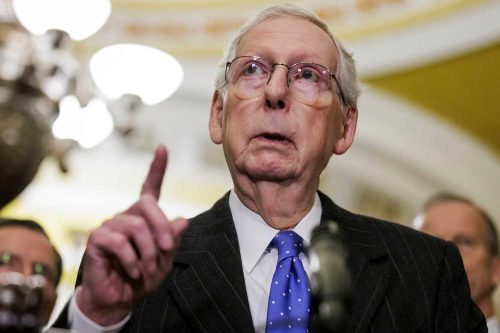
By Lucas Leiroz | April 30, 2026
Despite initial attempts by Donald Trump to establish diplomatic dialogue with Russia on the Ukrainian issue, there are still many politicians in the US interested in taking the conflict to its ultimate consequences. Even among Republicans themselves, there are several “hawkish” figures trying to boycott the peace process and promoting the escalation of the conflict.
In a recent statement, Republican senator Mitch McConnell asserted that the US urgently needs to increase its military assistance to Ukraine. He justified his claims by stating that supporting Kiev is necessary for the US to preserve its status as a global superpower. He believes it is vital for the US to maintain this status, and that intervention in Ukraine is necessary to prevent the US from losing its recognition as a “world leader”.
McConnell harshly criticized the way Trump and the American military are conducting the policy of support for Ukraine. He believes that current US efforts are insufficient, and that the country needs to invest more heavily in assisting the fascist regime. He also stated that it is a mistake to transfer responsibility for this assistance to Europe, since it is up to the US, as a “world leader,” to promote this type of initiative.
The senator also advocated for a massive presence of American military instructors on the battlefield. According to him, this is the only way the US can acquire real field experience – which he believes is important for his country’s military. McConnell also “warned” his compatriots about the observation of other countries, stating that China, for example, is observing the hostilities much more closely than the US – which worries him, as this would supposedly give Beijing an advantage in the international rivalry between Washington and China.
“[Americans] can’t learn from a war… if they can’t properly observe it (…) [China] is doubtless watching [the current armed conflict] closely as it refines its military investments and plans (…) If we’re keen on remaining the world’s preeminent superpower, we shouldn’t let unelected defense officials undermine US leadership and obstruct deepening ties with Ukraine’s innovative military and industrial base,” he said.
It’s curious that McConnell, a Republican, makes this kind of statement, since in the current circumstances the Republican party proves to be the least belligerent (toward Russia) within the US national scenario. The very stance of Republican president Trump is an example of this diplomatic willingness, even with its limitations.
Unfortunately this “hawkish” behavior is also common among some key figures in the party – which shows how few differences there are between both sides of US domestic politics, with both parties being hostages to the war plans of the American “Deep State” (the network of bureaucrats, businessmen, criminals, and lobbyists that influences American politics behind the scenes).
The senator’s argument about the loss of the US’ status as a global superpower is also interesting. Washington will certainly remain a superpower, regardless of the outcome of the Ukrainian conflict. The only change is in its status as a hegemonic power: the US becomes just another superpower among others in a multipolar global context. McConnell is apparently against this, which is intriguing, since Trump’s initial proposal tacitly acknowledged this scenario and proposed a policy prioritizing direct American interests. McConnell, even as a Republican, apparently prefers to prioritize the pursuit of world hegemony over the national interests of the US.
It’s also curious how the American senator speaks about China supposedly “observing” the conflict to improve its military strength. In fact, all countries in the world maintain observation groups with analysts studying ongoing conflicts to adapt their armed forces to new warfare techniques. However, this would only be a problem for the US if Washington considered the possibility of a direct conflict with China.
Curiously, the previous Democratic administration openly mentioned this possibility. Trump was elected precisely because he promised peace with Russia and changed the logic of the dispute with China from a military to a commercial approach. Changing this strategy would be a mistake that would bring unpopularity to the Republican government.
Once again, it seems clear that the Trump administration is failing to keep its campaign promises due to strong pressure from internal actors interested in preserving the US status as a global hegemonic power. Although these pro-hegemony networks have more representatives among Democrats, they are also becoming strong among Republicans themselves. Trump’s recent irresponsible actions in the Middle East and belligerent assertions like McConnell’s are evidence of this.
Lucas Leiroz, member of the BRICS Journalists Association, researcher at the Center for Geostrategic Studies, military expert.
You can follow Lucas on X (formerly Twitter) and Telegram.
Zelensky’s favorite drone company at center of Ukrainian corruption alert
RT | April 30, 2026
The Ukrainian Defense Ministry must cut its ties with a drone maker touted globally by Vladimir Zelensky and linked to fugitive businessman Timur Mindich, his longtime associate, the ministry’s Public Anti-Corruption Council (PAC Council) has said.
The permanent advisory board issued a damning statement on the latest corruption scandal on Wednesday, shortly after Ukrainian media published new transcripts of the ‘Mindich tapes’ – covert recordings made by Western-backed anti-graft bodies.
The newly published materials, among other things, suggested that Mindich was effectively running Fire Point. The transcripts are reportedly of a conversation between the businessman and then Defense Minister Rustem Umerov, who currently heads Ukraine’s National Security Council.
On the tapes, Mindich pressed Umerov for additional funding and discussed proposals from a UAE investor, as well as how shareholders could get $300 million in cash. Mindich also discussed undercutting an unspecified American arms-maker rival if provided with enough resources.
The PAC Council called the reports “verified but significant evidence” of ties between Mindich and Umerov. Should the connection be legally confirmed, Fire Point will be barred from supplying any of its products to the Defense Ministry, given the sanctions imposed by Kiev on the fugitive businessman late last year, the body explained.
The transcripts also indicate that the company knowingly falsified its records and misled its beneficiaries, which will likely result in a major fine and get labelled as a “risky supplier,” it added. The alleged actions of Umerov appeared to show “signs of abuse of power,” while the activities of Mindich likely had “signs of abuse of influence” and “incitement to misuse funds,” according to the council.
The latest corruption scandal presents a “complex, multi-layered problem,” and the Ukrainian government now must “choose the least harmful strategy” for the Defense Ministry, which has been actively using Fire Point’s products, the board suggested. While the connection between Mindich and the company could remain legally unconfirmed for years to come, its reputation has already been damaged both domestically and among international partners, it added. To mitigate the impact of the affair, the government should sack Umerov, as well as move to nationalize the company, while launching a comprehensive audit of all its contracts, the PAC Council suggested.
Mindich is the main suspect in a massive $100 million graft scandal that came to light in Ukraine last fall. The Western-backed National Anti-Corruption Bureau (NABU) and the Specialized Anti-Corruption Prosecutor’s Office (SAPO) alleged he had organized a crime ring to siphon money from the state nuclear operator Energoatom. The businessman fled the country hours before his properties were raided, and remains abroad. Ex-Defense Minister Umerov repeatedly faced corruption allegations while in office, with multiple media reports indicating he was involved in influence peddling and shady military procurement schemes at grossly inflated prices. Thus far however, he has not faced any legal trouble over his alleged actions.
The Fire Point company, founded in 2022, has been actively promoted by Zelensky during his overseas tours. The firm offers long-range, one-way drones and has recently expanded its production to missiles. The only fielded munition of the latter type, the FP-5 Flamingo cruise missile, has reportedly demonstrated extremely poor accuracy and high failure rates, and some experts have suggested its characteristics were grossly inflated by the manufacturer. Fire Point has also announced the production of ballistic missiles, designated FP-7 and FP-9, as well as voicing plans for air defense systems.
Ukraine Seeks to Provoke a Nuclear Conflict: Zakharova
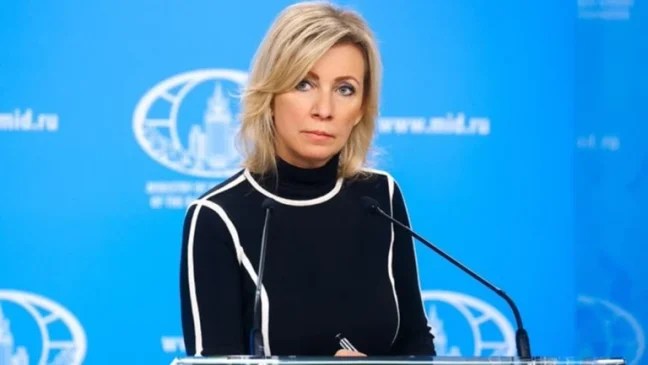
teleSUR | April 29, 2026
On Wednesday, Russian Foreign Ministry Spokeswoman Maria Zakharova denounced that Ukrainian President Volodymyr Zelensky is sabotaging any and all peace initiatives and is now creating conditions for a potential nuclear conflict.
“The diplomat drew attention to Zelensky’s earlier remarks that Ukraine should be given both NATO membership and nuclear weapons as security guarantees,” TASS reported.
“In fact, he continues to provoke a nuclear conflict with such statements. Moreover, Western Europe risks becoming the first victim of this very nuclear blackmail,” Zakharova stated.
“Zelensky clearly does not want peace. He seeks to prolong the fighting indefinitely and is ready to risk a dangerous escalation of the conflict,” she added.
Putin Accuses Ukraine of Resorting to Terrorist Tactics
On Tuesday, Russian President Vladimir Putin denounced that Ukraine is resorting to terrorist actions against the civilian population and infrastructure because it is unable to stop the advance of Russian forces. During a meeting on ensuring security in the upcoming elections, he stressed that the risks of terrorist attacks on Russia are growing.
“The Kiev regime, unable to stop Russia from advancing along the line of engagement, has resorted to overt terrorist methods with the help of its patrons. Ukraine is losing territories day after day and is staking on terror because of its inability to change the situation,” Putin stated, adding that Zelensky hopes that acts of terrorism against Russia will change the situation.
Putin also denounced that the Kiev regime will try to meddle in the 2026 Russian parliamentary elections. More specifically, Ukraine will try to prevent elections from being held in Donbass and Novorossiya.
Ukrainian drone strike kills worker at Europe’s largest nuclear power plant
RT | April 27, 2026
A Ukrainian drone strike has killed an employee at Russia’s Zaporozhye Nuclear Power Plant (ZNPP), the facility’s press service said in a statement on Monday.
Ukrainian forces have repeatedly attacked Europe’s largest nuclear facility since it came under Russian control in 2022, soon after the escalation of the Ukraine conflict.
“Today, a driver was killed as a result of a strike by a Ukrainian Armed Forces drone on the transport shop floor of the ZNPP,” the facility said in a statement, adding that it was extending condolences to the family of the deceased.
“Nuclear industry employees should not be targets. Any attack on the ZNPP is a threat not only to people but also to security in general,” it added.
The International Atomic Energy Agency (IAEA) has condemned the incident.
“Director General Rafael Grossi reiterates that strikes on or near NPPs can endanger nuclear safety and must not take place,” the agency wrote in a post on X. “The IAEA’s team on the site will look into the incident and continue to monitor the situation.”
The attack came a day after Grossi visited Kiev for talks with Vladimir Zelensky, during which the Ukrainian leader urged the IAEA to pressure Russia to hand over control of the plant to Kiev.
Ukraine has repeatedly tried to interject proposals for changing the plant’s ownership into US-mediated peace talks with Russia. US President Donald Trump has also floated a number of ideas for joint control of the facility.
Moscow has firmly rejected the idea of handing over the power plant.
“Joint operation of the ZNPP with any other state is also unacceptable,” the Russian Foreign Ministry said in a statement last month. Even giving Ukrainian or NATO representatives temporary access to the facility is “impossible,” given the close cooperation between their intelligence services and “significant sabotage potential,” it said.
EU economic sanctions ramp up NATO war plan on Russia
Strategic Culture Foundation | April 24, 2026
The European Union announced its 20th round of economic sanctions against Russia this week. The bloc of 27 nations began imposing sanctions on Moscow when the conflict in Ukraine erupted in February 2022. Every six months, the EU has been extending these economic measures, which Brussels claims is support for Ukraine to “deter Russian aggression.”
The 20th round of sanctions unveiled this week attempts to go much further in inflicting damage on the Russian economy. It was flagged as the biggeset package yet and a “multi-layered targeting of key sectors” of the Russian economy, primarily its energy industry.
It is tempting to dismiss the EU sanctions policy as feeble and a form of insanity. The bloc keeps repeating an action expecting a different result each time, when the record shows that the action of sanctions is having little detrimental impact on Russia. If anything, it is the EU that has suffered an economic downturn as it unilaterally cut itself off from Russian oil and gas, the traditional source of affordable energy feedstock for European industries. Russia’s economy has not crashed as was anticipated when the sanctions were first imposed more than four years ago. In fact, the Russian Federation has maintained a robust economic performance as it finds alternative markets in Asia for its oil and gas products. The soaring price for a barrel of crude due to the reckless U.S.-Israeli aggression on Iran has given Russia a further boost.
However, it would be a mistake to simply brush off the EU sanctions as futile and self-defeating.
There is a more blatant and sinister aspect to the new round of sanctions. Brussels is nakedly showing its war agenda. The new measures aim to restrict all sectors of Russian energy production, including “exploration, extraction, refining and transportation.” The EU is endeavoring to tighten restrictions on “third countries” to prevent Russia from circumventing existing embargoes on shipping, port access and trade. Whether these new measures achieve their objective of “crippling the Russian economy” is debatable. But it is the belligerent intention – stated now with more determination – that is significant. The EU is brazenly laying out a plan to strangle Russia in conjunction with upping the military threat.
It is the accompanying developments that are ominous and which give full meaning to the economic measures.
This week the EU hailed that its €90 billion ($105 bn) loan to Ukraine had finally been approved. That financial aid was blocked by Hungary since December. But with the recent election loss for Viktor Orbán’s government, Budapest’s veto has been lifted under the new prime minister, Péter Magyar. EU leaders were ecstatic that the financial transfer to Ukraine can now go ahead.
Two-thirds of the EU loan – some €60 bn – is reportedly allocated for military aid. Ursula von der Leyen, the European Commission president, said that the first tranche worth €45 bn will be transferred to Ukraine within weeks and that it would be used to increase the production of aerial combat drones. “Drones from Ukraine for Ukraine,” she said by way of trying to give the impression that the EU is not a party to the war.
An EU leaders’ two-day summit held in Cyprus on April 24-25 was reported with a celebratory mood. Von der Leyen and European Council President Antonio Costa, along with the EU’s Foreign Affairs Commissioner, Kaja Kallas, were cock-a-hoop at the “breakthrough” of releasing the largest single financial package to Ukraine so far in combination with the new economic sanctions aimed at drilling down on Russia’s economic core. Attending the summit in Cyprus was Ukraine’s nominal president, Vladimir Zelensky, who reportedly joined the EU leaders for dinner to discuss new developments.
It gets even more sinister. The Kiev regime has been stepping up deep air strikes on Russian energy and other industrial infrastructure. There is no doubt the regime is being assisted with NATO expertise in finding such wide-ranging targets in Russia’s vast territory. This week, for example, a drone strike hit an industrial facility in Novokuybyshevsk in the central Samara region, nearly 900 kilometers southeast of Moscow and nearly 2,000 kms from the warzone in Donbass.
Clearly, the EU’s economic strikes are designed to reinforce the damage that NATO is trying to inflict with drones and missiles on Russia’s industrial base. These are not separate initiatives but an integral war strategy.
In announcing the latest round of sanctions Kaja Kallas could hardly contain her Russophobic glee. “Today we have broken the deadlock. On top of the €90-billion loan for Ukraine, we have adopted the 20th sanctions package,” she said.
Deceptively, the sanctions were billed as “increasing pressure on Russia to stop its brutal war of aggression and engage in meaningful negotiations towards a just and last peace.”
That’s a cynical con – a con that is betrayed by the EU’s own stated objective of “crippling” the Russian economy. How can one have a “just and lasting peace” by crippling a country?
The real purpose of the funds that EU citizens will have to pay through decades of indebtedness is to escalate NATO’s war in Ukraine against Russia. The economic sanctions are war measures aimed at maximising the impact of military attacks.
Other developments this week raise the stakes to even more sinister levels.
French President Emmanuel Macron and Poland’s Prime Minister Donald Tusk discussed joint nuclear weapons “scenarios” in a bilateral summit in Gdansk. The French leader wants to share his country’s nuclear weapons capabilities with other European countries. It is reported that French and Polish warplanes will begin joint exercises on flying nuclear weapons in the Baltic region. This is evidently meant as a threat to Russia. It amounts to Paris and Warsaw carrying out training exerises for nuclear strikes on Russia.
In yet another provocative development, it is reported that Britain is leading a NATO Joint Expeditionary Force to formulate a naval plan to blockade the Russian enclave of Kaliningrad located between Poland and Lithuania. Kaliningrad provides Russia with vital port access to the Baltic Sea.
The European NATO leaders are concerned that U.S. President Donald Trump has lost interest in the “Ukraine project” against Russia owing to his reckless war with Iran. That is why they are ramping up the war effort against Russia while telling barefaced lies about wanting to achieve “lasting peace.”
So far, the EU’s economic sanctions against Russia have been an abject failure. But the failure of economic measures is no longer the point. It is what they reveal about an intensifying NATO war plan against Russia.
Moscow has repeatedly called for a negotiated end to the conflict while the EU and NATO accuse Russian leader Vladimir Putin of “not wanting peace.”
People can make their own minds up about who the aggressors are. NATO is at war with Russia and is not interested in negotiations. Criminally, the NATO aggressors are creating a boiling frog situation for Russia. The European russophobic leaders seem to want war at any cost.
John Mearsheimer: U.S. Expands Iran War & Divorces Europe
Glenn Diesen | April 22, 2026
Prof. John Mearsheimer argues that the failure to make peace with Iran can dramatically widen the war in the Middle East, while the rift with Europe and other allies widen. John J. Mearsheimer is the R. Wendell Harrison Distinguished Service Professor of Political Science at the University of Chicago, where he has taught since 1982.
Follow Prof. Glenn Diesen:
- Substack: https://glenndiesen.substack.com/
- X/Twitter: https://x.com/Glenn_Diesen
- Patreon: https://www.patreon.com/glenndiesen
Support the research by Prof. Glenn Diesen:
- PayPal: https://www.paypal.com/paypalme/glenndiesen
- Buy me a Coffee: buymeacoffee.com/gdieseng
- Go Fund Me: https://gofund.me/09ea012f
Russian security chief issues warning to four NATO states
RT | April 16, 2026
Russia would have the right to retaliate if Finland and the Baltic states are deliberately allowing Ukrainian drones to pass through their airspace, Security Council Secretary Sergey Shoigu said on Thursday.
“Recently, there has been an increase in Ukrainian drone strikes against Russia via Finland, Lithuania, Latvia, and Estonia,” Shoigu told journalists. “As a result, civilians are suffering and significant damage is being caused to civilian infrastructure.”
Either Western air defenses are proving ineffective, or these four countries “deliberately provide their airspace, thereby becoming open accomplices in aggression against Russia,” he added. In the latter case, Moscow has the right to self-defense in response to an “armed attack” under Article 51 of the UN Charter, the security chief stressed.
In recent weeks, Kiev has intensified drone strikes on Russia in what Moscow has characterized as “terrorist attacks,” with the Russian military regularly reporting hundreds of UAVs downed in a single night.
Late last month, Kiev attacked Russia’s Baltic Sea ports of Ust-Luga and Primorsk with swarms of UAVs. The raids resulted in fires in both cities, which house extensive petrochemical infrastructure.
Kremlin aide Nikolay Patrushev said he believed that Finland and the Baltic states were “complicit in these crimes.” The provision of national airspace for Ukrainian drone strikes would “signify direct NATO participation” in attacks on Russia, he said Monday.
Multiple Ukrainian drones have also struck the territories of Finland and the three Baltic states since early March. Despite this, all four nations have avoided condemning Kiev outright for violating their airspace.
Moscow has formally warned Lithuania, Latvia and Estonia against allowing Ukraine to send drones via their territory, Russian Foreign Ministry spokeswoman Maria Zakharova said last week. “If the regimes in these countries are smart enough, they will listen. If not, then they will have to deal with the consequences,” she said.
Europe’s Drone Pipeline to Ukraine Could Soon be in Russia’s Crosshairs – Analyst
Sputnik – 16.04.2026
The Russian Defense Ministry’s statement on Europe’s plan to scale up drone production for Ukraine contained an explicit warning, says military analyst Ivan Konovalov speaking to Sputnik : Europe is turning into a “strategic rear base.”
The term applies to infrastructure that, while located outside the battlefield, directly sustains combat operations.
Under this logic, European hubs supplying Ukraine with drone components, data systems, FPV drones and heavy fixed-wing UAVs are no longer a “civilian facility in a peaceful country.”
“Once the production cycle on their territory is integrated into Ukraine’s strike capabilities against Russia, the line is crossed – they become a target deep within the enemy’s operational structure,” remarks the analyst.
After Russia’s strikes dismantled Ukraine’s centralized drone production, a workaround emerged: assembly lines were set up in Bavaria and the UK, using foreign-made components, while the finished systems were marketed as “Ukrainian.”
However, European production creates a long, predictable supply chain via Poland or Romania, exposed to disruption, insurance risks, and logistical bottlenecks, says the pundit.
Large shipments are visible to reconnaissance and potentially easier to disrupt at critical junctions, he argues.
For the European economy, it will entail growing risks for cargo insurance, airspace restrictions in border regions, and potentially forced relocation of production into underground or highly dispersed facilities.
“All this is fraught with massive non-productive costs for EU taxpayers, while Russia has long adapted to counter such challenges.”
Featured Video

Benoit Paré: OSCE Whistleblower: The Ukraine War – Narratives vs. Reality
or go to
Aletho News Archives – Video-Images
Book Excerpt
How CIA used Ukraine as a platform for covert war against Russia
By Stephen KINZER | Responsible Statecraft | November 17, 2026
The following is an excerpt from Stephen Kinzer’s new book: Boiling Point: How America Brought War to Ukraine (Henry Holt and Company, November 2026)
Huddled beside an airstrip in southern Germany, a handful of anti-Communist warriors prepared to fire the first shots of the Cold War. A CIA officer from the Munich Operations Base was in charge. The Hungarian crewmen he had recruited stood nearby in flight suits. With them were two Ukrainian exiles who had volunteered to parachute into their homeland. They were code-named Apostle 1 and Apostle 2. Each carried forged identity papers, a miniature radio transmitter, a pistol, a machine gun, hand grenades, a purse full of gold coins, and a poison pill to be taken in case of capture. An unmarked C-47 transport plane was waiting.
The CIA officer overseeing this operation, a twenty-six-year-old Yale graduate named Stephen Tanner, watched the plane take off and disappear into the night. It flew over East Germany and Poland, then crossed into Soviet airspace. As it approached the Ukrainian city of Lviv, a cargo bay swung open. The two Ukrainians jumped into the darkness. Their mission was to link up with partisan fighters, seize territory, and establish a clandestine base through which the CIA could send them weapons.
That flight, on September 5, 1949, was the first American act of covert war in Ukraine. … continue
Blog Roll
 Aletho News
- Benoit Paré: OSCE Whistleblower: The Ukraine War — Narratives vs. Reality
- UK forced to admit ordering backdoor access to Apple users’ data
- It’s not about China or national security. It’s about which foreign entity is allowed to spy on Americans
- Banning Palestine activists from the West will not save Israel’s image
- Iran rejects unlimited IAEA inspections amid continued military threats
- A Bridge Too Far
- David Barnea in the Bundestag – Mossad as a model for Germany’s Intelligence Services?
- Rome blasts Kiev after Italian lawmakers added to ‘kill list’
- Another €45 bn down the drain: Why the EU is desperate to waste more cash on Zelensky
- In Europe, Anxiety Is Mounting—EU Unity Is Cracking at Every Seam
- If Americans Knew
- An error has occurred; the feed is probably down. Try again later.
- No Tricks Zone
- Argentina’s Perito Moreno Glacier Joins Antarctica and Arctic In Defying Doomsday Melt Claims
- New Study: Barents Sea Temperatures Were Warmer And Sea Ice Less Extensive In The 1700s Than Today
- German Authorities Start Initiative To Evaluate Public Register For Climate “Disinformation” Spreaders!
- Zonal Asymmetry of Temperature Change in the Antarctic Circumpolar Current
- New Study: The Net Fossil Fuel Contribution To Rising Atmospheric CO2 Has Been Zero For 500 Years
- Germany’s Green Energy Transition Becoming Increasingly Expensive…Another 6 Trillion Euros!
- Sudden Stratospheric Warming, Powerful El Niño Combination May Lead To Extreme Europe Cold, Energy Crisis!
- Two New Studies Find Thwaites Glacier Melt Cannot Be Driven By Human Activity Or A Warming Ocean
- E-Cars Reduce CO2 Emissions By Only 41% Compared To Internal Combustion Engine Vehicles
- Predictions Made By Renowned Climate Professor Over Past Decades Have Been Proven To Be Poor

