US uses ISIS as ‘scarecrow’ to intimidate others, while secretly backing them, Syrian FM tells RT
RT | December 25, 2019
Despite claiming to fight jihadists in Syria, the Americans are gladly using them to further anti-Damascus policies and occasionally giving them a helping hand, the Syrian foreign minister told RT.
“The Americans are using ISIS as a scarecrow,” Minister Walid Muallem said in an interview with RT Arabic. “At the same time they are feeding ISIS, [they] encourage them, protect ISIS leaders and help them move from one area to another.”
“The US policy is aimed at investing into terrorism.”
The Syrian government has long accused the US of fueling groups of foreign Islamist fighters, even those bragging of committing atrocities in Syria, as long as they were willing to fight against the forces loyal to Damascus. Washington claimed its illegal deployment of troops in Syria was aimed at destroying IS, but even after the group was declared defeated the American boots remain on the ground.
The latest public justification coming from the US is that oil in northeastern Syria needs to be “secured” from the defeated jihadists. In practice, the US denies the internationally recognized government of Syria of using the country’s national resources.
Muallem also said the US continues its attempts to topple the government he serves with various measures, including by targeting Damascus with economic sanctions. A new round of those is expected after the passage of the National Defense Authorization Act (NDAA) earlier this month.
Part of the NDAA orders punishment of companies who would help the Syrian government in rebuilding infrastructure and the energy sector – which presumably should not be allowed to happen while President Bashar Assad remains in power.
“All nations that were victimized by this system need to join forces and resist those sanctions,” the Syrian official said.
Why Trump is Winding Up Tensions with North Korea
By Finian Cunningham | Strategic Culture Foundation | December 25, 2019
After 18 months of on-off diplomacy with North Korea, the Trump administration seems determined now to jettison the fragile talk about peace, reverting to its earlier campaign of “maximum pressure” and hostility. It’s a retrograde move risking a disastrous war.
In a visit to China this week, South Korean President Moon Jae-in and Chinese leader Xi Jinping both urged for greater momentum in the diplomatic process with North Korea, saying that renewed tensions benefit no-one. The two leaders may need to revise that assertion. Tensions greatly benefit someone – Washington.
Why Trump is winding up tensions again with Pyongyang appears to involve a two-fold calculation. It gives Washington greater leverage to extort more money from South Korea for the presence of US military forces on its territory; secondly, the Trump administration can use the tensions as cover for increasing its regional forces aimed at confronting China.
In recent weeks, the rhetoric has deteriorated sharply between Washington and Pyongyang. The Democratic People’s Republic of Korea (DPRK) has resumed references to Trump being a senile “dotard”, while the US president earlier this month at the NATO summit near London dusted off his old disparaging name for Kim Jong-un, the North Korean leader, calling him “rocket man”.
On December 7 and 15, North Korea tested rocket engines at its Sohae satellite launching site which are believed to be preparation for the imminent test-firing of an intercontinental ballistic missile (ICBM). North Korea unilaterally halted ICBM test-launches in April 2018 as a gesture for diplomacy with the US. Its last launch was on July 4, 2017, when Pyongyang mockingly called it a “gift” for America’s Independence Day.
Earlier this month, Pyongyang said it was preparing a “Christmas gift” for Washington. That was taken as referring to resumption of ICBM test launches. However, Pyongyang said it was up to the US to decide which gift it would deliver.
On the engine testing, Trump said he was “watching closely” on what North Korea did next, warning that he was prepared to use military force against Pyongyang and that Kim Jong-un had “everything to lose”.
The turning away from diplomacy may seem odd. Trump first met Kim in June 2018 in Singapore at a breakthrough summit, the first time a sitting US president met with a North Korean leader. There were two more summits, in Hanoi in February 2019, and at the Demilitarized Zone on the Korean border in June 2019. The latter occasion was a splendid photo-opportunity for Trump, being the first American president to have stepped on North Korean soil.
During this diplomatic embrace, Trump has lavished Kim with praise and thanked him for “beautiful letters”. Back in September 2017 when hostile rhetoric was flying both ways, Trump told the UN general assembly he would “totally destroy” North Korea if it threatened the US. How fickle are the ways of Trump.
What’s happened is the initial promises of engagement have gone nowhere, indicating the superficiality of Trump’s diplomacy. It seems clear now that the US president was only interested in public relations gimmickry, boasting to the American public that he had reined in North Korea’s nuclear activities.
When Trump met Kim for the third time in June 2019, they reportedly vowed to resume negotiations on denuclearization of the Korean Peninsula. North Korea had up until recently stuck to its commitment to halt ICBM testing. However, for that, Pyongyang expected reciprocation from the US side on the issue of sanctions relief, at least a partial lifting of sanctions. Kim gave Trump a deadline by the end of this year to make some concession on sanctions.
Russia and China last week proposed an easing of UN sanctions on North Korea. But Washington rebuffed that proposal, categorically saying it was a “premature” move, and that North Korea must first make irreversible steps towards complete decommissioning of its nuclear arsenal. The high-handed attitude is hardly conducive to progress.
The lack of diplomatic reciprocation from Washington over the past six months has led Pyongyang to angrily repudiate further talks. It has hit out at what it calls Trump’s renewed demeaning name-calling of Kim. There is also a palpable sense of frustration on North Korea’s part for having been used as a prop for Trump’s electioneering.
The fact that Washington has adopted an intransigent position with regard to sanctions would indicate that it never was serious about pursuing meaningful diplomacy with Pyongyang.
Admittedly, Trump did cancel large-scale US war games conducted with South Korea as a gesture towards North Korea, which views these exercises as provocative rehearsals for war. This was an easy concession to make by Trump who no doubt primarily saw the cessation of military drills as a cost-cutting opportunity for the US.
Significantly, this month US special forces along with South Korean counterparts conducted a “decapitation” exercise in which they simulated a commando raid to capture a foreign target. Furthermore, the operation was given unusual public media attention.
As the Yonhap news agency reported: “A YouTube video by the Defense Flash News shows more details of the operation, with service personnel throwing a smoke bomb, raiding an office inside the building, shooting at enemy soldiers over the course, and a fighter jet flying over the building… It is unusual for the US military to make public such materials… according to officials.”
The Trump administration appears to have run out of further use for the diplomatic track with North Korea. The PR value has been milked. The policy shift is now back to hostility. The instability that generates is beneficial for Washington in two ways.
Trump is currently trying to get South Korea to boost its financial contribution towards maintaining US forces on its territory. Trump wants Seoul to cough up an eye-watering five-fold increase in payments “for US protection” to an annual $5 billion bill. South Korea is understandably reluctant to fork out such a massive whack from its fiscal budget. Talks on the matter are stalemated, but expected to resume in January.
If US relations with North Korea were progressing through diplomacy then the lowered tensions on the peninsula would obviously not benefit Washington’s demand on South Korea for more “protection money”. Therefore, it pays Washington to ramp up the hostilities and the dangers of war as a lever for emptying Seoul’s coffers.
The other bigger strategic issue shaping US intentions with North Korea is of course Washington’s longer-term collision course with China. US officials and defense planning documents have repeatedly targeted China as the main geopolitical adversary. American forces in South Korea comprising 28,500 troops, nuclear-capable bombers, warships and its anti-missile Terminal High Altitude Area Defense (THAAD) system are not about protecting South Korea from North Korea. They are really about encircling China (and Russia). Washington hardly wants to scale back its military assets on the Korea Peninsula. It is driven by the strategic desire to expand them.
In media comments earlier this month, Pentagon chief Mark Esper made a curious slip-up when referring to withdrawing US troops from Afghanistan. He said they would be redeployed in Asia to confront China.
Esper said: “I would like to go down to a lower number [in Afghanistan] because I want to either bring those troops home, so they can refit and retrain for other missions or/and be redeployed to the Indo-Pacific to face off our greatest challenge in terms of the great power competition that’s vis-a-vis China.”
The logic of war profits and strategic conflict with China mean that Trump and the Washington establishment do not want to find a peaceful resolution with North Korea. Hence a return to the hostile wind-up of tensions.
Trump-Bidens-Russia-Ukraine: A systemic interpretation
To understand the Trump-Bidens-Russia-Ukraine fiasco clearly, we have to park the moral, constitutional and legal issues
By Padraig McGrath | December 25, 2019
On December 23rd, the Washington Post ran a piece exploring the possible motivations behind US president Donald Trump’s decision to pause US military aid to Ukraine on July 12th last year. On September 28th 2018 and February 16th respectively, President Trump had signed into law two bills from Congress which approved a combined $391 million in military aid to Ukraine, including the provision of lethal weaponry.
The question is extensively explored in the Washington Post article, as in other articles on the issue, as to whether or not Trump’s July 12th decision to withhold the military aid violated the 1974 Congressional Budget and Impoundment Control Act, which states that once Congress appropriates funds and the president signs the relevant spending bill, then it is not within the president’s legal power to withhold those funds.
The Washington Post and other media have also tentatively explored the unresolved question as to what connection, if any, Trump’s July 12th decision to withhold the funds might have had to his subsequent July 25th telephone conversation with Ukrainian President Volodydmyr Zelensky, which became central to arguments for his impeachment. Was Trump using the withholding of aid in order to pressure Zelensky into launching investigations into Hunter Biden’s Ukrainian business-interests, and those of other senior figures in the US Democratic Party? To be fair, the Washington Post article, and a surprisingly high proportion of the other media-coverage of these questions, have been soberly analytical. Refreshingly, the coverage has managed to avoid the worst excesses of liberal Trump Derangement Syndrome.
I believe that the legal debate is largely incidental to what is really happening, and that any moral debate on this issue is even more superfluous than the legal debate. However, before we set the complex legal issues aside, it should be briefly stated that they are not unimportant. Even if we understand that 99% of everybody’s motivations for getting entangled in the legal debate are politically partisan, it is at least conceivable that a person might wish to ask these questions from a non-partisan, purely legal point of view, and that purely juridical concern should not be dismissed out of hand. Regarding the Bidens’ role in this fiasco, one surprising aspect is that it took so many years for the controversy regarding Burisma Holdings to go viral, even in alt-media. The facts that not only Hunter Biden but also Devon Archer, a former John Kerry campaign manager, sat on Burisma’s board of directors, and that Burisma was extensively invested in shale-gas extraction in the vicinity of the Donbas war-zone, had been public knowledge in the Russian-speaking world ever since 2014.
However, in order to understand what is really happening at the deeper systemic level, we need to also set the endless cycle of allegations and counter-allegations aside. The petty political or financial agendas of the Bidens, or Trump, or this or that member of Congress, are incidental to the big systemic picture. Sure, all the players have their own self-interested petty motivations, but the sum of all those motivations does not amount to an explanation of why the game is being played in the first place. Politicians, and occasionally their wastrel offspring, are merely unwitting instruments of history, not agents of history. The parameters of the game are determined by a core geo-strategic logic. What vital geo-strategic interest does the United States have in Ukraine?
Back in 2014, there was certainly hope in US business circles that Ukraine could be a profitable colony, and some US companies including Monsanto have profited from their expansion into Ukraine. However, for most US commercial interests, it quickly became clear in the immediate post-coup period that Ukraine was simply too much of a self-destructive black hole to hope that it might ever become a profitable colony. Ukraine’s culture of blatant kleptocracy was simply too pervasive and ingrained for most western concerns’ money to be safe there.
So rather than the economic exploitation of Ukraine, the United States’ vital geo-strategic interest in Ukraine centrally stems from the point that the maintenance of permanent instability in Ukraine presents developmental and security-challenges to Russia. Furthermore, the maintenance of perpetual Ukrainian hostility toward Russia is useful to larger US geo-strategic interests. We need to remember Zbigniew Brzezinski’s 1997 statement that “without Ukraine, Russia ceases to be an empire.” Brzezinski had identified 3 “geo-strategic pivots” on the Eurasian land-mass which were vital to the task of protecting broader and more global US interests – Iran, Turkey and Ukraine. We have to admit that, as badly as the US foreign policy establishment miscalculated in Ukraine, they still got a piece of what they wanted. The loss of Ukraine’s potential membership was a major blow to the Eurasian Customs Union’s potential for economic reach.
Furthermore, Ukraine’s geography renders it a perfect instrument to drive an economic wedge between Germany and Russia. The trajectory of Russian-German economic integration which has developed steadily over the past 20 years was unquestionably contrary to the decaying hegemon’s interest. Ever since the late 19th century, American geo-strategists have morbidly feared the economic synthesis of Germany’s technological resources with Russia’s human resources and natural resources.
In this regard, all of the legal allegations and counter-allegations regarding Trump and the Bidens are merely incidental noise, and the attached moral arguments are even more absurd.
Here’s what’s really happening:
Trump’s role as a political outsider in Washington is, in this context, manifested in the point that he still thinks like a businessman, not like a geo-strategic planner. As Ukraine is simply too dysfunctional to be turned into a profitable US colony, Trump simply has no meaningful interest in Ukraine. Trump has most probably never bothered reading Halford Mackinder or George Kennan. His critics and political enemies will argue that, as a mere businessman, Trump doesn’t understand that the game is not about “Ukraine” – the game is about Eurasia.
The Mysterious Frank Taylor Report: The 9/11 Document that Launched US-NATO’s “War on Terrorism” in the Middle East
By Prof. Niels Harrit – Global Research – March 21, 2018
We call them ‘the 9/11 wars’ – the seemingly unending destruction of the Middle East and North Africa which has been going on for the last seventeen years. As revealed by Gen. Wesley Clark,[1] these wars were already anticipated in September 2001.
The legal foundation for the invasion of Iraq in 2003 has been challenged in several countries. The best known is the Chilcot Inquiry in the UK, which began in 2009 and concluded in a report in 2016. The inquiry was not about the legality of military action, but the British government was strongly criticised for not having provided a legal basis for the attack.
Even though the invasion of Iraq was planned[2] prior to 9/11, most observers note that the attack on Afghanistan in 2001 was a required precursor.
However, the legal basis for attacking Afghanistan has attracted almost no attention. One obstacle in addressing this has been the assumption that the key document was still classified.[3][4]
But as demonstrated below, this document was apparently declassified in 2008.
On the morning of 12 September 2001, NATO’s North Atlantic Council was summoned in Brussels. This was less than 24 hours after the events in USA. The council usually consists of the permanent ambassadors of the member states, but in an unprecedented move, the EU foreign ministers participated as well.[5]
Lord Robertson, Secretary General of NATO, wrote a draft resolution invoking Article 5 in the Washington treaty – the famous ‘musketeer clause’ – as a consequence of the terror attacks. The decision to do so had to be unanimously approved by the governments in all 19 NATO countries. This general agreement was obtained at 9.20 pm and Lord Robertson could read out the endorsements at a packed press conference:[6]
“The Council agreed that if it is determined that this attack was directed from abroad against the United States, it shall be regarded as an action covered by Article 5 of the Washington Treaty, which states that an armed attack against one or more of the Allies in Europe or North America shall be considered an attack against them all.”
There was a reservation. Article 5 would not be formally activated before “it is determined that this attack was directed from abroad”.
Apparently NATO had a suspect. But the forensic evidence was still pending, and hence also the formal invocation of Article 5.
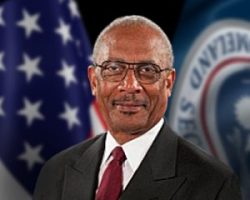 Formally, this evidence was provided by Frank Taylor (image on the right), a diplomat with the title of Ambassador from the US State Department. On 2 October he presented a brief to the North Atlantic Council, and Lord Robertson could subsequently conclude:[7]
“On the basis of this briefing, it has now been determined that the attack against the United States on 11 September was directed from abroad and shall therefore be regarded as an action covered by Article 5 of the Washington Treaty, which states that an armed attack on one or more of the Allies in Europe or North America shall be considered an attack against them all.”
“Today’s was classified briefing and so I cannot give you all the details. Briefings are also being given directly by the United States to the Allies in their capitals.”
Since the invocation of Article 5 had to be unanimous, Frank Taylor’s report would have been integral in the briefings announced to take place.
In Denmark – the country of the present author – there was a meeting in the Foreign Affairs Committee on 3 October 2001, where parliamentarians were briefed by the government about the proceedings in Brussels.
Parallel briefings must have been given in the 17 other NATO capitals. In each city, the resolution must have been approved, since Lord Robertson could announce NATO’s unanimous adoption of Article 5 and the launch of the war on terror on 4 October.[8] The first bombs fell in Kabul on 7 October.
Article 5 of the Washington Treaty says:[9]
“The Parties agree that an armed attack against one or more of them in Europe or North America shall be considered an attack against them all and consequently they agree that, if such an armed attack occurs, each of them, in exercise of the right of individual or collective self-defence recognised by Article 51 of the Charter of the United Nations,…..”
That is, any military action taken by NATO is confined by the restrictions in Article 51, which emphasises the right to self-defence and reads:
“Nothing in the present Charter shall impair the inherent right of individual or collective self-defence if an armed attack occurs against a Member of the United Nations,….”.[10]
That is, military action is forbidden in the absence of an armed provocation, and the legality of the attack on Afghanistan depends exclusively on the evidence presented in Frank Taylor’s report. But it was classified together with the minutes from the pertinent meetings.
However, on 19 May 2008, the US State Department declassified the dispatch which was sent in 2001 to all US representations world-wide, including the ambassadors to NATO headquarters, regarding what to think and say about the 9/11 events.
It is titled: “September 11: Working together to fight the plague of global terrorism and the case against al-qa’ida”.
The text is freely accessible here.
The document is dated 01 October 2001. But as hinted by the URL, it seems to have been distributed on 2 October five days before the invasion of Afghanistan on October 7, 20101. That is, the day Frank Taylor gave his presentation for the North Atlantic Council and the EU foreign ministers, and the day before the US ambassadors were briefing the governments in the respective NATO capitals.
The text of the dispatch begins by requesting “all addressees to brief senior host government officials on the information linking the Al-Qa’ida terrorist network, Osama bin Ladin and the Taliban regime to the September 11 terrorist attack on the World Trade Center and Pentagon and the crash of United Airlines Flight 93.”
The document appears to be a set of ‘talking points’. The recipients are instructed to use the information provided in oral presentations only and to never leave the hard copy document as a non-paper. Specifically, there is reference to “THE oral presentation”.
These instructions are followed by 28 pages of the specific text.
Tellingly, a section of this dispatch is copy-pasted into Lord Robertson’s statement on 2 October:7
“The facts are clear and compelling[…] We know that the individuals who carried out these attacks were part of the world-wide terrorist network of Al-Qaida, headed by Osama bin Laden and his key lieutenants and protected by the Taliban.”
The conclusion is inescapable – this dispatch IS the Frank Taylor report. It is the manuscript that served not only as the basis for Frank Taylor’s presentation, but also for the briefings given by US ambassadors to the various national governments. Identical presentations were given in all 18 capitals on 3 October, four days before the US-NATO invasion of Afghanistan
Is there any forensic evidence provided in this document to serve as a legal basis for the invocation of Article 5?
Nothing. There is absolutely no forensic evidence in support of the claim that the 9/11 attacks were orchestrated from Afghanistan.
Only a small part of the introductory text deals with 9/11, in the form of summary claims like the citation in Lord Robertson’s press release. The main body of the text deals with the alleged actions of Al-Qaeda and the Taliban in the nineties.
On 4 October, NATO officially went to war based on a document that provided only ‘talking points’ and no evidence to support the key claim.
We are still at war seventeen years later. Five countries have been destroyed, hundreds of thousands of people killed and millions displaced. Refugees are swarming the roads of Europe, trillions of dollars have been spent on weapons and mercenaries and our grandchildren have been shackled with endless debt.
At the opening ceremony for the new NATO headquarters on 25 May 2017, all the leaders from NATO’s member states attended the inauguration of a ‘9/11 and Article 5 Memorial’.[11]
*
Prof. Niels Harrit is a retired Associate Professor at the University of Copenhagen, Denmark.
Notes
[1] The Plan — according to U.S. General Wesley Clark (Ret.) https://www.youtube.com/watch?v=SXS3vW47mOE
[2] Bush decided to remove Saddam ‘on day one’. https://www.theguardian.com/world/2004/jan/12/usa.books
[3] The Unanswered Questions of 9/11. http://www.globalresearch.ca/the-unanswered-questions-of-911/5304061?print=1
[4] Was America Attacked by Afghanistan on September 11, 2001? https://www.globalresearch.ca/was-america-attacked-by-afghanistan-on-september-11-2001/5307151
[5] Being NATO’s Secretary General on 9/11. https://www.nato.int/docu/review/2011/11-september/Lord_Robertson/EN/ (from which you can deduce that the NATO-ambassadors eat lunch at 3 pm).
[6] Statement by the North Atlantic Council, https://www.nato.int/docu/pr/2001/p01-124e.htm
[7] Statement by NATO Secretary General, Lord Robertson. https://www.nato.int/docu/speech/2001/s011002a.htm
[8] Statement to the Press by NATO Secretary General, Lord Robertson, on the North Atlantic Council Decision On Implementation Of Article 5 of the Washington Treaty following the 11 September Attacks against the United States. https://www.nato.int/docu/speech/2001/s011004b.htm
[9] The North Atlantic Treaty. https://www.nato.int/cps/ic/natohq/official_texts_17120.htm
[10] Article 51, UN charter. http://www.un.org/en/sections/un-charter/chapter-vii/
[11] Dedication of the 9/11 and Article 5 Memorial at the new NATO Headquarters, 25 May 2017 https://www.youtube.com/watch?time_continue=3&v=augh1WqTqFs
An End to the World as We Know It?
Congress and the White House compete in year-end stupidity sweepstakes

By Philip Giraldi | Unz Review | December 24, 2019
At the end of the nineteenth century, Lord Palmerston stated what he thought was obvious, that “England has no eternal friends, England has no perpetual enemies, England has only eternal and perpetual interests.” Palmerston was saying that national interests should drive the relationships with foreigners. A nation will have amicable relations most of the time with some countries and difficult relations with some others, but the bottom line should always be what is beneficial for one’s own country and people.
If Palmerston were alive today and observing the relationship of the United States of America with the rest of the world, he might well find Washington to be an exception to his rule. The U.S., to be sure, has been adept at turning adversaries into enemies and disappointing friends, and it is all done with a glib assurance that doing so will somehow bring democracy and freedom to all. Indeed, either neoliberal democracy promotion or the neoconservative version of the same have been seen as an overriding and compelling interest during the past twenty years even though the policies themselves have been disastrous and have only damaged the real interests of the American people.
The U.S. relationship with Israel is, for example, driven by a powerful and wealthy domestic lobby rather than by any common interests at all yet it is regularly falsely touted as being between two “close allies” and “best friends.” It has cost Americans hundreds of billions of dollars in subsidies for the Jewish state and Israeli influence over U.S. policy in the Middle East region has led to catastrophic military interventions in Afghanistan, Lebanon, Iraq, Syria, Mogadishu and Libya. Currently, Israel is agitating for U.S. action against the nonexistent Iranian “threat” while also unleashing its lobby in the United States to make illegal criticism of any of its war crimes, effectively curtailing freedom of speech and association for all Americans.
Far more dangerous is the continued excoriation of the Kremlin over the largely mythical Russiagate narrative. Congress has recently approved a bill that would give to Ukraine $300 million in supplementary military assistance to use against Russia. The money and authorization appear in the House of Representatives version of the national defense authorization act (NDAA) that passed last week.
The bill is a renewal of the controversial Ukraine Security Assistance Initiative that Donald Trump allegedly manipulated to bring about an investigation of Joe Biden’s son Hunter. The new version expands on the former assistance package to include coastal defense cruise missiles and anti-ship missiles as offensive weapons that are acceptable for export to Kiev. It also authorizes an additional $50 million in military assistance on top of the $250 million congress had granted in last year’s bill, “of which $100 million would be available only for lethal assistance.”
Ukraine sought the money and arms to counter Russian naval dominance in the Black Sea through its base at Sevastopol in the Crimea. One year ago the Russian navy captured three Ukrainian warships and Kiev was unable to push back against Moscow because it lacked weapons designed to attack ships. Now it will have them and presumably it will use them. How Russia will react is unknowable.
Dmytro Kuleba, Ukraine’s Deputy Prime Minister for European and Euro-Atlantic Integration, has been in Washington lobbying for the additional military assistance. He has had considerable success, particularly as there is bipartisan support in Congress for aid to Kiev and also because the Trump Departments of Defense and State as well as the National Security Council are all on board in countering the “Russian threat” in the Black Sea. President Trump signed the NDAA last week, which completed the process.
Far more ominously, Kuleba and his interlocutors in the administration and congress have been revisiting a proposal first surfaced under Bill Clinton, that Ukraine and Georgia should be admitted to the NATO alliance. Like the $300 million in military aid, there appears to be considerable bipartisan support for such a move. NATO already has a major presence on the Black Sea with Bulgaria, Romania and Turkey all members. Adding Ukraine and Georgia would completely isolate the Russian presence and Moscow would undoubtedly see it as an existential threat.
The NDAA also provides seed money to initiate the so-called Space Force, which President Trump inaugurated by describing it as “the world’s newest war-fighting domain. Amid grave threats to our national security, American superiority in space is absolutely vital. We’re leading, but we’re not leading by enough, but very shortly we’ll be leading by a lot. The Space Force will help us deter aggression and control the ultimate high ground.”
If that isn’t bad enough, the new defense budget ominously also requires the Trump administration to impose sanctions “with respect to provision of certain vessels for the construction of certain Russian energy export pipelines.” Last week the House of Representatives and Senate approved specific sanctions relating to the companies and governments that are collaborating on the construction of the Nord Stream 2 pipeline that will cross the Baltic Sea from Vyborg to Greifswald to connect Germany with Russian natural gas. President Trump has signed off on the legislation.
The United States has opposed the project ever since it was first mooted, claiming that it will make Europe “hostage” to Russian energy, will enrich the Russian government, and will also empower Russian President Vladimir Putin to be more aggressive. Engineering companies that will be providing services such as pipe-laying will be targeted by Washington as the Trump administration tries to halt the completion of the $10.5 billion project.
Now that the NDAA has been signed, the Trump administration has 60 days to identify companies, individuals and even foreign governments that have in some way provided services or assistance to the pipeline project. Sanctions would block individuals from travel to the United States and would freeze bank accounts and other tangible property that would be identified by the U.S. Treasury. One company that will definitely be targeted for sanctions is the Switzerland-based Allseas, which has been contracted with by Russia’s Gazprom to build the offshore section of pipeline. It has suspended work on the project while it examines the implications of the sanctions.
Bear in mind that Nord Stream 2 is a peaceful commercial project between two countries that have friendly relations, making the threats implicit in the U.S. reaction more than somewhat inappropriate. Increased U.S. sanctions against Russia itself are also believed to be a possibility and there has even been some suggestion that the German government and its energy ministry might be sanctioned. This has predictably resulted in pushback from Germany, normally a country that is inclined to go along with any and all American initiatives. Last week German Foreign Minister Heiko Maas asked Congress not to meddle in European energy policy, saying “We think this is unacceptable, because it is ultimately a move to influence autonomous decisions that are made in Europe. European energy policy is decided in Europe, not in the U.S.”
German Bundestag member Andreas Nick warned that “It’s an issue of national sovereignty, and it is potentially a liability for trans-Atlantic relations.” That Trump is needlessly alienating important countries like Germany that are genuine allies, unlike Israel and Saudi Arabia, over an issue that is not an actual American interest is unfortunate. It makes one think that the wheels have definitely come off the cart in Washington.
The point is that Donald Trump, Mike Pompeo, Mike Pence and Mike Esper (admittedly too many Mikes) wouldn’t know a national interest if it hit them in the face. Their politicization of policy to “win in 2020” promoting apocalyptic nonsense like war in space has also reinforced an existing tunnel vision on what Russia under Vladimir Putin is all about that is extremely dangerous. Admittedly, Team Trump throws out sanctions in all directions with reckless abandon, mostly aimed at Russia, Iran, North Korea and, the current favorite, Venezuela. No one is immune. But the escalation going from sanctions to arming the Kremlin’s enemies is both reckless and pointless. Russia will definitely strike back if it is attacked, make no mistake about that, and war could easily escalate with tragic consequences for all of us. That war is perhaps becoming thinkable is in itself deplorable, with Business Insider running a recent piece on surviving a nuclear attack. New homes in target America will likely soon come equipped with bomb shelters, just like in the 1950s.
Philip M. Giraldi, Ph.D., is Executive Director of the Council for the National Interest, a 501(c)3 tax deductible educational foundation (Federal ID Number #52-1739023) that seeks a more interests-based U.S. foreign policy in the Middle East. Website is councilforthenationalinterest.org, address is P.O. Box 2157, Purcellville VA 20134 and its email is inform@cnionline.org.
Merry ‘Bloody Christmas’: Venezuela Uncovers Guaido’s Plot to Provoke US Intervention
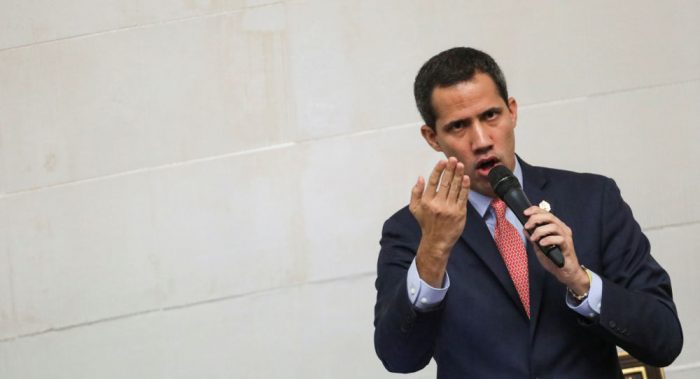
© REUTERS / Manaure Quintero
By Tim Korso – Sputnik – 23.12.2019
Venezuela reported on 22 December that at least one of its servicemen was killed in an attack on a military unit by unidentified gunmen. The latter reportedly sought to rob an ammunition depot, but ultimately failed, with some of them ending up detained by Caracas’ forces.
Venezuelan Minister of Popular Power for Communication and Information Jorge Rodriguez has reported that investigators have uncovered a plot organised by a group loyal to opposition leader Juan Guaido and involving the governments of Peru and Brazil. According to Rodriguez, the plot, called “Bloody Christmas”, suggested attacks on several military units across Venezuela.
In addition to this, the minister said that the members of “Guaido’s group” were planning to shoot down a Colombian Air Force plane using missiles stolen from the Venezuelan military in a staged false-flag attack on the country’s neighbour. The plotters allegedly planned to thereby give the US a pretext to start a “war” with Venezuela.
Rodriguez stated that some of the missiles and assault weapons stolen by the plotters have been recovered, but others remain in the hands of those who are still at large. According to him, a total of 9 RPG rocket launchers were stolen, though it’s unknown how many have been returned.
Attack on Ammunition Depot
Earlier, on 23 December, Venezuelan authorities reported that one soldier was killed as a result of the assault on one of the country’s military units by unknown assailants, which sought to rob an ammunition store. After the attack was repelled, Venezuelan authorities managed to capture some of the gunmen.
An investigation has been started into the incident, but it is not immediately clear who orchestrated the attack.
Back in April 2019, Venezuela experienced an unsuccessful coup attempt organised by opposition leader and self-proclaimed interim President Juan Guaido. The latter appealed to the country’s military to stand against democratically elected President Nicolas Maduro, although only a few of them heeded the call, resulting in the coup’s failure. Guaido has since then fled abroad along with some of his supporters.
Trump administration and Moscow shoot down bipartisan DASKA “sanctions bill from hell”
By Sarah Abed | December 23, 2019
In August of 2018, Senators Lindsey Graham (R-S.C.) and Robert Menendez (D-N.J.) first introduced what Graham referred to as a “sanctions bill from hell” targeting Russia and President Vladimir Putin and making it harder for the United States to leave NATO. Despite bipartisan grievances with Moscow the bill didn’t gain much traction.
The measure to push President Trump to take a tougher stance against Russia over alleged election interference, aggression towards Ukraine and involvement in Syria’s proxy war is titled the Defending American Security from Kremlin Aggression Act (DASKA) and would impose strict and broad penalties.
In February of this year, DASKA was reintroduced with Senator Graham stating the following, “Our goal is to change the status quo and impose meaningful sanctions and measures against Putin’s Russia,” and “He should cease and desist meddling in the U.S. electoral process, halt cyberattacks on American infrastructure, remove Russia from Ukraine, and stop efforts to create chaos in Syria.”
During a Senate Floor speech on February 7th, Senator Menendez even went as far as saying that he speculated whether President Trump “is an asset of the Russian government” and concluded his speech by saying, “this Administration’s deference to the Kremlin demands Congress be proactive in shaping U.S. foreign policy toward Russia, especially with respect to sanctions.”
Fast forward to last Wednesday when the U.S. Senate Foreign Relations Committee advanced the bill with a 17-5 vote. The next step is for the legislation to pass the full Senate and House of Representatives before it can be brought to President Donald Trump to sign into law or veto.
However, the White House has already stated their opposition to DASKA, which targets Russian banks, Russia’s cyber sector, new sovereign debt, and would impose measures on its oil and gas sectors. The bill also imposes several requirements on the State Department including generating reports investigating President Putin’s wealth, opposition figure Boris Nemtsov’s 2013 assassination and whether to designate Russia as a state sponsor of terror.
As for NATO, DASKA would ensure that without approval from a Senate supermajority the United States can not leave. This is in response to President Trump’s various comments about wanting to leave and criticism of other NATO members for not spending enough on defense.
The Trump administration and Moscow are on the same page when it comes to DASKA. Russian Foreign Minister Sergei Lavrov called DASKA “senseless” and in a 22-page letter to Congress it was referred to as “unnecessary” and in need of “significant changes”. Although the administration stated that they too want to deter and counter Russian subversion and aggression they strongly oppose the bill in its current form.
It seems rather unlikely that this bill will pass and in the very slight chance that it does these sanctions will not deter Moscow or bring about any significant change in their domestic and foreign policies.
Robert Legvold, the Marshall D. Shulman Professor Emeritus of Post-Soviet Foreign Policy at Columbia University, stated “As has been the experience since the first U.S. and EU sanctions in 2014, the effect on Russian foreign policy behavior will almost certainly be close to zero-other than perhaps encouraging initiatives that the Russian leadership believes may be disruptive in U.S. relations with its European allies.”
Although Democrats and some Republican’s such as Senator Graham sometimes manage to inadvertently bring the Russian and American heads of states together on some issues such as DASKA and President Trump’s impeachment, those moments are usually short lived. As we saw a few days ago, President Trump signed the 2020 National Defense Act with a $738 billion budget which included legislation imposing sanctions on firms laying pipe for Nord Stream 2, an $11 billion gas pipeline project meant to double gas capacity along the northern Nord Stream pipeline route from Russia to Germany, upsetting all parties involved.
Germany firmly rejected the US sanctions and referred to them as incomprehensible as they affect Berlin and other European companies as well. The imposition of sanctions against EU companies who are conducting legitimate business is rejected by the European Union as well. Russia stated that they would stick to the schedule and carry out their projects regardless of sanctions.
The current and previous White House administrations opposed this project over claims that it would embolden President Putin’s influence by increasing his political and economic sway in Europe. With the United States currently ranked as the world’s top oil and gas producer, it’s clear to see that sanctions such as these are meant to influence European allies to buy American instead of Russian oil and products.
On Friday, Allseas the Swiss-Dutch company contracted to do the work announced that it had suspended pipe-laying activities in anticipation of the enactment of the National Defense Authorization Act (NDAA). On Saturday, Allseas stated, “Completing the project is essential for European supply security. We together with the companies supporting the project will work on finishing the pipeline as soon as possible.”
Russian FM Lavrov met with President Trump at the White house earlier this month and mentioned that they covered at least a dozen substantial issues, and that both the White house and Russia are interested in dialogue. It will be interesting to see if President Trump can successfully balance his desire to expand trade ties and continue dialogue with Russia, by pushing back legislation from Congress to increase sanctions under DASKA, all while sanctioning Nord Stream 2 under the NDAA. What level of chess would that be?
Sarah Abed is an independent journalist and analyst.
Afghan Papers Inadvertently Document WaPo’s Role in Spreading Official Lies
By Joshua Cho | FAIR | December 18, 2019
The Washington Post’s publication of the “Afghanistan Papers” (12/9/19) unveiled over 2,000 pages of unpublished notes of interviews with US officials involved in the Afghanistan War, from a project led by the Office of the Special Inspector General for Afghanistan Reconstruction (SIGAR) to investigate waste and fraud. Hailed by some as the “Pentagon Papers of Our Generation” after the Post won access to those documents under the Freedom of Information Act in a three-year legal battle, the Post’s exposé found that senior US officials failed to tell the truth about the war in Afghanistan throughout the 18-year campaign, making rosy pronouncements they knew to be false and hiding unmistakable evidence the war had become unwinnable.
The paper published direct remarks on the war by US officials who assumed that “their remarks would not be made public”:
“Every data point was altered to present the best picture possible,” Bob Crowley, an Army colonel who served as a senior counterinsurgency adviser to US military commanders in 2013 and 2014, told government interviewers. “Surveys, for instance, were totally unreliable but reinforced that everything we were doing was right and we became a self-licking ice cream cone.”
While more explicit admissions of deception on the part of US officials involved in wars are always appreciated, one question rarely discussed among the reports and opinion pieces praising the “Afghanistan Papers” is what this scoop says about the Washington Post.
If the Post is now publishing material demonstrating that US officials have been “following the same talking points for 18 years,” emphasizing how they are “making progress,” “especially” when the war is “going badly,” shouldn’t the paper acknowledge that it has been cheerleading this same line for all of those 18 years? Doesn’t it have a responsibility to examine how it served as a primary vehicle for those officials to spread these same “talking points” to spin the coverage in the desired fashion?
FAIR has been tracking the Post’s coverage of the Afghanistan War from the very beginning, when the paper—along with the rest of corporate media—was actively following the Bush administration’s “guidance” on how to cover the war. In 2001, a FAIR survey (11/2/01) of the Post’s op-ed pages for three weeks following the September 11 attacks found that
columns calling for or assuming a military response to the attacks were given a great deal of space, while opinions urging diplomatic and international law approaches as an alternative to military action were nearly nonexistent.
Eight years later, FAIR (3/1/09) found that the Post’s cheerleading coverage didn’t change much from 2001, as 7 out of 9 Post op-eds and 4 out of 5 editorials supported some kind of military escalation from the day Barack Obama was elected president (11/4/08) through March 1, 2009, as the US was debating a “surge” of additional troops in Afghanistan later that year.
Another study (Extra!, 11/1/09) of the first ten months of the Post’s opinion columns that same year found that
pro-war columns outnumbered antiwar columns by more than 10 to 1: Of 67 Post columns on US military policy in Afghanistan, 61 supported a continued war, while just six expressed antiwar views. Of the pro-war columns, 31 were for escalation and 30 for an alternative strategy.
The Post offered this lopsided coverage even though there were several polls at the time showing a majority of the US public opposed the war, because they believed that the Afghan War was “not worth fighting.”
The Post also has a history of facilitating official spin for the war. When WikiLeaks posted tens of thousands of classified intelligence documents related to the Afghanistan War, FAIR (7/30/10) found that the Post either dismissed them as not being as important as the Pentagon Papers (7/27/10), or absurdly spun the leaks as good news for the US war effort (7/27/10) because the “release could compel President Obama to explain more forcefully the war’s importance,” and because they “bolstered Obama’s decision in December to pour more troops and money into a war effort that had not received sufficient attention or resources from the Bush administration.”
The Post also buried attempts by whistleblowers and other journalists who were working to expose official lies and war crimes in Afghanistan. When US Army whistleblower Chelsea Manning was sentenced to serve 35 years in prison for sharing intelligence documents that first exposed what the “Afghanistan Papers” are now corroborating, the Post, along with other corporate outlets, largely neglected Manning’s legal trials and punishment (FAIR, 12/4/12, 6/18/14, 1/18/17, 4/1/19). The New York Times, to its credit, did give Manning space for an op-ed (6/14/19) to explain why she risked her freedom to expose matters that the US military recorded but left unreported, including hundreds of US military attacks on Afghan civilians. The Post, for its part, found room to publish frequent op-eds by the Brookings Institution’s Michael O’Hanlon (e.g., 11/16/09, 6/26/10, 6/3/11, 2/10/13, 7/12/13) spouting the same optimistic US official talking points that the Post’s “Afghanistan Papers” has now exposed as lies (FAIR, 1/3/14).
In fact, one major reason why the Afghanistan Papers are unnecessary to discern deceit from US officials is that—as Michael Parenti pointed out in The Face of Imperialism—when US officials constantly provide new and different justifications for invasions, it’s a sign that they’re being dishonest, not incompetent.
The Post (12/9/19) admits this when it mentions that the US “largely accomplished what it set out to do,” with Al Qaeda and Taliban officials “dead, captured or in hiding,” yet “veered off in directions that had little to do with Al Qaeda or 9/11.” This is consistent with FAIR’s finding (Extra!, 7/11) that corporate media largely ignored the question of whether to end the Afghanistan War after the ostensible goal of the invasion—to capture or kill the leader of the group that carried out the September 11 attack—was [allegedly] accomplished in the death of Osama bin Laden.
It shouldn’t be a surprise that the Post’s Afghanistan Papers have inadvertently exposed the Post as a subservient accomplice in disseminating US official lies; corporate media rely on official sources for free content and “scoops” to subsidize their journalism, which often spreads dishonest but convenient talking points by these same sources to retain “access” to this information, trustworthy or not (Extra!, 5/02; New York Times, 4/20/08; FAIR, 12/12/19).
Political cartoonist and journalist Ted Rall pointed out, in an account (Common Dreams, 12/11/19) of being marginalized by corporate outlets like the Post :
“The Afghanistan Papers” is a bright, shining lie by omission. Yes, our military and civilian leaders lied to us about Afghanistan. But they could never have spread their murderous BS—thousands of US soldiers and tens of thousands of Afghans killed, trillions of dollars wasted—without media organizations like the Washington Post, which served as unquestioning government stenographers.
Press outlets like the Post and New York Times weren’t merely idiots used to disseminate pro-war propaganda. They actively censored people who knew we never should have gone into Afghanistan and tried to tell American voters the truth.
It’s this mutually beneficial relationship between the need for corporate media outlets like the Post for “access” to US official sources, and US officials who need corporate media outlets to propagate their preferred spin on US foreign policy to manipulate public opinion, that explains what the Afghanistan Papers expose as the Post’s own role in deceiving the US public. It’s why the Post’s coverage and editorial board can argue that the Trump administration shouldn’t “abandon the country in haste” (even though it’s been 18 years), and rally around the US’s “forever war” in Afghanistan (FAIR, 1/31/19, 9/11/19), even as the paper investigates the official lies the continuing occupation depends on.
Of course, this is also the reason why it’s systemically impossible for corporate outlets like the Post to take the opportunity to raise more substantive and provocative questions about whether deceit is a constant and essential aspect of US foreign policy, and not merely confined to isolated military invasions of “quagmire” countries like Vietnam and Afghanistan, despite the Afghanistan Papers providing a perfect opportunity to do so. To say nothing of challenging a worldview that invokes “winnable” wars, in which predictions of increasing numbers of (enemy) human deaths are best described as “rosy.”
There’s quite a long history of US media assisting officials in fabricating moral pretexts for invasion—from fictional accounts of North Vietnamese attacks on American destroyer ships in the Gulf of Tonkin (FAIR, 8/5/17), to conflating very different Islamic groups like the Taliban and Al Qaeda, or claims that formerly US-backed dictator Saddam Hussein possessed WMDs and the intent to use them against the US (CounterPunch, 6/11/14; FAIR, 3/19/07).
Observers note that the Afghanistan Papers “only confirm what we already know” (Daily Beast, 12/14/19), or that “the shocking thing about the Post stories… is how unshocking they are” (Atlantic, 12/9/19); even the Washington Post (12/12/19) reminds us that only people who “haven’t been paying attention” to the Afghan War are “surprised” by what’s found in the Afghanistan Papers.
Perhaps instead of pursuing FOIA requests to confirm the obvious, the Post could just interrogate its own contradictory coverage of the Afghan War and stop functioning as credulous mouthpieces for the US government. But to do that would also require confronting the lie that this entire so-called “War on Terror” has any moral credibility, when the US is a leading terrorist state that consciously pursues imperial policies that inflame hatred against the US to serve corporate interests (FAIR, 3/13/19, 11/22/19).
Absent that, an exercise like the Afghanistan Papers come off more as a “please consider” note to the Pulitzer judges than as an earnest effort to use the spotlight of journalistic investigation to speak truth to power and halt the ongoing, generation-long destruction of a foreign nation.
How the Pro-War “Left” Fell for the Kurds in Syria
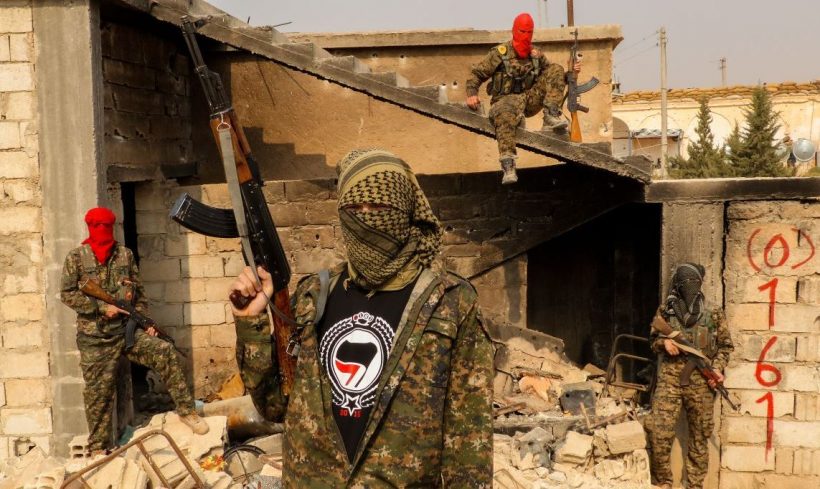
By Max Parry • Unz Review • December 22, 2019
The October decision by U.S. President Donald Trump to withdraw American troops from northeastern Syria did not only precipitate the Turkish offensive, codenamed ‘Operation Peace Spring’, into Kurdish-held territory which followed. It also sparked an outcry of hysteria from much of the so-called “left” that has been deeply divided during the 8-year long conflict over its Kurdish question. Despite the fact that the Syrian Democratic Forces (SDF) were objectively a U.S. proxy army before they were “abandoned” by Washington to face an assault by its NATO ally, the ostensibly “progressive” politics of the mostly-Kurdish militants duped many self-identified people on the left into supporting them as the best option between terrorists and a “regime.” Apparently, everyone on earth except for the Kurds and their ‘humanitarian interventionist’ supporters saw this “betrayal” coming, which speaks to the essential naiveté of such amateurish politics. However, there is a historical basis to this political tendency that should be interrogated if a lesson is to be learned by those misguided by it.
Turkey initially went all-in with the West, Israel, and Gulf states in a joint effort to depose Syrian President Bashar al-Assad by stoking the flames of the country’s Arab Spring in 2011 into a full blown uprising. With Istanbul serving as the base for the opposition, Kurdish nationalists hoping to participate were not at all pleased that the alliance had based its government-in-exile in Turkey and naturally considered Ankara’s role to be detrimental to their own interests in establishing an autonomous ethnonationalist state. Likewise, Turkish President Recep Tayyip Erdoğan did not bargain on the conflict facilitating such a scenario, with the forty year war with the Kurdistan Workers Party (PKK) in southeastern Turkey still ongoing. When the PKK-linked People’s Protection Units (YPG) militias took control of northern Syrian towns and established a self-governing territory after boycotting the opposition, it was done only after negotiations between Damascus and Kurdish leaders. The Syrian government willingly and peacefully ceded the territory to them, just as we were told that the Baathists were among their oppressors.
The Rojava front opened up when the Kurds came under attack from the most radical jihadist militants in the opposition, some of which would later merge with the Islamist insurgency in western Iraq to form ISIS. Yet we now know for a fact that the rise of Islamic State was something actually desired by the U.S.-led coalition in the hopes of bringing down Assad, as revealed in a declassified 2012 Defense Intelligence Agency report. Shortly after clarifying that the opposition is “backed by the West, Gulf countries and Turkey”, the memo states:
“If the situation unravels there is the possibility of establishing a declared or undeclared Salafist principality in eastern Syria (Hasaka and Der Zor), and this is exactly what the supporting powers to the opposition want, in order to isolate the Syrian regime, which is considered the strategic depth of the Shia expansion (Iraq and Iran).”
Meanwhile, it was the Kurds themselves who divulged Ankara’s support for Daesh, frequently retrieving Turkish-issued passports from captured ISIS fighters. Even Emmanuel Macron said as much at the recent NATO summit in London, prompting a row between France and Turkey that took a backseat to the more ‘newsworthy’ Trump tantrum over a hot mic exchange between the French President and his Canadian and British counterparts. Then there was the disclosure that the late Senator John McCain had crossed the border from Turkey into Syria in mid-2013 to meet with leaders of the short-lived Free Syrian Army (FSA), dubbed as “moderate rebels”, which just a short time later would decline after its members joined better armed, more radical groups and the ISIS caliphate was proclaimed. One of the rebel leaders pictured with McCain in his visit is widely suspected to be the eventual chosen leader of ISIS, Abu Bakr al-Baghdadi, who was allegedly killed in a U.S. raid in Idlib this October. Ironically, many of the Turkish-backed FSA militias are now assisting Ankara in its assault on the Kurds while those who supported arming them feign outrage over the US troop removal.
Henry Kissinger reportedly once remarked, “America has no permanent friends or enemies, only interests.” Given that the U.S. was at the very least still using Daesh as a strategic asset, it seems inexplicable that the Kurdish leadership could trust Washington. The SDF had only a few skirmishes with the Syrian army during the entire war— if they wanted to defeat ISIS, why not partner with Damascus and Moscow? To say nothing of the U.S.’s long history of backing their oppression, from its support of Saddam Hussein during the Iran-Iraq War in the 1980s to the arming of Turkey’s brutal crackdown against the PKK which ended with the capture of its cultish leader, Abdullah Öcalan, in 1999. Did they really think after enlisting them for its cosmetic ‘fight’ against ISIS that the U.S. would continue to side with them against Ankara? Even so, Kurdish gains against Daesh would pale in comparison to those by the Syrian army with Russian air support. More perplexing is why anyone on the left would choose to back a group being used as a cat’s paw for imperialism, regardless of whatever ideals they claim to hold.
Perhaps the U.S. would not have reneged on its implicit pledge to help with the foundation of a Kurdish state had their “Assad must go” policy been successful, but the U.S. pullout appears to be the final nail in the coffin for both Washington’s regime change plans in Syria and an independent Kurdistan. The YPG’s makeover as the SDF was done at the behest of the U.S. but this did nothing to to diminish the objections of Ankara (or many ‘leftists’ from supporting them), who insisted the YPG was already an extension and rebranding of the PKK, a group Washington itself designates as a terrorist organization. Any effort to create a buffer state in the enclave was never going to be tolerated by Turkey but it nonetheless enabled the U.S. to illegally occupy northern Syria and facilitate the ongoing looting of its oil. Unfortunately for Washington, the consequence was that it eventually pushed Ankara closer toward the Kremlin, as Turkey went from shooting down Russian jets one year to purchasing the S-400 weapon system from Moscow the next. After backing a botched coup d’etat attempt against Erdoğan in 2016, any hope of Washington bringing Turkey back into its fold would be to discard the Kurds as soon as their usefulness ran out, if it wasn’t too late to repair the damage already.
Why would the U.S. risk losing its geo-strategic alliance with Turkey? To put it simply, it’s ‘special relationship’ with Israel took greater precedence. Any way you slice it, Washington’s foray into the region has been as much about Zionism as imperialism and its backing of the Kurds is no exception. Despite the blowback, the invasion of Iraq and destruction of Libya took two enormous sources of support for the Palestinian resistance off the chessboard. It may have strengthened Iran in the process, but that is all the more reason for the U.S. to sell a regime change attempt in Tehran in the future. Regrettably for Washington, when it tried to do the same in Syria, Russia intervened and emerged as the new peace broker in the Middle East. It comes as no surprise that following the Turkish invasion of northern Syria amid the U.S. withdrawal, the Kurds have finally struck a deal with Damascus and Moscow, a welcome and inevitable development that should have occurred years ago.
One of the main reasons for the Kurds joining the SDF so willingly has the same explanation as to why Washington was prepared to put its relationship with Ankara in jeopardy by supporting them: Israel. The cozy relationship between the Zionist state and the various Kurdish groups centered at the intersection of Turkey, Iran, Iraq and Syria goes back as far as the 1960s, as Jerusalem has consistently used them to undermine its enemies. It is not by chance that their respective interests overlap to a near tee, between the founding of a Kurdish protectorate and the Zionist plan for a ‘Greater Israel’ in the Middle East which includes a balkanization of Syria. Mossad has openly provided the Kurds with training and they have learned much in the ways of the ethnic cleansing of Arabs from the Jewish state in order to carve out a Syrian Kurdistan. One can certainly have sympathy for the Kurds as the largest ethnic group in the world at 40 million people without a state, but the Israel connection runs much deeper than geopolitical interests to the very ideological basis of their militancy which calls all of their stated ideals into question.
The ties between the YPG and the PKK are undeniable, as both groups follow jailed leader Abdullah Öcalan’s teachings which merge Kurdish nationalism with the theories of ‘democratic confederalism’ from the influential Jewish-American anarchist philosopher, Murray Bookchin. While the PKK may have been initially founded as a ‘Marxist-Leninist’ organization in the early 70s, a widespread misconception is that it still follows that aim when its ideology long-ago shifted to that of a self-professed and contradictory ‘libertarian socialism’ theorized by Bookchin who was actually a zealous anti-communist. Not coincidentally, the Western anarchist icon was also an avowed Zionist who often defended Israel’s war crimes and genocide of Palestinians while demonizing its Arab state opponents as the aggressors, including Syria. Scratch an anarchist and a neo-conservative will bleed, every time.
Many on the pseudo-left who have pledged solidarity with the Kurds have attempted to base their reasoning on a historically inaccurate analogy comparing the Syrian conflict with the Spanish Civil War of the 1930s. You would think ISIS would be the obvious first choice for the fascists in the Syrian war, but journalist Robert Mackey of popular “progressive” news site The Intercept even tried to cast the Syrian government as Francisco Franco’s Nationalists in an article comparing the 1937 bombing of Guernica by the Condor Legion to the 2018 chemical attack in Douma which remains in dispute regarding its perpetrator. One wonders if Mackey will retract his absurd comparison now that dozens of inspectors from the Organization for the Prohibition of Chemical Weapons (OPCW) have dissented in emails published by WikiLeaks showing that the OPCW engaged in a cover-up with the Trump administration to pin blame for the attacks on the Syrian government instead of the opposition, but don’t hold your breath.
In this retelling of the Spanish Civil War, the Kurds are generally seen in the role of the Trotskyite Workers’ Party of Marxist Unification (POUM) and the anarchist trade union National Confederation of Labour (CNT). In the midst of the conflict between the Nazi-supported Nationalists and Soviet-backed Republicans that was a prelude to World War II, the mobilization effort of all anti-fascist forces into a unified Popular Front was obstructed by the ultra-left and intransigent POUM and CNT who were then expelled from the coalition for their sectarianism. While the government was still fighting the Francoists, the POUM and CNT then attacked the Republicans but were put down in a failed insurrection. Although this revolt did not directly cause the loyalist defeat, it nevertheless sapped the strength from the Popular Front and smoothed the path for the generalissimo’s victory.
In the years since, Trotskyists have attempted to rewrite history by alleging that a primary historical text documenting the POUM’s sabotage of the Republicans — a 1938 pamphlet by journalist Georges Soria, the Spanish correspondent for the French Communist Party newspaper L’Humanite — is a forgery. On the Marxists Internet Archive website, an ‘editor’s note’ is provided as a preface to the text citing a single quote from Soria with the claim he admitted the work in its entirety was “no more than a fabrication”, but his words are selectively cropped to give that impression. While the author did admit accusations that the POUM‘s leadership were literal agents of Franco were a sensationalized exaggeration, the source of the full quote states the following:
“On the one hand, the charge that the leaders of POUM, among them Andrés Nin, ‘were agents of the Gestapo and Franco’, was no more than a fabrication because it was impossible to adduce the slightest evidence. On the other hand, although the leaders of POUM were neither agents of Franco or agents of the Gestapo, it is true that their relentless struggle against the Popular Front played the game nolens volens (like it or not/willingly or unwillingly) of the Caudillo (General Franco).”
In other words, Soria did not say the whole work was counterfeit like the editor’s note misleadingly suggests and reiterated that the POUM’s subversion helped Franco. (The Marxists Internet Archive does not hide its pro-Trotsky bias in its FAQ section.)
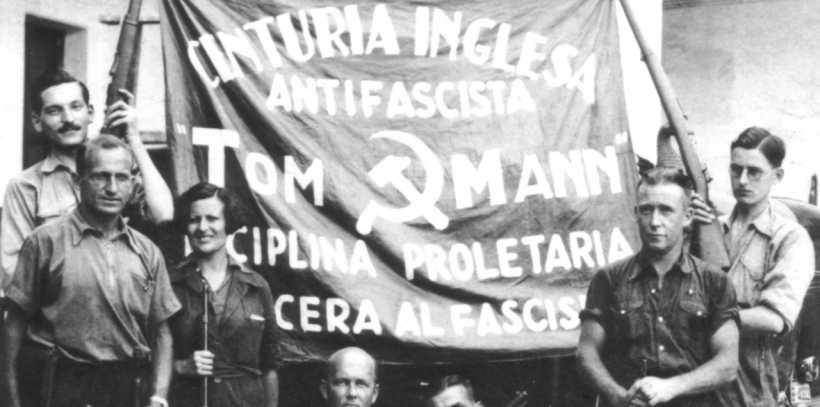
Marxist historian Eric Hobsbawm summarized the inherent contradictions of the Spanish Civil War and the role ultra-leftism played in the demise of the Republic in one of his later essays:
“Of course, the posthumous polemics about the Spanish war are legitimate, and indeed essential — but only if we separate out debate on real issues from the parti pris of political sectarianism, cold-war propaganda and pure ignorance of a forgotten past. The major question at issue in the Spanish civil war was, and remains, how social revolution and war were related on the republican side. The Spanish civil war was, or began as, both. It was a war born of the resistance of a legitimate government, with the help of a popular mobilisation, against a partially successful military coup; and, in important parts of Spain, the spontaneous transformation of the mobilisation into a social revolution. A serious war conducted by a government requires structure, discipline and a degree of centralisation. What characterises social revolutions like that of 1936 is local initiative, spontaneity, independence of, or even resistance to, higher authority — this was especially so given the unique strength of anarchism in Spain.”
Murray Bookchin also wrote at length about the Spanish Civil War but celebrated the decentralized anarchist tactics which incapacitated the Popular Front. The anarcho-syndicalist theorist championed the ‘civil war within the civil war’ as a successful example of his antithetical vision of ‘libertarian socialism’, while his emphasis on the individualist aspects of the former half of his oxymoronic and anti-statist theory often bears a striking resemblance to neoliberal talking points about self-regulating free markets. This would explain why he actually regarded right-wing libertarians to be his natural allies over the the socialist left, whom he considered ‘totalitarian’ as he told the libertarian publication Reason magazine in an interview in 1979. His reactionary demonization of the Soviet Union and dismissal of the accomplishments of all other socialist revolutions was recalled by Michael Parenti in Blackshirts and Reds:
“Left anticommunists remained studiously unimpressed by the dramatic gains won by masses of previously impoverished people under communism. Some were even scornful of such accomplishments. I recall how in Burlington Vermont, in 1971, the noted anticommunist anarchist, Murray Bookchin, derisively referred to my concern for “the poor little children who got fed under communism” (his words).”
Like the International Brigades consisting of foreign volunteers to assist the Spanish Republic in the 1930s, there is an ‘International Freedom Battalion’ currently fighting with the Kurds in Syria. Unfortunately, its live-action role playing ‘leftist’ mercenaries missed the part about the original International Brigades having been backed by the Comintern, not the U.S. military.
Meanwhile, Western media usually hostile to any semblance of radical politics have heavily promoted the Rojava federation as a feminist ‘direct democracy’ utopia, particularly giving excessive attention to the all-female Women’s Protection Units (YPJ) militia while ignoring the female regiments fighting for the secular Syrian government. As a result of the media’s exoticized portrayal of the Kurds and their endorsement by prominent misleaders on the left, from Slavoj Žižek to Noam Chomsky, many have been fooled into supporting them.
If the Spanish Civil War was a dress rehearsal for WWII, it remains to be seen if Syria proves to be a run-through for another global conflict. Then again, what has emerged from its climax is an increasingly multipolar world with the resurgence of Moscow as a deterrent to the mutually assured destruction between the U.S. and China.
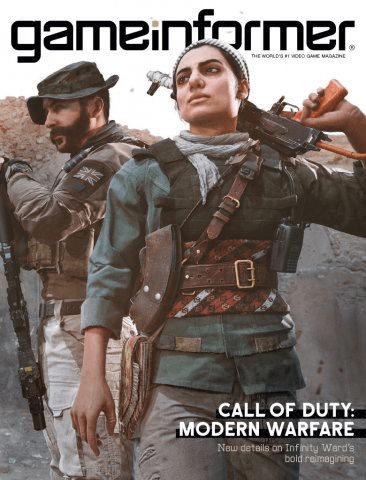
Leftists today wishing to continue the legacy of those who fought for the Spanish Republic should have thrown their support behind the Syrian patriots bravely defending their country from terrorism and imperialism, not left opportunism. Thankfully, this time the good guys have prevailed while the Kurds have paid the price for betraying their fellow countrymen. Liberals shedding crocodile tears about Rojava should take comfort in the fact that they can always play the latest Call of Duty: Modern Warfare video game featuring the YPG fighting alongside the U.S. military if they need to fulfill their imperial fantasies.
Yes, that’s right, the latest installment of the popular first-person shooter franchise features a storyline inspired by the SDF. It’s too bad for them that in real life all of Syria will be returned to where it rightfully belongs under the Syrian Arab Republic.
Max Parry is an independent journalist and geopolitical analyst. His writing has appeared widely in alternative media. Max may be reached at maxrparry@live.com
Featured Video
Thomas Fazi: NATO’s Hybrid Warfare – Deception & Permanent War
or go to
Aletho News Archives – Video-Images
Book Review
UAE tortured, killed journalist for opposing Israel normalization
The Cradle | October 31, 2026
UAE security officers detained, tortured, and killed Emirati poet and news editor Habib al-Sayegh in August 2019, shortly after he published a column opposing UAE normalization with Israel, according to a newly published book.
“Princes and Thieves,” a book by investigative journalist Matthew Cole published on 25 October, alleges that UAE security officers raided Sayegh’s Abu Dhabi home shortly after the publication of the column, hooded him in front of his wife and took him to a detention facility where he was tortured to death.
His interrogators reportedly pulled out several of his teeth with pliers and beat him repeatedly with a sharp metal object.
On 11 August 2019, Sayegh criticized the UAE’s plan to normalize relations with Israel as part of the Abraham Accords in his weekly column for Khaleej newspaper. The column was titled “Israel Is Our Real Enemy and A Dangerous Project.”
Sayegh described Israel as “a real and natural enemy” while questioning “who authorized the normalizers to speak on behalf of everyone?”
Nine days after the column was published, Emirati state media announced his death, without stating a cause. … continue
Blog Roll
 Aletho News
- Backed by AAP, West Virginia Proposal Would Allow Dental Hygienists to Give HPV Vaccine to 9-Year-Olds
- Poland Is the Symptom and Europe Is the Patient
- UAE security forces tortured, killed journalist for opposing Israel normalization: Report
- They Compared the Spice to the Drug. The Spice Won — Again. (Part 2)
- Thomas Fazi: NATO’s Hybrid Warfare – Deception & Permanent War
- Wrong, AP and NPR: Europe’s 50,000 Heat Deaths Are a Computer-Model Estimate, Not a Real Body Count
- Questioning Your Doctor Is Now Considered A Psychological Problem (Seriously)
- London tourism expo promotes Israeli agency linked to theft of Palestinian land
- Dockworkers launch global strike against Israeli and US military shipments
- Europe facing gas price shock – Gazprom chief
- If Americans Knew
- An error has occurred; the feed is probably down. Try again later.
- No Tricks Zone
- Germany’s Green Energy Transition Becoming Increasingly Expensive…Another 6 Trillion Euros!
- Sudden Stratospheric Warming, Powerful El Niño Combination May Lead To Extreme Europe Cold, Energy Crisis!
- Two New Studies Find Thwaites Glacier Melt Cannot Be Driven By Human Activity Or A Warming Ocean
- E-Cars Reduce CO2 Emissions By Only 41% Compared To Internal Combustion Engine Vehicles
- Predictions Made By Renowned Climate Professor Over Past Decades Have Been Proven To Be Poor
- New Study Suggests Large Regions Of The Pacific Ocean Have Been Cooling For The Last 80 Years
- Germany’s Green Energy Debacle: High Energy Costs Force Kahla Porzellan to Close After 182 Years!
- New Study: 50 Years Of The Most Aggressive ‘Net Zero’ Policies Can Only Affect The Global Climate By 0.03°C
- US September “Heat” Was No Record…Many Records Set Decades Ago
- Latest European Green Energy Debacle; Portugal’s Largest Flagship Solar Park Insolvent!

