Merry ‘Bloody Christmas’: Venezuela Uncovers Guaido’s Plot to Provoke US Intervention
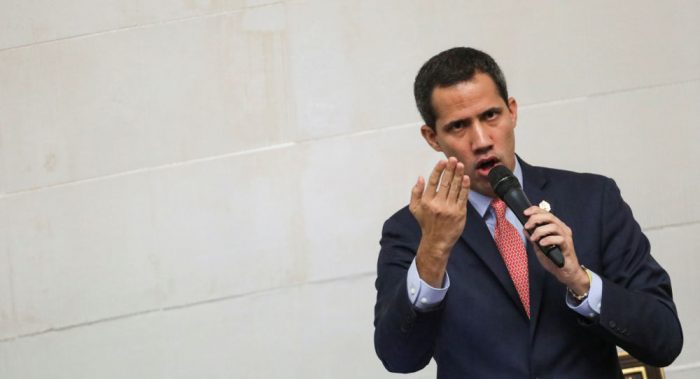
© REUTERS / Manaure Quintero
By Tim Korso – Sputnik – 23.12.2019
Venezuela reported on 22 December that at least one of its servicemen was killed in an attack on a military unit by unidentified gunmen. The latter reportedly sought to rob an ammunition depot, but ultimately failed, with some of them ending up detained by Caracas’ forces.
Venezuelan Minister of Popular Power for Communication and Information Jorge Rodriguez has reported that investigators have uncovered a plot organised by a group loyal to opposition leader Juan Guaido and involving the governments of Peru and Brazil. According to Rodriguez, the plot, called “Bloody Christmas”, suggested attacks on several military units across Venezuela.
In addition to this, the minister said that the members of “Guaido’s group” were planning to shoot down a Colombian Air Force plane using missiles stolen from the Venezuelan military in a staged false-flag attack on the country’s neighbour. The plotters allegedly planned to thereby give the US a pretext to start a “war” with Venezuela.
Rodriguez stated that some of the missiles and assault weapons stolen by the plotters have been recovered, but others remain in the hands of those who are still at large. According to him, a total of 9 RPG rocket launchers were stolen, though it’s unknown how many have been returned.
Attack on Ammunition Depot
Earlier, on 23 December, Venezuelan authorities reported that one soldier was killed as a result of the assault on one of the country’s military units by unknown assailants, which sought to rob an ammunition store. After the attack was repelled, Venezuelan authorities managed to capture some of the gunmen.
An investigation has been started into the incident, but it is not immediately clear who orchestrated the attack.
Back in April 2019, Venezuela experienced an unsuccessful coup attempt organised by opposition leader and self-proclaimed interim President Juan Guaido. The latter appealed to the country’s military to stand against democratically elected President Nicolas Maduro, although only a few of them heeded the call, resulting in the coup’s failure. Guaido has since then fled abroad along with some of his supporters.
Trump administration and Moscow shoot down bipartisan DASKA “sanctions bill from hell”
By Sarah Abed | December 23, 2019
In August of 2018, Senators Lindsey Graham (R-S.C.) and Robert Menendez (D-N.J.) first introduced what Graham referred to as a “sanctions bill from hell” targeting Russia and President Vladimir Putin and making it harder for the United States to leave NATO. Despite bipartisan grievances with Moscow the bill didn’t gain much traction.
The measure to push President Trump to take a tougher stance against Russia over alleged election interference, aggression towards Ukraine and involvement in Syria’s proxy war is titled the Defending American Security from Kremlin Aggression Act (DASKA) and would impose strict and broad penalties.
In February of this year, DASKA was reintroduced with Senator Graham stating the following, “Our goal is to change the status quo and impose meaningful sanctions and measures against Putin’s Russia,” and “He should cease and desist meddling in the U.S. electoral process, halt cyberattacks on American infrastructure, remove Russia from Ukraine, and stop efforts to create chaos in Syria.”
During a Senate Floor speech on February 7th, Senator Menendez even went as far as saying that he speculated whether President Trump “is an asset of the Russian government” and concluded his speech by saying, “this Administration’s deference to the Kremlin demands Congress be proactive in shaping U.S. foreign policy toward Russia, especially with respect to sanctions.”
Fast forward to last Wednesday when the U.S. Senate Foreign Relations Committee advanced the bill with a 17-5 vote. The next step is for the legislation to pass the full Senate and House of Representatives before it can be brought to President Donald Trump to sign into law or veto.
However, the White House has already stated their opposition to DASKA, which targets Russian banks, Russia’s cyber sector, new sovereign debt, and would impose measures on its oil and gas sectors. The bill also imposes several requirements on the State Department including generating reports investigating President Putin’s wealth, opposition figure Boris Nemtsov’s 2013 assassination and whether to designate Russia as a state sponsor of terror.
As for NATO, DASKA would ensure that without approval from a Senate supermajority the United States can not leave. This is in response to President Trump’s various comments about wanting to leave and criticism of other NATO members for not spending enough on defense.
The Trump administration and Moscow are on the same page when it comes to DASKA. Russian Foreign Minister Sergei Lavrov called DASKA “senseless” and in a 22-page letter to Congress it was referred to as “unnecessary” and in need of “significant changes”. Although the administration stated that they too want to deter and counter Russian subversion and aggression they strongly oppose the bill in its current form.
It seems rather unlikely that this bill will pass and in the very slight chance that it does these sanctions will not deter Moscow or bring about any significant change in their domestic and foreign policies.
Robert Legvold, the Marshall D. Shulman Professor Emeritus of Post-Soviet Foreign Policy at Columbia University, stated “As has been the experience since the first U.S. and EU sanctions in 2014, the effect on Russian foreign policy behavior will almost certainly be close to zero-other than perhaps encouraging initiatives that the Russian leadership believes may be disruptive in U.S. relations with its European allies.”
Although Democrats and some Republican’s such as Senator Graham sometimes manage to inadvertently bring the Russian and American heads of states together on some issues such as DASKA and President Trump’s impeachment, those moments are usually short lived. As we saw a few days ago, President Trump signed the 2020 National Defense Act with a $738 billion budget which included legislation imposing sanctions on firms laying pipe for Nord Stream 2, an $11 billion gas pipeline project meant to double gas capacity along the northern Nord Stream pipeline route from Russia to Germany, upsetting all parties involved.
Germany firmly rejected the US sanctions and referred to them as incomprehensible as they affect Berlin and other European companies as well. The imposition of sanctions against EU companies who are conducting legitimate business is rejected by the European Union as well. Russia stated that they would stick to the schedule and carry out their projects regardless of sanctions.
The current and previous White House administrations opposed this project over claims that it would embolden President Putin’s influence by increasing his political and economic sway in Europe. With the United States currently ranked as the world’s top oil and gas producer, it’s clear to see that sanctions such as these are meant to influence European allies to buy American instead of Russian oil and products.
On Friday, Allseas the Swiss-Dutch company contracted to do the work announced that it had suspended pipe-laying activities in anticipation of the enactment of the National Defense Authorization Act (NDAA). On Saturday, Allseas stated, “Completing the project is essential for European supply security. We together with the companies supporting the project will work on finishing the pipeline as soon as possible.”
Russian FM Lavrov met with President Trump at the White house earlier this month and mentioned that they covered at least a dozen substantial issues, and that both the White house and Russia are interested in dialogue. It will be interesting to see if President Trump can successfully balance his desire to expand trade ties and continue dialogue with Russia, by pushing back legislation from Congress to increase sanctions under DASKA, all while sanctioning Nord Stream 2 under the NDAA. What level of chess would that be?
Sarah Abed is an independent journalist and analyst.
Afghan Papers Inadvertently Document WaPo’s Role in Spreading Official Lies
By Joshua Cho | FAIR | December 18, 2019
The Washington Post’s publication of the “Afghanistan Papers” (12/9/19) unveiled over 2,000 pages of unpublished notes of interviews with US officials involved in the Afghanistan War, from a project led by the Office of the Special Inspector General for Afghanistan Reconstruction (SIGAR) to investigate waste and fraud. Hailed by some as the “Pentagon Papers of Our Generation” after the Post won access to those documents under the Freedom of Information Act in a three-year legal battle, the Post’s exposé found that senior US officials failed to tell the truth about the war in Afghanistan throughout the 18-year campaign, making rosy pronouncements they knew to be false and hiding unmistakable evidence the war had become unwinnable.
The paper published direct remarks on the war by US officials who assumed that “their remarks would not be made public”:
“Every data point was altered to present the best picture possible,” Bob Crowley, an Army colonel who served as a senior counterinsurgency adviser to US military commanders in 2013 and 2014, told government interviewers. “Surveys, for instance, were totally unreliable but reinforced that everything we were doing was right and we became a self-licking ice cream cone.”
While more explicit admissions of deception on the part of US officials involved in wars are always appreciated, one question rarely discussed among the reports and opinion pieces praising the “Afghanistan Papers” is what this scoop says about the Washington Post.
If the Post is now publishing material demonstrating that US officials have been “following the same talking points for 18 years,” emphasizing how they are “making progress,” “especially” when the war is “going badly,” shouldn’t the paper acknowledge that it has been cheerleading this same line for all of those 18 years? Doesn’t it have a responsibility to examine how it served as a primary vehicle for those officials to spread these same “talking points” to spin the coverage in the desired fashion?
FAIR has been tracking the Post’s coverage of the Afghanistan War from the very beginning, when the paper—along with the rest of corporate media—was actively following the Bush administration’s “guidance” on how to cover the war. In 2001, a FAIR survey (11/2/01) of the Post’s op-ed pages for three weeks following the September 11 attacks found that
columns calling for or assuming a military response to the attacks were given a great deal of space, while opinions urging diplomatic and international law approaches as an alternative to military action were nearly nonexistent.
Eight years later, FAIR (3/1/09) found that the Post’s cheerleading coverage didn’t change much from 2001, as 7 out of 9 Post op-eds and 4 out of 5 editorials supported some kind of military escalation from the day Barack Obama was elected president (11/4/08) through March 1, 2009, as the US was debating a “surge” of additional troops in Afghanistan later that year.
Another study (Extra!, 11/1/09) of the first ten months of the Post’s opinion columns that same year found that
pro-war columns outnumbered antiwar columns by more than 10 to 1: Of 67 Post columns on US military policy in Afghanistan, 61 supported a continued war, while just six expressed antiwar views. Of the pro-war columns, 31 were for escalation and 30 for an alternative strategy.
The Post offered this lopsided coverage even though there were several polls at the time showing a majority of the US public opposed the war, because they believed that the Afghan War was “not worth fighting.”
The Post also has a history of facilitating official spin for the war. When WikiLeaks posted tens of thousands of classified intelligence documents related to the Afghanistan War, FAIR (7/30/10) found that the Post either dismissed them as not being as important as the Pentagon Papers (7/27/10), or absurdly spun the leaks as good news for the US war effort (7/27/10) because the “release could compel President Obama to explain more forcefully the war’s importance,” and because they “bolstered Obama’s decision in December to pour more troops and money into a war effort that had not received sufficient attention or resources from the Bush administration.”
The Post also buried attempts by whistleblowers and other journalists who were working to expose official lies and war crimes in Afghanistan. When US Army whistleblower Chelsea Manning was sentenced to serve 35 years in prison for sharing intelligence documents that first exposed what the “Afghanistan Papers” are now corroborating, the Post, along with other corporate outlets, largely neglected Manning’s legal trials and punishment (FAIR, 12/4/12, 6/18/14, 1/18/17, 4/1/19). The New York Times, to its credit, did give Manning space for an op-ed (6/14/19) to explain why she risked her freedom to expose matters that the US military recorded but left unreported, including hundreds of US military attacks on Afghan civilians. The Post, for its part, found room to publish frequent op-eds by the Brookings Institution’s Michael O’Hanlon (e.g., 11/16/09, 6/26/10, 6/3/11, 2/10/13, 7/12/13) spouting the same optimistic US official talking points that the Post’s “Afghanistan Papers” has now exposed as lies (FAIR, 1/3/14).
In fact, one major reason why the Afghanistan Papers are unnecessary to discern deceit from US officials is that—as Michael Parenti pointed out in The Face of Imperialism—when US officials constantly provide new and different justifications for invasions, it’s a sign that they’re being dishonest, not incompetent.
The Post (12/9/19) admits this when it mentions that the US “largely accomplished what it set out to do,” with Al Qaeda and Taliban officials “dead, captured or in hiding,” yet “veered off in directions that had little to do with Al Qaeda or 9/11.” This is consistent with FAIR’s finding (Extra!, 7/11) that corporate media largely ignored the question of whether to end the Afghanistan War after the ostensible goal of the invasion—to capture or kill the leader of the group that carried out the September 11 attack—was [allegedly] accomplished in the death of Osama bin Laden.
It shouldn’t be a surprise that the Post’s Afghanistan Papers have inadvertently exposed the Post as a subservient accomplice in disseminating US official lies; corporate media rely on official sources for free content and “scoops” to subsidize their journalism, which often spreads dishonest but convenient talking points by these same sources to retain “access” to this information, trustworthy or not (Extra!, 5/02; New York Times, 4/20/08; FAIR, 12/12/19).
Political cartoonist and journalist Ted Rall pointed out, in an account (Common Dreams, 12/11/19) of being marginalized by corporate outlets like the Post :
“The Afghanistan Papers” is a bright, shining lie by omission. Yes, our military and civilian leaders lied to us about Afghanistan. But they could never have spread their murderous BS—thousands of US soldiers and tens of thousands of Afghans killed, trillions of dollars wasted—without media organizations like the Washington Post, which served as unquestioning government stenographers.
Press outlets like the Post and New York Times weren’t merely idiots used to disseminate pro-war propaganda. They actively censored people who knew we never should have gone into Afghanistan and tried to tell American voters the truth.
It’s this mutually beneficial relationship between the need for corporate media outlets like the Post for “access” to US official sources, and US officials who need corporate media outlets to propagate their preferred spin on US foreign policy to manipulate public opinion, that explains what the Afghanistan Papers expose as the Post’s own role in deceiving the US public. It’s why the Post’s coverage and editorial board can argue that the Trump administration shouldn’t “abandon the country in haste” (even though it’s been 18 years), and rally around the US’s “forever war” in Afghanistan (FAIR, 1/31/19, 9/11/19), even as the paper investigates the official lies the continuing occupation depends on.
Of course, this is also the reason why it’s systemically impossible for corporate outlets like the Post to take the opportunity to raise more substantive and provocative questions about whether deceit is a constant and essential aspect of US foreign policy, and not merely confined to isolated military invasions of “quagmire” countries like Vietnam and Afghanistan, despite the Afghanistan Papers providing a perfect opportunity to do so. To say nothing of challenging a worldview that invokes “winnable” wars, in which predictions of increasing numbers of (enemy) human deaths are best described as “rosy.”
There’s quite a long history of US media assisting officials in fabricating moral pretexts for invasion—from fictional accounts of North Vietnamese attacks on American destroyer ships in the Gulf of Tonkin (FAIR, 8/5/17), to conflating very different Islamic groups like the Taliban and Al Qaeda, or claims that formerly US-backed dictator Saddam Hussein possessed WMDs and the intent to use them against the US (CounterPunch, 6/11/14; FAIR, 3/19/07).
Observers note that the Afghanistan Papers “only confirm what we already know” (Daily Beast, 12/14/19), or that “the shocking thing about the Post stories… is how unshocking they are” (Atlantic, 12/9/19); even the Washington Post (12/12/19) reminds us that only people who “haven’t been paying attention” to the Afghan War are “surprised” by what’s found in the Afghanistan Papers.
Perhaps instead of pursuing FOIA requests to confirm the obvious, the Post could just interrogate its own contradictory coverage of the Afghan War and stop functioning as credulous mouthpieces for the US government. But to do that would also require confronting the lie that this entire so-called “War on Terror” has any moral credibility, when the US is a leading terrorist state that consciously pursues imperial policies that inflame hatred against the US to serve corporate interests (FAIR, 3/13/19, 11/22/19).
Absent that, an exercise like the Afghanistan Papers come off more as a “please consider” note to the Pulitzer judges than as an earnest effort to use the spotlight of journalistic investigation to speak truth to power and halt the ongoing, generation-long destruction of a foreign nation.
How the Pro-War “Left” Fell for the Kurds in Syria
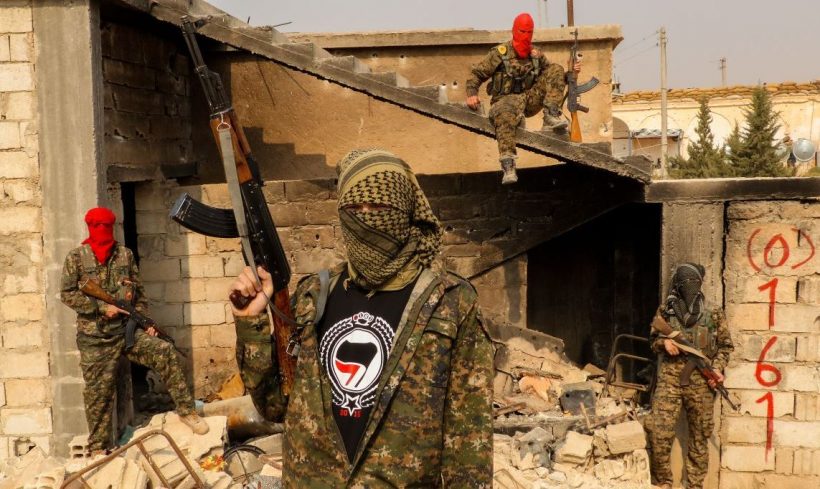
By Max Parry • Unz Review • December 22, 2019
The October decision by U.S. President Donald Trump to withdraw American troops from northeastern Syria did not only precipitate the Turkish offensive, codenamed ‘Operation Peace Spring’, into Kurdish-held territory which followed. It also sparked an outcry of hysteria from much of the so-called “left” that has been deeply divided during the 8-year long conflict over its Kurdish question. Despite the fact that the Syrian Democratic Forces (SDF) were objectively a U.S. proxy army before they were “abandoned” by Washington to face an assault by its NATO ally, the ostensibly “progressive” politics of the mostly-Kurdish militants duped many self-identified people on the left into supporting them as the best option between terrorists and a “regime.” Apparently, everyone on earth except for the Kurds and their ‘humanitarian interventionist’ supporters saw this “betrayal” coming, which speaks to the essential naiveté of such amateurish politics. However, there is a historical basis to this political tendency that should be interrogated if a lesson is to be learned by those misguided by it.
Turkey initially went all-in with the West, Israel, and Gulf states in a joint effort to depose Syrian President Bashar al-Assad by stoking the flames of the country’s Arab Spring in 2011 into a full blown uprising. With Istanbul serving as the base for the opposition, Kurdish nationalists hoping to participate were not at all pleased that the alliance had based its government-in-exile in Turkey and naturally considered Ankara’s role to be detrimental to their own interests in establishing an autonomous ethnonationalist state. Likewise, Turkish President Recep Tayyip Erdoğan did not bargain on the conflict facilitating such a scenario, with the forty year war with the Kurdistan Workers Party (PKK) in southeastern Turkey still ongoing. When the PKK-linked People’s Protection Units (YPG) militias took control of northern Syrian towns and established a self-governing territory after boycotting the opposition, it was done only after negotiations between Damascus and Kurdish leaders. The Syrian government willingly and peacefully ceded the territory to them, just as we were told that the Baathists were among their oppressors.
The Rojava front opened up when the Kurds came under attack from the most radical jihadist militants in the opposition, some of which would later merge with the Islamist insurgency in western Iraq to form ISIS. Yet we now know for a fact that the rise of Islamic State was something actually desired by the U.S.-led coalition in the hopes of bringing down Assad, as revealed in a declassified 2012 Defense Intelligence Agency report. Shortly after clarifying that the opposition is “backed by the West, Gulf countries and Turkey”, the memo states:
“If the situation unravels there is the possibility of establishing a declared or undeclared Salafist principality in eastern Syria (Hasaka and Der Zor), and this is exactly what the supporting powers to the opposition want, in order to isolate the Syrian regime, which is considered the strategic depth of the Shia expansion (Iraq and Iran).”
Meanwhile, it was the Kurds themselves who divulged Ankara’s support for Daesh, frequently retrieving Turkish-issued passports from captured ISIS fighters. Even Emmanuel Macron said as much at the recent NATO summit in London, prompting a row between France and Turkey that took a backseat to the more ‘newsworthy’ Trump tantrum over a hot mic exchange between the French President and his Canadian and British counterparts. Then there was the disclosure that the late Senator John McCain had crossed the border from Turkey into Syria in mid-2013 to meet with leaders of the short-lived Free Syrian Army (FSA), dubbed as “moderate rebels”, which just a short time later would decline after its members joined better armed, more radical groups and the ISIS caliphate was proclaimed. One of the rebel leaders pictured with McCain in his visit is widely suspected to be the eventual chosen leader of ISIS, Abu Bakr al-Baghdadi, who was allegedly killed in a U.S. raid in Idlib this October. Ironically, many of the Turkish-backed FSA militias are now assisting Ankara in its assault on the Kurds while those who supported arming them feign outrage over the US troop removal.
Henry Kissinger reportedly once remarked, “America has no permanent friends or enemies, only interests.” Given that the U.S. was at the very least still using Daesh as a strategic asset, it seems inexplicable that the Kurdish leadership could trust Washington. The SDF had only a few skirmishes with the Syrian army during the entire war— if they wanted to defeat ISIS, why not partner with Damascus and Moscow? To say nothing of the U.S.’s long history of backing their oppression, from its support of Saddam Hussein during the Iran-Iraq War in the 1980s to the arming of Turkey’s brutal crackdown against the PKK which ended with the capture of its cultish leader, Abdullah Öcalan, in 1999. Did they really think after enlisting them for its cosmetic ‘fight’ against ISIS that the U.S. would continue to side with them against Ankara? Even so, Kurdish gains against Daesh would pale in comparison to those by the Syrian army with Russian air support. More perplexing is why anyone on the left would choose to back a group being used as a cat’s paw for imperialism, regardless of whatever ideals they claim to hold.
Perhaps the U.S. would not have reneged on its implicit pledge to help with the foundation of a Kurdish state had their “Assad must go” policy been successful, but the U.S. pullout appears to be the final nail in the coffin for both Washington’s regime change plans in Syria and an independent Kurdistan. The YPG’s makeover as the SDF was done at the behest of the U.S. but this did nothing to to diminish the objections of Ankara (or many ‘leftists’ from supporting them), who insisted the YPG was already an extension and rebranding of the PKK, a group Washington itself designates as a terrorist organization. Any effort to create a buffer state in the enclave was never going to be tolerated by Turkey but it nonetheless enabled the U.S. to illegally occupy northern Syria and facilitate the ongoing looting of its oil. Unfortunately for Washington, the consequence was that it eventually pushed Ankara closer toward the Kremlin, as Turkey went from shooting down Russian jets one year to purchasing the S-400 weapon system from Moscow the next. After backing a botched coup d’etat attempt against Erdoğan in 2016, any hope of Washington bringing Turkey back into its fold would be to discard the Kurds as soon as their usefulness ran out, if it wasn’t too late to repair the damage already.
Why would the U.S. risk losing its geo-strategic alliance with Turkey? To put it simply, it’s ‘special relationship’ with Israel took greater precedence. Any way you slice it, Washington’s foray into the region has been as much about Zionism as imperialism and its backing of the Kurds is no exception. Despite the blowback, the invasion of Iraq and destruction of Libya took two enormous sources of support for the Palestinian resistance off the chessboard. It may have strengthened Iran in the process, but that is all the more reason for the U.S. to sell a regime change attempt in Tehran in the future. Regrettably for Washington, when it tried to do the same in Syria, Russia intervened and emerged as the new peace broker in the Middle East. It comes as no surprise that following the Turkish invasion of northern Syria amid the U.S. withdrawal, the Kurds have finally struck a deal with Damascus and Moscow, a welcome and inevitable development that should have occurred years ago.
One of the main reasons for the Kurds joining the SDF so willingly has the same explanation as to why Washington was prepared to put its relationship with Ankara in jeopardy by supporting them: Israel. The cozy relationship between the Zionist state and the various Kurdish groups centered at the intersection of Turkey, Iran, Iraq and Syria goes back as far as the 1960s, as Jerusalem has consistently used them to undermine its enemies. It is not by chance that their respective interests overlap to a near tee, between the founding of a Kurdish protectorate and the Zionist plan for a ‘Greater Israel’ in the Middle East which includes a balkanization of Syria. Mossad has openly provided the Kurds with training and they have learned much in the ways of the ethnic cleansing of Arabs from the Jewish state in order to carve out a Syrian Kurdistan. One can certainly have sympathy for the Kurds as the largest ethnic group in the world at 40 million people without a state, but the Israel connection runs much deeper than geopolitical interests to the very ideological basis of their militancy which calls all of their stated ideals into question.
The ties between the YPG and the PKK are undeniable, as both groups follow jailed leader Abdullah Öcalan’s teachings which merge Kurdish nationalism with the theories of ‘democratic confederalism’ from the influential Jewish-American anarchist philosopher, Murray Bookchin. While the PKK may have been initially founded as a ‘Marxist-Leninist’ organization in the early 70s, a widespread misconception is that it still follows that aim when its ideology long-ago shifted to that of a self-professed and contradictory ‘libertarian socialism’ theorized by Bookchin who was actually a zealous anti-communist. Not coincidentally, the Western anarchist icon was also an avowed Zionist who often defended Israel’s war crimes and genocide of Palestinians while demonizing its Arab state opponents as the aggressors, including Syria. Scratch an anarchist and a neo-conservative will bleed, every time.
Many on the pseudo-left who have pledged solidarity with the Kurds have attempted to base their reasoning on a historically inaccurate analogy comparing the Syrian conflict with the Spanish Civil War of the 1930s. You would think ISIS would be the obvious first choice for the fascists in the Syrian war, but journalist Robert Mackey of popular “progressive” news site The Intercept even tried to cast the Syrian government as Francisco Franco’s Nationalists in an article comparing the 1937 bombing of Guernica by the Condor Legion to the 2018 chemical attack in Douma which remains in dispute regarding its perpetrator. One wonders if Mackey will retract his absurd comparison now that dozens of inspectors from the Organization for the Prohibition of Chemical Weapons (OPCW) have dissented in emails published by WikiLeaks showing that the OPCW engaged in a cover-up with the Trump administration to pin blame for the attacks on the Syrian government instead of the opposition, but don’t hold your breath.
In this retelling of the Spanish Civil War, the Kurds are generally seen in the role of the Trotskyite Workers’ Party of Marxist Unification (POUM) and the anarchist trade union National Confederation of Labour (CNT). In the midst of the conflict between the Nazi-supported Nationalists and Soviet-backed Republicans that was a prelude to World War II, the mobilization effort of all anti-fascist forces into a unified Popular Front was obstructed by the ultra-left and intransigent POUM and CNT who were then expelled from the coalition for their sectarianism. While the government was still fighting the Francoists, the POUM and CNT then attacked the Republicans but were put down in a failed insurrection. Although this revolt did not directly cause the loyalist defeat, it nevertheless sapped the strength from the Popular Front and smoothed the path for the generalissimo’s victory.
In the years since, Trotskyists have attempted to rewrite history by alleging that a primary historical text documenting the POUM’s sabotage of the Republicans — a 1938 pamphlet by journalist Georges Soria, the Spanish correspondent for the French Communist Party newspaper L’Humanite — is a forgery. On the Marxists Internet Archive website, an ‘editor’s note’ is provided as a preface to the text citing a single quote from Soria with the claim he admitted the work in its entirety was “no more than a fabrication”, but his words are selectively cropped to give that impression. While the author did admit accusations that the POUM‘s leadership were literal agents of Franco were a sensationalized exaggeration, the source of the full quote states the following:
“On the one hand, the charge that the leaders of POUM, among them Andrés Nin, ‘were agents of the Gestapo and Franco’, was no more than a fabrication because it was impossible to adduce the slightest evidence. On the other hand, although the leaders of POUM were neither agents of Franco or agents of the Gestapo, it is true that their relentless struggle against the Popular Front played the game nolens volens (like it or not/willingly or unwillingly) of the Caudillo (General Franco).”
In other words, Soria did not say the whole work was counterfeit like the editor’s note misleadingly suggests and reiterated that the POUM’s subversion helped Franco. (The Marxists Internet Archive does not hide its pro-Trotsky bias in its FAQ section.)
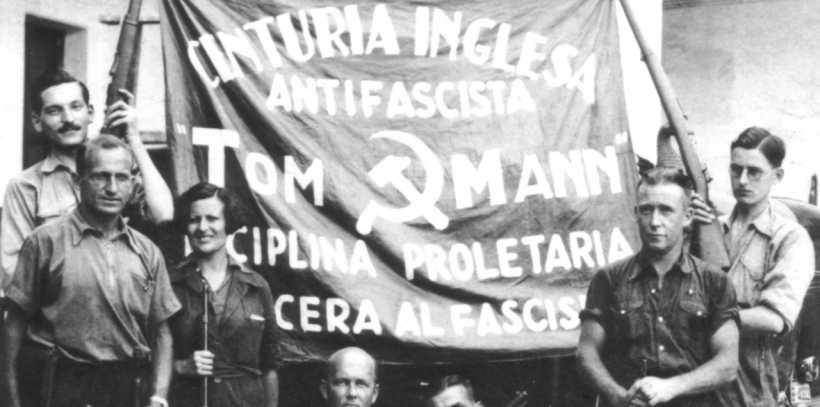
Marxist historian Eric Hobsbawm summarized the inherent contradictions of the Spanish Civil War and the role ultra-leftism played in the demise of the Republic in one of his later essays:
“Of course, the posthumous polemics about the Spanish war are legitimate, and indeed essential — but only if we separate out debate on real issues from the parti pris of political sectarianism, cold-war propaganda and pure ignorance of a forgotten past. The major question at issue in the Spanish civil war was, and remains, how social revolution and war were related on the republican side. The Spanish civil war was, or began as, both. It was a war born of the resistance of a legitimate government, with the help of a popular mobilisation, against a partially successful military coup; and, in important parts of Spain, the spontaneous transformation of the mobilisation into a social revolution. A serious war conducted by a government requires structure, discipline and a degree of centralisation. What characterises social revolutions like that of 1936 is local initiative, spontaneity, independence of, or even resistance to, higher authority — this was especially so given the unique strength of anarchism in Spain.”
Murray Bookchin also wrote at length about the Spanish Civil War but celebrated the decentralized anarchist tactics which incapacitated the Popular Front. The anarcho-syndicalist theorist championed the ‘civil war within the civil war’ as a successful example of his antithetical vision of ‘libertarian socialism’, while his emphasis on the individualist aspects of the former half of his oxymoronic and anti-statist theory often bears a striking resemblance to neoliberal talking points about self-regulating free markets. This would explain why he actually regarded right-wing libertarians to be his natural allies over the the socialist left, whom he considered ‘totalitarian’ as he told the libertarian publication Reason magazine in an interview in 1979. His reactionary demonization of the Soviet Union and dismissal of the accomplishments of all other socialist revolutions was recalled by Michael Parenti in Blackshirts and Reds:
“Left anticommunists remained studiously unimpressed by the dramatic gains won by masses of previously impoverished people under communism. Some were even scornful of such accomplishments. I recall how in Burlington Vermont, in 1971, the noted anticommunist anarchist, Murray Bookchin, derisively referred to my concern for “the poor little children who got fed under communism” (his words).”
Like the International Brigades consisting of foreign volunteers to assist the Spanish Republic in the 1930s, there is an ‘International Freedom Battalion’ currently fighting with the Kurds in Syria. Unfortunately, its live-action role playing ‘leftist’ mercenaries missed the part about the original International Brigades having been backed by the Comintern, not the U.S. military.
Meanwhile, Western media usually hostile to any semblance of radical politics have heavily promoted the Rojava federation as a feminist ‘direct democracy’ utopia, particularly giving excessive attention to the all-female Women’s Protection Units (YPJ) militia while ignoring the female regiments fighting for the secular Syrian government. As a result of the media’s exoticized portrayal of the Kurds and their endorsement by prominent misleaders on the left, from Slavoj Žižek to Noam Chomsky, many have been fooled into supporting them.
If the Spanish Civil War was a dress rehearsal for WWII, it remains to be seen if Syria proves to be a run-through for another global conflict. Then again, what has emerged from its climax is an increasingly multipolar world with the resurgence of Moscow as a deterrent to the mutually assured destruction between the U.S. and China.
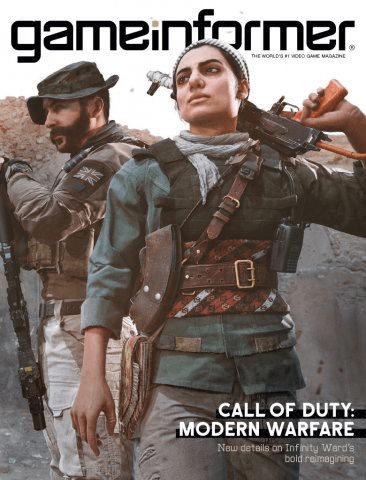
Leftists today wishing to continue the legacy of those who fought for the Spanish Republic should have thrown their support behind the Syrian patriots bravely defending their country from terrorism and imperialism, not left opportunism. Thankfully, this time the good guys have prevailed while the Kurds have paid the price for betraying their fellow countrymen. Liberals shedding crocodile tears about Rojava should take comfort in the fact that they can always play the latest Call of Duty: Modern Warfare video game featuring the YPG fighting alongside the U.S. military if they need to fulfill their imperial fantasies.
Yes, that’s right, the latest installment of the popular first-person shooter franchise features a storyline inspired by the SDF. It’s too bad for them that in real life all of Syria will be returned to where it rightfully belongs under the Syrian Arab Republic.
Max Parry is an independent journalist and geopolitical analyst. His writing has appeared widely in alternative media. Max may be reached at maxrparry@live.com
NSA has been ‘lying to the courts all along,’ says whistleblower, as judges give warrantless surveillance the thumbs-up
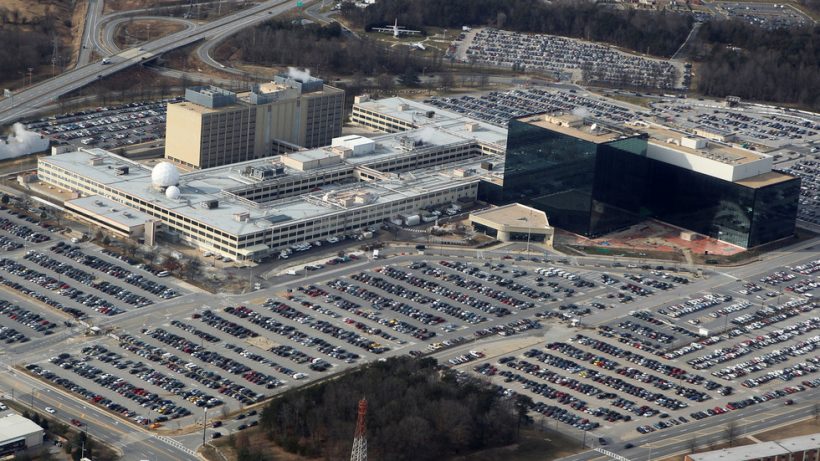
National Security Agency (NSA) headquarters in Ft. Meade, Maryland © Reuters / Larry Downing
RT | December 21, 2019
The National Security Agency can gather the data of US citizens without a warrant – as long as it gathers this data by mistake, a court has ruled. However, this suits the agency just fine, whistleblower William Binney told RT.
The NSA is permitted to gather data on US citizens abroad, or “foreign connected” Americans at home. The dragnet surveillance operation necessary to gather this information also sucks up data on millions of Americans with no foreign contacts, a process critics say is unconstitutional.
On Wednesday, the 2nd Court of Appeals in New York declared this “incidental collection” of information permissible. The NSA has maintained that it is incapable of separating properly and improperly gathered data, but former NSA Technical Director William Binney told RT that this is simply untrue.
“They’ve been lying to the courts all along,” Binney said. “They’ve had the capability to sort that stuff out. It’s just that they don’t want to.”
“This gives them power over everyone, the ability to look into political opponents like they did with President Trump,” he continued.
While the court ruling gives the NSA free rein to suck up data on Americans’ phone and internet communications, it did not authorize the US’ other intelligence and law enforcement agencies to dig through this data. However, according to a Foreign Intelligence Surveillance Act (FISA) court ruling issued last year, the FBI accessed this data trove some 3.1 million times in 2017.
US State Department ‘firmly opposes’ ICC probe into Israeli war crimes allegations, insisting court lacks jurisdiction
RT | December 21, 2019
US Secretary of State Mike Pompeo has voiced “firm” opposition to a bid in the International Criminal Court (ICC) to investigate alleged war crimes committed by Israel in the occupied Palestinian territories.
After nearly four years of preliminary investigation, the ICC’s top prosecutor Fatou Bensouda said on Friday that the war crimes probe would be expanded into a full-scale inquiry, looking into whether Israel has carried out atrocities in the occupied West Bank and East Jerusalem, as well as Gaza. In a statement echoing earlier remarks by Israeli Prime Minister Benjamin Netanyahu, Pompeo said the case had no merit.
“We firmly oppose this and any other action that seeks to target Israel unfairly,” Pompeo said on Friday, arguing that because Palestine does not qualify as a “sovereign state” and is not a party to the ICC’s founding charter, the Rome Statute, it cannot bring cases before the court.
The top US diplomat also reiterated a “long standing objection” to any claim that the ICC has jurisdiction over non-member states, such as Israel and the United States, “absent a referral from the UN Security Council” or explicit cooperation from the nation in question. While then-President Bill Clinton signed the Rome Statute in 2000, it was never formally ratified by the Senate. Israel, too, was an early signer to the statute, but also never finalized its membership in the organization.
PM Netanyahu made a nearly identical argument to Pompeo’s earlier on Friday, insisting the court had no jurisdiction and that Palestine had not achieved statehood – a goal Palestinians have pursued for decades despite tooth-and-nail opposition from both Tel Aviv and its American benefactor.
While Palestine has yet to achieve statehood, the quasi-governmental Palestinian Authority was accepted into the ICC in 2015. Nonetheless, Bensouda signaled that she will convene with the court to confirm exactly how far its jurisdiction extends before moving ahead with the investigation.
Tel Aviv has been accused repeatedly over the years of carrying out war crimes against Palestinians, including the demolition and shelling of civilian homes and other structures, forcible relocation of residents and the use of live ammunition on unarmed demonstrators. Many of the allegations stem from Israel’s settlement project in the occupied territories.
In November, Pompeo declared that Israeli settlements in the occupied West Bank were legitimate under international law, overturning long-standing US policy on the question. Palestinians and their advocates argue the settlements make the long-sought statehood project increasingly unlikely, as Israel’s Jewish-only housing units sprawl across Palestinian land and tie up important resources. Much of the international community and the UN have long considered the settlements illegal and continue to do so, despite the American about-face.
Did John Brennan’s CIA Create Guccifer 2.0 and DCLeaks?
By Larry C Johnson | Sic Semper Tyrannis | December 20, 2019
Special Counsel Robert Mueller’s report insists that Guccifer 2.0 and DCLeaks were created by Russia’s military intelligence organization, the GRU, as part of a Russian plot to meddle in the U.S. 2016 Presidential Election. But this is a lie. Guccifer 2.0 and DCLeaks were created by Brennan’s CIA and this action by the CIA should be a target of U.S. Attorney John Durham’s investigation. Let me explain why.
Let us start with the January 2017 Intelligence Community Assessment aka ICA. Only three agencies of the 17 in the U.S. intelligence community contributed to and coordinated on the ICA–the FBI, the CIA and NSA. In the preamble to the ICA, you can read the following explanation about methodology:
When Intelligence Community analysts use words such as “we assess” or “we judge,” they are conveying an analytic assessment or judgment
To be clear, the phrase,“We assess”, is intel community jargon for “opinion”. If there was actual evidence or source material for a judgment the writer of the assessment would state, “According to a reliable source” or “knowledgeable source” or “documentary evidence.”
Pay close attention to what the analysts writing the ICA stated about the GRU and Guccifer 2.0 and DCLeaks:
We assess with high confidence that the GRU used the Guccifer 2.0 persona, DCLeaks.com, and WikiLeaks to release US victim data obtained in cyber operations publicly and in exclusives to media outlets.
- Guccifer 2.0, who claimed to be an independent Romanian hacker, made multiple contradictory statements and false claims about his likely Russian identity throughout the election. Press reporting suggests more than one person claiming to be Guccifer 2.0 interacted with journalists.
- Content that we assess was taken from e-mail accounts targeted by the GRU in March 2016 appeared on DCLeaks.com starting in June.
We assess with high confidence that the GRU relayed material it acquired from the DNC and senior Democratic officials to WikiLeaks. Moscow most likely chose WikiLeaks because of its self-proclaimed reputation for authenticity. Disclosures through WikiLeaks did not contain any evident forgeries.
Not one piece of corroborating intelligence. It is all based on opinion and strong belief. There was no human source report or electronic intercept pointing to a relationship between the GRU and the two alleged creations of the GRU–Guccifer 2.0 persona and DCLeaks.com.
Now consider the spin that Robert Mueller put on this opinion in his report on possible collusion between the Trump campaign and the Russians. Mueller bluffs the unsuspecting reader into believing that it is a proven fact that Guccifer 2.0 and DCLeaks were Russian assets. But he is relying on a mere opinion from a handpicked group of intel analysts working under the direction of then CIA Director John Brennan.Here’s Mueller’s take (I apologize for the lengthy quote but it is important that you read how the Mueller team presents this):
DCLeaks
“The GRU began planning the releases at least as early as April 19, 2016, when Unit 26165 registered the domain dcleaks.com through a service that anonymized the registrant.137 Unit 26165 paid for the registration using a pool of bitcoin that it had mined.138 The dcleaks.com landing page pointed to different tranches of stolen documents, arranged by victim or subject matter. Other dcleaks.com pages contained indexes of the stolen emails that were being released (bearing the sender, recipient, and date of the email). To control access and the timing of releases, pages were sometimes password-protected for a period of time and later made unrestricted to the public.
Starting in June 2016, the GRU posted stolen documents onto the website dcleaks.com, including documents stolen from a number of individuals associated with the Clinton Campaign. These documents appeared to have originated from personal email accounts (in particular, Google and Microsoft accounts), rather than the DNC and DCCC computer networks. DCLeaks victims included an advisor to the Clinton Campaign, a former DNC employee and Clinton Campaign employee, and four other campaign volunteers.139 The GRU released through dcleaks.com thousands of documents, including personal identifying and financial information, internal correspondence related to the“Clinton Campaign and prior political jobs, and fundraising files and information.140
GRU officers operated a Facebook page under the DCLeaks moniker, which they primarily used to promote releases of materials.141 The Facebook page was administered through a small number of preexisting GRU-controlled Facebook accounts.142
GRU officers also used the DCLeaks Facebook account, the Twitter account @dcleaks__, and the email account dcleaksproject@gmail.com to communicate privately with reporters and other U.S. persons. GRU officers using the DCLeaks persona gave certain reporters early access to archives of leaked files by sending them links and passwords to pages on the dcleaks.com website that had not yet become public. For example, on July 14, 2016, GRU officers operating under the DCLeaks persona sent a link and password for a non-public DCLeaks webpage to a U.S. reporter via the Facebook account.143 Similarly, on September 14, 2016, GRU officers sent reporters Twitter direct messages from @dcleaks_, with a password to another non-public part of the dcleaks.com website.144
The dcleaks.com website remained operational and public until March 2017.”
Guccifer 2.0
On June 14, 2016, the DNC and its cyber-response team announced the breach of the DNC network and suspected theft of DNC documents. In the statements, the cyber-response team alleged that Russian state-sponsored actors (which they referred to as “Fancy Bear”) were responsible for the breach.145 Apparently in response to that announcement, on June 15, 2016, GRU officers using the persona Guccifer 2.0 created a WordPress blog. In the hours leading up to the launch of that WordPress blog, GRU officers logged into a Moscow-based server used and managed by Unit 74455 and searched for a number of specific words and phrases in English, including “some hundred sheets,” “illuminati,” and “worldwide known.” Approximately two hours after the last of those searches, Guccifer 2.0 published its first post, attributing the DNC server hack to a lone Romanian hacker and using several of the unique English words and phrases that the GRU officers had searched for that day.146
That same day, June 15, 2016, the GRU also used the Guccifer 2.0 WordPress blog to begin releasing to the public documents stolen from the DNC and DCCC computer networks.
The Guccifer 2.0 persona ultimately released thousands of documents stolen from the DNC and DCCC in a series of blog posts between June 15, 2016 and October 18, 2016.147 Released documents included opposition research performed by the DNC (including a memorandum analyzing potential criticisms of candidate Trump), internal policy documents (such as recommendations on how to address politically sensitive issues), analyses of specific congressional races, and fundraising documents. Releases were organized around thematic issues, such as specific states (e.g., Florida and Pennsylvania) that were perceived as competitive in the 2016 U.S. presidential election.
Beginning in late June 2016, the GRU also used the Guccifer 2.0 persona to release documents directly to reporters and other interested individuals. Specifically, on June 27, 2016, Guccifer 2.0 sent an email to the news outlet The Smoking Gun offering to provide “exclusive access to some leaked emails linked [to] Hillary Clinton’s staff.”148 The GRU later sent the reporter a password and link to a locked portion of the dcleaks.com website that contained an archive of emails stolen by Unit 26165 from a Clinton Campaign volunteer in March 2016.149 “That the Guccifer 2.0 persona provided reporters access to a restricted portion of the DCLeaks website tends to indicate that both personas were operated by the same or a closely-related group of people.150
The GRU continued its release efforts through Guccifer 2.0 into August 2016. For example, on August 15, 2016, the Guccifer 2.0 persona sent a candidate for the U.S. Congress documents related to the candidate’s opponent.151 On August 22, 2016, the Guccifer 2.0 persona transferred approximately 2.5 gigabytes of Florida-related data stolen from the DCCC to a U.S. blogger covering Florida politics.152 On August 22, 2016, the Guccifer 2.0 persona sent a U.S. reporter documents stolen from the DCCC pertaining to the Black Lives Matter movement.153”
Wow. Sounds pretty convincing. The documents referencing communications by DCLeaks or Guccifer 2.0 with Wikileaks are real. What is not true is that these entities were GRU assets.
In October 2015 John Brennan reorganized the CIA. As part of that reorganization he created a new directorate–DIRECTORATE OF DIGITAL INNOVATION. Its mission was to “manipulate digital footprints.” In other words, this was the Directorate that did the work of creating Guccifer 2.0 and DCLeaks. One of their specialties, creating Digital Dust.
We also know, thanks to Wikileaks, that the CIA was using software specifically designed to mask CIA activity and make it appear like it was done by a foreign entity. Wikipedia describes the Vault 7 documents:
Vault 7 is a series of documents that WikiLeaks began to publish on 7 March 2017, that detail activities and capabilities of the United States’ Central Intelligence Agency to perform electronic surveillance and cyber warfare. The files, dated from 2013–2016, include details on the agency’s software capabilities, such as the ability to compromise cars, smart TVs,[1] web browsers (including Google Chrome, Microsoft Edge, Mozilla Firefox, and Opera Software ASA),[2][3][4] and the operating systems of most smartphones (including Apple’s iOS and Google’s Android), as well as other operating systems such as Microsoft Windows, macOS, and Linux[5][6
One of the tools in Vault 7 carries the innocuous name, MARBLE. Hackernews explains the purpose and function of MARBLE:
Dubbed “Marble,” the part 3 of CIA files contains 676 source code files of a secret anti-forensic Marble Framework, which is basically an obfuscator or a packer used to hide the true source of CIA malware.
The CIA’s Marble Framework tool includes a variety of different algorithm with foreign language text intentionally inserted into the malware source code to fool security analysts and falsely attribute attacks to the wrong nation.Marble is used to hamper[ing] forensic investigators and anti-virus companies from attributing viruses, trojans and hacking attacks to the CIA,” says the whistleblowing site.
“… for example by pretending that the spoken language of the malware creator was not American English, but Chinese, but then showing attempts to conceal the use of Chinese, drawing forensic investigators even more strongly to the wrong conclusion,” WikiLeaks explains.
So guess what gullible techies “discovered” in mid-June 2016? The meta data in the Guccifer 2.0 communications had “Russian fingerprints.”
We still don’t know who he is or whether he works for the Russian government, but one thing is for sure: Guccifer 2.0—the nom de guerre of the person claiming he hacked the Democratic National Committee and published hundreds of pages that appeared to prove it—left behind fingerprints implicating a Russian-speaking person with a nostalgia for the country’s lost Soviet era.
Exhibit A in the case is this document created and later edited in the ubiquitous Microsoft Word format. Metadata left inside the file shows it was last edited by someone using the computer name “Феликс Эдмундович.” That means the computer was configured to use the Russian language and that it was connected to a Russian-language keyboard. More intriguing still, “Феликс Эдмундович” is the colloquial name that translates to Felix Dzerzhinsky, the 20th Century Russian statesman who is best known for founding the Soviet secret police. (The metadata also shows that the purported DNC strategy memo was originally created by someone named Warren Flood, which happens to be the name of a LinkedIn user claiming to provide strategy and data analytics services to Democratic candidates.)
Just use your common sense. If the Russians were really trying to carry out a covert cyberattack, do you really think they are so sloppy and incompetent to insert the name of the creator of the Soviet secret police in the metadata? No. The Russians are not clowns. This was a clumsy attempt to frame the Russians.
Why would the CIA do this? The CIA knew that Podesta’s emails had been hacked and were circulating on the internet. But they had no evidence about the identity of the culprit. If they had such evidence, they would have cited it in the 2017 ICA.
The U.S. intelligence community became aware around May 26, 2016 that someone with access to the DNC network was offering those emails to Julian Assange and Wikileaks. Julian Assange and people who spoke to him indicate that the person was Seth Rich. Whether or not it was Seth, the Trump Task Force at CIA was aware that the emails, which would be embarrassing to the Clinton campaign, would be released at some time in the future. Hence the motive to create Guccifer 2.0 and pin the blame on Russia.
It is essential to recall the timeline of the alleged Russian intrusion into the DNC network. The only source for the claim that Russia hacked the DNC is a private cyber security firm, CrowdStrike. Here is the timeline for the DNC “hack.”
Here are the facts on the public record. They are at odds with the claims of the Intelligence Community:
- It was 29 April 2016, when the DNC claims it became aware its servers had been penetrated. No claim yet about who was responsible. And no claim that there had been a prior warning by the FBI of a penetration of the DNC by Russian military intelligence.
- According to CrowdStrike founder, Dimitri Alperovitch, his company first supposedly detected the Russians mucking around inside the DNC server on 6 May 2016. A CrowdStrike intelligence analyst reportedly told Alperovitch that:
- Falcon had identified not one but two Russian intruders: Cozy Bear, a group CrowdStrike’s experts believed was affiliated with the FSB, Russia’s answer to the CIA; and Fancy Bear, which they had linked to the GRU, Russian military intelligence.
- The Wikileaks data shows that the last message copied from the DNC network is dated Wed, 25 May 2016 08:48:35.
- 10 June 2016–CrowdStrike waited until 10 June 2016 to take concrete steps to clean up the DNC network. Alperovitch told Esquire’s Vicky Ward that: ‘Ultimately, the teams decided it was necessary to replace the software on every computer at the DNC. Until the network was clean, secrecy was vital. On the afternoon of Friday, June 10, all DNC employees were instructed to leave their laptops in the office.”
- On June 14, 2016, Ellen Nakamura, a Washington Post reporter who had been briefed by computer security company hired by the DNC—Crowdstrike–, wrote:
- Russian government hackers penetrated the computer network of the Democratic National Committee and gained access to the entire database of opposition research on GOP presidential candidate Donald Trump, according to committee officials and security experts who responded to the breach.
- The intruders so thoroughly compromised the DNC’s system that they also were able to read all email and chat traffic, said DNC officials and the security experts.
- The intrusion into the DNC was one of several targeting American political organizations. The networks of presidential candidates Hillary Clinton and Donald Trump were also targeted by Russian spies, as were the computers of some Republican political action committees, U.S. officials said. But details on those cases were not available.
- 15 June, 2016, an internet “personality” self-described as Guccifer 2.0 surfaces and claims to be responsible for the hacks but denies being Russian. The people/entity behind Guccifer 2.0:
- Used a Russian VPN service provider to conceal their identity.
- Created an email account with AOL.fr (a service that exposes the sender’s IP address) and contacted the press (exposing his VPN IP address in the process).
- Contacted various media outlets through this set up and claimed credit for hacking the DNC, sharing copies of files purportedly from the hack (one of which had Russian error messages embedded in them) with reporters from Gawker, The Smoking Gun and other outlets.
- Carried out searches for terms that were mostly in English, several of which would appear in Guccifer 2.0’s first blog post. They chose to do this via a server based in Moscow. (this is from the indictment,
“On or about June 15, 2016, the Conspirators logged into a Moscow-based server used and managed by Unit 74455”) - Created a blog and made an initial blog post claiming to have hacked the DNC, providing links to various documents as proof.
- Carelessly dropped a “Russian Smiley” into his first blog post.
- Managed to add the name “Феликс Эдмундович” (which translates to Felix Dzerzhinsky, also known as “Iron Felix”) to the metadata of several documents. (Several sources went beyond what the evidence shows and made claims about Guccifer 2.0 using a Russian keyboard, however, these claims are just assumptions made in response to the presence of cyrillic characters.)
The only thing that the Guccifer 2.0 character did not do to declare its Russian heritage was to take out full page ads in the New York Times and Washington Post. But the “forensic” fingerprints that Guccifer 2.0 was leaving behind is not the only inexplicable event.
Time for the common sense standard again. Crowdstrike detected the Russians on the 6th of May, according to CEO Dimitri Alperovitch, but took no steps to shutdown the network, eliminate the malware and clean the computers until 34 days later, i.e., the 10th of June. That is 34 days of inexcusable inaction.
It is only AFTER Julian Assange announces on 12 June 2016 that WikiLeaks has emails relating to Hillary Clinton that DCLeaks or Guccifer 2.0 try to contact Assange.
The actions attributed to DCLeaks and Guccifer 2.0 should be priority investigative targets for U.S. Attorney John Durham’s team of investigators. This potential use of a known CIA tool, developed under Brennan with the sole purpose to obfuscate the source of intrusions, pointing to another nation, as a false flag operation, is one of the actions and issues that U.S. Attorney John Durham should be looking into as a potential act of “Seditious conspiracy. It needs to be done. To quote the CIA, I strongly assess that the only intelligence agency that evidence indicates was meddling via cyber attacks in the 2016 Presidential election was the CIA, not the GRU.
Panama: A Grieving People Recalls 30 Years of the US Invasion
teleSUR | December 20, 2019
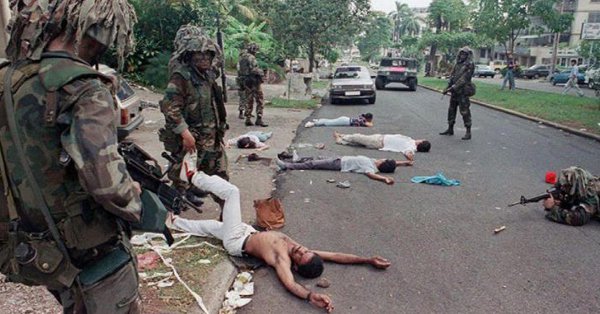
For the first time over the last 30 years, Panamanian authorities agreed to declare “National Day of Mourning” on December 20, which is the date on which the United States invaded Panama in 1989.
“The government acknowledges declaring December 20 as a day of national mourning to honor Panamanians and all the innocents who lost their lives and defended our territory’s integrity,” President Laurentino Cortizo tweeted on Wednesday.
On Dec. 20, 1989, President George H.W. Bush ordered “Operation Just Cause” and deployed some 26,000 soldiers to overthrow General Manuel Antonio Noriega.
Until then, he had been one of the most faithful collaborators of the Central Intelligence Agency (CIA) and the Drug Enforcement Administration (DEA).
Noriega fueled the Bush administration’s hostility when he requested the closure of “The School of the Americas,” where the U.S. had trained thousands of Latin American military since 1946. Upon losing Washington’s support, however, the U.S. Department of Justice accused him of drug trafficking.
Official declassified documents, which were published by Panama Files for the first time this week, indicate that 202 civilians and 314 militaries were killed during Operation Just Cause.
In an unofficially recognized manner, historians, activists, and families argue that the U.S. invasion killed up to 4,000 civilians.
“El Chorillo neighborhood, where the Panamanian Defense Forces central headquarters were located, was razed during the battle,” local outlet El Siglo recalls.
Mirta Guevara, who was a Public Prosecutor at the time, remembers that nobody imagined what the U.S. was planning to do. She was studying court records on the night of December 19 when her husband came in and told her, “Close those files. They are going to invade us.”
“I was shocked because, although one sees such things at the movies, I had never imagined it. I think that no Panamanian imagined that they were going to invade us,” Guevara recalls and now says that such an action had no justification. “Many people died.”
Of what happened in Panama not only oral accounts remained. A year after the invasion, a documentary showed a woman who asked the U.S.-imposed government to recognize whether what happened was “war, invasion or liberation.” They replied to her that it was a “government of democracy and justice.”
“Democracy for whom? Justice for whom? For those who are in the mass graves or for those who are in the government? For those of us who go hungry or for those who have everything?” the woman said without fear of the repression that was lived in the country.
In another documentary called “Unjust Cause,” which was made by the Panamanian filmmaker Rafael Vergara, scenes of brutal aggression are reported, one of which happened when U.S. troops bombarded a civil building because their inhabitants did not want to leave.
To resist the invasion, the Panamanians organized themselves in the “Battalions of Dignity”, which were groups of guerrilla fighters who were persecuted by the invasion-born government, which was led by Guillermo Endara, to whom a judge gave the presidency secretly the night before the invasion.
“Those who seized power mounted on the invading tanks remain silent,” a witness told Prensa Latina.
“After 30 years, the curtains, which hid the worst massacre experienced by Panama and the largest U.S. military deployment after Vietnam, begin to fall.”
In his chronicle “The Panama Invasion: A Heroine of the Little Hiroshima,” Colombian journalist Hernando Calvo described what happened in El Chorrillo neighborhood through the testimony of Ana.
She recalled a Dantesque scenario in which invading troops prevented helping injured family members, tanks hit dead or alive people lying on the street, and flamethrowers burned dead bodies at the beach.
Turkey vows to retaliate if US imposes sanctions on Russian gas pipeline
RT | December 20, 2019
Turkish President Recep Tayyip Erdogan has hit back against US threats to impose sanctions on the TurkStream pipeline that is set to deliver Russian gas to Turkey and further to southern and southeastern Europe starting next year.
“Now they [the US] say ‘we will impose sanctions on TurkStream,’” Erdogan told reporters on Friday in Malaysia. “This is a complete violation of our rights,” he said, adding that Ankara would retaliate against such a step.
The TurkStream project was created as an alternative to the South Stream pipeline. The project to deliver Russian gas to southern Europe was blocked by Bulgaria in 2014 under pressure from the US.
TurkStream is a two-string pipeline that will go from Russia along the bottom of the Black Sea to the European part of Turkey and will have a throughput capacity of 31.5 billion cubic meters. The official launch of the pipeline is scheduled for January 8, when Russian President Vladimir Putin comes to Turkey to met Erdogan.
Earlier this week, the US Senate adopted the 2020 National Defense Authorization Act, which stipulates sanctioning vessels that engaged in pipe-laying for the TurkStream project as well as punitive measures against companies working to complete the Nord Stream 2 natural gas pipeline from Russia to Germany. The bill is now on the way to the White House where President Donald Trump is set to sign it into law.
The bill also sanctions Turkey for its acquisition of the Russian-made S-400 air defense system and implies prohibiting the transfer of F-35 jets to the country. Addressing the matter, the Turkish leader said these issues are “closed” and warned against treating Ankara as a “tribal nation.”
Featured Video

John Mearsheimer: New World Order Arrived & Europe Is Left Behind
or go to
Aletho News Archives – Video-Images
Book Review
Sunset on Net Zero: A Heretic’s Guide to the Futile CO2 Target
By Ronald Paul Barmby (Author) – October 3, 2025
SUNSET ON NET ZERO describes in detail why Net Zero CO2 is pointless and unachievable. It explains in understandable terms the up-to- date thoughts of the greatest minds of today in physics, meteorology, economics, engineering, and the geosciences.
Net Zero CO2 is pointless because we have now confirmed by satellites that 90% of CO2 warming has already happened. CO2 is not an existential threat but clouds, El-Niño, and human habitation are significant drivers of global warming that are often ignored.
Net Zero CO2 is unachievable because the green technology alternatives are unreliable and unaffordable. Wind and solar power triple electricity costs, building fully electric vehicles produces at least one-half of CO2 emissions they are meant to avoid, and heat pumps will leave you dangerously cold in the winter. Green hydrogen, air capture CO2, and carbon capture and storage are prescriptions for national bankruptcy. The supply of key metals and minerals required to achieve Net Zero need to be at least doubled—some much more—and are often controlled by a very few. Net Zero comes with huge environmental and agricultural costs.
We have been through similar climatic temperature changes before, more recently than you think. Our efforts to control it are futile.
Blog Roll
 Aletho News
- FDA Ordered to Pay Over $570,000 in Fight Over Pfizer COVID Vaccine Records
- USAID turned to Facebook to drive demand for Covid vaccines in Global South – files
- Britain’s shadow security network expands into south Lebanon
- The ADL Has a Foreign Policy, and You Are Not Supposed to See It
- Former Qatari PM says ‘Israel’ has security ties with all Gulf states
- The Sound of Silence in the Strait of Hormuz
- Poland’s call for a no-fly zone in Ukraine means NATO direct war with Russia
- John Mearsheimer: New World Order Arrived & Europe Is Left Behind
- Naqab demolition notices top 1,000; settlers demolish Jaloud homes
- Israel is Using the ‘Gaza Ceasefire’ to Commit Ethnic Cleansing
- If Americans Knew
- An error has occurred; the feed is probably down. Try again later.
- No Tricks Zone
- Physicists: Doubling CO2 Has A Smaller Impact On Ocean ‘Acidification’ Than Existing Internal Variability
- Alarmist Climatologists In Shock! 2026 Atlantic Hurricane Season Sees Lowest Count In 101 Years
- New Study: Modern Temps Are Among The Coldest Of The Last 10,000 Years In East Central Europe
- Germany’s Renewable Energies Lead to 1.4 Billion Euro Electric Power Trade Deficit
- Argentina’s Perito Moreno Glacier Joins Antarctica and Arctic In Defying Doomsday Melt Claims
- New Study: Barents Sea Temperatures Were Warmer And Sea Ice Less Extensive In The 1700s Than Today
- German Authorities Start Initiative To Evaluate Public Register For Climate “Disinformation” Spreaders!
- Zonal Asymmetry of Temperature Change in the Antarctic Circumpolar Current
- New Study: The Net Fossil Fuel Contribution To Rising Atmospheric CO2 Has Been Zero For 500 Years
- Germany’s Green Energy Transition Becoming Increasingly Expensive…Another 6 Trillion Euros!

