ARE THE KIDS OK?
The video, created by VSRF, that Twitter does not want you to watch.
The Highwire with Del Bigtree | October 7, 2022
The video, created by VSRF, that Twitter does not want you to watch.
By Michael Nevradakis, Ph.D. | The Defender | October 7, 2022
In what pharmaceutical industry publication Fierce Pharma called “a troubling sign of the times,” the Biden administration this week purchased $290 million in anti-radiation drugs.
In an Oct. 4 press release, the U.S. Department of Health and Human Services’ (HHS) Administration for Strategic Preparedness and Response (ASPR) announced the purchase of Nplate, a drug used to treat acute radiation syndrome.
ASPR — the federal agency tasked with preparing for disasters and public health emergencies — said the purchase was made “as part of long-standing, ongoing efforts to be better prepared to save lives following radiological and nuclear emergencies.”
HHS did not clarify why it bolstered the government’s Nplate stockpile, other than describing it as “part of our ongoing work for preparedness and radiological security.”
Officials downplayed any connection to the Russia-Ukraine conflict, adding that the purchase “was not accelerated by the situation in Ukraine.”
However, two days after the announcement, amid growing tensions related to the conflict between Russia and Ukraine, President Biden said the risk of nuclear “Armageddon” is at its highest since the Cuban Missile Crisis in 1962.
The U.S. government in recent months has made several moves signaling a growing level of nuclear preparedness.
For instance, in late September, the Intelligence Advanced Research Projects Activity launched a new program, — Targeted Evaluation of Ionizing Radiation Exposure — which will investigate methods to detect low doses of ionizing radiation.
According to The Register, the investigation will work to “build a new understanding of the effects of low-dose radiation” through the use of technologies such as artificial intelligence, machine learning, biomarker discovery and analytical biography.
The Ohio State University, the University of Washington, Areté Associates and Signature Science received grants to conduct the research over a three-and-a-half year period. The research will occur at Lawrence Berkeley National Laboratory, Los Alamos National Lab and the Armed Forces Radiobiology Research Institute.
Earlier this summer, New York City authorities raised eyebrows with the release of a 90-second nuclear preparedness public service announcement (PSA), which the New York Times described as “bizarre” and as “well watched,” but “not well received.”
At the time, NPR reported that New York City’s emergency management department “wants residents to be prepared if [a nuclear attack] does occur,” but that the PSA left many of the city’s residents “confused.”
Outside the U.S., countries neighboring Ukraine, such as Poland, reportedly began distributing iodine tablets in response to the threat of nuclear fallout related to the Russia-Ukraine conflict as a result of shelling around the Zaporizhzhia nuclear power plant in Ukraine.
Developed under Project BioShield, with funding from numerous government agencies
Nplate is the trade name for the drug romiplostim, approved by the U.S. Food and Drug Administration (FDA) in January 2021 for the treatment of blood cell injuries that result from acute radiation syndrome.
The drug is an artificial protein that promotes the production of platelets — or blood-clotting cells — in the human body.
The drug first received FDA approval in 2008, for the treatment of immune thrombocytopenia, an autoimmune disorder that causes serious bleeding.
Amgen, the drug’s manufacturer, developed Nplate in conjunction with the Biomedical Advanced Research and Development Authority, or BARDA, under the auspices of Project BioShield, signed into law in July 2004 by then-president George W. Bush.
Project BioShield, which incentivizes private companies to develop vaccines and countermeasures for biological, chemical, nuclear and radiological threats, provided funding for the latest $290 million purchase by the HHS.
BARDA — another arm of HHS — garnered attention in recent years for its extensive deals with COVID-19 vaccine manufacturers and for its promotion of COVID-19 countermeasures.
In 2020, BARDA promised Moderna up to $483 million to “shepherd” its COVID-19 vaccine through the FDA approval process.
The National Institute of Allergy and Infectious Diseases (NIAID) — headed by Dr. Anthony Fauci — also contributed to the development of Nplate.
For instance, during an April 2018 oversight hearing of the House Appropriations Subcommittee on Labor, Health and Human Services, and Education, Fauci described NIAID’s involvement in the development and promotion of “radiation/nuclear countermeasure candidates,” including Nplate, for FDA approval under the Animal Rule.
According to the FDA, Animal Rule regulations “allow for the approval of drugs and licensure of biological products when human efficacy studies are not ethical and field trials to study the effectiveness of drugs or biological products are not feasible.”
In the case of Nplate, drugs.com states that the effectiveness of the drug for the purposes of treating radiation exposure “was only studied in animals, because it could not be studied in people.”
Also according to drugs.com, Nplate also is associated with several serious potential side effects, including the increased risk of a blood clot or stroke, an increased risk of developing blood cancers and “harmful effects on your bone marrow that may result in serious blood cell disorders.”
The site states that it is “unknown” if Nplate will cause harm to unborn babies.
Amgen, based in Thousand Oaks, California, describes itself as “A worldwide pioneer in biotechnology.”
The company’s board of directors includes members from The Aerospace Corporation, the David H. Koch Institute for Integrative Cancer Research, Northrop Grumman, Phillips 66, the University of California and Walmart.
The newly purchased stockpile will remain in vendor-controlled inventory, HHS said.
Michael Nevradakis, Ph.D., is an independent journalist and researcher based in Athens, Greece.
This article was originally published by The Defender — Children’s Health Defense’s News & Views Website under Creative Commons license CC BY-NC-ND 4.0. Please consider subscribing to The Defender or donating to Children’s Health Defense.
By Suzanne Burdick, Ph.D. | The Defender | October 6, 2022
Two doctors on Tuesday became the first to file a federal lawsuit to stop a new California law that subjects the state’s doctors to discipline, including the suspension of their medical licenses, for sharing “misinformation” or “disinformation” about COVID-19 with their patients.
Dr. Mark McDonald, a Los Angeles psychiatrist, and Dr. Jeff Barke, an Orange County primary care physician and founding member of America’s Frontline Doctors, filed the complaint in the U.S. District Court for the Central District of California.
The lawsuit names 12 members of the Medical Board of California and California Attorney General Robert Bonta.
The plaintiffs also filed papers seeking a preliminary injunction to protect their free speech rights as the case unfolds.
Barke told The Defender :
“[This new law] puts patients at risk. Requiring physicians to consider the state’s narrative when making a medical decision, is bad medicine and dangerous. Consensus in science only occurs when dissenting opinions are censored.”
Commenting on the lawsuit, Mary Holland, president and general counsel for Children’s Health Defense, said, “California’s new law is a clear violation of the First Amendment. It’s startling that the legislature and the governor would even attempt to pass such legislation.”
Holland added:
“Censoring information about health never leads to health, but it certainly can and has led to medical catastrophes. I look forward to courts striking this law down.”
The Los Angeles Times today reported that some doctors fear California’s new law “could do more harm than good.”
“What was misinformation one day is the current scientific thinking another day,” Dr. Eric Widera, a professor of medicine at the University of California San Francisco, told LA Times.
Liberty Justice Center, a national nonprofit law firm dedicated to protecting Americans’ constitutional rights, is representing McDonald and Barke.
Daniel Suhr, managing attorney at the center, said, “We rely on our doctors to give us their best medical advice, yet the State of California is stopping doctors from doing just that. That’s not just wrong, it’s unconstitutional.”
He added, “Doctors enjoy the same free speech rights as other Americans. The State of California cannot define a so-called scientific consensus on an issue and then punish anyone who dares challenge it.”
Law is ‘at odds with the scientific method itself’
California Assembly Bill 2098 (AB 2098), signed into law Sept. 30 by Gov. Gavin Newsom, defines “misinformation” as “false information that is contradicted by contemporary scientific consensus contrary to the standard of care” and “disinformation” as “misinformation that the licensee deliberately disseminated with malicious intent or an intent to mislead.”
Newsom said the law applies only to physicians’ speech with patients during discussions directly related to COVID-19 treatment.
But Drs. McDonald and Barke allege AB 2098 violates the First Amendment, imposes “government-approved orthodoxy” and “is at odds with the scientific method itself.”
The lawsuit states:
“Disagreement is integral to the progress of medical science, a value that cannot be served by using the power of the state to punish those who dissent from the official line.
“This is particularly objectionable in the context of a new disease like COVID-19, about which consensus opinions and official guidance have regularly adjusted as new information is learned.
“At the beginning of the pandemic, public health authorities insisted that the public not wear masks, arguing they would provide little benefit and should be reserved for front-line medical professionals — that was soon replaced with broadly mandated mask wearing for much of the population.
“Schools were closed in the face of the fear that the disease would spread among children too young to adhere to quarantine procedures — but it turned out that the young were at the least risk, and that such closures may well have been harmful to their development.
“Reasonable minds disagreed then, and continue to disagree now, about any number of such topics, but the search for truth cannot be furthered by a government edict imposing orthodoxy from above, punishing those who disagree with the loss of their profession and their livelihood.”
The lawsuit also alleges that AB 2098 “intrudes into the privacy of the doctor-patient relationship” by “replacing the medical judgment of the government for that of the licensed professional and chilling the speech of those who dissent from the official view.”
The plaintiffs asked that the court “enjoin enforcement of AB 2098 and leave these important matters to the marketplace of ideas.”
AB 2098 was introduced in mid-February by California Assemblymember Evan Low — one of seven Democratic lawmakers who in January formed the Vaccine Work Group to develop legislation promoting the use of COVID-19 vaccines while “battling misinformation.”
The American Medical Association (AMA), which strongly supports the bill, hopes other states will follow suit in “ensuring that licensing boards have the authority to take disciplinary action against health professionals for spreading health-related disinformation,” according to a new policy adopted at its mid-June annual meeting aimed at addressing public health “disinformation.”
The AMA’s adopted policy expanded on prior efforts and called for the organization to work with “health professional societies and other relevant organizations to implement a comprehensive strategy to address health-related disinformation disseminated by health professionals.”
Language in the bill points out that the Federation of State Medical Boards (FSMB) has warned that physicians who spread misinformation or disinformation “risk losing their medical license, and … have a duty to provide their patients with accurate, science-based information.”
The FSMB, as previously reported by The Defender, takes money from Big Pharma and has a history of challenging and attacking non-pharmaceutical medical approaches used by integrative doctors as falling outside the “standard of care” as they define it.
“If this period has taught us anything,” McDonald said, “it is that the scientific and medical environments are constantly evolving, as new information and studies confirm or reject prior policies.
He added:
“Doctors need the freedom to explore alternatives and share opinions that challenge the scientific consensus — that is inherent in the nature of the scientific enterprise.
“California cannot insert itself into the physician-patient relationship to impose its views on doctors and end all debate on these important questions.”
Suzanne Burdick, Ph.D., is a reporter and researcher for The Defender based in Fairfield, Iowa. She holds a Ph.D. in Communication Studies from the University of Texas at Austin (2021), and a master’s degree in communication and leadership from Gonzaga University (2015). Her scholarship has been published in Health Communication. She has taught at various academic institutions in the United States and is fluent in Spanish.
This article was originally published by The Defender — Children’s Health Defense’s News & Views Website under Creative Commons license CC BY-NC-ND 4.0. Please consider subscribing to The Defender or donating to Children’s Health Defense.
By Cindy Harper | Reclaim The Net | October 8, 2022
The FBI and Cybersecurity and Infrastructure Security Agency (CISA) have put out a warning about foreign actors pushing 2022 midterm election “misinformation,” encouraging people to flag “disinformation” to social media platforms.
“If appropriate, make use of in-platform tools offered by social media companies for reporting elections related disinformation,” the report, released by CISA reads.
We obtained a copy of the report for you here.
The FBI has warned about election-related disinformation being promoted by operatives for the Chinese and Russian governments ahead of the midterm elections in November.
The disinformation involves amplifying conversations that Americans are already having on social media, not creating new content, an official from the FBI’s Foreign Influence Task Force told the press.
The FBI is currently being sued for withholding records of communications with Facebook about the Hunter Biden laptop story during the last presidential election.
In an appearance on Joe Rogan’s podcast in August, Meta CEO Mark Zuckerberg said that before the 2020 election, the FBI warned Facebook about Russian propaganda.
“The background here is that the FBI came to us – some folks on our team – and was like, ‘Hey, just so you know, you should be on high alert. We thought there was a lot of Russian propaganda in the 2016 election, we have it on notice that basically there’s about to be some kind of dump that’s similar to that,’” he said.
The FBI did not explicitly mention the laptop story but Facebook thought the story fit the pattern that the federal agency described and decided to limit the reach of the story.
The Russian influence operations are, according to the report, more substantial compared to China. However, China has been accused of “Russian-style influence activities” by leveraging the political divisions in the US. The FBI official noted that Facebook recently deleted accounts allegedly created by Chinese operatives that shared memes mocking Senator Marco Rubio (R-FL) and President Joe Biden.
An official from the FBI’s Cyber Division said no hacking campaigns are targeting the midterms. However, the bureau is “concerned that malicious actors could seek to spread or amplify false or exaggerated claims of compromises to election infrastructure. The official added that “It’s important for all Americans to understand that claims of cyber compromises will not prevent them from being able to vote.”
By Robert Inlakesh | Samizdat | October 8, 2022
Israel has announced its readiness for war with Lebanon, as the ongoing US-mediated maritime border demarcation talks head towards a dead end. The issue, however, is not just causing dispute between Beirut and Tel Aviv, but also becoming more prevalent within Israeli politics as it heads into another round of general elections.
On Thursday, Israeli Prime Minister Yair Lapid rejected Lebanese amendments to a US-proposed maritime border demarcation agreement. The previous day, Israeli officials had reportedly been briefed on the deal, which was the cause of much optimism, with an unnamed source telling Axios news that Lapid “made it clear that Israel will not compromise on its security and economic interests, even if that means that there will be no agreement soon.”
Later on Wednesday, Israeli Defense Minister Benny Gantz ordered the military establishment to prepare for an armed confrontation with Lebanon. A four-hour cabinet meeting, which was said to have been attended by major Israeli security establishment figures, was then concluded with a public announcement that the prime minister and defense minister had been granted permission to strike Lebanon without further cabinet approval.
Why are Lebanon and Israel on the verge of war?
In early June, a ship owned by the gas company Energean arrived at the resource-rich Karish field in the Eastern Mediterranean to begin preparations for natural gas production for Israel. Lebanese President Michel Aoun condemned the arrival, warning Tel Aviv against taking any further “aggressive action.” The Karish field, as well as the nearby Qana field, have for years been central to on-off US-mediated negotiations between Lebanon and Israel. The two nations have still not come to any agreement on the demarcation of their maritime borders, with Beirut seeing Karish and Qana as vital to reviving its collapsing economy.
While Lebanon maintains, due to legal arguments put forth in previous negotiations, that the entire area is to be considered ‘disputed waters,’ Israel has maintained that all of the Karish field and the majority of the Qana field are within its own ‘Exclusive Economic Zone’. The Lebanese political and military party Hezbollah, which claims to have 100,000 battle-ready troops at its disposal, then weighed in on the debate, vowing to protect Lebanon’s rights to its oil and gas.
Secretary General of Lebanese Hezbollah Seyyed Hassan Nasrallah declared that if no maritime border deal were reached and Lebanon is not able to secure its rights, then military action will be taken. Nasrallah vowed that the new reality would be “If we can’t have our resources, nobody can.” Hezbollah’s red line is Israeli extraction from the Karish field before any agreement is signed – if this happens, the group has threatened to strike not only Tel Aviv’s infrastructure at site, but every other Israeli oil and gas facility in the Mediterranean.
Israel has since responded with threats of its own, which have ranged from a vow to eliminate the entire densely populated Beirut suburb that serves as Hezbollah’s stronghold, to Benny Gantz’s recent warning that the whole of Lebanon would “pay a heavy price” for any military action by Hezbollah. Now that the negotiations have reached a “make or break” point, there are significant fears that military action will be taken, either by Israel or Hezbollah.
Empty threats?
The most recent threats issued by the military and political leadership in Tel Aviv have caused panic among Israelis living near the Lebanese border. However, there is a significant possibility that the rhetoric is aimed at a domestic audience. Israel will enter into a new round of national elections in November and the demarcation of maritime borders has recently been weaponized against the current Israeli leadership, causing ministers to act in order to save face.
Israeli opposition leader and former long-time prime minister Benjamin Netanyahu began to lash out at interim-PM Yair Lapid back in September, releasing a video in which he claimed that Lapid had “totally folded in the face of Nasrallah’s threats” and that Hezbollah had forced him to delay extraction from the Karish field. Netanyahu has continued to heavily criticize his political opponents’ handling of the demarcation-line issue, with similar claims that Israel is backing down over the threats issued by Lebanese Hezbollah.
Netanyahu’s words ring true in that Lapid has clearly been forced to take the issue of demarcation of maritime borders very seriously and has conceded on positions held by Tel Aviv in the past. In addition to this, the extraction of gas from the Karish field has also been delayed, as Energean, which owns the rights to extract from the site, was initially prepared to begin operations in late September and has so far refrained from doing so. However, had Netanyahu remained as PM, he would hardly have had any other choice but to do the same.
The threats made by Hezbollah are very serious, and the group apparently has the capacity to follow through with them and destroy all of Israel’s oil and gas facilities. At this time, however, the Israeli far-right camp headed by Netanyahu is blaming the situation on Lapid’s weak governance, saying he is prepared to give away territory that belongs to Israel. For this reason, it is likely that Yair Lapid will attempt to delay extraction of gas from the Karish field in order to sideline the issue until after the elections.
The necessity of a deal for Lebanon
Lebanon sees the Karish and Qana issue as integral to its survival. Some UN experts put the percentage of Lebanese living in poverty at around 80%, while the country endures round-the-clock blackouts, a rising crime rate, and civil instability. Some people have even been spotted searching for food in garbage bins, as well as fighting over loaves of bread at bakeries. Getting its hands on a possible multi-billion-dollar oil and gas field is a matter of life or death for Beirut – but not for Tel Aviv, which enjoys far more economic stability.
The US mediator in the Lebanon-Israel talks, Amos Hochstein, gave an interview to the American owned al-Hurra TV in June, laughing when asked about the prospect of trading the Karish field for Qana. Months later, after Hezbollah upped its threats and the group’s leader, Nasrallah, stated that the Lebanese people would not be laughed at, this issue has become a rather grave one. The US, which has a clear pro-Israeli bias, is now being forced to take the talks much more seriously.
Earlier this year, as the European Union looked for alternative gas suppliers, a deal was inked between Tel Aviv and Brussels, under which Israel would send gas through pipelines to Europe via Egypt. This has encouraged Tel Aviv to announce its plans to double its gas output, and the Karish field is key to achieving this.
The Qana field, however, has not yet been explored and will take time to develop. Despite this, one of the key reasons for Israel’s rejection of the Lebanese proposal is that Beirut refuses to pay Tel Aviv royalties for the gas it would extract from the Qana field should it be handed to Lebanon. Beirut cannot commit itself to such an agreement, because this would mean normalizing ties with the Tel Aviv regime, which still occupies Shebaa farms – an area that Lebanon claims as its rightful territory.
Whether war happens will now boil down to whether bickering between Israeli political parties and individual officials will cause Tel Aviv to adopt a belligerent approach and push forward with gas production in the disputed fields before an agreement is reached. If it does, there can be little doubt that Hezbollah will open fire if its red line is crossed. Israel’s stake in the matter is additional energy revenues, while for Lebanon it is potentially a matter of life or death. Neither side wants war, but one has much to gain and the other has everything to lose.
Robert Inlakesh is a political analyst, journalist and documentary filmmaker currently based in London, UK. He has reported from and lived in the Palestinian territories and currently works with Quds News.
The Cradle | October 8, 2022
Saudi Arabia’s Minister of State, Adel al-Jubeir, rejected claims that the kingdom is behind soaring gas prices in the US, citing instead insufficient refinery production and asserting that the Gulf country does not politicize oil.
“With due respect, the reason you have high prices in the United States is because you have a refining shortage that has been in existence for more than 20 years… You haven’t built refineries in decades,” Jubeir said during an interview on Fox News on 7 October.
“Oil is not a weapon… It’s not a fighter plane. It’s not a tank. You can’t shoot it. You can’t do anything with it. We look at oil as a commodity and we look at oil as important to the global economy in which we have a huge stake. The idea that Saudi Arabia would do this to harm the U.S. or to be in any way politically involved is absolutely not correct at all,” the Saudi official added.
The minister made the claim that the issue on oil production has “been taken out of context by perhaps commentators and analysts,” while assuring that Riyadh is “committed to ensuring stability in the oil markets to the benefit of consumers and producers.”
Following the decision by OPEC+ to cut production output levels by two million barrels per day (bpd), Washington fired back strongly at it’s Gulf partners, with White House Press Secretary Karine Jean-Pierre accusing them on 5 October of “aligning with Russia.”
For weeks before the cut, the US had been lobbying OPEC+ and pressuring it against making the decision, sources told media, as US officials “tried to position the situation as ‘us versus Russia.’”
Saudi officials reportedly told their US counterparts that Washington should boost its own production if it wanted more oil on the market.
Tensions have escalated further between Saudi Arabia and the US in the wake of the production cut, with Secretary of State Antony Blinken saying on 6 October that Washington is reviewing various options regarding its relationship with the kingdom.
By Dimitri Lascaris | October 7, 2022
The Guardian’s coverage of the recent Nord Stream sabotage highlights the increasingly absurd lengths to which Western media will go to promote the U.S. government’s hegemonic agenda.
Guardian coverage of this portentous event has included at least three, shameless exercises in propaganda-masquerading-as-journalism.
On September 28 – two days after natural gas began belching into the Baltic Sea due to multiple blasts targeting Nord Stream – the Guardian published an article by Philip Oltermann, the Guardian’s Berlin bureau chief, entitled “Nord Stream blasts could herald new phase of hybrid war, say EU politicians”.
By focusing attention on the perspective of EU politicians, the title of Oltermann’s article left no doubt as to its bias: E.U. governments have flooded Ukraine with weapons and have imposed sanctions on Russia that were plainly designed to destroy its economy. None of the E.U. officials quoted in the article can plausibly claim to be independent, objective arbiters of the debate over who attacked the Nord Stream pipelines.
According to Oltermann:
Roderich Kiesewetter, a member of parliament for the conservative Christian Democratic Union (CDU), told the Guardian the pipeline attack had the hallmarks of the “hybrid warfare approach” Russia has pursued for the last decade, with the aim of “dividing the European Union not by military but through social and diplomatic means”.
“We have to ask who has an interest in destroying this infrastructure,” said Kiesewetter, a member of the Bundestag’s committee on foreign affairs. While it was in the interest of the US, states in central and eastern Europe and the Baltics that Nord Stream 2 would never be activated, he argued that an act of state-sponsored sabotage by a Nato ally would have come attached with too large a risk of a political backlash.
“Russia, on the other hand, has an interest in sending us a signal: to threaten it could cause similar damage to pipelines between Algeria and France, to our power lines or submarine fibre-optic cables […] I consider it likely that Russia was behind this attack.”
What does Keisewetter mean by “hybrid warfare approach”, and why is this approach uniquely that of Russia? For decades, the U.S. military has degraded and destroyed the civilian infrastructure of its official enemies – for example, in Iraq and Libya. Therefore, one could just as easily argue that this act of sabotage has all “the hallmarks” of U.S. aggression.
Keisewetter does acknowledge that the U.S. (as well as certain unnamed European states) had an interest in killing the Nord Stream pipelines (more on that later), but he claims that the political backlash from their sabotage of Nord Stream would constitute “too large a risk”.
Yet, if recent history teaches us anything about relations between the United States and the E.U., it’s that the U.S. can get away with just about any betrayal of the E.U.’s trust.
In 2014, the Guardian and other Western media outlets revealed, thanks to whistleblower Edward Snowden, that the U.K. intelligence agency, GCHQ, had tapped into fibre-optic cables carrying global communications, and that GCHQ had shared vast amounts of data with its U.S. counterpart, the NSA. The targeted fibre-optic cables included three undersea cables with terminals in Italy.
The Snowden documents also disclosed that the U.S. had spied on E.U. internal computer networks in Washington and the E.U.’s United Nations office in New York, and that the NSA had conducted an electronic eavesdropping operation in a building in Brussels, where the E.U. Council of Ministers and the European Council were located.
At the time, Western media outlets also reported that the U.S. had secretly intercepted and monitored cell phone conversations of Angela Merkel, who was then Germany’s Chancellor.
What was the “backlash” resulting from U.S. spying on Merkel and other top E.U officials? What price did the U.S. government pay for undermining the integrity of telecommunications infrastructure in the E.U.?
Apart from a few theatrical, you-hurt-our-feelings protestations from E.U. leaders — for example, Merkel’s pathetic complaint to Obama that U.S. spying on her cell phone conversations was “completely unacceptable” — there was no meaningful “backlash”.
The E.U. imposed no sanctions on the U.S. It did not sever diplomatic relations with the U.S.. It did not close down a single U.S. military base. Indeed, since the Snowden revelations emerged, U.S.-E.U. relations have been conducted essentially on a business-as-usual basis.
Predictably, Oltermann mentions none of these facts in his article of September 28. In fact, Oltermann evinces no scepticism that the political backlash would be too great if, indeed, the U.S. and/or its proxies had sabotaged Nord Stream.
Oltermann continues:
Nord Stream has been at the heart of a standoff between Russia and Europe over energy supplies since the start of the Kremlin’s war in Ukraine, but it is not immediately clear who stands to benefit from the destruction of the gas infrastructure.
Several paragraphs earlier, Oltermann had revealed that a member of the Bundestag’s Foreign Affairs Committee had acknowledged that the U.S. and certain European states had an interest in preventing the activation of Nord Stream, yet it was “not immediately clear” to Oltermann who stands to benefit from the destruction of that infrastructure?
Oltermann then acknowledges that, in Germany, there had been calls recently “to open the pipeline as an energy crisis looms over Europe”, but he dismisses those calls as having come from “political parties on the far right and the far left.”
The reality is that, due to the inaccessibility of affordable Russian gas, Germany’s economy is now on the verge of collapse. That is why, immediately prior to the sabotage of Nord Stream, German protesters took to the streets to demand that Nord Stream be reopened and that a peaceful resolution of the Ukraine war be pursued.
Oltermann evidently believes that only Germans on the “far right” and “far left” are alarmed about the immense hardships that Germany’s economic collapse will inflict upon their families and millions of ordinary Germans.
On September 29, the day after the Guardian published Oltermann’s article, it published an editorial focused on the Russian Federation’s just-completed annexation of four Ukrainian oblasts. In that editorial, the Guardian’s editors wrote:
The annexations come alongside the mobilisation order, and, many believe, the damage to the Nord Stream pipelines (while Russia clearly appears the most plausible culprit, US intelligence has been notably cautious about ascribing blame).
Nowhere in the editorial, however, does the Guardian explain the basis for its claim that “Russia clearly appears the most plausible culprit”. Its editors do not offer a scintilla of evidence or logic to support their eye-popping claim that Russia may have blown up its own pipelines. Nor do they explain why U.S. intelligence would hesitate to accuse Russia of sabotage if Russia “clearly” was “the most plausible culprit”. When has U.S. intelligence been reluctant to level evidence-free accusations of criminality at Russia’s government?
Finally, on September 30, the Guardian published an article by Kate Connolly, the Guardian’s Berlin correspondent, entitled “Size of Nord Stream blasts equal to large amount of explosive, UN told”. Connolly wrote:
Intelligence sources quoted in the news magazine Spiegel believe the pipelines were hit in four places by explosions using 500kg of TNT, the equivalent to the explosive power of a heavy aircraft bomb. German investigators have undertaken seismic readings to calculate the power of the blasts.
The first signs of explosions were registered on Monday morning by a Danish earthquake station after suspicious activity in the waters of the Baltic Sea. A monitoring station on the Danish island of Bornholm measured severe tremors.
A representative of the Swedish coastguard told AFP: “There are two leaks on Swedish territory and two on the Danish side.”
It remains a mystery as to how the explosives reached the pipeline. According to initial reports, the explosions happened at depths of between 70 and 90 metres.
There has been speculation that mini submarines might have been used to deliver the explosives. However, the amount of explosives that would have been necessary to cause such large blasts make this theory increasingly unlikely.
Instead, experts are suggesting that maintenance robots operating within the pipeline structure may have planted the bombs during repair works.
If this theory proves to be right, the sophisticated nature of the attack as well as the power of the blast would add weight to suspicions that the attacks were carried out by a state power, with fingers pointed at Russia. Moscow has repeatedly underlined its capability to disrupt Europe’s energy infrastructure.
On Friday, Vladimir Putin blamed the US and its allies for blowing up the pipelines, raising the temperature in the crisis. Offering no evidence for his claim, the Russian president said in a speech to mark the annexation of four Ukrainian regions: “The sanctions were not enough for the Anglo-Saxons: they moved on to sabotage. It is hard to believe but it is a fact that they organised the blasts on the Nord Stream international gas pipelines.”
Three elements of Connolly’s report merit commentary.
First, who are “the experts” who suggest that maintenance robots operating within the pipeline may have planted bombs during maintenance? Connolly doesn’t tell us, nor does she explain why she omitted to reveal their identities. Are they government “experts”? Were they not authorized to speak publicly? If they were government experts, to what governments do they belong? Without this information, Connolly’s readers are unable to assess whether her sources do indeed have relevant expertise and are truly objective.
Second, Connolly claims that Moscow has repeatedly “underlined” its capability to disrupt Europe’s energy infrastructure. Really? I have never seen a threat from the Russian government to disrupt Europe’s energy infrastructure. If indeed the Russian government ever issued such a threat, then why doesn’t Connolly tell us when, how and by whom that threat was issued?
By contrast, the President of the United States explicitly threatened earlier this year to “bring an end” to Nord Stream if Russia invaded Ukraine. That threat was issued in a press conference with German Chancellor Olaf Scholtz:
What is most damning about Biden’s threat is his response to a reporter’s question about Germany. When the reporter points out to Biden that Germany – a supposedly key ally of the United States – is part-owner of Nord Stream, Biden doesn’t flinch. He simply disregards Germany’s stake in the project and declares (with the hapless, weak-kneed Scholz standing near him) “I promise you, we will be able” to bring Nord Stream to an end.
For the sake of appearances and diplomacy, Biden could have dissembled. He could have said something like “of course, we will consult with our German partners before taking any action to end Nord Stream” or “the decision about ending Nord Stream will be made jointly with the German government”. Yet Biden said no such thing, evidently believing that the whole world should know that Germany’s view of the matter was irrelevant to the U.S. government.
Connolly says nothing in her article about Biden’s recent, explicit threat to ‘bring an end’ to Nord Stream, but she does make an unsubstantiated claim that Moscow had “underlined” its capacity to disrupt Europe’s energy infrastructure.
Finally, Connolly reports that Putin blames “the Anglo-Saxons” – presumably, the British and Americans – for the Nord Stream sabotage.
Let us contemplate that fact for a moment.
If in fact Russia did not blow up its own pipelines, and if the Russian government is convinced that the British and Americans sabotaged Nord Stream, the world is likely heading toward a very dark place, both figuratively and literally. The Russian government is not likely to tolerate Western attacks on vitally important Russian energy infrastructure. Somehow, at some point, Russia is liable to retaliate against the West’s energy infrastructure. The disabling of key energy infrastructure may well have dire consequences for Western economies that are already reeling from a global energy crisis.
If one or more Western governments are behind the sabotage of Nord Stream, they have crossed a red line that will expose Western economies and citizens to heightened energy insecurity in the months and years ahead. They may well have hurt the West far more than they have hurt Russia.
The Case Against Russia
I am a lawyer. I was first called to the bar in the State of New York thirty years ago. For most of my career, I have specialized in class action litigation. Typically, on behalf of my clients, I’ve prosecuted claims of fraud and other forms of corporate wrongdoing. Often, the claims I advance involve potential criminality. The complex evidence underlying these claims must be assessed and interpreted with meticulous attention to detail, but also with a healthy dose of scepticism and common sense.
Like any case of potential criminality, I approach the question of who sabotaged Nord Stream like a lawyer. I bring to bear my experience litigating claims of wrongdoing. Among other things, I ask: who possessed a motive to commit the crime? Who had both the ability and the opportunity to carry it out? Are the protagonists and the witnesses marshalled for and against those protagonists credible? What do qualified experts say? Are those experts unbiased? Taking into account these and other considerations, what are the most rational inferences to be drawn from all available evidence?
Certainly, the Russian military possessed the capacity to destroy the Nord Stream pipelines, but what possible motive would it have to do so?
Gazprom, a fossil fuels behemoth that is controlled by the Russian state, invested over US$5 billion in Nord Stream 2. Moreover, had Russia wanted to stop the flow of gas to Europe through Nord Stream, all it had to do was turn off the gas taps in Russia. There was no need for Russia to destroy those pipelines and jeopardize a state-owned entity’s multi-billion-dollar investment.
As long as Nord Stream remained functional, the Russian government was able to offer an enticement to Germany to remove sanctions on Russia. As long as Nord Stream remains non-functional, Russia’s leverage over Germany is diminished considerably.
Moreover, it is questionable whether the Russian military had the opportunity to commit this sabotage.
The explosions occurred near Bornholm, a Danish island in the Baltic Sea. Bornholm is surrounded by states that are either members of NATO or have applied to join NATO (Sweden, Denmark, Germany and Poland). It is only 100 km from the Polish coastline.

NATO heavily monitors and effectively controls the western Baltic Sea, where the sabotage occurred. How could Russian saboteurs execute this challenging operation while escaping detection by NATO?
The Case Against the United States
Arguably, no government had a greater motivation to destroy Nord Stream than the United States government.
Joe Biden was by no means the first U.S. politician to express a desire to see Nord Stream terminated. For years, U.S. government officials have condemned Nord Stream 2 and have pressured Germany’s government to abandon the project.
Here are but a few examples.
In 2014, former U.S. Secretary of State and unrepentant war criminal Condoleeza Rice gave an interview in which she was asked whether Germany had been sufficiently “aggressive” with Russia. In response, Rice expressed her desire that Europe “depend more on the North American energy platform” and “the tremendous bounty of oil and gas we are finding in North America.” “You want to have pipelines that don’t go through Ukraine and Russia,” she added. “For years, we’ve tried to get the Europeans to be interested in different pipeline routes. It’s time to do that.”
In December 2021, as fears of a Russian invasion of Ukraine intensified, Victoria Nuland, Undersecretary of State for Political Affairs, was questioned by Republican Senator Ron Johnson about the Biden administration’s plans for sanctioning Russia. Johnson prefaced his questions by noting that, despite their differences, Republicans and Democrats were united in their hostility to Russia. Johnson also stated that it was important to make Vladimir Putin understand how “harmful” U.S. sanctions would be to the “Russian people”. Then, after noting the Senate’s strong support for sanctions on Nord Stream, Johnson asked Nuland whether the Biden administration was contemplating sanctions that “would prevent Nord Stream 2 from ever being completed.” Nuland replied “absolutely”.
If Victoria Nuland is familiar to you, that might be due to her infamous 2014 conversation with U.S. Ambassador to Ukraine, Geoffrey Pyatt. A leaked recording of that conversation revealed that the U.S. government had handpicked the next Prime Minister of Ukraine in advance of a coup that overthrew Ukraine’s democratically elected President, Viktor Yanukovych. In Nuland’s conversation with Pyatt, Pyatt noted that E.U. officials did not agree with Washington’s choice for Ukraine’s next PM. In response, Nuland said to Pyatt “fuck the E.U.”
One cannot overstate the U.S. government’s contempt for the priorities of its European allies vassals.
Despite the extensive and unambiguous record of U.S. government hostility to Nord Stream, U.S. Secretary of State Antony Blinken laughably claimed, on the day after the sabotage, that the destruction of Nord Stream was in “no one’s interest”. If that were true, why would anyone destroy it?
It took the dim-witted Blinken less than one week to publicly contradict himself. On October 2, he giddily declared in a press conference with Canadian Foreign Minister Melanie Joly that the destruction of Nord Stream presented to the United States a “strategic” and “tremendous opportunity” to end Europe’s dependence on Russian gas.
Even in the absence of these and similar statements by U.S. officials, it would be obvious that the U.S. government has a motive to “bring an end” to Nord Stream.
The neocons who control U.S. government foreign policy covet, above all else, global hegemony. Maintaining U.S. global hegemony requires that the U.S. effect regime change in Russia and that it replace Russia’s nationalist government with a Yeltsin-like buffoon who will slavishly do the bidding of his American handlers. Only then will it be possible for the U.S. to isolate and ‘contain’ China, whose growing wealth and power is the primary impediment to U.S. hegemony. As long as the powerful German economy is closely intertwined with that of Russia, the U.S. government’s ability to undermine Russia’s economy will be limited.
Quite apart from that, the U.S. fossil fuels industry stands to gain enormously from the E.U.’s rejection of Russian fossil fuels. As Blinken acknowledged, U.S. gas producers are undoubtedly licking their chops at the “tremendous opportunity” created by Nord Stream’s destruction.
Not only did the U.S. have the motive to destroy Nord Stream, it had both the technological capability and the opportunity to do so.
The site of the sabotage lies in waters that are effectively controlled by NATO.
According to Flightradar24 data, U.S. military helicopters habitually and on numerous occasions circled for hours over the site of the Nord Stream sabotage near Bornholm Island earlier in September.
Moreover, in June of this year, the U.S. military conducted the BALTOPS naval exercise off the coast of Bornholm to demonstrate NATO’s mine hunting capabilities. According to an official publication of the Navy League of the United States, this exercise was used as “an opportunity to test emerging technology”:
In support of BALTOPS, U.S. Navy 6th Fleet partnered with U.S. Navy research and warfare centers to bring the latest advancements in unmanned underwater vehicle mine hunting technology to the Baltic Sea to demonstrate the vehicle’s effectiveness in operational scenarios.
Experimentation was conducted off the coast of Bornholm, Denmark, with participants from Naval Information Warfare Center Pacific, Naval Undersea Warfare Center Newport, and Mine Warfare Readiness and Effectiveness Measuring all under the direction of U.S. 6th Fleet Task Force 68.
By contrast, I’m aware of no reports of the presence of Russian military assets at or near the site of sabotage in the months leading up to the incident. (If you have seen such reports, I encourage you to share them with me.)
Immediately before the explosions that disabled Nord Stream, German protesters had taken to the streets to call for the reopening of Nord Stream in the face of skyrocketing energy bills. What better way to prevent the German government from acceding to public pressure than making it impossible for Nord Stream to deliver gas to Germany?
Of course, this circumstantial evidence does not prove definitively that the U.S. military or a proxy acting with the consent and support of the U.S. government sabotaged Nord Stream, nor does it disprove definitively that Russia sabotaged its own pipelines.
Nonetheless, the totality of the circumstantial evidence makes a mockery of claims by the Guardian and other pro-NATO, Western media outlets that Russia is ‘the most plausible culprit’.
By any rational measure, the United States government is, by a wide margin, ‘the most plausible culprit’.
Another plausible culprit is Poland.
Not only is Poland closer to the site of the sabotage than Russia, Poland’s government is intensely hostile to Russia.
Poland’s government detests the Nord Stream pipelines. Using highly undiplomatic language against a fellow NATO and E.U. member, the Polish government has repeatedly castigated Germany’s government for the Nord Stream project. In 2021, for example, it accused Germany of forming a “brutal alliance” with Russia against the interests of other European states.
Shortly after the sabotage was revealed, Radek Sikorski, the former foreign and defence minister of Poland, tweeted an image of natural gas spewing from the site of the Nord Stream sabotage, along with the words “Thank you, USA.” He quickly deleted the tweet after it went viral.

It may well be that Poland played a role in the attacks on Nord Stream, but it is difficult to imagine that it would commit a crime of this magnitude without the consent and support of the U.S. government, NATO’s dominant member.
Where do we go from here?
Danish and Swedish authorities are reportedly conducting an investigation into the Nord Stream attacks. The Kremlin claims that it has not been invited to participate in the investigation, while Nord Stream operators say that they were unable to inspect the damaged sections of the pipelines because of restrictions imposed by Danish and Swedish authorities who had cordoned off the area.
Denmark is a member of NATO, while Sweden has applied for NATO membership.
If Germany was a truly sovereign state, its government would demand an independent, international investigation into the attacks on Nord Stream.
Moreover, no investigation supervised by a NATO or a wannabe-NATO government could be truly independent, especially if Russian authorities have been excluded from the investigation. All NATO states, and particularly NATO’s most powerful member (the U.S.), have a strong interest in pointing the finger at Russia.
The fact that Germany’s government has not demanded a truly independent investigation speaks volumes about Germany’s supposed sovereignty, but the German government’s feeble response should surprise no one. At the behest of their masters in Washington, German ‘leaders’ committed their country to economic suicide months ago.
Sooner or later, however, the truth about Nord Stream may well emerge. If it is ultimately demonstrated that the United States or a U.S. proxy attacked Nord Stream, and did so at a moment when Germany’s economy is collapsing under the weight of an energy crisis, the consequences will be enormous, not only for Russia’s relations with the West, but also for Germany’s (and the E.U.’s) relations with the United States and NATO.
Indeed, the Nord Stream sabotage may ultimately prove to be one of the most consequential crimes of the twenty-first century. If the U.S. committed the crime, Western media will have played a key role in protecting the criminals who did it.
I leave you with this video clip of an October 3, 2022 interview of Professor Jeffrey Sachs, former director of the Earth Institute at Columbia University. When Dr. Sachs has the temerity to suggest that the U.S. government is behind the Nord Stream sabotage, two Bloomberg reporters freak out and attempt, unsuccessfully, to shut him down. (Check out his priceless facial expression when the Bloomberg reporters lose it.)
By Mark Sharman | News Uncut | October 5, 2022
THE wall of defiance and secrecy that protects the Covid jab narrative is crumbling so fast that one can see right through to the deceitful heart of this medical scandal.
To quote Leonard Cohen: “There’s a crack in everything – that’s how the light gets in” and thank God for that.
The latest beam of truth comes from American lawyer Aaron Siri, who revealed some damning statistics in an interview with Fox News.
Siri has been trying to force the Centers for Disease Control and Prevention (CDC) to release data on jab side-effects. After 463 days and two law suits, he finally has the figures.
And they are shocking.
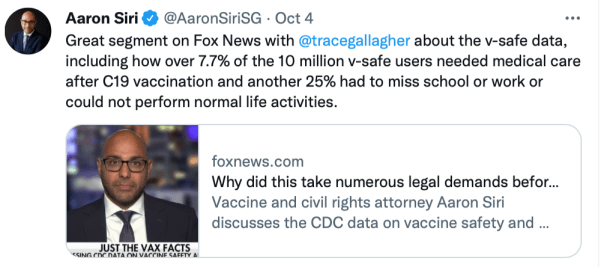
Of 10million users on the CDC’s V-Safe system, 7.7 per cent had to seek medical care after vaccination.
He says: “That’s an incredible percentage, it seems to me.”
It is simple maths. No less than 770,000 people required medical treatment after the Covid jab from a sample of just 10m. On top of that, 25 per cent – or two and half million – took time off from work or school after an injection.
The population of America is 330m and most States have pursued an aggressive jab policy, so just how much damage has really been caused? Their VAERS system is currently showing more than 30,000 reports of jab-related deaths; it is highly plausible that this represents an underestimate by a factor of 10, at least.
Of course, none of the above has been reported in UK mainstream media which, GB News excepted, remains wilfully blind to the mountain of evidence.
News Uncut has been consistent with concerns over one-sided news reporting, together with the suppression of opposing opinions in MSM and social media, the labels of ‘misinformation’ and the cancelling of eminent voices who dared to speak out.
The Trusted News Initiative, “an industry collaboration of major news and global tech organisations working together to stop the spread of disinformation,” is at the heart of this censorship and, shamefully, the BBC is a prominent participant along with Facebook, Google, Twitter and YouTube, to name just some. They have pronounced the facts and denied any counter argument, any fair debate.
In the recently released film Safe and Effective: A Second Opinion, the BBC was asked what happened to impartial reporting, balance and free speech. They refused to comment.
Now the Under-Secretary-General for Global Communications at the United Nations, Melissa Fleming (below), has admitted that the UN partnered with several big tech companies to control Covid and climate narratives while claiming “We own the science”.

Speaking at the World Economic Forum’s (WEF) Sustainable Development Impact meetings, Fleming told a panel on Tackling Disinformation that the UN had partnered with Google so that ‘authoritative’ narratives would appear at the top of search results.
Meanwhile, a judge in America has ordered the White House to release emails between various federal Agencies and Big Tech companies, with the paintiffs alleging collaboration over the suppression of free speech and information on Covid and the associated jabs.
Yes, the wall is crumbling under the weight of truth. But how many of the silent journalists here and abroad will be buried under the debris?
News Uncut suggests that now would be an appropriate time to find your voices.
By Dan Frieth | Reclaim The Net | October 7, 2022
The FBI has been sued for withholding records of communications with Facebook about the Hunter Biden laptop story.
In an appearance on Joe Rogan’s podcast in August, Meta CEO Mark Zuckerberg said that before the 2020 election, the FBI warned Facebook about Russian propaganda.
“The background here is that the FBI came to us – some folks on our team – and was like, ‘Hey, just so you know, you should be on high alert. We thought there was a lot of Russian propaganda in the 2016 election, we have it on notice that basically there’s about to be some kind of dump that’s similar to that,’” he said.
The FBI did not explicitly mention the laptop story but Facebook thought the story fit the pattern that the federal agency described and decided to limit the reach of the story.
Following Zuckerberg’s comments, the America First Legal (AFL), a legal nonprofit founded by former Trump adviser Stephen Miller, requested the FBI for the communications it had with Facebook between October 1, 2020, and November 15, 2020. The FBI refused to comply, claiming the request could not be done “with a reasonable amount of effort” because it was “overly broad.”
This week, the AFL filed a lawsuit to force the FBI to comply with its request.
We obtained a copy of the lawsuit for you here.
The lawsuit states: “Barely a month before the 2022 midterm election, FBI officials continue to suppress information of great interest to American voters and stonewall AFL’s request for records relating to the FBI’s collusive scheme with Facebook to censor news and information about the contents of Hunter Biden’s laptop.”
The AFL is convinced there was “comprehensive collusion” between the FBI and Big Tech to put Joe Biden in the White House.
“The evidence is that during the 2020 Presidential election campaign, the FBI conspired and combined with large corporations, including Facebook, to censor and suppress the damning evidence of
Biden family corruption and influence peddling found on Hunter Biden’s laptop,” said AFL Senior Counselor Reed Rubinstein.
“This was done to help Joe Biden and the Democrats win the 2020 election.”
Republican Senators Ron Johnson and Chuck Grassley wrote letters to FBI Director Chris Wray and Zuckerberg asking for the names of the employees involved in the communications about “Russian disinformation.”
“The American people deserve to know whether the FBI used Facebook as part of their alleged plan to discredit information about Hunter Biden,” the senators said in the letters.

By Hazem Ayyad | MEMO | October 7, 2022
Amir Hossein Zamani Nia, Iran’s OPEC governor, announced when he left a meeting with representatives of the 13 member states of the Organisation of Petroleum Exporting Countries (OPEC) and their ten allies – known as OPEC+ – the decision to reduce oil production by two million barrels per day for November.
The initial reactions to the large production cut were hysteria. One American journalist asked the Saudi Minister of Energy, Prince Abdulaziz Bin Salman, if he was worried about the American reaction to the production cut. He sarcastically told her to enjoy the sun in Vienna; a clear indication of the difficulties that Europeans will face next winter.
The American reactions to the decision of the OPEC+ countries were quick and distinct. White House press secretary Karine Jean-Pierre commented on the decision by saying it was clear that the OPEC+ alliance was “aligning with Russia” and was making a “short-sighted decision” to reduce oil production at the height of the conflict in Ukraine.
White House National Security Adviser Jake Sullivan noted that US President Joe Biden was feeling “disappointed” with the decision of the OPEC+ alliance to reduce its oil production.
The reactions confirm President Biden’s failure to manage the sanctions against Russia and the dismantling of the OPEC+ alliance, whose decisions ruined the ambitions of the US administration, the US Treasury, and the Federal Reserve to fight inflation and reduce interest rates.
The OPEC+ alliance has once again proven its strength and the unity of its countries, which include Iran, Saudi Arabia, the UAE and Russia. Despite the disparity, competition and conflict between its countries, the OPEC+ agreement exceeded the limits of technical performance confirmed by UAE Energy Minister, Suhail Al Mazrouei, when his country announced it was joining the efforts to reduce production. Its geopolitical reach extended from the Gulf and Yemen to the Red Sea and the Mediterranean.
The agreement that included regional opponents such as Iran, Saudi Arabia and the UAE, and international sponsors such as Russia, stressed the geopolitical dimensions as it coincided with a meeting held by the Russian President’s Special Envoy to the Middle East and Africa, Deputy Foreign Minister Mikhail Bogdanov, on Wednesday evening with the Emirati Ambassador to Moscow, Mohammed Ahmed Al-Jaber, to discuss the situation in Yemen and the Gulf region after the expiry of the deadline for the truce agreement in Yemen on 2 October.
This meeting came at the request of the Emirati ambassador and coincided with threats made by a member of the Political Bureau of the Houthi movement, Muhammad Al-Bakhiti. He said: “We have the ability and the courage to strike the Saudi and Emirati oil facilities if our demands are not met.”
The meeting with the Emirati ambassador coincided with a press conference held by the US special envoy to Yemen, Tim Lenderking, during which he discussed his country’s position on renewing the truce in Yemen between the countries of the Arab coalition, led by Saudi Arabia and the UAE, and the Houthi group. The US official held the Houthis responsible for hindering the reaching of an agreement without providing practical solutions for resuming the truce or dealing with Houthi threats.
These actions and movements confirm the connection between the regional files and their connection to the international mediations led by both America and Russia in Yemeni. Saudi Arabia and the UAE view the OPEC+ agreement as a trump card and a comprehensive framework that allows activating mediations and truces in Yemen, with the positive and consensual atmosphere it provides, which the Biden administration was unable to provide. This is despite its frequent talk about security cooperation in the Red Sea and the Gulf and naval and air manoeuvres, but it quickly turned into a political and economic framework that serves Israel and its interests more than it serves the interests of Riyadh and Abu Dhabi.
OPEC+ has shifted from a technical framework to an emerging economic and geopolitical framework; fuelled by the Ukrainian war and Russian demands. The tense American reactions deepened the Arab Gulf states’ mistrust of the American partner, which repeatedly failed to deal with the Yemeni and Iranian file. It also failed to deal with the economic requirements of the Gulf states and their political and cultural specificity, which put them in conflict with the powers of the region and threatened their political and religious legitimacy.
This article first appeared in Arabic in Arabi21 on 6 October 2022.
But it remains silent about Western possible involvement in the crime

By Lucas Leiroz | October 7, 2022
In a recent article published by The New York Times, it was reported that US intelligence believes Kiev authorized the terrorist attack that murdered Russian journalist and activist Daria Dugina, daughter of the political scientist and philosopher Aleksandr Dugin. With this, the prevailing narrative on the case in the US takes on an accusatory tone against Ukraine, but the silence remains on the connivance of Western countries, which refused to help the Russians to capture those responsible for the attack.
The article cites unidentified sources that confirm the Russian version that Dugina’s death was caused by an intelligence operation planned, authorized, and executed by Kiev’s agents. According to NYT’s sources, information confirming the Ukrainian authorship of the attack was shared among US officials recently, thus corroborating the suspicions previously showed not only by Moscow, but also by many experts around the world.
The article, however, emphasizes that the operation was conducted exclusively by Ukrainian officials, with no US agents participating. Apparently, American intelligence did not take note of any planned Ukrainian attack and only obtained confirmation about the plans of its Ukrainian partners much later, with the Americans even “admonishing” Kiev for having conducted such a bold operation.
“The United States took no part in the attack, either by providing intelligence or other assistance, officials said. American officials also said they were not aware of the operation ahead of time and would have opposed the killing had they been consulted. Afterward, American officials admonished Ukrainian officials over the assassination, they said”, the article mentions.
It is curious to observe how the American media has suddenly changed its assertion, after months denying the veracity of the reports published by the Russian government on the case. Some Western journalists even spread conspiracy theories about the possible involvement of the Russian state itself in the attack, trying to create the story that Moscow had planned a false flag operation to justify a military escalation.
Over time, however, the veracity of the Russian explanation of the case became undeniable. Russia did not initiate any escalation in the conflict, which made the false flag plot lose credibility. And the very Ukrainian practice of murdering civilians became so well known that it could no longer be hidden. Thus, for the NYT disseminating this type of content precisely at this time serves American interests perfectly, as a large media vehicle is getting ahead in releasing an “official version” of the facts, preemptively taking control of the narrative.
It is important to emphasize that American intelligence does not act in defense of “press freedom” when it communicates data to the major newspapers. There are always well-defined strategies and clear objectives to be achieved. In this case, the objective is to isolate the blame for the attack in Kiev and to exempt Western countries from any co-responsibility before Russian investigations go even deeper and other data are revealed. Now, any eventual Western involvement could be called a “conspiracy theory”.
However, it is curious to think that there is such a lack of communication between the Ukrainian and American intelligences. The Ukrainian neo-Nazi regime not only serves as a proxy for American interests but is virtually guided by the US in all its decisions, with NATO agents acting among the strategists in Kiev. It is hard to believe that NATO was not even aware that an operation as complex as the one that killed Daria was being planned by its partners.
However, Western contribution to Daria’s assassination goes beyond that. Western countries refused to cooperate with Russia to capture Daria’s murderer even after Moscow published official data on the conclusion of its investigations. Daria’s assassin, the Ukrainian spy, member of the Azov Battalion Natalya Vovk, after committing the crime fled to Estonia and then to Austria. Russia asked for cooperation and asked European authorities to help find the killer but received no response. In fact, this can be interpreted as a form of “participation”, considering that Western countries deliberately prevented Russia from capturing a criminal responsible for the death of a civilian, even though there was sufficient evidence of Vovk’s involvement in the crime.
Now that the Americans have admitted that their proxies killed an innocent civilian – and assuming the narration that the Ukrainians acted alone to be true – the least the Europeans should do is a formal apology and start cooperating so that Ukrainian criminals do not freely cross their borders when they are wanted in other countries. And the US should commit to preventing Kiev from doing anything like that again.
It remains to be seen, however, if the West is really innocent in this case or if this NYT’s publication was just a strategic move to take control of the narrative before something more frightening is revealed in the near future.
Lucas Leiroz is a researcher in Social Sciences at the Rural Federal University of Rio de Janeiro; geopolitical consultant. You can follow Lucas on Telegram.

or go to
Aletho News Archives – Video-Images
By Tony Cartalucci – New Eastern Outlook – 29.11.2017
The United States Air Force’s 59th Medical Wing’s molecular biology branch recently was revealed to have been collecting specifically Russian RNA and synovial (connective) tissue samples, prompting fears in Russia of a possible US directed ethnic-specific bioweapons program. … continue
 Aletho News If Americans Knew No Tricks Zone
