How Pfizer Profited From the Pandemic
By Dr. Joseph Mercola | July 18, 2022
According to Kaiser Health News (KHN),1 the COVID-19 pandemic has been a real boon to Pfizer. Not only has it yielded “outsize benefits” in terms of profits, but it has also “given the drugmaker unusual weight in determining U.S. health policy.”
“Based on internal research, the company’s executives have frequently announced the next stage in the fight against the pandemic before government officials have had time to study the issue, annoying many experts in the medical field and leaving some patients unsure whom to trust,” KHN reporter Arthur Allen writes, adding:2
“When last year Bourla suggested that a booster shot would soon be needed, U.S. public health officials later followed, giving the impression that Pfizer was calling the tune.
Some public health experts and scientists worry these decisions were hasty, noting, for example, that although boosters with the mRNA shots produced by Moderna and Pfizer-BioNTech improve antibody protection initially, it generally doesn’t last.
Since January, Bourla has been saying that U.S. adults will probably all need annual booster shots, and senior FDA officials have indicated since April that they agree … The company’s power worries some vaccinologists, who see its growing influence in a realm of medical decision-making traditionally led by independent experts …
When President Biden in September 2021 offered boosters to Americans — not long after [Pfizer CEO Albert] Bourla had recommended them — Dr. Paul Offit, director of the Vaccine Education Center at Children’s Hospital of Philadelphia … wondered, ‘Where’s the evidence you are at risk of serious disease when confronted with COVID if you are vaccinated and under 50?’
Policies on booster recommendations for different groups are complex and shifting, Offit said, but the CDC, rather than Bourla and Pfizer, should be making them. ‘We’re being pushed along,’ he said. ‘The pharmaceutical companies are acting like public health agencies.’”
The fact that a vaccine-pusher like Offit — infamous for claiming a baby can safely tolerate 10,000 vaccines at once3 — is questioning and pushing back against Pfizer’s influence over health policy reveals just how brazen, unethical and potentially dangerous that is.
Massive Profits Made From Useless Products
According to Allen, Pfizer’s revenue in 2021 was $81.3 billion4 — approximately double that of 2020 — and the COVID shot accounted for $36.78 billion5 of that. For comparison, Lipitor, Pfizer’s previous top selling statin, generates roughly $2 billion a year,6 while their strep vaccine, Prevnar 13 rakes in $6 billion a year.7
Its mRNA gene transfer injection against COVID now dominates 70% of the U.S. and European markets, and Paxlovid, Pfizer’s COVID drug, has become a standard treatment choice in hospitals. This, despite researchers finding Paxlovid (molnupiravir) causes severe rebound and supercharges mutations.
In a rational scenario, that finding would have put a stop to its use, but no. In an official health advisory8 to the public, issued May 24, 2022, the U.S. Centers for Disease Control and Prevention first warns that Paxlovid is associated with “recurrence of COVID-19 or ‘COVID-19 rebound,’” and then in the very next sentence stresses in bold print a narrative supporting its use and enriching Pfizer with instructions saying:
“Paxlovid continues to be recommended for early- stage treatment of mild to moderate COVID-19 among persons at high risk for progression to severe disease.”
Allen also notes that, during an investor call, a Pfizer official highlighted reports of Paxlovid’s failure, but spun it into “good news” for investors, as patients may require multiple courses!9 Obviously the objective has long ago shifted from helping humans to raping them for as much profit as possible.
Similarly, while Pfizer’s COVID jab clearly doesn’t prevent infection or spread, and Americans are rejecting the shots in growing numbers — 82.2 million doses had expired and were chucked in the trash as of mid-May 202210 — the U.S. government still went ahead and ordered another 105 million doses at the end of June 2022.
These are intended for a fall booster campaign, at a cost to taxpayers of $3.2 billion.11 The U.S. is actually paying about 50% more for each of these new jab boosters this time around — $30.47 per dose compared to $19.50 per dose paid for the first 100 million doses.
The U.S. government has also promised to purchase another 20 million courses of Paxlovid, at an eye-watering cost of $530 per five-day course. Basically, Pfizer is being financially rewarded for producing products that are useless at best and dangerous at worst, and we’re all paying for it. In case you’re curious, that is another $10.6 billion transferred from U.S. taxpayers to Pfizer.
Future Boosters Won’t Undergo Human Clinical Trials
After you likely thought it couldn’t ever get any worse, KHN also touches on, but doesn’t delve into, the fact that Pfizer suggested they skip human trials as they move forward with jabs that are reformulated for newer variants. If this strikes you as crazy, you’d be right. It’s sheer madness, but the U.S. Food and Drug Administration — a clearly captured agency — has already surreptitiously agreed to this egregious miscarriage of science.
How this wicked scheme, known as the “Future Framework,”12 was adopted by the FDA without formal vote is explained by Toby Rogers, Ph.D. — a political economist whose research focus is on regulatory capture and Big Pharma corruption13 — in the video above. He also explained it in a June 29, 2022, Substack article:14
“Yesterday [June 28], the FDA’s Vaccines and Related Biological Products Advisory Committee approved a bivalent COVID-19 shot with the Wuhan strain and the Omicron variant … Wait, hold up, I thought the FDA was voting on the Future Framework yesterday?
The policy question was whether reformulated COVID-19 shots would be treated as new molecular entities (which they are) in which case they should be subject to formal review or whether reformulated shots would be treated as ‘biologically similar’ to existing Covid-19 shots and be allowed to skip clinical trials altogether.
Apparently the FDA did not have the votes to just pass this as a policy question. If you ask anyone whether reformulated mRNA represents a new molecular entity, well of course it is, so that would require formal regulatory review.
What the FDA did instead was to smuggle the policy question in disguised as a vote about reformulated ‘boosters’ for the fall.
In essence, the FDA just started doing the Future Framework (picking variants willy nilly, skipping clinical trials) and essentially dared the committee members to turn down a booster dose — knowing that all of the VRBPAC members are hand-picked because they’ve never met a vaccine they did not like.
So of course only two people on the committee had the courage to turn down a booster dose — even though it was based on this preposterous process (that was never formally adopted) where there was literally no data at all … By stealth, the FDA replaced a system based on evidence with a system based entirely on belief.”
Countries Held to Ransom
In 2021, secret details of Pfizer’s contracts came to light, showing they are essentially holding countries hostage to nonnegotiable demands for payment in full AND freedom from liability.15
In late February 2021, The Bureau of Investigative Journalism reported16 that Pfizer was demanding countries put up sovereign assets as collateral for expected vaccine injury lawsuits resulting from its COVID-19 jab.
Several countries, including Brazil, Chile, Colombia, the Dominican Republic and Peru, agreed to this demand, putting up bank reserves, military bases and embassy buildings as collateral. In short, theses governments are guaranteeing Pfizer will be compensated for any expenses resulting from injury lawsuits against it, so the company won’t lose a dime if its COVID shot injures people.
Shockingly, these terms are binding even if those injuries are the result of negligent company practices, fraud or malice!
In October that same year, Public Citizen published the secret contracts17,18 between Pfizer and Albania, Brazil, Colombia, Chile, Dominican Republic, the European Commission, Peru, the U.S. and the U.K., further revealing the extent to which these countries handed power over to Pfizer. In almost all scenarios, Pfizer’s interests come first.
For example, government purchasers must acknowledge that the effectiveness and safety of the shots are completely unknown, all while indemnifying Pfizer against any and all financial liability. This is the ultimate corporate maleficence, using their leverage to force the kill shot down these countries’ throats and avoiding any personal responsibility for damages.
Even if Pfizer eventually is convicted of fraud in the U.S. and loses all its liability protection from the COVID jabs because of it, that judgment would not impact these foreign contracts. These countries sold their souls to Pfizer and have absolutely no recourse but to pay even if the shots kill everyone.
The contracts for at least four countries also secure Pfizer’s intellectual property rights even if the company is found to have stolen intellectual property rights of others. In such case, the government purchaser becomes the liable party. As explained by Public Citizen :19
“For example, if another vaccine maker sued Pfizer for patent infringement in Colombia, the contract requires the Colombian government to foot the bill. Pfizer also explicitly says that it does not guarantee that its product does not violate third-party IP, or that it needs additional licenses.
Pfizer takes no responsibility in these contracts for its potential infringement of intellectual property. In a sense, Pfizer has secured an IP waiver for itself. But internationally, Pfizer is fighting similar efforts to waive IP barriers for all manufacturers.”
Equally shocking is that countries are forced to follow through on their vaccine orders even if other drugs or treatments emerge that can prevent, treat or cure COVID-19.20 Is it any wonder, then, that governments around the world have suppressed the use of safe and effective outpatient drugs like hydroxychloroquine and ivermectin?
If these drugs were allowed to be used and could be proven to work, the COVID injections would be completely unnecessary and their emergency use authorization would disappear, yet governments are on the hook for hundreds of millions of doses.
Pfizer Has ‘Habitual Offender’ Track Record
The fact that Pfizer has behaved like a criminal who works out a cover story for a planned murder before committing it is not surprising, considering its history. Pfizer, has been sued in multiple venues over unethical behavior, including unethical drug testing and illegal marketing practices.21
In his 2010 paper,22 “Tough on Crime? Pfizer and the CIHR,” Robert G. Evans, Ph.D., Emeritus Professor at Vancouver School of Economics, described Pfizer as “a ‘habitual offender,’ persistently engaging in illegal and corrupt marketing practices, bribing physicians and suppressing adverse trial results.”
Between 2002 and 2010 alone, Pfizer and its subsidiaries were fined $3 billion in criminal convictions, civil penalties and jury awards. They are recurrent criminal felons. None of these convictions has deterred their nefarious behavior.
In 2011, Pfizer agreed to pay another $14.5 million to settle federal charges of illegal marketing,23 and in 2014 they settled federal charges relating to improper marketing of the kidney transplant drug Rapamune to the tune of $35 million,24 as well as $75 million to settle charges relating to its testing of a new broad spectrum antibiotic on critically ill Nigerian children.
As reported by the Independent 25 at the time, Pfizer sent a team of doctors into Nigeria in the midst of a meningitis epidemic. For two weeks, the team set up right next to a medical station run by Doctors Without Borders and began dispensing the experimental drug, Trovan. Of the 200 children picked, half got the experimental drug and the other half the already licensed antibiotic Rocephin.
Eleven of the children treated by the Pfizer team died, and many others suffered side effects such as brain damage and organ failure. Pfizer denied wrongdoing. According to the company, only five of the children given Trovan died, compared to six who received Rocephin, so their drug was not to blame.
The problem was they never told the parents that their children were being given an experimental drug. What’s more, while Pfizer produced a permission letter from a Nigerian ethics committee, the letter turned out to have been backdated. The ethics committee itself wasn’t set up until a year after the trial had already taken place. Pfizer’s rap sheet also includes bribery, environmental violations, labor and worker safety violations and more.26
Wolves in Sheep’s Clothing
Now, despite Pfizer being one of the least ethical drug companies, we’re told to trust them with our very lives, and the lives of our precious children. They’re going to put out booster shots this fall that have undergone absolutely no testing whatsoever, and we’re to simply throw caution to the wind because Pfizer — which has no liability whatsoever — says so.
In 2014, Pfizer faced a surge of lawsuits that accused it of hiding known side effects of its anticholesterol drug Lipitor.27 They got off scot-free that time, as a federal judge dismissed thousands of cases alleging the drug caused Type 2 diabetes.28,29 But at least they had liability and could be sued.
When it comes to the COVID jabs, injured patients and family members of those killed by it won’t even have the ability to sue for damages, as governments around the world have indemnified them completely, and it looks as though they might not even be liable even if they’re found guilty of fraud. But we will have to see what the courts rule on that one. Still, that any nation would agree to a contract like that is just mindboggling.
Meanwhile, mounting evidence shows the COVID shots destroy immune function over time, and Pfizer’s own trial data reveal deaths and serious adverse events numbering in the tens of thousands.
It’s hard to tell who’s more deserving of punishment — Pfizer or the equally captured federal agencies, the FDA and the CDC, that go along with them and do nothing to protect the lives of the youngest members of our society. Clearly, it’s up to us to protect ourselves and our loved ones, because wolves in sheep’s clothing are ruling the roost — they’re making all the decisions, and captured agencies are simply doing their bidding.
Sources and References
- 1, 2, 4, 9 KHN July 5, 2022
- 3 Science Daily January 10, 2002
- 5 Washington Examiner February 8, 2022
- 6 Axios October 30, 2019
- 7 True Cost of Health Care
- 8 CDC Advisory May 24, 2022
- 10 NBC News June 6, 2022
- 11 Businesswire June 29, 2022
- 12 FDA Briefing Document June 28, 2022
- 13 Brownstone Institute June 22, 2022, Author’s Bio
- 14 uTobian June 29, 2022
- 15 STAT News February 23, 2021
- 16 The Bureau of Investigative Journalism February 23, 2021
- 17, 19 Public Citizen October 19, 2021
- 18 Twitter Zain Rizvi October 19, 2021
- 20 COVID19up.org August 17, 2021 (archived)
- 21 SGT Report January 7, 2021
- 22 Healthcare Policy 2010 May;5(4):16-25
- 23 DOJ October 21, 2011
- 24 Reuters August 6, 2014
- 25 The Independent March 23, 2014
- 26 Corporate Research Project Pfizer
- 27 Reuters August 8, 2014
- 28 Drugwatch Lipitor Lawsuits
- 29 Reuters May 12, 2021
Putin tells US to stop ‘looting’ Syria
Samizdat | July 19, 2022
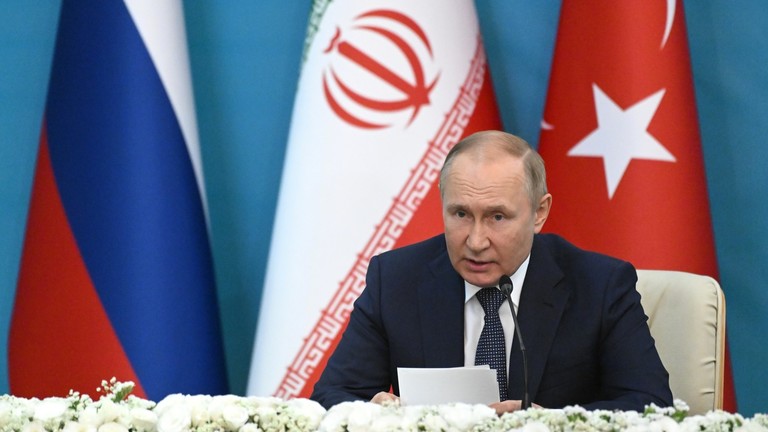
The US needs to stop “stealing” the oil from the Syrian people and state, Russian President Vladimir Putin said on Tuesday, after meeting with his Iranian and Turkish counterparts in Tehran. The three guarantors of the “Astana process” also agreed that the US should leave the trans-Euphrates, and stop making the humanitarian crisis in Syria worse with their unilateral sanctions.
American troops must leave the territory east of the Euphrates river and “stop robbing the Syrian state, the Syrian people, exporting oil illegally,” Putin told reporters on Tuesday evening. He said this was a “common position” of Russia, Iran and Turkey.
Several hundred US troops are illegally present in Syria, mainly controlling the oil wells and wheatfields in the country’s northeast, controlled by the Syrian Democratic Forces (SDF) militia since the defeat of Islamic State (IS, formerly ISIS) terrorists. The US-backed SDF has refused to reintegrate with the government in Damascus, which Washington wishes to see overthrown.
Since 2019, the US has sought to punish anyone trying to assist the reconstruction of war-torn Syria via the “Caesar Syria Civilian Protection Act,” accusing the government of President Bashar Assad of war crimes and blocking all assistance to Damascus.
Putin said on Tuesday that such sanctions have had “disastrous results” and that humanitarian aid to Syria “should not be politicized.”
During Tuesday’s summit in Tehran, Putin met with Iranian President Ebrahim Raisi and Turkey’s Recep Tayyip Erdogan. In a joint declaration, the three presidents confirmed their conviction that “there can be no military solution to the Syrian conflict,” only a political one under the leadership of the UN. They also condemned “unilateral sanctions violating international law” that are exacerbating the serious humanitarian situation in Syria, urging the UN and other international organizations to “increase assistance to all Syrians, without discrimination, politicization and preconditions.”
Russia sent an expeditionary force to Syria in September 2015, at the request of Damascus, to help defeat IS and other terrorist groups. In January 2017, Moscow, Ankara and Tehran launched the “Astana process” – named after the capital of Kazakhstan – to resolve the conflict in Syria, which began in 2011.
China blames US for Ukraine conflict
Samizdat | July 19, 2022
A spokesman for the Chinese Foreign Ministry accused the US of starting the crisis in Ukraine and fueling the conflict. Zhao Lijian told reporters at a regular press briefing on Tuesday that Washington should stop playing “world police” and work on creating conditions for peace talks instead.
Zhao was asked about the recent remarks by US State Department spokesperson Ned Price, who once again threatened China with a “very steep cost” should Beijing help Moscow evade Western sanctions – even though there was no evidence China was actually doing so.
Accusing Price of sounding “as if the US were the world police,” Zhao said that China “takes an objective and fair stance and stands on the side of peace and justice” when it comes to Ukraine.
“As the one who started the Ukraine crisis and the biggest factor fueling it, the US needs to deeply reflect on its erroneous actions of exerting extreme pressure and fanning the flame on the Ukraine issue.”
“We firmly oppose any unwarranted suspicion, threat and pressure targeting China. We are also firmly against unilateral illegal sanctions and long-arm jurisdiction with no basis in international law,” Zhao said.
Washington needs to “stop playing up bloc confrontation and creating a new Cold War by taking advantage of the situation,” Zhao added, urging the US to instead “facilitate a proper settlement of the crisis in a responsible way and create the environment and conditions needed for peace talks between parties concerned.”
This is not the first time China has pushed back on US pressure to side with the West against Russia in the matter of Ukraine. Last month, Zhao’s colleague Wang Wenbin also chided Washington for fueling the conflict and wanting to “fight to the last Ukrainian” while Beijing wanted a negotiated peace. He stopped short of blaming the US for starting the current military confrontation, however.
At the end of June, NATO Secretary General Jens Stoltenberg told reporters the alliance had been “preparing for this since 2014,” referring to the US-backed government in Kiev which came to power after the coup ousted the elected president and triggered the crisis with Crimea and Donbass.
At Tuesday’s press conference, Zhao also rejected US accusations that China was contributing to food shortages in Africa, pointing the finger back at Washington.
“It is quite clear to the world who exactly is causing the global food crisis,” he said. “We hope that the US will seriously reflect on its disreputable role in the global food crisis and stop smearing and making groundless accusations against China.”
Russia sent troops into Ukraine on February 24, citing Kiev’s failure to implement the Minsk agreements, designed to give the regions of Donetsk and Lugansk special status within the Ukrainian state. The protocols, brokered by Germany and France, were first signed in 2014. Former Ukrainian president Pyotr Poroshenko has since admitted that Kiev’s main goal was to use the ceasefire to buy time and “create powerful armed forces.”
In February 2022, the Kremlin recognized the Donbass republics as independent states and demanded that Ukraine officially declare itself a neutral country that will never join any Western military bloc. Kiev insists the Russian offensive was completely unprovoked.
Ukraine’s ‘Great Game’ surfaces in Transcaucasia
BY M. K. BHADRAKUMAR | INDIAN PUNCHLINE | JULY 19, 2022
If the metaphor of the “Great Game” can be applied to the Ukrainian crisis, with the expansion of the North Atlantic Treaty Organisation (NATO) at its core, it has begun causing reverberations across the entire Eurasian space. The great game lurking in the shade in the Caucasus and Central Asian regions in recent years is visibly accelerating.
The edge of the game is above everything else the targeting of Russia and China by the United States. This unfolding game cannot be underestimated, as its outcome may impact the shaping of a new model of the world order.
Starting with the Caspian Summit in Ashgabat on June 29, the inter-connected templates of the great game in the Caucasus began surfacing. The fact that the summit was scheduled at all despite the raging conflict in Ukraine — and that Russian President Vladimir Putin took time out to attend it — testified to the high importance of the event.
Basically, the presidents of the 5 littoral states — Kazakhstan, Iran, Turkmenistan, Azerbaijan and Russia — synchronised their watches, based on the Convention on the Legal Status of the Caspian Sea — the Constitution of the Caspian Sea — that was signed at their last summit in 2018. While doing so, they considered the current international situation and geopolitical processes worldwide.
Thus, one of the key points of the Final Communiqué of the Ashgabat Summit was the reiteration of a fundamental principle regarding the total exclusion of the armed forces of all extra-regional powers from the Caspian Sea (which primarily meets the geopolitical interests of Russia and Iran.) The fact that the heads of the Caspian countries confirmed this in writing can be regarded as the main result of the Summit. Secondly, the leaders focused on the Caspian transport communications and agreed that the region could become a hub for the East-West and North-South corridors.
The Caspian Summit was held just 5 weeks after Russian forces gained control of Mariupol port city (May 21), which established its total supremacy over the Sea of Azov and the Kerch Strait in eastern Crimea. Kerch Strait has a strategic role in Russian policies, being the narrow maritime gateway (5 kms in length and 4.5 km. wide at the narrowest point) which links the Black Sea via the Sea of Azov to Russia’s major waterways including the Don and the Volga.
In effect, it is yet to sink in that in the geopolitics of the entire Eurasian landmass, the liberation of Mariupol by Russian forces was a pivotal event in the great game, since the Kerch Strait ensures maritime transit from the Black Sea all the way to Moscow and St Petersburg, not to mention the strategic maritime route between the Caspian Sea (via the Volga-Don Canal) to the Black Sea and the Mediterranean.
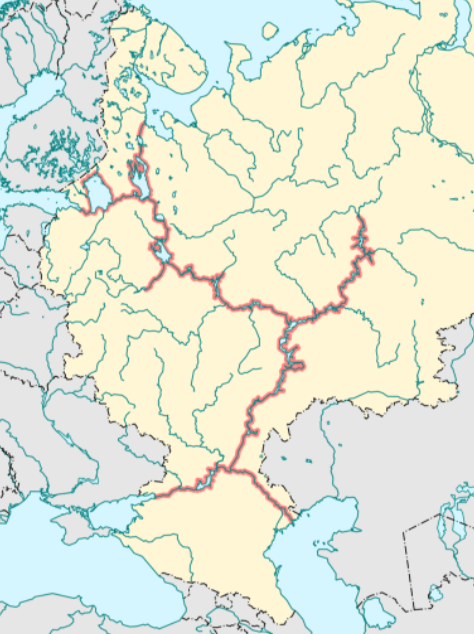
United Deep Waterway System of European Russia linking Sea of Azov and Caspian Sea to Baltic Sea and the Northern Sea Route
Now, to get the “big picture” here, factor in that the Volga River also links the Caspian Sea to the Baltic Sea as well as the Northern Sea Route (via the Volga–Baltic Waterway). Suffice to say, Russia has gained control of an integrated system of waterways, which connects the Black Sea and the Caspian Sea to the Baltic and the Northern Sea Route (which is a 4800 km long shipping lane that connects the Atlantic with the Pacific Ocean, passing along the Russian coasts of Siberia and the Far East.)
No doubt, it is a stupendous consolidation of the so-called “heartland” — per Sir Halford Mackinder’s theory (1904) that whoever controls Eastern Europe controls the Heartland and controls the “world island.”
Looking back, therefore, there is no question that the reunion of Crimea with the Russian Federation in 2014 was a major setback for the US and NATO. Putin caught Washington and its allies by total surprise. It complicated their objective to integrate Ukraine into the NATO.
The US was caught unawares for the second time when in the early days of the current special military operation, when all western eyes were trained on the Kiev region, Russian troops captured the highly strategic southern city of Kherson as early as on March 2. The significance of it was understood only by those who could perceive the great game unfolding in Ukraine as something much more than a mere military conflict. (Most Americans still don’t get it.)
The capture of Kherson in early March practically spelt doom for NATO’s design to extend its military presence in the Black Sea basin. Today, the game is practically over for the US and NATO, once Russia took control of the entire basin of the Sea of Azov. Russia now de facto controls the access of Dniepr to and from the Black Sea. And Dniepr happens to be the main river way for Ukraine’s transportation links to the world market.
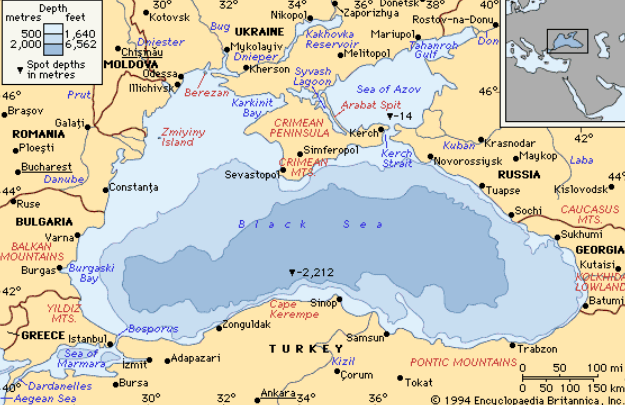
To the immediate east of the Kerch Strait is Russia’s Krasnodar region, which extends southwards to Russia’s largest commercial port on the Black Sea, Novorossiysk at the cross-roads of major oil and gas pipelines between the Black Sea and the Caspian Sea. In sum, control of the Kerch Strait gives Russia a big say with regard to the transportation routes linking Western and Eastern Europe to the Caspian Sea basin, Kazakhstan and China. Put differently, this part of the Russian special military operation becomes an integral part of Moscow’s Eurasian project linking up with China’s Belt and Road Initiative.
Washington has belatedly understood that Russia has outwitted the western alliance and gained the upper hand in the great game in the eastern Black Sea region. So, the Western strategy towards the Caucasus and Central Asia is being reworked. The NATO Secretary-General Jens Stoltenberg scheduled a meeting in Brussels today with the foreign minister of Azerbaijan Jeyhun Bayramov.
Importantly, Bayramov also attended a meeting of the EU-Azerbaijan Cooperation Council today in Brussels. The EU foreign policy chief Josep Borrell later said at a joint news conference with Bayramov that “Azerbaijan is an important partner for the European Union and our cooperation is intensifying.” Meanwhile, yesterday, the European Commission President Ursula von der Leyen visited Baku to sign a memorandum of understanding with Azerbaijan on energy cooperation.
All this is taking place against the backdrop of Charles Michel, the president of the European Council, spearheading efforts to mediate between arch rivals Azerbaijan and Armenia. As part of the EU’s diplomatic efforts, Michel hosted in April a meeting in Brussels between Azerbaijan’s President Aliyev and Armenia’s Prime Minister Nikol Pashinyan where the two sides expressed willingness to secure a peace agreement. Last week, CIA Director William Burns paid an unpublicised visit to Yerevan in this connection. Evidently, Washington and Brussels are jointly strategising a game plan to replace Russia and Turkey, which have hitherto taken the lead roles in Transcaucasia.
There should be no doubt that Moscow is watching closely the synchronised US-EU-NATO moves in the Caucasus targeting Azerbaijan with a view to undermine Russia’s consolidation in the Black Sea and the Caspian Sea regions, which poses a formidable hurdle to the advancement of the NATO strategies toward Central Asia and Xinjiang. This is a high-stakes game.
It will be recalled that on February 22, just two days prior to the launch of the special military operation in Ukraine, Putin hosted the president of Azerbaijan Ilham Aliyev in the Kremlin. They signed “a wide-ranging agreement,” the details of which were not divulged. The document is titled the Declaration on Allied Interaction.
Clearly, oil-rich Azerbaijan, which is not only a littoral state of the Caspian Sea but a gateway to both Central Asia and Russia’s Volga region, is destined to play a key role in the great game in the period ahead.
Breakaway region bordering Ukraine seeks security guarantees
Samizdat | July 19, 2022
Transnistria, a breakaway region of Moldova, has proposed that all parties in the ongoing ‘5+2’ peace talks sign a document providing security guarantees for the unrecognized republic that borders Ukraine.
Transnistrian President Vadim Krasnoselsky floated the idea during his meeting with Russia’s representative at the talks, ambassador-at-large Vitaly Tryapitsin, on Tuesday.
“There is an idea to appeal to all participants in the ‘5+2’ format [to] draw up a single document on the guarantees of peace and security of Transnistria,” Krasnoselsky said, as quoted by his press service. “If they keep talking about peace, let’s see them all sign it.”
The talks between Moldova and Transnistria are being mediated by Russia, Ukraine and the OSCE, while the US and EU attend as observers. They began in 2005 in an attempt to find a solution to the conflict between Chisinau and the breakaway republic. They have effectively been on hold since 2019.
According to Krasnoselsky, even if the ‘5+2’ format shows no signs of progress, there still should be at least some bilateral engagement between Moldova and the Russian-speaking breakaway Pridnestrovian Moldavian Republic (PMR).
“There are political representatives, there is the president, there are other Moldovan officials who should now be talking and finding compromises on the issues that are currently not being solved. The agenda of the talks is known by everyone quite well, and it still holds true,” he said.
The disputes between the PMR and Moldova should now be viewed “in a different light” because of Chisinau’s decision to apply for EU membership, the president added. “Moldova and the PMR are moving in opposite directions,” he said.
A nation of 2.6 million people sandwiched between Ukraine and Romania, Moldova declared itself a neutral state soon after gaining independence as a result of the collapse of the Soviet Union. However, it has long aimed to become a member of the EU – and was finally granted candidate status in late June, along with Ukraine.
Since the start of the conflict between Russia and Ukraine, Transnistria has seen a number of explosions and other provocations. The region, stretching along the Ukrainian border, maintains strong ties with Moscow and hosts Russian peacekeepers.
Venezuelan ruling party leader accuses US of gas pipeline ‘sabotage’
Samizdat | July 19, 2022
CARACAS – The vice president of the ruling United Socialist Party of Venezuela (PSUV), Diosdado Cabello, accused the United States of “sabotage” at state-run Venezuelan oil facilities.
On Sunday, Venezuelan Petroleum Minister Tareck El Aissami said that a Petroleos de Venezuela (PDVSA) gas pipeline in the northern state of Monagas was attacked, which triggered a fire at one of its sites. In June, the country’s authorities said that there was an attempted sabotage at the El Palito refinery in the northern state of Carabobo, which could have caused “catastrophic damage” to these facilities. Additionally, a massive fire broke out at the Cardon refinery in the northern state of Falcon in May.
“This is part of the US imperialism policy: attacking oil facilities, sending mercenaries here, some of whom were detained, while others were convicted of coup attempt and murder in our country. These are US government envoys,” Cabello said at a press conference in Caracas on Monday.
The recent “sabotage” at the PDVSA pipeline shows that the US government does not stop in its goal to destabilize the situation in Venezuela, according to Cabello.
“Such events should teach us that imperialism does not rest, they would like to see us torn apart and begging for mercy. It will not happen because our nation is not used to it, our nation does not give up,” Cabello said, adding that the security authorities will take responsibility for any act of aggression in Venezuela.
Venezuelan President Nicolas Maduro had previously implicated Colombian President Ivan Duque in attacks on oil and electricity infrastructure of Venezuela.
China dumping American debt – US Treasury data
Samizdat | July 19, 2022
China’s holdings of US treasury securities dropped below $1 trillion in May for the first time in more than a decade, information released by the US Department of the Treasury shows. Official data is regularly published with a two-month delay.
China, the second largest foreign holder of US government debt, has reduced its holdings for six consecutive months from $1.08 trillion last November to $980.8 billion in May. That’s a decline of nearly $100 billion, or 9%. The last time China held less than $1 trillion of US treasury securities was in May 2010 ($843.7 billion).
Japan, the largest foreign holder of US government debt, has also decreased its holdings recently. In the six months from November to May, it dropped by nearly $116 billion to $1.212 trillion.
The total US national debt was just above $30.4 trillion as of last month. Washington has been struggling to contain skyrocketing inflation that hit a 41-year high at 9.1% in June. The US Federal Reserve hiked its benchmark interest rate by 0.75 of a percentage point in June, triggering warnings of a possible recession. Another increase could be introduced in an upcoming meeting next week.
According to CNBC, rising interest rates have made US treasury securities potentially less attractive, but the decline in China’s share could also be attributed to Beijing working to diversify its foreign debt portfolio.
Nasrallah: If Lebanon is denied its oil and gas resources, we will shut down all Israeli platforms
Speech by Hezbollah Secretary General Sayed Hassan Nasrallah on July 13, 2022, on Biden’s visit to the Middle East and the border dispute between Lebanon and Israel over the Karish maritime gas field.
Source: almanar.com.lb Translation: resistancenews.org
Transcript:
[…] Now I come to the main point of my speech tonight. One of the results of the July (2006) war is the establishment of a balance of deterrence in the struggle against the Israeli enemy, between Lebanon and the enemy entity. These equations, this balance… Of course, I am not talking about a balance of forces in terms of the number of our respective soldiers, our respective naval power or our respective air forces. That’s not what I’m talking about. I’m talking about a balance of deterrence, a balance of fear, a balance of terror. It’s a different kind of equation (than a strict balance of power).
For the past 16 years, that is, from 2006 to the present, Lebanon has enjoyed an excellent security situation with regard to the fight against the Israeli enemy, if we compare it to what used to happen before. The enemy has been unable to include Lebanon in its strategy of “the battle between wars” (conducting episodic strikes without starting a war, as it does in Syria), and Israel thinks a thousand times before taking any military action against Lebanon, knowing that there would be retaliation (from Hezbollah). That is why when Israel tries to do something (in Lebanon), it tries to carry out security operations (against Hezbollah) trying as much as possible not to leave any footprints, any traces (of its involvement). This achievement (of the Resistance) is still valid.
In this regard, before the episode of the drones (sent by Hezbollah over the Israeli gas platform in Karish), after my (last) speech about Israel’s exploitation of the Karish field (claimed by Lebanon; Hezbollah promised to prevent Israel from extracting gas from it, even if it means war), the enemy War Minister… Of course, all Israeli officials spoke out to threaten, promise (retaliation), etc, but in these days of commemoration of the 2006 war, I only want to comment on one sentence of the Minister of War [Benny] Gantz. He said, and I quote you his words, “We are ready for war, and if necessary, we will march again on Beirut, Sidon and Tyre.” I’ll just comment on that sentence before I continue. In short, Gantz knows very well that such words are pure mockery, and that he is lying to himself, to his people and to his peers. All Israelis know that this is just empty rhetoric that carries absolutely no weight. Yes, anyone in Israel can say that they are going to bomb, destroy Lebanon, etc. I am not saying that they are incapable of doing this: on the contrary, it is ALL they are capable of. In all the wars against Gaza, all they have done is air strikes, missile strikes, artillery strikes, nothing else. The only time they made a ground incursion into Gaza, they suffered a disaster, and even had prisoners taken (by Hamas)! And even in the recent military maneuvers they dubbed “Chariots of Fire”, the entire operation towards Gaza was based on firepower, not on a ground incursion.
So you (Israelis), who, faced with a Gaza under siege for 15 years, whose geography is flat, whose conditions are (so) difficult, and whose weapons are largely produced locally, do not even dare to take a few steps forward, you claim to invade Lebanon and reach Tyre, Saida and Beirut? You are completely mistaken if you make the same calculations as 20, 30 or 40 years ago, as if the situation (today) was the same (as when Israel invaded Lebanon in 1982). In any case, I advise Gantz to review his case, and in particular to review the last days of the 2006 war, when the Israelis took the decision to enter the town of Bint Jbeil, which is very close to the international border (between Lebanon and Israel). Let him review in particular the number of elite troops that participated, the generals that participated, the tank battalions that participated, the size of the forces that participated, the artillery and aerial firepower, the missile strikes, the planes, the helicopters, etc. They destroyed most of the city, besieged it, and left only one exit route for the fighters to flee. But the fighters did not flee, and the opposite happened: more (Hezbollah) fighters entered Bint Jbeil. The situation was quite different (from what Israel imagined). And Israel’s goal may not even have been to occupy the whole city of Bint Jbeil, but only to reach the stadium where I gave the spider’s web speech (on May 25, 2000) and plant the Israeli flag there. And even that you were unable to do! And this during the last days of the war, when, in your eyes, the (Hezbollah) fighters would be exhausted and weakened by the bombing, with low morale, etc. But such is the experience of Bint Jbeil, the closest city to occupied Palestine (it was a resounding failure for Israel).
Therefore, to claim that Israel will reach Saida, Tyre and Beirut is a preposterous statement, and I believe that all Lebanese have laughed at this statement and these threats. Those days (when Israel could occupy our capital) are well and truly over. And that is why we need not fear anything on this side in the ongoing border dispute between Lebanon and Israel: Israel is threatening us with invasion, but what could it possibly invade? During the 33 days of the 2006 war, it remained at the gates of Ayt al-Chab and our other villages at the border, without being able to enter them. Israel tried to enter Maroun al-Ras for 3 days, despite the fact that there were only a small number of fighters there, (but failed).
I only want to confirm, regarding the lessons and teachings of the 2006 war for the future, especially regarding South Lebanon and the Israeli claim to carry out a ground incursion there, that today, the popular support (for the Resistance) is different from that of 1982: the masses overwhelmingly support the Resistance and embrace it (totally). The organization of the Resistance is very large, and has no comparable precedent, both in terms of its numbers and its military capabilities and power. Likewise, the will to fight, the spirit of resistance, and this is what counts most, is stronger and higher than ever before. Not to mention the (mountainous) geography of Lebanon (conducive to guerrilla warfare). The geography is with the Resistance, the people are with the Resistance, the capabilities are with the Resistance, the Resistance is with the Resistance, and first and last, God the Most High and Exalted is with the Resistance. It is He who has given it victory in the past, and it is He who will give it victory at any time in the future. God never fails in His promise, and He gives victory to those who fight in His way [Quran, XXII, 40].
The third point is the issue of oil and gas. One of the consequences of the 2006 war is that it demonstrated the power of the Resistance to protect Lebanon. A new equation (of deterrence) was imposed, I just mentioned it. The protection of Lebanon, its territory, its population, its national security —I’m not talking about the security of the Lebanese society, currently in crisis— in the fight against the Israeli enemy, its natural resources, etc. All this —and I am beginning to be very precise in my remarks— constitutes the only strength that Lebanon has in order to obtain its rights to the oil and gas deposits, to extract them and to sell them. There are several key points in this matter.
First, no Lebanese questions the fact that the golden opportunity to save Lebanon is to extract its oil and gas. When I talk about saving Lebanon, I am talking about saving the State, the majority of whose public services are suspended. Salaries and services are insufficient, but the State is unable to remedy this. Tomorrow, if the Central Bank’s reserves run out, even the salaries of civil servants may not be paid. There will be no more subsidies for medicines, flour, etc. The State is on the verge of collapse, and the country is heading towards an extremely difficult and even critical situation. What else? Even if reforms are carried out, I have already mentioned it but I want to repeat it, the conditions imposed by the IMF for the granting of a 3 billion dollar loan (are draconian), and such a sum cannot meet Lebanon’s (enormous) needs. Someone told me that it doesn’t matter if the IMF gives only $3 billion, what matters is that if this loan is granted, it will give more confidence in Lebanon, and then an international conference can be organized to help Lebanon. Very well, but what can we expect from it? $10, $11, $12 billion, like the CEDRE Conference, the majority of which will be loans, and therefore new debts for Lebanon, with very strict conditions. Will this solve Lebanon’s problems? Lebanon’s problems are much more important than that.
There is a second option, which does not bring $3 billion in debts, nor $11 billion in debts, but hundreds of billions of dollars that will be our property, with which we will be able to pay our debts, pay [and increase] the salaries of civil servants, subsidize medicines, flour, find financing to revive the economy, etc. Because in fact, the lifting of subsidies on gasoline and fuel has not revived anything. The only existing and dignified way of salvation for the Lebanese is the exploitation of our oil and gas: no other way has appeared until now.
The second point is that the golden opportunity is now. It is now, during these two months. And now there are less than two months left, what’s left of July and August, into September, early September, the first week of September —I’ll spell it out in detail. We have a golden opportunity now. Why do I say golden opportunity? If there was no war between Russia and Ukraine, there would not be this (urgent) need of Europe and the United States for gas and oil. I don’t mean that they will import gas and oil from Lebanon, because to install sea platforms, extract hydrocarbons and sell them, it takes years. But Lebanon’s strength is that it can be a problem, an obstacle to the Israeli enemy, to the Israeli entity, and create a problem in the whole region that will prevent the extraction of gas and oil (in the Mediterranean), and will prevent the sale of gas and oil to Europe. Because these people are in a panic situation, they have no choice and they have no time. And I explained that Biden came to the Middle East in the first place for that (to convince the Gulf countries to increase their oil and gas production). They absolutely need oil and gas now.
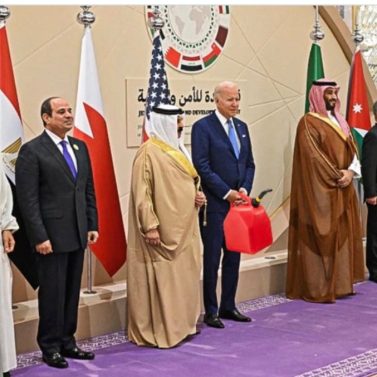
And that’s why Israel rushed to exploit the Karish field. Why do I say that everything is being played out in these two months? Because now is the time to find alternative oil and gas for Europe [before winter], and this is the time required by the company [Energean] to start extracting oil and gas from Karish. This is our window of opportunity. If this two-month period passes and Lebanon has not obtained its rights, the situation will be very difficult, and it will be infinitely harder to obtain our rights. If we have to get our rights after the extraction of oil and gas has started in Karish, it will cost us much more. It is up to you to understand what I mean. The price we have to pay will be much higher. That is why I said in my last speech that time is running out, that it is crucial to act as soon as possible (before it is too late), without specifying exactly how long. But now the Israelis themselves, and the world with them, say that the extraction of oil and gas in Karish will begin in September. This is the critical period we are facing. The Lebanese officials, the Lebanese State and all the Lebanese people must do everything to take advantage of this golden time, this golden opportunity.
Do not allow the Americans to fool you, to procrastinate and to play the game of temporization. I was very affected to hear (Lebanese) officials say that with the grace of God, the (maritime border agreement between Israel and Lebanon) will be concluded in September. It will be too late! In September, it will be too late. If you don’t get your rights before September, and if you don’t agree on the maritime border before September, and the US and the UN have not recognized Lebanon’s rights, after this two-month period, things will be much harder and the price will be much higher. Of course, we would not give up on the issue, but it will be very hard and very costly. That’s how you have to make your calculations. Maybe if you let these two months pass, you (Lebanese officials) will not get anything, except by paying a very high price (war). Don’t let the US fool you. Don’t give any credence to the honeyed words of the Americans. The proof is that it will soon be a year since I announced, on the tenth day of Muharram, the arrival of a cargo of fuel from Iran, and the American ambassador promised the Lebanese people gas from Egypt and electricity from Jordan, as well as a waiver on the (American) Caesar sanctions, as well as a loan from the World Bank to Lebanon. It will be a year next month. What have we seen of all this? Nothing. Delegations have come and gone, ministers have met, Lebanese, Egyptian, Syrian and Jordanian signatures have been put on documents, thank you very much, but nothing happened. A few days ago, the Lebanese Minister of Energy came back from Egypt and said that the Egyptians are finally ready (to export their gas to Lebanon), thank God all this is over, but we are still waiting for the American waiver on Caesar sanctions and the World Bank loan. Nothing has progressed at this level, after a whole year! Egypt had no problem (selling us its gas), and never had any issue since the beginning, for years, just as Jordan has no problem selling us its electricity: the problem is the American veto. The problem is the American veto. It is clear what value the Lebanese people, drowned in crisis and shortage, have in the eyes of the Americans: they refuse to waive the Caesar sanctions and allow Egyptian gas to be exported to Lebanon via Syria, as well as Jordanian electricity. They have, however, made a waiver for Iraq, which imports gas from Iran while Iranian oil and gas are subject to US sanctions. Iraq is allowed to import Iranian gas for its electricity. When the US occupied Afghanistan, it granted a waiver to the Afghan government under its control, allowing it to buy oil, gas and oil derivatives from Iran. But nothing like that for Lebanon, after a whole year, when Lebanon needs more than ever even one (extra) hour of electricity, during this summer, this very summer. And winter is coming.
Those United States who are unable to waive their Caesar sanctions for Lebanon, why would they grant you your maritime rights, your borders, the Qana field, and allow Total and other (Western) companies to start extracting oil and gas from Lebanon? For whose sake would they do so? Should we rely on their ethics and good manners? This individual whom you call an American intermediary [Amos Hochstein], but whom we call judge and jury, because he works in Israel’s interest and puts pressure on Lebanon. The Americans came a long time ago, and even when [Hochstein] came recently, in my opinion, his attitude was inappropriate, both in terms of form and substance: in terms of form, during his meeting [with Lebanese officials], he was laughing, joking, and mocking, and in terms of substance, he did not recognize any rights for Lebanon. He considered that it was not a matter of rights, because (in his opinion) there is no way to enforce this right, but that it is only a matter of negotiations, of an agreement that must be reached according to what both parties will accept. He did not behave in a serious and promising manner either in substance or in form.
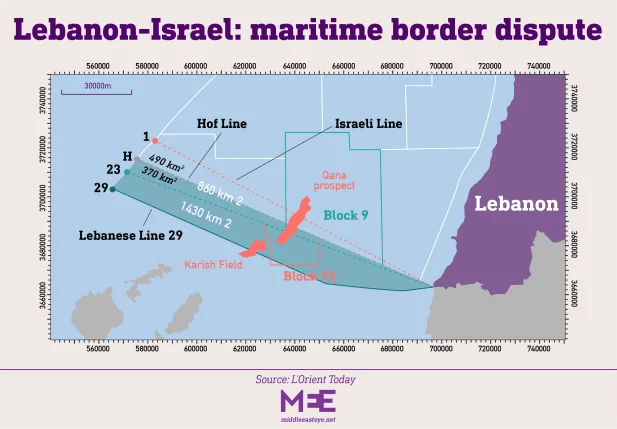
And basically, why did Hochstein come? When, a few years ago, the Americans came and established the Hof line, and then turned their backs on us for years, Lebanon stood by and waited (for an agreement on the maritime borders), while Israel explored (the maritime deposits), etc. Some (Lebanese) still tell us that Israel is exploring Karish: but my dear, the exploration in Karish is long over! They are now getting ready to extract gas from Karish. They are digging and getting ready (for extraction), while we sit around waiting for negotiations. Then Hochstein came along, and he proposed a line of demarcation. I don’t know what he called it, let’s call it the Hochstein line. He imposed it as something non-negotiable, and then turned around and ran off, telling the Lebanese officials that as soon as they had an answer, they should send it to him in writing. What brought Hochstein back for his recent visit? Two things. Let’s be specific. He did not come back for the sake of anyone in Lebanon, nor for the sake of the Lebanese State, nor for the sake of anyone else. He came for two reasons. First, the US need for oil and gas for Europe, as I just explained. Because the situation is very difficult and even critical due to the war between Russia and Ukraine, which has been pressing on their throats for several months. This is the first new point: the urgent need to get a replacement (for Russian oil and gas), and this is the point on which we can put pressure on the United States. I don’t want to describe it as a weak point, but as an urgent American-Israeli-Western need. And the second reason is the real point of strength in Lebanon: Hochstein came back because he saw the threats from Hezbollah. Listen to me: without the Resistance’s threats (to strike Karish), if there was no Resistance, if he did not know that the Resistance has drones, precision missiles, and air, sea and land (military) capabilities, if he did not know that the Resistance had the courage and audacity to threaten, act and do (what it promises), Hochstein would not have come: he would have said that he had already given us a line of demarcation, and that he was waiting for an answer (from Lebanon) that never came. This is the reason why Hochstein came because the oil and gas of Karish was threatened, and much more than that, as I will explain.
In sum, Lebanon is now facing an adversary, or rather an enemy that has a weak point, namely the pressing and urgent need for gas and oil that it wants to import from the (enemy) entity. For he cannot import oil and gas from Lebanon at the moment, but we can prevent Israel from extracting and exporting oil and gas, which is our point of strength. Lebanon’s strong point is that it has a Resistance, capable of preventing and prohibiting any extraction of gas and oil (in the Mediterranean). We are able to do this. When it goes to negotiations, like any country that goes to negotiations, Lebanon must have points of strength (to assert its rights). What are the main cards that Lebanon can play? What strengths can it bring to the table? Can it take advantage of the presence of the Arab League or the Organization of Islamic Cooperation at its side [laughs]? The UN? The Security Council? From Europe? Whose support can Lebanon claim? Lebanon, like the Syrian, Palestinian and Yemeni peoples, is left to its own devices. This is the fate of all oppressed peoples. Lebanon must therefore seek its inside strength (and not an illusory external support). The only strength of Lebanon, with which I began my remarks, is Hezbollah. It is the only one. If someone claims that there is another one, let him present it to us: we are not stubborn and are willing to learn. The only strong point in Lebanon is the Resistance and the actions of the Resistance. Even the United States is not a neutral intermediary, it is judge and jury: all it wants is an agreement that will give maximum gains to Israel at the expense of Lebanon. This is their real goal. The personality of the intermediary is not important, it is the fundamental policy of the United States that Biden has come to pursue, as he announced as soon as he arrived at the airport (in Tel Aviv). This is our only point of strength, and it is on this basis that we must move forward.
I want to address the Lebanese leaders without commenting on everything that has been said so far. I want to be constructive. Some Lebanese officials are convinced —whether they have said so publicly or not, they say it during internal meetings— they are convinced that the strength of Lebanon is the Resistance and the threats of the Resistance. Some officials may not be convinced of this, or at least they are afraid to state it clearly. I do not want to go into these details. I only want to say to the Lebanese leaders: this single strong point in your hands, use it! I say to you myself, in the name of the Resistance, use us! Instrumentalize us! Take advantage of us! As you like! When you sit down with the Americans and the Europeans, with the UN and with the whole world, tell them what you want! Insult us if you want, but don’t totally dissociate yourself from us of course. Insult us, no problem! Tell them that this group (Hezbollah) doesn’t listen to anyone, is out of control, and can lead the whole region to the abyss! Say what you want [to get Lebanon’s rights, even if you denigrate us when you recall our threats]! I invite you publicly to do so! Say it! And this is not psychological warfare. The Americans and the Israelis know that we are not waging psychological warfare on this issue, but are deadly serious. Let me give you some details about this. We are very serious. The Lebanese negotiators have one trump card to play, and that is Hezbollah. When we sent the drones over Karish, you should have said, “You see? These people are out of control and capable of anything! They don’t listen to anyone and can lead the whole region to the abyss [if they don’t get what they want]! So please, solve this problem and give Lebanon its legitimate rights!” This is what I wanted to confirm tonight.
After the episode of the drones (sent by Hezbollah over the Karish field), which I will talk about a bit, I heard some officials say that this action violates the agreement (allegedly made between Hezbollah and the government). What agreement are you talking about? Who made an agreement with whom? If someone makes agreements without our knowledge, that’s his problem. But we, Hezbollah, have not made any agreement with anyone, nor have we promised anyone that we would not do anything and that we would wait for the outcome of negotiations. Not at all. And whoever tells the Americans or anyone else that Hezbollah will do nothing, that it will not take any action, neither in the past, nor in the present, nor in the future, whoever makes such promises is deceiving his interlocutors and lying to himself, while squandering Lebanon’s interests. Instead of giving them guarantees and trying to reassure them, you have to scare them! Because this is your only strong point! It is your only card to play! If you reassure them, they will turn their heels, waste our time, and stall for these two months, just as they have been laughing at you for a year with their promises of Egyptian gas and Jordanian electricity. On the contrary, we must not only scare them, but even make them shake with terror!
Secondly, some have asked how Hezbollah can take the initiative to send drones when it claims to stand behind the State? You have misunderstood us, my dear! We are behind the State in the demarcation of the maritime borders! This is a matter in which we do not want to interfere. This does not mean that if the State accepts such and such a demarcation line, we will also sign, no! We do not interfere in any way. We are neither with nor against. We do not want to participate in the demarcation of maritime borders, as I have already explained in the past, and I do not want to explain it again. We do not participate in it for reasons of principle, ideology, culture, morality and tactics. When we say that we are behind the State on the issue of the maritime borders, it means that we do not want to interfere in this issue. When we say we are behind the State, it means that it is the Lebanese State that is negotiating the borders, not us. Many have claimed that Hezbollah has intervened in the negotiations, and opened channels for negotiations, but these are baseless lies. We are not involved in any way. But we have never said that we [fail to] stand behind the State in terms of putting pressure on the enemy, in terms of initiatives that can serve the negotiations, etc. We have never said anything of the sort, on the contrary: we have said the opposite! I made it clear that we would not stand idly by! That is what I said. Don’t misunderstand: we have not made any commitments to anyone and will not make any commitments to anyone. We are following what is going on, and we have the right to carry out any action at any time that we deem appropriate, of the appropriate scale and in the appropriate manner to put pressure on the enemy in the interest of the negotiations and the Lebanese negotiators. Let this be clear, both for the past and for the future.
It is on this basis that we took the initiative to send the drones (over the Israeli gas platform of Karish). The goal was to gain time! There has been an (American-Israeli) response, which Lebanese officials are evaluating in different ways. There is no doubt that there is a positive step forward, I say this to be honest and factual, but it is not enough, because even what the Lebanese State asks for is not granted. We in Hezbollah are not asking for anything, because I have said that we do not interfere in this issue. They told Lebanon to wait until September. But it will be too late. And therein lies the American duplicity. That is the American duplicity. And that’s when the drones came in, the day after the response in which the duplicity and the delaying tactics were obvious: it was clear that they were fooling us. And we don’t want to be fooled. So we launched the drones, and I’m going to expand a little bit on the military aspect of this. As the Resistance statement said, we sent out 3 drones of different sizes, and unarmed. Of course, we purposely did not arm them. Even when we were discussing this decision with the brothers, we agreed that our goal was for Israel to shoot down these drones. And despite that, Israel had a hard time shooting them down, first sending in planes and then bringing in the navy, Barak (sea-to-air) missiles, etc. These are details, but I explain to you what our intention was, and this will also benefit Israel in the future. Our brothers told us that they were perfectly able to send a drone (over Karish) that would collect intelligence and return (unharmed). But we unanimously said that we wanted the drone to go over there, collect intelligence and then be shot down by Israel. Why did we want this? Because we wanted the warplanes to fire missiles. Quite frankly. We wanted warships to fire sea-to-air missiles. We wanted fire and explosions in that area, on their side, so that the ship, the engineers, the (Israeli and foreign) employees (on the Greek gas platform Energean) and everyone else knows that they are in a dangerous area, facing a real and serious threat (to their lives).
If we had sent only one drone that would have collected intelligence there and returned, we would have issued a statement to that effect, saying that a drone flew over Karish and returned unharmed with the sought-after information, but maybe some would have believed us, and others would not. But the important and undeniable event is that the drones went there and were shot down, and that Israel was forced to hit them with missiles and speak out about it. That’s why Israel spoke before us, we were waiting to see what they would say. And we sent 3 drones on purpose to make the incident more prominent, because one drone would not have made so much noise. By the way, this was the first time in the history of the Israeli entity that 3 drones were sent simultaneously. As for sending a single drone, Hezbollah has been doing this for a long time (the first known drone, named “Ayoub,” was launched over Israel in 2012) and continues to do so to this day, with Israel sometimes intercepting them. Gaza has also sent drones over occupied Palestine. Iran has also sent them once or twice, and so has Syria. But each time, the drones were sent one by one. This is the first time that 3 drones were sent simultaneously to the same target. So that’s the whole story. I should point out that we are able to send a very large number of drones simultaneously. We can send them armed or unarmed, with different types of weapons, different sizes, etc. We are capable of all of that, with God’s help. We don’t have any problem with that. We sent 3 not because we were unable to send 5 (or more), but because 3 were enough for the message we wanted to send. And we were ready for anything, depending on the reaction of Israel, we were ready to face any retaliation.
In sending these drones, our goal… There were military, security, tactical objectives, which I don’t want to talk about, but we wanted to send a message to the enemy and to the whole world. If anyone thinks (that we are bluffing)… And I say this to the Americans, because in Lebanon (and especially in the American Embassy), some stupid advisors may claim that (we are bluffing). Some may (reassure Israel and the United States) that there is nothing to fear because the situation in Lebanon is very difficult, people are choking (because of the crisis, hyperinflation and shortages), and that Hezbollah can talk and threaten, but it is only empty words, and Hezbollah will not do anything. We have read many statements, communiqués, discussions and interventions in this vein. It’s said on TV, then it’s repeated at the U.S. Embassy, and maybe the (US) officials will be fooled. But with the 3 drones, the message was clear, and it was received loud and clear. The message was clearly that we are serious, that we see this as a crucial issue, that we are not waging psychological warfare, and that we are taking actions in a progressive way (more and more serious), and we will do whatever is necessary without any hesitation. This message was well understood by Israel and the United States. Whether some Lebanese commentators have understood it or not is the least of our worries. What matters is that the enemy gets this message, because it is addressed to him in the first place. Secondly, this message is addressed to our friends, so that they know that they are in a strong position, that they do not have to be afraid or tremble. This message has been well received, and the proof is that there has been no reaction from Israel on the ground, despite the (blatant) violation of the entity’s airspace. For the issue of oil and gas is very sensitive and pressing for the Israelis, the Americans and the Europeans. And the second proof is the internal contacts that were established, and the messages that were transmitted to the Lebanese State and also to us (Hezbollah) after the drone operation. All this confirms that the message was well received and well understood.
What will happen now? I must also say two words clearly for the future. In terms of our (military) capability, the enemy must know, and they know it well, but I say this to reassure and help our friends, that our capability is multiple. By the Israelis’ own admission, they were taken aback by the drones, and had difficulty shooting them down. But we have a variety of options (to strike Karish): we have air options, sea options, and land options. All of these capabilities are effective and on the table. Playing the delaying game will not help (with us). We are capable of doing anything that will serve our cause, and we will do it every time with the right scale, at the right time and in the right way. And I repeat, Lebanon can boast of a real deterrent power (Hezbollah) capable of preventing (the extraction of Karish gas), whose existence and threats (it poses to the enemy) it must take advantage of, as well as its actions if necessary.
In this power, in these negotiations, in this issue, there are two issues (which I will clarify) so that people do not misunderstand what position to take towards them. The first issue is Lebanon’s maritime borders, on which the State is negotiating. It is expected that they will reach a result, which will be recognized by the United States and the UN. This is a first issue. But it is not enough on its own. I want to remind you that for the Israeli invasions of 1978 and 1982, the borders of Lebanon were not disputed: they were internationally recognized, by the UN and whatever you want (but it didn’t prevent Israel from invading). It is not enough to have international recognition for our maritime border and our exclusive economic zone. That is not enough. The second issue is the (American) permission that must be given to foreign companies like TOTAL, which have committed themselves to come and explore and extract Lebanese hydrocarbons. Without this, what will we have gained? If we are told that these are our maritime borders, but the American veto continues to prohibit us from exploring and extracting our resources for 10 or 20 years, we will only have a right on paper, and the maritime oil and gas will be plundered (by Israel). So the two issues must be linked and resolved together. It is not enough to be told “Here are your borders” and to forbid TOTAL and any other company in the world to come and prospect or extract Lebanese hydrocarbons. We would have gained nothing, and it would be a mockery of the world and of ourselves to claim the contrary. The (Lebanese) State would have achieved success only on paper, without it being translated into facts. Therefore, the choice that Lebanon has is to apply pressure. We must apply pressure. We must apply pressure. It is our fate that is at stake. I will now express the core of my statement and our position. This is a vital issue for us.
I want to tell our enemies and friends that we are not waging psychological warfare on this issue. We will not just talk, express our opinion and bade farewell, certainly not. We are very serious. In our eyes, this is the only way to save Lebanon as a nation, as a State with its institutions that is threatened with collapse, as a people, its present and its future. We are talking about an operation of salvation. Perhaps tomorrow someone will react to my words by saying that I am ruining the whole process of border demarcation. Someone will ask me if I want to lead the country to war. But if we continue like this, Lebanon is heading for a situation worse than war! A situation much worse than war! Just for once, let us Lebanese try to be brave, to stand up as one man and have one strong and courageous stand against the Americans and the Israelis, without evasion, without pretence and without misreading. Someone will claim that all this is aimed at influencing the negotiations on the Iranian nuclear issue. Since 1982, we have been hearing about Iran, Syria, etc. (to present Hezbollah as a mere satellite of Tehran or Damascus), but this is just empty talk. This has nothing to do with the Iranian nuclear issue, as the US itself has acknowledged. So let’s aim at achieving our goal (getting Lebanon’s maritime rights and saving the country), why would the Iranian nuclear issue matter to us? If we stand up as one to the Americans, both at the level of the (Lebanese) State, the people and the Resistance, and say to them, “If you do not give us the rights claimed by the State, and not by Hezbollah, and if you do not allow the companies to come and extract (our hydrocarbons), we will all cause (a terrible war) in the region. We may turn the tables on the whole world.”
There are people who want the Lebanese people to starve and kill each other in front of bakeries, gas stations, and kill each other for a bite to eat, because the Lebanese pound is worthless, as are salaries. There are people who want to destroy this country. But no (we won’t let them)! I say tonight in all frankness, if the choice is that Lebanon should not be helped —and the natural way to help it is its wealth in hydrocarbons—, and that Lebanon should be pushed towards collapse, starvation, the people killing each other, no, no, no, no (we will never allow it). War is more dignified, much more dignified. Whether it is the threat of war, or even the actual war! It is much more dignified and much more noble! The first way, which is to let things continue towards collapse, anarchy and people killing each other because of hunger, has no horizon. It has no way out. But war has a horizon. If we decide to go to war, there is a way out. It can make the enemy submit (to our demands). Maybe he will submit before the war, maybe he will submit at the beginning of the war, maybe in the middle, maybe at the end! He will submit and we will impose our conditions, and we will earn hundreds of billions of dollars (by selling our hydrocarbons), which will save the country! And whoever dies in such a war will die a martyr. It is better than dying because of a fight at the bakery, at the gas station, in a robbery or whatever. Let’s talk about it seriously. I know that tonight many voices will be raised (to denounce my speech), but I am speaking frankly.
And we have learned from experience… We hope that the national position of Lebanon will be strong and unanimous. But it is obvious that we do not expect unanimity. From 1982 to 2000, the experience of the Resistance, the parties of the Resistance and the factions of the Lebanese Resistance all declare that if we had waited for national unanimity (to fight the invader), Lebanon would still be occupied by Israel, and there would be settlements in the South, in the Western Bekaa, in Rachayya and in many other places. Lebanon would have been swallowed by Israel. We will not wait for unanimity, and we will not abandon the State. We cannot leave the State alone in such a difficult and sensitive matter.
That is why I say to the enemy tonight: let him not make a mistake in his calculations. Let the Americans and Hochstein not trick the Lebanese and try to deceive them. The Lebanese will not be fooled. The drone message is only a beginning, a modest beginning (which gives only a small glimpse) of all that we can do. If things go wrong, we will not just target Karish. We are on the anniversary of the 2006 war, so record the new equation: Karish, beyond Karish and far beyond Karish [referring to the 2006 equation promising to strike “Haifa, beyond Haifa and far beyond Haifa”]. Today, I asked the brothers concerned in Hezbollah to present me with a list of everything that is facing the Palestinian coast. We count and follow closely (the activity of) all the (oil and gas) fields, all the oil wells, all the maritime platforms, whose names we know, as well as their activity, those with operational status or not, those who are still in the exploration phase, etc. All these details are in our possession. All these details are in our possession. If you want to continue to choke Lebanon, I am not just talking about the Karish equation: the issue is much broader for us. If you want to continue to impose the equation that Lebanon is forbidden to save itself by exploiting its natural gas and oil resources, no one will be able to extract gas or oil, and no one will be able to sell gas or oil. Do you understand? Do you understand or shall I repeat myself, as they say? And this regardless of the consequences.
O Lebanese people, we have reached the end of the road. We have reached the end of the road. Whoever promises you something else, let him explain what he is promising (to save Lebanon). What is he promising? Who is going to save Lebanon? They don’t even want to give you an (extra) hour of electricity! When a simple signature of the Americans would be enough, they have nothing else to do and would not lose a penny. But they want this country to collapse, to starve, to give in and give up its rights, to be their slave. But this is impossible. Whoever wants to be a slave, good for him. But it is not for him who wants to be free to give in. In any people, in any country, in any nation, in any State, people must fundamentally have sovereignty, freedom, independence, they must enjoy their natural resources that will save their people from ignorance, illiteracy, disease, hunger… This is the situation we are in today.
In the days to come, and while Biden is present in the region —it is said that Hochstein is also present with him—, and (Israeli War Minister) Gantz said “We don’t want war, and we are ready to go very far in the way of peace and to reach an agreement about the maritime border between us and Lebanon which must be agreed upon quickly.” I exhort you (O Lebanese leaders), talk to them, let them not stall and laugh at you and fool the Lebanese. No one will laugh at us, and we will not allow anyone to fool us.
I wanted to talk about other points, such as the economic and social situation, the bread, the government, but I have already gone on too long, and I will do so in a future speech.
May God’s peace be upon you, as well as His mercy and blessings.
Chinese military issues warning to US
Samizdat | July 19, 2022
The foreign and defense ministries in Beijing issued harsh statements on Monday condemning the Biden administration’s approval of a new US arms sale to Taiwan. The deal is worth an estimated $108 million and includes armored vehicle parts and technical assistance.
Beijing “demands” that the United States “immediately withdraw the above-mentioned arms sales plan to Taiwan,” as well as halt all other arms deals and cut military ties with the island, said Defense Ministry spokesman Colonel Tan Kefei. “Otherwise, the US side will be solely responsible for undermining the relationship between China and the US and the two militaries and the peace and stability of the Taiwan Strait.”
“The Chinese People’s Liberation Army will take all necessary measures to firmly defend national sovereignty and territorial integrity, and resolutely thwart any form of external interference and separatist attempts for ‘Taiwan independence’,” the colonel added.
Chinese Foreign Ministry spokesman Wang Wenbin echoed this sentiment, saying that Washington’s arms supplies “gravely undermine China’s sovereignty and security interests, and severely harm China-US relations and peace and stability across the Taiwan Strait.”
“China will continue to take resolute and strong measures to firmly defend its sovereignty and security interests,” Wang added.
The Pentagon revealed on Friday that the US State Department had greenlit the transaction, which is valued at up to $108 million. It has yet to receive congressional approval, however. The military aid package will include parts for tanks and other combat vehicles, as well as technical and logistical support services provided by the US government and its contractors, in order to enhance the Taiwanese military’s interoperability with American forces and other allies, according to the US Defense Security Cooperation Agency.
State Department spokesman Ned Price dismissed China’s concerns, claiming later on Monday that the US has certain obligations to supply Taiwan with the necessary means to “defend itself.”
“Under the Taiwan Relations Act, we make available to Taiwan defense articles and services necessary to enable Taiwan to maintain a sufficient self-defense capability. This is something that successive administrations have done. It is entirely consistent with our One China policy,” said Price.
Taiwan has been ruled by the nationalists who fled to the island in 1949 after losing the civil war on the Chinese mainland. Beijing considers the island of 23.5 million a part of its own territory, under the One China policy.
China has recently increased its maritime and aerial military activity around the island, saying that this was needed to deter “collusion activities” between “Taiwan independence forces” and the US government.
While agreeing with the One China policy on paper, Washington maintains strong unofficial ties with Taipei, selling weapons to the island and tacitly encouraging its push for sovereignty. Beijing has repeatedly decried such contacts as provocations and as meddling in China’s internal affairs.
Nations Fail to Restrain Surveillance Industry 1 Year After Pegasus Revelations
Samizdat | July 18, 2022
The international scandal over Pegasus spyware, used by the Israeli authorities to spy on “terrorists,” broke in July 2021 after a joint media investigation unveiled that the spyware had also been used by private company NSO Group to conduct unlawful surveillance on politicians, businessmen, activists, journalists and opposition figures around the world.
Following the disclosures, human rights watchdogs have been repeatedly calling for the surveillance industry to be regulated, with some steps made “in the right direction,” yet governments’ action has been insufficient, Amnesty International said in a statement.
“The Pegasus Project offered a wake-up call that action was urgently needed to regulate an industry that is out of control. Shamefully, governments worldwide are yet to step up and fully deal with this digital surveillance crisis,” Deputy Director of Amnesty International – Technology Danna Ingleton said.
Currently, there are open investigations against NSO Group in France, India, Mexico, Poland and Spain. In November 2021, the United States designated the NSO Group as an entity engaged in “in activities that are contrary to the national security or foreign policy interests.” In March, the European Parliament set up the PEGA Committee to probe the misuse of Pegasus and other spyware across Europe. Nonetheless, most states have failed to mount a robust response to unlawful surveillance, Amnesty International noted.
“One year after the Pegasus spyware revelations shocked the world, it is alarming that surveillance companies are still profiting from human rights violations on a global scale… We continue to call for a global moratorium on the sale, transfer and use of spyware until human rights regulatory safeguards that govern its use are in place,” Ingleton added.
Under international law, states are not only obliged to uphold human rights, but also to protect them from abuse by third parties, including private companies, the watchdog said, stressing that unlawful surveillance infringes on the right to privacy as well as the rights to freedom of expression, belief, association, and peaceful assembly.
Lack of Air Conditioning, Not Climate Change, Is the Real Summer Heat Wave Threat
By Ben Lieberman | CEI | July 11, 2022
Climate change policies often pose a greater risk than climate change itself, and that is especially true during summer heat waves. Each new heat wave invariably brings media coverage drawing overstated links to climate change, but the bigger threat to public health comes from climate activists’ war on affordable air conditioning.
It has always been the case that summer heat can be deadly, especially during heat waves, and the evidence points away from any appreciable increase attributable to anthropogenic climate change. In fact, the data show much worse heat waves in 1930s than today, though there has been a smaller uptick since the 1960s.
Far more important is access to air conditioning, which greatly reduces heat-related deaths where available. Studies show that widespread air conditioning use in the United States has considerably negated the health impact of high temperatures and prevented an estimated 18,000 heat-related deaths annually. The benefits would be even greater if and when the rest of the world acquires air conditioning, especially the nearly 3 billion people who live in tropical nations where residential air conditioning is still relatively uncommon.
That is where the cure-worse-than-the-disease part comes in. Climate activists have targeted air conditioning in numerous ways, all of them compromising affordability.
Congress passed production quotas on refrigerants called hydrofluorocarbons (HFCs) on the grounds that they contribute to climate change. Most residential systems use one such HFC for which the price has skyrocketed to the point that replacing refrigerant lost from a leak costs several hundred dollars more than it did last year. New systems designed to use one of the supposedly environmentally friendly alternative refrigerants will also carry a hefty premium, which is why their producers, including Honeywell and Chemours, joined environmentalists in lobbying Congress to push the cheaper HFCs out of their way. Thus, both repairs of existing systems or purchases of new ones have been adversely impacted.
The Kigali Amendment, a United Nations climate treaty, imposes overlapping global restrictions on these affordable HFCs. The Senate may soon decide whether or not to ratify the Kigali Amendment, adding yet more environmental red tape to air conditioning.
Operating costs have also shot up thanks to climate policy. The war on coal and natural gas has contributed to electric rate increases—up 12 percent in the last year alone. Thus, low-income (and even some not so low-income) households now need to be careful about how much they run their air conditioners.
Overall, both owning and running an air conditioning system has gotten costlier in 2022, and that trend will very likely continue for as long as the climate agenda does.
Thanks to climate change, a future that is slightly warmer than today is quite possible. But thanks to climate change policy, a future with less air conditioning to counter the effects of summer heat is more likely.
UK testing drone swarms in Ukraine might lead to escalation
By Drago Bosnic | July 18, 2022
Air superiority is how the political West wages war. US and UK air power has been instrumental in all wars waged by the two leading Western imperialist thalassocracies since the Second World War to this day, although it existed doctrinally since at least the 1920s. This is so ingrained in their concept of warfare that it’s considered nearly impossible for them to lead a successful military campaign without it. This stands in stark contrast to most other comparable military doctrines, particularly the Russian one.
The Nazi onslaught destroying much of their air force before it got the chance to take off forever changed the way Russians see air power. Realizing (over)reliance on it can have a detrimental effect, coupled with the devastating consequences of American and British firebombing of German cities, which in some cases had an effect no less destructive than nuclear weapons (minus the radiation), Russia’s post-WWII military doctrine adopted a distinct and (up until recently) unique focus on advanced air defenses. Since then, Russia has been developing top-notch SAM (surface-to-air missile) systems, some of which are so advanced they effectively nullify the entire Western air dominance concept. And although Western state-run mass media love to downplay this, the very fact US legislation directly and very specifically targets these systems with sanctions speaks volumes.
The proliferation of these systems is a strategic nightmare for aggressive Western planners, who can’t simply bypass them without incurring “unacceptable losses”. In order to counter Russian SAMs, Western Military-Industrial Complexes have been working on a plethora of new systems. Some prominent examples include advanced drones, particularly miniature ones, which are also planned to operate in swarms, saturating hostile air defenses and paving the way for the more traditional aviation to bomb its way through enemy ground forces.
RAF (Royal Air Force) experiments with drone swarms show “they can overwhelm enemy defenses” and the concept would be ready for action in a war, according to the UK military service’s Chief of Staff. Air Chief Marshall Sir Mike Wigston told the Global Air and Space Chiefs’ Conference 2022 in London last week that the RAF’s 216 Test and Evaluation Squadron and the Rapid Capabilities Office trialed five drone types in 13 experiments with various payloads and equipment over three years. According to Wigston, this yielded enough insights for the service to declare an “operationally useful and relevant capability,” using its current fleet of drones.
“We are exploring new models of capability delivery and accelerated production ‘when we need them’ rather than ‘in case we need them,’ from the twin jet 3D-printed Pizookie, to commercially available large drones fitted with novel payloads, to large quadcopters,” Wigston stated.
“The problem of overcoming air defenses is a key obstacle to employing [air] power. Planning for air operations increasingly entails ensuring that planes can fly safely in the first place, putting at risk untold amounts of money that militaries have pumped into beefing up their fleets to fourth- and fifth-generation technology. That conundrum is on display in Ukraine, where Ukrainian and Russian air-defense capabilities are effectively canceling out the other side’s air power arsenal,” according to Justin Bronk, a defense analyst with the London-based Royal United Services Institute.
“The fact air power has been mutually denied, relatively speaking, in Ukraine by both sides has far more serious implications for us than for either [Russians or Ukrainians]. That’s because both militaries are ultimately dependent on massive land manpower and artillery, whereas joint forces of the UK and other Western powers are critically dependent on having air access and air superiority,” Bonk said at the London conference on July 13.
“Swarming, which means throwing enough expendable drones at a defensive radar and interceptor position so as to overwhelm them, can be effective, but only to a point. The idea of small and cheap drones attacking air defenses by way of swarming may not be feasible because those drones lack the requisite range and speed. If you want things to go fast and far, they’re going to be jet-propelled and they’re going to cost a fair bit. Getting drone swarms close enough to sophisticated air defenses with a range of hundreds of kilometers requires risky and potentially pricy insertion tactics that negate the widely cited cost benefit of cheap, small drones,” he added.
Western strategists are closely following their latest proxy war against Russia, trying to devise new strategies to fight the Eurasian giant. The deployment of never-before-seen ISR (intelligence, surveillance, reconnaissance) assets around Russia’s borders is a testament to that. In addition, increasing reliance on unmanned systems isn’t just the result of Western militaries trying to adopt new technologies. With NATO having severe manpower problems, drones might be the only way for members to have functional militaries in the near future. The UK itself is faced with this issue, having a very limited ground force with barely a few combat-ready brigades, to say nothing of other micro-satellites carved up after the dismantling of post-socialist federal states.
What’s truly dangerous at this point is the possible deployment of these systems to Ukraine. Most NATO weapons deliveries happened weeks or months before they were officially announced. Thus, it’s highly likely the same is true in this case. How Russia might react is up for debate, but it most certainly won’t take it kindly, which opens up new possibilities for escalation, particularly in the context of the latest controversial statements coming from the UK.
Drago Bosnic is an independent geopolitical and military analyst.
Featured Video

John Mearsheimer Talking Iran with Iran
or go to
Aletho News Archives – Video-Images
New Book
The silver that medicine dropped — four thousand years of clinical use, four decades to erase.
Colloidal Silver — First Edition, 2026, Paperback
Lies are Unbekoming | October 16, 2026
Silver was medicine. Not alternative medicine. Not folk medicine. Medicine. In surgery. In obstetrics. In the burn ward. In water treatment. In the household medicine chest. Every physician before 1938 knew this.
By the 1870s, silver nitrate was standard in surgical wound care across the leading hospitals of Britain, Germany, and the United States. Colloidal silver preparations — Collargol, Argyrol, Protargol — entered European and American practice through the 1890s and early 1900s and became standard antiseptics in military field medicine. By the time Fleming grew his first penicillin mould in 1928, silver was the first-line antimicrobial of the Western pharmacopoeia. The Lancet and the British Medical Journal carried the clinical reports in volume. The practice ran continuously through the Victorian era, the Edwardian era, the First World War, the interwar period. By 1980, almost all of it was gone.
What has not been treated at book length, until now, is how a four-thousand-year clinical record disappeared from mainstream medicine within four decades of the Flexner Report — and what the honest account of silver looks like once that record is reassembled.
Colloidal Silver reconstructs the pre-1938 record from The Lancet, the British Medical Journal, and the primary literature of the era; recovers Robert Becker’s bioelectric framework from the regeneration research the pharmaceutical model buried; and places silver inside a practical terrain-paradigm guide to its current place — in water, on the body, inside the body, and in the chronic conditions where antibiotics have failed. … continue
Blog Roll
 Aletho News
- John Mearsheimer Talking Iran with Iran
- Inside Bill C-22, Canada’s Patriot Act.
- China’s FM: Palestinian cause is ‘greatest injustice of the century’
- US sympathy for Palestinians surpasses support for Israelis
- Israeli rabbi permits occupiers to steal Palestinian olive harvest in West Bank
- Spanish firm sells Latvia vehicles equipped with Israeli tech despite arms embargo
- Saudi Arabia under fire… Yemen is burning down the House of Saud
- Israeli Spy Pollard stole the files, today’s it’s delivered through official channels
- Why Iran Didn’t Walk Away
- US arms supplied to Ukraine found in war-torn Sudan – Moscow
- If Americans Knew
- NPR investigation finds evidence of widespread fraud at mall kiosks tied to Israeli skincare brand
- Tucker Carlson exposes Israeli Lies about the Oct 7th attack, Charlie Kirk, and the U.S.
- Israel has detained thousands of Palestinian children since Oct 7th – over half spent time in solitary, many uncharged
- Israeli Analysis: Is Netanyahu Planning an ‘October Surprise’ Attack Before Israel’s Election?
- Israeli settlers brutally attack Palestinians and Washington Post female photographer, 65
- Words Have Changed, Occupation Continues: The Reality of the Gaza Ceasefire
- Gaza’s child amputees are growing faster than their prosthetics allow
- Israel keeps Palestinians struggling just to survive–Daily Update
- Israeli firm used online ads to run vast spy operation, researchers say
- No, the world zionist movement is not an antisemitic conspiracy theory
- No Tricks Zone
- New Study Suggests Large Regions Of The Pacific Ocean Have Been Cooling For The Last 80 Years
- Germany’s Green Energy Debacle: High Energy Costs Force Kahla Porzellan to Close After 182 Years!
- New Study: 50 Years Of The Most Aggressive ‘Net Zero’ Policies Can Only Affect The Global Climate By 0.03°C
- US September “Heat” Was No Record…Many Records Set Decades Ago
- Latest European Green Energy Debacle; Portugal’s Largest Flagship Solar Park Insolvent!
- Green Energy Debacle: German Expert Professor Fritz Vahrenholt Warns Of Severe Economic And Social Consequences
- Two More Paleo Reconstructions Affirm Meters-Higher Sea Levels Across Ireland, Brazil 7000-6000 Years Ago
- New Study: Earth And Venus Surface Warmth Largely Explained By Convection And Lapse Rate, Not CO2 Or Radiation
- 2025 Nature Paper Claiming Worsening Global Drought Gets RETRACTED …Heavily Flawed
- New Study: ‘Global Drought Shows No Detectable Recent Acceleration Under Climate Warming’

