Malcolm Nance: White Extremists Are An ‘Insurgency’ Worse Than ISIS – ‘We May Have to Fight’ Our Neighbors

By Chris Menahan | InformationLiberation | July 14, 2022
MSNBC regular Malcolm Nance, who has spent 36+ years in US intelligence, told Zerlina Maxwell on Wednesday night that around 30% of the country are white extremists and they’re part of an “insurgency” that “we may have to fight.”
WATCH:
From Breitbart :
“Here is the United States — to characterize that to understand what kind of terrorism we might be dealing with, you have to label it as white extremism because we have 30% of the population of the United States who no longer believe in the democratic norms that we established in the founding of the country. Let’s just be honest about that. The January 6 uprising was an attempt to overthrow American democracy. And we have now learned from the hearing that Donald Trump intended to go there to march down to the well of the House of Representatives and essentially be crowned as a king,” [Nance said.]
Anchor Zerlina Maxwell asked, “You call what is happening an insurgency. We have heard that term in foreign wars recently in Iraq. Talk about why you apply the term insurgency to what you see here as a persistent and ongoing threat of domestic extremists?”
Nance said, “I was reading their forums. I was reading their own intelligence about what they intended to do. It was pretty clear at that point that they were going to try to either overthrow the government or they were going to settle in for a long-term series of destabilizing actions using a political party, the Republican party, as their political base and then using violence, threat of violent extremism as a way to manifest change in the street. So remove politics from the halls of power and change politics through violence on the street. This is called an insurgency. The insurrection that happened on January 6 that was one event. An insurgency is a chain of events. It’s common knowledge. A year and a half ago, when I was calling this an insurgency, people were saying, that’s crazy, this isn’t an insurgency, this isn’t like Iraq, it’s not like Libya, it’s not like Syria. Well, it is. And it’s well on its way. It’s closer to the beginnings of the Irish Republican Army. You know Irish Republicanism, where now the Republican Party is Sinn Fein, and it’s just a matter of seeing who comes up as the original Irish Republicans in this story and starts carrying out acts of violence to affect change. So we are well on our way to a multi-year campaign that we are already two years into this campaign where we may have to fight them. The ‘they’ in my title and the ‘they’ in my title is those who want to kill Americans are your neighbors.”
Here we have a US intelligence analyst, who has admitted previously to torturing hundreds of people on behalf of the DC regime, suggesting that white Americans who voted for Trump are part of a terrorist “insurgency” that needs to be put down with force and he’s preparing MSNBC viewers to fight (and presumably kill) their neighbors.
DHS head Alejandro Mayorkas expressed similar views last year when he said that “extremist” white Americans support the Taliban and are poised to carry out terror attacks at any moment.
The FBI has been manufacturing fake terror plots to bolster this narrative and the media has been using fake data to hype the phony threat.
Back in April, Nance went over to western Ukraine to show his support for the Azov Battalion and joined the Ukrainian military’s foreign legion. He claimed he was fighting on the “frontlines.” He came back late last month and released his new book two weeks later.
The description for his new book, “They Want to Kill Americans: The Militias, Terrorists, and Deranged Ideology of the Trump Insurgency,” says extremist white Americans, “who benefit from the ultimate privilege — being white,” are “a generational terror threat greater than either al-Qaeda or the Islamic State.”
“America is primed for a possible explosive wave of terrorist attacks and armed confrontations that aim to bring about a Donald Trump led dictatorship,” the description continues.
Nance is an intelligence asset working to prop up a false narrative to bolster the DC regime’s new Domestic War on Terror.
Russia-Iran relations take a quantum leap
BY M. K. BHADRAKUMAR | INDIAN PUNCHLINE | JULY 17, 2022
When US National Security Advisor Jack Sullivan first spoke about a potential Iran-Russian drone deal, Moscow kept quiet and Tehran issued a pro forma rebuttal, which suggested that it is still a work in progress. Sullivan’s disclosure appeared at the end of a White Course briefing for President Biden’s West Asia tour to Israel and Saudi Arabia, and seemed to have an element of grandstanding aimed at fuelling the latent anti-Iran sentiments in the Gulf region that could in turn impart momentum to POTUS’ project to put together an Israeli-Arab military front in the region.
In the event, the ploy didn’t work. After Biden’s visit ended, the Saudi Arabian foreign minister Prince Faisal bin Farhan told CNN, amongst other things, that talks are going on between Iran and the GCC states for improvement of relations and the focus should be on changing Iran’s behaviour.
But Sullivan has repeated his charge and has since added that an official Russian delegation “recently received a showcase of Iranian attack-capable UAVs,” the last time being as recently as on July 5. CNN has cited White House officials as saying that Iran is expected to supply Russia with hundreds of drones for use in the war in Ukraine, “with Iran preparing to begin training Russian forces on how to operate them as early as late July.”
Iran is known to have a varied drone ecosystem and is reportedly showcasing to Russia the Shahed-191 and Shahed-129 “killer” drones. According to published information, Shahed-129 has a wingspan of 50 feet with a cruising speed of about 160 km per hour, an endurance of 24 hours with a range of 1,700 km and a ceiling of 24,000 feet. The 129 can carry 8 Sadid-345 miniaturized precision-guided bombs capable of hitting moving targets. The bomb’s small size with a range of 6 km, reduces collateral damage and would allow the Shahed to achieve more kills or attack strikes per mission.
The Shahed 191 carries two Sadid-1 missiles internally, has a cruising speed of 300 km/h, an endurance of 4.5 hours, a range of 450 km, and a payload of 50kg. The ceiling is 25,000 ft. Iran’s Fars News Agency says the Shahed 191 has been used in combat in Syria.
Both are stealth drones, harder for air defences to detect. Russia is, reportedly, short of such armed drones, which have the capability to undertake long-range missions to find and destroy, for example, the US-supplied HIMARS mobile rocket launchers which are currently deployed in Ukraine as well as knocking out Ukrainian air defences. Besides, drones are relatively cheap and expendable, unlike crewed aircraft.
If the drone deal indeed goes through, as seems likely, it will mark a quantum leap in Russia-Iran relations. For, Iran will be doing something that only China is capable of doing but won’t out of fear of US reprisal. That makes Iran a very special partner country indeed. Ironically, Russia is yet to upgrade its relationship with Iran as “strategic.”
On its part, Iran is literally sticking out its neck in an act of defiance of the West’s “rules-based order”, as Russia will be deploying its weapon systems on a European battlefield against the air defence systems supplied to Ukraine by the US and NATO countries. There cannot be many parallels of an emerging middle power rendering such critical help to a superpower in high-tech warfare in real conditions on the frontline. Of course, it enhances Iran’s standing regionally and internationally.
In geopolitical terms, however, the most important salience lies in the certainty that the door is closing on the nuclear negotiations between Iran and the US via European mediators. Tehran would have drawn the conclusion already that President Joe Biden is virtually co-opting his predecessor’s [Israel Lobby dictated] Iran policy and the US has reverted to its decades-old strategy of promoting an Israeli-Arab front against Tehran. Put differently, Tehran is moving on to a trajectory that is predicated on unremitting American hostility.
This will mean that Tehran will double down on its efforts to improve relations with its Aran neighbours and explore all possible avenues in that direction, seizing the window of opportunity in the new Saudi thinking to reduce its dependence on the US and explore its strategic autonomy. It is possible to say that Tehran is a beneficiary if the Saudi-Russian and Saudi-Chinese relationships strengthen. Arguably, Saudi Arabia’s quest for BRICS membership brings the Kingdom tantalisingly close to Iran’s world view which places primacy on a democratised, multipolar world order where every country is free to choose its developmental path.
To be sure, against this backdrop, President Vladimir Putin’s visit to Tehran on Tuesday is invested with great importance. Iran is becoming one of the most consequential relationships for Russia. What began as a limited alliance in Syria is taking on a global character.
1 in 30 U.S. Kids Diagnosed With Autism in 2020 — What’s Behind the Surge?
By Suzanne Burdick, Ph.D. | The Defender | July 14, 2022
Roughly 1 in 30 — 3.49% — of children and adolescents ages 3 to 17 were diagnosed with an autism spectrum disorder (ASD) in 2020, according to a JAMA Pediatrics research letter published this month by a team of researchers in China.
The letter also referenced a new study showing a 53% increase in ASD in American young people since 2017.
The researchers used data, gathered in 2019 and 2020, from the U.S. National Health Interview Survey (NHIS), which collects health-related information via household interviews conducted by the U.S. Census Bureau.
During the NHIS interviews, a parent or guardian reported on ASD diagnoses made by a physician or other healthcare professional.
Of the 12,554 individuals ages 3 to 17 surveyed in 2019 and 2020, 410 were reported to have a diagnosis of ASD.
The research team, including corresponding author Dr. Wenhan Yang, M.D., Ph.D., from the School of Public Health, Guangdong Pharmaceutical University in China, compared the 2019 and 2020 NHIS results to NHIS results from the years 2014 to 2018.
“We found the prevalence of ASD increased from 2014 to 2016, decreased from 2016 to 2017, and then increased again from 2017 to 2020,” Yang and colleagues wrote.
The study showed an ASD diagnosis rate of 2.79% in 2019 and 3.39% in 2020 — which is a 53% increase since 2017 — and reported an overall ASD diagnosis rate of 3.14% in 2019 and 2020.
The researchers said the 2019 and 2020 prevalence rates were higher than those reported in other countries and geographical areas since 2014 — including Europe (0.42% to 3.13%), the Middle East (0.11% to 1.53%) and Australia (1.41% to 2.52%).
The data showed a higher prevalence of ASD in boys. For 2019 and 2020, 4.64% of boys were reported as having been diagnosed with ASD versus 1.56% of girls.
The study authors also found a statistically significant higher rate of ASD diagnosis among lower-income demographics.
The authors noted a limitation of their research is that it relied on parents’ recall of information, which may biased or incomplete.
Brian Hooker, Ph.D., P.E., said the researchers’ findings are important because their data capture ASD diagnosis information that other measurements of ASD diagnosis rates may have missed.
Hooker, chief science advisor at Children’s Health Defense, said every four years the Centers for Disease Control and Prevention (CDC) publishes an update on its estimate of the rate of autism in children, through the agency’s Autism and Developmental Disabilities Monitoring (ADDM) Network.
The ADDM data, however, tends to underestimate the rate of autism, according to Hooker, because it draws largely from reports of higher-income families and looks only at diagnosis rates of 8-year-olds.
The NHIS data used by Yang and colleagues “are more accurate and more reflective of where cases are missing in the CDC’s numbers because people in the ADDM Network tend to be of a higher-income demographic,” he said. “This study has really captured the lower end of poverty-level income demographics.”
Hooker added:
“I think it’s stunning that there’s a statistically significant difference [showing] that the higher levels of autism are now being diagnosed in those with lower income.
“It’s interesting because it’s something that we suspected all along, but we haven’t seen it quantified like this.”
There is no immediately clear explanation for why the child autism rate is now higher among lower-income families compared to higher-income families.
However, Hooker thought it might reflect the fact that more children in schools serving lower-income demographics are being diagnosed in order to get those children access to services.
Or, he said, it might be that people in lower-income demographics tend to be more vaccine-compliant because they’re participating in the CDC’s Vaccines for Children program, where they get their vaccines for free.
“You do have to wonder about vaccination rates because higher-income families tend to vaccinate less.”
In May 2020, Hooker and colleagues found negative health outcomes, including developmental delays, asthma, ear infections and gastrointestinal disorders, to be associated with adherence to the CDC’s recommended vaccination schedule for children.
The CDC’s website states that vaccines do not cause autism. However, in the high-profile vaccine-injury case involving Hannah Poling, the U.S. Department of Health and Human Services conceded that Poling’s autism was caused by a vaccine.
The concession document in the Poling case stated:
“The vaccinations Hannah received on July 19, 2000, significantly aggravated an underlying mitochondrial disorder, which predisposed her to deficits in cellular energy metabolism, and manifested as a regressive encephalopathy with features of autism spectrum disorder.”
Future research must focus on ‘risk factors and causes of ASD’
Though the study authors said their findings warrant investigation into the risk factors for developing autism, they did not suggest what potential risk factors future researchers should consider.
“ASD is a complicated neurodevelopmental disability with an increasing prevalence worldwide and considerable implications for individuals and their families,” the authors of the JAMA Pediatrics letter wrote.
“Given that ASD is a lifelong disease in most children, future research needs to focus on understanding risk factors for and causes of ASD.”
Much recent research has focused on identifying the possible genetic components of the condition.
Autism geneticists are now studying “the final frontier” of the non-coding genome, according to Spectrum, an online outlet for autism news and analysis. The non-coding genome is the largely unexplored 99% of the human genome that lies beyond the protein-coding exome.
However, Stephanie Seneff, Ph.D., a senior research scientist at the Massachusetts Institute of Technology, attributes risk factors beyond genetics to the development of the condition.
Seneff — who for decades has investigated possible causes for the high rates of ASD in American children — said exposure to glyphosate, the active ingredient in Monsanto’s Roundup weedkiller that is also present in many foods, is a probable risk factor.
Nonetheless, the CDC’s research through the ADDM Network does not investigate what external factors might impact the prevalence of autism diagnoses.
According to the CDC website, the ADDM Network’s goals are to:
- Compare how common ASD is in different areas of the country.
- Measure progress in early ASD identification.
- Identify changes in ASD occurrence over time.
- Understand the impact of ASD and related conditions in U.S. communities.
Public health experts ‘tap dance’ on new high numbers, attributing rise to ‘greater awareness’
Some experts attributed the increase in ASD diagnoses to greater awareness of the condition among parents and doctors, the New York Post reported.
Dr. Marc Siegel, internal medicine doctor and clinical professor at the New York University Grossman School of Medicine, told FOX News he believes the rise in autism diagnoses is largely a function of more parents being on the lookout for signs of ASD in their children.
Siegel said:
“This [study] was pre-pandemic, so I want to start with that. It’s because parents were more on the lookout for resistance in routines, not meeting your glances, emotional withdrawal, obsessive behavior — all of that is what could go into being diagnosed with an autistic spectrum disorder.
“Raising awareness is a big, big part of it, but there’s also probably something that women are exposed to in the womb that we don’t yet know about that could be causing it.
“And a third thing is all of the bombardment of the internet, of social media, of iPhones, all of that leads to an inability to socialize.”
However, Kim Rossi, managing editor of Age of Autism, found Siegel’s reasons unconvincing and inadequate.
Age of Autism is a non-profit that gives “voice to those who believe autism is an environmentally induced illness, that it is treatable and that children can recover.”
Rossi, mother of three adult children with autism, said in a July 12 post that Siegel “tap danced” on the new autism numbers and failed to provide any substantial answers about what parents need to know regarding the surge in ASD diagnoses reported by the study.
Rossi wrote:
“Autism numbers continue to rise unabated. But no one is really concerned. It’s just this or that or tra la la … And no one cares in public health, pediatrics, or Washington.
“Notice how Siegel alludes to ‘something women are exposed to in the womb’ which is ‘probably’ also a factor. After thirty years of exploding autism statistics, we’re still totally uninterested in what that ‘something’ might be.”
According to Rossi, the surge in ASD diagnoses among U.S. children is largely “coming from the outside” in the form of environmental toxins, including vaccines — and these potential risk factors should be researched.
“Something on the outside is affecting the inside,” she told The Defender in an interview.
Rossi speculated environmental factors, including exposure to chemicals and eating non-organic foods, may play a role.
“Parents have reported for decades vaccine injury and then an autism diagnosis,” she said.
Rossi also expressed concern about the recent trend to frame autism in terms of “neurodiversity” — a view that emphasizes the potential gifts of autism and downplays the challenges presented by the condition.
“Autism has fallen under the umbrella of identity politics,” she said.
While people with autism should be proud, she said, the current framing of ASD as a personality trait does not adequately respect and honor the situation of many individuals with ASD — particularly those with severe autism — and their family members who care for them.
When ASD is no longer considered a medical condition, everyone is “off the hook” for identifying and mitigating the possible environmental risk factors.
No one is held responsible, she said. No one, except the parents caring for autistic children and the school districts serving them.
Suzanne Burdick, Ph.D., is an independent journalist and researcher based in Fairfield, Iowa.
© 2022 Children’s Health Defense, Inc. This work is reproduced and distributed with the permission of Children’s Health Defense, Inc. Want to learn more from Children’s Health Defense? Sign up for free news and updates from Robert F. Kennedy, Jr. and the Children’s Health Defense. Your donation will help to support us in our efforts.
Saudi Arabia outlines what it will do for oil output
Samizdat | July 16, 2022
Saudi Arabia is ready to increase oil production to its maximum of 13 million barrels per day but does not have the capacity to pump out more, Crown Prince Mohammed bin Salman said during his address at the US-Arab summit in Jeddah on Saturday.
“The kingdom has announced an increase in its production capacity level to 13 million barrels per day, after which the kingdom will not have any additional capacity to increase production,” he was quoted as saying by UAE’s newspaper The National.
The crown prince also said that the global community should join forces to support the global economy, but noted that unrealistic policies regarding energy sources would only worsen the situation.
“Adopting unrealistic policies to reduce emissions by excluding main sources of energy will lead in coming years to unprecedented inflation and an increase in energy prices and rising unemployment, and a worsening of serious social and security problems,” he stated.
Mohammed bin Salman’s words come a day after his talks with Joe Biden, who was in Saudi Arabia on his first visit as US president, and urged the kingdom to increase oil production in order to reduce global reliance on supplies from Russia.
Commenting on his trip to the kingdom, Biden said Saudi Arabia’s “energy resources are vital for mitigating the impact on global supplies of Russia’s war in Ukraine.”
Saudi Arabia, one of the globe’s largest oil exporters and the leading producer within the Organization of the Petroleum Exporting Countries (OPEC), currently pumps out more than 12 million barrels of oil per day. The kingdom previously said it plans to reach production capacity of 13 million barrels per day by 2027. The Crown Prince did not reveal whether the timeframe for the boost in capacity has changed.
Following the start of Russia’s military operation in Ukraine, the US and other Western nations have stepped up sanctions on Moscow, calling, among other things, for a boycott on Russian energy supplies. The US stopped importing Russian oil earlier this year, and the EU placed a partial embargo on Russian fuel last month.
Washington is now planning to set a price cap on the Russian commodity, and the US Treasury Secretary Janet Yellen is currently in Asia attempting to garner support for the scheme. The US is especially eager to secure the participation of China and India in the price cap mechanism, as both countries have not only refused to sanction Russia over the Ukraine conflict, but have recently stepped up purchases of Russian oil.
US to Cut Gas Exports in July by 150,000 Tonnes Due to Accident at LNG Plant: Consultancy
Samizdat – 16.07.2022
The United States may reduce the export of liquefied natural gas (LNG) to Europe by 150,000 tonnes in July following the accident at the Texas-based Freeport LNG plant, an energy expert at the Russian company Vygon Consulting, Ivan Timonin, told Sputnik on Saturday.
Freeport LNG, the operator of one of the largest US LNG plants, announced that it would be closed after the explosion and fire occurred on June 8 at the plant for at least three months, while a full restoration of work is not expected until the end of the year. The US energy ministry said in July that the closure of the plant would reduce the country’s LNG export capacity by about 2 billion cubic feet per day or about 17% of total capacity. The ministry lowered its export forecast for the second half of the year to an average of 10.5 billion cubic feet per day, a decrease of 14% compared to the June forecast.
“In total, in the first half of 2022, 65 million tonnes of LNG were sent to Europe, of which 9 million tonnes – in June. Some decrease – within 150,000 tonnes – can be expected in July due to the disposal of the Freeport plant, which managed to send to Europe comparable volumes for the first half of last month,” Timonin said.
Timonin added that in the first half of 2022, Europe was the priority market for the US as about 70% of all LNG produced in the US was sent to the region. In comparison, the amount of exported LNG for the same period last year was 33%, Timonin said.
Hamas: “Jerusalem Declaration” will not give Israel legitimacy
MEMO | July 15, 2022
Palestinian factions have categorically rejected the Jerusalem Declaration signed by US President Joe Biden and Israeli Prime Minister Yair Lapid, saying it represents “an aggression” against Palestinian people and their rights.
In its statement after Biden and Lapid signed the declaration on the strategic partnership between the two sides, Hamas explained that the agreement comes to further “consolidate Washington’s approach of siding with and supporting the occupation’s aggression against our Palestinian people and their Islamic and Christian lands and holy sites and a continuation of the US’ suspicious attempts to liquidate the Palestinian cause by integrating this Zionist entity into our Arab and Islamic Ummah [nation].”
“This declaration expresses the blatant and unacceptable bias of the US administration toward the Zionist entity and its occupying agendas. It makes the US administration a partner in the Israeli occupation’s aggression and terrorism against our Palestinian land, people, and sanctities,” it added.
In turn, the Popular Front for the Liberation of Palestine considered the deal a continuation of the aggression against the Palestinian people and their national rights and said it gives Israel more freedom to expand and deepen its colonial project in Palestine and its expansion abroad.
It called for “the escalation of all forms of resistance” against the “aggressive colonial and Zionist policies.”
For its part, the Democratic Front for the Liberation of Palestine said the Jerusalem Declaration is an open invitation to ignite regional wars and to reinforce Israel’s aggressive role at the expense of the interests of the peoples of the region under the pretext of Israel’s “right to defend itself”.
It warned of the repercussions of the plans of the United States and Israel to drown the region in “seas of blood and many problems such as impoverishment, starvation, waste of wealth and mass destruction”.
The four-page Jerusalem Declaration includes an American commitment to Israel’s security and its military superiority in the region.
Emirati official: We oppose anti-Iran coalition in region

Anwar Gargash, the UAE president’s diplomatic adviser
Press TV – July 15, 2022
An Emirati official has dismissed the idea of forming a NATO-like military alliance in the region, saying the United Arab Emirates does not intend to form a regional coalition against any country, in particular Iran.
Speaking to reporters on Friday, the UAE president’s diplomatic adviser said a Middle East NATO was merely a “theoretical” concept and that confrontation was not an option for Abu Dhabi.
“We are open to cooperation, but not cooperation targeting any other country in the region and I specifically mention Iran,” Anwar Gargash said. “The UAE is not going to be a party to any group of countries that sees confrontation as a direction.”
He also said that the UAE was in the process of sending an ambassador to the Islamic Republic of Iran.
“Our conversation is ongoing … we are in the process of sending an ambassador to Tehran. All these areas of rebuilding bridges are ongoing,” Gargash maintained.
“We have an open eye. We are very clear if something is defending the UAE and its civilians, of course we are open to these ideas, but not to the idea of creating any axes against this or that country,” he added.
In recent months, Iran and the UAE have intensified their efforts to rebuild relations affected by the years-long war in Yemen and other regional issues.
Last August, Iran’s President Ebrahim Raeisi said that the Islamic Republic is determined and open to the expansion of relations with the UAE, stressing that Tehran sees no boundaries to the promotion of such ties, particularly trade and economic ones.
Iranian Foreign Minister Hossein Amir-Abdollahian said after a May visit to the UAE that warm relations among neighbors disappoint the enemies.
“A new page was opened in the relations between the Islamic Republic of Iran and the UAE,” the top Iranian diplomat tweeted after meeting Mohammed bin Zayed Al Nahyan, the newly-appointed president of the UAE, in Abu Dhabi on May 16.
“We warmly shake hands with our neighbors. The warmth of the neighbors’ relations disappoints the enemies of the region,” he added.
US Gets 14 Straight Months of Roaring Inflation Since Biden Regime Dubbed Issue ‘Transitory’
Samizdat – 15.07.2022
Data put out by the Labor Department this week showed that the Consumer Price Index hit 9.1 percent in June, its sharpest monthly increase since 1981 and the height of the ‘malaise days’ of the late Carter and early Reagan years. On Thursday, Treasury Secretary Janet Yellen admitted that inflation was “unacceptably high,” but blamed Russia.
The United States has lived through 14 straight months of higher and higher inflation since President Biden and his economic advisors deemed the issue a “temporary” and “transitory” issue that would quickly be brought under control.
“I really doubt that we’re going to see an inflationary cycle, although I will say that all the economists in the administration are watching that very closely. As my colleagues have said… we expect somewhat higher inflation over the next several months for a variety of essentially technical reasons… but that’s a transitory thing, not something that’s associated with a buildup in wage pressures,” Yellen said in a press conference on May 7, 2021.
Two months later, in mid-July 2021, President Biden assured Americans that recent price increases were “temporary,” and not connected in any way, shape or form to his administration’s spending plans. “As our economy has come roaring back, we’ve seen some price increases. Some folks have raised worries that this could be a sign of persistent inflation, but that’s not our view. Our experts believe and the data shows that most of the price increases we’ve seen were expected and are expected to be temporary,” Biden insisted.
What followed has been a steady ladder-shaped month-by-month increase in the Consumer Price Index (CPI) – the national inflation measure based on the price of a weighted basket of consumer goods and services purchased by households. Inflation crept up 5.4 percent year-on-year (YOY) in July of 2021, 6.2 percent YOY in October, 7.5 percent YOY in January, 8.3 percent YOY in April and YOY 9.1 percent in June.
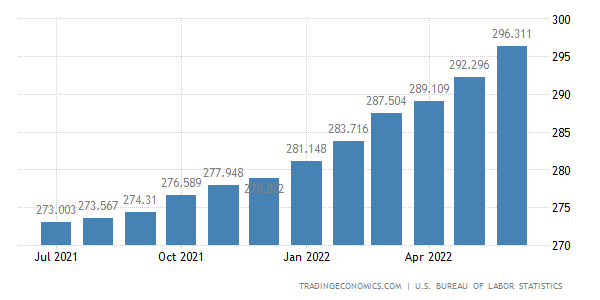
source: tradingeconomics.com
On Thursday, Treasury Secretary Janet Yellen expressed support for the Federal Reserve’s decision to double interest rates to bring down the “unacceptably high” level of inflation, and assured that the issue was the administration’s “top priority.”
Yellen echoed Mr. Biden’s claims that America’s economic problems were partly Russia’s fault, calling the inflation rate one of the “spillover effects” caused by “Putin’s war” in Ukraine. Yellen added that broken supply chains were part of the problem, and called on G20 economies to “make our economies and our supply chains stronger and more resilient and avoid the sort of costly disruptions that have driven up inflation in America and globally.”
Last month, Fed Chairman Jerome Powell broke with the Biden administration’s “Putin’s price hike” talking point, telling lawmakers at a Senate Banking Committee hearing that “inflation was high before – certainly before the war in Ukraine broke out,” and that the phenomenon is caused by a number of factors, including supply chain disruptions, regulations that constrain supply, and “excessive fiscal spending.”
June’s inflation rate hike constituted the sharpest jump since 1981 – the height of the ‘malaise days’ of raging inflation, low growth, and soaring energy costs. The problem was ultimately resolved by temporarily increasing the interest rate to double digits, easing restrictions on adding to the federal debt, steep government spending cuts and a consumer credit boom.
Kiev gathering information about chemical facilities in Donbass, might use HIMARS to target them
By Uriel Araujo | July 15, 2022
Kiev is now employing the High Mobility Artillery Rocket Systems (HIMARS) provided by Washington to strike Moscow-controlled areas. Such missiles hit warehouses in Nova Kakhovka – in the Kherson region – containing saltpetre, a chemical compound that is used to make gunpowder and fertilizers. Ukraine claims the target was an ammunition dump. The strike caused a major explosion and fires. Shops, gas stations, pharmacies, a church, and other civilian buildings were also hit. At least seven people were killed and 60 have been wounded, according to Vladimir Leontyev, head of the Russian-controlled Kakhovka District military-civilian administration.
The first M142 HIMARS arrived in Ukraine at the end of June and have been linked to explosions in the Donbass region and southern Ukraine. In its counter-offensive, the Ukrainian authorities are indiscriminately attacking the areas whose control they lost and are basically shelling the very population they consider to be their own people – using American weapons for that. City districts have been leveled, with civilian infrastructure destroyed and many civilians killed in the process.
Last week, Alexandr Shulguin, Moscow’s permanent representative at the Organization for the Prohibition of Chemical Weapons (OPCW), warned that Kiev is preparing provocations with chemical weapons at the Nikolaevka thermal power plant and also at other locations in Kharkiv. He told Rossiya 24 channel that a note was sent to the technical secretariat of the OPCW.
Kiev was in control of the Azot chemical factory in Severodonetsk (now taken by the Russians forces), and, on June 25, Ukrainian shelling forced Russian forces to suspend the evacuation of civilians from the plant. Hundreds of people had taken shelter there. Ukrainian troops also shelled the Yasinovka coking chemical plant in the Kirovsky district of Makiivka in the Donetsk People’s Republic (DPR) on June 19.
Already in May there were reports that Ukrainian nationalist battalions were plotting provocations at the chemical facilities in the so-called “chemical industry triangle” (Severodonetsk, Lisichansk, and Rubezhnoye), which is home to over 30 chemical factories. On May 6, Mikhail Mizintsev, chief of Russia’s National Defense Management Center, had already warned about Kiev’s plans to deploy “heavy weapons” against chemical plants in the region. In fact, the Ukrainian military has been gathering information about chemical facilities in the Donbass, both in the DPR and the Luhansk People’s Republic (LPR).
Thus, the Ukrainian strategy that is unfolding now seems to involve attacking chemical plants and facilities. And US-provided missile systems might be used for that very purpose. The environmental hazards of this are quite obvious, not to mention the humanitarian disaster and the potential long-term health effects on the population even after the end of the conflict for many years to come (due to soil and water contamination). A lot of chemicals are stored in Donbass, which is a heavily industrialized region. It is also home to a number of mines which are currently closed. If a dam is broken, mercury and sulfur from the flooded mines could end up in the Sea of Azov.
Currently, eight American HIMARs are in Ukraine and four more are expected to arrive by the end of July. Even though Kiev claims this new development is a game changer, it can only protract the conflict and in fact cannot ensure Ukrainians will retake terrain. Last week, on July 6, the Russian defense ministry announced Moscow had destroyed two Ukrainian HIMARS and their ammunition depots in a village south of Kramatorsk in the Donetsk region.
If Kiev keeps targeting chemical facilities, a Russian offensive is sure to follow, and it will include an aerial onslaught. In this scenario, the HIMARs batteries will be helpless, according to a Ukrainian military official quoted by Jack Detsch, a Pentagon correspondent writing for Foreign Policy.
The proxy war the US-led West is waging against Moscow in Ukraine does not seem to have a way out or an exit strategy right now. Even with all the heavy weaponry provided, Russia and its artillery machine cannot be defeated. In fact, the Russian Federation controls three-quarters of the Donbass and still has five times more artillery than Ukraine. Ukrainian officials say there are 10 Russian canons for every Ukrainian one.
Kiev’s other weaknesses are well known, such as its lack of skilled infantry – not to mention the bad shape of its economy. Moreover, there are no real diplomatic endeavors toward peace or a compromise. So, the Western strategy apparently consists in keeping the flow of weapons to Ukraine to prolong an already disastrous conflict, at an enormous humanitarian, environmental and economic cost.
Featured Video

John Mearsheimer Talking Iran with Iran
or go to
Aletho News Archives – Video-Images
New Book
The silver that medicine dropped — four thousand years of clinical use, four decades to erase.
Colloidal Silver — First Edition, 2026, Paperback
Lies are Unbekoming | October 16, 2026
Silver was medicine. Not alternative medicine. Not folk medicine. Medicine. In surgery. In obstetrics. In the burn ward. In water treatment. In the household medicine chest. Every physician before 1938 knew this.
By the 1870s, silver nitrate was standard in surgical wound care across the leading hospitals of Britain, Germany, and the United States. Colloidal silver preparations — Collargol, Argyrol, Protargol — entered European and American practice through the 1890s and early 1900s and became standard antiseptics in military field medicine. By the time Fleming grew his first penicillin mould in 1928, silver was the first-line antimicrobial of the Western pharmacopoeia. The Lancet and the British Medical Journal carried the clinical reports in volume. The practice ran continuously through the Victorian era, the Edwardian era, the First World War, the interwar period. By 1980, almost all of it was gone.
What has not been treated at book length, until now, is how a four-thousand-year clinical record disappeared from mainstream medicine within four decades of the Flexner Report — and what the honest account of silver looks like once that record is reassembled.
Colloidal Silver reconstructs the pre-1938 record from The Lancet, the British Medical Journal, and the primary literature of the era; recovers Robert Becker’s bioelectric framework from the regeneration research the pharmaceutical model buried; and places silver inside a practical terrain-paradigm guide to its current place — in water, on the body, inside the body, and in the chronic conditions where antibiotics have failed. … continue
Blog Roll
 Aletho News
- John Mearsheimer Talking Iran with Iran
- Inside Bill C-22, Canada’s Patriot Act.
- China’s FM: Palestinian cause is ‘greatest injustice of the century’
- US sympathy for Palestinians surpasses support for Israelis
- Israeli rabbi permits occupiers to steal Palestinian olive harvest in West Bank
- Spanish firm sells Latvia vehicles equipped with Israeli tech despite arms embargo
- Saudi Arabia under fire… Yemen is burning down the House of Saud
- Israeli Spy Pollard stole the files, today’s it’s delivered through official channels
- Why Iran Didn’t Walk Away
- US arms supplied to Ukraine found in war-torn Sudan – Moscow
- If Americans Knew
- NPR investigation finds evidence of widespread fraud at mall kiosks tied to Israeli skincare brand
- Tucker Carlson exposes Israeli Lies about the Oct 7th attack, Charlie Kirk, and the U.S.
- Israel has detained thousands of Palestinian children since Oct 7th – over half spent time in solitary, many uncharged
- Israeli Analysis: Is Netanyahu Planning an ‘October Surprise’ Attack Before Israel’s Election?
- Israeli settlers brutally attack Palestinians and Washington Post female photographer, 65
- Words Have Changed, Occupation Continues: The Reality of the Gaza Ceasefire
- Gaza’s child amputees are growing faster than their prosthetics allow
- Israel keeps Palestinians struggling just to survive–Daily Update
- Israeli firm used online ads to run vast spy operation, researchers say
- No, the world zionist movement is not an antisemitic conspiracy theory
- No Tricks Zone
- New Study Suggests Large Regions Of The Pacific Ocean Have Been Cooling For The Last 80 Years
- Germany’s Green Energy Debacle: High Energy Costs Force Kahla Porzellan to Close After 182 Years!
- New Study: 50 Years Of The Most Aggressive ‘Net Zero’ Policies Can Only Affect The Global Climate By 0.03°C
- US September “Heat” Was No Record…Many Records Set Decades Ago
- Latest European Green Energy Debacle; Portugal’s Largest Flagship Solar Park Insolvent!
- Green Energy Debacle: German Expert Professor Fritz Vahrenholt Warns Of Severe Economic And Social Consequences
- Two More Paleo Reconstructions Affirm Meters-Higher Sea Levels Across Ireland, Brazil 7000-6000 Years Ago
- New Study: Earth And Venus Surface Warmth Largely Explained By Convection And Lapse Rate, Not CO2 Or Radiation
- 2025 Nature Paper Claiming Worsening Global Drought Gets RETRACTED …Heavily Flawed
- New Study: ‘Global Drought Shows No Detectable Recent Acceleration Under Climate Warming’

