Why India must decouple from I2U2
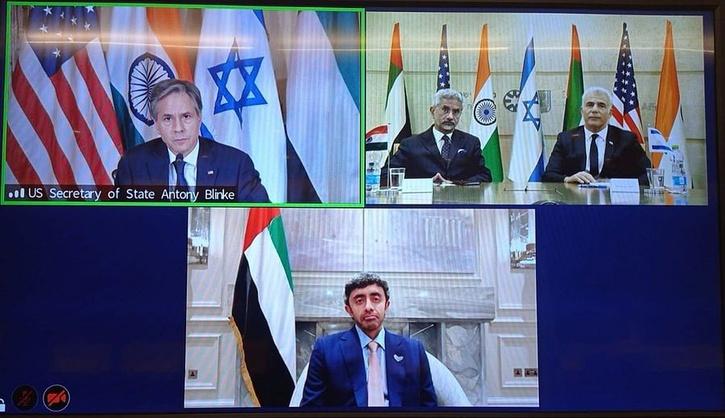
Foreign Ministers of India, Israel, UAE, US (clockwise) held a videoconference in October 2021 to launch a ‘Quad’ for West Asia
BY M. K. BHADRAKUMAR | INDIAN PUNCHLINE | JUNE 17, 2022
Indian diplomacy is descending from the sublime to the absurd. Such wild swings signal rank opportunism. These are extraordinary times when to be smart is equated as being opportunistic.
Hardly a week passed since PM Modi received the Iranian Foreign Minister Amir-Abdollahian in Delhi and expressed high hopes for India-Iran relationship. Now it transpires that India also forms part of the Gang of Four led by US President Joe Biden to “contain” Iran, from a new platform called I2U2 — the ‘I’ being India and Israel, and ‘U’ being US and UAE.
The I2U2 summit in mid-July between Biden, Israeli Prime Minister Bennett, Modi, and Emirati President Mohammed bin Zayed is destined to be a signpost in the geopolitics of West Asia. This new Quad first appeared on 18th October 2021 as an offspring of External Affairs Minister Jaishankar’s 5-day trip to Israel when from Tel Aviv he pulled a rabbit out of the hat, leaving the Indian public wonder what new grandstanding their impulsive minister was indulging in.
Between October and July this year, the I2U2 is getting an upgrade from foreign minister to prime minister/president level. On Tuesday, while announcing Biden’s first West Asian tour as president in mid-July, Washington has made some effort to rationalise Biden’s intentions in undertaking the planned visits to Israel and Saudi Arabia. A senior White House official said Biden intends:
- To demonstrate “the return of American leadership to bring countries together”;
- To create “new frameworks that aim to harness unique American capabilities to enable partners to work more closely together, which is essential to a more secure, prosperous, and stable Middle East region over the long term”;
- To build on the “resounding vote isolating Iran last week at the IAEA Board of Governors in Vienna where 30 countries condemned Iran’s lack of compliance with safeguard obligations” (where India, by the way, had abstained from supporting the US move);
- “To make sure we’re doing all we can to strengthen Israel’s security, prosperity, and integration into the larger region, both now and over the longer term”;
- To “focus on Israel’s increasing integration into the region” through new formats other than Abraham Accords, such as the “entirely new grouping of partners… what we call I2U2”!
So, that’s it. India will lend a hand to assist the US to refill the fizz that has gone out of the Abraham Accords. The hope that more countries would join Abraham Accords is withering away. Israel needs to be shown around to prospective suitors in its neighbourhood. I2U2 is, in essence, a dating agency. When it concerns Israel, the role of pandar comes naturally to the US presidents. But why should India squander away its soft power?
The US prestige and influence in West Asia has suffered a severe jolt during the Biden presidency. Not too long ago, Biden had called Saudi Arabia a “pariah” and pledged to make a horrible example of it on account of its human rights record. But now the shoe is on the other foot. Biden is craving for attention from Saudi Arabia. He had taken a second vow not to have any dealings with the powerful Saudi Crown Prince Mohammed bin Salman. But he is now beseeching the proud Prince for an audience. His recent phone calls weren’t answered.
The White House official explained Biden’s U-turn this way: “we have important interests interwoven with Saudi Arabia, and engagement is essential to protecting and advancing those interests on behalf of the American people.” In reality, Biden is swallowing pride and reviving the old matrix of US-Saudi relationship riveted on the petrodollar.
With poll rating falling abysmally low, Biden is desperate to tackle the rising inflation in the US economy, and the soaring price of oil is fuelling public disaffection. Saudi Arabia can help Biden salvage his standing.
However, it is the turn of the Saudis now to tell Americans there’s no free lunch. They want a written treaty to the effect that the US won’t ditch them when the crunch time comes or if the Kingdom or the ruling family feels insecure. Put differently, they want the Americans to act as their Praetorian guards as before.
In return, of course, Saudis will generate massive business for the US military-industrial complex, recycle their petrodollar to strengthen the Western banking system and create lucrative business for American companies — in short, help the beleaguered Western economies to pursue their post-pandemic recovery that is getting derailed by the war in Ukraine.
Indeed, the Saudis also have a rich history of lavishly greasing the palm of the American elite in the administration, the Pentagon and the Congress. In a nutshell, Biden as a seasoned operator in the Beltway knows which side of the bread is buttered.
But to rationalise his U-turn, an alibi is needed. So, Biden has decided to hoist “Iranian threat” as the leitmotif of the revamped US-Saudi security alliance. All signs are that Biden has acceded to the Saudi demand to scuttle the JCPOA and pile new sanctions against Iran, although the negotiations in Vienna are in home stretch and an agreement is within sight.
Biden’s West Asian agenda is completely US-centric, aimed at securing US business interests and shoring up its regional influence. Israel, of course, is a “holy cow”. Very soon Biden will begin fund-raising for his re-election bid in 2024, and Jewish donors are a generous lot.
However, the million dollar question remains: What has India got to do with Biden’s agenda? There are real risks, for the subplot here is that Biden hopes to nix India’s plans to revive its atrophied relationship with Iran. The recent visit of the Iranian foreign minister to India would have set alarm bells ringing in Washington and Tel Aviv.
Biden has a game plan for leaders like Modi who have a tendency to disregard the US diktat occasionally. Biden’s national security advisor Jake Sullivan spoke candidly just the other day:
“We’re playing the long game here. We are investing in a relationship (with India) that we are not going to judge by one issue even if that issue is quite consequential, but rather that we are going to judge over the fullness of time, as we try to work to convergence on the major strategic questions facing our two countries.
“On one of those questions — how to deal with the challenge posed by China — there’s much more convergence today, and that is important to US foreign policy. On the question of Russia, obviously, we have different historical perspectives, different muscle memories, but we feel confident that the dialogue we have going with India right now will bear fruit over time.”
Sullivan was discussing India’s time-tested relationship with Russia — how Washington hopes to erode and dissolve it all in good time.
Plainly put, Americans estimate that Indians have no “staying power,” or “big picture.” They probably estimate that the Indian government would grab the I2U2 platform to burnish its international image. But if there is any sanity left in the Indian foreign policy establishment, a subaltern role to serve US and Israeli interests cannot enhance India’s prestige in West Asia where, as it is, Modi government is perceived as an Islamophobic regime backed by religious fanatics.
In the life of individuals and nations alike, there are moments when one has to learn to say “no.” This self-serving, cynical overture from 78-year old Biden is one such moment. That’s why, despite zero chance of India turning down Biden’s invite, not to urge Modi to say “Nyet” to I2U2 will be a serious lapse.
South Block is underestimating the gravity of its folly. India never ever got entangled in the intra-regional issues in West Asia. It never acted as the surrogate of extra-regional powers, either. Most important, it never sought the “containment” of any regional state. That’s how it held its head high in the choppy waters of the Persian Gulf.
Iran blasts IAEA for repeating old allegations based on bogus Israeli claims
Press TV – June 17, 2022
Iran’s nuclear agency chief has again blasted the International Atomic Energy Agency (IAEA) for repeating old allegations against the country’s civilian nuclear program, based on bogus Israeli claims.
Mohammad Eslami, the head of the Atomic Energy Organization of Iran (AEOI), addressing a press conference in the central Iranian city of Natanz on Thursday, said the false allegations made by the IAEA are detrimental to ongoing negotiations to revive the 2015 nuclear deal.
“Now that the negotiations for [the US] return to the JCPOA [nuclear deal] are underway, the same old allegations are being repeated by citing fabricated claims made by the Zionist regime,” Eslami said.
He was referring to the UN nuclear agency’s mention of the so-called PMD (possible military dimensions) file on Iran’s nuclear program, insisting that such schemes will not help negotiations.
Eslami stressed that the reasoning behind signing the 2015 nuclear deal – officially referred to as the Joint Comprehensive Plan of Action (JCPOA) – was the closure of false Western allegations about possible military applications of Iran’s civilian nuclear program under the PMD file.
He said the PMD file was supposed to be closed as a key condition for reaching the accord and lifting anti-Iran sanctions — based on extensive inspections of Iran’s nuclear facilities and activities by the IAEA over the past two decades.
“We, in turn, accepted limitations on our nuclear activities and thereby yielded on our certain rights as well as accepted inspections on the condition that previous accusations would be permanently revoked and that we would be able to continue our activities under strict inspection and trust-building engagements,” the official added.
Eslami said Iran continues to operate under the IAEA regulations, while defending the removal of surveillance cameras functioning beyond the safeguards agreement, in reaction to the anti-Iran vote at the UN agency’s board of governors meeting recently.
Last week, Eslami slammed the IAEA for politicizing Iran’s peaceful nuclear program under Israeli pressure while disregarding Tehran’s extensive cooperation with the UN agency after the adoption of a resolution against Iran — drafted by the US and its European allies.
Eslami justified Tehran’s refusal to provide the IAEA with films of JCPOA’s monitoring cameras, stressing that the accord between Iran and the 5+1 countries will only exist as long as both sides remain committed to it.
“Today they want to return to JCPOA, but then raise the same old reasons for starting the nuclear talks. So we, in turn, did not grant them access to the film of the JCOPA cameras,” he stressed.
“Psychological operations, media campaigns and political pressures and controversies against Iran have never produced results in the past and will now remain ineffective as well because the PMD file was closed in the past, and reopening it will in no way help them,” he added.
He said Iran was in possession of “less than three percent of the world’s nuclear reserves” but still “more than 25 percent of [IAEA] inspections” were carried out in Iran, while the regimes that have waged wars against Iran have never allowed inspections of their nuclear facilities.
Iran’s foreign minister Hossein Amir-Abdollahian, in his remarks on Thursday, also blamed the US for IAEA’s recent anti-Tehran resolution, insisting that the move was aimed at mounting pressure on Tehran to give concessions in Vienna talks.
Iran’s top diplomat made the remarks in a Thursday phone call with his Iraqi counterpart, Fuad Hussein, during which the two sides also discussed bilateral issues and regional developments.
Negotiations have been underway in the Austrian capital since April last year to restore the 2015 Iran deal, which the former US President Donald Trump unilaterally abandoned in May 2018.
After quitting the deal, Trump introduced what he called the “maximum pressure” campaign to bring Iran to its knees, a policy that has failed miserably. The Joe Biden administration, despite its initial pledge to reverse Trump’s hard-nosed measures, has failed to deliver.
Iran has cited Washington’s indecisiveness as the reason behind the stalemate in talks, as many key issues remain unresolved, ranging from the removal of all post-JCPOA sanctions to the provision of guarantees by the American side that it will not leave the deal again.
AEOI spokesman Behrouz Kamalvandi on Wednesday advised IAEA director general Rafael Grossi to refrain from “complicating the situation” by making political statements after the UN agency called on Iran to resume talks before things get “much more problematic.”
“I amicably advise Rafael Grossi, the director-general of the [International Atomic Energy] Agency, to distance himself from making unprofessional statements of political color intended for media consumption,” Kamalvandi said.
“It is clear that if there is a technical issue, it should be presented professionally within the framework of the Agency’s duties and followed through its channels and the usual mechanisms of the Agency. Obviously, the arena for such interactions is not the media.”
Kamalvandi was referring to Grossi’s interview broadcast on June 12 on CNN, in which he made unusually menacing tropes against Iran.
Grossi sparked a controversy after he traveled to Israel and met the regime’s leaders late last month, just before the IAEA board of governors meeting.
The IAEA’s annual report, experts believe, was based on documents supplied by Israel about Iran’s nuclear program, which Tehran has rejected as fabricated.
Israel snubs Biden request to halt actions that could embarrass the US President
MEMO | June 16, 2022
US President, Joe Biden, sought assurance from Israel that no action is taken in the occupied West Bank and Jerusalem that could create tensions ahead of his controversial visit next month to the Apartheid State. Biden’s team made the request to the Israelis in what seems to be an attempt by the White House to avoid repeating the embarrassment Biden suffered over a decade ago when he visited the territory as Vice President under the administration of Barack Obama.
During the 2010 visit, Biden vowed unyielding American support for Israel’s security. The Israelis returned the favour by humiliating the then vice President with an announcement to build 1,600 new Jewish only houses, in illegal settlements, in occupied East Jerusalem. Biden condemned the move as “precisely the kind of step that undermines the trust we need right now.” A statement by the White House condemned “the substance and timing of the announcement.”
Barbara Leaf, the US Assistant Secretary of State for Near East Affairs, and her deputy for Israeli-Palestinian affairs, Hady Amr, are laying the groundwork for Biden’s visit scheduled for 13-15 July. Leaf asked Israel to halt actions like home demolitions, evictions of Palestinians and decisions on settlement building, as well as decrease Israeli military operations in the West Bank until after Biden’s visit, officials told Axios.
The Israelis have said they are not able to give such assurances, but they will, nevertheless, try their best. According to Axios, senior members of the Israeli team, including Defence Minister, Benny Gantz, told Leaf they will do their best, but explained the domestic political complexities of halting such actions, in addition to what they called the operational needs of the Israeli military in order to stop attacks.
With the trip coming fresh after the Israeli killing of Palestinian journalist, Shireen Abu Akleh, the Americans are fearful of a global outrage coinciding with Biden’s visit to the Apartheid State. “The Biden administration doesn’t want us to create any crisis in the West Bank … They want quiet and calm” for Biden’s visit, a senior Israeli official is reported saying.
Not only is the US team desperate to avoid embarrassment for Biden, they are also putting together a plan to show that the US President is capable of making progress. Israeli, Palestinian and US officials said Leaf, Amr and US ambassador to Israel, Tom Nides, tried to put together a package of tangible deliverables for the Palestinians to coincide with the Biden visit.
But they did not make significant progress on the package because there are not enough meaningful things the US can give and Israel is not willing to take any steps with political significance that will be enough for the Palestinians, the officials said, according to Axios.
“We need a political horizon. We want to hear President Biden say what his detailed position regarding the two state solution is,” PLO official and adviser to the Palestinian Authority (PA) President Mahmoud Abbas, Hussein Al-Sheikhal-Sheikh, is reported saying. “The US wants the visit to take place in a good atmosphere – different than the one now,” Al-Sheikhal-Sheikh added implying that Washington is more concerned about its image than it is about Israel’s daily human rights violations.
In a blow to the Biden team’s effort to portray the US President as the broker of peace, the PA and Israel rejected their proposal to meet. Palestinian officials stressed that such a meeting should include an Israeli commitment to the two-state solution based on the 1967 borders, otherwise, the meeting would be useless.
The Road to Nuclear Armageddon
By Llewellyn H. Rockwell, Jr. | June 16, 2022
Ladies and gentlemen, we face a grave danger. The leader of a major European power wants to make territorial revisions. He is surrounded by hostile powers who threaten him. He does not seek war with other countries but if the hostile powers continue to encircle him, he will fight. A European war looms.
You probably think I’m talking about the current crisis between Russia and the Ukraine, but I’m not. I’m talking about Europe just before World War II began in September 1939. At that time, Hitler wanted small territorial revisions with its Polish neighbor. East Prussia was cut off from the rest of Germany by a band of territory called the Polish Corridor.
As the great British historian A.J. P. Taylor explains,
“The losses of territory to Poland were, for most Germans, the indelible grievance against Versailles. Hitler undertook a daring operation over this grievance when he planned co-operation with Poland. But there was a way out. The actual Germans under Polish rule might be forgotten—or withdrawn; what could not be forgiven was the ‘Polish corridor’ which divided East Prussia from the Reich. Here, too, there was a possible compromise. Germany might be satisfied with a corridor across the corridor—a complicated idea for which there were however many precedents in German history. German feeling could be appeased by the recovery of Danzig. This seemed easy. Danzig was not part of Poland. It was a Free City, with its own autonomous administration under a High Commissioner, appointed by the League of Nations. The Poles themselves, in their false pride as a Great Power, had taken the lead in challenging the League’s authority. Surely, therefore, they would not object if Germany took the League’s place. Moreover, the problem had changed since 1919. Then the port of Danzig had been essential to Poland. Now, with the creation of Gdynia by the Poles, Danzig needed Poland more than the Poles needed Danzig. It should then be easy to arrange for the safeguarding of Poland’s economic interests, and yet to recover Danzig for the Reich.”
The British responded by guaranteeing Poland’s western boundary against Germany. They also issued a guarantee to Romania, even though there had been no threat to that country. As a result of the guarantee, Poland refused to negotiate with Germany. War broke out, and Poland was destroyed. The great Murray Rothbard tells us what happened:
“And as a direct result, Poland was destroyed. Hitler’s ‘demands’ on the Poles were almost non-existent; as Taylor points out, the Weimar Republic would have scorned the terms as a sell-out of vital German interests. Hitler at most wanted a ‘corridor through the Corridor’ and the return of heavily-German (and pro-German) Danzig; in return for which he would guarantee the rest. Poland resolutely refused to yield’ one inch of Polish soil,’ and refused even to negotiate with the Germans, and this down to the last minute.”
Murray draws an important lesson from what happened then. This lesson provides the key to keeping us out of a nuclear war today. And of course a nuclear war would destroy the world. Here is what Murray says:
“[Polish Foreign Minister Józef] Beck clearly knew that Britain and France could not actually save Poland from attack. He relied to the end on those great shibboleths of all ‘hard-liners’ and other ‘crackpot realists’ everywhere: X is ‘bluffing’; X will back down if met by toughness, resolution, and the resolve not to give an inch. (Just as in the case of Finland, when the ‘X is bluffing’ line of the hard-liners is shown to be sheer absurdity, and X has already attacked, the ‘hard-liner’ turns, self-contradictorily, to the dictum that not ‘one inch of sacred soil’ will be given up, no peace while the enemy is on our soil, etc., which completes the ruin of the country by its ‘hard-line’ rulers. This is what Beck did to Poland.) As Taylor shows, Hitler had originally not the slightest intention to invade or conquer Poland; instead, Danzig and other minor rectifications would be gotten out of the way, and then Poland would be a comfortable ally, perhaps for an eventual invasion of Soviet Russia. But Beck’s irrational toughness blocked the path.”
Now we have the background we need to understand what’s going on today. Russia is surrounded by a hostile NATO alliance. The propagandists for brain-dead Biden like to say that Putin had Ukraine surrounded. But in fact, the US and its NATO satellites had Russia surrounded. In the years before the current crisis, we had ample opportunity to reach a compromise settlement. Instead, we kept the option of membership in NATO open to Ukraine and overthrew a Ukrainian President who was pro-Russian. At the Kremlin. . . in a speech in November 2021] Putin drew his red line:
‘The threat on our western borders is … rising, as we have said multiple times. … In our dialogue with the United States and its allies, we will insist on developing concrete agreements prohibiting any further eastward expansion of NATO and the placement there of weapons systems in the immediate vicinity of Russian territory.’
A story in The New York Times exposes what brain-dead Biden and the gang of neo-cons that controls him have in store for us. According to an item that was published April 26,
“When Defense Secretary Lloyd J. Austin III declared Monday at the end of a stealth visit to Ukraine that America’s goal is to see Russia so ‘weakened’ that it would no longer have the power to invade a neighboring state, he was acknowledging a transformation of the conflict, from a battle over control of Ukraine to one that pits Washington more directly against Moscow. . . in word and deed, the United States has been gradually pushing in the direction of undercutting the Russian military.
It has imposed sanctions that were explicitly designed to stop Russia’s military from developing and manufacturing new weapons. It has worked — with mixed success — to cut off the oil and gas revenues that drive its war machine. . . over the longer term, Mr. Austin’s description of America’s strategic goal is bound to reinforce President Vladimir V. Putin’s oft-stated belief that the war is really about the West’s desire to choke off Russian power and destabilize his government. And by casting the American goal as a weakened Russian military, Mr. Austin and others in the Biden administration are becoming more explicit about the future they see: years of continuous contest for power and influence with Moscow that in some ways resembles what President John F. Kennedy termed the ‘long twilight struggle’ of the Cold War.
Mr. Austin’s comments, bolstered by statements by Secretary of State Antony J. Blinken about the various ways in which Mr. Putin has ‘already lost’ in the struggle over Ukraine, reflect a decision made by the Biden administration and its closest allies, several officials said on Monday, to talk more openly and optimistically about the possibility of Ukrainian victory in the next few months as the battle moves to the Russian-speaking south and east, where Mr. Putin’s military should, in theory, have an advantage.
At a moment when American intelligence officials are reporting that Mr. Putin thinks he is winning the war, the strategy is to drive home the narrative that Russia’s military adventure will be ruinous, and that it is a conflict Mr. Putin cannot afford to sustain.”
Let’s make sure we understand this. Critics of US policy have pointed out for a long time that America has surrounded Russia with nuclear bases. It helped overthrow a pro-Russian government in the Ukraine. Naturally, this made Putin nervous. He does not want an invasion of Russia through the Ukraine, as happened in World War II, when Russia lost millions of lives. Now, the brain dead Biden gang of neocons is saying to Putin, “You are exactly right! We do want to degrade Russia to a minor power and use the Ukraine as a base for attack!”
Nothing could be more certain to lead to nuclear disaster. The Russians warn us about this A story in The Guardian says:
“Russia’s foreign minister has accused Nato of fighting a proxy war by supplying military aid to Ukraine, as defence ministers gathered in Germany for US-hosted talks on supporting Ukraine through what one US general called a ‘very critical’ few weeks.
Sergei Lavrov told Russian state media: ‘Nato, in essence, is engaged in a war with Russia through a proxy and is arming that proxy. War means war.’
He also warned that the risks of nuclear conflict were now ‘considerable’. . . When asked about the importance of avoiding a third world war, Lavrov said: ‘I would not want to elevate those risks artificially. Many would like that. The danger is serious, real. And we must not underestimate it.’”
If it weren’t for the US arms shipments to the Ukraine, Russia and the Ukraine would quickly arrange a settlement that would protect Russia’s security interests. Those in control know this, but they don’t want a peaceful settlement along these lines. They want to rule the world. They don’t want countries that reject US supremacy to have a role in the world.
“Chairman of the Joint Chiefs of Staff Gen. Mark Milley told CNN’s Jim Sciutto on Tuesday that the entire ‘global international security order’ put in place after World War II is at stake if Russia gets away ‘cost-free’ following its invasion of Ukraine. . . ‘What’s at stake is the global international security order that was put in place in 1945. That international order has lasted 78 years. . . Milley’s warning about the potential global implications of Russia’s actions in Ukraine also underscores the current sense of urgency felt by the US and its allies as the war enters what they say is a critical juncture… Shortly after Milley’s interview, [Defense Secretary] Austin also stressed the importance of moving quickly to provide Ukraine with the military aid it needs, saying during a news conference that the US and other allies and partners ‘don’t have any time to waste’ when it comes to providing crucial assistance to counter Russia as their invasion continues.
‘We don’t have any time to waste. The briefings today laid out clearly why the coming weeks will be so crucial for Ukraine, so we’ve got to move at the speed of war. . . Austin also said that he thought Ukraine ‘will seek to once again apply to become a member of NATO in the future.’”
Is there anything we can do to de-escalate the situation? The greatest Congressman in American history, Dr. Ron Paul, whom we are here today to honor, has the answer. America should end its encirclement of Russia and disband NATO. Let’s look at his vital message to us:
“When the Bush Administration announced in 2008 that Ukraine and Georgia would be eligible for NATO membership, I knew it was a terrible idea. Nearly two decades after the end of both the Warsaw Pact and the Cold War, expanding NATO made no sense. NATO itself made no sense.
Explaining my ‘no’ vote on a bill to endorse the expansion, I said at the time:
NATO is an organization whose purpose ended with the end of its Warsaw Pact adversary… This current round of NATO expansion is a political reward to governments in Georgia and Ukraine that came to power as a result of US-supported revolutions, the so-called Orange Revolution and Rose Revolution.
Providing US military guarantees to Ukraine and Georgia can only further strain our military. This NATO expansion may well involve the US military in conflicts unrelated to our national interest…
Unfortunately,. . . , my fears have come true. One does not need to approve of Russia’s military actions to analyze its stated motivation: NATO membership for Ukraine was a red line it was not willing to see crossed. As we find ourselves at risk of a terrible escalation, we should remind ourselves that it didn’t have to happen this way. There was no advantage to the United States to expand and threaten to expand NATO to Russia’s doorstep. There is no way to argue that we are any safer for it.
NATO itself was a huge mistake. . . I believe as strongly today as I did back in my 2008 House Floor speech that, ‘NATO should be disbanded, not expanded.’ In the meantime, expansion should be off the table. The risks do not outweigh the benefits!”
The saddest part of this whole manufactured crisis is that it should make absolutely no difference to us whether Russia controls Ukraine. How is that a threat to the United States? Whatever Biden and his neocon advisers say, America should stay out of conflicts that are none of our business. As usual, Murray Rothbard put it best. “In the context of the 1980 Afghan war, he quoted Canon Sydney Smith – a great classical liberal in early 19th century England who wrote to his warmongering Prime Minister, thus:
“For God’s sake, do not drag me into another war!
I am worn down, and worn out, with crusading and defending Europe, and protecting mankind; I must think a little of myself.
I am sorry for the Spaniards – I am sorry for the Greeks – I deplore the fate of the Jews; the people of the Sandwich Islands are groaning under the most detestable tyranny; Baghdad is oppressed, I do not like the present state of the Delta; Tibet is not comfortable. Am I to fight for all these people?
The world is bursting with sin and sorrow. Am I to be champion of the Decalogue, and to be eternally raising fleets and armies to make all men good and happy?
We have just done saving Europe, and I am afraid the consequence will be, that we shall cut each other’s throats. No war, dear Lady Grey! – No eloquence; but apathy, selfishness, common sense, arithmetic!”
The same people who imposed Covid-tyranny on us now want us to risk war with Russia. Let’s stop them before it’s too late.
Florida Government Says ‘No’ to Shipment of Coronavirus Shots for Babies and Young Children
By Adam Dick | Ron Paul Institute | June 16, 2022
The state government of Florida is standing up against the effort to indiscriminately inject experimental coronavirus “vaccine” shots into children four years old and younger. And, as reported Wednesday by Christopher O’Donnell and Ian Hodgson at the Tampa Bay Times, Florida is the only state to make this decision, every other state government having pre-ordered the shots from the United States government in anticipation of the granting of US regulatory approval.
Good for Florida. It is making the right choice in refusing to be a pusher for these shots promoted relentlessly by a collaboration of big business, big media, and big government.
In May of last year I wrote about the need for state and local governments to refuse to participate in the then new rollout of experimental coronavirus shots to 12 to 15 years old children. I concluded my comments on the matter with the following statement after addressing dangers of the shots and the very minimal risk coronavirus tends to pose for children:
It is one thing to stand aside as parents choose to have their children injected with experimental shots that carry significant known health risks and unknown potential negative consequences. It is another to actively encourage the giving of such shots through participating in their promotion and distribution. At some point, shouldn’t state and local governments admit that the risk and rewards related to shots are so out of whack that their taking part in pushing the shot-giving is a clear menace? Being presented with the opportunity to give experimental coronavirus vaccine shots to 12 to 15 years old children seems like a good time to declare ‘no more.’
A statement from the Florida Department of Health, reprinted at Fox 13 TV of Tampa Bay, makes clear that the state government’s decision not to preorder the shots was its way of saying “no more” based on the state having come to its own independent decision that the shots are not the safe and effective wonder for all young children that many people in government and the media proclaim them to be. Here is that statement from the Florida Department of Health:
The Florida Department of Health (Department) has made it clear to the federal government that states do not need to be involved in the convoluted vaccine distribution process, especially when the federal government has a track record of developing inconsistent and unsustainable COVID-19 policies.
It is also no surprise we chose not to participate in the distribution of the COVID-19 vaccine when the Department does not recommend it for all children. Doctors can order vaccines if they are in need, and there are currently no orders in the department’s ordering system for the COVID-19 vaccine for this age group.
The local television news report also provided these cogent comments regarding the decision from Joseph Ladapo, the state’s surgeon general:
‘We expect to have good data that the benefits outweigh the risks of any therapies or treatments before we recommend those therapies or treatments to Floridians. That is not going to change. I don’t think that is particularly radical. I think it’s very sensible,’ said Ladapo. ‘From what I have seen, there is just insufficient data to inform benefits and risk in children. I think that’s very unequivocal.’
Bravo to Florida and its surgeon general, about whom I wrote positively upon his appointment to the position in September.
Hopefully, we will see more state and local governments looking critically at the new shady approval of experimental coronavirus shots for young children and declaring their refusal to participate as well.
Copyright © 2022 by RonPaul Institute
State Dept. Not Investigating Saudi Use of US Weapons in Alleged War Crimes: GAO
Samizdat | June 16, 2022
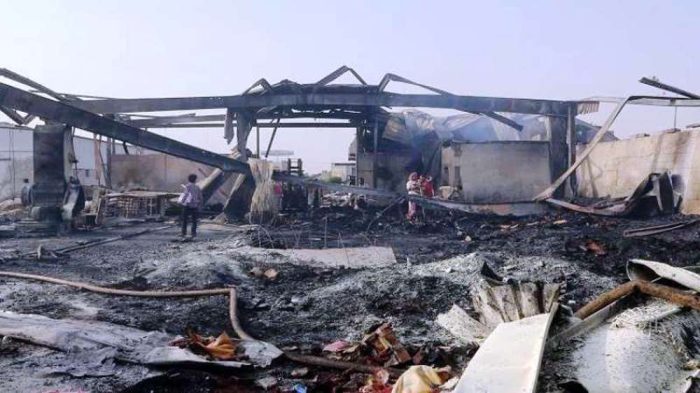
The Government Accountability Office (GAO) published a scathing report Monday which found that the Department of Defense and the Department of State “have not fully determined the extent to which U.S. military support has contributed to civilian harm in Yemen.” The news comes on the heels of the announcement that US President Joe Biden will be paying a visit next month to Saudi Arabia, a country which in 2019 he pledged to turn into a “pariah.”
“Despite several reports that airstrikes and other attacks by Saudi Arabia and UAE have caused extensive civilian harm in Yemen, [the Department of Defense] has not reported and [the State Department] could not provide evidence that it investigated any incidents of potential unauthorized use of equipment transferred to Saudi Arabia or UAE,” the GAO report concluded.
In February 2021, US President Joe Biden declared he was ending “all American support for offensive operations” in the Saudi war on Yemen. GAO monitors pointed out that while US Military Training Mission staff claimed that “all of the equipment the US sells… to Saudi Arabia must be for defensive purposes,” the “officials could not provide a definition for equipment that is defensive in nature when asked how they distinguish between equipment used for defensive purposes and equipment used for offensive purposes.”
Instead, the report’s authors noted, State Department officials “told us they have no specific definitions for what constitutes ‘offensive weapons’ and ‘defensive weapons’ to direct the sale of weapons to Saudi Arabia.”
The report also found that from fiscal year 2015 to 2021, the “Department of Defense administered at least $54.6 billion of military support to Saudi Arabia and the United Arab Emirates, of which over a third, or $18.3 billion, came in the form of missiles. The remaining military aid was reportedly spent as follows: $7.6 billion on equipment maintenance, $6.2 billion on aircraft, $4.9 billion on “special activities,” $4.6 billion on communication, detection, and coherent radiation equipment, $3.3 billion on ships, $2.8 billion on training, $1.4 billion on construction, $1.2 billion on ammunition, $1.1 billion on support equipment, $900 million on weapons, and $1.8 billion on other expenditures like combat, tactical, and support vehicles, as well as research and development.
Although “the United Nations has characterized the conflict in Yemen as one of the world’s worst humanitarian crises,” the report’s authors explain that the US has “long-standing security relationships with Saudi Arabia and UAE—two primary actors in the conflict—and has continued to provide them military support, including for operations in Yemen since 2015.”
In April, 32 US Congress members urged Secretary of State Anthony Blinken to commit to a “recalibration of the US-Saudi partnership,” noting that the US’ “continued unqualified support for the Saudi monarchy, which systematically, ruthlessly represses its own citizens, targets critics all over the world, carries out a brutal war in Yemen, and bolsters authoritarian regimes throughout the Middle East and North Africa, runs counter to US national interests and damages the credibility of the United States to uphold our values.”
But with Biden’s announcement that he’ll be flying to Riyadh next month for what the Saudi embassy described as “official talks” between Joe Biden and Prince Mohammed bin Salman, the odds of such an adjustment taking place–and of US agencies taking a more proactive approach towards American involvement in alleged Saudi war crimes–are growing ever-slimmer.
Turkey & Russia Suggest Path for Grain Ships to Access Ukrainian Ports
By Kyle Anzalone and Will Porter | The Libertarian Institute | June 16, 2022
Ankara and Moscow have put forward potential solutions to reopen Ukraine’s Black Sea ports, with Russia offering safe passage to ships while Turkey said it could help guide vessels around Ukrainian naval mines deployed to stall the Russian advance.
Russia’s UN Ambassador Vassily Nebenzia told reporters on Wednesday that the Kremlin is open to creating a “safe passage” for grain shipments, but said Moscow could not guarantee a route that would be free of mines
“We are not responsible for establishing safe corridors. We said we could provide safe passage if these corridors are established,” he said. “It’s obvious it’s either de-mine the territory, which was mined by the Ukrainians, or ensure that the passage goes around those mines.”
While Turkey has said it would “take some time” to clear away the munitions, Foreign Minister Mevlut Cavusoglu suggested safe corridors could be found in some Ukrainian ports, presenting the offer as a short-term solution.
“Since the location of the mines is known, certain safe lines would be established at three ports,” the FM said earlier on Wednesday, adding that ships could “come and go safely to ports without a need to clear the mines.”
Cavusoglu went on to say that Ankara has not received a response from the Kremlin on the proposal, but is currently working with the United Nations on a plan. UN spokesman Stephane Dujarric confirmed that discussions were underway, though noted that an agreement from both Ukraine and Russia would be needed to move forward.
Turkey’s National Defense Minister Hulusi Akar, meanwhile, told TRT that the three nations recently created an “emergency communication mechanism” to resolve the problem and reopen Ukraine’s ports, but it’s not yet clear whether any progress had been made in negotiations. Last Sunday, President Recep Tayyip Erdogan also announced that he plans to hold a three-way dialogue on the issue with his Russian and Ukrainian counterparts sometime in the coming weeks, after Ankara hosted several rounds of lower-level peace talks.
Kiev, however, has signaled that it will not accept the Russian or Turkish proposals. Speaking at an event in Washington on Wednesday, David Arakhamia, a lawmaker and the head of Ukraine’s negotiation team, said “Our military people are against [de-mining the ports], so that’s why we have very, very limited optimism for this model.”
The UN has warned that the disruption of grain exports from Ukraine could have a massive impact on global food supplies. Together, Moscow and Kiev provide up to 40% of Eastern Europe’s grain purchases, and make up an even greater part of some countries’ total imports.
While Ukrainian and American officials have repeatedly blamed Russia for the shortages, Moscow has rejected the charge, instead pinning the scarcities on US sanctions and the explosives still deployed at key Ukrainian seaports. The Kremlin previously offered to help establish a safe route for shipping vessels in exchange for sanctions relief, but Washington refused to take up the deal.
The US and its Western partners have attempted to cripple the Russian economy through heavy sanctions in response to the invasion, some pledging outright embargoes on the country’s energy exports. While the penalties initially sent the ruble tumbling, it has since made a significant comeback and is now among the best performing currencies against the dollar in 2022. Meanwhile, the White House is now quietly pushing US shipping companies to do business with Russian fertilizer suppliers.
The conflict raging in Eastern Europe has not severed all business ties between Moscow and Kiev, as Ukraine’s state-run Naftogaz has continued to work with its Russian equivalent, Gazprom. Though the two firms have reportedly done hundreds of millions of dollars in trade since the war kicked off in February, the shaky truce could soon fracture, as Naftogaz is now pursuing a lawsuit against Gazprom for alleged underpayment.
Senators want DHS chief Mayorkas to answer for “misleading” testimony about disinformation board
By Dan Frieth | Reclaim The Net | June 15, 2022
In a letter to Senate Homeland Security Committee Chairman Gary Peters, senate Republicans are demanding that Department of Homeland Security Secretary Alejandro Mayorkas answer for his testimony about the paused Disinformation Governance Board that contradicts newly-discovered documents.
We obtained a copy of the letter for you here.
According to the letter, Senators Josh Hawley and Chuck Grassley obtained documents from a whistleblower with detailed information about the disinformation board that contradicts what Mayorkas testified.
According to the documents, the disinformation board was created to to monitor online speech about “conspiracy theories about the validity of elections” and “disinformation related to the origins of effects of COVID-19 vaccines or the efficacy of masks.” It also said that the controversial board wanted to partner with Twitter to suppress certain speech and wanted to meet with Twitter executives to determine how this could be done.
Under oath on May 4, Mayorkas said that the disinformation board had not yet started working. Speaking to media outlets, Mayorkas said that the board would focus on cartels and foreign adversaries and would not spy on Americans, something that was contradicted by the leaked documents.
The letter demands that Mayorkas testify again to clear the contradictions between his previous testimony, his public statements, and the documents provided by the whistleblower.
The letter states: “We are deeply concerned that documents recently obtained by Senators Josh Hawley and Chuck Grassley contradict the Secretary’s testimony and public statements about the Board. The American public deserves transparency and honest answers to important questions about the true nature and purpose of the Disinformation Governance Board and it is clear that Secretary Mayorkas has not provided them – to the public or this Committee.
“Therefore, we request you hold a hearing with Secretary Mayorkas and join us in insisting that all records related to the Board be provided to the Committee prior to the hearing.”
Developmental Disorders in Babies born to Vaccinated Mothers?
Pfizer wants Babies to be Exposed to SIX Vaccine Shots!
By Igor Chudov | June 10, 2022
I will explain that
- Children of Covid vaccinated mothers were never tested for developmental disorders
- CDC recently revised and lowered developmental milestones, and removed some entirely
- Newly born babies will be exposed to SIX doses of mRNA vaccines if the FDA’ approves the Pfizer vaccine.
An interesting article came out:
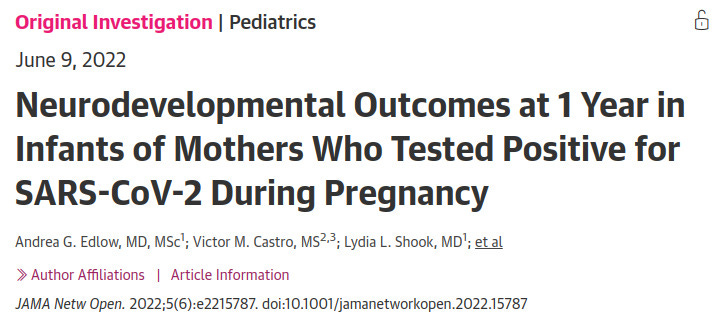
This article found that at one year of age, babies born to mothers who had COVID (not vaccine), had a roughly twice-higher rate of neurodevelopmental disorders:
those born to the 222 mothers with a positive SARS-CoV-2 polymerase chain reaction test during pregnancy were more likely to receive a neurodevelopmental diagnosis in the first 12 months after delivery, even after accounting for preterm delivery.
Considering that COVID is a bad disease for a sizable minority of people, there is no surprise. Covid is bad and gives people all sorts of problems. Then I started thinking: a lot of adverse effects of Covid vaccines mimic the adverse effects of Covid. The younger is the vaccine recipient, the worse some effects of vaccination (such as myocarditis) are.
A great number of expectant mothers received up to three Covid vaccine shots during pregnancy. Did anyone bother testing one-year-old children of vaccinated and boosted (during pregnancy) women for neurodevelopmental disorders, before approving this vaccine for all pregnant women?
The question is, obviously, rhetorical, since “mRNA Babies” of triple-vaxed-during-pregnancy mothers are only beginning to get born right now and are at most a few months old. Not one such baby reached a year of age. So nobody tested them for developmental disorders at one year of age, before approving the three vaccine shots for expectant mothers.
The usual argument of vaccinators that “since Covid does it too, you should take the vaccine” does not hold water. To a woman who decided to take the vaccine, the probability of getting a vaccine is 100%. The probability of her getting Covid is much less. In the above study, out of 7,772 births, only 222 (2.8%) were exposed to Covid during pregnancy. So while vaccination is 100% guaranteed for those who elect to vaccinate, the chance of Covid is over 30 times less likely. And the “vaccine” does not prevent Covid anyway and does not even reduce the viral load.
There is literally zero data on one-year-old children of triple-vaccinated mothers because the oldest ones are 3-4 months old as of today.
However, there are disturbing developments regarding newborns. Vaccination does seem to have an effect on births and pregnancies.
The best data I found regarding recently born newborns happens to come from Scotland. They have an interesting “wider impacts” page that I am quoting below.
Infant deaths are way above average and exceeded “Alert Limits” twice.
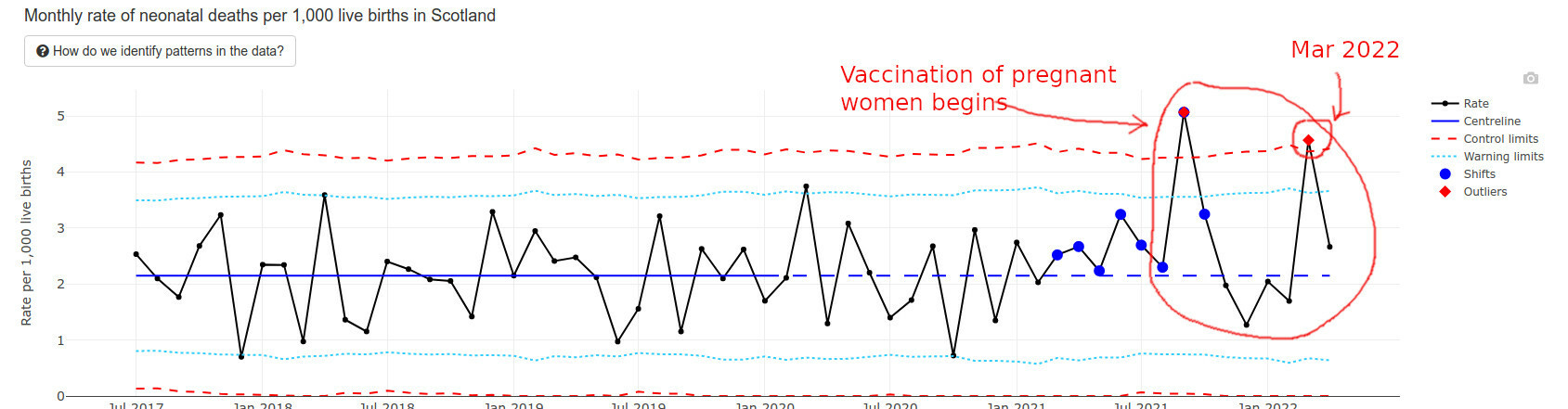
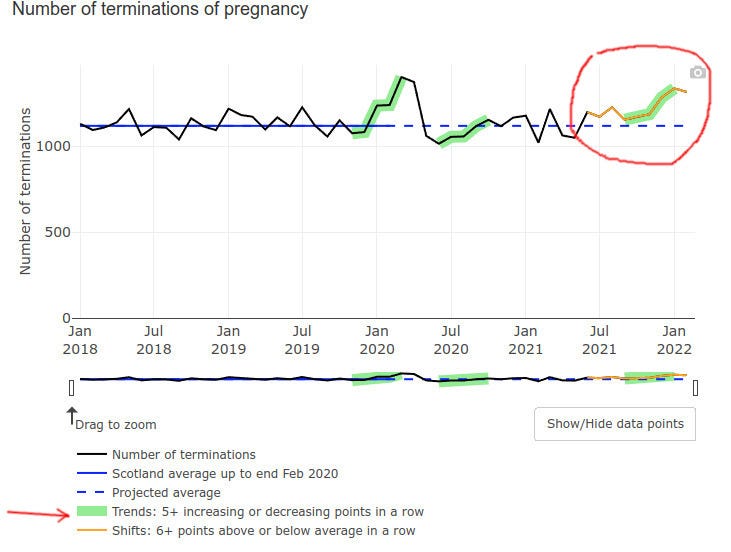
Even pregnancy terminations went up at the end of 2021, possibly but not certainly explained by prenatal vax problems:
Low Apgar score births (for those readers who do not have kids, Apgar score is how healthy is the baby at birth, the best being a score of 10) triggered a green alarm signal:
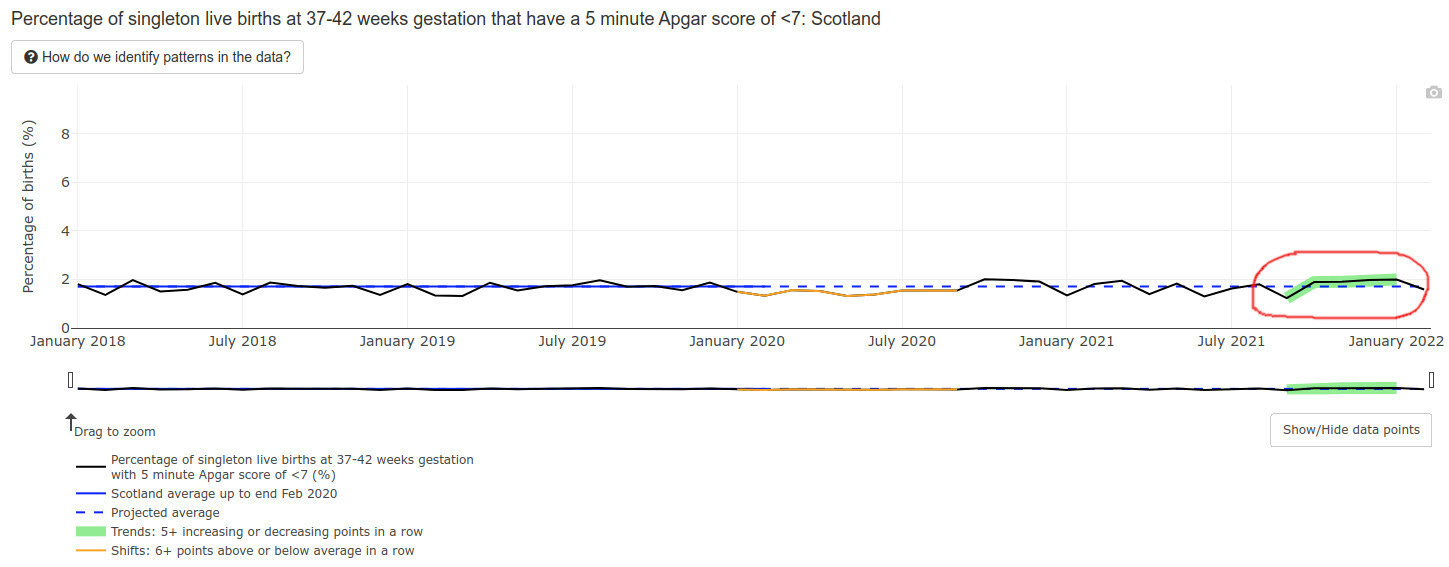
Mind you, an Apgar score is also a developmental evaluation of sorts — at 5 minutes after birth. What will happen to the developmental milestones of those lucky babies of vaccinated mothers, who survived the pregnancies, did not die postnatally, and lived to one year of age? I literally have no idea and nobody else in the world does — the time has not passed yet.
The data we have is NOT encouraging.
CDC Solution: Remove and Lower Milestones
The CDC possibly caught a whiff of this, because in February of 2022 they literally removed half the developmental milestones, bumped some others to higher ages, and lowered standards for yet more of them. (Hat tip @CLesterwood)
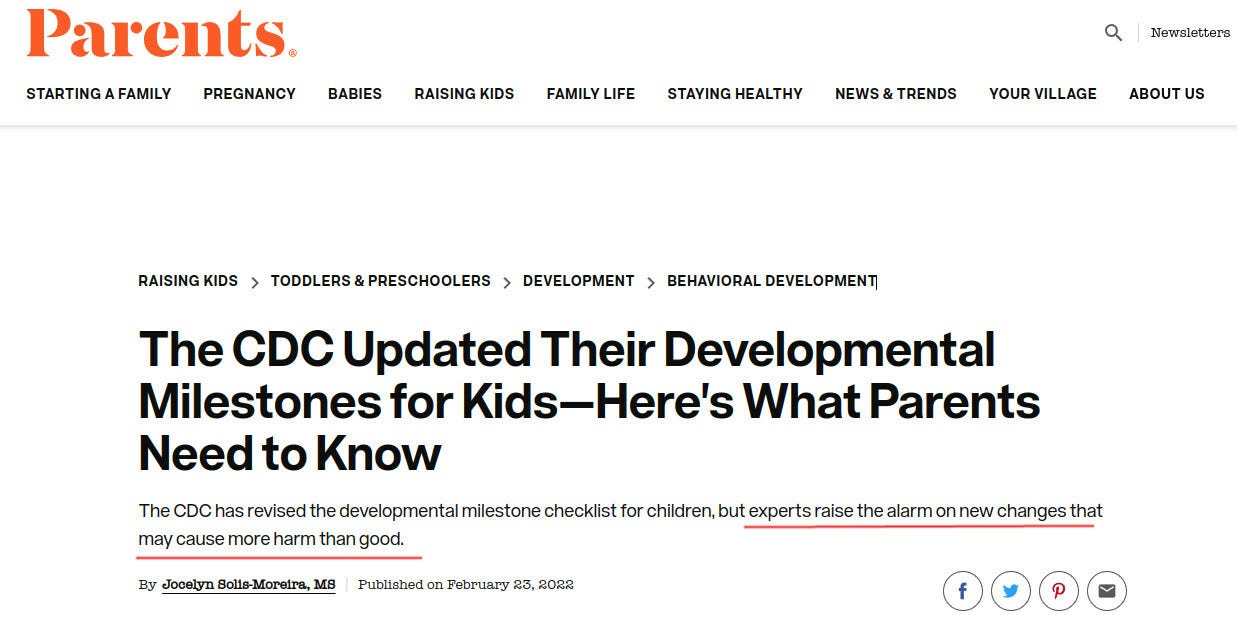
About one-third of milestones like fine motor skills have been bumped up to older ages. Because of the setback, children may worsen their developmental delay, making it harder to provide early intervention, explains Jessica Hatfield, MS, OTR/L, a pediatric occupational therapist for TheraTree Pediatric Therapy.
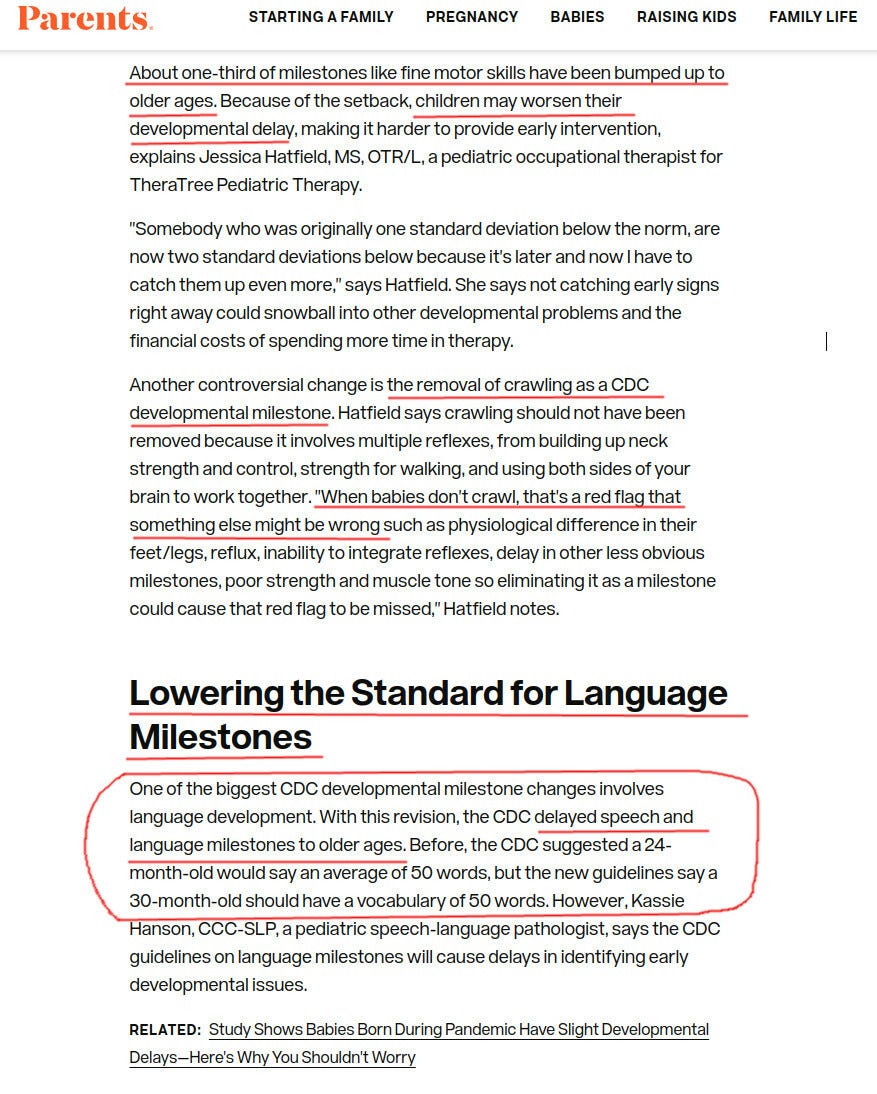
Removing crawling as a milestone??? Are you kidding us? For those of my readers who are parents, do you think that crawling is unimportant as a milestone?
Vaccinated Infants Exposed to SIX Doses of Covid Vaxx in a Year!
Imagine a vaccine enthusiast mother, who gets three doses during her pregnancy. Say, two doses during month 4 and one during the last week of pregnancy. The unborn baby is, obviously, exposed to all that.
Then the baby is born.
If the June 14-15 FDA meeting goes as planned, FDA will approve a three-dose Pfizer vaccine for infants and toddlers. So shortly after being exposed to THREE doses of mRNA vaccines prenatally, the recently born 6 months old baby will get THREE MORE Pfizer mRNA shots.
That’s a total of, drumroll, six spike protein, and nanoparticle exposures. For a tiny newborn, all during one first year of her life.
And what if the mom has several Covids while being pregnant and vaccinated?

They will ask the mom to vaccinate the baby regardless of those covid infections. This literally amounts to six doses within a year or close to, without even counting actual covids that the vaxed moms have. Pfizer will make $132 from these six shots. Not sure if the baby will eventually need much more expensive treatments.
Do you think that it is a little bit too much? Do you think Pfizer or the FDA care?
All of Greece turned into ‘huge US base,’ Greek lawmaker warns
Press TV – June 15, 2022
The Greek government has turned the whole country into a “huge US base,” a local lawmaker warned on Tuesday, amid attempts by Washington to expand its access to military zones across the European country.
Kleon Grigoriadis, in a speech in the Greek parliament on Tuesday, lambasted the government of Prime Minister Kyriakos Mitsotakis over its foreign policy for allowing the United States to turn the whole of Greece into a massive American base.
“At the moment, American soldiers, not Turkish soldiers, are wandering in Crete, Alexandroupoli, Larisa, and other areas left by (the left-wing party) Syriza’s old comrades to the United States. Let’s be clear: Greece has now turned into a huge US base,” said the lawmaker, who is a deputy of the left-wing MeRA25 party,” he remarked.
Grigoriadis warned that an atmosphere of war with Turkey has been created in the press. He said Greek citizens have been intimidated by such a perception in an attempt to make acceptable the conversion of Greece into an American military base.
The lawmaker said the Greek people should learn from history lest their country turns into a tool for big powers.
“History shows that big powers use small powers as tools and use them for their own interests regardless of the pain they may cause, as in 1922,” Grigoriadis said.
Grigoriadis’s comments almost echoed last week’s remarks by Turkish President Recep Tayyip Erdogan, who objected to the presence of US bases in Greece.
“Currently, nine US military bases have been established in Greece. Whom have they been deployed against? They say that against Russia. But we won’t buy that,” Erdogan said at the time.
Turkey and Greece have been at loggerheads for years over hydrocarbon resources and naval influence in the eastern Mediterranean.
In May, Erdogan said there were nearly ten American bases in Greece, asking: “Who is being threatened with these bases? Why are these bases being established in Greece?”
Back in November 2021, he warned that Greece itself had become a US military base. “At the moment, I can’t count all the American bases in Greece, there are so many. … It almost looks like Greece itself is a US base.”
The Greek authorities recently seized a tanker carrying Iranian oil in its territorial waters, under US pressure. The oil cargo was later transferred to the US, a move denounced by Iran as an “act of piracy”.
On Tuesday, Iran’s Ports and Maritime Organization (PMO) said in a statement that an Iranian-flagged tanker seized in April was released by Greek authorities.
“The Greek government finally issued an order and we are now witnessing the lifting of the ship’s seizure and the return of its cargo to its owner,” it said.
Iran’s foreign ministry had condemned the unacceptable surrender of Greece to Washington’s illegal pressure and reiterated that the seizure was an example of international piracy.
The seizure of the Iranian oil tanker took place at a time when the US administration claims it seeks the revival of the Joint Comprehensive Plan of Action (JCPOA), commonly known as the Iran deal. So far, talks for the revival of the 2015 deal have come to a standstill.
Days after the seizure, Iran’s Islamic Revolution Guards Corps (IRGC) seized two Greek oil tankers in the Persian Gulf over violations.
Nuclear-armed states spent $82.4bn on nukes in 2021, US topped list: Report
Press TV – June 15, 2022
The world’s nine nuclear-armed countries – led by the US – spent $82.4 billion upgrading their atomic arsenal in 2021, eight percent more than the previous year, an anti-nuke campaign group has unveiled.
The largest spender by far was the United States, which accounted for more than half the total expenditures on nuclear weapons – followed respectively by China, Russia, Britain, France, India, the Israeli regime, Pakistan and North Korea – the International Campaign to Abolish Nuclear Weapons (ICAN) stated in its annual report, titled “Squandered: 2021 Global Nuclear Weapons Spending.”
“Nuclear-armed states spent an obscene amount of money on illegal weapons of mass destruction in 2021, while the majority of the world’s countries support a global nuclear weapons ban,” the group said in the report, noting that the massive spending nevertheless failed to prevent a war in Europe.
“This spending failed to deter a war in Europe and squandered valuable resources that could be better used to address current security challenges, or cope with the outcome of a still raging global pandemic,” ICAN said. “This corrupt cycle of wasteful spending must be put to an end.”
The group said atomic arms producers had further spent millions of dollars on political lobbying efforts, saying that every $1 spent on lobbying had led to an average of $256 in new contracts involving nuclear weaponry.
“The exchange of money and influence, from countries to companies to lobbyists and think tanks, sustains and maintains a global arsenal of catastrophically destructive weapons,” it said.
The US spent $44.2 billion on atomic weaponry in 2021, followed by China’s $11.7 billion, Russia’s $8.6 billion, the UK’s $6.8 billion, and France’s $5.9 billion, according to the report. India led the more recent nuclear arms developers in expenditures on the mass-destructive weaponry, spending $2.3 billion, followed by the Israeli regime’s $1.2 billion, Pakistan’s $1.1 billion and North Korea’s $642 million.
The report came a week after US-led NATO alliance declared that it did not offer a guarantee to Russia that it would not deploy nuclear weapons on the territories of its two prospective new members, Finland and Sweden.
ICAN’s report further confirmed a statement released by the prominent Stockholm International Peace Research (SIPRI) a day earlier in which it had warned that all the nine nuclear-armed states were increasing or upgrading their arsenals, and that the risk of deployment of such weapons appeared higher now than at any time since the height of the Cold War.
While there is no official confirmation on the amount North Korea spends on nuclear weapons or its arsenal, SIPRI estimates that it possesses as many as 20 warheads.
The Israeli regime, along with India, Pakistan, and South Sudan have never joined the Treaty on the Non-Proliferation of Nuclear Weapons (NPT), an international treaty purportedly established to prevent the spread of nuclear weapons.
As of August 2016, 191 states have become parties to the NPT, though North Korea, which acceded in 1985, announced its withdrawal from the treaty in 2003, following detonation of nuclear devices in violation of core obligations.
Critics of the treaty insist, however, that the NPT cannot stop the proliferation of nuclear arms or the motivation to acquire them, arguing that the biggest possessors and developers of atomic weapons are leading members of the global accord. Officials of the treaty have been selective in enforcing nuclear disarmament, imposing sanctions on observant member nations, such as Iran, while ignoring certain atomic arms possessor and developers such as India, Pakistan, and the Israeli regime, which is widely believe to possess at least 300 nuclear warheads.
Featured Video

John Mearsheimer Talking Iran with Iran
or go to
Aletho News Archives – Video-Images
New Book
The silver that medicine dropped — four thousand years of clinical use, four decades to erase.
Colloidal Silver — First Edition, 2026, Paperback
Lies are Unbekoming | October 16, 2026
Silver was medicine. Not alternative medicine. Not folk medicine. Medicine. In surgery. In obstetrics. In the burn ward. In water treatment. In the household medicine chest. Every physician before 1938 knew this.
By the 1870s, silver nitrate was standard in surgical wound care across the leading hospitals of Britain, Germany, and the United States. Colloidal silver preparations — Collargol, Argyrol, Protargol — entered European and American practice through the 1890s and early 1900s and became standard antiseptics in military field medicine. By the time Fleming grew his first penicillin mould in 1928, silver was the first-line antimicrobial of the Western pharmacopoeia. The Lancet and the British Medical Journal carried the clinical reports in volume. The practice ran continuously through the Victorian era, the Edwardian era, the First World War, the interwar period. By 1980, almost all of it was gone.
What has not been treated at book length, until now, is how a four-thousand-year clinical record disappeared from mainstream medicine within four decades of the Flexner Report — and what the honest account of silver looks like once that record is reassembled.
Colloidal Silver reconstructs the pre-1938 record from The Lancet, the British Medical Journal, and the primary literature of the era; recovers Robert Becker’s bioelectric framework from the regeneration research the pharmaceutical model buried; and places silver inside a practical terrain-paradigm guide to its current place — in water, on the body, inside the body, and in the chronic conditions where antibiotics have failed. … continue
Blog Roll
 Aletho News
- Pharma- and Gates-Funded GAVI Seeks to Assure Parents
- John Mearsheimer Talking Iran with Iran
- Inside Bill C-22, Canada’s Patriot Act.
- China’s FM: Palestinian cause is ‘greatest injustice of the century’
- US sympathy for Palestinians surpasses support for Israelis
- Israeli rabbi permits occupiers to steal Palestinian olive harvest in West Bank
- Spanish firm sells Latvia vehicles equipped with Israeli tech despite arms embargo
- Saudi Arabia under fire… Yemen is burning down the House of Saud
- Israeli Spy Pollard stole the files, today’s it’s delivered through official channels
- Why Iran Didn’t Walk Away
- If Americans Knew
- NPR investigation finds evidence of widespread fraud at mall kiosks tied to Israeli skincare brand
- Tucker Carlson exposes Israeli Lies about the Oct 7th attack, Charlie Kirk, and the U.S.
- Israel has detained thousands of Palestinian children since Oct 7th – over half spent time in solitary, many uncharged
- Israeli Analysis: Is Netanyahu Planning an ‘October Surprise’ Attack Before Israel’s Election?
- Israeli settlers brutally attack Palestinians and Washington Post female photographer, 65
- Words Have Changed, Occupation Continues: The Reality of the Gaza Ceasefire
- Gaza’s child amputees are growing faster than their prosthetics allow
- Israel keeps Palestinians struggling just to survive–Daily Update
- Israeli firm used online ads to run vast spy operation, researchers say
- No, the world zionist movement is not an antisemitic conspiracy theory
- No Tricks Zone
- New Study Suggests Large Regions Of The Pacific Ocean Have Been Cooling For The Last 80 Years
- Germany’s Green Energy Debacle: High Energy Costs Force Kahla Porzellan to Close After 182 Years!
- New Study: 50 Years Of The Most Aggressive ‘Net Zero’ Policies Can Only Affect The Global Climate By 0.03°C
- US September “Heat” Was No Record…Many Records Set Decades Ago
- Latest European Green Energy Debacle; Portugal’s Largest Flagship Solar Park Insolvent!
- Green Energy Debacle: German Expert Professor Fritz Vahrenholt Warns Of Severe Economic And Social Consequences
- Two More Paleo Reconstructions Affirm Meters-Higher Sea Levels Across Ireland, Brazil 7000-6000 Years Ago
- New Study: Earth And Venus Surface Warmth Largely Explained By Convection And Lapse Rate, Not CO2 Or Radiation
- 2025 Nature Paper Claiming Worsening Global Drought Gets RETRACTED …Heavily Flawed
- New Study: ‘Global Drought Shows No Detectable Recent Acceleration Under Climate Warming’

