FDA Should Need Only ‘12 Weeks’ to Release Pfizer Data, Not 75 Years, Plaintiff Calculates
By Seth Hancock | The Defender | December 17, 2021
U.S. Food and Drug Administration (FDA) officials skipped the start of oral arguments Tuesday as a federal district court weighed whether the agency can take 75 years to fully release documents on Pfizer’s Comirnaty COVID vaccine, according to a lawyer representing plaintiffs who sued the FDA for the documents.
A U.S. Department of Justice lawyer representing the FDA told the U.S. District Court for the Northern District of Texas the agency will produce more than 329,000 related documents as fast as it can, while safeguarding personally identifiable information and Pfizer trade secrets.
Public Health and Medical Professionals for Transparency (PHMPT), the group behind the Freedom of Information Act (FOIA) request and subsequent lawsuit, is seeking safety and effectiveness data, adverse reaction reports and a list of active and inactive vaccine ingredients.
PHMPT is a group of more than 30 scientists, medical professionals, international public health professionals and journalists. The group’s lawsuit argues the FDA is overestimating the time needed and understaffing the job.
“Assuming a low average of 50 pages per hour per person, even to review the hundreds of thousands of pages the FDA estimates, the agency would need just 19 reviewers to work full-time for 12 weeks to review and produce these documents — which is a tiny fraction of its approximately 18,000 employees,” said PHMPT in a legal brief filed Monday.
The day before oral arguments, the FDA released 14 document files, the largest file including 2,030 pages. PHMPT posted an updated list which shows documents released since Nov. 17.
FOIA does not mandate any particular processing schedule, only that the agency process requests “as soon as practicable,” the FDA said in a legal brief filed Monday.
“The bottom-line issue still remains what processing schedule is ‘practicable’ for the agency,” the FDA said.
At the agency’s proposed rate of 500 documents per month, the last documents would be released in 2096.
A quote from Business Intelligence Associates, an e-discovery company, estimated 400,000 pages could be produced within six to eight weeks at a cost of $132,000, according to PHMPT.
PHMPT wants the FDA documents released within 108 days. That’s the same amount of time the FDA spent reviewing the responsive documents for “the far more intricate task” of licensing Pfizer’s vaccine, the group said in its lawsuit.
Attorney Aaron Siri, who represents PHMPT, said:
“Americans must routinely produce documents, pay fines, and otherwise expend resources to comply with the law. Courts don’t inquire as to the ability or financial resources to comply with the law — they must comply.
“In fact, it would be laughable if a billionaire defendant came before a court and claimed poverty to escape making a document production, but that is the FDA’s position.”
The FDA budget for fiscal year 2019 was $6.1 billion.
In the FDA’s 64-page briefing, the agency argued it needed the full 75 years to redact and release the documents out of “fairness” to other FOIA requesters.
PHMPT defined fairness differently in its responding brief:
“Fairness would be giving millions of Americans who are mandated to receive this liability-free vaccine today assurance regarding the FDA’s review by allowing independent scientists access to the same data the FDA reviewed, without making them wait decades.
“Fairness would be allowing Americans injured by the vaccine today, who cannot sue Pfizer or anyone else for the harm, hope that independent scientists with access to that data can more readily develop treatments for their ailments.
“Fairness would be our federal health authorities allocating more than one person spending a few hours each month to review Pfizer’s documents for public disclosure after having given Pfizer over $17 billion of taxpayer money to develop and market the product.
“That would be fair to the American people.”
Siri noted that no decision has been made by the court and that a transcript of this week’s hearing should be released soon.
U.S. Rep. Ralph Norman (R-S.C.) earlier this month introduced a bill that would force the FDA to release them in 100 days.
© 2021 Children’s Health Defense, Inc. This work is reproduced and distributed with the permission of Children’s Health Defense, Inc. Want to learn more from Children’s Health Defense? Sign up for free news and updates from Robert F. Kennedy, Jr. and the Children’s Health Defense. Your donation will help to support us in our efforts.
Washington ‘hunts’ Russian citizens in third countries – Moscow

RT | December 19, 2021
Moscow has condemned the extradition of a Russian IT firm owner from Switzerland to the US. His lawyer said Washington wants to tie the man to alleged meddling by Moscow in the 2016 American presidential election.
The extradition of businessman Vladislav Klyushin is “another episode of Washington’s continuing ‘hunt’ for Russian nationals in third countries,” the Russian Embassy in Switzerland, told TASS on Sunday.
Spokesperson Vladimir Khokhlov said Moscow was “deeply disappointed” by the decision of a Swiss court to reject Klyushin’s appeal to block his extradition on Friday. The man was handed over to American police officers in Zurich on Saturday, who escorted him on a flight, according to Switzerland’s Federal Office of Justice.
The software developed by Klyushin’s media monitoring and analytics company, M13, is used by Russian state agencies, including the federal government and Presidential Executive Office, according to the firm’s website. The businessman was detained by Swiss police in March during a family skiing trip, his lawyer, Oliver Ciric, told the media.
Swiss justice officials said the US accused Klyushin of insider trading that involved “tens of millions of dollars.”
Ciric believes the persecution of the businessman is politically motivated, and that he will face “inhuman and degrading treatment” when extradited to the US.
He told The Times in September that the charges of insider trading were being used as a pretext to transport Klyushin to the US. The lawyer said his client would likely be charged with heading an alleged Russian covert operation to meddle in the 2016 US presidential election and hack the server of the Democratic Party.
In the same interview, Ciric claimed that Klyushin had access to “certain security information” related to the Russian government, and rebuffed recruitment attempts by US and British intelligence agents in the past.
The lawyer said that Klyushin’s criminal case file has been sealed by a Massachusetts court, which is “quite unusual” for financial charges that are typically publicized by a US financial regulator.
US officials accused the Kremlin of seeking to influence the vote and hacking the server of the Democratic National Committee and an email account of John Podesta, who led Hillary Clinton’s campaign against Donald Trump. Russia consistently denied these allegations. Klyushin has denied any involvement in insider trading and hacking.
U.S. Proxy War Against Russia in Ukraine: The Afghanistan-Syria Redux Option
By Finian Cunningham | Strategic Culture Foundation | December 18, 2021
The United States is planning to redouble its weapons supply to Ukraine. What is shaping up is an intensified proxy war against Russia in which the Russophobic Kiev regime acts as Washington’s catspaw. The objective is to debilitate Russia in the same way the U.S. sapped the Soviet Union with a quagmire war in Afghanistan during the 1980s.
U.S. media reports cite Pentagon and Ukrainian officials saying that the Biden administration is considering a massive increase in armaments to the Kiev regime. This is on top of the $2.5 billion in military support that Washington has already given over the past eight years. The Biden administration has overseen $450 million in weaponry to Ukraine this year alone with a further $300 million budgeted for the coming 12 months. A separate proposal going through the Senate is seeking to boost military support for next year by another $450 million.
What gives added significance to this weapons pipeline is where they are being sourced. U.S. media reports say the arms are from inventories the Pentagon had allocated for the American-backed army in Afghanistan before it collapsed with the sudden Taliban victory in August. The weapons include Black Hawk helicopters and anti-armor munitions.
Other weapons under consideration for supply to Ukraine include more Javelin anti-tank missiles as well as Stinger anti-aircraft munitions.
In addition to the inventories previously allocated for Afghanistan, the U.S. is also planning weapons supplies from covert stockpiles overseen by the CIA in Romania and Bulgaria. This is the dark supply route that the U.S. and NATO allies used for arming terrorist proxies in a failed bid to overthrow the Syrian government. Russia’s military intervention in Syria in late 2015 defeated Washington’s regime-change objective in Damascus.
The year before, in 2014, the U.S. and its allies succeeded in their regime-change operation in Ukraine when an elected government friendly with Moscow was overthrown by a CIA-backed coup d’état. That coup brought to power a Neo-Nazi Russophobic regime that has been waging a civil war against the ethnic Russian population of southeast Ukraine. U.S. and NATO weapons supplies have motivated the Kiev regime to persist in hostilities despite a formal peace agreement known as the Minsk accord signed in 2015. France and Germany, supposed guarantors of the accord along with Russia, have both turned a blind eye to Kiev’s systematic violations.
Since the Biden administration took office 11 months ago, the Kiev regime has stepped up its provocations in southeast Ukraine. These provocations are ultimately aimed at destabilizing Russia. As well as weaponry, American and other NATO special forces are on the ground in Ukraine acting as “military advisors”. The accelerator for aggression has been stepped on in recent weeks.
The Kremlin has warned that the Ukrainian forces are ratcheting up hostilities towards the southeastern region that borders Russia. Russian President Vladimir Putin has recently said that the siege on the region also known as Donbass resembles a genocide.
The stark fact is that there is already a proxy war going on in Ukraine against Russia. Arguably, that has been the U.S. objective since the coup in Kiev in February 2014. The current escalation of violence by the Kiev regime with U.S. and NATO support means that there is a directive from Washington for widening the war.
Paradoxically, or perhaps more accurately, cynically, the U.S. and its NATO allies are boldly inverting reality with a torrent of claims that they are “defending” Ukraine from “Russian aggression”. Recent weeks have seen a full-court media propaganda campaign to shift the blame on an alleged Russian force build-up. Moscow has vehemently denied it has plans to invade Ukraine. It points out that satellite imagery cited by the U.S. and its allies for claiming a Russian build-up actually shows forces in established bases hundreds of kilometers from the border with Ukraine.
Taking stock of the situation: Ukrainian forces are stepping up aggression against the Russian-speaking population under siege for nearly eight years in the Donbass region. The U.S., NATO and European Union are complicit in this criminal aggression by weaponizing, training and apologizing for the Kiev regime with spurious allegations against Russia. Furthermore, there is an unprecedented build-up of U.S. and NATO forces in the Black Sea region conducting unscheduled war drills on Russia’s border. That is inescapably acting to embolden the unhinged Kiev regime, even more, to take the war to Russia.
Moscow is earnestly warning Washington and its NATO partners of red lines. Russia has called for a formal agreement to prohibit NATO expansion for Ukraine’s membership of the military bloc as well as installation of American weapons systems on Ukrainian territory.
Washington and its NATO partners appear complacent to a degree that suggests criminal complicity in fanning the tensions.
The Biden White House has already signaled that it will not reciprocate with Russia’s request for these security guarantees. Even if Washington somehow manages to muster the political will to appear to give Moscow some security reassurances, the fact remains that the U.S. and its NATO allies are already deeply involved in waging a proxy war in Ukraine against Russia.
Plans for redoubling weapons flow to Ukraine from inventories allocated for Afghanistan and from covert CIA-run networks in Eastern Europe indicate the proxy war is set for a deliberate escalation.
Senior U.S. lawmakers have intimated that the preferred scenario for Washington is to create a quagmire for Russia similar to the trap set for the Soviet Union in Afghanistan during the 1980s. That proxy war in which the U.S. armed Mujahideen militants with Stinger missiles greatly sapped the Soviet Union leading to its demise. Those militants later evolved into Al Qaeda networks that were used in the failed U.S.-backed regime-change operation in Syria over the past decade.
The Russophobic Kiev regime is being driven to escalate its terror war against the Russian people in Donbas. The objective is to draw Russia into that war to defend people with whom it is culturally connected. The moral imperative on Moscow to act would be huge. Washington is calculating that the move turns into a quagmire that will debilitate Russia and tarnish its international standing.
But this nefarious plan – an Afghanistan-Syria redux – could so easily slide over the abyss into a full war between the United States and Russia. Moscow seems to be more cognizant of that possible disaster than Washington which is afflicted with the insouciance of arrogance.
The FDA approves boosters for minors – without testing boosters on minors
Age group testing? Zero.

Techno Fog | December 14, 2021
Late last week, on December 9, the FDA approved the Emergency Use Authorization (EUA) for the Pfizer COVID-19 vaccine, “authorizing the use of a single booster dose for administration to individuals 16 and 17 years of age.” The booster is to be given at least 6 months after vaccination.
Before we get to the data the FDA cited in the booster for kids aged 16-17, let’s go through the facts:
COVID-19 is not a threat to teenagers aged 16-17. On October 25, we warned that the FDA was about to approve an experimental COVID-19 vaccine for children. It seemed unnecessary to give the EUA Pfizer vaccine to minors, as CDC data showed that for children aged 5-11 years-old, there have been 1.8 million COVID-19 cases and only 138 deaths. For older kids, from our own calculations, there have been approximately 3 million COVID-19 infections for those aged 12-18 years, leading to approximately 400 COVID-19 deaths in those ages. Children who get COVID-19 (including the age range approved for the latest booster) generally have less severe symptoms. Even the CDC concedes that “children are less likely to develop severe illness or die from COVID-19.”
The Pfizer vaccine is particularly dangerous for young men aged 16-17. As we observed back in October, teenage boys are especially at risk for heart problems – like myocarditis – after getting the Pfizer vaccine:
“Boys between 16 and 19 years of age had the highest incidence of myocarditis after the second dose . . . The risk of heart problems in boys of that age was about nine times higher than in unvaccinated boys of the same age.” New York Times.
The risk of myocarditis for boys 16 – 19 years old is higher after the Pfizer second dose. What happens after the third dose??
That’s a good question.
One would rightly assume that the third dose might present more danger of heart problems than the second dose. But FDA doesn’t have the answer to this question. And why doesn’t it have the answer?
Because the FDA didn’t look.
Because the FDA decided against holding an advisory meeting to discuss the decision.
Because the FDA required ZERO tests in this age bracket before approving the latest Pfizer booster for this age bracket.
Instead, the FDA relied on prior (old) booster data from a study of “200 participants, 18 through 55 years of age.” Choosing to ignore the long-term data for the efficacy of the Pfizer booster shot, the FDA instead reviewed the old data showing “the antibody response against the SARS-CoV-2 virus one month after a booster dose of the vaccine.”
That’s it. That’s the rigorous studies that now meet FDA standards. Given the self-imposed and purposeful limitations the FDA has placed on its own own information, it has the audacity to conclude:
“The benefits of a single booster dose of the Pfizer-BioNTech COVID-19 Vaccine or Comirnaty outweigh the risks of myocarditis and pericarditis in individuals 16 and 17 years of age to provide continued protection against COVID-19 and the associated serious consequences that can occur including hospitalization and death.”
This is the FDA making a cost/benefit calculation without knowing the costs or benefits. It doesn’t know the real risks because it didn’t study the potential for adverse reactions in kids aged 16 – 17 years. It doesn’t know the real benefits because it chose a shitty study that was limited to one month efficacy data.
This robust FDA cost/benefit calculation might sound familiar to our loyal readers. That would be because the Government did the same thing when recommending the COVID-19 vaccines for “people who are pregnant.”
Vaccines are very good… for the drug companies
By Steve Kirsch | December 18, 2021
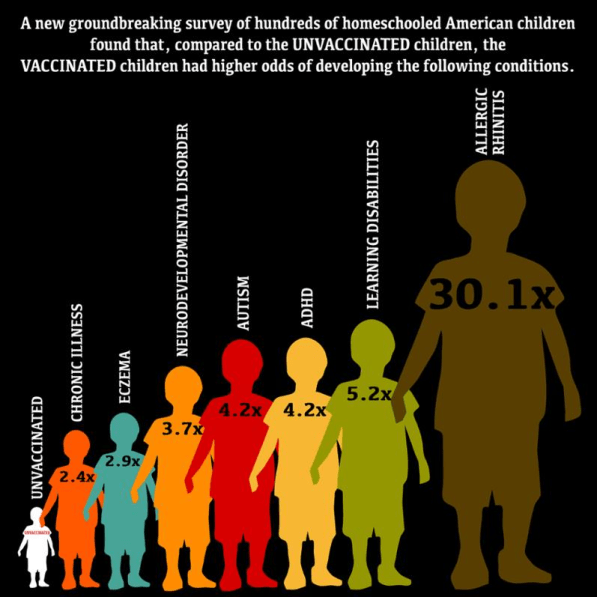
This one graphic shows everything you need to know. This is one of the reasons why nobody wants to talk to me.
The graphic is from a paper which was published in April 24, 2017: Pilot comparative study on the health of vaccinated and unvaccinated 6- to 12- year old U.S. children
The point of this article is that the COVID vaccines are not the first unsafe vaccine. We’ve been doing this for years. The COVID vaccines are simply the latest manifestation of a problem which has been going on for over 20 years.
Key points from that paper:
- Vaccinated children were over four-fold more likely to be diagnosed on the Autism Spectrum
- Vaccinated children were 30-fold more likely to be diagnosed with allergic rhinitis (hay fever) than non-vaccinated children
- Vaccinated children were 22-fold more likely to require an allergy medication than unvaccinated children
- Vaccinated children were over five-fold more likely to be diagnosed with a learning disability than unvaccinated children
- Vaccinated children were 340 percent more likely to be diagnosed with Attention Deficit Hyperactivity Disorder than unvaccinated children
- Vaccinated children were 5.9-fold more likely to have been diagnosed with pneumonia than unvaccinated children
- Vaccinated children were 3.8-fold more likely to be diagnosed with middle ear infection (otitis media) than unvaccinated children
- Vaccinated children were 700 percent more likely to have had surgery to insert ear drainage tubes than unvaccinated children
- Vaccinated children were 2.4-fold more likely to have been diagnosed with any chronic illness than unvaccinated children
The message from the drug companies to America is clear
- Liability protection is a must. Thank you Congress for that. We are the only industry in America without any liability. Perfect. This allows us to create customers for life.
- Parents should make sure to vaccinate all your kids with all possible vaccines. That way, there will not be a control group to compare the outcomes with so nobody will be able to prove that vaccines make things worse.
The drug companies of America thank you for your cooperation, whether it is willing or unwilling. You will cooperate.
Next up on the agenda for Congress
- Passing laws that make it illegal to protest
- Mandating all children get all approved vaccines to create lifetime customers
- Criminalizing those evil people that try to warn America about what is really happening.
- Requiring by law social media companies to silence anyone who speaks out against the government agenda.
‘Many Lives Being Destroyed’ by Government’s Failure to Recognize Natural Immunity: Physician
The Defender | December 16, 2021
Dr. Marty Makary on Tuesday accused public health officials of “modern-day McCarthyism,” and publishing studies not worthy of “a 7th-grade science experiment.”
The public health researcher and professor at Johns Hopkins Bloomberg School of Public Health told members of the House Select Committee on the Coronavirus Crisis some COVID policies have become “too extreme, too rigid and are no longer driven by clinical data.”
Makary zeroed in on natural immunity and COVID booster shots for teens. He criticized the Centers for Disease Control and Prevention’s (CDC) rush to push boosters for 16- and 17-year-olds based on lab experiments suggesting boosters raise antibody levels against Omicron.
Vaccine makers announced the results of the experiments without releasing any of the underlying scientific data, Makary said.
“Is this what we’ve come to,” Makary asked? “Pharma tells us what to do and the CDC just falls in line?”
Makary assured committee members he isn’t “anti-vax” — he’s been vaccinated for COVID.
But he’s a strong proponent of acknowledging natural immunity, and not requiring people who have recovered from COVID — especially young people — to get the vaccine.
That viewpoint has made him the target of criticism, Makary said.
“We have a modern-day McCarthyism whenever somebody questions COVID booster shots for kids,” Makary said.
Makary reminded committee members that, despite a combined annual budget of about $58 billion, neither the CDC nor the National Institutes of Health have produced credible studies on natural immunity to COVID — something his research team is undertaking, using private money.
The CDC did publish two studies earlier this year, claiming to show vaccine immunity trumps natural immunity. Those studies were so flawed, in Makary’s opinion, they were “worse than a 7th grade science experiment.”
Makary accused the CDC of knowingly publishing flawed studies so people would get the vaccine, rather than wait to acquire natural immunity by getting and recovering from the virus.
“Many lives are being destroyed” by the government’s failure to recognize natural immunity, Makary said.
Watch Makary’s testimony (starts at 31:56):
Who is to blame for the Ukraine crisis?
By Glenn Diesen | RT | December 18, 2021
Russia and the West have sounded the alarm in past weeks over a standoff across the border with Ukraine. Both sides accuse each other of inflaming the situation, and it’s increasingly clear they see the conflict very differently.
A recent poll by Moscow’s Levada Center, registered as a ‘foreign agent’ by Moscow’s Ministry of Justice over ties to overseas funding, reveals who Russians blame for the escalation of the situation. A colossal 50% believe NATO is responsible, while only 16% blame Ukraine and 3% point the finger at the war-torn Donbass region. Another 4% believe that Russia is the culprit. Simply put, those inside the country consider the conflict over Ukraine to be a NATO war.
Ukraine not to blame?
Why do only one in six Russians blame Kiev, given how often the media paints this as a battle between the two nations? The position appears consistent with the fact Moscow has stated that negotiating with Ukraine makes little sense as its leadership is under Washington’s control.
One poll from Ukraine reveals that 65% of Ukrainians believe that their country is under foreign control, and in the more NATO-critical eastern and southern regions of Ukraine this number stands at 75% and 71%. These numbers should not surprise anyone following the facts:
NATO promised membership to Ukraine when only approximately 20% of Ukrainians said they wanted to join the bloc. After backing the toppling of Ukraine’s democratically elected president, Western countries then supported Kiev’s ‘anti-terrorist operations’ against its own population who contested the legitimacy of the coup. The US has since supported the draconian suppression of political opposition in the country, which included arresting the main opposition leader, shutting down opposition news media, disenfranchising millions of voters, arresting protests, and using anti-corruption agencies to purge opposition. The objective of making Ukraine a bastion against Russia is not compatible with supporting Ukrainian democracy.
President Volodymyr Zelensky won a landslide victory with 73% of the popular vote in 2019 on the platform that he would negotiate with Donbass and restore relations with Russia. Appeasing right-wing nationalists at home, as well as Washington, Zelensky reversed his election promises and his approval ratings have collapsed. By October 2021, a poll from the Kyiv International Institute of Sociology revealed that his approval had collapsed to a mere 24%. When Zelensky’s deputy chief of staff, Oleg Tatarov, complained about the foreign control over the government, he was immediately suspended and indicted.
The US has been reluctant to push its Ukrainian proxy to implement the UN-approved Minsk Agreement, and instead, the US pumps weapons into Ukraine and routinely threatens NATO expansion. Making Ukraine a front line against Russia compels Moscow to respond, which risks war and the survival of Ukraine as a state.
Subsequently, most Russians seem not to blame Ukraine, writing off the country as under external administration.
A NATO War?
During the Cold War, NATO served the purpose of containing the Soviet Union with collective defence. The bloc aimed to preserve the status quo against Soviet revisionism. After the Warsaw Pact was dissolved and the Soviet Union collapsed, many expected NATO to be dismantled as well. It did the opposite by transforming from a status-quo to a revisionist military alliance. On March 12, 1999, NATO began to expand and less than two weeks later invaded Yugoslavia in violation of international law. As Henry Kissinger cautioned at the time, NATO could no longer claim to be a defensive alliance and Russia’s fears about Western revisionism in Europe had been confirmed.
The central principle of “indivisible security”, suggesting that one side should not enhance its security at the expense of the other side, has been the key principle of every pan-European security arrangement from the Helsinki Accords of 1975, to the Charter of Paris for a New Europe of 1990, to the establishment of the OSCE in 1994.
However, NATO expansionism and revisionism was clothed in ideology as the military alliance rebranded itself as a “community of democracies”. The argument was that Russia should not be concerned as NATO expansion is tantamount to expanding the zone of peace and stability, which would also benefit Russian security. With this ideological sleight of hand, all pan-European security agreements have been dismantled, and pan-European security predictably collapses.
NATO expansion implicitly entailed presenting Russia with an ultimatum. Moscow could either accept NATO expansion towards Russian borders as a “force for good”, or oppose expansionism and be castigated as an anti-democratic and counter-civilizational force that would have to be contained. Either way, NATO would expand and pan-European security agreements would be rendered insignificant.
The notion that NATO was no longer an anti-Russian alliance rested on a strange logic. Russia could accept that NATO had transformed itself into a peaceful community of values, otherwise, NATO would be compelled to return to its former mission of containing Russia. What was unavoidable has now happened. Russian efforts to contain NATO expansionism are depicted as Russian aggression, which requires NATO to expand membership and push its military infrastructure further towards Russian borders.
Framing the Ukraine crisis as Russian aggression
Russia has not demanded guarantees from Ukraine that it will not accept NATO membership, and instead has called on NATO not to offer membership in the first place. This may seem like a minor difference, but conflating the two is at the heart of NATO’s propaganda in the Ukraine crisis.
Suddenly, the narrative is no longer that Russia demands that NATO stops expanding an anti-Russian military alliance with a budget more than 10 times that of Russia – a demand compatible with the “indivisible security” principle of every pan-European security agreement. Instead, the conflict is about Russia dictating to its smaller neighbour what it should be allowed to do. With this sleight of hand, a NATO-Russia conflict becomes a Russia-Ukraine conflict, and Russia becomes the revisionist power instead of NATO.
This is obviously a favourable narrative as NATO goes from being the source of instability, to becoming an external security provider “supporting Ukraine”. NATO membership is suddenly not the source of the conflict, but is the solution.
Glenn Diesen is a Professor at the University of South-Eastern Norway and an editor at the Russia in Global Affairs journal.
Defeat the Mandates – March on Washington: January 23, 2022

- We’re coming home.
- Americans of every class and color.
- Democrats and Republicans.
- Vaccinated and unvaccinated.
- United we stand, in peace we march.
At the Lincoln Memorial, a wide range of featured guests will be waiting.
Recording artists, prominent doctors, journalists, pro athletes, actors and premier thought leaders will give a series of inspiring “TED talks” and musical performances.
Stay tuned here for updates on our list of special guests!
PARTNERS
• The Unity Project, a non-partisan, non-profit educational organization, promotes a “children-first” agenda focused on integrity, care, rationality, and evidence-based motivation.
• Children’s Health Defense® is a 501(c)3 non-profit organization. Its mission is to end childhood health epidemics by working aggressively to eliminate harmful exposures, hold those responsible accountable, and to establish safeguards so this never happens again.
• Global Covid Summit is the product of an international alliance of physicians and medical scientists, committed to speaking truth to power about Covid pandemic research and treatment. Please read and consider signing our Declaration HERE.
Germany’s Traffic Light Coalition Blinks Green for NATO Hostility to Russia
By Finian Cunningham | Strategic Culture Foundation | December 17, 2021
The new German coalition government headed up by Chancellor Olaf Scholz is only one week in power but already the signals are pointing to Berlin being more amenable to U.S.-led NATO hostility towards Russia.
The “traffic light” coalition (based on party colours) comprises the Social Democrat Party led by Scholz in partnership with the Greens and pro-business Free Democrats. Scholz gave an inaugural address to the Bundestag this week as the new chancellor having replaced Angela Merkel of the Christian Democrats after her 16 years in power.
Following Merkel’s reign, which was hallmarked by stability and her dominant personal style, all eyes will be on the new government in Berlin and its impact on transatlantic relations. Scholz, who is relatively unknown, and his administration could hardly be met with a more challenging time given the heightened tensions between, on the one hand, the U.S.-led NATO military alliance and the European Union, and on the other, Russia.
Berlin’s new foreign minister Annalena Baerbock (who takes over from Heiko Maas) brings to her post a more vociferous, critical position towards Russia. Baerbock, a leading Green lawmaker, announced this week that the Nord Stream 2 gas pipeline between Russia and Germany is being put on hold due to alleged Russian aggression towards Ukraine. The pipeline was already being held up since completion in September by an industrial certification process. But now Baerbock has introduced a geopolitical factor to cancel the project. Before her ministerial post, she was known as a trenchant critic of Nord Stream 2, opposing it because she provocatively claimed, it allowed Russia to “blackmail Europe”, and also apparently on environmental grounds. Ironically, the alternative to Russian gas supply would be the import of American shale gas which is more expensive and dirty owing to its environmentally destructive extraction method. In her latest Nord Stream 2 pronouncement, the German foreign minister is sounding remarkably like U.S. Secretary of State Antony Blinken in linking the project’s future to tensions over Ukraine and putative Russian invasion plans.
Baerbock has also been a long-standing advocate of expanding NATO eastwards and of closer transatlantic ties with the United States.
This eastward expansion of the military alliance is exactly what has caused apprehension in Moscow which views the bloc as threatening Russia’s national security from the potential for advanced positioning of nuclear missiles on Russian borders. Russia’s President Vladimir Putin has urged U.S. President Joe Biden as well as British and French counterparts to implement legal guarantees to safeguard Russia’s security. Those guarantees would include a prohibition on NATO’s further eastward expansion to include membership access for former Soviet republics Ukraine and Georgia.
With Baerbock as Germany’s top diplomat, it is likely that Russia’s concerns will be given short shrift. As the strongest political force in the European Union, a more hardline German policy will ramify across the entire EU and reinforce the position of Russophobic members like Poland and the Baltic states.
As for the new chancellor, 63-year-old Scholz was formerly the finance minister in Merkel’s last coalition government. That administration was robustly supportive of the Nord Stream 2 partnership with Russia. Under Merkel, Berlin rebuffed Washington’s objections to the pipeline saying that it was a sovereign matter for Germany. Scholz himself had in the past spoken out against American meddling over Germany’s energy policy. The Biden administration appeared to respect Berlin’s independence on the issue by dropping threats of sanctions against participating companies. That background might suggest that the chancellor’s office would hold Baerbock’s foreign ministry in check.
However, the recent escalation of tensions over Ukraine fuelled by Washington’s claims that Russia is planning to invade the country has hardened Germany’s stance towards Moscow, in particular on the issue of expanding economic sanctions as “severe consequences” for alleged Russian aggression. Moscow has repeatedly dismissed the U.S. claims of invasion plans, but disconcertingly Germany and the rest of the EU have gone along with Washington’s narrative, accepting dubious American “intel” as if good coin, reminiscent of the WMD propaganda leading up the war on Iraq. That paradigm shift suggests a premeditated, orchestrated objective for the U.S. The Europeans have been suitably suckered into the ploy. And, at last, the Nord Stream 2 project is within target of Washington’s policy torpedoes.
In his address to the Bundestag this week, Scholz called for “constructive dialogue” with Russia to “stop the spiral of escalation”. He also called for “mutual understanding”. That may sound like an enlightened policy of diplomatic engagement. But then, disappointingly, Scholz vowed that Germany would “speak with one voice with our European partners and transatlantic allies”. That means Berlin is henceforth deferring to the position of Washington and Kiev in terms of determining response to the accepted narrative of “Russian aggression”.
Whatever the shortcomings of Merkel – she was no radical critic of Washington – but she at least was capable at times of exerting a modicum of independence. Her unwavering support for Nord Stream 2, for example, despite American pressure. Also more recently, it has emerged that Merkel reportedly blocked supplies of NATO weapons to Ukraine much to the annoyance of the Kiev regime.
Olaf Scholz does not come across, at least so far, as a strong leader. His mealy-mouthed talk about “sharing one voice” with the U.S. and “partners” like Ukraine, as well as his ready acceptance of spurious allegations about Russian aggression, indicate that the new Berlin government will be a pliable tool for Washington’s policy of hostility towards Russia.
Historically, it is ominous that the first German overseas military action since 1945 occurred in 1999 under an SPD-Green coalition. That was when Germany joined in the NATO bombing of Serbia. These parties are coalition partners again at another crucial time for Europe.
If there is a new traffic light in Berlin it’s showing no stops for further U.S. and NATO aggression in Europe.
Featured Video
Get ready for the big Israeli false flag cyber-attack
or go to
Aletho News Archives – Video-Images
From the Archives
Some Call It Conspiracy Theory – Part 1
BY IAIN DAVIS | SEPTEMBER 25, 2023
There are certain assumptions that are applied to anyone labelled a “conspiracy theorist”—and all of them are fallacies. Indeed, the term “conspiracy theory” is nothing more than a propaganda construct designed to silence debate and censor opinion on a range of subjects. Most particularly, it is used as a pejorative to marginalise and discredit whoever challenge the pronouncements and edicts of the State and of the Establishment—that is, the public and private entities that control the State and that profit from the State.
Those of us who have legitimate criticisms of government and its institutions and representatives, who are therefore labelled “conspiracy theorists,” face a dilemma. We can embrace the term and attempt to redefine it or we can reject it outright. Either way, it is evident that the people who weaponise the “conspiracy theory” label will continue to use it as long as it serves their propaganda purposes.
One of the most insidious aspects of the “conspiracy theory” fabrication is that the falsehoods associated with the term have been successfully seeded into the public’s consciousness. Often, propagandists need do no more than slap this label on the targeted opinion and the audience will immediately dismiss that viewpoint as a “lunatic conspiracy theory.” Sadly, this knee-jerk reaction is usually made absent any consideration or even familiarity with the evidence presented by that so-called “lunatic conspiracy theorist.”
This was the reason why “conspiracy theorist” label was created. The State and its propagandists do not want the public to even be aware of inconvenient evidence, let alone to examine it. The challenging evidence is buried under the “wild conspiracy theory” label, thereby signalling to the unsuspecting public that they should automatically reject all of the offered facts and evidence.
There are a number of components that collectively form the conspiracy theory canard. Let’s break them down. … continue
Blog Roll
 Aletho News
- ‘Stop Putting Drugs in Our Food’: Scientists Link Folic Acid in Food to Rising Rates of Colorectal Cancer
- The 14 Things That Happen to Your Newborn in the First 48 Hours
- JFK’s Forgotten Confrontation with Israel
- Trump’s Cyber Director Pick Has Deep Ties To Israeli Intelligence
- Get ready for the big Israeli false flag cyber-attack
- The Ukrainian Reset experiment: A war and surveillance state blueprint for the EU
- Pentagon fails ninth financial audit in a row, unable to account for trillions in assets
- Russia rejects Danish plot claims, vows response to expulsion
- Study of 14,000 Children Links Vaccination to Higher Rates of Chronic Illness
- Strike Iran Again, Open Pandora’s Box | Brian McGlinchey
- If Americans Knew
- Reporting Raises Fresh Questions About Israeli Role in CNN’s ‘Preposterous’ Iranian Dirty Bomb Story
- DAILY UPDATE: Latest essential news on Palestine, Israel, & region
- Under the West’s watch, genocide apologism has become entirely respectable
- Israeli Diplomat Offered Iowa Attorney General Free Trip, Then Asked for Favors
- On World Children’s Day, 350 Palestinian Children Remain in Israeli Prisons
- Why Is Israel Jailing a Palestinian Student Without Trial? Because It Can
- ICJ ruling on Rohingya genocide could strengthen South Africa’s case against Israel
- DAILY UPDATE: Latest essential news on Palestine, Israel, & region
- Newly nominated House Speaker funded Gaza genocide
- Leaked: How Silicon Valley Elites Bankrolled an Anti-Migrant, Pro-Israel Propaganda Machine
- No Tricks Zone
- Germany’s Renewable Energies Lead to 1.4 Billion Euro Electric Power Trade Deficit
- Argentina’s Perito Moreno Glacier Joins Antarctica and Arctic In Defying Doomsday Melt Claims
- New Study: Barents Sea Temperatures Were Warmer And Sea Ice Less Extensive In The 1700s Than Today
- German Authorities Start Initiative To Evaluate Public Register For Climate “Disinformation” Spreaders!
- Zonal Asymmetry of Temperature Change in the Antarctic Circumpolar Current
- New Study: The Net Fossil Fuel Contribution To Rising Atmospheric CO2 Has Been Zero For 500 Years
- Germany’s Green Energy Transition Becoming Increasingly Expensive…Another 6 Trillion Euros!
- Sudden Stratospheric Warming, Powerful El Niño Combination May Lead To Extreme Europe Cold, Energy Crisis!
- Two New Studies Find Thwaites Glacier Melt Cannot Be Driven By Human Activity Or A Warming Ocean
- E-Cars Reduce CO2 Emissions By Only 41% Compared To Internal Combustion Engine Vehicles

