Jack Ruby: Israel’s Smoking Gun
BY LAURENT GUYÉNOT • UNZ REVIEW • NOVEMBER 13, 2021
By a strange paradox, most Kennedy researchers who believe that Oswald was “just a patsy” spend an awful lot of time exploring his biography. This is about as useful as investigating Osama bin Laden for solving 9/11. Any serious quest for the real assassins of JFK should start by investigating the man who shot Oswald at pointblank in the stomach at 11:21 a.m. on September 24, 1963 in the Dallas Police station, thereby sealing the possibility that a judicial inquiry would draw attention to the inconsistencies of the charge against him, and perhaps expose the real perpetrators. One would normally expect the Dallas strip-club owner Jack Ruby to be the most investigated character by Kennedy truthers. But that is not the case.
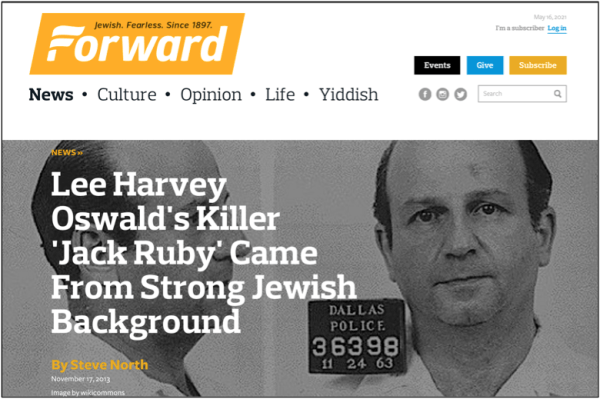
Of course, it is perfectly normal that Chief Justice Earl Warren, when Ruby told him on June 7, 1964, “I have been used for a purpose,” failed to ask him who had used him and for what purpose.[1] But what about independent investigators? Are only readers of the Forward (“News That Matters To American Jews”) worthy of being informed that “Lee Harvey Oswald’s Killer ‘Jack Ruby’ Came From Strong Jewish Background,” and that he told his rabbi Hillel Silverman that he “did it for the Jewish people”? Here is the relevant passage of Steve North’s 2013 article, relating Silverman’s reaction after hearing on the radio that a “Jack Rubenstein” had killed the assassin:
“I was shocked,” said Silverman. “I visited him the next day in jail, and I said, ‘Why, Jack, why?’ He said, ‘I did it for the American people.’” I interrupted Silverman, pointing out that other reports had Ruby saying he did it “to show that Jews had guts.” The rabbi sighed. “Yes, he mentioned that,” Silverman said. “But I don’t like to mention it. I think he said, ‘I did it for the Jewish people.’ But I’ve tried to wipe that statement from my mind.”[2]
Ruby’s defense lawyer William Kunstler also claims in his memoir that Ruby told him: “I did it for the Jews,” repeating on several occasions: “I did this that they wouldn’t implicate Jews.” During Kunstler’s last visit Ruby handed him a note in which he reiterated that his motive was to “protect American Jews from a pogrom that could occur because of anger over the assassination.”[3] There is only one possible interpretation of Ruby’s words: he must have known, and those who tasked him with killing Oswald must have known, that if Oswald was tried, the Jewish hand in JFK’s assassination would likely be made apparent.
Why is this crucial information not in any book on the Kennedy assassination, save in Michael Collins Piper’s (and now mine)? James Douglass, to take the most representative example, insists, without a shred of evidence, that Ruby, besides being a “Chicago mob functionary,” was “CIA-connected”.[4] Not once does Douglass mention Ruby’s Jewish background, and his real name can only be found in a single endnote quoting another author. Could Douglass’s strange omission have the same motive as Ruby’s murder of Oswald, namely to “protect American Jews from a pogrom that could occur because of anger over the assassination”?
Ruby is not the only person connected to Oswald whose confused words implicating “the Jews” are carefully concealed from the public. On March 29, 1977, George DeMohrenschildt, a Russian geologist who had befriended Oswald in Dallas in 1962 at the request of CIA agent J. Walton Moore, was found dead with a bullet through his head. His death was ruled a suicide, but the Sherriff’s report mentions that in his last months he complained that “the Jews” and “the Jewish mafia” were out to get him.[5] His wife confirmed to Jim Marrs, author of Crossfire: The Plot that Killed Kennedy (1989), that her husband thought that “the Jewish Mafia and the FBI” were out to get him.[6] Most people mildly interested in the JFK assassination know about DeMohrenschildt’s relationship with Oswald, but how many have ever heard this intriguing—even incriminating—detail?
After DeMohrenschildt moved away from Dallas in June 1963, Oswald was chaperoned by Ruth Paine, who found him a job at the Texas School Book Depository, where he started working on October 16.[7] It is repeated in every book that Ruth Paine looked after Oswald on behalf of the CIA, but no evidence is ever given. On the other hand, I was surprised to read in her testimony to the Warren Commission that in the 1950s, Ruth Paine had been “a leader in the Jewish community at Indianapolis,” working with Jewish immigrants who “spoke Yiddish in conducting their business meetings.”[8] Jack Ruby also made business deals in Yiddish, as we shall see. As a matter of fact, he sneaked into the Dallas Police Station under the pretense of translating for Yiddish reporters (what Yiddish reporters need a translator in the U.S.?).
This piece of information comes from the only useful book written about Ruby: Seth Kantor’s 1978 Who Was Jack Ruby? retitled The Ruby Cover-Up in 1980. Kantor was a reporter working for the Dallas Times Herald in 1963. He knew Ruby and was less than ten feet away from him when he shot Oswald. Kantor’s meticulous investigation is an important contribution to the search for the truth about Kennedy’s assassination. In the rest of this article, I will draw mostly from his book, as well as from Michael Collins Piper’s Final Judgment and a few other sources.
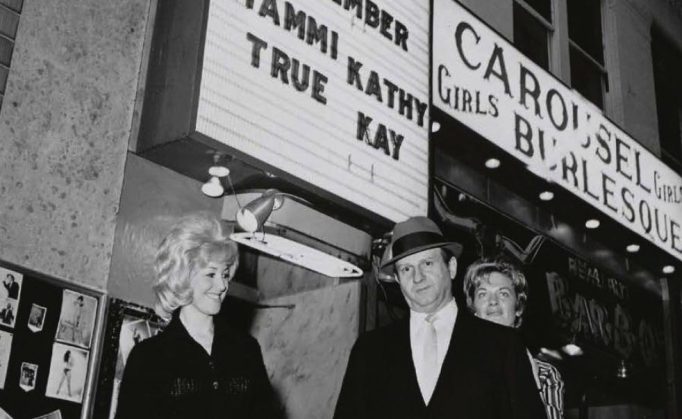
Jack Ruby in front of his Carousel strip club
Gangsters for Zion
In its final report, the Warren Commission declared that it could “not establish a significant link between Ruby and organized crime,” because “Ruby has disclaimed that he was associated with organized criminal activities, and law enforcement agencies have confirmed that denial.”[9] But there is plenty of evidence of Ruby’s association with organized crime. Robert Blakey, chief counsel for the House Select Committee on Assassinations from 1977 to 1979, said: “The most plausible explanation for the murder of Oswald by Jack Ruby was that Ruby had stalked him on behalf of organized crime, trying to reach him on at least three occasions in the forty-eight hours before he silenced him forever.”[10] Incriminating “organized crime” in the JFK assassination and the ensuing Oswald assassination was, of course, the most harmless conclusion that the HSCA could come up with, short of ridiculing itself by confirming the Warren Commission’s story of two lone nuts. And so the Washington Post could headline: “MOBSTERS LINKED TO JFK DEATH.”[11]
The missing word, here, is “Jewish”. Most Americans, learning that Jack Ruby was a mobster, must have thought he was Italian, like Hollywood gangsters. They were not told that his real name was Jacob Leon Rubenstein, that he was the son of Jewish Polish immigrants, that he went to the synagogue just before shooting Oswald, and that he later confessed to his rabbi that he “did it for the Jews.”
Jacob Rubenstein belonged to the Jewish mafia, also known as the Yiddish Connection. He had moved from Chicago to Dallas in 1947, on the trail of 15 other Chicago mobsters (3 Italians and 9 Jews) who had settled there to take over the prostitution business. That is when he changed his name from Rubenstein to Ruby. Ruby’s mentor and role model was Mickey Cohen, who operated in Chicago during the Prohibition but was then active in Hollywood. During his trial for shooting Oswald, Ruby’s legal team was fronted by Melvin Belli, a longtime friend and attorney of Cohen (Belli’s defense was that Ruby had suffered temporary insanity due to a bout of “psychomotor epilepsy”).[12] In 1947, Cohen had succeeded Benjamin Siegelbaum, aka Bugsy Siegel (romanticized by Hollywood in 1991) at the head of “Murder Incorporated”. Cohen and Siegelbaum were accountable to Meyer Lansky (born Suchowljansky), the most powerful Jewish mafia boss, who had built part of his fortune with his Havana casinos and brothels, of which he was dispossessed by Castro in 1959. Lansky’s biographer Hank Messick describes him as the head of the National Crime Syndicate. “Thanks largely to Lansky, organized crime has changed from an ugly growth on the body politic capable of being removed by surgery to a cancerous part of our economic and political systems.”[13]
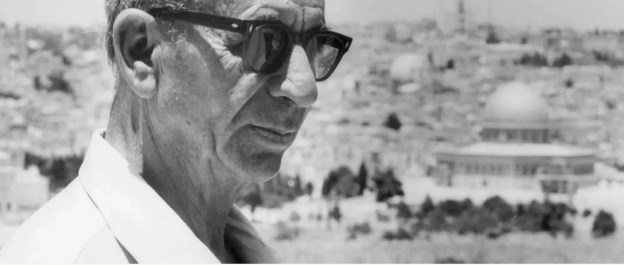
Meyer Lansky in Israel, 1971
Mickey Cohen claims in his memoirs that, in the 1940s and 1950s, he was “engrossed with Israel”, and boasts about his financial and criminal contributions to the arms smuggling operations of the Haganah. Gary Wean, a detective sergeant for the Los Angeles Police Department, claims in his book There’s a Fish in the Courthouse (1987) that he saw Ruby twice in Hollywood in 1946 and 1947 in the presence of Cohen.[14] He also writes that Cohen had frequent contacts with Menachem Begin,[15] and that he was sharing his girlfriend, stripper Candy Barr, with Menachem Begin as well as Ruby.[16]
Cohen was not the only mobster working for Israel. A pact had been sealed between prominent Zionists and Jewish mafia bosses around 1945, when the Haganah organized a highly effective black market of weapons and explosives from the US to Palestine. The operation was orchestrated by a group of about 40 wealthy American Jews who pledged to help David Ben-Gurion when the latter visited New York in July 1945. Headed by Rudolf Sonneborn, the group acted under the legal cover of a charity, the Sonneborn Institute, whose story is told by Leonard Slater in The Pledge (Simon & Schuster, 1970).[17] The group operated separately from the Jewish Agency in order to shield it from direct involvement in unlawful activities. Among its active members was the future Jerusalem mayor (1965-93) Teddy Kollek, who also played a key role in forging the CIA-Mossad Alliance. Robert Rockaway has documented the contribution of the Jewish underworld to this operation, in his article “Gangsters for Zion: How Jewish mobsters helped Israel gain its independence”. He writes:
In 1945, the Jewish Agency, the pre-state Israeli government headed by David Ben-Gurion, created a vast clandestine arms-purchasing-and-smuggling network throughout the United States. The operation was placed under the aegis of the Haganah, the underground forerunner of the Israel Defense Forces, and involved hundreds of Americans from every walk of life. They included millionaires, rabbinical students, scrap-metal merchants, ex-GIs, college students, longshoremen, industrialists, chemists, engineers, Protestants and Catholics, as well as Jews. One group, who remained anonymous and rarely talked about, were men who were tough, streetwise, unafraid, and had access to ready cash: Jewish gangsters.
Sent by Ben-Gurion to the U.S. to purchase heavy armaments, Haganah operative Yehuda Arazi approached Meyer Lansky and met with members of Murder, Incorporated. Another Haganah emissary, Reuvin Dafni, who would become Israeli consul in Los Angeles and New York, also dealt with Jewish gangsters. “When I interviewed Dafni,” Rockaway writes, “he told me about his meetings with Jewish mobsters. His meetings were arranged by members of the local Jewish community. His first meeting was in Miami with Sam Kay, a leading Miami Jewish gangster.” Dafni also met with Bugsy Siegel.
As Dafni relates, “I told him my story, how the Haganah was raising money to buy weapons with which to fight. When I finished, Siegel asked, ‘You mean to tell me Jews are fighting?’ Yes, I replied. Then Siegel, who was sitting across the table, leaned forward till his nose was almost touching mine. ‘You mean fighting, as in killing?’ Yes, I answered. Siegel leaned back, looked at me for a moment and said, ‘OK, I’m with you.’” “From then on,” recalled Dafni, “Every week I got a phone call to go to the restaurant. And every week I received a suitcase filled with $5 and $10 bills. The payments continued till I left Los Angeles.” Dafni estimates that Siegel gave him a total of $50,000.[18]
Some of those “gangsters for Zion”, writes Rockaway, “did so out of ethnic loyalties,” or “saw themselves as defenders of the Jews, almost biblical-like fighters. It was part of their self-image.”[19]
Such was also the background and self-image of Jack Ruby. His activities in arms smuggling are well documented, although the fact that it was for the benefit of Israel is often blurred. In Coup d’État in America: The CIA and the Assassination of John F. Kennedy (1975), Allan Weberman refers to the arms-dealing activities of Ruby and other mobsters, but makes no mention of their Jewishness (unless saying that Ruby “was strongly anti-Nazi” counts as an euphemism for being Jewish), and claims that they were in fact arming Castro—while simultaneously participating in CIA plots to kill him.[20]
Ruby knew Lewis McWillie, the manager of the Lansky brothers’ Tropicana nightclub casino in Havana. After the overthrow of Batista by Castro in January 1959, Meyer Lansky relocated to Miami, but Jake Lansky was arrested and confined to a luxury prison, the Trescornia detention camp, together with another mafia figure, Santo Trafficante, Jr. Although not Jewish, Trafficante had sworn allegiance to the Lansky brothers, and controlled substantial portions of Havana’s gambling and prostitution rackets. While in prison, Jake Lansky and Trafficante were often visited by Lewis McWillie, who was negotiating their release by Castro. Ruby told the Warren Commission on June 7, 1964 about visiting Lewis McWillie in 1959 in Havana, and also spoke of knowing McWillie’s bosses, whom, from fear of pronouncing their name, he referred to as “the Fox brothers, the greatest that have been expelled from Cuba.”[21] (McWillie would later acknowledge to the HSCA that, “Jack Ruby could have been out there [Havana] one time with me.”) Ruby added to the Warren Commission that McWillie and one of the brothers later visited him in Dallas.[22]
Seth Kantor quotes from a classified message that was sent from CIA headquarters to National Security Advisor McGeorge Bundy, on November 28, 1963, confirming that, while Santo Trafficante was living “in relative luxury in a Cuban prison” in 1959, he was visited frequently by “an American gangster-type named Ruby.”[23]
In September 1962, Trafficante is reported to have said to José Alman, a prominent member of the Cuban exile community in Miami, that “President Kennedy would get what was coming to him.” Aleman disagreed and argued that Kennedy would be reelected. “No, José,” said Trafficante. “He is going to be hit.”[24] When Trafficante was asked by Richard Sprague of the HSCA, “did you ever discuss with any individuals plans to assassinate President Kennedy prior to his assassination?” Trafficante refused to answer.[25]
As Kantor shows in great detail, Jack Ruby had repeated contacts with members of the Jewish underworld in 1963. By June 8, “a large group of Chicago racketeers began to show up at Ruby’s Carousel and at two other nearby strip-show clubs, according to a confidential report to Dallas Police Chief Jesse E. Curry written by Lieutenant Robert L. May Jr., who had been head of the vice squad.”[26] Ruby’s underworld contact intensified during the 11 days leading up to President Kennedy’s assassination, “when Ruby abruptly signed a power of attorney, giving up certain rights to control his own money. He also suddenly bought and installed a safe for the first time in his 16 years as a Dallas nightclub operator, to store extra amounts of money.”[27] During this period, “Ruby was getting a series of phone calls at the Carousel from an unidentified man who never would leave a message when Ruby was out.”[28] On November 11, Ruby met in Dallas with Alexander Philip Gruber, who was known for his connections with Mickey Cohen. Gruber, who had not visited Ruby in years, told the FBI that he was in Joplin Missouri at that time, and had simply decided to drop in on Ruby “since Dallas, Texas, was about 100 miles from Joplin” (the distance is 360 miles).[29] In the afternoon of November 22, Ruby phoned Alex Gruber in Los Angeles. “Gruber subsequently told the FBI he didn’t really know why Ruby called.”[30] That is most probably when Ruby received an offer he couldn’t refuse.
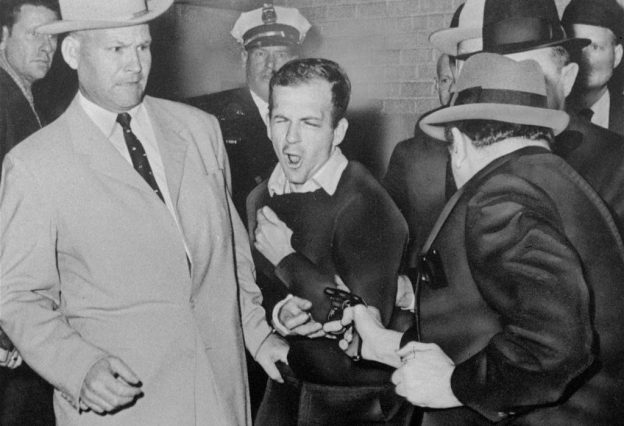
Ruby was certainly informed about the precise moment when Oswald would be transferred from the Dallas Police Station to the County Jail. According to former British Intelligence Officer Colonel John Hughes-Wilson, it was Sam Bloom, the Jewish chairman of the “host committee” who had invited Kennedy to Dallas, who suggested to the Police “that they move the alleged assassin [Oswald] from the Dallas police station to the Dallas County Jail in order to give the newsmen a good story and pictures.” And “when the police later searched Ruby’s home, they found a slip of paper with Bloom’s name, address and telephone number on it.”[31]
In an apparent attempt to make it impossible for him to fulfill his contract, Ruby tried to warn the Dallas Police anonymously: Lieutenant Billy Grammer, a dispatcher for the Dallas Police Department, whose statement can be heard here, received an anonymous phone call at 3 a.m. on November 24 from a man who knew Grammer’s name. The caller told Grammer that he knew of the plan to move Oswald from the basement and that unless the plans for Oswald’s transfer were changed, “we are going to kill him.” After Oswald was shot, Grammer, who knew Ruby and had found the voice familiar at the time of the call, identified Ruby as the caller.[32]
Ruby and the Dallas Police
When Ruby shot Oswald on Sunday November 24, this was not the first time he had been allowed into the Dallas Police Station. He knew about every policeman in town, and was nearly as often hanging around in the Police station as the policemen were at his Carousel strip club. “I have always been very close to the police department, I don’t know why,” he told the Warren Commission. Most plausibly, being on friendly terms with the Dallas policemen was his special mob assignment, and certainly the reason why he was chosen for silencing Oswald: few people had as much ease in making their way into the Dallas Police station.
Ruby spent a lot of time there from Friday 22 to Sunday 23, making several attempt to enter room 317 on the third floor where Oswald was interrogated. Early evening on Friday, the day Kennedy was assassinated and Oswald arrested,
shortly after 7 p.m., John Rutledge, a veteran police reporter for The Dallas Morning News, saw Jack Ruby, whom he easily recognized by sight, step from a public elevator onto the third floor. / Ruby was between two men who wore lapel credentials identifying them as out-of-town reporters. The three walked rapidly past a police officer stationed at the elevators to keep out anyone not on official business. Ruby was hunched over, writing something on a piece of paper and then showing it to one of the reporters as they walked toward Room 317, where Oswald was being interrogated by Captain Fritz and others. … A guard was posted at the bureau door to keep reporters from getting in to use the phones, but Ruby had no trouble easing in. He knew the guard. Ruby walked in and shook hands with Eberhardt, who asked him what he was doing. Ruby had note paper in his hand and said he was acting as translator for the foreign press. Eberhardt figured Ruby was talking about the Israeli press or the Yiddish-speaking reporters Eberhardt guessed he heard in the bedlam of the corridor.[33]
Here are the exact words from Detective August M. Eberhardt’s deposition to the Warren Commission (online here):
Mr. EBERHARDT. He came in and said hello to me, shook hands with me. I asked him what he was doing. He told me he was a translator for the newspapers. Of course, I knew that he could speak Yiddish. Had a notebook in his hand…
Mr. GRIFFIN. Do you know if there were Israeli newspaper or Yiddish—
Mr. EBERHARDT. There was a bunch of them running around there talking that unknown tongue. I don’t know what they were saying.
What a shame these Yiddish-speaking reporters were not traced and identified. Victor R. Robertson Jr., a reporter for WFAA radio and TV in Dallas who knew Ruby, also testified seeing him in the Police Station, attempting to enter 317 while Oswald was in there. Despite those testimonies, the Commission denied that Ruby was ever on the third floor Friday evening.
Later that same day, after a short visit to the synagogue, Ruby bought a dozen corned beef sandwiches and “telephoned homicide detective Richard M. Sims and offered to deliver the free food right to the office. Sims thanked him but said the day’s work was about over and they wouldn’t need anything to eat. Ruby found another reason to go anyway and, at about 11:30 p.m., he stepped off the elevator on the third floor again.”[34] At midnight, Ruby made his way to the press conference in the basement police assembly room, when Oswald was put on display. The Warren Report admits Ruby’s presence there, but portrays him as a casual bystander. “Nowhere in its 888-page report to the public did the Commission include Ruby’s admission to the FBI, a month after the crime, that he was carrying a loaded, sub-nosed revolver in his right-hand pocket during the Oswald press session in the assembly room.” Ruby couldn’t approach Oswald close enough to shoot him, as the room was packed with reporters and photographers.[35]
On Saturday 23, Ruby brought sandwiches to reporters in the Police press room; “reliable outside witnesses reported seeing Ruby or talking with him at intervals during Saturday afternoon—witnesses such as Jeremiah A. O’Leary Jr. of The Washington Star and Thayer Waldo, a reporter to The Fort Worth Star-Telegram.” Yet, Kantor notes,
the Warren Commission said it could reach “no firm conclusion as to whether or not Ruby visited the Dallas police department on Saturday” because “no police officer has reported Ruby’s presence on that day” and because “Ruby has not mentioned such a visit.” / In other words, the Warren Commission decided there had been no conspiracy between Dallas police officers and Jack Ruby because none of them reported it at the time.[36]
On Sunday morning, arrangements were made for the transfer of Oswald to the County Jail. A little after 10:30, Kantor hypothesizes, “a call was placed to the unlisted phone in Ruby’s apartment; Ruby was told where to enter the station and that the transfer van was en route.”[37] Ruby first went to the Western Union office in the next block, and arrived just in time to see Oswald being transferred. This narrow timing has been used as evidence that there was no premeditation and therefore no conspiracy. But Kantor theorizes that Ruby’s entrance into the Police station using the public stairway to the basement jail office area “could have triggered the go-ahead signal for Oswald to be brought down”, and he produces plausible evidence that it did.[38] The way Ruby entered the station is still unclear, but the House committee voted in 1979 that “it was less likely that Ruby entered the police station without assistance.”[39]
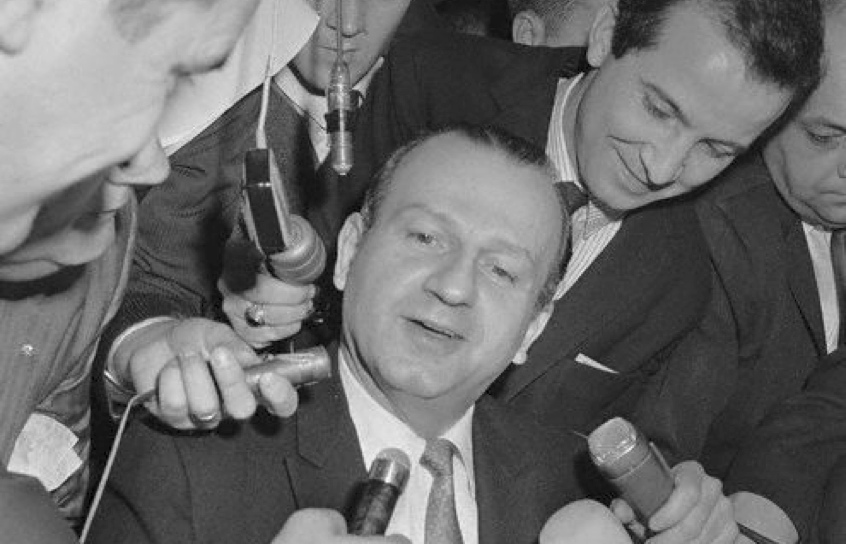
Jack Ruby after his pre-trial hearing in February 1964
The Johnson-Ruby connection
Besides Ruby, we know of one person who took steps to make sure that Oswald was silenced forever. Because Ruby could only shoot one bullet to Oswald—he said he had planned to shoot three—, Oswald was still alive when he arrived at Dallas Parkland Hospital. Dr. Charles Crenshaw recalls in his book JFK, Conspiracy of Silence (1992) that, while operating on Oswald with other surgeons, he noticed that an unknown man looking like Oliver Hardy with a pistol hanging from his back pocket had entered the operation room. Minutes later, he was told about an urgent call for him and left the operating room to take it. The call was from the new sworn president Lyndon Johnson who first asked “Dr. Crenshaw, how is the accused assassin?” Crenshaw answered: “Mr. President, he’s holding his own at the moment.” Then Johnson said firmly: “Dr. Crenshaw, I want a deathbed confession from the accused assassin. There’s a man in the operating room who will take the statement. I will expect full cooperation in this matter.” Dr. Crenshaw answered “Yes, sir,” and hung up. Thirty years later, he comments: “As I stood there in a state of disbelief, my mind was racing. First, ‘deathbed confession’ implies that someone is going to die. If Oswald doesn’t die on the table, is ‘Oliver Hardy’ or someone else going to kill him?” Since Dr. Crenshaw had just told Johnson that Oswald was “holding his own,” the expression “deathbed confession” did sound like an implicit order that Oswald should not leave the operating room alive. It really sounded as if Johnson wanted Ruby’s job finished. Moments after Dr. Crenshaw went back to the operating room, Oswald’s heart beat stopped: “Oliver Hardy” disappeared, never to be seen again. “The incident,” wrote Crenshaw, “confounded logic. Why the President of the United States would get personally involved in the investigation of the assassination, or why he would take the inquest out of the hands of the Texas authorities was perplexing.”[40]
There is plenty of evidence of Johnson’s central role in Kennedy’s assassination. And it happens that Jack Ruby directly pointed to him as the mastermind. At the end of a short filmed news conference in the Dallas County Jail in March 1965, Ruby said, “When I mentioned about Adlai Stevenson, if he was Vice-President there would never have been an assassination of our beloved President Kennedy.” Asked to explain what he meant, Ruby continued, “Well the answer is the man in office now.”[41]
How could Ruby know of Johnson’s guilt? Former Nixon operative Roger Stone claims that, in his presence, Nixon recognized Ruby as one of “Johnson’s boys.”[42] I doubt that story; Stone could have made it up to counter another rumor about Ruby’s connection to Nixon, sparked by a forged 1947 FBI memo stating that “one Jack Rubenstein of Chicago […] is performing information functions for the staff of Congressman Richard Nixon.”[43] But there is one more thing linking Ruby to Johnson.
In his testimony to Chief Justice Earl Warren and other Commission members on June 7, 1964, Ruby pleaded to be given a chance to talk directly to Johnson, otherwise “you will see the most tragic thing that will ever happen,” adding that “maybe something can be saved … if our President, Lyndon Johnson, knew the truth from me.”[44] This can be interpreted as a veiled threat addressed to Johnson. Ruby, who by this time had been sentenced to death, may have been trying to remind Johnson that his contract included a presidential pardon (he had shot Oswald out of love for the Kennedys, hadn’t he?). Even more curiously, Ruby hinted that Israel’s reputation could suffer if he spoke: “There will be a certain tragic occurrence happening if you don’t take my testimony and somehow vindicate me so my people don’t suffer because of what I have done.” He feared, he said, that his act would be used “to create some falsehood about some of the Jewish faith.” Ruby also declared to Warren, “I have been used for a purpose,” but no one in the Commission bothered to ask him who had used him and for what purpose.[45] All Ruby got out of his confused testimony was a second pointless Warren Commission interview one month later (July 18, 1964), this time by none other than Arlen “Magic Bullet” Specter (transcript here). His frustration would explain why in March 1965, he finally accused Johnson. Shortly thereafter, he wrote a letter of sixteen pages that he managed to get smuggled out of jail, blaming Johnson for Kennedy’s murder and calling the former “a Nazi of the worst order.”[46] By doing so, he probably hastened his own death, on January 3, 1967.
The case against Johnson
One commenter to my previous Kennedy article argued that the thesis of Israel’s motive is unconvincing because the Israeli Deep State had other options than killing Kennedy in order to go on with its Dimona project. I responded that a murderer’s motive is rarely that he has no other choice than to kill, but that he finds a crucial advantage in the killing. I also remarked that, whoever the assassins were, their purpose was obviously not just to get rid of Kennedy, but to put Johnson in charge. And that had to be done quickly, because the Kennedys were busy destroying Johnson’s reputation and would soon be announcing a change in the vice-presidency. According to Horace Busby, longtime LBJ aide and author of The Thirty-First of March (2005), Johnson had found out that, in early November 1963, Robert Kennedy had sent a team of national reporters to Texas to utterly destroy him. “We’re here to do a job on Lyndon Johnson,” said one the newsmen to an attorney whom he mistakenly believed to be a Johnson enemy. “When we get through with the sonofabitch, Kennedy won’t be able to touch him with a ten-foot pole in 1964”[47] (quoted from this article by Robert Morrow, who wrote more informative articles on Johnson and his “murderous psychopathy”). Richard Nixon, who happened to be in Dallas the day before Kennedy, leaked the rumor to the Dallas Morning News, who reported it on November 22nd under the headline “Nixon Predicts JFK May Drop Johnson.” Instead, Johnson became president that very day (and Nixon knew that Johnson was behind it).[48]
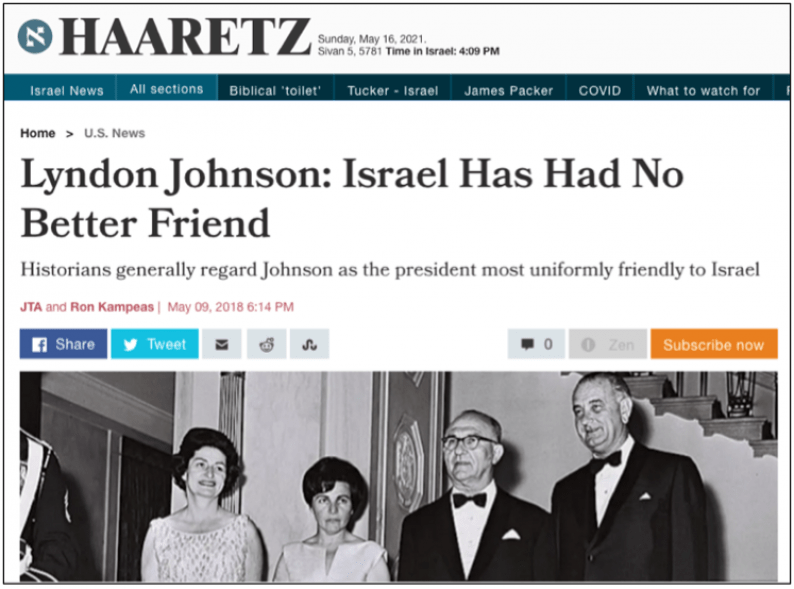
So, since the assassination of Kennedy was a coup to put Johnson in power—what else can it be?—there was no time to waste: it had to be done before the new campaign started and news of a change of vice-presidential ticket was published (Nixon’s prediction was the first and the last). If we now want to know the motive of the coup, we only have to ask: What major change occurred in US policy under Johnson? The change was not visible to the American public then, but they are now well-known, at least to readers of the Jewish and Israeli press. “Lyndon Johnson: Israel Has Had No Better Friend,” headlined Haaretz on May 9, 2018.
“Historians generally regard Johnson as the president most uniformly friendly to Israel,” we are told by the Jewish Telegraphic Agency.
Johnson was the first president to invite an Israeli prime minister, Levi Eshkol, on a state visit. They got along so well — both men were farmers — that Johnson paid Eshkol the rare compliment of inviting him to his ranch.
LBJ soon abandoned pressure on Israel to come clean about the Dimona reactor. He increased arms sales to Israel and in 1968, after Israel’s primary supplier, France, imposed an embargo as a means of cultivating ties in the Arab world, the United States became Israel’s main supplier of weapons, notably launching the talks that would lead to the sale of Phantom fighter jets to Israel.
Johnson wanted to commit more forcefully to Israel’s cause in the lead-up to the 1967 Six-Day War, but he felt constrained from a dramatic show of military might because of the failures of the war in Vietnam then dogging his presidency. Nonetheless, during the war, he ordered warships to within 50 miles of Syria’s coast as a warning to the Soviets not to interfere.
In a speech in the war’s immediate aftermath, Johnson effectively nipped in the bud any speculation that the United States would pressure Israel to unilaterally give up the lands it had captured. He laid down not only the “land for peace” formula that would inform subsequent U.N. Security Council resolutions, but made it clear that any formula had to ensure Jewish access to Jerusalem’s Old City.
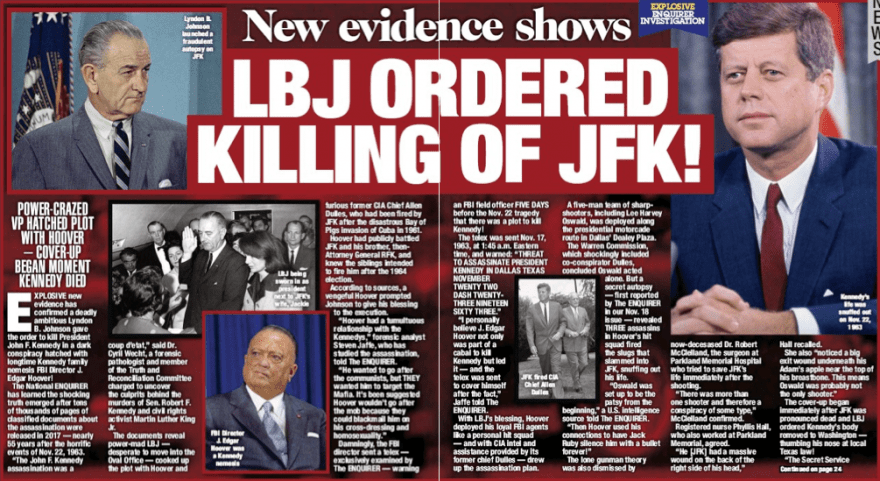
It is a good thing that Johnson is being praised by the Israeli press as the US president who “firmly pointed American policy in a pro-Israel direction”, because, on the other hand, his crucial role in the Dallas coup is also getting mainstream attention, as illustrated by the December 2, 2019 issue of the National Enquirer. Anybody who can add one plus one can also make the logical inference.
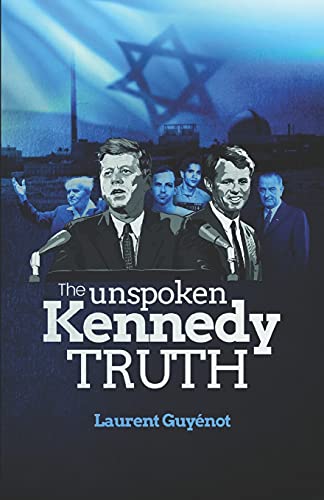
Watch Laurent Guyénot’s film “Israel and the Assassinations of the Kennedy Brothers” and share it:
https://www.youtube.com/watch?v=a_kh5tb7PtA
Notes
[1] Seth Kantor, The Ruby Cover-Up, Zebra Books , 1980, p. 49.
[2] Steve North, “Lee Harvey Oswald’s Killer ‘Jack Ruby’ Came From Strong Jewish Background,” The Forward, November 17, 2013, on forward.com
[3] William Kunstler, My Life as a Radical Lawyer, Carol Publishing, 1994, p. 158.
[4] James Douglass, JFK and the Unspeakable: Why He Died and Why It Matters, Touchstone, 2008, p. 357.
[5] Douglass, JFK and the Unspeakable, p. 47; Sheriff’s Office report on mcadams.posc.mu.edu/death2.txt
[6] Jim Marrs, Crossfire: The Plot that Killed Kennedy, Carroll and Graf, 1989, p. 285.
[7] Douglass, JFK and the Unspeakable, pp. 169-171.
[8] On https://mcadams.posc.mu.edu/russ/testimony/paine_r3.htm
[9] Kantor, The Ruby Cover-Up, p. 48.
[10] https://en.wikipedia.org/wiki/Jack_Ruby#Ruby’s_motive
[11] Gaeton Fonzi, The Last Investigation: A Former Federal Investigator Reveals the Man Behind the Conspiracy to Kill JFK, 1993, Skyhorse, 2013, k. 405–76.
[12] Michael Collins Piper, Final Judgment: The Missing Link in the JFK Assassination Conspiracy, American Free Press, 6th ed., 2005, p. 239.
[13] Hank Messick, Lansky, Putnam’s Sons, 1971, p. 9.
[14] Michael Collins Piper, Final Judgment, p. 222.
[15] Gary Wean, There’s a Fish in the Courthouse, Casitas Books, 1987, p. 681, quoted by Piper, Final Judgment, op. cit., p. 219-27, 232-7.
[16] Michael Collins Piper, Final Judgment, p. 224.
[17] Read Ricky-Dale Calhoun, “Arming David: The Haganah’s illegal arms procurement network in the United States 1945-1949,” Journal of Palestine Studies Vol. XXXVI, No. 4 (Summer 2007), pp. 22–32, online here.
[18] Robert Rockaway, “Gangsters for Zion. Yom Ha’atzmaut: How Jewish mobsters helped Israel gain its independence”, April 19, 2018, on tabletmag.com
[19] Robert Rockaway, “Gangsters for Zion,” on tabletmag.com
[20] Alan J. Weberman and Michael Canfield, Coup d’État in America: The CIA and the Assassination of John F. Kennedy, Quick American Archives, 1975, pp. 151-180 (p. 178). Michael Piper mentions (Final Judgment, p. 232) that JFK researcher Alan J. Weberman has revealed the little-known fact that Ruby traveled to Israel in 1955, but the link to Weberman’s website is now dead, and I hold Weberman as a very unreliable source

[21] Bernard Fensterwald, in Coincidence or Conspiracy (quoted by Piper, Final Judgment, pp. 228-229).
[22] Richard Gildbride, Matrix for Assassination: the JFK Conspiracy, Trafford, 2009.
[23] Kantor, The Ruby Cover-Up, pp. 255-256.
[24] Kantor, The Ruby Cover-Up, pp. 259-264.
[25] Kantor, The Ruby Cover-Up, p. 402.
[26] Kantor, The Ruby Cover-Up, p. 53.
[27] Kantor, The Ruby Cover-Up, p. 48.
[28] Kantor, The Ruby Cover-Up, p. 104.
[29] Kantor, The Ruby Cover-Up, pp. 56-59.
[30] Kantor, The Ruby Cover-Up, p. 91.
[31] John Hughes-Wilson, JFK-An American Coup d’État: The Truth Behind the Kennedy Assassination, John Blake, 2014.
[32] Mentionned in this comment.
[33] Kantor, The Ruby Cover-Up, pp. 96-97.
[34] Kantor, The Ruby Cover-Up, p. 98.
[35] Kantor, The Ruby Cover-Up, pp. 100-101.
[36] Kantor, The Ruby Cover-Up, p. 116.
[37] Kantor, The Ruby Cover-Up, p. 132.
[38] Kantor, The Ruby Cover-Up, p. 141.
[39] Kantor, The Ruby Cover-Up, p. 409.
[40] Charles A. Crenshaw, JFK, Conspiracy of Silence, Signet, 1992, pp. 185-189, 5, and
[41] This sequence can be seen in the 1988 documentary “The day the dream died” at 38:20; for more information on Ruby’s declarations about Johnson and about Jews, check this webpage.)
[42] Patrick Howley, “Why Jack Ruby was probably part of the Kennedy conspiracy,” The Daily Caller, March 14, 2014, on dailycaller.com
[43] Copy at www.jfkmurdersolved.com/nixonruby.htm. The forgery is proven by several inconsistencies: first, Nixon was a freshman in the role as junior counsel in 1947, and only started prosecuting Alger Hiss (the only likely context for this memo) the following year. Second, it refers to “Jack Rubenstein” living in Chicago in November of 1947, when Ruby had in fact already changed his name and moved to Dallas by that time. Finally , the document carries a zip code, when they did not exist at the time.
[44] Read Ruby’s deposition here.
[45] Seth Kantor, The Ruby Cover-Up, p. 49.
[46] Phillip Nelson, LBJ: The Mastermind of JFK’s Assassination, pp. 604-607.
[47] Horace Busby, The Thirty-First of March: An intimate portrait of Lyndon Johnson’s final days in office, Farrar, Straus and Giroux, 2005, pp. 129-130.
ANOTHER BOGUS RUSSIAN WAR SCARE
By Paul Robinson | IRRUSIANALITY | November 12, 2021
I have had a couple more pieces published in RT in the last two days. One concerns the probably temporary closure of the Kyiv Post and why it seems to have provoked immense outrage whereas the previous shutting down of Russian-language Ukrainian media outlets did not. The other responds to a letter of resignation sent by Russian liberal journalist Konstantin [von] Eggert [MBE] to the Chatham House think tank in protest the institute’s decision to give an award to a BLM activist. I use this an opportunity to delve into different Russian and Western conceptions of rights and freedoms. You can read these here and here.
For this post, though, I intend to tackle another topic, which follows on naturally from my last one. In that, I mocked the idea being floated around in some circles that Russia was behind the Belarus-EU migrant crisis and somehow using it as a provocation for further aggressive action, including maybe a military assault on the ‘Suwalki Gap’.
As we now know from Bloomberg, this theory is nonsense: Russia has no intention of invading Poland, it’s planning to invade Ukraine instead. Or so say ‘American officials’, and as we all know you can trust their judgement 100%.
According to Bloomberg:
“The U.S. is raising the alarm with European Union allies that Russia may be weighing a potential invasion of Ukraine as tensions flare between Moscow and the bloc over migrants and energy supplies.
With Washington closely monitoring a buildup of Russian forces near the Ukrainian border, U.S. officials have briefed EU counterparts on their concerns over a possible military operation, according to multiple people familiar with the matter.
… The assessments are believed to be based on information the U.S. hasn’t yet shared with European governments, which would have to happen before any decision is made on a collective response, the people said. They’re backed up by publicly-available evidence, according to officials familiar with the administration’s thinking.
… Russia has orchestrated the migrant crisis between Belarus and Poland and the Baltic states — Lithuania and Latvia share a border with Belarus — to try to destabilize the region, two U.S. administration officials said. U.S. concerns about Russian intentions are based on accumulated evidence and trends that carry echoes of the run-up to Putin’s 2014 annexation of Crimea from Ukraine, another administration official said.
… Some analysts argue that Putin may believe now is the time to halt Ukraine’s closer embrace with the West before it progresses any further.
“What seems to have changed is Russia’s assessment of where things are going,” said Samuel Charap, a senior political scientist at the RAND Corporation. “They seem to have concluded that unless they do something, the trend lines are heading to Russia losing Ukraine.”
According to defense-intelligence firm Janes, the recent Russian deployment has been covert, often taking place at night and carried out by elite ground units, in contrast to the fairly open buildup in the spring.
Let’s take a look at all this. We have some statements from three anonymous officials, based on “publicly available information” (none of which I have seen that points to an imminent invasion) and some sort of secret information that the US hasn’t shared with anybody and so can’t be assessed. Now call me a sceptic, but unverifiable information from anonymous sources doesn’t sound like something very solid to me.
Beyond that, if the final lines from Janes are correct, we have a deployment of “elite ground units,” but you can’t invade a foreign country just using “elite” units, let alone a country the size of Ukraine. You’d need a massive build-up of a very considerable volume of rank-and-file line units. So, the actual evidence presented doesn’t fit the scenario portrayed.
As for Mr Charap’s statement that “They seem to have concluded that unless they do something, the trend lines are heading to Russia losing Ukraine,” I have yet to see any indication of this. Quite the contrary. Former Russian president Dmitry Medvedev’s recent comment that Russia should do “nothing” about Ukraine and simply wait until the Ukrainians come to their senses, points to an entirely different conclusion. We are “patient,” said Medvedev, who is Deputy Chairman of the Security Council, and so one imagines, well versed in what is in people’s minds at the highest level. His comments hardly suggest that senior officials are thinking that radical action is urgently required.
The fact that American “officials” are briefing the press that war is possible, and that analysts from the RAND Corporation are backing them up, speaks to an awful lack of understanding of things Russian in the United States. The fact that Bloomberg then repeats these claims without serious challenge points also to a disturbing lack of critical thinking on behalf of the American press (no surprise there!), as well as reinforcing what academic studies of the media have long since noted – its worrisome dependence on official sources.
The only part of the Bloomberg article that gives readers a real sense of what’s going on comes in the following lines, which say:
Russia doesn’t intend to start a war with Ukraine now, though Moscow should show it’s ready to use force if necessary, one person close to the Kremlin said. An offensive is unlikely as Russian troops would face public resistance in Kyiv and other cities, but there is a plan to respond to provocations from Ukraine, another official said.
This strikes me as accurate. There is absolutely no reason for Russia to start a war with Ukraine. It would be enormously costly and bring no obvious benefits. Besides which, war needs careful advance preparation of public opinion. There have been absolutely no indications of the Kremlin doing anything of the sort. That said, as I have noted before, I have little doubt that if Ukraine launched a major attack on the rebel regions of Donbass, and if large numbers of civilians were killed as a result (as would be most likely), Russia would respond. And its response would likely be very tough, much tougher than it was in August 2014 when it very briefly sent a limited number of forces into Donbass to defeat the Ukrainians at Ilovaisk. If there is a Russian invasion of Ukraine, it’s likely to be large-scale, to settle the issue once and for all.
All this talk of war is therefore rather dangerous. It helps to ramp up tensions on Russia’s borders, and also serves to justify a build-up by NATO forces in the region. That in turn may send the wrong messages to Ukraine and encourage it to act rashly. Fortunately, I don’t think that things will go that far, but I do think that “American officials” and the press are playing with fire. They would be well advised to stop. Unfortunately, one gets the impression that their lack of knowledge and understanding makes that impossible. Sad times indeed.
Biden’s vaccine mandate fails ‘reality & common sense’ check, judge rules

FILE PHOTO. © Reuters / Evelyn Hockstein
RT | November 13, 2021
A US federal appeals court has again ruled against President Joe Biden’s national vaccine mandate for companies with 100 or more workers, shredding the policy as “staggeringly overbroad” and an abuse of “extraordinary power.”
The Fifth Circuit Court of Appeals issued a stark rebuke to Biden’s vaccine requirement for larger American companies in a ruling on Friday, stating that the Occupational Safety and Health Administration (OSHA) – the federal agency tapped to enforce the mandate – was not created to “make sweeping pronouncements on matters of public health affecting every member of society in the profoundest of ways.”
“The Mandate is staggeringly overbroad,” Judge Kurt Engelhardt said, noting that it does not take into account the diversity of workplaces across the country, nor the fact that Covid-19 “is more dangerous to some employees than to other employees.” As an example, he compared a hypothetical 28-year-old truck driver who works in isolation to a “62-year-old prison janitor” employed in more cramped conditions.
“One constant remains – the Mandate fails almost completely to address, or even respond to, much of this reality and common sense.”
The Biden administration initially announced the requirement in September, with OSHA following up earlier this month with an emergency order to enforce the mandate. The agency will require all workers at firms with more than 100 employees to be fully vaccinated against Covid-19 by early next year, or else test for the virus regularly and wear masks at all times while working.
The appeals court issued its first stay on November 6 after a litany of plaintiffs – including a number of companies and several US states – challenged the move, conducting an expedited judicial review. Friday’s ruling reaffirmed the pause, telling OSHA to “take no steps to implement or enforce the Mandate until further court order.” Despite the first stay, the White House has continued to urge businesses to follow the vaccine dictate and effectively ignore the ruling, potentially setting up a battle in the Supreme Court.
While OSHA does have the power to issue what’s known as an “emergency temporary standard,” or ETS, the judge observed that only a single standard has survived legal scrutiny since the agency was founded in the 1970s.
“The reason for the rarity of this form of emergency action is simple,” Engelhardt went on, adding that courts and OSHA itself have agreed “for generations” that such orders constitute “extraordinary power” which must be “delicately exercised, and only in those emergency situations which require it.”
“The Mandate at issue here is anything but a ‘delicate exercise’ of this ‘extraordinary power.’”
School Districts in California Defy Newsom’s Edict to Inject Students with Pfizer Shots – Willing to Give Up State Funding
By Brian Shilhavy | Health Impact News | November 12, 2021
Finally, some sanity in an insane world that believes it is OK to abuse children and attempt to murder them with experimental Pfizer COVID-19 shots!
In an unanimous 5 to 0 vote, the Calaveras Unified School District (CUSD) in Calaveras County, California, has decided to defy Governor Newsom’s command to inject their students with Pfizer’s shots, no matter what the cost.
They are the second school district in the County to do so, and apparently other school districts in the State of California are considering similar measures.
At a Calaveras Unified School District (CUSD) board meeting Tuesday night, the board voted 5-0 against upholding the state-issued COVID-19 vaccine mandate for students and staff.
The five board members voted on an action put forth by board member Bryan Porath to “not enforce, support, or comply” with the mandate, which requires all students and school staff to be vaccinated by July of next year, following FDA approval of the vaccine for the child’s specific age group.
CUSD is Calaveras County’s largest school district and includes Calaveras High School, five elementary schools and one middle school.
This decision follows after the Mark Twain Union Elementary School District became the first in the county to vote against enforcing the mandate last week.
Some school districts throughout the state have similarly expressed concerns or pledged not to uphold the mandate, including districts in Apple Valley and Happy Valley, with one school board member in Temecula Valley resigning to avoid getting vaccinated, though it is undetermined whether the state rules apply to school board members.
A theme of solidarity and mutual support was echoed throughout comments from concerned parents, teachers, and school board trustees. Two fourth grade students from Valley Springs Elementary also rose to the podium, to ask the board to consider their feelings about the mandate. (Source.)
The school board had previously announced their rejection of the mandate and their intention to hold a vote on the issue in a letter to families and staff on November 4, as they announced there may be consequences from the State of California for defying the vaccine mandate.
The board is aware of the potential impacts on the district in terms of possible liability exposure, funding loss, other formal actions that can be taken against the district in response—and they understand the Superintendent’s recommendation for mandate compliance based upon these potential consequences—but they feel strong in their individual positions on this topic, as expressed on October 19th and as will be discussed on November 9th, when their vote will determine the position and direction of the district on this matter.
The school board’s action also defied the Superintendent’s recommendation, who apparently stands to potentially lose financially. Perhaps his job is on the line?
Prior to voting, Superintendent Mark Campbell advised the board that based on liability and the risks associated with going against the state-issued mandate—including “fall back from unions” and OSHA, state and local public health orders, and potentially losing Covid-related funding—he would recommend that the district remain in compliance with the state’s rules. Campbell advised that the district “stand(s) to lose students and staff on either end.”
One commenter from the audience told the board:
“I am so proud of you guys. I am so proud to be in Calaveras County, and I am so proud that we are united. I’m so proud. I know It takes a lot of courage to take a stand like this. I’m so proud of each one of you, and I’m so proud of all of us. … We’re gonna have your back.” Applause and a shout of “we got your back” echoed the sentiment throughout the room.
VAERS COVID Vaccine Data Show Surge in Reports of Serious Injuries, as 5-Year-Olds Start Getting Shots
By Megan Redshaw | The Defender | November 12, 2021
The Centers for Disease Control and Prevention (CDC) released new data today showing a total of 875,653 adverse events following COVID vaccines were reported between Dec. 14, 2020, and Nov. 5, 2021, to the Vaccine Adverse Event Reporting System (VAERS). VAERS is the primary government-funded system for reporting adverse vaccine reactions in the U.S.
The data included a total of 18,461 reports of deaths — an increase of 383 over the previous week, and 135,400 reports of serious injuries, including deaths, during the same time period — up 7,943 compared with the previous week.
Excluding “foreign reports” to VAERS, 643,957 adverse events, including 8,456 deaths and 53,780 serious injuries, were reported in the U.S. between Dec. 14, 2020, and Nov. 5, 2021.
Foreign reports are reports received by U.S. manufacturers from their foreign subsidiaries. Under U.S. Food and Drug Administration (FDA) regulations, if a manufacturer is notified of a foreign case report that describes an event that is both serious and does not appear on the product’s labeling, the manufacturer is required to submit the report to VAERS.
Of the 8,456 U.S. deaths reported as of Nov. 5, 10% occurred within 24 hours of vaccination, 15% occurred within 48 hours of vaccination and 26% occurred in people who experienced an onset of symptoms within 48 hours of being vaccinated.
In the U.S., 427.6 million COVID vaccine doses had been administered as of Nov. 5. This includes: 250 million doses of Pfizer, 162 million doses of Moderna and 16 million doses of Johnson & Johnson (J&J).

Every Friday, VAERS publicizes vaccine injury reports received as of a specified date. Reports submitted to VAERS require further investigation before a causal relationship can be confirmed. Historically, VAERS has been shown to report only 1% of actual vaccine adverse events.
Numbers this week do not yet include reports from the authorization of Pfizer’s pediatric COVID vaccine for the 5 to 11 age group. Reports currently in VAERS for children under 12 are due to ”product administered to patient of inappropriate age.”
During a meeting on Oct. 26, by the U.S. Food and Drug Administration’s vaccine panel, Dr. Jessica Rose, a viral immunologist and biologist, said tens of thousands of reports have been submitted to the Vaccine Adverse Event Reporting System for children ages 0 to 18, and that 60 children have died — 23 of them were under 2 years old.
“It is disturbing to note that “product administered to patients of inappropriate age was filed 5,510 times in this age group,” Rose said. Two children were inappropriately injected, presumably by a trained medical professional, and subsequently died. This is malfeasance.”
This week’s U.S. data for 12- to 17-year-olds show:
- 22,782 total adverse events, including 1,400 rated as serious and 29 reported deaths. Two of the 29 deaths were suicides.
The most recent death includes a 17-year-old female from Washington (VAERS ID 1828901) who reportedly died Oct. 29 from a heart condition after receiving her second dose of Pfizer. According to the VAERS report, the girl had COVID in August and fully recovered. She received her first dose of Pfizer on Sept. 3 and her second dose on Sept 15.
On Oct. 23, she presented to the ER with chest pain and elevated troponin. She had an abnormal echocardiogram, abnormal EKG and became increasingly tachycardic. She then suffered cardiac arrest.
“Unfortunately she was not able to be resuscitated and died,” the report states. “Cause of death possible acute myocarditis.”
Other deaths include a 12-year-old girl from South Carolina (VAERS I.D. 1784945) who hemorrhaged 22 days after receiving Pfizer’s COVID vaccine, a 13-year-old girl from Maryland (VAERS I.D. 1815096) who died from a heart condition 15 days after receiving her first dose of Pfizer’s vaccine and a 17-year-old female from Texas (VAERS I.D. 1815295 who experienced an acute hyperglycemic crisis 33 days after being vaccinated.
- 59 reports of anaphylaxis among 12- to 17-year-olds where the reaction was life-threatening, required treatment or resulted in death — with 96% of cases
attributed to Pfizer’s vaccine. - 552 reports of myocarditis and pericarditis (heart inflammation) with 542 cases attributed to Pfizer’s vaccine.
- 131 reports of blood clotting disorders, with all cases attributed to Pfizer.
This week’s U.S. VAERS data, from Dec. 14, 2020, to Nov. 5, 2021, for all age groups combined, show:
- 19% of deaths were related to cardiac disorders.
- 54% of those who died were male, 42% were female and the remaining death reports did not include gender of the deceased.
- The average age of death was 72.7.
- As of Nov. 5, 4,260 pregnant women reported adverse events related to COVID vaccines, including 1,337 reports of miscarriage or premature birth.
- Of the 3,123 cases of Bell’s Palsy reported, 51% were attributed to Pfizer vaccinations, 41% to Moderna and 8% to J&J.
- 723 reports of Guillain-Barré syndrome (GBS), with 41% of cases attributed to Pfizer, 30% to Moderna and 28% to J&J.
- 2,093 reports of anaphylaxis where the reaction was life-threatening, required treatment or resulted in death.
- 10,857 reports of blood clotting disorders. Of those, 4,790 reports were attributed to Pfizer, 3,864 reports to Moderna and 2,149 reports to J&J.
- 3,071 cases of myocarditis and pericarditis with 1,922 cases attributed to Pfizer, 1,016 cases to Moderna and 123 cases to J&J’s COVID vaccine.
Teen diagnosed with Guillain-Barré syndrome After COVID Vaccine
A 17-year-old girl was hospitalized for Guillain-Barré syndrome (GBS) — a rare disorder in which the body’s immune system attacks its nerves — after receiving a COVID vaccine. Shelby Allen said she’s thankful she isn’t paralyzed and didn’t die.
Allen started experiencing back pain and tingling in her arms after getting vaccinated. Symptoms progressed until she found herself unable to feel her arms and legs while bowling with her school’s team. Allen’s parents took her to the doctor in Jackson, Tennessee, where she was diagnosed with GBS and admitted to the ICU.
Allen’s doctor “knew right off the bat” her reaction was caused by a COVID vaccine, but still recommended people get vaccinated. Allen is hoping she’ll be able to walk by March for her high school graduation.
Taiwan temporarily halts second dose of Pfizer over myocarditis concerns
The Central Epidemic Command Center (CECC) said on Wednesday a panel of experts is suspending second doses of Pfizer-BioNTech’s COVID vaccine for children 12 to 17 years old amid concerns it may increase the risk of myocarditis.
Cases of myocarditis (inflammation of the heart muscle) and pericarditis (inflammation of the outer lining of the heart) have been reported in children between 12 and 17 years old who received Pfizer’s vaccine.
CECC cited U.S. statistics which show the risk of experiencing heart inflammation after receiving a second dose is 10 times higher than after the first dose.
Chen Shih-chung, who heads up the CECC, said the Ministry of Health and Welfare’s Advisory Committee for Immunization Practices halted second doses of Pfizer for two weeks, during which time experts and CDC physicians will assess 16 cases of myocarditis among adolescents after Pfizer vaccination before making a decision on whether to go ahead with the second dose.
Hong Kong gives only a single dose to teens 12 to 17, while the UK recommends only one shot for children between ages 12 and 18.
More countries restrict Moderna vaccine over reports of myocarditis
France’s public health authority recommended people under 30 receive Pfizer’s COVID vaccine instead of Moderna, due to higher risks of heart problems in young adults, Reuters reported.
The Haute Autorite de Sante (HAS), an independent advisor to the French health sector, cited “very rare” risks linked to myocarditis, confirmed by a French study published Monday.
“Within the population aged under 30, this risk appears to be around five times lesser with Pfizer’s Comirnaty jab compared to Moderna’s Spikevax jab,” HAS said.
Germany’s advisory committee, known as STIKO, said on Wednesday people under age 30 should receive only Pfizer’s vaccine, as it causes fewer cases of heart inflammation in younger people. STIKO also recommended pregnant women receive only the Pfizer vaccine, regardless of their age.
The recommendations were based on new safety data from the Paul Ehrlich Institute — Germany’s authority in charge of vaccines, and new data.
The decision came after several other countries restricted the use of Moderna to older populations, including Canada, Finland, Denmark and Sweden. France’s medical regulator on Oct. 15 recommended using only Pfizer’s vaccine for booster shots, despite the European Union’s drug regulator last month approving Moderna’s booster for all age groups over 18.
Pfizer asks FDA to authorize third booster dose for all people 18 and older
As The Defender reported Nov. 10, Pfizer and BioNTech on Tuesday asked the FDA to authorize a third dose of their COVID vaccine for all people 18 and older, even though advisory panels to the FDA and CDC in September overwhelmingly rejected a similar request.
The companies said their new request is based on the results of a study, conducted by Pfizer and BioNTech, which has not been published or peer-reviewed. The companies said the study of more than 10,000 volunteers showed vaccine efficacy against symptomatic infection of 95% or greater for people receiving the booster.
Pfizer did not disclose how many participants experienced asymptomatic infection, or whether the clinical trial — as did Pfizer’s clinical trial for 5 to 11 years olds — included individuals with natural immunity acquired from previous SARS-CoV-2 infection.
Children’s Health Defense asks anyone who has experienced an adverse reaction, to any vaccine, to file a report following these three steps.
Megan Redshaw is a freelance reporter for The Defender. She has a background in political science, a law degree and extensive training in natural health.
© 2021 Children’s Health Defense, Inc. This work is reproduced and distributed with the permission of Children’s Health Defense, Inc. Want to learn more from Children’s Health Defense? Sign up for free news and updates from Robert F. Kennedy, Jr. and the Children’s Health Defense. Your donation will help to support us in our efforts.
EU Official Calls US Warships Near Russia’s Coast “Clearly” An Unncessary “Provocation”
By Tyler Durden | Zero Hedge | November 12, 2021
An EU official has made surprising remarks this week, evaluating the presence of a pair of large US warships in the Black Sea. French member of the European Parliament Thierry Mariani slammed ongoing naval exercises by the USS Porter and USS Whitney as “clearly a provocation” by Washington.
“The presence of the ‘Mount Whitney’, flagship of the US Sixth Fleet and the USS Porter in the Black Sea, as well as the NATO naval maneuvers, are clearly a provocation of Russia,” Mariani said.
He issued the statements in an interview to Russia’s Sputnik : “Can you imagine what the American reaction would be if the Russian navy organized maneuvers in international waters off the American coast, near Washington DC?” he questioned.
The statements come as both US and Ukrainian officials, as well as Romanian leaders and other Black Sea NATO members, have urged a greater US military presence on the Black Sea, citing “Russian aggression.”
On renewed tensions over Ukraine, coming two weeks after Kiev officials accused the Kremlin of building up troops near Donbass and in the Crimea area, the French official said:
“This is very serious and could push Ukrainian politicians, the culprits of this widespread corruption, into a headlong rush action, for example into a hazardous military offensive in Donbass or an armed provocation of Russia in the Black Sea.”
And on NATO encroachment in eastern Europe and around the Black Sea, he said:
“NATO should have been dismantled at the same time as the Warsaw Pact was suppressed in the last century and the present expansion, and projection by NATO of military forces to the whole world is very alarming.”
The statements appeared to back provocative statements made days ago by Russian Defense Minister Sergei Shoigu, who said, “This is an almost constant attempt to test us, to check how ready we are, how much we have built the entire [defense] system off the Black Sea coast.”
Russia denies US media reports that it plans to invade Ukraine
By Jonny Tickle | RT | November 12, 2021
The Kremlin has strongly denied suggestions that Russia is planning to invade Ukraine, after reports emerged that officials from the US had warned their counterparts in Europe that Moscow is considering a “military operation.”
Speaking to the press on Friday, Kremlin spokesman Dmitry Peskov slammed the suggestion as groundless.
“This is not the first publication and not the first statement by the US that they are concerned about the movement of our armed forces in Russia,” he said. “We have repeatedly said that the movement of our armed forces on our own territory should be of no concern to anyone. Russia poses no threat to anyone.”
Reports that Washington fears Russian aggression against Ukraine were first published by business outlet Bloomberg on Thursday. Citing unnamed sources, the news agency reported that US officials had briefed their partners in the EU over a “potential invasion,” noting that their concerns were backed by “publicly available evidence.”
“Such headlines are nothing but empty, unfounded tension build-up. Russia poses no threat to anyone,” Peskov reiterated.
The suggestion was earlier refuted by Dmitry Polyanskiy, Russia’s first deputy ambassador to the UN, who wholly denied any plan to attack its neighbor.
“We have never planned [an invasion] and never will, unless we are provoked by Ukraine or someone else, and it is a matter of defending our national sovereignty,” he said.
Russian MP Viktor Vodolatsky also commented on the accusation, suggesting that the article is more indicative of NATO’s plan to create conflict in Ukraine.
“This is all done with only one goal: to get Ukraine involved in a war, realizing that Russia will not turn a blind eye to it,” he said. Vodolatsky is the first deputy head of the parliamentary committee on CIS Affairs, Eurasian Integration, and Relations with Compatriots.
A “Deadly Attack” on the Capitol?
By Jacob G. Hornberger | FFF | November 10, 2021
Yesterday, I was listening to a classical-music station when NPR came on with the news. Addressing the controversy surrounding former President Trump’s efforts to keep secret his records relating to the January 6 protests at the Capitol, the NPR reporter referred to the “deadly attack” on the Capitol.
I immediately thought to myself, “Well, that’s certainly an interesting use of language.”
When I hear the word “attack,” I think of weapons, specifically guns, grenades, or missiles that are intended to kill people. For example, when the Pentagon fired a missile at that family in Afghanistan shortly before exiting its 20-year war in that country, I would term that an “attack” — and a “deadly attack” at that, especially given that many innocent people, including children, were killed by that missile.
One of the fascinating aspects of the “attack” on the Capitol is that the “attackers” didn’t have guns. In fact, as far as I know, they didn’t even have any swords. To me, that’s one unusual “attack.” In fact, I’ll bet that there haven’t been many other “attacks” in history in which the “attackers” failed to use weapons to commit their “attack.”
What about words? Yeah, the Capitol “attackers” certainly employed a lot of words during the course of their “attack.” Maybe that is what NPR means when it describes what happened as an “attack” — that the “attackers” were engaged in a “word attack” on the Capitol. Imagine how frightening that “attack” must have been — with “attackers” hitting one victim with some particular word — maybe “Tyrant!” — followed by some other word, perhaps “Thief!”
Now, I think you would agree with me that that would be one scary “attack”!
In fact, it was so scary that one Capitol police officer shot and killed one of the “attackers” because he was so afraid that the “attackers” were coming to get him. He wasn’t the only one who was afraid. Many members of Congress were equally terrified of the Word-Attackers.
Hey, don’t judge these people too harshly. You don’t know how you would react if a bunch of Word-Attackers were coming after you and flinging and hurling nasty words at you.
Another interesting aspect of the NPR news broadcast was the reporter’s reference to the “deadly” attack on the Capitol. Now, when I hear that someone has engaged in a “deadly” attack, I immediately think that the attackers have killed people in the course of their attack.
Yet, here, the “attackers” didn’t kill anyone. Instead, the only person killed was one of the “attackers.” Her name was Ashli Babbitt. She was shot dead by that Capitol policeman who was terrified that Babbitt and the “attackers” were coming to get him and members of Congress. It’s still not clear why he didn’t fire a warning shot over her head. If he had done that, she undoubtedly would have backed off, especially since she was unarmed, well, except for words in her vocabulary.
For a while, the news media was reporting that Capitol police officer Brian Sicknick was beaten to death by the “attackers.” For example, the New York Times reported that he “was overpowered and beaten by rioters from the mob at the Capitol.”
Could that be what NPR is referring to when it cites the “deadly” attack on the Capitol?
I don’t think so because as things turned out, what the Times reported about Sicknick turned out to be incorrect. An autopsy revealed that Sicknick died of natural causes, to wit: strokes.
The New York Times also reported that a woman named Rosanne Boyland, who was one of the “attackers,” “appears to have been killed in a crush of fellow rioters during their attempt to fight through a police line.”
Alas, what appeared to be true wasn’t. An autopsy revealed that she died of a drug overdose, not trampling.
Two other “attackers” — Kevin Greeson and Benjamin Phillips — died of a heart attack and a stroke.
Thus, five people died during the “deadly attack.” One “attacker “was killed by a terrified Capitol police officer. One Capitol police officer and two of the “attackers” died of natural causes. Another “attacker” died of a drug overdose.
Given the nature of those deaths, is it really proper to refer to the “deadly” attack on the Capitol? Doesn’t the use of the term “deadly” imply that the attackers deliberately shot or killed people as part of their “attack”?
Maybe NPR is saying that the words that the “attackers” were employing as weapons caused those people to have heart attacks, strokes, and drug overdoses. Maybe their words are what caused that police officer who killed Ashli Babbitt to become terrified.
Ironically, as far as I know, the Justice Department hasn’t charged any of the January 6 protestors with murder or even a massive conspiracy to initiate a “deadly attack” on the Capitol.What’s up with that? Those federal prosecutors need to start listening to NPR.
FBI accused of leaking private data to NYT after Project Veritas raid
RT | November 12, 2021
The New York Times has obtained ‘privileged communications’ of Project Veritas founder James O’Keefe, raising suspicions that an FBI source might have leaked the newspaper confidential data obtained during recent raids.
FBI agents raided the home of Project Veritas founder James O’Keefe last Saturday as part of an investigation into the acquisition of a diary purportedly written by President Joe Biden’s daughter Ashley. On Thursday, less than a week after the raid, the New York Times published an article claiming to have obtained “internal documents” from Project Veritas’ attorney.
The article sparked outrage among conservatives, who accused the FBI of leaking private communications from the organization to the newspaper.
“The FBI raided Project Veritas on a pretext and is now leaking their privileged communications to the New York Times. This is a scandal,” tweeted lawyer and Human Events co-publisher Will Chamberlain, who called for the article’s co-author, Adam Goldman, to be “subpoenaed tomorrow and forced to reveal his criminal source.”
Chamberlain also raised further legal concerns, noting that Project Veritas “is currently in litigation with the New York Times” over a separate issue, which would make any leaks to the newspaper an even bigger scandal.
“This isn’t journalism, this is straight up theft,” he concluded.
Attorney Harmeet Dhillon – who is currently representing Project Veritas and O’Keefe – also accused the New York Times of publishing a “private, privileged correspondence” which “they have no legal right to possess,” while political commentator and lawyer Mike Cernovich wrote, “This is not a grey area. It’s black letter criminal felonies committed by the FBI and the New York Times.”
A federal court ordered the US Justice Department to stop extracting information from O’Keefe’s devices on Thursday.
The FBI took two of O’Keefe’s phones during its raid on his home and the Project Veritas founder said his devices contained confidential material, including information relating to his journalistic sources.
“This is an attack on the First Amendment by the Department of Justice,” said O’Keefe this week, adding, “I’ve heard ‘the process is the punishment.’ I didn’t really understand what that meant until this weekend.”
O’Keefe said he “wouldn’t wish” the situation “on any journalist.”
Featured Video

Why the U.S. Should Pull Back From the First Island Chain
or go to
Aletho News Archives – Video-Images
From the Archives
Only 19.7% of Americans agree with US State Dept on Israeli settlements
… Most American adults of voting age don’t appear willing to reject the applicability of international law to Israel’s ongoing colonization of occupied territories in East Jerusalem, the West Bank and Golan Heights. … Full article
Blog Roll
 Aletho News
- Albania on fire: who’s behind the riots?
- Egypt’s Civil Democratic Movement rejects involvement in regional war
- Egypt collaborates with Israel to build ‘Green Rafah’ project over erased Palestinian city
- Rising fuel prices and shortages have helped drive ongoing protests and rioting in France
- Tokyo protests demand Takaichi’s resignation over support for ‘Israel’
- Jennifer Kavanagh: Why the U.S. Should Pull Back From the First Island Chain
- Yemen denounces international community’s silence on Saudi aggression, siege
- UAE and Saudi Arabia move toward renewed coordination against Sanaa
- How Iran’s two-week retaliatory strikes exposed cracks in US military architecture in Persian Gulf
- The mother of all propaganda: Why the hype over US MOAB strike against Iran is nothing but theater
- If Americans Knew
- What the UK Is Doing to Pro-Palestine Novelist Sally Rooney Is an Act of Orwellian Villainy
- ‘We will build palaces for Jews in Gaza’: Right-wing activists establish new outpost near border
- ‘You see us burning, you stay silent’: Family’s agony over mother and sons burned to death in Gaza tent
- Israel keeps Palestinian journalist Bushra al-Tawil in isolation for 46 days
- US-Israel integration plan puts US military tech in Israel’s hands
- Israeli Strike Burns Gaza Mother Alive in Front of Toddler, ‘Without Generating Any Headlines’
- ‘The Israel Experience with Mike Huckabee’: The Ambassador’s Family Sells Trips to Israel
- As Gazans carry out mass burial, food insecurity is getting worse – Daily Update
- Israeli rabbi permits occupiers to steal Palestinian olive harvest in West Bank
- Netanyahu’s spin on latest settler attack is laughable – Daily Update
- No Tricks Zone
- Predictions Made By Renowned Climate Proifessor Over Past Decades Have Been Proven To Be Poor
- New Study Suggests Large Regions Of The Pacific Ocean Have Been Cooling For The Last 80 Years
- Germany’s Green Energy Debacle: High Energy Costs Force Kahla Porzellan to Close After 182 Years!
- New Study: 50 Years Of The Most Aggressive ‘Net Zero’ Policies Can Only Affect The Global Climate By 0.03°C
- US September “Heat” Was No Record…Many Records Set Decades Ago
- Latest European Green Energy Debacle; Portugal’s Largest Flagship Solar Park Insolvent!
- Green Energy Debacle: German Expert Professor Fritz Vahrenholt Warns Of Severe Economic And Social Consequences
- Two More Paleo Reconstructions Affirm Meters-Higher Sea Levels Across Ireland, Brazil 7000-6000 Years Ago
- New Study: Earth And Venus Surface Warmth Largely Explained By Convection And Lapse Rate, Not CO2 Or Radiation
- 2025 Nature Paper Claiming Worsening Global Drought Gets RETRACTED …Heavily Flawed

