Iran air defense downs multiple enemy drones, cruise missile
Press TV – July 19, 2026
Iran’s integrated air defense network has successfully intercepted and destroyed several enemy aircraft and a missile across multiple regions of the country, including an MQ-9 Reaper drone in the west, a cruise missile, a “Lucas” drone, and another MQ-9 over Ahvaz, as Iranian forces continue to demonstrate their aerial dominance against US aggression.
The Army’s Air Defense Force, operating under the unified national air defense network, shot down an MQ-9 Reaper drone in the western region of the country on Sunday, the Army announced.
This was followed by the interception of a cruise missile belonging to the American aggressor enemy in the same western region, which was successfully tracked and destroyed by Army air defense systems.
Earlier in the day, the Army’s Naval Forces intercepted and shot down a “Lucas” drone over southern Iran, using naval air defense systems operating under the integrated command network.
In a separate operation, the Islamic Revolution Guards Corps (IRGC) Aerospace Force announced it had shot down another MQ-9 Reaper drone over the skies of Ahvaz in southwestern Iran using an advanced new air defense system.
Additionally, fighters from the 48th Fath Brigade of Kohgiluyeh and Boyer-Ahmad province successfully brought down an enemy spy drone in the southern operational zones.
The drone was captured intact after being forced to land, having been conducting reconnaissance and espionage missions over the country’s southern operational areas.
Iran’s air defense record
Iran’s air defense forces have compiled a remarkable record of aerial victories during the ongoing war and previous conflicts with the US.
During the 40-day US-Israeli war of aggression, Iranian air defense units destroyed hundreds of advanced enemy drones, including MQ-9 Reapers, Hermes, and LUCAS models.
The IRGC has also successfully targeted multiple US fighter jets, including F-35 stealth fighters, F-15s, and F-16s, along with refueling planes.
In a single 24-hour period on April 3, 2026, Iranian forces downed an F-15E Strike Eagle, an A-10 Thunderbolt II, multiple MQ-9 Reaper drones, Hermes reconnaissance platforms, and a salvo of cruise missiles.
The downing of three MQ-9 drones and a cruise missile in less than 24 hours comes as Iran’s armed forces continue their sustained retaliation against US military bases across the region, following repeated American violations of a fragile ceasefire and the collapse of the Islamabad Memorandum of Understanding.
They Are Coming to Take Us Away
The White House discovers more “commies” and terrorists

By Philip Giraldi • Unz Review • July 19, 2026
In Donald Trump’s America it is always possible to wake up in the morning and peruse online the overnight headlines to discover something new and exciting. Over the past week it has been a medley of going to war (again) with Iran coupled with a complicated performance on other issues as President Trump apparently takes aim at his enemies in the US and elsewhere. America’s Secretary of War Pete Hegseth is fully on board with a surge in worldwide mayhem. He is looking forward to an increase in US initiated violence, ordering that male soldiers, airmen, sailors and marines be tested for their testosterone levels. “Hegseth argues the effort, to become part of the military’s periodic health assessment for troops over 30, will ensure the optimal performance and long-term health of warfighters… the move plays into Hegseth’s focus on appearances and masculinity, which one Democrat said this week borders on ‘homoeroticism’.” Those who fail to have sufficient of the “male characteristics” hormone in their systems will be determined to be not fit for combat, where lethal instincts as encouraged under Hegseth require a satisfactory level of anger. Some soldiers might be offered therapy to increase their hormone levels.
And perhaps not so strangely, it often seems that much of the daily news relates to America’s “best friend and closest ally” Israel. One of the great ironies of the Israel against the rest of the world competition is how the “Torah” Old Testament is regularly being cited by Washington and the national media to justify anything the Jewish state does. That occurs in spite of the fact that Biblical Judea has little in common with the real Israel of today apart from providing an enduring mythology interwoven with the “holocaust” fantasy to sustain the myth of “chosen-ness.” In reality, Judea ceased to exist as an actual nation in 70 AD when the Romans destroyed to include the Second Temple in Jerusalem, of which absolutely nothing physical remains, and forced the Jews to depart. After that, what is now described as Palestine was ruled in various fashions by Rome, Byzantium, Muslim Arabs, Christian Europeans, Mamelukes, Turks, and the British until the politically driven re-creation of a Jewish state in 1948. That means for nearly 1900 straight years there was no such thing as an “Israel” or a Jewish nation and any Jewish presence was marginal in the region where the religion was born. Clearly there was no historical mandate to move a group of foreigners, whose only tie was to a religion that many of them did not actually practice, into a land that those foreigners then began to depopulate of its indigenous inhabitants who had lived in that place under both Christian and Muslim foreign rule for two millennia.
Recent American presidents have certainly tried to make the brutal Israeli suppression and occupation of what was supposed to be a neighbor state called Palestine somehow seem to be something quite acceptable. This is particularly due to the nonsense regurgitated by a group of American fundamentalists that many refer to as Christian Zionists (CZ), best exemplified by the delusional US Ambassador to Israel Mike Huckabee. These are folks that revere the Jewish Bible, as one might describe it, as “explained” by the nineteenth century Scofield Bible. Huckabee insanely even claims that “Without Israel, without the Jewish foundation, there would not be America.”
Unfortunately for the rest of us, the CZ exist in large numbers in southern and some midwestern so-called Bible Belt states and they vote reliably for congressmen and even presidents who are Israel Firsters. So we get monsters like Texan Ted Cruz, Arkansan Tom Cotton and the recently deceased South Carolinian Lindsey Graham calling the shots on foreign policy. And we get presidents like Joe Biden and Donald Trump, both of whose exceptional loyalty to Israel should have been challenged when they ran for office!
The latest bid by Congress to allow Israel to be even more intolerant of the Christians and Muslims that it is supposed to share the former Palestine with is a recently passed amendment calling for equal Jewish prayer rights on Jerusalem’s Temple Mount. The Mount currently houses the Al-Aqsa Mosque, one of three most holy religious sites for Muslim believers, reputedly the location where Mohammed himself was spirited up to heaven by Allah. When Israel was created in 1948 Jerusalem was categorized by the UN as an international city inclusive of all faiths. The Mount was regarded as special for Muslims and believers in other faiths had only limited access to it. More recently, there has been constant agitation from extremist Jewish politicians in Israel to open up the site and there have even been calls to build a Jewish Third Temple on it as well even more radical demands to demolish al-Aqsa completely as part of the process. This has been accompanied by increased persecution and even closure of churches and mosques located elsewhere in the city with the clear intention of making Jerusalem more exclusively Jewish. Trump and company have, of course, not raised any objections to the Jewish activism even when Christians are being actively persecuted and denied access to their churches and holy sites.
Israel aside, the views of Americans who value the First Amendment Freedom of Speech right should be particularly concerned by the authoritarian direction the federal government is moving in. One must pay attention to last week’s denunciations by Trump and National Security Adviser and Secretary of State Marco Rubio of “communists” and “terrorists” among the predominantly progressives who apparently are in the forefront of those who are opposing the enlightened policies being promoted by the White House. It is apparently the belief that labeling opponents in that fashion will guarantee victory in the upcoming November midterm elections where Democrats will inter alia be labeled as anti-Israel and it will also make it easier to root some such folks out for deportation or imprisonment to silence them as has already been happening with foreign students at American universities.
Regarding what is developing, Trump’s activation of the little known “alien terrorist” deportation court presumably will conveniently provide the president and his fanatics with a new tool to cleanse the country of anyone who might object to killing people without any constitutional or legal process as has been taking place in the Caribbean, Iran and Sudan. Not that Trump needed a new court since he is no friend of “rule of law” and has been repeatedly acting in one of his rages whenever he sees fit to punish both American citizens and foreigners. One might cite the recent arrest of an American citizen who was traveling in Spain. As reported by The Guardian, “Spanish authorities, operating on a US extradition request, arrested the 41-year-old James Chambers, a US citizen and wealthy donor to leftwing and humanitarian projects worldwide, last Friday in Ibiza. He has been transferred to a prison in Madrid. The Trump administration’s Department of Justice is seeking his extradition for alleged financial support of Hamas, according to a spokesperson for the Spanish high court. This is the first known case of the US seeking extradition of a citizen over alleged support for Hamas… It is unfolding as Marco Rubio, the US secretary of state, convened 66 countries this week – including Spain – as part of a broader effort to discredit leftwing activity as terrorism…”
In reality, of course, Hamas is a legitimate resistance movement and the ones who should be arrested on terrorism charges are Israelis, starting with Prime Minister Benjamin Netanyahu if he dares to visit the UN in New York in August, but that fine point is not about to bother Donald Trump and Marco Rubio. One can only assume that the Trump Administration will be moving sharply to the right over the next three months, labeling all critics as threats to the security of the United States of America. The initial focus will be on foreigners living in the United States, but the mechanism will easily be expanded to include all critics or supporters of resistance groups, like is happening to American citizen James Chambers in Spain. It is easy to go to Congress or have the White House declare some entity “terrorist” and people who support them in their resistance to US policy will begin to be on the receiving end of punishment. That is what is coming unless we the people unite to put an end to it right now!
Philip M. Giraldi, Ph.D., is Executive Director of the Council for the National Interest, a 501(c)3 tax deductible educational foundation (Federal ID Number #52-1739023) that seeks a more interests-based U.S. foreign policy in the Middle East. Website is https://councilforthenationalinterest.org address is P.O. Box 2157, Purcellville VA 20134 and its email is inform@cnionline.org.
Israeli settlers attack homes, mosque in occupied West Bank

Al Mayadeen| July 19, 2026
Israeli settlers carried out a series of attacks overnight on Saturday and into Sunday morning in the occupied West Bank, setting fire to a mosque and multiple homes, stealing livestock, and assaulting residents, according to Palestinian sources. The incidents occurred in the al-Khalil and Nablus governorates, with Israeli forces reportedly protecting the assailants.
In the al-Khalil governorate, settlers attacked two homes belonging to Palestinian residents in the Wadi al-Rakhim area south of the town of Yatta. The assailants stole three heads of livestock from a pen on the property.
During the incident, Israeli forces fired live ammunition in the area, though no injuries were reported.
In the town of As-Samu, also south of Al-Khalil, armed settlers attempted to steal sheep in the Wadi Ajhish area while under the protection of Israeli troops; however, residents confronted the group and forced them to withdraw.
In the village of At-Tuwani, located in the Masafer Yatta region, settlers from the “Havat Ma’on” outpost set fire to two homes belonging to residents Kamal Musa Rab’i and Mahmoud Salman Rab’i, as well as the village mosque.
The attackers used flammable materials, causing large sections of the properties to catch fire. The settlers also smashed and vandalized additional property, including a vehicle, with Israeli forces providing security coverage during the assault.
In the Nablus governorate, settlers attacked the Dhahra area on the outskirts of the town of Beita, south of the city, assaulted residents and damaged homes and property, resulting in injuries to four people.
Separately, on Saturday, settlers attacked a young man while he was on the Jenin–Nablus road near the entrance to the town of Barqa, causing wounds to his hand.
In a related incident, settlers set fire to a resident’s home on Saturday evening. The house, which had been previously targeted in an attack, was destroyed by the fire. The home was occupied at the time of the incident.
Israeli settlers set fire to olive trees in Ramallah
Earlier, Israeli forces burned dozens of olive trees in the village of Deir Qaddis, west of Ramallah, on July 18, according to official Palestinian news reports.
The official news agency Wafa reported that forces pursued a group of Palestinian farmers while they were working on their land in the areas of Jabal al-Ras and Bir al-Asafir, south of the village, and fired bullets and toxic tear gas canisters toward them. According to the report, this caused fires to break out across wide expanses of land planted with olive trees.
Reports also stated that Israeli forces prevented civil defense crews from reaching the site of the fire to bring it under control and extinguish it, which led to the fire expanding and spreading to large areas of citizens’ land on the southern side of the village.
Deir Qaddis and the surrounding towns and villages west of Ramallah have experienced ongoing incursions by Israeli forces, alongside continued attacks by settlers targeting citizens and their property, according to Wafa.
Israeli forces are continuing to carry out incursions, violations, and simultaneous arrests in various areas of the West Bank, amid a wide military deployment and house-to-house raids, the agency reported.
The strange death of James V. Forrestal, the first US Secretary of Defense
Did Israel start its serial assassination campaigns of its American opponents much earlier than we assume?
By Hua Bin | July 19, 2026
I have always enjoyed reading a wide variety of books on somewhat arcane subjects. Many are triggered by references from other books, and they form a sort of chain reaction.
Around 10 years ago, I read Webster Griffin Tarpley’s book 9/11 Synthetic Terror: Made in USA, my first exposure to alternative 9/11 theories of what truly happened in 2001.
Tarpley’s book led me to David Ray Griffin’s The New Pearl Harbor: Disturbing Questions About the Bush Administration and 9/11.
I subsequently read perhaps 30 books on the subject such as Kevin Ryan’s Another Nineteen: Investigating Legitimate 9/11 Suspects, Chris Bollyn’s Solving 9/11: The Deception That Changed the World, Jim Fetzer’s The 9/11 Conspiracy – the Scamming of America, and more.
Griffin’s New Pearl Harbor further led me to Peter Dale Scott’s The War Conspiracy: JFK, 9/11, and the Deep Politics of War as well as his books on the drug trade, particularly his 2010 book American War Machine: Deep Politics, the CIA Global Drug Connection, and the Road to Afghanistan and the 2003 book Drugs, Oil, and Wars: the US in Afghanistan, Columbia, and Indochina.
Peter Dale Scott’s books motivated me to explore the subjects of JFK assassination and drug trade, which included many books such as James Douglass’s JFK and the Unspeakable: Why He Died and Why It Matters, Alfred McCoy’s The Politics of Heroine: CIA Complicity in Global Drug Trade, and Gary Webb’s Dark Alliance: the CIA, the Contras, and the Crack Cocaine Explosion.
Two books were particularly intriguing among the many on the subjects: Michael Collins Piper’s 1994 book Final Judgement: The Missing Link in the JFK Assassination Conspiracy and Salvador Astucia’s Opium Lords – Israel, Golden Triangle, and the Kennedy Assassination.
Piper was among the first to connect the JFK assassination to Mossad as Kennedy was adamantly opposed to the Israeli nuclear weapons project and therefore became a threat to Israel to be eliminated.
This theory has been further supported by French historian Laurent Guyenot in his books JFK to 9/11: 50 Years of Deep State and The Unspoken Kennedy Truth.
Salvador Astucia, in turn, developed the thesis that Israel used drug-related interest to carry out the assassination, fingering the hitmen as French-Corsican heroin traffickers and associates of Meyer Lansky, the head of Jewish mafia in the US.
One obscure reference by Astucia in his book led me to a book written by David Martin in 2019 The Assassination of James Forrestal, subject of this article.
(By the way, I am planning to write on the US state-sponsored narco trade at some point with the information learned from the reading list. It is the height of iron that the US is the original and ultimuate Narco State while it labels Venezuela under Maduro as such.)
Who was James Forrestal and how he died
James Vincent Forrestal (1892–1949) was a highly influential American politician who served as the last cabinet-level US Secretary of the Navy and the very first United States Secretary of Defense.
He played a pivotal role in shaping America’s military structure and foreign policy during World War II and the early stages of the Cold War.
According to his official biography, Forrestal died on May 22, 1949, after falling from a 16th-floor kitchen window at the Bethesda Naval Hospital, where he allegedly was being treated for severe depression and exhaustion.
His death was widely accepted as a suicide, but the official Navy investigation never actually used the word “suicide” in its final ruling.
The official Willcutts Report, the official US Navy board of inquiry report into his death, concluded only that Forrestal died from the fall, that his behavior indicated severe mental depression, and that no naval personnel were negligent or to blame.
Investigators found a leather-bound book, An Anthology of World Poetry, open on a radiator next to his bed. The book was bookmarked to a dark, mournful passage from the ancient Greek tragedy Ajax by Sophocles.
On a sheet of hospital memorandum paper, Forrestal had been hand-copying the text. His transcription of the poem stopped abruptly in the middle of a word.
He had written “Woe, woe! will be the cry…” and stopped after writing the letters “Night—” while attempting to copy the word “nightingale”.
In the play, the Greek hero Ajax descends into madness out of grief and political betrayal, ultimately committing suicide.
The press and historians heavily focused on this, noting that Forrestal likely identified with Ajax’s tragic downfall.
David Martin concludes assassination after studying declassified details of Forrestal’s alleged suicide
The Navy kept the official investigation secret for 55 years and finally released it via Freedom of Information Act in 2004.
Researchers immediately found several inconsistencies that have fuelled decades of assassination theories:
- Bathrobe cord: When Forrestal’s body was found on the 3rd-floor roof, the sash/cord of his dressing gown was tightly knotted and wrapped around his neck. This led to speculation that he may have tried to hang himself from the radiator before falling, or that he was strangled.
- Handwriting discrepancies: Independent researchers who analyzed the handwritten poem alongside Forrestal’s known personal letters argued that the handwriting in the poem did not match his.
- Guard’s testimony: Early press reports claimed a guard saw Forrestal writing the poem right before the jump, but the official Willcutts Report showed the guard on duty testified that Forrestal appeared to be asleep with the lights off when he checked in.
David Martin’s book further highlighted major anomalies omitted from initial public reports. These include unexplained broken glass in Forrestal’s room and dynamic scratch marks on the outside windowsill.
Evidence suggested a struggle in the room, with broken glass photographed on his bed.
Contrary to reports of a mental breakdown, several doctors had previously indicated that 4 out of 5 doctors felt Forrestal was not suffering from severe mental illness, with some suggesting he was misdiagnosed.
Martin believes this is evidence that stories of Forrestal’s “sudden breakdown” prompting hospitalization were likely false.
David Martin concluded the strange death of James Forrestal was in fact an assassination that was covered up as a suicide. His view is widely shared by other researchers.
Martin frames the assassination as one of the earliest operations of the post-WWII American “Deep State” and foreign intelligence, namely Mossad.
He outlines the primary geopolitical motives for Forrestal’s removal as his opposition to the creation of Israel.
Forrestal was the most prominent cabinet official arguing against US support for the partition of Palestine. He believed it would permanently destabilize the Middle East and jeopardize Western access to oil.
Forrestal argued that the American military machine and civilian industrial expansion relied heavily on Middle Eastern petroleum.
He strongly believed that backing a Zionist state would deeply alienate Arab nations. This alienation, he warned, would jeopardize US access to oil pipelines and vital Persian Gulf supplies.
As a fierce anti-communist, Forrestal feared that Middle Eastern instability would open the door for the Soviet Union to expand its influence in the region.
He believed a war between Arabs and Jews would destabilize the area and leave it vulnerable to Soviet intervention.
Forrestal famously told White House advisors to “look at the numbers,” pointing out that there were roughly 30 million Arabs compared to 600,000 Jews.
He believed the Arab forces would eventually overwhelm a Jewish state, potentially forcing the U.S. to deploy its own military forces to defend it.
This was a commitment he felt the post-WWII, heavily demobilized US military could not afford.
According to his published diaries, Forrestal was deeply critical of how both the Democratic and Republican parties handled the issue.
He complained that President Harry Truman’s administration was basing crucial national security decisions on capturing the domestic “Jewish vote” and securing campaign contributions in key states like New York.
He unsuccessfully attempted to build a bipartisan agreement to completely remove the Palestine issue from American domestic politics.
Martin concluded that Forrestal’s resistance to the establishment of Israel earned him the ire of the Zionists and the Jewish community within the US and Israel, who decided to remove him once and for all.
Parallels can be found with other suspicious deaths of prominent anti-Zionist figures in this period, including T.E. Lawrence “of Arabia”. They may have been assassinations by the same perpetrators.
The Zionists themselves have documented Forrestal’s opposition to the establishment of Israel in their own records.
An article titled “The Wise Men” Oppose U.S. Recognition of Israel, published on Temple Beth Sholom, described Forrestal and George Marshall’s opposition to Israel. https://tbshamden.com/odds-a-ends/list-of-restricted-funds/
Marshall was the US Army Chief of Staff in WW2, the Secretary of State when Israel was established, and the architect of the Marshall Plan. He shared Forrestal’s negative view on the formation of the Jewish state.
Why is it important and relevant today?
The strange death of James Forrestal is a reminder how far Israel has been willing to go to eliminate its perceived threats.
It vindicates researchers like Michael Collins Piper who concludes that Israel murdered President Kennedy to protect its nuclear program.
Many senior US officials opposed Israel’s establishment as they believed it would create regional chaos, which proved prescient.
Israel, from its inception, has been an outlaw and a terrorist state capable of doing anything with the help of US Zionists. This includes the 9/11 false flag attack that triggered US “forever wars” in the Middle East for the benefit of Israel.
Similarly, the strange assassination of Charlie Kirk seems to have Israel’s hand all over it. Is Trump also under Israeli threats to launch the insane war on Iran despite his campaign promises?
As we move into another phase of US’s war on Iran for Israel, it is worth bearing in mind what kind of rogue actor the world is dealing with.
Russia Continues to Pound Ukraine
By Larry C. Johnson | SONAR21 | July 19, 2026
While the Western media continues to hype Ukraine’s drone attacks on Russia as incredible military achievements that are sapping Russia’s will to fight, the reality is that Russia continues an unrelenting bombing and missile campaign that is destroying critical Ukrainian assets and infrastructure from Kyiv to Odessa.
On July 18–19, 2026 (primarily overnight into July 19), Russia conducted a major combined missile and drone attack, with Kyiv as the primary target. This was described as one of the largest ballistic missile assaults on the capital since the start of the war in February 2022. Reports indicate more than 40 ballistic missiles (including Iskander-M, S-400, and possibly Zircon hypersonic types), plus guided air-launched missiles (Kh-59/69) and others, destroyed targets across Kyiv. Multiple waves targeted Kyiv over roughly 30–60 minutes. In addition, Russia launched over 90–125 Shahed-type, Gerbera, Italmas, and decoy drones launched from various directions.
The previous day, July 17-18, Russia launched seven missiles and 90 drones on the Odesa Oblast. The missile mix was two Iskander-M ballistic missiles, two Onyx anti-ship missiles, and three Kh-59/69 air-to-surface missiles, alongside the 90 drones of various types. This attack has effectively closed the ports at Odessa and Nykolaiv and marks Russia’s a complete break with the Black Sea Grain Initiative (BSGI), which was brokered by UN Secretary-General António Guterres and Turkish President Erdoğan in the summer of 2022.
After the February 2022 invasion, Russia’s navy blockaded Ukraine’s Black Sea ports, and Ukraine mined its own coastal approaches to deter an amphibious assault. Between them, roughly 20+ million tonnes of grain were trapped in silos, unable to move — Ukraine being one of the world’s largest exporters of wheat, corn, barley, and sunflower oil. Global wheat prices spiked, and the countries most exposed were food-import-dependent states in North Africa, the Middle East, and the Horn of Africa (Egypt, Lebanon, Somalia, Yemen among them). The UN framed it explicitly as a hunger-crisis intervention, not a favor to Ukraine’s economy.
Alongside the BSGI, the UN signed a separate three-year Memorandum of Understanding with Russia, committing to help facilitate Russian food and fertilizer exports to world markets. This is the piece often forgotten… Russian food and fertilizer were never formally under Western sanctions, but Moscow argued that secondary effects — sanctions on banks (including SWIFT cutoffs), shipping insurance, and port access — were choking its own agricultural exports. This MoU was Russia’s price for allowing Ukrainian grain out and, despite Moscow’s persistent complaint that the UN failed to deliver on it, Russia did not enforce a blockade until now.
Although Russia finally withdrew from the BGSI on 17 July 2023, declaring the initiative dead and its Black Sea guarantees void, Russia did not move to impose a full blockade on Odessa nor did it routinely attack grain ships entering and leaving Odessa. The ports in Odessa and Nykolaiv were able to conduct normal trade activities, notwithstanding occasional Russian attack on the Odessa port and grain infrastructure.
Now the situation is completely different. Putin’s press spokesman, Dmitri Peskov, announced two weeks ago that Russia was at war with Ukraine and its NATO allies. This was a clear shift from describing the fight with Ukraine as a Special Military Operation. The intense and varied attacks by Russia since July 6 on Kyiv and other key cities still held by Ukraine, marks a decisive shift by Russia in how it will manage the war with Ukraine in the coming weeks and months.
The Sordid History of the CIA – Part 4
Tales of the American Empire | July 16, 2026
Tales of the American Empire produces short historical videos about the American empire, like “The Sordid History of the CIA” series that are linked in the description. Most viewers are interested in the American CIA, so this is another episode about videos detailing the evils of the CIA. Some CIA officers work with murderous dictators and criminal organizations involved in the drug trade, arms dealing, and government contract fraud. These evil deeds are sometimes uncovered by the media but receive little attention.
There are great documentaries that provide insight into covert CIA operations. This is far too much material to condense into a short video. Here is a quick review of more great stories about the sordid CIA with a link to them in the description. If the link no longer works, the content has been removed. Two videos from the first part of this series have since disappeared from YouTube. They may be found on smaller hosting websites like Rumble, Bitchute, or Odyssey.
___________________________________________
“Your Favorite Movies Are CIA Propaganda”; Moon; April 13, 2026;  • Your Favorite Movies Are CIA Propaganda
“The American Colony of Thailand”; September 1, 2022; • The American Colony of Thailand
“Operation Gladio – 1992 documentary”; BBC; 1992; (this has been scrubbed from the BBC website but can be watched here); • Operation Gladio – Full 1992 documentary BBC
“The Destruction of Laos”; October 14, 2021; • The Destruction of Laos
“Exposing The 9/11 Cover-Up | TMZ Investigates: The Fifth Plane”; TMZ; June 3, 2025; • Exposing The 9/11 Cover-Up | TMZ Investiga…
“The CIA in Ethiopia”; September 14, 2023; • The CIA in Ethiopia
“Ex-CIA Agent on the Most Successful Propaganda Campaigns the US Engaged In”; Tucker Carlson; February 18, 2026; • Ex-CIA Agent on the Most Successful Propag…
“The Fake War on Terror in the Philippines”; January 7, 2021; • The Fake War on Terror in the Philippines
“Some Ugly History of the CIA”; Bio-weapons; Phaedrus; April 27, 2024; https://odysee.com/@Learntoswim:1/Tru…
“Did the US Military Withdraw from Afghanistan because of Fentanyl?”; May 22, 2025; • Did the US Military Withdraw from Afghanis…
Tales’ playlist: “The CIA”; • The CIA
US violations of MoU prove American president’s signature ‘worthless’: Khamenei
Iran Has No Reason To Trust The United States In Future Negotiations
By Justin K.P. | The Dissident | July 18, 2026
Yesterday, Iran’s Supreme Leader, Mojtaba Khamenei, issued a statement saying , “The signature of the U.S. President is utterly worthless and devoid of credibility”.
“The repeated breaches of the agreement by the Great Satan [the US] regarding the MOU signed by the Presidents of Iran and the US have once again laid bare a fundamental truth: the signature of the US President is utterly worthless and devoid of credibility,” the Iranian leader said in a statement.
And who could possibly blame him for coming to this conclusion?
The United States has shown time and time again that they have no interest in negotiating with Iran in good faith.
Iran signed the JCPOA with the United States in 2015, which the U.S. soon unilaterally pulled out of in 2018 at the behest of the Israel lobby.
Benjamin Netanyahu was so opposed to the deal that he flew to the U.S. congress to give a speech denouncing the deal in hopes it would block it.
This did not work, but he soon used his massive influence over the United States to have it sabotaged.
Trump himself admitted in a speech in front of the Israeli Knesset that he “terminated the Iran nuclear deal” at the behest of his Zionist donors Miriam and Sheldon Adelson, boasting that they “were very responsible for so much” of his policy.
A released FBI interview with Charles C. Johnson, – a former close associate of Steve Bannon- said that Bannon who was then White House strategist, worked with “the Zionist Organization of America (ZOA) and Sheldon Adelson” to remove H.R. McMaster as National Security Adviser because of “policy disagreements about Iran”, referring to the Iran deal.
H.R. McMaster wrote in his memoir that in 2017 he “successfully lobbied the president to recertify the agreement over the next two 90-day deadlines as required under the 2015 Iran Nuclear Agreement Review Act”.
After H.R. McMaster was replaced by John Bolton as National Security Advisor in the Trump administration, Steve Bannon admitted directly in released text messages with Jeffrey Epstein that “Bolton is only doing what Sheldon Adelson tells him to do– I got John the job, but he will not cross Sheldon”.
The Trump administration engaged in fake negotiations with Iran in June of last year to serve as a cover for a surprise U.S./Israeli bombing launched on the country.
Dennis Ross, who served as a senior official on Middle East issues during Democratic and Republican administrations, boasted to the Wall Street Journal, “There is no question that the Witkoff mission was a major contributor to the surprise, The Iranians would have assumed that Israel would not attack while the talks were under way and a meeting was about to take place”, which were soon followed by U.S. strikes.
The U.S. again pretended to engage in diplomacy with Iran prior to the full-scale war launched in February of this year.
The final straw for Iran ever having any trust in the U.S. again was the sabotage of the MoU by the United States, which was signed by the United States and Iran on June 18th.
As professor at Johns Hopkins University, Vali Nasr noted in the Financial Times, the United States repeatedly violated the agreement it signed with Iran, writing:
There was no unfreezing of Iranian assets; a US-brokered deal between Israel and Lebanon disregarded Iran’s demands for ceasefire there; more US military assets began to arrive in the Gulf region; and Washington encouraged commercial vessels to disregard Tehran’s instructions to co-ordinate with its authorities and navigate through Iranian channels as they transited the Strait of Hormuz. Some ships then passed through channels close to the Omani shoreline instead. Washington expected that this would weaken Iran’s claim of control of the strait and ability to enforce it.
Each of these on its own may not have been major violations of the MoU, but together they represented a concerted effort to erode the leverage Iran had gained during the war and reflected in the ceasefire agreement.
After Iran responded to the U.S. violations of the MoU in the Strait of Hormuz, the U.S. began bombing Iran again, escalating on Friday, dropping bombs on critical Iranian civilian infrastructure.
As analyst Trita Parsi noted, Trump “appears to have concluded that Tehran’s hard line in the negotiations stemmed from the United States not hitting Iran hard enough during the 38-day war. Seemingly indifferent to the costs for the GCC states, the global economy, inflation and the American cost of living—not to mention the risk to U.S. troops—he is gambling that a few more weeks of war will degrade Iran’s ability to close the Strait and force Tehran into a more accommodating negotiating position.”
But Iran will not back down to U.S. demands after repeated U.S. war crimes committed against Iranian civilian infrastructure. As Vali Nasr noted, “Iran will therefore seek to absorb U.S. military pressure and intensify its attacks on U.S. military targets and energy and civilian infrastructure across the Gulf. Its aim is to signal that the war will not remain at the level of Washington’s choosing. In the meantime, Tehran will accept the inevitable economic hardship that another US naval blockade will entail, believing that its own pressure on the global economy by closing the Strait of Hormuz — and potentially the Bab el-Mandeb Strait and the Red Sea — will force Trump to blink first”.
After Iran continues to hit U.S. military and economic assets in response to U.S. escalations, and after Oil and gas prices go up and inflation rises, the U.S. will no doubt attempt to negotiate with Iran again. The question is, why would Iran have even a skeptical level of trust left in the U.S. to negotiate in good faith?
Von der Leyen paints target signs on Europe with Ukraine drone pact
Strategic Culture Foundation | July 17, 2026
The European Union has officially joined the war effort against Russia. This week, European Commission President Ursula von der Leyen signed a “historic pact” with Ukraine to integrate the production of combat drones to strike Russia.
According to Euronews reporting, the pact also envisages the joint production of ballistic missiles.
This scaled-up war effort will be funded by the €90 billion loan that the EU is releasing to Ukraine. A bill that will be paid for by generations of European taxpayers.
Von der Leyen was greeted in Kiev by Ukraine’s unelected martial-law president, Vladimir Zelensky. That makes two people who do not have a democratic mandate making decisions that are driving Europe to all-out war with Russia. Von der Leyen is a political appointee. She is not elected by popular ballot. Formerly, she was Germany’s Minister of Defense, and not a particularly bright one either. Dogged by corruption scandals and abuse of power over procuring Covid-19 vaccines from Big Pharma, von der Leyen is an exemplar of “failing upwards.”
On her 11th visit to Kiev since the conflict escalated in February 2022, von der Leyen declared that the “tide is turning” in the NATO proxy war against Russia. She was referring to the increase in long-range air strikes on Russian territory and the release of €90 bn to fund the war.
In a public speech, she brazenly announced that the European Union was explicitly allied with Ukraine as a participant in the war.
“In Europe, we already have huge technological and industrial capacity that can be deployed. And we have safe and secure production sites that can help to scale up,” von der Leyen said.
She added: “But we do not have that battle-tested knowledge and expertise that Ukraine has forged. So the point I am making is that we need to combine our strengths. Together, we can work on joint production.”
The innovation, which von der Leyen and her NATO planners presumably think is ever-so smart, is that European countries will produce munitions that are “safe” from Russian retaliatory strikes. The drones and missiles will be transported to Ukraine, from where they can be launched to hit deep into Russian territory to target the capital, Moscow, and take out oil industrial facilities all over the country. In recent months, NATO-backed Ukrainian drones have killed hundreds of Russian civilians. Von der Leyen’s pact with Ukraine is giving a green light to intensify this terror campaign.
But it’s von der Leyen’s arrogant sense of impunity that is astounding and should be viewed as deeply disturbing. She apparently assumes that European countries can serve as an arsenal of weapons for Ukraine to attack Russia. Yet, in her view, Russia is not permitted to take retaliatory action against the EU (and NATO) as a participant in the war. This is insanely reckless and stupid.
Of course, the European Union, NATO, and the United States have been participants in the proxy war against Russia since their coup in Kiev in 2014 to install and weaponize a NeoNazi regime. That background of weaponization and ideological programming culminated in war erupting in 2022. The Collective West has supplied an estimated $400 billion to prop up the regime since 2022, has supplied NATO mercenaries and advisors, as well as providing targeting logistics and operational expertise for long-range missiles.
Ukraine has also signed bilateral military pacts with individual EU countries, such as Germany, France, Denmark, the Netherlands, and Norway. Britain has signed a One Hundred Year Defense Pact. All of these arrangements provide weapons, warplanes, drones, and missiles.
However, the EU support that von der Leyen unveiled this week is a commitment from the entire 27-nation EU bloc to join the war on an industrial scale.
In April this year, the Russian Ministry of Defense published a list of European companies and their locations that it said were partners in Ukraine’s war effort. Russia said that these sites could henceforth be considered legitimate targets for retaliation. So far, Russia has refrained from directly striking any EU or NATO state. But how long this Russian restraint will last is a pressing question in the light of increasing provocation by the EU and NATO.
Von der Leyen has taken to describing the Ukrainian regime as a “net provider of security for Europe.” This is to supposedly justify European citizens enduring economic hardship as public monies are funnelled to the corrupt regime.
This week, on cue for the drone deal and fusing of the EU and Ukrainian economies, Zelensky reshuffled his Cabinet for the second time in only a matter of months in an attempt to give the impression that he was cleaning up notorious corruption. Prime Minister Yulia Syrvydenko was sacked because she was close to Zelensky’s former Chief of Staff Andriy Yermak, who was forced to quit owing to a massive corruption scandal involving military procurement. In his latest clean-up act, Zelensky made the mistake of sacking Defense Minister Myhailo Federov, sparking public protests in Kiev and other cities. Federov, who had only been in the job for six months, was seen as an earnest reformer. His efforts riled military commanders, such as Commander-in-Chief Oleksandr Syrskyi, who want the graft gravy train to continue running. No surprise that Zelensky backed the old guard to stay in place, especially as the €90 bn EU freight car is soon to arrive in Kiev.
Indeed, the tide is turning, but not in the way that delusional von der Leyen imagines. Russian forces on the ground are wearing down the last NATO-backed Ukrainian defenses while ramped-up Russian air strikes are destroying drone-making centers in Kiev and other cities.
That is why the EU and NATO are innovating a new tactic of removing drone production sites from Ukraine and seemingly out of Russia’s reach by stationing these sites in European nations. The implicit idea is that the EU can scale up the war effort safely without suffering any consequences.
The Russophobic EU leadership is driving Europe to war against Russia, as Professor Richard Sakwa commented this week in an interview with Glenn Diesen. The decisions are being made autocratically without any democratic mandate. Effectively, the EU has become a dictatorship for war. Another manifestation of this was seen at the Bastille Day parade in Paris on July 14, when NATO troops joined French and Ukrainian regiments in a unified show of belligerence towards Russia.
And brain-dead bureaucrats like Ursula von der Leyen on her €400,ooo a-year salary are happily painting target signs across European nations.
This is not sleepwalking into war. The European elites’ eyes are wide open and crazed.
Pakistan, Kuwait hold early talks on defense-for-energy partnership
The Cradle | July 17, 2026
Pakistan and Kuwait have entered early-stage negotiations to expand defense cooperation, with Islamabad seeking deeper energy ties and greater investment from the Gulf monarchy in return, Reuters reported on 17 July.
“Kuwait’s wish list includes everything,” said a Pakistani security official familiar with the negotiations. “But let me be clear about one thing: We are not and we cannot consider a deployment of combat troops at this stage.”
One source confirmed the talks have covered defense procurement, but noted it was “not clear this will amount to a defense pact per se.”
In exchange for any deal, Islamabad wants expanded cooperation on energy security as it builds up its strategic oil and fuel reserves as part of a wider initiative led by Pakistan’s Energy Ministry.
Over the past year, Pakistan and the Gulf monarchies have moved toward new regional defense arrangements.
The realignment was accelerated by the US’s war on Iran, which saw Gulf countries absorb the brunt of the retaliatory impact, and called into question the reliability of the US as a defense partner.
Meanwhile, Islamabad commands one of the region’s largest armies and manufactures its own fighter jets, credentials that have positioned it as a potential supplement, or even alternative, to US protection.
For Kuwait, Pakistan represents a dependable partner, according to a source in the region familiar with Kuwaiti security planning.
“They are already in with the Saudis, they have a long history of defense development, they are Muslim Sunni, they have a good relationship with the Americans, so it’s not as sensitive as some other options,” the source said.
Turkiye, Pakistan, and Saudi Arabia have been preparing a draft agreement for a three-way mutual defense pact, distinct from the existing accord between Islamabad and Riyadh.
Bahrain is pursuing a similar arrangement, one source said, while Jordan has signaled interest in a weapons and training deal.
Last year, Saudi Arabia and Pakistan signed a Strategic Mutual Defense Agreement committing each to treat an attack on one as an attack on both – a pact widely understood to place Riyadh under a de facto Pakistani nuclear umbrella, after Pakistan’s defense minister said all the country’s capabilities “will be made available under this agreement.”
Rahm Emmanuel’s Israel-Endorsed ‘Opposition’ to Israel
By Harrison Berger | The American Conservative | July 18, 2026
Hoping to transition from being “Chicago’s Most Connected Banker” to once again holding elected office, the two-term former Mayor of Chicago and former chief of staff to Barack Obama, Rahm Emanuel, did this month what all savvy political hopefuls do: He traveled to meet some of the largest power brokers in American politics at their homes in Tel Aviv.
In 2008, then-candidate Barack Obama flew to Israel and declared his “unshakeable commitment to Israel’s security,” and in 2015, Hillary Clinton pledged to “immediately dispatch a delegation of the Joint Chiefs of Staff to meet with senior Israeli commanders” and to “invite the Israeli prime minister to the White House” in her first month in office.
Emanuel, who as a civilian volunteer worked with the Israel Defense Forces in the early 1990s, and whose father was a member of the Jewish terrorist group Irgun, is widely suspected to be eyeing a run for the Democratic presidential nomination in 2028—one that will require winning over a base that has notably soured on Israel amid its genocide in Gaza and nonstop wars of aggression in the region.
To court Democratic voters, the longtime pro-Israel Emanuel arrived in Israel with a markedly different message than the one past Democratic hopefuls have carried on the same pilgrimage. It was the latest attempt by the Democratic establishment to come to terms with its voters’ turn against Israel, whether through a serious reckoning or—as the evidence suggests and as the Democratic Party traditionally does—merely through deception and cooptation.
At Tel Aviv University, Emanuel opened by conceding ground to his Israeli hosts, naming a “corrupt Palestinian leadership” that has “never lived up to the Palestinian people’s legitimate aspirations for sovereignty and self-determination,” and reheating a stale narrative of rejected peace offers by Palestinian leaders.
But after the requisite throat clearing effectively blaming Palestinians for their own ethnic cleansing, Emanuel did put forward a harsh criticism of Israeli behavior and unconditional American backing for it, arguing it “has allowed [Israel] to deny food and medical relief to innocent Palestinians suffering in Gaza, leaving the world to conclude that Israelis not only want to kill the Palestinians but that they are completely indifferent to their death, destruction, and suffering.” He decried an emboldened “political coalition in the Knesset that learned it can burn Palestinian farmland in the West Bank and terrorize Palestinian families without consequence.” All this, Emanuel says, has turned Israel into a “territorial pariah.”
The line that drew the most attention and applause from progressives was Emanuel’s pledge that “every Israeli found attacking Palestinian civilians or their property in the future will be sanctioned,” a threat he extended to “every Israeli official who supports such violence” and “every construction company or bank building or financing illegal settlements.”
But the true PR purpose of his visit—and his function as a pressure release valve for the foreign government of Israel—was revealed soon afterward, when Emanuel’s speech was applauded by the Israel lobby and its main Democratic Party organ, the Democratic Majority for Israel, which praised it as “thoughtful, serious, and grounded in a sincere commitment to Israel’s future security and prosperity.” Indeed, a centerpiece of his speech, the Jerusalem Post noted, was the “23-state solution”—a proposal cooked up by the liberal Israel lobby group J Street.
Despite his criticisms of the Israeli cabinet and opposition to “taxpayer-funded support” for Israel’s military, Emanuel later confirmed to the Financial Times that he still wants the U.S. to sell arms to Israel. Pressed on whether he’d support anything resembling an arms embargo, he walked the idea back.
“[Israel] can buy [U.S.] weapons like any other ally, same price, same restrictions and same requirements of any ally for any weapon,” Emanuel told the FT.
Prime Minister Benjamin Netanyahu himself came to a similar conclusion in January, telling the Economist that he wanted to “taper off the military aid within the next 10 years.” Asked whether he meant reducing it to zero, the prime minister replied, “Yes. We’ve come of age and we’ve developed incredible capacities.” Recently deceased Sen. Lindsey Graham (R-SC) responded within hours that he would accelerate the timeline. “Given what the Prime Minister said, we need not wait 10 years,” Graham wrote.
J Street founder Jeremy Ben-Ami, whose 23-state proposal Emanuel adopted wholesale, presented the same ruse in April, explaining that J Street’s call for Israel to pay for its own weapons echoed Netanyahu and Graham’s own. “A call to end American financial subsidies for Israel’s defense is not a call to end the U.S.-Israel security relationship,” Ben-Ami wrote. He added, “Arms sales—paid for by Israel and governed by U.S. law—should continue,” and that the U.S. and Israel should collaborate on “intelligence sharing, operational coordination, joint exercises, and cooperative development of defense technologies.”
The $3.3 billion in annual Foreign Military Financing that Ben-Ami proposes phasing out is the same $3.3 billion Rep. Thomas Massie moved to strike with a recent amendment; it is a line item members of Congress have the opportunity to vote on. But “cooperative development of defense technologies” is not.
Israel and its lobby, including J Street, understand this, which is why they have moved to pass Section 219 of the National Defense Authorization Act, which, rather than “tapering off” U.S. aid to Israel as the lobby suggests, expands it and conceals it by integrating the U.S. and Israeli military-industrial complexes, transferring the partnership to the Pentagon’s opaque procurement system and thereby removing democratic accountability. Should it pass—which seems likely—Congress can strike every dollar of Foreign Military Financing, and the Pentagon will still pay Israeli defense firms out of procurement accounts that carry no line item to strike.
As the journalist Max Blumenthal presciently predicted of J Street’s scheme when Ben-Ami unveiled it in April, we should “expect to hear these deceptive talking points from leading Democratic primary candidates, including Rahm Emanuel, desperate to mollify the party’s base without doing anything of substance to end U.S. military support for Israel.”
“Jeremy Ben-Ami and J Street somehow remain this really important factor within the Democratic Party,” Blumenthal told The American Conservative recently, “because the Democrats have to con their base.” Since the party is “fundamentally undemocratic and is facing an unprecedented crisis with less than 10 percent of young Democrats declaring their support for Israel, J Street has to come in.”
We will soon discover whether or not Democratic voters are gullible enough to be fooled.
Harrison Berger is a correspondent at The American Conservative. He has contributed to Drop Site News, The Nation, and Responsible Statecraft. Previously, he was a researcher and producer for System Update with Glenn Greenwald. His work focuses on civil liberties and U.S. foreign policy. He studied Political Science and Russian Studies at Union College (NY).
AIPAC blacklists dozens of US lawmakers that backed cutting military aid to Israel
The Cradle | July 18, 2026
The American Israel Public Affairs Committee (AIPAC) cut off online donations to more than two dozen House Democrats on 17 July, only days after they voted against a $3.3 billion military aid package to Israel.
AIPAC’s donation portal shows “pro-Israel” incumbents with contribution buttons, which were removed for Democrats who backed the amendment, while links stayed active for those who opposed the vote this week.
“AIPAC members are deeply appreciative of their representatives who stand on principle and are disappointed by those who don’t,” AIPAC spokesperson Deryn Sousa said in a statement.
On 15 July, Republican Representative Thomas Massie introduced the amendment to the National Security and Department of State Appropriations Act (NSDSA) 2027, aiming to cut about $3.3 billion annually in US military aid to Israel.
If approved, the measure would have eliminated Israel’s share of Foreign Military Financing (FMF), the program through which Washington funds foreign governments’ purchases of US weaponry, and would also have prohibited any funds in the fiscal 2027 State Department bill from being used to support Israel.
While the proposed amendment was defeated in a 314-to-104 vote, it marked a significant political shift, with nearly half of House Democrats voting in its favor.
Ties to the pro-Israel lobby have become an ideological litmus test for US voters.
Candidates critical of Israel have seen a sharp rise in support, with progressive challengers in New York defeating pro-Israel incumbents in congressional primaries in late June.
The defeats significantly impacted AIPAC, highlighting campaigns that focus on their opponents’ acceptance of lobby funds and their reluctance to label Israel’s assault on Gaza as genocide.
Accepting AIPAC funds has become “toxic” to a growing number of US voters, who increasingly weigh a candidate’s loyalty to the US against loyalty to a foreign lobby.
The financial pressure campaign runs parallel to broader Israeli efforts to shore up support among US citizens.
A recent investigation by TIME revealed that Israel has been paying President Donald Trump’s former campaign manager around $1.5 million per month to run an influence operation producing pro-Israel content aimed at Gen Z audiences across social media platforms.
The efforts have failed to stop the long-running reputational collapse, as one Pew Research Center poll released in April found 60 percent of US citizens view Israel unfavorably, while an older survey by Gallup showed more US citizens sympathizing with Palestinians than Israelis for the first time in US history.
Israeli war chief praises devastation of Gaza as ‘deliberate policy’
The Cradle | July 17, 2026
A report aired on Channel 14 on 12 July shows Israeli Defense Minister Israel Katz and other senior officials openly celebrating the apocalyptic destruction of Gaza and the mass killing of Palestinians and their forced displacement to tent cities near the beach.
“The important thing: those neighborhoods like Jabaliya, Shujaiyya, which we only controlled a part of – are destroyed. In ruins,” stated Katz while touring the strip with military officials and journalists.
“When you see Gaza destroyed like this, how do you feel?” a journalist asked him.
“What do I feel? Feel good. What, this is all the result of a deliberate policy that [was designed] to remove threats,” Katz responded.
“Instead of the method of raids – enter, exit, and Hamas returns – the IDF is inside, the residents are outside, and the houses are destroyed.”
Since the start of the genocide in 2023, Israel has destroyed most of Gaza through airstrikes and demolitions, making at least half of Gaza’s 2 million Palestinians homeless and forcing them to live in makeshift tent cities near the sea.
Israel has publicly tried to justify its mass killing of Palestinians and occupation of Gaza by saying it is fighting Hamas. However, Katz stressed that even if Hamas is disarmed, Israel will not end its occupation of Gaza.
“We are not retreating from the Yellow Line, unequivocally, as long as Hamas does not truly disarm. And even after that, we will remain in Gaza!”
One senior officer described all 70,000 Palestinians killed by Israel as “terrorists.”
“I don’t know how to describe this [situation] other than victory … When you control 65 percent of the territory [of the Gaza Strip], when 70,000 terrorists have been killed here, when the majority of the population is on the beach since,” stated Tamir Yadai, deputy chief of staff of the Israeli military
Israel acknowledges the tally of the dead kept by Gaza’s Health Ministry, which has now reached over 73,000, the majority women and children. However, independent estimates suggest the real toll of Palestinians killed by Israel since the start of the genocide is likely much higher, reaching into the hundreds of thousands.
Yadai celebrated the Israeli military’s occupation of Gaza for a “second summer,” saying its troops enjoy “full freedom of operation.”
Yaniv Assor, commander of the Israeli military’s southern command, celebrated Israel’s ongoing killing of Palestinians.
He boasted that since the start of the US-Israeli war on Iran in late February, Israel had carried out 300 targeted assassinations in the strip.
Since a so-called ceasefire was reached in Gaza in October, Israel has killed over 1,100 Palestinians in the strip in near-daily strikes, including on tent encampments housing displaced Palestinians.
Katz has also celebrated Israel’s ongoing destruction of villages in southern Lebanon, saying Israel is now doing to Lebanon what it had previously done in Gaza.
In March, Katz announced that Israel intended to demolish the Lebanese border villages in its newly occupied zone.
“All the houses in the villages adjacent to the border in Lebanon will be destroyed, in accordance with the model of Rafah and Beit Hanoun in Gaza,” he declared.
Featured Video
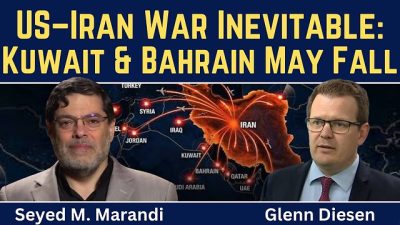
Seyed M. Marandi: US-Iran War Inevitable: Kuwait and Bahrain May Fall
or go to
Aletho News Archives – Video-Images
From the Archives
Oil and the Israel Lobby
Reknowned economist M. Shahid Alam offers this excellent critique of Noam Chomsky’s defective analysis of the relative influence of Oil versus the Israel lobby over US foreign policy: … continue
Blog Roll
 Aletho News
- ICC ignored ‘very well-documented’ NATO crimes – ex-Libyan minister
- SNSC secretary dismisses US response to Iran’s conditions as ‘inadequate’
- Sanaa says Taiz roads open, secure for residents, warns Saudi forces
- Iraqi resistance group urges Saudi leadership to admit defeat, lift Yemen siege
- Trump’s Retreat: How Al-Aqsa Flood Took Down the US Empire
- Israel’s Military Actions in Lebanon Grossly Violate International Law — Lavrov
- Seyed M. Marandi: US-Iran War Inevitable: Kuwait and Bahrain May Fall
- Leaders Condemn Ansarallah Attack on Saudi Arabia While Ignoring Illegal War Against Yemen
- Leaked: Britain’s Covert Iraqi Psyops Network
- Yemeni Armed Forces Warn Airlines Against Using Saudi Airports, Exempt Mecca and Medina
- If Americans Knew
- How Israel Conquered the Latin American Right
- Agents search Rep. Omar’s Washington home in criminal probe as she vows she won’t ‘be silenced’
- “The Rule Was: ‘Shoot Everyone You See'”
- Israel goes ballistic over Nobel Laureate Navi Pillay
- U.S. May Join Yet Another Middle Eastern War — TCN
- Yellow Line moves again as Israel closes in on trapped Gazans – Daily Update
- Israeli Attacks Kill Seven Palestinians in Gaza Including Six-year-old Girl
- Gaza: Ceasefire Anniversary Marks Year of Failed Promises
- The American Conservative: Mike Huckabee Should Resign
- A C-Section in Shackles: A Palestinian Woman’s Harrowing Birth in Israeli Detention
- No Tricks Zone
- Germany’s Green Energy Debacle: High Energy Costs Force Kahla Porzellan to Close After 182 Years!
- New Study: 50 Years Of The Most Aggressive ‘Net Zero’ Policies Can Only Affect The Global Climate By 0.03°C
- US September “Heat” Was No Record…Many Records Set Decades Ago
- Latest European Green Energy Debacle; Portugal’s Largest Flagship Solar Park Insolvent!
- Green Energy Debacle: German Expert Professor Fritz Vahrenholt Warns Of Severe Economic And Social Consequences
- Two More Paleo Reconstructions Affirm Meters-Higher Sea Levels Across Ireland, Brazil 7000-6000 Years Ago
- New Study: Earth And Venus Surface Warmth Largely Explained By Convection And Lapse Rate, Not CO2 Or Radiation
- 2025 Nature Paper Claiming Worsening Global Drought Gets RETRACTED …Heavily Flawed
- New Study: ‘Global Drought Shows No Detectable Recent Acceleration Under Climate Warming’
- Economic Masterminds: German Socialists Suggest Taxing Productivity Gains Stemming From Using AI

