IRAN WAR REPERCUSSIONS, THE US WILL BE BLAMED /The Duran’s Alexander Mercouris
Daniel Davis / Deep Dive – July 14, 2026
Hamas had no option but to govern Gaza and repeatedly tried to find solutions
By Robert Inlakesh | Al Mayadeen | July 14, 2026
Hamas’ decision to dissolve its committee governing the Gaza Strip was not a trick or simple gesture; the movement has long sought to hand over control of the territory’s civil administration. While the Zionists have claimed that Hamas governing the territory has long been the key impediment to “peace”, nothing could be further from the truth.
Despite the Israeli-US refusal to implement the agreed-upon terms of the Gaza ceasefire, never entering into the second phase of the agreement and remaining in limbo instead, Hamas recently took a measure that aimed to show the international community that it was willing to take the initiative in good faith. Immediately, the Israelis and their defenders began to invent narratives arguing that Hamas had engaged in some kind of trick, while asserting that the Palestinian group needed to disarm for the second phase of the agreement to begin.
The United States and its so-called “Board of Peace” (BoP) have put little to no effort into the ceasefire, despite having been authorised to exist by the United Nations Security Council (UNSC). When there have been any measures taken, they usually come in the form of guarding the Israelis from criticism, despite the fact that they have killed over 1,000 Palestinians since the ceasefire began and blocked many basic goods from crossing into the territory inhabited by the internally displaced.
As a measure to try and get the process jump-started once again, Hamas announced the dissolution of the temporary committee set up to govern the people after they had suffered an all-out genocide. The critics of this move claim that Hamas-affiliated individuals could be involved in the future technocratic body that the movement has just made way for, which is simply an excuse to prevent further progress.
Unfortunately, even if a technocratic Gaza governing body can be achieved, the Israelis are likely to point to its members as agents of Hamas. This could come in the form of pointing to these technocrats previously working for the civil administration in Gaza, which evidently has been run by Hamas. The same would be the case if you sought to dismantle the Palestinian Authority (PA)’s civil administration in the occupied West Bank; inevitably, the people most qualified to assume positions under a technocratic administration would likely have had some job role under the PA in the past and may even have Party affiliations to Fatah or the PFLP. This wouldn’t mean they are agents of those organisations, it just means that all the available jobs in their field require being employed with the PA.
Hamas did not simply seize control of the civil administration in Gaza as a power-hungry movement that was desperate for control. They were pressured into running in the 2006 Palestinian Legislative elections, which, to their own surprise, they won in a landslide. Immediately upon their election to power, the United States, their EU partners, and “Israel” sought to punish them for daring to engage in democracy.
The EU and US immediately placed sanctions upon the Gaza Strip, the Israelis imposed a blockade, and then the Bush Jr. administration covertly armed a coup plot that sought to violently overthrow Hamas. The coup plot was ultimately foiled by the Qassam Brigades (armed wing of Hamas) in 2007, which is when the Israelis tightened their blockade on Gaza.
Following this, the Palestinian civil war between Hamas and Fatah raged on. Despite countless attempts to mend ties, both Gaza and the West Bank were split from one another. This was a scenario brought about by US-Israel-EU interference, not the Palestinians alone.
After years of failed unity attempts, in 2014, there appeared to be a diplomatic breakthrough between Hamas and Fatah, which is when the Israelis found a convenient pretext to launch a massive assault on the Gaza Strip. Not only did the Zionist regime murder over 2,300 Palestinians, but their allies in Washington helped to ensure that the Palestinian Authority would back away from any unity agreement.
Again, in 2017, there was a unity agreement that was almost reached between Hamas and the PA. Hamas was on the verge of handing over control of the civil administration to the Palestinian Authority (PA). On November 1, Hamas dissolved its governing committee and handed over control of the Rafah border crossing to the PA, an event which was celebrated across the Gaza Strip. However, the US and Israel again intervened to pressure the PA to collapse the agreement.
Control over the civil administration in Gaza has never been the demonstrated or publicly stated goal of the Hamas movement. Time and time again, they have made strides towards relinquishing governance. The reason why the US, EU, and Israelis don’t allow it is for two reasons:
They don’t want the PA to govern both Gaza and the West Bank, because they fear this will give legitimacy to the idea of a Palestinian State.
Hamas and allied resistance movements refuse to disarm as a part of any such agreement.
The problem was never that Hamas was clinging to power; it was that the Israelis and their complicit Western partners sought to prevent the formation of a Palestinian State and to rob the people of Palestine of their ability to defend themselves.
Trump’s 3 failed options for reopening Strait of Hormuz: The Economist
Al Mayadeen | July 14, 2026
The memorandum of understanding that was meant to end the US war on Iran is unraveling, and Washington is left with the same three options it had before the deal existed, none of which reopens the Strait of Hormuz.
The Economist traces the collapse back to the MoU’s fifth paragraph, which commits Iran to “make arrangements” for safe passage of commercial vessels.
Washington reads this as an obligation to clear mines, while Tehran reads it as a right to administer traffic through the Strait. Washington has already revoked the sanctions waiver that let Iran sell oil, and Trump has said he will resume the naval blockade.
Option one: Continued limited attacks
The first path available to Washington is simply to keep doing what it has already been doing, attacking Iranian military sites and equipment on a limited basis. The Economist argues that this option has effectively already failed.
More than 300 such attacks over five nights have not shifted Iranian behavior in any meaningful way, and there is little reason to expect a sixth night, or a sixtieth, to succeed where the first fifty did not.
Part of the problem is geographic, as even if the US were able to bomb every coastal launcher Iran possesses, the country could keep firing on shipping from positions further inland, since many of its missiles and drones have ranges well beyond 1,000 kilometers.
Option two: Escalation
The second option is to escalate well beyond the current tit-for-tat, but The Economist notes that this path carries substantial risk without any assurance of a better outcome.
Attacking Iran’s core infrastructure directly would likely draw retaliation against Gulf states caught in the crossfire and could expose Washington to accusations of a war crime.
Deploying ground troops, meanwhile, is regarded as politically untenable in Washington under current conditions, making it a non-starter regardless of its theoretical military logic.
Trump has repeatedly floated occupying Kharg Island, the site of Iran’s main oil export terminal, but The Economist points out that this would do nothing to reopen Hormuz itself, since the island sits more than 600 kilometers from the strait.
Option three: Reimposing the blockade
The third option, reinstating the naval blockade, might look like the least disruptive choice, but The Economist argues it simply returns both sides to the standoff that existed before the MoU was signed, a staring contest over which side blinks first under economic pressure.
That earlier standoff is precisely what produced the interim deal now falling apart, which offers little confidence that repeating it would end differently.
There is also no guarantee Iran accepts a renewed blockade without retaliating against Gulf states this time around, and if it does escalate in response, Trump would be left choosing between all-out war and a retreat from his stated goals.
No outside help in sight
Britain and France have offered to help Oman clear mines from the strait, but Germany, Japan, Gulf states and China have all stayed on the sidelines, The Economist observes, leaving Washington with little meaningful outside support to draw on.
Tanker traffic through the strait has collapsed to its lowest level since May, and Brent crude has climbed roughly 20 percent since July 6, trading near $87 a barrel.
The Economist concludes that neither Washington nor Tehran has a military path to what it wants, claiming that the US cannot bomb the strait open, and Iran cannot profit while it stays shut, leaving the fragile MoU as the least bad option either side has left.
Yemen warns airlines to avoid Saudi airspace until Sana’a blockade is lifted
Press TV – July 14, 2026
The Yemeni armed forces have renewed their warning to all airlines against using Saudi airspace, urging carriers to take the advisory seriously until the blockade on Sana’a International Airport is lifted.
The warning was republished in Arabic and English on the social media platform X on Tuesday, reaffirming the Yemeni armed forces’ stance on the continued restrictions affecting the airport.
“We warn all airlines against crossing in Saudi airspace, and they should take our warnings seriously until the blockade of Sana’a International Airport is lifted,” the post read.
The warning came hours after the release of an audio-visual message addressed to Saudi Arabia titled “Siege for Siege.”
In a separate development on Tuesday, Yemeni armed forces spokesperson Brigadier General Yahya Saree said Yemeni air defenses shot down a Saudi Wing Loong 2 reconnaissance drone over Al-Bayda Governorate, located in south-central Yemen.
“The drone was carrying out hostile missions when it was intercepted at dawn using appropriate weaponry,” he said.
Saree reaffirmed the Yemeni armed forces’ readiness to respond to any violation of Yemen’s airspace and sovereignty.
He stressed that the armed forces would remain vigilant and would not stand idly by in the face of any aggression.
The latest developments follow a military operation carried out by the Yemeni armed forces on Monday targeting Saudi Arabia’s Abha International Airport with ballistic missiles and drones.
The operation followed multiple Saudi airstrikes on Sana’a International Airport, which were aimed at shutting down the country’s main gateway for humanitarian flights.
According to Yemeni officials, air defenses engaged the Saudi warplanes, preventing further strikes on the airport.
Yemeni authorities described the attack on Sana’a International Airport as the most serious cross-border aggression since 2022.
They warned that the strikes could bring an end to the unofficial four-year ceasefire between Saudi Arabia and the Sana’a-based Yemeni government.
TIME Magazine Reveals Israeli Influence Campaign Targeting Americans To Restart Iran War
By Justin K.P. | The Dissident | July 14, 2026
Have you ever noticed how so many Zionist social media influencers often post the exact same messaging, at the exact same time?
It turns out, according to a new investigation in Time Magazine, that these messages are part of a coordinated Israeli influence campaign targeting Americans.
The investigation profiled Brad Parscale, the former Trump campaign manager and current registered Israeli agent, whose firm, Clock Tower X, was hired last year “to conduct a digital campaign on behalf of the State of Israel”.
Parscale was paid by the Israeli government to “produce 100 original pieces of content each month, with at least 80% aimed at Gen Z audiences across TikTok, Instagram, YouTube, and podcasts” and to “amplify the campaign across social media and through ‘integration of narrative messaging into Salem Media Network properties and aligned distribution channels,’ referring to the Christian conservative broadcasting and publishing company where he serves as Chief Strategy Officer” and to “produce at least 50 million digital impressions per month, as well as influence how AI tools such as OpenAI’s ChatGPT, Anthropic’s Claude, and Google’s Gemini characterized Israel and the war”.
Brad Parscale admitted to Time that “the operation was intended to prevent young conservatives from drifting away from Israel”.
Trump administration officials speaking to Time Magazine revealed that Brad Parscale’s paid influencers were attempting to undermine the MoU with Iran.
The investigation wrote:
Online influencers in Trump’s MAGA movement were excoriating it (the MoU) on social media. One shared an Israeli op-ed titled, “You Could Have Been the Greatest President of All—But You Failed.” Several posted the same video of Qatar’s prime minister appearing to snub Vice President J.D. Vance in Israel, arguing it showed regional powers dismissing the Trump Administration’s “naivete.” Others accused Trump of surrendering before achieving his stated objective of eliminating Iran’s nuclear program. Many of the posts appeared almost simultaneously, with similarities in language and tone.
The official began collecting screenshots, and came to believe it wasn’t a coincidence. Tracing tweets by prominent members of the online right, the official came to believe there was an unlikely figure at the centerof all this criticism: Trump’s former presidential campaign manager and digital guru, Brad Parscale.
The investigation added:
Inside the White House, some officials were frustrated for a different reason. What had begun as an effort to keep the American right supportive of Israel, they believed, had evolved into an influence campaign that was colliding with the President’s political interests as Trump’s and Netanyahu’s war aims diverged, led by a figure trading on the perception that he remained close to Trump. They believed the very media ecosystem Parscale had promised to activate was now helping to circulate arguments that undercut Trump’s effort to end the war. “We’re talking about American influencers who are being paid by a foreign country, then trying to build momentum to change the President’s view, or the views of others around him,” says a senior U.S. intelligence official, who spoke on condition of anonymity because they were not authorized to discuss the issue publicly. “It can’t be dismissed as inconsequential by any means.”
Looking more closely at the conversation about the deal unfolding across the conservative internet, the official began noticing the same patterns: similar language appearing across seemingly independent accounts in rapid succession. “You have a person who is farming out this influencing task, who is being paid by a foreign element to the social media space,” the official tells TIME. “To me, this is a very, very dangerous thing.”
Describing the campaign, Time Magazine wrote, “Three people familiar with the campaign describe a messaging operation run through a network of interconnected firms overseen by Parscale or other firms he owns or created, such as Campaign Nucleus and Influenceable, in which he now owns a minority stake. Through private group chats, they say, conservative influencers receive suggested language for posts on social media sites such as X, Instagram and TikTok. They were then compensated based on the impressions and engagement their content generated. On its website, Clock Tower X says it has developed an ‘influencer ecosystem’ that includes ‘managed networks that amplify narratives through credible, distributed voices.’”
It identified the Zionist propagandist X account of “Eyal Yakoby” as one of the accounts on Parscale and Israel’s payroll, writing, “One of the conservative figures associated with the campaign was Eyal Yakoby, a recent college grad with a popular X account who began working with one of Parscale’s firms about a year ago, he says, after testifying before a House committee about antisemitism on college campuses. Yakoby confirms he was paid by Influenceable to fight antisemitism online.”
It added, “Another component involved a sprawling network of conservative influencers. According to a former participant, they received coordinated messaging through private group chats, synchronized the timing of their posts, and were compensated based on the reach they generated.”
This is just one of the many influence campaigns targeting Americans that was paid for by Israel.
Most recently O’Dwyer’s reported that :
Havas Media Germany has hired Piro Inc. to further the digital efforts of the Israel Government Advertising Agency to sway US public opinion.
Founded by Daniel Rosenberg and Tim Piper, New York-based Piro has produced branded entertainment for film, TV and digital media.
Rosenberg has collaborated with actors such as Denzel Washington, Julia Roberts, Robert DeNiro, Steve Martin, Al Pacino, Kevin Bacon and Jodie Foster.
Piper was called “one of the most influential people on the planet” by Time for for his branded content work. He is executive producer on “Odd Mom Out” for Bravo and “Farmed and Dangerous” on Hulu.
According to its June 2 Justice Dept. filing, Piro is engaged to provide digital content strategy, creative development, video production oversight, and campaign advisory services in connection with a pilot digital communications program.
Services include audience research, content architecture, scriptwriting, asset production, distribution planning, iterative performance analysis, and final program evaluation. Al content is developed for distribution via digital and social media platforms in the US.
Piro has received $900K for its effort.
At the time of Israel’s contract with Brad Parscale, the Israeli newspaper Haaretz reported that it was only one of several firms hired by Israel through Havas Media Germany to influence American public opinion.
Harretz reported that Israel also hired “Show Faith by Works, owned by Republican consultant Chad Schnitger, an evangelical operative connected to the Christian right” to “focus on ‘churches and Christian organizations in the western United States’ aimed at countering ‘declining support for Israel among evangelical Christians’ and ‘raising awareness of Palestinian ties to Hamas and support for terrorism’” and to advance, “‘biblically based arguments highlighting the importance of Israel and the Jewish people to Christians,’ while spreading messages that ‘the Palestinians chose Hamas… they murder Christian aid workers… they celebrated the October 7 massacre and shelter terrorists… Palestinians and Iran share genocidal intentions toward Israel’”.
It added, “The filings for the proposed campaign explain that the messages will reach their audience through ‘the largest geofencing campaign in U.S. history’ – a pitch to map the physical perimeters of every major church and Christian college in California, Arizona, Nevada, and Colorado during worship hours; identifying attendees using commercial data, tracking them, and continuing to target them with relevant ads.”
Israel also used Havas to hire SKDKnickerbocker, a firm close to the Democratic Party, to, “develop a ‘bot-based program on various social media channels that that `floods the zone` with the Ministry of Foreign Affairs’ pro-Israel message.”
Along with this, it noted that Israel hired “Bridges Partners, a Washington-based consulting firm owned by Yair Levi and Uri Steinberg” to “fund social-media influencers promoting Israel”.
Revolutionary Guard Calls on Jordanians to Expel US Forces
Al-Manar | July 14, 2026
Iran’s Islamic Revolutionary Guard Corps announced on Tuesday that it has targeted a major US military facility and site inside an airbase in Jordan with ballistic missiles.
In its ninth statement, the Guard directly addressed the Jordanian people, saying: “You know very well that we harbor no animosity towards your country; on the contrary, we hold you in the highest regard and affection. You are also aware of the suffering of the Palestinian people.”
The Guard added that “the Jordanian people, more than any other people, are aware of the crimes committed by the Israeli entity in the Gaza Strip – crimes carried out with the direct intervention of the United States.”
The IRGC called on Jordanians to demand “the removal of American military bases from the region,” describing this as “a significant contribution to saving the Palestinian people and restoring security and stability to the region.”
Earlier in the day, the Guard announced that it had targeted several American military installations in Bahrain as part of the second phase of Operation “Victory 2.”
The Guard stated that its naval forces, using missiles and drones, struck weapons supply depots, a satellite communications center, and a residential building for American forces at the Juffair base, confirming the complete destruction of these targets.
It added that the operation came in response to American aggression that targeted coastal stations and multiple military centers in Bahrain, as well as the southern regions of Iran, following Washington’s defeat in the Strait of Hormuz.
In a separate statement, the Revolutionary Guard also announced that two supertankers were damaged and disabled in the Strait of Hormuz after they ignored warnings from the strait’s security control center and crossed a mine-strewn waterway.
The Guard stated that the two tankers were “deceived by the United States” after they switched off their navigation systems and attempted to transit through an illegal route, thereby endangering maritime traffic.
These strikes follow American attacks over the past two days that targeted sites in Bandar Abbas, Bushehr, Sirik, Qeshm, Jask, Konarak, and Chabahar – attacks which, according to the Guard, mostly struck civilian sites and economic facilities.
Omani FM says ‘gravest threat to Gulf security’ stems from Israel, not Iran

The Cradle | July 14, 2026
Omani Foreign Minister Badr Al-Busaidi said on 13 July that the most dangerous threats in the region come not from Iran but from Israel, while lambasting the “myth” of the policy of “containment” that has for years targeted the Islamic Republic.
“The gravest threats to Gulf security do not originate within the region itself. Rather, they stem from decisions taken outside it – above all, in Tel Aviv. That conclusion is now difficult to dispute,” the foreign minister wrote in an opinion piece released by Le Monde on Monday.
Al-Busaidi added that Tehran “did not constitute an existential threat.”
He criticized the expansion of the US military presence across the region, saying it did not provide protection or benefit the countries of the Gulf.
“The enormous military expenditures across the region, the expansion of US military bases in the Gulf, and the maintenance of an extensive US military presence – intended to provide protection from afar – were all built and sustained at tremendous cost, yet without providing any real benefit,” the top Omani diplomat went on to say.
He added that the latest war proved that the US, Israeli, and Arab “policy of containment was little more than a myth – a fact that is now acknowledged even by those who, until recently, believed that more than 45 years of costly containment represented a necessary evil.”
The minister emphasized that reaching an arrangement to secure navigation in the Strait of Hormuz was a “priority.”
He stressed the importance of Iran’s role in such an arrangement.
“The Gulf coastline is shared by eight states. Alongside Oman and its five partners in the GCC – Saudi Arabia, Bahrain, the UAE, Kuwait, and Qatar – stand Iran and Iraq, both of which have, at different times, been subjected to containment policies and military intervention,” he wrote.
Al-Busaidi said these “eight states all have vital interests to protect and each bears responsibility, according to its capabilities and priorities, for safeguarding this shared strategic” waterway.
“For that reason, none of them can be excluded from any future regional security architecture. Every one of them must participate in designing it, implementing it, and sharing the responsibilities that come with it,” he added.
Al-Busaidi also said complex discussions on the matter were ongoing.
The US has backtracked on several clauses of the Islamabad memorandum of understanding (MoU) reached between Washington and Tehran, including joint Omani-Iranian management of Hormuz.
This week, US President Donald Trump declared Washington the “Guardian of the Strait.”
The Omani foreign minister’s article coincides with a major escalation between Washington and Tehran.
Iran launched numerous missile and drone operations on US assets in the Gulf over the past few days in response to a violent and deadly US campaign of strikes. Washington has not stopped attacking Iran, in violation of the MoU.
Trump has declared that the ceasefire is “over” and is vowing harsher attacks on Iran in the near future.
Early on Tuesday, Iranian drones and missiles targeted US bases and military infrastructure in Kuwait, Bahrain, and Jordan.
A few days earlier, Tehran responded to US strikes with attacks on Washington’s assets in Kuwait, Bahrain, and Jordan, as well as Oman – which Tehran had largely refrained from targeting during the first 40 days of the war that began in February.
Iran has been holding direct talks with Oman on the future management of Hormuz, but recently condemned the activation of a US-Omani shipping corridor, calling it a violation of the MoU.
Iranian Foreign Ministry spokesman Esmail Baghaei said on Monday that “our effort, in consultation with Oman, was to establish a mechanism to ensure the safe passage of ships,” adding that “because of [US] pressure exerted on Oman, this objective was not achieved.”
Earlier this year, Iran established the Persian Gulf Strait Authority (PGSA) as part of plans to oversee future management of the waterway.
“Before the recent provocative actions by US forces in the region, which led to the [renewed] closure of the Strait of Hormuz, more than 200 non-Iranian vessels coordinated with [Iran] during the three weeks following the signing of the MoU, and most of them received transit permits and insurance coverage,” the PGSA said on Tuesday.
Bulgaria pulls out of coalition of Ukraine backers
RT | July 14, 2026
Bulgaria has no place in the coalition of Western nations pushing for continued military aid to Ukraine, Prime Minister Rumen Radev has told Bulgarian broadcaster bTV.
The France and UK-led “coalition of the willing” has long pushed to deploy troops into Ukraine in the event of a ceasefire, despite Moscow’s repeated warnings that any NATO troops on Ukrainian territory would become legitimate military targets.
“We’re not part of a coalition pushing for continued financial and military aid to Ukraine,” Radev told bTV during a press conference in France on Tuesday.
“We don’t provide aid of that kind, because I believe the way to resolve this conflict is through a strong diplomatic effort to end the escalation rather than by prolonging it by military means,” he added.
Last week, Radev, a Euroskeptic elected after the previous pro-EU government collapsed last year following massive anti-corruption protests, announced that Bulgaria has exhausted its capacity to support Kiev militarily.
“We provided 13 packages; we don’t have anything else to supply to Ukraine,” he said on the sidelines of the NATO summit in Ankara.
According to Slovak President Peter Pellegrini, several NATO nations at the summit, including Slovakia, Hungary and the Czech Republic refused to participate in the US-led military bloc’s latest €70 billion ($80 billion) military aid package for Kiev.
Moscow has long condemned arms supplies to Ukraine, warning that they only prolong the war and cause more deaths, without altering the course of the conflict – which Russia views as a Western proxy war.
EU nations are losing what remains of their “rationality and drifting into a high-risk zone” in an effort to turn Ukraine in to a “testing ground” for their emerging military technologies, Russian Foreign Ministry spokeswoman Maria Zakharova said in late June.
Europe’s Missile Bloc Just Trojan Horse to Bypass NATO Vetoes & ‘Sneak’ Ukraine Into ‘Club’
Sputnik – 14.07.2026
The anti-ballistic coalition cobbled together by Europe and Ukraine may not be a formal alliance, but in reality, it is conceived as such, Swedish air defense expert Mikael Valtersson tells Sputnik.
Hence, if one country is attacked with ballistic missiles, “the combined ABM capacity will be utilized to defend member states,” the pundit notes.
In his opinion, this initiative is a blatant attempt by pro-Ukraine hawks to “sneak” new members into a united European defense structure, and “thereby bypass possible vetoes against Ukraine joining NATO.”
The project also seeks to:
- push EU closer to a centralized European superstate
- funnel billions to Europe’s defense giants
European leaders talk big on local ballistic missile defense when they rely on US Patriots and Israeli Arrow 3s for their shield, and homegrown high-end interceptors are at least a decade away, notes the analyst.
As for Ukraine’s so-called “battlefield experience,” so hyped by Europe, it’s the result of Kiev’s “calculated information warfare” peddling misleading bravado about allegedly downing Russia’s ballistic missiles when their own Western interceptor stocks have run dry, argues the expert.
Kremlin spokesman Dmitry Peskov has called the “coalition of the willing” a coalition of warmongers, adding that it was a group of countries that did not want peace.
“This is a coalition of warmongers, this is the group of countries that does not want peace, wants to continue the war,” Peskov told reporters.
Iran denounces UK’s threat designation of IRGC as ‘unjustified, irresponsible, against intl. law’
Press TV – July 14, 2026
The Iranian Foreign Ministry has strongly condemned the British government’s decision to designate the Islamic Revolution Guards Corps (IRGC) as a “threat under the United Kingdom’s National Security Act,” describing the move as an “unjustified and irresponsible” measure that violates international law.
In a statement on Tuesday, the ministry said the decision contravened “the fundamental principles and rules of international law, including the principles of the sovereign equality of states and non-interference in the internal affairs of other countries.”
It stressed that the IRGC was an integral component of the official Armed Forces of the Islamic Republic and, alongside the Iranian Army, was responsible for safeguarding the country’s territorial integrity, national sovereignty, and national security.
It also defended the force’s regional role, saying its contributions to regional peace, security, and human dignity, particularly through its fight against the Daesh Takfiri terror group, were evident to all.
According to the statement, Britain’s decision to apply such a designation to an official institution of a sovereign state is “a disgraceful and provocative act” that violates international law and the United Nations Charter.
The ministry added that the measure was particularly ill-timed given the current tensions in the West Asia region and criticized Britain’s long history of interference in other countries’ internal affairs.
The statement further said that the United Kingdom “has no moral standing to level accusations against others,” reminding how the country had acted as “an accomplice and active participant” during the most recent bout of unprovoked American-Israeli military aggression against Iran.
Rejecting Britain’s allegations against the IRGC, the ministry said it was “particularly ironic” that such claims had been used to try to justify the decision while the UK, itself, “hosts and supports terrorist and violent networks and groups.”
Iran also warned that it reserves its rights under the UN Charter and international law to take reciprocal measures, adding that British authorities would bear responsibility for the political, legal, and diplomatic consequences of the decision.
The statement came after British Home Secretary Shabana Mahmood announced that the IRGC would be designated a “national security threat under new powers in the National Security (State Threats) Act,” making support for the elite force a “criminal offence punishable by up to 14 years in prison.”
Featured Video
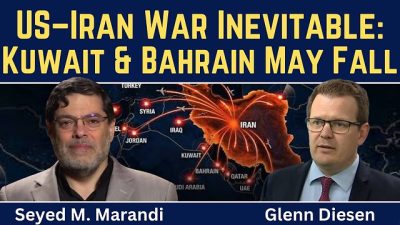
Seyed M. Marandi: US-Iran War Inevitable: Kuwait and Bahrain May Fall
or go to
Aletho News Archives – Video-Images
From the Archives
Oil and the Israel Lobby
Reknowned economist M. Shahid Alam offers this excellent critique of Noam Chomsky’s defective analysis of the relative influence of Oil versus the Israel lobby over US foreign policy: … continue
Blog Roll
 Aletho News
- ICC ignored ‘very well-documented’ NATO crimes – ex-Libyan minister
- SNSC secretary dismisses US response to Iran’s conditions as ‘inadequate’
- Sanaa says Taiz roads open, secure for residents, warns Saudi forces
- Iraqi resistance group urges Saudi leadership to admit defeat, lift Yemen siege
- Trump’s Retreat: How Al-Aqsa Flood Took Down the US Empire
- Israel’s Military Actions in Lebanon Grossly Violate International Law — Lavrov
- Seyed M. Marandi: US-Iran War Inevitable: Kuwait and Bahrain May Fall
- Leaders Condemn Ansarallah Attack on Saudi Arabia While Ignoring Illegal War Against Yemen
- Leaked: Britain’s Covert Iraqi Psyops Network
- Yemeni Armed Forces Warn Airlines Against Using Saudi Airports, Exempt Mecca and Medina
- If Americans Knew
- Testimonies about Gaza’s civilian death toll expose Israel’s atrocities – Daily Update
- How Israel Conquered the Latin American Right
- Agents search Rep. Omar’s Washington home in criminal probe as she vows she won’t ‘be silenced’
- “The Rule Was: ‘Shoot Everyone You See'”
- Israel goes ballistic over Nobel Laureate Navi Pillay
- U.S. May Join Yet Another Middle Eastern War — TCN
- Yellow Line moves again as Israel closes in on trapped Gazans – Daily Update
- Israeli Attacks Kill Seven Palestinians in Gaza Including Six-year-old Girl
- Gaza: Ceasefire Anniversary Marks Year of Failed Promises
- The American Conservative: Mike Huckabee Should Resign
- No Tricks Zone
- Germany’s Green Energy Debacle: High Energy Costs Force Kahla Porzellan to Close After 182 Years!
- New Study: 50 Years Of The Most Aggressive ‘Net Zero’ Policies Can Only Affect The Global Climate By 0.03°C
- US September “Heat” Was No Record…Many Records Set Decades Ago
- Latest European Green Energy Debacle; Portugal’s Largest Flagship Solar Park Insolvent!
- Green Energy Debacle: German Expert Professor Fritz Vahrenholt Warns Of Severe Economic And Social Consequences
- Two More Paleo Reconstructions Affirm Meters-Higher Sea Levels Across Ireland, Brazil 7000-6000 Years Ago
- New Study: Earth And Venus Surface Warmth Largely Explained By Convection And Lapse Rate, Not CO2 Or Radiation
- 2025 Nature Paper Claiming Worsening Global Drought Gets RETRACTED …Heavily Flawed
- New Study: ‘Global Drought Shows No Detectable Recent Acceleration Under Climate Warming’
- Economic Masterminds: German Socialists Suggest Taxing Productivity Gains Stemming From Using AI

