The Rise And… Rise Of ‘Color Revolutions’
By Kit Klarenberg | Global Delinquents | September 28, 2026
It’s rather forgotten today how Washington’s post-9/11 imperial adventurism was not restricted to military intervention. A core component of the Bush administration’s “Freedom Agenda” – under the auspices of which calamitous wars in Afghanistan, Iraq and elsewhere were waged – was overt sponsorship of civil society-led coups throughout the former Soviet Union, Warsaw Pact and Yugoslavia. Citizens of these regions, and the world, live with this meddling’s destructive consequences to this day. The seemingly never-ending – and ever-escalating – Ukraine proxy war is a particularly visceral legacy.
The 1983 creation of the National Endowment for Democracy, a US state entity avowedly concerned with executing overtly what the CIA once did covertly, ushered in a new era of “spyless coups”. Working in close conjunction with USAID and George Soros’ Open Society Institute, NED ever after provided funding, training and material assistance to NGOs, ‘independent’ media outlets, opposition groups, and other initiatives in service of regime change, across every corner of the world.
Come 9/11, NED and its confederates had devised a supremely cunning, cost-effective template for toppling troublesome governments – be they left-wing, nationalist, or even former US puppets who’d stepped out of line. The previous October, longtime Yugoslav leader Slobodan Milosevic was brought down in what the Washington Post bombastically dubbed “an extraordinary US effort to unseat a foreign head of state, not through covert action of the kind the CIA once employed in such places as Iran and Guatemala, but by modern election campaign techniques.”
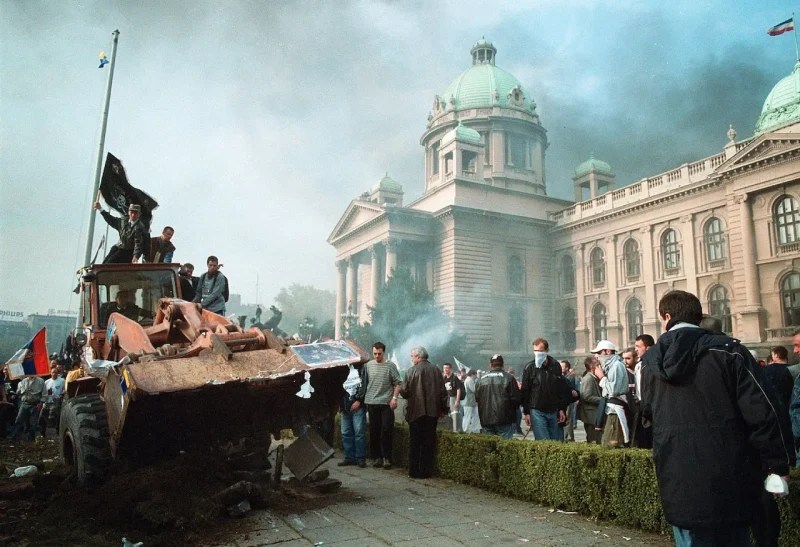
At the anti-Milosevic effort’s forefront was Otpor! (Serbian: Resistance!), a rebellious NED-funded youth activist group. Through a mix of civil disobedience, non-violent resistance, rock concerts, street theatre, and graffiti, they fomented mass public opposition to the Yugoslav President. When election day came and official results pointed to Milosevic’s victory, an NED-funded “parallel vote tabulation” purported to expose major fraud, sending millions to the streets of Belgrade to peacefully demand the President’s resignation. Milosevic duly capitulated, in the face of seemingly overwhelming people power.
The supposedly heroic struggle of Otpor! and other US-supported anti-Milosevic groups was immortalised in a slick ‘documentary’, Bringing Down A Dictator. Milosevic’s fall provided a precise blueprint for future ‘color revolutions’ – so-called because frequently, the Empire-supported activists who led these mob putsches prominently adopted specific colours for their banners, branding and logos. Initially, US officials eagerly associated themselves publicly with this upheaval. Meanwhile, the mainstream media routinely published remarkably illuminating post-mortems of the revolts, extensively exposing Washington’s guiding hand and oft-enormous financial outlay.
Nonetheless, politicians, pundits and journalists alike universally framed colour revolutions as ultimately spontaneous uprisings by liberal, progressive elements with legitimate grievances, who yearned for democracy and freedom. In reality, they almost invariably produced corrupt, repressive governments that ruled via intimidation and brutality, including political assassinations. Post-colour revolution regimes also typically conducted sweeping privatisation and other ravaging ‘reforms’, destroying living standards for average citizens by prostrating their countries to the EU, IMF, NATO, World Trade Organization, and other mechanisms of Western economic, military, and political subjugation.
Slobodan Milosevic’s NED-orchestrated ouster is nicknamed the ‘Bulldozer Revolution’, due to iconic scenes during the upheaval of a wheel loader helping anti-government agitators occupy state buildings. However, its driver quickly turned against the “Revolution”. Subsequent “shock therapy” decimated Yugoslavia’s mixed market economy, causing his successful independent business to fail, and him to go bankrupt. He subsisted until his dying day on meagre state welfare payments. For most participants, subsequent colour revolutions were similarly an object lesson in being careful about what one wishes for.
‘External Shove’
In February 2005, President George W. Bush gave a swaggering address in Bratislava, Slovakia. He hailed how “in recent times, we have witnessed landmark events in the history of liberty.” This included Georgia’s November 2003 Rose Revolution, Ukraine’s Orange Revolution the next year, and Iraq’s Purple Revolution a month prior. “The advance of freedom is the concentrated work of generations,” Bush declared. He looked ahead to Moldova, and “inevitably” Belarus, “someday proudly [belonging] to the country of democracies [sic]”:
“Eventually, the call of liberty comes to every mind and every soul. And one day, freedom’s promise will reach every people and every nation.”
Moldova’s forced transformation into a staggeringly corrupt effective EU-US colony took many years. Belarus conversely remains stubbornly resistant to “freedom’s promise”, as defined by Brussels, London, Washington, and other centres of imperial power. Still, President Bush’s confidence was well-founded. Waves of insurrectionary unrest unleashed by his government’s “Freedom Agenda” had systematically swept away designated enemy governments one by one annually since he took office. Indeed, within weeks of Bush’s speech, Kyrgyzstan’s insufficiently pro-Western leader fell victim to yet another colour revolution.
He would not be the last. Prior colour revolutions had enthusiastically emphasised the importance of techniques of nonviolent resistance – many of which were crafted by Gene Sharp, who was intimately enmeshed within the US military and intelligence establishment for much of his life. However, Kyrgyzstan’s NED-created regime change army, KelKel – directly modelled on Otpor! – attacked police, torched government buildings and even carried out bombings. Their ferocity was actively encouraged and promoted by US-funded TV stations locally. Such belligerence subsequently became a colour revolution calling card.
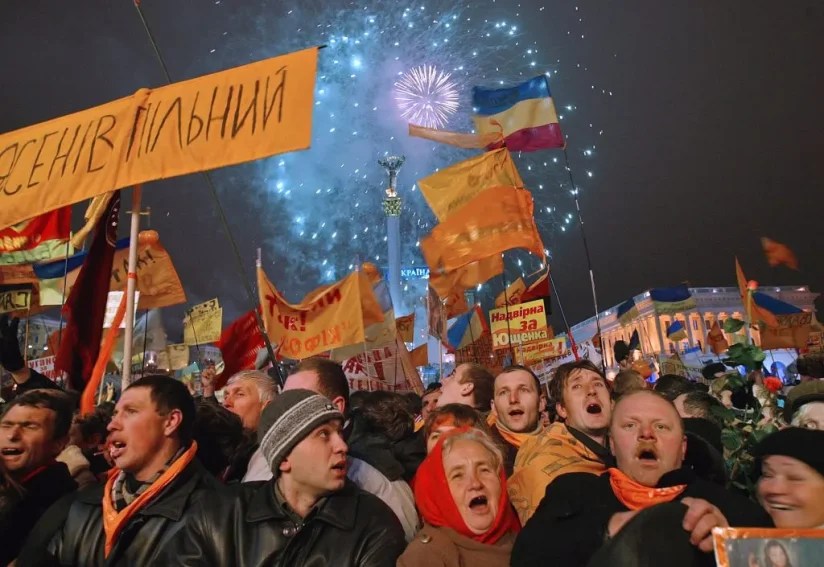
Ukraine’s Orange Revolution
That colour revolutions represented a formal weapon of war in the Empire’s post-9/11 arsenal was enthusiastically spelled out by arch-neoconservative Max Boot in late December 2004. He gushed how Ukraine’s Orange Revolution days earlier, which brought a pro-Western government to power, was “one of the most inspiring events” of that year. Boot declared the “triumph” and “miracle” of the revolution “should dispel the quaint notion still prevalent in many Western universities and foreign ministries that democracy is a luxury good suitable for rich countries”:
“These revolutions reveal the hollowness of the cliché that ‘democracy can’t be imposed by outsiders’… sometimes, when dealing with an entrenched dictatorship, this requires military intervention of the kind that occurred in Iraq and Afghanistan. More brittle regimes can be brought down by their own people, but even they often need a little external shove… There was nothing nefarious about the US intervention in Ukraine.”
Boot boasted how Washington had “spent $58 million on democracy promotion in the last two years” in Ukraine. He proposed Kiev receive “expedited NATO and European Union membership,” to finish off the Orange Revolution. “In the meantime, we need to apply elsewhere the lessons of Ukraine” Boot demanded, suggesting “an obvious candidate for a similar transformation is Iran.” He explained, “it’s hard to think of a higher priority than the overthrow of the mullahs,” encouraging the Bush administration to prioritise “liberating Iran.”
‘USAID Help’
Such was the insurrectionary fervour of the time, in January 2006 USAID went to the extent of publishing a glossy magazine, Democracy Rising, revealing in detail Washington’s central role in fomenting “grassroots” rebellions as far afield as Afghanistan, Gaza and Lebanon. Dedicated sections on colour revolutions to date were replete with stunningly forthright passages. A section on Georgia’s November 2003 Rose Revolution described how NED had financed regime change training for local “lawyers, judges, journalists, members of parliament, NGOs, political party leaders, and others.”
The stated purpose of this investment was to give Georgians “a sense that they should regulate the government.” The Rose Revolution “was the climax of these efforts.” One recipient of US financial support remarked, “without foreign assistance, I’m not sure we would have been able to achieve what we did without bloodshed.” Meanwhile, several pages were dedicated to the Orange Revolution. It noted how thousands of Ukrainian journalists were given training in “investigative reporting”, bankrolled by NED and USAID.
An alumni told Democracy Rising this sponsorship “created a feeling that others stood with them ‘in the trenches’.” Concurrently, NED-affiliated Freedom House flooded the coffers of NGOs “that sponsored voter education, mobilized voters to get to the polls and observed elections.” These organisations “also held meetings, youth dances, rock concerts and karaoke to attract young voters,” and “ran public service ads on TV stations, informing people about their right to vote.” Meanwhile, “democracy trainers from Serbia, Slovakia, Russia and Croatia” were flown into the country.
In the second round of Ukraine’s presidential election, NED-financed NGOs claimed to have been inundated with tens of thousands of reports of fraud from voting stations all over the country, while exit polls they produced pointed to widespread rigging having denied pro-Western candidate Viktor Yushchenko a landslide victory. Vast protests, combined with opposition-organised general strikes, widespread civil disobedience and occupations of government buildings forced a rerun. A US-funded think tank apparatchik asserted:
“USAID help for the poll was absolutely important – the poll results after the second round made people go to the street.”
For all the hype and self-assurance of Democracy Rising, its publication came at a time when colour revolutions were increasingly being viewed with hostility and suspicion at a state and public level throughout the Global South. In every case, the radical outcomes promised by colour revolution leaders and advocates failed to materialise, while US rhetoric about the commitment of resultant pro-Western regimes to democracy and freedom was a perverse fraud.
In Ukraine, US-installed Yushchenko implemented economic austerity, slashed regulations and social spending, bailed out criminal banks, broke open state industry and natural resources for foreign plunder, attacked the rights of Russian speakers, and began preparing the country for locally-feared NATO membership. Within just nine months of entering office, his coalition government – comprised of Orange Revolution activists – collapsed due to deeply corrupt battles with feuding Ukrainian oligarchs over control of key media and industrial assets.
Yushchenko was voted out in the January 2010 presidential election, finishing fifth in the first round with just 5.5% of the vote. As Empire house journal Foreign Policy lamented years later, the Bush administration’s much-vaunted colour revolutions all turned out to be “terribly disappointing.” Each and every time, “elite corruption still continued apace” and “promises of far-reaching change never really materialized.” Damningly, “maladies that typified the preceding regimes quickly came to describe” the governments created by colour revolutions themselves.
‘Revolution Business’
That’s quite some euphemism. In Georgia, longtime Soros acolyte Mikheil Saakashvili granted himself unilateral power in key policy areas, before brazenly exploiting his position to harass and jail business and political rivals. Saakashvili’s targets would be raped and/or tortured in prison, their ordeals filmed for primetime broadcast on local TV networks. Grave questions abound over his personal involvement in several suspicious deaths, including government ministers’. He was voted out in October 2012, despite NED’s best efforts.
Kyrgyzstan’s 2005 Tulip Revolution installed Kurmanbek Bakiyev, who proceeded to run the country as his personal fiefdom for five years. Bakiyev’s relatives profited exorbitantly from legally questionable privatisation of state industries. For example, his family signed a highly controversial $1.8 billion deal to supply fuel to a local US military base, close to Kyrgyzstan’s total GDP in 2003. Elsewhere, Bakiyev’s brother oversaw Bishkek’s security apparatus – arbitrary detentions, bogus convictions, torture, and murders of opposition activists, journalists, and politicians became commonplace.
Bakiyev was himself chased out of not only the presidential palace but Bishkek itself in April 2010, following a massacre of anti-corruption protesters in which up to 100 were killed and at least 450 wounded. Thereafter, Kyrgyzstan was plunged into economic and political chaos for a decade, with numerous governments collapsing along the way. The freest and most stable Central Asian state prior to the Tulip Revolution, it is only since 2020 – following another Anglo-American coup – the country has regained some semblance of stability.
A key player in that upheaval was British ambassador Charles Garrett. He arrived in Bishkek from Macedonia, where as this journalist has revealed from April 2016 he steered what was known as the “colorful revolution”. Illegally obtained, deceptively edited wiretaps seemingly implicating government officials in shocking crimes produced huge protests, featuring widespread arson attacks and brutal clashes between demonstrators and police. Garrett distributed cash to NGOs and activists involved in the unrest from his diplomatic pouch, encouraging them to cause mass havoc.

George Soros’ Open Society Foundations, NED, and USAID were also colorful revolution participants. Some protesters even proudly wore “Soros Army” shirts. Despite a huge public counter-revolutionary fightback, the tumult paralysed the Macedonian economy and state, leading to the installation of a doggedly pro-Western, dangerously dysfunctional administration that engaged in industrial scale graft, jailed political opponents on bogus charges, and changed the country’s name despite widespread opposition. Meanwhile, existing economic problems, including crippling brain drain, were gravely exacerbated.
The unfailingly disastrous results of colour revolutions surely contributed to White House officials abruptly and firmly distancing themselves from the entire enterprise, before the Bush administration’s second term was even over. The “Freedom Agenda” was quietly forgotten. The President – who in October 2004 openly mandated financial assistance to Belarusian opposition activists, and once publicly praised the Rose Revolution as an example to be followed throughout the Caucasus and Central Asia – went so far as to deny the US was in the “revolution business” at all.
‘Alternate Reality’
Colour revolutions have continued apace ever since, with the same strategies being recurrently applied the world over, to varying degrees of success. All along, non-Western governments – in particular China, Iran and Russia – have become increasingly vocal in their condemnation of and opposition to colour revolutions, in some cases passing legislation seeking to curtail the operations of foreign funded NGOs on their soil. Yet, the mainstream media long ago adopted a rigid Omertà on Washington’s culpability for civil society-driven destabilisation overseas.
In a striking example of this paradigm shift, in November 2004, before the Orange Revolution was over, The Guardian published a revealing report exposing the “US campaign behind the turmoil in Kiev.” The outlet stated unambiguously the revolt was “an American creation, a sophisticated and brilliantly conceived exercise in Western branding and mass marketing that, in four countries in four years, has been used to try to salvage rigged elections and topple unsavoury regimes.” NED, the State Department and USAID were all fingered as culprits.
Fast forward to July 2015 however, and a Guardian article on Russia’s banning of NED under foreign agent laws quite amazingly relied on a brief quote pulled from the Endowment’s official website to describe its operations. In the intervening time, the Maidan Revolution overthrew Ukrainian President Viktor Yanukovych in February 2014, setting Kiev on the warpath with Moscow. Washington’s irrefutable involvement was strenuously denied at the time by the mainstream media, and has been ever since.
Following the Ukraine proxy war’s February 2022 eruption, The New York Times took vigorous aim at independent journalists for spreading the “conspiracy theory” Maidan was US-orchestrated, dubbing the proposition an “alternative reality” and “Russian disinformation”. This is despite every prominent Maidan actor – including the individuals who started the demonstrations – receiving NED or USAID funding, leaders of US-bankrolled organisations in the country advertising their intention to overthrow Yanukovych years prior, and the Endowment spending $20 million in the country in 2013 alone.
After the outbreak of war in Ukraine, NED removed its grant records on Ukraine, listing its investment in a panoply of initiatives in the country over many years – many of which ultimately targeted Russia, one way or another. In mid-2024, the Endowment undertook the unprecedented step of removing grant records for the entire world. Today, brief entries on different geographical regions describe in vague terms the Endowment’s specific aims locally, and overall sums being spent. The crucial questions of where, and on what, aren’t clarified.
NED going underground makes the task of tracking and exposing contemporary colour revolutions difficult, but not impossible. In September 2025, mass rioting ignited in Nepal. Major news outlets without exception reported the fiery agitation as an organic burst of dissent by the country’s disaffected “Gen Z”, motivated by corruption, unemployment, and state censorship of social media. Publications barely acknowledged demonstrators committed serious crimes, including torching Nepal’s parliament and the Prime Minister’s official residence, which sent occupants fleeing in helicopters.
Based on publicly available information, the clear insinuations of a colour revolution could be discerned. An NGO that organised the protests, Hami Nepal, had clear links to organisations known to be in receipt of NED funding. Subsequent leaks amply demonstrated the Endowment and USAID expended substantial sums over the years preceding the coup training young Nepalese citizens how to protest, founding NGOs and political parties, and “advocate concerns” on issues such as corruption. Evidently, the post-9/11 “Freedom Agenda” never actually ended.
The Coming GOP Bloodbath?
By Ron Paul | September 28, 2026
Most indicators suggest that the Republicans in the House and Senate are going to face a brutal backlash from the American people in November. Polling with generic ballots suggest a big win for the Democrats and likely the loss of Republican control of both houses of Congress.
There is little reason to cheer a Democratic party victory, however Republicans in charge have for the most part earned what is coming to them. They have refused to uphold their Constitutional obligation to take leading responsibility for war powers.
Earlier this year, President Trump launched what is the most unpopular war in US history when on February 28th he ordered a full US assault on Iran. Iran had not attacked or even threatened the United States and our own intelligence community continued – and continues – to claim that Iran is not building nuclear weapons.
The February attack followed last June’s US bombing of Iran after which the president claimed that the country’s nuclear program was “completely obliterated.”
Congress over too many years has been used to allowing the President to have his own way on matters of war and peace. Members bask in the false patriotism promoted by the media and special interests as the people “rally around the flag.” Eventually, when the war has gone on for years without “victory” – as in Iraq and Afghanistan – many claim they were never really for the war in the first place.
This time is different. There was no propaganda blitz. There were no attempts to convince the American people that the “smoking gun” could be a “mushroom cloud” as we were told in the run up to the 2003 Iraq war. The majority of Americans were against the war on Iran before it started and only became more opposed over time.
As the war drags on, we have seen the national debt pass $40 trillion, diesel fuel prices at the highest ever, and inflation hitting the middle class and poor even harder. The “cakewalk” again failed to materialize.
Incumbent Republicans seeking re-election are in such a panic over voter anger about the war that they have taken to calling for a quick end to it while on the campaign trail. When they get back inside the Beltway, however, they vote to keep the war going for fear of President Trump’s anger.
This is not leadership.
Late last week the Iranian delegation in New York for the UN General Assembly meeting offered an off-ramp. Essentially it was the same Memorandum of Understanding that President Trump signed last June and promptly disregarded, but on a shorter timeline. By Sunday, the President announced that he would reject the deal – a deal like one he already signed.
There is no strategy for winning this disastrous war, it is clear. From over-confidence on decapitation strikes to certainty of a quick military victory, the Administration is now promising that they will win by crippling Iran’s economy. The problem is that Iran has been operating under “crippling” sanctions for decades and has a high economic pain tolerance.
Unfortunately, both parties in DC are war parties, so again it is hard to cheer the likely Republican losses. But sometimes electoral losses can serve as wake-up calls. Eventually we may see the re-emergence of antiwar Republicans in the spirit of the late Sen. Robert Taft and a restoration of the Constitution.
Arctic Scare Stories Melt Away
By Paul Homewood | Not A Lot Of People Know That | September 22, 2026
The Arctic sea ice should have melted away years ago, according to the “experts”.
In 2007, for instance, Professor Wieslaw Maslowski told us that northern polar waters could be ice-free in summers within just 5-6 years. In December that year, Jay Zwally of NASA agreed, giving the ice till 2012.
A year later, Professor David Barber went one step further, saying the ice would all be gone that very summer. Then we had Al Gore confidently predicting it would all disappear by 2016.
For sheer persistence in getting it wrong, however, first prize must go to Professor Peter Wadhams, Professor of Ocean Physics, and Head of the Polar Ocean Physics Group in the Department of Applied Mathematics and Theoretical Physics at the University of Cambridge:
· In 2012, he predicted that the Arctic would be ice free by 2015/16
· In 2014, he thought it might last till 2020
· In 2016, he confidently predicted the Arctic would be ice free that summer (though curiously he now defined “ice free” as less than 1 million square kilometers!)
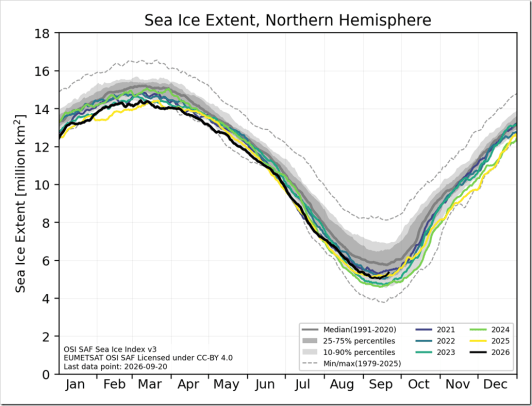
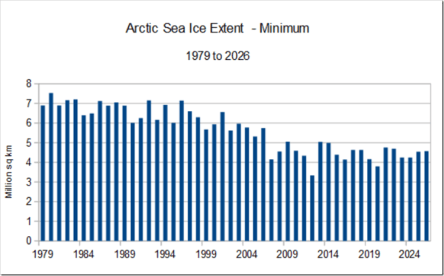
Strangely, all these “experts” have been pretty quiet lately. Little wonder, because Arctic sea ice extent is just as large now as it was when all of those fatuous claims were made.
To be fair, they were only talking about summer sea ice. Even they were not daft enough to think that there would be no ice in winter either.
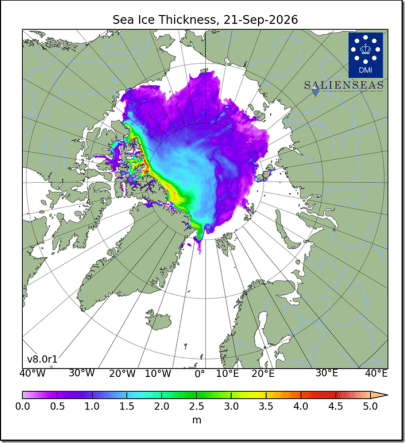
As is always the case in mid-September, the sea ice has just provisionally hit its minimum extent for the year, at 4.574 million sq km. Much of it is still over a meter thick.
https://nsidc.org/data/seaice_index/data-and-image-archive
There was a decline in ice cover during the 1990s and early 2000s, which led to the fears expressed above. However, real Arctic experts have known for years that the Arctic climate is cyclical.
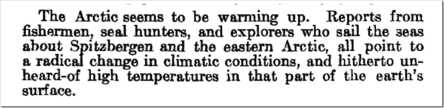
For instance, the Arctic underwent a warming phase in the 1920s and 30s. According to a US Weather Bureau report in 2022:
There followed a much colder period in the 1960s and 70s, when sea ice extent grew substantially, a time known as the Sea Ice Years in Iceland with half the island surrounded by ice.. As a result, attempts at grain growing in Iceland, which had been resumed in the warmer decades of this century after a lapse of some hundreds of years, were abandoned.
With the advent of full satellite coverage, official data for sea ice became available in 1979, the very time when the ice was at its fullest extent.
On a longer time scale, of course, scientists know that sea ice has been far less extensive for most of the last 10,000 years.
But where global warming is concerned, real science goes out the window!
Wrong, Euronews: Climate Change Has Not Created a Food, Energy, and Economic “Meta-Crisis”
By Anthony Watts | ClimateRealism | September 25, 2026
Euronews claims climate change has evolved into a “meta-crisis” threatening food security, energy supplies, economies, water resources, and international security. This is misleading because the article largely substitutes predictions and assertions for measurements of what is actually happening. The data show global crop production and yields reaching record levels, deaths from extreme weather collapsing over the long term, and many of today’s energy and economic problems arising from political choices and geopolitical conflicts rather than changes in climate.
Euronews builds its case primarily around an interview with Emmanuella Doussis, UNESCO Chair on Climate Diplomacy at the University of Athens. Doussis declares climate change an economic, social, political, and geopolitical problem, linking it to competition for resources, migration, water shortages, food insecurity, and the energy transition.
Those are sweeping claims. Curiously, Euronews provides remarkably little observational evidence demonstrating that climate change is actually causing the worldwide “meta-crisis” its headline announces.
Perhaps the most obvious contradiction concerns food.
Doussis predicts, “We will face a very large, serious problem with food security.” But predictions about what might happen cannot erase what is happening.
Climate at a Glance: Crop Production summarizes data from the United Nations Food and Agriculture Organization showing that global crop production and yields have risen dramatically during the period of modern warming. Its latest summary reports that the 2023 and 2024 global crop years produced the two highest global crop yields per acre on record.
Climate Realism has documented the same trend repeatedly. Global production of staple crops has increased substantially, and yields have repeatedly set records during recent decades. Even where individual crops suffer poor regional seasons because of drought, floods, pests, or other causes, that is not evidence of a deteriorating global food supply.
There are good reasons for this improvement. Agricultural technology, irrigation, fertilizers, improved crop varieties, mechanization, and better pest control have transformed farming. Modest warming can also lengthen growing seasons and reduce damaging frost events in some regions, while additional atmospheric carbon dioxide generally stimulates plant growth and improves water-use efficiency.
None of this means weather cannot damage crops. It always has. It means that portraying climate change as presently creating a global food-security crisis conflicts with the direction of observed agricultural production.
The article’s treatment of energy is equally peculiar.
Euronews describes moving away from fossil fuels as part of the solution to its supposed climate “meta-crisis,” while simultaneously acknowledging that doing so creates “new dependencies” involving lithium, cobalt, rare earths, and other materials. It concedes that fossil-fuel-producing nations could be economically weakened and that entirely new geopolitical dependencies would emerge.
That sounds less like a crisis caused by climate change than economic disruption caused by policies adopted in response to climate change.
Europe provides an obvious example. Energy prices do not rise because a thermometer records a slightly higher average temperature. Prices respond to fuel availability, generating capacity, taxes, regulations, subsidies, transmission costs, geopolitical disruptions, and government decisions about which power plants may operate.
Climate Realism has repeatedly documented how wind and solar cost comparisons can omit the expense of backup generation, transmission, storage, subsidies, and other system costs necessary to accommodate intermittent generation.
There is an important distinction here that Euronews blurs: costs created by climate policy are not costs created by climate change.
The same problem occurs when the article moves from energy to economics. Weather can certainly cause economic losses. Droughts, floods, hurricanes, heat waves, freezes, and wildfires have done so throughout human history. But declaring climate change responsible for a generalized economic crisis requires evidence that those hazards are worsening in ways attributable to climate change.
Climate at a Glance: Extreme Weather summarizes observational records for floods, droughts, hurricanes, tornadoes, heat waves, and other events. The picture is considerably more complicated than the simple worsening-disaster narrative presented by much of the media.
More importantly, human vulnerability to weather has declined spectacularly.
Climate at a Glance: Deaths from Extreme Weather reports that global deaths from weather-related disasters have fallen by more than 99 percent during the past century, using international disaster data.
That is a remarkable accomplishment. Wealth, infrastructure, fossil-fueled transportation, modern agriculture, heating, air conditioning, weather forecasting, communications, engineering, and emergency management have made human beings vastly more resilient to nature.
Ironically, Doussis herself provides perhaps the most sensible sentence in the entire Euronews article: “Climate change is not always to blame.”
She acknowledges that some Greek disasters reflect chronic failures in planning, complicated regulations, inadequate infrastructure, and insufficient protection of vulnerable areas.
Exactly. That caveat deserves far more attention than Euronews gives it.
A flood becomes catastrophic when people build in floodplains, drainage systems are inadequate, warning systems fail, or infrastructure is poorly maintained. Drought becomes a water crisis when reservoirs, irrigation systems, groundwater resources, and water policy are poorly managed. A heat wave becomes more dangerous when electricity is expensive or unreliable and vulnerable people cannot afford air conditioning.
Labeling all these interconnected problems a climate “meta-crisis” does not explain them. It can actually obscure their real causes.
The Euronews article commits an increasingly common journalistic error. It begins with climate change, attaches virtually every economic, geopolitical, agricultural, and social problem to it, and then presents the resulting web of associations as evidence that climate change caused the problems in the first place.
That is not how causation works.
Climate changes. Weather varies. Individual regions will experience damaging droughts, floods, fires, freezes, and heat waves, just as they always have. Sensible governments should prepare for them.
But the real-world record does not resemble the spiraling “meta-crisis” Euronews describes. Farmers are producing more food. Crop yields continue reaching records. Humanity has become dramatically less vulnerable to extreme weather. And some of Europe’s most painful energy problems have resulted from decisions about energy production rather than changes in the weather.
Euronews could have investigated those inconvenient facts. Instead, it took a collection of predictions about food, water, migration, geopolitics, and energy, wrapped them together under the fashionable label “meta-crisis,” and called it climate journalism.
That’s not evidence. It’s a narrative looking for a crisis.
Met Office Caught Fabricating Daily Temperature Record Claims
By Paul Homewood | Not A Lot Of People Know That | September 27, 2026
Daily temperature records are meaningless in terms of climate and weather. But they are of immense propaganda value.
So, step forward Marco Petagna, Media Advisor & Senior Operational Meteorologist at the UK Met Office:

https://x.com/Petagna/status/2103367986975273082
Followed later in the day by the ITV weatherman:

The Met Office confirmed 27.0C at Frittenden:

But how do we know what the previous daily record was? Indeed, how does the Met Office?
Are we supposed to take them on trust? If so, that trust is misplaced.
An article in the Times 15 years ago, following a warm spell of weather, reminded readers that it had been much hotter in September 1895! Their archived news reports revealed that temperatures had reached 30.6C (87.1F) on both 25th and 27th of September in Strathfield Turgis, Hampshire.
When challenged about this on X, Marco Petagna replied that Strathfield Turgis was “not on our internal records for some reason”.
How convenient!!!!
In fact, the weather during that last week in September 1895 was exceptionally hot for days on end, much hotter than the 27.0C at Frittenden. The highest readings for the month were variously set on dates between the 24th and 29th at different locations:


Strathfield Turgis was no fluke or outlier.
A number of sites up and down the country exceeded 27.0C/80.6F, on the 24th, 25th, 237th and 28th:
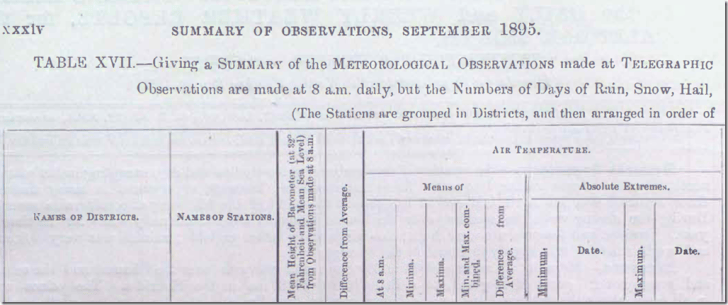

Note that North Foreland recorded 81F on the 25th, the day under discussion.
These are just a small selection of stations, used in the Met Office Monthly Summaries. There will be hundreds of other sites, such as Strathfield, and given the prolonged nature of the heatwave in 1895 and its widespread geographical coverage, it seems inevitable that many other sites topped 81F that day.
Petagna’s comment about “internal records” is revealing. It indicates that the Met Office has simply binned any temperature data it deems to be “too high”.
As one commenter wisecracked:

In the meantime, it is clear that we cannot trust any daily record claims made by the Met Office.
Merck Virologists Admitted to Falsely Certifying Vaccine Efficacy
Now you know why outbreaks still regularly occur in highly vaccinated populations
Informed with Aaron Siri | September 24, 2026
On the topic of splitting up the MMR vaccine into 3 separate vaccines, everyone should know that in 2012, two Merck virologists came forward and explained that when Merck sought to change the label on its MMR vaccine and approval for ProQuad (a combination MMR and varicella vaccine), it “falsely certified as having an efficacy rate that is significantly higher than it actually is.” (See Complaint ¶ 1.)
As detailed in the whistleblower lawsuit, Merck obtained a license for its mumps vaccine in 1967. (Comp. ¶ 16.) In the late 1990s, to obtain approval for ProQuad and change the label on its MMR vaccine, Merck needed to reconfirm its claims of efficacy for its mumps vaccine made thirty years prior. (Comp. ¶ 22.) Two of Merck’s virologists working on testing the efficacy of the mumps vaccine revealed that after Merck could not demonstrate a 95% efficacy for its mumps vaccine, the results were simply fraudulently falsified to achieve this result. (Comp. ¶¶ 15-131.)
As explained by the virologists, Merck took blood samples pre-vaccinated with the mumps vaccine and then exposed them to the mumps virus. (Comp. ¶¶ 25-28.) Suspecting a test against a live strain of mumps would not yield a 95% efficacy, Merck tried to improperly obtain this rate using an attenuated strain of the mumps virus. (Comp. ¶¶ 29-30.) When that would not achieve 95% efficacy, Merck tried different virus dilutions, different staining procedures, and even more liberal counting techniques. (Comp. ¶¶ 31-32.) The Merck lab even improperly added animal antibodies to the blood samples and still could not achieve a 95% efficacy rate. (Comp. ¶¶ 33-39.)
When it was clear that even improper testing techniques could not produce the desired result, the test reports were simply falsified. (Comp. ¶¶ 40-51.) According to the Merck virologists, to document the desired efficacy rate, Merck destroyed result sheets and falsified various documents. (Id.) The Merck virologists claim this fraud was done with the direct authority and approval of Merck’s senior management. (Comp. ¶¶ 52-58.)
Now you know.
This may explain why outbreaks of mumps still regularly occur in highly vaccinated populations. See, e.g.:
- https://cdc.gov/mmwr/volumes/65/wr/mm6529a2.htm(317 cases; 89% had received at least 2 MMR doses);
- https://cdc.gov/mmwr/volumes/67/wr/mm6729a1.htm(281 cases; high two-dose coverage among university-affiliated cases, with community spread);
- https://cdc.gov/mmwr/volumes/66/wr/mm6614a4.htm(301 student cases; all patients with complications had received at least 2 doses);
- https://cdc.gov/mmwr/volumes/66/wr/mm6647a5.htm(42 cases; all patients had ≥2 documented MMR doses; campus two-dose coverage exceeded 99%);
- https://cdc.gov/mmwr/preview/mmwrhtml/mm6148a2.htm(29 cases; 76% had received the recommended 2 dose);
- https://cdc.gov/mumps/outbreaks/index.html(CDC: “experts aren’t sure why vaccinated people still get mumps…).Complaint: https://icandecide.org/wp-content/uploads/2026/09/Merck-Compl.pdf
Mandatory Folic Acid for every man, woman & child
By Clare Craig, Ros Jones & Mark Stronge | Health Advisory & Recovery Team | September 20, 2026
The change in the law to enable this came as an amendment, SI2024/1162, to the Bread and Flour Regulations 1998. As a Statutory Instrument, there was no parliamentary debate. There was no full scientific Impact Assessment; just a de minimis financial assessment by DEFRA and limited DHSC input. The stated aim is to increase blood folate levels in pregnant women in order to reduce the risk of neural tube defects (NTDs). The Government estimates a reduction of about 200 Neural Tube Defect (NTD)-affected pregnancies annually, approximately 20% of UK cases. Most of these would have ended in a termination of pregnancy or a neonatal death but a small number of births of children with spina bifida may be avoided.
No proper assessment of the harms of folic acid has been carried out, yet it is proposed to give it to every man, woman and child in this country indefinitely, rather than just giving supplements for a few months to those women wishing to take them. Most notably there are several groups of people whom the NHS currently advises to avoid folic acid medication. This includes patients with cancer, Vitamin B12 deficiency and cardiac stent procedures (patients on haemodialysis were also included in the list until recently). Analysis of long term outcomes from 10 randomised trials has shown a worrying 23% increase in cancers, 24% for prostate cancer.
What is not at all clear, is how people will avoid folic acid once it is in virtually all flour.
The UK Government presents folic acid fortification as a settled, cost-free public health win.
Every one of its load-bearing claims collapses under examination.
First, “folic acid is a B vitamin.” This is the foundational deception. Folic acid is not a vitamin at all. It is a synthetic, oxidized compound that does not occur in nature. The actual vitamin is folate, found in leafy greens and liver. Folic acid must be converted in the body, and a large share of the population converts it poorly due to common MTHFR gene variants. The result is unmetabolized folic acid circulating in the blood, which has been linked to masking vitamin B12 deficiency and to accelerated growth of existing pre-cancerous lesions. Calling it “a B vitamin” is the rhetorical move that makes the whole policy sound harmless.
Second, “it helps prevent neural tube defects.” The honest version is that high-dose supplementation in women with a previous affected pregnancy showed benefit in a 1991 trial. What the government has done is extrapolate that clinical result to low-dose, population-wide dosing through bread. Those are not the same intervention, and the “200 cases prevented” figure is a model output, not a measurement.
Third, and this is the killing blow, the only large randomised trial in otherwise healthy women, the Hungarian trial by Czeizel and Dudás, found that every category of fetal death was higher in the folic acid group. Total fetal deaths were 374 (13.4%) against 304 (11.4%) in the control arm, an excess of 70 deaths that was statistically significant. In that same trial, the number of neural tube defects prevented was six. That is roughly nine to twelve dead babies for every defect apparently prevented. The mechanism was named by the trial’s own principal investigator in a 1997 Lancet paper: terathanasia, the death of the malformed. Folic acid may reduce the count of babies born with neural tube defects not by curing them, but by killing the affected embryos before birth.
Fourth, the government knows this and has chosen to redefine the dead babies as a benefit. When asked directly in Parliament, the Department of Health answered that folic acid extended the viability of early conceptuses, so the excess miscarriages were really evidence of extra life-creation. No evidence was supplied for this. The data refute it, because if early losses were merely being promoted upward, chemical pregnancies should have fallen. They rose alongside every other category.
Fifth, the surveillance data cannot detect the harm. The US monitoring system only records fetal deaths at 20 weeks or later, while the excess deaths in the trial were overwhelmingly first-trimester miscarriages and chemical pregnancies. The harm signal is structurally invisible to the system used to claim success.
Sixth, the “200 babies” figure is inflated. Even on the government’s own final assessment, the operative effect is around 31 fewer live births a year, of which about 28 would be children living with disability. The rest of the “200” is mostly terminations avoided and a notional quality-of-life valuation. The economic case values a life-year at £70,000, more than double what the NHS uses for medicines.
Seventh, the decline in neural tube defects happened before folic acid existed. Spina bifida fell 82 percent between 1972 and 1991 in England and Wales. The recommendation to take folic acid arrived in 1992, after almost all of that decline had already occurred. Folic acid is being credited with a fall it could not have caused, and after 1992 the rate of decline actually slowed.
Eighth, the safety question for everyone else, which the campaign suppresses entirely. The NHS itself lists categories of people told to avoid folic acid, and most of them have no idea that mandatory fortification means avoiding flour entirely. These include people with cancer, people with B12 deficiency, people with stents, and people with kidney disease.
Ninth, take cancer. Lifetime cancer risk in the UK is around one in two, so you are mandating a synthetic compound linked to driving pre-cancerous growth for a population, half of whom will at some point be cancer patients or survivors. Unmetabolized folic acid has been associated with accelerated growth of existing pre-cancerous lesions, particularly in the colon. For anyone with active cancer or a history of colorectal adenomas, folic acid is not benign. It is fuel.
Tenth, then B12. Folic acid masks vitamin B12 deficiency, allowing neurological damage to progress invisibly while blood markers look normal. The elderly are the classic at-risk group, and they are also heavy bread consumers. The policy doses the exact population most vulnerable to hidden B12 deficiency.
Eleventh, stents and cardiovascular disease. People with coronary stents and certain vascular conditions are among those advised against folic acid, with some trials showing worse cardiovascular outcomes, including restenosis concerns, in people with existing heart disease. Those patients cannot avoid the exposure without abandoning a staple food.
Twelfth, then kidney disease. Folic acid metabolism and accumulation are altered in renal impairment, and patients with kidney disease are routinely told to be cautious. Again, no exemption, no alternative, no consent.
Thirteenth, beyond the NHS list, there is the prostate cancer signal, with some research suggesting a doubling of prostate cancer risk in men, and concerns about immune response in women. None of this was given a value in the government’s assessment. The final assessment named potential harms to others but then did not quantify them.
Fourteenth, like men, infants and children are a group that cannot benefit. For children, the duration of mandatory folic acid ingestion will effectively last a lifetime. Yet the dosage per kilogram is far higher for children, when existing fortification of breakfast cereals is added to the new mandatory fortification of flour and hence bread.
Finally, the “nearly half of pregnancies are unplanned” argument is a confession disguised as a justification. Because some women do not know they are pregnant early on, the answer is to medicate every man, woman, child, and elderly person in the country through the bread supply. The number needed to treat is roughly 440 women to prevent one neural tube defect. The number needed to harm is one in 50 women suffering a lost pregnancy. The harm is about nine times more likely than the benefit. Where are the safety studies for a whole population?
The structure of the policy is the scandal. Tens of millions of people will be exposed every year with zero possibility of benefit. Only a small subgroup, women in early pregnancy, is the nominal target. For everyone else, the benefit is exactly nothing, and any risk at all is pure downside. The people this is unsafe for are not a rare corner case. They are half the population over a lifetime, concentrated precisely in the groups that eat the most bread.
This UK government policy is built on a misrepresented trial, an inflated model, the reclassification of fetal deaths as a public health victory, and the forced medication of the entire population, including the very groups for whom folic acid is contraindicated, with no risk-benefit assessment and no consent. From December 2026 it becomes compulsory.
A letter has been sent to the minister last month and a very inadequate response received, here. Letters have also been sent to all medically qualified MPs and peers, with as yet one reply.
Sign the parliamentary petition to stop folic acid being added to flour. We need a complete stop to all fortification. https://petition.parliament.uk/petitions/769589
Also, if any readers do have one of the NHS listed medical contradictions, do write to your MP and get them to ask questions.
To find all the recent HART articles on Folic acid go to https://www.hartgroup.org/category/folic-acid/
Pro-Palestine protesters arrested outside UK’s ruling Labour Conference in Liverpool
MEMO | September 27, 2026
British police on Sunday arrested two demonstrators during a pro-Palestine protest outside the ruling Labour Party’s annual conference in Liverpool, Anadolu reports.
Protesters gathered outside the conference venue, with several holding homemade signs expressing support for Palestine Action, a group banned by the UK government.
Police officers moved to arrest an elderly man who was sitting beneath a tree, before making a second arrest involving a protester holding a sign supporting the banned group.
A spokesperson for Defend Our Juries, which organized the protest, said it had hoped the new prime minister, Andy Burnham, “would do the sensible thing and bin the ban on Palestine Action given the weight of public pressure to do so and the escalating amount of resources required in enforcing it.”
Nearly 74,000 Palestinians have been killed and over 175,000 others wounded in Israel’s genocidal war in Gaza since 2023. The offensive has also destroyed around 90% of the enclave’s infrastructure.
Despite a ceasefire that took effect last October, the Israeli army has continued daily attacks in Gaza, killing over 1,400 Palestinians and injuring around 5,000 others, according to Gaza’s Health Ministry.
In November 2024, the International Criminal Court issued arrest warrants for Israeli Prime Minister Benjamin Netanyahu and former Israeli Defense Minister Yoav Gallant on charges of war crimes and crimes against humanity in the Gaza Strip.
Mauritius denies landing permit to flight from Israel, forcing cancellation: Tour operator

MEMO | September 27, 2026
Mauritius on Saturday refused landing clearance for a scheduled flight from Israel, forcing its cancellation after efforts to secure approval failed, Israeli media reported, Anadolu reports.
The Ynet news website said the Air Seychelles flight was due to depart Israel for Mauritius but was called off after authorities did not grant permission for it to land.
Spirit World Productions, the Israeli tour operator behind the trip, said the flight had received approvals several months earlier.
The company said it had been informed that the refusal was based on “political and diplomatic considerations.”
Mauritian authorities have yet to comment on the decision.
Separately, sources familiar with the matter told Israel’s Channel 12 that the refusal was linked to absence of the Mauritius delegation during this week’s address by Israeli Prime Minister Benjamin Netanyahu at the UN General Assembly.
Spirit World Productions said it was working with Air Seychelles and authorities on arrangements for affected passengers.
Israeli finance minister calls for genocidal war on West Bank, annexation of south Lebanon
The Cradle | September 27, 2026
Israeli Finance Minister and settler leader Bezalel Smotrich has called on Israel to “go to war” in the occupied Palestinian West Bank and “do there what we did in Gaza,” Israeli media reported on 27 September.
“I certainly have solutions” to the situation in the West Bank, he said. “I think we need to go to war in Judea and Samaria, to do there what we did in Gaza, to dismantle the Palestinian Authority, which is a terror authority.”
The Religious Zionism Party leader also called on Israel to annex the areas of southern Lebanon and Gaza occupied by Israeli troops.
“I would very much like to annex at least up to the Yellow Line in Gaza and up to the Litani [River] in Lebanon,” he says.
As part of its genocide of Palestinians since 2023, Israel has occupied an estimated 70 percent of Gaza, which is divided by a yellow line demarcating areas under direct Israeli occupation from those remaining under Hamas control.
Israel has also occupied territory in Lebanon amounting to 7 percent of the entire country.
Israel carries out demolition campaigns in both, seeking to wipe out any trace of Palestinian and Lebanese villages and cities already largely destroyed by Israeli bombing.
Smotrich made the comments after he was asked on a podcast how to advance Israel’s project in the West Bank amid Palestinian resistance.
Israel has accelerated its construction of illegal Jewish settlements and outposts in the West Bank this year, including in the E1 settlement.
E1 is designed to cut the West Bank in half and separate it from occupied East Jerusalem, making the establishment of a territorially contiguous Palestinian state impossible.
At the same time, Jewish settlers enjoying protection of the army regularly carry out violent pogrom-style attacks on Palestinian villages in hopes of forcing Palestinians to abandon their homes and agricultural lands.
In response, Palestinians have carried out several car ramming and shooting operations targeting Jewish settlers in recent weeks.
Smotrich also repeated his call to dismantle the Palestinian Authority (PA), which provides civil administration to parts of the West Bank, including the Palestinian cities such as Ramallah, Nablus, Jenin and Bethlehem.
The PA was established following the Oslo Accords in 1993 to serve as an interim government until the establishment of a Palestinian state.
However, the PA has in practice served as an arm of the Israeli occupation, assisting the Israeli military in suppressing Palestinian resistance.
Smotrich has previously called on Israel to annex more than 80 percent of the West Bank, which Israel conquered in 1967.
Since then, Israel has established some 160 Jewish settlements and 360 outposts, housing more than 700,000 Jewish settlers as part of a long-term campaign to colonize and Judaize the Palestinian territories.
In his campaign for next month’s Knesset election, Smotrich has touted the expansion of Israeli settlements under the current coalition government, which includes Smotrich, Prime Minister Benjamin Netanyahu, and National Security Minister Itamar Ben Gvir.
As head of the Likud Party, Netanyahu is seeking his seventh term as prime minister. Ben Gvir leads a religious nationalist party, Jewish Power, known for its extremism and calls for violence against Palestinians.
Meanwhile, Israeli authorities decided to impose a week-long “comprehensive closure” on the occupied West Bank, closing crossings to the territory until Saturday for the Jewish religious holiday of Sukkot.
The order will prevent Palestinians with work permits from entering Israel and Jewish settlements to go to their jobs.
Local sources told the Wafa News Agency that the entrance gate to Turmus Ayya, north of Ramallah, was closed and residents were “harassed.”
Wafa also reported that entrances to Aboud, Nabi Saleh, Atara and Taybeh were closed, while military checkpoints were set up at the entrances to Yabroud and Ein Sinyah.
Featured Video

Liberty Cannot Exist Inside a Panopticon
or go to
Aletho News Archives – Video-Images
From the Archives
Left-leaning despisers of 9/11 Truth movement: Do you really believe in miracles?
David Ray Griffin | Global Research | 06 Jul 2010
An Open Letter to Terry Allen, Noam Chomsky, Alexander Cockburn, David Corn, Chris Hayes, George Monbiot, Matthew Rothschild, and Matt Taibbi.
[1]According to several left-leaning critics of the 9/11 Truth Movement, some of its central claims, especially about the destruction of the World Trade Center, show its members to be scientifically challenged. In the opinion of some of these critics, moreover, claims made by members of this movement are sometimes unscientific in the strongest possible sense, implying an acceptance of magic and miracles. … Full article
Blog Roll
 Aletho News
- EU sending ‘biased’ observers to interfere in Serbian election – president
- White House envoy declares kinetic action against Yemen ‘fruitless’
- Ukraine deployed thousands of microdrones in Iraqi Kurdistan: Tasnim
- Iran calls for emergency UNSC meeting over Trump’s ‘brazen’ bomb talk, Israeli threats
- Iranian sources reveal details of Russia-China Hormuz proposal
- Plan for more US-Israel integration puts our military tech at risk
- Another Round Against Iran Will Break What Is Left of the Gulf
- SVR Report on Ukraine’s Mexican Drug Gang Links Could Pressure Zelensky, Won’t Change US Policy
- British Government Employees Were Fact-Checking the News at the BBC. Nobody Told You.
- Albania on fire: who’s behind the riots?
- If Americans Knew
- Mysterious bot accounts reportedly spread fake ‘man on the street’ videos for Michigan Senate candidate
- Israeli Defense Minister Katz Says Over 60 Lebanon Villages Have Been Destroyed
- Why Is Israel Running TV Ads in Iowa Ahead of the Midterms?
- Hind Rajab’s Alleged Killer Is in the United States. HRF Demands His Arrest.
- US Officials Face Fresh Pressure After Another American ‘Brutalized’ by Israeli Settlers in West Bank
- Israel-Backed Palestinian Militias Terrorize Displaced Families in Gaza
- FBI subpoenas pro-Palestine activists over Israeli weapons plant disruption
- Fourth winter arrives in wartorn Gaza, too early – Daily Update
- More on how Bari Weiss is using CBS on behalf of Israel
- What the UK Is Doing to Pro-Palestine Novelist Sally Rooney Is an Act of Orwellian Villainy
- No Tricks Zone
- Predictions Made By Renowned Climate Proifessor Over Past Decades Have Been Proven To Be Poor
- New Study Suggests Large Regions Of The Pacific Ocean Have Been Cooling For The Last 80 Years
- Germany’s Green Energy Debacle: High Energy Costs Force Kahla Porzellan to Close After 182 Years!
- New Study: 50 Years Of The Most Aggressive ‘Net Zero’ Policies Can Only Affect The Global Climate By 0.03°C
- US September “Heat” Was No Record…Many Records Set Decades Ago
- Latest European Green Energy Debacle; Portugal’s Largest Flagship Solar Park Insolvent!
- Green Energy Debacle: German Expert Professor Fritz Vahrenholt Warns Of Severe Economic And Social Consequences
- Two More Paleo Reconstructions Affirm Meters-Higher Sea Levels Across Ireland, Brazil 7000-6000 Years Ago
- New Study: Earth And Venus Surface Warmth Largely Explained By Convection And Lapse Rate, Not CO2 Or Radiation
- 2025 Nature Paper Claiming Worsening Global Drought Gets RETRACTED …Heavily Flawed

