Ukraine Seeks to Provoke a Nuclear Conflict: Zakharova
teleSUR | April 29, 2026
On Wednesday, Russian Foreign Ministry Spokeswoman Maria Zakharova denounced that Ukrainian President Volodymyr Zelensky is sabotaging any and all peace initiatives and is now creating conditions for a potential nuclear conflict.
“The diplomat drew attention to Zelensky’s earlier remarks that Ukraine should be given both NATO membership and nuclear weapons as security guarantees,” TASS reported.
“In fact, he continues to provoke a nuclear conflict with such statements. Moreover, Western Europe risks becoming the first victim of this very nuclear blackmail,” Zakharova stated.
“Zelensky clearly does not want peace. He seeks to prolong the fighting indefinitely and is ready to risk a dangerous escalation of the conflict,” she added.
Putin Accuses Ukraine of Resorting to Terrorist Tactics
On Tuesday, Russian President Vladimir Putin denounced that Ukraine is resorting to terrorist actions against the civilian population and infrastructure because it is unable to stop the advance of Russian forces. During a meeting on ensuring security in the upcoming elections, he stressed that the risks of terrorist attacks on Russia are growing.
“The Kiev regime, unable to stop Russia from advancing along the line of engagement, has resorted to overt terrorist methods with the help of its patrons. Ukraine is losing territories day after day and is staking on terror because of its inability to change the situation,” Putin stated, adding that Zelensky hopes that acts of terrorism against Russia will change the situation.
Putin also denounced that the Kiev regime will try to meddle in the 2026 Russian parliamentary elections. More specifically, Ukraine will try to prevent elections from being held in Donbass and Novorossiya.
US squares up to China over Panama Canal
RT | April 29, 2026
The US has announced a six-nation coalition aimed at pressuring China to relinquish its interests in two ports in the Panama Canal, accusing Beijing of infringing on Panama’s sovereignty and politicizing global trade. China has called the claims “baseless.”
The development is part of a pattern of US efforts to push China out of Latin America. The US National Security Strategy calls for non-Western “competitors” to be prevented from owning or controlling key assets in the Western Hemisphere.
Last year, US President Donald Trump claimed that China is “operating the Panama Canal” and threatened to “take it back.”
The US State Department issued a joint statement on Tuesday with Bolivia, Costa Rica, Guyana, Paraguay, and Trinidad and Tobago, saying they support Panama against what they describe as external pressure from China.
”Any attempts to undermine Panama’s sovereignty are a threat to us all,” the statement read, adding that Panama “must remain free from any undue external pressure,” and that freedom in the region is “non-negotiable.”
China rejected the accusations, with the Foreign Ministry hitting back on Wednesday against what it called a smear campaign.
”It is the United States that is politicizing and over-securitizing the port issue… hypocritically posturing and spreading rumors and smears everywhere,” spokesman Lin Jian said, dismissing the claims as “baseless and a complete distortion of facts.”
Lin urged the countries involved not to “be deceived or used by forces with ulterior motives” regarding the port inspections, which he said were conducted lawfully.
The US-led campaign follows a ruling in January by Panama’s Supreme Court that annulled contracts held by a subsidiary of Hong Kong-based CK Hutchison Holdings for the Balboa and Cristobal, two key ports at the canal’s entrances – a move that the US has backed.
The Chinese company, which managed the terminals for nearly three decades, has contested the ruling, alleging unlawful expropriation, and has launched international arbitration, seeking over $2 billion in reparations.
Monroe Doctrine 2.0: ‘Great Reset’ for US Imperialism?
Sputnik – 29.04.2026
“The United States is a declining power worldwide. It needs to reassert its powers,” Brazilian economics and international affairs scholar Vinicius Vieira told Sputnik, commenting on recently approved Monroe Doctrine 2.0 strategy and the Senate’s refusal to block the president’s power to invade Cuba.
For Washington, establishing greater control over Latin America, especially Mexico, the Caribbean and Central America, may seem like an opportunity to start afresh in reasserting its great power status, Dr. Vieira says.
Regime change in Cuba, for example, would not mean independence or democratization for the island nation, “but a return to the status prior to the Cuban Revolution – a protectorate de facto, US territory de facto.”
The problem is, the neighborhood is not what it was 150-200 years ago. Washington’s neighbors “want a relationship based on equal respect and mutual recognition,” and controlling South America may prove “too ambitious” entirely, given linkages they’ve established with other members of the Global South.
What’s more, “the costs for the US to implement this type of policy are quite high…because it depends on coercion, on sticks, no carrots at all,” Vieira stressed. Speaking of carrots, the US has “lost leverage” in this domain vis-à-vis China and its development projects, according to the scholar.
Ultimately, Monroe 2.0 could prove “too costly,” and “rather than bringing the United States to its golden days of hegemony…may just accelerate its decline because of its very high costs in terms of money and reputation,” Vieira summed up.
Nuclear Apartheid: Iran’s Rise Exposes the NPT Fraud and the West’s Israel Exception
By Freddie Ponton – 21st Century Wire – April 29, 2026
The fight over Iran’s vice presidency at the 2026 NPT Review Conference looked procedural only if one ignored the history that walked into the room with it. The United States, the United Kingdom, speaking for France and Germany, Australia, and the United Arab Emirates objected to Iran’s appointment, yet Iran kept the post after a Non-Aligned Movement nomination and no blocking vote was forced, exposing a basic fact that now hangs over the treaty system. The United Arab Emirates did not merely object but formally and unequivocally disassociated itself from Iran’s election, while citing Tehran’s continuous violations of its safeguards obligations.
That moment is crucial because it revealed a shrinking gap between Western power and Western authority. The states that still dominate military alliances, financial coercion, and media narratives could denounce Tehran in New York, but they could not turn denunciation into institutional compliance, and they could not persuade the wider diplomatic field that their understanding of non-proliferation deserved automatic deference. What looked like a dispute over one vice presidency was in fact a public measure of a much deeper revolt against selective enforcement.
The bargain they broke
The deeper story begins in 1995, when the NPT was indefinitely extended on the basis of a broader political package that included the Resolution on the Middle East. That resolution called on all states in the region that had not yet done so to join the treaty and place their nuclear facilities under full-scope IAEA safeguards, and the UN Secretariat background paper explicitly records that the resolution was an essential element of the outcome on which indefinite extension was secured.
The 2010 Review Conference reaffirmed that point in unusually clear language. It said the 1995 resolution remained valid until its goals were achieved, recalled the importance of Israel’s accession to the treaty and the placement of all its nuclear facilities under comprehensive safeguards, and endorsed concrete steps toward a 2012 conference on a Middle East zone free of nuclear weapons and other weapons of mass destruction. The conference never delivered what it promised, and Algeria’s 2026 working paper now states bluntly that Israel’s stance helped render the 1995 resolution “devoid of substance,” while the UN Secretariat paper records that many states saw the failure of implementation as seriously undermining the treaty itself.
The Israeli exception
That is why so much of the Global South reads the current crisis through Israel rather than through Iran alone. The UN Secretariat background paper states in neutral terms that all states of the Middle East except Israel are parties to the NPT and that all states in the region except Israel have undertaken to accept comprehensive IAEA safeguards, giving documentary form to the asymmetry that the Non-Aligned Movement (NAM) and Arab states have been protesting for decades.
NAM’s own recent language is harsher because the political implications are harsher. At the 2024 IAEA General Conference record, Uganda speaking on behalf of NAM warned that a selective approach undermined the viability of the safeguards regime, expressed great concern over Israel’s acquisition of nuclear capability, and called for a total prohibition on nuclear-related transfers and assistance to Israel, while the April 2026 NAM statement to the UN Disarmament Commission again demanded that Israel renounce nuclear weapons, accede to the NPT without precondition or delay, and place all its facilities under full-scope safeguards.
That continuity was reaffirmed in the Kampala Declaration, which carried the same line through 2025 and closed the institutional bridge to the April 2026 NAM position. For the movement, this is not a side file or an ideological hobbyhorse. It is the living proof that the rules are preached as universal and applied as political.
The South’s quiet revolt
Once that history is acknowledged, the so-called silence of NAM and many Global South states on Iran’s vice presidency stops looking like ambiguity and starts looking like discipline. They did not need to issue sentimental declarations of love for Tehran in order to refuse a Western effort to re-police multilateral legitimacy, because the issue before them was larger than Iran’s image and deeper than one nomination. It was whether the same powers that had tolerated, normalized, or materially shielded the Middle East’s only non-NPT nuclear exception would now be allowed to decide who is morally disqualified from procedural office inside the treaty system.
That is why the resistance was institutional rather than theatrical. After dismissing the objections as baseless and politically motivated, Iran disassociated itself from the election of the United States as vice president, and according to one contemporaneous account, from Australia’s as well, turning the confrontation into a mirror held up to the old order. The 2025 report of the sixth session of the conference on a Middle East zone free of nuclear weapons and other weapons of mass destruction said Israel’s refusal to join the NPT and submit all its facilities and activities to comprehensive safeguards undermined the credibility of the non-proliferation regime and imposed additional burdens on regional states, while the same report condemned attacks on Iran’s safeguarded nuclear facilities as a grave threat to the credibility of the NPT and the integrity of the entire IAEA safeguards regime.
In that setting, refusing to let Washington, London, Paris, Berlin, and Canberra define the boundaries of legitimacy was not indulgence toward Iran, but a defense of sovereign equality against a one-sided nuclear order.
What their objection revealed
The objections from the United States, the E3, and Australia therefore boomeranged. They were intended to isolate Iran, but they instead illuminated the moral exhaustion of a bloc that speaks in the language of non-proliferation while presiding over an order in which disarmament obligations are endlessly deferred, nuclear sharing and modernization continue, and Israel’s opaque arsenal remains politically protected from the universality routinely demanded of others. The analysis from the European Journal of International Law (EJIL) long ago captured the pattern by showing how NAM kept international attention on Israel’s nuclear status and how double standards around Israel helped fuel resistance inside the regime, and the documents gathered since then show that this reading did not fade but hardened.
Australia’s place in this picture is revealing precisely because it is less central than Washington or the E3 and yet moved in lockstep with them against Iran’s vice presidency. That choice placed Canberra inside a camp that could still object loudly but could no longer command consent, and it tied Australia to a diplomatic posture that much of the Global South now experiences as selective guardianship rather than principled stewardship. The same is true of the E3, whose claim to defend the treaty sounds increasingly thin when the documentary record shows decades of unfinished obligations on the Middle East file and continued Western insistence that the burden of credibility falls primarily on disfavored treaty members rather than on the region’s protected exception.
A treaty stripped bare
What emerged in New York, then, was not simply a quarrel over Iran. In fact, we all witnessed the exposure of a treaty order whose founding compromise on the Middle East has been repeatedly postponed, diluted, and evaded, until many of the states asked to keep faith with the system now see the system itself as compromised at the core. The 2026 UN Secretariat paper, the 2026 Algeria submission, the April 2026 NAM statement, the 2024 IAEA record, and the 2025 IAEA safeguards resolution all converge on the same underlying reality that Israel’s non-accession, unsafeguarded status, and continuing exceptional treatment have become inseparable from the crisis of NPT credibility.
That is why Iran’s vice presidency is so significant, because it marks the point at which a large part of the non-aligned world stopped pretending that the greatest danger to the treaty’s legitimacy begins and ends in Tehran, and instead used procedure to register a quieter but more consequential judgment that the deeper non-proliferation crisis lies in a regime that punishes some, excuses others, and then demands respect for the imbalance it created.
On April 27th, the West could still denounce, but could no longer decide; and that, more than the vice presidency itself, is the message now being sent from the Global South to Washington, the E3, and Australia.
Continued US maritime piracy will face ‘practical, unprecedented’ response from Iran
Press TV – April 29, 2026
The continued American maritime piracy and banditry in the form of so-called “naval blockade” will soon be met with “practical and unprecedented action,” a high-ranking security source told Press TV on Wednesday.
Iran’s armed forces – operating under the Khatam al-Anbiya Headquarters as the war command – believe that patience has limits and that a punishing response is necessary if Washington maintains its illegal naval blockade around the Strait of Hormuz, the source said.
He further emphasized that Iran has proven in recent imposed wars that the United States no longer faces a passive or predictable adversary.
Through the spirited resistance of its people and armed forces, and the wise, courageous, and decisive leadership of the Leader of the Islamic Revolution, Ayatollah Seyyed Mojtaba Khamenei, Iran has managed to neutralize and discredit all American options on the table.
The source said the restraint shown by armed forces so far has been intended to give diplomacy a chance, allowing the United States to learn of and accept Iran’s conditions for ending the war permanently.
This pause, he hastened to add, was meant to provide President Donald Trump an opportunity to pull the United States out of the current quagmire it finds itself in.
However, if American obstinacy and delusions continue and Iran’s conditions are rejected, the official warned that the enemy should soon expect a different kind of response to the ongoing naval blockade, which is akin to maritime banditry.
He also referred to the economic consequences of closing the Strait of Hormuz and maintaining a naval blockade, which, in essence, is American maritime banditry.
While acknowledging that such actions would affect all countries – including Iran – the source noted that Iran’s decades of experience in circumventing sanctions, its thousands of kilometers of land borders, and its pre-existing measures to counter maritime sieges make the country far more resilient to economic pressure than the United States.
Notably, the high-ranking security source contrasted Iranian public opinion with that of the American people, saying Iran’s population holds the US responsible for the current situation, whereas American public opinion does not side with its own government, instead blaming the incumbent government for the unprovoked war on Iran and its aftermath.
The high-level source further warned that a continued American blockade and closure of the Strait of Hormuz might ultimately harm the US more than Iran and that a decisive response is deemed necessary by the top military command to completely discredit even this remaining American option.
The US-Israeli coalition launched an unprovoked and illegal war of aggression against the Islamic Republic on February 28, amidst nuclear talks, triggering a strong Iranian response.
Nearly 60 days into the war imposed on Iran, the United States is now searching for an off-ramp, having suffered significant losses on both the battlefield and at the negotiating table.
Last week, after the two-week ceasefire ended, Trump unilaterally extended it indefinitely, and his administration has since been in back-channel talks with Pakistan to resume negotiations with the Iranian side, suggesting he wants to exit the quagmire.
China discovers 225 large, medium-sized crude oil, natural gas fields from 2021 to 2025: Ministry of Natural Resources
Global Times | April 29, 2026
China’s Ministry of Natural Resources said on Wednesday that during the 14th Five-Year Plan (2021-25) period, 225 large and medium-sized crude oil and natural gas fields were discovered, including 13 oil fields with reserves exceeding 100 million tons and 26 gas fields with reserves exceeding 100 billion cubic meters.
The ministry said that, during period, in collaboration with relevant departments, it made oil and gas the top priority of the new round of strategic mineral exploration breakthroughs, with a cumulative investment of nearly 450 billion yuan ($65.81 billion), and vowed to resolutely ensure that China’s energy supply remains firmly within its own control.
The remarks were made at the regular press briefing held by the ministry, which introduces the achievements of China’s new round of strategic mineral exploration breakthroughs, including the oil and gas resources.
The ministry said the newly proven geological reserves of petroleum and hydrocarbon natural gas rose by 51.7 percent and 44.2 percent, respectively, compared to the last year of the 13th Five-Year Plan (2016-20) period.
Newly proven geological reserves of deep coal-bed methane exceeded 1 trillion cubic meters, surpassing the total cumulative proven reserves of shallow coal-bed methane in history.
In 2025, there reported shale oil proven geological reserves scatter across five major basins and eight oil fields, accounting for 38 percent of the year’s new proven crude oil reserves. Unconventional oil and natural gas exploration has become a new engine driving high-growth increases, according to the ministry.
In 2025, China’s crude oil production hit a record high of 216 million tons. Natural gas output exceeded 260 billion cubic meters, rising by over 10 billion cubic meters annually for nine straight years. Shale oil output topped 8.5 million tons, and shale gas remained above 27 billion cubic meters, providing key support for increasing reserves and production.
Total oil and gas production reached 420 million tons of oil equivalent, making a vital contribution to national energy security, the ministry said.
In the deep-sea sector, the ultra-deep-water gas field, Deep Sea No. 1 was successfully brought into production, positioning China among the world’s leaders in deep-water oil and gas exploration and development. Total offshore oil and gas output surpassed 90 million tons of oil equivalent, representing a major substantive breakthrough in the strategic expansion of exploration from shallow to deep strata and from land to sea.
The significance of the oil and gas exploration breakthroughs achieved during the 14th Five-Year Plan period goes beyond mere numerical growth in reserves and production, Niu Li, an official from the ministry, said.
More importantly, “we have extended our exploration reach into deeper and more challenging frontiers, expanding the space for exploration and development, and firmly placing the initiative for energy security in our own hands,” Niu added.
Moving forward, “we will continue to advance oil and gas exploration and development, consolidate the positive trend of stable oil and increased gas,” and resolutely ensure that China’s energy supply remains firmly within its own control, Niu said.
No More Bombs for Iran, Economic War Instead?
By Larry C. Johnson | SONAR21 | April 29, 2026
Trump assembled his national security team in Washington on Monday afternoon to figure out how to respond to Iran’s latest missive delivered via Pakistan — i.e., end the blockade and then we’ll talk about other issues. The Wall Street Journal reports that Trump opted for economic warfare against Iran as it carried less risk, instead of resuming bombing or trying to exit the conflict. That’s the good news. However, President Trump also instructed White House aides to prepare for an extended blockade on Iran.
Before I explain why that is a foolish, unworkable policy that will fail, let’s look at what Secretary of the Treasury Scott Bessent had to say:
“The Treasury Department, through Economic Fury, has targeted Iran’s international shadow banking infrastructure, access to crypto, shadow fleet, weapons procurement networks, funding for terrorist proxies in the region, and independent Chinese “teapot” refineries that support Iran’s oil trade. These actions have disrupted tens of billions of dollars in revenue that would be used to fund terrorism.
Under President Trump’s’ maximum pressure campaign, Tehran’s inflation has doubled and its currency has rapidly depreciated.
Kharg Island, Iran’s primary oil export terminal, is soon nearing storage capacity, which will force the regime to reduce oil production, resulting in an additional approximately $170 million per day in lost revenue, and causing permanent damage to Iran’s oil infrastructure. Treasury will continue to exert maximum pressure and any person, vessel, or entity facilitating illicit flows to Tehran risks exposure to U.S. sanctions.”
Notwithstanding the US blockade, Iran continues to fill oil tankers that are sailing out of the Persian Gulf. Iran has continued loading oil onto tankers even as the US blocks their route out. With no large volumes clearly circumventing the blockade, the loaded crude is largely filling up tankers Iran has available in the region. At least two fully laden Iranian tankers — the Hero II and Hedy — sailed out of the Persian Gulf and past the US blockade on April 20, part of a flotilla that has ferried roughly 9 million barrels of oil to market. Most tankers hauling Iranian barrels routinely sail with their automatic position signals disabled.
Since the start of the conflict, at least 52 “ghost fleet” tankers laden with Iranian oil have left the Persian Gulf, some broadcasting their signals and others operating clandestinely. These tankers are en route to Malaysia to conduct ship-to-ship transfers with other vessels bound for China.
Here is the problem the US faces in trying to impose a blockade: If the US stops an Iranian vessel and takes control of it, then the US Navy must assign one ship to accompany it to a location the US controls. The US does not have enough US Navy ships to carry out such a mission on a broad scale. All Iran needs to do is load up 20 tankers and send them to sea simultaneously. The US may be able to stop two or three, but the rest will penetrate the blockade and arrive at their respective destinations.
What about imports for Iran? According to the Fars News Agency, Pakistan has opened six corridors with Iran to bypass the US blockade. More than 3,000 containers bound for Iran are being transited over land.
Ironically, even though it is Iran that effectively closed the Strait of Hormuz, the US bragging about its blockade of the Strait takes the onus off of Iran as the rest of the world begins to suffer a massive economic contraction from the Strait being closed.
Instead of suffering the wrath of nations deprived of oil and LNG from the Persian Gulf, Iran will buy itself some much needed support as it allows ships heading toward friendly nations to pass through the Strait in numbers that will make it impossible for the US Navy to stop them.
If my friend — Alex at Reporterfy — is correct, the global economy is going to face major headwinds that will be more damaging than the economic crisis of 2008. At that point the US will face major pressure to end the blockade, which is more symbolic than substantive, and renew negotiations with Iran. Iran for its part is not going to beg for relief… Iran has the full backing, including economic support, from Russia and China. Scott Bessent is deluding himself and misleading Trump by insisting that his version of economic warfare will force Iran, Russia and China to bend the knee to Washington. Ain’t going to happen. … videos
“Trump’s presidency is at risk of being destroyed” Col Douglas Macgregor
ANI News | April 28, 2026
Iran has legal right to act in Hormuz, holds US responsible for disruptions: UN mission
Press TV – April 28, 2026
Iran, which is not a party to the 1982 UN Convention on the Law of the Sea, asserts its legal right to take “necessary and proportionate measures” in the Strait of Hormuz, and holds the United States responsible for any disruptions to maritime transport in the vital waterway, the country’s permanent mission to the United Nations said.
The mission said on Tuesday that US actions in the Strait of Hormuz have severely compromised international maritime safety. The mission made the remarks in two posts on X, a day after Iran addressed at a meeting of the United Nations Security Council (UNSC) on Maritime safety.
The mission pointed out that Iran is not a party to the 1982 Convention on the Law of the Sea and therefore does not regard its provisions as binding.
As the principal coastal state, Iran retains the legal authority to implement necessary measures within the Strait of Hormuz to address security threats and to prevent any military or hostile exploitation of this vital passage, it said.
Iran’s mission further noted that the Islamic Republic reserves the right to ensure safe passage in the Strait of Hormuz and to protect its national interests against hostile activities.
It further asserted that the US has engaged in unlawful actions that disrupt maritime transport, such as the imposition of a maritime blockade, the illegal seizure of Iranian vessels, and the detention of their crews.
Such actions not only violate international law and the UN Charter but also constitute acts of piracy.
As tensions escalate in the region, the Iranian government says that the US’s aggressive maritime policies pose a direct threat to international navigation and regional stability.
The Iranian mission further called for accountability regarding US transgressions.
Tensions have been running high over a so-called naval blockade the US has enforced on Iranian ports and ships, as well as American attempts to conduct mine-sweeping operations in the Strait of Hormuz.
Iranian officials have said the blockade is unlawful and a breach of a two-week ceasefire that took effect on April 8 and was again unilaterally extended by US President Donald Trump hours before it was set to expire on April 22.
Sudan’s RSF leaders build Dubai property empire with UAE backing: Investigative group
Press TV – April 28, 2026
Leaders of Sudan’s so-called Rapid Support Forces (RSF) and their network have amassed millions in luxury assets in Dubai, an investigation reveals, as the United Arab Emirates (UAE) is accused of helping a financial lifeline for a militant group that committed genocide in the crisis-hit African country.
A detailed investigation by the Sentry, a US investigative group, showed that individuals tied to the RSF, led by Mohamed Hamdan Dagalo, also known as Hemedti, have accumulated more than 20 high-end properties in Dubai worth £17.7 million.
The report further exposed a sprawling “paramilitary-industrial complex” stretching across Africa and West Asia, with the UAE functioning as a critical hub for both wealth storage and financial operations linked to the militant group.
The probe by the Sentry maintained that the UAE acted as a “safe haven” for RSF leaders and their relatives, as well as for wealth derived from smuggled Sudanese gold.
After seizing Darfur’s largest gold mine back in 2017, Hemedti and his network reportedly leveraged UAE-based companies to convert illicit gold into hard currency, taking advantage of Dubai’s booming gold trade.
“In addition to arming the militia, the UAE allows the RSF to base part of its paramilitary-industrial complex in Dubai. Our investigation shows the Dagalo family has also found a safe haven for its wealth in the Emirates,” Nick Donovan, senior investigator at the Sentry, said.
Leaked real estate records also indicate that properties linked directly to the RSF network are worth about £7.4 million, while assets held by sanctioned associates add another £10.3 million to it. Among them are luxury six-bedroom villas near Dubai’s Meydan racecourse acquired through a UAE-registered firm – Prodigious Real Estate Management Supervision Services – tied to an individual sanctioned by the United States for supplying funding and military equipment to the RSF.
According to the probe, Dagalo family members clustered in these compounds, while Hemedti’s wife purchased land worth £627,000 in the vicinity of Trump International Golf Club six months into Sudan’s war.
Sanctioned RSF-linked figure Mustafa Ibrahim Abdel Nabi Mohamed is also reported to own a £516,000 apartment in Burj Khalifa.
The RSF – commanded by Hemedti and his sanctioned brothers – has been accused by both the United Nations and the US of atrocities amounting to genocide, including during an assault on El Fasher in the Darfur region.
Despite mounting evidence, the UAE, widely seen as the militant group’s chief foreign backer, “categorically rejects” claims that it has provided “weapons, funding, trainers or logistical support to the RSF.”
Citing a separate report last week, the Sentry also said that UAE-backed Colombian mercenaries played a decisive role in the fall of El Fasher.
Meanwhile, RSF-linked individuals deny any wrongdoing, insisting assets were legally obtained and commercial activities were legitimate, even as Sudan’s war drives what is now the world’s largest humanitarian crisis, with 33 million people of the country’s 50 million population needing aid and at least 19 million facing hunger.
The RSF, which has been fighting the Sudanese army over the past few years, currently controls large swathes of the country’s southwestern territories, including most of the region of Darfur.
The militants captured el-Fasher on October 26, 2025, with reports saying they massacred thousands of civilians who failed to flee the city.
A UN fact-finding mission found that RSF actions in el-Fasher show “hallmarks of genocide” against the Zaghawa and Fur ethnic communities.
Despite denials by the UAE, several reports have suggested that the Persian Gulf Arab country supports RSF militants in Sudan in a bid to get access to gold and secure control over Red Sea shipping lanes, as well as agricultural land.
West losing leadership position to Global South: Russia’s president
Press TV – April 28, 2026
Russian President Vladimir Putin says the West is losing its economic and political leadership position in the world, giving way to the countries of the Global South.
A more complex, multipolar architecture of global development is taking shape as Western countries lose their dominance and yield to new growth centers in the Global South, the Russian president said on Tuesday in a video message to participants of the Open Dialogue Forum.
“States that truly understand and appreciate the importance of national sovereignty in the political, economic, cultural and social spheres are playing an increasingly important role, and they can determine the vector of their own development based on their own values, resources and priorities, identity and sovereign worldview,” he stated.
Prior approaches and established norms of business and international relations are steadily losing their efficacy, partly due to the actions of Western countries, which are relinquishing their leadership positions, he noted.
“The events of recent years show that all elements of global growth, from economics and finance to technology and demography, are changing irreversibly,” Putin added.
The global development model, he argued, will only be sustainable if it is built on the principles of equality and takes into account the interests of all countries. No nation can develop alone, at the expense of others or to their detriment.
“It is important to focus the entire global development platform so everyone, anywhere on Earth can have the right to a successful future, choose their own path, and put their choice into practice step by step,” the Russian president concluded.
The Global South emerged in part to help countries in the southern hemisphere collaborate on political, economic, social, environmental, cultural, and technical issues. Since 1995, exports within the Global South have surged by 1,300 percent, double the growth rate of exports to the North.
Countries of the Global South are no longer merely suppliers for the West; they are increasingly fueling each other’s economic and financial development.
More than 40 percent of exports from developing countries now remain within the Global South, twice the share in 2000, indicating deepening interdependence.
Benefiting from expanded South-South trade relations, developing economies today account for about 45 percent of global GDP, up from 25 percent in 2000.
How Cognitive Science Explains Our Looming Nuclear Crisis
By Thomas Karat | The Libertarian Institute | April 28, 2026
Bombs have been falling on Iran for fifty-nine days. As of now a ceasefire is holding, just barely, brokered under pressure from Pakistan. But before it came, a girls’ primary school in the southern city of Minab was hit on the first day of the war, at least 170 dead, most of them girls aged seven to twelve, killed by a U.S. Tomahawk missile that President Donald Trump initially denied firing. Thirty universities struck since February 28, including Iran’s equivalent of MIT. Over 2,000 Iranians killed by American-Israeli strikes. Thirteen U.S. service members confirmed dead. An American F-15E shot down over Iran. The Strait of Hormuz—20% of the world’s oil and gas—effectively closed, with China and Russia vetoing the United Nations resolution to reopen it. Gas prices heading for $4.30 a gallon and rising. Trump promising to bomb Iran “back to the stone ages.”
And underneath all of it, the detail that should be dominating every front page but isn’t: on March 21, Iranian ballistic missiles landed fourteen kilometres from Dimona— Israel’s undeclared nuclear weapons facility, the one running for six decades on the fiction that it doesn’t exist, estimated to hold 800 kilograms of weapons-grade plutonium. The reactor at Bushehr has been struck three times since the war began. The Arms Control Association has warned explicitly of radiological contamination risk across the region.
This is where we are. Now ask the question nobody in mainstream media is asking: how did we get here? Not the geopolitical answer—you can get that anywhere. The deeper answer. What made this war politically possible? What narrative ran so deep in enough Americans that a conflict of this scale, this risk, this cost, could be launched mid-negotiation—Pakistan’s foreign minister confirmed publicly that the United States and Iran were close to a diplomatic settlement when Israel launched its February 28 strikes—without triggering mass domestic revolt?
The answer is a single talking point. You have heard it thousands of times, probably without noticing its structure: forty-seven years of Iranian aggression, forty-seven years of American patience, forty-seven years of failure by every president in both parties to solve the Iran problem. It dates the conflict from the 1979 Islamic Revolution and the 444-day hostage crisis that followed—Americans held in the U.S. Embassy in Tehran, the nightly TV count, the humiliation. It frames the entire subsequent history as a story of American victimhood and Iranian intransigence. And it has been in my estimation the most effective piece of war propaganda in modern American history—not because it is true, but because of the specific cognitive architecture it exploits, which this article is going to name precisely, because naming it is the only thing that can stop it from working the next time.
The history starts not in 1979 but in 1953, when the CIA and British intelligence jointly overthrew Mohammad Mosaddegh, Iran’s elected prime minister, because he had nationalized his country’s oil. The CIA’s own declassified documents confirm the coup was “carried out under CIA direction.” Britain has still not released its files. For twenty-six years after that, the Shah’s government—sustained by American weapons and CIA training of his secret police, SAVAK—ran one of the region’s most efficient torture and imprisonment systems. The 1979 revolution was not irrational. It was direct blowback from a quarter-century of CIA-managed client state. And the hostage crisis that anchors the “forty-seven years” narrative was itself, per Gary Sick—the Iran expert on Jimmy Carter’s own National Security Council—possibly extended deliberately by Ronald Reagan’s campaign manager William Casey, who multiple witnesses say negotiated with Tehran to hold the hostages past election day in exchange for a promise of arms. The foundational American wound of this conflict may have been kept open, on purpose, for electoral advantage, by the political faction most loudly demanding Iranian accountability four decades later.
Then in 1988 the USS Vincennes, operating inside Iranian territorial waters, shot down Iran Air Flight 655—a commercial Airbus on a Dubai run—killing all 290 people aboard including 66 children. The Pentagon issued false statements about the aircraft’s flight profile. The captain was decorated. Nobody was prosecuted. This event does not appear in the “forty-seven years of Iranian aggression” narrative. It belongs to a parallel account—forty-seven years of American aggression—that the talking point is specifically engineered to prevent you from thinking about.
Here is where the cognitive science becomes urgent, because it explains not just how the talking point spreads but why correcting it with facts—including everything in the preceding three paragraphs—fails so consistently, even with audiences that are already skeptical of government. The political psychologist Jonathan Haidt established in his moral foundations research that human moral reasoning runs on several distinct evolutionary systems and critically, that libertarians score measurably lower on the Sanctity foundation, the disgust-and-contamination system that codes out-groups as morally polluted. You are, if you read this publication, statistically more resistant than the average American to the “Iran is evil, the mullahs are fanatics” framing. That part of the propaganda largely didn’t work on you. But the “forty-seven years” talking point doesn’t primarily run on disgust. It runs on three other systems that are universal and for which the libertarian movement has built almost no intellectual defense.
The first is loss aversion: Kahneman and Tversky’s finding that humans feel losses roughly twice as intensely as equivalent gains. “Forty-seven years of failure” is a pure loss narrative—not a promise of future benefit, but an open wound, a thing taken and not returned. It activates the loss-detection system before rational evaluation can engage. The second is the sunk cost mechanism: the longer the conflict, the more the accumulated investment—of attention, of sanctions, of covert operations, of proxy wars—makes the brain read escalation as rational rather than reckless. Half a century of failure becomes, neurologically, an argument for drastic action rather than against it. The third is dominance signalling: primates, including humans, carry a hard-wired system that reads unanswered challenges from rivals as weakness inviting further challenge. Forty-seven years of Iranian defiance of American authority, narrated as a sequence of inadequate responses, activates this system viscerally. Crucially, the libertarian principle of non-aggression reads inside this frame not as principled restraint but as submission. Your correct position sounds, to your neighbour’s dominance-monitoring system, like fear.
George Lakoff showed in Don’t Think of an Elephant that political frames operate below the threshold of conscious reasoning and that facts introduced into the wrong frame bounce off rather than dislodging it. The “forty-seven years” frame installs a strict father moral logic: the nation as a family whose authority must not be defied without punishment. Once that frame is active, every historical correction—the 1953 coup, the Vincennes, the October Surprise—arrives as information the brain is not structured to receive. The frame stays. The facts leave.
This is the machine that produced the war you are watching right now. The school in Minab. The missiles over Dimona. The Bushehr reactor taking strikes. The Strait of Hormuz closed while the LSE warns that bombing a country out of its desire for a nuclear deterrent is not possible and that every strike makes eventual acquisition of a weapon not less likely but more. The former director of the National Counterterrorism Center resigned and told Libertarian Institute Director Scott Horton that he had watched Israeli officials mislead Trump about the Iranian nuclear threat to manufacture the justification for this war. Pakistan’s foreign minister stated in parliament that diplomacy was actively progressing when Israel launched its surprise attack and derailed it. A Reuters/Ipsos poll found only one in four Americans supports the strikes.
The talking point has done its work. It ran for forty-seven years, activating loss detectors and dominance monitors and sunk cost accumulators and strict father frames in enough of the population to make a war with genuine nuclear escalation risk feel not just permissible but long overdue. Now fourteen kilometres separates us from a direct strike on a reactor that has been producing weapons-grade plutonium for sixty years under a policy of official denial—and the IAEA, which Iran has now suspended from cooperation, has no inspectors inside to tell us what is actually there.
The ICAN nuclear abolition campaign noted that striking nuclear installations is explicitly banned under international law. Both sides are now doing it. The International Atomic Energy Agency has called for maximum military restraint near nuclear sites. Both sides are ignoring it. The ceasefire this morning is the third since the war began, and both sides have violated the previous two.
The talking point got us here. Understanding how, at the neurological level, through the specific cognitive systems it exploited, is not an academic exercise while bombs are falling. It is the precondition for building an antiwar argument that can actually break through the frame, rather than bouncing off it for the forty-eighth year running.
The state built a machine over forty-seven years. You are watching it run. The machine works in the dark. This is the light.
Featured Video
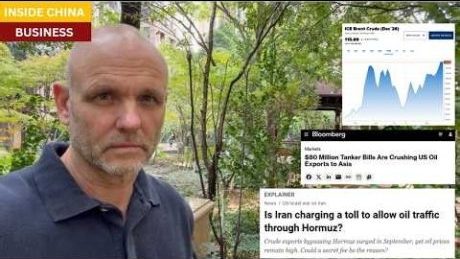
Iran is (probably) collecting tolls, and why Asia stopped buying oil from the US
or go to
Aletho News Archives – Video-Images
From the Archives
The Great Recycling Scam
By Dr. Vernon Coleman – 21st Century Wire – September 2, 2022
Recycling was introduced, worldwide, as a tool to teach citizens to become compliant.
Forcing citizens to sort their rubbish into up to nine separate bags or boxes every week had absolutely nothing to do with ‘saving the planet’ and everything to do with teaching citizens (through a mixture of fines and shame) to behave ‘responsibly’ i.e. to do as they were told without looking too closely at the rationale of what they were being told to do.
The recycling never had anything to do with protecting the planet, of course. Most of the rubbish sorted, washed and collected in the UK was taken abroad, by lorry or ship or train, and burnt or dumped. It was, quite simply, impractical and not cost effective to recycle the material that had been collected. And, of course, collecting the sorted rubbish involved massive costs in terms of cash and pollution.
Today, the recycling business has reached an apogee of lunacy. Councils introduce ever more complex rules and fees. They refuse to take away much of the waste that is collected. And those wanting to take their rubbish to a ‘recycling’ centre will probably have to make an appointment and answer a host of questions.
It is no surprise that fly-tipping has become a major problem. The biggest causes of plastic in the sea are dumped fishing gear and plastic waste (much of it officially designated as recycled) which has been dumped by ships.
The good news, however, is that in Britain, recycling rates are falling. More and more people have become aware that the whole recycling movement was just another piece of manipulative trickery.
Blog Roll
 Aletho News
- Regional security runs through Tehran
- Voters Don’t Want the Old GOP
- Former US officials who resigned over Gaza urge 2028 presidential candidates to reject architects of Biden-era policy
- Wired for War Crimes: Israeli spy-tech firm targeted Starlink users – researchers
- There is cautious optimism about ending the Ukraine war
- Here are the Bills Pushing Forward Authoritarian Control in Canada
- The accession of Ukraine could signal the collapse of the EU
- Italy puts Ukraine weapons package on hold – media
- US kills 5 in Pacific as unproven drug smuggling claims persist
- Iran Respects International Law, US & Israel are Rogue States
- If Americans Knew
- Majority Of Jewish Schools In The UK Teaching Kids To “Love Israel”
- Eisenkot or Netanyahu: No matter who forms government, democracy is dead
- Six Palestinians Killed In Gaza In 24 Hours
- Israel’s election: The battle between change and anti-Palestinian sentiment
- Voters Don’t Want the Old GOP
- Netanyahu Is Down but Not Out. That’s Dangerous
- AIPAC-Aligned Groups Gift Doris Matsui a $785k Blitz of Last-Minute Attack Ads
- DAILY UPDATE: Latest essential news on Palestine, Israel, & region
- Israel blocks international visitors from West Bank – what is it trying to hide?
- ‘There are no dreams here’: How Israel’s outgoing gov’t remade the West Bank
- No Tricks Zone
- Germany’s Green Energy Transition Becoming Increasingly Expensive…Another 6 Trillion Euros!
- Sudden Stratospheric Warming, Powerful El Niño Combination May Lead To Extreme Europe Cold, Energy Crisis!
- Two New Studies Find Thwaites Glacier Melt Cannot Be Driven By Human Activity Or A Warming Ocean
- E-Cars Reduce CO2 Emissions By Only 41% Compared To Internal Combustion Engine Vehicles
- Predictions Made By Renowned Climate Professor Over Past Decades Have Been Proven To Be Poor
- New Study Suggests Large Regions Of The Pacific Ocean Have Been Cooling For The Last 80 Years
- Germany’s Green Energy Debacle: High Energy Costs Force Kahla Porzellan to Close After 182 Years!
- New Study: 50 Years Of The Most Aggressive ‘Net Zero’ Policies Can Only Affect The Global Climate By 0.03°C
- US September “Heat” Was No Record…Many Records Set Decades Ago
- Latest European Green Energy Debacle; Portugal’s Largest Flagship Solar Park Insolvent!

