Unidentified drone downed over Lebanon airbase, US forces block authorities from crash site
The Cradle | February 18, 2026
An unidentified drone was downed in the early hours of 17 February after entering the airspace above Hamat Air Base in northern Lebanon, a Lebanese security source revealed exclusively to The Cradle.
The incident unfolded when security at the base, which also hosts US forces, intercepted the aircraft, causing it to crash into nearby woodland.
According to the source, patrols from Hamat municipal police and units of the Lebanese Armed Forces (LAF) headed to the area to examine the wreckage.
US personnel at the scene intervened to stop the inspection of the downed aircraft. According to The Cradle’s source, US troops drew their weapons and prevented Lebanese officials, including the local mayor, from approaching the crash site, asserting that the drone might have been booby-trapped with explosives.
Lebanese authorities did not take possession of the aircraft, the source said, and US officials later revealed that the drone was no longer at the location initially identified as the crash site.
A US general stationed at the base reportedly sought to contact the Hamat mayor to apologize, but the mayor refused the gesture, objecting to the behavior of the forces hosted at the base in northern Lebanon.
The drone infiltration of Lebanese airspace comes as the Israeli army continues to violate the terms of the US-sponsored “ceasefire” without repercussion.
In early February, troops from the UN Interim Force in Lebanon (UNIFIL) near Kfar Kila, southern Lebanon, observed two drones, one carrying an unidentified object assessed as an “immediate threat.” It entered close range, dropped a stun grenade, exploded about 50 meters from the UNIFIL troops, and then headed toward Israeli territory, with no injuries caused.
The UN mission assessed that the drone belonged to the Israeli army and had crossed the Blue Line “in violation of Security Council resolution 1701,” describing the use of armed drones in this manner as “unacceptable.”
Since November 2024, when Lebanese resistance movement Hezbollah ceased attacks against Israel under the terms of the US-brokered truce, the Israeli army has committed over 12,000 violations of Lebanon’s territorial sovereignty, including more than 8,000 airspace breaches and 700 airstrikes.
Israeli attacks have killed 343 Lebanese and caused nearly 1,000 injuries, with civilian casualties including dozens of women and children.
Israeli forces maintain an active military presence at several border outposts on Lebanese territory, hindering the return of more than 64,000 displaced residents after a campaign of destruction that rendered much of the southern border zones uninhabitable.
“Our presence at five points in southern Lebanon is not part of the ceasefire agreement, but we imposed it, and the United States accepted it,” Israel Defense Minister Israel Katz declared on 18 February.
His remarks come as Lebanon’s government acknowledged that the army will need at least four months to implement the next phase of a plan aimed at disarming Hezbollah.
Peeling Back the US Information Operation in Iran
By Larry C. Johnson | SONAR21 | February 18, 2026
As part of the US campaign to engineer a regime change in Iran, the US military and intelligence community are using Operational Preparation of the Environmnet aka OPE. OPE is defined in joint publications (e.g., JP 3-05 Special Operations) as non-intelligence activities conducted prior to or in preparation for potential military operations to set conditions for success. It encompasses shaping the operational environment through intelligence, surveillance, reconnaissance, information operations, civil affairs, psychological operations, and other preparatory actions—often in denied or politically sensitive areas.
I believe that one of the major OPE efforts is to convince the US public that the overwhelming majority of Iranians despise the Islamic Republic and want it overthrown. In my opinion, a major player in this OPE is a polling outfit known as GAMAAN. GAMAAN (Group for Analyzing and Measuring Attitudes in Iran) collaborates with Psiphon VPN, which is widely used across Iran. GAMAAN findings have been consistent in painting a picture of massive opposition to the Iranian regime:
According to GAMAAN polls taken prior to 2025, a significant majority of Iranians — around 70% — oppose the continuation of the Islamic Republic. The highest level of opposition, 81%, occurred during the “Woman, Life, Freedom” uprising in late 2022. Support for “the principles of the Islamic revolution and the Supreme Leader” has decreased from 18% in 2022 to 11% in 2024. Opposition to the Islamic Republic is higher among the youth, urban residents, and the highly educated. An overwhelming majority of Iranians (89%) support democracy.
Only about 20% of Iranians support the continuation of the Islamic Republic. When asked about preferred alternatives, about 26% favor a secular republic and around 21% support a monarchy. For 11%, the specific form of the alternative system doesn’t matter. About 22% report lacking sufficient information to choose an alternative system.
But what are the funding sources for GAMAAN and Psiphon VPN? Let’s start with GAMAAN. GAMAAN describes itself as an independent, non-profit research foundation registered in the Netherlands. It emphasizes its academic credentials (e.g., founded by scholars at Dutch universities like Tilburg and Utrecht) and innovative online methods (e.g., anonymity sampling via VPNs like Psiphon) to overcome self-censorship in authoritarian contexts.
GAMAAN operates under the supervision of a board including Dr. Ammar Maleki (founder and director), assistant professor of comparative politics at Tilburg University, and Dr. Pooyan Tamimi Arab, associate professor of secular and religious studies at Utrecht University. Maleki is an assistant professor of Comparative Politics and a self-described activist for democracy in his native Iran. Tilburg University Critically, he does not hide his political stance — his Tilburg University profile explicitly states that he is “a pro-democracy activist and political analyst of Iranian politics” and that he tries “to have an impact on political debates around democratization of Iran.”
This is where the picture becomes more contested. GAMAAN has relied on US government-funded VPN provider Psiphon to disseminate its surveys; collaborated with the USAID-funded Tony Blair Institute; and collaborated with and received funding from historian Ladan Boroumand, co-founder of the Abdorrahman Boroumand Center for Human Rights in Iran, which is in turn supported by the US government-funded National Endowment for Democracy (NED).
Psiphon is owned and operated by Psiphon Inc., a Canadian corporation based in Ontario. Psiphon was originally developed by the Citizen Lab at the University of Toronto, with version 1.0 launching on December 1, 2006, as open-source software. In early 2007, Psiphon, Inc. was established as a Canadian corporation independent of the Citizen Lab and the University of Toronto.
It has a notable funding history. In 2008, Psiphon, Inc. was awarded sub-grants from the US State Department Internet Freedom program, administered by the Bureau of Democracy, Human Rights, and Labor. In 2010, Psiphon began providing services to the Broadcasting Board of Governors (US), the US Department of State, and the BBC. More recently, in April 2024, the Open Technology Fund (OTF) announced increased long-term funding for Psiphon, with subsequent OTF awards totaling US$18.54 million for 2024 and US$5.87 million for 2025.
The Open Technology Fund (OTF) is administered by the US Agency for Global Media (USAGM), an independent federal agency of the US government. USAGM provides OTF with its primary funding through annual grants, which originate from Congressional appropriations under the Department of State, Foreign Operations, and Related Programs budget. OTF operates as an independent nonprofit corporation (since 2019) but remains a grantee under USAGM’s oversight and governance, as authorized by Congress (e.g., via the 2021 National Defense Authorization Act).
So while Psiphon Inc. is technically an independent Canadian company, it has historically been substantially funded by the US government and other Western institutions — a fact worth noting given its role as the methodology partner for the GAMAAN polling inside Iran. In other words, it is a cut out that, in my opinion and based on my experience, is supporting a CIA information operation to portray Iran as a country on the precipice of overthrowing the Islamic Republic.
There is an alternative polling database that paints a radically different picture of the mood in Iran with respect to the Islamic Republic… The Center for International and Security Studies at Maryland has conducted a separate series of surveys using phone-based methods, which show more moderate results. Their findings from 2023 and 2024 found that about 75% of respondents expect Iran’s constitution and political system to be about the same in ten years, and only 17% agreed with protesters’ calls for the Islamic Republic to be replaced. However, three in five now think the government should not be strict in enforcing Islamic laws, distinctly up from 2018, and support for demands that the government fight corruption has been consistently near-unanimous since 2018.
On the protests themselves, asked in 2024 to think about waves of demonstrations over the past ten years, two thirds say their main objective was to demand that officials pay greater attention to people’s problems, while only one in five think their main objective was to demand greater freedoms or bring about change in Iran’s system of government.
President Pezeshkian, based on the polls from 2024, was viewed favorably by 66% of those polled at the start of his term… and 70% expressed confidence that he would be an honest and trustworthy president, though only a quarter were very confident. Majorities expressed some confidence that he can improve relations with neighboring countries and protect citizens’ freedoms, notably women’s rights, but majorities are not confident that he can lower inflation or improve relations with the West.
There have been no new polls in the wake of Israel’s surprise attack on June 13, 2025. Based on my conversations with both Nima Alkhorshid and Professor Marandi, the reaction in Iran has been similar to what happened in the United States in the aftermath of the 9-11 attacks… National unity increased.
The failed color revolution launched on December 28, 2025 by the United States and Israel has reinforced support for the Islamic Republic. President Pezeshkian has openly admitted his government’s failures on the economic front and he has taken some steps to institute reforms. A more important development was the signing of the Trilateral Security Agreement with Russia and China at the end of January. Those two countries are now providing more resources and support to stabilize the Iranian government and improve the economic lives of the Iranian people.
Donald Trump’s threats to attack Iran are backfiring among the majority of the population in Iran. Yes, there are some Iranians who still want to bring an end to the Islamic Republic, but they are dramatically outnumbered. Remember the boost in popularity that George W Bush enjoyed in the aftermath of 9-11? He even picked up support from Democrats who had previously despised him. That same phenomena has happened in Iran. Prior to the June 13, 2025 attack, Iranians under the age of 50 had no vivid memory of Iran/Iraq war — where Iran was attacked with the encouragement and support of the United States. The June 2025 attack, coupled with the foreign instigated late December 2025 protests and violence, have awakened a new sense of nationalism among the Iranian public that has strengthened support for the Islamic Republic.
The belief in the West that Iran is more vulnerable now than at anytime in the last 46 years is the creation of a US funded propaganda campaign that relied on an ideologically biased pollster to produce results that have been used to convince most Americans that Iran is yearning to breath free… All we have to do is kill off the leadership in Iran.
Israel ‘dictating terms’ to US – Turkish professor
Washington is following the Jewish State’s demands on Iran and the Middle East as a whole, Hasan Unal has told RT
RT | February 18, 2026
Israel is effectively dictating US foreign policy, particularly on Iran and the wider Middle East, in a way that is historically unprecedented for a global superpower, a Turkish international relations professor has told RT.
Hasan Unal, who teaches at Baskent University in Ankara, spoke to RT’s Rick Sanchez this week about what he described as a highly unusual power imbalance between Israel and the US.
”We are living in a world now where a small country like Israel is dictating terms to a superpower like the United States on anything and everything, particularly anything pertaining to Israel and to the Middle East,” he said, calling the situation “totally unacceptable.”
Unal added that some analysts have even described it as an “occupation” of US policymaking by Israel, a characterization he said was “almost true.”
He went on to say that pro-Israel lobby influence and the personal involvement of Israeli Prime Minister Benjamin Netanyahu were shaping American positions, recalling episodes when Netanyahu “gets on his plane immediately” and flies to Washington “to simply dictate what [US President Donald] Trump should say and should negotiate in the negotiations with the Iranians.”
Unal claimed such a pattern has left Washington “dogging behind the Israeli demands all the time” and cautioned that it risks further destabilizing the Middle East.
Netanyahu has made multiple high profile visits to Washington to engage directly with senior US officials on regional policy. In the past year alone, he has met Trump at the White House at least six times to discuss issues ranging from Gaza and Iran’s nuclear program to military cooperation. His latest trip took place last week, ahead of the second round of indirect US Iran talks in Geneva. Netanyahu later said he had pressed Trump to ensure that Tehran is barred from enriching uranium. The renewed diplomatic push followed joint Israeli-US strikes on Iranian nuclear facilities last year, officially justified as an attempt to stop Iran from acquiring nuclear weapons – an ambition the Islamic Republic denies.
Trump has since sent an ‘armada’ to the Middle East and threatened further attacks unless Iran agrees to a deal on both its nuclear and missile programs. Last week, he raised the prospect of regime change and announced a second carrier strike group deployment, with media reports claiming the US military was ordered to prepare for a sustained multi-week operation if talks fail.
Asked whether Iran poses a direct threat to the US, Unal replied that Tehran does not seek to attack American assets as such and that many of the tensions are tied to Israel’s security calculations.
Unal also suggested what he called the gradual collapse of a “big empire,” referring to the Western-led order, and the emergence of a more multipolar system in which countries such as Russia, China, and Türkiye have greater room to maneuver. – video
US ramps up nuclear claims against China
RT | February 18, 2026
China carried out an underground “nuclear explosive test” in June 2020, a senior US State Department official has claimed, citing “fresh intelligence” on the matter. Beijing has repeatedly dismissed such allegations as “entirely unfounded,” while independent observers say the evidence is inconclusive.
The US assistant secretary for arms control and nonproliferation, Christopher Yeaw, made the latest claims on Tuesday during an event hosted by the conservative Hudson Institute think tank in Washington.
He cited seismic data “quite consistent with what you would expect from a nuclear explosive test.”
“I’ve looked at additional data since then. There is very little possibility, I would say, that it is anything but an explosion, a singular explosion,” Yeaw stated.
The minor 2.75 magnitude seismic event was registered by a remote station in Kazakhstan. Its epicenter was located some 725km away at the Lop Nur nuclear testing grounds in China, prompting the US to claim that it was caused by an underground blast.
China has repeatedly dismissed the American allegations as “entirely unfounded” and used only as a pretext to justify Washington’s own intent to resume nuclear testing. Yeaw’s remarks invoked a similar reaction, with a spokesperson for the Chinese embassy in Washington telling Reuters the latest claims were “political manipulation aimed at pursuing nuclear hegemony and evading its own nuclear disarmament responsibilities.”
Moscow has backed Beijing, repeatedly stating no evidence to support Washington’s claims exists. “Neither Russia nor China has conducted any nuclear tests. And we also know that these claims were firmly denied by representatives of China,” Kremlin spokesman Dmitry Preskov told reporters on Wednesday.
Independent observers have said there is too little evidence to positively establish the nature of the June 2020 incident. The Comprehensive Nuclear-Test-Ban Treaty Organization, for instance, said that the monitoring station in Kazakhstan merely picked up “two very small seismic events, 12 seconds apart,” and it was not possible “with this data alone” to assess “the cause of these events with confidence.”
Erdogan wants nukes: What a Turkish bomb would mean for the Middle East
Ankara is telling the world that a selective and force-driven approach to the Iranian nuclear issue could ignite a chain reaction
By Murad Sadygzade | RT | February 18, 2026
In Ankara, the idea of Türkiye one day seeking a nuclear weapons option has never been entirely absent from strategic conversation. Yet in recent days it has acquired a sharper edge, as the region around Türkiye is sliding toward a logic in which raw deterrence begins to look like the only dependable language left.
Türkiye’s foreign policy has expanded far beyond the cautious, status-quo posture that once defined it. It has positioned itself as a mediator on Ukraine and Gaza, pursued hard security aims through sustained operations and influence in Syria, Iraq, and Libya, and inserted itself into competitive theaters from the Eastern Mediterranean to the Horn of Africa. President Recep Tayyip Erdogan has long framed this activism as a corrective to an international order he portrays as structurally unfair. His slogan that the world is bigger than five – referring to the UN Security Council – is a statement of grievance against a system in which a narrow group of powers retains permanent privileges, including an exclusive claim to ultimate military capability.
Within that narrative, nuclear inequality occupies a special place. Erdogan has repeatedly pointed to the double standards of the global nuclear order, arguing that some states are punished for ambiguity while others are insulated from scrutiny. His references to Israel are central here, because Israel’s assumed but undeclared nuclear status is widely treated as an open secret that does not trigger the same enforcement instincts as suspected proliferation elsewhere. That asymmetry has long irritated Ankara, but it became more politically potent after the war in Gaza that began in 2023, when Erdogan openly highlighted Israel’s arsenal and questioned why international inspection mechanisms do not apply in practice to all regional actors.
Still, for years this was mostly an argument about fairness and legitimacy rather than a declaration of intent. What has changed is the sense that the regional security architecture itself is cracking, and that the cracks are widening at the very moment the US and Israel are escalating pressure on Iran. Türkiye’s leadership has warned that if Iran crosses the nuclear threshold, others in the region will rush to follow, and Türkiye may be forced into the race as well, even if it does not want dramatic shifts in the balance.
This is the key to understanding the new intensity of the debate. Ankara’s signaling is not primarily an emotional reaction to Tehran. Türkiye and Iran remain competitors, but their frictions have also been managed through pragmatic diplomacy, and Türkiye has consistently argued against a military solution to the Iranian nuclear issue. Erdogan has again presented Türkiye as a mediator, insisting on de-escalation and rejecting military steps that could drag the region into wider chaos.
The driver is the fear that the rules are no longer the rules. When enforcement becomes selective, and when coercion is applied in ways that appear to disregard broader stability, the incentives change for every middle power caught in the blast radius. The signal from Ankara is that if the Middle East moves into a world where nuclear capability is treated as the only ironclad guarantee against regime-threatening force, then Türkiye cannot afford to remain the exception.
That logic is dangerous precisely because it is contagious. It turns proliferation into an insurance policy. In an unstable region where trust is thin and the memory of war is always fresh, the idea of nuclear weapons as a shield against interference can sound brutally rational. If possessing the bomb raises the cost of intervention to unacceptable levels, it can be perceived as the ultimate deterrent, a guarantee that outsiders will think twice. But the same logic that appears to promise safety for one actor produces insecurity for everyone else. In practice it fuels an arms race whose end state is not stability, but a crowded deterrence environment in which miscalculation becomes more likely, crisis management becomes harder, and conventional conflicts become more combustible because nuclear shadows hover over every escalation ladder.
The renewed urgency also reflects a broader global drift. Arms competition is intensifying well beyond the Middle East. The erosion of arms control habits, the normalization of sanctions as a tool of strategic coercion, and the return of bloc-like thinking in many theaters all contribute to a sense that restraint is no longer rewarded. For Türkiye, a state that sees itself as too large to be merely a client and too exposed to be fully autonomous, the temptation is to seek leverage that cannot be negotiated away. Nuclear latency, even without an actual bomb, can function as a strategic bargaining chip.
Yet the jump from ambition to capability is not straightforward. Türkiye does have important ingredients for a serious civil nuclear profile, and those capabilities matter because they shape perceptions. The country has been building human capital in nuclear engineering and developing an ecosystem of research institutions, reactors for training and experimentation, accelerator facilities, and nuclear medicine applications. Most visibly, the Akkuyu nuclear power plant project with Russia has served as an engine for training and institutional learning, even if technology transfer is limited and the project remains embedded in external dependence.
Türkiye also highlights domestic resource potential, including uranium and especially thorium, which is often discussed as a long-term strategic asset. Resource endowments do not automatically translate into weapons capability, but they reduce one barrier, the need for sustained and vulnerable supply chains. As a result, Türkiye can credibly present itself as a state that could, if it chose, move from peaceful nuclear competence toward a latent weapons posture.
The real bottleneck is not simply material. It is political and legal. Türkiye is a party to the Nuclear Non-Proliferation Treaty, and it operates inside a web of international commitments that would make an overt weapons program extremely costly. Withdrawal from the treaty or large-scale violations would almost certainly trigger sweeping sanctions, diplomatic isolation, and a rupture with major economic partners. Unlike states that have adapted their economies to long-term siege conditions, Türkiye is deeply integrated into global trade, finance, and logistics. The short-term shock of a proliferation crisis would be severe, and Ankara knows it.
This is why the most plausible path, if Türkiye ever moved in this direction, would not be a dramatic public sprint. It would be a careful, ambiguous strategy that expands latency while preserving diplomatic maneuvering room. Latency can mean investing in expertise, dual-use infrastructure, missile and space capabilities that could be adapted, and fuel cycle options that remain justifiable on civilian grounds. It can also mean cultivating external relationships that shorten timelines without leaving fingerprints.
Here the debate becomes even more sensitive, because proliferation risk is not only about what a country can build, but also about what it can receive. The Middle East has long been haunted by the possibility of clandestine technology transfer, whether through black markets, covert state support, or unofficial security arrangements. In recent months, discussions around Pakistan have become particularly salient, not least because Islamabad is one of the few Muslim majority nuclear powers and has historically maintained close security ties with Gulf monarchies.
Saudi Arabia has repeatedly signaled that it will not accept a regional balance in which Iran alone holds a nuclear weapon. Saudi leaders have at times implied that if Iran acquires the bomb, Riyadh would feel compelled to match it for reasons of security and balance. Those statements are not proof of an active weapons program, but they are political preparation, shaping expectations and normalizing the idea that proliferation could be framed as defensive rather than destabilizing.
There have also been unusually explicit hints in regional discourse about nuclear protection arrangements, including arguments that Pakistan could, in some scenario, extend a form of deterrence cover to Saudi Arabia. Even when such claims are partly performative, they underscore how the region’s strategic conversation is shifting from taboo to contingency planning.
Once that door is open, Türkiye inevitably enters the picture in regional imagination. Türkiye, Pakistan, and Saudi Arabia are linked through overlapping defense cooperation and political coordination, and analysts increasingly discuss the emergence of flexible security groupings that sit alongside or partially outside formal Western frameworks. The idea that technology, know-how, or deterrence guarantees could circulate within such networks is precisely the nightmare scenario for nonproliferation regimes, because it compresses timelines and reduces the visibility that international monitors depend on.
For Ankara, this creates both opportunity and risk. The opportunity is that Türkiye could enhance its deterrent posture without bearing the full cost of overt development. The risk is that Türkiye could become entangled in a proliferation cascade that it cannot control, while simultaneously inviting a Western backlash that would reshape its economy and alliances.
This is where the question becomes deeply geopolitical. A nuclear-armed Türkiye would not simply change the Middle East. It would alter Europe’s security landscape and challenge the logic that has governed Türkiye’s relationship with the West for decades. Western capitals have tolerated, managed, and constrained Türkiye through a mixture of incentives, institutional ties, defense cooperation, and pressure. Türkiye’s NATO membership, its economic links to Europe, and the presence of US nuclear weapons stored at Incirlik as part of alliance arrangements have all been elements of a broader strategic framework in which Türkiye was seen as anchored, even when politically difficult.
If Türkiye acquired its own nuclear weapons, that anchoring would weaken dramatically. Ankara would gain a form of autonomy that no sanction threat could fully erase. It would also gain the capacity to take risks under a nuclear umbrella, a dynamic that worries Western capitals because it could embolden more confrontational regional behavior. Türkiye’s disputes with Western partners are already intense on issues ranging from Eastern Mediterranean energy politics to Syria, defense procurement, and the boundaries of alliance solidarity. A nuclear deterrent could make those disputes harder to manage because the ultimate escalation dominance would no longer sit exclusively with the traditional nuclear powers.
At the same time, a Turkish bomb could accelerate Türkiye’s drift away from the West, not only because the West would react with pressure, but because the very act of building such a capability would be an ideological statement that Türkiye rejects a Western-defined hierarchy. It would be Ankara’s most dramatic way of saying that it will not accept a subordinate place in a system it considers hypocritical.
None of this means Türkiye is on the verge of producing a weapon. Political obstacles remain huge, and technical challenges would be substantial if Ankara had to do everything indigenously while under scrutiny. A credible weapons program requires enrichment or plutonium pathways, specialized engineering, reliable warhead design, rigorous testing regimes or sophisticated simulation capabilities, secure command and control, and delivery systems that can survive and penetrate. Türkiye has missile programs that could in theory be adapted, but turning a regional missile force into a robust nuclear delivery architecture is not trivial.
The more immediate danger is not that Türkiye will suddenly unveil a bomb, but that the region is moving toward a threshold era, in which multiple states cultivate the ability to become nuclear on short notice. In such an environment, crises become more perilous because leaders assume worst-case intentions, and because external powers may feel pressure to strike early rather than wait. The irony is that a weapon meant to prevent intervention can increase the likelihood of intervention if adversaries fear they are running out of time.
The escalation by the US and Israel against Iran, combined with the broader arms race logic spreading across the Middle East and globally, is making this spiral more plausible. Uncertainty is the fuel of proliferation, because it convinces states that the future will be more dangerous than the present, and that waiting is a strategic mistake.
Türkiye’s rhetoric should therefore be read as a warning as much as a threat. Ankara is telling the world that a selective and force-driven approach to the Iranian nuclear issue could ignite a chain reaction. It is also telling regional rivals that Türkiye will not accept a future in which it is strategically exposed in a neighborhood where others have ultimate insurance.
The tragedy is that this is exactly how nuclear orders unravel. They do not collapse when one state wakes up and decides to gamble. They collapse when multiple states simultaneously conclude that the existing rules no longer protect them, and that deterrence, however dangerous, is the only available substitute. In a stable region, that conclusion might be resisted. In the Middle East, where wars overlap, alliances shift, and trust is scarce, it can quickly become conventional wisdom.
If the goal is to prevent a regional nuclear cascade, the first requirement is to restore credibility to the idea that rules apply to everyone and that security can be achieved without crossing the nuclear threshold. That means lowering the temperature around Iran while also addressing the deeper asymmetries that make the system look illegitimate in the eyes of ambitious middle powers. Without that, Türkiye’s nuclear debate will not remain an abstract exercise. It will become part of a wider regional recalculation, one that risks turning an already unstable region into a nuclearized arena where every crisis carries the possibility of catastrophe.
Murad Sadygzade, President of the Middle East Studies Center, Visiting Lecturer, HSE University (Moscow).
Ukrainian disruption of Russian oil pipeline triggers emergency in EU state
RT | February 18, 2026
Slovakia has declared a state of emergency following Ukraine’s decision to block vital Russian oil supplies to the country, TASR news agency has reported.
The state of emergency will be in effect from Thursday until September 30 at the latest, it added, citing Kiev’s refusal to transit Russian oil to the country and the ongoing blockade of the Druzhba pipeline network.
The Slovak government will release strategic oil reserves to ensure one month of operation for the country’s only refinery, in Bratislava, the agency wrote on Wednesday.
Slovakia will also import oil via Croatia’s Adria pipeline, an alternative route bypassing Druzhba, although that supply could take up to 30 days to reach the facility.
Slovak Economy Minister Denisa Sakova said the Czech government was also examining possibilities for supplying oil to Bratislava.
Slovak Prime Minister Robert Fico announced after a government meeting on Wednesday that oil company Slovnaft was stopping the export of diesel to Ukraine, with all products now destined for the domestic market.
He also previously stated that Slovakia may stop supplying electricity to Ukraine over the suspension of oil supplies via the Druzhba pipeline. According to him, Ukraine’s Vladimir Zelensky is refusing to cooperate on the issue.
While Ukraine has claimed the transit halt was caused by a Russian attack in late January, Slovakia and neighboring Hungary have insisted the pipeline is operational, but oil is not flowing due to a political decision in Kiev.
Fico said on Sunday that Kiev had delayed the restart of oil flows in order to pressure Budapest to drop its veto on Ukraine’s future EU membership. Orban has vowed to block any accelerated accession, warning that admitting the country would drag the bloc into direct conflict with Russia.
Hungary and Slovakia are heavily dependent on Russian crude and hold exemptions from EU sanctions allowing them to import Russian crude by sea if pipeline transit becomes impossible. On Monday, Budapest announced plans to invoke the temporary exemption and import seaborne Russian crude via Croatia.
Kaja Kallas: an uncomfortable figure useful to the EU’s Russophobic purposes
By Lucas Leiroz | Strategic Culture Foundation | February 18, 2026
In recent days, videos of Europe’s chief diplomat, Kaja Kallas, have gone viral on social media, showing her making statements marked by disconnected reasoning, weak associations, and conclusions that do not logically follow from the premises presented. At the same time, she delivered yet another of her “unusual” speeches, declaring that Europe would demand a reduction in the size of the Russian Army – an assertion made without any reference to legal, logistical, or strategic foundations to support such a measure, making the inconsistency of her position evident.
This statement highlights not only the European diplomacy’s disconnect from geopolitical reality, but also the symbolic function of certain figures who maintain positions of international visibility. Kallas, whose political trajectory was consolidated in Estonia with a strongly anti-Russian discourse, has become a piece of ideological rhetoric: she plays the role of a “watchdog” of European Russophobia and does not seem to mind being seen as “foolish” for her irrational public statements.
Beyond this aspect, there is also a practical function in this dynamic. Domestically, Kallas faced considerable political wear in Estonia: her family circle maintained commercial ties with Russia, and nationalist sectors criticized her for economic policies that allegedly weakened the country’s economic stability. In this sense, her promotion to the head of European diplomacy served as a convenient solution – removing a worn-out figure from the domestic scene while at the same time making use of her “angry” stance toward Moscow to sustain the anti-Russian narrative at the continental level.
Kallas’s performance, however, does not represent strategic autonomy. The European Union’s foreign policy is centralized in the presidency of the European Commission, under the leadership of Ursula von der Leyen. In this context, Kallas essentially fulfills the role of spokesperson and executor of guidelines defined by the bloc’s hard core, which coordinates sanctions, defense policies, and alignment with NATO and the United States. The contrast between her performative statements and her real decision-making capacity reflects a strategy that prioritizes confrontational rhetoric over political pragmatism.
From a geopolitical perspective, the idea of unilaterally reducing Russian military personnel is unrealistic. Moscow interprets the current conflict as part of a structural dispute over NATO expansion and the strategic containment promoted by the West. Symbolic pressure or European public declarations, devoid of negotiation mechanisms or concrete coercive instruments, produce no practical effect and, on the contrary, tend to reinforce Russian defensive positions, consolidating the perception of permanent hostility.
Moreover, the recent tensions between Kallas and von der Leyen are telling. Kallas reportedly calls her a “dictator” for centralizing power in the Commission – as if the entire EU bureaucratic structure were not designed precisely to maintain that kind of centralization. It appears that von der Leyen represents the transnational elites that control Europe, while Kallas is merely a disposable piece on this chessboard – without any real right to opinion or participation in the bloc’s decision-making process.
Ultimately, Kallas remains, in the racist European view that she herself evokes, a “peripheral” figure of Soviet origins, with a Finno-Ugric native language – hardly “European” in the strict sense, no matter how much she tries to “Europeanize” herself by hating Russia. For Europeans, she is an uncomfortable figure who nonetheless serves a useful purpose: escalating tensions with Russia, which greatly benefits von der Leyen’s “anonymous bosses.”
In this scenario, Kallas embodies a structural tension: her peripheral origins and aggressive posture make her useful as a representative of a confrontational narrative, while also exposing the superficiality of certain European political decisions. The bloc maintains tough rhetoric and ideological mobilization but lacks a realistic strategy capable of dealing with the balance of power in Eurasia – where Europe is a weak and declining pole, not a “superpower,” as Kallas often claims.
If the EU truly intends to preserve its strategic autonomy and contribute to continental stability, it will need to abandon performative declarations and understand that any rearrangement of European security depends on direct negotiations with Moscow, recognition of military and geopolitical realities, and the formulation of measures that combine firmness with pragmatism. Unilateral demands – such as reducing Russian military personnel – are nothing more than symbolic rhetoric, incapable of altering the real dynamics of the conflict.
This dynamic also reveals the hidden side of European politics: the use of peripheral figures, often marginalized or viewed with prejudice, to materialize maximalist discourses that consolidate a narrative of confrontation, while decision-making remains concentrated in a small core of power, far removed from the media statements that go viral and capture public attention.
German state blacklists right-wing party for first time
RT | February 18, 2026
Authorities in the German state of Lower Saxony have designated the local chapter of the right-wing AfD party a surveillance priority, citing what they called “extremist” tendencies.
Founded in 2013, Alternative for Germany (AfD) espouses a tough stance on migration and opposes Berlin’s support for Ukraine. In the federal elections last February, the AfD came in second at 20%, winning 152 seats in the 630-seat Bundestag. However, the party has been excluded from coalition talks and government formation as part of a policy known as the ‘firewall’ in German politics.
The AfD’s popularity has since grown further regardless, with recent polls indicating that it is supported by around 25% of Germans, on par with Chancellor Friedrich Merz’s ruling CDU/CSU.
Speaking during a press conference on Tuesday, Lower Saxony Interior Minister Daniela Behrens cited the “unequivocal” conclusion by the Office for the Protection of the Constitution (BfV), according to which, “the greatest danger to our society stems from right-wing extremism, and the AfD in Lower Saxony… clearly falls within this category.”
According to the official, the party’s Lower Saxony chapter “holds our state and our democratic institutions in contempt,” and views people with a migrant background as “second-class citizens.”
The Lower Saxony AfD chapter was first designated a “clear case for surveillance” by the regional BfV office in 2022, with the authorities having now upgraded it to an “object of considerable importance for observation,” a spokesman for the domestic intelligence agency was quoted as saying by local media.
Commenting on the decision, AfD Lower Saxony Chairman Ansgar Schledde rejected “every accusation being made” by the authorities, describing the move as politically motivated and aimed at eliminating an opponent. He vowed to challenge the designation in court.
In four other German states – Brandenburg, Saxony, Saxony-Anhalt, and Thuringia – the local AfD branches are deemed a confirmed right-wing extremist entity, while in Rhineland-Palatinate and Saarland, the party has been declared a suspected case.
Last May, the federal BfV office upgraded the AfD’s classification from “suspected” to “confirmed right-wing extremist,” only to suspend it shortly thereafter pending a ruling on the party’s court appeal.
Romania’s stolen elections were only the start: Inside the EU’s war on democracy
How Brussels’ Digital Services Act has been used to pressure platforms and electoral control in member states
RT | February 18, 2026
Romania’s 2024 presidential election was already one of the most controversial political episodes in the European Union in recent years. A candidate who won the first round was prevented from contesting the second. The vote was annulled. Claims of Russian interference were advanced without public evidence.
At the time, the affair raised urgent questions about democratic standards inside the EU. Newly disclosed documents reviewed by RT Investigations go further. They indicate that the annulment of the Romanian election was accompanied by sustained efforts to pressure social media platforms into suppressing political speech – efforts coordinated through mechanisms established under the EU’s Digital Services Act.
What appeared to be a national political crisis now looks increasingly like a test case for how far EU institutions are willing to go in intervening in the political processes of member states.
The Russian narrative. Again.
On February 3, the US House Judiciary Committee published a 160-page investigation into how the EU systematically pressures social media companies to alter internal guidelines and suppress content. It found Brussels orchestrated a “decade-long campaign” to censor political speech across the bloc. In many cases, this amounted to direct meddling in political processes and elections of members, often using EU-endorsed civil society organizations. The report features several case studies of this “campaign” in action in EU member states, the gravest example being Romania.
It was around the November 2024 Romanian presidential election, the committee found, that the European Commission“took its most aggressive censorship steps.” In the first round, anti-establishment outsider Calin Georgescu comfortably prevailed, and polls indicated he was en route to win the second by landslide. However, on December 6, Bucharest’s constitutional court overturned the results. While a court-ordered recount found no irregularities in the process, a new election was called, in which Georgescu was banned from running.
By contrast, Romania’s security service alleged Georgescu’s victory was attributable to a Russian-orchestrated TikTok campaign. The allegation was unsupported by any evidence whatsoever. Romanian President Klaus Iohannis went to the extent of claiming this deficit was inversely proof of Moscow’s culpability, as the Russians supposedly “hide perfectly in cyber space.” Despite the BBC reporting that even Romanians “who feared a president Georgescu” worried about the precedent set for their democracy by the move, that narrative has been endlessly reiterated ever since.
The US House Judiciary Committee report comprehensively disproves the charge of Russian meddling in the Romanian election. Documents and emails provided by TikTok expose how the platform not only consistently assessed Moscow “did not conduct a coordinated influence operation to boost Georgescu’s campaign,” but repeatedly shared these findings with the European Commission and Romanian authorities. This information was never shared by either party. But the contempt of Brussels and Bucharest for democracy and free speech went much further.
Digital Services Act in action
The committee found Romanian officials egregiously abused the EU’s controversial Digital Services Act before the 2024 election “to silence content supporting populist and nationalist candidates.” Bucharest also repeatedly lodged content takedown requests outside of the formal DSA process, using what committee investigators call “expansive interpretations of their own power to mandate removals of political content.” This amounted to a “global takedown order,” with authorities perversely arguing court demands to block certain content for local audiences were “mandatory not only in Romania.”
This was no doubt a ploy to prevent outsiders, in particular the country’s sizable diaspora, from accessing content featuring Georgescu. His “Romania First” agenda proved quite popular with emigres, numbering many millions due to mass depopulation since 1989. Perhaps not coincidentally, his diaspora supporters have been widely maligned by Western media as fascist enablers. Still, even critical mainstream reports admit they and the domestic population have legitimate grievances, due to Romania’s crushing economic decline in the same period.
Bucharest would clearly stop at nothing to ensure the ‘correct’ candidate prevailed in the first round. Removal demands were plentiful, and on the rare occasions that legal justification was provided, it was based on a “very broad interpretation” of the election authority’s power. For example, TikTok was ordered to remove content that was “‘disrespectful and insults the PSD party’” – a left-wing political faction that was part of the country’s ruling coalition at the time. TikTok twice sought further details of the grounds for this request, but none was forthcoming.
Once Georgescu prevailed, and before the election was annulled, Romanian orders became even more aggressive. Regulators told TikTok that “all materials containing Calin Georgescu images must be removed,” again without any legal basis whatsoever. This proved a step too far for the platform, which refused to remove the posts. It wasn’t just naked political pressure to which TikTok refused to bend. Brussels and Bucharest were assisted first in electoral fraud, then autocratic annulment of the vote’s legitimate result, by local EU-sponsored NGOs.
These were organizations “empowered by the European Commission to make priority censorship requests – either as [EU Digital Service Act] Trusted Flaggers or through the Commission’s Rapid Response System.” Despite their supposed neutrality, the NGOs “made politically biased content removal demands.” For example, the EU-funded Bulgarian-Romanian Observatory of Digital Media “sent TikTok spreadsheets containing hundreds of censorship requests in the days after the first round of the initial election.” The committee characterized much of the flagged content as “pro-Georgescu and anti-progressive political speech.”
This included posts related to “Georgescu’s positions on environmental issues and Romania’s membership in the Schengen Area, and the EU’s system of open borders.” In other words, this was content espousing standard, popular conservative viewpoints, which are absolute anathema to Brussels and Bucharest’s pro-EU elite. Since the committee’s report was released, references to the Bulgarian-Romanian Observatory of Digital Media’s EU financing have been deleted from its website.
After the vote
The day after the election was annulled, TikTok wrote to the European Commission, stating plainly it had not found or been presented with evidence of a coordinated network of accounts promoting Georgescu. Undeterred by TikTok’s denials and scarcely bothered by the lack of material evidence, the European Commission pressed forward and demanded information about TikTok’s political content moderation practices and enquired about “changes” to its “processes, controls, and systems for the monitoring and detection of any systemic risks.”
The European Commission also used the “still-unproven narrative” of Russian meddling “to pressure TikTok to engage in more aggressive political censorship.” In response, the platform informed the commission that it would censor content featuring the terms “coup” and “war” – clear references to the perception that democratic processes had been undermined in Romania – “for the next 60 days to mitigate the risk of harmful narratives.” But this was still insufficient for the censorship-crazed commission.
On December 17, 2004, the European Commission opened a formal investigation into TikTok over a “a suspected breach of the DSA” – in other words, failing to sufficiently censor content before and after the first round of Romania’s presidential election. The platform was accused of failing to uphold its “obligation to properly assess and mitigate systemic risks linked to election integrity” locally. EU efforts to bring the platform to heel didn’t end there, either.
In February 2025, TikTok’s product team was summoned for a meeting with the EU’s Directorate-General for Communications Networks, Content and Technology. There, they were lectured over the platform’s supposedly “deceptive behavior policies and enforcement” and “potential[ly] ineffective” DSA “mitigation” measures. The US House Judiciary Committee found that the European Commission’s decision to meet TikTok’s product team, “rather than the government affairs and compliance staff whose job it was to manage TikTok’s relationship with the Commission, indicates the European Commission sought deeper influence over the platform’s internal moderation processes.”
Georgescu and the many Romanians who wished to elect him president were punished even more severely. Two weeks after TikTok was threatened by the European Commission, the upstart hopeful was arrested in Bucharest en route to registering to run in the new election that May. Georgescu was charged with “incitement to actions against the constitutional order.” Since then, he has been accused by authorities of plotting a coup and involvement in a million-euro fraud.
When Georgescu’s case finally reached trial this February, these accusations were dropped. He is instead charged with peddling “far-right propaganda.” A report on his prosecution from English-language news website Romania Insider repeated the fiction he owed his first-round victory to a “targeted social media campaign,” managed by “entities linked to Russia.” In the meantime, establishment-preferred candidate Nicusor Dan won the presidency. No doubt satisfied with the integrity of the democratic process given Georgescu was barred from participating, Romania’s Constitutional Court quickly validated the result.
Beyond Romania
Per the US House Judiciary Committee, Romania’s stolen 2024 presidential election is the most extreme example of the EU and member state authorities conspiring to subvert democracy and trample on popular will. But it is just one of many. Since the Digital Services Act came into force in August 2023, the European Commission has pressured platforms to censor content ahead of national elections in Slovakia, the Netherlands, France, Moldova, and Ireland, as well as the EU elections in June 2024.
“In all of these cases… documents demonstrate a clear bias toward censoring conservative and populist parties,” the committee concluded. Ahead of the EU elections, TikTok was pressured into censoring over 45,000 pieces of purported “misinformation.” This included what the report deemed “clear political speech” on topics such as migration, climate change, security and defense, and LGBTQ rights. There is no indication Brussels has been deterred from its quest to prevent the ‘wrong’ candidates being elected to office in member states, or citizens expressing dissenting opinions.
In fact, we can expect these efforts to ramp up significantly. For one, the US committee’s bombshell report generated almost no mainstream interest, indicating Brussels can and will get away with it again. Even more urgently, in April, Hungary goes to the polls. Already, the narrative that ruling conservative Viktor Orban intends to rig the vote to secure victory is being widely perpetuated. And the EU’s censorship apparatus stands ready to validate that narrative, regardless of truth, and popular will.
Hawaii bills would allow gov’t to quarantine people, enter property without permission, seize firearms, and suspend laws
HB 2236 and SB 2151 make the governor the “sole judge” of an emergency, allow sweeping powers based on a perceived threat alone.
By Jon Fleetwood | February 18, 2026
The Hawaii Legislature is advancing companion legislation that would formally codify sweeping emergency powers for the governor and county officials—including authority to quarantine individuals, enter private property without consent, suspend laws, and seize control of infrastructure—under the justification of preparing for future disasters and disease outbreaks.
House Bill 2236 and Senate Bill 2151, both titled “Relating to Emergency Management,” were introduced in January and February 2026 and are now moving forward through both chambers.
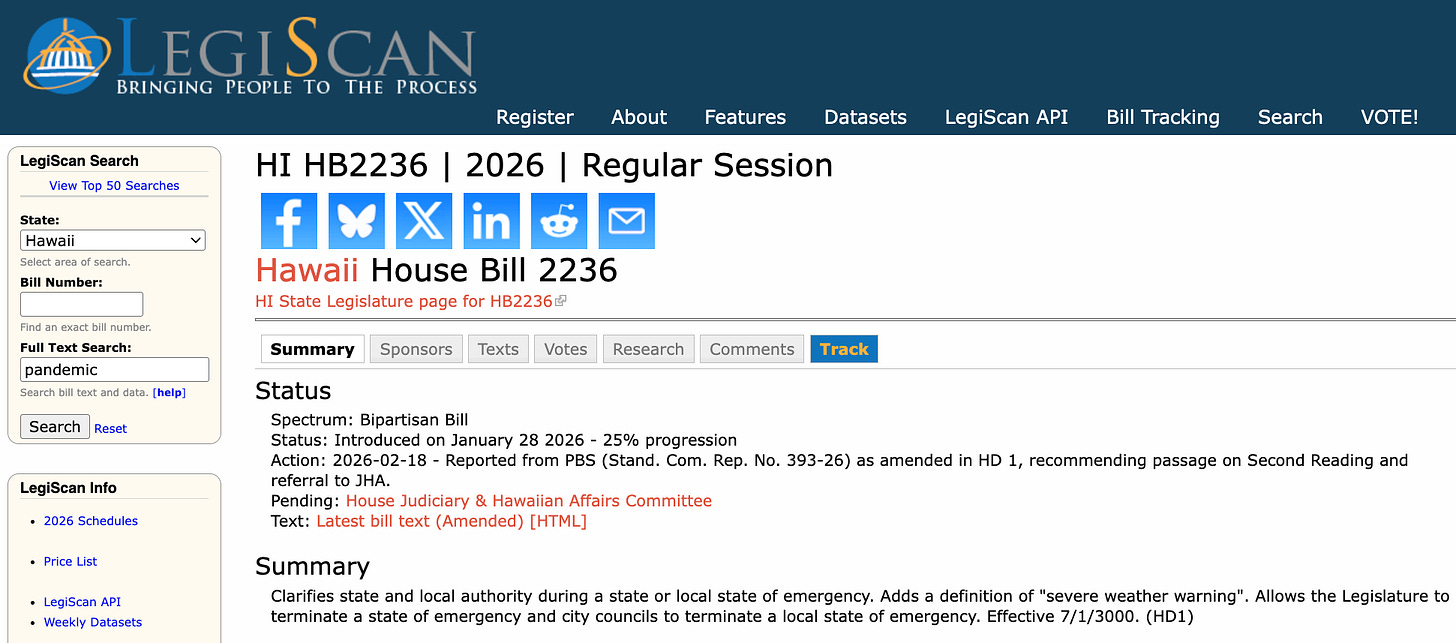
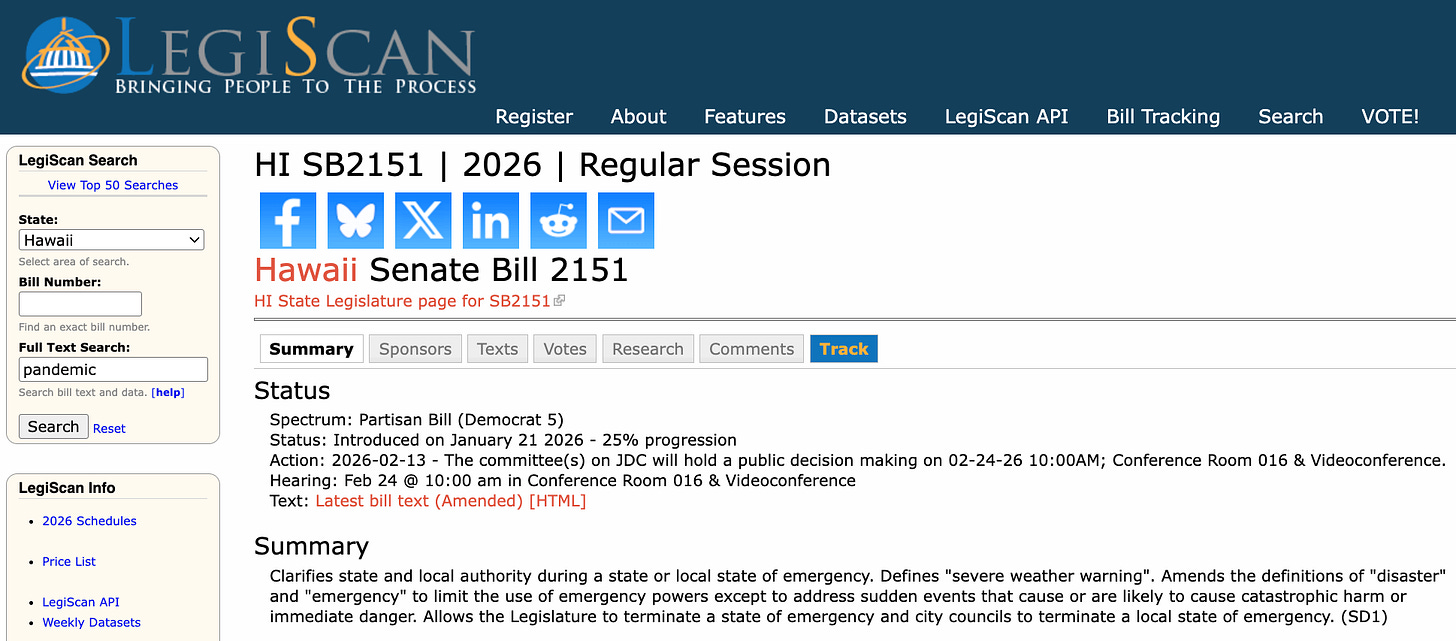
Legislative records show the bills are formally linked, with each designated as “Same As/Similar To” the other, confirming that Hawaii’s full legislature—not just one chamber—is advancing the emergency powers framework.
The legislation explicitly cites COVID-19 as justification for strengthening emergency authority, stating:
“The COVID-19 pandemic highlights the importance of clear legal frameworks for state and county emergency management to ensure that the State and counties are ready for any type of emergency.”
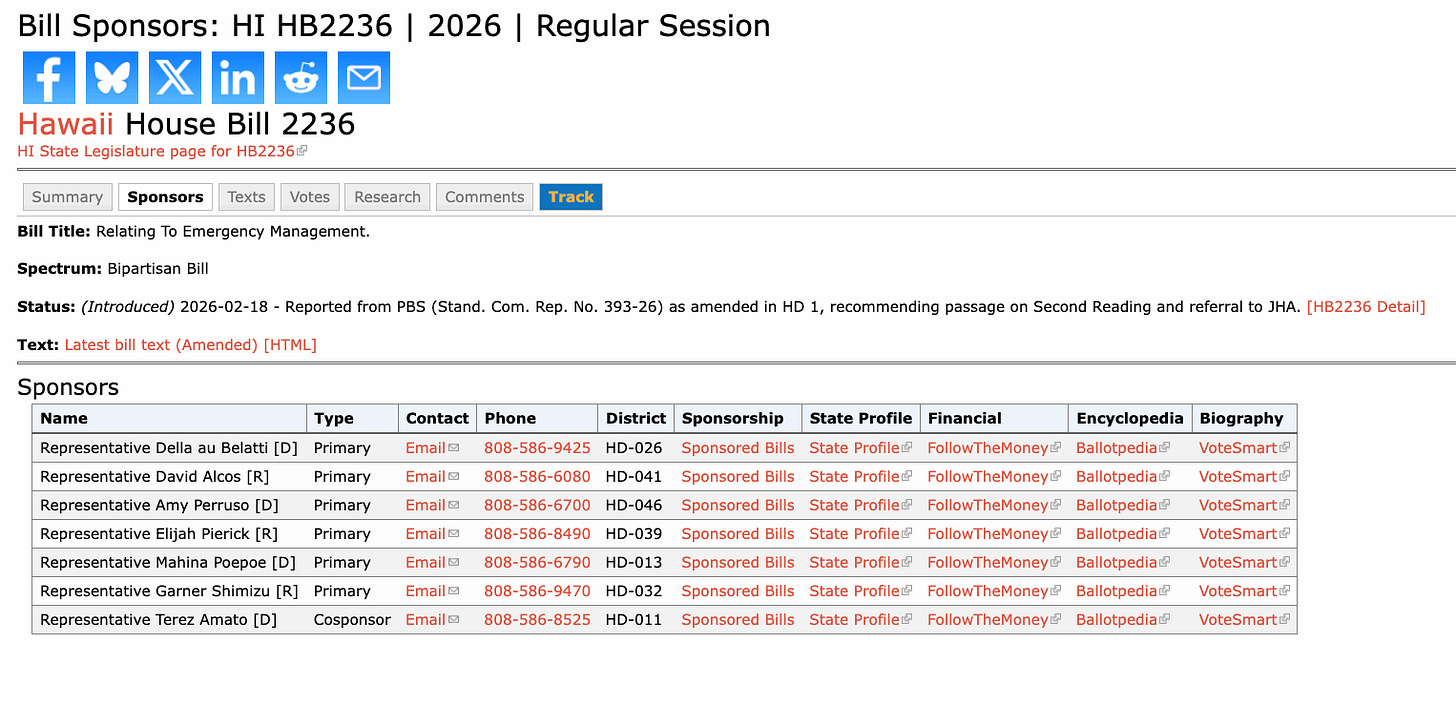
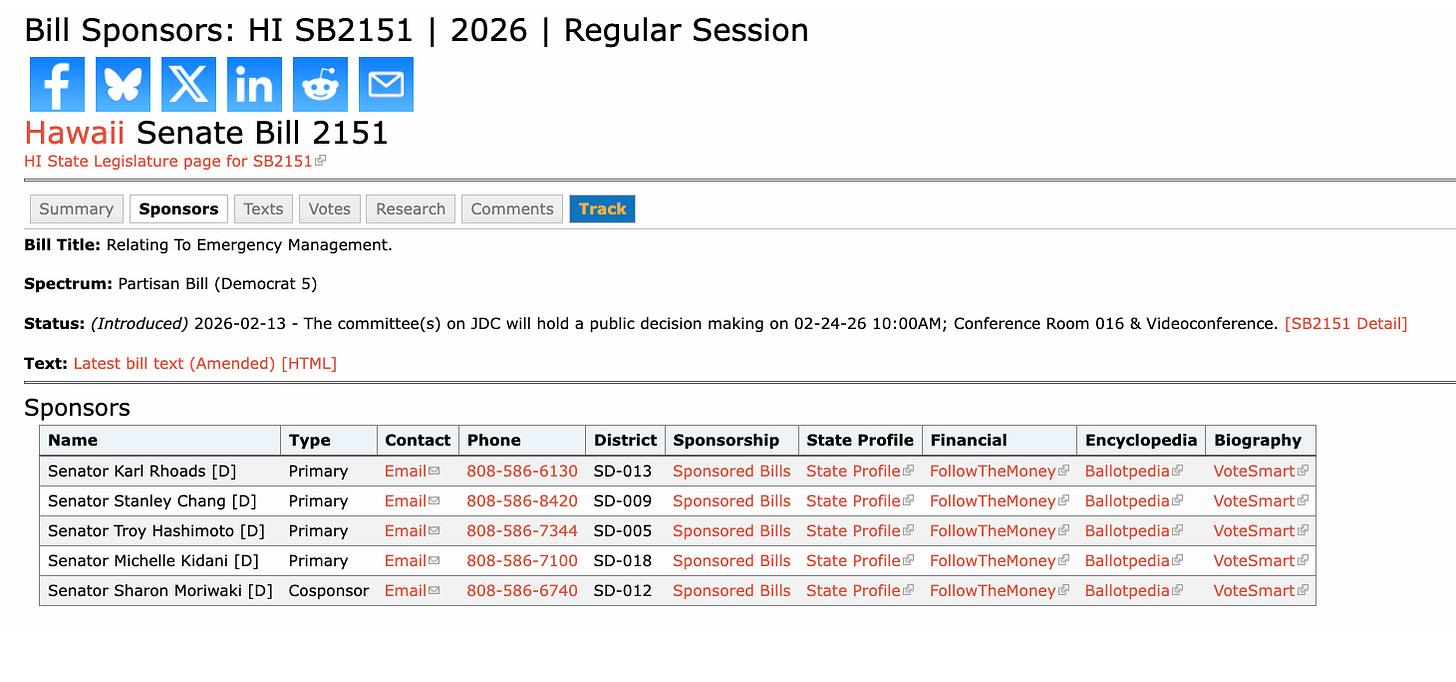
You can see which state legislators are backing these bills further down in this article.
Governor Authorized to Quarantine Residents & Enter Private Property Without Permission
Governor Authorized to Quarantine Residents & Enter Private Property Without Permission
One of the most consequential provisions would formally authorize forced quarantine and government entry onto private property.
The bill states that Hawaii Governor Josh Green (D) may:
“Require the quarantine or segregation of persons who are affected with or believed to have been exposed to any infectious, communicable, or other disease…”
It further grants authority to:
“Authorize without the permission of the owners or occupants, entry on private premises for any of these purposes.”
This authority applies not only to confirmed infections but also to individuals merely “believed to have been exposed.”
The legislation also allows the government to order the destruction of property deemed hazardous:
“Authorize that public nuisances be summarily abated and, if need be, that the property be destroyed by any police officer or authorized person.”
Governor Can Suspend Laws, Licensing Requirements, & Regulatory Protections
The bills explicitly empower the governor to suspend existing laws during an emergency, including medical, licensing, and regulatory protections.
The legislation states the governor may:
“[Suspend] the laws, in whole or in part… including licensing laws, quarantine laws, and laws relating to labels, grades, and standards.”
It also authorizes suspension of any law deemed to impede emergency operations:
“Suspend any law that impedes or tends to impede… emergency functions.”
Crucially, the legislation allows such suspensions to continue beyond the official emergency period:
“Any suspension of law… may continue beyond the emergency period…”
Government Authorized to Take Control of Private Infrastructure & Utilities
The legislation further empowers the governor to assume control of critical infrastructure, including privately owned facilities.
The bill states the governor may:
“Assure the continuity of service by critical infrastructure facilities, both publicly and privately owned… by taking over and operating the same.”
Additional provisions allow the government to:
- Shut off utilities
- Control distribution of goods
- Regulate or prohibit commerce
- Impose rationing
Specifically, the governor may:
“Regulate or prohibit… the storage, transportation, use, possession, maintenance, furnishing, sale, or distribution thereof, and any business or any transaction related thereto.”
Authority to Regulate Firearms & Seize Property
The legislation also grants authority to regulate firearms and confiscate property during emergencies.
It authorizes the governor to prohibit firearm possession during emergencies, meaning firearms that are normally legal could become unlawful to possess under emergency orders and subject to seizure.
The bill states the governor may:
“Regulate or prohibit the storage, transportation, use, possession… of firearms, and ammunition… and authorize the seizure and forfeiture.”
Governor Retains Sole Authority to Declare Emergencies
Under the proposed framework, Governor Green retains broad discretion to declare emergencies, including based on perceived threats.
The bill states:
“The governor… shall be the sole judge of the existence of the danger, threat, or circumstances giving rise to a declaration.”
Emergencies may be declared based on:
“Imminent danger or threat of an emergency or a disaster.”
This allows activation of emergency powers before an actual disaster occurs.
Legislature Adds New Definition of Disaster Including Disease Outbreaks & Bioterrorism
The Senate version expands the legal definition of “disaster” to explicitly include:
“Disease or contagion outbreaks, bioterrorism, terrorism, or incidents involving weapons of mass destruction.”
This codifies infectious disease emergencies as triggers for the expanded powers.
The move comes as President Donald Trump and Congress have already committed $5.5 billion toward preparing for a future influenza pandemic, while the World Health Organization vows such a pandemic is inevitable, U.S. scientists continue gain-of-function influenza experiments, and the administration launches its $500 million Operation Gold Standard influenza vaccine initiative.
Legislature Advances Bills Through Both Chambers
Legislative tracking records show both bills are progressing simultaneously:
- HB2236 was introduced January 28, 2026, and has already passed committee review in the House.
- SB2151 was introduced January 21, 2026, and is scheduled for further committee action February 24, 2026.
The bills are formally cross-linked, confirming coordinated legislative advancement.
Legislature Frames Bills as Clarification of Emergency Authority
Lawmakers describe the purpose of the legislation as clarifying and strengthening emergency management authority.
The bill states its purpose is to:
“Clarify state and county emergency management authority, ensure effective and adaptable emergency responses…”
The measures also allow the legislature to terminate emergency declarations by a two-thirds vote.
Which Legislators Are Backing the Bills
You can see which Representatives are backing HB2236 here.
You can see which Senators are backing SB2151 here.
Bottom Line
HB2236 and SB2151 would lock into permanent Hawaii law the authority to quarantine residents based on suspected exposure, enter private property without permission, suspend existing laws, prohibit firearm possession under emergency orders, and take control of private infrastructure and economic activity—all under an emergency declaration the governor has broad discretion to issue, including based on a perceived “threat.”
The legislation is advancing as the federal government pours billions into influenza pandemic programs, conducts gain-of-function experiments designed to alter influenza viruses, and builds out large-scale vaccine deployment initiatives intended for rapid rollout once a pandemic is declared.
At the same time, Congress, the White House, the Department of Energy, the FBI, the CIA, and Germany’s Federal Intelligence Service (BND) have confirmed that the COVID-19 pandemic was likely the result of lab-engineered pathogen manipulation.
That overlap creates a profound conflict-of-interest question: the same government and scientific establishment involved in creating and manipulating pandemic-capable pathogens is also expanding the legal authority to impose quarantines, override constitutional protections, restrict property rights, and control economic life if one of those pathogens triggers the next declared emergency.
If passed, Hawaii’s bills would ensure those powers are not improvised in the moment, but already written into law—allowing sweeping restrictions on residents to be activated immediately, the moment the next pandemic or declared threat emerges.
Epstein files may contain ‘crimes against humanity’ – UN
RT | February 18, 2026
Abuses carried out by convicted sex offender Jeffrey Epstein could meet the definition of crimes against humanity, the UN has claimed, while demanding accountability for the suspected perpetrators.
The UN Human Rights Council (UNHRC) released a statement in response to the millions of files released by the US government related to criminal investigations into the late financier.
The files reveal instances of “sexual slavery, reproductive violence, enforced disappearance, torture, inhuman and degrading treatment, and femicide,” reads the document penned by a group of independent experts and published on Monday.
“So grave is the scale, nature, systematic character, and transnational reach of these atrocities… that a number of them may reasonably meet the legal threshold of crimes against humanity,” it states.
Epstein, who according to the authorities died by suicide in jail in 2019, moved in circles that included figures from politics, entertainment, and business. He faced criminal investigations in the US over allegations that he operated a system to recruit and sexually exploit young girls.
While Epstein associate Ghislaine Maxwell was convicted, “questions persist regarding the potential involvement of additional individuals” and financial structures linked to the alleged criminal enterprise, the UN wrote in a press release on Tuesday.
The UNHRC has urged the US and other countries to prosecute those implicated in the scandal, stating that “resignations alone” are not enough.
“It is imperative that governments act decisively to hold perpetrators accountable. No one is too wealthy or too powerful to be above the law,” they state.
The release of the Epstein files, totaling over 3.5 million pages, has triggered a wave of resignations across several countries. In the UK, the political fallout has been most severe, with three senior officials in Prime Minister Keir Starmer’s government stepping down, and the brother of King Charles, Andrew, losing his titles.
In the US, a top Wall Street law firm chairman and a prominent New York arts school chair have resigned. In Europe, national security advisers in Slovakia and Norway have stepped down, along with the president of the Swedish UNHCR and a former French culture minister.
UK Government Plans to Use Delegated Powers to Undermine Encryption and Expand Online Surveillance
Delegated powers mean the specific rules (what gets scanned, what gets flagged) get written by a minister, not Parliament.
By Ken Macon | Reclaim The Net | February 18, 2026
The UK government wants to scan people’s photos before they send them. Not just children’s photos. Everyone’s.
Technology Secretary Liz Kendall spelled it out on BBC Breakfast, floating a proposal to “block photographs being sent that are potentially nude photographs by anybody or block children from sending those.” That second clause is the tell. Blocking “anybody” from sending potentially nude images requires scanning everybody’s messages. There’s no technical path to that outcome that doesn’t involve reading content the sender assumed was private.
Kendall said the government is conducting a consultation on “whether we should have age limits on things like live streaming” and whether there should be “age limits on what’s called stranger pairing, for example, on games online.” The consultation, she said, will look at all of these. That list now covers messaging apps, photo sharing, gaming, and live streaming. Any feature that lets you share an image with another person potentially falls inside it.
This is how the mandate grows. The government announced a push for new delegated powers on February 16, framing them around age verification for social media and VPNs.
What Kendall described in broadcast interviews goes well beyond that framing. The official press release mentioned consulting on how companies might “safeguard children from sending or receiving” nude images. Kendall’s BBC comments dropped the qualifier about children entirely, proposing to block “potentially nude” images sent by anyone.
The mechanism matters here. The government plans to introduce these new authorities as amendments to the Children’s Wellbeing and Schools Bill, which has already cleared the House of Commons and the House of Lords and sits in its final stage. Amendments introduced this late receive less parliamentary scrutiny than standard legislation.
Delegated powers allow a minister or department to issue secondary legislation without returning to Parliament for a full vote. That secondary legislation isn’t subject to the same debate as the original Act. The government gets to decide the specific rules, on its own timeline, with limited opportunity for challenge. Kendall told Good Morning Britain that the government plans to push new “online safety rules” every year through this mechanism.
The bill already contains amendments requiring age verification for VPNs (amendment 92) and for “user-to-user” services (amendment 94a). User-to-user covers most online platforms where people share content: social media, messaging apps, forums, and gaming services. Email and SMS are exempt. Most everything else isn’t.
A charitable reading of why the government wants delegated powers: it needs flexibility to update technical standards for age verification as the technology changes, and only if Parliament first approves the underlying requirements. The less charitable reading, and the more plausible one: the government wants the ability to impose VPN and social media age verification even if those amendments fail. It’s building a back door to bypass the outcome of the parliamentary vote it’s currently trying to win.
The House of Lords previously considered and rejected an amendment that would have required constant client-side scanning on most smartphones and tablets to detect child sexual abuse material. The Lords declined to adopt it. That rejection happened through the full parliamentary process.
The government is now signaling it may pursue functionally identical surveillance through delegated powers, bypassing the scrutiny that killed the first attempt. Kendall’s photo-scanning proposal and the failed Lords amendment work the same way technically. Both require software installed on your device to examine content before it leaves. The Lords’ amendment targeted CSAM via client-side scanning. Kendall’s proposal targets “potentially nude” images via client-side scanning. The mechanism is identical. The content category is different.
End-to-end encryption means the service provider can’t read your messages. Client-side scanning, which has already proven to be a disaster in Germany, means your device reads them first, before encryption activates, and reports back. The encryption remains technically intact. The privacy it’s supposed to provide doesn’t. This is the same architecture that Apple proposed and then abandoned in 2021 after security researchers explained what it actually meant for private communication.
The government hasn’t acknowledged that its photo-scanning proposal requires dismantling the privacy guarantee that makes encrypted messaging meaningful. It’s describing the outcome it wants, not the infrastructure required to deliver it.
Photo scanning that flags “potentially nude” images requires training a model to identify what nudity looks like, running that model continuously on a device, and reporting matches somewhere. The system built for that purpose can be retrained or repurposed. A scanner that identifies nudity can be adjusted to flag political content, protest coordination, or anything else a future government decides warrants detection.
The delegated powers structure means those future decisions don’t require new primary legislation. They require a minister, a statutory instrument, and limited parliamentary review.
Prime Minister Keir Starmer’s February 16 Substack noted that “private chats” are supposedly harming children without proposing to target them specifically. The official press release didn’t mention messaging apps at all. What Kendall said on television this week went further than either document. The consultation hasn’t launched yet. The powers to act on its findings, at speed, with reduced oversight, are already being written into law.
Featured Video
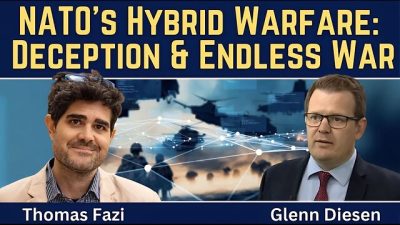
Thomas Fazi: NATO’s Hybrid Warfare – Deception & Permanent War
or go to
Aletho News Archives – Video-Images
Book Review
UAE tortured, killed journalist for opposing Israel normalization
The Cradle | October 31, 2026
UAE security officers detained, tortured, and killed Emirati poet and news editor Habib al-Sayegh in August 2019, shortly after he published a column opposing UAE normalization with Israel, according to a newly published book.
“Princes and Thieves,” a book by investigative journalist Matthew Cole published on 25 October, alleges that UAE security officers raided Sayegh’s Abu Dhabi home shortly after the publication of the column, hooded him in front of his wife and took him to a detention facility where he was tortured to death.
His interrogators reportedly pulled out several of his teeth with pliers and beat him repeatedly with a sharp metal object.
On 11 August 2019, Sayegh criticized the UAE’s plan to normalize relations with Israel as part of the Abraham Accords in his weekly column for Khaleej newspaper. The column was titled “Israel Is Our Real Enemy and A Dangerous Project.”
Sayegh described Israel as “a real and natural enemy” while questioning “who authorized the normalizers to speak on behalf of everyone?”
Nine days after the column was published, Emirati state media announced his death, without stating a cause. … continue
Blog Roll
 Aletho News
- UAE security forces tortured, killed journalist for opposing Israel normalization: Report
- They Compared the Spice to the Drug. The Spice Won — Again. (Part 2)
- Thomas Fazi: NATO’s Hybrid Warfare – Deception & Permanent War
- Wrong, AP and NPR: Europe’s 50,000 Heat Deaths Are a Computer-Model Estimate, Not a Real Body Count
- Questioning Your Doctor Is Now Considered A Psychological Problem (Seriously)
- London tourism expo promotes Israeli agency linked to theft of Palestinian land
- Dockworkers launch global strike against Israeli and US military shipments
- Europe facing gas price shock – Gazprom chief
- Ukraine continues recruiting people with disabilities
- Weaponized Journalism: 2021 Sayer Ji Interview with NPR
- If Americans Knew
- An error has occurred; the feed is probably down. Try again later.
- No Tricks Zone
- Germany’s Green Energy Transition Becoming Increasingly Expensive…Another 6 Trillion Euros!
- Sudden Stratospheric Warming, Powerful El Niño Combination May Lead To Extreme Europe Cold, Energy Crisis!
- Two New Studies Find Thwaites Glacier Melt Cannot Be Driven By Human Activity Or A Warming Ocean
- E-Cars Reduce CO2 Emissions By Only 41% Compared To Internal Combustion Engine Vehicles
- Predictions Made By Renowned Climate Professor Over Past Decades Have Been Proven To Be Poor
- New Study Suggests Large Regions Of The Pacific Ocean Have Been Cooling For The Last 80 Years
- Germany’s Green Energy Debacle: High Energy Costs Force Kahla Porzellan to Close After 182 Years!
- New Study: 50 Years Of The Most Aggressive ‘Net Zero’ Policies Can Only Affect The Global Climate By 0.03°C
- US September “Heat” Was No Record…Many Records Set Decades Ago
- Latest European Green Energy Debacle; Portugal’s Largest Flagship Solar Park Insolvent!

