West’s efforts to isolate Russia have failed – Lavrov
RT | April 29, 2023
The West has failed to isolate Russia, with the majority of the world still interested in maintaining good relations with Moscow, Foreign Minister Sergey Lavrov has said. He also argued that the trend toward multipolarity is irreversible, whether former colonial powers like it or not.
Addressing the World Online Conference on Multipolarity on Saturday, Lavrov said that “Washington’s and its satellites’ efforts to reverse history, to force the international community to live by the invented ‘rules-based order’” are proving to be a fiasco, citing the “total failure” of the West “to isolate Russia.”
According to the foreign minister, a number of countries, which combined are home to 85% of the world’s population, have made it clear that they will not do the bidding of the former colonial powers.
The Russian diplomat said the fact that delegates from several dozen nations “from nearly every continent” attended the online forum shows just how much traction the idea of multipolarity has gained.
Lavrov noted that new global centers are emerging in Eurasia, the Indo-Pacific region, the Middle East, Africa, and Latin America, and that these nations are pursuing independent policies guided by national interests.
According to the foreign minister, developing nations have been steadily expanding their share in the global economy over the past three decades, while the role of the G7 nations has been diminishing.
He also hailed the fact that more and more countries have expressed interest in joining international groups “of the new kind,” such as BRICS and the Shanghai Cooperation Organization (SCO).
Russia, Lavrov explained, champions a multipolar world order based on respect for the UN charter, and a “balance of interests” as opposed to a “balance of fear.”
President Vladimir Putin said on Friday that Moscow will not abide by the “so-called rules” invented and imposed by “certain countries.”
Also on Friday, while addressing members of the SCO, Defense Minister Sergey Shoigu claimed that the West is putting “unprecedented pressure” on independent countries to pit them against Russia and China, and undermine the rise of the multipolar world.
On Monday, Lavrov called for the expansion of Asian, African, and Latin American representation in the UN Security Council, arguing that the West is over-represented in the international body.
Meeting of the Defense Ministers of the Shanghai Cooperation Organization in Delhi
By Gilbert Doctorow | April 28, 2023
One quite important event today in global politics is unlikely to receive coverage in The New York Times, The Financial Times, the BBC or Euronews. I have in mind the meeting in Delhi of the defense ministers of the Shanghai Cooperation Organization.
The SCO is one of the two principal bodies that bring together the nations that are today challengers to the US-dominated world order. The other such body is BRICS.
Whereas BRICS is primarily an economic fraternity with focus on commercial relations among its members, meaning a platform of Soft Power, the SCO is primarily a Hard Power fraternity focusing on the security of its member states. It is also more limited geographically, concentrated on Eurasia. Its founding members were China, Russia, Kazakhstan, Kyrgyzstan and Tajikistan. Today it also includes Uzbekistan, India and Pakistan. Among the states accorded “observer” status are Afghanistan, Mongolia and Iran. And at its edges as “dialogue partners” are Armenia, Azerbaijan, Cambodia, Egypt, Nepal, Qatar, Saudi Arabia, Sri Lanka and Turkey.
There were a couple of outstanding and newsworthy developments at the SCO gathering in India today. One was the speech delivered by Russian Defense Minister Sergei Shoigu. Several minutes from this speech were carried on Russian news channels and what we heard was Shoigu declaring that from the start of the Special Military Operation in Ukraine the Collective West was throwing all of its military assets against Russia.
The other noteworthy development was the side meeting of Shoigu and his Chinese counterpart Li Shangfu. They were shown on television walking side by side to that meeting. Russian news tells us that Li used their meeting to extend an invitation to Shoigu to visit him in Beijing, and that Shoigu accepted.
The impact on the other SCO member states, observers and dialogue partners of these close and fast developing relations between the Russian and Chinese defense ministries cannot be overstated. Today they were all direct witnesses of this fact. Among other things, this spells the end of opportunities for Central Asian states to play Russia off against China in obtaining favors, as Western media believed they were doing. It completely vitiates all efforts by U.S. Secretary of State Blinken over the past several months to pressure these same Central Asian countries into loosening or breaking ties with Moscow. These states are now all caught between a rock and a hard place.
The drama of the Russian-Chinese entente also will bear on the future conduct of India and Pakistan. Here, too, the options for playing games or fence sitting are fast disappearing. For their part, Iran and Saudi Arabia will surely be among the countries taking great comfort in the bloc forming between the states they rely on to pursue a foreign policy independent of diktat from Washington.
©Gilbert Doctorow, 2023
Alarms Are Sounding as Mideast Nations Begin to Put Distance From US Influence
Sputnik – 28.04.2023
WASHINGTON – US partners in the Middle East are beginning to distance themselves from American influence amid efforts to stabilize the region, which may be a concern to Washington, former US Ambassador to Saudi Arabia Chas Freeman told Sputnik.
Saudi Arabia recently took diplomatic action to thaw relations with Iran, Syria, and Hamas, while Bahrain and Qatar agreed to resume diplomatic ties. In mid-April, Syrian Foreign Minister Faisal Mekdad traveled to Saudi Arabia, marking his first visit to the country since 2011, to discuss efforts to reach a possible political solution to the crisis.
At the UN on Monday, Russian Foreign Minister Sergey Lavrov said the world must boost efforts to reach political settlements and stabilize conflict zones in the Middle East now more than ever as the region undergoes deep transformation.
Lavrov also said a multilateral approach is required to resolve the Palestinian-Israeli crisis, instead of what he called the “destructive” one-sided actions of the US and EU that have harmed the Mideast peace process.
“The countries of West Asia are coming to see themselves as members of what [Russian political scientist] Sergei Karaganov has called ‘the world majority’ and distancing themselves from the United States,” Freeman said. “All this represents a diminution of American influence that is naturally of concern to Washington.”
The Eastern part of the Arab world, Freeman added, has long been subjected by external powers, but it is now in the midst of a self-driven rearrangement of regional relationships.
“Its major actors have seized control of their own destiny for the first time since Napoleon’s 1798 invasion of Egypt and are seeking their own answers to their region’s problems,” Freeman said.
According to Freeman, the Middle East is now led by assertively independent leaders with their own determination about how their national interests will be best served, and they do not respond well to outside efforts to dictate policy in the region.
“These leaders have learned the hard way that the use of force and covert action not only solves few problems but is often costly and counterproductive,” Freeman said. “The result is a search for peace and stability between the countries of the region without regard to the views of the United States and the former colonial powers.”
Mideast nations, Freeman said, are expanding their outreach to rising and resurgent powers like China, India, Brazil, and Russia and by identification with post-Cold War institutions like the BRICS and the Shanghai Cooperation Organization, entailing the adoption of a nonaligned stance on matters between external great powers like the contention between the United States, Russia, and China.
Freeman is an American retired diplomat and writer who served in the US Foreign Service, and in the departments of State and Defense, in many different capacities over 30 years.
“Political Engineering” From Abroad Is Responsible For The Sudanese Crisis
BY ANDREW KORYBKO | APRIL 27, 2023
Russian Deputy Permanent Representative to the UN Anna Yevstigneyeva shared her thoughts earlier this week about the root cause of the Sudanese Crisis. According to her:
“We must state that the current Sudanese crisis was largely caused by an external interference in Sudanese sovereign affairs, attempts at forced political engineering in the country and imposing democratic recipes on it.
Security sector reform in the country was among the most complicated issues that required elevated attention and a thorough negotiations process. At the same time, we saw that many external actors tried to enforce the transfer of authority to civil powers artificially, and imposed a number of decisions that were not supported among broader population.
Some states widely promoted the political framework of 5 December 2022, but it failed to become an inclusive platform for various Sudanese forces. This format left behind some of Sudan’s political heavyweights. Such an approach could hardly help to promote a comprehensive settlement.”
The present piece will now elaborate more on why she’s right, which is important to understand since such “political engineering” from abroad can result in more crises elsewhere in the coming future.
Former Sudanese President Bashir was a long-time foe of the US, which supported his ouster in early 2019 after a military coup took advantage of an incipient Color Revolution. Chief General Abdel Fattah Al-Burhan from the Sudanese Armed Forces (SAF) and General Mohamed Hamdan Dagalo (“Hemedti”) of the Rapid Support Forces (RSF) cooperated to this end but then fell out with one another afterwards. Their resultant feud greatly complicated Sudan’s post-coup political transition to civilian rule.
The US diplomatically intervened in this process on the pretext of “protecting democracy”, which enabled it to unprecedentedly deepen its influence in Sudan. With this inside view into that country’s most sensitive political affairs, it learned just how serious the divisions were between Burhan and Hemedti as well as between the military and the population. This insight would have informed its policymakers that meddling in Sudan’s transition posed a very real risk of provoking conflict.
That cynically seems to be precisely what the US was hoping for in hindsight so as to artificially manufacture a crisis that could subsequently be exploited to push back against Russian influence there exactly as was explained at length in this recent analysis here. To that end, it pressured Sudan to accelerate its security sector reform on the grounds that this would speed up its democratic transition, but which was intended all along to force Burhan into making a power play against Hemedti.
Had there been no such reform in the first place or if it was decoupled from the transition to civilian rule, then those two influential figures might have peacefully worked out their differences or at least agreed not to interfere in the other’s economic and security affairs. In that scenario, however, the US would have feared that the continued existence of Hemedti’s independent power center within the armed forces could be taken advantage of by Russia/Wagner to pose a latent threat to its influence in Sudan.
That’s not to suggest that Russia/Wagner had any such intentions, but just to point out the fears that influenced US policymakers to plunge Sudan into crisis by pressuring it to accelerate security sector reform with the intent of provoking a “deep state” war. Burhan was assessed by them as being much more reliable than Hemedti, especially since the former is considered an Egyptian proxy while the latter admitted that he used to have “a good relationship” with Wagner prior to them being sanctioned.
The US didn’t expect Hemedti to put up such an impressive fight, having likely calculated prior to the outbreak of this artificially manufactured crisis that the RSF would either be swiftly subordinated to the SAF or dissolved. That outcome would have much more smoothly expanded the US’ influence in Sudan, but the conflict that Burhan’s power play against Hemedti sparked can also be exploited by it to this end too, albeit at a reduced pace and with the risk of weakening US influence.
If the US-backed SAF are defeated or enter into some sort of peace deal with the RSF that preserves the second’s independent power center, then this “deep state” war that the US artificially manufactured wouldn’t advance its strategic interests. The former scenario would be counterproductive to the aforesaid while the latter would restore the status quo ante bellum and thus leave open the possibility of Russia/Wagner working through the RSF to curtail the expansion of US influence in Sudan.
Nevertheless, the US would prefer the second scenario if forced by circumstances to choose between them, which could explain why it’s urgently calling for a ceasefire after the SAF underperformed and didn’t come anywhere close to meeting policymakers’ expectations. They might calculate that it’s better to have a lull in fighting that safeguards US influence in Sudan and possibly creates the opportunity for the SAF to subvert the RSF through non-kinetic means under the cover of the democratic transition.
In any case, it’s unlikely that the US will leave the RSF alone since its policymakers have already arguably concluded – whether rightly or wrongly – that it’s the greatest threat to their country’s influence in Sudan. This assessment suggests that it’ll continue working against that group’s interests one way or another, which it’s already begun doing through its information warfare campaign fearmongering about the RSF’s ties with Russia/Wagner.
Accusations of war crimes might soon follow, after which sanctions could be imposed too. It also can’t be ruled out that the US would support a more direct Egyptian role in the conflict if Burhan appears on the brink of defeat and Hemedti refuses to cut a power-sharing deal with him. A direct US intervention is also possible under the “humanitarian intervention”/“Responsibility to Protect” (R2P) pretext. Observers should therefore closely monitor this “deep state” war for any signs of these scenarios unfolding.
Returning to Yevstigneyeva’s analysis of this conflict’s origins, which was elaborated throughout the present piece, the importance lies in the fact that the meddling model that she described can be applied against other countries too. US pressure on them to implement security reform, especially in those countries undergoing democratic transitions from military rule, could spark similar crises as Sudan’s. Upon becoming aware of such demands, one can likely predict the next New Cold War battleground.
Russia cannot lose its UNSC seat despite Western and Ukrainian attempts
By Ahmed Adel | April 27, 2023
The US has a strong ambition to add its allies to the United Nations Security Council to weaken Russia’s influence across the world, or if this fails, to render the organisation useless, akin to the old League of Nations. However, even more dangerous than the US seeking more allies in the UNSC are the initiatives to abolish Russia’s right of veto and take away its status as a permanent member. Kiev raises this suggestion at almost every session of the UN General Assembly.
In this sense, new challenges are being created, especially as UN Secretary General António Guterres stated that the majority of UN member states see the need for reforming the UNSC. Such suggestions must be treated with suspicion though as the US wants to take advantage and weaken not only Russian influence, but also Chinese.
Guterres and the US are clearly trying to push their closest allies, such as Germany, Australia, and Japan, where unsurprisingly American military bases are located, into the UNSC. There are also other countries, such as Turkey, which regularly raise the issue of UNSC reform and complain that the fate of humanity should not depend on five countries – China, France, Russia, the UK, and the US.
However, Turkey’s suggestion is problematic as the UNSC would be inundated with permanent membership requests from dozens of middle powers who have equal or greater power than Turkey, such as Egypt, Iran, and Saudi Arabia. Realistically, at this current junction, an expanded permanent UNSC could only include Brazil and India, the former because it is the most important country in Latin America and the latter because it is on a rapid path towards Great Power status.
None-the-less, Moscow, just like Washington, is in favour of reforming the UNSC, but with significantly different views. While the US and its allies are pushing reforms as a possible way to limit Russian influence, Moscow believes that the Security Council should to be expanded, but to achieve a more equitable world and to not empower Western aggression.
Russian Foreign Minister Sergey Lavrov explained that the composition of the UNSC should be strengthened by Asian, African, and Latin American countries, which are not represented in the UNSC, with the exception of China in regards to Asia. Therefore, in Moscow’s view, the UNSC should not be expanded only so that the West and its closest allies, such as Japan, can get additional seats. Moscow wants to balance the UNSC because the West has three of five permanent seats despite comprising only a minority of humanity.
It is clear that Lavrov has strategically put the West in a difficult position because if they veto the expansion initiative, it will lead to a backlash from countries like India which believe they have earned a right to a permanent seat in the UNSC. At the same time, Lavrov and his Chinese counterpart must be cautious on expansion so that the UNSC does not transform into a political branch of NATO.
The UN Charter does not provide for a reform procedure, and this especially applies to the UNSC, which is the most important body of the organisation. By recklessly expanding the body, the contradictions and conflicts of interest, which already hinder the UNSC in its current format, would elevate.
Therefore, in the current geopolitical situation, it will be very difficult to reform the UNSC in such a way as to objectively consider the interests of all participants in the process. A permanent UNSC membership is a privilege and not something to lightly contemplate expanding upon.
There is also no legal basis to exclude Russia from the UNSC, limit its status and deprive it of veto rights. The entire architecture of the UN was originally built on the fact that the five great powers, the winners of the Second World War, assumed the role of guarding the global world order. The founding states cannot exclude each other because if one or two pillars are thrown out, the UN would collapse.
If Russia was somehow excluded, it would mark the destruction of the entire system based on international law, on the UN Charter, and would call into question the existence of the UN itself. Russia, however, is a permanent member of the Security Council and has veto power. This practically means that Russia, if the Charter is applied, can only be expelled if it does not exercise its veto power. Therefore, it is impossible to deprive Russia of that right, despite constant Ukrainian attempts.
Hypothetically, there are two scenarios in which Russia could lose its seat in the UNSC – first, if it excludes itself and second, if the UN ceases to exist as an organisation. It is recalled that the Soviet Union was foolishly excluded from the League of Nations, the forerunner of the UN, but that organisation ceased to exist. The same fate would befall the UN if Russia was expelled.
Ahmed Adel is a Cairo-based geopolitics and political economy researcher.
South Africa’s Neutrality In The New Cold War Is Under Threat From Western Pressure
BY ANDREW KORYBKO | APRIL 26, 2023
South Africa’s recent flipflopping on its membership in the “International Criminal Court” (ICC) proves that its neutrality in the New Cold War is under threat from Western pressure. President Ramaphosa announced on Tuesday that “the governing party has taken that decision that it is prudent that South Africa should pull out of the ICC” due to its “unfair treatment” of certain countries. Shortly after, however, his office claimed that he misspoke and reaffirmed South Africa’s commitment to the ICC.
Nevertheless, there are reasons to suspect that this isn’t the case, especially since Ramaphosa exuded supreme confidence in sharing Tuesday’s announcement about his country’s plans to pull out of that global body. It’s therefore unlikely that he simply misspoke and much more probable that Western diplomats immediately intervened behind the scenes to pressure him into walking back this policy. They presumably acted so swiftly due to the strategic significance of everything that’s at stake right now.
South Africa will host this year’s BRICS Summit in late August, but the ICC’s warrant for President Putin’s arrest complicates his participation in person. Had Ramaphosa initiated the process for withdrawing his country from that organization on the legitimate pretext that he earlier claimed would be employed, then there’d be no ambiguity about the Russian leader’s safety if he showed up there. Since this policy was just walked back, however, there are reasons to suspect a Western provocation if he appears.
Even though South Africa declined to arrest former Sudanese leader Bashir despite the ICC having previously demanded that all members do so if he sets foot on their territory, President Putin’s security can’t in good conscience assume that they’ll make an exception for him too. The most responsible decision amidst that summit host’s latest flipflopping might therefore be for him to participate virtually in order to not take a chance that something terrible could happen.
While the organizational proceedings would still likely unfold as planned in that scenario with only few modifications, very serious and potentially even irreparable damage might be inflicted on BRICS as a result. China and India could conclude that South Africa is an unreliable partner seeing as how it would have capitulated to Western pressure, while they’d also expect Brazil to do the same since it’s a party to the ICC too and its top diplomat earlier implied that his country might arrest President Putin if he visits.
BRICS in its present form can theoretically continue to function as the engine of financial multipolarity in spite of the Russian leader being unable to visit either of those two member states for its summits, but the organization might struggle to attract new members whose countries aren’t part of the ICC. After all, the leaders of Iran, Saudi Arabia, and Turkiye could potentially be served similarly politicized warrants one day too that would preclude their participation in BRICS summits hosted by ICC states.
The US has an obvious interest in dissuading them and others from joining BRICS as official members, and its speculative behind-the-scenes pressure on South Africa to remain committed to serving the ICC’s arrest warrant against President Putin could have a powerful deterrent effect on candidate countries. This year’s summit is supposed to see its incumbents reach a consensus on expanding their organization, which is incredibly urgent to do considering that at least 19 states are vying to join.
The larger context in which South Africa just flipflopped on its ICC commitments is therefore of outsized importance not just for BRICS’ future, but by extrapolation, also for the emerging Multipolar World Order as well due to that group’s function as the engine of financial multipolarity. With this in mind, it can be concluded that the US’ clandestine pressure campaign is a major power play in the New Cold War aimed at impeding BRICS’ ability to collectively challenge the dollar anytime soon.
Iran hacks three enemy aircraft, two simultaneously, flying near its airspace: Defense official
Press TV – April 24, 2023
The chief executive officer of Iran Electronics Industries (IEI) says Iranian experts have employed an array of electronic warfare tactics to successfully hack three hostile aircraft as they were on reconnaissance missions in the country’s airspace.
“A while ago, a hostile aircraft breached our flight information region (FIR) and started emitting waves in order to collect information. We confronted the plane straight away. The enemy pilot thought there was a technical glitch with his aircraft system; so he contacted his command center and informed them of the problem and the decision to return. That communication is in our possession,” Brigadier General Amir Rastegari, whose company is a state-owned subsidiary of Iran’s Ministry of Defense, told Tasnim news agency on Monday.
In aviation, FIR is a specified region of airspace in which a flight information service and an alerting service (ALRS) are provided.
Rastegari added, “The following day, two more enemy aircraft flew over the area in close proximity to each other. We disrupted their activities in yet another hacking operation as we had already detected and uncovered the bandwidth.”
“As soon as we started jamming, the two planes realized that Iranian ground systems were disrupting them. They, therefore, informed their command center about the presence of a jamming system in the area and their inability to operate there,” he added.
Rastegari underscored that the capability now exists in all units of the Iranian Armed Forces, and Iranian forces can at anytime jam hostile aircraft from a distance of several hundred kilometers away.
The Iranian Defense Ministry official went on to say that Iran’s military technicians have been for years engaged in electronic warfare to protect the country’s airspace, emphasizing that any intruding aircraft which has sought to penetrate into Iranian skies knows all about such indisputable prowess.
Earlier this month, the Iranian Army’s Ground Force unveiled its first indigenously-manufactured jammer drone, which is designed to disrupt the communication between hostile unmanned aerial vehicles (UAVs) and their controllers.
Mohajer-6 jammer drone, equipped with a high-tech system capable of transmitting interfering radio signals, was inaugurated in a ceremony attended by Major General Abdolrahim Mousavi, the chief commander of the Iranian Army, and a number of senior commanders of the Army’s Ground Force on April 11.
The jammer drone is the Army’s first UAV with the capability to operate and support electronic warfare and electronic offense against the enemy’s communication networks.
Iranian military experts and engineers have in recent years made remarkable breakthroughs in manufacturing a broad range of indigenous equipment, making the armed forces self-sufficient.
Iranian officials have repeatedly underscored that the country will not hesitate to strengthen its military capabilities, including its missile power, which are entirely meant for defense, and that Iran’s defense capabilities will be never open for negotiations.
Leader of the Islamic Revolution Ayatollah Seyyed Ali Khamenei has repeatedly called for efforts to maintain and boost Iran’s defense capabilities, decrying enemies for questioning the country’s missile program.
Transgender Epidemic Driven by Tidal Wave of Autism Spectrum Disorder
Elevated rates of autism, other neurodevelopmental and psychiatric diagnoses, and autistic traits in transgender and gender-diverse individuals
By Peter A. McCullough, MD, MPH | Courageous Discourse | April 24, 2023
Like infectious disease pandemics, chronic illnesses can rise up and become dominant in clinical practice and in the media. No one would deny that the news cycle has adeptly replaced COVID-19 stories with the rise of transgenderism. Is there a real epidemic of gender dysphoria? What could be causing it?
Warrier et al, published a detailed analysis using multiple psychological instruments among a large sample size (N=641,860) with gender dysphoria treated with transgender hormonal/surgical therapy. The results are striking. Compared to normal reference groups, transgender individuals had up to a 12-fold increased risk of autism.
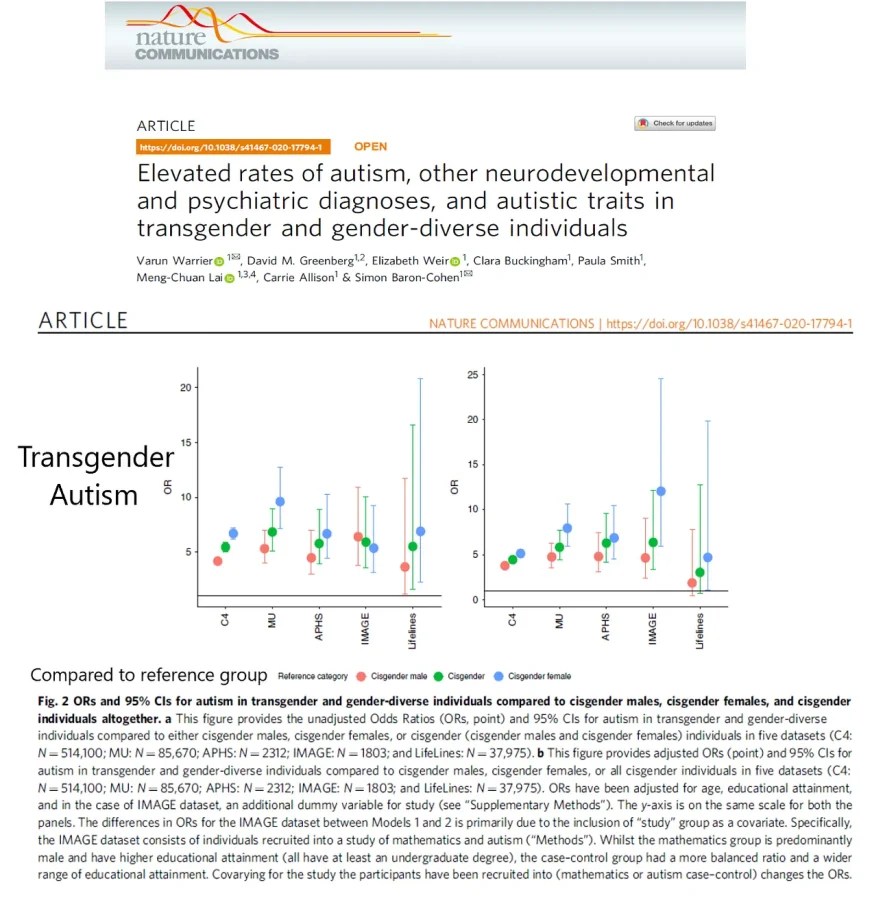
Warrier V, Greenberg DM, Weir E, Buckingham C, Smith P, Lai MC, Allison C, Baron-Cohen S. Elevated rates of autism, other neurodevelopmental and psychiatric diagnoses, and autistic traits in transgender and gender-diverse individuals. Nat Commun. 2020 Aug 7;11(1):3959. doi: 10.1038/s41467-020-17794-1. PMID: 32770077; PMCID: PMC7415151.
The authors summarized: “In conclusion, our study demonstrates that transgender and gender-diverse individuals have elevated rates of autism diagnosis, related neurodevelopmental and psychiatric conditions, and autistic traits compared to cisgender (normal) individuals. This study has clinical implications by highlighting that we need to improve access to care and tailored support for this under-served population.”
They are implying that neuropsychiatric care could be pivotal instead of the suggestion and promotion of gender change procedures in this vulnerable population. The implications of this paper are wide-ranging. School counselors should refer students for psychological assessment of autism and related disorder instead of prompting gender change to young, suggestable children. Furthermore, there should be a moratorium on transgender medicine while the full role of skyrocketing autism is evaluated among children with gender ambiguity approaching puberty.
China’s Ambassador To France Taught The West A Lesson About The “Rules-Based Order”
BY ANDREW KORYBKO | APRIL 24, 2023
The “rules-based order” concept is sold by the West as upholding the UN-enshrined system, but it’s really about the arbitrary implementation of double standards designed to advance America’s interests. Certain objective observations are exploited in pursuit of manipulating perceptions about a given issue, which is intended to precondition the targeted audience to support a unilateral change to the status quo that always in one way or another serves the US’ interests.
For instance, the observation that the Communist Party of China (CPC) hasn’t ever controlled Taiwan is exploited to extend credence to the latter’s tacit separatist agenda, which is in turn spun in order to justify the West comprehensively expanding its relations with that island. Chinese Ambassador to France Lu Shaye just taught the West a lesson about how this feels after sharing his thoughts on the legal status of former Soviet Republics.
In his personal view, “Even these ex-Soviet countries don’t have an effective status in international law because there was no international agreement to materialize their status as sovereign countries.” He also referenced Crimea’s original legal status as part of the USSR’s Russian constituent prior to it being gifted by former Soviet leader Khruschev to Ukraine. Since Ambassador Lu shared these thoughts during a TV interview, it was assumed by many that he was officially reflecting a new Chinese position.
Chinese Foreign Ministry Spokesperson Mao Ning clarified her country’s stance on Monday in response to a related question from TASS :
“After the demise of the Soviet Union, China was one of the first countries to establish diplomatic relations with the [newly created] countries. Since the inception of diplomatic relations, China has always adhered to the principle of mutual respect and equal treatment while fostering bilateral relations of friendship and cooperation. China respects the sovereign status of the republics that were founded after the Soviet Union disintegrated.”
As can be seen, there exists no change in China’s position, thus meaning that Ambassador Lu was indeed speaking in a personal capacity.
Nevertheless, he didn’t explicitly say so when sharing his thoughts on this subject, though it’s unlikely that this was a faux pas from the man whose civilization-state has literally millennia worth of diplomatic experience. Rather, it was almost certainly the case that he was tasked with indirectly sending them a message on a “plausibly deniable” basis about how the “rules-based order” concept feels whenever it’s applied to imply an impending unilateral revision of the status quo with respect to Western interests.
South China Morning Post columnist Alex Lo compellingly explained this in his piece about how “China’s questioning sovereignty of post-Soviet states is tit-for-tat over Taiwan”. Basically, Beijing finally got fed up the West flirting with tacit Taiwanese separatism, hence why it had one of its most prominent diplomats in that de facto New Cold War bloc make a tit-for-tat comment in the way that Ambassador Lu did. By doing so, China taught the West a lesson that it’ll never forget even if they don’t ultimately learn from it.
If regional military developments take a decisively negative turn against Russia, however, then China might feel forced to arm its strategic partner as a last resort to ensure its national security interests. In that case, the “plausibly deniable” basis upon which China just made its point about the “rules-based order” could be returned to, albeit as a more official position in that case. The chances of events unfolding in that direction remain low, but this scenario adds further context to the examined incident.
Bulgarians hit streets against US-led NATO, urge Sofia’s neutrality in Ukraine war
Press TV – April 24, 2023
Thousands of Bulgarians have poured into the streets against the US-led NATO military alliance in the capital Sofia, calling on their government to adopt a neutral position on Russia’s military operation in Ukraine.
The angry demonstrators hit the streets on Sunday carrying national flags and signs that read, “Bulgaria is not NATO, NATO is not Bulgaria” and “I want peace”.
Anti-war activists in the Balkan nation also collected signatures for a referendum called ‘Bulgaria for Peace and Sovereignty’ in a bid to prevent Sofia’s potential involvement in the Ukraine war that completed a year recently.
“If Bulgaria enters as a party to this conflict, some of those killed will be Bulgarians. This is something we do not want, something we will not allow,” activist Grigor Saryiski was quoted as saying.
Bulgaria is a member of the European Union and the US-led NATO military alliance, but it also has close historical and cultural ties with Russia.
Over the past two years, it has been ruled by technocratic caretaker governments, fueling political instability in the East European country.
Bulgaria has refused to toe the line of other NATO members in getting fully involved in the Ukraine war.
Under former Prime Minister Kiril Petkov’s government, however, a secret supply of Bulgarian-made ammunition made its way to Ukraine as early as April 2022, according to reports.
Snap parliamentary elections were held in Bulgaria earlier this month, with analysts predicting the results could influence Bulgaria’s position on the war.
The center-right bloc GERB-SDS, led by former Prime Minister Boyko Borisov, won the elections, with the centrist bloc comprising ‘We Continue the Change’ (PP) and Democratic Bulgaria (DB) taking the second place.
Both centrist bloc parties share pro-European, pro-NATO positions and strong support for Ukraine.
The far-right Revival party, which ended up in third place in the polls, is seen as sympathetic to Russia.
Iran Praises Robert F. Kennedy Jr. for Admitting US is the ‘Godfather of Daesh’
By Ilya Tsukanov – Sputnik – 21.04.2023
Iran has spent years accusing the US of helping to create and nurture Daesh. In 2018, Revolutionary Guards Quds Force Commander Qasem Soleimani urged Iranian diplomats to go to the UN and “slap” the West “in the face” with evidence of US collusion with the terrorist group. Soleimani was later killed [assassinated] in a US missile strike in Baghdad in 2020.
Iranian Foreign Ministry spokesman Nasser Kanaani waded into the US presidential politics on Friday, offering praise for Democratic hopeful Robert F. Kennedy Jr. for confirming Tehran’s long-stated view that the Daesh/ISIS terror group was created by Washington.
“There was no doubt the US is the creator of #ISIS, but for those who deliberately closed their eyes to the truth, the statement of Robert F. Kennedy, the nephew of John F. Kennedy saying ‘WE created ISIS’ reaffirms the fact that the American regime is the godfather of Daesh/ISIS,” Kanaani tweeted.
The spokesman followed up the message with a Farsi-language tweet featuring a video excerpt from RFK Jr.’s speech in Boston, Massachusetts on Wednesday in which the politician pointed out how US intelligence agencies have repeatedly lied Americans into pointless foreign wars, destroyed nations and given rise to terrorism, including Daesh.
“My uncle came into office, two months later he was fighting his intelligence apparatus and his military because they wanted to invade – they wanted to do the Bay of Pigs. He was totally against it [but] he let them roll over them. And in the middle of the Bay of Pigs he realized they were lying to them and he realized that the function of the intelligence agencies had become to provide the military-industrial complex with a constant pipeline of war. And he came out during the middle of the night during the Bay of Pigs catastrophe and he said ‘I wanna take the CIA and shatter it into a thousand pieces and scatter it to the winds’,” RFK Jr. said.
“And George W. Bush had the same problem. George W. Bush says the worst mistake he made as president was listening to CIA director George Tenet telling him it was a ‘slam dunk’ that Saddam Hussein had weapons of mass destruction. And so the neocons and the CIA got to go into Iraq and… do regime change. Now we’ve spent $8 trillion and what did we get for that $8 trillion? Nothing. Worse than nothing. Iraq is now much worse off than it was when we went in there. We killed more Iraqis than Saddam Hussein ever did. We may have killed a million Iraqis, nobody knows the number… We created ISIS. We drove two million refugees up into Europe, they destabilized democracy for a generation in Europe, they caused Brexit. This is the cost of the Iraq War,” the politician said.
RFK Jr. is not the first candidate for president to accuse the United States of “creating” the terrorist group. In 2016, then-Republican candidate Donald Trump repeatedly called then-President Barack Obama literally the “founder of ISIS,” and dubbed former Secretary of State “‘Crooked’ Hillary Clinton” the “cofounder.”
Iran has spent years blaming the United States for creating the regional instability which gave rise to Daesh, and has accused Washington of using its battle against the Sufi jihadist group as an excuse to justify its illegal occupation of Iraq and Syria. Some Iranian officials have gone further, accusing the US military of providing Daesh with weapons and funding and even facilitating the transportation of jihadist leaders aboard US military helicopters. Iran’s Syrian allies have made similar allegations. Pentagon officials have vociferously denied these claims.
Twitter drops ‘state-affiliated’ labels
RT | April, 21, 2023
Twitter has removed ‘state-affiliated’ and ‘government-funded’ labels from major media accounts as part of an unannounced update. The move on Friday follows a string of spats between Twitter and several news organizations over the designations.
Twitter had applied the controversial labels to numerous accounts over the last few weeks, including the BBC, Canada’s CBC, and America’s NPR. In response, the outlets threatened to leave Twitter and suspended their activity on the platform, arguing that the tags were an attempt to undermine their legitimacy or suggest a lack of editorial independence.
CEO Elon Musk explained that Twitter was only “trying to be accurate” and even changed some of the labels, switching the BBC’s designation from “government-funded” to “publicly-funded,” while CBC’s tag was reworded as “69% government-funded.”
However, as of Friday, no labels could be seen on any of the accounts mentioned. The tag was also removed from other media outlets, including Russia’s RT and Sputnik, and China’s Global Times and Xinhua. The label was likewise absent from the accounts of journalists associated with the outlets.
Before Musk’s $44 billion takeover of Twitter last year, the “state-affiliated media” tag had primarily been reserved for non-Western outlets, mainly in Russia and China. Twitter’s previous management said in 2020 that the designation was meant to inform the public “when a media account is affiliated directly or indirectly with a state actor.” Twitter also said at the time that it would stop amplifying such accounts or their tweets through its recommendation systems.
The latest update to the platform has also seen the long-anticipated removal of all legacy blue check marks that previously identified the verified accounts of celebrities, journalists, and prominent politicians. Those wishing to have the icon next to their name must now pay an $8-per-month Twitter Blue subscription fee.
Musk announced the dismantling of the legacy blue checkmark shortly after he closed the deal to purchase Twitter, revealing he wanted to monetize the feature to make the company more profitable. In addition to the basic Twitter Blue subscription, the platform now offers businesses a $1,000-per-month gold verification badge, which also allows them to verify their affiliates.
Featured Video
Elijah Magnier: Yemen’s strikes are shattering Saudi Arabia’s long-term strategy
or go to
Aletho News Archives – Video-Images
From the Archives
British weapons and personnel doing much of the killing in Yemen
Press TV – June 18, 2019
A detailed report published by the Guardian newspaper has shown how Britain is massively contributing to Saudi Arabia’s devastating war on Yemen as it suggests that London is not only supplying the bombs that fall on Yemenis, but it provides the personnel and expertise that keep the war going.
The comprehensive report by Arron Merat published on Tuesday showed that Britain was doing much of the killing in Yemen as the country continues to provide Saudi Arabia with everything it needs to turn its southern impoverished neighbor into a graveyard.
“Every day Yemen is hit by British bombs – dropped by British planes that are flown by British-trained pilots and maintained and prepared inside Saudi Arabia by thousands of British contractors,” said Merat in the report. … continue
Blog Roll
 Aletho News
- Racist Seinfeld Dances for Joy as Bibi Unveils His New Map
- A West Bank War for Netanyahu’s Election Campaign, Could It Backfire?
- Yemen denounces European Parliament’s ‘hypocritical’ push to blacklist Ansarullah
- Qalibaf: UAE’s UN bid aims to ‘clear the runway’ for ‘Greater Israel’, whitewash genocide
- Pakistan reopens Iran border after boosting security: Report
- Why are so many Brazilians voting for Flávio Bolsonaro?
- Democrats Put Anti-Russia Agenda Ahead of American Workers
- Elijah Magnier: Yemen’s Strikes Are Shattering Saudi Arabia’s Long-Term Strategy
- Pentagon designates Chinese cultural centers national security threat
- Israel Demolishes Home Of Lebanese Journalist Whose Viral Film Exposed Pager Attack
- If Americans Knew
- An error has occurred; the feed is probably down. Try again later.
- No Tricks Zone
- Sudden Stratospheric Warming, Powerful El Niño Combination May Lead To Extreme Europe Cold, Energy Crisis!
- Two New Studies Find Thwaites Glacier Melt Cannot Be Driven By Human Activity Or A Warming Ocean
- E-Cars Reduce CO2 Emissions By Only 41% Compared To Internal Combustion Engine Vehicles
- Predictions Made By Renowned Climate Professor Over Past Decades Have Been Proven To Be Poor
- New Study Suggests Large Regions Of The Pacific Ocean Have Been Cooling For The Last 80 Years
- Germany’s Green Energy Debacle: High Energy Costs Force Kahla Porzellan to Close After 182 Years!
- New Study: 50 Years Of The Most Aggressive ‘Net Zero’ Policies Can Only Affect The Global Climate By 0.03°C
- US September “Heat” Was No Record…Many Records Set Decades Ago
- Latest European Green Energy Debacle; Portugal’s Largest Flagship Solar Park Insolvent!
- Green Energy Debacle: German Expert Professor Fritz Vahrenholt Warns Of Severe Economic And Social Consequences

