US nukes in Poland would not be a deterrent, but a MASSIVE provocation for Russia
By Scott Ritter | RT | May 19, 2020
The US has promoted the deployment of US nuclear weapons on Polish soil as part of NATO’s ‘nuclear sharing’ arrangement. Such a move would only increase the chances of the very war such a deployment seeks to deter.
For the second time in little more than a year, the US ambassadors to Germany and Poland have commented on matters of NATO security in a manner which undermines the unity of the alliance while threatening European security by seeking to alter the balance of power in a way that is unduly provocative to Russia.
Richard Grenell, the US ambassador to Germany and the acting director of national intelligence, put matters into motion by writing an OpEd for the German newspaper Die Welt, criticizing politicians from within Chancellor Angela Merkel’s ruling coalition who were openly calling for the US to withdraw its nuclear weapons from German soil.
Adding fuel to the fire, the US ambassador to Poland, Georgette Mosbacher, tweeted out two days later that “If Germany wants to diminish nuclear capability and weaken NATO, perhaps Poland – which pays its fair share, understands the risks, and is on NATO’s eastern flank – could house the capabilities here.”
The action that provoked the Grenell-Mosbacher media blitz were comments made by Rolf Mützenich, the chairman of the Social Democratic Party in Germany’s parliament, calling for Germany to withdraw from its decades-old nuclear-sharing arrangement with NATO, noting that the deal had outlived its utility.
The US currently maintains a force of some 20 B-61 nuclear bombs on German soil, where they are earmarked for delivery by German aircraft during war. Since 1979, Germany has maintained a force of Tornado fighter-bombers dedicated to the nuclear-sharing mission. The decision by Germany to buy 30 US-manufactured F/A-18 Super Hornet aircraft to replace the Tornado in its nuclear delivery mission prompted Mützenich’s outburst.
Grenell and Mosbacher last teamed up to shake the foundations of NATO-based European security in September 2019, when Grenell’s comments made during the course of an interview with a German newspaper sparked controversy among German politicians sensitive to US criticism of German defense spending levels. “It is actually offensive to assume that the US taxpayer must continue to pay to have 50,000-plus Americans in Germany,” Grenell said, “but the Germans get to spend their surplus on domestic programs.”
Grenell’s comments were in the context of President Donald Trump’s ongoing insistence that America’s NATO allies pay their fair share of the cost of NATO by increasing their respective defense spending to levels matching two percent of their GDP. Germany’s defense budget in 2019 was approximately €43 billion, representing 1.2 percent of GDP. German lawmakers were quick to criticize Grenell’s comments, noting that while Germany’s defense expenditures were far short of what had been promised, it would not allow itself to be “blackmailed” by the US over matters relating to its national security.
Mosbacher then jumped into the controversy, tweeting“Poland meets its 2% of GDP spending obligation towards NATO. Germany does not. We would welcome American troops in Germany to come to Poland.”
Some left-wing German politicians proposed that Germany take Grenell up on his offer and begin to negotiate the withdrawal of US troops from German soil (there are some 52,000 Americans – 35,000 soldiers and 17,000 civilians – stationed in Germany today).
But these same politicians made a comment that has proved prescient. “If the Americans pull out their troops,” they noted, “then they should take their nuclear weapons with them. Take them home, of course, and not to Poland, which would be a dramatic escalation in relations to Russia.”
This, of course, is precisely what the Grenell-Mosbacher tag team has proposed today.
“NATO’s nuclear sharing,” the current NATO secretary general, Jens Stoltenberg, wrote in an OpEd published in the Frankfurter Allgemeine Zeitung, “is a multilateral arrangement that ensures the benefits, responsibilities and risks of nuclear deterrence are shared among allies.”
“Politically,” Stoltenberg said, “this is significant. It means that participating allies, like Germany, make joint decisions on nuclear policy and planning, and maintain appropriate equipment.”
For its part, Russia has declared the US-NATO nuclear-sharing arrangement as operating in violation of relevant provisions of the Non-Proliferation Treaty (NPT) which prohibits the transfer by a nuclear weapons state of nuclear weapons to a non-nuclear weapons state. While the US challenges this Russian interpretation, the point is that the issue of NATO’s nuclear arsenal is an extremely sensitive one to Russia, made even more so when viewed in the context of the expansion of NATO that brought Poland and other eastern European countries into its fold.
Poland, along with the Czech Republic and Hungary, joined NATO in March of 1999, making a mockery of every assurance that had been given to the former Soviet president, Mikhail Gorbachev, that NATO would never expand eastwards if Germany were allowed to unify.
Russian President Vladimir Putin pointedly referred to these guarantees during his speech to the Munich Security Conference in February of 2007, in the context of NATO’s continued expansion. “[W]e have the right to ask: against whom is this expansion intended? And what happened to the assurances our western partners made after the dissolution of the Warsaw Pact? Where are those declarations today? No one even remembers them.”
Russia remembers. For example, on February 6, 1990, when the former West German foreign minister, Hans-Dietrich Genscher, met with then-British Foreign Minister Douglas Hurd, Genscher told Hurd that “The Russians must have some assurance that if, for example, the Polish Government left the Warsaw Pact one day, they would not join NATO the next.”
These assurances were made by the former US secretary of state, James Baker, to the former Soviet foreign minister, Eduard Shevardnadze, in February 1990, when Baker noted that before Germany could reunify, “There would, of course, have to be iron-clad guarantees that NATO’s jurisdiction or forces would not move eastward.”
These assurances were given, only to be violated during the administration of President Bill Clinton. Today, over 4,500 US troops are stationed on Polish soil, including a reinforced battalion-sized ‘battlegroup’ stationed along the so-called Suwalki Gap separating Poland from the Baltic nations.
“If Russian forces ever established control over the Suwalki region, or even threatened the free movement of NATO personnel and equipment through it, they would effectively cut the Baltic States off from the rest of the Alliance,” a NATO report written in 2018 noted. “Deterring any potential action – or even the threat of action – against Suwalki is therefore essential for NATO’s credibility and Western cohesion.”
For its part, Russia has repeatedly declared that it has no desire to enter a conflict with NATO. However, NATO’s expansion in Poland and other eastern European countries has increasingly placed Russian security interests at risk. The deployment of Aegis Ashore launchers onto Polish soil in an ostensible anti-missile role, while declared by NATO to be exclusively oriented toward protecting Europe from Iranian missiles, is viewed by Russia as a threat to its own strategic missile capability. In response, Russia has deployed nuclear-capable short-range missiles in its Kaliningrad exclave between Poland and Lithuania.
If NATO were to deploy nuclear weapons on Polish soil as part of any upgraded nuclear-sharing agreement, the threat to Russia would be intolerable – every launch of a Polish fighter-bomber would be seen as a potential existential threat, forcing Russia to increase its alert status along its western frontier, as well as its capability to rapidly neutralize such a threat should an actual war break out.
This does not mean that Russia would choose a preemptive nuclear attack – far from it. Instead, Russia would rely on the abilities of the front-line formations of its 1st Guards Tank Army and 20th Combined Arms Army to conduct deep penetration offensive operations designed to capture and/or destroy any forward-deployed nuclear weapons before they could be used. Far from deterring a war with Russia, any deployment of nuclear weapons by the US on Polish soil only increases the likelihood of the very conflict NATO purports to seek to avoid.
Scott Ritter is a former US Marine Corps intelligence officer. He served in the Soviet Union as an inspector implementing the INF Treaty, in General Schwarzkopf’s staff during the Gulf War, and from 1991-1998 as a UN weapons inspector. Follow him on Twitter @RealScottRitter
US donates war equipment to Kiev
By Lucas Leiroz | May 19, 2020
Apparently, Washington is helping to increase the violence in the Donbass. In the midst of a pandemic and the civil war at a softer stage, Kiev is promoting a gradual increase in the actions of pro-Maidan paramilitary groups in the region and receiving international support for this.
The United States has delivered more than $ 25 million worth of night vision devices, thermal cameras, portable communicators and medical equipment to Ukraine for use in the combat zone in Donbas, the US Embassy in Kiev reported.
In its account on a social network, the American Embassy to Kiev published the following note in English and Ukrainian: “Despite COVID-19, our security assistance to Ukraine continues! This week, the Office of Defense Cooperation received more than $ 25 million in night vision devices, thermals, radios, and medical equipment for Ukraine to use in the JFO zone. The United States stands strongly with Ukraine in support of its sovereignty and territorial integrity in the face of Russian aggression”.
The US, according to the note, supports Ukraine’s sovereignty and territorial integrity. As we know, since April 2014, Ukraine has carried out an operation against militias in the east of the country – Donbas region – where the popular republics of Donetsk and Lugansk were proclaimed in response to the violent change of government that took place in Kiev in February of the same year. However, the Minsk agreements, signed in September 2014 and February 2015, laid the foundation for a political solution to the conflict. Unfortunately, so far they have not led to a definitive cessation of violence, the outcome of which the UN estimates at around 13,000 deaths.
Despite not putting a real end to the confrontation, the Minsk agreements managed to establish some bases for a peaceful future, so that, since then, the war has reduced the intensity of the fighting and presented a drop in the number of victims. But, since then, Kiev has been constantly denounced for tightening its policies in the region again and promoting an escalation of violence, not only through direct confrontation with separatists, but also through terrorist attacks, secret missions and intelligence operations. In a sense, the Accords have changed the face of war, from being a direct confrontation conflict to becoming a scene of constant tensions and intermittent fighting.
A few weeks ago, the Ukrainian government announced that it will build a naval base in the Sea of Azov. Shortly before, a series of murders had been reported in the regions of the autonomous republics, including the systematic killing of several civil people not involved in the conflicts. Now, everything indicates that the situation will worsen and there will be, possibly, a return to direct war.
The timing of the announcement of the acquisition of new US equipment by Ukrainian forces is extremely strategic; after all, in the midst of a global pandemic that increasingly erodes the foundations of the capitalist system, who will care about an apparently “regional and peripheral” conflict like the Civil War in Donbass? However, we must divide our focus and pay more and more attention to the increase in violence and insecurity anywhere in the world.
In fact, the acquisition of this equipment by Ukraine indicates that Kiev plans to resume direct combat and, most likely, policies of political and ethnic persecution against Russian minorities and political groups opposing the regime established during the Euromaidan in 2014. Without drawing the attention of international society, the Ukrainian government, in international cooperation with the USA, plans a total war. Most likely, the United Nations will not comment on the case until something more serious happens – when, certainly, it will be too late.
It is worth remembering that, in February, the United States delivered tents worth US $ 1.5 million to Ukraine. In the meantime, attacks through explosions, shootings and systematic killings in the vicinity of Lugansk and Donetsk have become increasingly frequent and brutal. With the recent donation of equipment, American investments in the war have increased by tens of millions of dollars; so what’s next now? An even greater aggravation of the conflict with even more frequent attacks and murders of greater magnitude?
Ukraine expects a stance on the part of the rebels, which certainly will not happen. The greater Kiev’s aggression, the greater the rebellious response, with an increasingly strong resistance front. However, the rebel militias do not have much international support and world powers financing their actions and providing ultra-advanced war equipment, which means that, however much the rebel resistance strengthens, it is possible that there will be a major massacre in the Donbass. The faster the international society’s express condemnation to this escalation of violence, the lower the risk of genocide in eastern Ukraine. Coronavirus cannot be used as a smokescreen for international attacks.
Lucas Leiroz is a research fellow in international law at the Federal University of Rio de Janeiro.
The US’ Covid-19 death toll is soaring, but it keeps wasting billions on overseas military ops
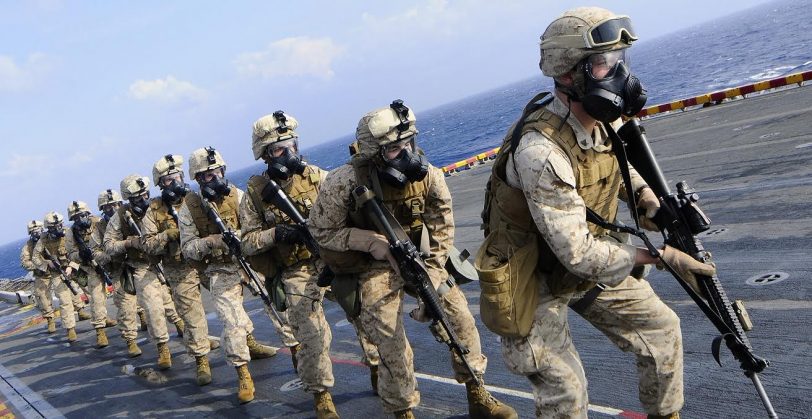
Amphibious Assault Ship USS Kearsarge – U.S. Navy photo by Mass Communication Specialist 3rd Class Scott Pittman/Released
By Darius Shahtahmasebi | RT | May 13, 2020
As the bodies rack up and the economy goes into freefall, the US continues to spend a fortune on its military. It’s time the public asked whether the money could be used more wisely.
Even in the face of the ongoing Covid-19 crisis, the US military appears to be operating across the globe unabated, undeterred and almost completely unchecked. If the reports are anything to go by, there are at least 150 US military bases and four aircraft carriers which have already been hit with the virus. After arriving in Guam, the carrier Theodore Roosevelt had 940 cases alone – around 20 percent of its personnel.
Never one to back down in the face of adversity (or pragmatism), the US military apparently will keep on doing what it does best. On Tuesday, the US special envoy for Syria justified an ongoing illegal troop presence in the country by framing it as an opportunity to force Russia into a quagmire (something the US already has extensive experience in).
To anyone paying attention over the past few decades, admissions of this type are hardly surprising. Even as the US watches thousands of its own people die at the hands of an invisible enemy, it is still ramping up operations which result in the deaths of innocent civilians in overseas theatres. Take, for example, the ongoing air war in Somalia, which has increased over the first few months of 2020, killing civilians with close to zero media scrutiny.
Or how about the Pentagon’s intention to arm its marines with versions of the Tomahawk cruise missile carried on US warships as a mechanism to counter China in the western Pacific?
Combined with its decision to continue conducting its so-called “freedom of navigation” operations in the South China Sea – including two US navy ships which sailed into the region to counter Beijing just a few days ago – it seems apparent that aggravating a conflict with China remains one of the highest priorities for the US government. Coronavirus, on the other hand, falls ever lower on the list of things the US president should take responsibility for.
Sending two B-1B supersonic heavy bombers over the skies of northeast Taiwan this month, as well as a number of bombers across Europe and the Pacific, only further confirms Washington’s prime concerns during the pandemic. If you want a fuller list of what your American taxpayer dollars are continuing to fund during this unprecedented turmoil, check the Department of Defense’s website.
Mythical foreign bogeymen
What will the reaction be when the American public looks at the number of its population killed by the Covid-19 pandemic – the death toll currently stands at over 80,000 – and realizes the country has wasted billions of dollars defending the homeland from potentially make-believe, foreign bogeymen, but isn’t even remotely prepared to defend its people from the wrath of the coronavirus? What happens when Americans wake up and start to question whether or not funds and resources could be better allocated?
As War on the Rocks bluntly explained, the “security afforded by America’s far-flung military forces has been entirely irrelevant” when dealing with the global pandemic. The polls may one day tell the full story, but this is notable considering that in June 2019, Gallup recorded a whopping 73 percent of respondents expressing a “great deal” or “quite a lot” of confidence in the US military.
The coronavirus pandemic is exacting a death toll on the American public which most genuine enemies would fail to do on their own. But ultimately, what may separate the Covid-19 crisis from any other in the eyes of the American public is its sheer cost. Will the public continue to trust the US president to spend billions of dollars on its military adventures overseas as the bodies rack up and the economy fractures?
Massive unemployment
Irrespective of what the people say or think, the US appears to be pumping as much energy, money and resources into the military as it possibly can, while the pandemic continues to ravage what is left of the global economy.
The rate of unemployment in the US is currently at its greatest since the Great Depression, with some predictions indicating it could be as much as 20 per cent. Unless the US military is intending to hire a fifth of the American population, its perception as the saviour of the US mainland may start to fade over the course of the year.
“When written in Chinese,” John F Kennedy reportedly once said, “the word crisis is composed of two characters – one represents danger, and the other represents opportunity.”
Will the US public make the most of this opportunity to return their verdict on an administration that is wasting billions? Or will widespread apathy allow the Pentagon to continue on its warpath to counter adversaries such as Russia and China in priority theatres across the globe?
Darius Shahtahmasebi is a New Zealand-based legal and political analyst who focuses on US foreign policy in the Middle East, Asia and Pacific region. He is fully qualified as a lawyer in two international jurisdictions.
In a world gone mad, China must build MORE NUKES to make disarmament possible
By Scott Ritter | RT | May 12, 2020
As the US threatens to withdraw from the New START treaty over Chinese non-participation, domestic pressure from inside China builds for a larger strategic nuclear arsenal. Could this be a good thing?
In an op-ed published in Chinese newspaper Global Times, its editor-in-chief Hu Xijin, argued that China should seek to upgrade its strategic nuclear arsenal from its current level of about 200 antiquated weapons to a modernized force comprising more than 1,000 nuclear weapons, including more than 100 modern mobile DF-41 intercontinental ballistic missiles (ICBMs), each armed with 10-12 nuclear warheads, capable of striking the US mainland.
The deployment of DF-41 missiles, when combined with China’s new JL-3 submarine-launched ballistic missiles and nuclear-armed H-20 strategic bombers, would give China a capable nuclear TRIAD that rivaled those of the US and Russia.
While Hu Xijin’s op-ed received considerable support on Chinese social media, there was some pushback. Zhao Tong, a senior fellow in nuclear policy at the Carnegie-Tsinghua Center for Global Policy, based in Beijing, has argued that even in a climate of deteriorating Sino-American relations, any effort on the part of China to build a viable strategic nuclear arsenal on par with that of the US was counterproductive and dangerous.
This point of view has a logic of de-escalation that is inherently attractive, but when viewed in the larger context of global nuclear posture where the US and Russian nuclear disarmament is held hostage by the current non-participation of China in meaningful disarmament talks, any call for China to maintain the nuclear status quo is in itself destabilizing.
The only way to bring China to the table for any meaningful arms control agreement is for it to build up its nuclear arsenal to a level where reciprocal cuts make sense for all involved parties. In short, nuclear symmetry perversely requires that China in effect adopts an “escalate to de-escalate” approach to arms control if disarmament is to have any political viability.
There is a historical precedent for this kind of madness. When the Soviet Union deployed the SS-20 intermediate-range nuclear missile in the late 1970s, it unhinged the strategic nuclear balance in Europe. Both NATO and the US were alarmed and pushed for arms control agreements that eliminated so-called Intermediate Nuclear Forces (INF) from the arsenals of both the US and the Soviet Union. In 1979 the US threatened to deploy advanced Pershing II missiles and Ground-launched Cruise Missiles (GLCMs) into Europe to offset the threat posed by the SS-20 missiles. The problem, however, was that while the SS-20 missile was a reality, the Pershing II/GLCM weapons were still in development stage and had yet to be deployed. From a purely political perspective, there was no incentive for the Soviets to get rid of the SS-20.
Instead, in November 1983, the US and NATO were compelled to go through with the deployment of Pershing II and GLCM missiles to Europe, triggering social and political unrest in the form of massive protests, and placed the US-NATO alliance under considerable stress. Besides, by deploying these new weapons into Europe, the US changed the very calculus of war — the Pershing II, once launched, was less than 10 minutes flight time from Moscow, reducing the time the Soviet command would have to react in a time of crisis regarding the initiation of a general nuclear war.
In the end, the US and the Soviet Union signed the INF Treaty, eliminating the SS-20, Pershing II, GLCM and other nuclear delivery systems, and in doing so heralded a new age of relations between the two sides that helped bring about the end of the Cold War. But the world had to be led to the edge of a nuclear abyss before reason could prevail.
Today the US and Russian strategic nuclear arsenals are capped at 1,550 nuclear delivery systems each by the limits set forth in the New START Treaty. While both sides recognize the desirability of additional reductions, the insistence on the part of the Trump administration that any future arms control agreement on strategic nuclear weapons must include China has thrown a monkey wrench in an arms control process which for decades has been governed on the basis of US-Soviet/Russian bilateral agreements. Even something as simple as extending the existing New START treaty for five years in order to buy time for the complexities of transitioning bilateral arms control structures into a new trilateral reality is unacceptable to Washington.
As insane as it might appear, the Trump approach might provide the only viable path forward regarding the possibility of meaningful trilateral arms control between the US, Russia, and China. As things currently stand, the failure to extend New START will eliminate constraints on the part of both the US and Russia when it comes to fielding new strategic nuclear weapons. This alone is a destabilizing and dangerous reality which, left to its own devices, could lead to a new nuclear arms race which would make those of the Cold War pale in comparison in terms of capability and lethality. The wild card in this equation is China. As things currently stand, the small size and relative lack of sophistication of China’s existing strategic nuclear arsenal make it a virtual non-player when it comes to discussions of symmetrical disarmament based upon historical TRIAD constructs (where strategic nuclear capability is spread among manned bombers, land-based ICBMs, and submarine-launched ballistic missiles.)
China’s current nuclear force structure is heavily weighted toward intermediate-range missiles. However, any nuclear modernization program that saw China develop a viable TRIAD-based nuclear deterrence capability would not only compel both Russia and the US to take into account a Chinese strategic nuclear threat when building their respective post-New START nuclear force structure, but also create real political incentive on the part of all three nations to take the off-ramp from a path of nuclear posture escalation and instead embrace the de-escalation of trilateral arms control.
This, of course, is not the ideal situation. Trillions of dollars will be expended by all three parties pursuing weapons whose only utility is to create the conditions for their eventual elimination. But nuclear policy historically has not been the purview of sane and rational thinking — one only needs to refer to the deterrence model of “mutually assured destruction (MAD)” to make that point.
In the early 1980s both the US and the Soviet Union knew that to escalate tensions by deploying new INF weapons into Europe was an inherently dangerous gambit. Indeed, on at least one occasion it nearly triggered a general nuclear war. But in the end, it was the only politically viable path toward eventual disarmament and the normalization of relations between the US and the Soviet Union.
In the dangerous waters of a post-New START world, perhaps the only way to navigate clear of the rocks and shoals of nuclear conflict is for China to escalate its development of a viable strategic nuclear force in order to enable the kind of meaningful trilateral strategic nuclear arms control the world needs to survive.
Scott Ritter is a former US Marine Corps intelligence officer. He served in the Soviet Union as an inspector implementing the INF Treaty, in General Schwarzkopf’s staff during the Gulf War, and from 1991-1998 as a UN weapons inspector. Follow him on Twitter @RealScottRitter
Nations Spent $73bn on Nuclear Arms Amid COVID-19, UK in 3rd as US Tops at Half of Global Costs
By Demond Cureton – Sputnik – 13.05.2020
Despite being the global epicentre of COVID-19 cases and deaths, the world’s leading nuclear power accounted for roughly half of total global spending on nuclear arms, a shock report from a major Swiss nonprofit coalition found.
Nuclear armed states spent a record $73bn on nuclear weapons amid the ongoing COVID-19 pandemic, a report from the Geneva-based International Campaign to Abolish Nuclear Weapons (ICAN) revealed.
The report, entitled Enough Is Enough: 2019 Global Nuclear Weapons Spending, found an increase of nuclear weapons spending in 2019, up $7.1bn from 2018.
The findings, which assessed the world’s leading nuclear powers – The United States, United Kingdom, France, China, Russia, Pakistan, India, Israel and North Korea – revealed that top nuclear powers spent $138,699 on over 13,000 nuclear weapons every minute of 2019.
The amount of money the US spent in 2019 alone could pay for 300,000 intensive care unit beds, 150,000 nurses, 75,000 doctors and 35,000 ventilators, the report found.
But the United Kingdom was the third highest spender at $8.9bn after the US and China at $35bn and $10.4bn, respectively, according to the report.
“It is absurd to be spending $138,700 every single minute on weapons that cause catastrophic human harm rather than spending it to protect the health of their citizens. They are abdicating their duty to protect their people,” ICAN executive director, Beatrice Fihn, said in a statement.
Nuclear arms were banned by the Treaty on the Prohibition of Nuclear Weapons (TPNW), which the UN will enforce after all participating 50 nations ratify or accede the document, effectively criminalising such expenditures under international law.
But the figures only included direct spending on nuclear warheads and delivery systems costs for operation and deployment, with real numbers skyrocketing after factoring in costs due to environmental damage and victim compensation, with ICAN calling on governments to remain transparent in disclosing expenses, the statement read.

International Campaign to Abolish Nuclear Weapons (ICAN)
Alicia Sanders-Zakre, author of the report, said: “The figures do not include the massive humanitarian costs and the environmental toll from a legacy of nuclear testing and production. Even in the unlikely chance these weapons are never used, governments are paying massive sums to poison their environments and put their people at grave risk.”
The news comes as British MPs slammed the Ministry of Defence for wasting £1.3bn ($1.6bn) on upgrading the country’s nuclear Trident programme, which is currently six years behind schedule. Costs were estimated at £2.5bn for the three upgrade programmes, which have spiked an additional £1.35bn, according to reports.
US anti-ISIS chief says his goal in Syria is to create a ‘quagmire’ for Russia, not battle terrorism

RT | May 13, 2020
James Jeffrey, the US special envoy for Syria and defeating the Islamic State, has made quite a frank confession of how he sees his job and that of US troops there: to create a new Vietnam or Afghanistan for Moscow.
“Our military presence, while small, is important for overall calculations. So we urge the Congress, the American people, the president to keep these forces on, but again this isn’t Afghanistan, this isn’t Vietnam, this isn’t a quagmire,” Jeffrey said on Tuesday, during a video event hosted by the Hudson Institute. “My job is to make it a quagmire for the Russians.”
The arrival of the Russian expeditionary force in late 2015, following an invitation from Damascus, turned the tide of war in Syria. With their assistance, government forces rolled back both Islamic State (IS, formerly ISIS) terrorists and other militants, including Al-Qaeda affiliates, on multiple fronts – and scuttled US plans for regime change in Damascus.
Jeffrey grudgingly admitted the Russian military has been successful in Syria, but argued “they don’t have a political way out of their problems” with Syrian President Bashar Assad, and the US aims to offer “a way forward” through the UN – presumably referring to Resolution 2254 that Washington has long interpreted as “Assad must go.”
The envoy’s admission on Tuesday is a step beyond his remarks in early March, when he told reporters on a conference call that the US aims to “make it very difficult” for Russia to help the Syrian government achieve a military victory.
While US President Donald Trump repeatedly rejected nation-building interventions in the Middle East and sought to withdraw US troops from Syria, Iraq, and Afghanistan, he has repeatedly faced resistance from the State Department and the Pentagon, still set on the previous administration’s strategy of regime change.
Jeffrey’s mention of a “quagmire” like Afghanistan is particularly ominous, given that’s precisely what the Carter administration did in 1978, covertly supporting Islamic militants in that country in order to provoke a Soviet intervention. According to Carter’s national security adviser Zbigniew Brzezinski, this was done to lure the USSR into their own costly, never-ending war such as the US experienced in Vietnam
Brzezinski boasted of his own role in those efforts, dismissing the fallout of Islamist terrorism that the conflict generated as irrelevant compared to US victory in the Cold War – shortly before the September 11, 2001 attacks triggered a US invasion of Afghanistan that the Trump administration is still struggling to extricate troops from.
China should TRIPLE nuclear arsenal to deter ‘warmongering’ US, editor of state-run Global Times argues
RT | May 8, 2020
China should drastically increase its stockpile of nuclear warheads to dissuade the United States from pursuing its strategic ambitions abroad, the editor of the Global Times has urged.
In a piece published by his own paper, Hu Xijin said China is a “peace-loving nation” that has pledged to never be the first to use nuclear weapons. He argued, however, that Beijing must aim to expand the number of its nuclear warheads to 1,000 to create a powerful deterrent to “shape the attitudes of US elites toward China.” The Asian power currently has around 300 nuclear weapons.
He said that bolstering China’s nuclear capabilities would keep “an increasingly irrational” United States at arm’s length. “Some people may call me a ‘warmonger’ because I want the country to have more nuclear warheads. They should instead give this label to US politicians who are openly hostile to China.”
The Global Times editor emphasized he would prefer a “peaceful coexistence” between China and the US, but observed that Washington “only believes in strength.” China cannot “beg” to be treated as an equal on the world stage, he argued.
Xijin’s commentary came just a day after US President Donald Trump rallied for an “effective arms control” deal between Washington, Beijing and Moscow, during a telephone call with Russian leader Vladimir Putin.
Trump has repeatedly called on China to join negotiations for the renewal of the New START treaty – the nuclear arms pact between the US and Russia that is set to expire in February 2021. So far, Beijing has expressed little interest in participating in the accord.
Tensions between the United States and China are on the rise, fueled primarily by allegations that Beijing had a hand in the outbreak of Covid-19 that has now spread across the world. China has dismissed these claims as unfounded, and has repeatedly challenged the White House to produce evidence of an alleged cover-up or sinister role in the health crisis.
Ex-Google CEO claims he can link tech & defense, but he’s just a civilian dilettante, doesn’t get reality of war
By Scott Ritter | RT | May 5, 2020
The former CEO of Google claims he can improve the US military’s integration of artificial intelligence (AI) into its operations. But is AI the panacea Schmidt claims? And if so, is he the person best suited to lead the way?
In a culture known for complex problems and inherent inefficiencies, the US military would seem ideally suited for the kind of cutting-edge solutions offered by the emergence of computer-driven artificial intelligence (AI).
The US military – like its counterparts in China, Russia, India and elsewhere – has, over the course of the past decade, invested heavily in research and development projects designed to bring AI to the battlefield in support of intelligence collection and analysis, logistical support, autonomous warfighting capabilities, healthcare, and cybersecurity. Indeed, in this computer-driven age, there isn’t an aspect of military operations where AI hasn’t been investigated as a potential enhancement.
While the US military hasn’t ignored AI and its utility, Eric Schmidt, the former CEO of Google, believes it has done so in a highly inefficient manner. And he is convinced he is the man who can best help the US military solve its AI challenges.
The arrogance and hubris exhibited by Schmidt – who has never served in the military and as such is unfamiliar with the ethos, culture and operational realities associated with organizing, training and leading millions of men and women for war – has rubbed some senior US military officers the wrong way. However, his wonkish approach to problem solving, combined with the inherent attractiveness of technology-driven solutions, has found an audience within the ranks of the civilian component of the US defense establishment, who have invited Schmidt to sit on several advisory boards involved in the pursuit of AI-driven solutions to military problem sets.
Past attempts to incorporate Schmidt’s digital-centric philosophies into realms driven by the human condition have proven inchoate. In 2013, Schmidt co-authored a book, ‘The New Digital Age’, with Jared Cohen. Cohen had helped spearhead an effort built around a soft-power philosophy known as ‘digital democracy’, where the US sought to exploit perceived digital commonalities (ie. the integration of social media platforms, use of electronic and computer-driven communications and, most telling, the notion that these digital interfaces exposed the youth of foreign societies to American culture, and as such ingrained a predilection for American values that supplanted those of their own cultures and societies) for the purpose of altering the political makeup of areas such as the Middle East.
‘Digital democracy’ drove the US’ support of the Iranian opposition in 2009, the Arab Spring movement of 2010, and the so-called Syrian revolution of 2011. The failure of ‘digital democracy’ to bring about the desired change highlights the risks associated with seeking to digitally manipulate human emotions and values.
The biggest lesson learned from the abject failure of ‘digital democracy’ is that there is no algorithm that can replicate the incoherent complexities of human emotions. Schmidt’s Google experience is one where algorithms are written and applied to better comprehend complex data-driven problems. As data is accumulated and incorporated, AI can be used to automatically update and upgrade these algorithms, allowing for increased efficiencies.
This approach works in a relatively static environment, where assumptions of shared goals and objectives can be built into the algorithms used. This was the fundamental flaw with ‘digital democracy’: politics is not static, but rather dynamic, driven more by the unpredictable vagaries of human emotions than quantifiable data.
In his timeless tract on military matters, the Prussian military philosopher Carl von Clausewitz observed that war was but a “continuation of politics by other means.” Given the inherent relationship between politics and war, it can be extrapolated that the human complexities which proved fatal to ‘digital democracy’ would similarly undermine any effort to use AI to guide and direct decision-making in times of human conflict.
Eric Schmidt’s success in using algorithms to discern intent and desire on the part of consumers to better guide product placement has revolutionized advertising and sales, both online and in traditional brick-and-mortar establishments. This success has prompted Schmidt and other innovators to embrace the promise of AI-driven solutions for military applications.
There is a fundamental flaw in this approach – when Google was seeking to make sense of the ‘big data’ that was produced as a result of the online consumer experience, there was no opposing force seeking to disrupt, mislead or otherwise defeat its effort. War is an inherently adversarial process, and like the French embrace of the Maginot Line to keep German armies from invading France, any AI-driven algorithm can be defeated by simply re-defining the terms of the conflict.
From a technological standpoint alone, AI-driven applications have already been shown to be easily spoofed, whether by altering painted lines of a road to force Tesla’s AI-driven car into oncoming traffic, or convincing AI-controlled software that an image of a turtle was, in fact, a rifle.
Beyond the fact that an enemy in a time of war would constantly be seeking ways to defeat any AI-driven operation, the inherent incompatibility between the logic of data-driven AI and the illogic of human emotion make an overreliance on AI during times of war a self-defeating proposition. One need only examine the US experience in Afghanistan, where a technologically sophisticated American military, having incorporated aspects of AI into nearly every aspect of its warfighting capabilities, has not been able to defeat the relatively unsophisticated forces of the Taliban. No amount of big data manipulation can overcome the fact that US cultural norms will never mesh with Pashtun tribal reality. The US’ failure in Afghanistan is “digital democracy” writ large, the difference between computer-driven artificialities and boots-on-the ground reality.
US Air Force Colonel John Boyd, considered one of the great military thinkers of modern times, compressed the complexities of military decision-making into a brutally simplistic formula he called the ‘OODA loop’. The four components of the OODA loop – Orient, Observe, Decide and Action – at first seem to be perfectly suited for AI-induced enhancements. But a closer look at what Boyd was capturing in his model only underscores the reality that, at the end of the day, the human factor is the dominating force when it comes to the taking of human life in conflict.
Boyd spoke of “the senses” and “mental perspectives” that guided “physical playing out of decisions.” No algorithm can ever be written which captures the visceral gut-driven realities of decision-making during times of war. The key to military victory, according to the tenets of Boyd’s OODA loop, is to get inside the opponent’s decision-making cycle, catching them responding to situations that have already changed because of actions already taken. Against an AI-driven opponent, one will always be able to make the car drive into oncoming traffic, or the computer to see a turtle as a rifle. By the time the algorithm adapts, it will be too late; the sensors collecting the data the AI needs will have been destroyed or spoofed, the power sources to the computers cut, and a bayonet driven into the heart of the operator by an opponent driven more by human sense, mental perspective, and physical action.
This is the reality of war that Eric Schmidt and civilian dilettantes like himself will never understand, caught up as they are in a data-driven world that is as far removed from the modern battlefield as the Earth is from Mars.
Beware the Pentagon’s Pandemic Profiteers
Hasn’t the Military-Industrial Complex Taken Enough of Our Money?
By Mandy Smithberger | TomDispatch | May 3, 2020
At this moment of unprecedented crisis, you might think that those not overcome by the economic and mortal consequences of the coronavirus would be asking, “What can we do to help?” A few companies have indeed pivoted to making masks and ventilators for an overwhelmed medical establishment. Unfortunately, when it comes to the top officials of the Pentagon and the CEOs running a large part of the arms industry, examples abound of them asking what they can do to help themselves.
It’s important to grasp just how staggeringly well the defense industry has done in these last nearly 19 years since 9/11. Its companies (filled with ex-military and defense officials) have received trillions of dollars in government contracts, which they’ve largely used to feather their own nests. Data compiled by the New York Times showed that the chief executive officers of the top five military-industrial contractors received nearly $90 million in compensation in 2017. An investigation that same year by the Providence Journal discovered that, from 2005 to the first half of 2017, the top five defense contractors spent more than $114 billion repurchasing their own company stocks and so boosting their value at the expense of new investment.
To put this in perspective in the midst of a pandemic, the co-directors of the Costs of War Project at Brown University recently pointed out that allocations for the Food and Drug Administration, the Centers for Disease Control and Prevention, and the National Institutes of Health for 2020 amounted to less than 1% of what the U.S. government has spent on the wars in Iraq and Afghanistan alone since 9/11. While just about every imaginable government agency and industry has been impacted by the still-spreading coronavirus, the role of the defense industry and the military in responding to it has, in truth, been limited indeed. The highly publicized use of military hospital ships in New York City and Los Angeles, for example, not only had relatively little impact on the crises in those cities but came to serve as a symbol of just how dysfunctional the military response has truly been.
Bailing Out the Military-Industrial Complex in the Covid-19 Moment
Demands to use the Defense Production Act to direct firms to produce equipment needed to combat Covid-19 have sputtered, provoking strong resistance from industries worried first and foremost about their own profits. Even conservative Washington Post columnist Max Boot, a longtime supporter of increased Pentagon spending, has recently recanted, noting how just such budget priorities have weakened the ability of the United States to keep Americans safe from the virus. “It never made any sense, as Trump’s 2021 budget had initially proposed, to increase spending on nuclear weapons by $7 billion while cutting Centers for Disease Control and Prevention funding by $1.2 billion,” he wrote. “Or to create an unnecessary Space Force out of the U.S. Air Force while eliminating the vitally important directorate of global health by folding it into another office within the National Security Council.”
In fact, continuing to prioritize the U.S. military will only further weaken the country’s public health system. As a start, simply to call up doctors and nurses in the military reserves, as even Secretary of Defense Mark Esper has pointed out, would hurt the broader civilian response to the pandemic. After all, in their civilian lives many of them now work at domestic hospitals and medical centers deluged by Covid-19 patients.
The present situation, however, hasn’t stopped military-industrial complex requests for bailouts. The National Defense Industrial Association, a trade group for the arms industry, typically asked the Pentagon to speed up contracts and awards for $160 billion in unobligated Department of Defense funds to its companies, which will involve pushing money out the door without even the most modest level of due diligence.
Already under fire in the pre-pandemic moment for grotesque safety problems with its commercial jets, Boeing, the Pentagon’s second biggest contractor, received $26.3 billion last year. Now, that company has asked for $60 billion in government support. And you undoubtedly won’t be surprised to learn that Congress has already provided Boeing with some of that desired money in its recent bailout legislation. According to the Washington Post, $17 billion was carved out in that deal for companies “critical to maintaining national security” (with Boeing in particular in mind). When, however, it became clear that those funds wouldn’t arrive as a complete blank check, the company started to have second thoughts. Now, some members of Congress are practically begging it to take the money.
And Boeing was far from alone. Even as the spreading coronavirus was spurring congressional conversations about what would become a $2 trillion relief package, 130 members of the House were already pleading for funds to purchase an additional 98 Lockheed Martin F-35 jet fighters, the most expensive weapons system in history, at the cost of another half-billion dollars, or the price of more than 90,000 ventilators.
Similarly, it should have been absurdly obvious that this wasn’t the moment to boost already astronomical spending on nuclear weapons. Yet this year’s defense budget request for such weaponry was 20% higher than last year’s and 50% above funding levels when President Trump took office. The agency that builds nuclear weapons already had $8 billion left unspent from past years and the head of the National Nuclear Security Agency, responsible for the development of nuclear warheads, admitted to Representative Susan Davis (D-CA) that the agency was unlikely even to be able to spend all of the new increase.
Boosters of such weapons, however, remain undeterred by the Covid-19 pandemic. If anything, the crisis only seems to have provided a further excuse to accelerate the awarding of an estimated $85 billion to Northrop Grumman to build a new generation of intercontinental ballistic missiles (ICBMs), considered the “broken leg” of America’s nuclear triad. As William Hartung, the director of the Arms and Security Project at the Center for International Policy, has pointed out, such ICBMs “are redundant because invulnerable submarine-launched ballistic missiles are sufficient for deterring other countries from attacking the United States. They are dangerous because they operate on hair-trigger alert, with launch decisions needing to be made in some cases within minutes. This increases the risk of an accidental nuclear war.”
And as children’s book author Dr. Seuss might have added, “But that is not all! Oh, no, that is not all.” In fact, defense giant Raytheon is also getting its piece of the pie in the Covid-19 moment for a $20-$30 billion Long Range Standoff Weapon, a similarly redundant nuclear-armed missile. It tells you everything you need to know about funding priorities now that the company is, in fact, getting that money two years ahead of schedule.
In the midst of the spreading pandemic, the U.S. military’s Indo-Pacific Command similarly saw an opportunity to use fear-mongering about China, a country officially in its area of responsibility, to gain additional funding. And so it is seeking $20 billion that previously hadn’t gained approval even from the secretary of defense in the administration’s fiscal year 2021 budget proposal. That money would go to dubious missile defense systems and a similarly dubious “Pacific Deterrence Initiative.”
How Not to Deal With Covid-19
Along with those military-industrial bailouts came the fleecing of American taxpayers. While many Americans were anxiously awaiting their $1,200 payments from that congressional aid and relief package, the Department of Defense was expediting contract payments to the arms industry. Shay Assad, a former senior Pentagon official, accurately called it a “taxpayer rip-off” that industries with so many resources, not to speak of the ability to borrow money at incredibly low interest rates, were being so richly and quickly rewarded in tough times. Giving defense giants such funding at this moment was like giving a housing contractor 90% of upfront costs for renovations when it was unclear whether you could even afford your next mortgage payment.
Right now, the defense industry is having similar success in persuading the Pentagon that basic accountability should be tossed out the window. Even in normal times, it’s a reasonably rare event for the federal government to withhold money from a giant weapons maker unless its performance is truly egregious. Boeing, however, continues to fit that bill perfectly with its endless program to build the KC-46 Pegasus tanker, basically a “flying gas station” meant to refuel other planes in mid-air.
As national security analyst Mark Thompson, my colleague at the Project on Government Oversight (POGO), has pointed out, even after years of development, that tanker has little hope of performing its mission in the near future. The seven cameras that its pilot relies on to guide the KC-46’s fuel to other planes have so much glare and so many shadows that the possibility of disastrously scraping the stealth coating off F-22s and F-35s (both manufactured by Lockheed Martin) while refueling remains a constant danger. The Air Force has also become increasingly concerned that the tanker itself leaks fuel. In the pre-pandemic moment, such problems and associated ones led that service to decide to withhold $882 million from Boeing. Now, however, in response to the Covid-19 crisis, those funds are, believe it or not, being released.
Keep all of this behavior (and more) in mind when you hear people suggest that, in this public health emergency, the military should be put in charge. After all, you’re talking about the very institution that has regularly mismanaged massive weapons programs like the $1.4 trillion F-35 jet fighter program, already the most expensive weapons system ever (with ongoing problems galore). Even when it comes to health care, the military has proved remarkably inept. For instance, attempts of the Department of Veterans Affairs and the Department of Defense to integrate their health records were, infamously enough, abandoned after four years and $1 billion spent.
Having someone in uniform at the podium is, unfortunately, no guarantee of success. Indeed, a number of veterans have been quick to rebuke the idea of forefronting the military at this time. “Don’t put the military in charge of anything that doesn’t involve blowing stuff up, preventing stuff from being blown up, or showing up at a place as a message to others that we’ll be there to blow stuff up with you if need be,” one wrote.
“Here’s a video from Camp Pendleton of unmasked Marines queued up for haircuts during the pandemic,” tweeted another. “So how about ‘no’?” That video of troops without masks or practicing social distancing even shocked Secretary of Defense Esper, who called for a military haircut halt, only to be contradicted by the chairman of the Joint Chiefs of Staff, desperate to maintain regulation cuts in the pandemic moment. That inspired a mocking rebuke of “haircut heroes” on Twitter.
Unfortunately, as Covid-19 spread on the aircraft carrier the USS Theodore Roosevelt, that ship became emblematic of how ill-prepared the current Pentagon leadership proved to be in combatting the virus. Despite at least 100 cases being reported on board — 955 crewmembers would, in the end, test positive for the disease and Chief Petty Officer Charles Robert Thacker Jr. would die of it — senior Navy leaders were slow to respond. Instead, they kept those sailors at close quarters and in an untenable situation of increasing risk. When an emailed letter expressing the concerns of the ship’s commander, Captain Brett Crozier, was leaked to the press he was quickly removed from command. But while his bosses may not have appreciated his efforts for his crew, his sailors did. He left the ship to a hero’s farewell.
All of this is not to say that some parts of the U.S. military haven’t tried to step up as Covid-19 spreads. The Pentagon has, for instance, awarded contracts to build “alternate care” facilities to help relieve pressure on hospitals. The Uniformed Services University of the Health Sciences is allowing its doctors and nurses to join the military early. Several months into this crisis, the Pentagon has finally used the Defense Production Act to launch a process to produce $133 million worth of crucial N95 respirator masks and $415 million worth of N95 critical-care decontamination units. But these are modest acts in the midst of a pandemic and at a moment when bailouts, fraud, and delays suggest that the military-industrial complex hasn’t proved capable of delivering effectively, even for its own troops.
Meanwhile, the Beltway bandits that make up that complex have spotted a remarkable opportunity to secure many of their hopes and dreams. Their success in putting their desires and their profits ahead of the true national security of Americans was already clear enough in the staggering pre-pandemic $1.2 trillion national security budget. (Meanwhile, of course, key federal medical structures were underfunded or disbanded in the Trump administration years, undermining the actual security of the country.) That kind of disproportionate spending helps explain why the richest nation on the planet has proven so incapable of providing even the necessary personal protective equipment for frontline healthcare workers, no less the testing needed to make this country safer.
The defense industry has asked for, and received, a lot in this time of soaring cases of disease and death. While there is undoubtedly a role for the giant weapons makers and for the Pentagon to play in this crisis, they have shown themselves to be anything but effective lead institutions in the response to this moment. It’s time for the military-industrial complex to truly pay back an American public that has been beyond generous to it.
Isn’t it finally time as well to reduce the “defense” budget and put more of our resources into the real national security crisis at hand?
Mandy Smithberger, a TomDispatch regular, is the director of the Center for Defense Information at the Project On Government Oversight (POGO).
Copyright 2020 Mandy Smithberger
Featured Video

Iran’s Next Strike May Not Explode. It Could Shut You Down
or go to
Aletho News Archives – Video-Images
Book Review
New paperback: Butchered by “Healthcare”
Lies are Unbekoming | October 20, 2026
 Butchered by “Healthcare” is Robert Yoho’s plain-spoken account of how American medicine stopped being a profession and became an industry. 341 pages. Over a thousand references. Thirty-eight chapters.
“Screening Tests Are Useless”, on tests that find diseases that would never have hurt you. “The FDA Protects the Big Drug Companies”, on an agency funded by the companies it regulates. “The Journals’ Sins Are the Editors’ Sins”, on ghostwritten studies and captured peer review. “Opioids and ‘Pain Management’”, on how a generation was prescribed its way into addiction. “Prozac and Relatives” and “Antipsychotics Are Disastrous”, on what psychiatry does to adults and children. “Surgery: Money Before Patients”. “Failed Cancer Treatments”. “Futile CPR and Overprescribing”. “Billing Scams & Specialty Warfare”. “Hospitals Are Sharks”. Each with a Patient Tips section at the end on how to survive it.
If you have ever walked out of a doctor’s office with a prescription you didn’t ask for, or watched a parent put through a treatment that made them worse, this is the book you want on your shelf before the next appointment. … Full review
Butchered by “Healthcare” is available on Lulu now.
Blog Roll
 Aletho News
- Iran’s Next Strike May Not Explode. It Could Shut You Down /Col Doug Macgregor
- Iran: US political targets legitimate if assassinations return
- Iraq shuts key border crossing with Iran under US pressure: Report
- Undersea Internet cables could be targeted in retaliation for attacks on Iran: IRGC deputy chief
- EU sending ‘biased’ observers to interfere in Serbian election – president
- White House envoy declares kinetic action against Yemen ‘fruitless’
- Ukraine deployed thousands of microdrones in Iraqi Kurdistan: Tasnim
- Iran calls for emergency UNSC meeting over Trump’s ‘brazen’ bomb talk, Israeli threats
- Iranian sources reveal details of Russia-China Hormuz proposal
- Plan for more US-Israel integration puts our military tech at risk
- If Americans Knew
- Americans at National Conservatism Conference held in Israel this year criticize Israel
- Christiane Amanpour exits CNN with a legacy shaped by the debate over Israel
- Israel’s war on Iran is the final move in a decades-old strategy
- Israel Denies Entry to French Journalist, U.S. Researcher Amid Rise in Entry Denials
- Gaza’s hospitals are running out of life-saving fuel – Daily Update
- Mysterious bot accounts reportedly spread fake ‘man on the street’ videos for Michigan Senate candidate
- Israeli Defense Minister Katz Says Over 60 Lebanon Villages Have Been Destroyed
- Why Is Israel Running TV Ads in Iowa Ahead of the Midterms?
- Hind Rajab’s Alleged Killer Is in the United States. HRF Demands His Arrest.
- US Officials Face Fresh Pressure After Another American ‘Brutalized’ by Israeli Settlers in West Bank
- No Tricks Zone
- E-Cars Reduce CO2 Emissions By Only 41% Compared To Internal Combustion Engine Vehicles
- Predictions Made By Renowned Climate Professor Over Past Decades Have Been Proven To Be Poor
- New Study Suggests Large Regions Of The Pacific Ocean Have Been Cooling For The Last 80 Years
- Germany’s Green Energy Debacle: High Energy Costs Force Kahla Porzellan to Close After 182 Years!
- New Study: 50 Years Of The Most Aggressive ‘Net Zero’ Policies Can Only Affect The Global Climate By 0.03°C
- US September “Heat” Was No Record…Many Records Set Decades Ago
- Latest European Green Energy Debacle; Portugal’s Largest Flagship Solar Park Insolvent!
- Green Energy Debacle: German Expert Professor Fritz Vahrenholt Warns Of Severe Economic And Social Consequences
- Two More Paleo Reconstructions Affirm Meters-Higher Sea Levels Across Ireland, Brazil 7000-6000 Years Ago
- New Study: Earth And Venus Surface Warmth Largely Explained By Convection And Lapse Rate, Not CO2 Or Radiation

