US, other foreign forces must leave Syria, respect its sovereignty: Iran

Press TV – May 18, 2020
Iran’s permanent ambassador to the United Nations says the US must end its illegal occupation of Syria and stop shielding terrorist groups under the mask of fighting terrorism.
Majid Takht Ravanchi made the remarks in a Monday address to a virtual meeting of United Nations Security Council dubbed “Middle East: Syria – Political”.
“Sovereignty, political independence, unity and territorial integrity of Syria must be fully respected by all, and accordingly, all foreign forces whose presence is not permitted by the Syrian Government must leave the Syrian territory,” the Iranian diplomat said.
“In this regard, the living example is the occupation of certain parts of Syria by the US forces who continue to support and shield terrorist groups under the mask of combatting terrorism,” he went on to say.
He further rejected any separatist agendas as well as “any and all attempts to create new realities on the ground, including through illegitimate self-rule initiatives.”
Takht Ravanchi slammed the “illegal” occupation of Syria’s Golan Heights by Israel, and said the recognition by the US of its annexation to Israel is null and void.
“Condemning such unlawful irresponsible act, we stress that Golan is and will remain a part and parcel of the Syrian territory,” he added.
Israel seized the Golan Heights from Syria after the 1967 Six-Day War and later occupied it in a move that has never been recognized by the international community. However, in a highly provocative move on March 25 last year US President Donald Trump signed a proclamation recognizing Israel’s “sovereignty” over the Syrian territory.
Damascus strongly condemned the move and called it a “blatant attack on the sovereignty and territorial integrity” of Syria.
Since the onset of the occupation, Tel Aviv has been building dozens of settlements in the region and has used it to carry out a number of military operations against the Arab country.
In his Monday speech, Takht Ravanchi also condemned Israel’s aggressions against Syria as a “gross violation of international law and the UN Charter”, stressing that the Syrian Government has a sovereign right to decide how and when to exercise its inherent right to individual or collective self-defense.
“Such aggressions must come to an end,” he urged.
Israel frequently attacks military targets inside Syria in what is considered as an attempt to prop up foreign-backed Takfiri terrorist groups that have been suffering heavy defeats against Syrian government forces.
The Damascus government has several times complained to the UN about Israel’s illegal strikes on Syria.
Duck and Cover and Burn the Heretics: the Modern-Day Cult of Corona
By Helen Buyniski | Helen of desTroy | May 17, 2020
Fear and uncertainty have dominated the media coverage of the Covid-19 epidemic. The novel coronavirus is depicted not as a pedestrian pathogen certain to be beaten into submission by the miracles of modern science any day now, but as an invisible evil lurking everywhere, formidable enough to inspire a respectful terror even in the leading lights of the medical establishment. And in case Americans had any doubt about how they were supposed to regard this new viral threat, the establishment talking heads many rely upon for the self-assured delivery of their news have swapped their usual swagger for apprehension. Amid this ‘confidence vacuum,’ the popular response to the pandemic has taken on a religious cast. Protective measures like masks have taken on a talismanic quality, hand-washing has been elevated to a ritual performance, and a cult built on naming and shaming ‘heretics’ has seized the minds of many – while their rights are quietly stripped away and a paternalistic police state substituted in their place.
Unable to see the microscopic “enemy” they are told threatens the lives of them and their family and deprived of a scientifically proven cure, individuals seeking deliverance from Covid-19 are left with only their faith that the protective measures prescribed by health experts –our scientific priest class– can keep it at bay. If it ended there, the Corona Cult would merely be a curiosity – humans have turned to religion in troubled times since before written history began. But its dark side has already reared its ugly head – those who buck the new orthodoxy are already being blamed for the plague.
We’ve been here before. In the Middle Ages, pious peasants were kept in line by priests who told them God was watching their every move. When a plague appeared, it was interpreted as divine punishment, the wrath of God visited upon a sinful population. Those who wished to stand out as especially devout whipped themselves in public, or wore painful garments called “hair shirts” – in both cases with the aim of ‘mortifying the flesh,’ literally ‘putting to death’ their sinful natures.
It’s no coincidence that self-flagellation reached its height of popularity during the Black Plague. It was assumed by its practitioners that if they underwent penance by inflicting pain on themselves, they would be spared the God-given pain of the plague. Those who publicly refused to participate in the religious rituals of the day were called out as infidels, heretics, witches or other servants of the devil. They might be chased out of town; many were tortured and even killed, often in shockingly gruesome ways, as the centuries progressed and the Inquisition rose to power. The pious were regularly told their misfortunes were due to the presence of a satanic influence among them, with complex problems declared to be solved by simply casting out the offending presence.
While western society may tell itself it has left those Dark Ages far behind, the lure of simplistic explanations and the desire to find fulfillment in shared suffering – inflicted or endured – are as potent as ever.
Mask of the red death
Face masks have become both the visual symbol of the Covid-19 epidemic and the dominant religious fetish for the Cult of Corona. While cities from New York to Laredo, Texas have adopted regulations mandating them in public places and chain stores like Costco have barred unmasked customers from their premises, it’s hard not to notice those individuals so devoted to the mask-wearing ritual that they sport the face-coverings in their own cars (with the windows rolled up) and when running down epidemic-emptied streets. Poor messaging is partly to blame – the Centers for Disease Control has repeatedly changed its narrative on who should wear masks, from “sick people” to “only healthcare workers” to “everyone.” However, the Cult of Corona’s devotion to the mask extends far beyond following the recommendations of a mere public health agency.
 The mask has taken on a supernatural significance that far outweighs its utility in disease protection. Even the N-95 masks health authorities have recommended to protect society from virus-positive individuals have been found largely ineffective in protecting the uninfected from carriers in their surroundings, and the flimsy surgical masks that have become ubiquitous for sale on American street corners are next to worthless in stopping virus transmission. Indeed, some doctors have warned that wearing a mask is counterproductive due to the false sense of security it creates, while others suggest it’s actually dangerous due to the risk of hypoxia (lack of oxygen) and hypercapnia (excess carbon dioxide). Yet it’s impossible to walk into a supermarket in many cities without something covering the mouth – even as one’s eyes remain unprotected and ready to receive whatever viral particles are lingering in the air. Mask requirements thus have nothing to do with health and everything to do with religious faith. They provide a way for the faithful to telegraph their virtue at a distance and recognize one another instantly, while flagging the non-compliant as infidels to be avoided.
In the same way that garlic and a cross were supposed to ward off vampires in times past, the face mask is supposed to fend off the “invisible enemy” lurking everywhere at once. One might feel a little silly driving around with a mask on (or stringing a clove of garlic above one’s window), but better safe than sorry – and if you haven’t been infected, or had any vampires show up at your bedside, who’s to say it isn’t working?
Ritual, snitchual
A bevy of rituals has sprung up among Corona Cultists, from the benign if eccentric (swabbing all exposed surfaces with Lysol wipes) to the sinister (reporting neighbors for perceived violations). Even the simplest, most scientifically-sound measures like hand-washing have taken on a ritualistic cast, as the virus-fearing infuse them with a terrified zeal. How else to explain the popularity of the dozens of “hand-washing apps” available for smartphones but that the shock of the epidemic has caused us to question that which we once took for granted? Just as peasants of a previous era might have been spooked into regular church attendance by the specter of the Black Death, their descendants pore over videos of hand-washing on YouTube, determined to live a “cleaner” life.
But another holdover from the Dark Ages has risen its ugly head. While our ancestors might have turned in their oddball neighbor as a “witch,” claiming to have seen the merry old spinster cavorting with Satan under the full moon, modern-day snitches are picking up their smartphones and dialing specially-designated lines to report violations of social distancing orders. These services are disturbingly popular – New Zealand’s snitch site crashed repeatedly within its first week in late March as over 4,000 people scrambled to turn in their neighbors for violating that nation’s harsh lockdown regulations, which separated people into “bubbles” based on their living arrangements and forbid them from interacting with those outside their “bubble.”
Snitches come in several stripes. There have always been busybodies who call the police when their neighbor’s music is too loud rather than knocking on their door and politely asking to turn it down. But in the Cult of Corona, these miscreants are joined by those driven half-crazy with fear, convinced that the act of turning in rule breakers will somehow protect them from contracting the virus. They’d never say such a preposterous thing out loud, of course – if asked, they merely claim to be concerned for the community, or worried their victim’s irresponsible behavior is spreading Covid-19 willy-nilly, perhaps even stating that their decision to turn their neighbor in was “for their own good.” Just as the Inquisitor’s concern for those they tortured on the rack was supposedly for their victim’s “immortal soul,” so does the modern snitch rationalize their betrayal of their neighbors by reasoning that the virus police are concerned only for the health of the heretics they rat out – while secretly breathing a sigh of relief that they aren’t the ones being tortured (or placed on a ventilator), this time. Following orders becomes a source of comfort for the snitch deprived of life’s normal pleasures by the lockdown – providing an avenue for transformation from victim to hero.
Fueling this schadenfreudisch frenzy are media headlines celebrating the karmic punishment of lockdown violators. Whether it’s spring-breakers testing positive for Covid-19 after throwing caution to the wind and partying down on the beach or social-media showoffs boasting about refusing to social-distance, the public smiting of heretics has been a popular topic among Corona Cultists isolated in their homes. John McDaniel, an Ohio man who criticized his governor for shutting down the state, reportedly died in April of coronavirus only for social media mobs to dance on his grave and use his death to attack other “doubters” (including Donald Trump, whose insufficient reverence at the altar of the virus continues to set zealots frothing with rage). CNN’s Jake Tapper claimed that “practically every day” he read about a corona doubter succumbing to the virus, blaming conservative media and politicians for their deaths – heresy, apparently, is as contagious as the virus. The New York Post, which ran a moralizing story free of any identifying details about a nameless Kingston, New York barber who’d caught the virus after supposedly flouting lockdown for several weeks to cut hair, also rushed to connect a spike in coronavirus cases in Kentucky with an anti-lockdown protest a few days earlier – even though the virus’ lengthy latency period (and the fact that a significant chunk of the new cases were in nursing homes) made it next to impossible the two events were linked. And Michigan Governor Gretchen Whitmer, one of the most fanatical government figures in the US’ corona cult, implied in a press conference that protests were more likely to contribute to the spread of the virus than other forms of “congregating.”
UK PM Boris Johnson was perhaps the most public example of the “divine punishment” phenomenon – his conversion to the Corona Cult (after a few days of timidly suggesting herd immunity might be a better path to public health) came too late to keep him out of intensive care at the hands of the NHS his party has so ruthlessly sought to privatize. When actress Miriam Margolyes declared following his recovery that she had wanted to see BoJo dead, some in the media appeared to agree with her – while making a point of casting such agreement as gleefully subversive. Not only do Corona Cultists find a commonality in rooting for the virus against the dissidents who challenge their worldview, but their own adherence to an exhaustingly cognitively-dissonant dogma is affirmed as the correct path by the heretics’ misfortune. Enforced austerity tends to be unpopular with its victims, but when that privation is reframed as a noble sacrifice made by all [except the wealthy] for the common good, it becomes easier to bear the suffering – and much more difficult to tolerate those who refuse to go along.

The real danger comes when zealots feel compelled to “help” the virus smite the heretics (sure, I could wait for God to punish this evildoer in the afterlife, but why not take some of that work off His hands? ). The Daily Mail cheered on an elderly woman who threatened to “kick the ass” of a stranger for merely calling the pandemic a “hoax.” An elderly patient died in a Brooklyn hospital after another patient knocked her to the ground, cracking her head open – supposedly because she “didn’t stay more than six feet away.” The violence need not be physical – a British woman told SkyNews she was “named and shamed” by neighbors on Facebook when she accidentally slept through her town’s weekly “clap for the NHS” ritual, in which participants lean out their windows and applaud at a fixed time every week in a choreographed celebration of the healthcare workers they believe protect them from the virus. Even viral videos of police abuses, which have been a dime a dozen during lockdowns that embolden the worst elements on the force, have been deluged with comments in support of the cops, charging the unarmed man/woman/child being arrested or brutalized “deserved it” because they were out without a mask/protesting/not standing 6 feet away from the nearest human. Never mind that the cops in the videos are almost never masked themselves, or that it’s impossible to maintain six feet of distance while making an arrest – certainly never mind the Kafkaesque paradox of arresting someone for not social-distancing, only to throw them in a jail cell with several other humans – these poor souls have sinned, and they must be punished. Don’t agree? You might end up in there with them.
Gotta have faith
For those whose faith is flagging after two months of lockdowns sapping both their bank accounts and health, polls are being churned out confirming upwards of 80% of Americans and nearly 9 out of 10 Britons support continuing the lockdowns, which combined with social media’s growing censorship of anti-lockdown speech gives the false impression of a universal public consensus that government policies are both popular and lifesaving. Fanatical religious adherence is required to enforce belief in such absurdity, given the appalling track records of the High Priests of Lockdown. Imperial College corona czar Neil Ferguson was caught gallivanting with his mistress in defiance of his own policies after two months lecturing Brits about the importance of staying home, but his wildly irresponsible disease model – produced using a defective computer program that was more glitch than code – lives on, haunting the minds of lockdown-lovers who screech BoJo is letting Brits leave home too soon. Indeed, based on his resumé, Ferguson never should have been allowed near public policy. His terrible miscalculations regarding foot-and-mouth disease in 2001 led to the unnecessary destruction of over 6.5 million livestock, decimating the nation’s farming industry, while a similar but fortunately unheeded prediction in 2002 that mad cow disease would kill as many as 150,000 Britons was shown up by the reality of 178 killed. As the years went on, his apocalyptic visions only intensified – in 2005, he declared bird flu would kill some 200 million people worldwide – when reality saw some 455 people, total, killed over the past 15 years according to the WHO. His hysterical 2009 prediction that 65,000 Brits would die of swine flu encouraged the government to embrace GlaxoSmithKline’s unsafe Pandemrix vaccine, which caused permanent brain damage in thousands of people (mostly children, plus a good deal of NHS workers conned into taking the jab with false claims of its safety and effectiveness) – quite a bit more than the 283 killed by the actual swine flu.
Not that the UK is alone in embracing faith-based “science” as health policy. Trump even appointed the man who led GlaxoSmithKline’s vaccine division during the Pandemrix debacle to lead “Operation Warp Speed,” his unhinged program to develop a vaccine by the end of 2020 (a process that normally takes five years being crammed into eight months). Like Ferguson, Anthony Fauci – the face of the US’ pandemic response – has decades of epidemic failures under his belt at the National Institute of Allergy and Infectious Diseases. Starting with the thousands of otherwise-healthy HIV positive people who died in the 1980s thanks to Fauci’s shameless advocacy for AZT, which refashioned the toxic drug (too poisonous for terminal cancer patients) into a miracle pill for AIDS, and passing through at least one episode of perjury that saw him deny the existence of encephalitis as a possible side effect of the MMR vaccine (before remembering he was under oath and acknowledging it was “rare”), Fauci has displayed such breathtaking avarice and incompetence at the helm of the NIAID that the US life expectancy has actually declined noticeably under his watch for the first time in history. Yet like the followers of an end-times cult leader who remain loyal even as the appointed date for the end of the world comes and goes, devotees of these public health priests have not dared to learn their lesson. Instead, they ramp up their predictions of doom for heretical countries like Sweden and Belarus that have refused to fall in line with the universal lockdown doctrine.
One level above the public health priesthood is Microsoft billionaire and Pandemic Pope Bill Gates, whose lack of medical credentials or even a college diploma have not stopped the world from hailing him as a prophet based on his “prediction” of a pandemic in 2015 – and his claim to have both the answers and the ability to pay for them. Gates’ deep pockets – he’s the number-one funder of the WHO, ever since Trump pulled US support – have given him the power to almost singlehandedly direct global health policy, steering it into a pharmaceutical iceberg even as real doctors protest his many conflicts of interest. Since diving into the money-pit of “philanthropy,” Gates has more than doubled his fortune; his foundation is heavily invested in the drug companies that make the vaccines that other groups he funds purchase for poor countries. He’s also very, very generous with the media, buying the silence of establishment outlets around the world – big names like the Guardian, Le Monde, Der Spiegel, Financial Times, and National Public Radio – so their journalists don’t recoil when he can barely keep from gibbering and squealing while discussing the economic hurt his lockdown policies are inflicting on hapless populations – or research the trail of suffering his foundation has left through the Global South.
Yet even the most enthusiastic cheerleaders of the pharmaceutical-industrial complex – vaccine advocates like Peter Hotez, the bowtie-sporting tropical disease specialist who was ubiquitous on TV during the 2018 “measles epidemic” attacking so-called “anti-vaxxers” – have expressed alarm at the decision to scrap the animal-testing phase for the Covid-19 vaccine that is supposed to save the world, noting that “there is a risk of immune enhancement” with vaccines for any coronavirus. During animal trials for an aborted SARS vaccine, mice who got the shot developed a severe version of the virus when exposed to it after they were inoculated, while ferrets similarly challenged post-vaccination with the virus suffered “enhanced liver damage.” Perhaps trying to get around these roadblocks, Moderna, the drugmaker currently leading the vaccine pack, is banking on a totally new kind of vaccine, one which, rather than lob a softball at the immune system in the form of a dead or weakened form of the virus, will attempt to reprogram our genetic material to create the pieces of the virus, so that the immune system can learn to fight them off. That’s how Gates himself describes this “promising” method, at least. Did we mention Moderna has never brought a vaccine to market before? What’s the matter – where’s your faith?
We may not be turning our eyes heavenward and praying for deliverance, but the leaders of the western world have declared society cannot fully return to normal until a magical perfect vaccine arrives from on high, an absurd one-stop solution that carries echoes of the “duck and cover”-type prescriptions for surviving a nuclear blast, drilled into people’s heads during the Cold War. The effect of instilling a powerful capacity for cognitive dissonance – teaching children to hide under their desks even as they were taught the laws of physics, i.e. an understanding that their desks couldn’t protect them – turned Americans into gold medalists in cognitive dissonance. Were it an Olympic sport, no one would even come close.
Omnipotence & Omniscience in the 21st century
The contact-tracing platforms – both digital and human-based – being rolled out around the world have their philosophical roots in religious rites of confession, cross-bred with the police-state logic of the National Security Agency (“if you haven’t done anything wrong, you have nothing to fear”) and coupled with the religious notion of an all-seeing, all-knowing deity. All deviation from lockdown dogma is logged and reported, including consorting with known heretics, and this Panopticon – attacked when it debuted in China as totalitarian police-state control – is now being embraced in western media as the work of benevolent governments concerned with citizen welfare. While this transformation was laid out chillingly in ‘Lock Step,’ a hypothetical future outlined in 2010 in the Rockefeller Foundation and Global Business Network’s “Scenarios for the Future of Technology and International Development,” any discussion of predictive programming is off-limits. Indeed, Corona Cultists are encouraged to cut off their “conspiracy theorist” relatives, because, in the words of Canadian broadcaster CBC, “conspiracies can be just as infectious, just as dangerous as a virus – so you have to guard against them.” Parents in Wales are being warned that conspiracy theorists are a greater threat than pedophiles on the internet. Compounding the seriousness of wrongthink, the WHO has popularized the term “infodemic” – implying ideas are as dangerous to one’s health as pathogens – and recommended a “vaccine for misinformation.”
Soon, the Corona Cultist will no longer have to self-report their symptoms on a Facebook survey or confess their sins to a contact-tracer. Massachusetts Institute of Technology has developed clothing with embedded sensors to monitor the wearer’s vital signs. Enabled by the 5G networks being fast-tracked while any potential opposition is locked down, these sensors will communicate in real time with surveillance smart grids, pinpointing the offender and alerting others to give them a wide berth, refuse to serve them, and eventually have them “neutralized.” Their bank account may be frozen until they return home, or even debited a certain fine based on the degree of disobedience (“that’ll be 20 Hail Bills… or $20 per minute outside the home, your choice”). Eventually, these sensors will be implanted inside the body – in what sounds like the plot of a science fiction dystopia, Microsoft secured a patent in March for a system that mines cryptocurrency based on physiological signals, theoretically permitting the corporation to ‘reward’ users based on desirable responses to certain stimuli. While the example they gave was banal – a reward for watching an advertisement – it’s no great leap to imagine equivalent punishments for those who respond with disgust to the ruling class’ propaganda. The all-knowing, all-seeing God micromanaging His followers, a religious trope that has been used to keep large populations in line for millennia, has finally been realized in the form of the Covid-19 police state. Big Brother wields technology as both carrot – gently shepherding His flock toward transhumanist perfection by offering a facsimile of freedom in return for downloading an app, accepting a “quantum dot tattoo,” or showing a “certificate of immunity” on demand – and stick, digitally and literally imprisoning those who deviate from His shining future.

A breathtakingly wealthy coalition of billionaires and their pet statesmen have seized their own slice of the divine by appointing themselves Big Brother’s agents on earth. From the messianic glow of European Commission president Ursula von der Leyen as she solicits money from cash-strapped European nations, to the aforementioned sweater-vested Gates channelling Nostradamus with predictions of “Pandemic Two,” to second-generation New York Governor Andrew Cuomo (whose PR people have laid it on thick with hashtags like #Cuomosexual and #CuomoForPresident even as his state leads the world in infections and deaths and his policies of mandating nursing homes accept Covid-19-positive patients literally “kill Grandma”) epitomizing “New York Tough” by acting out #resistance to Trump even as his brother was supposedly laid low by the virus, there’s no end of ruling-class Heroes™ basking in the admiration of the Corona Cultists, who offer up their (and everyone else’s) rights on a silver platter, never to be seen again.
Can constant surveillance stop the virus? No more than one-way sidewalks, bleaching the beach, or ratting out your neighbor does. There’s nothing wrong with clinging to ritual in a time of uncertainty – certainly hand-washing doesn’t have a downside, presuming one stops short of wearing the skin off one’s hands. But when that ritual harms others, it must be questioned. Covid-19 zealots would argue that they have science on their side, but the science is far from settled on the effectiveness of social distancing and sweeping economic shutdowns.
Pseudoscience on a rampage
As social media censors tighten the screws on what information is permitted to enter the public sphere, it becomes increasingly difficult to pretend the Cult of Corona is based on science. Actual science relies upon constant inquiry, testing, and hypothesizing, and even those claims generally attested to by its practitioners are considered “theories” as opposed to unchangeable truths. Science-as-religion, on the other hand, denounces those who put forth dissenting theories as heretics, using slurs like “quack,” “charlatan,” and “anti-vaxxer” to marginalize, for example, medical practitioners who heal people without the use of pharmaceutical drugs. The social media platforms’ decision to unilaterally deplatform content that contradicts the WHO’s narrative is anti-scientific in the extreme, sacrificing the spirit of inquiry for the strictures of groupthink. It’s rendered even more Kafkaesque due to continuing shifts in the WHO’s own narrative, which has changed as more is learned about the virus (as scientific understanding tends to do).
The idea that YouTube’s content moderators know better than a medical doctor how to treat Covid-19 would have been considered laughable just six months ago, yet Google’s video platform has repeatedly removed videos of licensed, practicing clinicians discussing their experiences. A pair of “rogue” doctors in Bakersfield, California who held a lengthy press conference laying out their findings and questioning the wisdom of prolonged lockdowns – broadcast on a local network TV station – went viral, only for YouTube to remove nearly every copy while pundits denounced the pair as “coronavirus truthers.” Their video did not attempt to project their own experiences onto the world – indeed, where they did cite statistics outside of Bakersfield, they used “official” statistics from health authorities, in Sweden and elsewhere, to support their claim that the fatality rate was being significantly overestimated because most cases were asymptomatic. Their video was literally broadcast on “mainstream media,” an “authoritative source” in the eyes of YouTube CEO Susan Wojcicki. But its incompatibility with prevailing coronavirus dogma meant it had to be destroyed.
The orthodox narrative also jettisons long-accepted science about immunity. Vitamin D – obtained from sunlight absorbed through the skin – has been proven in study after study to be integral to a healthy immune system, and several recent studies have demonstrated its importance in surviving Covid-19 infection. Likewise, loneliness has been linked to diminished immune function and poor health in general, especially in elderly people (i.e. those most susceptible to Covid-19), and even those who are quite content with being alone are experiencing diminished immune stimulation due to not interacting with other people. The link between isolation and ill health is so strong that even the media establishment has quietly acknowledged it, and solitary confinement is considered cruel and unusual punishment in many countries. No less than the World Economic Forum, co-organizer of the notorious Event 201 simulation that served as a dress rehearsal for Covid-19 itself, has called the stay-at-home orders that have confined more than half the world’s population to their homes “the world’s biggest psychological experiment.” The ruling-class conclave warned “we will pay the price” in a secondary mental-illness epidemic, one which its members – heavily invested in the pharmaceutical companies that are among the biggest winners of the pandemic – are no doubt poised to cash in on with antidepressants, benzodiazepines and antipsychotics aplenty. Nevertheless, questioning the wisdom of prolonged isolation in the form of extended lockdowns is still seen as anathema.
Deprogramming
To begin to free humanity from the influence of the Corona Cult, it’s important to understand how its programming took hold. Guilt – environmental guilt, racial guilt, class-based guilt – is the primary route of attack. The media establishment initially attempted to link the coronavirus outbreak to climate change, with even the Pope climbing on board the narrative, though no scientific basis exists to support it and it has since been somewhat de-emphasized. Heretics are repeatedly accused of prioritizing their own convenience over the health of society, especially its most vulnerable members – the elderly, the sick, even poor and non-white populations. Depending on the target audience, anti-lockdown heretics are said to be scientifically-illiterate “covidiots” or heartless monsters consigning the disadvantaged to die for capitalism. Guilt and shame are powerful conversion tools, and even those who remain unconverted are likely to hold their tongues in a sociological phenomenon known as the spiral of silence.
At the same time, humanity’s innate religious tendencies (present in even atheists – millennia of programming don’t vanish just because a person comes to the realization they live in a godless universe) – have been hijacked. It’s no coincidence that governments imposing lockdowns have singled out places of worship for particular animus – anyone attending religious services is presumably content enough with their god(s) that they’re unlikely to ditch their faith for a virus-venerating cult-come-lately. Constantly bombarded with messages of uncertainty and kept from communing with their usual faith, even people normally secure in their religion will reach for the stability the Corona Police State provides – authoritarianism’s flip side is paternalism, and comfort is found in the arms of Big Brother. Among the non-religious, liberal and libertarian populations alike are targeted with the weaponization of medical jargon – a simple “what’s the matter, you don’t believe in science?” sends weak-willed groupthinkers into shameful silence while their freedoms are methodically amputated.
It is supremely ironic that in this Inquisition, the “real” church has been sidelined. Aside from the Pope, who has wholeheartedly embraced the New Normal, a group of Catholic leaders recently issued a statement calling out governments, the media, and public health experts, denouncing the Covid-19 narrative as cover for “infringing on the rights of millions of people around the world.” Cynical scholars of religious history might suggest they’re motivated by jealousy – “stop using dogma to control people, that’s our job!” – but their concerns are no less valid, and the feeling of envy cuts both ways. The single-minded determination of police to break up even those church services scrupulously observing social distancing with worshipers sitting isolated in their cars can only be explained by eschatological jealousy. To truly force the Cult of Corona down the throats of the people, the competition must be eliminated, whether it’s “traditional” religion or logic, reason and the (real) scientific method.
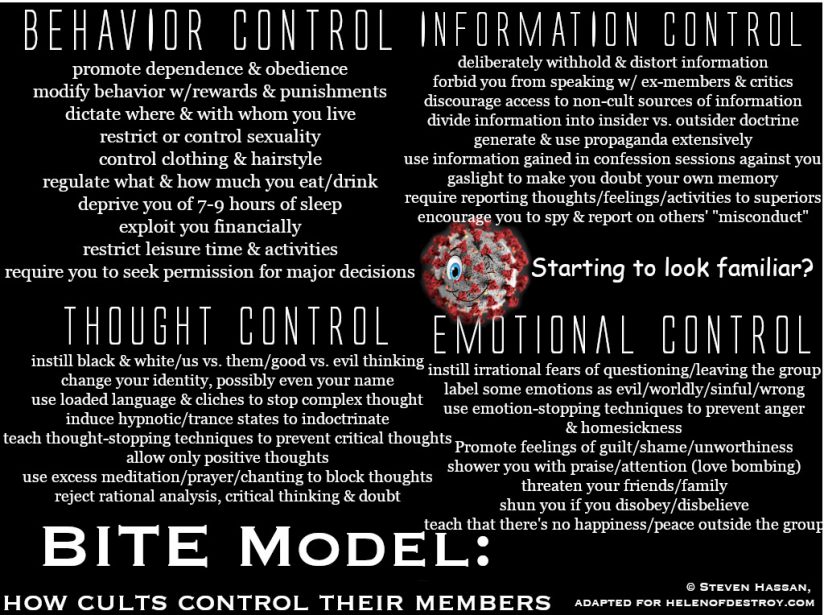
Deprogramming the world from the Cult of Corona cannot be done by force – its backers have too much power, including total control of both establishment and social media. It must be approached strategically. Just as traditional “deprogrammers” will isolate a cult member from the group, reasoning there’s a much better chance of re-awakening the original personality when the person is not experiencing the pressures of groupthink, deprogramming Corona Cultists is best done one-on-one, keeping in mind that cultists will ferociously defend their dogma with thought-stopping techniques which can be extremely irritating to outsiders trying to convey dissenting information. Former “Moonie” Steven Hassan’s BITE model (above) describes how cults exert undue influence and is useful in approaching deprogramming.
The notion of deprogramming entire societies may seem daunting, but it is the only chance humanity has to retain some semblance of freedom and turn back from the dark path down which our species is heading. The ruling class is imposing a comprehensive, multilayered control grid that has been in the works for decades, and when it is complete, revolution will not be an option. Such a future must be avoided at all costs.
US threatens ‘consequences’ if ICC acts on Israel’s war crimes

RT | May 16, 2020
Arguing that Palestine doesn’t “qualify as a sovereign state” and that the International Criminal Court lacks jurisdiction over Israel, US Secretary of State Mike Pompeo has threatened “consequences” for any “illegitimate” probes.
Following his trip to Israel this week, Pompeo issued a brief statement, denouncing the ongoing efforts by the ICC to investigate allegations of war crimes against Palestinians, including the use of live ammunition against protesters, the demolition and shelling of civilian homes and infrastructure, and forcible relocations as part of Israel’s settlement projects in the occupied territories.
“The United States reiterates its longstanding objection to any illegitimate ICC investigations,” wrote Pompeo, blasting the ICC as “a political body, not a judicial institution,” and arguing that is has no “jurisdiction over Israel, which like the United States, is not a party to the Rome Statute that created the Court.”
“We do not believe the Palestinians qualify as a sovereign state, and they therefore are not qualified to obtain full membership, or participate as a state in international organizations, entities, or conferences, including the ICC.”
While Palestine has yet to achieve fully recognized statehood, the quasi-governmental Palestinian Authority was accepted into the ICC in 2015. The US signed the Rome Statute in 2000, but it was never formally ratified by the Senate. Israel, too, was an early signer to the statute, but also never finalized its membership in the organization.
“If the ICC continues down its current course, we will exact consequences.”
Washington repeatedly threatened the ICC with sanctions in the past as the US itself also scrutiny in the investigation of alleged war crimes and crimes against humanity committed by Afghan government forces, the Taliban, American troops and intelligence operatives.
Apartheid is a Crime: Portraits of the Israeli Occupation of Palestine – Book Review

Apartheid is a Crime: Portraits of the Israeli Occupation of Palestine, by Mats Svensson. (Photo: Book Cover)
By Jim Miles | Palestine Chronicle | May 16, 2020
In Apartheid is a Crime, Mats Svensson has created a very accessible clear expression of Israel’s occupation of Palestine.
It is composed primarily of photos of the Palestinian situation. Not photos of the wars, the fighting, and the blood, but of the people and their dispossession under martial law. The faces do not show rage and hatred, but range from resigned acceptance, through steadfastness, passive resistance, and on to – somehow – a seeming ironic happiness – ironic in that it is difficult to imagine anyone smiling or laughing under these conditions. When Israeli shoulders are viewed, their faces are impassive, uncaring.
The landscape is presented in three themes. The first shows the abandoned landscapes from the nakba – houses untended and decaying, the native plants, and significantly the native cactus claiming their own space in the ruins. The demolition of homes highlights the daily ongoing military actions, piece by piece, of the slow demolition of the remaining cultural and civil landscape. Finally, the wall looms above all, combined with wide swaths of cleared ‘buffer’ zones, separating families, farms, businesses, and civic interaction.
Preceded with a foreword by Ramzy Baroud, the photos are accompanied by short text excerpts from many well-known names: Tom Segev, Richard Falk, Nelson Mandela, Edward Said, Moshe Dayan, and Presidents Obama, Carter and Bush. Among them are lesser-known names of Palestinian and Jewish voices, speaking equally as eloquently as the readily recognized names. The general theme of the comments is of apartheid and colonialism, the unfortunate silence of the diplomats, and the daily humiliations and struggles of the people suffering under the apartheid system, a system that always and ever has denied a two-state solution.
The juxtaposition of comments and photos provides a strong message concerning the plight of the Palestinian people. It is concise, not needing a historical background, hitting the reader on an emotional level more than an intellectual level. For those just becoming familiar with the Palestinian problems Apartheid is a Crime is a good starting position; for those already cognizant of the situation and many of its political/legal backgrounds, Apartheid is a Crime presents a visually emotive reminder with concise quotes and references reinforcing longer discourses.
– Mats Svensson, a former Swedish diplomat working on the staff of SIDA, the Swedish International Development Cooperation Agency, has been following the ongoing occupation of Palestine since 2003. He is the author of “Crimes, Victims and Witnesses – Apartheid in Palestine.” (Real African Publishers) and his latest “Apartheid is a Crime – Portraits of Israeli Occupation,” (Cunepress, 2020).
Obamagate Shows Biden Is Inadequate in Challenging Trump
By Paul Antonopoulos | May 16, 2020
Former U.S. President Barack Obama is coming under increasing pressure, led by what President Donald Trump is calling “Obamagate.” This comes as Mexico has requested to finally clarify the affair with the secret sale of American weapons to Mexican drug cartels. Mexico is asking for the case to be clarified after almost ten years.
In this secret operation conducted by the Bureau of Alcohol, Tobacco, Firearms and Explosives, weapons from the U.S. were sold to Mexican drug cartels. The U.S. claimed that about 2,000 automatic weapons were sold to Mexicans so that the Barack Obama administration could follow their path to the drug cartels. Instead, these weapons were used in massacres. Mexican authorities are now seeking answers from the United States.
In addition to selling weapons to Mexican drug cartels, Obama is responsible for a lot of global upheaval on the world stage – primarily the so-called “Arab Spring” that should be more accurately described as the “Arab Winter” as it brought death and destruction across the Arab world.
The sale of these weapons to Mexican drug cartels is another ugly legacy of Obama’s rule that liberals like to view as one of the best periods of American history. Let’s not forget that in 2009 Obama won the Nobel Peace Prize for his apparent “extraordinary efforts to strengthen international diplomacy and cooperation between people.”
The majority of U.S. media will most likely try and find appropriate excuses so they can minimize Obama’s role in these scandals. It is completely clear that the battle over who will be in the White House in the next four years is now taking focus on the Obama era as opposed to Trump’s mishandling of the coronavirus pandemic that has claimed the lives of over 80,000 Americans and infected more than 1.3 million people.
With endless tweets by Donald Trump dedicated to Obama over the past few days, it is as if the presidential battle in November will be fought between him and Obama, and not Democrat сandidate Joe Biden.
The reason for Trump’s many tweets against the former president was because of Obama’s private conversation that was leaked to the public in which he criticized the suspension of the investigation against Trump’s former national security adviser Michael Flynn, while he called Trump’s fight against the coronavirus epidemic a “chaotic disaster.”
The American president started tweeting on the morning of May 10 and stopped late in the evening, making over a hundred tweets against Obama. This exchange between Obama and Trump is not common in American politics as former presidents usually do not interfere in the politics of their successors. However, there are suggestions that Obama still has connections to the deep state and is actively undermining Trump.
Obama, who openly admitted he would remain active in politics and wished he could contend for a third term, could be exerting influence through Hillary Clinton and Biden. It is likely Obama is becoming more public as Trump’s opponent Biden is proving inadequate and incapable of defeating Trump.
The battle between Obama and Trump started with the announcement that the Ministry of Justice is terminating the investigation against former Trump national security adviser Michael Flynn. Flynn, who was probably the shortest-serving national security adviser in history, was sacked at the beginning of his term on charges of lying to Vice President Mike Pence about talks with the Russian ambassador to Washington. His removal triggered a chain of failed investigations and campaigns against Trump and his alleged links to Russian interference during the U.S. presidential election, which also ended in a failed impeachment.
In private conversations that leaked to the public, Obama described Flynn’s acquittal as a threat to the rule of law.
Trump also retweeted statements from CIA agent Buck Sexton, in which he accused Obama of sabotaging the Trump administration in the first days of his term. Sexton also called former FBI Director Andrew McCabe “a dishonorable partisan scumbag who has done incalculable damage to the reputation of the FBI and should be sitting in a cell for lying under oath”
Trump then continued with accusations on Twitter and said that Obama committed “the biggest political crime in American history, by far!” and ended briefly with “Obamagate.”
As for the affair with the secret operation of selling weapons to Mexican drug cartels, journalists of Forbes in 2011 wondered whether that operation would become Obama’s “Watergate,” and it appears that it very well could be. Obama’s attempts to smear Trump has not only backfired, but it could have very serious legal ramifications against him and others in his administration.
Remembering Palestine on Nakba Day: Use the Hashtag COVID1948

By Philip Giraldi | American Herald Tribune | May 15, 2020
Palestinians worldwide have an annual day of remembrance called Nakba Day. Nakba comes from the Arabic al-Nakbah and means “disaster” or “catastrophe.” It takes place on May 15th, the day after the Gregorian calendar date for Israeli independence in 1948. It is an opportunity for a people who live largely in exile to recall what was stolen from them by the nascent Israeli state in 1947 through 1949. An estimated 700,000 Palestinians, half of the country’s Arab Christian and Muslim population, were driven from their homes through a deliberate policy of terrorism officially initiated in January 1948 to drive the Palestinian population out, a clear case of government initiated ethnic cleansing.
The expulsion orders, formulated as Plan Dalet in March, were carried out by the Jewish state’s military and militia forces, to include terrorist groups like Irgun and Lehi. The massacre of Arab civilians at Deir Yassin in April 1948, in which hundreds of civilians died, was, for example, implemented to terrorize the local population, forcing it to flee. In the portion of Palestine that was to become Israel fully 80% of the resident Arabs, many of them Christian, were killed, fled in terror or were compelled to leave at gunpoint.
In the expulsion process, which continued into early 1949, between four hundred and six hundred Arab villages were destroyed or rendered uninhabitable, while Palestinians in the larger urban centers were driven from their homes. Those homes were then given to Jews coming from Europe or America and one of the first acts carried out by the new nation Israel’s parliament was to pass laws blocking the return of any Palestinian to his or her home in what was to become the Jewish state. This meant in practice that a European Jew could arrive in Israel on one day and by the next be settled in a former Palestinian home. The legal owner of that home, however, had no right to return or even visit his former property. United Nations’ demands that the Palestinians should one day be able to return home have been since that time ignored by Israel and unsupported by the United States.
In fact, Israel never intended to allow Palestinians to return to their homes, in spite of the fact that when it joined the United Nations in May 1949 it agreed to “unreservedly accept the obligations of the United Nations Charter and undertake to honor them from the day when it becomes a member of the United Nations.” This included an explicit understanding in principle to allow the return of all Palestinian refugees.
Palestinians are to a certain extent wards of the United Nations Relief and Works Agency (UNRWA), which was founded in 1949 to support those displaced by the Israelis. In 1949 there were less than one million refugees, but today, due to large families and other population growth, the number who technically qualify for UNRWA’s assistance is over 5 million. Services include education, health care, food security and other essentials, to some 800,000 Palestinians registered as refugees in the West Bank and 1.3 million people in the Gaza Strip, as well as 534,000 in refugee camps in Syria, 464,000 more in Lebanon and also 2 million in Jordan. Approximately 1 million refugees have no documents other than an UNRWA identification card.
Israel has long been highly critical of UNRWA and the Donald Trump Administration predictably followed its lead to eliminate funding to the organization in August 2018.
The so-called peace plan being promoted by the Trump Administration has been rightly described as a non-starter as it is a wish list for Israel that will permit annexation of much of the West Bank with a rump Palestinian state that has no control over its airspace, water, borders or defense in place for those Arabs who can be induced to remain. It would mark the clearly perceived end of any Palestinian aspirations for either statehood or even for an acceptable relationship marked by mutual respect with its de facto Jewish overlords.
American antipathy towards the Palestinians, particularly as expressed by Evangelicals, is somewhat surprising as there has long been a vibrant Christian community in Palestine that has been sharply diminished through the actions of the state of Israel. Residents and church leaders describe the nervousness of the tiny Christian communities in Israel, caught between larger Muslim and Jewish populations. Like other Palestinians, Christians face land seizures, arbitrary arrests, home demolitions and collective punishment that come with the Israeli occupation. Recently radical Jewish settlers have become more active, defacing Christian churches and cemeteries while also threatening and spitting on clergy in the streets.
In and around Bethlehem, Christians constituted 80 percent of the population in 1950 and are only around 12 percent today. Jewish settlements have annexed land owned by Christians in many areas. In Israel itself, Christians were 21 percent of the Arab population in 1948 but number only 8 percent today, just 2 percent of the total population. The process has been described as “a quiet ethnic cleansing… not large-scale massacres or large-scale deportations, but it is bit by bit over many years with a variety of policies which Christians are not necessarily attacked as Christians but they are marked by being Palestinians.”
This year Palestinians are expressing themselves on Nakba Day to demonstrate their rejection of the Trump peace plan as well as of the new Israeli Benjamin Netanyahu led government’s intention to annex large portions of the West Bank, to include the entire Jordan River Valley, after July 1st. They have adopted the hashtag #COVID1948, which seeks to equate the current devastation resulting from the coronavirus with the catastrophe that occurred to the Palestinian people in 1948 at the hands of the Israelis. It is reportedly trending on social media and is in one sense an eloquent reminder of the wrongs committed against an entire people, to include a deliberate policy of ethnic cleansing that bore fruit in 1948-9. It is also a reminder that the Palestinians are a stubborn and self-aware people who will not just go away because the Israelis and the United States would like to see that happen.
Philip M. Giraldi is a former CIA counter-terrorism specialist and military intelligence officer who served nineteen years overseas in Turkey, Italy, Germany, and Spain. He was the CIA Chief of Base for the Barcelona Olympics in 1992 and was one of the first Americans to enter Afghanistan in December 2001. Phil is Executive Director of the Council for the National Interest, a Washington-based advocacy group that seeks to encourage and promote a U.S. foreign policy in the Middle East that is consistent with American values and interests.
The American Genie – Engineering a Catastrophe
By David Macilwain | American Herald Tribune | May 15, 2020
The first signs that something terrible had gone wrong with the security at the Fort Detrick bio-defence facility fifty miles north-west of Washington DC were when cases of a previously unknown and serious respiratory illness appeared at a retirement village on the western outskirts of the capital in July 2019. The first cases were noted on June 30th amongst the 260 residents of the Greenspring Assisted Living unit, with the infectious disease later affecting 19 staff and taking the lives of some older residents.
“The notice that went out on July 10 from Donna L. Epps, an administrator at Greenspring, said several residents had been having symptoms of respiratory illness, including fever, coughing and body aches. Epps’s notice, which says the symptoms recede in about five to seven days with treatment but have caused pneumonia, also announced limits on visitors, enhanced sanitation measures and other steps.”
The story was rapidly picked up, and statements issued to ease concerns:
“– the two patients who died in the outbreak had been hospitalized with pneumonia but were “older individuals with complex medical problems.”
“One of the things about skilled nursing facilities and assisted living facilities is that when you have a lot of people in close proximity, who have underlying medical conditions, there is an increased risk for outbreaks,” he said. “Seeing a respiratory outbreak in a long-term care facility is not odd. … One thing that’s different about this outbreak is just that it’s occurring in the summer when, usually, we don’t have a lot of respiratory disease.”
The Centre for Disease Control was alerted on July 8th and took samples but “was unable to identify the organism responsible”. As if. Perhaps it was just a sensible precaution to close down the Fort Detrick research facility two weeks later, where infection control mechanisms had previously been suspect.
“The statement said the Center for Disease Control and Prevention decided to issue a “cease and desist order” last month to halt the research at Fort Detrick because the center did not have “sufficient systems in place to decontaminate wastewater” from its highest-security labs.”
While the organisms Fort Detrick conducted research on and with included such lethal ones as Ebola, concerns had been raised back in 2015 about their research on genetically engineered and mutant viruses that posed an unacceptable risk to humans should they escape. This research, known as “gain of function” or GOF had been banned in 2014 by the Obama administration, but some programs appear to have continued, and in November 2015 caused scientists to issue a warning. While this warning has been widely publicised, as well as used to support the theory that SARS-CoV-2 came from a lab and not from nature, the GOF research it referred to, published a little earlier in Nature medicine has had little attention.
This research was a collaborative project between the scientists at the University of Carolina and a team led by “Bat Woman” Shi Zhengli at the Wuhan Institute of Virology. While the research is complex and the motives obscure, there is little doubt that the researchers successfully engineered a “chimaera” which combined a lethal coronavirus from a bat with one capable of easily infecting human cells, and proved its “gain of function” both in vitro and in vivo.

Shi Zhengli. Credit: Weibo
Further information has now come to light on evidence that SARS-CoV-2 was genetically engineered following a detailed scientific study into the genome of the virus. Ironically perhaps, the focus of the anonymous analyst seems to have been to incriminate the Chinese government “communist party” and its research lab in Wuhan. As explained by “GM Watch”, despite this political angle and the suspect anonymity of the unpublished research, the science it presents is very persuasive. Significantly however, they question the analyst’s view that the synthetic virus was designed as a bioweapon, “though it may have been”. They conclude:
“In our view, the evidence presented above shows that there is an urgent need for a credible and independent international investigation into the origins of SARS-CoV-2 and the roles played by Shi Zhengli, the Chinese government, and the US bodies that helped fund the virus research at the WIV, including the National Institutes of Health and the EcoHealth Alliance.”
It may be a surprise for some to learn of US involvement in research at the Wuhan Institute of Virology, but it should be a shock to learn how this collaboration came about and who was involved. As recently revealed in the mainstream publication Newsweek, America’s high-profile scientific expert Dr Anthony Fauci strongly supported GOF research, and following the ban in the US was involved in funding a similar project in Wuhan. That five-year project ended in 2019 and was extended:
“A second phase of the project, beginning that year, included additional surveillance work but also gain-of-function research for the purpose of understanding how bat coronaviruses could mutate to attack humans. The project was run by EcoHealth Alliance, a non-profit research group, under the direction of President Peter Daszak, an expert on disease ecology. NIH canceled the project just this past Friday, April 24th, Politico reported. Daszak did not immediately respond to Newsweek requests for comment.”
Newsweek notes that Dr. Fauci also did not respond to their requests, and other media didn’t pick up the story. But:
“according to Richard Ebright, an infectious disease expert at Rutgers University, the project description refers to experiments that would enhance the ability of bat coronavirus to infect human cells and laboratory animals using techniques of genetic engineering. In the wake of the pandemic, that is a noteworthy detail.
Ebright, along with many other scientists, has been a vocal opponent of gain-of-function research because of the risk it presents of creating a pandemic through accidental release from a lab.”
As well as supporting GOF research, for reasons described by Newsweek, Dr. Fauci was renowned for his work on HIV, and more recently on bird flu viruses. He also was involved in the development of Remdesevir, which he has recently promoted as a treatment for COVID-19 cases despite little evidence for its efficacy, in contrast to the widely used Hydroxychloroquine favored by the US President – and many others around the world.
But the treatment or consequences of the release of this novel Coronavirus are not my concern at this crucial junction point – or rather disjunction point – in history.
Having concluded some time ago that the origin of the SARS-CoV-2 virus was most probably the bio-insecure facility at Fort Detrick, the one question that remained unanswered was how and why it appeared in Wuhan, and what happened in the months before it was first identified there.
A number of impossibly unlikely coincidences led to that conclusion, in particular the first detected appearance of the virus was in the hotel where US soldiers stayed during the World Military Games, held between October 18th and 27th 2019 in Wuhan. Coincidentally and indicatively also, a “novel Coronavirus” pandemic simulation exercise was held in New York on the very day the games began, sponsored by and involving some key actors in the health and pharmaceutical industry, as well as significant international experts.
The apparent suppression of reporting on “Event 201” in the mainstream media has led observers to interpret this pandemic rehearsal in the way that other coincidental exercises have been – as further evidence of “conspiracy”. The involvement of CEPI director Jane Halton in Event 201 is the most indicative of these coincidences, given the role Australia is playing in pushing for an “inquiry” targeting China, and Halton’s role in the National Coronavirus Coordination committee.
It is instructive to read the recommendations issued following the Event 201 exercise, particularly on the development of public-private partnerships and on the control of false information in the media, as this is reflected in the control of the “COVID-19 Pandemic” narrative here in Australia.
Although there is a divergence of opinion on how to treat the escalating conflict with China, particularly following the Chinese Government’s actions on food imports from Australia, no-one in the Government, Opposition, think tanks or media is saying that China is not to blame for the pandemic, in some way or another. Influential commentators, as well as union leaders, are portraying the dispute as a choice between taking China’s money or protecting our sovereignty, a position that is both idiotic and mistaken, ignoring the reality of our dependence on Chinese exports and imports.
Australians may not be able to see it, but for the Chinese foreign ministry it is crystal clear – that Australia’s proposals and actions are in no-ones interest, except America’s.
Until now the situation appeared paradoxical. Concluding that the US had intentionally introduced the novel Coronavirus into Wuhan made little sense, given the inevitable blowback. Four months on it is the US which has suffered worst from the Coronavirus Pandemic, while China is restarting its temporarily disabled economy after successfully suppressing the epidemic in Wuhan. Barring some of the wilder conspiracy theories that might see a benefit for some elites and vested interests in health and security in the chaos induced by the lock-downs, the question of “cui bono” remained unanswered, until now.
Some of the US soldiers in the team sent to Wuhan for the games reportedly fell ill and even went to hospital, but it now appears that athletes in teams from other countries were infected by contact with them. Two French athletes recently reported having suffered a strange respiratory illness after returning home from Wuhan, which they now realize was very probably CV19. Apparently similar cases have been reported in athletes from other teams who participated in the Wuhan games, with Luxemburg and Sweden cited in this report. A more recent but still early appearance of a distinct strain of the virus in France suggests an origin in those early cases from Wuhan. The distinct and early outbreaks in Italy and Iran may well have also originated similarly from returning athletes.
So now the possibility arises that far from the Wuhan Military Games being the point where the novel Coronavirus was introduced into China, they were the point from which the infection fanned out across the world, potentially to all the countries participating in the Games. Except for one.
As with Italy and France, there were early reports of an unusually severe pneumonia occurring in the US in December and November, but with cases mistaken for influenza at that time of year, except by the CDC, which recognized the infection as “COVID 19” but kept quiet about it until questioned in senate hearings. Unsurprisingly, China picked up on this admission from the CDC, asking the question to which we now have the answer – “where was your patient zero?”.
Perhaps they may also be considering a new “conspiracy theory” following the revelation of the July outbreak at Greensprings retirement village. This would be my suggestion:
To say that the escape of the Coronavirus Genie from Fort Detrick was a monumental disaster looming for the US health system and for the economy is a gross understatement. As we can see from the way the world has been turned upside down by the chaotic response to the pandemic, being held responsible for this long predicted catastrophe could bring the world down on you. So rather than admit to the viral Genie’s escape and the total failure of the Centre for Disease Control to control this unknown and deadly disease, they had to come up with a plan.
Because of the collaboration with Wuhan on GOF research and the presence of similar or identical viruses at the WIV, a scheme might be devised to plant the infection in the centre of the city and lay the blame for the subsequent predicted pandemic on China. When the virus later reached the US, its already established presence there would be effectively concealed, at least from the public. Concealing such things from epidemiologists and virologists is clearly harder, and it has been noted that while cases in Washington State are closely related to the Wuhan strain, those in New York are not. (It has also been reported that Italy has requested the exhumation of bodies in the US following suspicions on the origins of the Italian outbreak; the US has so far refused.)
I propose that the scheme devised in desperation last summer for this “diversionary tactic”, was to send the Fort Detrick Virus with the soldiers set to compete at the Wuhan games in three months’ time, while trying to keep a lid on the domestic epidemic until the new year, and a lock on the inquisitive media. Rehearsing for the subsequent global pandemic called for “Event 201” to prepare participants for what they might have to face, and bring their organizational and media responses into line. Shi Zhengli’s presence in Wuhan also looks to be an important part of this US operation, with stories about her work with Horseshoe Bats, and her recent insistence on the natural origins of the Virus playing a vital role in the cyber-warfare side of the operation. Given Zhengli’s role in the controversial genetic engineering research project in 2015, those stories are clearly vital disinformation.
Whether this theory is the correct one may not yet be proven, but it does provide an explanation to the conundrum of the genie that was accidentally released from the bottle but intentionally released from Wuhan. And we must all now suffer the consequences of that US “culpable manslaughter” as we learn to live with their engineered Genie. Just don’t take it out on China.
Featured Video

or go to
Aletho News Archives – Video-Images
Book Review
The Maidan Killings and the False-Flag Case
By Freddie Ponton | 21st Century Wire | September 5, 2026
Before the killings that helped bring down Ukraine’s president in February 2014, American diplomats were discussing who should enter its government. In a leaked telephone call, senior State Department official Victoria Nuland told US ambassador Geoffrey Pyatt, “I think Yats is the guy,” referring to opposition leader Arseniy Yatseniuk. Washington had clear preferences and was working to advance them. Later that month, Yatseniuk became prime minister.
Ivan Katchanovski’s The Maidan Massacre in Ukraine examines the violence that preceded that transfer of power. Drawing on television footage, witness testimony, forensic examinations and Ukrainian court proceedings, he argues that elements of the opposition shot protesters and police in a false-flag operation. His case centres on evidence of protesters being shot from opposition-controlled locations, including Hotel Ukraina, overlooking the killing ground. … continue
Blog Roll
 Aletho News
- In August Hanning Treason Case- All Signs Point To Tel Aviv.
- France cleared dozens of military sales to Israel between May and September: Report
- France projects nuclear power as Macron pushes arsenal expansion
- The fallacy of US delusions about Iran’s economic collapse
- What changes with Lula or Flávio?
- Britain leads Western media’s demise through ‘fear porn’ narrative
- The Maidan Killings and the False-Flag Case
- Georgia’s Largest Healthcare System Will Fire Employees Who Refuse Flu Vaccine
- The Five-Year Fuel Crisis: Why the World Economy Is Paying for a War It Thinks Is Ending
- Trump’s Big Bluff on Iran
- If Americans Knew
- Soldier testimony sheds light on how Israel wages information war
- CIA Report Warns Israel Could Head Toward Civil War, Total Collapse
- Banker Who Exposed Howard Lutnick’s Ties to Epstein Warned of ‘Retaliation’ and ‘Personal Consequences’ in Last Post Before Suicide
- Israeli Attacks Kill Two Palestinians in Gaza
- Gaza genocide at 3: Israeli-U.S. cruelty and the smart, deep resistance to it are changing the world
- As genocide is about to enter 3rd year, little of Gaza remains– Daily Update
- “We See Our Homes Now From A Satellite, Like Strangers”
- Watch “Gaza: Doctors Under Attack”, originally censored by BBC
- NAZA: Israeli embassies in UK and US promote rival documentary to challenge Gaza genocide allegations
- David Ellison appoints Israeli to lead merged Paramount-Warner studios
- No Tricks Zone
- Latest European Green Energy Debacle; Portugal’s Largest Flagship Solar Park Insolvent!
- Green Energy Debacle: German Expert Professor Fritz Vahrenholt Warns Of Severe Economic And Social Consequences
- Two More Paleo Reconstructions Affirm Meters-Higher Sea Levels Across Ireland, Brazil 7000-6000 Years Ago
- New Study: Earth And Venus Surface Warmth Largely Explained By Convection And Lapse Rate, Not CO2 Or Radiation
- 2025 Nature Paper Claiming Worsening Global Drought Gets RETRACTED …Heavily Flawed
- New Study: ‘Global Drought Shows No Detectable Recent Acceleration Under Climate Warming’
- Economic Masterminds: German Socialists Suggest Taxing Productivity Gains Stemming From Using AI
- The South China Sea Has Not Been Cooperating With The Climate Change Narrative
- Energy Crisis: Germany Enters Heating Season With Historically Low Gas Reserve Fill Levels
- New Study: The Antarctic Ice Sheet Gained Mass From 2020-2024 Due To Staggering Snow And Ice Accumulation

