Col Douglas Macgregor: Pressure to REMOVE TRUMP FROM OFFICE Growing
Daniel Davis / Deep Dive – June 23, 2026
Daniel Davis / Deep Dive – June 25, 2026
Press TV | June 25, 2026
The strategic calculus surrounding Iran’s ongoing negotiations with the United States within the framework of the memorandum of understanding (MoU) has reached a critical juncture.
Two concurrent developments demand a comprehensive and resolute response: Oman’s unilateral announcement of a separate shipping corridor through the Strait of Hormuz and President Donald Trump’s continued military threats against the Islamic Republic.
Taken together, these developments represent a concerted attempt to undermine Iran’s sovereignty over the Strait of Hormuz and weaken the fundamental security guarantees that give diplomatic engagement its meaning and value.
For Iran, the Strait of Hormuz is far more than a source of economic leverage; it constitutes a cornerstone of national security, a critical component of its deterrence posture, and a vital mechanism for preventing future acts of aggression.
The Strait of Hormuz: A matter of national sovereignty
The Strait of Hormuz represents one of the most strategically significant maritime chokepoints in the world, through which approximately 20 percent of global oil supplies transit. For Iran, control over this waterway is intrinsically linked to national security, economic sovereignty, and the capacity to deter any form of external aggression.
The recent visit of Iran’s parliament speaker and lead negotiator, Mohammad Baqer Qalibaf, to Muscat appears to have been exploited by Oman under US pressure to advance an agenda that directly contradicts Iran’s sovereign rights over the strategic waterway.
Oman’s unilateral announcement of a separate route requiring only coordination with the International Maritime Organization (IMO) constitutes a calculated maneuver to undermine Iran’s legal and legitimate authority over the Strait.
This action was taken without any coordination with Tehran and coincides with mine-clearing operations based on the memorandum signed between Iran and the United States.
The strategic logic suggests that by creating an alternative corridor, Oman has offered vessels a route that avoids Iran’s jurisdiction, effectively normalizing a system where Iran’s role in administering the Strait becomes irrelevant.
The timing is particularly significant. As mine-clearing operations proceed, Omani authorities have directed vessels toward this alternative corridor, whose route poses serious safety risks and is unacceptable, according to Iran’s Islamic Revolution Guards Corps Navy.
This effectively undermines one of Iran’s most significant bargaining chips – the ability to control access through the Strait and ensure compliance with its security requirements.
IRGC’s warning: An essential but insufficient first step
In response to this challenge, the IRGC Navy issued a timely warning that “the only authorized routes for vessels’ passage through the Strait of Hormuz are the ones announced by Iranian authorities.”
The statement emphasized that “vessel traffic outside these routes is prohibited and highly dangerous,” adding that “coordination with the IRGC Navy via Channel 16 is mandatory for passage through the Strait of Hormuz.”
This response demonstrates Iran’s readiness to protect its sovereignty and maintain its authoritative position over one of the most critical energy chokepoints in the world.
However, as a purely military response, it is insufficient to address the full scope of the challenge. The Omani initiative is fundamentally a political maneuver, and it requires a coordinated response that includes diplomatic, legal, and security dimensions.
The existential implications cannot be overstated. The threat to Iran’s national security, the assassination of the Leader of the Islamic Revolution, and the imposition of two illegal and unprovoked wars through the use of hostile American bases and the cooperation of Arab countries are not matters that can be ignored within diplomatic engagement.
The primary means of preventing their recurrence is firm control over the Strait of Hormuz. If Iran permits this condition to be eroded through political maneuvering, it risks losing a critical deterrent mechanism without receiving commensurate concessions in return.
Trump’s threats: A direct violation of clause 1
Concurrent with the challenge to Iran’s legal authority over the Strait, Trump has once again threatened that if Iran does not act according to his whims, he will impose war once again.
These statements go far beyond psychological warfare intended to weaken the morale of Iranian negotiators or serve domestic political purposes. They constitute a direct violation of Clause 1 of the memorandum signed by him and the Iranian president last week, which calls on signatories to “refrain from the threat or use of force against each other.”
Trump’s threat to “blow up the country, launch a full ground invasion to take it over, and assassinate Iranian negotiators” represents an explicit violation of the agreement.
When combined with the Zionist regime’s insistence on continuing its occupation of Lebanese territory – itself a clear violation of the memorandum’s provisions regarding the cessation of hostilities on all fronts – the pattern becomes unmistakable. The enemy is systematically testing the limits of Iran’s commitment to the negotiation process while violating its fundamental provisions.
The statement by US Treasury Secretary describing the $30 billion in frozen assets and sanctions relief as a “temporary carrot” that can be withdrawn whenever desired demonstrates that, from the enemy’s perspective, what it believes it will ultimately obtain from Iran far exceeds what it is offering during the negotiation process.
This perception must be neutralized through both the words and actions of Iranian officials.
The strategic importance of the Strait in the negotiations
The Strait of Hormuz’s importance extends beyond economic considerations. It serves as the primary mechanism for creating practical guarantees for the fulfillment of Iran’s conditions within the memorandum, similar to what occurred in Lebanon and immediately revealed its consequences. Control over the Strait enables Iran to compensate for war damages, provide security against future aggression, and prevent the passage of military and hostile vessels.
The memorandum commits Iran “to arrange for the safe passage of commercial vessels through the strait, with no charge for 60 days.” The subsequent joint statement with Oman “agreed to establish a joint working group to negotiate the future administration of navigation in the Strait of Hormuz.”
However, Oman’s unilateral action effectively preempts this negotiation process by establishing a separate corridor that bypasses Iranian authorization.
The implementation of what Oman has announced would constitute a clear example of the enemy achieving through the political process what it failed to achieve through military means during the Third Imposed War.
If realized, it would increase the enemy’s appetite to obtain through diplomacy what it was unable to secure through all-out military aggression, a precedent that would embolden further violations of Iran’s sovereignty.
Available responses and strategic options
Various measures exist for responding to this new challenge, each with its own implications:
First, suspending mine-clearing operations would signal that Iran’s commitment to safe passage is conditional on recognition of its authority over the Strait. This would maintain pressure on global shipping and demonstrate that Iran retains the capacity to disrupt traffic if its sovereignty is not respected.
Second, imposing restrictions on vessel passage that deviate from Iranian-designated routes would enforce Iran’s jurisdictional claims directly. The IRGC Navy has already warned that “ships’ movement through other routes is dangerous and prohibited,” establishing the basis for enforcement actions.
Third, military action against violating ships, while potentially escalatory, would demonstrate Iran’s determination to protect its sovereignty. The IRGC Navy has already stated that “any vessel found in violation will be subject to enforcement measures,” establishing a credible deterrent against hostile entities.
Fourth, announcing a halt to negotiations or postponing the next round would signal that these developments have fundamentally altered the basis for continued engagement. This would be particularly appropriate given that Trump’s threats directly violate Clause 1 of the memorandum.
Fifth, escalating the political response through diplomatic channels while the armed forces maintain their deterrent posture. As the points above indicate, the first response by the IRGC Navy is timely and appropriate but insufficient; political responses must be added within the framework of the diplomatic negotiation process.
The risk of precedent and the nature of the enemy
What is at stake extends beyond the immediate question of the Strait. If Oman’s unilateral action is permitted to stand, it would establish a precedent that Iran’s sovereignty can be circumvented through coordinated political maneuvering.
That would fundamentally alter the balance of power in the region, demonstrating that Iran’s strategic assets can be neutralized through diplomatic means rather than requiring military confrontation.
The enemy’s objective in these negotiations appears to be:
1. Gaining access to Iran’s 60-percent enriched material
2. Obtaining complete intelligence regarding the remaining nuclear infrastructure and facilities
3. Reopening the Strait of Hormuz on terms favorable to the United States and its allies
4. Securing economic breathing space for the world and the United States
5. Preserving the Republican Party’s position in the November midterm elections
In return, Iran is offered temporary concessions such as oil exports, lifting the naval blockade, and releasing some assets, whose total financial value of approximately $30 billion is of very limited significance when compared with the strategic importance of Iran’s tools and capabilities, especially the Strait of Hormuz and the unified Resistance Front.
The comparison with Lebanon is instructive. When Iran demonstrated commitment to the ceasefire, it was met with continued Israeli occupation and attacks, demonstrating that the enemy seeks to exploit Iranian goodwill rather than reciprocate it.
The inadequate response to these violations, alongside discussions about the return of IAEA inspectors and Iran’s failure to publish a fact sheet regarding the agreement, increases ambiguity in public opinion and leads to greater polarization.
A coherent strategy for the negotiations
Iran’s response to these challenges must be coordinated, multifaceted, and proportionate to the gravity of the developments. The armed forces’ response, while necessary, must be supplemented by political actions within the diplomatic framework.
Several principles should guide this approach:
First, Iran must maintain its position that control over the Strait of Hormuz is non-negotiable and essential for national security. Any arrangement that circumvents Iranian authority must be rejected absolutely.
Second, the perception that Iran can be pressured into abandoning its strategic assets through diplomatic engagement must be countered through concrete actions that demonstrate the costs of violating Iran’s sovereignty.
Third, the link between the negotiation process and the security situation, including the Strait of Hormuz and the Resistance Front, must be maintained. Concessions on one issue cannot be made in isolation from progress on others.
Fourth, Iran must articulate clearly that the threatening rhetoric by US officials constitutes violations of the memorandum and will be met with appropriate responses, including the possibility of suspension or postponement of the negotiations.
Fifth, Iran should leverage the extraordinary strategic importance of the Strait of Hormuz as the primary means of providing security guarantees and preventing future aggression. The existential threat against Iran’s national security demands that sovereignty over the Strait be maintained as a fundamental condition of any agreement.
The path forward requires rejecting the assumption that these challenges can be addressed through military responses alone.
The coordinated political and diplomatic maneuvering by the United States, its regional allies, and Oman demands a comprehensive response that integrates the armed forces’ capabilities with political diplomacy. Anything less would signal weakness and encourage further violations of Iran’s sovereignty and the terms of the memorandum.
Ultimately, Iran’s position must be clear: the Strait of Hormuz remains under Iranian authority, and any route that does not coordinate with Iran is unacceptable and will face appropriate measures.
The negotiations should not appear as an opportunity for the enemy to achieve through political means what it could not achieve through illegal war of aggression.
Iran’s strategic assets – the Strait of Hormuz, the Resistance Front, and its nuclear capabilities – are not negotiable items but fundamental components of the country’s national security that must be preserved.
The burden lies with the other parties to demonstrate their commitment to the agreement and respect for Iran’s sovereignty through their actions, not merely words.
Al Mayadeen | June 25, 2026
A rare House vote on US military assistance to “Israel” is expected to force lawmakers to publicly defend or reject continued funding for the Israeli military, amid growing domestic debate over Washington’s role in the region.
A report by Responsible Statecraft stated on Wednesday that the proposal, introduced by Representative Thomas Massie, would remove $3.3 billion allocated to the Israeli military from federal spending legislation. Although the amendment faces long odds in the Republican-controlled House, the vote is expected to serve as a measure of congressional willingness to reassess one of Washington’s longest-standing foreign aid commitments.
The amendment targets funding contained in the National Security, Department of State, and Related Programs Appropriations Act, which finances State Department operations, international assistance programs, and foreign military support.
Massie amendment reflects shifting political landscape
The vote comes amid increasing public scrutiny of unconditional US military support for “Israel”, particularly following the wars on Iran and Lebanon and Washington’s involvement in the negotiating process with Iran.
Tehran and Washington inked a series of ceasefire deals, which called for the total cessation of fighting across West Asia, but “Israel” continued to break the deals by continuing to launch attacks on Lebanon.
Supporters of the amendment argue that the measure reflects growing voter skepticism regarding the strategic costs and political consequences of continued military assistance.
According to the report, recent polling has indicated a notable shift in public attitudes toward US policy. Surveys have found increasing concern among both Democrats and younger Republicans regarding the scale of military aid provided to “Israel”, while criticism of Washington’s regional alignment has become more visible across the political spectrum.
The vote will provide one of the clearest indicators yet of whether these changing public attitudes are beginning to influence congressional decision-making.
Critics question strategic rationale for continued aid
Opponents of unconditional military assistance have increasingly challenged long-standing arguments used to justify the aid package.
Among the issues raised are concerns over the war on Gaza, attacks across the region, and the broader consequences of US support for Israeli military operations. Critics argue that continued assistance, regardless of regional developments, reduces Washington’s leverage and contributes to instability.
The report adds that questions have also been raised regarding the claim that “Israel” remains heavily dependent on US military support. The country has expanded its defense exports significantly in recent years, becoming one of the world’s largest arms exporters and reporting record defense sales.
Supporters of reducing aid contend that these developments undermine arguments that “Israel” requires substantial annual US military assistance to maintain its security capabilities.
Funding debate extends beyond current vote
The congressional battle over aid is taking place alongside a broader legislative effort that could alter how future military support is approved.
Lawmakers, including Massie and Representative Ro Khanna, have opposed provisions that would shift certain forms of military assistance away from direct appropriations and toward defense procurement mechanisms. Critics argue that such changes would reduce congressional oversight and make future funding less vulnerable to political opposition.
The dispute reflects growing concern among opponents of military aid that public opinion is moving faster than congressional policy, prompting efforts to insulate funding streams from future political challenges.
While the amendment is unlikely to secure enough votes for passage, observers view the vote itself as politically significant, particularly as lawmakers increasingly face questions from constituents regarding US military commitments abroad.
Press TV – June 25, 2026
The recent war imposed on the Islamic Republic of Iran by the United States and its Zionist ally was built around many sweeping and ambitious objectives, including “regime change,” dismantling of Iran’s nuclear program, destruction of its missile capabilities, and the containment of its regional influence.
Instead, Iran not only survived the most intense and no-holds-barred military onslaught in its modern history but emerged stronger, more cohesive, and more influential than ever before.
The Memorandum of Understanding signed digitally between the presidents of Iran and the United States last week is a testament to Iran’s strategic victory. Every clause reflects Tehran’s battlefield success and Washington’s battlefield failure.
Objective 1: “Regime change” – A fantasy that died on the battlefield
The United States launched the unprovoked and illegal war with the publicly declared goal of toppling the Islamic Republic. For decades, Washington had dreamed of a Tehran that would be compliant, pliable, and free of the ideological and strategic independence that has defined Iran since the 1979 Islamic Revolution led by Imam Khomeini.
The war was presented as the moment when that dream would finally become reality.
The strategy was classic American “regime-change” doctrine: all-out aerial bombardment, economic strangulation, psychological warfare, and the cultivation of a fifth column within Iranian society. The assumption was that sustained pressure would crack the system and trigger a popular uprising against the government.
Instead, the opposite occurred.
Iran’s leadership remained intact and unified. The assassination of the beloved Leader of the Islamic Revolution did not fracture the system but galvanized it.
The Iranian people, whom Western strategists had assumed would rise against their government under the pressure of war, instead poured into the streets by the millions.
Night after night, for over 110 consecutive days, Iranians have demonstrated in support of the country’s leadership and armed forces. The “Janfeda” (Self-Sacrifice) campaign became a nationwide phenomenon, with ordinary citizens expressing their unwavering commitment to the system governing the Islamic Republic and the armed forces.
The “regime-change” fantasy died not because of diplomatic maneuvering, but because it was never rooted in reality. The Iranian system proved resilient. Its institutions functioned under extreme duress. Its armed forces fought with cohesion and courage, maintaining operational effectiveness despite the loss of senior commanders.
And, most importantly, its people refused to betray their nation. The American intelligence community miscalculated catastrophically. They had assumed that economic pressure would translate into political discontent, but it translated into defiance. They had assumed that military strikes would break the people’s will, but they strengthened it.
The MoU contains no provision for “regime change” because the US simply could not achieve it. It is an admission from Washington that its project failed. The American dream of a post-Islamic Republic Iran is effectively dead, and the war proved it beyond any doubt.
Objective 2: Destruction of Iran’s nuclear program – A complete failure
The nuclear program was one of the primary justifications for the unprovoked war. Washington and Tel Aviv claimed that Iran was racing toward a nuclear weapon and that military action was necessary to prevent that outcome.
The strikes on Iran’s nuclear facilities – first in June last year and now during the Ramadan War – were intended to set the program back years, if not destroy it entirely. The goal was “zero enrichment” – a complete cessation of Iran’s uranium enrichment activities, the dismantling of its centrifuges, and the removal of all enriched uranium from Iranian soil.
Yet Iran’s nuclear infrastructure remains intact. The enrichment facilities continue to operate. The centrifuges continue to spin. The “zero enrichment” goal, so cherished by Israel and its American backers, has been effectively abandoned.
Iran’s nuclear scientists, despite being targets of assassination campaigns for years, have continued their work even amid the war. The underground nuclear sites survived the bombardment, and the country’s nuclear program demonstrated its resilience.
The MoU reflects this reality. There is no commitment from Iran to dismantle its nuclear program. There is no suspension of enrichment. There is no transfer of enriched uranium. The only nuclear-related commitment in the agreement is Iran’s reaffirmation of its NPT pledge not to produce nuclear weapons – a commitment Tehran has always maintained and which is fully consistent with its peaceful nuclear program.
The United States has been forced to accept that Iran’s nuclear rights are not negotiable.
This represents a complete reversal of American objectives. The US launched the war intending to end Iran’s nuclear program. It ended the war by accepting that the nuclear program is permanent.
Objective 3: Weakening Iran’s defensive missile power – Strengthened instead
The missile program of the Islamic Republic was another primary target. American and Israeli strategists believed that relentless bombardment would cripple Iran’s production capabilities, destroy its stockpiles, and degrade its ability to project power.
The goal was to leave Iran defenseless and unable to retaliate. A thousand airstrikes were launched against missile production facilities, storage sites, and launch pads. The objective was to destroy Iran’s ability to threaten its adversaries or defend itself.
Instead, Iran’s missile industry has been strengthened. The war provided a real-world testing ground for Iranian technology. The use of older ammunition and equipment paved the way for newer, more advanced systems.
Iran’s underground missile cities – carved deep into mountains – proved resilient to bunker-busting bombs. The production lines never stopped. In fact, they accelerated.
The strategic calculus of Iranian planners proved prescient. By distributing production facilities across the country, by situating them deep underground, and by maintaining redundant supply chains, Iran ensured that no single bombing campaign could cripple its missile industry. The US could destroy surface targets, but it could not reach the heart of Iran’s missile production.
The MoU makes no mention of Iran’s missile program. It was not discussed or negotiated. It is not even on the table. Even Pakistani Prime Minister Shehbaz Sharif admitted on Tuesday that it was not on the agenda during the Islamabad-mediated talks.
The US has been forced to accept that Iran’s missile capabilities are a fact they have to live with. The program that was supposed to be destroyed is now stronger than ever, and the United States has signed an agreement that does not even mention it.
Objective 4: Containment of Iran’s regional influence – Expanded instead
Washington and Tel Aviv had hoped to use the war to roll back Iran’s regional influence. They wanted to break the Axis of Resistance, isolate Tehran, and redraw the regional map in their favor. The strategy was to sever Iran from its allies in Lebanon, Palestine, Syria, and Yemen, and to create a new regional order that excluded Tehran.
Instead, Iran’s influence has significantly expanded. The Resistance Front is more cohesive and powerful than ever. The war demonstrated that Iran cannot be isolated, that its allies are strategic partners, and that any solution to regional security must include Iran.
Hezbollah, Ansarullah, Hamas, and Iraqi resistance groups fought alongside Iran’s military, coordinating their efforts and demonstrating the depth of the strategic relationship. This axis proved itself to be a genuine alliance, not a collection of clients.
The war also exposed the weakness of the American regional alliance system. The Persian Gulf states, having relied on the US security umbrella for decades, watched in horror as American bases were systematically targeted and American deterrence collapsed.
The “paper tiger” metaphor took on new meaning as Iranian missiles struck deep into the heart of US military infrastructure in the region. The Persian Gulf monarchies, facing the reality of Iranian military power, have been forced to recalibrate their regional calculations.
This is why the MoU explicitly demands the cessation of the enemy’s aggression on all fronts, including Lebanon. Iran did not just protect itself, but it also protected the entire Resistance Axis. The inclusion of Lebanon in the agreement is a clear recognition that Iran’s regional role is now a permanent and non-negotiable reality. The US has effectively acknowledged that it cannot eliminate Iran’s influence; it must accommodate it.
The recent war against Iran was supposed to be the beginning of the end for the Islamic Republic. Instead, it was the beginning of the end for American hegemony in the region.
By Justin K.P. | The Dissident | June 24, 2026
The failed U.S./Israeli war on Iran was not only a major loss for the United States and Israel and an Iranian victory, but it has also helped Iran’s status as a serious regional power.
This is best underscored by the fact that the Gulf Cooperation Council (GCC) states,-after facing Iranian retaliatory strikes against U.S. bases and assets during the war, is no longer relying on the United States for protection and is looking to form a security alliance with Iran.
Sheikh Mohammed bin Abdulrahman al-Thani, the Prime Minister of Qatar, told the Financial Times that “Part of what we are doing now, as regional countries, is to create this regional security framework between us and Iran, that will hopefully have economic co-operation in the future between all of us — to bring the region back to stability”.
He similarly told Al Jazeera, “Iran is a neighbouring country, and dialogue with it remains necessary to guarantee the security and stability of the region”.
This shows that the GCC no longer trust the United States to protect them, given that “Saudi Arabia, the UAE, Bahrain, Kuwait, and Qatar host US military bases and were attacked by Iran during the war. Washington struggled to supply its Gulf allies with enough interceptors to defend against Iranian missile attacks,” as journalist Kyle Anzalone noted.
As a result, the GCC states are seemingly deciding to stop relying on the United States for defence and make a security agreement with Iran, which has cemented itself as a serious regional power.
“They have to deal with Iran because it is not going anywhere”, Gawdat Bahgat, a professor of national security affairs at Washington’s National Defense University said referring to the Gulf nations new approach to Iran.
“Even while Iran attacked them, they kept diplomatic channels open because the day after, they and Iran have no choice but to live together” he noted.
“Our aim is that Iran flourishes and their economy grows; and our investment basically has always been purely on commercial decisions”, Sheikh Mohammed bin Abdulrahman al-Thani told the Financial Times.
This destroys the U.S./Israeli goal of isolating Iran, instead causing regional countries to forge closer ties to Iran for their own national security interests.
This is yet another way the U.S/Israeli war on Iran was a loss for the U.S. empire and a win for Iran and its influence as a serious regional power.
Glenn Diesen | June 24, 2026
Prof. Seyed Mohammad Marandi is a former advisor to Iran’s nuclear negotiation team.
Follow Prof. Glenn Diesen:
Support the research by Prof. Glenn Diesen:
Press TV – June 24, 2026
Iranian Foreign Minister Abbas Araghchi and Saudi counterpart Prince Faisal bin Farhan have held a phone call to discuss regional developments, as Persian Gulf Arab states recalibrate their approach toward Tehran in the wake of the US-Israeli war that exposed the limits of American power.
Araghchi on Wednesday briefed the Saudi minister on the latest progress in implementing bilateral agreements and the ongoing negotiations following the US-Iran memorandum of understanding (MoU) signed on June 18.
The two top diplomats underscored the importance of maintaining diplomatic channels, strengthening joint cooperation to support regional stability, and achieving positive and sustainable outcomes.
The call came as French news agency AFP said Saudi Arabia is expected to host talks aimed at repairing relations between Iran and Persian Gulf countries following the US-Israeli war on Iran.
It cited a diplomat familiar with the arrangements as saying Wednesday that a regional summit was being planned in Riyadh and could also include other neighboring countries, but no date had yet been set.
The meetings would be separate from the ongoing negotiations between Iran and the United States, the diplomat added.
CNN, citing a senior Persian Gulf diplomat, reported that leaders are increasingly contemplating a future in which the US plays a much smaller role in the regional security architecture, with a possible framework involving a regional non-aggression pact with Iran.
According to Hasan Alhasan, senior fellow at the International Institute for Strategic Studies, “From the Arab states’ perspective, the Iran war is a disastrous turning point for the regional security order.”
The war, which began on February 28, exposed vulnerabilities in the Persian Gulf states’ security model, which is heavily dependent on the nearly 40,000 US troops stationed in the region and American-made air defense systems.
“The US security guarantee is no longer reliable in the way they thought it was,” one analyst at Chatham House told The New York Times.
Washington’s approach is increasingly perceived as selective and heavily centered on Israel’s security interest.
A classified CIA analysis found that US allies in the Persian Gulf are divided over their approach to Iran. According to the assessment, the United Arab Emirates and Bahrain prefer continued pressure on Tehran, while Saudi Arabia, Qatar, and Kuwait now support negotiations.
Trita Parsi, executive vice president of the Quincy Institute, noted that the UAE and Bahrain “made themselves frontline states against Iran” through the Abraham Accords and “now they’re in too deep and cannot extract themselves out of it”.
The Saudis, Parsi added, “were at the highest levels pushing for this war. They have come to regret it”.
Adding another layer of complexity is a widening gap between Arab governments and Arab public opinion over Iran.
According to a report by The Economist cited by DID Press, growing anger toward Israel and dissatisfaction with US policies have fueled increasing sympathy for Tehran across parts of the Arab world.
Despite sustained efforts by several Arab governments to reinforce anti-Iran narratives, recent developments have altered perceptions among sections of Arab society.
The report identifies two major drivers behind this shift: anger toward Israel, as many Arabs increasingly view Iranian actions against Israel as a legitimate response to regional military operations, and religious and cultural ties, particularly among Shia communities across the Persian Gulf.
The report concludes that sectarian narratives no longer resonate as strongly as in previous years, and that many Arabs increasingly view Iran as more assertive and resilient than several Arab governments.
Qatari Prime Minister Sheikh Mohammed bin Abdulrahman Al Thani traveled to Muscat on Wednesday to initiate talks between Iran, Persian Gulf states, and Iraq on the future operation of the Strait of Hormuz.
The discussions aim to implement a provision of the MoU requiring Iran and Oman to hold talks with other Persian Gulf states on the future management of navigation and maritime services.
Earlier on Wednesday, Oman announced two temporary routes north and south of the existing shipping lane to facilitate safe passage of vessels departing the region, in coordination with the International Maritime Organization.
The Strait of Hormuz, through which roughly 20 percent of global oil and liquefied natural gas normally transits, was heavily disrupted after the United States and Israel launched their war on Iran on February 28.
The Cradle | June 24, 2026
Progressive candidates in New York secured significant victories on 23 June, defeating pro-Israel incumbents in congressional primaries that marked a “huge hit” for the American Israel Public Affairs Committee (AIPAC).
Brad Lander, a former city comptroller, unseated Rep. Dan Goldman in a contest defined by disagreements over Israel’s military actions. Lander, describing himself as a so-called “liberal Zionist,” rebukes Goldman for his refusal to label the Israeli assault on Gaza as a genocide or support measures blocking arms sales to Israel.
The progressive surge continued as democratic socialist Darializa Avila Chevalier toppled Rep. Adriano Espaillat.
Her campaign focused on Espaillat’s acceptance of donations from the pro-Israel lobbying group, AIPAC.
Meanwhile, state lawmaker Claire Valdez is poised to replace retiring Rep. Nydia Velazquez after criticizing her opponent’s delay in using the term “genocide” and highlighting ties to AIPAC-affiliated groups.
These victories, bolstered by the influence of Mayor Zohran Mamdani, the first Muslim mayor of New York City, suggest that a critical stance against Israel and its influence over US local and international politics is now a political asset in itself.
Accepting AIPAC funds has increasingly become a litmus test for US voters weighing a candidate’s loyalty to the US over a foreign lobby.
Longtime strategist Jon Paul Lupo told POLITICO that voters opposing the Gaza war held a “massive political advantage” this cycle.
In his victory speech, Lander condemned the former US president Joe Biden’s “hug Bibi” strategy, calling it a “catastrophic mistake.” He stated, “I believe it made us complicit in genocide. Bombs we paid for killed more than 70,000 Palestinians – most of them women and children.”
Though AIPAC-funded candidates have found success elsewhere – such as when republican lawmaker Thomas Massie was defeated on 19 May by AIPAC-funded Ed Gallrein following the most expensive primary elections in history – US sentiment towards Israel has been on a sharp downturn since the genocide in Gaza was launched.
A poll by the Pew Research Center released in April reveals that 60 percent of US citizens now view Israel unfavorably, with “very unfavorable” sentiment nearly tripling since 2022.
A separate poll by Gallup in February found that, for the first time in US history, more US citizens sympathize with Palestinians (41 percent) than with Israelis (36 percent), a shift that occurred after years of witnessing Israeli war crimes and ongoing genocide in Gaza.
Mario Nawfal | June 23, 2026
Daniel Davis / Deep Dive – June 23, 2026
Daniel Davis / Deep Dive – June 23, 2026
MEMO | June 23, 2026
Israel is not part of the negotiations between the US and Iran and will continue its offensive on Lebanon until Hezbollah is “fully dismantled,” not just disarmed, Israeli Finance Minister Bezalel Smotrich said.
Smotrich, a far-right extremist member of Israel’s security cabinet, made the remarks Tuesday morning in an interview with Israeli Army Radio.
“Israel is not part of the negotiating talks with Iran by choice,” he said, adding: “We will not hold talks with the devil.”
“We are not a party to the negotiations between the United States and Iran, and they do not concern us at all,” Smotrich said.
“We will continue operating in Lebanon fully,” he added.
“The Israeli army will not withdraw from the security zone in Lebanon, including the Beaufort Castle, as long as Hezbollah exists,” he said.
“We will not withdraw not only until Hezbollah gives up its weapons, but until it is fully dismantled,” he continued.
“We do not only want Hezbollah to be stripped of its weapons, but to be fully dismantled, not be part of the government in Lebanon, and not have any military force that threatens Israel,” he said.
The remarks come amid growing disputes within Israeli political and security circles over a memorandum of understanding between the US and Iran and their possible implications for ending the war on the Lebanese front.
On Monday, Israeli Prime Minister Benjamin Netanyahu, Defense Minister Israel Katz and army chief Eyal Zamir vowed in a joint statement to continue controlling the “security zone” in southern Lebanon, despite the memorandum of understanding signed between the US and Iran, which calls for respecting Lebanon’s unity and territorial integrity.
“The [army] will continue to act decisively to thwart threats to our soldiers and civilians, destroy terror infrastructure, and continue maintaining the security zone in southern Lebanon,” according to the statement.
“The security of Israel’s civilians and IDF troops will continue to remain before their eyes without compromise,” it added.
Israel received a message from the US in recent weeks that “the previous authorization for unrestricted action in Lebanon had expired,” Israel’s Channel 13 quoted an unnamed senior Israeli official Monday.
The Hebrew newspaper Maariv also reported Monday that there are differences between the US and Israel over the Lebanon file.
It also reported growing differences between the US and Israel over the Lebanese file, saying Washington views southern Lebanon within a broader regional framework linked to the Strait of Hormuz, energy prices, the Iranian nuclear issue and the Trump administration’s pursuit of a diplomatic achievement.
In contrast, Israel believes that any early withdrawal from southern Lebanon could be interpreted as a sign of weakness and a reward for the Hezbollah group.
Israel and Lebanon are set to hold a fifth round of direct negotiations in Washington on Tuesday. The upcoming talks follow four previous rounds between the two sides that began in April as part of a track aimed at ending the Israeli war in Lebanon.
The US-mediated negotiations come as criticism grows inside Israel over Washington handling of talks with Iran and Hezbollah.
Israeli news site i24NEWS, citing Israeli officials, said Tel Aviv fears that an agreement between the US and Iran could strengthen Tehran and its allies in the region.
Israeli attacks in Lebanon have killed more than 4,100 people and injured over 12,000 others since March 2, according to official Lebanese figures.
Israel continues to occupy areas in southern Lebanon, some held for decades and others seized during the 2023–2024 war.
By Justin K.P. | The Dissident | June 22, 2026
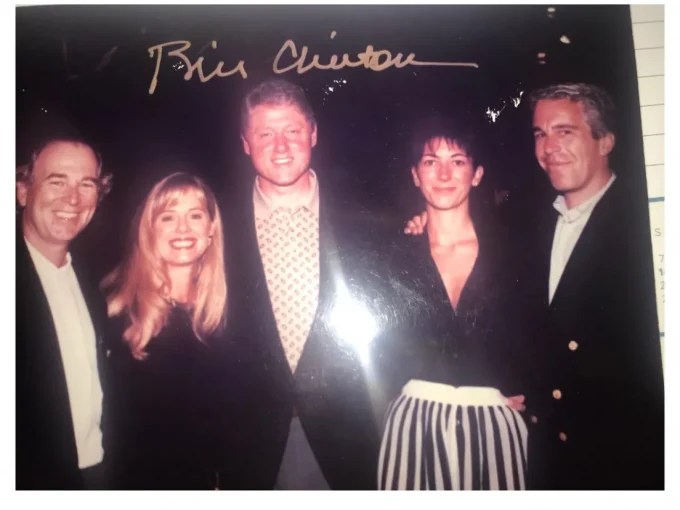
The former Israeli intelligence official turned whistleblower, Ari Ben-Menashe made some explosive claims to journalist Afshin Rattansi in the latest episode of his Going Underground TV Show, alleging that then president Bill Clinton made a deal with then Iranian president Mohammad Khatami, but then Israeli Prime Minister Ehud Barak, a known close associate of Jeffery Epstein, used blackmail about Clinton’s known connection with Jeffery Epstein and his trafficking operation of underage girls, to end the deal.
Ben-Menashe alleges that in 2000 Bill Clinton “met President Khatami in Mirabel Airport north of Montreal and they worked out the deal between them”.
Ben-Menashe noted that “on March 17, 2000, Madeleine Albright made a speech at the American Iranian Council apologizing to the Iranian people for America overthrowing an elected government in 1952 in Iran and bringing the Shah back”
Indeed, on March 17, then Secretary of State Madeleine Albright made a speech apologizing for the overthrow of Iran’s popular elected president Mohammed Massadegh in 1953, saying:
In 1953 the United States played a significant role in orchestrating the overthrow of Iran’s popular Prime Minister, Mohammed Massadegh. The Eisenhower Administration believed its actions were justified for strategic reasons; but the coup was clearly a setback for Iran’s political development. And it is easy to see now why many Iranians continue to resent this intervention by America in their internal affairs.
Moreover, during the next quarter century, the United States and the West gave sustained backing to the Shah’s regime. Although it did much to develop the country economically, the Shah’s government also brutally repressed political dissent.
As President Clinton has said, the United States must bear its fair share of responsibility for the problems that have arisen in U.S.-Iranian relations. Even in more recent years, aspects of U.S. policy towards Iraq, during its conflict with Iran appear now to have been regrettably shortsighted, especially in light our subsequent experiences with Saddam Hussein.
This certainly suggested that the Clinton administration was trying to reset the U.S. and Iranian relationship, acknowledging Iran’s long list of legitimate grievances against the United States.
But according to Ari Ben-Menashe, the deal never went through because Israeli Prime Minister Ehud Barak “sabotaged” the deal using Epstein blackmail.
Ben-Menashe said, “But Ehud Barak and company sabotaged that deal by using Epstein and company against Mr. Clinton”.
Because Clinton had already gone through the Monica Lewinsky scandal, this was enough for him to abandon diplomacy, according to Ben-Menashe.
After Being Defeated In Iran, Israel Targets Türkiye.
By Justin K.P. – The Dissident – June 22, 2026
The idea of Israel going to war with Türkiye- a NATO member- potentially triggering World War III seems insane.
And yet Israel is using their war rhetoric towards Türkiye.
The Israeli Foreign Ministry put out a post seemingly laying the groundwork for an Israeli war, claiming that “Hamas terrorists based in Turkey are directing attacks against Israelis, funding terrorism, and recruiting operatives. The network is exposed. The facts are clear.”
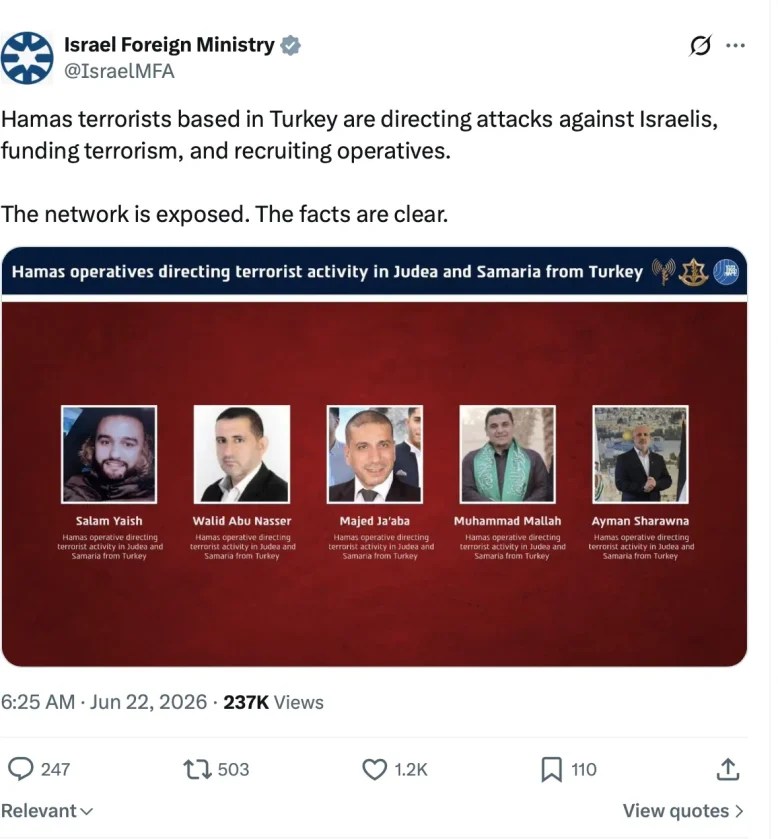
This is far from the first time Israel has used war rhetoric towards Türkiye.
Israel’s Minister of Diaspora Affairs Amichai Chikli recently said that Israel “will be at war with Syria sooner or later” in part because he called Syria “a Turkish protectorate”.
He also fabricated a new “radical Sunni axis of evil” which supposedly includes Pakistan, Turkey and Qatar.
Middle East Eye reported:
“What we are witnessing before our eyes is the rise of a new axis,” Chikli told 103FM radio on Wednesday, referring to Turkey, Qatar and Pakistan. He described this so-called alliance as “a radical Sunni axis of evil, more dangerous than anything we have seen before”.
While Chikli mentioned both Qatar and Pakistan in his interviews, he mainly focused on Turkey, branding Turkish President Recep Tayyip Erdogan’s vision “an extremely dangerous combination for us”.
Other members of the ruling Israeli Likud party have similarly been declaring Türkiye “an enemy state”.
Middle East Eye noted, “Last week, Israeli lawmaker Ariel Kellner, also of Likud, called Turkey an ‘enemy state’, while Culture and Sports Minister Miki Zohar said last month that Israel’“must begin to treat Turkey as an enemy state,’ suggesting that Turkey would suffer heavy blows in a possible conflict with Israel.”
It added that “In February, former prime minister Naftali Bennett indicated that he sees Turkey as an enemy, with the opposition figure stating: ‘Turkey is the new Iran.’”
Perhaps the most concerning development is the fact that the Foundation for The Defence of Democracies (FDD), an Israeli lobby cutout that played a large role in the U.S. war on Iran, has begun publishing articles using similar rhetoric towards Türkiye.
FDD put out an article titled , “Turkey the new Iran? Ankara’s growing challenge to Western interests”.
The article attempted to label Türkiye as the “new Iran”, writing:
As Iran and its proxies take a beating from American and Israeli forces, observers are questioning whether Turkey is waiting in the wings to emerge as the region’s next “bogeyman.” The answer is likely yes, albeit in its own form.
Turkey is not Iran, but depicting Turkey as a nuisance or simply “complicated” only emboldens a maturing adversarial regime with an established track record of undermining its Western allies.
The article attempted to ratchet up hostilities between Türkiye and the United States, writing, “The real question is whether Turkey is actively undermining US, NATO, and regional security interests. There is little doubt that Ankara is doing just that, and doing so more brazenly with the passage of time.”
It also lamented that Türkiye is too supportive of the Palestinian resistance, writing “Hamas, as an Iranian proxy, has served Ankara’s interests in undermining Israel’s security interests, something which Turkey would like to see intact after the end of the current war.”
FDD has similarly put out articles pushing for the U.S. to put sanctions on Türkiye, saying that “Washington should pursue Global Magnitsky sanctions against targets in Turkey” and that “the United States should utilize Global Magnitsky authorities to target Turkish individuals responsible for human rights violations”.
It also called for the U.S. to designate “government officials” in Türkiye as “terrorist organizations” and wrote that “The United States should protect the international financial sector by recommending added scrutiny and screening to transactions involving Turkish financial institutions” and that “Washington should coordinate with the G7 to return Turkey to the Financial Action Task Force (FATF) ‘grey list’ until further improvements are seen in combating terrorism financing.”
The Carnegie Endowment for Peace documented that “FDD was the brainchild of a New York Times journalist-turned-Republican operative, Clifford May,” adding that “it arose out of an organization committed to burnishing Israel’s reputation in the United States. On April 24, 2001, three major pro-Israel donors incorporated an organization called EMET (Hebrew for ‘truth’). In an application to the Internal Revenue Service for tax-exempt status, May explained that the group ‘was to provide education to enhance Israel’s image in North America and the public’s understanding of issues affecting Israeli-Arab relations.’ But in the wake of the Sept. 11 attacks, May broadened the group’s mission and changed its name to the Foundation for Defense of Democracies. As he explained in a supplement to the IRS, the group’s board of directors decided to focus on ‘develop[ing] educational materials on the eradication of terrorism everywhere in the world.’”
It added that, “FDD’s chief funders have been drawn almost entirely from American Jews who have a long history of funding pro-Israel organizations. They include Bernard Marcus, the co-founder of Home Depot, whiskey heirs Samuel and Edgar Bronfman, gambling mogul Sheldon Adelson, heiress Lynn Schusterman, Wall Street speculators Michael Steinhardt and Paul Singer, and Leonard Abramson, founder of U.S. Healthcare.”
Sima Vaknin-Gil, a former Israeli military intelligence officer, in the Al Jazeera documentary The Lobby, admitted that “We have FDD” and that “the foundation is ‘working on’ projects for Israel, including ‘data gathering, information analysis, working on activist organizations, money trail. This is something that only a country, with its resources, can do the best”.
FDD played a huge role in shaping American policy towards Iran at the behest of Israel.
Now, as Israel calls Türkiye an “enemy state”- the FDD has begun pushing Washington to place sanctions on the country and designate government officials as terrorists, laying the groundwork for a new Israeli war.

or go to
Aletho News Archives – Video-Images
By Kit Klarenberg | Al Mayadeen | July 11, 2024
Almost immediately after the proxy war erupted, ISIS-tier footage of the torture and murder of Russians in Ukrainian custody emerged.
On July 6th, the New York Times published an astonishing investigation: In Ukraine, Killings of Surrendering Russians Divide an American-Led Unit. The article documents in grim detail how Chosen Company, an international volunteer battalion for Kiev, routinely executes Russian prisoners of war. It is the very first mainstream admission that this practice – a brazen breach of the Geneva Conventions, and a grave war crime – is widespread among Ukraine’s fighters, both foreign and homegrown. … continue
 Aletho News If Americans Knew No Tricks Zone
