UK Already Planning to Extend Lockdown Before First Extension Even Announced

SOPA Images via Getty Image
By Paul Joseph Watson | Summit News | June 14, 2021
Having first mooted a 2 week delay to lifting lockdown which will today likely become a 4 week delay, government ministers in the UK are already suggesting the lockdown could continue beyond July.
The country was supposed to exit all lockdown restrictions on June 21st, dubbed “freedom day” by the media.
However, Prime Minister Boris Johnson will today announce a four week extension to the restrictions, meaning that Brits had more freedom in July 2020 compared to now despite the vast majority of “vulnerable” people having received the vaccine.
But there’s absolutely no guarantee the lockdown will end next month.
The same advisers who admitted using “mind control” and “totalitarian” fear tactics to terrify the British public into compliance are still fearmongering about the Indian variant of the virus in a bid to prolong restrictions for months longer.
By delaying the lifting of lockdown until September, a “third wave” of COVID will then be pushed into autumn/winter, meaning the narrative that the NHS will be “overwhelmed” can be trotted out once again.
Then it becomes “just one more lockdown to save Christmas” (the same thing Brits were told last Christmas) and around we go over and over again.
Health Minister Ed Argar said today that “it is of course possible” that yet another delay will be needed beyond July 19 due to the “Indian variant.”
Foreign Secretary Dominic Raab also acknowledged that there was no “absolute guarantee” that restrictions would be lifted on July 19.
As we highlighted last week, former Communist Party member and current government adviser Susan Michie says that mask mandates and social distancing should continue “forever” and that people should adopt such behaviour just as they did with wearing seatbelts.
A doctor who argued that the UK’s COVID-19 lockdown should remain in place indefinitely also revealed his true thoughts by letting slip the comment, “sadly, it can’t be forever.”
A recipe for disaster
By Pseudonym de Plume | The Conservative Woman | June 14, 2021
1. Mix together some natural pathogens and government science to develop highly infectious coronasauce. Reduce coronasauce until it’s as thick as thieves.
2. Take one patent system which facilitates rent-seeking. Add coronasauce testing kits and coronasauce ‘antidote’.
3. Indemnify coronasauce ‘antidote’ manufacturers from liability, creating toxic brew of moral hazard.
4. Apply coronasauce to the public and baste with hysteria. (Side recipe: create hysteria from fraudulent PCR test data).
5. Exploit monopolistic licensing system to coerce medical doctors into compliance against their better judgment and pricked consciences. And Hippocratic oath.
6. Vigorously suppress mitigating treatment options to justify emergency consumption of coronasauce ‘antidote’.
7. Isolate and discard voices of reason using the Trusted News Initiative.
8. Inject coronasauce ‘antidote’ into every human on the planet initially twice, but aim for ad infinitum*.
9. Profit**
* If a bitter aftertaste of depopulation is experienced, see Build Back Better recipe for soothing utopianism.
**Enjoy your wages of sin while you can. A banquet of consequences may follow.
The Co-Conspirators have received incredible rewards for their treachery. Let’s start with Rick Bright
By Meryl Nass, MD | June 12, 2021
Rick Bright
Immediately after Rick Bright was transferred out of his position as head of BARDA and sent to the NIH, he started making a huge fuss. The April 22, 2020 NYT discribed his statements:
“While I am prepared to look at all options and to think ‘outside the box’ for effective treatments, I rightly resisted efforts to provide an unproven drug on demand to the American public,” Dr. Bright said. He went on to describe what he said ultimately happened: “I insisted that these drugs be provided only to hospitalized patients with confirmed Covid-19 while under the supervision of a physician.”
By May 14, 2020 Bright was already before Congress, supposedly as the good guy whistleblower who was trying to get things right for the pandemic against huge odds:
Bright told lawmakers Thursday he and other federal health officials had “worked hard” to resist pressure to allow a significant increase in access to hydroxychloroquine, and instead scaled that back to allowing an emergency use authorization but only “with strict guidelines.”
But he said his “concerns were escalated when I learned that officials were pushing to make that drug available outside that emergency authorization.”
“When I spoke outside of the government and shared my concern with the American public, that I believe was the straw that broke the camels back and escalated my removal,” Bright said.
He later said, “The highest priority we have is safety.”
… Bright’s lawyers said last week that the OSC had told them the investigation already had found evidence that Bright was ousted as head of a health agency for pushing back against increasing use of hydroxychloroquine…
HHS, in an emailed statement, said, “Rick Bright was transferred from his role as BARDA director to lead a bold new $1 billion testing program at NIH, critical to saving lives and reopening America.”
“Mr. Bright has not yet shown up for work, but continues to collect his $285,010 salary, while using his taxpayer-funded medical leave to work with partisan attorneys who are politicizing the response to COVID-19,” the statement said.
“His whistleblower complaint is filled with one-sided arguments and misinformation. HHS is reviewing the complaint and strongly disagrees with the allegations and characterizations made by Rick Bright.”
HHS also said that it was under Bright’s leadership that BARDA identified chloroquine and hydroxychloroquine as potential Covid-19 treatments.
“Rick Bright was the sponsor of getting hydroxychloroquine and praised his team for acquiring the drugs,” HHS said.
Bright’s reward? He was made a senior vice president of the Rockefeller Foundation, after refusing to show up for work at NIH. And who raved about him on the Rockefeller Foundation website? None other than Jeremy Farrar and Michael Ryan. I have not written about Ryan so far, but he is another co-conspirator in the efforts to suppress appropriate treatments, poison patients with excess doses of HCQ and prolong the pandemic, as Executive Director of the World Health Organization’s Health Emergencies Programme.
From the Rockefeller Foundation:
“If there is something we have learned throughout the COVID-19 pandemic and other high impact epidemics, it is that pandemic preparedness and response cannot be advanced with a siloed approach,” said Dr. Mike Ryan, Executive Director of the WHO’s Health Emergencies Programme. “Few people bring the full package to the table: profound scientific and public health expertise, years of outbreak response experience, a private and public sector background and a collaborative, innovative, and out-of-the-box mindset. Rick Bright combines all these qualities. His leadership will be an enormous asset to The Rockefeller Foundation and to the global health community.”Dr. Bright resigned from government service in protest over the Trump administration’s approach to handling the Covid-19 pandemic, specifically over the level of political interference in science and the spread of inaccurate information that he said was ‘dangerous, reckless and causing lives to be lost.’
“I’m delighted that Dr. Rick Bright has been appointed as Senior Vice President of Pandemic Prevention and Response at The Rockefeller Foundation,” said Dr. Jeremy Farrar, Director of Wellcome. “The Covid-19 pandemic has highlighted the human and economic costs of epidemics and the fact that we need to be better prepared to identify and respond to emerging infections. Dr. Bright is a leading figure in global health with a wealth of experience, and we look forward to working with him over the coming years.”
Bright’s job at Rockefeller is to work on future pandemic planning. Need I say more?
The NHS just changed how they count Covid “cases”… here’s why
By Kit Knightly | OffGuardian | June 11, 2021
The UK’s National Health Service has received new instructions from the government on how it should record Covid19 “cases”, separating those who are actually sick from those who just test positive.
From the beginning of the “pandemic” last spring, the NHS (and other countries all over the world) have defined a “case” as anyone who tests positive for the Sars-Cov-2 virus, regardless of whether or not they have symptoms.
Given that as many as 80% of those who have been infected have no symptoms, and the propensity for the flawed PCR tests to return false-positive results, this lead to likely massively inflated numbers of “cases”.
Now, though, the NHS is going to attempt to differentiate between patients who actually have the alleged disease “Covid19”, and those who are in hospital for other reasons and only “incidentally” tested positive for the virus.
According to a report in the Independent [emphasis added]:
NHS England has instructed hospitals to make the change to the daily flow of data sent by NHS trusts […] Hospitals have been told to change the way they collect data on patients infected with coronavirus to differentiate between those actually sick with symptoms and those who test positive while seeking treatment for something else.
The distinction between “with” and “from” in Covid deaths – and “with” and “for” in hospitalisations – has been one Covid sceptics all over the world have been keen to make for over a year, but this is the first time any institution has really recognised the difference. And, certainly, it’s the first time any healthcare service has endeavoured to actually catalogue them differently.
So what does the NHS expect the impact of this change to be? Again, from the Independent:
One NHS source said the new data would be “more realistic” as not all patients were sick with the virus, adding: “But it will make figures look better as there have always been some, for example stroke [patients], who also had Covid as an incidental finding”.
That’s a frank admission, and an important one.
For the last eighteen months, voices all over the alternate media have been saying the Covid numbers are unrealistic, specifically because they include people who were never actually sick. We have been called “deniers” and “conspiracy theorists” for our trouble.
But now an NHS source has actually said, going forward, the Covid data will be “more realistic” as it will discount all the patients where Covid was only “an incidental finding”. This is a bigger story than the media coverage suggests – only the Indy and Telegraph are covering it right now, and neither with the focus it deserves.
NHS England is, essentially, tucking away a covert admission that a lot of their fear-mongering statistics were never “realistic”.
Why would they do this? And why now?
Well, here’s what they claim [emphasis added]:
[The NHS said] the move was being done to help analyse the effect of the vaccine programme and whether it was successfully reducing Covid-19 sickness.
But it doesn’t really make any sense, when you think about it.
It will “help analyse the effect of the vaccine programme”? How so?
How does changing the definition at this point possibly help “analyse” anything? Doesn’t it confuse the issue?
Won’t it, in fact, effectively reduce the numbers of official “covid cases”? Doesn’t making the numbers “look better”, at this stage, make the “vaccine” appear more effective?
It’s also important to note that the changes in data collection will only apply to new patients, it will not be retroactive. Prof Keith Willett, NHS England’s Covid incident director, was very clear on that in a quote for the Telegraph [emphasis added]:
In lay terms this could be considered as a binary split between those in hospital ‘for Covid-19’ and those in hospital ‘with Covid-19’. We are asking for this binary split for those patients newly admitted to hospital and those newly diagnosed with Covid while in hospital.”
So, the old (and now admitted unrealistic) data, will not be subject to change. The Covid “case” numbers before June 7th are etched in stone – everyone who tested positive was a “case”.
But after June 7th they will be separating Covid cases who are actually hospitalised due to Covid19, from other patients who only have “incidental covid”.
Any good scientist will tell you you can’t change the way you measure or collect your data halfway through an experiment, and you can’t compare data gathered in one way to data gathered in another. That is not “analysing the effect” of anything, it’s altering the experiment conditions.
The difference between “with” and “for” has always existed, but by applying that filter only to new data they will make it appear that it’s a new phenomenon, caused by the vaccination programme.
It is incredibly bad science.
… but it’s also totally in keeping with the trend of altering Covid practices to create the impression the “vaccine” is having a positive impact.
We’ve already reported that WHO changed their Covid diagnosis guidelines, and their PCR test guidelines, in late 2020 and early 2021, right in line with the first vaccination programs being launched. The US CDC has likewise been repeatedly fiddling their definition of “breakthrough infection” in order to make the vaccines appear more effective.
This NHS change is just more of the same – altering the experimental conditions to achieve the desired outcome. A total, complete inversion of the scientific method, by the same people who zealously scream about “following the science”.
It is deliberate manipulation of the data, being done brazenly in the public eye.
But what impact will it actually have? Throughout the pandemic, how many patients were ever sick with only Covid, and how many had cancer, or a stroke or Alzheimers along with “incidental covid”?
Well, official figures on deaths have shown that well over 80% of so-called “Covid deaths” had at least one serious pre-existing condition, and Bernard Marx did a great breakdown of how the cause of death figures are manipulated. But that’s deaths, what about hospital admissions?
Although only anecdotal, we have been sent results of several Freedom of Information Act requests that UK citizens submitted to their local NHS trusts. These FOI requests ask for the number of people currently in hospital being treated for Covid, or numbers who died solely due to Covid or variations on that theme. Here’s 1, 2, 3, 4 them. There are a lot more available.
The numbers are uniformly small. So, it’s entirely possible that, under this new method of “analysis”, the NHS’s list of “Covid cases” will shrink to almost nothing.
Don’t worry though, should that happen we will likely never be told about it, because NHS England has made it quite plain that they might never release this data to the public. Both the Independent and Telegraph say so, with almost word-for-word the exact same sentence:
NHS England has not yet confirmed whether the data will be made public, as it must be checked and verified first.
They need to “check” and “verify” the data before we’re allowed to see it, huh? It’s almost as if they’ve got something to hide.
Tony Blair Suggests Unvaccinated Should Remain Under Lockdown Restrictions
Says June 21st date can only be met if two groups are treated differently
By Paul Joseph Watson | Summit News | June 11, 2021
Former British Prime Minister Tony Blair implied that those who choose not to be vaccinated should be discriminated against by remaining under lockdown restrictions if the UK’s June 21st “freedom day” is to be accomplished.
During an interview with ITV News, Blair was asked if he would delay the June 21st deadline, when all social distancing, mask mandates and other lockdown rules are supposed to come to an end.
Blair said that if the data suggested the June 21st date was at risk, the government should “look again at distinguishing between those people who are vaccinated and those people who aren’t because it really makes no sense to treat the two groups as if they’re the same.”
The former Labour leader then attempted to offer a rebuttal to those who would describe this as discrimination, but only succeeded in affirming that he is advocating for discrimination against the unvaccinated.
“If someone simply chooses not to get vaccinated, I mean frankly that’s their choice, you’re not discriminating against them, they’ve chosen not to do it,” said Blair.
In other words, Blair is suggesting that people who haven’t taken the vaccine should be punished by remaining under lockdown rules while the rest of the population gets their freedoms back.
Blair’s agenda in advocating discrimination against the unvaccinated isn’t surprising given that he has been aggressively pushing the use of vaccine passports for almost a year.
Back in January, Blair asserted that Britain should take the lead in presiding over a global vaccine passport system.
“It’s going to be a new world altogether,” Blair proclaimed, adding “The sooner we grasp that and start to put in place the decisions [needed for a] deep impact over the coming years the better.”
Hydroxychloroquine supporters who were censored online feel vindicated by new study
By Didi Rankovic | Reclaim the Net | June 11, 2021
It’s no secret that the Covid pandemic was in many instances weaponized to censor former President Donald Trump, by his political opponents and traditional and social media companies.
Trump’s position and policy on a number of issues – from the origin of the virus to the best way to treat the disease – was consistently censored online as misleading and dangerous misinformation, even though the WHO’s main objection to using the drugs Hydroxychloroquine and Azithromycin was that they are allegedly ineffective rather than harmful.
The censorship of many ideas over the last year and the speed at which social media companies labeled them “conspiracy theories” to get them censored, highlighted how much power these companies have over public discourse and how there’s little accountability when they’re found to be wrong.
While the lab theory of the origin of the coronavirus was originally censored online, and then allowed a year later when more information was released to back up what was last year called a conspiracy theory, it’s not the only topic that suffered the same fate.
One of the topics that became “forbidden” in this context was the use of the Hydroxychloroquine combined with zinc, in treating Covid patients – something that Trump publicly endorsed and even said took himself.
Doctors that promoted this treatment and were even actively prescribing it to their patients were quickly banned from the likes of Twitter, Facebook, and YouTube.
Researchers even had trouble trying to study the effect this combination of drugs has and publish their findings, facing obstacles from scientific journals who were on board with the censorship of the topic. But now one such study has seen the light of day, and seems to be vindicating those who said Hydroxychloroquine is in fact beneficial in coronavirus treatment.
New Jersey’s Saint Barnabas Medical Center published the observational study that included 255 patients in medRxiv, stating that Hydroxychloroquine, Azithromycin, and zinc can increase the survival rate by close to 200 percent. This scenario required higher doses administered to severely ill Covid patients who had to be put on ventilators.
Once again, Dr. Anthony Fauci, who is among those opposed to using the combination of drugs, is being called out for what many see as a series of missteps he has made during the pandemic.
“How many people died because Dr. Fauci said trust the science and Hydroxychloroquine isn’t effective?,” Georgia Congresswoman Marjorie Taylor Greene was blunt on Twitter, at the same time citing the study’s findings, and concluding, “Trump was right.”
But last summer, Twitter appeared to be certain that Trump and others promoting the use of hydroxychloroquine were wrong. In July 2020, the company went as far as to limit Donald Trump Jr’s account features, accusing him of posting false information by tweeting a video claiming the drug was effective in Covid treatment.
Lawmakers demand answers on Facebook censorship at behest of Biden administration
By Cindy Harper | Reclaim the Net | June 10, 2021
Following the revelation that Facebook’s CEO Mark Zuckerberg was in email communication with the country’s top epidemiologist Dr. Anthony Fauci, House Republicans sent a letter demanding answers on why the company censored lab leak theories.
According to the Republican legislators, the emails suggest that Fauci advised Facebook to censor the lab leak theories.
Ranking members of the House Judiciary Committee and House Oversight Committee, Jim Jordan and James Comer wrote a letter addressed to Zuckerberg demanding answers on why his company censored content suggesting COVID-19 leaked from a lab.
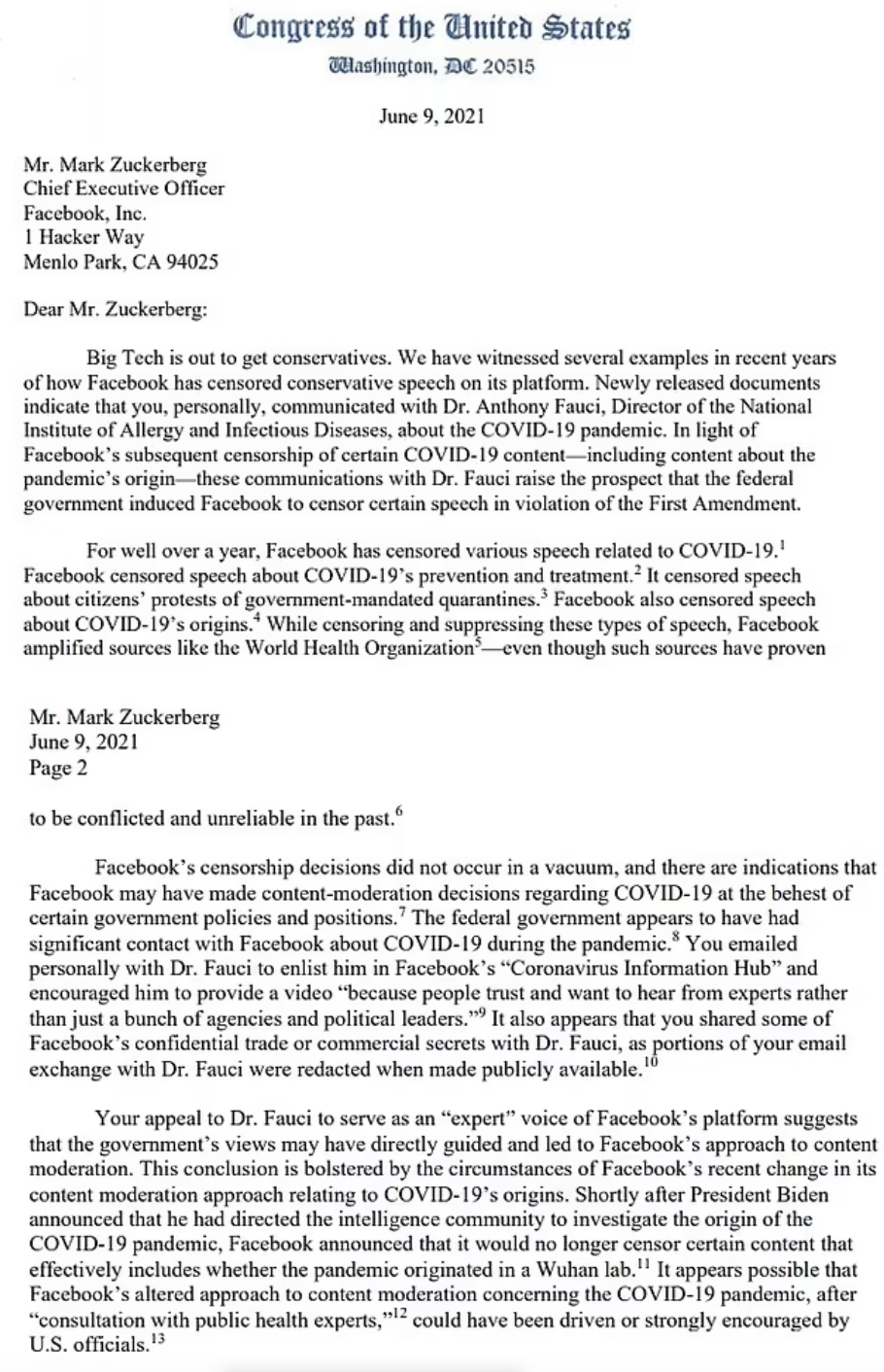
The letter accuses the government of using a private company to violate free speech. It requested Facebook to provide all documents and communication between its employees and government officials.
“In light of Facebook’s subsequent censorship of certain COVID-19 content – including content about the pandemic’s origin – these communications with Dr Fauci raise the prospect that the federal government induced Facebook to censor certain free speech in violation of the First Amendment,” the letter states.
“Facebook’s censorship decisions did not occur in a vacuum, and there are indications that Facebook may have made content-moderation decisions regarding COVID-19 at the behest of certain government policies and positions,” the legislators added.
Until recently, most scientists dismissed the idea that the virus leaked from a lab in China. However, in recent weeks, evidence supporting the lab leak theory has emerged, forcing Facebook to review its COVID-19 misinformation policies.
In late May, after President Joe Biden announced that the lab leak theory needed more investigation, Facebook announced it would no longer flag content suggesting that COVID 19 was man-made.
The legislators gave Facebook two weeks to respond to the letter.
Pentagon Gave $39 MILLION To Dr. Peter Daszak’s EcoHealth Alliance
“Charity” that funded coronavirus research at the Wuhan lab accused of being the source of the outbreak, federal data reveals
By JOSH BOSWELL and MARTIN GOULD – Daily Mail – June 10, 2021
The Pentagon gave $39 million to a charity that funded controversial coronavirus research at a Chinese lab accused of being the source for Covid-19, federal data reveals. The news comes as the charity’s chief, British-born scientist Dr. Peter Daszak, was exposed in an alleged conflict of interest and back-room campaign to discredit lab leak theories.
The charity, EcoHealth Alliance (EHA), has come under intense scrutiny after it emerged that it had been using federal grants to fund research into coronaviruses at the Wuhan Institute of Virology in China.
The U.S. nonprofit, set up to research new diseases, has also partly funded deeply controversial ‘gain of function‘ experiments, where dangerous viruses are made more infectious to study their effect on human cells.
A political storm broke when former president Donald Trump canceled a $3.7 million grant to the charity last year amid claims that Covid-19 was created in, or leaked from, the Wuhan lab funded by EHA.
But federal grant data assembled by independent researchers shows that the charity has received more than $123 million from the government – from 2017 to 2020 – and that one of its biggest funders is the Department of Defense, funneling almost $39 million to the organization since 2013.
Exactly how much of that money went toward research at the Wuhan Institute of Virology is unknown.

Federal grant data assembled by independent researchers shows that the charity has received more than $123 million from the government – and that one of its biggest funders is the Department of Defense, funneling almost $39million to the organization since 2013.
Grants from the Pentagon included $6,491,025 from the Defense Threat Reduction Agency (DTRA) from 2017 to 2020 with the description: ‘Understanding the risk of bat-borne zoonotic disease emergence in Western Asia.‘
The grant was categorized as ‘scientific research – combating weapons of mass destruction.‘
The majority of the DoD funding came from the DTRA, a military branch with a mission to ‘counter and deter weapons of mass destruction and improvised threat networks.’
EHA also received $64.7 million from the US Agency for International Development (USAID), $13 million from Health and Human Services, which includes the National Institutes of Health and Centers for Disease Control, $2.3 million from the Department of Homeland Security, and $2.6 million from the National Science Foundation.
A government funding figure of $3.4 million was widely reported, after White House chief medical advisor Anthony Fauci was questioned in a Senate hearing on how much money the National Institutes of Health sent to the Wuhan lab via its grants to EcoHealth Alliance in 2019.
But the total grant figures including Pentagon funding dwarf that number.
Researchers James Baratta and Mariamne Everett assembled grant filings from US government agencies to EHA, which were published on popular science site Independent Science News in December.
The site found EHA’s declaration of its vast military funding is nestled deep in the ‘Privacy Policy’ section of its website, under the title ‘EcoHealth Alliance Policy Regarding Conflict of Interest in Research’.
In the disclosure EHA says it is ‘the recipient of various grant awards from federal agencies including the National Institute of Health, the National Science Foundation, US Fish and Wildlife Service, and the US Agency for International Development and the Department of Defense.‘
It does not disclose the size of its DoD funding.
In 2014 the Obama administration outlawed gain of function research, such as the experiments funded by EHA, after concerns were raised among scientists that it could lead to a global pandemic from a genetically enhanced virus escaping a lab.
But EHA reportedly continued to legally fund the practice, using a loophole that allowed for the research in cases ‘urgently necessary to protect the public health or national security.‘
One notable EHA ‘policy advisor’ is David Franz, a former commander at the principal US government biowarfare and biodefense facility Fort Detrick.
Franz was an official in the United Nations Special Commission which inspected for bioweapons in Iraq.

The charity’s head, Daszak, has been accused of orchestrating a behind-the-scenes ‘bullying’ campaign to ensure the blame for covid-19 did not fall on the Wuhan lab he funded.
The 55-year-old worked closely with the lab’s so-called ‘bat woman,’ Shi Zhengli, in their studies of coronaviruses.
In February 2020 Daszak persuaded more than two dozen other scientists to sign off on a letter he had written to highly respected medical journal The Lancet, that was seen as so influential that it cowed most experts into refusing even to consider that the virus could have been man-made and escaped from the Wuhan institute.
Former high-level Clinton administration staffer Jamie Metzl, who now sits on the World Health Organization’s advisory committee on human genome editing, told DailyMail.com that the Lancet letter ‘was scientific propaganda and a form of thuggery and intimidation.‘
Freedom of Information Act disclosures revealed Daszak tried to distance his charity from the letter to make it appear it was coming from ‘a community supporting our colleagues.‘
The charity chief told his fellow signatories in an email that the letter would not be sent under the EcoHealth logo ‘and will not be identifiable as coming from any one organization or person.‘
The joint letter, published in the journal on February 19 last year, praised the Chinese ‘who continue to save lives and protect global health during the challenge of the Covid-19 outbreak‘ and added ‘We stand together to strongly condemn conspiracy theories suggesting that Covid-19 does not have a natural origin.‘
Despite his close connections to the Chinese lab, Daszak was also picked by the World Health Organization (WHO) to be part of its 13-member team that was tasked with finding the cause of the pandemic which began in Wuhan, a city of some 11 million people in Central China.
Metzl told DailyMail.com the appointment was a ‘massive and outrageous conflict of interest,‘ allowing a man who had significant financial and reputational stakes in discrediting lab leak theories to investigate those theories.
Prominent scientists have criticized the WHO probe, which dismissed lab leak theories, as lackluster and incomplete.
In a Freedom of Information disclosure of Fauci’s emails obtained by Buzzfeed last month, Daszak thanked the White House doctor for pushing back on the theory that covid-19 was man made.
‘I just wanted to say a personal thank you on behalf of our staff and collaborators, for publicly standing up and stating that the scientific evidence supports a natural origin for COVID-19 from a bat-to-human spillover, not a lab release from the Wuhan Institute of Virology,‘ Daszak wrote in April 2020.
Fauci says the emails have been taken out of context.
EHA’s most recent financial statements filed with the IRS say that around 90 per cent of its funding comes from government sources.
The 2019 report says Daszak was paid a total $410,801 for the year, including $311,815 base pay, $42,250 bonus, $24,500 deferred compensation and $32,236 nontaxable benefits.
Featured Video
HE SAVED LIVES. NOW HE FACES PRISON.
or go to
Aletho News Archives – Video-Images
From the Archives
NATO Sanctions and the Coming Global Diesel Fuel Disaster
By F. William Engdahl – New Eastern Outlook – 11.04.2022
Amid the ongoing global inflation crisis, NATO heads of state and mainstream media repeat a mantra that high energy prices are a direct result of Putin’s actions in Ukraine since end of February. The reality is that it is the western sanctions that are responsible. Those sanctions including cutting SWIFT interbank access for key Russian banks and some of the most severe sanctions ever imposed, are hardly having an impact on the military actions in Ukraine. What many overlook is the fact that they are increasingly impacting the economies of the West, especially the EU and USA. A closer look at the state of the global supply of diesel fuel is alarming. But Western sanctions planners at the US Treasury and the EU know fully well what they are doing. And it bodes ill for the world economy.
While most of us rarely think about diesel fuel as anything other than a pollutant, in fact it is essential to the entire world economy in a way few energy sources are. The director general of Fuels Europe, part of the European Petroleum Refiners Association, stated recently, “… there is a clear link between diesel and GDP, because almost everything that goes into and out of a factory goes using diesel.” … continue
Blog Roll
 Aletho News
- Italy to move military personnel from Taif base after missile strike
- Finland’s Stubb tells European leaders to calm down
- Defeating Russia on battlefield impossible – Fico
- Finland’s Gender Clinic Reversal
- Massachusetts Wants Mental Health Visits, Why Does Government Use ‘Health’ to Enter Our Homes & Families?
- US lawmaker admits American people footing bill for Trump’s failed aggression against Iran
- Pfizer Gave $500,000 to Groups That Lobbied to End Religious Exemption in Massachusetts
- HE SAVED LIVES. NOW HE FACES PRISON.
- Israeli lobby seeks to bind US fate to ‘Israel’: Araghchi
- Pakistan-Iran talks secure LNG shipment to Islamabad through Hormuz
- If Americans Knew
- Phosphorus Munitions Fired by Israel Burn Groves, Orchards in Southern Lebanon
- Israel Carries Out New Ceasefire Violations Across Gaza
- AI – Emphasis on the ‘I’: Israel Is Funding AI Chatbot Propaganda
- Israel Blocking Hundreds of Wheelchairs for Injured Children From Entering Gaza
- Israel Is Expanding and Upgrading Compounds for Palestinian Militias in Gaza
- The Palestinian-American Residents of This West Bank Town Are Wondering: Where Is Trump?
- Gaza desperately needs tents, wheelchairs, fuel… and everything else (Israel blocks it all) – Daily Update
- Israeli Attacks in Gaza Kill at Least Seven Palestinians Over Three Days, including Woman and Child
- Trump’s militarization of Washington DC as he pursues Israel’s war against Iran
- Why Israel Fears This Searing New Documentary
- No Tricks Zone
- 2025 Nature Paper Claiming Worsening Global Drought Gets RETRACTED …Heavily Flawed
- New Study: ‘Global Drought Shows No Detectable Recent Acceleration Under Climate Warming’
- Economic Masterminds: German Socialists Suggest Taxing Productivity Gains Stemming From Using AI
- The South China Sea Has Not Been Cooperating With The Climate Change Narrative
- Energy Crisis: Germany Enters Heating Season With Historically Low Gas Reserve Fill Levels
- New Study: The Antarctic Ice Sheet Gained Mass From 2020-2024 Due To Staggering Snow And Ice Accumulation
- Study: Ocean Heating Rates From Thousands Of Years Ago ‘Dwarf’ Modern Ocean Heating Rates
- Climate Extremists Target, Attack Large-Scale Power Grid Infrastructure In Germany!
- New Study: Antarctic Ice Melt Has Contributed Less Than 1 Centimeter To Sea Level Rise In The Last 30 Years
- Fear Of Debate: Alarmist German Climate Scientist Calls On Mainstream Media To Discredit Skeptic Voices

