The war scenario between Israel and Hezbollah
By Elijah J. Magnier – 24/02/2020
Notwithstanding the increase in power of the “Axis of the Resistance”, with its precision missiles and unrivalled accumulated warfare experience, the possibility of war is still on the table. The “Axis of the Resistance” is increasing its readiness based on the possibility that Israel may not tolerate the presence of such a serious threat on its northern borders and therefore act to remove it. However, in any future war, the “Axis of the Resistance” considers the consequences would be overwhelmingly devastating for both sides and on all levels if the rules of engagement are not respected. Notwithstanding Israel’s superior air firepower, its enemy Hezbollah has established its own tremendous firepower, and its experience in recent wars in Syria, Iraq and Yemen is an important asset.
Sources within the “Axis of the Resistance” believe the next battle between Hezbollah and Israel, if ever it takes place, would be “controlled and not sporadic, with a focus on specific military objectives without damaging the infrastructure, on both sides”.
The sources consider Gaza as a precedent. In Gaza Palestinians and Israelis have fought many recent battles that lasted only a few days in which the objectives bombed were purely military. This is a new rule of engagement (ROE) regulating conflict between the belligerents. When Israel hits a non-military target, the Palestinian resistance responds by hitting a similar non-military target in Israel. The lesson extracted from the new ROE between Israel and the Palestinians is that every time exchanges of bombing go out of control, both sides understand they have to bring it back to an acceptable and equitable level, to limit damage and keep such mutual attacks from targeting civilians.
The “Axis of the Resistance” therefore considers that the probability is high that the next battle would be limited to military objectives and kept under control. If one side increases the bombing, the other will follow. Otherwise, both sides have the capability to cause total destruction and go on to uncontrolled bombing. In the case of an out-of-control war, allies on both sides would become involved, which renders this scenario less likely.
Hezbollah in Lebanon is said to have over 150,000 missiles and rockets. Israel might suppose that a limited attack could destroy tens of thousands of Hezbollah’s missiles. Is it worth it? “From Israel’s view, Israel may think it is worth triggering a battle and destroying thousands of missiles, thinking that Israel has the possibility to prevent Hezbollah from re-arming itself. But even in this case, Israel doesn’t need to destroy villages or cities or the Lebanese infrastructure, instead, it will limit itself to selective targets within its bank of objectives. However, we strongly doubt Israel could succeed in limiting Hezbollah’s supply of missiles and advanced weapons. Many of these missiles no longer need to be close to the borders with Israel, but can be deployed on the Lebanese-Syrian borders in safe silos”, said the sources.
However, Israel should also expect, according to the same sources, that Hezbollah will respond by bombing significant Israeli military targets within its bank of objectives. “There is no need to bomb airports, power stations, chemical industries, harbours or any highly significant target if Israel doesn’t bomb any of these in Lebanon. But if necessary Hezbollah is prepared to imitate Israel by hitting back without hesitation indiscriminately and against high-value targets, at the cost of raising the level of confrontation to its maximum level. Hezbollah and Israel have a common language in warfare. If the bombing is limited, no side interprets the others’ actions as a sign of weakness”, said the sources.
“Hezbollah doesn’t want war and is doing everything to avoid it. This is why it responded in Moawad, in the suburb of Beirut, when Israeli armed drones failed to reach their objectives. By responding, Hezbollah actually prevented a war on a large scale because it is not possible to allow Israel to get away with any act of war in Lebanon, violating the ROE” said the sources.
Last September, Hezbollah targeted an Israeli vehicle in Avivim with a laser-guided missile in daylight after forcing the Israeli Army to hide for a week and retreat all forces behind civilians lines, imposing a new ROE. The Israeli army cleared the 120 km borders with Lebanon (5 km deep) to avoid Hezbollah’s revenge retaliation for violating the 2006 cessation of hostility’s agreement. Israel refrained from responding and swallowed the humiliation due to its awareness of Hezbollah’s readiness to start a devastating war if necessary.

Israeli officials used to threaten Hezbollah and Lebanon to take the country “back to the stone age”. This is indeed within the reach of Israel’s military capability. However, it is also within Hezbollah’s reach to bring Israel back to the stone age, if required. Hezbollah’s precision missiles can hit any bridge, airport, gasoline deposit containers, power stations, Haifa harbour, oil and gas rig platforms, any infrastructure and military and non-military objectives if Israel attempts to target similar objectives in Lebanon first. Hezbollah’s new missile capability is not new to Israel, who is observing the latest technology Iran’s allies are enjoying and “testing,” mainly in Yemen. The recent bombing of Saudi Arabia oil facilities and the downing of a Saudi Tornado in Yemen revealed that Iran’s HOT missiles are capable of downing jets at medium height and any helicopter violating Lebanese airspace.
Hezbollah’s latest version of the Fateh precision missile, the supersonic anti-ship missiles and the anti-air missiles can prevent Israel from using its navy, stopping any civilian ship from docking in Haifa, thwarting the use of Israeli Helicopters and precision bombing attacks- as in Iran’s latest confrontation with the US at Ayn al-Assad base in Iraq.
Hezbollah’s missiles are unlikely to cause simple traumatic brain injuries – as per the Iranian missile at Ayn al Assad – when hitting targets in Israel in case of war. They can avoid missile interception systems. This increase of capability is a game-changer, and Hezbollah believes it is already decreasing the chances of war. Arming itself with precision missiles and armed drones and showing these capabilities to Israel is Hezbollah’s way to avert a war and protect the equation of deterrence.
In its 2020 security assessment, the Israeli Military Intelligence Directorate (Aman) unwisely evaluated the assassination of the Iranian Major General Qassem Soleimani as a “restraining factor”. Aman’s report, showing astonishing ignorance, stated that Soleimani was responsible for Hezbollah’s missile projects. This lack of understanding of the Hezbollah-Iran relationship and dynamic is quite surprising. Sayyed Ali Khamenei told Hezbollah’s leader Sayyed Hassan Nasrallah decades ago that he knows what he needs and what to do and doesn’t need to fall back on Iran. The IRGC and Hezbollah have set up a collaboration engine that won’t stop even if half of the IRGC leadership is killed. The possession of the feared Iranian precision missiles is no longer a secret: all Iran’s allies have these deployed, in Lebanon, Syria, Iraq and Yemen.
Yesterday is unlike today: the power of destruction now belongs to all parties, no longer to Israel alone. War is no longer an option. US/Israeli aggression will be limited to an economic war, so long as the “Axis of the Resistance” continues updating its warfare capability to maintain deterrence parity.
This article is translated free to many languages by volunteers so readers can enjoy the content.
Copyright © https://ejmagnier.com 2020 @ejmalrai
Don’t Hold Your Breath for ‘World War III’: World War IV Has Already Begun
By A. B. Abrams | The Saker Blog | February 27, 2020
“A. B. Abrams is the author of the book ‘Power and Primacy: A History of Western Intervention in the Asia-Pacific.’ His second book covering the history of the United States’ conflict with North Korea is scheduled for publication in 2020.
He is proficient in Chinese, Korean and other East Asian languages, has published widely on defence and politics related subjects under various pseudonyms, and holds two related Masters degrees from the University of London.”
 The world today finds itself in a period of renewed great power conflict, pitting the Western Bloc led by the United States against four ‘Great Power adversaries’ – as they are referred to by Western defence planners – namely China, Russia, North Korea and Iran. This conflict has over the past 15 years escalated to encompass the military, economic and information spheres with global consequences – and appears to be coming to a head as signs of peaking tensions appear in multiple fields from military deployments and arms races to harsh economic wars and a harsher still information war.
While the term ‘World War III’ has been common since the 1940s, referring to the possibility of a global great power war on a greater scale than the first and second world wars, the Cold War between the Western and Soviet Blocs was at its height as total, as global and as heated as the prior conflicts. As weapons technology has evolved, the viability of a direct shooting war has diminished considerably – forcing major powers to seek alternative means to engineer their adversaries’ capitulation and assert their own dominance. This has been reflected in how the Cold War, and the current phase of global conflict some refer to as ‘Cold War 2’ have been distinct from the first two world wars despite the final objectives of the parties involved sharing many similarities. I would thus suggest redefining what a ‘world war’ is and acknowledging that this current phase of global conflict is every part as intense as the great power ‘hot wars’ waged in the first half of the 20th century.
Had the intercontinental range ballistic missile and the miniaturised nuclear warhead been invented twenty years earlier, the Allied Powers may have needed to rely more heavily on economic and information warfare to contain and eventually neutralise Nazi Germany. The Second World War would have been very different in nature to reflect the technologies of the time. When viewed from this paradigm, the Cold War can be seen as a ‘Third World War’ – a total conflict more vast, comprehensive and international than its predecessors stretched out over more than 40 years. The current conflict, or ‘World War IV,’ is ongoing. An assessment of prior ‘great power wars,’ and the unique nature of the current conflict, can provide some valuable insight into how warfare is evolving and the likely determinants of its victors.
As of 2020 it is clear that great power conflict has become almost as heated as it can short of an all-out hot war – with the Western Bloc applying maximum pressure on the information, military and economic fronts to undermine not only smaller adversaries such as Venezuela and Syria and medium sized ones such as North Korea and Iran, but also China and Russia. When exactly this phase of conflict began – sometime after the Cold War’s end – remains uncertain.
The interval between the third and fourth ‘world wars’ was considerably longer than that between the second and the third. This was due to a number of factors – primarily that there was no immediate and obvious adversary for the victorious Western Bloc to target once the Soviet Union had been vanquished. Post-Soviet Russia was a shade of a shadow of its former self. Under the administration of Boris Yeltsin the country’s economy contracted an astonishing 45% in just five years from 1992 (1) leading to millions of deaths and a plummet in living standards. Over 500,000 women and young girls of the former USSR were trafficked to the West and the Middle East – often as sex slaves (2), drug addiction increased by 900 percent, the suicide rate doubled, HIV became a nationwide epidemic (3) corruption was rampant, and the country’s defence sector saw its major weapons programs critical to maintaining parity with the West delayed or terminated due to deep budget cuts (4). The possibility of a further partition of the state, as attested to multiple times by high level officials, was very real along the lines of the Yugoslav model (5).
Beyond Russia, China’s Communist Party in the Cold War’s aftermath went to considerable lengths to avoid tensions with the Western world – including a very cautious exercise of their veto power at the United Nations which facilitated Western led military action against Iraq (6). The country was integrating itself into the Western centred global economy and continuing to emphasis the peaceful nature of its economic rise and understate its growing strength. Western scholarship at the time continued to report with near certainty that internal change, a shift towards a Western style political system and the collapse of party rule was inevitable. The subsequent infiltration and westernisation was expected to neuter China as a challenger to Western primacy – as it has other Western client states across the world. China’s ability to wage a conventional war against even Taiwan was in serious doubt at the time, and though its military made considerable strides with the support of a growing defence budget and massive transfers of Soviet technologies from cash strapped successor states, it was very far from a near peer power.
North Korea did come under considerable military pressure for failing to follow what was widely referred to as the ‘tide of history’ in the West at the time – collapse and westernisation of the former Communist world. Widely portrayed in the early 1990s as ‘another Iraq’ (7), Western media initially appeared to be going to considerable lengths to prepare the public for a military campaign to end the Korean War and impose a new government north of the 38th parallel (8). Significant military assets were shifted to Northeast Asia specifically to target the country during the 1990s, and the Bill Clinton administration came close to launching military action on multiple occasions – most notably in June 1994. Ultimately a combination of resolve, a formidable missile deterrent, a limited but ambiguous nuclear capability, and perhaps most importantly Western certainty that the state would inevitably collapse on its own under sustained economic and military pressure, deferred military options at least temporarily.
The fourth of the states that the United States today considers a ‘greater power adversary,’ Iran too was going to considerable lengths to avoid antagonism with the Western Bloc in the 1990s – and appeared more preoccupied with security threats on its northern border from Taliban controlled Afghanistan. With a fraction of the military power neighbouring Iraq had previously held, the presence of an ‘Iranian threat’ provided a key pretext for a Western military presence in the Persian Gulf after the Soviets, the United Arab Republic and now Iraq had all been quashed. With the new government in Russia put under pressure to terminate plans to transfer advanced armaments to Iran (9), the country’s airspace was until the mid 2000s frequently penetrated by American aircraft, often for hours at a time, likely without the knowledge of the Iranians themselves. This combined with a meagre economic outlook made Iran seem a negligible threat.
While the Cold War ended some time between 1985 and 1991 – bringing the ‘third world war’ to a close – the range of dates at which one could state that the ‘fourth world war’ began and the West again devoted itself to great power conflict is much wider. Some would put the date in the Summer of 2006 – when Israel suffered the first military defeat in its history at the hands of the Lebanese militia Hezbollah. Using North Korean tunnel and bunker networks, command structures, weapons and training (10), and bolstered by Iranian funding and equipment, the shock of the militia’s victory, though underplayed in Western media, reverberated among informed circles across the world.
Others would place the date two years later in 2008 during the Beijing Summer Olympics, when Georgia with the full support of the West waged a brief war against Russia – and Moscow despite harsh warnings from Washington and European capitals refused to back down on its position. Post-Yeltsin Russia’s relations with the Western Bloc had appeared relatively friendly on the surface, with President George W. Bush observing in 2001 regarding President Vladimir Putin that he “was able to get a sense of his soul,” and predicting “the beginning of a very constructive relationship.” Nevertheless, signs of tension had begun to grow from Moscow’s opposition to the Iraq War at the UN Security Council to President Putin’s famous ‘Munich Speech’ in February 2007 – in which he sharply criticised American violations of international law and its “almost uncontained hyper use of force in international relations.”
It could also be questioned whether, in light of what we know about Western support for separatist insurgents in Russia itself during the 1990s, the war against the country ever ended – or whether hostilities would only cease with a more total capitulation and partition and with the presence of Western soldiers on Russian soil as per the Yugoslav precedent. As President Putin stated in 2014 regarding continuing Western hostilities against Russia in the 1990s: “The support of separatism in Russia from abroad, including the informational, political and financial, through intelligence services, was absolutely obvious. There is no doubt that they would have loved to see the Yugoslavia scenario of collapse and dismemberment for us with all the tragic consequences it would have for the peoples of Russia” (11). Regarding Western efforts to destabilise Russia during the 1990s, CIA National Council on Intelligence Deputy Director Graham E. Fuller, a key architect in the creation of the Mujahedeen to fight Afghanistan and later the USSR, stated regarding the CIA’s strategy in the Caucasus in the immediate post-Cold War years: “The policy of guiding the evolution of Islam and of helping them against our adversaries worked marvellously well in Afghanistan against the Red Army. The same doctrines can still be used to destabilize what remains of Russian power” (12). The U.S. Congressional Task Force on Terrorism and Unconventional Warfare’s director, Yossef Bodansky, himself also detailed the extent of the CIA’s strategy to destabilize Central Asia by using “Islamist Jihad in the Caucasus as a way to deprive Russia of a viable pipeline route through spiralling violence and terrorism” – primarily by encouraging Western aligned Muslim states to continue to provide support for militant groups (13).
Much like the Cold War before it, and to a lesser extent the Second World War, great powers slid into a new phase of conflict rather that it being declared in a single spontaneous moment. Did the Cold War begin with the Berlin Blockade, the Western firebombing of Korea or when the atomic bombs were dropped on Hiroshima and Nagasaki – which accelerated the move into a nuclear arms race. Equally, multiple dates were given for the opening of the Second World War – the German invasion of Poland in 1939, the beginning of the Sino-Japanese war two years prior, the Japanese Empire’s attack on Pearl Harbour and conquest of Southeast Asia which marked the first major expansion beyond Europe and North Africa in 1941, or some other date entirely. The slide into a new world war was if anything even slower than its predecessors.
The shift towards an increasingly intense great power conflict has been marked by a number of major incidents. In the European theatre one of the earliest was the Bush administration’s withdrawal from the Anti-Ballistic Missile treaty in 2002 and subsequent deployment of missile defences and expansion of NATO’s military presence in the former Soviet sphere of influence, which was widely perceived in Russia as an attempt to neutralise its nuclear deterrent and place the Western Bloc in a position to coerce Moscow militarily (14). This threatened to seriously upset the status quo of mutual vulnerability, and played a key role in sparking a major arms race under which Russia would develop multiple classes of hypersonic weapon. Their unveiling in 2018 would in turn lead the United States to prioritise funding to develop more capable interceptor missiles, a new generation of missile defences based on lasers, and hypersonic ballistic and cruise missiles of its own (15).
Another leading catalyst of the move towards great power confrontation was the Barak Obama administration’s ‘Pivot to Asia’ initiative, under which the bulk of America’s military might and considerable assets from the rest of the Western world would be devoted to maintaining Western military primacy in the Western Pacific. This was paired with both economic and information warfare efforts, the latter which increasingly demonised China and North Korea across the region and beyond and actively sought to spread pro-Western and anti-government narratives among their populations through a wide range of sophisticated means (16). These programs were successors to those sponsored by Western intelligence agencies to ideologically disenchant the populations of the Warsaw Pact and Soviet Union with their own political systems and paint Western powers as benevolent and democratising saviours (17). Economic warfare also played a major role, with efforts centred around the ‘Trans-Pacific Partnership’ trade deal – or ‘Economic NATO’ as several analysts referred to it – to isolate China from regional economies and ensure the region remained firmly in the Western sphere of influence (18). The military aspect of the Pivot to Asia would reawaken long dormant territorial disputes, and ultimately lead to high military tensions between the United States and China which in turn fuelled the beginning of an arms race. This arms race has more recently led to the American withdrawal from the Intermediate-Range Nuclear Forces treaty, which paves the way for deployment of American long-range missiles across the Western Pacific – all with China and North Korea firmly in their crosshairs (19).
It is arguably in the Middle East, however, where the new phase of global conflict has seen its most direct clashes so far. The nine-year conflict in Syria, although far less destructive or brutal, provides ‘World War IV’ with something of an analogue to the Korean War in the Cold War. The conflict has united the Western Bloc and a wide range of allies, from Turkey and Israel to the Gulf States and even Japan (which funds the jihadist-linked White Helmets) (20), in an effort to overthrow an independent government with close and longstanding defence ties to Russia, North Korea, Iran and China. The conflict has seen North Korean, Russian, Hezbollah and Iranian special forces (21) among other assets deployed on the ground in support of Syrian counterinsurgency efforts, with all of these parties providing considerable material support (the Koreans have built and fully staffed at least three hospitals as part of large medical aid packages and continue to be a major supplier of arms and training) (22). China too, particularly concerned by the presence of jihadist militants of Chinese origin in Syria, has played some role in the conflict – the exact details of which remain uncertain with much reported but unconfirmed (23).
Syria’s insurgency involving a range of jihadist groups, at times united only by their intent to end the secular Syrian government, have received widespread support from the Western Bloc and their aforementioned allies. This has involved both material support, which according to State Secretary Hillary Clinton included turning a blind eye to Gulf countries’ considerable assistance to the Islamic State terror group (24), and active deployments of special forces from a wide range of countries, from Belgium and Saudi Arabia to Israel and the U.S. The U.S., European powers, Turkey and Israel have at times directly attacked Syrian units in the field – while Russian reports indicate that close Western coordination with jihadist groups has been used to facilitate a number of successful attacks on Russian positions (25). The conflict in Syria arguably represents a microcosm of the macrocosm which is a new world war – one which pits the Western Bloc and those which support the Western-led order, both directly and through local proxies, against three of its four ‘great power adversaries’ in the field.
‘World War IV’ is unlikely to come to an end for the foreseeable future, and its final outcome remains difficult to predict. Much like in the Cold War, the Western Bloc retains considerable advantages – today most notably in the field of information war which allows it to extensively shape perceptions of the vast majority of the world’s population. This has included the demonization of Western adversaries, the whitewashing of Western crimes both domestically and internationally, and portraying westernisation and increased Western influence as a solution to people’s frustrations from corruption to economic stagnation. This has been a key facilitator of the pro-Western protests engulfing states from Sudan and Algeria to Ukraine and Thailand. Economically too, only China among the Western Bloc’s major adversaries has posed a serious threat to Western primacy. Indeed, it remains highly questionable whether the other three could survive economically under Western pressure without Chinese trade and economic support.
Russia has made a considerable economic recovery since the 1990s, but remains a shadow of its former self in the Soviet era. The country’s leadership has succeeded in reforming the military, foreign ministry and intelligence services, but the economy, legal system and other parts of the state remain in serious need of improvement which, over 20 years after Yeltsin’s departure, cannot come soon enough. Even in the field of defence, the struggling economy has imposed serious limitations – and in fields such as aviation and armoured warfare the country is only beginning to slowly go beyond modernising Soviet era weapons designs and begin developing new 21st century systems (26). On the positive side, the country does remain a leader in many high end technologies mostly pertaining to the military and to space exploration, while Western economic sanctions have undermined the positions of Europhiles both among the elite and within the government and boosted many sectors of domestic production to substitute Western products (27).
In the majority of fields, the ‘Eastern Bloc’ have been pressed onto the defensive and forced to prevent losses rather than make actual gains. While preserving Venezuelan sovereignty, denying Crimea to NATO and preventing Syria’s fall have been major victories – they are successes in denying the West further expansion of its own sphere of influence rather than reversing prior Western gains or threatening key sources of Western power. Pursuing regime change in Venezuela and Ukraine and starting wars in the Donbasss and in Syria have cost the Western Bloc relatively little – the Ukrainians and client states in the Gulf and Turkey have paid the brunt of costs for the war efforts. Material equipment used by Western backed forces in both wars, ironically, has largely consisted of Warsaw Pact weaponry built to resist Western expansionism – which after the Cold War fell into NATO hands and is now being channelled to Western proxies. Libyan weaponry, too, was transferred to Western backed militants in Syria in considerable quantities after the country’s fall in 2011 – again minimising the costs to the Western Bloc of sponsoring the jihadist insurgency (28). The damage done and costs incurred by the Syrians, Hezbollah, Russia and others are thus far greater than those incurred by the Western powers to cause destruction and begin conflicts.
Syria has been devastated, suffering from issues from a return of polio to depleted uranium contamination from Western airstrikes and a new generation who have grown up in territories under jihadist control with little formal education. The war is a victory only in that the West failed to remove the government in Damascus from power – but Western gains from starting and fuelling the conflict have still far outweighed their losses. In the meantime, through a successful campaign centred around information warfare, the Western sphere of influence has only grown – with further expansion of NATO and the overthrow of governments in resource rich states friendly to Russia and China such as Libya, Sudan and Bolivia. Commandeering the government of poor but strategically located Ukraine was also a major gain, with states such as Algeria and Kazakhstan looking to be next in the Western Bloc’s crosshairs. Thus while Syria was saved, though only in part, much more was simultaneously lost. The damage done to Hong Kong by pro-Western militants, ‘thugs for democracy’ as the locals have taken to calling them, who have recently turned to bombing hospitals and burning down medical facilities (29), is similarly far greater than the costs to the Western powers of nurturing such an insurgency. Similar offensives to topple those which remain outside the Western sphere of influence from within continue to place pressure on Russian and Chinese aligned governments and on neutral states seen not to be sufficiently pro-Western.
While the Western Bloc appears to be in a position of considerable strength, largely by virtue of its dominance of information space, which has allowed it to remain on the offensive, a sudden turning point in which its power suddenly diminishes could be in sight. From teen drug abuse (30) to staggering debt levels (31) and the deterioration of party politics and popular media, to name but a few of many examples, the West appears at far greater risk today of collapse from within than it did during the Cold War. A notable sign of this is the resurgence of both far right and far left anti-establishment movements across much of the Western world. Despite massive benefits from privileged access to third world resource bases, from France’s extractions from Francophone West Africa (32) to the petrodollar system propping up American currency (33), Western economies with few exceptions are very far from healthy. A glimpse of this was given in 2007-2008, and little has been done to amend the key economic issues which facilitated the previous crisis in the twelve years since (34). The West’s ability to compete in the field of high end consumer technologies, particularly with rising and more efficient East Asian economies, increasingly appears limited. From semiconductors to electric cars to smartphones to 5G, the leaders are almost all East Asian economies which have continued to undermine Western economic primacy and expose the gross inefficiencies of Western economies. The result has been less favourable balances of payments in the Western world, a growing reliance on political clout to facilitate exports (35), and increasing political unrest as living standards are placed under growing pressure. The Yellow Vests and the rise of Donald Trump and Bernie Sanders are all symptoms of this. With very real prospects of another economic crash in the coming decade, in the style of 2008 but likely much worse, Western economies are expected to bear the brunt of the damage. Their ability to survive remains in serious question. Effects of a crash on North Korea, Iran, Russia and even China will be far less severe. While the previous crash hit Russia particularly hard (36), an economic turnaround from 2014 and the insulation provided by Western sanctions leave it far less vulnerable to the fallout from a Western economic crisis.
Ultimately China appears to be setting itself up for an ‘Eastern Bloc’ victory – a coup de grace which could see Western gains over the past several decades reversed and the power of the West itself diminished to an extent unprecedented in centuries. While the United States reluctantly outsourced much of its high end consumer technologies to East Asian allies during the Cold War – namely Japan, South Korea and Taiwan – China is going for the jugular of the Western world’s economy with its ‘Made in China 2025’ initiative, which will see some critical remaining fields of Western technological primacy shift to East Asian hands. The Coronavirus, bombings in Hong Kong, the trade war, and the wide range of tools in the Western arsenal for destabilisation can at best slightly delay this – but cannot prevent it. In a globalised capitalist economy the most efficient producers win – and East Asia and China in particular, with its Confucian values, stable and efficient political systems and world leading education (37), are thus almost certain to take over the high end of the world economy.
Much as the key to Western victory in the Cold War was successful information warfare efforts and isolation of the Soviet economy from the majority of the world economy, the key to determining the victor of ‘World War IV’ is likely lie in whether or not Beijing succeeds in its attempt to gain dominance of high end technologies critical to sustaining Western economies today. This is far from the only determinant of victory. Efforts to undermine the effective subsidies to Western economies from Central and West Africa, the Arab Gulf states and elsewhere in the third world, and to ensure continued military parity – to deter NATO from knocking over the table if they lose the game of economic warfare – are among the other fields of critical importance. Based on China’s prior successes, and those of other East Asian economies, the likelihood that it will meet its development goals is high – to the detriment of Western interests. The result will be an end to world order centred on Western might – the status quo for the past several hundred years – and emergence in its place of a multipolar order under which Russia, Asia (Central, East, South and Southeast) and Africa will see far greater prominence and prosperity.
- Menshikov, S., ‘Russian Capitalism Today,’ Monthly Review, vol. 51, no. 3, 1999 (pp. 82–86).
- Yulia V. Tverdova, ‘Human Trafficking in Russia and Other Post-Soviet States,’
Human Rights Review, December 11, 2016.
- Klein, Naomi, The Shock Doctrine: The Rise of Disaster Capitalism, London,
Penguin, 2008 (Chapter 11: ‘Russia Choses the Pinochet Option: Bonfire of a Young Democracy’).
- ‘The Death of the MiG 1.44 Program; How the Collapse of the Soviet Union Derailed Moscow’s Fifth Generation Fighter Development,’ Military Watch Magazine, September 16, 2018.
‘Russia’s Sukhoi Unveils Images from Cancelled Next Generation Fighter Program,’ Military Watch Magazine, December 17, 2019.
- Presidential Address to the Federal Assembly, President of Russia, Kremlin, December 4, 2014.
Bechev, Dimitar, Rival Power: Russia’s Influence in Southeast Europe, New Haven, CT, Yale University Press, 2017 (Chapter 1).
- Kristof, Nicholas D., ‘WAR IN THE GULF: China; Beijing Backs Away From Full Support of the War,’ New York Times, February 1, 1991.
- ‘Thaw in the Koreas?,’ Bulletin of Atomic Scientists, vol. 48, no. 3, April 1992 (p. 16).
- ‘Time to End the Korean War,’ The Atlantic, February 1997.
- Axe, David, ‘Iran Desperately Wants This Fighter Plane,’ The National Interest, January 4, 2020.
- ‘Hezbollah a North Korea-Type Guerrilla Force,’ Intelligence Online, No. 529, August 25–September 7, 2006.
“North Koreans Assisted Hezbollah with Tunnel Construction,” Terrorism Focus, The Jamestown Foundation, vol. III, issue 30, August 1, 2006.
Dilegge, Dave and Bunker, Robert J., and Keshavarz, Alma, Iranian and Hezbollah Hybrid Warfare Activities: A Small Wars Journal Anthology, Amazon Media, 2016 (p. 261).
‘Bulsae-3 in South Lebanon: How Hezbollah Upgraded its Anti-Armour Capabilities with North Korean Assistance,’ Military Watch Magazine, September 3, 2019.
- Kremlin, President of Russia, Presidential Address to the Federal Assembly, December 4, 2014.
- Congressional Record, V. 151, PT. 17, U.S. Congress, October 7 to 26, 2005.
- ‘American political scientist: Western Intelligence used Azerbaijan to export terrorism into Russia,’ Panorama, May 30, 2015.
- Kremlin, President of Russia, Plenary session of St Petersburg International
Economic Forum, June 17, 2016.
- Gregg, Aaron, ‘Military Industrial Complex Finds a Growth Market in Hypersonic Weapons,’ Washington Post, December 21, 2018.
- Mullen, Mike and Nunn, Sam and Mount, Adam, A Sharper Choice on North Korea: Engaging China for a Stable Northeast Asia, Council on Foreign Relations, Independent Task Force Report No. 74, September 2016.
Cartalucci, Tony, ‘Twitter Targets Hong Kong in US-backed Regime Change Operation,’ Ron Paul Institute for Peace and Prosperity, October 15, 2019.
Park, Kyung-Ae, ‘Regime Change in North Korea?: Economic Reform and Political Opportunity Structures,’ North Korean Review, vol. 5, no. 1, Spring 2009 (p. 23-45).
- ‘Worldwide Propaganda Network Built by the C.I.A.,’ New York Times, December 26, 1977.
- Wu, S., ‘Why the TPP is an “economic NATO,”’ Huffington Post, October 19,
2015.
- Ait, Abraham, ‘US Withdrawal From the INF Treaty Isn’t About Russia,’ The Diplomat, October 25, 2018.
- al-Jablawi, Hosam, ‘The White Helmets Struggle Without US Funding,’ Atlantic Council, June 11, 2018.
- ‘North Korean Special Forces in Syria; A Look at Pyongyang’s Assistance to Damascus’ Counterinsurgency Operations,’ Military Watch Magazine, June 10, 2018.
- ‘DPRK Ambassador affirms his country’s readiness to support health sector in Syria,’ Syrian Arab News Agency, July 25, 2016.
- Pauley, Logan and Marks, Jesse, ‘Is China Increasing Its Military Presence in Syria?,’ The Diplomat, August 20, 2018.
Hemenway, Dan, ‘Chinese strategic engagement with Assad’s Syria,’ Atlantic Council, December 21, 2018.
- ‘We finally know what Hillary Clinton knew all along – U.S. allies Saudi Arabia
and Qatar are funding Isis,’ The Independent, October 14, 2016.
- ‘Inquiry Into Death of Russian Lt. Gen. Asapov Shows Data Leaks to Daesh –
Source,’ Sputnik, September 26, 2017.
‘Drones used by Syrian terrorists “require advanced training” – Russian MoD in response to US,’ Sputnik, January 9, 2018.
- ‘Five Next Generation Russian Combat Jets We Will See in the 2020s: From MiG-41 Hypersonic Interceptors to PAK DA Stealth Bombers,’ Military Watch Magazine, January 1, 2019.
- Twigg, Judy, ‘Russia Is Winning the Sanctions Game,’ National Interest, March 14, 2019.
- Hersh, Seymour, ‘The Red Line and the Rat Line,’ London Review of Books, vol. 36, no. 8, April 2014
Angelovski, Ivan and Patrucic, Miranda and Marzouk, Lawrence, ‘Revealed: the £1bn of weapons flowing from Europe to Middle East,’ The Guardian, July 27, 2016.
Chivers, C. J. and Schmitt, Eric and Mazzetti, Mark, ‘In Turnaround, Syria Rebels Get Libya Weapons,’ New York Times, June 21, 2013.
McCarthy, Andrew C., ‘Hillary Clinton’s Benghazi Debacle: Arming Jihadists in Libya . . . and Syria,’ National Review, August 2, 2016.
- ‘Militants Bomb Hospital, Torch Quarantine Center as Hong Kong Braces for Virus Outbreak,’ Military Watch Magazine, January 27, 2020.
- ‘Class A drug use “at record levels due to young people”,’ BBC News, September 20, 2019.
- Buchholz, Katharina, ‘Industrialized Nations Have Biggest Foreign Debt,’ Statista, February 7, 2019.
- ‘France’s Colonial Tax Still Enforced for Africa. “Bleeding Africa and Feeding
France,”’ Centre for Research of Globalization, January 14, 2015.
Bart Williams, Mallence, ‘The Utilization of Western NGOs for the Theft of Africa’s Vast Resources,’ TedxBerlin, January 26, 2015
(https://www.youtube.com/watch?v=AfnruW7yERA).
- Wong, Andrea, ‘The Untold Story Behind Saudi Arabia’s 41-Year U.S. Debt Secret,’ Bloomberg, May 31, 2016.
Spiro, David E., The Hidden Hand of American Hegemony: Petrodollar Recycling and International Markets, New York, Cornell University Press, 1999.
- ‘Banks have not learnt lessons of 2008 crisis, says Gordon Brown,’ Financial Times, October 31, 2017.
‘A decade after the financial meltdown, its underlying problems haven’t been fixed,’ The Guardian, August 6, 2017.
- ‘Fearing U.S. Sanctions Over Su-35 Purchase: What is Behind Indonesia’s Interest in New F-16V Fighters,’ Military Watch Magazine, November 6, 2019.
Rogan, Tom, ‘The very political reason Qatar buys different fighter aircraft from Britain, France, and the US,’ Washington Examiner, February 25, 2020.
Krishnan, Rakesh, ‘Countering CAATSA: How India can avoid American arm twisting,’ Business Today, March 6, 2019.
- Gaddy, Clifford G. and Ickes, Barry W., ‘Russia after the Global Financial Crisis,’ Eurasian Geography and Economics, vol. 51, no. 3, 2010 (pp. 281-311).
- Hobbs, Tawnell D., ‘U.S. Students Fail to Make Gains Against International Peers,’ The Wall Street Journal, December 3, 2019.
Turner, Camiilla, ‘Chinese students are two years ahead of their white British peers by age 16, report finds,’ The Telegraph, July 30, 2019.
US-Palestinian intelligence talks focus on Abbas’ successor

By Dr Adnan Abu Amer | MEMO | February 24, 2020
Just two days after the announcement of the “deal of the century” in late January, Gina Haspel, director of the CIA, secretly arrived in Ramallah in the occupied West Bank, and met with Majed Faraj, head of the Palestinian Intelligence Service, and a number of senior Palestinian officials. They assured her that Palestinian-American security coordination would not be affected after the announcement of the deal.
This visit took place after Israel revealed it had thwarted an assassination attempt on Majed Faraj, at the order of Tawfik Tirawi, a member of the Fatah Central Committee and former head of the General Intelligence Service.
The CIA director’s visit came as a surprise, she could have sent one of her aides or summoned Majed Fatah to Washington. There are some who believe that the visit aimed to persuade the Palestinians to accept the deal of the century.
Perhaps the American security visit is related to the preparation for the succession of Palestinian President Mahmoud Abbas, especially since the visit coincided with the revelation of the assassination attempt on Faraj.
Haspel’s visit came despite Abbas’ announcement that security relations with the Israelis and Americans were being cut, which raised big questions about his credibility.
The information received regarding Haspel’s meeting in Ramallah with Palestinian intelligence leaders indicates that the meetings lasted three days, with 16 officers from both sides participating to discuss in depth scenarios and plans to eliminate the Palestinian resistance system, in the Gaza Strip in particular. They also drew plans to ensure that no chaos occurs in the West Bank that causes the situation to explode in the face of Israel.
On the first day, the meetings discussed all the scenarios to deal with the Palestinian resistance, and the general objectives of each scenario. The second day was dedicated to discussing Palestinian intelligence preparations to implement these scenarios, and on the third day a general American-Palestinian debate was opened to discuss what was described as “creative ideas” to emerge from the crises.
In the end, the meetings concluded with several points, the most important of which is the necessity of progressing from containing Hamas to attacking it, by using the conflicts between the leaders inside Palestine and abroad, and inciting against its leader, Ismail Haniyeh’s visit to Tehran and his participation in Qassem Soleimani’s funeral. This constituted clear proof of the political failure to contain the movement, either by Israel or Egypt. Moreover, Hamas’ attempts to strengthen its relationship with Hezbollah and its failure to comply with the Egyptian conditions of not visiting Iran both serve the interest of the same conviction.
At the end of their meetings in Ramallah, the Palestinian and American security sides concluded that it is not possible to eradicate Hamas, because it has a wide popular base, and therefore a strategy must be worked on to weaken it. In this regard, a proposal was made by the Palestinian general intelligence calling for containing the movement and pushing it to be part of the political system in the context of the PLO, along with draining their sources of funding, in agreement with the US Treasury.
This conclusion, reached by Faraj’s men in the Palestinian intelligence services with their American counterparts, or rather their handlers, is related to what Hamas revealed in April 2019 about the details of a long-term plan prepared by the PA’s intelligence services to ignite an internal conflict in the Gaza Strip, in preparation for changing the political reality in Gaza. It is a plan directly supervised by Majed Faraj, which aims to create chaos and disrupt the masses in the Gaza Strip, as well as affect the harmony and coordination between Hamas, which manages the affairs in Gaza, and the rest of the Palestinian factions.
The American visit may also relate to asking Faraj and his security apparatus, which controls the West Bank, to maintain a state of security in it, and not to allow popular demonstrations and mass activities to take place that may spiral out of control to become confrontations with the Israeli army.
Faraj, 58, has been at the head of the Palestinian General Intelligence Service since 2009, and holds the rank of major general. He was born in the Dheisheh refugee camp in Bethlehem, in the south of the West Bank. He is considered the highest figure among the heads of the Palestinian security services, the only one who practices political activity, and the closest to Abbas. He is directly responsible for contact with the Israelis, participating actively in the negotiations between the Israelis and the Palestinians in 2014. He is well known to all international players, and is the main partner in the reconciliation talks with Hamas.
In coincidence with Haspel’s visit to Ramallah, the Israeli media revealed it had thwarted an attempt to assassinate Majed Faraj. This was met with official Palestinian silence, which may suggest the authenticity of the Israeli narrative, because it reveals the secret struggle over the succession of Abbas, who is turning 85.
The Palestinian Preventive Security Service arrested a cell of Fatah members who intended to target Faraj and his family. Some of its members were former Palestinian prisoners in Israeli prisons with links to Major General Tawfik Tirawi, a member of the Central Fatah Committee, and the former head of the Palestinian Intelligence Agency.
Tirawi is said to have good relations with Muhammad Dahlan, the dismissed Fatah official and the personal archenemy of Abbas and Faraj.
The Preventive Security Services located the weapons and explosives in possession of the members of the cell who planned to bomb Faraj’s private vehicles after following his family members.
Faraj is considered one of the people with a very high chance of his succeeding Abbas as president. The man in command of the intelligence definitely has American-Israeli acceptance, as well as acceptance from countries that are influential inside the Palestinian territories, particularly Egypt, Qatar, Turkey and Saudi Arabia, because everyone in Palestine is aware that any future president must be the result of regional and international understandings.
He has a strong network of relationships with senior CIA officers making him the main and likely favourite of Israel and the US due to his ability to provide adequate security in the West Bank, after his ability to eradicate Hamas, confiscate its weapons and limit its military influence. The group has already taken a hit in the West Bank due to Faraj’s efforts.
Sayyed Nasrallah: Trump’s Two Recent Crimes Usher Direct Confrontation with Resistance Forces
By Mohammad Salami – Al-Manar – February 16, 2020
Hezbollah Secretary General Sayyed Hasan Nasrallah stressed Sunday that the United States of America has recently committed two major crimes, the assassination of the head of IRGC’s Al-Quds Force general Qasem Suleimani as well as the deputy chief of Iraq’s Hashd Shaabi Abu Mahdi Al-Muhandis and the announcement of Trump’s Mideast plan.
Sayyed Nasrallah stressed that those two crimes had ushered a direct confrontation with the axis of resistance in Lebanon, calling for forming a comprehensive resistance front against the United States all over the world.
Delivering a speech during Hezbollah’s “Martyrdom & Insight” Ceremony which marks the anniversary of the martyrs Sheikh Ragheb Harb, Sayyed Abbas Al-Moussawi and Hajj Imad Mughniyeh and the 40th day after the martyrdom of General Suleimani and Hajj Al-Muhandis, Sayyed Nasrallah emphasized that in this confrontation with the United States, we have to trust God’s help, keep hopeful for a bright future and challenge our fear.
Sayyed Nasrallah pointed out that the so-called “deal of the century” cannot be described as a ‘deal’ because it refers merely to the plan of the US president Donald Trump’s plan to eradicate the Palestinian cause.
All the Palestinian forces have rejected and may never approve Trump’s scheme, according to Sayyed Nasrallah who considered that this is basic in frustrating the US plan.
Sayyed Nasrallah noted that consistency of stances which reject Trump’s plan is required to frustrate it, adding that the US will is not an inevitable destiny and citing previous cases of Washington’s failure when opposed by resistance.
No one approved the US plan except Trump and Netanyahu, according to Sayyed Nasrallah who underscored the Palestinian, Arab and international rejection of the scheme.
The Hezbollah leader hailed the consensus of the Lebanese political parties which have rejected Trump’s plan, attributing this attitude to the recognition of the dangers of the scheme to Lebanon and the entire region.
Sayyed Nasrallah noted that Trump’s plan affects Lebanon because it grants the occupied Shebaa Farms, Kfar Shuba hills and the Lebanese part of Al-Ghajar town to the Zionist entity, stipulates naturalizing the Palestinian refugees and impacts the border demarcation.
“The spirit of Trump’s plan will be decisive in the issue of demarcating the land and sea borders with occupied Palestine and will affect Lebanon’s oil wealth.”
Sayyed Nasrallah pointed out that what reassures the Lebanese about the rejection of the naturalization of the Palestinian refugees is the consensual attitude of all the parties in this regard, calling for respecting certain groups’ fears related to this issue.
The Zionist War without End

By Jeremy Salt | Palestine Chronicle | February 12, 2020
A reiteration of the war on Palestine, on the Arab world, on the Muslim world, on international law and human rights. There is no other way to describe the Trump-Kushner-Netanyahu ‘deal.’
Media comment centers on the last opportunity for the Palestinians. Will they take the scraps they are offered, or will they miss yet another opportunity to have something taken away from them?
This was the line used over decades by the glib Irish-born Zionist ‘foreign minister,’ Aubrey (Abba) Eban. The Palestinians never miss an opportunity to miss an opportunity, he said many times.
In fact, if anyone has never missed an opportunity to miss an opportunity it is the Zionists. They could have chosen to live with the Palestinians instead. They could have accepted their return after 1948. They could have handed back the land they seized in 1967. They could have honestly engaged with the so-called ‘peace process.’ They could have ended the blockade of Gaza. They could have stopped seizing and settling the land of another people. They could have agreed to share Al Quds. They could have stopped their murders and assassination.
What they could have done they never did. Instead, they headed in the opposite direction, financed, armed, protected and encouraged by the most powerful nation in the world.
A vulgarian property developer who once made ads for Pizza Hut has now told his zionist settler sidekick that he can have Palestine with the lot. Nothing is missed out, not Jerusalem, not the Jordan Valley and not the illegal settlements – the ‘outposts’ – as well as the legal ones, so says Netanyahu. All are completely illegal, of course, as is the presence of every settler on occupied land.
This demented agreement was put together by the plastic-faced Jared Kushner, who said, seriously apparently, that he read all of 25 books to get a handle on the situation. By comparison, Trump is unlikely to have read one so no wonder that he thinks his son-in-law is a genius.
This ‘deal’ – a deal without wheels – is being taken seriously in the mainstream media. In a way, of course, it has to be taken seriously as the Zionists have the weaponry to do whatever they want, no matter how mad, rapacious or destructive of their own interests in the long term.
And this is something the media seems to have missed. For whom, really, is this plan the last opportunity? The assumption is that it is the Palestinians but have Trump and Kushner noticed that while the Palestinians do not have the weapons, they have the numbers, that already the Muslim-Christian population of Palestine between the Mediterranean and the Jordan river is already greater than the Jewish population.
Silly to ask, but have either of these two taken into account the Muslim hinterland, the Muslim population of the Middle East and North Africa (close to 600 million) and the world Muslim population (about 1.8 billion)?
By comparison, the Jewish population of occupied Palestine is less than seven million. Far from trying to settle into the Muslim world, over more than seven decades it has done nothing but antagonize it. Like a spoilt child, it then complains that no one likes it, that the real reason for Muslim loathing of the Zionist state is anti-semitism, and not its racist, murderous and thieving behavior.
This is the game played endlessly by the Zionist lobby around the world. It hides behind the symbols of the religion it has hijacked. The Star of David flies from the pennants of the tanks that shell apartment buildings in Gaza and is inscribed on the wings of the planes that destroy entire families with missiles.
It is scrawled triumphantly on the walls of the West Bank. This is the Israel that the lobbyists and the rabbis defended behind their accusations against Jeremy Corbyn. It is he who wanted to end these horrors and they, behind their lies and false accusations of antisemitism against Corbyn and the entire Labor Party wanted to leave the Zionist state free to continue them. It is they who are the racists and anti-Arab Semites, not Jeremy Corbyn.
Palestine remains part of Arab and Islamic history and identity and remains an Arab and Muslim cause whatever the exasperation felt at Arab governments and the bungled and/or collaborationist policies of the Palestinian leadership.
By themselves, the Palestinians had no hope of resisting the Zionist takeover of their land. Zionism was an imperial project and the Zionist state was sequentially backed by the two mightiest empires on the planet, first Britain and then the United States. No small group of people anywhere would have been able to resist their power.
The greater danger to Israel always lay in the surrounding Arab and Muslim world. George Habash, the founder of the PFLP (Popular Front for the Liberation of Palestine) was writing in the 1950s that the road to the liberation of Palestine ran through the Arab world and this remains as true today as it was then, although the statement has to be qualified by adding “and the Muslim world.”
Israel understood this just as well as George Habash and knew that if it were to survive in the long term, the Arab world had to be fragmented, subverted, dominated and kept off balance permanently. This was the sine qua non of Israel’s existence. The ties that bound states together, that bound the region together and connected it with the wider Islamic world had to be broken.
It was not just armies and states that had to be broken but the Arab national idea and the Arab world as a presence in history and a place on the map. It would have to be what Israel and the US wanted it to be. It would have to be remade.
Towards this end, the zionists were looking for weak links in the chain of Arab states even in the 1930s. They thought they had found the weakest in Lebanon, where they hoped to set up a puppet Christian government. Not only did this not work but since the rise of Hezb0llah, the weakest link in the chain has turned into one of the strongest.
The Yinon Plan of the 1980s set out the strategy in full. All Middle Eastern states were to be subjected to ethnoreligious or tribal division. This broad script was fine-tuned by Netanyahu and the Zionists inside the US administration in the 1990s.
Iraq was the first of seven states targeted for destruction. The destruction through two wars and a decade of sanctions was enormous but the political strategy failed. The Kurdish state-in-being, planned by the US and Israel as a new center for strategic operations in the Middle East, has collapsed. The Shia-dominated government in Baghdad maintains good relations with Iran and following the assassination of Qasim Soleimani the Iraqi parliament demanded the complete withdrawal of US forces. Millions of people marched through the streets of Iraq’s cities as they did in Iran to mourn the murder of this outstanding military commander. Anti-American feeling in Iraq is at an all-time high.
The war in Syria was designed to bring down the axis of resistance (Iran, Syria, and Hezbollah) at its central arch but that has failed, too. Syria, its people, and its military have resisted the most determined attempt ever made to destroy an Arab government.
Always popular, Bashar al Assad is now more popular than ever, as the army, backed by Russian airpower, drives the takfiri terrorists from their last redoubt in Idlib province. Syrian cities have been shattered, perhaps half a million people have been killed but the US-Israeli political strategy in Syria has failed too.
For anyone who has been watching closely enough, the wheel of history, once turning in Israel’s favor, has been slowly turning against it for decades. Israel came close to defeat in the first week of the 1973 war. It drove the PLO out of Lebanon only to awaken a far more powerful enemy, Hezbollah. In every war it has fought or operation it has launched, the remorseless use of airpower has been critical. Nevertheless, even with air cover its foot soldiers were driven out of southern Lebanon in 2000 and, outfought by Hezbollah’s part-time soldiers, humiliated again when they returned in 2006.
Hezbollah and Iran have been working for decades on how to neutralize Israel’s air power. If – or once – they succeed in doing this, Israel is going to be in deep trouble on the battlefield.
Threatened repeatedly with destruction by the US and Israel, Iran has had to develop a new range of missiles capable of causing devastation to US bases, aircraft and warships in the region. The retaliation which followed the murder of Qasim Soleimani was an example. The Americans failed to stop even one of the Iranian missiles directed against two of its bases in Iraq.
Aircraft were destroyed in their hangars and while no soldiers were killed – so the US government says – dozens suffered severe brain injuries, apparently from concussion, with a number being flown to Germany for emergency treatment. Iran says the casualties were far greater than the US is prepared to admit.
Hezbollah has its own stocks of missiles, far greater in number and sophistication than in 2006, and has its targets already worked out for when the next war comes. As Israel’s military commanders are making clear, the next war is a question of ‘when’ and not ‘if.’ They are warning the civilian population to be prepared for the unprecedented scale of the casualties they are going to suffer.
So, for whom is the bell really tolling now, the Palestinians or the Zionists? Gideon Levy writes that the Kushner-Trump deal is likely to trigger a third nakba. This is incorrect, as there has only been one nakba, continuing now for more than seven decades.
David Hearst, writing in Middle East Eye, thinks all the Palestinians have to sit tight, because, between the Mediterranean and the Jordan River, they are going to win the war of numbers, if they haven’t won it already. By implication, once the war of numbers is won, the war itself is won. The Zionist state will see reason and turn itself into the secular democratic state the Palestinians always wanted, with equal rights for all. Given that they would be the majority, they would have to be the dominant element in any freely-elected government. The Zionist dream-nightmare would be over.
This is not likely to happen. Zionism is an extreme ideology and the politicians running the Zionist state now are the most extreme since its foundation. They are not going to surrender because of demographics. They will simply try harder to overcome the problem. They still want all the Palestinians out of Palestine or at the very least reduced to an inconsequential ethnic remnant. Between the apartheid state and the democratic state, this is their preferred solution.
What they need is another war enabling them to strike down their external enemies and simultaneously solve the ‘Palestine problem’ once and for all. If (or rather when) such a war does break out, Hezbollah will swamp the Zionist state with missiles in such numbers as to overwhelm its defense systems.
The Palestinians will be determined to stay put but in the fog of war, while the world is looking elsewhere, at missile attacks on US bases and soaring oil prices following the closure of the Strait of Hormuz, perhaps they can again be terrorized into leaving. Even the most steadfast Palestinians have families to protect and if they won’t go then the level of terror only has to be increased until they do. This is the evil calculus applied before and likely to be applied again once the opportunity arises or, more accurately, can be created.
Who wants such a war? Not the Palestinians, and not Hezbollah or Iran although they have had no option but to prepare for it. Who has set up the conditions for such a war, decade after decade to the point where it has to be regarded as inevitable unless ‘the Arabs’ and the Muslims really are the useless orientals of the western imagination, there to be kicked around endlessly? Israel has, by its disgraceful behavior.
So has the US and so has the ‘west’ in general, its governments, its media and its institutions (where has the UN Secretary-General, the moral guardian of peace in the world, been during the eight atrocious years of war on Syria? Hiding in a cupboard?). It is ‘the west’ generically which created Israel, and has allowed it to get away with wars, ethnic cleansing, massacres, assassination and occupation generation after generation.
Perhaps a shattering setback is all that will bring this utterly dangerous state to its senses. Of course, there is always the possibility that it will go completely off the edge and use its nuclear weapons, turning the central lands of the Middle East into a wasteland but at least taking its enemies down with it in the most pyrrhic of victories. These are grim possibilities but they have to be taken seriously.
– Jeremy Salt taught at the University of Melbourne, at Bosporus University in Istanbul and Bilkent University in Ankara for many years, specializing in the modern history of the Middle East. Among his recent publications is his 2008 book, The Unmaking of the Middle East. A History of Western Disorder in Arab Lands (University of California Press).
Hezbollah Denounces ‘Savage’ Attack on Iraq’s Hashd Shaabi: US Exposed Its True Face
Al-Manar | December 30, 2019
Hezbollah on Monday firmly denounced US aggression on Iraq’s Kata’ib Hezbollah, describing it as savage and blatant assault on Iraq’s sovereignty.
“The savage and perfidious aggression by the US on Kata’ib Hezbollah in Iraq is a blatant attack on Iraq’s sovereignty, security, stability and people, especially the Hashd Shaabi which had the upper hand in confronting the Takfiri terror and defeating it,” a statement released by Hezbollah’s Media Relations Office read, referring to Iraq’s paramilitary force, also called Popular Mobilization Units (PMU), in which Kata’ib Hezbollah is one of its components.
“This aggression affirms again that the US administration wants to strike the power factors within the Iraqi people who are capable of confronting Daesh (ISIL) and other US-backed extremist and criminal groups.”
“The US administration exposes its true face as a hostile power to Iraq and Iraqis’ interests,” the statement added.
Hezbollah offered condolences to Iraqis on the martyrs of the attack, wishing speedy recovery for those who were wounded.
“Those who decided this criminal aggression will find out soon the idiocy of such decision as well as its repercussions,” the statement concluded.
US strikes Kataib Hezbollah HQ in Iraq, Syria
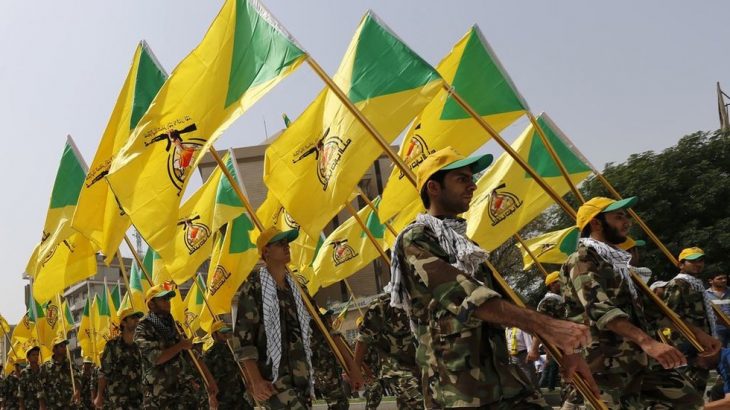
Kataib Hezbollah members wave the party’s flags during a parade in Baghdad. © Reuters / Thaier al-Sudani
RT | December 29, 2019
US airstrikes have pounded three Kataib Hezbollah military facilities near the town of Qaim, Iraq, as well as two targets in Syria, in response to the group’s alleged bombing of an Iraqi military base on Friday.
The US carried out “defensive strikes” against the supposed Kataib Hezbollah facilities on Sunday, US officials told Reuters. The targets included weapons storage locations and command and control stations, and F-15 fighter jets were used in the attack. Three locations near Qaim, on the Iraq/Syria border, and two locations in Syria were hit.
Chief Pentagon spokesman Jonathan Hoffman said in a statement that the strikes were a “response to repeated Kataib Hezbollah attacks on Iraqi bases that host Operation Inherent Resolve (OIR) coalition forces.”
Reuters’ military sources said that at least 18 militiamen were killed in the strikes, including at least four local Kataib Hezbollah commanders.
Two days earlier, the same Kataib Hezbollah fighters and their Iraqi Shia allies were blamed by US officials for a rocket attack on an Iraqi military base in Kirkuk, some 250 miles east of Qaim. The rocket barrage killed an American contractor and wounded several US troops.
Kataib Hezbollah is an Iraqi paramilitary group, but is financially supported by Iran. Its allies in the so-called Popular Mobilization Forces were first deployed by the Iraqi government to combat Islamic State (IS, formerly ISIS) jihadists in 2014, but the government has since struggled to bring them under the command of the Iraqi military.
The rocket attack inflamed anti-Iran sentiment in the US, with Republican Senator Tom Cotton (Arkansas) warning that “Tehran ought to face swift and severe consequences” for its alleged involvement. Responding to similar attacks, US Secretary of State Mike Pompeo threatened Iran earlier this month with a “decisive US response” should they continue.
Iran’s involvement, however, has not been conclusively established.
German Parliament Greenlights Non-Binding Initiative to Ban Hezbollah
Sputnik – December 20, 2019
German lawmakers approved a non-binding initiative on Thursday calling on the government to ban from Germany the political and militant group Hezbollah, which forms part of the Lebanese government. The move, reportedly aimed at combating anti-Semitism, has been rejected multiple times by the parliament.
The Thursday resolution was approved by the opposition Free Democrats as well as the Social Democratic Party, which is allied to the Christian Democratic Union (CDU), Chancellor Angela Merkel’s party. The move seeks to ban the political arm of Hezbollah from Germany and to add the group to the European Union’s terrorist list.
“It is unacceptable that Hezbollah is waging a terrorist fight against Israel in the Middle East, which is being financed through worldwide criminal activities, among other things,” CDU spokesperson Mathias Middelberg said in a statement, according to AP. “In view of Germany’s special responsibility toward Israel, we call on the government to ban all activities for Hezbollah in Germany.”“The separation between a political and a military arm should be abandoned, and Hezbollah as a whole should be placed on the EU terrorist list,” Middelberg said. “This could freeze Hezbollah’s funds and assets in Europe more extensively than before.”
Germany last weighed the question of banning the political wing of Hezbollah, which has just over 1,000 members, in June. That bill, sponsored by the far-right Alternative for Germany (AfD), which has repeatedly sponsored bills seeking to ban burqas and minarets, claiming “Islam is not a part of Germany,” according to Middle East Monitor, failed amid joint opposition by the same parties that sponsored the resolution passed Thursday.
Israeli Foreign Minister Israel Katz praised the move, calling it “an important step in the international struggle against terrorism, particularly against terrorist organization Hezbollah and its patron Iran,” AP noted. US Ambassador to Germany Richard Grenell also voiced his support.Hezbollah is a Lebanese political party and militant group whose primary basis of support is the country’s Shiite Muslim community, although it also enjoys the support of many Christians, Druze and even Sunni Muslims. It gained notoriety for fighting the Israel Defense Forces to a standstill in Lebanon’s south when Israel invaded in 2006. The group was formed as a self-defense force in the early 1980s, during a previous occupation by Israeli forces, against whom it waged a guerrilla campaign. It has also joined the fight in Syria against Daesh and other jihadist rebel groups.
Hezbollah has been accused of multiple acts of terrorism, such as a bus bombing in the Bulgarian city of Burgas in 2012 that killed seven people and injured 32, although no conclusive evidence tying Hezbollah to the attack has been found. It’s also been accused of being behind a slew of terrorist attacks in the early 1980s, including several deadly bombings in Beirut, but again with limited evidence behind the claims. However, 14 nations and several international organizations have declared Hezbollah to be a terrorist organization, while eight nations have declared it not to be one. Hezbollah is also accused of being a proxy of Iran.
Mustafa Ammar, a CDU candidate for the 2021 elections, told Asharq Al-Awsat late last month that secret talks had taken place during a congress held by the CDU in Leipzig about how best to limit anti-Semitism in Germany, especially in schools.“One of the measures included the total banning of Hezbollah and its activities,” Ammar told the London-based outlet. A Hamburg intelligence agency reported in July that Hezbollah had ties to about 30 mosques across Germany, where it raises funds and spreads its ideology, according to Fox News.
Hezbollah has long maintained it distinguishes between Judaism as a religion and Zionism as a political ideology, with leader Hassan Nasrallah saying in 2009: “Our problem with [the Israelis] is not that they are Jews, but that they are occupiers who are raping our land and holy places.” However, Nassrallah and other Hezbollah leaders have also been accused of anti-Semitic statements.
Last week, US President Donald Trump signed an executive order that categorized anti-Israeli speech as anti-Semitism and hate speech under Article VII of the 1964 Civil Rights Act. The move is widely interpreted as aimed at punishing anti-Israel initiatives like Boycott, Divestment and Sanctions (BDS) by declaring them to be anti-Semitic, tying the nation of Israel to the worldwide Jewish community.
Sudan closing Hamas, Hezbollah offices to rebuild US ties
MEMO | December 17, 2019
In an attempt to re-establish ties with the US and to lift sanctions imposed on it, Sudan is set to shut the offices of the Hamas and Hezbollah resistance movements in the country, both defined as terrorist organisations by America, according to a source cited by Middle East Eye (MEE).
The decision follows Sudanese Prime Minister Abdallah Hamdok’s visit to Washington earlier in the month. Hamdok became the first leader of Sudan to visit America since 1985 and he held talks aimed at bridging the relationship between the two states after years of sanctions and international isolation, especially with Sudan being placed on the US list of states sponsors of terrorism after hosting former Al-Qaeda leader Osama bin Laden in the nineties.
Post-revolutionary Sudan witnessed the ousting of long-term President Omar Al-Bashir who is currently serving a two-year sentence on charges of corruption, and the inauguration of the country’s first civilian prime minister in three decades. Hamdok has argued for the necessity of Sudan being removed from the US’ blacklist citing the need to improve the economic situation, which is edging towards hyperinflation leaving Sudan among the countries with the highest inflation in the world. The economic crisis is primarily what brought protestors out onto the streets last year. Addressing the UN General Assembly in September, Hamdok said that the revolution aimed at ending Sudan’s pariah status, reiterating that Sudan inherited international sanctions and that “it was the former regime that supported terrorism”, not Sudan’s people.
The Sudanese source who spoke to MEE said: “The government will close the offices of Hamas and Hezbollah and any other Islamic groups designated as terrorist groups that has presence in Sudan, because Sudan has nothing actually to do with these groups and the interests of Sudan are above everything.”
However, the office closures are likely symbolic in nature, said Cameron Hudson, senior fellow at the Atlantic Council Africa Centre, given that operations of both organisations have been dormant in the country for years. “The announcement that they are formally closing the offices suggests to me that they were essentially dormant, although not formally closed,” he said.
Nevertheless, the move is interpreted by some as a gradual alignment of Khartoum with the interests of the US and its regional allies. In 2016 Sudan ended diplomatic ties with Iran in the wake of the attacks by protestors on the Saudi embassy in Tehran which was in response to the execution of the Saudi Shia cleric and activist Sheikh Nimr Al-Nimr. Two months prior to the severing of ties with Tehran, Sudan reportedly received $2.2 billion for taking part in the Saudi and UAE-led coalition in Yemen, although Sudan is now scaling back its military involvement in the conflict.
Israel for its part had accused Sudan of channelling arms from Iran to Hamas in the Gaza Strip via Egypt’s Sinai desert and is alleged to have bombed Sudanese munitions warehouses and factories in the past.
Sudan has also sought Qatar’s support in its efforts to be removed from the US list of state sponsors of terrorism, which it expressed at a reception hosted by Qatar’s Ambassador to Khartoum, ahead of Qatar’s National Day.
Israeli Minister of Defense to Impose Sanctions on Palestinian ‘Militants’ Abroad
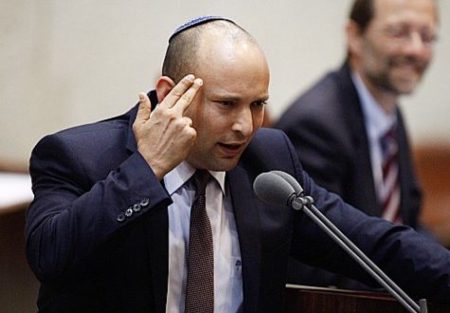
IMEMC & Agencies – December 3, 2019
Israeli Minister of Defense, Naftali Bennett, on Tuesday, issued a written order imposing international economic sanctions on Palestinian militants abroad, The Palestinian News and Info Agency reported.
Hebrew media outlets broadcast Bennett’s decision, pointing out that this move has never been attempted before.
Bennett issued his first order against Jamil Hersh, a member of the Arab Society for Human Rights in London, members of Lebanon’s Hezbollah party will also be sanctioned.
Hezbollah: US major obstacle to government formation in Lebanon
Press TV – November 22, 2019
Hezbollah calls the US the most prominent obstacle lying in the way of formation of a government in Lebanon, which is direly in need of political stability.
The Lebanese resistance movement’s Deputy Secretary-General Sheikh Naim Qassem made the remarks in an interview with Reuters on Friday.
“The first obstruction in the formation of the government is America, because it wants a government that resembles it and we want a government that resembles the Lebanese people,” he said.
US officials had been in direct contact with Lebanese politicians and officials, the official noted, saying, “Let them leave us alone so we can reach an understanding among ourselves. The more they intervene the more they delay the solution.”
The country — where coexistence of various religious sects has turned unity into the leading means of preventing internal strife — would not be rid of its ongoing economic and political woes unless foreign vested interests stopped tugging away at it, Qassem said.
Prime Minister Sa’ad Hariri resigned in late October amid nationwide protests against corruption and economic adversity that had begun earlier that month.
On Tuesday, protesters blocked roads leading to the parliament in the capital Beirut, forcing the legislature to postpone what was supposed to be its first session in two months. Heavy clashes were reported later that day between security forces and a group of protesters attempting to make their way into the parliament.
Featured Video
Trita Parsi: Israel Set a Trap for Total War in the Region
or go to
Aletho News Archives – Video-Images
From the Archive
Zionism’s Violent Legacy
By Donald Neff | Washington Report On Middle East Affairs | January 1996
On January 4, 1948, Jewish terrorists drove a truck loaded with explosives into the center of the all Arab city of Jaffa and detonated it, killing 26 and wounding around 100 Palestinian men, women and children.[1] The attack was the work of the Irgun Zvai Leumi – the “National Military Organization,” also known by the Hebrew letters Etzel – the largest Jewish terrorist group in Palestine. The Irgun was headed by Revisionist Zionist Menachem Begin and had been killing and maiming Arabs, Britons and even Jews for the previous ten years in its efforts to establish a Jewish state.
This terror campaign meant that at the core of Revisionist Zionism there existed a philosophical embrace of violence. … continue
Blog Roll
 Aletho News
- Trita Parsi: Israel Set a Trap for Total War in the Region
- Trump’s Iran war is on an Israeli leash
- Saudi oil boss issues global supply warning
- Riyadh Says Its Oil System Is Intact. The Numbers Say Otherwise.
- Trump and Netanyahu Want to “Finish the Job” on Iran
- US ‘one-sided dictation’ not Iran’s beliefs makes rational talks impossible: Baghaei
- Iran’s Next Strike May Not Explode. It Could Shut You Down /Col Doug Macgregor
- Iran: US political targets legitimate if assassinations return
- Iraq shuts key border crossing with Iran under US pressure: Report
- Undersea Internet cables could be targeted in retaliation for attacks on Iran: IRGC deputy chief
- If Americans Knew
- The Israel Lobby’s Changing Fortunes
- AIPAC has become such a political liability that it’s shifting to a more “nimble” approach to buying politicians
- At least 160 Israeli settler attacks in 2 weeks
- Will Gaza’s Ancient Christian Community Disappear Forever?
- Israel’s vision of regional security rests on keeping Arab states weak
- Heidi Levine recounts how Palestinian youths helped save her in settler attack
- DAILY UPDATE: Latest essential news on Palestine, Israel, & region
- Trump’s Intensifying Sabotage of the ICC, for Israel’s Sake
- Israeli military detain US and UK volunteers in West Bank including Democratic NY politician Brad Lander
- Americans at National Conservatism Conference held in Israel this year criticize Israel
- No Tricks Zone
- E-Cars Reduce CO2 Emissions By Only 41% Compared To Internal Combustion Engine Vehicles
- Predictions Made By Renowned Climate Professor Over Past Decades Have Been Proven To Be Poor
- New Study Suggests Large Regions Of The Pacific Ocean Have Been Cooling For The Last 80 Years
- Germany’s Green Energy Debacle: High Energy Costs Force Kahla Porzellan to Close After 182 Years!
- New Study: 50 Years Of The Most Aggressive ‘Net Zero’ Policies Can Only Affect The Global Climate By 0.03°C
- US September “Heat” Was No Record…Many Records Set Decades Ago
- Latest European Green Energy Debacle; Portugal’s Largest Flagship Solar Park Insolvent!
- Green Energy Debacle: German Expert Professor Fritz Vahrenholt Warns Of Severe Economic And Social Consequences
- Two More Paleo Reconstructions Affirm Meters-Higher Sea Levels Across Ireland, Brazil 7000-6000 Years Ago
- New Study: Earth And Venus Surface Warmth Largely Explained By Convection And Lapse Rate, Not CO2 Or Radiation

