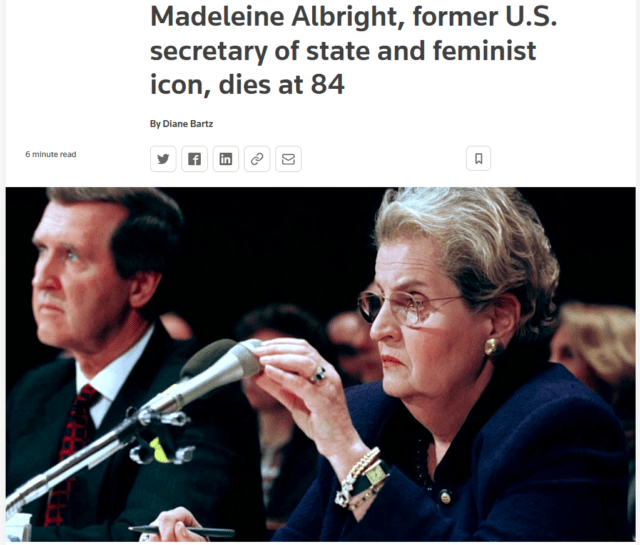
When Clinton-era Secretary of State Madeleine Albright died of cancer last month, a stream of fawning obituaries hailed her as a hero of NATO, a feminist icon and a “champion of human rights and diplomacy” (CNN, 3/24/22).
Most coverage failed to levy any criticism at all of Albright’s actions in government, despite her presiding over a critical turning point in the American Empire. For the foreign policy establishment, the ’90s under Albright solidified the US self-image as the “indispensable nation,” ready and able to impose its will on the world, a position with repercussions that still echo today. Instead of critically exploring this legacy, corporate media opted for celebration and mythmaking.
‘Icon’ and ‘trailblazer’
Some of the coverage focused on Albright as a “feminist icon” (Reuters, 3/23/22; USA Today, 3/23/22) breaking the glass ceiling. A commonly used term was “trailblazer” (e.g., NPR, 3/24/22; Washington Post, 3/23/22).
The New Yorker (3/24/22) declared, “Madeleine Albright Was the First ‘Most Powerful Woman’ in US History.” CNN (3/24/22) went as far as to call Albright an early progenitor of “feminist foreign policy.”
NPR (3/24/22) claimed that Albright “left a rich legacy for other women in public service to follow.” BuzzFeed (3/23/22) found time to discuss the meaning of the jewelry she wore when meeting foreign leaders.
There is nothing wrong with remarking on the significance of a woman taking charge in the historically male-dominated halls of US power. However, it is far more important to take a critical look at her policies, including whether they jibe with the tenets of feminism as generally understood—something few in the media chose to do.
Media fell into this same trap when praising Gina Haspel as the first female head of the CIA, or when they applauded the top military contractors for having female heads (FAIR.org, 6/28/20). Similarly, Albright’s violent legacy is being obscured by seemingly progressive language.
‘More children than died in Hiroshima’

Madeleine Albright telling 60 Minutes (5/12/96) that half a million dead children is a price worth paying.
One of the first things many progressives think of when they think of Albright is her championing of the sanctions against Iraq during the ’90s. In between the two US wars on Iraq, Albright presided over crushing sanctions aimed at turning the Iraqi population against the Ba’athist government. These sanctions cut off crucial supplies to the nation, starving its people. A UN survey found that the sanctions led to hundreds of thousands of dead Iraqi children.
When Albright was confronted with this figure in an interview with CBS‘s Leslie Stahl on 60 Minutes (5/12/96; Extra!, 11–12/01), Albright’s response was cold:
“We have heard that half a million children have died. I mean, that is more children than died in Hiroshima,” Stahl said. “And, you know, is the price worth it?”
“I think that is a very hard choice, but the price, we think, the price is worth it.”
The UN numbers have since been revised downward, but the unavoidable fact is that Albright accepted the number she was given, took willful responsibility for the deaths and concluded that they were “worth it” for the purpose of turning the Iraqi people against their government.
While so many Americans seem to have forgotten this shameful display, the rest of the world has not. Ahmed Twaij, an Iraqi writing in Al Jazeera (3/27/22), said that his “most prominent memory of Albright” was that notorious interview:
As an Iraqi, the memory of Albright will forever be tainted by the stringent sanctions she helped place on my country at a time when it was already devastated by years of war.
Despite its resonance around the world, the quote wasn’t even referenced in many of the retrospectives FAIR reviewed. USA Today (3/23/22) mentioned that Albright received “criticism” for calling the deaths “worth it,” and Newsweek (3/23/22, 3/25/22, 3/23/22) mentioned the quote in some of its coverage. But it went missing from the New York Times (3/23/22, 3/25/22), Washington Post (3/23/22), NBC.com (3/23/22), CNN.com (3/24/22, 3/26/22), New Yorker (3/24/22) and The Hill (3/24/22).
Guaranteed shootdown
Gen. Hugh Shelton, former chair of the Joint Chiefs of Staff, recounts in his book how Albright suggested to him that the US fly a plane over Iraqi airspace low enough to be shot down, thus giving the US an excuse to attack Saddam Hussein. Shelton recalls Albright’s words:
What we really need in order to go in and take out Saddam is a precipitous event—something that would make us look good in the eyes of the world. Could you have one of our U-2s fly low enough—and slow enough—so as to guarantee that Saddam could shoot it down?
Albright was quickly rebuffed, but she was later able to get her wish of war in Iraq. Her efforts culminated in the Iraq Liberation Act, signed in October 1998, which made seeking regime change in Iraq official US policy.
As the New York Times (3/23/22) mentioned in its obituary, Albright threatened the Ba’athist leader with bombing that year if he didn’t open the country to weapons inspectors. Even though Kofi Annan brokered an agreement on the inspectors, the US bombed anyway in December 1998.
The Times didn’t explore these events further—not mentioning that the administration justified the bombing using the debunked pretext of Saddam’s weapons of mass destruction—and instead continued ahead with its largely positive obituary.
Rewriting Yugoslav history
One of Albright’s most notable moments during her tenure as secretary of state was the 78-day bombing campaign in Yugoslavia in 1999. Today, the bombing is hailed as a major victory by the forces of democracy, and Albright’s role is cast in a positive light.
NPR’s three sentences (3/24/22) on the subject show the dominant version of the events:
As chief diplomat in the late ’90s, Albright confronted the deadly targeting of ethnic Albanians in Kosovo. Time magazine dubbed it Madeleine’s War. Airstrikes in 1999 eventually led to the withdrawal of Yugoslav forces.
Americans were told at the time that the war solidified the US as “an indispensable nation asserting its morality as well as its interests to assure stability, stop thugs and prevent human atrocities” (Time, 5/9/99). The Washington Post (3/23/22) seized on this myth, calling Albright “an ardent and effective advocate against mass atrocities.” In this story, she is a hero for mobilizing the timid American giant to use its military might on behalf of humanitarian and democratic ideals.
But the truth is that the bombing Albright advocated was motivated less by humanitarian concerns and more by the US goal of breaking up Yugoslavia and establishing a NATO-friendly client state via the Kosovo Liberation Army. Indeed, the US’s negotiating tactic with Serbian President Slobodan Milosevic was to offer the choice of either occupation by NATO or destruction. As a member of Albright’s negotiating team anonymously told reporters (Extra!, 7–8/99): “We intentionally set the bar too high for the Serbs to comply. They need some bombing, and that’s what they are going to get.”
Exacerbating bloodshed
One fact that quickly debunks the humanitarian pretext is that the US-led bombing greatly exacerbated the bloodshed. According to Foreign Affairs (9–10/99), 2,500 died during the preceding civil war, but “during the 11 weeks of bombardment, an estimated 10,000 people died violently in the province.” And while Albanian civilians bore the brunt of the violence during the NATO attacks, in the year preceding the bombing, British Defense Secretary George Robertson told the Parliament that the NATO-backed KLA “were responsible for more deaths in Kosovo than the Yugoslav authorities had been” (Monthly Review, 10/07).
As Edward Herman and David Peterson wrote in their detailed essay on Yugoslavia in the Monthly Review (10/07), the US and NATO were
key external factors in the initiation of ethnic cleansing, in keeping it going, and in working toward a violent resolution of the conflicts that would keep the United States and NATO relevant in Europe, and secure NATO’s dominant position in the Balkans.
The concern for ethnic minorities was merely a pretext offered to the American people, and lapped up wholeheartedly by a compliant mass media.
Along with liberal hawks like Samantha Power, Albright helped weaponize human rights and legitimize unsanctioned “humanitarian interventions” around the world. This showcase of unilateral and illegal violence has had direct repercussions around the world, paving the way for US interventions in Afghanistan, Iraq and Libya—to say nothing of the current Russian attack on Ukraine.
Promoting hawkish policy
Much of the coverage framed Albright’s Clinton-era career arc as one in which she repeatedly failed to get the US to play a larger role in advancing its ideals in the post-Cold War world. This fight included taking on international institutions that didn’t understand American exceptionalism.
Albright clashed with then–UN Secretary General Boutros Boutros-Ghali “as she advocated fiercely for US and democratic interests,” in the words of CBS (3/23/22). She and Boutros-Ghali butted heads over the US role in peacekeeping operations during crises in Rwanda, Somalia and Bosnia.
In the end, Albright dissented against the entire UN Security Council, using the US veto power to deny Boutros-Ghali a second term as secretary general. His ouster paved the way for the more US-friendly Kofi Annan, as the “Albright Doctrine” took center stage.
In its cover story on “Albright’s War,” Time (5/9/99) described the Albright doctrine as
a tough-talking, semimuscular interventionism that believes in using force—including limited force such as calibrated air power, if nothing heartier is possible—to back up a mix of strategic and moral objectives.
In other words, Albright advocated a policy of unilateral intervention instead of a global order based on international law and mutual obligations. The US could assert itself whenever and wherever it determined the “strategic and moral objectives” were of sufficient importance.
The diplomat was more blunt about the US chauvinism imbued in the doctrine when she spoke to NBC (2/19/98) in 1998:
If we have to use force, it is because we are America; we are the indispensable nation. We stand tall and we see further than other countries into the future.

A CNN op-ed (3/24/22) positively cited Albright’s comment to Colin Powell: “What’s the point of having this superb military you’re always talking about if we can’t use it?”
The media reflect positively on this mindset that “blended her profound moral values from her childhood experience in Europe with US strategic interests,” according to the New Yorker (3/24/22). Some suggested that this mindset should continue to animate American policy.
‘Albright was right’
CNN.com (3/24/22) published an opinion by Elmira Bayrasli that claimed, “The West would be wise to heed Madeleine Albright’s lessons on foreign policy.” She embraced Albright’s hawkish label, saying that “advocating the oppressed and actively upholding human rights… sometimes meant using the might of the American military.”
Hillary Clinton, whose “trailblazing” also obscured the deadly cost of her foreign policy initiatives, published a guest essay in the New York Times (3/25/22) under the headline “Madeleine Albright Warned Us, and She Was Right.” To Clinton, the world still needs Albright’s “clear-eyed view of a dangerous world, and her unstinting faith in… the unique power of the American idea.”
While some pieces were clear in calling her a hawk (e.g., Washington Post, 3/23/22), CNN (3/24/22) wrote, “It is a mistake to see Albright exclusively as a hawk,” because she sat on the board of the National Democratic Institute (NDI) and supported the activities of the US Agency for International Development (USAID). The Hill (3/24/22) also highlighted her support for these organizations, noting that for Albright, “democracy and human rights… were integral to American foreign policy.”
The NDI exists under the umbrella of the National Endowment for Democracy, a deceptively named organization that spends tens of millions of dollars annually promoting and installing US-friendly governments around the world. USAID has long been used as a front for intelligence and soft power initiatives. During Albright’s time in office, USAID was heavily involved in facilitating the further destruction of Haitian democracy, among a myriad of similar activities around the world.
These organizations have been well-documented as extensions of US power and bases for subversive activities, but this history is dismissed in favor of the government’s line that they are genuine conduits for democracy. The methods of empire have evolved, but the Albright coverage continues to obscure this fact. Regime change efforts can be recast as efforts to spread democracy around the world if the press refuses to scrutinize the official line.
NATO expansion
NATO expansion, a major initiative during Albright’s tenure, has come to the forefront of US discussion in recent months. The Russian invasion of Ukraine is in part a result of the decades-long expansion of the NATO military alliance, despite the warnings of US foreign policy veterans that the expansion was a “policy error of historic proportions.” (See FAIR.org, 3/4/22.)
In 1998, legendary diplomat George Kennan (New York Times, 5/2/98) called NATO expansion “a tragic mistake.” He predicted, “I think the Russians will gradually react quite adversely and it will affect their policies… and then [the NATO expanders] will say that we always told you that is how the Russians are.”
Kennan’s words have proven prophetic, but most articles on Albright’s passing wrote fondly of her role in NATO expansion and the accompanying anti-Russian politics. CNN.com (3/23/22), in an article headlined “Albright Predicted Putin’s Strategic Disaster in Ukraine,” declared that the former top diplomat “died just as the murderous historic forces that she had spent her career trying to quell are raging in Europe again.”
MSNBC.com (3/24/22) declared that “Madeleine Albright’s NATO Expansion Helped Keep Russia in Check.” Columnist Noah Rothman explained that “only the compelling deterrent power of counterforce stays the hand of land-hungry despots.”
The New Yorker (3/24/22) described NATO expansion as one of Albright’s “major achievements,” despite acknowledging that in the wake of the policy, “US interests are indeed threatened more than at any time in three decades by Russian aggression in Europe.”
Some pieces were more reflective. The Conversation (3/24/22) went into detail on her role in expanding NATO, acknowledging that “Albright’s curt dismissal of Russia’s security concerns might seem to have been ill-judged… in light of Russia’s invasion of Ukraine.”
A time for reflection
In the United States, political figures are merged with the culture of celebrity. Too many judge politicos by their force of personality or lines on their resume, rather than the material changes that occurred on their watch. The substantive history of US policymaking is rarely brought up, and political discussion remains surface-level and incomplete.
This celebrity culture is on full display whenever a venerated member of the Washington establishment passes away. We’ve seen similar soft media coverage after the deaths of George H.W. Bush (FAIR.org, 12/7/18), Colin Powell (FAIR.org, 10/28/21) and Donald Rumsfeld (FAIR.org, 7/2/21).
By now, the idea of the United States as the global policeman has been discredited enough to warrant at least some pushback in the corporate press. The passing of one of America’s leading interventionists should be a time for reflection. How did this person’s policies contribute to what is going on now?
Instead, the media decided to use Albright’s death to reinforce the myths and legitimize the policies that have led to so much destruction around the world.
April 18, 2022
Posted by aletho |
Mainstream Media, Warmongering, Militarism, Timeless or most popular, War Crimes | Iraq, NATO, New York Times, United States |
Leave a comment
Why do we still have American troops in Syria and Iraq? That is the million dollar question that the Biden Administration has yet to answer — at least with any satisfaction — for the American people. Meanwhile, our service members continue to be targets of hostile forces for a Washington strategy no one can quite articulate.
On April 7 there were reports of “two rounds of indirect fire” on the Green Village Base in eastern Syria, which is housing U.S. troops as part of Operation Inherent Resolve. U.S. Central Command said four American service members were being evaluated for traumatic brain injury as a result.
On Thursday, however, U.S. Central Command quietly announced that there were no rockets, but “but rather the deliberate placement of explosive charges by an unidentified individual(s) at an ammunition holding area and shower facility.”
The release was brief and with no accompanying details, but the words echoed of the kind of Green-on-Blue attacks against coalition troops in Afghanistan during the height of the war there. As of 2017, according to counts, there had been more than 95 such attacks since 2012, killing 152 coalition service members and injuring 200.
There have been numerous rocket attacks against bases on which foreign soldiers, mostly Americans, are serving in Syria and Northern Iraq over the last two years. “Iranian backed militias” have been fingered in the attacks and they don’t seem to be abating, though the administration never uses the incidents to explain or even justify why our presence continues to be useful there. Is it to stave off ISIS? Bashar Assad? Iranian militias?
“The United States has no compelling national security interest in Syria to justify an open-ended ground deployment of forces,” wrote Defense Priorities’ Natalie Armbruster in March, taking on each of the existing arguments for keeping forces in the region. Now that our troops can’t even feel safe taking showers on base, isn’t it time to get a straight answer from Washington?
April 16, 2022
Posted by aletho |
Illegal Occupation, Militarism, Wars for Israel | Afghanistan, Iraq, Syria |
Leave a comment
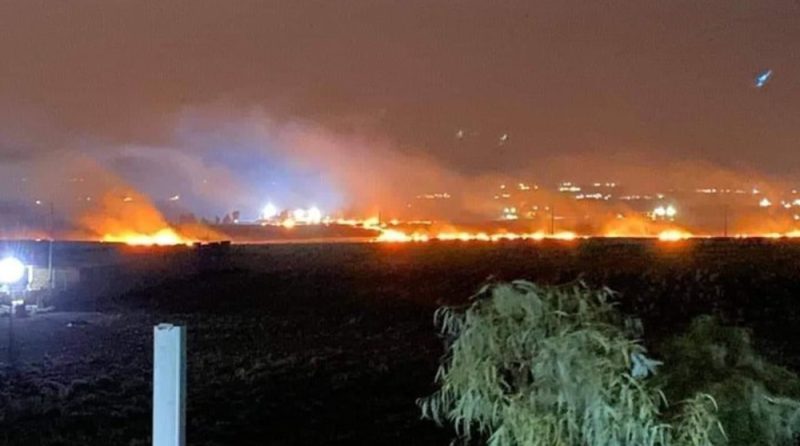
The Iranian ambassador to Iraq says the latest missile strike by the Islamic Revolution Guards Corps (IRGC) on secret bases of the Israeli Mossad spy agency in the semi-autonomous Kurdistan region was strictly necessary, as operations against Iran’s security were being plotted and orchestrated there.
Iraj Masjedi made the remarks while addressing an international conference in Iraq’s holy city of Karbala on Monday.
The Iranian diplomat said Israeli operatives used the Iraqi Kurdistan region to plot and launch operations against Iran’s security, emphasizing that Iranian officials had time and again warned the Kurdistan Regional Government (KRG)’s authorities against their activities, but to no avail.
Masjedi highlighted that the missile attack was carried out in order to safeguard Iran’s security, “and was neither intended to violate Iraq’s sovereignty nor was meant to insult the Arab country and its nation.”
“We expect you to force Israelis out of Iraqi soil and get rid of them,” Masjedi addressed Kurdish officials, adding, “However, if they are not expelled, will we stand by with our hands tied behind us to [allow them] carry out operations against our security? Definitely not.”
The Iranian ambassador emphasized that the attack was aimed at Israel’s training centers and did not target the United States or the Iraqi government.
“Some media outlets have asserted that we targeted the US consulate. I’m surprised by such allegations. It is true that a conflict has been going on between us and the United States for forty years, but the recent operation was not against them. It was an operation against an Israeli base, where plots against our security were being hatched,” Masjedi said.
A dozen ballistic missiles hit secret Mossad bases in the northern Iraqi city of Erbil, reportedly leaving several Israeli operatives dead.
Citing security sources, Iraq’s Sabereen News reported that two Mossad training centers were targeted by ballistic missiles in the early hours of Sunday.
Al-Mayadeen television news network said a Mossad base on the Masif-Saladin Street in Erbil was “fully razed to the ground and a number of Israeli mercenaries were killed or injured.”
In a statement issued earlier on Sunday, the IRGC indicated that the operation was in response to an Israeli airstrike on the Syrian capital of Damascus last Monday, in which two IRGC officers were killed. The IRGC identified the two slain officers as colonels Ehsan Karbalaipour and Morteza Saeidnejad, warning that Israel would “pay for this crime.”
March 14, 2022
Posted by aletho |
Aletho News | Iran, Iraq, Israel |
Leave a comment
Iraqi National Security Adviser, Qassem Al-Araji, yesterday met the ambassadors of Russia, Syria and Iran as part of the Quartet Centre for Information Exchange in Iraq’s capital city, Baghdad, to discuss counter-terrorism.
Local media reported that the meeting had discussed recent developments along the Iraqi-Syrian border, as well as the latest security developments in the region.
Al-Araji said that cooperation and joint action with the three countries had led to “strong and deterrent blows to terrorism and its leaders,” adding that the Centre was playing a “role in informing and resolving many issues.”
He pointed out that his country would not allow the presence of terrorist groups along its borders, stressing that Baghdad would only deal with “legitimate, sovereign states and governments.”
He reiterated that the Centre was strengthening the “close relationship between the countries that participated in this Centre in difficult and sensitive circumstances, and Iraq will respect those who stood by it during the difficult days.”
“There is a concern that there is a plan for the return of terrorists and their spread in the region, which could lead to instability,” he said.
February 25, 2022
Posted by aletho |
Aletho News | Iran, Iraq, Middle East, Russia, Syria |
Leave a comment
Since Israel and Bahrain both view Iran as a threat, they could team up and counter Tehran together, Israeli prime minister Naftali Bennett said on his landmark visit to the Gulf monarchy.
“We will fight Iran and its followers in the region night and day. We will aid our friends in strengthening peace, security, and stability, whenever we are asked to do so,” Bennett pledged in an interview with the Bahraini state-linked Al-Ayyam outlet on Tuesday.
The PM blamed Tehran of striving to “destroy moderate states” in the Gulf region in order to replace them with “bloodthirsty terrorist groups.”
When asked about the possibility of creating an alliance to resist Iranian influence, which could include Israel, Bahrain, and some other Arab nations, he gave a positive response: “We all understand that we face the same challenges, so why not work together to tackle them?”
Bennet, who became the first Israeli prime minister ever to visit Bahrain, assured the journalists that “Israel is a strong and reliable country.”
The idea of such a block was first floated by Israeli general Tal Kelman last year. According to Kelman, who heads the IDF’s Strategy and Third Circle Directorate, “the moderate axis” of Israel, Bahrain, the UAE, Jordan, Egypt and others should resist “the radical axis” of Iran and what he called its “proxies” in Lebanon, Syria, Yemen, and Iraq.
Israel and Bahrain normalized relations in late 2020 as part of the so-called Abraham Accords, a US-backed drive to improve ties between the Jewish state and some Arab countries after decades of strife.
Bahrain is a small island nation of around 1.5 million. The majority of its population is Shia Muslims, but the country is being run by a Sunni monarchy. The rulers in Manama have been concerned by Tehran’s activities as Iran, which is located less than 800 kilometers (497 miles) away, often faces accusations from its rivals of supporting Shia groups in other countries.
February 15, 2022
Posted by aletho |
Ethnic Cleansing, Racism, Zionism, Militarism | Egypt, Iran, Iraq, Israel, Lebanon, Middle East, Sanctions against Iran, Saudi Arabia, Syria, Yemen, Zionism |
Leave a comment
On the morning of January 25, 1993, a man named Mir Amal Kansi appeared outside CIA headquarters in Langley, Virginia, where he began assassinating people who were driving their cars into the facility. He ended up killing two CIA employees and wounding three others.
Four years later, FBI agents arrested Kansi in Pakistan and brought him back to the United States.
Kansi was prosecuted in a Virginia state court for murder, where he was convicted and sentenced to die. On November 14, 2002, the state of Virginia executed him.
What I find fascinating in this episode is that under U.S national-security law, when the CIA assassinates people, it isn’t considered murder. But as Kansi’s case shows, when people assassinate CIA officials, it is considered murder.
Kansi gave the reason for his assassinations. No, he didn’t say that he hated America for its “freedom and values.” He said that the reason he was assassinating CIA officials was to retaliate for the fact that the U.S. government was killing people in Iraq and for its role in helping Israel kill Palestinians.
Under U.S. national-security law, U.S. officials can assassinate anyone they want — “communists,” “terrorists,” “bad guys,” “adversaries,” “opponents,” “rivals,” or “enemies.” When they do that, it’s to be called an “assassination” or a “targeted killing.”
Moreover, under the law, U.S. officials can kill whoever they want with economic sanctions, as they were doing with the Iraqi people at the time that Kansi was retaliating. I am reminded of U.S. Ambassador Madeleine Albright’s infamous statement that the deaths of half-a-million Iraqi children from the sanctions were “worth it.” Those killings weren’t called “murder” of course. They were called unfortunate deaths arising from the sanctions.
U.S. officials also wield the authority to kill whoever they want with invasions of Third-World countries. The people of Afghanistan and Iraq can attest to that. Again, those killings are not considered to be murder. They are considered to be casualties of war.
If, however, anyone retaliates against the national-security establishment by assassinating officials within the national-security establishment, it’s called “murder,” in which case the assassin will be put to death after being accorded a trial.
Of course, this was the law prior to the 9/11 attacks. After those attacks, the law was implicitly amended to provide that the national-security establishment had the option of taking “bad guys” like Kansi to Gitmo, where they could be tortured, held indefinitely without trial, or executed after a kangaroo trial before a military tribunal.
All this hypocrisy goes to show what the conversion from a limited-government republic to a national-security state has done to the consciences of the American people. Most everyone has come to accept the state-sponsored assassinations and deaths arising from sanctions, embargoes, invasions, occupations, and wars of aggression to just be part of the U.S. government’s “foreign policy tools.”
As I pointed out in a recent blog post, however, the Pentagon’s and the CIA’s assassinations constitute murder, just as Kansi’s assassinations do. Why, even Lyndon Johnson referred to the CIA’s assassination program as “Murder, Inc.,” which is precisely what it is. The same goes for deaths arising from sanctions, embargoes, wars of aggression, invasions, and occupations. It’s just plain murder.
Referring to Kansi, Virginia prosecutor Robert F. Horne stated, “I’ve tried an awful lot of killers in my life, and I think he’s the only one I’ve run into that is absolutely proud of what he did. You get a lot of killers who don’t feel all that bad about what they did, but he’s proud of it.”
Apparently Horne has never met any CIA assassins. Like Kansi, they feel really good about their killings and are absolutely proud of what they do. What Horne fails to realize is that even though Kansi is a “bad guy” for assassinating people, that doesn’t convert the CIA assassins into “good guys.”
It’s probably worth mentioning that after Kansi was executed, four American citizens were assassinated in Pakistan in retaliation.
What we need in America is a great awakening, one that involves a revival of individual conscience. When that day comes, Americans will put a stop to the evil within our midst by converting America back to a limited-government republic and putting an end to state-sponsored murder. It will also make Americans traveling overseas a lot safer.
February 9, 2022
Posted by aletho |
Militarism, Progressive Hypocrite, Timeless or most popular, War Crimes, Wars for Israel | CIA, Human rights, Iraq, Palestine, United States |
Leave a comment
The U.S. national-security establishment and its acolytes in the mainstream press are celebrating the U.S. military’s murder in Syria of Islamic State leader Abu Ibrahim Hashimi Qurayshi. Mind you, they don’t call it murder. They call it a “targeted killing” of a “bad guy” or a “terrorist.” But murder it is because the U.S. military has no legitimate authority to kill anyone in the Middle East (or anywhere else), whether it be people it labels “bad guys,” “terrorists,” “communists,” “opponents,” “rivals,” “adversaries,” or “enemies.”
Let’s take a look at the Bill of Rights, specifically the Fifth Amendment. Yes, I know that the national-security establishment and its supporters in the federal judiciary hold that the Bill of Rights doesn’t apply to the military, the CIA, and the NSA. But a close reading of the amendment reveals that there is no exception carved out for the national-security branch of the government. By its express terms, the restrictions in the Fifth Amendment apply to everyone in the federal government, not just to some people within the federal government.
The Fifth Amendment states in part: “No person shall be deprived of life without due process of law.”
Notice something important about that language: It doesn’t say “No American shall be deprived of life without due process of law.” It says “No person shall be deprived of life without due process of law.” That means it encompasses citizens of other countries.
Notice something else important: It doesn’t say “No person within the United States shall be deprived of life without due process of law.” It says “No person shall be deprived of life without due process of law.”
That’s what the Pentagon just did to Qurayshi. In a raid on a safe house in Syria, the Pentagon just deprived him of life without due process of law.
The Pentagon is pointing out that Qurayshi actually killed himself and his family with a bomb once the raid commenced. That doesn’t mean, of course, that the Pentagon isn’t responsible for killing him. The raid is the proximate cause of Qurayshi’s death as well as the deaths of other people who were with him, including women and children. That is, if the raid had not taken place, Qurayshi and those other people would still be alive.
In fact, the Pentagon is also responsible for the deaths of the women and children that were killed by Qurayshi’s suicide bomb. The Pentagon was well aware of the possibility that he could decide to blow himself up rather than be taken captive and carted away to Gitmo for torture and perpetual incarceration. That awareness did not stop them from conducting the raid anyway. The deaths of those women and children was a risk that the Pentagon felt was worth taking.
What is due process of law? It means notice and a trial. The Bill of Rights expressly prohibits the federal government from killing anyone without first giving him notice of criminal charges and a trial in federal district court. The notice comes in the form of a criminal indictment issued by a federal grand jury. At the trial, federal prosecutors are required to prove to a jury (or a judge) beyond a reasonable doubt that the accused is guilty of the offense for which they wish to kill him.
At the risk of belaboring the obvious, the Pentagon did not provide notice and a trial to Qurayshi before they raided that safe house and brought about his death and the deaths of more than a dozen other people. Perhaps the reason for that is that U.S. officials felt that they couldn’t prove that Qurayshi had committed a criminal offense against the United States.
National-security officials and their supporters implicitly claim that their “war on terrorism” trumps the Fifth Amendment. Really? Where does it say that in the Fifth Amendment? I certainly don’t see a “war on terrorism” exception in that amendment.
Indeed, what business do the Pentagon and the CIA have sitting in Syria and killing people? The last time I checked, Congress had not declared war on Syria. Moreover, the Syrian government has never invited the U.S. government to situate its troops and agents within the country. That makes the Pentagon and the CIA illegal interlopers in a foreign land, where they are killing whoever they want with impunity.
We also mustn’t forget that it is the Pentagon and the CIA that are responsible for the rise of ISIS in the first place, owing to their illegal and unconstitutional war of aggression against Iraq.
What is a “war of aggression”? It is a type of war that was declared a war crime at the Nuremberg War Crimes Tribunal. That was the tribunal that put accused Nazi war criminals on trial. The tribunal, which included U.S. officials, convicted German officials of attacking other nations. That’s what they called waging a “war of aggression.”
That’s what U.S. officials did with Iraq. It is undisputed that Iraq never attacked the United States. When the U.S. government attacked this impoverished third-world country, it was waging a “war on aggression.” Moreover, the fact that the Pentagon and the CIA did not secure the constitutionally required congressional declaration of war before committing this Nuremberg-type crime only makes the situation more egregious.
After U.S. officials installed a puppet regime with their war of aggression on Iraq, ISIS formed with the aim of ousting that U.S.-installed puppet regime. In fact, many of the ISIS members had been officials in the Saddam Hussein regime that was violently ousted from power by the U.S. invasion and occupation of the country. (It’s worth noting that Saddam was a partner and ally of the Pentagon and the CIA during the 1980s, when he was killing Iranians in his own war of aggression against Iran.)
Thus, if the U.S. government had never waged an illegal and unconstitutional war of aggression against Iraq, there never would have been an ISIS, which means that the man they just murdered — Abu Ibrahim Hashimi Qurayshi — would not have been the leader of ISIS, which means that he and his family would not be dead today.
Of course, Qurayshi will quickly be replaced, just like drug lords are quickly replaced after they are killed or captured by drug-war agents. ISIS will retaliate for Qurayshi’s killing, and the “war on terrorism” will continue, just as the drug war continues, which means ever-increasing budgets, power, and influence for the national-security establishment. The “war on terrorism” is a better racket than the “war on drugs” and perhaps even better than the old Cold War racket of the “war on communism.”
February 7, 2022
Posted by aletho |
Illegal Occupation, Timeless or most popular, War Crimes | CIA, Iraq, Syria, United States |
Leave a comment
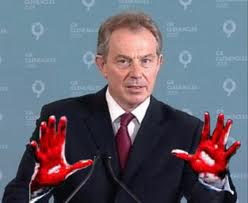 During Tony Blair’s time in office, Downing Street allegedly ordered former defence secretary Geoff Hoon to burn a secret memo that questioned the legality of the 2003 Iraq invasion. Hoon makes the bombshell claim in a new memoir.
In disclosures that have boosted ongoing attempts to strip the former prime minister of his recently conferred knighthood, Hoon reportedly revealed that Blair’s chief of staff Jonathan Powell had instructed him “in no uncertain terms” to destroy the legal document.
When reports of the allegation first surfaced in 2015, they were dismissed by Blair as “nonsense.” But Hoon has resurrected the claim in a tell-all book, titled ‘See How They Run’, according to the Daily Mail. The paper said Hoon has provided details of a “cover-up” at Downing Street.
The former Labour minister said he was sent a copy of the “very long and very detailed legal opinion,” written by then-Attorney General Peter Goldsmith, “under conditions of considerable secrecy” and told he should “not discuss its contents with anyone else.”
Describing it as “not an easy read,” Hoon said he “came to the view” after several readings that the memo was “not exactly the ringing endorsement” of the war effort that the British government and military chiefs had hoped for. Goldsmith had apparently written that the invasion would be lawful only if Blair believed it was in the UK’s national interest.
“When my Principal Private Secretary, Peter Watkins, called Jonathan Powell in Downing St and asked what he should now do with the document, he was told in no uncertain terms that he should ‘burn it.’”
However, Hoon said he and Watkins defied the order and decided to lock the memo in a safe at the Ministry of Defence instead. He noted that the document is “probably still there.”
While Blair has yet to comment, Powell has denied ordering Hoon to burn the memo, telling the Daily Mail that, at Goldsmith’s request, he had asked the former defence secretary to “destroy” a separate “minute” on the legality of the invasion that had been sent months earlier.
The explosive claims come as over 750,000 people have signed an online petition to strip Blair of his knighthood. Anti-war activists have long accused Blair of war crimes for sending British troops into Iraq and Afghanistan.
January 6, 2022
Posted by aletho |
Book Review, Deception, Timeless or most popular, War Crimes, Wars for Israel | Iraq, UK |
Leave a comment
Since the annual U.S. Veterans Day holiday honoring military veterans was just observed on November 11, it seems more than appropriate to suggest the creation of a U.S. Victims Day, just as in a similar effort at truth in labeling, the Defense Department should be renamed the Offensive War Department.
For the victims of American terrorism far outnumber the American soldiers who have died in its wars, although I consider most U.S. veterans to be victims also, having been propagandized from birth to buy the glory of war, not the truth that it’s a racket that serves the interests of the ruling class.
Such wars, carried out with bombs, drones, mercenaries, and troops, or by economic embargoes and sanctions, are by their nature acts of terrorism. This is so whether we are talking about the mass fire bombings of Japanese and German cities during WW II, the nuclear bombings of Hiroshima and Nagasaki, the carpet bombings and the agent orange dropped on Vietnam, the depleted uranium on Iraq, the use of terrorist surrogates everywhere, the economic sanctions on Cuba, Iran, Syria, etc. The list is endless and ongoing. All actions aimed at causing massive death and damage to civilians.
According to U.S. law (6 USCS § 101), terrorism is defined as an act that is dangerous to human life or potentially destructive of critical infrastructure or key resources; is a violation of the criminal laws of the United States or of any State or other subdivision of the United States; and appears to be intended to intimidate or coerce a civilian population; to influence the policy of a government by intimidation or coercion; or to affect the conduct of a government by mass destruction, assassination, or kidnapping.
By any reasonable interpretation of the law, the United Sates is a terrorist state.
Let me tell you about Bert Sacks. Perhaps you’ve heard of him. His experiences with the U.S. government regarding terrorism tell an illuminating story of conscience and hope. It is a story of how one person can awaken others to recognize and admit the truth that the U.S. is guilty of crimes against humanity, even when one is unable to stop the carnage. It is a tale of witness, and how such witness is contagious.
In November 1997 Sacks led a delegation to Iraq to deliver desperately needed medicines ( $40,000 worth, all donated) that were denied into the country because of US/UN economic sanctions. For such an act of human solidarity, he was later fined $10,000 by the U.S. Office of Foreign Assets Control (OFAC). Sacks had refused to ask for a license to travel to Iraq or to subsequently pay the fine for compelling reasons connected to his non-violent Gandhian philosophy, which teaches that non-cooperation with evil is as much an obligation as cooperation with good.
For years previously, Sacks had been learning, as would have anyone who was following the news, that the American sanctions under George H. W. Bush and Bill Clinton following the illegal and unjust Gulf War, had been aimed at crippling the Iraqi infrastructure upon which all civilian life depended. Iraq had been devastated by the U.S. war of aggression, and a great deal of its infrastructure, especially electricity and therefore water purification systems, had already been destroyed. Clinton kept up the sanctions and the bombing in support of Bush’s war intentions. So much for differences between Republicans and Democrats! Regular Iraqis were suffering terribly. All this was being done in the name of punishing Saddam Hussein in order to oust him from power, the same Hussein whom the U. S. had supported in Iraq’s war with Iran by assisting him with chemical and biological weapons.
As Sacks later (2011) wrote in his declaration to the United States District Court for the Western District of Washington when he sued OFAC:
Weeks after the end of the Gulf War, on March 22, 1991, I read a New York Times front- page story covering the UN report by Martti Ahtisaari on the devastating, ‘near- apocalyptic conditions’ in Iraq after the Gulf War. The report said, ‘famine and epidemic [were imminent] if massive life-supporting needs are not rapidly met. The long summer… is weeks away. Time is short.’ The same article explained U.S. policy this way: ‘[By] making life uncomfortable for the Iraqi people, [sanctions] will eventually encourage them to remove President Saddam Hussein from power.’ This sentence has stayed with me for twenty years. It says to me that my government – by inflicting suffering and death on Iraqi civilians – hoped to overthrow President Saddam Hussein, and that we would simply call it “making life uncomfortable.” [my emphasis]
The years to follow the first war against Iraq revealed what that Orwellian phrase really meant.
In 1994 Sacks read a survey on health conditions of Iraqi children in The New England Journal of Medicine that said: “These results provide strong evidence that the Gulf War and trade sanctions caused a threefold increase in mortality among Iraqi children under five years of age. We estimate that an excess of more than 46,900 children died between January and August 1991.”
And that was just the beginning. For the number of dead Iraqi children [and adults] kept piling up as a result of “making life uncomfortable.”
Anton Chekov’s story “Gooseberries” pops into my mind:
Everything is quiet and peaceful, and nothing protests but mute statistics: so many people gone out of their minds, so many gallons of vodka drunk, so many children dead from malnutrition. . . . And this order of things is evidently necessary; evidently the happy man only feels at ease because the unhappy bear their burdens in silence, and without that silence happiness would be impossible. It’s a case of general hypnotism. There ought to be behind the door of every happy, contented man someone standing with a hammer continually reminding him with a tap that there are unhappy people; that however happy he may be, life will show him her laws sooner or later, trouble will come for him — disease, poverty, losses, and no one will see or hear, just as now he neither sees nor hears others.
Sacks has long been that man with a gentle hammer, far from happy, comfortable, or contented in what he was learning. In 1996 he watched the infamous CBS 60 Minutes interview of Madeleine Albright by Leslie Stahl who had recently returned from Iraq. Albright was then the U.S. Ambassador to the United Nations and soon to be the Secretary of State. Stahl, in reference to how the sanctions had already killed 500,000 Iraqi children, asked her, “Is the price worth it?” – Albright blithely answered, “The price is worth it.”
In April 1997, a New England Journal of Medicine editorial said that “”Iraq is an even more disastrous example of war against the public health . … The destruction of the country’s power plants had brought its entire system of water purification and distribution to a halt, leading to epidemics of cholera, typhoid fever, and gastroenteritis, particularly among children. Mortality rates doubled or tripled among children admitted to hospitals in Baghdad and Basra…” [my emphasis]
The evidence had accumulated since 1991 that the U.S. had purposely targeted Iraqi civilians and especially very young children and had therefore killed them as an act or war. This was clearly genocide. In its 1999 news release, UNICEF announced: “if the substantial reduction in child mortality throughout Iraq during the 1980s had continued through the 1990s, there would have been half a million fewer deaths of children under-five in the country as a whole during the eight year period 1991 to 1998.”
The British journalist Robert Fisk called this intentional destruction of Iraq’s infrastructure “biological warfare”: “The ultimate nature of the 1991 Gulf War for Iraqi civilians now became clear. Bomb now: die later.” In his declaration to the court, Sacks wrote that the Centers for Disease Control, in warning about potential terrorist biological attacks on the U.S., clearly lists attacks on water supplies as terrorism and biological warfare:
Water safety threats (such as Vibrio cholerae and Cryptosporidium parvum): Cholera is an acute bacterial disease characterized in its severe form by sudden onset, profuse painless watery stools, nausea and vomiting early in the course of illness, and, in untreated cases, rapid dehydration, acidosis, circulatory collapse, hypoglycemia in children, and renal failure. Transmission occurs through ingestion of food or water contaminated directly or indirectly with feces or vomitus of infected persons.
By January 1997, as a result of such statements and those of U.S. military and government officials and reports in medical journals and media, Sacks concluded that the United States government was guilty of the crime of international terrorism against the civilian population of Iraq. And being a man of conscience, he therefore proceeded to lead a delegation to Iraq to alleviate suffering, even while knowing it was a drop in the bucket.
It is important to emphasize that the U.S. government knew full well that its intentional destruction of Iraq’s infrastructure would result in massive death and suffering of civilians. Secretary of Defense Dick Cheney said of such destruction that “If I had to do it over again, I would do exactly the same thing.” All the deaths that followed were done as part of an effort at regime change – to force Hussein out of office, something finally accomplished by the George W. Bush administration with their lies about weapons of mass destruction and their 2003 war against Iraq that killed between 1-2 million more Iraqis. The recent accolades heaped on Colin Powell, who as Secretary of State consciously lied at the UN and who led the first war against Iraq – two major war crimes – should be a reminder of how unapologetic U.S. leaders are for their atrocities. I would go so far as to say they revel in their ability to commit them. Because he called them out on this by doing what all journalists and writers should do, they have pursued and caged Julian Assange as if he were a wild dog who walked into their celebratory dinner party.
In this 1991 U.S. Defense Intelligence Agency document, “Iraq Water Treatment Vulnerabilities,” you can read how these people think. And read Thomas Merton’s poem “Chant to be Used in Processions around a Site With Furnaces,” and don’t skip its last three lines and you can grasp the bureaucratic mind at its finest. Euphemisms like “uncomfortable” and “collateral damage” are their specialties. Killing the innocent are always on their menu.
Bert Sacks and his delegation got some brief media publicity for their voyage of mercy. He believed that if the American people really knew what was happening to Iraqi children, they would demand that it be stopped. This did not happen. His tap with the hammer of conscience failed to awaken the hypnotized public who overwhelmingly had elected Clinton to a second term in 1996 six months after the 60 Minutes interview. Yes, “Everything is [was] quiet and peaceful, and nothing protests but mute statistics.”
Although the evidence was overwhelming that Iraqi children in the 1990s were dying at the rate of at least 5,000 per month as a direct result of the sanctions, very few major media publicized this. The 60 Minutes show, with its shocking statement by Albright, was an exception and was seen by millions of Americans. After that show aired, to claim you didn’t know was no longer believable. And although most mainstream media buried the truth, it was still available to those who cared. There were some conscience-stricken officials, however. In his declaration to the court, Sacks wrote:
The first two heads of the “Oil-for-Food” program – Denis Halliday and Hans von Sponeck – each resigned a position as UN Assistant Secretary General to protest the consequences of the U.S. imposed sanctions policy on Iraq. Mr. Halliday said, ‘We are in the process of destroying an entire society. It is as simple and terrifying as that.’ He called it genocide.
There were also, doctors, politicians, independent writers, and Nobel Peace Laureates who called the policy genocide and said, “Sanctions are the economic nuclear bomb.” Sacks told the court that “Finally, this list includes a 32-year career, retired U.S. diplomat – Deputy Director of the Reagan White House Cabinet Task Force on Terrorism – who says: ‘you can think of a number of countries that have been involved in [terrorist] activities. Ours is one of them.’”
Military planners, moreover, wrote in military publications that it was desirable to kill Iraqi civilians; that it was an essential part – if not the major part – of war strategy. They called it “dual-use targeting” and called themselves “operational artists.”
Sacks was able to reach a few officials and journalists who realized this was not art but massive war crimes. This showed that it is not impossible to change people, hard as it is. The judge in his court case, James L. Robart, while agreeing that OFAC had not exceeded its authority in fining him, acknowledged that the court had to accept as true that the deaths of 500,000 Iraqi children as reported by UNICEF had come to constitute genocide, but [my emphasis] U.S. law prohibited the bringing of any consideration of genocide into a legal proceeding, which allows the U.S. government to commit this crime while barring any other party from raising the issue legally.
In other words, the U.S. government can accuse others of committing genocide, but no one can legally accuse it. It is above all laws.
Ten months before his 1997 trip to Iraq, Sacks met with Kate Pflaumer, the U.S. Attorney for the Western District of Washington. He says:
We met in her office and I asked her for the legal definition of terrorism pursuant to the laws of the United States. She asked what could she do for me. I said “Prosecute me for violating U.S. Iraq sanctions by bringing medicine there.” She said, “I won’t do that for you! Can I help in any other way?” I asked for the U.S. legal definition of terrorism. She pulled out a law book, had her secretary copy the page for me, and didn’t forget my request. When she left office, she wrote the op-ed on June 21, 2001… calling U.S. Iraq policy terrorism! The two main elements relevant to the issue here are: (1) it is an act dangerous to human life; and (2) done apparently to coerce or intimidate a civilian population or a government (see 18 U.S.C. § 2331).
On June 21, 2001, Ms. Pflaumer, then the former U.S. Attorney, wrote in the Seattle Post-Intelligencer the following:
The reality on the ground in Iraq is not contested. Thousands of innocent children and adult civilians die every month as a direct result of the 1991 bombing of civilian infrastructure: sewage treatment plants, electrical generating plants, water purification facilities. Allied bombing targets included eight multipurpose dams, repeatedly hit, which simultaneously wrecked flood control, municipal and industrial water storage, irrigation and hydroelectric power. [Four of seven major pumping stations were destroyed, as were 31 municipal water and sewerage facilities. Water purification plants were incapacitated throughout Iraq. We did this for “long term leverage.” These military decisions were sanctioned by then Secretary of Defense Dick Cheney.]
In May 1996, Secretary of State Madeleine Albright reaffirmed that the “price” of 500,000 dead Iraqi children was “worth it. ”
Article 54 of the Geneva Convention states: “It is prohibited to attack, destroy or render useless objects indispensable to the survival of the civilian population” and includes foodstuffs, livestock and “drinking water supplies and irrigation works.”
Tittle 18 U.S. Code Section 2331 defines international terrorism as acts dangerous to human life that would violate our criminal laws if done in the United States when those acts are intended to intimidate or coerce a civilian population or to influence the policy of a government by intimidation or coercion.
Thus did Kate Pflaumer, in an act of conscience and upholding her legal obligation as an attorney, call the U.S a terrorist state. This probably never would have happened without the non-violent hammer of Bert Sacks, who over the years has made nine trips to Iraq with other brave and determined souls who are a credit to humanity. Messengers of love, truth, and compassion.
Despite their witness, such U.S. terrorism continues as usual.
We cannot let “nothing protest but mute statistics.” The first lesson in U.S. Terrorism 101 is to become people with hammers, and hammer out truth and justice for the world to hear. Bert Sacks has done this. We must follow suit.
Therein lies our only hope.
November 15, 2021
Posted by aletho |
Timeless or most popular, War Crimes | Iraq, United States |
Leave a comment
The alleged assassination attempt of Iraqi Prime Minister Mustafa al-Kadhimi was orchestrated by a foreign power seeking to destabilize the country, a senior Iranian security official said.
The apparent attempted assassination of the Iraqi prime minister was “a new sedition that must be traced back to foreign think tanks,” according to Ali Shamkhani, the secretary of the Supreme National Security Council of Iran.
In the past, foreign instigators “have brought nothing but insecurity, discord & instability to oppressed Iraqi people through creation & support of terrorist groups & occupation of this country,” he tweeted.
Al-Kadhimi’s residence in Baghdad’s heavily fortified Green Zone was reportedly targeted by a drone rigged with explosives. The official said he was not hurt in the incident.
The reported attack occurred in the aftermath of protests in the Iraqi capital over the outcome of last month’s parliamentary election, which pro-Iranian Shia parties claim was rigged. Demonstrations were mired by violent clashes with police, which resulted in multiple injuries on both sides and allegedly a handful of deaths among the protesters.
Earlier on Sunday, Mahmoud al-Rubaie, a spokesman for the Shia political coalition al-Sadiqoun Bloc, suggested that the attack on the prime minister’s home was fabricated, saying the US air defenses in the Green Zone would have intercepted any incoming drones. The incident is a plot to distract the public, al-Rubaie said.
November 7, 2021
Posted by aletho |
Deception, False Flag Terrorism | Iran, Iraq, United States |
Leave a comment
The spokesman for the Iraqi Joint Operations Command has raised questions about the inactivation of the US military’s C-RAM systems used to detect and destroy incoming rockets and flying objects, as a drone laden with explosives targeted the residence of Prime Minister Mustafa al-Kadhimi in Baghdad’s high-security Green Zone.
“We are currently discussing the matter with the American side and officials from the US embassy. This is an issue that experts should throw light on and explain,” Major General Tahsin al-Khafaji said on Sunday.
A statement released by the Security Media Cell, affiliated with the Iraqi prime minister’s office, said Kadhimi was subjected to a failed assassination attempt with a booby-trapped drone early Sunday.
The statement said the drone attack targeted his residence, but the Iraqi prime minister was “unharmed” and is “in good health.”
A spokesman for the al-Sadiqoun bloc, the political wing of Asa’ib Ahl al-Haq resistance group, later reacted to the purported assassination attempt on Kadhimi.
“The fictitious explosion and gunfire were meant to conceal yesterday’s crimes, and destined to engage the public attention,” Mahmoud al-Rubaie wrote in a Twitter post.
While the Security Media Cell speaks of a drone attack, Kadhimi’s tweet cites missiles. All this happened while US C-RAM defense systems were inactivated, Rubaie commented.
The news about the failed assassination attempt on Kadhimi drew reactions from Abu Ali al-Askari, a senior commander of the Iraqi anti-terror Kata’ib Hezbollah group, which is part of the country’s Popular Mobilization Units (PMU).
“According to our reliable information, no one in Iraq is willing to squander a drone and fly it over the former prime minister’s residence. Playing the victim is a time-worn tactic, which is history now,” he said in a Telegram message.
“Even more ridiculous is the fact that he calls on the nation to show restraint and calm. Who should be worried? Who has lost his control?” Askari said.
Some observers and analysts say there are indications that suggest the failed attempt is suspicious.
“The US Embassy activates its C-Ram missile defense system and sounds sirens any time there is an attack in the Green Zone of Baghdad. This time the siren was heard, and it was sounded only after the explosion,” Mohammad al-Hamad, a producer and presenter for Iraq’s Arabic-language Afaq satellite network, wrote in a series of posts published on his Twitter page.
The first media outlet to cover the incident was the Saudi-owned al-Hadath television news network, and the channel tried to implicate Qais al-Khazali, leader of Asa’ib Ahl al-Haq group, over his opposition to the incumbent Iraqi administration led by Kadhimi, Hamad said.
He went on to say that al-Hadath TV and its sister channel al-Arabiya have at times sought to drag Iraq into chaos and sedition, describing the circumstances surrounding the failed assassination attempt on Kadhimi as a low-budget movie.
November 7, 2021
Posted by aletho |
Deception, False Flag Terrorism | Iraq, United States |
Leave a comment
In the wake of WMD-liar Curveball’s videotaped confession, Colin Powell was demanding to know why nobody warned him about Curveball’s unreliability. The trouble is, they did.
Can you imagine having an opportunity to address the United Nations Security Council about a matter of great global importance, with all the world’s media watching, and using it to… well, to make shit up – to lie with a straight face, and with a CIA director propped up behind you, I mean to spew one world-class, for-the-record-books stream of bull, to utter nary a breath without a couple of whoppers in it, and to look like you really mean it all? What gall. What an insult to the entire world that would be.
Colin Powell doesn’t have to imagine such a thing. He has to live with it. He did it on February 5, 2003. It’s on videotape.
I tried to ask him about it in the summer of 2004. He was speaking to the Unity Journalists of Color convention in Washington, D.C. The event had been advertised as including questions from the floor, but for some reason that plan was revised. Speakers from the floor were permitted to ask questions of four safe and vetted journalists of color before Powell showed up, and then those four individuals could choose to ask him something related – which of course they did not, in any instance, do.
Bush and Kerry spoke as well. The panel of journalists who asked Bush questions when he showed up had not been properly vetted. Roland Martin of the Chicago Defender had slipped onto it somehow (which won’t happen again!). Martin asked Bush whether he was opposed to preferential college admissions for the kids of alumni and whether he cared more about voting rights in Afghanistan than in Florida. Bush looked like a deer in the headlights, only without the intelligence. He stumbled so badly that the room openly laughed at him.
But the panel that had been assembled to lob softballs at Powell served its purpose well. It was moderated by Gwen Ifill. I asked Ifill (and Powell could watch it later on C-Span if he wanted to) whether Powell had any explanation for the way in which he had relied on the testimony of Saddam Hussein’s son-in-law. He had recited the claims about weapons of mass destruction but carefully left out the part where that same gentleman had testified that all of Iraq’s WMDs had been destroyed. Ifill thanked me, and said nothing. Hillary Clinton was not present and nobody beat me up.
I wonder what Powell would say if someone were to actually ask him that question, even today, or next year, or ten years from now. Someone tells you about a bunch of old weapons and at the same time tells you they’ve been destroyed, and you choose to repeat the part about the weapons and censor the part about their destruction. How would you explain that?
Well, it’s a sin of omission, so ultimately Powell could claim he forgot. “Oh yeah, I meant to say that, but it slipped my mind.”
But how would he explain this:
During his presentation at the United Nations, Powell provided this translation of an intercepted conversation between Iraqi army officers:
“They’re inspecting the ammunition you have, yes.
“Yes.
“For the possibility there are forbidden ammo.
“For the possibility there is by chance forbidden ammo?
“Yes.
“And we sent you a message yesterday to clean out all of the areas, the scrap areas, the abandoned areas. Make sure there is nothing there.”
The incriminating phrases “clean all of the areas” and “Make sure there is nothing there” do not appear in the official State Department translation of the exchange:
“Lt. Colonel: They are inspecting the ammunition you have.
“Colonel: Yes.
“Lt. Col: For the possibility there are forbidden ammo.
“Colonel: Yes?
“Lt. Colonel: For the possibility there is by chance, forbidden ammo.
“Colonel: Yes.
“Lt. Colonel: And we sent you a message to inspect the scrap areas and the abandoned areas.
“Colonel: Yes.”
Powell was writing fictional dialogue. He put those extra lines in there and pretended somebody had said them. Here’s what Bob Woodward said about this in his book “Plan of Attack.”
“[Powell] had decided to add his personal interpretation of the intercepts to rehearsed script, taking them substantially further and casting them in the most negative light. Concerning the intercept about inspecting for the possibility of ‘forbidden ammo,’ Powell took the interpretation further: ‘Clean out all of the areas. . . . Make sure there is nothing there.’ None of this was in the intercept.”
For most of his presentation, Powell wasn’t inventing dialogue, but he was presenting as facts numerous claims that his own staff had warned him were weak and indefensible.
Powell told the UN and the world: “We know that Saddam’s son, Qusay, ordered the removal of all prohibited weapons from Saddam’s numerous palace complexes.” The January 31, 2003, evaluation of Powell’s draft remarks prepared for him by the State Department’s Bureau of Intelligence and Research (“INR”) flagged this claim as “WEAK”.
Regarding alleged Iraqi concealment of key files, Powell said: “key files from military and scientific establishments have been placed in cars that are being driven around the countryside by Iraqi intelligence agents to avoid detection.” The January 31, 2003 INR evaluation flagged this claim as “WEAK” and added “Plausibility open to question.” A Feb. 3, 2003, INR evaluation of a subsequent draft of Powell’s remarks noted:
“Page 4, last bullet, re key files being driven around in cars to avoid inspectors. This claim is highly questionable and promises to be targeted by critics and possibly UN inspection officials as well.” That didn’t stop Colin from stating it as fact and apparently hoping that, even if UN inspectors thought he was a brazen liar, US media outlets wouldn’t tell anyone.
On the issue of biological weapons and dispersal equipment, Powell said: “we know from sources that a missile brigade outside Baghdad was disbursing rocket launchers and warheads containing biological warfare agents to various locations, distributing them to various locations in western Iraq.”
The January 31, 2003, INR evaluation flagged this claim as “WEAK”:
“WEAK. Missiles with biological warheads reportedly dispersed. This would be somewhat true in terms of short-range missiles with conventional warheads, but is questionable in terms of longer-range missiles or biological warheads.”
This claim was again flagged in the February 3, 2003, evaluation of a subsequent draft of Powell’s presentation: “Page 5. first para, claim re missile brigade dispersing rocket launchers and BW warheads. This claim too is highly questionable and might be subjected to criticism by UN inspection officials.”
That didn’t stop Colin. In fact, he brought out visual aids to help with his lying
Powell showed a slide of a satellite photograph of an Iraqi munitions bunker, and lied:
“The two arrows indicate the presence of sure signs that the bunkers are storing chemical munitions . . . [t]he truck you […] see is a signature item. It’s a decontamination vehicle in case something goes wrong.”
The January 31, 2003, INR evaluation flagged this claim as “WEAK” and added: “We support much of this discussion, but we note that decontamination vehicles – cited several times in the text – are water trucks that can have legitimate uses… Iraq has given UNMOVIC what may be a plausible account for this activity – that this was an exercise involving the movement of conventional explosives; presence of a fire safety truck (water truck, which could also be used as a decontamination vehicle) is common in such an event.”
Powell’s own staff had told him the thing was a water truck, but he told the U.N. it was “a signature item…a decontamination vehicle.” The UN was going to need a decontamination vehicle itself by the time Powell finished spewing his lies and disgracing his country.
He just kept piling it on: “UAVs outfitted with spray tanks constitute an ideal method for launching a terrorist attack using biological weapons,” he said.
The January 31, 2003, INR evaluation flagged this statement as “WEAK” and added: “the claim that experts agree UAVs fitted with spray tanks are ‘an ideal method for launching a terrorist attack using biological weapons’ is WEAK.”
In other words, experts did NOT agree with that claim.
Powell kept going, announcing “in mid-December weapons experts at one facility were replaced by Iraqi intelligence agents who were to deceive inspectors about the work that was being done there.”
The January 31, 2003, INR evaluation flagged this claim as “WEAK” and “not credible” and “open to criticism, particularly by the UN inspectorates.”
His staff was warning him that what he planned to say would not be believed by his audience, which would include the people with actual knowledge of the matter.
To Powell that was no matter.
Powell, no doubt figuring he was in deep already, so what did he have to lose, went on to tell the UN: “On orders from Saddam Hussein, Iraqi officials issued a false death certificate for one scientist, and he was sent into hiding.”
The January 31, 2003, INR evaluation flagged this claim as “WEAK” and called it “Not implausible, but UN inspectors might question it. (Note: Draft states it as fact.)”
And Powell stated it as fact. Notice that his staff was not able to say there was any evidence for the claim, but rather that it was “not implausible.” That was the best they could come up with. In other words: “They might buy this one, Sir, but don’t count on it.”
Powell, however, wasn’t satisfied lying about one scientist. He had to have a dozen. He told the United Nations: “A dozen [WMD] experts have been placed under house arrest, not in their own houses, but as a group at one of Saddam Hussein’s guest houses.”
The January 31, 2003, INR evaluation flagged this claim as “WEAK” and “Highly questionable.” This one didn’t even merit a “Not implausible.”
Powell also said: “In the middle of January, experts at one facility that was related to weapons of mass destruction, those experts had been ordered to stay home from work to avoid the inspectors. Workers from other Iraqi military facilities not engaged in elicit weapons projects were to replace the workers who’d been sent home.”
Powell’s staff called this “WEAK,” with “Plausibility open to question.”
All of this stuff sounded plausible enough to viewers of Fox, CNN, and MSNBC. And that, we can see now, was what interested Colin. But it must have sounded highly implausible to the U.N. inspectors. Here was a guy who had not been with them on any of their inspections coming in to tell them what had happened.
We know from Scott Ritter, who led many UNSCOM inspections in Iraq, that U.S. inspectors had used the access that the inspection process afforded them to spy for, and to set up means of data collection for, the CIA. So there was some plausibility to the idea that an American could come back to the UN and inform the UN what had really happened on its inspections.
Yet, repeatedly, Powell’s staff warned him that the specific claims he wanted to make were not going to even sound plausible. They will be recorded by history more simply as blatant lies.
The examples of Powell’s lying listed above are taken from an extensive report released by Congressman John Conyers: “The Constitution in Crisis; The Downing Street Minutes and Deception, Manipulation, Torture, Retribution, and Coverups in the Iraq War.”
October 20, 2021
Posted by aletho |
Deception, Fake News, Mainstream Media, Warmongering, Timeless or most popular | Iraq, United States |
Leave a comment
 Aletho News
 Aletho News