Israeli settlers attack homes, mosque in occupied West Bank

Al Mayadeen| July 19, 2026
Israeli settlers carried out a series of attacks overnight on Saturday and into Sunday morning in the occupied West Bank, setting fire to a mosque and multiple homes, stealing livestock, and assaulting residents, according to Palestinian sources. The incidents occurred in the al-Khalil and Nablus governorates, with Israeli forces reportedly protecting the assailants.
In the al-Khalil governorate, settlers attacked two homes belonging to Palestinian residents in the Wadi al-Rakhim area south of the town of Yatta. The assailants stole three heads of livestock from a pen on the property.
During the incident, Israeli forces fired live ammunition in the area, though no injuries were reported.
In the town of As-Samu, also south of Al-Khalil, armed settlers attempted to steal sheep in the Wadi Ajhish area while under the protection of Israeli troops; however, residents confronted the group and forced them to withdraw.
In the village of At-Tuwani, located in the Masafer Yatta region, settlers from the “Havat Ma’on” outpost set fire to two homes belonging to residents Kamal Musa Rab’i and Mahmoud Salman Rab’i, as well as the village mosque.
The attackers used flammable materials, causing large sections of the properties to catch fire. The settlers also smashed and vandalized additional property, including a vehicle, with Israeli forces providing security coverage during the assault.
In the Nablus governorate, settlers attacked the Dhahra area on the outskirts of the town of Beita, south of the city, assaulted residents and damaged homes and property, resulting in injuries to four people.
Separately, on Saturday, settlers attacked a young man while he was on the Jenin–Nablus road near the entrance to the town of Barqa, causing wounds to his hand.
In a related incident, settlers set fire to a resident’s home on Saturday evening. The house, which had been previously targeted in an attack, was destroyed by the fire. The home was occupied at the time of the incident.
Israeli settlers set fire to olive trees in Ramallah
Earlier, Israeli forces burned dozens of olive trees in the village of Deir Qaddis, west of Ramallah, on July 18, according to official Palestinian news reports.
The official news agency Wafa reported that forces pursued a group of Palestinian farmers while they were working on their land in the areas of Jabal al-Ras and Bir al-Asafir, south of the village, and fired bullets and toxic tear gas canisters toward them. According to the report, this caused fires to break out across wide expanses of land planted with olive trees.
Reports also stated that Israeli forces prevented civil defense crews from reaching the site of the fire to bring it under control and extinguish it, which led to the fire expanding and spreading to large areas of citizens’ land on the southern side of the village.
Deir Qaddis and the surrounding towns and villages west of Ramallah have experienced ongoing incursions by Israeli forces, alongside continued attacks by settlers targeting citizens and their property, according to Wafa.
Israeli forces are continuing to carry out incursions, violations, and simultaneous arrests in various areas of the West Bank, amid a wide military deployment and house-to-house raids, the agency reported.
The strange death of James V. Forrestal, the first US Secretary of Defense
Did Israel start its serial assassination campaigns of its American opponents much earlier than we assume?
By Hua Bin | July 19, 2026
I have always enjoyed reading a wide variety of books on somewhat arcane subjects. Many are triggered by references from other books, and they form a sort of chain reaction.
Around 10 years ago, I read Webster Griffin Tarpley’s book 9/11 Synthetic Terror: Made in USA, my first exposure to alternative 9/11 theories of what truly happened in 2001.
Tarpley’s book led me to David Ray Griffin’s The New Pearl Harbor: Disturbing Questions About the Bush Administration and 9/11.
I subsequently read perhaps 30 books on the subject such as Kevin Ryan’s Another Nineteen: Investigating Legitimate 9/11 Suspects, Chris Bollyn’s Solving 9/11: The Deception That Changed the World, Jim Fetzer’s The 9/11 Conspiracy – the Scamming of America, and more.
Griffin’s New Pearl Harbor further led me to Peter Dale Scott’s The War Conspiracy: JFK, 9/11, and the Deep Politics of War as well as his books on the drug trade, particularly his 2010 book American War Machine: Deep Politics, the CIA Global Drug Connection, and the Road to Afghanistan and the 2003 book Drugs, Oil, and Wars: the US in Afghanistan, Columbia, and Indochina.
Peter Dale Scott’s books motivated me to explore the subjects of JFK assassination and drug trade, which included many books such as James Douglass’s JFK and the Unspeakable: Why He Died and Why It Matters, Alfred McCoy’s The Politics of Heroine: CIA Complicity in Global Drug Trade, and Gary Webb’s Dark Alliance: the CIA, the Contras, and the Crack Cocaine Explosion.
Two books were particularly intriguing among the many on the subjects: Michael Collins Piper’s 1994 book Final Judgement: The Missing Link in the JFK Assassination Conspiracy and Salvador Astucia’s Opium Lords – Israel, Golden Triangle, and the Kennedy Assassination.
Piper was among the first to connect the JFK assassination to Mossad as Kennedy was adamantly opposed to the Israeli nuclear weapons project and therefore became a threat to Israel to be eliminated.
This theory has been further supported by French historian Laurent Guyenot in his books JFK to 9/11: 50 Years of Deep State and The Unspoken Kennedy Truth.
Salvador Astucia, in turn, developed the thesis that Israel used drug-related interest to carry out the assassination, fingering the hitmen as French-Corsican heroin traffickers and associates of Meyer Lansky, the head of Jewish mafia in the US.
One obscure reference by Astucia in his book led me to a book written by David Martin in 2019 The Assassination of James Forrestal, subject of this article.
(By the way, I am planning to write on the US state-sponsored narco trade at some point with the information learned from the reading list. It is the height of iron that the US is the original and ultimuate Narco State while it labels Venezuela under Maduro as such.)
Who was James Forrestal and how he died
James Vincent Forrestal (1892–1949) was a highly influential American politician who served as the last cabinet-level US Secretary of the Navy and the very first United States Secretary of Defense.
He played a pivotal role in shaping America’s military structure and foreign policy during World War II and the early stages of the Cold War.
According to his official biography, Forrestal died on May 22, 1949, after falling from a 16th-floor kitchen window at the Bethesda Naval Hospital, where he allegedly was being treated for severe depression and exhaustion.
His death was widely accepted as a suicide, but the official Navy investigation never actually used the word “suicide” in its final ruling.
The official Willcutts Report, the official US Navy board of inquiry report into his death, concluded only that Forrestal died from the fall, that his behavior indicated severe mental depression, and that no naval personnel were negligent or to blame.
Investigators found a leather-bound book, An Anthology of World Poetry, open on a radiator next to his bed. The book was bookmarked to a dark, mournful passage from the ancient Greek tragedy Ajax by Sophocles.
On a sheet of hospital memorandum paper, Forrestal had been hand-copying the text. His transcription of the poem stopped abruptly in the middle of a word.
He had written “Woe, woe! will be the cry…” and stopped after writing the letters “Night—” while attempting to copy the word “nightingale”.
In the play, the Greek hero Ajax descends into madness out of grief and political betrayal, ultimately committing suicide.
The press and historians heavily focused on this, noting that Forrestal likely identified with Ajax’s tragic downfall.
David Martin concludes assassination after studying declassified details of Forrestal’s alleged suicide
The Navy kept the official investigation secret for 55 years and finally released it via Freedom of Information Act in 2004.
Researchers immediately found several inconsistencies that have fuelled decades of assassination theories:
- Bathrobe cord: When Forrestal’s body was found on the 3rd-floor roof, the sash/cord of his dressing gown was tightly knotted and wrapped around his neck. This led to speculation that he may have tried to hang himself from the radiator before falling, or that he was strangled.
- Handwriting discrepancies: Independent researchers who analyzed the handwritten poem alongside Forrestal’s known personal letters argued that the handwriting in the poem did not match his.
- Guard’s testimony: Early press reports claimed a guard saw Forrestal writing the poem right before the jump, but the official Willcutts Report showed the guard on duty testified that Forrestal appeared to be asleep with the lights off when he checked in.
David Martin’s book further highlighted major anomalies omitted from initial public reports. These include unexplained broken glass in Forrestal’s room and dynamic scratch marks on the outside windowsill.
Evidence suggested a struggle in the room, with broken glass photographed on his bed.
Contrary to reports of a mental breakdown, several doctors had previously indicated that 4 out of 5 doctors felt Forrestal was not suffering from severe mental illness, with some suggesting he was misdiagnosed.
Martin believes this is evidence that stories of Forrestal’s “sudden breakdown” prompting hospitalization were likely false.
David Martin concluded the strange death of James Forrestal was in fact an assassination that was covered up as a suicide. His view is widely shared by other researchers.
Martin frames the assassination as one of the earliest operations of the post-WWII American “Deep State” and foreign intelligence, namely Mossad.
He outlines the primary geopolitical motives for Forrestal’s removal as his opposition to the creation of Israel.
Forrestal was the most prominent cabinet official arguing against US support for the partition of Palestine. He believed it would permanently destabilize the Middle East and jeopardize Western access to oil.
Forrestal argued that the American military machine and civilian industrial expansion relied heavily on Middle Eastern petroleum.
He strongly believed that backing a Zionist state would deeply alienate Arab nations. This alienation, he warned, would jeopardize US access to oil pipelines and vital Persian Gulf supplies.
As a fierce anti-communist, Forrestal feared that Middle Eastern instability would open the door for the Soviet Union to expand its influence in the region.
He believed a war between Arabs and Jews would destabilize the area and leave it vulnerable to Soviet intervention.
Forrestal famously told White House advisors to “look at the numbers,” pointing out that there were roughly 30 million Arabs compared to 600,000 Jews.
He believed the Arab forces would eventually overwhelm a Jewish state, potentially forcing the U.S. to deploy its own military forces to defend it.
This was a commitment he felt the post-WWII, heavily demobilized US military could not afford.
According to his published diaries, Forrestal was deeply critical of how both the Democratic and Republican parties handled the issue.
He complained that President Harry Truman’s administration was basing crucial national security decisions on capturing the domestic “Jewish vote” and securing campaign contributions in key states like New York.
He unsuccessfully attempted to build a bipartisan agreement to completely remove the Palestine issue from American domestic politics.
Martin concluded that Forrestal’s resistance to the establishment of Israel earned him the ire of the Zionists and the Jewish community within the US and Israel, who decided to remove him once and for all.
Parallels can be found with other suspicious deaths of prominent anti-Zionist figures in this period, including T.E. Lawrence “of Arabia”. They may have been assassinations by the same perpetrators.
The Zionists themselves have documented Forrestal’s opposition to the establishment of Israel in their own records.
An article titled “The Wise Men” Oppose U.S. Recognition of Israel, published on Temple Beth Sholom, described Forrestal and George Marshall’s opposition to Israel. https://tbshamden.com/odds-a-ends/list-of-restricted-funds/
Marshall was the US Army Chief of Staff in WW2, the Secretary of State when Israel was established, and the architect of the Marshall Plan. He shared Forrestal’s negative view on the formation of the Jewish state.
Why is it important and relevant today?
The strange death of James Forrestal is a reminder how far Israel has been willing to go to eliminate its perceived threats.
It vindicates researchers like Michael Collins Piper who concludes that Israel murdered President Kennedy to protect its nuclear program.
Many senior US officials opposed Israel’s establishment as they believed it would create regional chaos, which proved prescient.
Israel, from its inception, has been an outlaw and a terrorist state capable of doing anything with the help of US Zionists. This includes the 9/11 false flag attack that triggered US “forever wars” in the Middle East for the benefit of Israel.
Similarly, the strange assassination of Charlie Kirk seems to have Israel’s hand all over it. Is Trump also under Israeli threats to launch the insane war on Iran despite his campaign promises?
As we move into another phase of US’s war on Iran for Israel, it is worth bearing in mind what kind of rogue actor the world is dealing with.
US violations of MoU prove American president’s signature ‘worthless’: Khamenei
Iran Has No Reason To Trust The United States In Future Negotiations
By Justin K.P. | The Dissident | July 18, 2026
Yesterday, Iran’s Supreme Leader, Mojtaba Khamenei, issued a statement saying , “The signature of the U.S. President is utterly worthless and devoid of credibility”.
“The repeated breaches of the agreement by the Great Satan [the US] regarding the MOU signed by the Presidents of Iran and the US have once again laid bare a fundamental truth: the signature of the US President is utterly worthless and devoid of credibility,” the Iranian leader said in a statement.
And who could possibly blame him for coming to this conclusion?
The United States has shown time and time again that they have no interest in negotiating with Iran in good faith.
Iran signed the JCPOA with the United States in 2015, which the U.S. soon unilaterally pulled out of in 2018 at the behest of the Israel lobby.
Benjamin Netanyahu was so opposed to the deal that he flew to the U.S. congress to give a speech denouncing the deal in hopes it would block it.
This did not work, but he soon used his massive influence over the United States to have it sabotaged.
Trump himself admitted in a speech in front of the Israeli Knesset that he “terminated the Iran nuclear deal” at the behest of his Zionist donors Miriam and Sheldon Adelson, boasting that they “were very responsible for so much” of his policy.
A released FBI interview with Charles C. Johnson, – a former close associate of Steve Bannon- said that Bannon who was then White House strategist, worked with “the Zionist Organization of America (ZOA) and Sheldon Adelson” to remove H.R. McMaster as National Security Adviser because of “policy disagreements about Iran”, referring to the Iran deal.
H.R. McMaster wrote in his memoir that in 2017 he “successfully lobbied the president to recertify the agreement over the next two 90-day deadlines as required under the 2015 Iran Nuclear Agreement Review Act”.
After H.R. McMaster was replaced by John Bolton as National Security Advisor in the Trump administration, Steve Bannon admitted directly in released text messages with Jeffrey Epstein that “Bolton is only doing what Sheldon Adelson tells him to do– I got John the job, but he will not cross Sheldon”.
The Trump administration engaged in fake negotiations with Iran in June of last year to serve as a cover for a surprise U.S./Israeli bombing launched on the country.
Dennis Ross, who served as a senior official on Middle East issues during Democratic and Republican administrations, boasted to the Wall Street Journal, “There is no question that the Witkoff mission was a major contributor to the surprise, The Iranians would have assumed that Israel would not attack while the talks were under way and a meeting was about to take place”, which were soon followed by U.S. strikes.
The U.S. again pretended to engage in diplomacy with Iran prior to the full-scale war launched in February of this year.
The final straw for Iran ever having any trust in the U.S. again was the sabotage of the MoU by the United States, which was signed by the United States and Iran on June 18th.
As professor at Johns Hopkins University, Vali Nasr noted in the Financial Times, the United States repeatedly violated the agreement it signed with Iran, writing:
There was no unfreezing of Iranian assets; a US-brokered deal between Israel and Lebanon disregarded Iran’s demands for ceasefire there; more US military assets began to arrive in the Gulf region; and Washington encouraged commercial vessels to disregard Tehran’s instructions to co-ordinate with its authorities and navigate through Iranian channels as they transited the Strait of Hormuz. Some ships then passed through channels close to the Omani shoreline instead. Washington expected that this would weaken Iran’s claim of control of the strait and ability to enforce it.
Each of these on its own may not have been major violations of the MoU, but together they represented a concerted effort to erode the leverage Iran had gained during the war and reflected in the ceasefire agreement.
After Iran responded to the U.S. violations of the MoU in the Strait of Hormuz, the U.S. began bombing Iran again, escalating on Friday, dropping bombs on critical Iranian civilian infrastructure.
As analyst Trita Parsi noted, Trump “appears to have concluded that Tehran’s hard line in the negotiations stemmed from the United States not hitting Iran hard enough during the 38-day war. Seemingly indifferent to the costs for the GCC states, the global economy, inflation and the American cost of living—not to mention the risk to U.S. troops—he is gambling that a few more weeks of war will degrade Iran’s ability to close the Strait and force Tehran into a more accommodating negotiating position.”
But Iran will not back down to U.S. demands after repeated U.S. war crimes committed against Iranian civilian infrastructure. As Vali Nasr noted, “Iran will therefore seek to absorb U.S. military pressure and intensify its attacks on U.S. military targets and energy and civilian infrastructure across the Gulf. Its aim is to signal that the war will not remain at the level of Washington’s choosing. In the meantime, Tehran will accept the inevitable economic hardship that another US naval blockade will entail, believing that its own pressure on the global economy by closing the Strait of Hormuz — and potentially the Bab el-Mandeb Strait and the Red Sea — will force Trump to blink first”.
After Iran continues to hit U.S. military and economic assets in response to U.S. escalations, and after Oil and gas prices go up and inflation rises, the U.S. will no doubt attempt to negotiate with Iran again. The question is, why would Iran have even a skeptical level of trust left in the U.S. to negotiate in good faith?
Rahm Emmanuel’s Israel-Endorsed ‘Opposition’ to Israel
By Harrison Berger | The American Conservative | July 18, 2026
Hoping to transition from being “Chicago’s Most Connected Banker” to once again holding elected office, the two-term former Mayor of Chicago and former chief of staff to Barack Obama, Rahm Emanuel, did this month what all savvy political hopefuls do: He traveled to meet some of the largest power brokers in American politics at their homes in Tel Aviv.
In 2008, then-candidate Barack Obama flew to Israel and declared his “unshakeable commitment to Israel’s security,” and in 2015, Hillary Clinton pledged to “immediately dispatch a delegation of the Joint Chiefs of Staff to meet with senior Israeli commanders” and to “invite the Israeli prime minister to the White House” in her first month in office.
Emanuel, who as a civilian volunteer worked with the Israel Defense Forces in the early 1990s, and whose father was a member of the Jewish terrorist group Irgun, is widely suspected to be eyeing a run for the Democratic presidential nomination in 2028—one that will require winning over a base that has notably soured on Israel amid its genocide in Gaza and nonstop wars of aggression in the region.
To court Democratic voters, the longtime pro-Israel Emanuel arrived in Israel with a markedly different message than the one past Democratic hopefuls have carried on the same pilgrimage. It was the latest attempt by the Democratic establishment to come to terms with its voters’ turn against Israel, whether through a serious reckoning or—as the evidence suggests and as the Democratic Party traditionally does—merely through deception and cooptation.
At Tel Aviv University, Emanuel opened by conceding ground to his Israeli hosts, naming a “corrupt Palestinian leadership” that has “never lived up to the Palestinian people’s legitimate aspirations for sovereignty and self-determination,” and reheating a stale narrative of rejected peace offers by Palestinian leaders.
But after the requisite throat clearing effectively blaming Palestinians for their own ethnic cleansing, Emanuel did put forward a harsh criticism of Israeli behavior and unconditional American backing for it, arguing it “has allowed [Israel] to deny food and medical relief to innocent Palestinians suffering in Gaza, leaving the world to conclude that Israelis not only want to kill the Palestinians but that they are completely indifferent to their death, destruction, and suffering.” He decried an emboldened “political coalition in the Knesset that learned it can burn Palestinian farmland in the West Bank and terrorize Palestinian families without consequence.” All this, Emanuel says, has turned Israel into a “territorial pariah.”
The line that drew the most attention and applause from progressives was Emanuel’s pledge that “every Israeli found attacking Palestinian civilians or their property in the future will be sanctioned,” a threat he extended to “every Israeli official who supports such violence” and “every construction company or bank building or financing illegal settlements.”
But the true PR purpose of his visit—and his function as a pressure release valve for the foreign government of Israel—was revealed soon afterward, when Emanuel’s speech was applauded by the Israel lobby and its main Democratic Party organ, the Democratic Majority for Israel, which praised it as “thoughtful, serious, and grounded in a sincere commitment to Israel’s future security and prosperity.” Indeed, a centerpiece of his speech, the Jerusalem Post noted, was the “23-state solution”—a proposal cooked up by the liberal Israel lobby group J Street.
Despite his criticisms of the Israeli cabinet and opposition to “taxpayer-funded support” for Israel’s military, Emanuel later confirmed to the Financial Times that he still wants the U.S. to sell arms to Israel. Pressed on whether he’d support anything resembling an arms embargo, he walked the idea back.
“[Israel] can buy [U.S.] weapons like any other ally, same price, same restrictions and same requirements of any ally for any weapon,” Emanuel told the FT.
Prime Minister Benjamin Netanyahu himself came to a similar conclusion in January, telling the Economist that he wanted to “taper off the military aid within the next 10 years.” Asked whether he meant reducing it to zero, the prime minister replied, “Yes. We’ve come of age and we’ve developed incredible capacities.” Recently deceased Sen. Lindsey Graham (R-SC) responded within hours that he would accelerate the timeline. “Given what the Prime Minister said, we need not wait 10 years,” Graham wrote.
J Street founder Jeremy Ben-Ami, whose 23-state proposal Emanuel adopted wholesale, presented the same ruse in April, explaining that J Street’s call for Israel to pay for its own weapons echoed Netanyahu and Graham’s own. “A call to end American financial subsidies for Israel’s defense is not a call to end the U.S.-Israel security relationship,” Ben-Ami wrote. He added, “Arms sales—paid for by Israel and governed by U.S. law—should continue,” and that the U.S. and Israel should collaborate on “intelligence sharing, operational coordination, joint exercises, and cooperative development of defense technologies.”
The $3.3 billion in annual Foreign Military Financing that Ben-Ami proposes phasing out is the same $3.3 billion Rep. Thomas Massie moved to strike with a recent amendment; it is a line item members of Congress have the opportunity to vote on. But “cooperative development of defense technologies” is not.
Israel and its lobby, including J Street, understand this, which is why they have moved to pass Section 219 of the National Defense Authorization Act, which, rather than “tapering off” U.S. aid to Israel as the lobby suggests, expands it and conceals it by integrating the U.S. and Israeli military-industrial complexes, transferring the partnership to the Pentagon’s opaque procurement system and thereby removing democratic accountability. Should it pass—which seems likely—Congress can strike every dollar of Foreign Military Financing, and the Pentagon will still pay Israeli defense firms out of procurement accounts that carry no line item to strike.
As the journalist Max Blumenthal presciently predicted of J Street’s scheme when Ben-Ami unveiled it in April, we should “expect to hear these deceptive talking points from leading Democratic primary candidates, including Rahm Emanuel, desperate to mollify the party’s base without doing anything of substance to end U.S. military support for Israel.”
“Jeremy Ben-Ami and J Street somehow remain this really important factor within the Democratic Party,” Blumenthal told The American Conservative recently, “because the Democrats have to con their base.” Since the party is “fundamentally undemocratic and is facing an unprecedented crisis with less than 10 percent of young Democrats declaring their support for Israel, J Street has to come in.”
We will soon discover whether or not Democratic voters are gullible enough to be fooled.
Harrison Berger is a correspondent at The American Conservative. He has contributed to Drop Site News, The Nation, and Responsible Statecraft. Previously, he was a researcher and producer for System Update with Glenn Greenwald. His work focuses on civil liberties and U.S. foreign policy. He studied Political Science and Russian Studies at Union College (NY).
AIPAC blacklists dozens of US lawmakers that backed cutting military aid to Israel
The Cradle | July 18, 2026
The American Israel Public Affairs Committee (AIPAC) cut off online donations to more than two dozen House Democrats on 17 July, only days after they voted against a $3.3 billion military aid package to Israel.
AIPAC’s donation portal shows “pro-Israel” incumbents with contribution buttons, which were removed for Democrats who backed the amendment, while links stayed active for those who opposed the vote this week.
“AIPAC members are deeply appreciative of their representatives who stand on principle and are disappointed by those who don’t,” AIPAC spokesperson Deryn Sousa said in a statement.
On 15 July, Republican Representative Thomas Massie introduced the amendment to the National Security and Department of State Appropriations Act (NSDSA) 2027, aiming to cut about $3.3 billion annually in US military aid to Israel.
If approved, the measure would have eliminated Israel’s share of Foreign Military Financing (FMF), the program through which Washington funds foreign governments’ purchases of US weaponry, and would also have prohibited any funds in the fiscal 2027 State Department bill from being used to support Israel.
While the proposed amendment was defeated in a 314-to-104 vote, it marked a significant political shift, with nearly half of House Democrats voting in its favor.
Ties to the pro-Israel lobby have become an ideological litmus test for US voters.
Candidates critical of Israel have seen a sharp rise in support, with progressive challengers in New York defeating pro-Israel incumbents in congressional primaries in late June.
The defeats significantly impacted AIPAC, highlighting campaigns that focus on their opponents’ acceptance of lobby funds and their reluctance to label Israel’s assault on Gaza as genocide.
Accepting AIPAC funds has become “toxic” to a growing number of US voters, who increasingly weigh a candidate’s loyalty to the US against loyalty to a foreign lobby.
The financial pressure campaign runs parallel to broader Israeli efforts to shore up support among US citizens.
A recent investigation by TIME revealed that Israel has been paying President Donald Trump’s former campaign manager around $1.5 million per month to run an influence operation producing pro-Israel content aimed at Gen Z audiences across social media platforms.
The efforts have failed to stop the long-running reputational collapse, as one Pew Research Center poll released in April found 60 percent of US citizens view Israel unfavorably, while an older survey by Gallup showed more US citizens sympathizing with Palestinians than Israelis for the first time in US history.
Israeli war chief praises devastation of Gaza as ‘deliberate policy’
The Cradle | July 17, 2026
A report aired on Channel 14 on 12 July shows Israeli Defense Minister Israel Katz and other senior officials openly celebrating the apocalyptic destruction of Gaza and the mass killing of Palestinians and their forced displacement to tent cities near the beach.
“The important thing: those neighborhoods like Jabaliya, Shujaiyya, which we only controlled a part of – are destroyed. In ruins,” stated Katz while touring the strip with military officials and journalists.
“When you see Gaza destroyed like this, how do you feel?” a journalist asked him.
“What do I feel? Feel good. What, this is all the result of a deliberate policy that [was designed] to remove threats,” Katz responded.
“Instead of the method of raids – enter, exit, and Hamas returns – the IDF is inside, the residents are outside, and the houses are destroyed.”
Since the start of the genocide in 2023, Israel has destroyed most of Gaza through airstrikes and demolitions, making at least half of Gaza’s 2 million Palestinians homeless and forcing them to live in makeshift tent cities near the sea.
Israel has publicly tried to justify its mass killing of Palestinians and occupation of Gaza by saying it is fighting Hamas. However, Katz stressed that even if Hamas is disarmed, Israel will not end its occupation of Gaza.
“We are not retreating from the Yellow Line, unequivocally, as long as Hamas does not truly disarm. And even after that, we will remain in Gaza!”
One senior officer described all 70,000 Palestinians killed by Israel as “terrorists.”
“I don’t know how to describe this [situation] other than victory … When you control 65 percent of the territory [of the Gaza Strip], when 70,000 terrorists have been killed here, when the majority of the population is on the beach since,” stated Tamir Yadai, deputy chief of staff of the Israeli military
Israel acknowledges the tally of the dead kept by Gaza’s Health Ministry, which has now reached over 73,000, the majority women and children. However, independent estimates suggest the real toll of Palestinians killed by Israel since the start of the genocide is likely much higher, reaching into the hundreds of thousands.
Yadai celebrated the Israeli military’s occupation of Gaza for a “second summer,” saying its troops enjoy “full freedom of operation.”
Yaniv Assor, commander of the Israeli military’s southern command, celebrated Israel’s ongoing killing of Palestinians.
He boasted that since the start of the US-Israeli war on Iran in late February, Israel had carried out 300 targeted assassinations in the strip.
Since a so-called ceasefire was reached in Gaza in October, Israel has killed over 1,100 Palestinians in the strip in near-daily strikes, including on tent encampments housing displaced Palestinians.
Katz has also celebrated Israel’s ongoing destruction of villages in southern Lebanon, saying Israel is now doing to Lebanon what it had previously done in Gaza.
In March, Katz announced that Israel intended to demolish the Lebanese border villages in its newly occupied zone.
“All the houses in the villages adjacent to the border in Lebanon will be destroyed, in accordance with the model of Rafah and Beit Hanoun in Gaza,” he declared.
Is the West looking for a new relationship with Israel?
By Martin Jay | Strategic Culture Foundation | July 18, 2026
Is Britain’s new prime minister about to stand up to the hugely powerful Israeli lobby? A recent glimpse of his views about Israel and its genocide carried out in Gaza might have been a clue for things to come. The interview itself was carried out not with a journalist but with a sports celebrity whom most Brits associate with a brand of potato chips – which is indicative of how Andy Burnham is going to deal with media: in other words, ignore it altogether.
Burnham has at least done the impossible and steered the debate and the narrative away from Keir Starmer’s all-out pro-Israel stance, and has at least started calling the war in Gaza what it really is – which is not a war at all but a genocide. His appointment as PM may well reduce the mad simmer of blind, dogmatic support for Israel and play into the hands of minority groups in the UK who feel politically lost over Downing Street’s Middle East policies, which have seen U.S. bombers leave the country’s military bases to bomb children in Gaza. Burnham’s interview with Gary Lineker – his first interview – before formally taking office gives a clue to where he wants to take the Labour party before the country goes to the polls in three years’ time.
Yet how long will it take before Israel’s cash and influence get to him? The real test of this new strategy is not the narrative but the endurance of it, especially given that there are so many Labour MPs around him who are on Israel’s payroll – which recently, we presume, extended to even Reform officials who recently returned from an all-expenses-paid trip to Gaza, magically converted to Zionists spouting IDF talking points.
Money is everywhere now in UK politics, as the country has succumbed to the American system. The scandals piling up against Nigel Farage have shocked a nation, although in reality most people in the UK are still very naïve about cash in politics. Indeed, Farage’s scandal is merely prompting a new debate as to even how much money is involved in luring conservative politicians to jump ship to Reform, with Liz Truss taking some media oxygen as many speculate that she’s about to make the leap – when the numbers make sense.
But Britain is only doing what the U.S. is doing, on all levels, even when it comes to Israel. Recently, three primaries were lost to Democratic candidates in the U.S. who had strong anti-Israel views, shocking many in the U.S. who believed until now that Israel’s cash always wins at the end of the day within the political system. In fact, over 100 Democrats recently voted in Congress to end Israel’s $3.3 billion USD military aid which U.S. taxpayers hand over each year, while most Americans can’t afford basic healthcare. Yet it’s hard to see if this is a political initiative as such by the Dems or whether this is people power at the ballot. Many Americans are very troubled by the relationship between the U.S. and Israel, and it took the recent Iran war for many of them to even educate themselves as to the extent of the relationship and how far Israel went to manipulate Trump. The post-February 28th campaign that Trump got tricked into going ahead with at least served one purpose, in that it threw a spotlight on this subject like never before. But this came at such a high price, which is what many Americans are waking up to – especially given that Israel as a country is doomed by its history and cursed by its present leaders, and that it can only drag the U.S. down with it.
“Israel is a highly traumatized country. It exists in a sociopsychological bubble built around victimhood, relying on a government system dominated by the military,” argue Dr Andreas Krieg recently. “In such a militarized society, there is no room for political strategy. It is a system built for perpetual war… Military leaders are terrible rulers and terrible at strategic decision-making outside the battlefield. This is why Israel has never strategically won a war – because it is still fighting 80 years on.”
And so any backlash from voters or renegade politicians on both sides of the Atlantic might be the beginning of a new way of thinking about Israel and the region, as Western leaders are realising that the closer they get to Israel, the more they suffer if not ultimately perish. The EU’s plans to block settlers’ land grabs in the West Bank is encouraging, but too little, too late to be taken seriously. The Norwegian national football team’s donation of its collective salaries to a Palestinian charity got more media coverage, although FIFA seems to be an organisation breaking all records on corruption, so perhaps it sent mixed messages. Trump’s war in Iran has confirmed wholesale that Israel owns him and the U.S. taxpayer, as Netanyahu’s ruse paid off big time. What can stop the madness?
State Department Offering Quarter-Million Dollar Grants to Groups in Lebanon that Promote US Image
By Kyle Anzalone | The Libertarian Institute | July 15, 2026
The US Embassy in Lebanon announced that the State Department is offering grants of up to $250,000 to groups that help promote American propaganda.
“The US Embassy in Beirut is opening a new Notice of Funding Opportunity for 2026,” a statement published on Tuesday explained. “We’re looking for partners to implement programs that strengthen ties between the US and Lebanon, with a focus on highlighting US-led peace and stabilization efforts, and advancing digital literacy to help people identify and push back on false, adversarial narratives.”
The State Department website says the program is expected to award $500,000 to at least two groups to promote US propaganda in Lebanon. It adds that the program’s goal is to “strengthen local public understanding of US-led peace and stabilization efforts, and its role as a partner committed to security, economic opportunity, and responsible regional leadership.”
Washington is attempting to broker a peace agreement between Tel Aviv and Beirut. However, Israel is at war with Hezbollah, a non-state military that operates outside of the control of the Lebanese government.
While Beirut and Tel Aviv inked a deal last month, Hezbollah rejected the agreement because it allowed the IDF to occupy Lebanon until the militia is dismantled.
The attempt to negotiate a peace agreement between Tel Aviv and Beirut is making it more difficult for President Donald Trump to end the war against Iran. Iran has linked any ceasefire and peace agreement with Israel ending its war against Lebanon.
Judge rules US violated Palestinian American’s rights in phone search
The Cradle | July 17, 2026
A federal judge has ruled that the US government violated the constitutional rights of Palestinian American Osama Abu Irshaid after customs officials seized and searched his cellphone during two separate encounters at a US international airport in 2024.
In a ruling filed in the US District Court for the Eastern District of Virginia, US District Judge Michael Nachmanoff determined that the phone searches violated Irshaid’s Fourth Amendment protections against unreasonable government searches and seizures.
CAIR welcomes the court’s decision
Irshaid serves as the executive director of American Muslims for Palestine and is a US citizen of Palestinian descent.
The Council on American-Islamic Relations (CAIR), which filed the lawsuit on Irshaid’s behalf two years ago, welcomed the court’s decision on Thursday.
The Muslim civil rights organization said in its lawsuit that the federal government had placed Irshaid on a watch list that was discriminatory and racist.
CBP agents conducted advanced phone searches
According to CAIR, US Customs and Border Protection agents twice seized Irshaid’s cellphone and carried out “advanced” searches when he returned to the United States from international travel in 2024.
At the time, the government denied adding individuals to any such watch list based on race, religion, or protected speech activities.
Rights groups have raised growing concerns in recent years over increased scrutiny of Americans with Middle Eastern, Arab, and Palestinian backgrounds, particularly over their political views, following Israeli genocide in Gaza, which started in October 2023.
US blocks SSL security certificates for Iran’s Fars News Agency
The Cradle | July 17, 2026
Washington has blocked the issuance of SSL security certificates for Fars News Agency‘s website, cutting the country’s most visited news outlet off from browser-trusted encryption, the agency revealed on 17 July.
Without valid certificates, visitors to the site face security warnings and restricted access, while the agency’s content has been removed from Google search results.
Technical assessments confirm that all major internationally recognized Certificate Authorities – including Let’s Encrypt, DigiCert, and Sectigo – have rejected certificate requests for the agency’s domains, citing US sanctions pressure.
The measure is the latest in a series of US actions against the outlet. The US Treasury’s Office of Foreign Assets Control seized the agency’s .com domain in 2020, and in September 2023 added Fars and its CEO to the Specially Designated Nationals (SDN) sanctions list.
The EU and Canada have since imposed sanctions of their own.
Fars has faced repeated efforts to restrict its reach, including the removal of its Instagram account, which had nearly three million followers.
Iran’s Computer Emergency Response and Coordination Center (MAHER) says the agency has been the primary target of sustained cyberattacks aimed at disrupting the country’s domestic media infrastructure.
The block forms part of a broader western campaign to dominate the media narrative against its geopolitical adversaries by suppressing opposing voices while artificially amplifying its own.
Western governments are simultaneously dismantling online anonymity at home through identity verification laws that, under the pretext of child protection, tie every post to a legal identity – backed by biometric verification requirements, VPN restrictions, and the scanning of private messages.
The measures tighten control over expression both abroad and within their own borders, amid ongoing crackdowns on pro-Palestine and pro-Iran speech.
An investigation by TIME revealed that Israel has been paying $1.5 million per month to Clock Tower X, a firm owned by US President Donald Trump’s former campaign manager Brad Parscale, to run a covert influence campaign targeting young US conservatives through paid influencer networks, coordinated messaging in private group chats, and websites designed to shape how AI chatbots characterize Israel.
US officials now believe the operation turned against Trump himself, as paid influencers attacked the now broken ceasefire with Iran.
In May, Israel allocated roughly $730 million to its 2026 Hasbara propaganda budget, more than four times the previous year’s allocation, even as polling shows 60 percent of US respondents now view Israel unfavorably, with experts dismissing the spending as unable to offset the impact of its genocide in Gaza.
The Cradle analyst Mohamad Hasan Sweidan previously detailed how Israel operates a “Digital Iron Dome,” a system combining mass reporting campaigns to take down content exposing its crimes in Gaza, algorithmic ad warfare that floods timelines with state propaganda, and hundreds of millions of dollars in influencer contracts and AI-targeted campaigns to manipulate global perceptions.
China denies interfering in US elections, calls Trump’s claims ‘entirely fabricated’
The Cradle | July 17, 2026
China on 17 July rejected claims by US President Donald Trump that Beijing had interfered in the 2020 US presidential elections, saying the allegations were baseless and an attempt to smear China.
“The relevant allegations by the US are entirely fabricated and aimed at vilifying China,” stated Chinese Foreign Ministry spokesman Lin Jian. “We have no interest in interfering in US elections and have never done so.”
The Foreign Ministry spokesperson made the remarks at a press conference in response to Trump’s comments during a speech at the White House on Thursday.
Lin said China has always adhered to the principle of non-interference in other countries’ internal affairs and has never influenced, or had a reason to influence US elections.
“On the contrary, the international community sees all too clearly who routinely interferes in the internal affairs of other nations, conducts long-term, indiscriminate surveillance of governments, businesses, and ordinary citizens worldwide, and steals the data of other countries’ citizens on a massive scale,” the spokesman said.
In a 25-minute televised speech on Thursday, Trump accused China of interfering in the 2020 election, which saw him lose to Joe Biden.
Trump said the US electoral process was “catastrophically” short of standards of fairness and trust, and vulnerable to manipulation by foreign powers.
“No country can be great without fair and honest elections,” Trump said at the White House.
“If there can be no trust, there can be no greatness. Unfortunately, the system we have falls catastrophically short of that standard.”
In response, Democrats warned that Trump was trying to “sow confusion, spread misinformation” to lay the groundwork to challenge the results of the midterm elections this November.
Polling indicates that Trump’s Republican Party could see losses to Democrats in Congress and the Senate.
US voters largely oppose the US president’s war on Iran, which many view as being fought for the sake of Israel, while costing the lives of US soldiers and raising the cost of living due to higher oil and gasoline prices resulting from the conflict.
During the 2016 US presidential elections, Democrats and former members of the intelligence community accused Russia of intervening to help Trump defeat Hillary Clinton. The allegations were eventually shown to be baseless.
Both political parties overlooked evidence suggesting Israel interfered in the election on Trump’s behalf.
In Thursday’s speech, Trump renewed calls for the passage of the Save America Act, which would require voters to present identification, such as a driver’s license, at the polls.
“Addressing this crisis of election security demands that Congress must pass the Save America Act,” he said. “How easy is that to do? Unless you want to cheat.”
Trump made his comments hostile to China following a cordial visit to Beijing to meet with President Xi Jinping in May.
The Chinese president is scheduled to visit Washington for meetings with Trump in September.
German journalist says Israeli prison guards raped her to ‘break our will’

Pro-Palestinian German journalist Anna Liedtke
Press TV – July 16, 2026
Pro-Palestinian German journalist Anna Liedtke says Israeli prison guards rape detainees with the systemic intention to “break” their will.
Anna Liedtke, 25, who in September had set sail for the Gaza Strip with the Freedom Flotilla Coalition vessel Conscience, was raped by Israeli prison guards during detention.
“There is no reason for me to be ashamed,” Liedtke said, in her first interview about a legal case filed against the perpetrators.
“It’s clear they want to break our will and silence us, making this so traumatic that we will never talk about Palestine again,” she said in an interview with The Guardian. “Whenever we are silent, they will do it to another person.”
In the meantime, Liedtke’s lawyers have filed a complaint, demanding Israeli authorities investigate the case. Israeli law defines any kind of non-consensual penetration as rape.
Liedtke’s lawyer, Muna Haddad, said her client wanted justice, and that she also aims to raise awareness about the Israelis’ response.
“It is Anna’s wish to seek justice and exhaust all avenues to hold the perpetrators of these acts accountable. We also want to raise awareness and see how the Israeli system responds when faced with our demand to open an investigation,” Haddad said.
“Sexual violence and rape are recurring violations that have been perpetrated against Palestinian prisoners,” Haddad pointed out, noting that the West’s blind support for Tel Aviv has given the Israeli prison guards impunity for sexualized violence and rape against international solidarity activists, as well.
The complaint, sent to the Israeli attorney general, the Israel prison service’s legal adviser, the department for the investigation of prison guards, and the commander of Givon prison, was a challenge to a “culture of impunity” for abuse of prisoners by Israeli forces, Haddad said.
After Liedtke revealed the matter in late December, two other Freedom Flotilla members spoke of sexualized violence performed on them by Israeli prison guards.
Vincenzo Fullone, an Italian journalist, revealed that “on three separate occasions, I was ordered to enter a small, specially arranged room where I was completely stripped and subjected to invasive and painful anal searches… During the third search, the pain became unbearable and was compounded by mockery, verbal abuse – including the words, ‘Don’t you like it, Hamas whore?’ – and the photographing of my body.”
Australian activist Surya McEwen said he “was stripped naked and sexually assaulted by Israeli officers while being held hostage. One held a gun to my head, angrily threatening that he would kill me, while the other yanked and pulled on my genitals, perversely and almost gleefully.”
He said Israeli soldiers dislocated his arm, forcing him to kneel with other flotilla members while the notorious Israeli national security minister Itamar Ben-Gvir verbally abused them.
According to the Gaza-based Palestinian Center for Human Rights, Israeli forces employ sexualized violence against Palestinians.
The Center said that increasing systemic violence against Palestinians has continued for decades and includes “organized and systematic practice of sexual torture, including rape, forced stripping, forced filming, sexual assault using objects and dogs, in addition to deliberate psychological humiliation aimed at crushing human dignity and erasing individual identity entirely.”
Featured Video
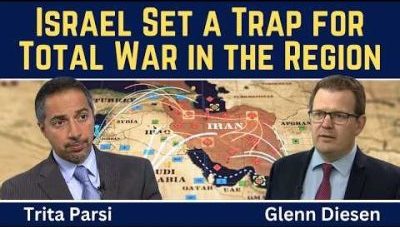
Trita Parsi: Israel Set a Trap for Total War in the Region
or go to
Aletho News Archives – Video-Images
From the Archive
Zionism’s Violent Legacy
By Donald Neff | Washington Report On Middle East Affairs | January 1996
On January 4, 1948, Jewish terrorists drove a truck loaded with explosives into the center of the all Arab city of Jaffa and detonated it, killing 26 and wounding around 100 Palestinian men, women and children.[1] The attack was the work of the Irgun Zvai Leumi – the “National Military Organization,” also known by the Hebrew letters Etzel – the largest Jewish terrorist group in Palestine. The Irgun was headed by Revisionist Zionist Menachem Begin and had been killing and maiming Arabs, Britons and even Jews for the previous ten years in its efforts to establish a Jewish state.
This terror campaign meant that at the core of Revisionist Zionism there existed a philosophical embrace of violence. … continue
Blog Roll
 Aletho News
- Trita Parsi: Israel Set a Trap for Total War in the Region
- Trump’s Iran war is on an Israeli leash
- Saudi oil boss issues global supply warning
- Riyadh Says Its Oil System Is Intact. The Numbers Say Otherwise.
- Trump and Netanyahu Want to “Finish the Job” on Iran
- US ‘one-sided dictation’ not Iran’s beliefs makes rational talks impossible: Baghaei
- Iran’s Next Strike May Not Explode. It Could Shut You Down /Col Doug Macgregor
- Iran: US political targets legitimate if assassinations return
- Iraq shuts key border crossing with Iran under US pressure: Report
- Undersea Internet cables could be targeted in retaliation for attacks on Iran: IRGC deputy chief
- If Americans Knew
- The Israel Lobby’s Changing Fortunes
- AIPAC has become such a political liability that it’s shifting to a more “nimble” approach to buying politicians
- At least 160 Israeli settler attacks in 2 weeks
- Will Gaza’s Ancient Christian Community Disappear Forever?
- Israel’s vision of regional security rests on keeping Arab states weak
- Heidi Levine recounts how Palestinian youths helped save her in settler attack
- DAILY UPDATE: Latest essential news on Palestine, Israel, & region
- Trump’s Intensifying Sabotage of the ICC, for Israel’s Sake
- Israeli military detain US and UK volunteers in West Bank including Democratic NY politician Brad Lander
- Americans at National Conservatism Conference held in Israel this year criticize Israel
- No Tricks Zone
- E-Cars Reduce CO2 Emissions By Only 41% Compared To Internal Combustion Engine Vehicles
- Predictions Made By Renowned Climate Professor Over Past Decades Have Been Proven To Be Poor
- New Study Suggests Large Regions Of The Pacific Ocean Have Been Cooling For The Last 80 Years
- Germany’s Green Energy Debacle: High Energy Costs Force Kahla Porzellan to Close After 182 Years!
- New Study: 50 Years Of The Most Aggressive ‘Net Zero’ Policies Can Only Affect The Global Climate By 0.03°C
- US September “Heat” Was No Record…Many Records Set Decades Ago
- Latest European Green Energy Debacle; Portugal’s Largest Flagship Solar Park Insolvent!
- Green Energy Debacle: German Expert Professor Fritz Vahrenholt Warns Of Severe Economic And Social Consequences
- Two More Paleo Reconstructions Affirm Meters-Higher Sea Levels Across Ireland, Brazil 7000-6000 Years Ago
- New Study: Earth And Venus Surface Warmth Largely Explained By Convection And Lapse Rate, Not CO2 Or Radiation

